Front matter (continued 3)
Reading edition
"And so," Dora went on, "I shall not speak to you again--ever."
"I think," replied Jim, "that you are taking far too harsh a view of the case. If you will walk round the crescent just once with me, I will try to put myself right in your eyes."
"That you can never do," said Dora. But, after a moment's hesitation, she lifted her skirt and walked on, and Jim, with an overflowing heart, paced along by her side.
"I know you are engaged, of course," began Jim, "and I know that I ought not to have said what I did, that being the case."
"Then why did you say it?" demanded Dora, with an imperious little stamp of her foot.
"I couldn't help it," said Jim; "you are so pretty. You are the prettiest girl I have ever seen--the prettiest, the daintiest, and the sweetest. There is nothing on earth I wouldn't do for you, even to the laying down of my life, if that would serve you. I have loved you from the first moment I ever set eyes on you, and I shall never love another girl as long as I live."
Thus spoke Jim in the fulness of his heart, and his words were as music in Dora's ears; for what woman--worthy of the name--would be displeased by such a confession? That was Jim's speech--those were Jim's sentiments--hackneyed sentiments enough in all conscience, seemingly, and yet not hackneyed at all, because they were quite fresh and sincere. He meant them, he felt them. Never did love speak more honestly.
Yet there was a ring on Dora's finger--a ring--an emblem of her plighted troth. And this ring seemed to burn into her finger and reproach her for even letting this other lover complete his declaration.
"You are making it worse and worse," she said, but not at all crossly.
"Well," said Jim, "you know now. You can tell Jefferson what I've said if you like. I've told you I love you, and why. I've got it off my mind, and I shan't be so miserable now."
"Have--have you been miserable?" asked Dora, very gently.
"Yes," said Jim.
"Very?"
"As miserable," said Jim, "as a man could be."
"Oh," said Dora, "I'm so sorry! I suppose I ought to be angry with you, but I don't see how I can be when you--you like me so much."
Jim looked up at the sky with a mist in his eyes. They walked on, and all too soon came round to No. 9 again.
"Oh, if you please, give me my net," said Dora, for all this time her purchases had been dangling from Jim's left hand. She had forgotten all about them, and Jim had been quite unconscious of his burden.
"Then," said Jim, as they stopped in the shadow thrown by the porch, "you forgive me?"
"Yes, yes, entirely--on condition you never say anything like that again. And now give me my net."
"Here is the net," said Jim, "and here," as he kissed her, "is something else."
"Oh, how dare you!" cried Dora, snatching at her net and running up the steps with cheeks of scarlet.
As for Jim, he diplomatically continued his walk round the crescent.
CHAPTER XVIII.
MASTER HARRIS IS SHOWN OUT.
One evening, a week or two later, Koko was sitting with his short legs propped up over the Long 'Un's surgery fire. During a pause in the conversation he observed Jim fumbling in his inner coat pocket.
"Twenty-five," said Jim, at length, handing his friend that amount in bank-notes; "half what I owe you."
"Don't bother about that yet," said Koko, tossing them back.
"If you don't take them," said Jim, in a ferocious tone, "I'll make you eat them."
"Try it on, you bully!" returned Koko, springing up.
Jim therefore squeezed the notes up into a round, tight ball, and advanced upon the little man.
"Be careful, my son," said Koko; "if I hit you, it'll hurt."
For answer Jim leapt forward like a bloodhound, seized Koko by his coat-collar, and threw him on to the floor. Koko, however, nimble as a kitten, wriggled through Jim's legs, overturning the Long 'Un in so doing, and with a dexterous movement seated himself astride Jim's chest.
Jim puffed and fumed, and tried every trick he could think of to throw off his assailant. But Koko was not easily beaten. A rough-and-tumble with Mortimer was nothing new to him. For some time he resisted Jim's efforts to dislodge him, and Jim was getting redder in the face every moment.
"Make me eat 'em, will he!" cried Koko, exultingly, addressing Tom, the big cat, who still often followed Jim to the surgery, and was now watching the struggle with grave impartiality. "Not a long lamp-post like this, without enough fat on him to grease a cart-wheel!"
Now, it's an old sporting saying that a good big 'un is better than a good little 'un--it holds in boxing, wrestling, and many other forms of athletics. Koko was a good little 'un, but Jim was a good big 'un, and, though not of great girth, was immensely strong in the arms and back.
There is also an old saying that you shouldn't laugh till you're out of the wood. Jim proved the truth of both sayings on this occasion, for, just as Koko finished his taunting speech, Jim clutched him round the ribs, and, with a prodigious output of nervous energy, threw the little man clean over his head.
Koko flew crash into one of the rotten old pawn-broking cupboards with which the place was lined, and such was the force with which he was impelled that his head and shoulders went right through the door of the cupboard. Before he could extricate himself, Mortimer had pinned his hands to his sides.
"Will you give in?" demanded Jim.
"I will," murmured Koko from within the cupboard.
"And take what I owe you?"
"Yes--let me out of this old clo' hole, will you?"
"Certainly."
Thereupon, with a neat wrench, Jim liberated his friend, and Koko rose to his feet, looking battered and sorry for himself.
"You ought to know better than to scrap with me, young fellow," said Jim; "you ought to know it's no use."
Koko rubbed his bald head ruefully. "Give me a bran mash," he said; "that winded me."
"Right you are," said the Long 'Un, taking a glass jar off one of the shelves.
"Steady!" cried Koko, observing the label on the jar; "that's prussic acid."
Jim, however, got two tumblers and proceeded to measure out a couple of drams.
"No--I keep my whisky in this jar," he said, drawing some fresh water from the tap; "it's safer here. Mrs Brown, my old lady upstairs, has a liking for whisky, and used to help herself out of my bottle when I was out--so I got a clean jar, put a prussic acid label on it, filled it with whisky, and now she hunts in vain."
"Smart man, Jim," laughed Koko, who then proceeded to roll out the notes and put them carefully away in his pocket-book.
"You see," said Jim, when they had settled themselves down by the fire, "I've been catching on about here lately."
"Cutting out the bearded man?"
"Something like that. I was going down Pine Court soon after you last looked me up, when I saw a group of women talking excitedly round a doorway. I had a case on the top floor of the house. 'Wot I says is,' I heard a very fat woman remark, 'there ain't no symptoms to go by. 'E guessed it!'
"I always talk to these people, so, as I was passing into the house, I said: 'Who guessed it?' They turned to me and began talking all at once, and I gathered from their observations that the fat woman's little girl was down with what our bearded friend at Taplow's had diagnosed as small-pox. It appeared that he had made a report to the Medical Officer of Health for this district, and that the hospital people's ambulance was momentarily expected. The fat woman vehemently declared that our bearded friend was wrong. 'What makes you think it isn't small-pox?' I said. 'Why, doctor,' says she, 'my Annie ain't been sick, eats 'earty, and sleeps sound, and is well in 'erself. 'E only went by the spots.' 'Well,' I said, 'they'll tell you at the hospital whether it's small-pox or not.' But at that she began painting the air blue with her language, and swore no ambulance men should touch the kid. After a time she asked me to look at the child, but I explained that it was Dr Taplow's case, and nothing to do with me. She then asked whether a lady couldn't take two doctors' opinions on a case, and I replied that a lady certainly could. 'Well, then,' says she, 'why shouldn't a pore woman like me?' I recognised the justice of this, and, after I'd been to my case, I took a look at the child. I saw at once it wasn't small-pox----"
"The chicken variety?" put in Koko.
"Not even that--simply blood out of order. I told her the child wanted some medicine and more fresh air. As luck had it, the Medical Officer--old Jackson--awfully nice chap--being scared by the report, came with the ambulance himself, and corroborated my verdict. I had cleared off by then, but the next time I went to Pine Court I found myself famous, and ever since they've been coming to me instead of to the bearded pard."
"Good," said Koko. "Have you caught him napping again?"
"Curiously enough, I have. He told a woman in Mount Street that her husband--a plumber--was suffering from heart disease. His feet were swollen, and he was pretty bad all over. However, she wasn't satisfied, and came to me, and I found the fellow really had a congested liver. I dosed him with calomel, and he was running up and down ladders again in a few days."
"That was another ad.," said Koko.
"It was," said Jim. "Have another two-penn'orth?"
Koko nodded, and Jim was reaching for the mislabled bottle, when a quaint metal Chinaman, that stood in the middle of the mantelpiece, fell with a crash on to his face.
"Hullo!" cried Koko, much mystified, for neither he nor Jim had touched the ornament.
Jim laughed. "That's all right--shows there's somebody at the front door. You see there's a bell, but my callers don't always use it. Some of them like to walk in, as the door opens when you turn the handle. I've fixed up an arrangement of string, therefore, which causes that old geezer to fall down when the front door is opened. Quite simple. I'll show you the dodge in a minute."
Whilst he had been speaking, Jim had popped the prussic acid jar on its shelf, and opened the door communicating with the waiting-room.
"Ah, Mr Harris! Good evening! Come in!"
The old provision dealer--for it was he--walked into the surgery. Koko made as if he would withdraw, but Jim motioned to him to stop.
"I'm pretty near done, doctor," said Mr Harris, sinking wearily into a chair; "my 'ead feels as if my 'air was bein' brushed more than ever. And that velp--'e's gettin' more a caution every day. 'E tumbled to my game, and marked the wrong 'orses for me to back--and my money's all gone. Yes, vot vith 'im and my 'ealth, I vish I vos dead."
"You don't get enough fresh air, Mr Harris," said Jim.
"Fresh air!" cried the old man; "no, not a mouthful. Not likely. That boy--that son of mine--Isaac--'e's a 'eartless young 'ound. Keeps 'is old father vorkin' and vorkin' from seven in the mornin' till ten at night. Fresh air! Vy, I falls asleep in my chair ven I've locked up the shop!"
Koko and Jim looked sympathetic, but made no comment.
"Now 'e's boss," proceeded the old dealer--"now 'e's 'Arris, and I'm only the Father, there's no end to the airs he gives 'isself. Wears a red veskit and a big chain and a norty turn-down collar like vot the swells vear, and a check soot vich 'e got second-'and from a bookmaker. There's no 'oldin' 'im!" declared Mr Harris, with a groan.
He paused a moment to wag his head sorrowfully, and then again took up the tale of his woes.
"So vot vith Isaac, and vot vith this 'air brushin' a-always goin' on on the top of me 'ead, I feel pretty near like throwin' myself inter the river and settlin' it all that vay. Not that Isaac vould care--not 'e! 'E'd bury me as cheap as possible, and think it 'ard lines I vosn't voshed out to sea instead of bein' brought 'ome to cause 'im expense!"
"Well, well," said Jim, soothingly, "I'll give you some medicine that'll make you feel very much better, Mr Harris. You're run down, and that's why you feel so despondent."
"The real reason vy," continued Mr Harris, as Jim got up to prepare the medicine, "I don't do avay vith myself is, I vant to stay by Isaac's side and go on varnin' 'im agen Rebecca Nathan. She's a designin' minx--she's just leadin' Isaac on to get vot she can out of 'im."
"What--has your son got a young woman?"
"Young voman! Vy, she's older than Isaac by ten years, and Isaac's twenty-four. 'E's infatooated, is Isaac. 'E leans 'er photograrf agen the corfee pot an' sighs venever 'e looks at it, and 'e puts it just vare 'e'll see it ven 'e vakes in the mornin'. 'E bought her a flash diamond brooch, but she noo better than to be took in that vay, so 'e 'ad to buy 'er a real one. She's the sharpest bit of female-goods in Mount Street--father keeps the fried-fish shop by the 'Lord Nelson.'"
"I know the place," said Jim.
"'Eaps o' money," continued Mr Harris, "but do you think my son Isaac vill ever get even a sniff at it? Not 'e! Rebecca Nathan vill marry a gentleman, doctor dear--she's only usin' Isaac!"
"Here's the medicine, Mr Harris. Take a wine-glassful after each meal."
"Vell, I don't believe any medicine in the vorld vill do me any good," said Mr Harris, "but I'll take it, so it von't be vasted. Yes, I'll be gettin' back now. That velp Isaac, 'e's goin' to take Rebecca to a music-'all--yes, in the two-bob seats. 'E never spent more than sixpence on a seat in 'is life before. Larst veek 'e took 'er to 'ave 'er 'ead told by a phrenologist feller, and then 'e 'ad 'is own told, and came 'ome with it all swelled up because the phrenologist said 'e 'ad a big bump of locality and noo 'is vay about."
At that moment the surgery bell rang, and directly after the little Chinaman fell bang on to his nose.
Jim opened the door of communication.
"It is your son," he informed Mr Harris. "Come in," he added, addressing the caller.
The senior partner of the firm of Harris & Father strutted into the surgery. For Mount Street, his attire was resplendent, though, to be sure, the suit he had bought from the bookmaker seemed a couple of sizes too large for him.
"Fader," he said, irritably, "'ow much longer am I to vait?"
"I'm comin', Isaac, I'm comin'," replied the old Jew, putting on his hat and seizing his medicine with trembling hands; "I vos only takin' a little advice for my 'ealth, Isaac."
"You vos takin' all the evenin' to take it," snapped Isaac; "come on--quick!"
The old man nodded hurriedly to Jim and Koko, and left the surgery.
The young Jew turned to Jim.
"See 'ere," he said. "Ven my fader comes 'ere, send him 'ome sharp. That's 'is place--'ome."
"Your father is not at all well," said Jim, "so when he comes here I shall allow him to stay as long as he likes, if that is any comfort to him."
"You've a nice sauce," said Master Harris, who felt very brave in his loud toggery.
For reply, Jim inserted one finger inside Master Harris's collar, conducted him (held thuswise) to the front door, and shot him into the street. And when Jim discovered that Miss Rebecca Nathan was waiting outside for Master Harris, and thus witnessed the latter's discomfiture, he laughed a great laugh, and walked back to the surgery little thinking that his short way with Isaac Harris was destined to bring dire ill upon himself.
CHAPTER XIX.
HARD PRESSED.
On the day preceding the departure of the students from Matt's for the brief Christmas vacation, things were very lively indeed at the hospital.
Soon after breakfast, Tom Deadwood, one of the most dissipated characters connected with the institution and Teddy Mildmay, his faithful henchman and boon companion--celebrated for his speed of foot, being, in fact, an old Cambridge "blue"--walked into the house-surgeon's room looking bleared and dishevelled. Their story was that they had careered about London in a four-wheel cab (and occasionally on the top of it), with frequent stops for refreshment, until the small hours of the morning, and finally found themselves in the vicinity of Covent Garden market. Here Tom, who was a "bruiser" of parts, tackled a gigantic porter, and after (according to his own account) "slaying" this worthy, fought two other men, Mildmay contenting himself with inspiring his friend with bits of ring wisdom, and at the conclusion of each combat demanding cheers for the reigning monarch.
Eventually a policeman hove in sight in one direction, and three others in three other directions, and then there ensued a chase of a most varied and engrossing description, the market porters, who took a sporting interest in the matter, giving the fugitives many tips as to the best way to run in order to avoid capture. Mildmay, had he been by himself, could have escaped easily, so fleet of foot was he, but Tom Deadwood was blown by his series of scraps with the porters, so in the end they were captured and afforded a night's lodging at Bow Street police-station. At breakfast-time they were allowed to depart, Mr Deadwood having told the superintendent that his mother, who had not seen him for five years, was expecting him home early in the afternoon. The superintendent grimly gave it as his opinion that the colour of her boy's eyes and the state of his nose would give the poor lady a bit of a shock. Having told their story to the Matt's staff, they cleaned themselves and sallied forth in search of breakfast. After this they settled themselves down to a long morning's beer and billiards. Returning to the hospital about one o'clock, they found the red-haired student, who has already figured in this story, marshalling a number of his fellows preparatory to leading them out for a slight midday snack.
Having lined them up in single file--Messrs Deadwood and Mildmay taking their places at the end of the line,--the Welshman placed himself at the right hand of No. 1, and gave the word to "Quick--March!"
In perfect order and comic solemnity the students tramped out of the hospital precincts, wheeled into the road, and proceeded along the extreme outside of the pavement until they arrived at an A B C shop. Obeying the word of command on the instant, and still preserving splendid order, they wheeled into the establishment--their captain holding the door open for them--and took their seats at a group of tables.
The red-haired one approached a waitress.
"Sixteen scones, sixteen butters, and sixteen cups of coffee!"
The giggling girl having provided these refreshments, the students fell to, and very soon the order was repeated. The Welshman then collected eleven-pence from each man and paid the score, the extra penny a head being levied as a douceur for the waitress. The students having re-formed in line, the red-haired leader marched them back to Matt's in the circumspect manner that had characterised their outward journey.
At tea-time came another march out and home, and at seven the Welshman conducted his warriors to a restaurant, where, bearing in mind the fragile nature of the two previous meals, he ordered sixteen steaks, sixteen helps of two "veges," sixteen hunks of bread, sixteen tankards of bitter ale, sixteen portions of currant pudding, sixteen slices of cheese, sixteen pats of butter, and sixteen cups of coffee.
When they had consumed this homely but satisfying meal, the Welshman again collected the amount necessary to discharge the bill, with twopence extra per diner for the waiter. Then he once more marched his men back to Matt's, there to deliberate on further proceedings.
"Pity the Long 'Un isn't here," observed Mr Deadwood, in the midst of the discussion; "he was a fellow of great resource and suggestion. Where's he got to?"
"Jim," said the red-haired one, "is earning money for a man named Taplow, once of this hospital. That is the latest news of him, received in September last."
"I thank you," said Mr Deadwood, with as much dignity as his discoloured eyes and swollen nose rendered possible; "your reply, friend of the Orange Locks, is direct and lucid, but conveys little information. Speak further, Red Scalp, and put us on his trail!"
Mr Deadwood was addicted to the use of highly ornate language. He insulted everybody in terms that were clothed with plumage of a peculiarly offensive nature.
"Jim's new pitch is in Mount Street, Blackfriars," observed a student who had been blessed by nature with beetle brows and very irregular features.
"I thank you, Face," said Mr Deadwood, with simple courtesy.
The red-haired one moved that they should look Jim up. The motion being agreed upon, the party started off in twos and threes, the Welshman previously directing that Jim was not to be apprised of their visit until all had assembled outside Taplow's surgery.
It was not a very far cry to Mount Street. Arrived there, and perceiving a light in the surgery window, the Welshman turned the handle of the street door and walked in.
"Jim's out," he announced, appearing on the threshold a few moments later; "come on in."
They went in, and proceeded, while waiting for Jim, to amuse themselves in a naïve manner that was very upsetting to any compartment they chanced to favour with their attentions. In point of fact, they turned the surgery upside down, and were about to proceed with the still more disconcerting operation of putting it straight again, when a bearded gentleman appeared in the doorway and stared aghast at the confusion they had wrought.
"What are you doing here?" he demanded, furiously.
"Waiting for Jim," said the Welshman.
"What do you mean? Who are you?"
"Go away," said Mr Deadwood, playfully discharging the contents of a four-ounce syringe at the newcomer; "we don't want you to play with us!"
"Play with you! I'll have the police to you! I'll teach you to play here!" thundered the bearded man, turning on his heel and hastening down the street.
Jim's successor--for the bearded man was no less a personage--soon returned well backed up by several representatives of the law.
"Now, then, what's all this foolery? Clear out of here at once!" observed one of the latter, a stout sergeant.
The Welshman advanced. "We have come to see Dr Mortimer. You can't turn us out of here unless he wishes us to be turned out."
"Get out--all of you!" was the sergeant's abrupt rejoinder.
"Before we get out," said Mr Deadwood, "tell us what right this hairy-faced fellow has here, my excellent but somewhat overfed friend!"
"You'll find out what right he has here when you appear before the beak to-morrow!" spluttered the sergeant.
"Corpulent people should avoid excitement," put in Mr Deadwood.
The sergeant glared at him and went on: "This here surgery is Dr Taplow's, and this gentleman is in charge of it. You've come and broke up the wrong place, and so we must take you to the station--that is to say, if this gentleman wishes to charge you."
"Certainly," said the bearded man; "they have damaged the place, and must pay for it."
The students looked ruefully at each other.
"We thought this was Dr Mortimer's surgery," one of them said.
"Dr Mortimer's is farther down the street," said the sergeant, "so you've made a big mistake in playin' the fool here, and giving me cheek. You've got to come to the station, every man jack of you, and the quieter you come the better it will be for you in the morning."
Now the Welshman--acknowledged leader of the band--spoke up.
"Look here, bobby," he said, "we'll go to the station, but we're not going to be marched off like pickpockets. If you keep to the left-hand pavement, we'll keep to the right, and I'll give you my word of honour for the lot that we won't cut."
The Welshman had a good pair of eyes, and the stout sergeant was an old hand at summing up character at short notice. He conferred briefly with his men.
"Very well," he said, at length, "I'll agree to that. First give me your name and address, though."
The Welshman handed him his card. The sergeant made a sign, and the police withdrew. Then the Welshman formed his men up in single file, gave the word to "March!" and led them in good order out of the surgery and down Mount Street, keeping them to the edge of the right-hand pavement. The sergeant, true to his compact, kept his men to the left-hand pavement, the bearded man walking sulkily by his side.
It is now necessary to return to Jim and his movements.
This had been a very hard day with the Long 'Un, who had been out and about constantly, for there was much sickness in the district. Some of Jim's frequent emergings were witnessed by young Isaac Harris, who, as often as his duties in the shop permitted it, took up a position on his step and watched the surgery door.
For, ever since Jim, before Rebecca Nathan's very eyes, had expelled Isaac from his surgery in the manner recently described, Isaac had been thirsting for revenge. And to-day an excellent idea had entered his head. The chief of the Hooligans still looked in at the Harris emporium for odd meals, and Isaac fancied that this nice gentleman would serve as a convenient instrument in the matter of harming Dr Mortimer. Isaac knew that the Hooligans bore Jim plenty of ill-will, and would be only too pleased to get an opportunity to wreak their spite against him. And it struck Isaac that their most favourable opportunity would occur at night-time, when Jim was attending a patient in one of the narrow courts in which the locality abounded.
The Hooligan leader had been in that afternoon, and Isaac had lost no time in sounding him about Jim. The Hooligan's sentiments and hopes were expressed in brief but blasphemous terms.
Now, Isaac knew what sort of metal Jim was composed of, and did not believe in his heart of hearts that the Hooligans would ever succeed in--as they elegantly put it--"outing" him; but he fancied they might be able to hustle him and do him some serious harm, and that, Isaac decided, would just suit his book. He did not want them to murder Jim, only hurt him.
That evening the Hooligan came in again and consumed a large meal which heartened him up considerably, and filled him with a savage desire to turn his hand against some of his fellow-beings. Kicking a policeman's skull in would have formed a most delectable dessert to his repast.
As he was leaving the shop in his usual truculent manner, he found Isaac lounging on the step.
"Good evening, sir," said Isaac, smoothly.
"Evening, guv'nor."
Isaac gazed at the other craftily. "Our dear doctor has been busy to-day," he murmured.
The Hooligan spat on the pavement.
"'E's off again--just gone to Pine Court," added Isaac, carelessly.
An evil light glittered in the Hooligan's pig eyes. "Pine Court? 'Ow d'yer know?"
"Saw a kid from the court fetch him."
Half a dozen friends of the Hooligan's were standing idly about near a public-house close by. The Hooligan's glance fell on them. There was a shady little tavern not much farther away, where half a dozen more would certainly be "on call."
The Hooligan lit his short clay pipe, nodded to Isaac, and strolled away. Isaac saw the man approach his pals and enter into conversation with them. Then Isaac chuckled contentedly and went back to his work.
The case Jim had been called to was a serious one, and he was detained over an hour in the wretched room the Pine Court urchin had conducted him to. He drew a deep breath of relief when he at length quitted the loathsome sleeping-den and walked down the dirty stairs into the comparatively fresh air of the court below.
He was fumbling for his pipe, thinking to enjoy a smoke on his way back to the surgery, when a sight met his eyes which, for a moment, made his heart beat quickly. The narrow entrance to the court--whose opposite end was a cul de sac--was completely blocked up by a gang of louts. A glance showed him that their attitude was hostile to himself, and another quick glance round and about made manifest the disturbing and uncomfortable fact that he was absolutely cornered.
He knew, however, that it would be fatal to show the slightest fear or hesitation. They meant mischief, and although, to the best of his reckoning, they were twelve to his one, he saw he would have to go for the lot.
He walked quickly and resolutely forward. As he came up to the gang, the foremost of its members retired a few steps, for Jim's prowess was well known to them. All but one--a stalwart ruffian who stood his ground and leered up impudently at the young doctor.
"We've got yer this time," he said, exultingly.
For reply, Jim hit him, and as the man dropped to the ground with a howl of pain, a knife fell from his nerveless hand.
Instantly the rest threw themselves upon Jim. A blow from a knobbed stick crushed his hat in, and a belt-buckle, whizzing past his ear, cut right through his coat and nipped his shoulder. Simultaneously he was venomously kicked and struck on the body and legs. Still, no blow got really home, and Jim, warming to the fight, left a bruise every time either of his fists shot out. Several belts came swinging at his face; he dodged them, then seized one, wrenched it out of its owner's hands, and lashed back at them with the cruel buckle.
He was nearer the entrance of the court now, and as he fought, edged still farther that way. Perceiving his design, the Hooligans massed themselves between their single opponent and the outlet, and such were their numbers that Jim had to retire towards the blind wall at the end of the court.
Step by step Jim was being forced back. If he were to make a rush into any of the houses he would be trapped still more surely. He was safer in the open. But when he reached the wall, and could retire no farther, the end must come, for the wall was unscalable, and he could not break his way through this pack of human wolves.
Still, Jim was lashing out as furiously as ever with the belt, and the curses of the Hooligans gave proof of the execution the heavy buckle wrought amongst them. His hat was off, his face was bleeding, his breath was coming in short, sharp gasps; they were all round him, hemming him in, and in a few seconds he must have been down, when of a sudden there was a great, boisterous cry, and Jim knew that help had come.
"Matt's! Matt's to the rescue! Hold up, Jim! Matts!"
This was the call as the sixteen men from Matt's, headed by the Welshman and Deadwood, came streaming into the court.
Unseen by the Hooligans, the small boy who had fetched Jim to his mother, witnessing Jim's perilous situation, had crept out of the court, and, encountering the students on their march down Mount Street, had, in a few breathless words, informed them of the "doctor's" plight. If it had been any other doctor they would have flown to the rescue, but they guessed it was Jim, and, directed by the urchin, made a frantic rush for Pine Court.
The Hooligans left Jim to face the new danger. The students and the Mount Street ruffians met with a crash, and there was a short, sharp mêlée.
But it was quite short. The Hooligans--under-sized wretches as many of them were--had no chance against the students, most of whom were athletes, and a few, like Deadwood, skilled fighters.
Jim's assailants were knocked down in all directions, and thrashed with their own belts. When they got up it was to make a dash for the entrance of the court, where they ran into the arms of the stout sergeant and his merrie men. Each policeman held tight to a Hooligan, and the students, pursuing hotly, captured others, but several got away.
Among the captured was the chief of the gang.
"This 'll mean five years for you, Jack Smith," said the stout sergeant, "and serve you right, you dirty scoundrel!"
Mr Smith's reply need not be recorded.
But among those who remained at large was the big brute Jim had felled to the ground. This man, in falling, had sustained a severe scalp wound, and had crept out of the fight and up a dark staircase, where he lay until the police disappeared, writhing with pain and vowing eternal vengeance on Jim Mortimer.
CHAPTER XX.
AFTER THE PLAY.
"Dear old man!" said the red-haired student, wringing Jim's hand. "I'm so glad we got here in time!"
The red-haired one then briefly recapitulated the events of the evening, and just as he concluded his story the stout sergeant touched him on the shoulder.
"My men have taken those rascals off to the station, sir," he said. "It's a good haul, and we couldn't have got 'em if you gentlemen hadn't helped. That being the case, I don't feel like taking you to the station as well. Couldn't you arrange matters, sir, with the gentleman at Dr Taplow's surgery?"
"Certainly, sergeant," said the red-haired one, who promptly approached the bearded man, Mr Deadwood following in his wake.
"I say, you know, sir," said the red-haired one to the bearded man, "if we've done any damage we shall be glad to make it good, don't you know. You don't wish to take further proceedings, do you?"
"It was a most unwarrantable intrusion," rejoined the bearded man, stiffly.
"I admit it," said the red-haired student.
"And we're sorry," added Mr Deadwood, "--beastly, awfully sorry."
Mr Deadwood accompanied this statement with a glance which was intended to indicate that if he (the bearded man) didn't accept the red-haired one's proposal, he (the bearded man) would get a jolly good punch in the nose from him (Mr Deadwood).
The bearded man evidently interpreted the glance thus, for he replied: "Very well, I will see what damage has been done, and send you the bill."
"Right O!" said the red-haired one. "My name's Evans Evans, of Matt's."
"Matt's!" cried the bearded man. "Why didn't you tell me that before? I'm a Matt's man!"
"You didn't look like a Matt's man, you see," explained Mr Deadwood in his nice way.
"But I am a Matt's man," said he of the beard, "so I won't send in any account."
"Thanks. But if we've done any serious damage, we'll pay for it. That's only fair," responded the Welshman.
Jim had joined the group. "Well," he said, "I hope you'll all come along to my place now and have some of the old poison."
"We will," said Mr Deadwood, with emphasis. "Come on, old cock," he added, linking his arm in the bearded man's. "I believe you're not a bad sort, in spite of your looks."
The bearded man wisely submitted to being led off in this way, and the rest followed, Jim bringing up the rear with the Welshman. The stout sergeant's friendliness had not been forgotten, for he arrived at the police-station the wealthier by half-a-sovereign.
It was midnight before the students left Jim's surgery, and by that time Jim and the bearded man were good friends, the latter having proved to be by no means a "bad sort." Mr Deadwood insisted on making a note of the bearded man's natal day, as he said he would like to send him a birthday present. In parting, Mr Deadwood shook the bearded man warmly by the hand several times, wished him a merry, merry Christmas, and added that after all it was better to be healthy than handsome, and that he saw no reason why he (the bearded man) should not, therefore, be perfectly contented.
After this Mr Deadwood climbed into a cab and fell fast asleep. Edmund Mildmay got in after him, and said it would be all right, he would "see Deady home--merry Christmas everybody!" So they drove off amid the wild hallooing of their fellow-students, who then chartered other cabs, and drove off too, leaving Jim and the bearded man saying very nice things to each other on the pavement. And so the evening ended in seasonable fashion.
Christmas came on apace. Down at Threeways, Christmas was always kept jovially, and Jim had been much in request everywhere. There were skating and hockey, theatricals and dancing, and Jim had been the central figure of all such activities and recreations. But, alas! Threeways was now forbidden land to him.
Late in the afternoon of Christmas Eve, Jim sat by his surgery fire smoking a solitary pipe. Paying Koko the twenty-five pounds had left him with very light pockets, but he had bought a few presents. No. 9 was now his home, so to speak, and he did not like to let Christmas pass without recognising the fact in some way. So, earlier in the afternoon, he had journeyed to Regent Street and wandered vaguely round a huge shop which seemed to contain nothing else but what one would like to buy. While waiting his turn, Mortimer found amusement in watching the crowd of purchasers. Here was a boy hungrily eying a huge model yacht or torpedo boat; there a girl, wistfully calculating whether she could afford to give the price marked on the purse, or the letter-case, or the inkstand she knew mother would love! Here were two sisters, holding a whispered consultation; there a portly uncle, blandly making a big hole in a ten-pound note for little nephews and nieces.
Christmas has not gone from us, although some soured folk say that this sweet and holy season is not what it was. Christmas has certainly conformed itself to the times, like everything else, but Christmas will always be with us. Though there be no snow on the ground, no ice upon the ponds, yet it will always be Christmas in our hearts.
Jim was at length brought to bay by a good-looking dark girl in a neat black dress. There was a touch of Dora about her, and as she smiled in a friendly way upon the very tall customer, Jim told her just exactly what he wanted, and the dark girl's suggestions were so practical and tasteful that his presents subsequently proved great successes. For that voluble dame, Mrs Maybury, and her elder step-daughter, Miss H. R. Maybury, he bought neat little velvet handbags of the kind ladies carry when they take walks abroad; for Frank he got a huge knife, containing, among other wonders, an implement for extracting stones from horses' hoofs--no boy's knife, indeed, seems complete without this strange appendage, which is never by any chance used for the humane purpose it is intended for. For Dora, Jim bought a little writing-case made of light brown leather. Upon the corner he had an initial "D" affixed, in silver. This addition was expeditiously made while he waited. Jim knew that he must be very discreet in the kind of present he gave to Dora, so he chose something that looked quite simple, though, as a matter of fact, the little writing-case cost him more than the other three presents put together. The dark girl, with her quick instinct, seemed to read in Jim's eyes that this was a very special present, for Jim looked at eleven other writing-cases before he fixed on the brown one.
The presents were packed up at last, and Jim told the dark girl he was very much obliged to her, and that he was afraid he had given her a great deal of trouble. But the dark girl said that he hadn't given the slightest trouble, and hoped he would come there for his presents next Christmas, which Jim promised faithfully to do.
When he got back to his surgery he made up some medicine, and then sat down by the fire to smoke. And while he smoked he wondered whether his grandfather was thinking of him, and whether they would ever be re-united. Judging from his grandfather's stern silence, it seemed that he and the dear old home at Threeways were destined to be strangers for evermore.
Now it happened that the enterprising son of a Mount Street tradesman had taken a snapshot of Jim one sunny November afternoon, as the Long 'Un was standing by his surgery door. The snapshot showed a good deal of the building as well as its occupier, and made a good picture. The youth had subsequently given Jim a mounted copy of the photo.
"I'll send the old man a Christmas card," said Jim, and straightway took the photo off his mantelpiece and wrote upon its back: "The present quarters of your affectionate grandson, Jim. Wishing you a Happy Christmas."
He put his Mount Street address under this message, and on his way to No. 9, posted the photo to his grandfather.
Christmas Day dawned bright and frosty, and passed off far more pleasantly than Jim had anticipated. Those for whom Jim had bought presents were genuinely surprised and pleased by Jim's thoughtfulness. Mrs Maybury scrutinised Dora's face keenly as the girl opened the packet addressed to her in Jim's handwriting. But Dora simply thanked Jim as her sister had thanked him. She did not appear at all self-conscious, and so Mrs Maybury, who had begun of late to regard Jim and Dora with some suspicion, felt distinctly puzzled.
Frank was delighted with the knife, and for several days kept a sharp look-out for a limping horse that might require a stone removed from its hoof. But, as he afterwards told Jim, he didn't have any luck--probably because "nearly all the streets were made of beastly wood."
By the first post on Christmas morning there arrived for Dora a magnificent diamond brooch--Mr Jefferson's gift. At the same time Mr Jefferson reminded her that he would be calling about seven o'clock on Boxing Night to take her to the pantomime at Drury Lane.
At breakfast on Boxing Day Jim produced some yellow tickets. "There's a big show on for children in the Mount Street Church Room to-night," he said, "and I'm going to sing. Anyone care to come? It's a free show."
Mr Maybury quietly said that he would like a ticket, but nobody else accepted Jim's offer, so, as he had several tickets at his disposal, Jim gave one to Mary, and, later on, one to the old woman who looked after his surgery.
Mr Cleave and Miss Bird, it should be mentioned, were spending Christmas with relations--a fact which filled Jim with a feeling of devout thankfulness.
There was a very early dinner at No. 9 that evening, as Mrs Maybury, Miss "H.R.," and Frank were going to the pantomime at the Surrey Theatre. Punctually at seven, Mr Jefferson arrived and bore Dora, radiant and blushing, off to Drury Lane. The others went out about the same time, Mary trotting off to the Church Room in advance of Mr Maybury and Jim in order to secure a good seat.
So No. 9 remained locked up and tenantless until a quarter past eleven, when Mr Maybury arrived home.
The others trailed in half an hour later, Frank bursting with laughter over the antics and wheezes of the principal low comedian. Between twelve and one Dora and Mr Jefferson came.
Dora, strangely silent, went to her room at once. Mr Jefferson, on the other hand, seemed much elated, and chatted gaily for some minutes before he took his departure.
Dora had not been in her room long before there came a little tap at her door, followed by the entrance of Mary.
"Oh, Miss, I'm sure you must be tired," said Mary; "may I help you?"
"If you like, Mary; yes, I am very tired."
Dora sighed as she sat down in front of her glass. Mary hastened to comb and brush her young mistress's hair. It was like old times to Dora, having her hair brushed by a maid--the old times when Mr Maybury was wealthy and held his head high in the commercial world. But now, alas! he was only a clerk in the office of the man who had taken Dora to the theatre that night! Her diamonds came from the man who paid her father a weekly wage!
"Oh, Miss, wasn't the pantomime lovely?"
"Yes, it was very nice," replied Dora, absent-mindedly. Then, rousing herself a little, she said: "And did you enjoy the concert, Mary?"
"Oh, Miss Dora, it was grand! And so was the doctor, Miss!"
"Did he sing well?"
"Sing! I should think he did! You should 'ave 'eard 'em larf! They wouldn't let 'im leave off. They clapped and 'oorayed every time--them children--till I thought they'd never stop. Funny ain't the word. I very nearly split in 'arf, Miss! There was five hundred children, and 'eaps of other folk, and the vicar and 'is curates, and their lady friends--and they larfed as much as the children did, Miss. And right at the end 'e sang a little song--to finish with--which was funny at first, and then made you feel you'd like to cry. And the kiddies kept quite quiet in that part--they seemed to understand, Miss. And when he'd done, Miss, he bowed to all the children just as if they were lords and ladies, and it was real pretty to see the little girls kiss their hands to 'im, and the doctor kiss his hand back to them! Everybody enjoyed it, and them kids went 'ome as 'appy as if they'd each found a shillin'."
Mary dilated on the concert at great length, but she went off at last, and Dora was still sitting thoughtfully before the glass when there came yet another knock at her door.
She rose from her chair and went to see who it was. "May I come in a moment, dear?"
It was Mr Maybury. "I wanted to hear how you enjoyed the pantomime."
For reply, Dora flung her arms round her father's neck and burst into tears.
"Why, Dora, dear--what is the matter?"
But Dora still sobbed upon his shoulder.
"Is it anything to do with Mr Jefferson, dearest?"
"Yes," said Dora.
"You have not quarrelled, I hope?"
Dora lifted her head and looked bravely into her father's eyes.
"No, we haven't quarrelled, father dear. On the way home he asked me to marry him within a month from now."
"And you said?"
"And I promised that I would, father."
CHAPTER XXI.
A MATTER OF WAGES.
After this declaration, Dora's father, knowing something of the nature of women, expected a fresh outburst of tears. But none came. Dora turned towards her glass, and a moment later wheeled round with a smile upon her face.
"And so, you see, dear," she said, "you must make the most of me, while you have me. It does seem a short time, doesn't it--a month--such a very little time for us to be together!"
Mr Maybury took the girl's soft hand in his and looked thoughtfully into her face. For this news came as a sudden shock to him. He had not anticipated parting with her for at least a twelve-month--or perhaps more--from the day of her betrothal to Harold Jefferson.
Dora and he had been very firm friends from the earliest days, and since his commercial downfall this bond between the two had increased tenfold. For, when Mr Maybury was rich, Dora had been a queen-in-little, very imperious, exacting, impetuous, and possibly somewhat selfish. But ever she had been her father's most treasured possession, and he had loved to see her in dainty dresses, and surrounded by those pretty things which his wealth had enabled him to buy for her in abundance. So devoted was he to the child, indeed, that when he married for the second time, his new wife had exhibited no little jealousy on Dora's account.
Then came the crash--when Dora was a schoolgirl--and then, when the elder Miss Maybury and Mrs Maybury uttered lamentations for their altered estate, and even went so far as to upbraid Mr Maybury for his short-sighted business policy, Dora's arms closed about his neck, her lips sought his haggard face, and Dora's voice, with words of love and affection, acted like healing balm upon his sore heart.
"Yes," he said at length, "it does seem a little time--a month!"
He sighed--and Dora's eyes filled with tears she would not let fall, so that she saw him as through a mist, dimly.
"Oh, father," she said, laying her head upon his shoulder, "it does seem dreadful to have to leave you, but I shall come to see you very often--very, very often!"
"Yes, yes, dear," he said, "you will come and see me. I must not be selfish. I cannot expect to keep you by my side all my life. It is the same with most fathers. Their sons seek wives, their daughters are taken from them, and they are left alone."
"Poor father," said Dora, gently, as she kissed him.
Mr Maybury sat down, and Dora placed herself on his knees, as had been her custom from babyhood, with one round arm encircling his neck.
In those early days Dora may have sadly plagued her nurse or governess, but with her father she had always been docile, serving him with a demure obedience that had been very sweet to see. As a child, her storms of tears would be replaced of a sudden by sunny smiles when she heard his voice or noticed his approaching form. Their mutual love was a talisman which chased away her frowns and pouts, and changed her, upon his entrance, into a totally different creature, her nurse or governess wondering greatly the while. And so, though of a naturally wilful disposition, Dora would often strive to conquer the rebellious mood when she felt it coming upon her, simply that she might please her father.
Tender recollections had both now of the strolls they used to take through the fields which surrounded their old home, which stood far enough outside Manchester to be free from the smoke of the factories. Mr Maybury revelled in the peace of the meadowland after the din of the city in whose midst he earned his money, and Dora, though she loved to romp with other girls, and to go to theatres and concerts and parties, preferred these quiet walks to anything else--the walks which came to an end when she was just merging into womanhood. And now they lived in a poor crescent, and one had to go by train to reach woods and green fields. On Sunday evenings now the clang of many bells came to their ears above the ceaseless hum of toiling omnibuses and trams, and the badinage of Londoners promenading--so sadly different was it all to the excursions of olden times, her little hand in his big one, the grave father's voice mingling with her childish tones.
Picture after picture presented itself to their minds in phantasmal fashion. There was the cool old church where they sat side by side in a roomy, ancient pew, Dora nestling close to her father and watching the preacher with wondering big eyes. Then there was the pleasant after-service talk with their neighbours, and finally the walk home along the leafy lanes, with Nature's winged choristers chanting songs of the holy day, and all sorts of tiny hedge-people buzzing and laughing in the sunshine.
"Father, you look so sad!" said Dora. "But there is still a month, and we must make the most of that--you and I! We will go to the theatre together--so as to be quite by ourselves--and sit in the pit and enjoy ourselves tremendously. It will be such a change, after stalls and boxes! I don't suppose I shall ever sit in the pit after I am married."
It seemed to Mr Maybury that her voice lost its gay ring as she uttered these concluding words, but it never occurred to him to ask her whether she was quite sure that she loved the man she was going to marry. He took it for granted that she did.
They chatted on together until a clock near at hand tolled out "One." Then Mr Maybury said it was time they both went to bed.
He kissed her tenderly on the forehead, and then she held the light so that he might see his way down to the next landing. "Good-night, dear!" she said; and he, glancing upwards, thought he had never beheld so fair a picture as she made standing there in the dark doorway.
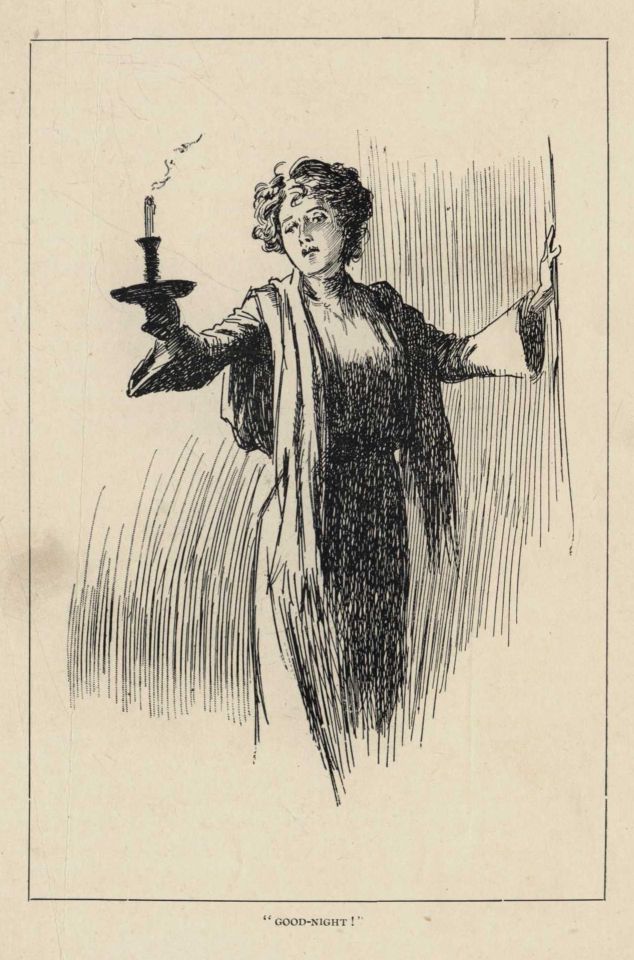
"GOOD-NIGHT!"
And thus they parted--he to rest, she to think. For, long after the house was hushed in slumber, Dora paced up and down her little bedroom. Often she paused in front of her glass and communed with the white-faced reflection that gazed back at her.
On their way home from the theatre, Harold Jefferson had told her that he intended to use all his influence to procure her father a more remunerative position at the office.
"And then," said Dora, at length, to the face in the glass, "father will be comfortably off all his life. That is everything!"
With a little shiver she blew out her candle and crept into bed. For long she lay sleepless, but presently a compassionate angel, in the course of her flight over the Dark City, entered the little room, and, touching the girl's eyelids with her cool finger-tips, led her away to Dreamland.
Harold Jefferson was as good as his word, for, shortly before lunch time on the following day, Mr Maybury was informed that the head of the firm wished to see him in his private room. Mr Maybury at once obeyed the summons, concluding that it must have something to do with his daughter's engagement to Harold. Possibly the elder Jefferson objected to the match, and a curious feeling of elation took possession of Mr Maybury as it occurred to him that this might be the case.
Mr Jefferson was a stout, rather apoplectic-looking man of some sixty years--quite unlike his son in appearance. There was nothing of the keen, lean stockbroker about him; indeed, his ponderous manner and measured speech reminded one of an old-fashioned type of merchant that is now almost extinct.
"Ha! sit down, Mr Maybury. A pleasant change after the muggy weather we have been experiencing lately! Ahem! yes, I wanted to see you on a little matter--quite a little matter--ahem! You have been with us now----"
"Three years, sir," said the other quietly.
"Three years? So long! Well, well--time flies, time flies. But to business. I--er--I have--er--asked my manager, Mr Jacobs, to recommend such persons in--er--in my employ as he considers deserving of an increase in salary. The new year is close at hand, and it appears to me an--er--an appropriate season for such--er--recommendations. Your name, Mr Maybury, comes first on the list. I am assured that you are most punctilious in--er--in the discharge of your duties, and that you are a man to be implicitly trusted in all respects. I gather, in short, that you are in all respects a most satisfactory servant of the--er--firm. I have decided, therefore, to make a substantial addition to your present salary. You are now paid--er--you receive----"
"One hundred and fifty pounds a year, sir."
"One hundred and fifty? Well, well,--that is hardly adequate remuneration for a man of your integrity and ability. A good man is--er--is worth good pay. I shall have much pleasure, therefore, Mr Maybury, in raising your salary to--er--three hundred pounds a year."
Three hundred a year! The amount had a refreshing, satisfying sound! It would mean a very different state of things at No. 9, would three hundred a year.
"I am deeply grateful to you, sir----" began Mr Maybury.
"Don't mention it. You deserve it. Your increase of salary will commence on New Year's Day. And now, Mr Maybury, we will turn to another topic. There has for some time been a little affair--a little love-making--between two young people we both know very well. I have known, of course, that my son Harold was paying attentions to your daughter; he has spoken of her--in fact, he has shown me her photograph. She is, if I may say so, a very charming young lady, and I hope to have the--er--pleasure of making her acquaintance quite shortly. In fact, I trust that Mrs Maybury and yourself will bring Miss--er--Flora----"
"Dora," corrected Mr Maybury, with a slight smile.
"Dora! Pardon my mistake! Yes, I trust you will all three come and dine with Harold and myself at an early date. I--er--I had no idea that Harold contemplated matrimony--ahem!--quite so soon, but I shall be glad to see him settle down, as he has hitherto been a little restless--a little--ahem!--a little irregular in his habits. So I am not displeased at this--er--this approaching union."
"I am glad to hear that it meets with your approval, sir."
Mr Jefferson drummed thoughtfully on the table with his fingers. For a long time he had been dissatisfied with his son's conduct, and the news of the latter's matrimonial intentions had come as an immense relief to the worried parent.
"I do not think I need keep you any longer, Mr Maybury," said the stockbroker, at length; "er--we shall no doubt see a little more of each other in--er--in future."
Mr Maybury rose from his chair with a curiously determined look on his face. He had fully made up his mind on a certain matter that had dawned upon him during the latter part of this short interview.
"I wish to ask you one question, sir," he said, "before I definitely accept your proffered increase of salary."
"Certainly, certainly," said the other. "What is it?"
"I wish to ask you, as man to man, and not as servant to employer, whether your son's forthcoming marriage with my daughter has anything to do with your proposed doubling of my salary?"
The stockbroker frowned. "That, Mr Maybury," he replied, "is entirely my business. It is sufficient for you to know that I have decided to enlarge your stipend by the amount I have named."
"I wish you to answer my question, sir," said Mr Maybury, firmly.
"And I decline to answer it," returned the other, his previously urbane manner vanishing as he spoke.
"Then, sir, I shall take it that I am correct in my assumption--that you are making this increase solely because you wish me to occupy a better position in the world than my present salary enables me to hold."
"And supposing it were that?" demanded the stockbroker, roughly. "Do you mean to say you will refuse such an offer?"
"I do, sir. I absolutely decline this increase of salary. I will take what I earn, and not a penny more."
So saying, with a slight bow, Mr Maybury turned on his heel and left the room.
The stockbroker sat for some time in a state of amazement. At length he spoke.
"I could not have imagined--I would not have believed--that the City of London contained such a fool. Here is a man, as poor as a rat, actually throwing away a hundred and fifty a year! He must be mad!"
Mr Maybury breathed not a word at home of his interview with Mr Jefferson the elder. As for Harold, when he was informed by his father of the result of the conversation, he too marvelled greatly.
But he did not think it necessary to mention the upshot of the interview to Dora.
CHAPTER XXII.
THE WARNING.
On the same morning, at breakfast, Miss H. R. Maybury informed Jim that her sister was to be married to Harold Jefferson at the end of January.
Miss Maybury kept a careful watch on Jim's face while she imparted this piece of news, for she, like her stepmother, had for some time suspected the young doctor of not being entirely indifferent to Dora. Of the latter's attitude towards Dr Mortimer Miss H. R. Maybury was in a state of aggravating doubt. She had a shrewd idea that Dora, on her part, was not insensible to such charms as Jim might possess, but she was not sure about it. She had quite unsuccessfully endeavoured to "draw" Dora on the subject, but Dora had listened to H. R.'s references to Jim with a blank countenance that told no tales and gave nothing away.
On this occasion Jim was taken quite by surprise, and his face yielded up his secret. H. R., warily observing his expression, saw that she had been correct in her surmise. Dr Mortimer was in love with her sister!
"Indeed!" said Jim confusedly. "Rather soon, isn't it?"
"Yes, it has been a very short engagement," returned H. R.--"in fact, I don't think myself that Dora ought to be married until she's at least twenty--she is so very young for her age! What do you think?"
"It has never struck me that she was," replied Jim, beginning to regain his self-possession.
"She is still a child in her thoughts," Miss Maybury declared.
Jim, framing his opinion on the events of a certain walk Dora and he had taken in the Crescent one night, thought otherwise, but thought it quite to himself.
"However," continued Miss Maybury, "it appears that Mr Jefferson has been advised by Dr Taplow to go abroad for a few months--until the worst of the winter is over."
"He looks delicate," said Jim, grimly.
"Yes, I'm afraid his chest is not too strong. Well, as I was saying, he has got to go abroad, and, as he can't bear to leave Dora all that time, he thinks that the best plan will be for them to get married at once."
Jim wondered whether Mr Jefferson's delicate chest was his sole reason for hurrying on the marriage.
"And so now," concluded Miss Maybury, "it will be all bustle and milliners until the important day, and I am afraid you poor men will be made rather uncomfortable."
"Oh, you mustn't mind us," said Jim, good-humouredly; "we can have our meals on the stairs, if you like."
And so, with a laugh, Jim got on to his long legs and departed to his surgery, leaving Miss Maybury wondering more than ever whether Dora had given him any secret encouragement.
Jim whistled in a melancholy, stolid way as he walked along Blackfriars Road to his work. So Dora Maybury was to be married in a month. One month! And that would be the end of the little romance which had started in a tea-shop at mid-summer, when he, Jim, first saw a face which had haunted him ever since.
Dora was to be married in a month's time, and the face would vanish, and he didn't suppose he would ever care about another girl all his life long.
"For if I live to a hundred," thought Jim, still staunch to his lady-love, "I shall never meet such an angel again. Henceforth, J. Mortimer, you've got to settle down to a bachelor existence. It's Dora or nobody, and, as it can't be Dora, it must be nobody."
It was lucky for Jim that he found heaps of work awaiting him in the shape of a long queue of humble patients, for he had no time to brood over his sorrows. He had to anoint unsavoury sores and bind up ugly wounds; he had to listen to long tales of neuralgias, sleepless nights, cramps, and the olla podrida of small woes to which our human flesh is heir--and heiress. It was chiefly heiress, as we have before remarked, at the Mount Street surgery. And Jim, of course, had to listen very carefully, for sometimes he found himself face to face with a malignant disease--something that called for prompt and accurate diagnosis. Love and lovers' thoughts must be driven into the background when a doctor finds himself gazing on a waxen-faced morsel of humanity which, unbeknown to its mother, has the seeds of diphtheria apparent in its wee throat--and such cases were presented to Jim in plenty. The dire complaints which came into Jim's surgery seemed to be shed upon him by a beneficent Providence, for they brought out the man and the surgeon, and bade the love-sick swain forget his own woes in the bodily ills of his fellow-creatures.
After the visiting patients had been dealt with, Jim went out upon his rounds. He returned to his surgery about tea-time, and had not been long back when the Chinaman adorning the mantelpiece was precipitated on to his face, and a sound of shuffling steps proceeded from the waiting-room.
"Come in!" bawled Jim, who was reading an evening paper by the fire. "Old Harris, I'll bet a dollar," he added to himself.
He had guessed aright. Mr Harris it was, but this time his disorder was something more substantial than a feeling as if his hair were being brushed. In point of fact, the face of the junior partner in the firm of Harris & Father was decorated with scratches.
The old man sank into a chair.
"I've come over for a box of ointment, doctor. You see these marks on my face?"
"They're pretty visible," said Jim.
"Rebecca!" explained the old man, in a hollow voice.
"Miss Nathan?"
"Yes, that was the party vot done it."
"Showing her affection for her future father-in-law rather early in the day?" ventured Jim.
"Father-in-law?--not me! She'll never marry that velp Isaac. She's about finished vith 'im!"
"That's good news," said Jim. "Who's the new young man?"
"Vy," said the provision dealer, "I'm thinkin' she'll be after you next, doctor!"
"Me!" said Jim, looking so amazed that the old Jew was seized with a most unpleasant spasm of mirth.
"Yes, ever since you chucked Isaac out that night," he explained, "she's referred to you in an admirin' vay vich turns Isaac simply yeller. Yes, I told you she'd marry a gentleman, and you're 'er choice, my dear sir!"
And again the old man's throat gave out a croaking wheeze which, by a lurid effort of the imagination, might be described as laughter.
"So you will understand," added Mr Harris, "that Isaac don't love yer. In fact, I believe 'e set those 'Ooligans on yer in Pine Court."
"You think that?" inquired Jim, sharply.
"It's a bad thing to say of one's own flesh an' blood," returned Mr Harris, "but I think 'e did. I want to varn yer, doctor; keep yer eye open, for them ruffians ain't done vith yer yet--nor 'as Isaac."
"You imagine they'll have another go at me?" said Jim.
"I do," said the old man, "and next time they'll make dead sure of yer. They're not men--they're wolves. They never forgive. That's their natur'--and Isaac's."
Jim pulled at his pipe thoughtfully. He felt that the old Jew, despite Isaac's unfilial conduct, would not have denounced his own son in this way if there had not been serious reasons for his so doing.
"I'll remember your warning, Mr Harris," he said at length; "and now," he added, "let me see what I can do for you. Stand here by the gas, will you?"
The old man obeyed.
"She went for you pretty hard," remarked Jim, proceeding to mix up some healing ointment for his patient; "how did it happen?"
"Like this," said Mr Harris. "Last night Isaac and I vos invited to spend the evenin' at the Nathans. On'y she and 'er brother vos there--the old 'uns vos out. 'Er brother is a big loud feller, and despises Isaac. Vell, ve set down to cards--'Uncle Sam' vos the game----"
"A tricky one, too," put in Jim.
"So ve found," added the provision dealer, "for Rebecca, she von nearly ev'ry pool. After a bit I votched 'er close, and found some of the cards vos marked. So I says: 'Rebecca,' I says, 'you ain't playin' fair,' I says. 'Vot!' she cries, colourin' up. 'Vy,' I says, 'you're cheatin', my dear!' Yes, I said that--to 'er face--and she up and let me 'ave 'er nails--all ten of 'em--down my face, an' 'er brother 'e says if I vosn't an old man 'e'd throw me out of the 'ouse. Yes, 'e said that. And I says, 'Isaac,' I says, 'vill you see your old fader used in this vay, vithout raisin' a 'and to 'elp 'im?' But Isaac was turnin' green an' pink, and didn't dare say nothink, so ven I'd got out of Rebecca's clutches I ups vith my glass of gin-and-vater an' lets Rebecca's brother 'ave it full in the face, an' then I gets 'old of the poker an' I says: 'Touch me,' I says, 'an' I'll rap you over the skull,' I says. Yes, like that! And he daren't put a finger on me, so I gets my 'at an' off I goes, and if they've got my money I've got their poker--yes, and I'll keep it, too--yes, and that's vot 'appened, doctor dear."
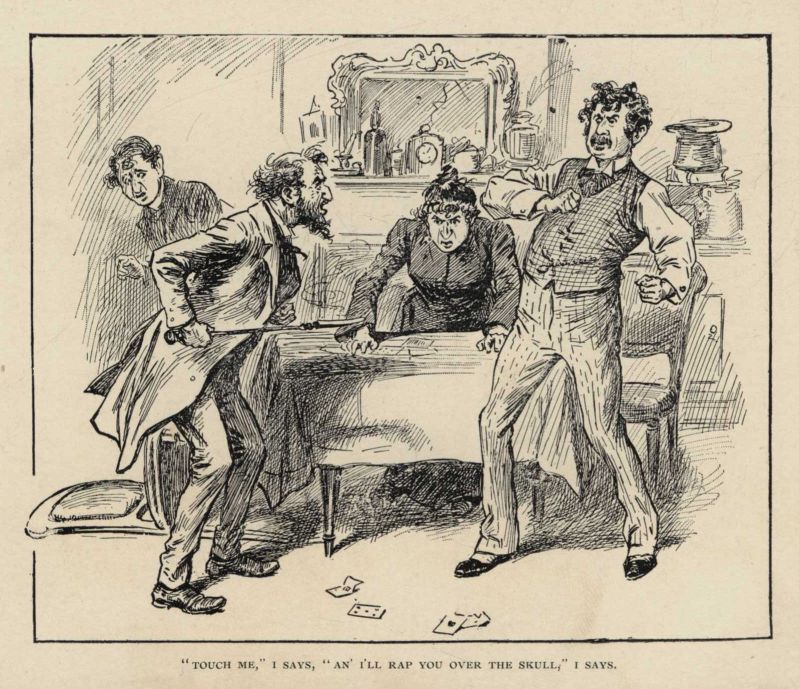
"TOUCH ME," I SAYS, "AN' I'LL RAP YOU OVER THE SKULL," I SAYS
"Bravo!" said Jim, who had listened to this improving story with all possible interest. "You're quite a scrapper, Mr Harris."
But the old man, whose eyes had burnt fiercely during his recital of the incident, sat down with a sigh.
"But it's vorse than ever at 'ome, now," he said. "Isaac, 'e's like a vild beast. 'E sees vot Rebecca is, and yet 'e's mad after 'er still. Yes, that's 'is state."
It was hardly to be supposed that Jim would evince any sympathy for the young Jew, knowing, as he did, that Isaac had put the Hooligans on his track in Pine Court that night. But Jim felt for the old dealer.
"Now, look here, Mr Harris," he said, "if you pull up and play the man you can get that business back, and be your own master again."
But the dealer shook his head. A reaction had followed his animated account of the card-party, and he seemed to have shrunk into a smaller and older man than he really was.
He took the ointment Jim handed to him and put on his hat. His grey locks were unkempt, his clothes shabby and unbrushed, his eyes dim. He presented, indeed, a pathetic spectacle. Bidding Jim good evening, the old Jew, with bowed shoulders, crept out of the surgery, and trudged away through the December drizzle to resume his joyless tasks at the provision shop.
For some time Jim sat by his fire thinking over the words of warning Mr Harris had uttered. Next time, the provision dealer had said, the Hooligans would make sure of him.
Of a sudden, a pebble crashed through the waiting-room window. Jim started to his feet, hurried into the passage, and threw open the front door. Mount Street was the picture of desolation; a light, clammy rain was descending steadily, and the pavements were deserted. One figure, however, was plainly visible by the lamp-post on the opposite pavement--that of a man with his head bound up.
In a flash Jim recognised him as one of the gang that had assaulted him in Pine Court--this was the man, indeed, whom he had knocked down early in the proceedings.
Instantly on making this discovery Jim strode across the road. As quickly the man vanished down an alley. Jim, reaching the entrance to the alley, hesitated. Might not this fellow be acting as a decoy?
Jim had learnt prudence. Slowly he turned on his heel and went back to the surgery. Closing the street door, he resumed his chair by the fire, and in a narrow street just off the alley a group of Hooligans, baffled again, uttered curses of disappointment as they slowly dispersed about their bad business.
CHAPTER XXIII.
THE IVORY FAN.
"In my opinion," quoth Miss Bird, looking up from her embroidery (she was making Dora a table-centre for a wedding present), "girls have too many dresses. When I was your age, my dear, I had two dresses--one for everyday and the other for Sundays. They were both black. In those days girls were taught to be contented with a few clothes, and to make them last a very long time!"
"How long did you have to make your best dress last?" asked Dora.
"Five years," said Miss Bird.
"Just fancy!" cried Dora. "Why, it must have been green by that time."
"It was green," acknowledged Miss Bird, with a hard smile.
"And you still wore it?"
"Of course I wore it! I had no other."
"But you must have hated wearing it!"
"I did hate wearing it," said Miss Bird; "I loathed the sight of it. I could have torn it to pieces. But it was my only good dress, and so I kept it in constant repair, and cleaned it, and brushed it, and put it away very carefully every Sunday night or after a party. Ah! young girls had a very different time of it forty years ago, I can tell you, my dear!"
Dora gazed at Miss Bird in some surprise. The severe-looking maiden lady seldom spoke so feelingly. Yet, of late, she had talked to Dora a good deal. Dora had given up her situation at the post-office--by Harold Jefferson's express desire--and so was at home all day now. Consequently, she and Miss Bird saw much of each other, and a kind of little friendliness had grown up between them which had never existed previously. In fact, before this cold, wet January set in, Miss Bird had seemed to entertain a feeling of dislike for Dora.
"No," recommended Miss Bird, who probably felt that she had shown a little too much of her human side, "in those days girls didn't gad about on bicycles and scamper after footballs and cricket balls like so many boys. Nor did they go to the theatre alone with young men. No, in my young days I wasn't even allowed to look out of the window at people passing along the pavement. I was fined a shilling if I did. You may not believe that, but it's true! I was brought up very strictly by an aunt in a country village, and I don't suppose anybody on this earth--except a convict in prison, who deserves all he gets, the rascal!--ever passed such a monotonous existence as I did."
"How long did you live with your aunt?" asked Dora, rather timidly.
"Until I was thirty," replied Miss Bird, "and then she died and left me just enough to live on. And I've been living on that just enough ever since."
Miss Bird's customary conversation consisted of harsh comments on current events or severe criticisms of internal affairs at No. 9. She had never been so communicative regarding her past life before.
Dora employed herself with her sewing for a time, and then observed: "I am afraid you cannot have been very happy as a girl, Miss Bird. Did--did you ever see any young men?"
Miss Bird uttered a grating, unmusical laugh. "I saw the backs of a few in church."
"Was that all?"
"And occasionally talked to a curate at a croquet party."
"How dreadful!" cried Dora.
"My aunt,", explained Miss Bird, "hated men! She was jilted as a girl, and detested men ever afterwards. So I never spoke to any men--except curates. No man ever said a tender word to me--no man ever lent me a book or wrote a poem to me, or presented me with a bunch of flowers. That was my girlhood--and now, perhaps, you won't be so surprised at my being a cross old woman!"
Dora, with a sweet impulse, dropped her sewing, and, putting her arms round the elderly lady's neck, kissed her on the cheek.
"I am so sorry you were unhappy," she said, gently.
The grimness faded out of Miss Bird's face. She laid down her embroidery and took Dora's hand.
"My dear," she said, "that is all over and gone. Still, I shall not forget what you said. Some day you may want a friend--a woman--and then you mustn't be afraid to come to me. My bark, child, is worse than my bite.... There! now we mustn't be sentimental any longer, but get on with our work."
Dora therefore relapsed once more into her seat by Miss Bird's side and resumed her sewing, and for some time the silence was unbroken save by the sound of stitching.
"When is the wedding, child?" asked Miss Bird, suddenly.
"On the 26th," said Dora, bending rather more closely over her work.
Miss Bird submitted the girl's profile to a severe scrutiny. "Personally," she said at length, "I don't like the man."
"Who?" said Dora.
"Jefferson."
"But," Dora hastened to retort, "you were in favour of my being engaged to him."
"I know more of him now," said the old maid, "and in my opinion that young doctor's worth ten of him."
Dora started, and her needle went into her finger.
"You pricked yourself then," jeered Miss Bird.
Dora said nothing.
"Because I mentioned him!"
"What do you mean, Miss Bird?" demanded Dora, with cheeks afire.
Before Miss Bird could reply, however, the door opened and Mr Cleave appeared.
"I hope--er--I hope I am not interrupting you," said the newcomer, with a slight cough; "that is to say, you may be discussing some matter of dress--ahem!--trust I am not de trop?"
"That's exactly what you are!" roared Miss Bird.
"Oh--er--ahem!--in that case I will retire----"
"If you please!" replied Miss Bird, sternly.
"Oh, Mr Cleave, of course you may come in!" cried Dora, rising to her feet. "In fact, I was just going out----"
"That's a fib!" said Miss Bird.
But Dora had flown. "Well, come in, come in," said Miss Bird; "come in and read your wretched little paper----"
"Pardon?" inquired Cleave.
"Your paper!" howled Miss Bird; "your wretched little rag of a paper that squeals like a pig when anybody has a glass of beer."
"I--er--think--I--er--I think I will not come in just now," bleated Cleave, retiring precipitately.
"Bah!" muttered Miss Bird, "everything's upside down. That man ought to be in skirts, and Mortimer ought to be shot for not eloping with Dora!"
And so the preparations for the wedding continued apace. Of course, economy had to be studied, wherefore Mrs Maybury hired an industrious seamstress to come and sew every day; and sew the seamstress did, till her fingers ached. Miss Bird sat by and threw out hints; H. R. snapped at Miss Bird, and Mrs Maybury snapped at H. R. Finally, the two latter would snap at Dora, who, after firing up at them, would retire to her bedroom, presently descending softly to sit in the drawing-room, the others being in possession of the dining-room.
So passed this damp January time, and the wedding day drew nearer and nearer. Occasionally Mr Jefferson appeared, very dapper and smiling, in evening dress, and carried Dora off to a theatre. But after these excursions, Dora would be very silent, and slip off to her bedroom at the first possible moment.
Mr Maybury and Dora had a quiet evening together at the theatre. They went to see a comedy--a piece in which laughter and tears trod upon one another's heels--a good little piece whose like is not often seen on London boards. They sat hand-in-hand, as in the old days, this father and daughter, and when it was all over, and they came out into the street, their faces were sad. For they were to part soon--so soon.
One day Koko met Jim, by appointment, at Charing Cross, and they both set off for Regent Street to buy Dora a wedding present.
"I know a shop," said Jim; "bought some things there at Christmas."
"Oh yes," said Koko, "you told me. Very nice dark girl there, eh?"
"I forget," said Jim, indifferently; "I daresay there is. Most of the girls in these shops are dark."
"I recollect you mentioned this one to me particularly," said Koko.
"Did I?" replied Jim. "Well, I daresay I did. Anyhow, I haven't the faintest idea what I'm going to get. Been thinking about it for three weeks, too."
"Personally," said Koko, "I am going to buy her a work-box."
"A what?"
"A work-box--full of pins and needles and tapes, and all that sort of thing."
"I thought ladies used work-baskets," hazarded Jim, vaguely.
"Boxes," said Koko.
"Baskets," insisted Jim; "work-boxes are a trifle obsolete, I believe."
"Obsolete or not obsolete," said Koko, "I shall get her a work-box."
"All right," returned Jim; "I don't care."
Koko stole a glance at Jim as they walked up Waterloo Place. He had noticed, of late, that Jim was looking unusually gaunt and thin. Koko felt very sorry for his friend, for, in spite of the Long 'Un's lively manner, Koko saw that his old chum was quite a different man now to the jaunty youth who had been the life and soul of Matt's.
"I must get him away for a holiday," thought Koko, in his quiet way; "this business has knocked him over a bit."
They stood for some time outside the shop staring at the array of presents in the window. Koko was staunch to his work-box, but Jim, after gazing into the window for five minutes, was still quite undecided. At length he declared he would leave it to the dark girl.
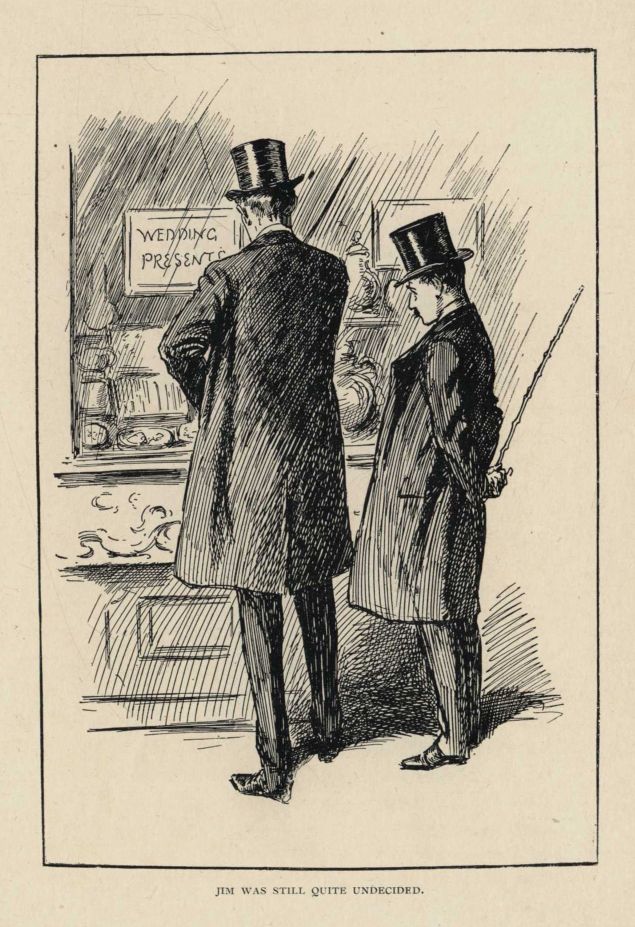
JIM WAS STILL QUITE UNDECIDED.
Koko walked in first, and, espying the dark girl, approached her part of the counter. Very soon a dozen work-boxes lay before him, and he was not long in making up his mind about one. Then, true to his programme, he had it well stocked with everything that Dora could possibly require--even down to a box of matches.
"You never know when you won't want matches," he explained to Jim.
"Well," said Jim, brusquely, "you've got your work-box. Now what about me?"
"Go ahead," said Koko; "there are about twenty thousand things to choose from in this shop."
"A present for a lady?" queried the dark girl.
"Yes," said Jim; "a wedding present."
"I know the very thing," she said, and took down from a shelf near by an ivory fan with forget-me-nots painted by hand upon it.
"Yes, very pretty," agreed Jim; "but--er--I should prefer some other kind of flower."
The dark girl fancied she understood.
"I have another ivory fan that is just as pretty as this one. I will get it."
The fan was brought. Upon the pure ivory was painted a little sprig of rosemary.
"'That's for remembrance,'" quoted Koko, softly.
And so Jim chose the ivory fan as a wedding present for Dora.
CHAPTER XXIV.
JIM CATCHES A TRAIN.
When old Dr Mortimer received Jim's Christmas card, his face hardened into stone, and his first impulse was to throw the little photograph into the fire. After Jim's final and crowning sin, the Doctor had decided that he would have nothing more to do with his grandson, whose hospital career had been one long escapade, punctuated, at rare intervals, with fits of steady reading.
Jim owed his qualification to his natural genius rather than to these bursts of study. A certain amount of book-work he had been obliged to do, and he did it. Practical work he had revelled in, for action suited his mercurial, restless disposition, and his practical work had saved him. He was by head and shoulders the finest operator Matt's had turned out for many a year, and the examining board knew it.
Throughout his student's career he had been by turns the pride and despair of his grandfather. Dr Mortimer had sent him angry letters when he was in town, and delivered stern reproofs when he came down to Threeways. Jim had promised reformation, only to fall away from the narrow path of rectitude at the first opportunity that presented itself. At last came the paragraph in the local paper anent Jim's doings at the Exhibition, and this had used up the last scrap of his grandfather's patience. Everybody read the paragraph, and everybody laughed at it. Overcome with rage, the Doctor had sat down at his desk and penned the letter which changed the whole course of Jim's existence.
So the old doctor put Jim out of his life--thrust him forth to get his bread--or starve. But he could not put his grandson out of his heart, and, as he sat by his lonely fireside during the following weeks and months, his thoughts had often wandered to the wayward lad, and he had often wondered how Jim was faring--had wondered even, indeed, whether he were alive or dead.
The photograph of his surgery which Jim sent to his grandfather served to allay the old man's misgivings. He had fancied at one time that Jim had gone clean to the bad, and that Sir Savile and other old friends who knew both grandfather and grandson were loth to inform him of the lad's downfall. But it appeared from the photograph--and the particulars on the back of it--that Jim was earning his living. His practice did not appear to embrace an aristocratic quarter, but that did not matter very much. Jim was working, and probably amassing much useful experience.
The old doctor felt relieved. His first impulse--to tear up the little picture--soon departed. He turned Jim's card over several times, and finally, wondering somewhat at his unusual weakness propped it up against one of the massive bronze candlesticks which stood upon his dining-room mantelpiece. It was the only card Dr Mortimer received, and it looked curiously small and forlorn stuck up on that spacious, dignified mantelpiece all by itself.
There, however, the Doctor put it, and there it stayed. The servants examined it and read the message it bore on its little back, and so they too came to learn where "Mr James" was, as did Hughes and the other attendants over at the asylum, not to mention the gardeners, the coachman, and the stable hands. So the kitchen drank a bumper on Christmas night; the butler gave the toast "Mr James--his health!" and with right honest warmth was it drunk. "Bless his handsome face and kind heart!" added the cook, wiping her motherly eyes--and thus Jim, knowing nothing of it, was remembered.
And it is just possible that the proud old man in the dining-room drank a silent toast to the lad he had expelled--without acknowledging to himself that he did so.
Christmas passed away, and January was drawing to a close, when not only the county of Eastfolk but the whole country was distressed by news to the effect that Lord Lingfield, the eminent statesman--one of the few prominent politicians of the day reputed to speak and vote according to the dictates of conscience--had been laid low by a dangerous and distressing internal malady. The illness had been threatening for some months; indeed, it had first manifested itself on the day when Lady Lingfield, having driven over to consult Dr Mortimer, encountered Jim in the act of crossing the high road in his dressing-gown.
Since that day old Dr Mortimer had paid frequent visits to his distinguished patient, who had at first made light of his complaint, and who did not really realise that his life was in jeopardy until a sudden change in the weather gave him a chill and brought matters to a head. A provincial specialist had been summoned to consult with Dr Mortimer, and Jim, glancing through his morning paper on 25th January--the eve of Dora's wedding day--lighted on a paragraph announcing that Sir Savile Smart was also in attendance at the invalid's bedside. The three doctors had issued the following bulletin on the previous evening:--
The Earl of Lingfield is in a critical condition. Should no improvement take place during the next twelve hours, an operation will be rendered imperative.
(Signed) SAVILE SMART, F.R.C.S.
E. A. M'IVER, M.D. JOHN MORTIMER, M.D.
Jim smiled affectionately at the sight of his grandfather's familiar name thus figuring in the public press. He was turning to another item of news, when there came a thundering rat-tat at No. 9's front door, and next moment Mary entered with a telegram, which she handed to Jim. He tore open the envelope. The message it contained was addressed from "Carhall," Lord Lingfield's country seat near Threeways, and ran:--
Come by first train. Most urgent.--SAVILE SMART.
Jim stared in amaze at the summons. This was, indeed, a strange turn of fortune's wheel. He--Jim Mortimer--was evidently required to assist in an operation in which his grandfather would also be participating! He had helped Sir Savile in this very operation a score of times, and had performed it by himself at Matt's with the great specialist looking on. For Jim had guessed the nature of the operation when Sir Savile was sent for.
"And so he wants me to lend a hand. Good man!"
In a few moments Jim had looked up a train. There was an express leaving for Threeways in half an hour. Just time! Mary flew for a cab, Jim got into his hat and coat, and was away before the Maybury family had fully grasped the reason of his haste or the exalted nature of his destination.
"Half-a-sovereign if you catch the 9.30 at Liverpool Street," said Jim to the cabman.
"Right, sir!" said the cabby, joyously.
But the roads were slippery, and travelling was bad. Horses steamed and plunged, drivers lashed and swore--and Jim's cab made slow progress.
At last the cabby found an opening and dashed forward. But, alas! he had just got up speed, when his horse stumbled and fell, and could not regain its feet, despite its frantic struggles.
Jim leapt out nimbly. "Hard luck, cabby!" he said. "Here's your half-sov."
"You're a gentleman, sir," returned the driver, touching his hat as he went to undo the prostrate nag's harness.
Jim took a fresh cab, and caught his train with a minute to spare. He welcomed this journey, for the rapid motion suited him to a nicety. This was better than brooding in his surgery--this was action, life, excitement. The country was anxiously awaiting news of the great statesman's illness--and Jim was to help in the drama. The operation would not be performed, Jim knew, until he arrived at Lord Lingfield's residence ... and the train whirled on, and Jim, though sore at heart--for was not Dora to be married on the morrow?--derived great comfort from Sir Savile's call.
The train sped on, and Jim's thoughts raced along with it. His brain and the mighty engine kept stride for stride.
"To-morrow! To-morrow!" sang the whirling wheels.
As the meadows, streams, and woods came into view and as quickly passed out again, so the events of the last few months presented themselves panorama-wise to Jim's mind. The tea-shop--the dainty girl with the fairest face in the world--he in raptures, with Koko soberly listening--the vacation--the return--the introduction--the fight at the Exhibition--his grandfather's letter--No. 9--the surgery in Mount Street--and ... that night in the Crescent! Ah, that one kiss! ...
Meadows, streams, woods flashed into view and out again as the express flew eastwards. London was left farther and farther behind, and Dora with it. Jim's heart telegraphed her a farewell. To-morrow she was to be married--to-morrow! So good-bye, little Dora--good-bye! ...
"THREEWAYS! THREEWAYS!"
Here he was at last! A tall footman was on the platform. Evidently he had received a description of Jim, for he advanced directly the latter stepped out of the train, and in another half-minute Jim was rolling along a road very dear and familiar to his eyes.
It was four miles to Lord Lingfield's residence--and the earl's fine bays made a mouthful of the journey.
"Sir Savile wishes to see you at once, sir," said the butler, as Jim entered the lofty hall of the great house.
Jim followed the servant into the library. Sir Savile was leaning back in a big easy-chair, and Jim noted with some concern that the specialist's right arm was in a sling. By his side stood Jim's grandfather. The third doctor was in the sick-room.
Sir Savile, without rising, put out his left hand.
"My dear Mortimer, this is splendid of you! You have not lost a moment!"
They shook hands. Jim turned to his grandfather. "How do you do, sir?" he said, flushing a little.
Dr Mortimer bent his head slightly, but did not speak.
"I suppose you were surprised to receive my message?" said Sir Savile. "The fact is, I've had an accident. I was coming downstairs this morning, when I fell and dislocated my shoulder. That being the case, I wired to you----"
"I shall be pleased to assist in any way I can," said Jim.
The specialist smiled. "You haven't got to assist, Mortimer--you've got to operate yourself."
"I, sir!" cried Jim.
"Yes, you! You're the best man in England after me, as I have reason to know. So, when I found myself out of the running, I sent for you. I shall direct you, and you will receive assistance from my colleagues, but the success or failure of the operation will rest entirely in your hands. If you succeed, you're a made man; if you fail----"
"I shall not fail," said Jim quietly.
"I know you won't, my boy," said Sir Savile; "for, if I had had any doubt of you, I shouldn't have sent for you ... and now we will go upstairs."
CHAPTER XXV.
IN THE SILENT HOUSE.
At six o'clock that night Jim Mortimer caught a train back to London. He had operated with complete success, and every evening paper in the country had published the reassuring bulletin which Sir Savile drew up after the satisfactory completion of Jim's task.
Had the operation failed, no mention would have been made of Jim's participation in the affair. But the young surgeon had come through the trying ordeal with an unshaken nerve and triumphant skill, and Sir Savile was more than satisfied.
It was the concluding sentence of the bulletin, therefore, which caused universal surprise and set the whole medical world by the ears--as well as a multitude of laymen--until the fact of the specialist's accident became public knowledge.
The operation was performed by Mr James Mortimer, M.R.C.S., late of St Matthew's Hospital.