Mrs Molesworth
Reading edition
"Jasper"
Chapter One.
“Stockings.”
Chrissie Fortescue sat looking at her toes. They were pretty little toes, pink and plump and even. But she was not looking at them in admiration. And indeed this morning they were scarcely as pretty as usual, for they were rapidly becoming blue and crimson, instead of merely pink, and though blue and crimson are charming colours in themselves, they are not seen to advantage on toes.
It was wintry weather, as you will already, I daresay, have guessed, and very cold indeed, and as the unpleasant consciousness of this made itself felt more and more plainly, Chrissie’s face grew crosser and crosser.
“Nurse,” she called out, and it was the third or fourth time that she had done so, “Nurse, will you come and put on my stockings? I am getting quite frozen.”
There was no answer for a moment or two, then Nurse’s face appeared at the door leading from, the little girls’ room into the large day nursery, where the table was already neatly spread for breakfast and a bright fire blazing.
“Miss Chrissie,” said Nurse, remaining in the doorway, “it is no use—no use whatever your going on calling to me like that. I have told you ever so many times this morning that I won’t and can’t put on your stockings for you. I promised your Mamma before she went away yesterday that I would not, and I cannot break my promise.”
“I can’t either,” was Chrissie’s reply, “and I’ve promised myself that I won’t put them on this morning, so there you see.”
Nurse turned away with a sort of groan.
“Oh dear,” she said, “it is really too bad of you. A young lady of ten behaving like a baby. I’ll come at once when you’re ready for me to do your hair, but not before. How can you behave so, and trouble in the house, too? Breakfast will be up directly, and Master Jasper all ready, and—” poor Nurse stopped short as she caught sight of another figure in the room. “Miss Leila,” she exclaimed, “what are you thinking of? Reading again before you’ve finished dressing! I heard your Mamma—”
“Oh bother, Nurse,” interrupted Leila, “I didn’t promise anything, so leave me alone, please. If I choose to read while I’m dressing, it’s my own business.”
Apparently poor Nurse was at the end of her patience, for she disappeared into the other room, repeating reproachfully, “and trouble in the house, too.”
“Rubbish,” said Chrissie contemptuously.
“There’s no trouble in this house. I didn’t care much for old Uncle Percy. Did you, Leila? He’s been ill such a long time, and last summer at Fareham it was horrid having to be so quiet.”
“I don’t mind being quiet if people will leave me in peace,” replied Leila.
“No, I daresay not, with your everlasting books,” Chrissie retorted; “but for all that, you needn’t think yourself any better than me. You like books and I like playing, and we both like to do what we like and not what we don’t, and I suppose that’s about all that can be said,” and she began swinging her feet defiantly.
Leila, who was getting to think that after all it would be more comfortable to read beside the nursery fire, gave a little laugh, as she hurried on with her own dressing.
“Tastes differ,” she remarked; “I shouldn’t like to sit there in the cold with no shoes or stockings on. I’m going to coax Nurse to tie up my hair in there by the fire. It is cold this morning.”
But Christabel sat on obstinately, though she was really beginning to feel wretchedly frozen, and as Leila hurried past her with another word of remonstrance, she only muttered something about “I can’t break—” which her sister did not clearly catch.
Leila was a year and a half older than Chrissie, but in appearance, and in several other ways also, though different in character, they seemed much about the same age. They really loved each other, but, I am sorry to say, this did not prevent their quarrelling a great deal. There was much truth in what Christabel had said—neither had learnt to think of others before herself; neither was willing to do anything she did not wish to do; neither had learnt to be obedient, or, still less, unselfish. But a great deal, oh a great, great deal of all this sad state of things came from utter thoughtlessness, and this their mother was growing aware of, and beginning to blame herself for not having realised it sooner.
“I have only wanted to make them happy,” she said to herself. “Children should be happy,” and so they should, but are selfish people ever really happy?
The happiness that depends on outside things, on the circumstances of our lives, on amusement and indulgence and having every wish gratified—surely that is not the best and truest and most lasting?
And sometimes this lesson has to be taught by rather severe teachers.
Silly Chrissie! She was already punishing herself by her obstinacy. I really would be afraid to say how long she might have sat there, growing colder and colder, if something had not happened.
The something was a tap at the door—not from the nursery side, you understand, but at the other door, which opened on to the large landing outside.
At first Chrissie took no notice of the tap.
“It’s that tiresome Fanny, I suppose,” she said to herself. Fanny was the nursery-maid. “She’s no business to come bothering till we’ve left the room.”
But the tap was repeated, and a voice, which was certainly not Fanny’s, a soft, coaxing little voice, made itself faintly heard.
“Chrissie, Chrissie, do let me come in.”
“Come in, then,” was the rather ungracious reply. “What do you want, child? I’m not dressed.”
The door opened and a small figure entered.
It was Jasper, the youngest of the family.
He was barely seven years old, and not tall or big for his age. Fair and slight and rather delicate-looking, and though his face was sweet and even pretty when you examined it closely, he was not the sort of child that is noticed or admired, as were his handsome brother and sisters.
“What do you want?” Christabel repeated. “Don’t you see I’m not half dressed?”
Jasper nodded.
“I know,” he said calmly. “I’se come to help you.”
In spite of her ill-humour, Chrissie began to laugh. She was a child of very changeable moods.
“You must be so cold,” continued Jasper.
“I should rather think I was,” his sister agreed. “Frozen! But you see it can’t be helped. I’ve made a vow that I won’t put on my own stockings this morning, and I can’t break a vow.”
Jasper looked up at her with a twinkle in his bright blue eyes.
“Bad vows is better broken nor kept,” he said.
Then Chrissie laughed again, and more heartily. It was a relief to her, for, to tell the truth, she was fast getting to a state in which if she had not laughed she would have burst into tears—a sad downfall to her pride and dignity.
“What awful grammar, Japs,” she said. “You really should know better at seven years old.”
But Jasper took her merriment quite pleasantly: indeed he was glad of it, and by this time he was down on his knees on the floor, softly stroking his sister’s cold feet.
“What are you after now?” she said sharply.
“I’se going to put on your stockin’s for you,” he replied, “and then you needn’t mind about vows, ’cept that you’d better not make any more, till it gets warmer, any way.”
Christabel said nothing. In her heart she was very thankful for this unexpected release from the silly predicament she had got herself into, and deeper down still—for in that wayward little heart of hers there were better things than she allowed herself to be conscious of—she was really touched by her small brother’s kindness. So she said nothing, but watched him with some amusement as he cleverly drew on the stockings—toes first, then heels, sighing a little as he got to the long legs, so that Chrissie at this stage condescended to give a pull or two herself. And at last the task was triumphantly accomplished, and she stood upright and slipped the now clothed toes into the shoes lying in readiness.
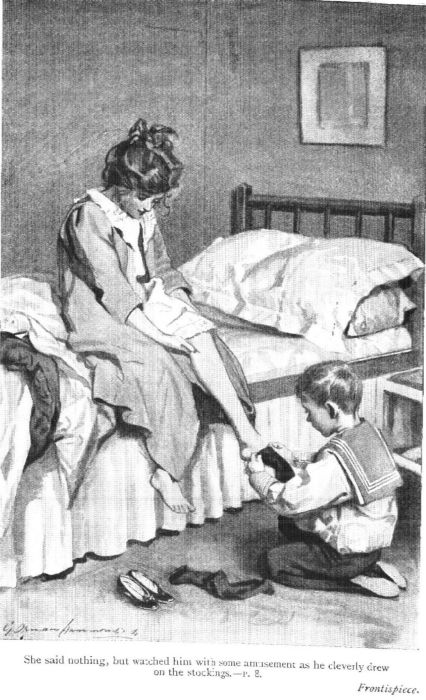
“You’d better be a boy at a boot-shop, Japs,” she remarked. “You’re so clever.”
Jasper looked up with great gratification at this rather meagre acknowledgment of his services. And then, somehow, the sight of his flushed face and smiling eyes got hold of Chrissie—the naughty, foolish fit of obstinacy left her—she stooped and kissed him.
“You’ve been very kind,” she whispered, and Jasper threw his arms round her and hugged her.
Thanks and kisses did not come in his way as often as they ought to have done.
“I’ll be very quick now,” Christabel added. “I’ll be ready for Nurse to do my hair in five minutes. Run off, Japs, and tell her so. No—I’d rather you didn’t,” and she hesitated.
Jasper stood still and looked at her, his legs rather wide apart, his face solemn.
“I wasn’t going to tell nobody,” he replied.
“Well, run away then,” Christabel repeated, and off he went.
She was a quick and clever child when she chose to give her mind to anything, little more than the five minutes had passed when she opened the door of communication and called out.
“I’m ready for my hair. Do you hear, Nurse?”
Poor Nurse required no second summons. She had really been growing uneasy about Christabel, and almost afraid that she herself would be obliged to give in, in spite of her promise to Mrs Fortescue. So the sound of Chrissie’s voice came as a welcome surprise. She was a kind and good young woman, but not possessed of much tact, otherwise she would not have greeted the little girl as she did on entering the room.
“That’s right, Miss Chrissie,” she exclaimed with a smile; “I was sure you’d think better of it in a few minutes, and not force me to have to complain to your dear Mamma, when there’s trouble in the house, too.”
Instantly Christabel’s gentler feelings took flight, like a covey of startled birds. She turned upon Nurse.
“That’s not true,” she said rudely. “You know you weren’t sure of anything of the kind. You know me too well to think I’d go back from what I said, and, as it happens, I didn’t. I’ve not put on my stockings myself this morning, but I won’t tell you anything more. And I do wish you’d leave off talking rubbish about trouble in the house. There’s no trouble. We didn’t care for Dad’s old uncle, who was as deaf as a post and whom we scarcely ever saw, and we can’t be expected to.”
Nurse was silent. She went on tying the ribbons round Chrissie’s abundant locks, without seeming to pay attention to this long tirade.
“Can’t you speak?” said the little girl, irritated by her manner.
“Yes, Miss Chrissie,” was the reply, “I can, but I would rather not. I don’t think what you say is at all pretty or nice.”
Chrissie gave a little laugh.
“Thank you,” she said. “Well, one thing’s certain: it’ll be ever so much jollier at Fareham the next time we go—you’ll see.”
This was too much for Nurse.
“Oh, Miss Chrissie,” she exclaimed, “and your poor aunt! She’s getting to be an old lady now, and lived all her life with Sir Percy such a devoted sister. You should care for her.”
Christabel’s face softened.
“Well, yes, I do love Aunt Margaret,” she said, “but I never thought she’d mind so very much. I should think she’d be glad to be free. Why, she can come and stay with us in London now as much as she likes, in turns with us going to Fareham, though, of course, Fareham will be Daddy’s very own now.”
Again Nurse was silent, but this time Chrissie took no notice of it, as she was growing very hungry as well as cold, and very glad to escape into the next room, where breakfast was now quite ready.
Leila and Jasper were already there, and as Chrissie ran in, Roland, the eldest of the four children, made his appearance at the other door. He was a tall, handsome boy of nearly fourteen—shortly to go to a public school, but, for the present, working in preparation for this, under a private tutor. He was dark, like Leila, Chrissie’s reddish-brown hair and eyes making the middle colouring between these two elder ones and fair, blue-eyed little Jasper.
It was not often, as a rule, that the nursery was honoured by Roland’s presence at breakfast, but he preferred it to solitary state in the dining-room just now, when the death of their old uncle had called away his father and mother for some days. And, indeed, nobody could have wished for a pleasanter room than this cheerful nursery, with its large, old-fashioned bow-window facing the park, the pretty paper on the walls, white-painted furniture, bright fire, and neatness; though, as regards this last attraction, I fear first thing in the morning was the only hour at which one could be sure of finding it!
Poor Nurse and Fanny! I should be sorry to say how many times a day they were called upon to “tidy up.”
“I’ve a letter from Mother,” Roland announced, after Jasper, as the youngest, had said grace for the party. “They got there all right.”
“Is that all she says?” asked Chrissie, for Leila was already buried in a book which she had propped against her breakfast-cup, only moving it from time to time as she drank her tea. “When are they coming back? She said she’d tell us as soon as she could.”
“They’d only been there a few hours when she wrote. I don’t know how you could expect her to say—you’re so babyish, Chrissie,” said Roland.
“Babyish,” she repeated scornfully, “I know what Mummy said better than you do. I’ll write and ask her to tell me, not you.”
Roland by this time had got out the letter and was reading it again.
“As it happens,” he said, good-naturedly enough, though his tone was decidedly “superior,” “she does say something about it, and something else that I don’t understand,” and the boy’s face clouded a little.
“She seems very bothered,” he replied doubtfully, still fingering the sheet of paper. “I think both she and Dad were pretty worried before they left.”
“Well,” said Chrissie, “I suppose they had to be. I suppose they had to care for Uncle Percy. P’raps he was nicer before he got so deaf. I don’t see that Mums need have gone, though.”
“She’s coming back as soon as she can,” Roland went on. “On Monday, most likely. Dad will have to stay there, and she has to come back to do a lot of business things for him here, and then she says she’ll explain that Dad and she are very worried, and she hopes we’ll all be very good while they’re away, and that we must help her to be very brave. What can she mean?”
All except Leila looked rather grave and puzzled; all, that is to say, except Nurse, whose face expressed distress, but not surprise.
“She knows something,” thought Chrissie. Then she turned impatiently to her elder sister.
“Leila,” she exclaimed, “don’t you hear? Leave off reading, you selfish thing.”
“Miss Leila,” Nurse joined in, “you know your Mamma has forbidden you to read at meals.”
Leila looked up at last.
“What are you all chattering about?” she said, and she pushed her book to one side, in so doing almost upsetting the milk jug, had not Jasper, who was next her, just caught hold of it in time, and lifted away the little volume.
“I’ll put it down for you,” he said, clambering off his chair as he spoke, and Leila, who, to tell the truth, had got to the end of a chapter, made no objection.
“What are you all chattering about?” she repeated, though without giving any one; a chance of replying she turned to Nurse complaining that her tea was quite cold.
“How could it be anything else,” said Chrissie. “You let it stand while you go on reading. I never did know anyone as selfish as you, Lell.”
As regarded the cold tea there really was no possible defence, so Leila contented herself with saying—
“I only ask to be left in peace. I don’t call that half as selfish as perpetually teasing and worrying everybody, as you do, Chrissie,” and a war of words was on the point of beginning had not her curiosity suddenly changed her ideas. “What’s the matter?” she went on, “I’ve asked you twice. What are you all so excited about?”
“It’s poor little Mumsey,” said Jasper softly.
“Shut up, Japs,” said Roland. “You don’t deserve to be told, Leila. It’s a letter from Mother. She seems in very low spirits and—”
“She says we must help her to be brave,” interrupted Christabel, “and we don’t know what she means, and—”
“Chrissie,” interrupted Roland in his turn, but certainly with more right to do so, “be so good as to hold your tongue. The letter is to me, not to you.”
He glanced at it again. “Yes,” he said, “it looks as if there was something the matter.”
“Is that all?” said Leila. “I daresay it’s nothing much. P’raps she said ‘brave’ by mistake for ‘cheerful,’ for I suppose Dads is rather cut up about old uncle, though really we can’t be expected to mind much.”
In this sentiment apparently both Roland and Christabel agreed. Only Jasper murmured half to himself—
“I don’t like nobody to die. He used to pat my head, and he gave me five shillin’s on my birthday”; but to this modest tribute to poor old Uncle Percy’s memory there was no response.
“Oh, I daresay it’s all rubbish,” said Chrissie, having recourse to one of her favourite words. “Any way, it’s no good bothering beforehand. If there’s anything wrong we’ll know it soon enough, when Mums comes back on Monday.”
“Monday,” repeated Leila in surprise. “Is she coming as soon as that?”
“She says she has things to see to for Dads here,” said Roland, “and he’s got to stay up there for a bit.”
“Oh, that’s of course,” said Chrissie. “Fareham’s all ours now, don’t you see? Dads will have to give lots of orders and settle everything. I daresay Mummy is bothered about all she’ll have to do now, with two big houses—though I’m sure she needn’t mind; it’s easy to get plenty of servants.”
For the first time Nurse here ventured on a remark.
“Not so easy as you might think, my dear. Large possessions bring their burdens. Still there are worse troubles than riches, ’specially to those not used to small means.” She sighed, and, in unconscious sympathy, little Jasper murmured again, “Poor Mumsey.”
“You’re always so gloomy, Nurse,” said Chrissie pertly, and though it was far from true, Nurse said nothing in her own defence; she only glanced across the table, saying gently, “Master Roland, won’t you be late?”
The boy jumped up hastily, exclaiming—
“Where’s my book strap? I’m sure I brought it in here.”
“It’s fastened round your books, Roley. I did them,” said a small voice.
“Thank you, Japs; you’re not half a bad sort,” the elder brother returned, and Jasper glowed with pleasure.
Chapter Two.
“Spoilt.”
Some half-hour or so after Roland had gone, Lewis, the footman, made his appearance at the nursery door, looking somewhat aggrieved.
“If you please, Miss Leila,” he began; then catching sight of Leila completely absorbed in her book and comfortably established by the fire, he hesitated and turned to Chrissie.
She was sitting on the floor, surrounded by scraps of silk, ribbon, coloured paper, and every article of furniture belonging to the beautiful large dolls’ house standing in a corner of the room.
“It’s Miss Earle, please, Miss Chrissie,” he began again. “She’s been here ever so long, and now she’s been ringing and ringing the schoolroom bell, till I didn’t know what was the matter.”
Chrissie went on calmly with her sortings.
“Well,” she said, “there’s nothing the matter. Tell Miss Earle we’ll come directly,” and with this piece of information Lewis had to content himself.
Chrissie glanced at Leila. Except for Jasper, quietly marshalling an army of tin soldiers at a side-table, the sisters were alone in the room, as Nurse and Fanny were busy in the little girls’ bedroom, the arranging and tidying of which was a much more serious affair than it should have been, and the door of which was shut.
“Leila,” said Chrissie.
No answer.
“Leila,” more emphatically, “Leila!”
“Well?” and Leila’s lovely dreamy dark eyes lifted themselves for a moment.
“Didn’t you hear? You might as well be stone deaf,” Chrissie went on, growing angry. “Miss Earle has sent up to say she’s been waiting hours.”
“Then she told a great story,” replied Leila lazily. “I’ll come in a moment, but I must just stop at a good place.”
“And I must match these colours for the new drawing-room furniture covers,” said Chrissie. “I’ll never get them so nice again, if Fanny muddles them all up in the scrap drawer.”
Just then her glance fell on Jasper, who had left off playing and was standing beside her.
“I’ll ’range them for you, if you like,” he was beginning, but Christabel shook her head.
“You couldn’t,” she said. “It’s something awfully partickler. But I’ll tell you what, Japs—you run down to Miss Earle and say you’ll have your reading first this morning. Tell her I’m having a spring cleaning and all sorts of fusses. You can say I didn’t know it was so late, and we’ll be down before you’ve half finished.”
Jasper moved towards the door, but less readily than usual.
“Hurry up, child, can’t you?” exclaimed Chrissie.
“Mumsey wanted us to be very good,” said the little fellow timidly.
“Well, we’re not being naughty. What does it matter to Miss Earle which lessons come first? She’s only a governess, and I am sure Mums pays her well.”
Her raised tone of voice had caught even Leila’s unhearing ears. She turned sharply.
“Chrissie, I’m shocked at you,” she said. “That’s not like a lady. Suppose we were grown-up and had to be governesses, you wouldn’t like to be spoken to like that.”
“I’m not speaking to her,” muttered Chrissie, rather sullenly, though she was already rather ashamed.
“But Jap might have said it to her,” persisted Leila.
“I wouldn’t,” exclaimed the child indignantly, “in course I wouldn’t.”
“Then go off at once and say what I told you to,” said Christabel, and Jasper obeyed her.
Leila, however, for once was roused. Certain words of her mother’s about remembering that she was the elder and should set a good example to heedless Chrissie, returned to her memory. She shut up her book with a sigh, and stooping, began to gather together some of the dolls’ belongings. But Chrissie pushed her away.
“Leave my things alone,” she said rudely.
“They’re not specially yours,” replied Leila. “The dolls’ house belongs to us both.”
“Much you do for it,” said Chrissie contemptuously. “It’d be all choked with dust like ‘in a dirty old house lived a dirty old man,’ if it depended on you.”
“It’s in a nice mess just now, any way,” remarked Leila. “Well, I’m going down to the schoolroom. You can do as you please.”
The last words were like a spur to impetuous Christabel.
“You shan’t go off and put all the blame on me to Miss Earle,” she exclaimed, starting up. “I’m coming too. Nurse,” she went on, “Nurse,” so loudly, that the bedroom door opened and Nurse and Fanny hurried out in alarm.
Chrissie looked up coolly. She had an irritating way of getting cool herself as soon as she saw that she had irritated others.
“You needn’t stare so,” she said. “It’s only about my toys and things. I want them left exactly as they are, till after lesson-time this afternoon—exactly as they are. Don’t you hear what I say, Nurse?” waxing impatient again.
“It’s impossible, Miss Chrissie,” replied Nurse. “Master Jasper and I couldn’t get to the table for our dinner; and even if we sat over at the other side, Fanny’d be sure to tread on some of those dainty little chairs and things and break them.”
Chrissie, as a matter of fact, saw the force of this, but she would not seem to give in, so she contented herself with making a scape-goat of the nursery-maid.
“Fanny is an awkward, clumsy creature, I’ll allow,” she said, with an air of great magnanimity, “so you may move them, or make her do it. But if she breaks one single thing I’ll complain to Mamma; I will indeed,” with a very lordly air, as she got up from the floor and prepared to follow Leila downstairs.
Nurse had the self-control to say nothing till the young lady was out of hearing, but as she and Fanny began together to clear the confused heap out of danger’s way, she could not resist saying to the girl, “To hear the child speak you’d think she never broke or spoilt a thing in her life! She’s worse than Miss Leila, and she’s bad enough, always half in a dream over her books. But Miss Chrissie’s worse. The losings and breakings!”
“Yes,” Fanny agreed, “and the messing with paint and gum and ink. Those new blouses. Nurse, are just covered with spots, and between them I don’t think they’ve a brooch with a pin to it.”
Nurse sighed, and the sigh was not a selfish one.
Downstairs, in the meantime, Miss Earle had, unwillingly enough, judged it wisest to make the best of things and to waste no more time, by beginning Jasper’s lessons in accordance with the message from Christabel, which the little fellow delivered much more politely than he had received it.
But the governess was far from satisfied.
She was young, excellently qualified for her post, and really interested in the children, as they were far from wanting in intelligence and love of knowledge, and now and then the lessons went swimmingly; brightly enough even to satisfy her own enthusiasm. But at other and more frequent times there was, alas, a very different story to tell, a sadly disappointing report to make, and Miss Earle almost began to despair. She had not been with the Fortescues very long, and she was intensely anxious to give satisfaction to their kind mother, who had behaved to her with the greatest consideration and liberality, and it grieved her to feel that, unless she could gain more influence over the girls, she must resign her charge of them.
“They are completely ‘out of hand,’ as it were,” she found herself one day obliged to say to Mrs Fortescue. “They don’t seem to know what ‘must’ means; in fact, in their different ways, their only idea is to do what they like and not what they don’t, and yet they are so clever and honest and they can be such darlings,” and she looked up almost with tears in her eyes. “It is discipline they need,” she added, “and—” hesitating a little, “unselfishness—thought for others.”
She need not have hesitated. Mrs Fortescue knew it was all true.
“I suppose the simple explanation is that I—we—have spoilt them,” she said sadly. “And now it is beginning to show. But Jasper, Miss Earle, the youngest—he should be the most spoilt.”
Miss Earle shook her head.
“And he is not spoilt at all!” she exclaimed. “He is not a very quick child, perhaps, but he is painstaking and attentive. He will do very well. And as to obedience and thoughtfulness—why, he has never given me a moment’s trouble.”
This talk had taken place some time ago. Over and over again the young governess had tried to hit upon some way of really impressing her pupils more lastingly, of checking their increasing self-will and heedlessness. For we don’t stand still in character; if we are not improving, it is greatly to be feared we are falling off. Now and then she felt happier, but never for more than a day or two, and this morning—this cold winter morning when she herself had got up long before it was light, to do some extra bookwork, and attend to her invalid sister’s breakfast—this morning was again to bring disappointment.
How cosy and comfortable the schoolroom looked as she came in, and held out her cold hands to the fire!
“Really, they are lucky children,” she thought, as she remembered the bare walls and carpetless floor and meagre grates of the good but far from homelike great school where she herself had been educated. “How good they should be,” as her glance wandered round the pretty, library-like little room. “But perhaps it is not easy to be unselfish if one has everything one wants, every wish gratified!”
Then came the tiresome waiting, the unnecessary waste of time—the footman’s cross face at the door, when she felt obliged to ring and send up a rather peremptory summons, a summons only responded to by Jasper, burdened with Chrissie’s far from satisfactory message—followed, just when Miss Earle was getting interested in the little boy’s reading, by a bang at the door and the younger girl’s noisy entrance, for she had overtaken Leila on the staircase and insisted on a race, in which, of course, she had been the winner.
“Chrissie!” exclaimed Miss Earle, surprised and remonstrant. “My dear child, you should not burst into the room in that way. It is too startling.”
“Yes, do speak to her, Miss Earle,” said Leila, in a complaining tone, with which their governess at one time would have had more sympathy than she now felt. For truly the little girls’ quarrels were almost always “six of one and half-a-dozen of the other.”
“She nearly knocked me downstairs and I was coming quite quietly.”
“And in the meantime neither of you has said good-morning to me, and it is eighteen minutes past the half-hour,” Miss Earle continued. “Besides which, you know you should be here before I come, with your books and all ready.”
Both children were silent. Then Christabel said, rather sullenly—
“I sent a message by Jasper. I suppose he didn’t give it properly.”
“He gave it as properly as a message that was not a proper one could be given,” was the reply, and Miss Earle’s voice was very cold.
“I must keep up my authority, such as it is,” she said to herself, “but oh, what a pity it is to have so constantly to find fault, when I love them and we might be so happy together.”
It was a bad beginning for the morning’s lessons, and as was to be expected, things did not go smoothly. In their hearts both Leila and Christabel were feeling rather ashamed of themselves, but outwardly this only showed itself by increased sleepy inattention in the one, and a kind of noisy defiance in the other. But Miss Earle knew children too well to “pile on the agony,” and said no more, hoping that the interest they really felt in their work would gradually clear the atmosphere.
So she gave them some history notes to copy out correctly, while Jasper went on with his reading.
He was not a very quick child, as I think I have said already, but it was impossible to feel vexed with him, as he did his very best—getting pink all over his fair little face when he came to some very difficult word. Nor was it always easy to help laughing at his comical mistakes, but a smile of amusement on his teacher’s face never hurt his feelings. It was different, however, when Chrissie burst into a roar at his solemnly narrating that “the gay-oler locked the door of the cell on the prisoner.”
“The what, my dear?” said Miss Earle.
Jasper’s eyes were intently fixed on the word.
“Go-aler,” he announced triumphantly.
Then came his sisters noisy laughter, and the child’s eyes filled with tears.
“Be silent, Chrissie,” said Miss Earle sternly, and Chrissie’s face just then was not pleasant to see.
Nor did she recover her good temper till the French lesson came and her translation was found to have only two faults, whereas Leila’s rejoiced in five!
On fine days the three children went for a walk with Miss Earle from twelve to one—that, at least, was the rule. But how seldom was it obeyed! At a quarter to twelve they were sent upstairs to get ready, but in spite of Nurse’s and Fanny’s doing their best, it was rarely, if ever, that Leila and Chrissie made their appearance again till ten or twenty minutes past the proper time. And to-day was no exception. Nurse brought them downstairs herself, almost in tears.
“Miss Earle,” she began, “I don’t know what to do. Will you—can you say anything to the young ladies? I did so want to tell their Mamma that they had been good while she was away, and it’s worse than ever. Miss Leila’s been reading all the time I was trying to dress her, and Miss Chrissie pulled off her hat three times and stamped on it.”
“She put it all on one side. I looked like Falstaff in it,” said Christabel coolly.
“Then why do you not put it on yourself?” said Miss Earle, as they went out.
“Why should I, when they’re there to dress us?” was the reply. Miss Earle was silent. Chrissie repeated her question.
“I don’t think there is any use in my answering you,” she said at last. “We look at these things in such a different way, according to different ideas.”
Chrissie grew more amiable at this. She liked to be spoken to as if she were grown-up.
“You may as well explain,” she said condescendingly. “Tell me how you mean.”
“I mean that if I were rich enough to have half-a-dozen maids to dress me—or nurses to make a baby of me—I should be, and at your age should have been, ashamed to be as helpless as you and Leila are,” said Miss Earle.
Leila, who was listening, wriggled a little. Chrissie tossed her head.
“I’m not helpless. I can do anything I choose to do.”
“Indeed,” said their governess drily, “I should not have thought it.”
“But why should we?” said Leila, “We don’t need to.”
“Why should you learn to be self-helpful and, to a certain extent, independent?” replied Miss Earle. “I should say, for two reasons. Because it would be good for your own characters, and also because nobody can tell what they may not have to do sooner or later, and surely it is best to be a little prepared for the chances and changes of life.”
“I suppose you mean we might be sent to school some day,” said Chrissie; “but we shan’t—that’s certain.”
“I meant nothing in particular. I was only answering your question. But I must add something. If you do let yourselves be treated like babies, at least you should be as nice as babies generally are—healthy babies, I mean—to those who treat them kindly.”
Both the girls grew red at this, and Miss Earle was glad to see it.
“I don’t fink I was a very nice baby,” said Jasper consideringly. “Mumsey says I cried lots. That’s why I must try to be good now.”
“Poor Jasper!” said Miss Earle, “perhaps you were a very delicate baby.”
“I fink p’raps I was,” he said with satisfaction. “I can’t remember very well, but I don’t fink I meaned to be naughty.”
“You did roar,” said Leila; “I can remember it; or rather squealed. You weren’t big enough to roar.”
“Everybody’s got to be naughty some time or other,” remarked Chrissie jauntily. “I know you think Lell and me horridly bad, Miss Earle, but p’raps we’ll turn out awfully good after all.”
“I hope so,” said their governess, smiling. Then she added rather gravely, “I wish, dears, you could understand how much sorrow and regret you would save yourselves in the future if you would really try to be more thoughtful now,” and for a few minutes both little girls seemed impressed. Then, to change the subject, Christabel began again—
“Mummy’s coming back on Monday, Miss Earle. Roland’s had a letter, and he thinks she’s very worried.”
“I am sorry to hear it,” said Miss Earle. “Well, any way, let us try to have a cheerful report waiting for her, as far as we are concerned.”
And the rest of the walk passed in a most pleasant way.
But, alas! the children’s dinner, which the two girls had with their governess downstairs, was a cause of irritation, for, without being “greedy,” I am afraid I must allow that they were very “dainty,” which is almost as bad.
“I hate cutlets done like this,” said Chrissie. “They’re so dry. I like them with that nice reddy sauce.”
“Tomatoes,” said Leila. “So do I. And I don’t see why we should have plain potatoes, instead of mashed or browned, just because Mummy’s away.”
She pushed her plate from her.
“Leila,” said Miss Earle sternly, “go on with your dinner,” and as there was nothing else to eat, and Leila was hungry, she had to do so.
Then came the next course.
“Apple pudding! I hate cooked apples!” exclaimed Christabel. “Is there no cream, Lewis?”
No—there was no cream.
“What a hateful dinner,” both children complained, and as they saw Miss Earle about to speak, Chrissie interrupted her.
“I know what you’re going to say—all that about poor children who have nothing to eat, and that we should be thankful to have anything. But I’ve heard it hundreds of times, and I don’t see why we should have nasty things, all the same. It doesn’t make it any better for the poor children.”
“If your food were not nice, perhaps I would agree with you, but as things are, I cannot,” said Miss Earle.
But eat her apple pudding Chrissie would not, and as she had really not had enough dinner for a strong, healthy child as she was, her temper was by no means at its best for afternoon lessons, and Miss Earle walked home, feeling sadly discouraged.
“I must tell Mrs Fortescue that I’m making no way with them,” she thought. “Things have gone too far. I do not see how one is to get any lasting impression on them. And yet, I am so sorry to disappoint their mother! I wonder if she is really in trouble? What would those children do if actual misfortunes came over them?”
A sort of presentiment, caused greatly, no doubt, by her sincere interest in her pupils, and anxiety about them, seemed to add to her depression.
“I wish I had heard what Roland said,” she thought. “He is a good sort of boy. Perhaps he was only trying to make the girls more considerate for their mother just now.”
Chapter Three.
Breaking Bad News.
The day I have described was a Thursday, and on Monday the children’s mother did return, as she had said. Nothing very particular had happened during the last day or two. Leila and Chrissie had gone on much as usual, sometimes good-tempered and pleasant—so long, that is to say, as there was nothing to ruffle or annoy them—but always thoughtless and heedless, quite unconcerned as to the comfort of those about them, thinking of nothing but their own wishes and amusement.
Still, on the whole, both the schoolroom and the nursery had been fairly peaceful. Miss Earle had found less fault than she might have done; she even let some small misdemeanours pass as if unnoticed, but she was grave and rather silent.
“I hope she’s beginning to find out that it’s no use nagging at us,” said Chrissie, though “nagging” had never been Miss Earle’s way; but as to this, Leila seemed doubtful.
“I don’t know. I think there’s something the matter with her,” she replied. And so there was; the poor girl—for she was still a girl in spite of her learning and cleverness—was making up her mind that she was not the right person for her present pupils.
“Perhaps an older governess would manage them better,” she thought. “I must speak to Mrs Fortescue when she returns,” and in the meantime it seemed wiser to avoid “scenes.”
And Nurse, too, on her side, had been extra patient—scarcely interfering in the squabbles and noisy discussions which every day was sure to bring. She almost left off begging Leila and Christabel to try to be less careless and untidy; she only “scolded,” as they called it, once or twice, when the inkstand was overturned on Leila’s new red serge frock, and when Christabel wilfully cut a quarter of a yard off her best sash to make an “eiderdown” for the doll-house bed.
“There’s something the matter with Nurse too,” said Chrissie. “She’s as gloomy as an owl.”
“Poor Nurse, she’s had bad news,” said Jasper. “Her was cryin’ all by herself last night. I sawed her, and I kissed her, and she hugged me. I was so sorry for her.”
“Rubbish,” exclaimed Chrissie; “you’re so silly, Japs. I hate people in low spirits. It’s so gloomy, and when Mummy comes back, I suppose we’ll have to look rather gloomy too for a bit. Roland says it would be only decent because of Uncle Percy. I call it humbug.”
But when “Mummy” did arrive, there was no need for any “seeming,” for as soon as her little daughters saw her poor face they were both startled and shocked and really grieved; even the few days, less than a week, that she had been away from them had changed her so sadly. And as I have already said, neither Leila nor Christabel was actually hard-hearted or wanting in affection down at the bottom of her heart.
It was all thoughtlessness and selfishness—selfishness truly not known by themselves—that were the cause of their being so troublesome, so disappointing, so very far from what they should have been, in so many ways.
“Mummy,” exclaimed Chrissie, always the first to notice things, “Mummy, have you been ill? Leila, don’t you see how pale poor Mummy is, you stupid thing?”
Their mother glanced up beseechingly. She was kissing Jasper over and over again, as he clung to her, though with tears in her eyes.
“Dears,” she said, “my head is aching terribly. No, Chrissie, I have not been actually ill, but I have not been able to sleep, and scarcely to eat, since I left you. And poor Daddy, too—when I have taken off my things and rested a little, I will send for you and tell you—” her voice broke.
“I wish you’d tell us now,” said hasty Christabel. “If it’s anything horrid, it’s worse to have to wait.”
But Leila was thoroughly roused out of her dreams for once, by this time.
“Be quiet, Chrissie. It’s very selfish of you, when Mummy is so tired. I wonder—” and she glanced round the schoolroom, where they all were—Miss Earle having left—“I wonder if—” but before she could finish her sentence, Jasper, who had run off suddenly, made his appearance again, very solemn and important, as he was carefully carrying a cup of nice steaming tea.
“Ours was just ready,” he said. “I knew it was, and Nurse brought it to the door for me. Her wants you to take it while it’s quite hot.”
Mrs Fortescue took the cup from the kind little hands and drank it gladly.
“Thank you, darling,” she said, “that has done me good;” but Leila looked rather put out, and murmured something about a “meddlesome brat.”
“I was just going to order it,” she said, but while she had been “thinking,” Jasper had been “acting!”
Their mother got up from her seat.
“Your own teas will be cold. Don’t stay any longer just now. You may run up to my room as soon as Roland comes in,” and for once the little girls felt they could not loiter or linger.
“There’s something awful the matter,” said Christabel, as they walked slowly upstairs. “P’raps robbers have got into Fareham and stolen lots of things, and Mummy’s come back to send detectives after them, and—”
“Really, Chrissie, you are too silly,” interrupted Leila; “as if Mamma would look like that about a stupid burglary! Besides, there would have been no secret about it, and it would have been in the papers.”
“Then what can it be?” said Christabel, and as they were now at the nursery door, she ran in, without waiting for an answer, exclaiming to Nurse, quite heedless of Fanny’s presence, “Mummy’s come, and she looks as ill as anything, and so dreadfully—”
Nurse shook her head with a slight glance of warning, which Leila caught, and by way of attracting her sister’s attention, pinched her arm.
“Leila!” cried Chrissie in a fury, and the pinch would probably have been repaid with interest, had not Nurse interfered.
“Fanny, we shall not have butter enough. Please fetch some more,” she said, and then, as the girl was leaving the room, she went on, in time for her to hear, “of course, dears, your poor Mamma must be dreadfully tired. Travelling so far in such a few days and so much to see to;” and when they were alone she added, “Miss Chrissie, I do wish you could take thought a little. I don’t know what you were going on to say, but Fanny is only a girl, and we don’t want gossip downstairs about—” she hesitated.
Chrissie’s curiosity made her take this reproof in good part.
“About what?” she asked eagerly. “You know something that we don’t, and I don’t think it’s fair to have mysteries and secrets. We’re quite big enough to know too.”
“Yes, especially if you scream things out for Fanny to hear,” said Leila teasingly. “Why, Jap has more sense than that,” and she glanced at the little boy, who was seated at the table, his tea and bread-and-butter untouched, his face very grave indeed.
“You will understand everything very soon,” said Nurse, feeling that the time had come for her to try to make some impression on the children, and thus help their mother a little in her painful task. “Your Mamma is going to tell you herself, and I can only beg you, my poor dears, to think of her before yourselves and to be of comfort to her.”
There was no reply to this, beyond a murmur. Leila and Christabel felt overawed and vaguely frightened and yet excited. They found it difficult to swallow anything, but a sort of pride made them unwilling to show this, so the meal passed in unusual silence, Nurse’s voice coaxing Jasper to eat, being almost the only one heard.
Leila’s imagination, filled with the quantities of stories she had read, was hard at work on all sorts of extraordinary things that might have happened or were going to happen; Christabel was simply choking down a lump that would keep rising in her throat, and trying not to cry, while she repeated to herself, “Any way, it can’t be as bad as if Dads or Mummy had been killed on the railway, or died like old Uncle Percy.”
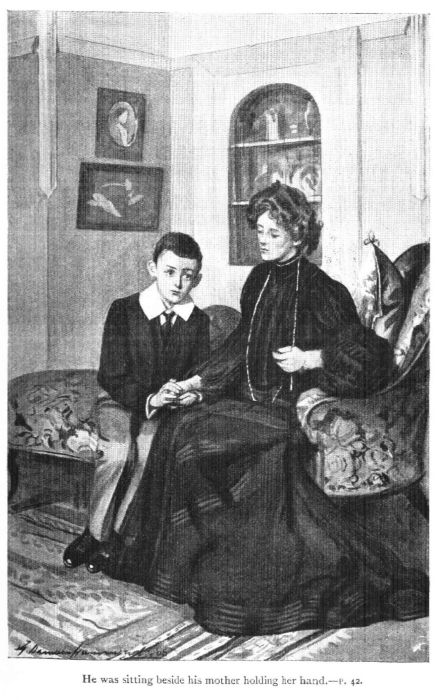
Roland generally came home about half-past five, but he had tea downstairs with his mother, or, if she were out or away, by himself, in his father’s study. It was less interrupting for him, as he usually had a good deal of work to do at home, than with the others in the nursery. So when a summons came for the little girls to go to Mrs Fortescue in her own room, they were not surprised to find their elder brother already there. His face, however, was not reassuring. Never had they seen him so grave—Leila even fancied he looked white. He was sitting beside his mother holding her hand.
She tried to smile cheerfully as Leila and Christabel came in, followed—very noiselessly—by Jasper, who had slipped out of the nursery behind them, being terribly afraid of being left out of the family conclave!
“Why, Jasper,” exclaimed his mother, when she caught sight of him, “I didn’t send for you—”
“No, Mumsey, darlin’,” he replied, “but I’se come,” and he wriggled himself on to a corner of her sofa, where he evidently meant to stay. The others could not help laughing at him, half nervously, I daresay, but still it somewhat broke the strain which they were all feeling.
“We’re going to talk of very serious things, my boy,” Mrs Fortescue said, persisting a little, “and you are only seven, you see. You could scarcely understand. Don’t you think you had better run upstairs again? Nurse will give you something to amuse you.”
“No fank you. Please let me stay. I’m not so very little since my birfday, and if you’ll explain, I fink I’ll understand.”
By this time he had got hold of his mother’s other hand and was squeezing it tightly. She had not the heart to send him away.
“What you really need to know, my own darlings,” she began at last, rather suddenly, as if otherwise she could scarcely have spoken, “can be told you in a very few words. Till now you have been very happy children—at least I hope so—perhaps I should say ‘fortunate,’ for your father and I have made you our first thought and given you everything you wanted or could want. We were able to do this because we have had plenty of money. And now, in the most terribly unexpected way, everything is changed. Our poor old uncle’s death has brought a little dreamt-of state of things to light. He, and therefore we—for you know Daddy is his heir—just as if he had been his son, and almost all our means came from him—he was on the brink of ruin. And we—we are ruined.”
The children’s faces grew pale, and for a moment no one spoke. Then said Roland, with a sort of angry indignation in his voice—
“Did he know it, Mother? If he did—I must say it, even though he is dead—if he did, it was a wicked shame to hide it. If Dads had known—Dads who is so clever—something could have been done, or at worst we could have been preparing for it.”
Mrs Fortescue did not blame the boy for what he said, but she answered quietly—
“Your father felt almost as you do, at first,” she said, “till things were explained a little. It seems that poor uncle had no idea that the state of his affairs was desperate, until the very last—it was the shock of a letter telling this that must have caused the stroke that killed him. Aunt Margaret found the letter in his hand, though he was unconscious and never spoke afterwards.”
“But still,” Roland went on, though his tone was softer, “I can’t understand it, for Fareham belonged to him and it must come to father, mustn’t it?”
“Yes, it is entailed. But it is not a very large property, nor a productive one. It is a charming place as a home, but expensive to keep up. Uncle’s large income was from other sources—not land-investments. Some of these must have begun to pay less for the last few years, and to make up for this and be able to go on giving us as much as we have always had, he was foolish enough to try other things—to speculate, as it is called. He must have lost a good deal of money a year or so ago, and since then it has all been getting worse and worse, and now—well; practically all is gone.”
“Still,” Roland went on, looking puzzled, “there’s Fareham.”
“Yes,” exclaimed Chrissie. “Why shouldn’t we go and live there all the year round and not have to pay for a house in London.”
“Don’t be silly,” said Leila. “Hasn’t Mummy just said that Fareham’s expensive to keep up, and if we’ve no money!”
“Hush, dears,” said their mother, “don’t speak sharply to each other. Yes, there is Fareham, but that is what we have to depend on. It can’t he sold, but it will probably—almost certainly—let well, furnished, just as it is, and that will give us a small income in addition to the very little we have of our own. Your father is already seeing about it. And this house is almost certain to let very quickly. It is only ours for another year legally. We will just keep enough furniture for a small home, where Aunt Margaret will live with us, and sell all the rest. And your father may get some work; he has friends who know what he can do.”
“Will he have to leave off being an M.P.?” asked Leila very dolefully.
Mrs Fortescue only bent her head.
“And—” began Roland again, hesitatingly, “I don’t want to be selfish, Mums, but I suppose I can’t possibly go to Winton,”—the public school for which he was preparing.
“Of course not,” said Chrissie pertly: “most likely you’ll have to be a boy in an office, or even an errand boy.”
“I could be a errand boy,” cried Jasper, his face lighting up. “Or p’raps a messenger boy. There was one comed here the other day that was almost littler than me. And they have such nice coats and caps.”
The others could not help laughing, and again it did them good, though Jasper got rather red.
Mrs Fortescue took no notice of Christabel’s uncalled-for speech.
“Dear Roland,” she said, “your school is one of the things we are the most anxious about. If by any possibility it can be managed, it shall be done. There are still fully six months before the date of your going, and somehow—I can’t help hoping for it.”
Roland flushed a little.
“I—I feel as if it was selfish even to hope for it,” he blurted out.
“No,” his mother replied, “it is not. Your whole future may hang upon it. You have always done very well at school, and now with your tutor. You might get a scholarship at Winton and then College, which we have always looked forward to for you, would be possible;” for Roland was a boy not only of ability, but great steadiness and perseverance.
“It’s—it’s very good of you and Dads,” he murmured.
Mrs Fortescue’s spirits seemed to be recovering themselves a little. She was still quite a young woman and naturally of a gentle, rather childlike character, easily depressed and easily cheered. And Roland’s way of receiving the bad news seemed to strengthen her.
“There are some things I am thankful for,” she went on. “We can at once face it all and arrange to live in the new way, without any waiting or suspense or any trying to keep up appearances. It is the sort of tremendous blow that can’t be kept secret. As soon as possible Daddy and I will look out for a small house. I feel as if every day here was wasting money.”
Leila and Chrissie had been silent for a minute or two; Leila in a mixed state of feeling, uncertain whether to think of herself as a heroine, or a martyr. Christabel, on her side, was far from pleased at the “fuss” as she called it to herself, that her mother was making about Roland.
“It isn’t fair,” she thought, “it’s much worse for us. Boys and men can work; being poor doesn’t matter for them. Besides, Roland’s going to get all he wants, and we’re evidently to be sacrificed for him,” and the expression on her face was not a pleasant one.
“And what’s to become of its?” she inquired. “Lell and me? We’ll have to be governesses, or dressmakers, I suppose.”
Mrs Fortescue could not help smiling, though she felt disappointed at the child’s tone.
“You certainly have plenty of time to think about anything of that kind,” she said. “I cannot fix as yet what we must do, but in the meantime I hope you will learn as much and as well as you can with Miss Earle. She is such a first-rate teacher. I shall be terribly sorry to part with her,” and she sighed.
“I shan’t,” said Chrissie, “she does nothing but scold.”
“No doubt you deserve it then,” said Roland gruffly. He was terribly sorry for his mother, and his sisters’ want of sympathy made him indignant.
“I don’t think either of them cares, as long as things don’t touch themselves,” he said to Mrs Fortescue when Leila and Chrissie had left the room.
“Things will touch themselves, and very sharply,” his mother replied with a sigh. “They don’t realise it at all, Roland; we must remember that they are very young.”
“They are just very spoilt and selfish,” the boy muttered. “Just look at Jap, Mums—what a difference! And he’s only seven, and quite ready to be a shoe-black if it would be any help to you. I tell you what, mother, it will be a capital thing for those girls to have to rough it a bit.”
“I hope so. I suppose there is good hidden in every trouble, though it is sometimes difficult to see it,” Mrs Fortescue answered. “But, darling, don’t be too down on your sisters. If they are spoilt, and I fear they are, it is my fault more than theirs.” Roland put his arms round his mother and kissed her. “Nothing’s your fault, except that you’ve been far too kind to us all,” he said, “and—about my still going to school—to Winton, I mean. I don’t half like it. Why should I be the only one to—well, why should things be made smoother for me than for the others? The girls will be thinking it’s not fair.”
His mother smiled.
“It’s not likely that they will be jealous of your going to school,” she said. “I’m quite sure they don’t want to be sent to school themselves.”
“Oh, but it’s quite different for girls,” said Roland.
“Yes,” his mother agreed. “But now, dear, I must send a word to your father—just to tell him I got home safely, and—and that, in one sense, the worst is over.”
“You mean the telling us? Oh, Mums, it’s all much, worse for you than for us,” said Roland, and somehow the words comforted her a little.
Upstairs in the nursery, it certainly did not seem as if the strange and startling news had had any very depressing effect on Leila and Christabel. The former was already established in her usual cosy corner, buried in her newest story-book; the latter was only very cross. She had discovered that Nurse had been crying, and turned upon her sharply, though the poor thing was only anxious to be all that was kind and sympathising.
“What in the world have you to cry about, Nurse?” she demanded. “It isn’t your father and mother that have lost all their money.”
“I have no father, as you know, Miss Chrissie,” she said quietly, “and my brothers take good care of mother. But your father and mother have been kind true friends to me, and you surely can understand that I can feel sadly grieved for their troubles, and indeed for all of you, my poor dears,” and her voice broke.
Chrissie felt a little ashamed. She turned away so as not to see Nurse’s tears.
“It’s no use crying about it, all the same,” she said more gently. “What can’t be cured, must be endured.”
“That’s true,” Nurse agreed, “and I’m glad to see you so brave;” but to herself she wondered if the thoughtless child realised in the very least all the changes that this unexpected loss of fortune could not but bring about in the, till now, indulged and luxurious life of the Fortescue children.
Chapter Four.
The New Home.
Some days passed. Mr Fortescue was detained in the country longer than he had expected, and us it was impossible for their mother to decide things very definitely without him, especially as regarded the future home of the family, the children’s daily lives went on much as usual.
“You could almost fancy it was all a dream,” said Leila to her sister.
“You could, I daresay,” Christabel replied, “for you’re never doing anything but dreaming; but I don’t feel like that at all. It’s enough to see Nurse’s red eyes, and the servants stepping about as if there was straw all over the place, like when people are very ill, and Miss Earle’s never been so kind before. It really almost makes me try to please her.”
“I think it’s rather nice of them all,” Leila remarked. The “romantic” side of the position quite took her fancy, and she felt as if she really was some thing of a heroine. “I shan’t mind being poor, if people are so sorry for us—so-so respectful, you know, Chrissie.”
But Chrissie was made of different stuff.
“I don’t agree with you at all,” she said, tossing her proud little head, so that her thick reddish-brown hair fell over her face like a shaggy mane. “Sorry for us! No indeed, I don’t want people to be sorry for us. Almost the worst part of it is everybody having to know. I can’t understand Mummy thinking that a good thing. I don’t mind Miss Earle,” she went on, softening a little, “she’s different somehow. But I’m not going to pretend, any way not to you, Lell, you sleepy, dreaming thing, I’m not going to pretend that I don’t think it’s all perfectly horrid, for I do.”
“If we could go to live in the country,” said Leila; “a pretty quaint cottage, thatched perhaps, any way covered with roses—”
“Yes, especially in winter,” interrupted Chrissie. “What a donkey you are, Lell! Better say thistles.”
“We could have roses a good part of the year, and I know there are some creepers that are evergreens. Ivy, for instance. No, a cottage wouldn’t be so bad, however tiny it was,” Leila maintained.
“You’d have to be cook, then, and I’d have to be housemaid, for where would you put servants in your tiny cottage I’d like to know? It would be freezing in winter—no bathroom or hot water—and in summer all insecty. Horrible! However, we needn’t fight about it. We’re going to stay in London. Mums says we must, if Dads is ever to get any work to do—or in the suburbs close to. I think that would be almost worse. The sort of place with rows and rows of little houses all exactly like each other, you know, with horrid scraps of garden in front.”
“No,” said Leila, “I think any sort, of a garden would make it better. We could grow things.”
“I’d like to see you gardening,” said Chrissie. “I know what it would be. If there was any sort of a summer-house, or even a bench, you’d be settled there with a book, calling out, ‘Chrissie, Chrissie, do come and rake that border for me. I’m so tired.’”
“I might call,” retorted Leila coolly, “but most certainly the border wouldn’t get raked if I had no one to call to but you.”
“I’d rake it, Lelly,” said Jasper. They had not noticed that he was in the room, for he was busied in a corner, as quiet as a mouse, as was often the case.
“I believe you would,” said Leila. “We’re not a very good-natured family, but I think you’re about the best, poor old Jap.”
“Nonsense,” said Christabel. “He’s just a baby. Shall we toss up, Lell?” she went on recklessly. “Heads or tails? I’ve got two halfpennies—heads for a house with a garden six feet square, tails for a dirty little pig of a house in—oh, I don’t know where to say.”
“I know,” said Jasper; “that place where Nurse’s cousin lives what makes dresses. I’ve been there with Nurse. Mummy said I might go. It’s quite clean, and there’s a sort of gardeny place in the middle, where the children was playin’. They didn’t look—not very dirty,” for if Jasper was anything, he was exceedingly “accurate.”
“Really, Jasper,” began Leila. Then she turned to Christabel, “You don’t think it could be as bad as that, Chrissie?” and the alarm in her soft dark eyes was piteous. “Living in a slum, that would be.” Just then Nurse came into the room.
“What were you saying, Miss Leila, my dear?” she inquired. “Something about a ‘slum’?”
“It’s what Jasper was saying,” said Leila, and she went on to explain.
Nurse got rather red.
“It can’t be called a slum where my cousin lives,” she said. “She’s a respectable dressmaker in a small way, and suchlike don’t live in slums. Still it won’t be as poor a place as that where,” she hesitated, and then went on, “where the new house will be.”
“Jasper’s so vulgar,” said Chrissie, “the minute you speak of being poor, he thinks it means leaving off being ladies and gentlemen.”
“I doesn’t,” exclaimed the boy indignantly. “Nothin’d made Dads and Mums not be ladies and gentlemen—and us too,” but the last words somewhat less confidently.
Both the girls laughed.
“Thank you, Jap,” said Leila, “though I don’t wonder he doesn’t feel quite sure of you, Chrissie. You really needn’t talk of ‘vulgar,’ with your ‘heads and tails,’ like a street boy.”
A sharp retort was on Christabel’s lips, but Nurse hastened to interrupt it.
“What are you so busy about, my dear little boy?” she said, turning to Jasper, which made the others look at him also.
“I’se packin’,” was the reply, and then they saw that he was surrounded by his special treasures, in various stages of newness and oldness, completeness and brokenness. “Mums said I might divide them, and the old ones are to go to the ill children; and I’m goin’ to pack the others very caref’ly, for you see they’ll have to last me now till I’m big,” and he gave a little sigh, for in his unselfish, yet childish heart, there had been visions of what future Christmases might bring in the shape of a new stable and stud—“still splendider nor the one I got two birfdays ago,” as he thought to himself.
Leila drew near him.
“Shall I help you?” she said. “I’ve finished my book,” she went on, “and I’ve nothing to do,” as if half-ashamed of her unusual good-nature. “I say, Japs, you do keep some of your toys a long time. I don’t see many bad enough for the Children’s Hospital.”
Jasper’s serious blue eyes slowly reviewed his spread-out treasures, but for a minute or two he did not speak.
Then he said gravely—
“There’s isn’t many broken, but I’d like to give some of the others too. Mumsey won’t mind—and pr’aps, you know, I can’t send many more, for these’ll have to last me, and I’ll get fonder and fonder of them. So I think I’d better send a good lot now—don’t you think so too, Lelly?”
His hands strayed lovingly over his beloved horses and dogs, squirrels and rabbits, each one of which was known to him individually.
“It’s my aminals I care most for,” he said. “I want to divide them quick, Lelly, for fear I get greedy and want to keep them all.”
“You can’t do that, any way,” said Chrissie, who had joined the group. “You won’t have room in the new house. I daresay there’ll be no nursery at all. Look here, Japs, Nurse can give us one of the clothes-baskets, and we’ll put all for the hospital in it for Mums to look over, and then you can pack quite comf’ably for yourself,” and with the quickness and good sense she had plenty of when she chose to use them, she helped the little fellow in his rather painful task. And once the division was made, and the old favourites out of sight, Jasper grew more cheerful again, as he murmured to himself, “I daresay they’ll be quite happy with the ill children. They have such nice little white beds.”
How proud Chrissie felt of herself! It was just to be regretted that Nurse could not help saying—
“Dear me, what a pity you can’t always be so kind and helping, Miss Chrissie,” for immediately came the toss of the haughty little head and the pert reply—
“I shall do as I choose always, Nurse. You might know that, by this time, I should think.”
“Your father writes that he is coming home to-morrow,” said Mrs Fortescue, the next day. “I am so glad to be feeling better and stronger than when I first got back, for now house-hunting will start in good earnest. The agents have several chances of letting this, I hear, and we must not lose any.”
“How horrible it is,” exclaimed Christabel, and though Leila did not speak, her face grew very gloomy. Their mother glanced at them with disappointment.
“Dears,” she said, “I hoped you were going to be so brave and help me to meet Daddy cheerfully.”
“Really, Mummy,” said Chrissie, “I don’t see why you should scold us before we’ve done anything naughty.”
“Scold you,” repeated their mother. “I don’t think you have the least idea of what the word means, my poor little girl,” and she could not help smiling a little.
“Well,” persisted the child, “you can’t expect us to like going to live in some horrible poky place.”
Mrs Fortescue thought it best not to answer. She knew too well what Chrissie could be, once a “contrary” fit was on her.
“Is Aunt Margaret coming too?” asked Leila.
Her mother shook her head.
“Not yet,” she said. “Poor Aunt Margaret has to stay to see the last of things at Fareham. I don’t want her to come till we are at least a little settled. Children,” she went on, rousing herself to a new appeal, “my darlings, I know it is hard for you, and it is still harder for your father and me, because we feel it for all of you; but it is hardest of all for Aunt Margaret to have to leave the place where she has spent all her life, where she loves every tree and bush as if they were living things; never to have the joy of welcoming us all there, and arranging our rooms for us, and making us so happy. ‘The delight of her life,’ she called our visits the other day. It is awfully hard on her. Uncle Percy’s death would have been a sad blow at any time, but the way it came made it ten times sadder. And she is an old woman now, though a good deal younger than he was. Yet I cannot tell you how unselfish she is—how determined to see the bright side of things, how thankful for the blessings we still have.”
The children did not speak. Their mother’s words could not but impress them.
Then said Chrissie, still with a touch of defiance—“I know she’s awfully good, Mumsey, and we do love her, but you see I don’t pretend to be good and unselfish and all that. Pr’aps when I get to be old, it’ll come somehow.”
Mrs Fortescue smiled a little.
“I don’t want you to ‘pretend,’ Chrissie, most certainly not. I want you to be. And the longer you put off trying, the harder you will find it. Goodness does not come all of itself like one’s hair getting grey. And though it may sometimes seem as if God left us to ourselves, it is not really so. Sorrows and trials may have to be our teachers if we allow happiness and prosperity to make us selfish and thoughtless.”
“Well,” said Leila gloomily, “perhaps they’re beginning now—it doesn’t look as if there was much to be cheerful about;” and, as often happened, Christabel turned upon her sister, though Leila was only expressing her own discontent in different words.
“I call that selfish, if you like,” she said. “Mumsey has enough to be worried about without your grumbling.”
“Hush, Chrissie,” said their mother, rather wearily. “I think you will both try to help your father and me, but I cannot say any more. I have a great many letters to write, and Miss Earle has kindly offered to stay later to do some for me. I do want to get them done before to-morrow when Daddy comes. So run off now, dears.”
All the children loved their father, though perhaps in a different way from their sweet mother. But he was a very busy man, much engaged in public matters, and till now he had seen but little of them, comparatively speaking, especially of his daughters. But for this, possibly their faults, so greatly owing to over-indulgence and over-gentleness, would not have been allowed to have taken such root. And just at first, on his return home, Mr Fortescue was pleased with them all, Roland, of course, in particular, for the boy showed great good feeling and consideration for his parents.
“And Leila and Chrissie, too,” said their father, when speaking about them to their mother, “they seem rather subdued, naturally enough, but they will be plucky and sensible and do all they can to help us, I hope.”
“Yes, I hope so,” she agreed, and Mr Fortescue was too busy about other things to notice the want of confidence and cheerfulness in her tone.
Then followed a week or two of extreme “busyness” for the children’s parents. Strange men were constantly coming to the house, with note-books, in which they made long lists of the furniture, and pictures, and ornaments—what were to be sold and what to be kept. House agents, too, and several times, parties of ladies and gentlemen to be shown over all the rooms—some of whom were already friends or acquaintances of the Fortescues, some complete strangers.
It was all very queer, but there was a certain kind of excitement about it, though once or twice Chrissie grew red and angry at hearing some murmured expressions of pity, such as—“Poor people, isn’t it sad for them?” or, “I do feel so for them all.”
“Impertinent things,” muttered the child, though fortunately in a whisper.
Then at last came the day on which their mother with a little touch of relief in her voice, told them that the new house was chosen and decided upon.
“We shall move into it in about a fortnight,” she said, “and it will not be so very difficult to manage. A great deal of the furniture has been bought by the people who have taken this house, and as they are not coming in here for a month or more, we can send off all that we shall require at Spenser Terrace next week, and have it fairly in order before we go ourselves.”
“Spenser Terrace,” repeated Leila, “I never heard of it. Where is it, Mummy?”
“Some way out, of course,” was the reply. “Still, not in the suburbs, which I am glad of. It will be easier in many ways, especially for Daddy and Roland coming and going. Daddy has got a post, my dears—nothing very much, but we are very thankful. We shall just be able to get on with great care, for Aunt Margaret insists on joining the little income left to her, to ours. And I hope and think we can manage Roley’s school,” she added as she hurried off.
“Of course,” said Christabel, when she and Leila were alone, “of course Roland is the one they care about. You and I are to be educated anyhow or nohow, I suppose, so long as he goes to Winton. Why, we shan’t even be able to be governesses!”
“What’s the good of your saying those horrid things to me,” replied Leila, almost in tears. “You’d better say them to Dads.”
To this there was no response. Even Chrissie’s audacity would have failed her at such an idea.
Notwithstanding their mother’s continued cheerfulness, and Nurse’s assurances that they were not going to live in so poor a place as Jasper’s “quite nice and clean” row of houses, the imaginations of both little girls had been running riot, almost without their knowing it, on the subject of their new home, and on the whole they were rather pleasantly surprised when the day came for the move to it.
It was, of course, at a considerable distance from the first-rate part of the West End where they had hitherto lived, and as the rumbling four-wheeler made its slow way along, it seemed to Chrissie, with the boxes outside and packages inside, as if all that had happened in the last few weeks must be a dream, and that they were on their way to King’s Cross Station, to travel down for one of their happy visits to Fareham!
“Doesn’t it seem just like that?” she said to the others. “You know we’ve often gone with Nurse and Jap in a four-wheeler, when Daddy and Mummy were in the carriage.”
Leila gave a little shiver.
“Don’t, Chrissie,” she exclaimed. “It only makes things worse thinking of it all like that.”
Jasper slipped his hand into hers.
“Pr’aps we’ll be very happy in the new house,” he said. “I’d not mind if only Nursie was going to stay.”
For, alas! Nurse was only to be a few days longer with them—“just to see you a little bit settled,” she had pleaded with Mrs Fortescue. Her remaining permanently would have been impossible in the changed circumstances of the family, and as she was looking forward to being married in two or three years, it was of importance for her to save what she could of her wages. But she had done all in her power to help; it was a cousin of hers who was one of the two servants which were all Mrs Fortescue could afford to have, and she had privately begged this girl to be very patient with the young ladies if they were sometimes troublesome and thoughtless.
“It will all be such a change for them, you see,” she explained, and Harriet, who was good-natured and willing, delighted to come to London, and not troubled with nerves, promised to do her very best.
Hers was the face which met them as the cab at last drew up at one of a row of houses in a quiet, rather dull, but by no means “slummy” side-street.
“It isn’t so very bad,” said Chrissie, “and that new servant looks rather nice. I suppose she’ll be instead of Fanny.”
“Of course not,” said Leila, “there’ll be no Fanny and no Nurse and no anybody except a cook and housemaid. You certainly will have to put on your own shoes and stockings now!”
And Chrissie’s face, which had brightened a little, clouded over again. But it was not in human nature, above all not in child, even spoilt-child nature, not to try to smile and look pleased, when at the open door of the little drawing-room the sisters caught sight of their mother, and heard Jasper’s joyful cry, “Oh Mumsey, what a sweet little room.”
“Come in, darlings. I’ve been longing so for you,” she exclaimed, “and tea is all ready in the dining-room. Nurse, you must have it with us. Daddy, darlings, won’t be back till seven, but Roley is here.” It was a pretty little room. Mrs Fortescue had wisely kept only such furniture as was really suitable, especially as to size, so there was no look of crowding or “not-at-home-ness” about it. And as the whole house had been freshly painted and papered, there was nothing dark or dingy.
“If I could fancy it was a little house we had got for a few weeks at the seaside somewhere, I’d think it was quite nice,” thought Christabel. “I wonder how many rooms there are. We really need one each if we’re not to be always knocking against each other!”
Chapter Five.
A Stormy Morning.
Small as the dining-room was in comparison with the spacious one “at home,” as, more than once, the children caught themselves saying, still, they all settled round the table quite comfortably, and on the whole they were a more cheerful party than might have been expected. Chrissie, even, was graciously pleased to express her approval of the hot buttered scones which their kind mother had specially ordered for the occasion.
“They are quite as good as Mrs Williams’s,” she said when she had eaten, I am afraid to say how many of them. “May we have them often, Mummy? The new cook will have lots of time, as there’ll never be dinner-parties, or luncheon-parties, or—or anything like that, of course,” and she gave a deep sigh.
“The new cook, as you call her,” said Mrs Fortescue, “is no other than Mrs Williams’ niece, Susan, who till now has been the kitchen-maid. So it is not surprising that her scones are good. But as for having lots of time, you must remember that, now we have only two servants, she will have to do many things besides cooking. We mustn’t expect scones except as a treat.”
“Oh, of course,” murmured Chrissie, “we mustn’t expect anything nice. I see how it’s going to be.” But either she spoke too low for her words to be heard, or her mother thought it wiser to take no notice of them, and she went on talking about other things.
“Yes,” she said, in reply to a question of little Jasper’s, “there is a tiny garden behind, as you see, and, besides the back-door, there is an entrance to it out of Daddy’s study, through a French window. I daresay you will be able to grow some pretty hardy things in it.”
Jasper’s face flushed with pleasure.
“Oh, I do hope Aunt Margaret will remember to bring my new garden-tools what are at Fareham,” he exclaimed.
“I will ask her about them when I write to-morrow,” said his mother.
“Daddy’s study,” repeated Leila, “then there is a third sitting-room. I was just wondering what we’d do for a schoolroom.”
“You will have to use this room a good deal,” said Mrs Fortescue, “but in warmer weather, when you don’t need fires, you can prepare your lessons in your own room upstairs, as you will see. Now, if we’ve all finished, I am anxious to take you over the house, Roley has seen it all,” with a glance at him.
“Yes,” Roland answered, “and I think it’s quite wonderful what you’ve made of it, Mums, really wonderful. The rooms couldn’t be nicer.”
And as the little girls followed their mother upstairs, in their heart they could not but agree with him. A nice airy room, not large of course, but as large as any in the house, had been furnished for them, with their own little beds and toilet-table, and as many of their favourite belongings as it was possible to find room for, including two bookcases with glass doors, on the wall, and a small writing-table in front of the fireplace.
“It’s really very nice, Mumsey dear,” said Leila, delighted at the sight of her low straw chair in one corner; “I don’t believe I’d ever be too cold up here—not with a shawl on. It seems so nice and peaceful, if only—” she stopped and hesitated and glanced at her sister.
“You’d better finish,” said Chrissie sharply. “I know it’s something horrid about me.”
“No, it isn’t horrid,” Leila replied. “It’s only if you could be tidy.”
”‘Tidy,’ indeed,” repeated Chrissie scornfully.
“I’m quite as tidy as you, and tidier. Am I not, Nurse?” she went on, turning to her.
Nurse, in spite of her extreme anxiety to make the best of things and to keep all smooth, could scarcely help smiling.
“I’m afraid, my dear, that there isn’t much to be said as to tidiness,” she replied. “Perhaps it’s been partly my fault, ma’am,” she went on to Mrs Fortescue, “I’ve not left off feeling as if the young ladies were still the tiny little fairies I remember them when I first came. But now they’re so much bigger, and with things being so different, I’m sure Miss Leila and Miss Chrissie will do their very best to help in every way.”
“She’s not at all sure of anything of the kind,” thought Christabel, “and that’s why she says she is. I wish people wouldn’t be humbugs.”
Poor Nurse herself certainly did her very best during the two or three days she remained at Spenser Terrace. And there was, of course, still a great deal to do. For, notwithstanding the careful choice of furniture and such things for the little house, when the trunks and boxes came to be unpacked, it was by no means easy to find room for all that had been brought. But for Nurse, I much doubt if the children’s possessions would ever have been properly arranged! She managed to interest the girls—Chrissie especially, who was naturally quick and active—in her plans about cupboards and shelves and chests of drawers, and before she left she glanced round with satisfaction at the result.
“If only they will try now to be thoughtful and methodical,” she said to herself.
These first few days had passed not unpleasantly. With Nurse still there, the great difference to themselves personally had not, of course, been very much felt by the little girls, and there is always, I think, to all children—and to many grown-up people too—a curious charm in novelty. It was a nice change to breakfast downstairs with their father and mother, to have tea also in the dining-room, and no lessons. Then, fortunately, just then the weather was fine and bright and dry. They went out with Mrs Fortescue or Nurse two or three times to explore their new neighbourhood, and found it rather amusing. They even thought it would be great fun to have expeditions in omnibuses, though at present there was still too much to do indoors for anything of that kind.
Mr Fortescue was pleased with them, and said so to their mother.
“I think we have worried ourselves unnecessarily about Leila and Chrissie,” he said, “they seem to be settling down all right.”
“I hope so,” she replied. “But of course the real test will come when Nurse goes and Aunt Margaret comes. In some ways she must be my first thought, when we remember all she is doing to help us.”
“But she is a miracle of unselfishness. I am only afraid of her spoiling the children,” he said.
“She is too wise to do so,” said Mrs Fortescue. “I earnestly hope they may learn to follow her example,” but still she sighed, and Mr Fortescue thought that anxiety and overwork were probably making her rather downhearted, though he did not say so.
Nurse left on a Saturday, and Aunt Margaret was expected to arrive on the Monday. I don’t think this was a very good arrangement, and if I had been consulted I should have said so. Sundays are, and should be, rather different from other days, but to make them thus in a happy way takes some method and planning, as the heads of all households, large and small, know well. And in a family accustomed to twelve or fifteen servants, suddenly obliged to manage with only two, of course the difficulties were much increased.
“We must begin rightly at once, or we shall get into wrong ways,” thought Mrs Fortescue. “The servants must both go to church; one in the morning, and one in the evening, turn about. And we must have a cold meal once a day. Let me see—if Harriet goes to-morrow morning, we can have a hot luncheon and cold supper this first Sunday, and tea all together in the afternoon,” and she lay awake half the night thinking about it, which was not very wise, I must allow, as it made her sleep later than usual the next morning.
But she dressed quickly, and on her way downstairs to breakfast, glanced in at the little girls’ room, expecting to find them ready.
Alas! What was the spectacle that met her view?
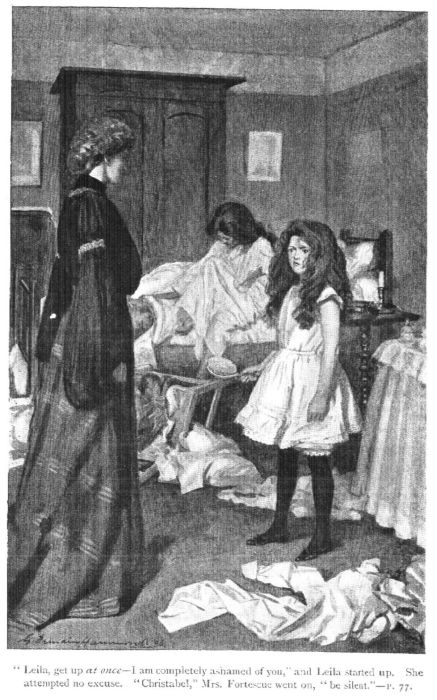
Leila in bed reading—a candle still alight on the little table by her side, though the room was, of course, in full daylight. Christabel, half dressed, standing in front of the looking-glass, tearing wildly at her hair, and scolding furiously at her sister, who was calmly paying no attention to her. And the room! Its state may be imagined when I say that it looked as if every article of clothing the children possessed had been dragged out of wardrobe and drawers and flung pell-mell on beds, chairs, and floor. It was really difficult to believe that such confusion was possible in the same room that Nurse had left in perfect order the very afternoon before.
Mrs Fortescue’s heart sank. For a moment or two she stood there speechless—unobserved by Leila, absorbed in her book, or by Chrissie, in the noise and excitement of her temper. And when at last their mother spoke, it was only by raising her voice that she gained their attention.
“Leila,” she said, and her tone was more severe than either of the girls had ever before heard it, “Leila, get up at once. I am completely ashamed of you;” and Leila started up. She attempted no excuse.
“Christabel,” Mrs Fortescue went on, “be silent.”
“I can’t be, I won’t be,” stormed Chrissie. “It is all Leila’s fault. I got up very soon after that stupid Harriet brought the hot water, and she said she’d come back to help me to tie my hair, and I would have been ready, but Leila wouldn’t get up, and at last I threw a pillow at her, and it overturned the chair with her clothes on, and then she said I’d got out her Sunday frock instead of mine, and I hadn’t, and then she went on so, that I did get out hers and threw it on the floor, and her jacket and hat too, just to show her, and—”
“Christabel be silent,” repeated her mother, and this time the child, though with flaming cheeks and really shaking with anger, did obey her.
“And this,” said Mrs Fortescue, “this is the first Sunday in our new little home; the first day you have really had an opportunity of—I won’t even say helping me—but of showing yourselves sensible and trustworthy. It might and should have been a peaceful and happy morning. Stand still, Christabel,” as the little girl was flouncing about, “stand still while I tie your hair. It is very good-natured of Harriet to offer to do it, but you and Leila are perfectly able to help each other.”
“She’s not good-natural,” muttered Christabel: “when I told her to come back in ten minutes, she said she couldn’t. She’s very impertinent.”
“Be silent,” was her mother’s only reply. Then, turning to Leila, she went on, “Give me that book,” and Leila did so. Mrs Fortescue glanced at it. It was one of Mrs Ewing’s. “I cannot let you have it again to-day,” she said, “nor to-morrow, unless you are dressed and downstairs by half-past eight, and properly dressed, remember,” and so saying she left the room, and with a very heavy heart slowly made her way downstairs.
It was a dull, grey day, not yet raining, but with small promise of lightening or brightening, and Mrs Fortescue, accustomed to a well-warmed and luxurious house, felt it very chilly. And when she opened the little dining-room door, she felt even chillier, and no wonder, for the window was pushed up as far as it would go, evidently to get rid of smoke, some remains of which was still hanging about. There was only one person in the room, and that person not only a very small one, but so crouched down in a little bundle on the hearth-rug, that for a moment or so Mrs Fortescue really did not see him. Then the bundle stirred, and a small face, rather red and with smutty marks on its cheeks, looked up.
“Jasper,” his mother exclaimed, “what are you doing? Not playing with the fire, surely!” in anxiety, for indeed if Jasper were going to turn mischievous or disobedient, where would she be?
“Playin’, Mummy,” he repeated, with a touch of very excusable indignation, “in course not. It wouldn’t flame up nicely, and I’ve been down a long time. Roley buttoned my waistcoat before he got up, but he’s just comin’. So Susan gave me the bellowses,” and he held them up in triumph, “and it’s burnin’ beautifly now,” and so it was. “I think we might shut the window,” he added, with a glance of consideration.
“My darling,” said his mother, “I hope you haven’t caught cold,” and having closed the window, she turned to this brownie in a sailor suit with some anxiety.
“Oh no, I’m quite hot,” he replied. “Shall I take the bellowses back to Susan?” he went on. “Daddy wouldn’t like to see them here, and you don’t mind us goin’ to the kitchen if it’s a real message, now we mustn’t ring the bells often, do you, Mumsey?”
“No, my boy, take the bellows back by all means,” said his mother, and on he went, murmuring us he did so, “Susan will think I’m handy and clever.”
The funny little scene had cheered Mrs Fortescue again, and she was looking quite calm and happy when Roland and his father made their appearance.
“Breakfast is all ready. The things have just come in—everything is nice and hot,” she said brightly.
“That’s all right,” Mr Fortescue replied. “I’m quite hungry. Change of air—eh?” but he smiled as he said it. Then with a glance round the table—“Where are the others?” he went on, “Leila and Chris—There is a gong, isn’t there?”
“Yes, I brought the small one, but I haven’t taught Harriet to strike it yet. Perhaps they—”
But almost before she had got as far as this in her sentence Jasper was at the door.
“I’ll run up and tell them. I won’t be a minute,” he said. Nor was he. He was down again almost at once, but Mrs Fortescue’s quick eyes saw that his small face looked troubled. And several minutes passed before the door opened to admit first Christabel, and a moment or two later, Leila.
“Hurry up, young ladies,” said their father. “Why, Mummy has been down for ever so long, and the rest of us not far behind. I’m afraid you overslept yourselves.”
“I didn’t,” said Chrissie; “you’d better ask Leila, Daddy, why we’re late.”
Her father, who had spoken quite cheerfully, glanced at her, for something in her tone struck him as slightly sullen. And the expression of her face did not reassure him. Still he spoke kindly and brightly.
“Well, here you are, better late than never,” he went on. “Will you have bacon and eggs—or bacon alone—or egg alone, Leila?” but before she replied he caught sight of her strange appearance. “What’s the matter with you, child?” he exclaimed. “Have you forgotten to do your hair?” and certainly there was every reason for the inquiry, for Leila’s dark locks were in an extraordinary state of confusion. She had evidently tried to tie them up herself, and had only succeeded in perching a very dilapidated bow of ribbon in a wild way over one ear, where it was dangling about as if on the point of falling. And her face hardly looked as if she had washed it at all.