Mrs Molesworth (continued 3)
Reading edition
“Let’s be ready early, Lell,” said Chrissie, when they were by themselves, “and then perhaps we could ask about it as we go in.”
“If only Japs wasn’t coming,” said Leila. “But if we had seemed not to want him, they’d have been vexed.”
“P’raps he won’t notice,” said Christabel.
For once they were ready in exceedingly good time—too early, in fact—so afraid were they of a sudden shower of rain, or any other unlucky event, stopping their going. As they ran downstairs their father, who had not yet started on his walk, called them into the drawing-room—the door was standing open, and thus he heard them passing.
“Children,” he said, “don’t try any short-cuts to church. Go as we went this morning. I particularly want you not to go by Peter’s Place—you know where I mean?—a street of small houses round the first corner from the church.”
“Oh yes,” replied Chrissie glibly. “I know. We did pass that way once, but it’s much nicer to keep to the wide streets.”
“Then you quite understand? You promise to go the way we went this morning,” he repeated.
“Yes, certainly,” said the two together. “Where’s Japs?” Chrissie went on. “I wish he’d come.”
“I’m here,” the little boy called out, running downstairs. “I’m pairfitly ready. I didn’t know you’d come down,” and off the three set.
“Why did you say that about Peter’s Place to the children?” Mrs Fortescue inquired.
“Because,” Mr Fortescue replied—“because I saw something in the papers yesterday about an outbreak of scarlet fever there. It was quickly stopped, and there are no fresh cases, but anything like that lingers about, especially in cottage houses of that sort. And there is not the slightest need to pass anywhere near the place.”
“Of course not,” Mrs Fortescue agreed. “But I am glad you remembered to warn them.”
“It was nothing locally wrong,” he added. “It was brought from a distance, I saw. Yes,” he added, “on the whole, I suppose we are really safer in London from epidemics than in most country places.”
The children reached the church in good time, but though they glanced about as they entered, the little girls saw no one of whom to inquire for the missing prayer-book.
“We must ask as we come out,” whispered Leila, for as yet the misfortune had not been told to Jasper; “and do let us sit in the same place, or as near as we can to where we were this morning, just in case you dropped it there.”
But Chrissie shook her head.
“No,” she replied, “I’m certain I didn’t leave it in the church. It was out here, I’m almost sure,” and her eyes searched all round the porch, but in vain.
The service was not long, and not dull. There was a good deal of singing, which the children enjoyed, and the little address was interesting and impressive. It was almost impossible not to listen.
“Oh,” thought Chrissie at the close, “if only we can find the prayer-book, I do think from now I’ll try to be less careless, and ‘gooder’ altogether;” and in her way Leila, too, felt the influence of the wise and kindly words.
Outside they waited a few minutes till the little crowd of children and mothers and governesses had dispersed, in hopes of seeing some one from whom they could get information or advice. But they saw no one looking at all like a verger, and almost in despair Chrissie caught hold of a belated choir-boy, who was passing out.
“Please,” she said, “I’ve lost my prayer-book. Who is there I can ask about it?”
The boy stopped.
“Best ask the verger,” he replied. “But you can’t see him just now. He’s busy, I know. If you left it inside, it’ll be in the vestry, pr’aps. But if you dropped it outside—well, I’m sure I can’t say,” and he gave a low whistle; but as he saw the distress on the child’s face he took pity, and went on. “It might be took to his house, if a honest person picked it up. I’ve known of such. He’s well known about here, you see—and they might have been passing that way.”
“Where is it?” gasped Chrissie.
“Peter’s Place,” replied the boy, “number twenty-two,” and off he ran.
Leila and Chrissie looked at each other.
“Peter’s Place,” they both exclaimed.
It meant nothing to Jasper, of course, for he had not heard Mr Fortescue’s warning.
“I know,” he said. “It’s a funny little street near here. We could go home that way, or I could run down from the corner. I’se so solly, Chrissie, about your prayer-book. Is it your best one?”
“No,” said Chrissie, “I haven’t got a best one. It’s only Lell that has. No, it’s far, far worse. Japs,” she went on, “you won’t tell, for p’raps we’ll get it back and then it’ll be all right and I’ll never do such a thing again,” and seeing that there was now nothing else for it, she told Jasper the whole unhappy story.
He grew pale with sympathy: he was too sorry for her, much to blame though she had been, to say anything to hurt her. No one certainly could have called the little fellow a “prig” who had seen him then. His one idea was to “help.”
“Come along, quick,” he said. “I’ll show you the way to his house,” and he sprang forward.
“Chrissie,” whispered Leila, “we daren’t go—we mustn’t go. We promised.”
“I know,” Chrissie replied, “though I daresay Dads only said it for fear of our losing our way. As if we were so silly! But Japs didn’t promise, Lell?” Leila hesitated—the breaking a promise in the spirit, if not in the letter, does not come easy to honest consciences, such as these two little girls did really possess.
“There’s nothing else to be done,” persisted Christabel, trying to talk down her own misgivings. “We won’t go home that way, Lell, we’ll keep to the big street, and let Japs run round to the house. He knows where it is, and we’ll wait for him.”
And to this the elder sister at last consented. “No, Japs,” she said, as he was hurrying them on by what was actually the nearest way to Peter’s Place, “we don’t want to go that way. It’s rather slummy. We’ll keep to the wide streets, and when we get to the corner—you know where I mean?—you can run back, you see, and Chris and I will wait for you.”
“Werry well,” said Jasper, “but Peter’s Place isn’t at all dirty. It’s kite neat and clean, somefin’ like where Nurse’s cousin, what Mumsey let me go to see, lived.”
But he was pleased at the importance of being trusted, and ran off eagerly when they reached the corner in question.
“Japs has a natural affinity for slums,” Leila remarked in her rather lordly manner, as they stood awaiting his return with what patience they could. “He’ll probably go in for Holy Orders and work himself to death in the East End, when he grows up.”
“He might do worse,” sighed Chrissie. “Any way, I wish I was as good as he is now.”
It seemed a long time—in reality barely ten minutes had passed—before, hurrying round the further corner from where they were waiting, for Peter’s Place did not run directly out of the main street, they at last caught sight of the little figure, and—yes, oh joy!—in his uplifted hand he was waving something,—something too small to be seen distinctly, but which, from Jasper’s manner, there could be no doubt, was the precious prayer-book.
“Got it! got it!” he shouted, almost before he was near enough for them to hear what he said. “It was there. Somebody picked it up what lives near, and brought it to the church-man’s house.”
“Oh Japs, darling Japs, how glad I am,” said Chrissie. “I’ve never been so glad in my life. Now I can put it back on Aunt Margaret’s table, and it’ll be all right.”
Jasper beamed all over; it was not often that he was spoken to as “darling” by either of his sisters. But suddenly a new thought struck him, and an anxious look came over his face.
“But you’ll tell Mumsey all about it, won’t you, Chrissie?” he asked.
Chrissie wriggled and Leila frowned.
“I’ll see about it,” said the former. “I won’t tell her to-day—it’s best not to bother her on Sunday, the only day Daddy’s at home.”
Leila murmured something, but Jasper did not hear what it was. Indeed, he did not listen, and his expression cleared a little.
“Not to-day or any day,” had been the elder sister’s whisper. “There’s no need ever to tell.”
And great temptation never to do so! For now, the indirect disregard of their father’s orders as to not passing by Peter’s Place had involved Leila as well as Christabel in confession, if such ever took place. “And I needn’t have been mixed up in it at all, except out of good-nature to you,” she said afterwards to Chrissie; “so if you tell, it’ll be the meanest thing you ever did.”
“Why were you so long, Japs?” they asked, rather wishing to change the subject. “Did the verger’s people make a fuss about giving it to you?”
“Oh no,” was his reply, “the minute the little boy’s mother sawed me, she gived it me. I told her it was a werry old book, though it was so pretty. It was lyin’ on the table where he was on the sofa, but he said I must wait till his mother came.”
“What do you mean?” said Leila impatiently. “Who was lying on the sofa?”
“The little boy—I said the little boy,” answered Jasper. “He’s been werry ill, though he’s almost kite better now. But his mother didn’t let me shake hands wif him—fear of disturbin’ him, she said. She wasn’t werry polite—not werry. She said, ‘Now, sir, you’d better be quick and go.’”
“I daresay she was busy,” said Chrissie carelessly, “but she didn’t need to say ‘be quick,’ for you didn’t want not to be quick.”
“In course I didn’t. She’d kept me waitin’,” agreed Jasper, whose feelings had been evidently slightly ruffled. “I was only shakin’ hands—goin’ to, I mean. Still,” he added, with his usual kindliness, “it was polite of her to say ‘sir’ to me.”
By this time they were close to their own house. Arrived there, the little girls ran upstairs as quickly as possible. As quickly as possible, too, did they take off their hats and jackets, though in spite of Chrissie’s new resolutions I fear I must own that her jacket, if not hat, found its resting-place on the floor, and as to what became of boots and gloves I really could not say!
For on their way past the dining-room, the door of which had been purposely left slightly open, they had heard their mother’s voice begging them to come down at once. “Tea is ready. Your aunt and I are waiting for you,” she said.
To be quickly obedient, I am sorry to say, was not the motive that inspired their haste.
“Now’s our time, Lell,” said Chrissie. “There’s no one in the drawing-room. We can put it back at once on Auntie’s table. I’ll just slip it a little under some of the other things, so if she possibly has missed it, she’ll think afterwards she had made a mistake.”
“Do it yourself,” said Leila, and then it was that she added her warning as to what she would think of Chrissie if she ever “told,” to which no reply was vouchsafed.
And the prayer-book was replaced, and when the little sisters made their appearance, with, as I have said, unusual quickness, in the dining-room, their mother greeted them with her brightest smiles.
“I really think,” she was saying to herself, “that things are beginning to improve wonderfully with them.”
But Aunt Margaret, though always ready to hope and believe the best, felt less sanguine. There was a certain flurry and excitement about Chrissie, a half-veiled uneasiness about Leila, a sort of reluctance in both to look one frankly in the face, which made her anxious, though she could have given no real reason for this.
And Jasper was very silent, and for once the cheerful and ever-ready little fellow seemed absent and self-absorbed.
“What can it be? or am I growing fanciful in my old age?” thought Miss Fortescue.
The evening passed quietly. The sisters answered intelligently to a few questions from their mother about the little “sermon for children” they had heard, and Jasper added a word or two. It was evident that all three had listened with attention, and this somewhat reassured their aunt.
“Good-night, my darlings,” she said, when she kissed them, as they were all going to bed, for on Sunday evenings Jasper too was allowed to sit up till eight o’clock. But—was it fancy?—did not Leila shrink away a little; was there not a slight catch, as of a very far-away sob, in Chrissie’s throat; and why did Jasper’s blue eyes, which always looked dark at night, strike her as sad and mournful?
“What can it be?” she repeated to herself.
Nor would she have felt reassured, but, on the contrary, still more perplexed, had she overheard the little boy’s whisper as the three made their way upstairs.
“You will to-morrow, won’t you, Chrissie?” and Chrissie’s impatient “Nonsense, Japs. You’re not to interfere—it’s no business of yours.”
The child went to sleep with a heavy heart.
“And I were so pleased at findin’ it,” he thought. “It would all have been kite happy, if only Chrissie would tell.”
For he, of course, had no idea that his very readiness to help in the matter had been accepted by the others in direct defiance of their father’s warning.
And though the next day and two or three days after were bright and sunny, and though Leila and Chrissie really seemed more anxious to please their mother and to keep to her rules, a sort of cloud hung over the house, though Aunt Margaret was the only one who said to herself, with increasing misgiving—“The children have something on their minds. What can it be?”
But before a week had passed, already the impression had faded, if not entirely, yet very nearly so. The shame and regret, the wishing, and for a time meaning, to be, as Chrissie had called it half-jokingly to herself, “gooder,” had no root; they had made fair promise for a moment, and then they “had withered away.” For if children—and people—allow themselves just to be governed by their inclinations; to put off till “more convenient seasons” real penitence, real turning in the right direction; to fill their minds and thoughts with pleasanter subjects than their own faults and failings—why, nothing is easier than to do so! And, on the other hand, more and more difficult does it become to take up the good resolutions again. For in this world we never stand still in character, any more than in our bodies; every day we are growing older, and every day, if we are not growing better, we are growing worse.
So the sudden improvement in her two little daughters, which had brought such happy hopefulness about them to their mother’s heart, proved but sadly passing—indeed, they fell back in several ways, as if, instead of being the better for making the start, they were the reverse; the truth being that, after all, their consciences were not at rest, though they tried to silence them and sometimes succeeded. The sight of the prayer-book always gave Chrissie a twinge, and still worse was the look in Jasper’s reproachful eyes, though after a day or two he left of reminding her of what, in his innocence, he had looked upon as a promise.
And Leila was as lazy and disobliging as ever, often ungenerously taunting Chrissie with ingratitude, which naturally led to very unlovely quarrels.
Neither helped the other in the last. They grew more and more unpunctual and careless and ill-tempered. They only just stopped short of actual rudeness to poor Miss Greenall, and even the pleasant French lessons with their aunt, seemed to have lost their flavour.
“Something has gone wrong,” she said to herself over and over again. “What can it be? I wish I knew what is best to do—how really to make some impression on them. I used to think I was able to influence children,” and she could not help sighing.
She little thought that her own words were so soon to come true. “Sharper lessens will be sent if they do not listen to gentler teaching,” she had said.
Chapter Eleven.
A Stern Lesson.
One morning, rather more than a fortnight after the Sunday I have told you about, while the three children were at lessons with patient Miss Greenall in the dining-room, Jasper suddenly put his head down on the table, and burst into tears.
They all gave a start of surprise; it was so unlike him!
“What is the matter, dear?” asked the governess, very kindly.
“I can’t do them,” he sobbed, pushing his slate away. “I can’t. My head’s hurtin’ so, and I don’t know how to do them.”
Miss Greenall looked distressed.
“Perhaps I have given you too difficult sums,” she said, for his sums were the “them” of his lament, and she glanced at the rows of figures.
“How she does spoil him!” whispered Chrissie, adding, as she turned to Jasper, “I wouldn’t be such a baby as to cry about it, if I were you.”
But though, as a rule, nothing hurt the little fellow’s feelings as much as any hint of “babyishness,” the words seemed to have no effect. He just cried on.
Miss Greenall tried to soothe him.
“We’ll put away the sums for to-day,” she said. “I know you have tried to do them, and to-morrow I’ll explain them again to you. Suppose you do a little writing for a change? That won’t tire your head.”
“Werry well,” sighed Jasper. “But I really did try.”
“I know you did,” his teacher repeated, and she pretended not to see the half-mocking glances that passed between her elder pupils.
So with half-suppressed sobs and deep-drawn breathings, Jasper set to work again, and Miss Greenall turned her attention to Leila and Christabel.
“Is your Mamma at home this morning?” she asked later, as she was putting on her cloak to leave. “I should like to see her for a moment.”
“No, she’s not. She won’t be in till luncheon,” Leila replied, none too politely. Miss Greenall hesitated. Then she said, lowering her voice, “Would you mind telling her that I don’t think Jasper is very well?”
“There’s nothing the matter with him except that he’s a spoilt baby,” said Chrissie. “We’re not petted if our lessons are difficult.”
Miss Greenall said nothing, but a glance, almost of appeal, to Leila, brought out a condescending reply.
“You really needn’t bother about him, but I will tell Mummy if I don’t forget,” and with this small amount of response Miss Greenall had to be content.
Leila did forget, however, and Chrissie did not try to remember, as might have been expected, and as both their mother and Aunt Margaret were very busy that day about the sale of some of the Fareham pictures, Jasper’s languor and aching head passed unnoticed.
But the next morning, while Mrs Fortescue was dressing, she was startled by an unexpected tap at the door, and Roland put in his head.
“Mums,” he said, “will you come up and look at Jap? He’s caught cold or something, and he seems so queer. He doesn’t want to get up, and you know he’s never lazy.”
Mrs Fortescue needed no second bidding. She was in Jasper’s little room in another minute.
“What’s the matter, darling?” she asked anxiously.
“My ’hroat’s razer sore, Mumsey darlin’,” he said, “and I’m tired in my head. Must I get up?”
“No, no. Stay in bed and I’ll send up some nice breakfast,” she replied, and as she met Roland following her—“Roley, dear,” she said, “I hope it’s only a cold, but I must get the doctor—or a doctor, for it’s so far to send for our own from here.”
“Let me go,” the boy replied. “It’s better to have some one we know. I’ll take the ’bus and be very quick, and you can give me a note to explain why I’m late at Mr Banbury’s,” and he was off, almost before his mother realised that he was going.
After all it was not so very far to go, and as Roland at once caught the omnibus, which all but passed Dr Wilkins’ door, he was back before breakfast was finished.
“What’s Japs doing?” Chrissie had asked, as she and Leila made their appearance, by no means too early.
“He is not well,” her mother replied. “I hope it is only a cold, but—”
“Oh, by-the-bye,” Leila interrupted, “Miss Greenall thought he wasn’t well at lessons yesterday.”
“Why did she not say so?” said Mrs Fortescue, “it was careless of her.”
“N-no,” replied Leila hesitatingly, “you and Auntie were out, and—well she did tell us to speak of it to you, but—”
“She told you, not me. I’d nothing to do with it,” exclaimed Christabel rather rudely, “and you forgot. But there wasn’t anything to tell. He was only cross over his sums, and cried like a baby.”
Mrs Fortescue seemed far from pleased.
“Jasper’s being cross about anything,” she said coldly, “certainly points to his being ill. I cannot understand neither of you speaking of it to me.”
And it was just then that Roland came in. Mr Fortescue had already left—unusually early that morning, as there was a pressure of work at his office.
“He’s coming—I just caught him,” said Roland, as he drew in his chair.
“You have been quick, dear,” said his mother. “It is a great relief. How soon do you think he will come?”
Leila and Chrissie turned to their aunt.
“Where has Roland been?” they asked. “What is he talking about?”
“He has been to Dr Wilkins,” Miss Fortescue replied quietly.
“What a fuss!” Chrissie muttered. It was only meant for Leila, but her aunt, who was by no means deaf, caught the words.
“Mother,” Roland went on, “you don’t think it can be anything worse than a cold? I told the doctor you thought it was a bad chill, but he questioned me a good bit when he heard Japs was sleeping close beside me—and he was queer in the night. Talking nonsense, you know. Dr Wilkins asked if he went to school, or had been near any infection. He said there had been a lot of scarlet fever near here—in a street called Peter’s Place. It had been brought in a curious way, and they had some difficulty in tracing where it came from—that was how he had heard of it. It’s over now, but if Japs had been near there, you see?”
“No,” his mother replied, “that is impossible. We knew of the illness there some time ago, and your father warned us. No—I cannot see that he has been exposed to any infection.”
But she was feeling very anxious—so much so that she did not notice the strange look that had come over the faces of both her little daughters as they heard what Roland said. She did not see that Leila grew white and Christabel red, but Aunt Margaret’s eyes were keen.
“Can it be only nervousness—dread of serious illness?” she said to herself. “No, they are far from cowardly. I fear, I fear, it is something worse.”
But then, for the time being, her mind and thoughts, as well as their mother’s, were too entirely taken up by the sudden new trouble that had come upon the household, for her to be able to let them dwell on the increased misgiving that something was wrong, something “on the children’s minds.”
Breakfast was cleared away quickly and the two girls told to remain where they were in the dining-room. Then Dr Wilkins’ brougham drove up and he came in. It was still standing at the door when, at ten o’clock, Miss Greenall punctually made her appearance.
“Is that a doctor’s carriage here?” she asked with some anxiety, and then, glancing at her pupils, she saw that they seemed unusually subdued and quiet.
“Yes,” replied Chrissie. “It’s our own doctor. He’s come to see Japs, who’s got a cold.”
Miss Greenall started.
“I hope you told your mother what I said,” and she turned to Leila, who answered vaguely—
“Yes—I told her, but not last night. He seemed all right again yesterday afternoon. He didn’t cry or anything.”
Miss Greenall only sighed. But before the regular time for her to leave had come, Mrs Fortescue looked in at the door.
“Miss Greenall,” she said, “will you please leave off lessons now, and when you have put on your hat, I would like to speak to you in the drawing-room. I am going to ask you to do me a favour.”
“I will come directly, dear Madam,” was the reply.
Then books were closed, slates and pencils, and ink and pens, put away, and with a rather cold “good-morning” to the children the little governess left them to themselves.
To themselves—yes—and to their thoughts!
“What does it mean—what’s all the fuss about?” at last said Chrissie irritably.
Leila made no reply. She stood looking out of the window for a minute or two. Then she went to the door and opened it a little.
“What are you doing that for?” asked her sister.
“I want to hear when she goes,” said Leila in a low voice, “and then I’ll ask Mummy what’s the matter.”
Then came the sound of the drawing-room door opening and Miss Greenall on her way out.
“I’m sure it can be arranged,” the children heard her say. “Mother always keeps the rooms so nice.”
“I am very, very much obliged to you. It is most good of you to give up your own,” was Mrs Fortescue’s reply.
Leila and Chrissie looked at each other in perplexity. What did it mean? But they were not long left in doubt. Their mother came into the dining-room.
“Children,” she said, “I have to tell you some bad news. Stand over there by the window,” she went on, and then they noticed that she herself remained at the door. “Dr Wilkins has seen Jasper, and—and—” she seemed to catch her breath, “there is no doubt that it is scarlet fever. We must hope for the best, but it may be a bad attack. A nurse is coming at once. It is not very infectious at the beginning, so there is no reason to be afraid about you two and Roland, so far. Dr Wilkins has very kindly offered to have Roley in his own house, so that his lessons will not be interrupted, and he is packing his things now, to go at once.”
She stopped for a moment. The children did not speak.
“We have arranged,” she went on, “for you and Aunt Margaret to go to rooms in Mrs Greenall’s. She lets two, and luckily they are vacant, and Miss Greenall is most kindly giving up her own. It is near here and we can hear of each other every day,” she sighed. “How the dear child has caught it, we cannot imagine,” she added, “but he is never as strong as the rest of you, and therefore perhaps more sensitive. Now, you must go upstairs and do your best in the way of packing all you will need. You will find Aunt Margaret and Harriet in your room, and they will help you. I must not see you again, as I shall have to stay with Jasper till the nurse comes. But, oh, my dear children, I may trust you, surely? You will try to be good and obedient and unselfish in this time of trouble?”
They both looked down. Then Leila murmured something that sounded like “we’d far rather stay here.”
“Yes,” echoed Chrissie, and even this seemed to cheer their mother. “I’m not afraid of the fever,” said Leila, in a strange voice.
“But it would add to all our distress if you did get it,” said Mrs Fortescue, smiling, though sadly enough.
“The unselfish thing is to go, and to be very, very good and thoughtful.”
She turned to leave the room.
“Mumsey,” cried Chrissie, and she made a sort of dart forward, but her voice was husky, and her mother did not hear or see her, and she stopped short.
“What were you going to say to her?” questioned Leila gloomily.
“You know,” was the reply.
“What good would it do?” said Leila. “It can’t be undone—and perhaps he didn’t get it that day. It’s so long ago.”
“It’s always like that,” said Chrissie. “I remember about Miss Earle. She had to stay away once for three weeks to see if she didn’t get it, after her sister had had it. Leila,” she went on, “you said you weren’t afraid of it. I am—awfully.”
Leila looked at her in surprise.
“Yes,” said Christabel, “I wouldn’t dare to be very ill—and p’r’aps—you know—not get better, after being so wicked. Yes, wicked. Worse than you, I know. You needn’t think I don’t know that.”
“I wasn’t thinking about it,” said Leila. “I thought if they let me help to nurse Japs, it would be a sort of make-up, and if I did get it, that would do for a punishment, and would put it all straight, you see.”
“No, I don’t see. It would make it all worse,” said Chrissie irritably. Deep down in her heart, she knew well what would be the first step to take towards “putting it straight” but the impulse to confession had faded again, leaving only enough uneasiness to make her cross and quarrelsome.
Just then Harriet appeared.
“If you please,” she said timidly, “Miss Fortescue says aren’t you coming up to help about your things?”
They turned to go.
“What’s going to happen to you, Harriet?” asked Chrissie recklessly. “Are you going to be turned out too?”
Harriet smiled in calm superiority.
“I’ve had it, Miss,” she said, “and of course your Mamma couldn’t nohow do without me. I’d never dare look Aunt—that’s Nurse, you know, Miss—in the face again if I didn’t do my best.”
“She’s much better than we are,” thought Christabel.
That very morning—no, for they did not go till after the early dinner—saw the two girls and Miss Fortescue established in Mrs Greenall’s scrupulously neat and clean, but very tiny, rooms. Spenser Terrace had seemed small in comparison with their old home, but here it looked as if the whole house could have been fitted into their former nursery!
“There is one advantage in very close quarters,” said Aunt Margaret, as she busied herself in unpacking and arranging their belongings. “You have to be neat. It is rather like being on board ship.”
Leila sighed and Chrissie wriggled, but neither grumbled. How indeed could they have done so? For besides the miserable consciousness which they were doing their best to stifle, was there not the “object lesson” of their aunt’s utter self-forgetfulness and devotion—old woman as she almost was—cheerfully accommodating herself to what, with the habits of her life, could not but be very trying, to say the least?
“What would she think of us—worst, of course, of me—if she knew,” thought Christabel, little suspecting that Aunt Margaret’s still keen eyes were at that very moment noting the expression on her face.
“She is very unhappy,” said Miss Fortescue to herself, “and so is Leila. Poor children! They have more feeling than sometimes has seemed the case. And if—if their consciences are not at rest, this trouble, whatever it is that they are remorseful about—this trouble may be a turning-point for them.”
A day or two passed, quietly enough. Miss Greenall attended to the little girls’ lessons as usual, in the afternoon their aunt went out with them, and in the evening they read French with her. They were obedient and subdued; never had their governess found them so easy to manage, and she, naturally, put this state of matters altogether down to their anxiety about little Jasper, and liked them the better for it.
But when they were alone together, things were less smooth. Leila was peevish and inclined to “cast up” to Christabel the greater amount of blame due to her, and Christabel was not of a character to bear this patiently. With their careless habits, the small rooms and close quarters—fresh and bright as Mrs Greenall and her one small maidservant kept everything—were a great trial. Tidyings-up seemed to be needed every hour of the day, and by degrees, as the first shock of their little brother’s illness wore off, they grew more selfishly alive to their own really very trifling discomfort.
“I’m sure we’re punished enough,” said Chrissie one morning when they were arguing about first turn at the tiny toilet-table. “There’s Japs having quite a good time of it, after all—everybody fussing and petting him. And Roland treated like a grown-up man at Dr Wilkins’s! I daresay he goes in to late dinner.”
“But they’ve done nothing to be punished for,” said Leila, “and I,”—she changed her mind, and went on, “there’s Mummy, and Aunt Margaret, as well as us.”
“Mummy adores Japs so—she loves nursing him, I’m sure,” replied Chrissie; “and as for Auntie—well, I suppose she’s a saint and angel, and I don’t pretend to be.”
“It wouldn’t be much good if you did,” remarked Leila drily. “You’d better hurry up or you’ll be the late one this morning.”
Breakfast was all ready and Aunt Margaret at the table when they went in. But almost at once the children became conscious of a change in her face and tone; it almost seemed as if she had been struggling to keep back her tears, and tears, to the old, seldom come lightly.
“Is—is anything wrong?” asked Leila tremblingly, and all in a moment something came over Christabel—she felt as if her heart had stopped beating.
“Yes,” said Miss Fortescue. “Darlings, we must be brave and hopeful still—and better than all, we must earnestly pray that he may be spared to us—but—I cannot hide it from you. There is sad news this morning—little Jasper has had a bad turn of some kind in the night. He is very, very ill.”
“Who said so—who brought word of it?” said Chrissie with a strange sort of fierceness in her tone; “p’r’aps it’s not true.”
Miss Fortescue shook her head.
“Miss Greenall went herself, as she has done every morning,” she replied; “she has been so kind; and when she rang, your mother spoke to her out of the window. She has done so twice a day, you know, and till now she looked quite cheerful. But this morning—the poor girl scarcely knew how to tell me. Edith was quite calm, but, oh dear, dear—she just said what I have told you. The darling is terribly ill—I don’t think—” but here the poor old lady, brave as she was, turned away. She could say no more.
“Have they sent for Dr Wilkins?” asked Leila, and her voice sounded quite unlike itself.
“Oh yes,” replied Aunt Margaret. “He has been there half the night, and is coming again this morning.”
“Can’t Miss Greenall go back now to ask if he’s any better?” Leila went on.
“It would be no use just yet,” Miss Fortescue said sadly. “There cannot be anything more to hear for some time. While you are at your lessons, I think perhaps I will go round myself—not to go in, of course, but to speak to your mother through the window.”
“Lessons,” repeated Leila, “we can’t do lessons. We can’t be expected to.”
“My dears,” said their aunt, “you must do something. No one knows better than I do, how miserably trying such anxiety is, but it would be worse if you hung about doing nothing. One must face these things in life, and try to be patient. Sickness and sorrow come to all.”
Then for the first time Chrissie spoke.
“Yes,” she said, “I suppose they do, but—oh, oh—if it was only that!” and so saying, she rushed out of the parlour and locked herself into the little bedroom that she shared with Leila.
“Poor Chrissie,” said Miss Fortescue, and the knowledge of what her sister was feeling made Leila look up sharply. Did Aunt Margaret suspect anything? She was moving away, when Miss Fortescue went on speaking. “Leave her alone for a little. You can keep some breakfast for her on the side-table. Finish your own, and then the things must be cleared, and you can get out your books,” and Leila, herself in a turmoil of misery, silently obeyed.
And somehow or other the morning passed. With swollen eyes and burning cheeks Chrissie came back after a while and drank some milk, and the two went through a sort of pretence of lessons with kind Miss Greenall, who was patience and gentleness personified. Then Aunt Margaret came in, but with no cheering report.
“Just the same,” she said; and after dinner she made the children come out with her for an hour or two, and in a dull stupor of wretchedness they paced along beside her, feeling as if nothing in all the world mattered in the least, if only Jasper were well again, or—crueller still—if only they had not been the cause of this terrible illness!
For by this time, I think, Leila’s misery and self-reproach were as severe as Chrissie’s.
Later in the evening Miss Greenall, as had been arranged, went off again for news. It was nearly the children’s bedtime when she returned, and catching sight of her face as she came into their sitting-room, Miss Fortescue turned quickly to them.
“It is quite time for you to go, dears,” she said. “I will come in to say good-night, and will tell you if there is anything different.”
But they, too, had seen the girl’s white face and tremulous lips.
“No, no,” cried both together, “let her say it before us. Aunt Margaret, we must hear.”
And then the dreaded word came.
“Worse,” and with a burst of irrepressible tears, for she was only a girl herself, she went on confusedly, “they scarcely think—Dr Wilkins is afraid—he may not live through the night.”
Poor Miss Fortescue, who had risen from her chair, staggered back into it. Miss Greenall had already rushed away. Leila stood by the table as if turned to stone, white as a sheet. Christabel, the tears pouring again from her still swollen and aching eyes, flung herself on the floor before her aunt.
“I must tell, I must,” she sobbed in wild despair.
“I can’t bear it, Lelly, I can’t, and you needn’t be afraid. I was the worst. You meant to help me. I’ll take all the blame—all, all—I’ll—oh, what can I do? I’d be cut in pieces if it would do any good. Oh Japs, Japs, my own little Japs! Auntie, Auntie, listen—it was all me.”
Miss Fortescue raised her without speaking and drew her on to her knee.
“I am listening, my child,” she said.
And then, between choking sobs and torrents of tears, came the story that we know. The whole story—without excuses, without slurring over the sad wrongness of it all, in any way, till at the end the miserable little face hid itself on her aunt’s shoulder while she murmured—
“Can I ever be forgiven? Is it any use for me to pray for Japs to get better? I haven’t dared to before—oh Auntie, Auntie.”
It was, under the circumstances, a terrible confession to hear, though, at the root of it all, was nothing worse than childish carelessness and disobedience, followed, all too naturally, alas, by concealment and deceit. And for a moment, or two Miss Fortescue felt as if she could scarcely speak.
“How could they? How could they?” she said to herself. But when Leila, too, flung herself upon her, in less stormy but still agonised penitence, saying over and over again, “I’ve been as much to blame. I have. I was older and I knew how wrong it was. Poor Chrissie—you were no naughtier than I was,” a strange sort of calm, almost of joy, came over Aunt Margaret.
“The lesson they needed—was this to be it?” she thought. “Oh, if the darling can yet be restored to us—if only our prayers may be granted.”
And the very thought brought hope again, and strength to speak the best and wisest words to the two broken-hearted little girls—words which they never would forget—true in their earnest, even stern, blame of the small wrong-doings which had led to greater, yet full of loving sympathy and encouragement.
But the night which followed—of broken sleep and waking to fresh fits of misery; of miserable dreams, and flashes of hopefulness—gone as soon as they came!—the night was a dreadful one.
“Will the morning never come?” thought Chrissie as she woke for the twentieth time, to hear Leila’s half-stifled sighs and moans beside her. For the morning must bring news—if no better, it must be worse.
And as often happens in such cases, their first sound sleep was after dawn. And when they opened their weary eyes, Aunt Margaret was standing there, with, thank God, a smile on her face.
“Yes,” she said, before they could ask the question half-choking them. “Yes—a shade better. They are hopeful.”
Chapter Twelve.
Sea-Breezes.
And the hopefulness grew. For the improvement continued. That night of terrible anxiety had brought the crisis and the turning-point in more ways than one!
The news at noon was still good, by the evening better still, and thankfulness beyond words filled the hearts of Aunt Margaret and her little grand-nieces. And when the next day, and the days following, saw, in spite of some ups and downs of course, less and still lessening cause for anxiety, the thankfulness grew and grew and began to bear fruit. Never, I think I may safely say, never, in the course of their short lives, had Leila and Christabel been really happier than during the weeks they had still to remain at Mrs Greenall’s, though the rooms were small and crowded; the food plain, though neatly cooked; though they had to dress themselves and put away their hats and jackets, and even, now and then, under Aunt Margaret’s supervision, sew on a button and darn holes in their stockings! There were “ups and downs” in all this too, of course, as well as in little Jasper’s recovery; bad habits are seldom to be uprooted all at once; they are terribly clinging! But so, we may gratefully allow, are good ones also—a week of steady perseverance in doing a right thing, small though it may be, is something like “compound interest,” if you have come to that rule in your sums. It is really astonishing to find what progress may be made in the time.
“I really think, Auntie, we are beginning to learn to be neater and carefuller,” said Chrissie one Sunday morning when, passing their room on the way downstairs to go to church, she begged Miss Fortescue to “peep in.”
She glanced up brightly as she said it, and her aunt’s smile in return was bright also. But then Chrissie’s face clouded.
“There’s only one thing that keeps us miserable,” she murmured.
“Yes,” Leila agreed; “it always comes over me early in the morning, but Chrissie minds it most at night.”
“When I say my prayers,” whispered Chrissie.
“So we’ve made a plan,” Leila went on, “of not talking—except just what we have to, you know, either dressing or undressing.”
“A very good plan at all times,” said Miss Fortescue, “even when there is no special reason for it. When I was a child, it was a rule among us. It keeps tempers and feelings calm and quiet in a wonderful way to begin and end the day in silence. But what is this one thing that distresses you so?”
Both children looked down. Then there came the whisper—“Can’t you guess, Auntie? It’s Mummy’s not knowing yet—Mummy and Daddy.” Miss Fortescue stooped to kiss them.
“Dears,” she said, “I can give you some comfort. They do know—only a day or two ago I wrote a long letter to your mother. She cannot write back, as it might bring infection, but she spoke to me out of the window yesterday. I was to tell you—I was only waiting for a quiet time this afternoon—to tell you that they both, Daddy and Mummy, send you their full and loving forgiveness.”
Chrissie drew a deep breath of relief.
“I think God has forgiven us by making Japs get better,” she said.
“Need he ever know?” asked Leila.
“Not about the way he caught the illness,” said Aunt Margaret. “We think it better not. But about the prayer-book, yes. From what you both told me, that was evidently on his mind, and it will make him happy to know that Chrissie has at last kept what he believed to be a promise. You must not see your mother, dears, before she takes Jasper to the seaside, as the house has to be thoroughly disinfected, but when they go—next week we hope—she is planning to pass by us on their way to the station, so that she, and perhaps little Jasper, may nod and smile to you.”
“Auntie,” said Leila, “I’m afraid it’ll all cost a lot—doing the house, and the doctor and the nurse, and going to the seaside, and even us at Mrs Greenall’s; and it needn’t have been, and we’ve so little money now.”
“Yes,” replied her aunt. By this time they were on their way to church. “Yes, that is true. Still, that is really a small trouble compared to what might have been, if—” and though she said no more they understood.
She was not one to “pile on the agony” or to tell them how almost overwhelmingly difficult it was to meet these utterly unlooked-for expenses.
“They are so young still,” she said to herself, “but it is delightful to see real consideration and thoughtfulness beginning gradually to grow in them.”
The spring, unfortunately, was a cold and late one that year. April was fairly advanced before the doctor gave leave for Jasper to be taken away for change of air, or to do more than walk up and down for a very few minutes in the best time of the day. A sadly thin and white little creature he looked the morning that, as had been promised, the four-wheeler, with luggage on the top and his mother and himself inside, drove slowly past Mrs Greenall’s house, where Leila and Chrissie and Aunt Margaret were eagerly on the look-out. Then there were nods and smiles and kissings of hands—but when the little girls drew their heads in again and shut the window, their aunt was scarcely surprised to see that there were tears in their eyes.
“He does look so ill,” they murmured, “and poor Mummy taking him away all alone, without a nurse or a maid.”
“They will be all right when they get to Seabay,” she replied; “for there they will be at your old nurse’s mother’s. You have often been there—it is so near Fareham. She has a nice little house with two rooms that she lets. It would not have done to go to a hotel, even if we could have afforded it, just for fear of any lingering infection, though your mother says Jasper has been bathed and carbolic-ed and I don’t know all what—and their clothes stoved and boiled! In a fortnight or so from now, the house will be perfectly safe, and we shall be able to go back there and make everything nice for them to return to,” she added cheerfully.
But still the children sighed.
“I’m glad they’re going to Seabay,” said Leila, “only it’ll make Mummy rather sad to be so near Fareham and for it not to be ours any more.”
“My dears,” said their aunt, “I truly do believe that nothing of that kind could make her sad just now. All her heart is filled with thankfulness—and, my little girls, hopefulness too. She is looking forward to a happier home life than you have ever yet had, and I do not think she will be disappointed?”
“We do mean to try,” murmured Chrissie, and the way in which the simple, humble words were said showed that the good seed had taken root.
And now, for a little change, we are going to leave Leila and Christabel and their aunt, and travel to Seabay with Jasper and his mother. A fine, mild day had been chosen for the journey, and if any of you who read this story have ever known what it was to be very ill and to get better again, you can picture to yourselves our little boy’s delight at being out once more and able to enjoy the open air and the bright spring sunshine. Even the drive in the four-wheeler was full of pleasure, and once he was comfortably settled in the railway carriage, in a corner by the window, you may be sure his face beamed with satisfaction.
Yet what a small white face it looked! Full of thankfulness and hopefulness as his mother was, she could scarcely keep back a little sigh as she glanced at him.
“You are sure you are quite warm, darling?” she said.
“Pairfitly, Mumsey darlin’,” was the reply: and then he added, “It’s very nice, isn’t it, in this comfable train, and mayn’t I dig on the sands when we get there?”
“Soon, dear, I hope,” said his mother, “but just at first we must be very careful, you know, for fear of your catching cold.”
“It would have been nice if Lelly or Chrissie could have come too,” he went on. “Chrissie likes digging and makin’ sand castles, doesn’t she, Mumsey?”
“Yes, I am sure she does. But you see, dear, it’s best for you not to be with your sisters just yet, for fear of their possibly catching the fever, even though it is not very likely.”
“I know,” said Jasper. “Poor Chrissie—I am so glad she told Auntie about the prayer-book. I fink she’d never have been kite happy if she hadn’t, would she, Mumsey?” and again his mother agreed with him. And after a while the excitement and the air began to make the still delicate little fellow sleepy. His head began to nod, and Mrs Fortescue put her arm round him, and it was not till they were just drawing up at the station that he fairly awoke.
There was a drive of a mile or two to Seabay, and by the time they reached their destination, Jasper was as lively as ever, pointing out the places he remembered, the grand hotel they had stayed at the year before, the donkey-boys’ stand, and other interesting objects. Nurse’s mother’s house was a very small one, standing in a row of neat modest little dwellings with tiny gardens in front. But to Jasper’s happy feelings it was all perfectly delightful, and indeed, in its humble way, the house was quite comfortable. Nurse’s mother had done her utmost—all was exquisitely clean and fresh, and she herself eager to do everything she possibly could for her guests. For she felt their coming to her a great honour—neither she nor her daughter being the sort of people to think any less highly of “the family” in these days of adversity.
So Mrs Fortescue was able to send a cheerful letter to both Aunt Margaret and to “Daddy”—poor Daddy, so busy at his office that he had not even been able to see them off at the station!
And the days passed very peacefully. For the weather on the whole was fine, and Jasper was able to be out a great deal, though principally in a bath-chair, as his poor little legs were still too weak to allow of his walking for more than a very short time.
The bath-chair man was a relation of their landlady; a good careful old fellow, and more than once, when Mrs Fortescue was very tired—walking beside a bath-chair is harder exercise than it looks!—or had many letters to write, she let Jasper go out alone in his carriage, well wrapt up and quite content in his human horse’s company. Thus it happened one day when they had been more than a week at Seabay. It was a very warm afternoon for April, and Mrs Fortescue told old Evans that he might draw up on the terrace facing the sea, for part of the time, and let Jasper watch the people walking about and the children on donkeys or digging on the sands, for already, on a very fine day like this, the regular summer customs were beginning.
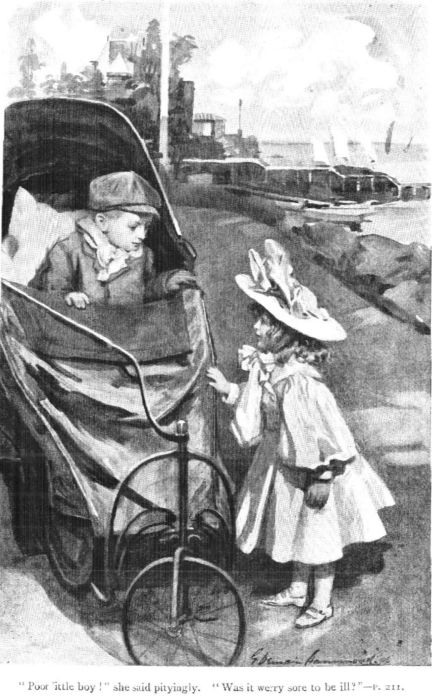
The old man did as he was told, and Jasper sat in his nest, warm and comfortable and perfectly content. Suddenly he heard a small voice beside him, and glancing round, he saw a very little girl gazing up at him with great interest, not unmingled with awe. She was a pretty little creature, charmingly dressed in white, looking about four years old, and she seemed to be quite alone. It was not in our little boy’s nature not to smile at her, and then she took courage.
“Is you hurted your foots?” she said; “can’t you walk or ’tand?”
“No,” said Jasper, “it’s not my feet. I’ve been ill and my legs gets tired if I walk much.”
“Poor ’ittle boy!” she said pityingly. “Was it werry sore to be ill? I’d like to kiss you, to make it better?” and she came close to the bath-chair, raising herself on tip-toe with the evident intention of kissing him. But a sudden remembrance flashed into Jasper’s mind.
“No, darlin’,” he said in great distress, “no, no. I were forgettin’. You mustn’t come near me. You mustn’t kiss me. Oh, I can’t explain. She wouldn’t understand. Is there nobody wif you—not your nurse or nobody?” he cried, on the point of tears by this time.
“Yeth, there’s Gran,” the baby was beginning, when another voice came from behind the chair, the new-comer having approached from that side.
“Why, what’s the matter, Lily?” it said; “you’ve not been teasing this young gentleman, I hope?” for Jasper’s distress was too plain to be unnoticed. “She is sometimes a little too friendly,” he went on, “though she means well, don’t you, my pet?”
“Oh no, no, she was sweet and kind,” said the boy; “please send her furzer away and I’ll explain,” and so he did—most clearly and sensibly—when the grey-haired stranger had called to the nursemaid, who now made her appearance with a donkey and donkey-boy whom she had been to fetch, and Lily was safely escorted off.
“I was only strolling about with her till the donkey came. She is my grand-daughter. And it is very good of you, my little fellow, to be so thoughtful, though I shouldn’t think there’s much risk now. You’ve been here some days, I suppose, and the sea-breezes blow away infection finely.”
“But he’s been pretty ill,” he added to himself, “or else he’s very delicate.”
“Do you always live in London?” he went on, and feeling interested in the child, by one or two kindly questions he drew out a good deal of the Fortescue family history.
“Fortescue,” he repeated, “and ‘Fareham.’ Why, then I’m your father’s tenant now! I must see if we haven’t some Fareham grapes for you—or I’ll tell them to send you some direct. Tell me your whole name, my boy;” and Jasper, well pleased, replied—
“Jasper’s my first name. ‘Jasper Greville Fortescue,’ that’s it all.”
The look of interest deepened on the gentleman’s face.
“Jasper,” he said musingly; “a very uncommon name, to begin with. But Jasper Greville, the two together! It’s an extraordinary coincidence, if no more.”
“Greville,” said Jasper, “Greville was Mumsey’s name ’afore she married Daddy, and I was called it after her Daddy, you see; and oh, there’s Mumsey herself,” as he caught sight of his mother coming towards them.
She looked a little surprised at seeing her boy on such friendly terms with a stranger, but a few words explained the whole, after which Mr Maynard introduced himself as the present occupier of Fareham. Then Evans was told to move on again slowly, Mrs Fortescue and Lily’s grandfather following.
“Mumsey’s” heart was soon won by Mr Maynard’s praise of Jasper.
“Such a thoughtful little fellow,” he said. “When I was his age I am sure it would never have entered my head to warn off any one when I was recovering from one of the illnesses so much commoner among children in those days. But your boy looks delicate—does London suit him? I’m afraid,” he went on, hesitating a little, “I’m afraid you must miss Fareham a great deal. We find it so healthy—Lily is twice the child she was. She and her mother live with us. My daughter’s husband was killed in the war.”
“How very sad!” said Mrs Fortescue gently. Then after a moment’s pause she went on—“Jasper has never been as strong as my other children, but I don’t think it’s the fault of London. We have always been there six or eight months of the year.”
“I know what would set him up,” Mr Maynard remarked. “A sea voyage! I am a great believer in sea voyages—had so many of them, you see, for I’ve spent most of my life in Australia.”
“Indeed,” said Mrs Fortescue with interest, for this explained the slight touch of abruptness in her new friend’s manner, as well as some small peculiarities of tone and pronunciation. “I wish we could send him—or take him, rather—a voyage, but it is now quite impossible.”
“Ah, yes—I suppose so,” he replied, but rather absently. Then he turned to her again with a kind of eagerness.
”‘Jasper,’ your little fellow is called, he told me—‘Jasper Greville.’ Excuse my asking if they are family names.”
“Yes,” said Mrs Fortescue, a little surprised, “they were my father’s. My name before I married was ‘Greville.’ We wanted to preserve them, for, strangely enough, my family has completely died out.”
“I have met ‘Grevilles,’” said Mr Maynard.
“Oh yes—there are plenty of Grevilles, but none with whom we can trace any connection. I was an only child, and so was my father. I was left an orphan very young and brought up by my mother’s people. ‘Jasper’ was the name for the eldest sons in our family for generations, I believe.”
“It is a very uncommon name,” Mr Maynard said. Then seeing Lily on her donkey coming towards them, he lifted his hat in farewell, just stopping for a moment to ask if he might venture to send some grapes to the little invalid—“Fareham grapes,” with a half-apologetic smile. And of course Mrs Fortescue thanked him, and gave him the address of their present modest home.
And the next day, and several other times besides, the grapes arrived—and a lovely basket of flowers with them. But of Mr Maynard and his little Lily they saw no more.
“Most likely,” said Mrs Fortescue, “they only drove over from Fareham for the day, to give the child a breath of sea-air. But I am glad to have seen them. It is pleasant to think that kind, nice people are living at dear Fareham.”
How surprised she would have been if she had known the thoughts in Mr Maynard’s mind as he walked away, after his talk with her!
“I will write at once,” he said to himself. “It is better to hear from old Greville first before speaking of the possibility to them. He may be dead—in which case he will have left everything to public object—hospitals and so forth, as he said to me. What a sweet woman she is, and that dear boy! I can write with real interest about them, and sympathy. Things must have been very hard upon them, I fear.”
A week or two more brought the visit to Seabay to a close. Jasper, by this time, was able to take a fair amount of exercise on his own little legs, which were a good deal firmer and stronger than when he first came. Mrs Fortescue, too, was feeling rested and refreshed, and she was delighted to return home and be all together again. For Aunt Margaret’s letters continued to give very cheering accounts of her two charges.
“They really are earnestly trying to overcome all the tiresome habits and thoughtless ways which made us so anxious about them,” she wrote, “and this is truly encouraging, as it shows that the impression made on them has not been a passing one. Of course there are—there must be—fallings back and disappointments sometimes, but even from these they may learn new experience and strength.”
The little house in Spenser Terrace had been thoroughly disinfected and was looking fresh and bright in the sunshine—for it was a real “May day”—the afternoon on which Jasper and his mother returned home. The boy was in a state of happy excitement, and his cheeks were flushed and rosy as the four-wheeler drew up at the door.
“It will be so nice to be wif zem all again,” he murmured, adding to himself, “and I are so glad Chrissie told about that church-book.”
Yes—there they were—all at the door to meet the travellers. Aunt Margaret, Leila and Christabel, and Roland, just back from his tutor’s.
“Darlings,” exclaimed their mother, “what a long, long time it seems since I kissed you all!” and—
“Darlin’s,” echoed Jasper, “and we’ve brought some grapes from Fareham. That kind man sent us lots! Didn’t he, Mumsey?” and he had quite a story to tell his sisters about “meetin’” the little girl on the seashore, with her grandfather, and how “frightened” he’d been of her kissing him and catching the fever, and all the rest of it.
“He’s not looking ill, I don’t think,” said Christabel when she was alone with Leila. “His face was quite nice and rosy.”
“Just at first,” replied Leila. “He was so glad to see us all. But he looked very white after tea, and his cheeks are very thin,” and she sighed.
“Well,” said Chrissie, with a touch of the sharpness she was trying to overcome, “you needn’t be so gloomy about him. I’m going to be gooder to him than I’ve ever been, and if you are too, he’ll just get fat with happiness.”
And so daily life got back into its usual round again. But with—oh, such a difference!
“Everything seems so much nicer at home now,” said Christabel one day with satisfaction. “Of course it may be partly the weather,” which was very bright and pleasant during that early summer.
“Yes,” said Aunt Margaret, “if you include the invisible ‘weather’ as well, Chrissie dear, I can quite agree with you,” and though Jasper looked rather puzzled, the little girls “understood.”
Chapter Thirteen.
From across the World.
I have reached, I see, the thirteenth chapter of my story! And thirteen is supposed to be an unlucky number. Nevertheless, I scarcely think it would be fair to any children who have read to the end of chapter twelve, to stop short there, even though things are now in a much happier position in the little house at Spenser Terrace than they were a few chapters back.
Besides, I really have something more to tell about my small hero and his family, and though at first it may not sound very cheerful, I think, before we have to say good-bye to each other, you will agree with me that this time the number thirteen does not bring bad luck with it. So now I will go on with this family history.
That early summer, even in the rather dull out-skirt, where Spenser Terrace is situated, was really bright and pleasant, and for some weeks after the return from the seaside no one felt specially anxious about Jasper, though he certainly did not gain strength very satisfactorily.
“It takes a good while for a rather delicate child to recover thoroughly from such an extremely sharp attack as his was,” said the doctor when he called one day. “Of course it would have been better to have kept him much longer at the seaside or in the country. But no doubt, when the weather becomes hot, you will be planning another change for him. It would not do for him to be in London if it grew oppressively warm.”
And Mrs Fortescue did not like to say how exceedingly difficult it would be to manage any change of any kind for any of them! The expenses of the illness and all it brought about had already exhausted the very small sum they were able to scrape together, beyond what was actually necessary for every-day life, and the prospect of sending Roland to Winton by the autumn was growing sadly uncertain. But to Dr Wilkins, though he was such a very old friend, poor “Mumsey” said nothing.
“It would look,” she thought, “as if I was hinting for him to invite Jasper to his own country house—and even if he did so, I could not let the darling go without a nurse or a maid of some kind, and Mrs Wilkins is rather too old to be troubled with children. It was most good of her to have Roley, but of course he is able to look after himself.”
So indeed—remembering his seven years only—was Jasper; quite wonderfully self-helpful and independent. Or rather he had been so before his illness. But of late, more than once, his mother had said to him, laughingly, that he was “growing into a baby again;” he was so clinging and quiet, though always sweet and unselfish.
“Everything’s so tirin’, Mumsey darlin’,” he said, “and Lelly and Chrissie does spoil me so. They’se always fetchin’ my fings, and they won’t never let me run messages, scarcely. But please, Mumsey darlin’, might I not go out a walk to-day, but just stay here ’aside you?”
And day by day the pitiful little request was repeated, though it had to be refused. For even if the small legs ached and the feet dragged along rather painfully, air, fresh air, he must have, if he was ever to get stronger, or even not get worse!
“I wish we had old Evans and his bath-chair here for you,” said his mother one day, feeling rather in despair.
“There is a stand of them about a mile off,” said Roland.
“I know,” replied she, “but the hire is very dear. Nearly as much as a hansom, and they would charge extra to come so far, I suspect,” with a sigh.
Now and then the little patient cheered up and grew more like his old active little self again. Sometimes on a Saturday afternoon his father took him an hour or two’s drive in a hansom, which nowadays was, of course, a great treat, and brought some colour into his cheeks. But, alas! it soon faded again, and he seemed more tired than usual on Sunday morning, so that there was no question of church for him, and Jasper liked going to church! Then, as June advanced, there came a spell of August heat, and though it lessened somewhat after a few days, it left him whiter and thinner and more exhausted.
“We must do something,” thought Aunt Margaret, “or he will be slipping out of our hands altogether,” and that afternoon she shut herself into her own room for some time, to decide what that something must be. “Yes,” she said to herself, “I must do it, but I will tell the dear little girls first. It will do them no harm to be consulted,” and she quietly called them to come to her.
She was seated at her writing-table, with two or three small, somewhat old-fashioned, jewel cases before her.
“Leila dear, and Chrissie,” she said as they came in, looking rather surprised at her summons, “I am going to confide in you. We are not happy about Jasper. He is not improving, and he must have country or sea-air if he is ever to grow quite strong.”
“I know,” said Leila, growing pale. “Chris and I are very miserable about him, aren’t we, Chrissie?—for of course—” but here her voice failed her: and as for Chrissie, she was already in tears.
“The lesson has been a lasting one,” thought their aunt, and she was thankful to see it. But she was not one to “break the bruised reed.”
“Leave the past, darlings,” she said, “that is all over and forgiven. What I want to tell you is that you may help me to do something for our dear boy,” and as she spoke she opened two ring boxes, showing their contents. There were two beautiful, though not very large, diamond rings—of different designs, but about the same size. The children gazed at them in admiration.
“These are the only jewels of any value that I have kept,” she said, “and they are not very valuable, but they are old family ones, and I meant them for you two. I know the pair would sell for forty or fifty pounds—enough, with care, to get a little country cottage for two or three months where we could take it in turns to be with Jasper. But I count them really yours, you see?” and she looked up at them.
“Oh, sell them, sell them. Auntie darling,” cried both the children together. “Thank you, oh, thank you, for letting us join in it. When can you settle about it, dear Auntie?”
“To-morrow morning, I think,” was the reply. “I will tell no one but you two, dears, and perhaps Mummy will let one of you go with me to a jeweller I know. I am rather nervous about omnibuses still. And then when we bring back the money, we will all three together give it to your mother, and talk over what will be the best place. Perhaps Seabay again—it seemed to suit him.”
And so it was settled. But, strange to say, the plan was not carried out! The dear old rings were never sold. They are on Leila’s and Chrissie’s fingers at this very moment. And how this came about, I must hasten to tell you.
Something had happened which even Aunt Margaret had not yet been told. “We must not raise false hopes till we know more about it all. Dear Aunt has been through so much strain already,” Mr and Mrs Fortescue had thoughtfully decided.
But at the very time that the consultation was taking place about the rings, another and most important one was being held in a private room at a certain hotel, where, after several letters had passed between Mr Fortescue and his tenant at Fareham, it had been arranged that the three—for Mrs Fortescue was particularly required—should meet.
This was the subject of it. You will remember that Mr Maynard had been strangely struck by the name “Jasper Greville.” It was that of a very old man—a gentleman—whom he had known for several years in Australia. This Mr Greville had been foolish and extravagant in his early youth, and having wasted what money he had—not very much after all—had been shipped off to the colonies by his relations, none of whom, as he was an orphan and an only child, cared very much what became of him, except one cousin, who had gone to Liverpool with him and done what he could for his comfort, till he sailed. And this the emigrant never forgot. Tears and years afterwards he wrote to his kind namesake—they were both “Jaspers”—to tell of his prosperity; but the letter was never answered, for by some mistake in the address, it was never received. And as the Australian was by this time happily married and the father of several boys and girls, and full of home interests and business, he never wrote again.
Life had opened sadly for him, and now, when he was over eighty, it seemed as if it were to close in the same way. For after many happy years, sorrow after sorrow fell upon him. His wife died, then his daughters; then again, after some years’ interval, his two sons, in the prime of life, and last of all his twin grandsons, the last of his children, on whom all his hopes were centred, the sole heirs of his large fortune! And then all seemed at an end for the poor old man.
“What do I care for possessions on this side now?” he had often said to his friend, Mr Maynard. “It is not a case of ‘moth and rust’ with me—it is even sadder from this world’s point of view, though not really so,” for he was a true Christian. “I can look forward to the better country where my dear ones are waiting for me. Still, I must not be selfish: I must make some use of my wealth. I will leave a fair amount for good charities here, where it has been made, but besides this Maynard, if you should come across any of my name in England, let me know. ‘Jasper Greville,’ remember—not Greville only; of Grevilles there are plenty, but my branch was always marked by ‘Jaspers.’ I fancy, however, they have all died out. There were never very many of us.”
And so they had—all died out, except “Edith Greville,” now Mrs Fortescue, the grand-daughter and only descendant of the kind cousin.
She—when she heard what I have just related—remembered vaguely the story of the poor lonely young fellow whom her grandfather had comforted, and this was an additional assurance that there was no mistake about the relationship.
Now good Mr Maynard had lost no time in writing to his aged friend at the antipodes, though very doubtful as to the letter finding him still alive. But it had done so—and the reply, just a few days ago received by Mr Maynard, was the reason of his correspondence with Mr Fortescue, and the present talk at the “Marvellous Hotel.” For the contents of old Mr Greville’s letter were most important, as it brought an urgent request that Mr Maynard would do all he possibly could to persuade the old man’s newly-discovered relations to pay him a visit, in his far-away home, without delay. And this was the subject of the consultation.
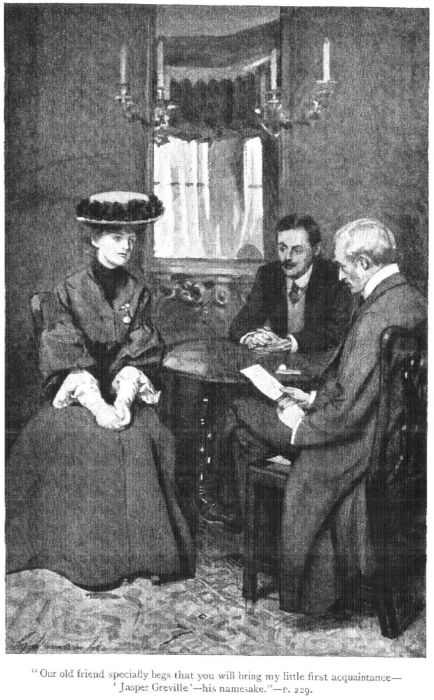
At first, of course, it seemed a very startling idea, and Mrs Fortescue grew pale with nervousness.
“To leave them all and go so far,” she murmured, but Mr Maynard caught the words.
“Not all,” he said gently. “Our old friend specially begs that if possible you will bring my little first acquaintance—‘Jasper Greville’—his namesake. You see I wrote very fully to him, giving every detail. I even told him of your boy’s illness and delicacy. It will really be a curious coincidence if my prescription for him, ‘a long sea voyage,’ should come to be followed! And,” he went on, hesitating a little, “as—as this letter explains, expense must be no consideration,” and though he said no more, his visitors fully understood that the unexpected and tremendous change in their means and position had been thoroughly explained to the rich relation at the other side of the world.
Then another difficulty struck Mrs Fortescue. She turned to her husband.
“Your post, Reginald?” she said. “Will you not lose it if you are away for six months?”
But it was Mr Maynard who answered her.
“Not necessarily,” he said. “In fact I can assure you that if Fortescue cares to resume his present work, the place will be open for him. I have plenty of influence in that quarter. But, my dear lady,” he continued, and his tone grew more earnest, “you scarcely realise the whole position. If you accede to Mr Greville’s wish, and start without delay, it will certainly mean that he receives you as his heir—or heiress—and he is very rich. You are his only living relatives—except possibly some very distant cousins—there is nothing unnatural about it; nothing to hurt your reasonable feelings of independence—”
“No, I see that,” she said gently. “It is very, very good of Mr Greville all the same. Most old people grow selfish and give themselves as little trouble as they can.”
“That is not his character,” replied Mr Maynard; “and remember, there is the association of long ago kindness received from your grandfather, which he has never forgotten. My only anxiety is that there should be no delay. Mr Greville is aged and very far from strong. If you consent, I will cable to tell him so, this very day. And the sooner you start, the better for the boy, I should say.”
And I do believe it was this last consideration as much as the prospect of a return to freedom from anxiety as regarded money, that at last carried the day with Jasper’s “Mumsey.”
It was astounding news—was it not?—that Mrs Fortescue carried back to Spenser Terrace that afternoon, when she left her husband and their kind new friend to go on to the City, and she herself hurried home. Aunt Margaret, of course, forgetting all about herself and the trouble and responsibility this unexpected move might bring upon her, was strongly of opinion that the decision was a right one.
“Have no anxiety about the girls and Roley and me,” she said at once. “We shall be all right. If we can afford to go for two or three weeks to Seabay, that will keep us all well and strong, I hope, and we may very possibly be together again by the New Year.”
Mr Maynard’s instructions to do everything to smooth away difficulties had been most liberal, and when things have to be done quickly, and there is no lack of money to do them with, it is astonishing how speedily they can be managed. Within ten days of the talk at the Hotel, the three travellers, pale little Jasper and his parents, were on board ship and on their way. The parting was a terrible wrench—it could not but be so; and though none of the group put their fears into words, there were sad misgivings in all hearts, when our brave little boy hugged each dear one in turn, choking back his own tears and sobs, and promising to get “kite, kite well again,” and come back with Daddy and Mumsey for Christmas.
And before very long, letters from various points on the way began to drop in—and after a little longer, a cable to Mr Maynard, sent on by him without a moment’s delay, you may be sure, which, being translated by his “code,” told of “safe arrival, all well, Jasper especially.”
And the refreshing visit to Seabay was paid, and Roland did go to Winton at the October term, without dear Aunt Margaret’s rings needing to be sold, and the letters that she and her little nieces sent by every mail, had happy and cheering news to give of the peaceful and busy home life in the small house in Spenser Terrace, though, of course, they all ended with the same chorus—“oh, how we long for you to come home again.”
Christmas came and went without bringing this joy. For just as Jasper and his parents were on the point of starting on their return, old Mr Greville, who had revived wonderfully for a time, refreshed and cheered by the presence and affection of his newly-found relations, died suddenly—peacefully and painlessly—at the great age of eighty-seven. And this delayed their leaving. It was not till the end of January, just about a year from the time we first made the acquaintance of Chrissie and her stockings, that the three travellers came home at last. I think happy times of this kind are difficult to describe, but less difficult to picture in one’s own mind, especially for those who have themselves known the exquisite delight of “being all together again” after separation, and no doubt some of my unknown little friends have had this joy.
There was nothing to spoil the return. Jasper was taller and plumper and ruddier than he had ever been in his life; his father and mother glad to feel that their visit had given happiness as well as brought it to themselves and their dear ones; for the future now looked very different from what had been the case a year ago. There was even a prospect of having Fareham as their country home again before very long, as Mr Maynard had begun to rebuild a charming old house in the neighbourhood which he had bought, and intended to settle in, as soon as it was ready.
And many good and happy plans gradually took shape in the children’s minds as to how others, less fortunate than themselves, should be made to benefit by their prosperity—ideas suggested, in great part, I feel sure, by their close companionship with their Aunt Margaret.
“Ever since I were so ill,” said Jasper one day—his English by this time being almost quite “grown-up”—“ever since I were so ill, I’ve thought I’d like to make a beautiful big house at the seaside for poor children who’ve been ill, too, to get well in. And I’d have lots of bath-chairs and donkeys for the weller ones.”
And who knows what may come of the idea some day?
“But in the meantime,” said Leila, “as soon as ever we’re settled in our big new London house, Aunt Margaret and Mumsey are going to have a room on purpose for us to have some poor children—not ill ones, of course—at tea, once a week. Won’t it be nice?”
“There’s to be a piano for them to dance to, and all sorts of things,” added Chrissie.
“And lots and lots of cakes and buns,” said Jasper.
His sisters laughed.
“Why, Japs,” said Chrissie, “you used never to care about nice things to eat.”
“But you see I’m always hungry now,” he replied with satisfaction, “so it make me think that lots of them must be hungry too—awfly hungry sometimes, I daresay.”
“Well, they must have plenty to eat when they come to tea with us,” Chrissie agreed, and I am quite sure they did.
The End.
|
Chapter 1
| |
Chapter 2
| |
Chapter 3
| |
Chapter 4
| |
Chapter 5
| |
Chapter 6
| |
Chapter 7
| |
Chapter 8
| |
Chapter 9
| |
Chapter 10
| |
Chapter 11
| |
Chapter 12
| |
Chapter 13
|