Mrs Molesworth (continued 2)
Reading edition
She grew scarlet when she felt all eyes upon her.
“I can’t tie up my hair myself,” she said. “I have brushed it and combed it, and it would have been all right if Chrissie had helped me a little, instead of standing mocking at me and throwing all my things about and—” here her voice broke, she was evidently on the point of bursting into tears.
“Christabel, will you have bacon and eggs?” asked her father.
“Yes, please, Daddy,” she replied calmly, though she darted a look at Leila that was not good to see.
“And you, Leila?” he continued, turning again to the older girl.
“Nothing, thank you,” she murmured. “I’ll have some bread and butter.”
“As you please,” Mr Fortescue said. Then he helped Chrissie, and when her plate was before her, he looked at both children.
“This is our first Sunday morning in the new little home which your mother and I are doing our best to make a happy one for you. If you choose, wilfully and foolishly, to quarrel, do so. I shall not pity either of you. But one thing I will not allow, and that is, that your tempers are to upset the comfort of the rest of the family. So I give you fair warning. You must behave properly when you are at table with us.”
Neither answered. Christabel went on eating, though with a slightly contemptuous expression which her father and mother thought it wiser to pretend not to see. Leila choked down her tears and munched away at what would have been dry bread, had not Jasper quietly put a pat of butter on her plate.
And Roland and his father began talking about the weather, the fors and againsts of frost setting in and the chances of skating, as if no such silly, disagreeable little girls as Leila and Christabel were in existence. And Mrs Fortescue made little jokes with Jasper, and poured out second cups of coffee in a most matter-of-fact way. For once, I think, both the foolish, ungrateful children began to feel themselves rather small, and the rest of the day passed fairly well, though, but for their mother’s hurrying through with her own dressing, so as to be able to superintend theirs, I much doubt if either Leila or Christabel would have been ready for church, or fit to be seen when their father called them.
Mrs Fortescue did not speak till she was leaving their room, then she said quietly—
“Leila and Chrissie, I have helped you to dress this morning because I could not bear to have another scene, especially as it is Sunday. But from now, I warn you, I cannot and will not do for you what you are perfectly able to do for yourselves. When you do need help, you shall have it, and I can make allowance for things being difficult for you just now, but I will not help you to make them more difficult for yourselves. When you come in from church, you must put away your out-of-doors things and make the room perfectly neat,” and so saying, she left them, without giving them time to reply.
“I hope you’re pleased,” said Christabel to her sister, as soon as the door had closed. “You know it all began with your refusing to get up.”
Leila did not answer. She was naturally more timid and less high-spirited than Christabel, but in some ways more difficult to manage, owing to her indolence and dreaminess.
“Oh, well,” continued Chrissie, “if you like to be sulky I’m sure I don’t mind. Any way, it is a satisfaction to learn that you won’t have any story-book all to-day.”
Her tone was most provoking; Leila would have liked to turn upon her, but she was afraid of beginning to cry, so with some difficulty she remained silent till Chrissie had flung out of the room.
“I wish they would let me go to school,” she said to herself when she was alone. “I don’t mind lessons, I only want to be left in peace. I’m sure they might find some cheap school, and when I’m old enough I’d ask to be kept on as a governess. I will ask Mummy about it. If Roland’s the eldest boy, I’m the eldest girl, and if they pay hundreds of pounds for him to go to Winton, they might pay something for me.”
The idea seized her fancy. There was a touch of “romance” about it. She pictured herself working hard at school, becoming a teacher herself at an extraordinarily early age, earning enough to be no longer a burden on her unnatural family, whom she would only visit at rare intervals and for a very short time.
“Perhaps they would begin to wish they had treated me differently,” she thought. “Perhaps even Chrissie would find out that everything wrong was not my fault—yes, when it was too late,” and with her usual habit of fanciful dreaming, she occupied her thoughts almost the whole of church-time, I fear, by picturing herself as the heroine of this touching and romantic story. And poor Mrs Fortescue, catching sight of her little daughter’s charming face, her dark eyes gleaming with interest, said to herself that Leila was really very open to good impressions. “I am sure she is making all sorts of excellent resolutions. Poor dear, I must not be hard upon her, nor upon Chrissie either,” though Christabel’s face still looked resentful and obstinate.
Chapter Six.
Dusters.
Monday morning brought considerable improvement. That is to say, Leila, having no book to read, and in her secret heart still faithful to the character of innocent and unappreciated martyr which she had imagined for herself, got out of bed almost as soon as she was awakened, dressed herself in silent dignity, and even offered to help Christabel.
“No thank you,” Chrissie replied loftily, “I don’t want any one to do anything for me except tying my hair, and Harriet can do that much, I suppose.”
“Mother has told her to come for ten minutes, at eight,” Leila replied meekly, glancing at Chrissie, and at the little bee-clock on the mantelpiece, which told that eight o’clock was fast approaching; much nearer at hand, according to present appearances, than the completion of Chrissie’s toilet.
“And you think I won’t be ready,” replied Chrissie. “Well then, you’ll just see,” and she rushed at her clothes in a rapid but very helter-skelter fashion, stopping, however, with her skirt half over her head, to have another fling at Leila. “What’s the matter with you this morning?” she said. “Why do you say ‘mother,’” and she copied her sister’s subdued tone of voice in a very irritating way, “like that? What a prig you can be, Leila! For my part I’d rather you were as lazy as a dormouse, staying in bed all day if you like, than to be so affected and lackadaisical.”
No answer to this tirade was vouchsafed, and just then Harriet knocked at the door.
“All right,” called Chrissie, “I’m ready—readier than Miss Leila, Harriet,—she hasn’t fastened her belt yet, and nowadays it’s got to be first come, first served, so here’s my comb—hurry up.”
Harriet was young and countrified, and, to tell the truth, rather in awe of “the young ladies,” whom hitherto she had only heard of in her aunt’s letters as beings not far removed from little princesses. So she gave a half-nervous laugh, and set to work at Christabel’s thick curls, Leila—her belt fastened by this time—standing by with a solemn, resigned expression of face.
As a rule it was no easy task to “do” Miss Chrissie’s hair, the owner of it being given to amusing little excursions about the room during the process, dragging her unfortunate attendant after her, in spite of all remonstrances. But this morning, out of sheer contradiction I fear, she stood like a lamb, and as soon as the ribbons were tied, dashed off, shouting, “Who’s first—who’s first? Who’ll be first downstairs after all?”
“Chrissie, Chrissie,” Leila called out, and this time she really meant well, and had forgotten for the moment all about being an innocent martyr, “Chrissie, you haven’t said your prayers, and your—”
But a whistle from the staircase—plainly heard, though it was not a very successful one, as Christabel had been true to her rule of not shutting the door—was the only reply, and Leila sighed.
“Miss Chrissie do be a high-spirited young lady,” quoth Harriet with a respectful little cough.
“What did you say?” asked Leila, as if awaking from a dream. “Oh yes—you wouldn’t think I was only a year and a half older than she is, would you?”
“No indeed, Miss,” was the reply in an awe-struck tone, and again Leila sighed and retreated to her self-chosen character of unappreciated heroine.
It was rather provoking, though entirely her own fault, that, in spite of her prompt getting up and irreproachable behaviour, she was not down early. For only when her little brother tapped at the door did she again glance at the clock, and started to see that it was already twenty-five minutes to nine.
“Lelly, Lelly, Mumsey’s sent me for you. We’re all down ’cept you.”
Leila opened the door.
“Oh dear, it’s too bad!” she exclaimed. “I’ve been ready ever so long. I got up ages before Chrissie.”
“Never mind, poor Lelly,” said Jasper consolingly. “You’se not really late. Nobody’s vexed wif you. And you do look so neat,” he went on admiringly, as hand-in-hand they hastened downstairs. “Chrissie seems all—all in a muddle,” he added anxiously. “I saw Daddy lookin’ at her rather funnily, though he didn’t say nothin’.”
“It’s her own fault. I shan’t be sorry for her if she gets scolded,” said Leila. “She only hurried down to be before me.”
And when she caught sight of her sister at table, she really felt surprised that her father’s annoyance had been only shown by “funny” looks. Christabel—except that, thanks to Harriet, her hair was fairly tidy—might have passed for a well-to-do scarecrow. Her collar was all on one side, her blouse buttoned crookedly, her face far from clean—her hands and nails—but perhaps it is better not to enter into particulars as to these! She seemed quite pleased with herself, however, and mixed in the conversation even more than was called for.
“It is going to be a very wet day, I fear. It is such a pity. I had so hoped it would be bright and clear,” said Mrs Fortescue.
“Why do you mind, Mumsey?” asked Christabel. “It’s hotter than if it had been yesterday and we’d had to paddle to church in the rain. I think it’s much the worst for us now when it’s wet—with nowhere proper to play in.”
“Your mother was not asking your opinion,” said Mr Fortescue drily, and Chrissie’s face darkened. She hated being “snubbed” more, I think, than anything else in the world, but no one took any notice of her annoyance, and her father went on speaking to her mother as if there had been no interruption.
“You must not think of coming to the station,” he said. “You would probably catch cold, for—” and for once, poor man, he sighed a little, “you would come in an omnibus, I am sure, and on a day like this you might have to wait some time to get a seat. Much better stay quietly at home, and have everything ready and comfortable for her when she arrives.” He hesitated a little. He was on the point of adding a word or two, almost of appeal, to the two girls, but Christabel’s cross expression and Leila’s air of dreamy self absorption were not encouraging.
“Very well, then,” Mrs Fortescue replied, though with evident regret. “Perhaps you are wiser about it. Then we may expect you about—when—four o’clock?”
“Yes, or a little later,” was the reply, as Mr Fortescue rose to go, Roland having already hurried off.
“And mayn’t I help you, Mumsey?” whispered Jasper, edging up to his mother. “If only there was some flowers in the garden to put in her room!”
“Perhaps she will bring—” Mrs Fortescue was beginning, when Chrissie interrupted.
“What are you talking about, Japs?” she said pertly. “Flowers—in the middle of winter, even if there was a garden, which there isn’t. What does he want them for, Mums?”
Her mother looked at her in silence for a moment. She had stood up and was holding Jasper’s hand tightly in her own, almost as if the touch of it strengthened and cheered her. Then she said quietly—
“You cannot have forgotten surely, or if you have you should not have done so, that Aunt Margaret is expected to-day, and naturally we want to make her coming to us—the only home she has now—as bright and happy as possible.” Christabel tossed her head. “I was going to say, Japs dear,” she added to the child, “that very likely there will be some flowers from the Fareham conservatories. The last we can have! But it will be nice if there are.”
“Mayn’t we have some in our room?” asked Leila suddenly. The word “flowers coming” had caught her ears, though she had heard nothing else.
“I cannot say till I see what there are,” replied Mrs Fortescue, and Leila relapsed into silence, and turning to the window, stood gazing out at the rainswept street.
“Even a few flowers grudged me,” she thought. “I wish I hadn’t asked for them,” and indeed the doing so had been an impulse not at all of a piece with her attitude of “suffering saint.”
“Chrissie,” Mrs Fortescue began again, “did you look at yourself in the glass before you came down? you had better do so now. You are inexcusably untidy.”
“Am I?” said Christabel airily. “Well, yes, my collar’s crooked, I feel.” She gave a tug to it, but in the wrong direction, which did not improve matters. “It was all.”
“You’re not to say I had anything to do with it, or you, this morning,” snapped out Leila.
“Hush,” said their mother. “Go upstairs, Christabel, and dress yourself properly, and above all, wash your face and hands carefully.”
“I did wash them—at least I think I did, after I got out of my bath,” Chrissie replied. “They can’t have been very bad or Dads would have noticed them.”
“I am quite sure he did, but we did not want another breakfast upset by you children, like yesterday,” said Mrs Fortescue. “Go now and do as I have told you,” and Chrissie went off, pretending to whistle. “Leila,” she continued, “what are you intending to do this morning?”
“Mayn’t I have my book back?” asked Leila, “I did get up early.”
“It is in the drawing-room,” her mother replied. “Yes, you may have it, but in the first place I want you and Chrissie to help a little in the house. I am thinking of leaving the dusting of the drawing-room every morning to you, if you will be very careful with the ornaments. Harriet sweeps and brushes and does the fire of course, early, but the dusting takes time, and she is very busy in the mornings.” Leila stared.
“Us dust—like housemaids,” she said, and a sharp pang of disappointment went through her mother, for she had really expected that the little girls would have felt interest, and even pride, in taking upon them the charge she proposed—a far from difficult or disagreeable one.
Leila, not observing her mother’s change of expression, went on coolly.
“What’s the hurry with the drawing-room?” she said. “The fire’s not to be lighted first thing, I suppose. Harriet can surely dust it before the middle of the day.”
“No,” replied Mrs Fortescue, “I do not think she can. Certainly she could not do it properly. At your age I should have been very proud of being trusted with a little work of the kind; besides—”
“I daresay, Mummy, you were an angelic child, and certainly neither Chrissie nor I pretend to be anything of the sort; it seems to me that fathers and mothers always were pieces of perfection by what one hears them say of themselves.”
Her words were almost impertinent, but her tone sounded as if she were half in fun, so her mother took no notice of the interruption: “besides,” she went on, “the drawing-room from now must be ready early for Aunt Margaret. She must have all the comfort we can give her.”
“Aunt Margaret,” repeated Leila, opening her eyes very wide. “But it’s not fixed about her coming, is it?”
Then Mrs Fortescue’s patience began to give way.
“Leila, you are too bad,” she exclaimed. “What have you been thinking of all this time? You heard your father talking of going to the station? You yourself asked if you could have some of the flowers? You must have understood that Aunt Margaret is coming to-day—this afternoon.”
Leila looked rather foolish.
“To-day,” she repeated lamely. “I—well, yes, I remember about the flowers, but I thought they were being sent up from Fareham as usual.”
Perhaps for peace’ sake it was as well that just then Harriet came in to clear the breakfast-table, and Mrs Fortescue hurried off to her morning interview with Susan in the kitchen, leaving Leila still staring out of the window. But the clatter and bustle of Harriet’s rather clumsy movements fidgeted her. She turned to the door and made her way slowly into the drawing-room.
“I may as well get my book,” she said to herself, though I hope that in her heart there was some faint intention of fulfilling the task her mother had spoken of. Arrived in the drawing-room, she stood still and looked round her.
“So this, the only decent room in the house, is to be given up to Aunt Margaret,” she thought, “and we’re to be her servants! Well—it’s all of a piece: but Chrissie won’t stand it, and it will all fall upon me, no doubt, like everything else disagreeable. Yes I would far, far rather be a governess, or even what they call a pupil-teacher, in a school, than be treated like a servant in my own home. If only I were a little older.”
Then her eyes fell on her book. She took it up and sat down, fingering the pages.
“I can’t dust without a towel or a cloth or whatever they call it, and I don’t know where to get one. I may as well read till Chrissie comes down,” and in two moments she was lost to everything outside her story.
Luckily, however, as she probably would have caught cold from sitting still in a fireless room where the window was still slightly open at the top, and the door, of course, ajar—luckily, she was not long left in peace. A clatter and dash down the staircase, and Christabel’s voice—
“Where are you, Lell? Answer, can’t you?” as she dived in and out of the dining-room, without finding her sister. “Oh, there you are! You can’t be hidden for long in this cupboard of a house.”
Her good-humour seemed restored, and as Leila, unwillingly enough, glanced up in response to this summons, she saw that Christabel, if not very tidy as yet, still looked better than at the breakfast-table.
“What are you doing? Oh, reading of course. I say, it’s freezing in here. Don’t you see the window’s half open and there’s no fire. Why don’t you stay in the dining-room? There’s no one there,” Chrissie went on.
“Mother will be coming there directly, and I don’t want her to see me just now,” said Leila. “Chrissie,” she went on, feeling too much in need of sympathy to keep up her rôle of solitary martyrdom. “Chrissie, what do you think Mummy’s just been telling me? Shut the window, can’t you, if you don’t like it open. I’m sure I don’t care whether it’s open or shut—I’m far too miserable;” and Chrissie, her curiosity aroused, for once obeyed without a murmur, and then turned eagerly to Leila.
“What?” she asked, “are we to be sent to school?”
Leila shrugged her shoulders.
“I only wish it was that,” she said. “No—of course they’d say a good school would cost too much, and they couldn’t send us to a common one. No, it’s nothing about lessons. I daresay we shan’t be taught any more—it doesn’t seem as if we’d need to be! No—it’s this—you and I are to be housemaids!”
“What do you mean?” exclaimed Christabel, “you are talking nonsense.”
Leila explained, but to her chagrin she did not meet with the sympathy she expected. On the contrary, Christabel’s eyes sparkled.
“Dusting the drawing-room,” she repeated. “Oh, I don’t mind that. It will be fun. I shall like it, at least,” she added candidly, “till I yet tired of it. I’d much rather do it than tidy up our own room.”
“You may be quite sure you’ll have to do both,” said Leila gloomily, “and you’d better not talk about getting tired of it.”
“Well, any way, I’m quite ready to begin at once,” said Chrissie. “Where are the things—dusters—and soft brushes—feather brushes; I’ve seen them using them for china ornaments, haven’t I?”
“I don’t know,” groaned Leila, without moving; and with a contemptuous “you are a lazy idiot,” Chrissie darted off. But she was brought to a sudden standstill in the doorway by running against Jasper, who was making his way in, carrying some cloths, and one or two brushes, among them a feather one, which he evidently much admired, as he held it aloft. It was of several colours.
“Isn’t it pretty?” he said. “It’s to stay in the droind-room, Mumsey says, just to be used a werry little—for the bestest orniments, I s’pose. But here’s another one, and lots of dustiners for us all.”
“Dusters, you silly,” corrected Chrissie, “but, they’re for Lell and me, Japs. You can’t dust.”
“Mumsey says I might ’elp,” he exclaimed, for his “h’s,” like those of all young children, still sometimes deserted him, when he was very eager. “I’ll be werry careful—Mums said I might do the tiny iv’ry figures—what Dads brought from Inja, you know,” and he pointed to some curious and valuable little carvings, which Mr Fortescue had not found it in his heart to part with.
Chrissie glanced at them.
“Well, you couldn’t very easily break those, I suppose,” she said. “Give me a duster: and Lell, wake up, can’t you?”
Leila slowly rose and looked about her. There was really not very much fear of the amateur housemaids doing any damage, for Mrs Fortescue had taken care to place the few ornaments of value in a glazed cabinet, and only left out several pretty but not very rare or irreplaceable things, just to give the room a bright and homelike look. And one side-table was left quite bare.
“We must put some things—books any way,”—said Leila, “on that table—it looks so silly with nothing at all;” and she was on the point of doing so, for, in spite of herself, she was beginning to enter into the spirit of their new occupation a little, when Jasper stopped her.
“That table’s to be for Aunt Margaret,” he said. “She’ll keep her books and things there. And there’s a nice deep drawer—that goes down quite low, you see,” he opened it as he spoke, “for her work, Mums says.”
“How do you know about it?” asked his sisters, rather sharply. “You are such a prig,” added Chrissie.
“Mumsey showed it me when we was settlin’ about the dustin’ this mornin’,” he replied calmly.
Leila and Chrissie looked at each other.
“Really,” said the former, though in a low voice, “I do think mother should talk to us about what she is going to make us do before she discusses it all with a baby like Jasper.”
Christabel did not at once answer. She was less of a self-deceiver than Leila, and she knew that neither she nor her sister had behaved in such a way as to let it be easy or pleasant for their mother to consult them about the new state of things.
“I don’t suppose she said much to him,” she replied, “and he’s not a bit a tell-tale—he never makes mischief. He’s really a good little fellow—much better than we were at his age, or than—”
“Speak for yourself, if you please,” interrupted Leila crossly. She had a very shrewd suspicion what the end of the sentence was going to be and she did not want to hear it.
Christabel set to work in her usual energetic way. Jasper had already been at his corner steadily for some minutes. He rubbed at the chairs as if they were ponies that he was grooming, calling out to his sisters to look how he had made the wood shine, and seeing him, and Chrissie too, so active, Leila caught the infection, and being the tallest of the three, took the mantelpiece ornaments as her special department, and found to her surprise that she really enjoyed “housemaiding.”
So that the dusting proved quite a success, and when Mrs Fortescue, having given her orders downstairs and seen to the last arrangements for their expected guest upstairs, glanced in, to see what they were all about, she was pleased and surprised to hear cheerful voices and to be met by bright faces.
“We’ve done it, Mummy—all, splendidly. I don’t believe you could find a speck of dust if you looked for it with a microscope,” cried Chrissie.
“That’s very nice—very nice indeed,” replied her mother. “I hope you haven’t felt cold. From now, the fire will always be lighted early, and you can come straight in here immediately after breakfast.”
“Or before,” said Chrissie, with overflowing zeal. “I’m not afraid of cold—when you’re bustling about you never feel it.”
“Well,” said her mother, smiling, “if Harriet gets her part done early, you may certainly follow her as soon as you like.”
“You may safely say so to Chrissie,” said Leila. “I think it’s better to promise less and keep to what you undertake. I don’t see that I can do my part any earlier, and you know, Mummy, Chrissie tires of everything much quicker than I do.”
“Then you must keep her up to the mark,” said Mrs Fortescue. “With enthusiasm in one and steadiness in the other, things should go on very well, I think,” and this pleasant little speech was fortunately in time to stop a burst of indignation from Chrissie.
“And I’ll always make the chairs shine, Mummy. I’ll never forget,” said Jasper.
“I’m sure you won’t, my boy,” replied his mother.
But as she was just leaving the room as she spoke, it is to be hoped she did not hear Leila’s muttered—
“Spoilt little prig that he is—”
Chapter Seven.
Jasper’s Dream.
The rain went on; by two o’clock Mrs Fortescue had given up any hope of its clearing.
“I do wish it had been brighter for poor Aunt Margaret’s journey and arrival,” she said more than once, when they were all at table.
“Never mind, Mumsey,” said Jasper, “it’ll be nearly dark when she comes, won’t it? And then when it’s all lighted up in the house it’ll not matter outside.”
“I wish it was lighted up now,” said Christabel dolefully. “It’s a perfectly horrid day. It never seemed so dark and dull at home—there were always nice things to do,” and she sighed deeply.
“That’s something new,” said Leila. “You used to grumble like anything—even on fine days, because you had lessons to do, and when it rained, because you couldn’t go out. I don’t mind a bit. I can always read.”
“Poor Chrissie,” said Mrs Fortescue, hastening to prevent a squabble, “I am afraid you have had a very dull morning. You will feel more settled when you have some lessons again, won’t you?”
Her words roused the child’s curiosity. Not that she was by any means eager for schoolroom work to begin.
“Are we going to have a governess?” she inquired. “I thought p’raps you’d teach us yourself, Mummy, as we’ve so little money now to pay for lessons.”
“And Roland’s school will take all there is,” murmured Leila gloomily. “I wish I was a boy, I know that.”
Her mother glanced at her, but said nothing in reply to these remarks. And then she went on quietly—
“Nothing is quite settled yet. I have had so many other things to attend to. I am thinking of taking your music lessons myself”—Mrs Fortescue played beautifully,—“but I should not have time for more. I hope to find a good English teacher to come three or four mornings a week, and Aunt Margaret wants to give you French lessons. You know she is an excellent French scholar; she was educated in France and has been there so much.”
“Aunt Margaret!” repeated the children, and from their tone it was difficult to judge if the idea met with their gracious approval or not, and their mother showed no intention of inquiring as to this.
“In the meantime,” she continued, “I think you might make some sort of plan for yourselves. And I want Jasper to have some lessons every day. Chrissie, you seem very short of occupation. Suppose you read with him this afternoon, and give him a little writing and arithmetic?”
Christabel hesitated.
“I don’t mind sums,” she said, “I like them and I can explain them quite well; but as for reading—he does read so slowly, Mummy—it was bad enough to hear him with Miss Earle. I wanted to shake them both, often.”
Jasper’s face grew very pink.
“I did try, I really did,” he murmured.
“I daresay you did, but I couldn’t be as patient as Miss Earle, and then there’d be fusses,” objected Chrissie with great candour.
“I’ll be werry good,” persisted Jasper. “I wish you’d do lessons with me. I’m beginnin’ to forget lots, I’m sure,” and the look in his small face touched his sister. After all, it might be rather amusing, better than staring out of the window at the rain pouring down on the dull street.
“Well, I’ll try, as you want me so much to do it, Mummy,” she said, though not too graciously. “I don’t see why Leila shouldn’t help,” she went on.
“I’ve not been asked,” said Leila, “and I’ve not been grumbling like you at having nothing to do.”
“I hope you will take your part in teaching Jasper, Leila,” said her mother as she rose from her chair, “but to-day it is best to leave it to Chrissie. You can come here as soon as Harriet has cleared the table,” she added to the new little governess.
Jasper kept his promise—he tried his best manfully, and, for part of the time at least, Christabel did her best. But even with real goodwill, if one has not got the habit of self-control, patience and gentleness, especially in teaching, cannot be learnt all at once.
“You are too stupid for words,” cried Chrissie, pushing away the book before them violently. “At your age I could read perfectly—as well as I do now.”
“I am tryin’,” said the little boy, choking down a sob which was not far off.
“Well, p’raps you are. Begin that sentence again. ‘The S A X,’ you must know what ‘Sax’ is.”
Jasper gazed at the letters. He was not a quick child, though “stupid” was not by any means a true description of him, for where any service to others, or his power to help them, was in question, his gift of finding it out was almost like a fairy one.
“But there’s more than ‘S A X’,” he objected. “I know what ‘Saxon’ is,” and he pronounced it correctly, “why am I to say only ‘Sax’?”
Christabel groaned.
“Oh, you donkey!” she exclaimed. “I was dividing it into syllables to make it easier for you, of course. If you knew what the whole word was, why did you sit staring at it as if you didn’t?”
“I only wanted to be quite certin,” he said humbly, and then they started again, and again came to a standstill, for Christabel’s sharpness seemed to stupefy the little fellow; and when Mrs Fortescue, half-an-hour or so after the lessons had begun, looked in to see how teacher and pupil were getting on, she was disappointed to gather, by the traces of tears in Jasper’s eyes and by Chrissie’s flaming cheeks, that things were not going any too smoothly.
“Oh Mummy, he is so stupid!” exclaimed the little governess. “Oh, I do hope I shall never have—”
But a stifled sob from Jasper made his mother interrupt Chrissie’s “hopes,” the nature of which it was not difficult to guess.
“Jasper, dear,” she said, and there was perhaps a tiny shadow of reproach in her tone.
“I has tried, Mumsey, Mumsey, teruly I has,” and then his voice broke.
Mrs Fortescue glanced at Christabel questioningly.
Chrissie did not like to see her little brother crying: Jasper so seldom cried.
“Well, yes,” she said, in reply to her mother’s unspoken inquiry, “I don’t say he hasn’t tried, and I don’t say I’ve been extra patient. But I never pretend to be very patient or good-tempered. I can’t help the way I’m made,” and she tossed her head as if this settled the question. “I’m certainly not meant to be a governess.”
Mrs Fortescue sighed, and the sigh went to Jasper’s tender heart. He flung his arms round her.
“Mumsey, darling,” he whispered, “Chrissie hasn’t been cross to me—scarcely not—and I did try, but some of the words were so hard. But I don’t want you to be sorry, and I’ll try more to-morrow.”
In her own mind Mrs Fortescue felt very doubtful as to whether it would be wise to repeat the experiment, but just now it was better not to say so. So she soothed the little fellow, and reminded him that Chrissie did know that he had tried; and Chrissie, though not over amiably, condescended to kiss him, though she added—
“You are a baby, Jap. I hope you won’t have red eyes when Aunt Margaret comes.”
Mrs Fortescue started at the words.
“By-the-bye,” she said, “we have not too much time to spare,” and she glanced at the clock. “Put away the books, children, for Harriet must get tea ready early. Your aunt will like to have it with all of us together, when she arrives. I wonder what Leila is about.”
“There isn’t much need to wonder about her,” said Chrissie, as she hastily collected the books and slates and bundled them into their little owner’s arms with an “I don’t know where you keep them, Jap.”
“I keep them in my own room now,” he replied with pride, for the possession of “my own room,” a tiny slip of a place out of Roland’s, had gone far to console him for the loss of former luxuries and comforts; “and I’ll tell Lelly to come down to be ready for Aunt Margaret; shall I, Mumsey?” and off he ran.
So, thanks to Christabel’s feeling vaguely wishful to make up for her impatience with her pupil, and perhaps in her heart grateful to him for having made the best of it to her mother; thanks, too, to Jasper’s timely rousing Leila to come downstairs to be ready for their expected guest, the sisters were in good trim when the four-wheeler drew up at the door and Jasper’s joyful cry, “They’ve come,” brought them all out into the hall.
It was such a rainy day—a really hopelessly wet winter’s day—the dull street looking duller than ever, the sky without the faintest gleam—everybody knows what London, above all London “far out,” and where there are no shops even near at hand, can look like in these conditions. And to one whose whole home life till now had been spent in beautiful places, the contrast must have been sharp. Yet never did a face look brighter than Aunt Margaret’s as she got out of the cab and smiled up at her nephew as if asking him, too, to be happy, which poor Mr Fortescue just then was finding difficult.
He glanced anxiously at the house, and was pleased to see the door open and a row of heads in the passage.
“I am sure of Edith”—“Edith” was Mrs Fortescue—“and little Japs,” he thought, “but those girls! I do hope they will be all light.”
Yes, they were at their best—gentle and affectionate, and indeed it would have been difficult to greet their aunt in any other way. She was not a very old lady, though her hair was quite white and she looked delicate, for she was many years younger than her brother, Sir Percy.
She came in, her eyes bright with pleasure, her kind voice already murmuring all their names, and the children gave a start of delight when they saw that their aunt was carrying a huge basket of the loveliest flowers—Fareham flowers, from the beloved hot-houses there. Their delicate fragrance already seemed to fill the little hall.
Mrs Fortescue darted forward.
“How good of you,” she exclaimed, even before she kissed the new-comer, and indeed it would not have been easy to do so with the mass of flowers between them! “Oh, how delicious! Leila, Chrissie,” and the little girls seized the treasures eagerly, and between them bore the basket off to a safe place.
“I thought I would like to bring the flowers in myself for my darlings,” said Aunt Margaret, smiling, “as a sort of ‘good luck,’ you know.”
Then she hugged them all round—Jasper coming in for a hearty share; and what with her pleasure and the scent and colour of her gift, somehow sunshine seemed to have come into the house for the time, and the rainy, muddy, gloomy street outside to have vanished.
“Morris,” Aunt Margaret went on, “Morris was so eager to send you a good supply. The last he can send, poor man,” with a quick sigh, “for the tenants are expected to-morrow.” Morris was the Fareham gardener of longstanding. “And there is a hamper-full of plants in pots, with my luggage—oh no, coming by goods train, I mean. We thought, Morris and I, it would amuse the dear children, Edith, to do some indoors gardening, so he chose ferns and flowers that will grow well in the house with a little care.”
“Oh, I am so glad,” exclaimed Jasper. “May I have a planted one of my werry own, Auntie?”
“Of course you may—more than one,” she replied, “and Leila and Chrissie too,” and she kissed them in turn as she named them. “My dears, how you have grown!” she went on; “Leila especially, I think. And Chrissie looking so well and rosy.”
Leila was pleased to be told she had grown, and not sorry for the “so well and rosy” to fall to her sister’s share, for she liked to think she herself looked rather pale and delicate. And Chrissie, to do her justice, cared exceedingly little about “looks” at all. Just now her whole attention was given to the flowers.
“I do hope Mums will let me arrange them,” she thought. “She’ll very likely say that Lell and I may do them together to-morrow morning, and if she does, I know what I’ll do.”
By this time the whole party had somehow got into the dining-room, where, thanks to Mrs Fortescue’s care, tea was all ready.
“We thought you would not mind having it like this all together, this first evening, dear Aunt,” she said. “Just take off your thick cloak and—”
“Please may I take it upstairs for Auntie,” said Jasper, scrambling down from his chair and hurrying off with the heavy wrap, though it was almost more than he could carry. He managed it somehow, however, and was back again almost immediately, his gaze fixed lovingly on something he held in his hand.
“Jasper,” exclaimed Chrissie, forgetting her aunt’s presence, “that’s very naughty of you. Mummy, he’s taken a flower out of the basket.”
Mrs Fortescue winced at her sharp tone. She was so anxious for everything to be smooth and peaceful.
“It does smell so lovelily,” said Jasper, for his treasure was a spike of stephanotis, “but if it was naughty of me I’ll put it back.”
“No, no, dear—keep it by all means,” said Aunt Margaret. “There is plenty more of it. And—oh Roland, my dear boy,” for just at that moment the elder brother luckily made his appearance, “how glad I am to see you! Now we are all together,” she added with a glance round the well-filled table, “and when one can say that, one should not feel there is much to complain of—should we, dear Reginald?” and she turned to Mr Fortescue, beside whom she was sitting.
“No indeed,” he replied heartily. “You and gloomy feelings certainly couldn’t live together, Aunt Margaret—could they, eh, Jasper, my boy? what do you think about it?” for Jasper was listening with all his ears and a pleased smile on his face, while he fondled his precious stephanotis.
“How they do spoil that child,” Leila whispered to Christabel.
“Yes,” was the reply in the same tone; “it looks as if it would be worse than ever now she’s come.” Then, as they had all finished tea, Mrs Fortescue took the traveller upstairs to her room.
“Mumsey, darlin’,” said Jasper, as she passed him, “mayn’t we help you to rerange the flowers?”
“Not to-night, dear. It’s too late, and it would upset the drawing-room. But I’ll tell you what—listen, Leila and Chrissie—you may all do them to-morrow morning, as early as you like. I will send them down to the cellar for the night, and I will look out the biggest glasses and vases we have. I am so glad I kept several, though I didn’t expect to have so much to fill them with.”
“As early as you like,” Chrissie repeated to herself. “That’ll just suit me. I love doing flowers if I’m not interfered with. And there’s not much fear of Lell turning out of bed early if I don’t hurry her up,” for, in spite of all orders to the contrary, Leila was still naughty enough often to read in bed at night with a candle lighted on a little table by her side, which, naturally, did not make her very wakeful in the morning. And Chrissie, though she had threatened more than once to tell their mother of this dangerous disobedience, took care that evening to offer no objection to it, for the selfish and unsisterly reason that I have spoken of.
Aunt Margaret was tired, notwithstanding her good spirits, and not sorry to go to bed early. As she was on her way to her room, Mrs Fortescue accompanying her, she glanced up the higher staircase.
“Let us say good-night again to the children,” she said. “I hear Leila and Chrissie talking, so they cannot be in bed yet, and I have not yet seen their room,” and as in that little house there was never far to go, Mrs Fortescue readily consented.
“Leila, Chrissie,” she said, “Aunt Margaret has come to say good-night to you in your own domain,” and they came forward to be kissed again. On the whole, things were not so desperately untidy as was often the case, and their visitor glanced round approvingly.
“Yes, it is really a nice room,” she said. “Poor dears, they must miss Nurse. Still you are big girls now and will be pleased to be independent,” and she did not notice that there was only a very vaguely murmured reply. “Let me have one peep at Jasper,” she went on. “It is so long since I have seen the dear little fellow asleep, and I remember how sweet he used to look.”
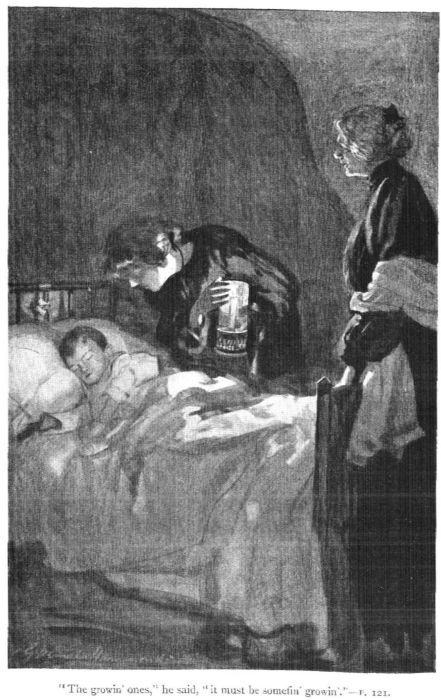
Mrs Fortescue lighted a candle in Roland’s room, out of which Jasper’s opened—Roland was still downstairs with his father,—and carefully shading it from the little sleeper’s eyes, led the way in. The child was fast, very fast asleep—he looked prettier than when awake, for slumber brought a rosy flush to his face, as a rule paler than one would have wished to see it.
And to-night he looked particularly well and happy, for he was smiling, and murmured some words as his mother bent over him, which at first puzzled her—“the growin’ ones,” he said, “it must be somefin’ growin’.”
“What can he be dreaming about?” she whispered to her aunt, and then her eye caught sight of the probable cause of Jasper’s pleasant fancies. It was the sprig of stephanotis, carefully tied to a bar at the head of his little cot, so that the sweet perfume was doubtless wafted to him as he lay.
“I know,” exclaimed Aunt Margaret. “Dear little fellow—it is something about the plants that I said were coming by goods train to-morrow. How glad I am that Morris thought of them!”
She was right, though it was not till long afterwards that Jasper told his dream, which in time to come, as his ideas grew and developed, seemed to him almost, simple as it was, to have been a kind of allegory. And for fear I should forget about it as our story goes on, I may as well tell it to you now.
He dreamt that he was walking up a rather steep hill; it was grassy and pleasant to step on, but still he felt a little tired and wondered how much farther he would have to go. Where he was going, or why, he could not clearly understand; he only knew that go on he must, and all the time, in his hand, he carried his sweetly scented flower. Then, suddenly, he became aware that, on his journey, whatever was the reason and object of it, he was not alone—numbers and numbers of other children were pressing on in the same direction. They did not speak to him or to each other, every one seemed full of the same eagerness to get to the top of the hill; and soon the explanation of this grew plain to him, for a breath, more than a voice, passed through the crowd of little travellers, murmuring—
“The gates, the gates of the beautiful garden.” And lifting his eyes he saw, now but a short way off, great gates of silvery trellis-work, through which he could already catch glimpses of stretches of exquisite lawns, and glorious trees, and smooth winding paths, bordered by plants and flowers of indescribable loveliness. He seemed to himself to give a bound of delight, for something told him that he and all his companions were coming there by invitation, and in another moment or two the crowd of children had reached the top of the hill and were standing in front of the gates. And then Jasper noticed another thing—each child was carrying a flower, or a plant—many, like himself, a cut-off branch or blossom only; some, and the faces of these had a different expression from that of the others, flowerpots filled with earth in which the plant was happily alive and growing. They were not all of equal size or beauty; several were very tiny, nothing but a few green leaves perhaps; some, what one would carelessly call “quite common” little things—a daisy root or a small nest of violets, of which only one timid head was as yet to be seen. But all these had roots, and were growing! Then glancing at the other children, who like himself carried only a single blossom, he saw an anxious look on their faces, and to his distress he perceived that these flowers were drooping and beginning to fade and wither, and he was just turning to examine his own, when he heard an eager cry—and looking up, he saw a figure coming down the garden and opening the gate at one side, not widely, but enough to let one child through at a time.
Jasper pressed forward—the new-comer was all dressed in white—the face was more beautiful than any face not seen in dreams.
“It’s an angel,” thought Jasper, and some words he had heard or read of came into his mind.
”‘The garden of Paradise,’ that must be it,” he thought dreamily.
And then he looked again and more anxiously, for he saw that by no means every child was allowed to enter—and of those who with saddened or disappointed faces turned back, every one was the bearer of a single blossom only, a poor, already-fading flower!
The angel’s face was grave as he slowly shook his head, when Jasper himself drew near.
“I cannot, my child, I cannot,” he said; “you must bring a different offering;” and Jasper, on the point of tears, replied—
“I didn’t know—I didn’t know. What shall I do?”
And the angel smiled and said—
“No, my darling, you did not know. But you can come again and bring a living plant. All have to learn. Many of those you now see entering did not know the first time they came. Take courage—your growing plant is ready for you.”
And then it was, I think, that he smiled in his sleep and whispered, “It must be a growin’ one.”
Yet for a moment or two he stood by the silver gate and watched, for he felt the angel wanted him to do so. And some things surprised him. The most beautiful plants were not always carried by the prettiest or most attractive children. Some of their bearers were sadly poor-looking—one, above all, a little cripple in shabby clothes, who could scarcely hobble in—but oh, what a glorious wealth of snow-white lilies he carried, and how his face shone with delight at the gate-keeper’s approving smile. And once inside—for Jasper gazed longingly after him—how was it?—such things come to us in dreams, and are they not the shadow of the true?—the shining seemed to clothe the stunted figure as with a garment, till he stood there erect and beautiful—a very angel himself. And murmuring, “P’raps he’ll be the one at the gate the next time I come,” Jasper awoke.
But it was not yet even midnight, so, as the scent of his flower—poor little flower, faithful to the last, though it had to wither—reached his but half-awakened senses, the boy smiled again, and this time went off into dreamless slumber.
Chapter Eight.
A Catastrophe.
Chrissie, as I think you will remember, was not given to sleeping late. Indeed, laziness of any kind was not a weak point of hers.
And on the morning after Aunt Margaret’s arrival, she woke, as she had gone to sleep determined to do, even earlier than usual. It was only just beginning to be faintly light. She lay still for some little time, for it was as yet too dark to see what o’clock it was, and if she had struck a light it might have roused Leila—the last thing she wished to do.
But before long, some slight sounds overhead gave notice that the two servants, who, being young country-bred girls, had not yet lost their good habit of early rising, were getting up. Then, even in that quiet side-street, came sounds of the great world of London being awake again—a church clock struck six, a milk cart or two rattled by, and farther off in the distance was faintly heard the rumbling of heavier carts and waggons.
“I suppose it’s no good my getting up till the servants are down, and till it’s lighter,” thought the little girl. “I’ll try to keep still till it strikes the half-hour, or at least till I can see the figures on the bee-clock. But it’s awfully tiresome. I can’t understand Lelly liking to stay in bed.”
And never did a half-hour pass more slowly for an impatient child than did this one. Still, Chrissie kept to her resolution; she could be both sensible and self-controlled when it suited her.
But by seven o’clock she was fully dressed, though there had been no question of a bath, seeing that Harriet only brought the hot water at half-past, and I fear the amount of washing that she had stealthily performed with cold water and a basin only, had better not be inquired into. All the same, she felt decidedly proud of her good management when she found herself quietly slipping downstairs, leaving Leila still peacefully slumbering.
It was not a very cold morning and it had quite left off raining. Still, it felt very chilly as she entered the drawing-room, where Harriet had just opened the windows.
“Miss Chrissie!” she exclaimed with a start.
“Is there anything the matter?”
“Of course not. I’ve got up early to do the flowers. Mother said I might. So go and fetch them at once, and bring the glasses to put them in, and a big can of water.”
Harriet hesitated.
“Couldn’t you wait, Miss, just till I’ve brushed and swept up and done the fire? I’ve to get the room right quickly, you see, to be ready for the old lady.”
”‘Wait’!” repeated Christabel, “of course I can’t. And you’re very rude, Harriet, to speak of the ‘old lady’ like that. Can’t you say ‘Miss Fortescue’?”
“I’m sure I beg pardon,” Harriet replied, and feeling rather ashamed of her unintended disrespect, she dared not object further, and hurried off as Chrissie had ordered.
But with the young lady spreading out flowers and glasses and water-cans all over the floor, it was clearly impossible to go on sweeping. Furthermore, Chrissie made her shut the window, so all the poor girl could attend to, and that not without difficulty, was the fireplace.
Little cared Chrissie. She went on sorting and selecting, cleverly enough, it must be owned, and some of the glasses were looking pretty and graceful, when a sound made her glance at the door. There stood Jasper, Harriet by this time having fled in despair.
“What do you want?” said Chrissie sharply. She was already getting a little tired of her task, for she had been at it for three-quarters of an hour.
“Oh Chrissie, Lelly is so cross,” he said. “She heard me goin’ down and she called me. She’s nearly dressed and she’s comin’ immediately. And I’m afraid she’s very vexed. And the room is in such a mess,” and, child though he was, he gazed round in consternation.
It was quite true—the mess was appalling. For it was not in Chrissie’s nature to do anything with method, and Leila’s greater neatness would have been a help in the morning’s work. But even worse was to follow; for almost before Chrissie had taken in what Jasper was saying, Leila, for once, in her indignation, as hasty as her sister, dashed into the room, upsetting as she did so, one of the big cans of water brought by Harriet, and, sadder still, one of the already arranged vases, breaking it into pieces—the water streaming out to mingle with the pool already forming, the poor flowers pitched about in all directions.
Christabel flew at her, trying to push her out of the room.
“You horrid girl,” she said, “you clumsy creature.”
“It’s you that’s horrid,” returned Leila. “Worse than horrid. How could you be so mean and sneaky? Why didn’t you wake me? Mother meant us to do them together. It’s all your fault. I shall tell Mother—it isn’t mine a bit. Let go of me,” but Chrissie only pushed her the more fiercely.
And this was the sight, these were the sounds, that met poor Mrs Fortescue as, unheard by the furious children, she stood in the doorway,—room in chaos, the pretty carpet, chosen newly on purpose to brighten the look of things, soaking—dark with water—the bits of glass and poor flowers all strewed about, and, worst of all, two little girls, crimson with anger, struggling together and hurling out ugly words of reproach and rage.
They started however—Chrissie releasing Leila, who stood silent and motionless—when they heard their mother’s voice.
“Aunt Margaret’s first morning. And I trusted you both to help me,” she said, as she turned away.
She was so bitterly disappointed that I really think there were tears in her eyes as she hurried down the passage in search of Harriet and cloths to wipe up the pools and streams of water. But before she got to the top of the staircase leading down to the basement, she almost ran across a small figure, whose face was hardly to be seen amid the pile of things he was carrying.
“I’ve been to get cloths and sponges to dry it all up, Mummy,” he said breathlessly, “and a pail to squeeze it into, and Harriet’s comin’,” and sure enough the housemaid’s head just then emerged at the top of the kitchen staircase.
“Master Jasper, Master Jasper,” she gasped, “you can’t carry all that;” and certainly he did look very comical, with his intensely grave face peeping out above his load.
“My poor Brownie,” said his mother, “my good fairy—what would I do without you?” and somehow she could not help a little laugh.
Jasper gazed at her in surprise, but then feeling that he was the master of the situation, he hurried off again. “Come quick, Mumsey,” he said, “p’raps we can stop any more of the carpet getting wet, if we’re quick,” and, followed by Harriet, they hurried into the drawing-room.
Leila and Christabel, by this time sobered and ashamed, though feeling, I fear, very far from friendly to each other, were on their knees in different parts of the floor—Leila picking up the fragments of broken glass; Chrissie rescuing the poor scattered flowers. Neither spoke, and their mother said coldly—
“Go upstairs. You are only in the way here. Come down at once when you hear the breakfast gong.”
Then Chrissie burst out—
“It’s not fair. It was all Leila. She knocked over the things, and I’d got up early on purpose.”
“Chrissie,” said her mother, and the one word silenced her again—“I cannot trust you together, I see,” Mrs Fortescue went on. “Go up to your room, Leila, and you, Chrissie, stay in the dining-room.”
Then with Harriet’s help—Jasper carefully collecting the flowers—some sort of order was by degrees brought about; the dangerous pieces of glass swept up, and the carpet dried as far as was possible. But it was necessary to leave the window open, and it was plain that some hours must pass before the room could be occupied.
“Make as large a fire as you can, to help to dry the floor, Harriet,” said Mrs Fortescue, and then she took Jasper’s hand and left the room. “Oh dear, oh dear!” she could not help murmuring, “it does seem too bad—Aunt Margaret’s first morning,” and a little squeeze of her fingers told her of Jasper’s sympathy.
“I’m sure Lelly and Chrissie is really werry sorry,” he said, “and Auntie is so kind, Mumsey.”
Kind indeed she was. For a few minutes later, when she came downstairs and it had to be explained to her that a woeful catastrophe had occurred, she declared that it would be a very good thing for her not to be tempted to loiter in the drawing-room that morning, “for I really must unpack and arrange my things upstairs. I suppose lessons have not begun regularly yet,” she went on, “so may Leila and Chrissie help me a little?” and she glanced at them as she spoke. Leila looked down, Chrissie grew scarlet.
“Ah,” thought Aunt Margaret, “I fear what has happened was not all an accident. Poor children—it would have been kinder to them in the end if they had been less indulged. We have all been to blame in the matter. Still, it is never too late to mend, and I must do my part.”
But from now, her eyes, loving though they were, watched things more closely and anxiously.
Neither of the little girls ventured to reply, but Mrs Fortescue, glancing at them, could not keep back a start.
“Chrissie,” she said, “have you looked at yourself this morning? Do you know that your face is simply—well, to speak plainly, dirty, and your hair ‘Like a crow’s nest,’ as my old nurse used to say? I hope Daddy won’t notice it.”
For their aunt’s sake, Mrs Fortescue tried to speak lightly, though she was really feeling sadly discouraged. Chrissie tried to toss her head in the way she usually did when found fault with, but I scarcely think the effort was a success, and she was very glad that as her father was late that morning, having had letters to write in his study, she had finished her breakfast before he came in.
“Yes,” said her mother, in answer to her unspoken question, “yes, you can go upstairs at once and make yourself fit to be seen.”
“Leila,” said Mrs Fortescue in a moment or two, “I do think you might take a little charge of Chrissie. After all she is younger and more thoughtless by nature than you are. Did you not see how untidy she was?”
“How could I?” said Leila gloomily. “She had left the room before I awoke.”
Just then Mr Fortescue’s step was heard in the passage, and as Leila’s black looks were almost as much to be dreaded as Chrissie’s dirty face, their mother added quickly, “Well, at any rate, you can help her now. So run after her;” and Leila, though with evident unwillingness, did as she was told.
“I am so sorry, so terribly sorry,” Mrs Fortescue had time to say to her aunt in a low voice, “that you should have such an uncomfortable first morning with us;” but Aunt Margaret only smiled quietly.
“My dear,” she said, “I am here, I hope, to be of some little help to you, not only to be comfortable, though really there is nothing that matters as far as I am concerned. And don’t lose heart. The little girls will profit by all this in the end.”
An hour or so later, when Aunt Margaret, up in her own room, was still busy unpacking, there came a tap at the door, and in answer to her “come in,” a small voice replied—
“It’s me, Auntie. Mumsey said p’raps I could carry things downstairs, or rerange them for you.”
“Thank you, my dear little boy. Yes—here in this corner are some books and my knitting and some of my pet treasures that I should like to have in the drawing-room. Mumsey showed me the nice table she has kept for me.”
“Yes,” said Jasper, “the table with the splendid big drawer. Shall I take them down now?”
“No, wait a minute or two till I have emptied this last trunk. You may unwrap all those things and then we can throw away the paper.”
“Auntie,” said Jasper, while he worked away busily, “will the glowin’ plants come soon? I do so want them, ’cos you see they won’t wither,” and he sighed. “Roots is funny things—when I was very little I thought flowers would grow wifout roots, just the same.”
“And now you know better,” said his aunt with a smile. “Boots are very wonderful things—not only plant roots. We need them in our characters too.” Jasper looked puzzled. His dream was in his mind, though he was too shy to tell it.
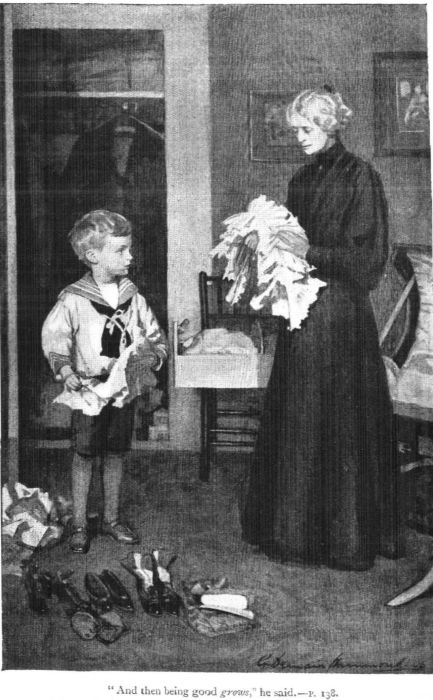
“You see,” Miss Fortescue went on, “it is like this. We should do things because we feel we ought, not just because we’re inclined. Being kind to each other, for instance, when we are feeling good-humoured and pleasant is all very well, but we need more than that. We need to be kind even when we are feeling cross or tired, or even when others are unkind to us, because it is right. Passing feelings are like plucked flowers—what are called good principles are like plants with roots.”
Jasper’s face lighted up.
“And then being good grows,” he said.
“Yes, indeed,” said Aunt Margaret, almost startled by his quickness. “Still it needs care. Watching, and above all, praying to God to help us—that is like the refreshing, nourishing water that plants need if they are to grow and prosper.”
Jasper gave a deep sigh of satisfaction.
“Now,” said his aunt, “I think you might carry down some of these things. Suppose you first take the books. Not too many at a time—can you manage all those?”
“Oh yes. I could take more quite well,” was the reply, for Jasper was a most zealous helper.
“I don’t think I want to send down any more, thank you, dear. I will keep most of my books up here, on those nice little shelves.”
So off trotted the small messenger with his load. Perhaps he was too careful, glancing so often at the pile of books that he did not glance enough at his own feet, for just as he was half-way down the last stair, there came an accident. Somehow or other he tripped and rolled down six or seven steps, the books on the top of him. Poor Jasper! He did not cry out, though for a moment or two he could scarcely keep back his tears—he felt bruised and giddy and rather mortified. But he was a very brave as well as patient little fellow, and he was struggling to his feet again when the dining-room door opened and Chrissie looked out.
“What was that noise?” she said. “Oh, it’s you, Japs—have you fallen downstairs?”
“Yes, I has,” he replied, “but please don’t tell Aunt Marg’ret or she won’t let me help her any more. I hasn’t hurt myself much.”
“Poor Jasper,” said Chrissie, “never mind. It’s a good thing you were only carrying books, not china or glass. Leila’s done enough in that way for to-day. But I say, how pretty some of these books are,” and she held up a small, beautifully bound prayer-book, and another “birthday book,” exquisitely illuminated.
“Yes,” said Jasper, “I fink they’re Auntie’s bestest books. She’s goin’ to keep them in the droind-room, on her table.”
“I’ll help you to carry them in,” said Chrissie, and so she did—the carpet by this time was beginning to dry, though only beginning!—“I wish somebody would give me a prayer-book like this,” she went on. “I’d love to take it to church.”
And then, their pile being safely deposited, Jasper turned to go upstairs again, though limping a little.
“I hope I won’t tumble any more,” he said, “for there’s lots of fings still to bring down.”
“Suppose I offer to help too?” said Chrissie. “My face is quite clean now and my hair’s tidy. I think it was too bad of Mummy to say anything about them before Aunt Margaret, when it was all, or nearly all, Lell’s fault this morning.”
“Auntie’s werry kind,” said Jasper. “I daresay she’d like you to help,” and if he felt a tiny scrap of disappointment at not having all the honour to himself, his good little heart would not allow him to show it. “What’s Lelly doing?” he went on.
“Crouched up by the dining-room fire over a story-book, of course,” said Chrissie. “She won’t mind,” and her face was so bright and her tone so pleasant when she went into her aunt’s room with Jasper, that Miss Fortescue began to think that she had really been taking the little girls’ misdemeanours too seriously!
“They are only children after all,” she said to herself, and “Yes, dear,” she replied to Christabel, “I shall be very glad of your help. Can you hang up some of these cloaks and things in the cupboard? I am so glad there is a cupboard! And Jasper, my boy, will you put my boots and shoes and slippers neatly in a row on that lowest shelf? I won’t send anything more downstairs till I see what had better stay up here, and I have not come across my wool for knitting yet.”
Her cheerfulness touched a gentle chord in Chrissie.
“Aunt Margaret,” she said, “it must be awfully strange for you here in this poky house, compared to Fareham. I wonder you don’t mind more.”
“Dear child, you must not think me better than I am,” Miss Fortescue replied. “I have ‘minded’,” and her voice shook a little, “terribly—wrongly, I fear. But it might have been so much worse. Think what some have to bear—of loneliness and lovelessness when they are old like me! If I can feel that I am of use to you all, and able to brighten things a little for your father and mother, it will be almost as great a joy as it used to be to me to have you all at Fareham.”
Christabel did not reply. But her aunt’s words impressed her. Ideas—feelings rather, perhaps—were awaking in her, which were new to her; though she had often heard and read of “unselfishness,” and the happiness of living for others, of bearing, or at least sharing their burdens, she had never really “taken in,” realised these truths. To see them acted upon, made the very sunshine of life, struck her as very wonderful. For perhaps the first time, she said to herself, “I wish I could really care for other people and try to make them happy and not mind about myself,” and though the thought passed off again, and she was as ready as ever to grumble and to squabble with Leila and to fight for her own rights and fancies, still, it was something that it had been there, a beginning, a tiny seedling, which might yet take root and blossom into beauty.
So the day which had seemed likely, like poor long-ago Rosamund’s, to be “one of misfortunes,” cleared and improved as it went on. Chrissie had one happy quality—she really, if once interested in a thing, did throw her whole heart and cleverness into it; and careless and unmethodical though she was, the sight of her aunt’s fairy-like neatness and order struck her pleasantly.
“If it wasn’t such a trouble,” she said, “I would like to be beautifully neat like you, Aunt Margaret. Leila thinks she is, but I don’t call it neat just to be slow and dreamy and never sure where you are or where your things are. I think its just as bad as my dashing about and turning things topsy-turvy. I don’t say she tears and spoils her frocks as much as I do, but she forgets quite as badly, and—”
A sigh from Jasper’s corner interrupted her.
“What’s the matter?” she said.
“Oh, I was only thinkin’ I do hope I won’t forget to water the growin’ plants when they come,” replied the little boy.
Chrissie laughed.
“He’s got those plants on the brain, Aunt Margaret,” she said. “You’d better forget about them for just now, Japs,” she went on, turning to him, “for very likely they won’t come for ever so long. Things take such a time by luggage trains.”
Jasper’s face fell—somehow his dream and the talk with his aunt had got mixed up with the thought of the real plants and made him long for them with the curious intensity of longing that one scarcely sympathises with enough in children. But his aunt understood.
“Cheer up, Jasper,” she said. “I shouldn’t wonder if they come to-day—this very afternoon perhaps.”
Chapter Nine.
Prayer-Books, Lost and Found.
And so they did! Aunt Margaret would not have raised Jasper’s hopes without good reason, and she knew that there are ways and means of hurrying up hampers and cases even by goods trains, when there is cause for doing so. Morris, the Fareham gardener, had seen to it all, and the well-chosen plants and flowers arrived in good order, looking none the worse for their journey.
They gave all the children a busy and—for that very reason perhaps—a happy afternoon, Jasper especially, as his mother chose out half-a-dozen pots “for his very own” to keep on a tiny table in front of his window, and the others were arranged in groups on flower-stands in the three rooms downstairs, as neither Leila nor Chrissie cared to have any in their own quarters.
“I’d only forget to water them,” said Chrissie coolly, “and so would Lell, I’m sure, and then there’d be fusses,” and though Leila half thought of firing up at this, her usual dislike to trouble gained the day, and she said nothing.
“The drawing-room looks quite a different place with flowers and greenery about,” said Mrs Fortescue, “and Aunt Margaret’s pretty work-baskets and silver scissors and knick-knacks.”
“And books,” added Chrissie. “Aren’t they lovely—the bindings, I mean?” and she fondled the prayer-book which had so caught her fancy.
“I am afraid the prayer-book is more ornamental than useful to me now,” said Miss Fortescue. “The print is too small for my old eyes. So I have to use a much larger one. Yes—my corner looks quite homelike, thanks to your table and that most comfortable arm-chair, Edith.”
“I think we may sit in here this evening,” said Mrs Fortescue, eyeing the still darkened carpet. “We will leave the window open and keep up a big fire till dark. But we had better not stay any longer just now. I do hope to-morrow will be a brighter day.”
“But it is not raining, though it is dull,” said her aunt, “and the children have not been out. I think we might have a little walk before tea. I should like to know something of the neighbourhood.”
“I can show you the post-office—it’s nearer than the pillar-box,” said Jasper. “Mumsey lets me go to buy stamps—and the omlibus startin’-place, and the church, and—”
“Don’t be silly, Jasper,” said Leila, who was feeling cross at having to go out. “That’s not what Aunt Margaret wants to see—not that there’s anything at all to see,” she added gloomily. “It’s perfectly hideous, it’s not like London at all.”
“I thought you were within a mile of Kensington Gardens,” said Miss Fortescue quietly. “I have very pleasant associations with Kensington Gardens and the old Palace.”
“We’ve never been there since we came,” said Leila. “Mother’s been too busy to take us, and besides—they’re always stuffed with nursery-maids and perambulators.”
“Well—let us explore a little by degrees; as the spring comes on we must find some pleasant walks. But we must be quick just now, or it will be getting too late for even a short one.”
And for a wonder the two sisters did manage to be ready when their aunt came downstairs, followed by Jasper, who insisted on carrying her “numbrella.” Leila was feeling a little ashamed of her peevishness, and Chrissie was still under the good impression of the morning. So both were, for the time being, at their best, and the walk passed off pleasantly.
But Aunt Margaret was very observant, and even now, in these first few day’s, when the novelty of her presence and the influence of her never-failing cheerful kindliness did much to smooth things, her heart was sometimes sad and anxious.
“They have been terribly spoilt,” she said to herself, “and while life was made so very easy for them, this did not show as it does now. Poor dears—I hope we may be able to check this selfishness and want of consideration for others—it may be more owing to want of thought than to any deeper cause.”
As time went on, however, her anxiety and disappointment increased. Leila fell back into her indolent habits, and Christabel grew more openly defiant and self-willed. And at last their mother felt that she could no longer go on trying to make the best of things in hopes of sparing her aunt distress, and herself perhaps, unselfish as she was, some sharp mortification.
“I don’t know what to do with either of the little girls,” she said one day, when things and tempers had been unusually trying. “I cannot bear to say much about it to Reginald—he has enough to worry him in so many ways. I had hoped that when we settled down into this new life they would really try to be a comfort to us. But they think of nothing but their own likes and dislikes—they don’t seem to have the least idea of obedience. Why, Chrissie was almost rude to you, dear aunt, at their French lesson to-day—and Leila had evidently not pretended to learn those verses! And you are so good to them.”
“Do not distress yourself for me,” said Miss Fortescue. “We have all been to blame in the past, and we must face it and do our best. I am sure it will all come right in the end. Your children and Reginald’s, dear Edith, cannot be really selfish.”
Mrs Fortescue tried to smile.
“Perhaps I have been selfish in not being stricter with them,” she said. “My one idea was to make them happy, and with the boys it seems to have done no harm.”
“Roland has had the discipline of school for several years,” said Aunt Margaret; “and as for little Jasper—well, really, he seems one of those sweet natures that can’t be spoilt.”
“And I fancy he has had rather a Cinderella-like life in the nursery, boy though he is,” said his mother. “How strange it seems that selfishness in some should be good training for those who suffer from it.”
“But, on the other hand, there is the good example,” replied Miss Fortescue. “I have noticed several times that the little fellow’s gentleness and sweetness have made his sisters ashamed of themselves—Chrissie especially. And Jasper is not very strong, you know, whereas the girls are overflowing with health, which may be a bar to sympathy sometimes—all good gifts may be abused. But I do hope that the great change in their lives may prove a blessing in disguise to our little girls.”
“I had hoped so too,” said their mother. “Indeed, Miss Earle said something of the kind before she left. She had begun to feel very discouraged.”
“And other discipline will be sent if they do not profit by this,” said Miss Fortescue almost solemnly. “But let us hope that they will.”
Life, however, as the days went on, was by no means as peaceful and happy in the small house in Spenser Terrace as it might have been, and should have been. And but for Aunt Margaret’s unfailing sympathy and hopefulness I scarcely think Mrs Fortescue could have kept up at all. For she knew that she must be cheerful when her husband was at home. Life was far from easy for him at present; he was working hard in ways that were new to him, and more trying than if he had been a younger man, and a bright welcome and peaceful evenings were certainly due to him. More than once she tried to make her little daughters understand this, and for a few hours, a day or two at most, it seemed to impress them. But, alas! all too soon the old habits overmastered them again: Leila was as lazy and self-absorbed as ever; Chrissie disobedient and defiant.
Mrs Fortescue, with some difficulty, had found a daily governess, living near them, who was glad to come for the morning hours and take the children for a walk when lessons were over. She was a simple, good-natured girl, well taught and well able to teach up to a certain point, but she was a very different sort of governess from Miss Earle, and very soon both Leila and Christabel began to take advantage of her simplicity and half-timid manners.
One day, to her great distress, Mrs Fortescue, meeting the poor thing on her way out, saw unmistakable signs of recent tears in her face and eyes, and when a kind inquiry was made as to their cause, they burst out again more freely.
“I’m afraid I must give it up,” she sobbed, “and I was so glad to come near home and all. And it’s not easy for me to find pupils, as of course I am not accomplished.”
“But your English teaching is excellent,” said Mrs Fortescue; “it is all I require for the children at present. Please don’t be discouraged.”
Still she sobbed on.
“It’s—it’s not that,” she said, “except that if I were cleverer they—they might respect me. Jasper is as good as gold, but—but the little girls, the young ladies—they do not obey me in the least, and—and—they say things—”
Mrs Fortescue turned and walked down the street with her. It was quiet, and really less likely to be disturbed by passers-by than the small house by incursions of children!
“What sort of things? Tell me more, I beg you, Miss Greenall.”
“That—that I’m not a lady—and I have never pretended to be one in the full sense of the word. Father was only a shop-keeper, and mother is a farmer’s daughter. But still—I don’t think Christabel need speak as she does. And leila dawdles on purpose to vex me sometimes, I do think, and when I found fault to-day—she kept us waiting fully ten minutes—she said of course I couldn’t understand what it was to have no maid—‘of course you,’ she said, ‘have been used to huddling on your clothes anyhow, ever since you were quite a baby almost’—and,” Miss Greenall continued, “I know I am not untidy, though I dress plainly. Mother brought us up to be very neat.”
Mrs Fortescue sighed deeply.
“My dear Miss Greenall,” she said, “your mother brought you up much better than I seem to have brought up my daughters. I am unspeakably ashamed of them, and I beg you to accept my apology. And they shall apologise to you to-morrow morning.”
But at this poor Miss Greenall looked up with frightened eyes. She was a pretty fair girl, small and delicate-looking.
“Oh, please, please,” she entreated, “do not tell them I have complained. I could not go on if they knew it. I will try again and be a little firmer with them, if only, only you will say nothing.”
And, though against her own convictions, Mrs Fortescue had to agree to what Miss Greenall asked.
And for a few days things were better. The little girls had been startled by the sight of the tears which the poor governess had not been able to repress—startled and shamed. Nor had Jasper’s face of shocked surprise lessened the impression.
He was no tell-tale, but still—
“Japs,” said Chrissie, the first time they were alone together, “I’m sorry we made that silly Miss Green—what’s-her-name—cry, and so’s Lell. We were half joking, you know.”
The child looked at her with his solemn blue eyes, and Christabel felt herself blushing. She was naturally truthful.
“At least,” she went on, “we didn’t mean her to take it like that. She might have seemed to think it a joke. But we don’t want Mummy to hear about it. Things sound worse when they’re tell-taled.”
“I’se not a tell-tale,” said Jasper stoutly.
“Well, well—I didn’t say you were. And I promise that we won’t say those things again, as she minds them so, silly that she is.”
“Will you tell her you’re solly?” Jasper inquired.
“I don’t know—we’ll see about it,” Chrissie replied, “but any way we won’t make her cry again.”
So Jasper contented himself with cherishing most carefully the very best of his hyacinths, just beginning to show a little colour, as a gift to Miss Greenall, to be presented as soon as it would be fit for her acceptance.
“And if Lelly and Chrissie would werry much like to join,” he said to himself in his generous little heart, “we might give it ’atween us all. I’m sure it’s goin’ to be a splendid one.”
But, alas! before the hyacinth’s delicate pink flowers had reached perfection, and Jasper’s kind plan could be carried out, sad things had come to pass, which I must hasten to tell you about.
The impression made upon Leila and Chrissie by Miss Greenall’s distress was not a lasting one, except in so far as they were more careful in their way of speaking to her; for they knew that Jasper’s eyes were upon them, and that any rudeness to their teacher would not escape him. But beyond this, there was no real improvement. They were careless, unpunctual, and, so far as they dared, disobedient. Still Miss Greenall went on doing her best, and now and then her patience and gentleness had some little good, effect. She was able to tell Mrs Fortescue that things were rather better. “I think I can go on,” she said, “if only Leila was more attentive and Chrissie less heedless.”
It really went to her heart—brought up as she had been in neat and careful ways—to see the children’s destructiveness—copy-books blotted and torn; lesson-books dog-eared and spotted; worse still, frocks and aprons covered with ink, or ruthlessly smeared with fingers much in need of soap and water! And in these kinds of carelessness Christabel was the worst offender, in spite of her occasional good resolutions, always encouraged by Aunt Margaret, to try to be as neat as “you were, when you were a little girl,” in reply to which, her aunt would smile and assure her that good habits of no kind come all of themselves to anybody, man or woman, boy or girl.
It chanced one Sunday morning, when the sisters were, as usual, late in getting ready for church, and their father’s voice had sounded more than once up the staircase hastening them, that Chrissie could not find her prayer-book. Go without it she scarcely dared, for this was the sort of carelessness that Mr Fortescue himself might notice, and when “Daddy” did “notice,” even Chrissie “minded!” Now Leila was the happy possessor of two prayer-books, one of which was practically new, and which she kept wrapped up in tissue-paper in a drawer.
“Oh Lell,” said Chrissie in despair, as Leila was leaving the room, “do lend me your best one, or take it yourself and let me have the one like mine.”
“No, indeed, I won’t,” said Leila, hurrying off, as Mr Fortescue’s voice came again.
“You must run after us. We can wait no longer, children,” he called. Leila was already half-way downstairs.
Chrissie gave a frantic rush round the room again, scrambling under the beds, pushing aside chairs and tables in search of her book, but all in vain. And even if she had dared to take her sister’s “best one,” she was not sure where to look for it. It would have needed time to find.
“I must go,” she thought, “whatever happens.” So she dashed off—narrowly escaping falling downstairs in her hurry.
The others had all started, but the hall-door was left slightly ajar, and that of the drawing-room stood wide open, and as she ran past it, a sudden idea struck the child.
“I’ll take Aunt Margaret’s prayer-book,” she thought. “It’s just about the same size as mine, and if I keep it open nobody will see any difference, unless Lell perhaps, and she surely wouldn’t be so mean as to tell, after being so ill-natured to me.”
No sooner said than done, and in another minute Chrissie was racing down the street, book in hand, to overtake the family party, just turning the corner.
Leila glanced at her.
“You’ve found it, then?” she whispered, for Chrissie took care to hold the book so that its cover did not show. She made no reply, and Leila’s face darkened.
“If you’ve taken mine after all,” she said threateningly, though still in a low voice, “I’ll—”
“I haven’t, then,” said Chrissie, “I wouldn’t touch a thing of yours, you mean creature.”
“I don’t believe you,” said Leila, catching her arm, so as to see the book.
“Children,” said their mother’s voice, warningly.
They started.
“I’ve got Aunt Margaret’s out of the drawing-room,” whispered Christabel. “There now—if it’s found out, it’s all your fault,” and Leila, startled, made no reply.
Church-time passed, and more than once Mrs Fortescue, glancing at the children, was pleased to see that Chrissie appeared to be following the service with unusual attention. She would have been less content had she known that for this there were two reasons. Firstly, Chrissie was afraid of closing the prayer-book; secondly, she was interested and amused by the old-world names she found in it—“His Majesty King George,” “Our gracious Queen Charlotte,” etc, etc, the Service for “Gunpowder’s Day,” and other now discarded memorials. It was really quite “entertaining,” but I doubt if her idle, careless thoughts took part in one single prayer all through the morning, if even one “Our Father,” in which surely the very youngest child, as well as the humblest and simplest worshipper, can fully join, came from her heart.
Poor Chrissie—poor Leila—sterner teaching was preparing for them.
There was some delay in the church porch, as the congregation was passing out.
“I do believe it’s raining,” said Mrs Fortescue, and so it was. “I hope you have your umbrellas, children?” she went on.
Yes—Leila had brought hers; but Chrissie, no! “Really Chrissie,” said her father, “you are too forgetful. Don’t you remember my saying at breakfast that it looked very like rain?”
Chrissie made no reply; for once she had no excuse to offer.
“Give me your umbrella, Leila,” said their mother, “and you take mine—or, yes, Daddy’s,” as he hold it out, “that is larger still, and run home together as fast as you can.”
The sisters set off, as they were told, Leila, as the taller, holding the umbrella. But oh, how cross she was! “Too bad’s” and “All your fault’s” were hurled at Chrissie, till the rain and the running and the weight of the rather heavy umbrella, reduced Leila to silence, in spite of Chrissie’s provoking rejoinders.
“My fault indeed! If you had been good-natured for once and lent me your other prayer-book I wouldn’t have been in such a fuss, and then I wouldn’t have forgotten my own umbrella.”
They were both out of breath, and certainly out of temper, when at last—for distances do seem doubled and trebled in such uncomfortable circumstances—they reached Spenser Terrace, and flinging the wet umbrella at Harriet to look after, slowly made their way upstairs to their own room.
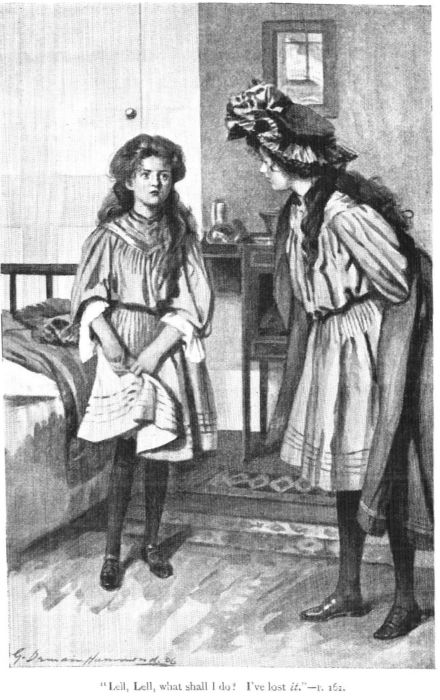
Chrissie tore off her hat and coat with her usual haste. They were not very wet after all, but as she was tossing the jacket aside, something hard bumped against her knee.
“There’s something in one of the pockets,” she said, feeling in it as she spoke. Then out she drew her own prayer-book. “Look here, Lell,” she exclaimed, restored to good-humour by her triumph. “It was in here all the time—ever since last Sunday, I daresay.”
“I daresay,” repeated Leila scornfully. “There never was any one so careless as you. You’d better run down and put Aunt Margaret’s treasure back in its place before she misses it.”
Christabel started. She got red, then white. She glanced at the bed, where her hat and gloves were lying; she felt in her frock pocket, she stared at the floor, then in terror and despair she burst out—“Lell, Lell, what shall I do? I’ve lost it.”
Chapter Ten.
Peter’s Place.
Leila gasped. For once, her better feelings came to the surface. The enormity of the misfortune aroused her sympathy so fully as to drown every less amiable feeling. Then she pulled herself together.
“It can’t be lost—you were thinking of it all church-time; you couldn’t have carried it carelessly. Feel in your other coat packet.”
Chrissie shook her head.
“No, no,” she said, “I know I didn’t put it in my pocket; and now I remember that the last time I had the feeling of it was in the church porch, when there was all that fuss about the rain and the umbrellas. I dropped it then, or in the street just after, and oh, if it was in the street, it’ll have got soaked in the rain and ruined! And I do believe Auntie cares for it more than anything in the world. It was her grandmother’s. Oh, Leila,” and she clasped her hands in misery.
“Don’t begin crying about it,” said Leila, though not unkindly. “Let’s hunt about a little,” and her eyes wandered round the room. “Mightn’t you have dropped it on the staircase?” She turned towards the door, but Christabel stopped her. “No, no,” she said, “it’s no good. I know now that I didn’t bring it home. And I hear them all coming in, Leila. Don’t seem to be looking for anything.”
“Perhaps we may get it back,” said Leila, who could use her wits to advantage when she aroused herself to give her full attention. “The thing to be done is to ask for it at the church. If we could but get there by ourselves.” Then her eyes turned to the window. “I wonder if it’s going to rain all day.”
A sudden thought struck Christabel.
“What Sunday is it? The first of the month! Oh, I do believe it’s the Sunday when there’s a Children’s Service in the afternoon, and Mummy said once that she thought it would be nice for us to go. Suppose we ask her to let us?”
“If it leaves off raining,” said Leila. “I don’t think we’d be allowed to go again if it pours. But it’s looking brighter.”
“Oh, do let’s try to manage it,” said Chrissie, clasping her hands. “I’d rather—well, rather do anything, or have the horridest pain, rather than tell Aunt Margaret that I’ve lost her book.”
“Yes,” said Leila, piling on the agony, “for, of course, you couldn’t call it an accident, as you’d no business to take it.”
“And if you’d been,”—began Chrissie, but she did not finish the sentence, for at that moment the gong sounded for the early dinner—on Sundays now everybody’s dinner—and the children had to hurry downstairs. On reflection, too, Chrissie said to herself that it would be “awfully silly” to quarrel with Leila.
“She’s been kind about it, and I could never manage without her,” she thought; and as they were entering the dining-room she whispered to her sister, “You ask; I really daren’t.”
It was new for Christabel to own to “not daring” about anything in the world, and Leila felt rather gratified at being trusted in the matter. Nothing was said till dinner was nearly over; the children were very quiet and behaved to perfection. Mrs Fortescue felt pleased. This state of things, following on Chrissie’s attentive looks in church, made her begin to hope that her anxieties about her little daughters were likely to grow less, and inclined her to consent to Leila’s unexpected request.
“Mummy,” she said, “Chrissie and I would like to go to the Children’s Service at church this afternoon. It’s the Sunday for it, and we know the way there quite well, of course. Mayn’t we go?”
Mrs Fortescue smiled.
“I should very much like you to go,” she said, “and I think I can quite trust you by yourselves. But how about the weather?”
“It is clearing,” said Mr Fortescue, “and the glass is going up. Yes—I think they may safely go.”
Chrissie’s face, which had been looking unusually solemn, brightened up. But it clouded again as her father went on, patting Jasper, who was seated next him, on the head—
“And this little man? Wouldn’t you like to escort your sisters to church, Jap?”
“In course I would. I’ll cally your numbrellas and your church-books—all of them, if you like.”
“Then that’s settled. Roley and I are going a good walk,” continued Mr Fortescue. “We need a breath of fresh air, after working so hard all the week, don’t we, my boy? And it will give Aunt Margaret and your mother a nice peaceful afternoon, which I am sure they will be glad of.”