Front matter (continued 4)
Reading edition
Then Silvette did a curious thing. She sat down at Mr. Rivett's desk and bent her head over the blotter, and sat so, with her small handkerchief against her eyes.
There was not a sound from her nor from Mr. Rivett.
For a long while she sat there, finally burying her face in her handkerchief and both hands.
Mr. Rivett bent over her presently.
"Silvette?"
She merely nodded in sign that she had heard him.
He said quietly: "You are in love with Jack."
She sat motionless.
"Your loyalty to honor deceived a very gentle heart," he said; "you loved him all the time."
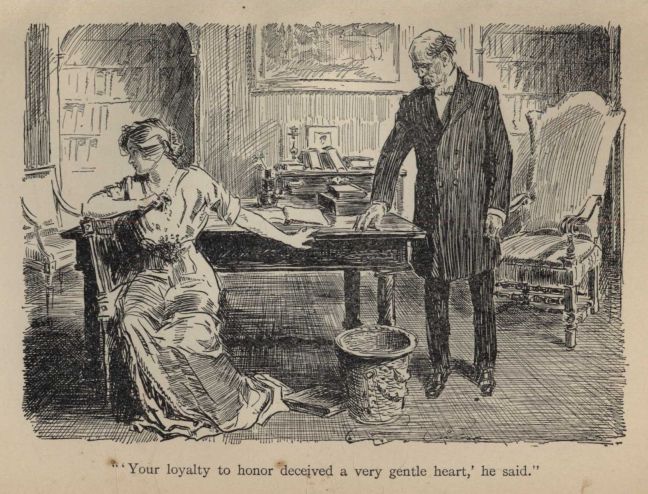
"'Your loyalty to honor deceived a very gentle heart,' he said."
She made no sign, no movement.
"We could ask no better woman for our daughter," he said. "I was very blind. Jack knew, but his mother knew best of all. My wife is very wise, Silvette—far wiser than I.... And I have—I am in debt—to the name you bear. I thought by giving you my boy I was canceling it.... You put me under obligations I am unable to meet—unless you can accept my—affection—as collateral. Can you, child?"
Her hand moved slightly—moved farther across the polished surface of the desk. His hand fell over it.
"Thank you," he said.
They remained silent for a few moments; then he gently relinquished her hand and went out, leaving the door just ajar.
When Silvette lifted her head from the desk, she knew that Jack had entered.
Tall and quiet, he stood looking at her; tall and pale, she rose, looked at him steadily, came toward him as he moved toward her, and laid both hands fearlessly in his.
"I didn't know," she said. "I wouldn't let myself even think of you.... Do you want me, Jack?"
Then down he went on one knee, and kissed hers, and her hands, and her gown; and, confused, she drew away, then waited as he rose waited, looking at him as his arm encircled her.
Very gravely they exchanged their first kiss.
That seemed to break the divine spell, for they found their tongues very quickly now, and, sitting perched on his father's desk, side by side, feet hanging, and hand in hand, they succumbed to the rapture of garrulity, asking Love's same old questions with all the ardor of neophytes, and answering as Love has answered for many a century, and will answer for many more—tritely, passionately, and with that incurable redundance of which lovers alone are masters.
CHAPTER XIII
CUI MALO
For the present, it was decided between Mr. Rivett and his wife that the engagements of both their children should be kept secret.
Except those immediately concerned, only the parents, Diana, and Mr. Dineen knew; and Edgerton, as the nearest male relative of Silvette, was to be informed.
It had been left to Diana to inform him. Silvette wrote a hasty and cordial note for her sister to inclose; then Diana took her writing materials up to the mossy ledge in the woods from where Edgerton and she had once taken the Path to Yesterday on that sun-drenched morning so long—so long ago.
She had never been there since. Once, strolling with Scott Wallace, he had espied the ledge, climbed thither, and called to her to join him in a new-found wonderland.
But it was not new-found to her, and the wonder of it had departed; and she continued on along the river bank below, heedless of his enthusiasm and persuasion.
Now something drew her there. What the sentiment was she did not analyze. Perhaps it was because the girl knew no spot as intimate, no fitter place in which to write him of her sister's happiness.
The place had changed with the season; yellowing leaves clothed the trees; the beds of moss had turned to vast reaches of golden velvet; naked branches crossed and recrossed above in delicate network against the sky.
Here was the silver birch against which she had leaned when his arms were round her and her lips touched his; there he had lain at her feet, stretched across that bed of gilded moss—only a boy then, smiling, idle, unawakened.
She seated herself exactly as she had sat that day, and looked at the empty place where once, so long ago, life had begun and ended for her—the place of self-sacrifice, the altar where her heart had died to appease the Fates and mollify the mischief of the far white gods.
Among the yellow leaves a blue jay screamed through the stillness; and presently she saw him for a moment, a flash of azure and silver, high-winging from his invaded sanctuary.
Behind him he left a silence, deeper for the constant whisper of falling leaves, stranger for the far sighing of the unseen stream below.
She bent over and searched for the imprint of her fingers in the moss where he had kissed them unrebuked. Many a sun and moon and rain had smoothed out that delicate sign manual long since. Only upon her heart the imprint of his lips remained.
Then—for the path was easy to her; alas! too easy—she sent her spirit back along the Road to Yesterday; and soon she heard the starlings piping and saw the sky all rose and gold above the river; and she saw him, and heard his voice, talking of starlings and of children.
If a single bright tear fell, the moss buried it; and when at last she could see her letter paper through glimmering lashes, she inked her pen and set her small, sun-tanned hand resolutely to the task before her:
"Jim, dear, Silvette is going to marry Jack Rivett. She is supremely happy. I inclose her note to you.
"Only the families concerned know about it yet. It is to be announced in December. The date of the wedding has not yet been fixed.
"I write you this pleasant news because you are our nearest relative.
"In my last letter I told you that Silvette did not love him. I was wrong; she did love him all the while, but she was too decent to know it. So how on earth was I to suspect it? I didn't, and she didn't, and if it hadn't been for Jack kicking over the traces and cantering away out of bounds, there probably would have been a tragedy in the family; for Silvette and I had your kind and sensible letter, saying that the only honorable thing to do was to take the first opportunity to withdraw from Adriutha, and we had decided you were right.
"But man proposes, Jim, and the far gods laugh at him—not unkindly, sometimes. My little sister is radiantly happy. Jack is a dear; so is his sister and parents.
"It amuses me to realize that I have come to be a purveyor of marital news to you. First, it was Christine and Mr. Inwood; now it's Silvette and Jack. The nearest I can come to rounding out the classical triad of the blessed is to inform you, monsieur, that the symptoms of Colonel Curmew are becoming acute. He tried to take my hand in the billiard room—not my bridge hand, either.
"He retains my hand too long when he helps me into a canoe. The other day I was horribly tempted to tip him into the river; he said such silly things and popped his eyes and went into rhapsodies over my ankles—which was slightly infringing les convenances, wasn't it?
"But he's merely a foolish, pompous, well-meaning man, slightly silly about all women, but with a very kind heart, I fancy. He is always doing things for me, always strutting around me and shooting his cuffs and curling his mustaches. Half the time I don't understand his talk—his jokes and apparently witty innuendoes, which perhaps are very funny, for he laughs at them himself, and I have to smile and pretend I am not stupid.
"No flight has occurred, although there was a white frost Saturday night.
"The shooting brotherhood are anxious and gloomy. Some even declare that a flight did occur Saturday night; that the birds remained with us over Sunday, when nobody could shoot, and left Sunday night, which was bitter cold and froze water in the garden.
"I don't know about such things—and don't care very much. It seems to me that these big, red-faced men make a ridiculous to-do about the migrations of a few small birds.
"Scott Wallace is the laziest man—which reminds me in time, Jim, to speak about your apparent attitude toward Scott. I merely wrote you that you would like him if you knew him.
"To my surprise, you wrote that you, personally, had no use for the kind of man I described.
"Was that a snub for me or for Scott? I'm sorry I spoke of him. To me he is a nice, wholesome, amusing fellow, so friendly to everybody that, somehow, your letter—what you said in it about a man you never met—hurt me. You would like him if you knew him. So, with this feminine prerogative, I close my lips about Scott Wallace for the present and the future.
"I am glad your arm is practically well; but what makes me entirely contented is what you say of your constant and bewildering promotions. Best of all is what I read between the lines—that you really love the business—the business of generations of Edgertons; and you, the last of them—but not the last, God willing!—are plunging into the game up to your neck, interested, optimistic, enthusiastic, fitting yourself for that dignified place which is yours, Jim, by every right.
"Now that it's over, and the mist blown clear of your path forever, I want to confess to you how dreadfully I felt to see you here in such a capacity. More than that, your light talk about the arts, your light and graceful accomplishments in them, your tendency to drift back toward a career for which you are no more fitted than I—all these things troubled me deeply, so that, sometimes, I even dreamed of them, and finally came to regard your facility with actual fear, so jealous was I for your real career, so anxious was I that you should become your real self.
"I suppose you will scarcely believe it, Jim, when I tell you that this feeling began from the very moment when you offered to go with Silvette and me to Adriutha. Somehow, blindly, I understood even then that it was not the thing for you to do; and, remember, I knew you scarcely at all.
"Yet my instinct resented your going, and if I did not actually protest, perhaps you may recollect that my attitude was not cordial; that you had to ask me many times for my vote; that, after all, I never cast it, but simply refrained from voting at all.
"I suppose this was cowardly in me; yet, Jim, what else could I have done? I scarcely knew you; I dared not appear ungrateful after your kindness to Silvette and to me.
"Forgive this self-defense. I merely wanted you to know; I only wish you to understand that, at heart anyway, I have been, from the beginning, loyal to the best interests of a friend and a kinsman who was most kind to two girls alone in the world."
"This is a still, golden, autumn world—autumn no longer, alas! for we are already well along in November. But autumn lingers in this land of hills and waters, and the frost was not severe enough to blacken the late roses. If the weather is unseasonable, it is also charming, and I love it. Russet and gold always did fascinate me—like the hangings and tapestries in your studio, with the dusty sunlight falling over all.
"Eh bien, monsieur, I must conclude my monologue. You are a brave man if you have read as far as the name you gave me once—centuries ago.
"JAPONETTE."
She closed and sealed her letter, wrote his name on the envelope, rested awhile, blue eyes seeing nothing; then, touching the envelope with her lips, she laid it between the leaves of her portfolio.
Since that day in this very place, Edgerton had spoken no more of love to her. She knew that he never would again, that what had begun here on the Path to Yesterday had ended where the path ended. Never again would he retrace those steps with her; never again travel them alone. For it was a lost road to him, a blind trail already overgrown with briars. The days made it fainter, the months were hiding it, the years would obliterate it for him. But for her, alas—she had many a pilgrimage yet to make along that briar-grown path; and many a scar, yet unmade, must heal before that path closed before her pilgrim feet, and shut out forever from her eyes the hidden shrine it led to, where the sky was rosy above the river and the starlings called through the golden light of Paradise.
And now, as she stood up, the subtle scent of autumn hung heavy in the air—a faint odor of ripening, hinting of decay and death. Summer had gone indeed—on earth and in her heart.
Never again would life be the same to her after this day, in this place, alone with memory; never again would she be the same. How old her heart had become—how old—how old! O amari dies! O flebiles noctes!
She rode that afternoon with Colonel Curmew, accepting him instead of another because she thought his chatter might leave her freer to follow her own thoughts.
But after a while it seemed to her as though she could no longer endure them, and that the colonel's inanities were preferable.
They were riding down a mountain road, the horses picking a cautious way among the scattered stones.
He was paying court to her, as usual, and she had been riding on, smiling absently, preoccupied with her own thoughts and mentally oblivious to him, when there came a clatter of stones from behind, and Scott Wallace galloped recklessly up at the risk of his horse's neck as well as his own.
"Halloo!" he said cheerfully; "hope I'm not smashing a twosome, colonel."
The colonel glanced sourly at him. Diana laughed with pleasure: "Not at all, Scott! Colonel Curmew and I are old acquaintances, and the resources of sentiment were long ago exhausted between us. Where are you going?"
"Nowhere; I just felt like a gallop. All the chaps are kickin' over the flight, which either isn't goin' to materialize or passed over Sunday and made boobs of the bunch of us. Where are you goin'?"
"Nowhere in particular; come with us. My nerves needed soothing, so I took the colonel along."
"As a tonic or quieter?" asked Wallace so seriously that Diana threw back her pretty head and the woodlands were melodious.
The colonel laughed loudly, too, and began to hate young Wallace with a hatred that passes all understanding.
Wallace turned to her. "What's wrong with your nerves? I supposed you hadn't any."
"I didn't know it either, Scott. Probably I've played with cards and cigarettes too hard. For all the sunshine, to-day has been a gray one for me.... Shall we gallop?"
She launched her horse into a trot, a canter, then into a dead run. Behind her tore the two men through the afternoon sunlight, on, on, until their winded mounts topped the homeward crest of the hill and they looked down on the meadows of Adriutha.
They wended their way down the mountain in silence—Diana, grave and apparently tired; Wallace smiling slightly, and glancing at her from moment to moment; Colonel Curmew pop-eyed, expressionless, curling his mustache with gloved fingers.
He was furious with Diana, with Wallace, with himself. Yet even he could not see how he might have resented the young man's intrusion otherwise than by the lack of cordiality which he had certainly manifested. Besides Diana had invited him to remain with them. Of what low tricks women are capable! Because she knew well enough that he had desired and sought a tête-à-tête.
Curling his mustache tighter, he rode on, a good figure in the saddle always—ruminating, considering, angry because of the interruption.
For Colonel Follis Curmew had for days, now, been carefully preparing the way for something he meant to say to Diana. He was a cautious man with women; he reconnoitered by degrees, inch by inch, carefully watching effect. Hint, innuendo, double meanings, sly feelers, veiled intent, was the strategy he usually employed at first, skirmishing as close to the dead line as he dared; furtive, alert, ready always for a brilliant and resistless climax at the psychological moment.
A few minutes ago he had believed that the psychological moment was approaching. He had said one or two things so cleverly that not the least resentment had altered her smile; but how was he to know that, if she had heard him at all, she had not in the least understood him? It takes more than one to play a game of that kind. The trouble was that her smiling inattention had deceived him—had always deceived him. He was entirely persuaded that she had drifted into the game long ago.
Surely, surely the psychological moment had been close at hand when that big fool of a boy had come clattering downhill and smashed their approaching understanding into smithereens for the moment. The colonel silently damned him as he rode. It took time and patience to gather up and piece together the fragments and smithereens; it took skill and watchfulness to choose another such propitious day and hour—to select the scenery and the moment for what he meant to say to this young girl.
As he dismounted her at the foot of the terrace he pressed her arm significantly, and said under his breath:
"Can we get away for a moment together this evening?"
Wallace was close by, and the colonel spoke so low and pinched so discreetly that she neither understood nor noticed his amenities, so she merely nodded smilingly, thanked him for his escort, and ran up the steps beside Wallace.
"I'll be in the billiard room later, if that interests you," she called back over her shoulder to Wallace as she ascended the stairs.
"It certainly does!" he replied promptly, and went away to change.
Diana continued on to her own room, disturbing Jack and Silvette on the stairs, and gaily jeering at them as she banged the door. A curious reaction had set in from the sadness of the morning—a feverish desire to escape from herself, from the misery that lay always heavy in her breast, the relentless hours that weighted her heart so that its dull beating had become a burden.
The bath refreshed her; so did the tea. She put on her little Japanese gown and her straw sandals, and curled up by the window, sipping her tea and watching the declining sun.
Dusk came swiftly, and with it Silvette who bent over and kissed her, and tasted the tea, and wandered about the rooms gossiping, too full of the joy of living to endure silence in herself or in anybody else.
Pangs of swift remorse and self-reproach stabbed her at intervals when she thought of her own happiness and remembered Diana's late unhappy affair.
How far Diana had cured herself, she did not know, but she knew that her sister was still more or less unhappy about Edgerton.
"Did you send him my note?" she inquired.
"Yes: I wrote him, and inclosed it."
"He's a dear boy.... How well he must be doing! He ought to go down on his knees and thank you every day of his life for what he is turning out to be."
"He would have turned out all right anyway, sooner or later."
"Well, he's a horrid pig if he isn't grateful to you.... I don't suppose he has the slightest idea what his regeneration cost you."
"Don't talk that way, Silvie."
"What way? I'm merely saying——"
"Don't say it, dear.... If it cost me anything, he is never going to know it."
Silvette looked at her wistfully. "If I could only see you as happy as I am, Di.... Sometimes I can scarcely bear to be as happy as I am, and remember that you are not sharing it."
"True," said Diana, smiling; "Jack can't marry us both, so we can't share your happiness, dear."
Silvette came and sat on the arm of the chair, drawing one arm about Diana's neck.
"Do you still care for him very much?" she asked sorrowfully.
"Very much."
"Do you think it will last?"
"Yes."
"What are you going to do?"
"Nothing."
"Isn't there something to do?"
"Nothing."
"Perhaps, all this time he really cares for you."
"There is not the slightest possibility. I had my chance; he cared for me—at that moment—when he told me so.... Those men out there"—she made a vague gesture toward the unseen hills—"are no more deadly cool when they shoot than was I when I deliberately killed in him whatever love he may have had for me.... I slew it, I tell you. There is no resurrection for dead things."
Silvette sighed heavily, and laid her smooth cheek against her sister's hair.
"Still," she murmured half to herself, "there are miracles."
"There were."
"There may be others yet."
"No; I wounded his pride."
"You aroused it."
"By wounding it, and at the expense of what fell dead beside it. Love died that day, little sister, and for that death there is no reincarnation."
Again the feverish desire for escape came over her, seeming to burn through every vein, and she sprang to her feet and rang for the maid.
"I'm likely to do almost anything to-night," she said. "Shall I make it a double event when you're ready?"
"A double—what?"
"Double event—double wedding? I can easily do so. Is it a good way to drown your griefs, Silvie? Because the prospect of being alone after you and Jack marry actually terrifies me."
"You little goose, you'll live with us!"
"I see myself doing it!—the superfluous spinster to be reckoned with, counted in at dinners, mollified by kindness, secretly feared for her acidulated tongue, to be employed later in either bribing or disciplining the children."
"Di!"
"What?"
"If—in the—the——"
"Course of human events——"
"Jack and I have children," continued Silvette, flushing, "we'll also have nurses to look out for the grubby little things."
"Grubby! You don't know what you're saying. You'll be the most adoring—and adorable mother——"
"Well, please don't talk about it.... I don't care for children now.... I don't know how I'll feel later."
Diana stood in the middle of the room—the smile fading from her face, her small hands clenching.
"I've learned to like children," she said. "I've learned to love them, somehow—even babies.... I want one of my own," she added fiercely. "I wish for one very much; and if I can't have one—and it's impossible, of course—I—I'll marry some man and have one!"
"Good heavens!" exclaimed Silvette, horrified, "what are you talking about? I'll let you have one of mine!"
"I don't want yours! How do you know you'll have any? How do you know you'll have more than one?"
Her eyebrows were bent inward, her lips compressed; she turned her head and stared out at the stars—from where, they say, all babies come, and where they all return at last.
"You know," she said calmly, "that I wouldn't really do such a thing—even to have what I care for so much.... And yet—if a woman is tired, hopeless, alone, isn't marrying some man a help to her? Can't she stand the passing years better? Doesn't it give her some respite from the eternal pain—here"—she laid a slim hand on her breast—"doesn't it give her something to live for, especially if children should come? I don't know, Silvie; I ask you because I'm tired and confused with the pain of it."
"My darling!"
She dropped her head on Silvette's shoulder for a moment; then, as the maid knocked, lifted it calmly and bade her come in.
That night at dinner she was very gay—a charming, sparkling, bewildering creature. Through and through Colonel Curmew shot intermittent pangs of jealousy and doubt, mercifully assuaged by hope; through and through Scott Wallace her blue eyes seemed to penetrate, exposing to her laughing gaze his youthful and very susceptible heart.
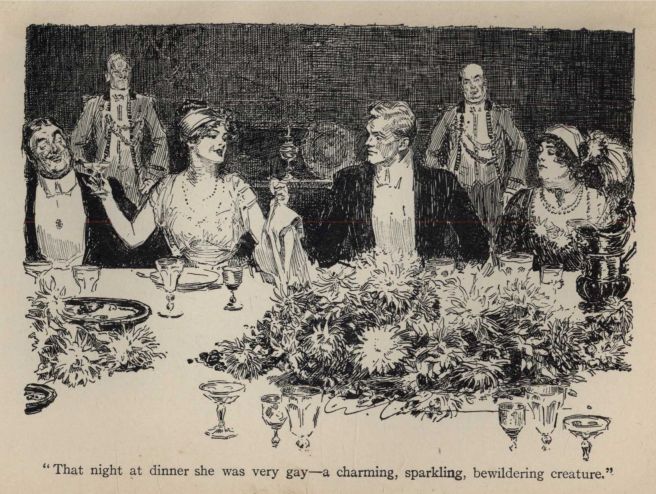
"That night at dinner she was very gay—a charming, sparkling, bewildering creature."
"Certainly I'm bowled over," he admitted cheerfully to himself. "She is the cunnin'est thing that ever missed a pheasant; but she's found me, all right, with both barrels, and the sky's full of feathers, and I'm on the sod, kickin'."
Me managed to tell her so that evening, in language sportsmanlike and picturesque, before they cut for partners at auction. She was standing on the stairs, two steps up; he below her, with his handsome face lifted.
"All you've got to do is to send your dogs forward, and retrieve me, Diana. I'm grassed in the open in plain sight."
"Suppose I should take you up, Scott?"
"Is it a go?"
She smiled down at him.
"Take care, young man. I'm approaching spinsterhood at a terrifying speed. How do you know that I may not clutch wildly at you?"
"For Heaven's sake, clutch!" he urged her.
"How? Shall I roll up my eyes and whisper, 'Oh, Scott!'—or shall I take a flying leap at you from here, and rope you before you can get away? Instruct me, please, because I really don't know as much about such customs as perhaps you think I do."
"Take the flyer, Diana; I'll catch you. Are you ready? Come on; be a sport!"
"I can't be a sport, Scott. I try; I make a brave effort to be cigaretteful and naughty, but—I'm ashamed to say it isn't in me. Now you'll run, I suppose."
"After you—yes.... Diana, I do love you. I haven't said it right, that's all. Will you marry me and make somethin' out of me besides a loafin' lout in puttees?"
"Oh, Scott, you're so beautiful in puttees! I wouldn't make anything else out of you if I could; you must be perfectly gorgeous in pink."
"Come down to the next hunt ball and see. They're a fine bunch at Meadowbrook. You'll like 'em; maybe you'll learn to like me."
"I do now, you scatter-brain! I adore you, Scott; but, you know, love is a different game."
"That'll come all right," he protested. "When you're the missus, and you see me come a cropper over five bars, you'll suddenly wake up to find you love hubby. And I won't be hurt, but you'll think I am, and you'll pull up and scramble down and look me over, and cover my pale and beautiful face with kisses and—I'll play foxy and let you," he ended with pleased satisfaction.
The smile on her face had suddenly become fixed: for what he was saying had conjured up a vision of the polo field, and a young fellow in white picking himself up from the trampled sod.
Wallace, looking around to see that the hall was empty, sprang up the two steps and took her hand in his.
"Diana, I do love you dearly," he said. "Will you take me on for a trial gallop?"
"Do you mean an engagement?" she said, looking him over.
"Yes, I do; will you?"
"What kind of an engagement?"
"The regular—with a sparkler on the side. Will you, Di?"
"No, you very slangy young man, I won't."
"Well, then—then—what kind of an engagement do you suggest?" he asked cheerfully. "Just the circingle and halter kind?"
"What kind is that, Scott?"
"Oh, an understanding that you're not bitted and bridled yet."
"You mean that the engagement lasts during my pleasure?"
"Yes, that's it."
"And ends in marriage—or a very, very kind note?" she asked, laughing.
"Sure thing! Am I on?"
She considered him, smilingly.
"If you like," she said.
"Oh, I do like! It's awf'lly good of you, Diana.... Would you be gracious enough to wear a sparkler?"
"Not yet, Scott."
"Oh, that's all right—whenever you say." He looked up at her, blushing. "Do you mind if I kiss you?"
She looked at him for a second, then impulsively bent forward and kissed him squarely.
"You nice boy," she said gently; "you nice, nice boy. I wish the world were fuller of your sort.... I don't love you, Scott.... I don't suppose I shall.... But if you knew what I feel for you, I believe you wouldn't exchange it for any love I could ever give you.... Shall we go into the billiard room? I'm playing at Colonel Curmew's table, and he's probably perfectly furious at being kept waiting."
She gave his hand a friendly pressure as he released it, laughed, blushed, and turned away toward the billiard room, where the clamor was already audible.
They parted at the door, where she met her sister in conversation with Mr. Rivett.
"Diana," she said, "Mr. Rivett and I are going to town on the early train. You know he goes every week, and I've simply got to do some shopping. Will you come with us?"
Diana's heart gave a bound. To her, New York had become merely the abiding place of Edgerton, and every mention of it started her pulses.
"Oh, do come, Di," urged her sister. "If you'll come, we'll have Jim to dinner at the Plaza. All the theaters are open, too, and we can have a jolly time."
"How on earth is Jack going to bear it?" asked Diana, laughing.
"Bear it? Did you suppose Jack wasn't coming?" asked Silvette so naïvely that the corners of Mr. Rivett's eyes cracked into wrinkles.
"All right, I'll come," said Diana, with never a thought for Scott Wallace; but, thinking of Edgerton, she had meant to go from the first.
As Silvette, on her future father-in-law's arm, walked on toward the drawing-room, Colonel Curmew appeared from the billiard room.
"Oh," said Diana, "I am so sorry to have kept you waiting. I was talking to my sister about going to town to-morrow."
"I want to see you before you go," said Curmew in a low voice. "It can't be done now—they're waiting for us, and Mrs. Wemyss is developing a temper. When can I see you?"
"Why, I don't know," she said, smiling. "What have you to say to me that cannot be said now?"
The colonel's eyes popped, and he leered at her, not doubting her coquetry.
"On the terrace after cards," he said, curling his mustache. "Is that understood?"
"Indeed, it is not, Colonel Curmew!" she said, amused. "I shall retire early, because I have an early train to catch."
The colonel's face darkened. There were limits to coquetry.
"When did you decide to go?"
"A few minutes ago."
"You knew I had something to say to you?"
"I knew nothing of the sort. And what has it to do with my going to town, anyway?"
The colonel had only a few moments to decide.
"How long will you be in town?"
"I don't know."
"Where will you be?"
He wearied her, and to be rid of him she thoughtlessly gave him the address at the Plaza.
"I'll be in town for a day or two," he said, leering at her once more.
If she heard, she paid no heed, for she was already entering the billiard room with a gay gesture and a smile for Wallace, who waved his hand in reply, and looked volumes at her across the hubbub.
CHAPTER XIV
DESUNT CÆTERA
Silvette and Diana, in one of Mr. Rivett's town limousines, had shopped to their hearts' satisfaction, inspected fashions for the coming winter in hats and furs and gowns and various intimate affairs of flimsier fabric, had whirled away down town to lunch with Mr. Rivett and Mr. Dineen at the Iron and Steel Club, then whirled up town again to resume the delicious exploration of those glittering Fifth Avenue shops which line that thoroughfare from Madison Square to the gilded battle horse and its rider in two almost unbroken ranks.
In that magic land, where trousseaux are assembled and garnered by pretty brides to be, Silvette lingered, fascinated; but her rapid, intelligent survey was only preliminary as yet. She and Diana were merely en vidette; official inspection and an advance in force would follow later.
But, oh, the jewels and the furs and the lovely laces and the heavenly hats!
Every shop was now in full swing toward the culminating, scintillating transformation of Christmas; the avenue was crowded with flashing automobiles and carriages, the florists' windows were beautiful, the sidewalks crowded.
Men sold violets everywhere at street corners or offered enormous, orange-tinted chrysanthemums nodding on long stems; giant policemen on foot kept busy ward at every crossing; superb mounted police calmly stemmed the twin torrents and, with lifted hand, quieted the maelstrom. Far to the south, in snowy magnificence against the sky, the huge marble tower brooded under its golden lantern above the city's roar; northward the naked trees of the park turned ruddy and golden in the eye of the level sun.
And all of it the two young girls beheld, and part of it they were—sometimes afoot in the throng, sometimes in their limousine, looking out with enchanted eyes upon all this magic—magic only, alas! to the unspoiled eyes of youth.
From time to time Silvette had stopped at any convenient place to telephone Edgerton, calling him up at his various points of possible contact. She had telegraphed him the morning that they left Adriutha, which was the day before, but, as time passed, it became evident that he had not yet received the telegram.
Some days ago he had gone to Pittsburg at Mr. Dineen's suggestion. On his way back he was to stop at Philadelphia and Jersey City.
Rivett said at luncheon that he'd probably return to his rooms before dining, and find their telegram in time to join them at the Plaza for dinner.
But he didn't come, nor did any word arrive from him; and Silvette and Jack went off to the New Theater to see "The Thunderbolt" matchlessly staged and acted in a matchless theater; and Rivett offered to take Diana anywhere.
But the girl was sick at heart under her smiling, feverish gayety, and the brilliant darkness of the streets seemed to mock her as she looked out into them.
Also, there was a chance that Edgerton might arrive late and telephone to somebody—perhaps even to her.
It was merely a chance, but her chances were few these days, and she durst not pass one by, no matter how unlikely it looked.
So she thanked Mr. Rivett, and preferred her room in the pretty suite to which he had invited Silvette and herself; and there she sat in her silken dinner gown, sunk into the velvety depths of a chair, watching the city lights from the window, waiting, listening—always listening with a hope that died and lived with her unquiet breathing; fading, flowering, waxing, waning, dead and alive between two heartbeats—the hope forever new—the only living thing which cannot die while the sad world endures.
Below her, far below, the lights of motors ran swiftly like passing meteors; the lights of carriages and hansoms streamed to and fro, yellower and slower; the lighted windows of street cars glided across her line of vision in endless, level repetition.
To the west the gemmed façade of the New Theater sparkled above the trees; northward the lighted streets spread away like linked jewels under the winter stars.
Into the high silence where she lay and looked out into the night, only a faint rumor of the city mounted from below; a tongue of flame rustled on the hearth; the clock ticked.
Suddenly, silence was shattered in her ears; she sprang to her feet, one hand against her heart, her stunned senses deafened by the clamor of the telephone.
The next instant she was at the receiver—the receiver pressed convulsively to her ear.
"Yes," she said faintly.
* * * * * *
"Yes; this is Miss Tennant."
* * * * * *
"Yes—Diana Tennant. Who is it?"
* * * * * *
"Yes; I will hold the wire."
She rested against the shelf, relaxing from the tension; then, rigid, electrified:
"Yes! Is that you, Jim?"
"Of course!" he replied. "Are you at the Plaza?"
"Yes—all alone. Oh, Jim! I am so glad to hear your voice!"
"It's bully of you to say it. I'm delighted to hear yours. I have just come in and found Silvette's telegram on my desk. Shall I come around?"
"Will you?"
She could hear him laughing, then:
"Watch me," he said, "if the dust doesn't obscure the spectacle, I'll be with you in five minutes. Is that right, Diana?"
"It is perfectly right."
As though dazed she hung up the receiver in its nickel wishbone, and began walking aimlessly up and down the room trying to collect her wits and calm her senses. Outwardly composed, inwardly facing chaos, she threw open the window and turned her face to the coolness of the winter stars.
Then behind her the telephone sounded again. It was only the announcement of his arrival, and she closed the door of her room and went into the pretty parlor, where a maid was already turning on the electric lights.
His ring sounded; the maid admitted him to the outer hall, took his hat and coat, and ushered him in. Diana rose to receive him with smiling composure as the maid retired to the bedroom.
"This is very prompt of you, Jim—-and promptness is the most subtle of flatteries.... How thin and white you look! ... Are you perfectly well?"
"Perfectly. I need not ask that question of you, Rose of the Berkshires!"
"Do I really look well?"
"Flawless and dewy fresh—a trifle slim, perhaps. Don't they keep you in pheasants?"
"They do, kind sir. It's fashion, not slenderness, you behold. Never mind how it's accomplished. But, Jim, you don't look well. Are they working you to death?"
"Not so you'd notice my decease," he said laughingly. "I'm in the game, up to the neck, and swimming strongly. It's a fine game, Diana. No doubt generations of Edgertons on high look down on me and sing in unison the Anvil Chorus. It's a great game—this iron one. The iron is in me; I'm lanced through and through—it's flowing in my blood; it's in my bones. Iron! iron! There is nothing to compare with it in all the world, Diana."
"Let me see your arm, Jim."
"Shall I take off my coat and——"
"No; I'll just feel it—very gently."
"It's mended. Squeeze all you please."
"Was it here?"
"Higher."
"Here?"
"Lower."
"Here?"
"Higher."
"Jim, I believe you're just letting me fondle your old arm and waste oceans of sympathy on it!"
They laughed; he showed her where the fracture had occurred. She, gravely curious, explored his sleeve with timid fingers.
"Doesn't hurt at all, Jim?"
"Damp weather," he said briefly. "How long do you remain in town, Diana?"
"Only over to-morrow."
"Good Lord! Is that all?"
"We've been here two days."
"And I was in Pittsburg, dammit!"
"You certainly were, my friend; but, could I help that? I did my best. We wired you, and we have telephoned you steadily every minute since we've been here.... Jim, do you know, in the excitement we've quite forgotten to sit down."
They laughed again; he placed a chair for her, but she chose the lounge, and made a place for him beside her. Within the half hour a physical transformation had changed her to a flushed and radiant young girl, shy and audacious by turns, brilliant of eye and lip, and charmingly alert to his every word and smile. From her shoulders the robe of care seemed to have fallen, shriveling, as it fell, in the soft fire of her youth and spring-tide, leaving visible only her fresh, unstained, and winsome beauty.
She told him all that had occurred at Adriutha—all except what had happened between herself and young Wallace; and for the time she really forgot that such a man existed.
Then she asked eager questions; and he laid open the first pages of his new life before her proud, happy, sympathetic eyes, tracing it paragraph by paragraph for her since he had entered into man's estate, and had put away childish things.
The clock ticked; the tongue of flame flickered low among its ashes. They talked on, heeding nothing except each other.
"I thought you and Silvette were to use the apartment when you come to town. Your room is ready; but here you are in white marble and palatial grandeur overlooking the park. Explain those phenomena, pretty maid!"
"We're guests of Mr. Rivett, Jim. Otherwise, no palatial grandeur for us. We wanted to go to the studio apartment; I was perfectly crazy to go. But we saw it would hurt Mr. Rivett's feelings, and that he had set his kind old heart on entertaining us.... Oh, Jim, I don't want to seem ungrateful, but if older people only knew that the less they entertain the young, the better they are beloved!"
"That's a rather sad truth, but it's the truth," he said. "Rivett handed me one black eye, too, bless his heart. I had so counted on your being in the apartment.... Well, you'll come sometime—" He hesitated, looked at her, troubled.
"When is Silvette to be married?"
"They think in the spring; they haven't settled it yet."
"Then you and she will be in the apartment this winter?"
"If you want us," she said almost shyly.
"Want you! It will be paradise! I'll make my salary go as far as it will."
"Indeed, you won't! Silvette and I chip in pro rata, or we refuse your marble halls!"
"I'm afraid I'll have to agree, Japonette. My poverty, not my will, consents!"
After a moment she said: "It is a long while since you have called me that."
"What?"
"Japonette. I like it. There's a sort of an irresponsible frou-frou to the name which suits me. That's all I am, Jim," she added with a laugh—"just a swish of scented skirts."
He glanced up at her, half smiling.
"I know what you are," he said.
"Do you? I don't. Reveal me to myself, O Cagliostro!"
"Not now."
"Why?"
"Not now," he repeated.
"When?" she insisted.
"Some particularly sunny day in June, perhaps."
"June! Listen to this man! The very nearest June is seven months off!"
"And I don't believe it will be next June, either," he said with a grin.
"Jim!"
"Yes?"
"You're a plain masculine brute! You say you know what I am. If you do, tell me now! I maintain that I'm only a silken rustle and a hint of scent. Am I a louder episode than that, Jim?"
"The vault of heaven rings with you!" he assured her, laughing.
"Harmoniously?"
"Entrancingly."
"Well, that's better," she nodded dubiously. "Evidently I'm not the kind of a noise that gets arrested. Jim, when the others come in, shall we have supper?"
"Tons of it, dear lady. They'll have to push me out of this hotel before I consent to go."
"Do you mean it?"
"Militantly—truculently!"
"Are you glad to see me?"
He glanced at her with an odd expression, then turned aside to set his cigarette afire.
"Yes, I'm glad," he said.
She took one of his cigarettes, lighted it, savored it daintily, then leaned back watching mm. Their eyes encountered, and they smiled.
"Where are the others, Diana?"
"Jack and Silvette are at the New Theater. Mr. Rivett and Mr. Dineen are sitting somewhere, cheek by jowl, looking wealthy."
"How does one look wealthy?"
"You always do, Jim."
"Thank fortune for that. It ought to land me somewhere on the grandstand."
"Haven't you noticed," she said, "that some people always look wealthy? I don't know exactly what it is about them; it has nothing to do with breeding, or clothes, or careful grooming."
"Neither has wealth," he smiled.
"That's trite; you're becoming too prosperous to remain clever. But, oh, Jim! isn't it fine!" she exclaimed impulsively.
"What is fine?"
"Why, your success, of course! Your splendid interest in the business—your fitting yourself for a position of honor among your peers! It is fine! fine! And it is the happiest thing that has ever happened in my life!"
He looked at her.
"You dear girl," he said quietly.
"I? It was none of my doing. You're mistaken if you think so. Once you said something of that sort in a letter to me; but it isn't true, Jim. You have found yourself; the credit is yours alone."
"I give credit to the far white gods.... In that Olympian Pantheon one is known as Diana."
"She of the Ephesians—yes. She was great, wasn't she? Did you ever hear of the fly who said, 'I lie on my back in space, balancing the world on my six legs'? The fly was quite right; there's no top or bottom point to this sphere—or to your logic, Jim."
He smiled quietly.
"Did you ever hear of that Chinese goddess of the lotus, Kwan-Yin, who, from her blossom throne in the Happy Isles, rescues lost souls?"
"With how many incarnations are you going to endow me, Jim?"
"Do you think I am endowing you with anything you do not already possess?"
"What do I possess?" she laughed; "blue eyes and a fair skin and a heart as mercenary as a Persian pussy's. Warmed in the sunshine of life, I radiate purrs; but I'm a slit-eyed opportunist in storm and stress."
After a moment he said:
"What are your plans when Silvette marries?"
"I suppose I'll marry somebody," she said, thinking of Wallace for the first time. "Old age alone doesn't attract me; in fact, I've been hedging already," she added.
"Hedging?"
"Practically; I've told a man I'd marry him if it suited me to do so some day; but, meanwhile, he must consider himself padlocked. Isn't that a nice, thrifty, feminine contract?"
"Are you serious?"
"Entirely."
"Who is he?"
She glanced at him uncertainly.
"I think you've heard me speak of him, Jim."
"Wallace?"
"That is the youth."
"Are you in love with him?"
"Oh, more than that, Jim. I like him."
"Enough to marry him?"
"Not at present.... But you never can tell. I await the event. I haven't anything else to do."
He nodded, smiling.
"I rather imagined him to be the sort of man you'd come to care for.... I've heard one or two men speak of him recently."
"You mean that you made inquiries?"
A tint of red touched the city pallor of his skin.
"Yes, I took that, liberty."
"It was a friendly one. The reports were excellent, of course."
"Excellent. He must be a good deal of a man."
Her eyes were fixed on him, expressionless, considering. The slightest smile edged her lips.
"He is young—and nice.... I don't know how much of a man he may become.... I know nothing about him, and haven't studied him very minutely yet."
"You will—before you marry him."
"I may not.... A girl often misuses a microscope. I think I have, frequently. Do you remember King Gama's song?—
"'And interested motives
I'm delighted to detect!'
"No, Jim; my snooping days are about over. Dissection wearies; the clinic is a bore. I'm beginning to be content with the surface of things; I'm tending toward impressionism and the elimination of detail—toward the blessed serenity of stupidity. There is rest, there."
"Rest," he repeated, smiling. "Of what are you already tired?"
"I am tired of intelligence. It's too exacting. It forms a liaison with conscience, and affronts inclination. I'm tired of rule and precept with which an occult and inborn tyranny shackles me. I'm tired of more than that—but isn't that sufficient to fatigue a girl?"
"Heavy chains," he said, looking at the figures on the carpet, tracing them with an incurious eye.
"So I think I'll file away a few links."
"You can't."
He rose, walked to the window, drew the curtain, and looked out at the November stars. Limpid, inexorable, the countless eyes of the night met his. Whatever message they held for him he seemed to understand it, for, presently he came quietly back to her.
"Yes," he said, "it's a good game, after all. The main thing is to get into it and stay there—in medeas res—squarely." He looked up, smiling. "Your superb interference put me there. Why do you deny it?"
"Does it please you that I should not deny it?"
"Yes, Diana."
"Then I affirm and deny nothing—which makes me sufficient of a nonentity to suit you, I hope."
"I am suited."
A moment later the bell rang, and Silvette and Jack, followed by Mr. Rivett, came laughing through the hall and into the little parlor.
"Jim! At last!" cried Silvette, giving him both hands.
"How are you, cousin! How are you, Mr. Rivett! Hello, Jack!" he said as they surrounded him with lively greetings.
"How goes it?" inquired Mr. Rivett dryly.
"First rate."
"Did you see McMillan in Pittsburgh?"
"By jove, I did! He was tremendously interesting—and exceedingly cordial to me."
Mr. Rivett nodded. He might have said that he kept McMillan in his vest pocket, but he only stared at Edgerton through his big, round glasses.
They all had supper together, later; Jack and Silvette bubbled enthusiasm over the play and the splendid cast; Dineen came in and talked business to Rivett in casual undertones; Diana and Edgerton were quieter, even inclined to silence.
Meanwhile Jack was consulting Silvette about theater plans for the following evening, and Edgerton said that he would return from business in time to join them.
"You'll be in Jersey, won't you?" asked Rivett.
"Yes."
"Well, try to get back in time to dress and join us at dinner."
"I don't believe I can do that."
Rivett looked at him. "Try," he said briefly.
But Edgerton said aside to Diana:
"I can't get back to the studio before eight.... By the way, you have a key, you know, if you wish to go there at any time."
"Thank you, Jim. I may look in to-morrow sometime. I want to see—" She flushed, and hesitated; then calmly: "We left two trunks there, you know."
He nodded. "Go and rummage. The janitor has orders. He has taken splendid care of that big white cat of yours. You'll find everything in order, and quite comfortable."
So he made his adieux and went his way; and Mr. Dineen followed, and Jack and his father retired to their suite, and Silvette and Diana went to theirs.
"Little sister," whispered Silvette, leaning over Diana's pillow, where she lay, eyes closed; "are you any happier than you were this morning?"
"Yes."
"Very much?"
"Very much."
And that was all. Silvette looked down at the white face and closed eyes, sighed, and extinguished the night light.
The eyes of happiness close only in sleep, or in the arms of the best beloved.
Silvette's excited heart began to sing with the first ray of the morning sun. Also she arose, dressed, and breakfasted with her equally reckless affianced, which showed that theirs was a hopeless case, and a recent one.
Dineen came and took Rivett away. Diana tasted a grape fruit in bed, and lay thinking until noon brought luncheon and her maid pro tem.
Jack and Silvette, unable to persuade her, drifted off somewhere into the sparkling confusion of the metropolis, promising to return and take her for a drive through the Park.
About five o'clock she summoned her maid.
"Please say that I have gone to the studio apartment to get some things from my trunks," she said; and wrote out the address in case either Mr. Rivett or Mr. Dineen wished to communicate with her.
Then, in furs, walking skirt and veil, and her tired little heart already outstripping her feet, she went out into the sunset world upon the pilgrimage so long desired, so long and wistfully deferred.
Her pulse beat fast as she entered his street. The sight of the house filled her with sudden trepidation, but she knew that he was not there. She had nearly three hours alone before her, unless the others, returning to find her note, might telephone and interrupt her.
Her key turned smoothly in the lock; she crossed the threshold, holding her breath.
A dull, mellow light filled the studio. In the stillness a faint fragrance of tobacco hung in the air. Step by step she advanced, looking at each familiar object as she came to it and passed it—pausing to lay a gloved hand on the sofa where, ages ago, two very young people sat, touching with lingering fingers the empty silver bowl which once, on a summer day, had been almost hidden under a fragrant load of peonies.
Something behind her—and it was not a sound—made her turn. The white cat sat looking at her with no recognition in its solemn eyes; and when she moved forward, hand outstretched in wistful appeal, it calmly retreated into the demi light of the bedroom beyond.
The well of desolation was filling fast now; she sank into a wide chair by the tea table and, lifting her veil, touched her eyes with her handkerchief. Then, disciplined, controlled, she lay back looking into the bedroom where she and her sister had slept and awakened through those three magic days which even Fate allowed before foreclosing on her destiny forever.
Pink bars of sunlight slanted on the wall, warming the painted armor of a forgotten dead man—forgotten no more than some among the living. A great lady, painted in her jewels, seemed to flush and smile as a rosy bar crept across her cheek. Doubtless she, too, had loved before she died.
The girl extended her arm listlessly along the upholstered arm of her chair, and looked at her white-gloved hand.
In the hollow of that hand she had once held Love, and had smilingly released it. Out of that little palm Love had flown far beyond her ken; and there was no returning for that winged thing.
Then, very quietly, she bowed her head, eyes sheltered by her hand, and remained so, motionless, for a long while.
The outer bell had sounded twice before she realized that it was the bell of the apartment. Dazed, she rose, stood a moment collecting herself, then walked to the door and opened it.
Colonel Curmew stepped jauntily in.
So astonished was she that she scarcely understood what he was about before they both were on the studio threshold—she instinctively retreating, he advancing, wreathed in a smile so remarkable that it fascinated her.
"What an odd thing of you to do," she said, still confused by the suddenness of his invasion, groping instinctively for the reason.
"You left word at the Plaza; I understood," he said, his eyes fairly popping at her, then palely roving around the place.
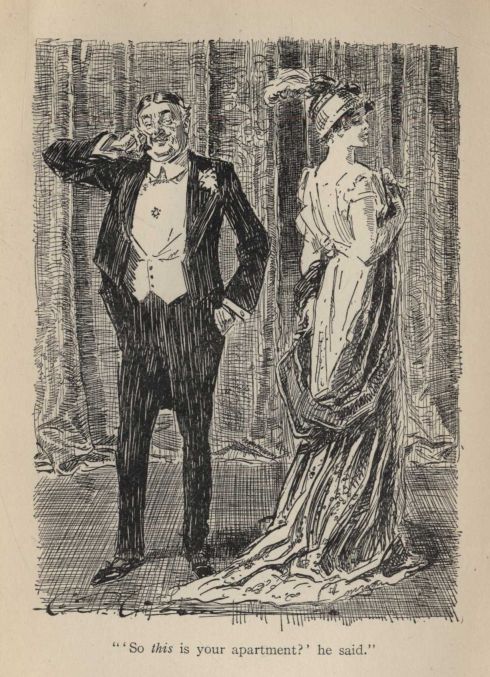
"'So this is your apartment?' he said."
"So this is your apartment?" he said. "What a discreet and charming little nest!"
"I think you don't understand," she said; "this is Mr. Edgerton's apartment."
He looked at her oddly, then burst into laughter.
"You clever girl!" he chuckled.
"What!" she said, bewildered.
But he only smirked at her.
"Look here, little girl," he said, "suppose you begin to make your eyes behave, and come down to actualities. You know what I want; I know what you want. We've been wasting time all summer. I'm no fool; neither are you, as you show by selecting this nice, little nook for a good, sensible talk."
She only stared at him, thinking he had gone mad, and he laughed and twirled his mustache.
"Nix for the baby stare," he said reprovingly. "I tell you I know what a girl like you wants—privacy, discretion, and the usual ... And I've got it, little girl—wads of it!"
The grotesqueness of the dream seemed to make her stupid; she tried to find some sense and reason in what this man was saying to her, strove to comprehend him, his visit, his words.
"Are you asking me to—marry you," she said, confused.
"Marry you!" he repeated, his expressive features suddenly blank, then jocular again.
"Then—what——"
And, suddenly staring into the sinister smirk, she comprehended, and turned ashy white.
Even he could not mistake the genuineness of that white horror.
"You—you d-don't understand," he stammered, his effrontery shaken.... "I—perhaps I didn't understand you, either.... But I thought—I supposed——"
His top hat fell clattering on the floor; he stooped and picked it up, lifting a redder and more impudent countenance to confront her.
"After all," he said with a sneer, "I had a right to think you knew what you were about—a girl, alone, who lives on her wits."
He hesitated, malignant now, writhing internally under her pallid contempt.
"By God!" he said, "you're nothing better than any other hired woman! I helped hire you myself." And added, between his teeth: "You little clawing cat! I know damned well you're an adventuress, but your game is beyond me——"
He swung insolently on his heel, and found himself looking straight into the eyes of Jacob Rivett.
"Go out!" said Mr. Rivett in a low voice.
The colonel stared at him, confounded.
"Go out!" repeated Rivett softly.
The colonel, flushed and utterly discountenanced, started toward the door. Mr. Rivett followed him out into the hall, closing the door behind him.
Diana stood stock still, as though turned to stone. There had been a crash outside; then, in rather rapid but irregular succession, a series of thuds. It was Colonel Curmew's impact with wall and floor; Mr. Dineen had been patiently knocking him down until that battered and half-senseless warrior took the count. Then one careful and heavy kick sent him down the first of the flights of stairs, and a moment later Diana heard the door bell.
She opened; Mr. Rivett walked in slowly, as though abstracted; Mr. Dineen came behind, straightening his scarf-pin.
"You left the door ajar, so we walked in," observed Rivett, ignoring his previous entrance. He strolled about, glancing up at the pictures and tapestries. Then his manner changed.
"Well, my dear," he said briskly, "Mr. Dineen and I stopped at the hotel, and your maid told us you had come here to get things out of your trunks. So, if you've finished rummaging, the car is below, and Jack and Silvette are waiting tea for us at the St. Regis."
"Thank you," she said in a low voice.
"Had you rather not come?"
"I had rather not—if you don't mind."
He walked over to her, took both her hands, and looked into her eyes.
"I am at your service, my dear," he said.
"I know it.... My heart will always be in yours."
His face grew grimmer.
"I guess we understand each other, child.... Next to my own—Silvette—and you.... Shall the car wait for you?"
"I will walk back."
"Dinner at seven," he said, releasing her hands.
She nodded, forcing a smile.
"At seven," she repeated, offering her hand to Mr. Dineen, who squeezed it shamelessly while unfeigned admiration transfigured his broad face.
So they left her there in the studio, standing in the dusk, head held high, and in her eyes that dauntless courage that remains though lips quiver and the hot tears sting the straining throat.
Cautiously, lest self-control slip the leash, she reseated herself and lay back in the chair, closing her eyes. Whatever battle raged within her was fought out there in darkness and in silence. She lay motionless, never stirring save for the slow clenching and relaxing of her fingers; and at last even that ceased.
Then the steel nerves and iron will that had mastered the storm and soothed it, turned traitor, tricking her, furtively relaxing in the wake of exhaustion.
In the dark the white cat stole in, hesitated, looked at her; then, satisfied, stretched out on a Persian rug in front of her.
Long ago all sound had ceased in her ears; her heart beat quietly, her breath came and went as evenly and softly as the respiration of a sleeping child.
Through the tall windows the starlight touched her; at her feet the white cat dozed, dreaming of nothing.
Confused, the brilliancy of electric light in her eyes, Diana found herself sitting bolt upright, clutching the arms of her chair, and staring at a dark figure which leaned over her—a man, laughing, still amazed, still a little incredulous.
"Jim!" she faltered.
"Certainly. What do you mean by going to sleep in my favorite chair?"
"Oh, dear! Oh, Jim!" she wailed, dropping back helplessly into the depths of the chair, "I must be perfectly crazy to do such a thing! What time is it? I came in here to—to get something"—she pressed her hands to her temples—"to find—to look— Oh, I don't know what I'm talking about!"
Her hands dropped; she gazed hopelessly up at him.
"Did you ever hear of such a perfect fool?" she said. "What time is it?—if you think I can bear the information."
"It's only eight."
"Eight! Jim, dear, will you go to that telephone and inform Mr. Rivett that I have not been run over, murdered, or arrested?"
He went over and telephoned, adding: "Don't wait for either of us. Leave the tickets on Diana's dresser. We'll be along pretty soon."
"What did you mean, Jim?" she asked, struggling with her veil.
"It's so late," he said, "that you'd better wait for me to get into my jeans, and then I'll take you over and you can get into yours, and then we'll dine together, and go in for the last act if we have time."
"I've spoiled your evening," she said.
"Do you think so?"
"Oh, I know it. Did Mr. Rivett think me an utter lunatic?"
"He didn't say so over the wire."
"What did he say, Jim?"
"Nothing that meant anything."
"Tell me!"
"All he said was for me to take care of you. You perceive the irony, don't you?"
"Irony?" she repeated, looking at him.
"Why? Aren't you capable of doing it?"
"Do you need anybody to look after you?" he asked, smiling.
Slowly she lifted her eyes to his; his smile died out. Never had he looked into such a desolate face.
"What is it?" he said, astonished; "what on earth is the matter, Diana? Has anything happened?"
"Nothing—unusual—I suppose."
"You are not ill, are you?"
The tears were slowly blinding her, and she turned her head, standing so, fighting for self-mastery.
"Diana——"
She motioned him to silence. He stood it as long as he could, then stepped over beside her and touched her arm.
"Tell me, dear?" he said under his breath.
She strove to speak—could not, yet; motioned him aside, but he would have none of such commands.
"You took my troubles on your slender shoulders," he said; "may I not help you to carry one or two of yours?" ... And, as she made no answer: "Dear, if you have not loved me, you have done for me, perhaps, even more than love might have done."
She had dried her eyes; now she turned to him quietly.
"It was love.... But don't mistake it, Jim.... It was a love that asked for nothing that it had not—desired nothing that you had not already given.... I thought it best to tell you—because—it is a world of men; and women—sometimes—are held—lightly in it——"
Her lip quivered, but she, somehow, managed to meet his eyes and smile.
"All that happened long ago, Jim."
"Did love—die?"
"Yours," she said, smiling. "I slew it very neatly for you."
"I mean yours, Diana?"
"Mine? Why, I gave you something better than that," she began gaily. Then her face altered; she fell silent, watching him—at first incredulous, then a little dazed.
"Didn't you know that I loved you?" he said.
"You mean—last summer.... Yes."
"Now! Didn't you know it?"
"I—no."
Far in the chaos of her brain she heard his words echoing, reëchoing in confused reiteration.
He was saying, slowly: "There has never been a moment since that day that my life has not been yours—that you have not possessed my heart, my mind, filled them, owned them, overwhelmingly inspired me with love and adoration for you alone. What I am, and will be, I am, and shall be by grace of you.
"But gratitude is not the love of man for woman; it is not even part of it; it is a separate passion—a shrine by itself. I worship you there in my own fashion.
"But you, Diana—Japonette—" He flung one arm around her body. She placed a firm hand on his wrist as though to break the clasp, looked at him, and began to tremble.
"Can you love me, Japonette?"
"Can you?"
"Yes."
Her hand tightened over his wrist as he drew her close, crushing her to him. She looked up blindly into his eyes as he kissed her; then her lids unclosed and her silent lips moved, forming his name.
They neither dressed for the theater nor went to it. They dined together at an outrageous hour in an unfashionable haunt of his.
Silvette, Jack, Mr. Rivett, and Mr. Dineen found them at supper in the little parlor when they arrived from the play.
"Di!" cried Silvette, "what on earth has possessed you and Jim?"
Her voice failed her at sight of her sister's face.
"That!" she exclaimed; "has that happened? Darling! My little Di—my little, little girl!" she murmured, dropping on her knees beside her.
Mr. Dineen looked foolishly at Mr. Rivett.
"Say it later, John," whispered Mr. Rivett dryly. "We'll go downstairs for a while."
"You won't!" said Diana, turning laughingly on them. "You will wish us happiness, and drink to it, too." She rose, flushed and radiant. Silvette sprang to her feet and kissed her; Jack seized her with determination, and made no ceremony about it.
Then Diana walked straight up to Mr. Rivett, and held out both hands; and the little man kissed her grimly.
Mr. Dineen's blue eye sparkled; she looked at the big, jolly Irishman, audaciously delighted.
"What man has done, man may do," she said.
"Faith, I'll see if a woman can do it, too!" he said, saluting her with all the reckless grace of his race.
Then Edgerton's hand was shaken and his shoulder patted, and Jack summoned legions of waiters from the regions below.
Rivett's burned-brown eyes bored through and through Edgerton as he took his hand.
"I thought you'd do it," he said.
"Did you? I wasn't very hopeful myself," said the young fellow, laughing.
"I was.... They're good children—good children—like my own.... If you will excuse me, I will go and telegraph my wife.... It will be a happiness to her—a great happiness."
Jack thrust a glass into his hand. "What's this?" demanded his father.
"We are to drink health to them, dad."
Mr. Rivett inspected his glass, hesitated, while all waited; then, lifting it:
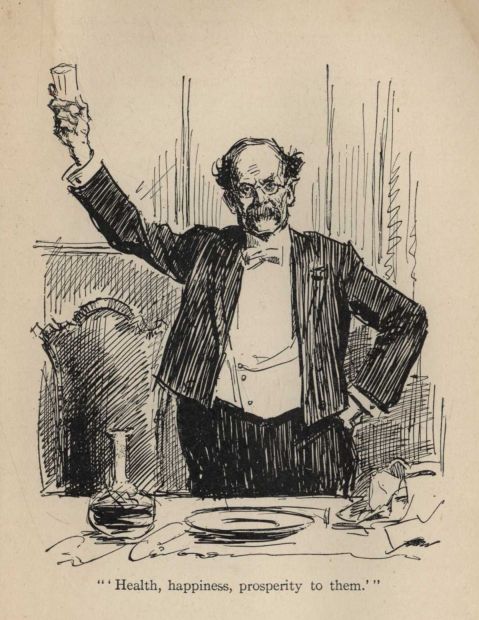
"'Health, happiness, prosperity to them.'"
"They're good children," he said. "Health, happiness, prosperity to them—and—to the house of Edgerton, Tennant and Company! ... Break your glasses!"
THE END
* * * * * * * *
Works of Robert W. Chambers
Japonette The Common Law The Adventures of a Modest Man Ailsa Paige The Danger Mark Special Messenger The Firing Line The Younger Set The Fighting Chance Some Ladies in Haste The Tree of Heaven The Tracer of Lost Persons A Young Man in a Hurry Lorraine Maids of Paradise Ashes of Empire The Red Republic Outsiders The Green Mouse Iole The Reckoning The Maid-at-Arms Cardigan The Haunts of Men The Mystery of Choice The Cambric Mask The Maker of Moons The King in Yellow In Search of the Unknown The Conspirators A King and a Few Dukes In the Quarter
For Children
Garden-Land Mountain-Land Forest-Land Orchard-Land River-Land Outdoor-Land Hide and Seek in Forest-Land