Front matter (continued 3)
Reading edition
Presently he looked up at her.
"What was it you were lecturing me about?" he asked cheerfully.
"About our twosing, Jack."
"Did you say you did prefer it, or otherwise?"
"Otherwise—you monkey!" she said, laughing, free of the restraint and of the bright color that had made even her neck hot.
"Very well," he said briskly; "keep your distance! Don't start running after me the moment I come in sight across the landscape. Will you promise?"
"I promise," she said solemnly.
"Thank you. I shall have a little leisure now. I'll have so much I won't know what to do with it. Can you advise me?"
"I cannot."
"Then I'll have to think for myself.... I'll have to do something, of course.... Suppose you and I take a canoe——"
"Canoes hold only two, Jack."
"By Jove! What am I thinking of! Thank you for saving me from incredible suffering.... So suppose we don't take a canoe, you and I, but we take the red runabout?"
"Jack!"
"What?"
"The red runabout holds two, only."
"I must be demented!" he said with a shudder.... "Silvette, I'll tell you what we'll do—we'll take a walk, you and I. There's room all around us for millions of other people. They can come if they like; if they don't, why, it's up to them!"
"No, Jack."
"Won't it do?"
"No. Why won't you be a little bit serious about a matter that, after all, concerns me very nearly."
"I am serious," he said. "It concerns me, too."
"No, it doesn't."
"Indeed, it does. Two people are not to go twosing any more; I'm one of those people. Therefore, it concerns me, doesn't it?"
She looked at him, confused, half smiling, half reluctant.
"Don't you know," she said, "that your attention to me is worrying your father and mother?"
He thought a moment, then slowly turned toward her a sober and youthful face, from which all humor had departed; and she looked back at him out of grave young eyes that met his very sweetly, but inexorably.
"Do you mean it, Silvette?"
"About your parents?"
"Yes."
"Yes, I do, Jack."
He said, partly to himself: "I had not noticed it."
"I have. It's a woman's business to notice such things. Otherwise, she'll find herself in trouble.... Inclination is a silly guide, Jack."
"For me?"
"For—us both.... I will be frank with you all the way through. I do like you. I enjoy our tête-à-têtes. They are perfectly honest and harmless, and without significance—the significance, alas, that others will surely attach to them.... It isn't that there's anything wrong with you and me, Jack.... It's the World that is wrong.... But—it's the World; and you and I must conform to its prejudices as long as we inhabit it—at least I must."
"I suppose you must," he said. Then, leaning a little nearer, he took her hand, held it lightly across his palm, looked at it a moment, then at her.
"Will you let me tell father and mother that I am in love with you, and wish to marry you?" he said.
"Jack!" she exclaimed in consternation.
"Will you let me?"
"No, I won't! ... Jack! Don't be foolish. I had no idea you had arrived as far as that. I had no reason to think so—to suppose for one moment—because it has always been the jolliest and most unsentimental—and—you never even touched me before."
Her color brightened, and her breath came irregularly. She tried to laugh, and failed.
"You know perfectly well that they have other ambitions for you."
"I know.... How is it with you, Silvette?"
"With me? What do you mean?"
"Could you care for me?"
"I—I haven't even thought about such a—I haven't really, Jack. You know that, don't you? You must try to look back on our very brief friendship—try to recollect how brief it has been—try to remember—remember how happy and amusing and confident that friendship has been—with no suspicion of sentiment to embarrass or vex——"
"I know.... Isn't there any hope for me?"
"Hope? No.... Don't put it that way, Jack.... I don't love you.... I oughtn't to, and, thank Heaven, I don't. And you don't really love me—you dear, sweet fellow! It's just part of your niceness—your generous attitude toward a girl——"
"I'm in love with you.... But that mustn't worry you. It had to be. You need feel no self-reproach. You didn't do anything—you were just yourself—and I"—he laughed a little—"started in to love you as soon as I saw you.... I'm glad you know it, anyway. We won't say anything more about it——"
"Jack, we will! Do you understand that you have distressed me dreadfully? Do you realize what a girl's responsibilities are when a nice man loves her? Do you think she can merely shrug her shoulders and go about her daily frivolities without another thought?"
She rose to her feet, looking at him earnestly.
"Oh, Jack! Jack!" she said, nervously clasping and unclasping her hands; "why did you do this? Why did you?"
He forced a laugh. "I won't do it again—ever," he said. "Promise you never to fall-in-love-again-hope-I-may-die'n-cross m'heart."
But there were no smiles left in her now.
"If you don't behave," he threatened, "I'll lock us both inside and sing songs to you!" ... But the smile died out on his face. "I was a gink to tell you. Don't feel unhappy about it," again the engaging humor glimmered in his eyes. "Cheer up, Silvette; you may fall in love with me yet!"
She looked up, the smile dawning, distressed, yet sweet.
"Don't let me, Jack.... Because I'm all right, so far.... And you know what your father wishes for you. I want to deal honorably by him."
"All right," he said quietly.
They walked slowly back to the house together, and the girl went directly to her room, where she found her sister mending stockings.
CHAPTER IX
NON SEQUITUR
Silvette dropped into an armchair, crossed her knees, and sat swinging her foot and gazing through the open window in silence until Diana's head, lifted from time to time in smiling interrogation, could be no longer ignored.
"Jack Rivett has asked me to marry him," she said in an expressionless voice.
Diana laughed in frank surprise:
"That infant!"
"Yes."
"What an absurdity!"
Her sister said nothing.
"How did it come—out of a clear sky?"
"Yes.... I knew he liked me. I had no idea he wanted to marry me."
"You're not going to, are you?"
"No."
"I should think not. It would be sheer cradle snatching."
"He's a year older than I am."
"In years, yes; but, intellectually, he ought to be playing marbles. Moreover, that sort of a boy never grows up."
"I don't think he will.... God bestows that gift sometimes."
"What gift?"
"The gift of eternal youth.... I haven't it.... But I believe it can be shared." She gazed thoughtfully at the distant hills. "Years and years slip from me when that boy and I talk nonsense together."
"Better talk sense with him, and wake up, sweetness, or you'll relapse into your second childhood."
"I have just been talking sense to him.... I'm awake," she said dreamily.
"Do you mean to admit that the interview has seriously affected you?"
"Oh, I don't know yet."
"Better investigate," said Diana. "You know what his parents expect of their children. And if we are to remain here, I think, dear, that you had better see a little less of Jack Rivett than you have been seeing. Don't you?"
"I am sure of it."
"Otherwise," continued Diana calmly, "it would be playing the game fairer for you and me to seek another business engagement. These people have been very honorable toward us. We can scarcely permit them to outdo us."
Silvette looked up calmly, her cheek resting on her hand.
"How dishonorable would it be?" she asked.
"What?"
"To—let him fall in love with me?"
"Ask yourself. You know their social ambitions."
"I know; but, after all, you and I started out to make of life a successful business proposition. I thought a desirable marriage was to be part of the programme."
"Do you consider Jack Rivett desirable? He could take you nowhere. With all his wealth, where could you take him? And anyway, it's not playing the game, Silvie. It's kidnaping." She laughed. "Take a man of your size—and of the world, little sister; and if he isn't of the world, and is poor, defy him to take you!—give him battle—put up a good fight with foot, horse, and artillery. The best one of you will always win, and the other get what's coming."
Silvette went to the desk, supplied herself with pen and paper, and prepared to resume her interrupted correspondence. Presently she looked around, pen poised.
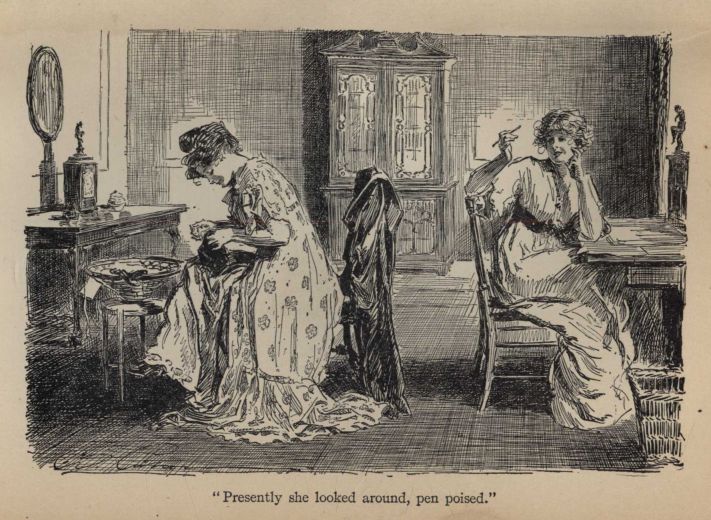
"Presently she looked around, pen poised."
"Did the best man win between you and Jim Edgerton?" she asked.
Diana bent lower over her sewing.
"I'm afraid so, Silvie."
"Then you won."
"I think so.... I have fought it over every day since—alone."
"You poor little thing," said Silvette softly.
Diana looked up with a slight smile. "Perhaps you misunderstood me, dear. I told you I was winning.... Which means, I think, that Jim Edgerton isn't going to remain very long at Adriutha."
"Where is he going?"
"I don't know that he is going at all; he doesn't know it, either.... But, somehow, I dare believe that he is going."
"Where?"
"Into a man's world to engage in a man's business."
"It isn't in him, Diana.... You are taking a great responsibility on your shoulders. Do you realize that you are?"
"Yes."
"And that a man with no more force of character and real ability than he has may starve? That the world will probably break his heart, anyway."
"Let it, then.... Only a real man's heart breaks. I'll know he's one if it does; and so will he. And that's worth all the rest."
"That's a stern creed, little sister, considering the pleasure-loving lips that utter it."
"Out of the mouth of fools, wisdom. It doesn't matter what I am. The thing that is important is what he shall become."
"If he become what you desire, he may have little further interest in you."
"He will have none, if he becomes what he could become," said the girl steadily. "Did you suppose my—ambition for him was selfish?"
"Little breaker of images, are you going to shatter your own under his very eyes?"
"He will be the iconoclast some day.... Probably I'll be married before that—as soon, anyway, as it's best for him.... I've plenty of time." ... She smiled without a trace of mirth in her eyes. "Mr. Snaith has already indicated his noiseless entry into the lists. He and Colonel Curmew are at lance points. Materially speaking, a girl ought to consider both of them."
"But, child, we have many another business engagement before us yet, I trust.... You wouldn't think of taking the first—the first——"
"Million offered?" asked Diana, laughing. "No, of course not, silly. I'm merely observing the manners and customs of the creature man."
Silvette laughed, too. "How are you getting on with Billy Inwood?" she asked demurely—"speaking of more agreeable matters."
"Perfectly; after the initial shock at encountering me here, he behaved most reasonably. I have an idea that he came here on Christine's account, and he seemed to be rather nervous as to his obligations to me, but I set that right at the first opportunity. I said: 'Billy, if I don't tell you, somebody else will, that Silvette and I are here practicing our profession, which is—to be amiable to the guests and help entertain them. So I'm going to be just as amiable to you as I know how, but it need not frighten you because I have no designs on you.'"
They both laughed. Diana, mending her stocking, continued:
"I think he was very much relieved, though he pretended not to be. I wonder if he did come here to see Christine? The girl is cool enough with him, and he is inclined to follow her about in an aimless sort of way, as though he had something on his mind."
"He seems to be equally attentive to Christine and Mrs. Wemyss," observed Silvette. "It appears that he and that ample beauty are old friends."
"Who is Mrs. Wemyss, anyway?"
Silvette smiled. "I asked Mrs. Rivett, saying that there was something familiar about Mrs. Wemyss, and that I had an idea I had seen her somewhere; but Mrs. Rivett didn't know who she was. She had met her last winter at the Plaza, which is the kind of thing one might have expected—even of Mrs. Rivett, who is as dear a little woman as ever wore sapphires at breakfast.... What a horrid, cynical thing I'm turning into! ... And now I'm going to turn into an imitation of a young girl dressing for luncheon. Heigho! I wish other people were what they ought to be and I were what I'd like to be. The world would wag very well, then."
Luncheon was the usual animated, gossipy, and amusing function that Silvette and Diana and Jack Rivett always made it, and at which Colonel Curmew assiduously assisted according to his notions of jollity.
Edgerton for the last week or so had remained rather silent among the others, amiable and nice always and perfectly receptive when spoken to, but not volunteering very much, and not, according to Colonel Curmew's idea, earning his salary. However, as the colonel didn't like him, that fact may have colored his judgment when he spoke to Mr. Rivett about it after luncheon in the privacy of that silent man's study.
"He's turned into what I knew he was—a damned snob!" said the colonel, sitting with widened legs, a rich cigar tucked in under his military mustache, and furtively loosening the rear buckle of his white waistcoat.
"He doesn't pay for his keep," he went on. "What use to you is a man who sits around looking unapproachable?"
"I have no difficulty in approaching him," observed Mr. Rivett.
"You pay him. To look at him, one would think he paid you."
"He pays me his services."
"Ah, but he doesn't! He's off with that little Diana girl half the time."
"That's their affair."
"By gad! Is it? They're both here on a salary if it comes to that, Jake.... Say, did it ever strike you as funny—this cousin business he puts up?"
Mr. Rivett's burned-brown eyes fixed themselves on the jaunty colonel.
"How?"
"Oh, nothing.... They're rather distant relatives, that's all.... Not but what she seems to be straight—as far as I know."
"What does anybody else know about her?"
"Oh, nothing—nothing," said the colonel, waving his cigar and heavy seal ring. "But it's curious.... You can't really say a word against an Edgerton, rich or poor; but, as far as I can see the girl is only a little adventuress looking for trouble.... She'll probably get it some day," he added with a tenor laugh peculiarly ungrateful to the auditory mechanism of Mr. Rivett.
The colonel puffed his cigar in smiling silence for a while; then, expelling another laugh and a large volume of blue smoke, slapped his knee, straightened his tie and waistcoat and shot his cuffs.
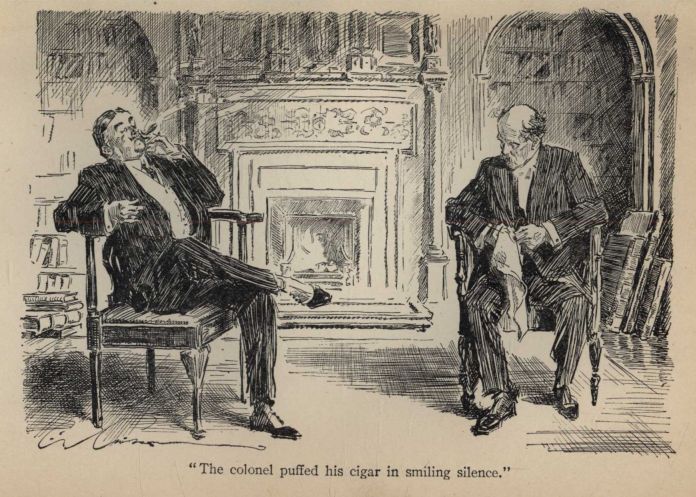
"The colonel puffed his cigar in smiling silence."
"She'll be all right to take about town, eh, Jake?" he said.
Mr. Rivett said nothing.
"Now, there's old Parke Ellingford," continued the colonel; "he's never had as good looking a girl, and, b'gad! I've seen 'em all—known most of 'em," he added with a leer. "And take any of the men you and I know—Wallowby, Dankland, and that hatchet-faced Van Wyne! They've never had any better-looking girl than that little Diana."
Mr. Rivett said nothing.
"B'gad!" said the colonel, with a laugh that approached the falsetto, "if she doesn't cut a dash in town' this winter, I miss my guess."
"Oh—are you to be in town?" inquired Mr. Rivett.
"I? No; Palm Beach," said the colonel hastily, watching the other out of his pale and protruding eyes. "And then—I don't go in for such capers," he explained with a pained expression. "What a man jokes about, he never bothers with."
"I've joked many a man out of half a million," observed Rivett grimly.
"That's different.... I'm a settled citizen." He looked cautiously at Rivett, hesitated, then said carelessly: "I mean to marry, some day."
"Do you?"
"I do, certainly.... And I flatter myself that the woman I marry will receive her equivalent, sir."
"Her moral equivalent?"
"Certainly. Perhaps not her—ah—financial equivalent." He looked up at Rivett to see how he took it. Rivett neither took it nor rejected it, apparently, and the colonel probed further.
"I expect to wait a year or two——"
"Aren't you getting on, Follis?"
"No, sir, I am not getting on!" said the colonel shortly. "I am forty-five. No man is fit to marry before he's forty-seven, in my opinion. At that age he's able to treat his wife intelligently. Intelligence is what a young girl most deeply appreciates in a man."
"A—young girl?"
"I prefer a youthful wife. Youth is susceptible of being moulded. I propose to make a perfect specimen of womanhood out of whatever charming and adolescent material fortune bestows upon me." The colonel slightly lifted his eyes until they protruded toward the ceiling. "I shall consider my wife as a sacred trust, a soul for which I am responsible."
"Very good idea," said Rivett without the slightest trace of expression on his face. "Why not marry the little Diana—and mould her into the ideal?"
"Marry her!" blurted out Curmew. "What! Marry a hired—a paid—employee!"
His countenance became crimson and congested, and his eyes popped and popped.
Rivett rose. "My wife worked in her uncle's kitchen when I married her," he said indifferently, and walked out.
On the stairway he joined Diana, also descending.
"Well," he said, looking at her through his round glasses, "you look happy enough."
"I am, thank you," said the girl, smiling.
"Don't thank me for it," he said dryly.
"You're to be thanked, too," she laughed—"or ought to be. But you don't like it, I know, so I tell your wife how very pleasant you are making Adriutha for my sister and myself."
"Do you find it pleasant?"
"Yes, I do."
"Like the people?"
They had halted on the stairs.
She looked up at him.
"Some of them I like," she said frankly.
"Which?"
"That is bad manners! ... But I like you and your wife and Christine and Jack."
"All of us?"
"Unreservedly—except in your case."
"What's the matter with me?" he asked grimly.
"Why, I don't know you very well," she said, "so how can——"
"Come and talk it over," he said.
They resumed the descent of the stairway together, and, side by side, walked out to a seat on the terrace overlooking the river.
"Sit down, ma'am," he said, dusting the marble bench with his drab-colored soft hat. She seated herself with decorum, inwardly amused. He dusted a place for himself, and sat down beside her.
"Now," he said, "what's the matter with me, Miss Tennant?"
She laughed deliciously. "Nothing that I have ever discovered."
"You're not much of an explorer, are you?"
"A rather good one, Mr. Rivett. But—you know there are still certain peaks in the world that defy approach," she added audaciously.
"I'm a peak, am I?"
He came so near to smiling that the girl watched him with increasing interest.
"You know," she said, "that you are not exactly talkative, Mr. Rivett. How is a girl to form any definite idea of a—a—sphinx?"
"That's two names you've called me already"—he looked at his watch—"in the last four minutes—a peak and a sphinx."
She was laughing so unrestrainedly now that the corners of his eyes began to wrinkle a trifle.
He said: "What do you think of a self-made man who was once schoolmaster, day laborer, donkey-engine tender, foreman—all kinds of things, and whose wife was washing out a wood shed when he first met her?"
"Is that you?"
"It is. What do you think of such a man's chances in New York?"
"Financial?"
"Social."
"I don't know New York."
"You're highly connected there?"
"It is a very distant connection.... Mr. Edgerton chooses to acknowledge it."
"He's a snob, isn't he?"
"Not in the slightest," she said pleasantly; but the blood mounted to her cheeks and betrayed her.
"You like him?"
"Naturally."
"Unnaturally, too?"
"Kinship has little to do with my liking him."
"He's rather easy-going, isn't he?"
She flushed up again, and turned her clear eyes on his little brown ones.
"Don't you like him?" she asked.
"Isn't he easy-going?"
"He has not yet found himself. He is an intelligent, warm-hearted, high-minded man, capable of taking an honorable position in the world.... And I do not doubt that he will one day take and keep it."
"He was in iron, was he not—Edgerton, Tennant & Co.?"
"Yes."
Mr. Rivett thought for a while. "By the way," he said, "I neglected to answer your question. I'll answer it now. I like Mr. Edgerton."
"Thank you," said Diana, not perfectly aware of what she said.
Mr. Rivett sat buried in meditation for fully five minutes; at the end of that period he turned his glasses on her.
"I want to gossip with you," he said abruptly.
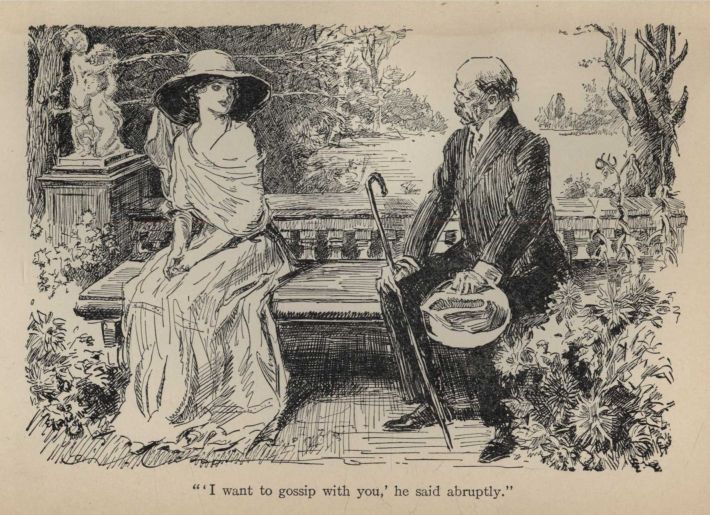
"'I want to gossip with you,' he said abruptly."
She began to laugh again.
"How did you discover that I am such a dreadful gossip? Begin at once, please. I adore picking to pieces my absent acquaintances."
"Yes—tearing 'em to tatters, the way you demolished Mr. Edgerton just now," he said grimly. "Well, I'll begin the scandal bee. Where did you know Mr. Inwood?"
"In Keno, Nevada," she said coolly, wondering what was impending.
"Know him long?"
"One winter."
"In Keno?"
"In Keno."
"Like him?"
"Immensely."
"Oh! So you're going to tear him to tatters, too?"
"Just as I demolished Mr. Edgerton. They're the two nicest men I ever knew. It's odd, isn't it, that I didn't know they were such intimate friends before Mr. Inwood came here?"
"Are they?"
"I understand so."
"And you didn't know it?"
"How should I? I never saw Mr. Inwood except that winter in Keno; and I don't know my cousin intimately."
"How well do you know your cousin?"
The girl sat thinking for a moment, then looked up frankly.
"Perhaps you can judge," she said, and told him the history of her friendship with Edgerton from their meeting in his studio to their arrival at Adriutha. And Mr. Rivett listened without a shade of expression on his face, but his little dark eyes seemed to bore her through and through.
"That," she said, "is the situation." She hesitated, then meeting his gaze candidly, but with a slight increase of color in her cheeks:
"I told you this because I wanted to be fair to Mr. Edgerton—in case—in the event of you—your family—people here not considering us of much importance. Mr. Edgerton is not responsible for us.... I think he came from some boyish impulse—some chivalrous notion that my sister and I, being alone, might receive perhaps more consideration if a man of our family accompanied us."
"I see."
"I wanted you to see. I'm glad I've had an opportunity to make the matter plain that Mr. Edgerton is in no way responsible for any shortcomings on our part."
"Nobody complains of you."
"Oh, no; everybody is nice to us. But—we—do things—which—women of his family—perhaps would not do."
"Smoke?"
"Yes. Cocktails, too. Also we gamble, dreadfully."
"Wouldn't his people?"
"I don't know," said the girl. "I don't know New York. One reads about these rather harmless vices being universal there. But Silvette and I are really provincial. Provincials usually go too far in either direction. It was only that I did not wish people to judge Mr. Edgerton from us."
Mr. Rivett scraped the gravel with his cane for a moment, then:
"So you like Inwood?"
"Very much."
"Wasn't he mixed up in some mess or other?"
"I never heard so," she said, surprised.
"Oh! What was he doing in Keno?"
She laughed. "Visiting, as we were, I suppose. You know we weren't being divorced."
"Glad to hear it."
"You didn't think so!" she exclaimed.
His eyes twinkled.
"No," he said, "I didn't. But you can't throw a stone into a crowd and give odds on its not hitting a divorced person."
"Does divorce shock you?"
"Not in the least; I'm past shocks, young lady. Who is Mrs. Wemyss?"
"Your own guest?"
He winced. "I'm asking you. We made her acquaintance at the Plaza last winter.... It seems that she and young Inwood knew each other in Keno."
"That is where I've seen her!" said Diana with innocent conviction. "I knew I'd seen her somewhere.... But she was very much slighter—oh, very much—and extremely pretty."
"Divorcée?"
"Isn't she a widow?"
"I guess so.... No matter." ... He stood up briskly; she rose, too, understanding that the interview was ended—feeling slightly uncomfortable because she had permitted herself to be so thoroughly pumped. Yet there seemed to be nothing significant in the operation or results.
"I'm going for a ride with my wife"—he meant drive—"just a buggy and an old plug. She and I enjoy it, Miss Tennant."
To her surprise he took her hand between his own dry little palms and pressed it.
"You're a good girl," he said; "you and your sister—and Edgerton—he's all right—you're good children—and all off the same tree, little lady—all off the same old block in the beginning—that's plain as preaching.... Do you really like my Christine?"
"Yes, I do."
"And Jack?"
"Exceedingly."
"That's right; they like you, too. They ought to. They're good children, and so are you. Good-by."
CHAPTER X
COMPOS MENTIS
As Diana put her pony to a full gallop and rode him off, Edgerton's mount fell, and the young fellow lay sprawling on the sod.
He was on his feet immediately; so was his polo pony. When Diana pulled up, whirled her mount and came scurrying back, Edgerton had picked up his mallet and stood resting against his saddle.
"All right, Jim?" she asked briefly.
"All right, thanks."
The color had left his face under the tan, and his expression was queer.
"You look rather white," she insisted. "Did Parsnip kick you?"
"It's nothing," he said, smiling. "Put Jack in; I've got some business to talk over with Mr. Rivett."
"You're sure you're all right?"
"What a fuss you are!" he said, leading Parsnip across the field toward a groom.
The girl looked after him, saw the groom slip a white wool polo coat over the young man's shoulders and take the pony, saw Edgerton drop his hands into the pockets and stroll across the field toward the terrace; then, lifting her mallet, she hailed Jack Rivett in a clear, ringing call, and cantered away up field.
As Mr. Rivett senior stood waiting for his wife at the foot of the terrace steps, wrapped in his old-fashioned linen duster and pulling on a pair of worn driving gloves, Edgerton, in white from head to foot, came across the lawn, the youthful antithesis of the older man—tall, powerfully built, his smooth skin and short, thick hair burned by the summer sun—a graceful, leisurely figure agreeable to see on anybody's lawn.
"Good morning!" he said pleasantly, stopping on the gravel drive.
"Good morning, Mr. Edgerton. Are the young people amusing themselves?"
"I think so—thoroughly."
"You came a cropper?"
"I sometimes do."
"You are amusing yourself?"
"I always do."
"So do I," nodded Rivett, buttoning his gloves. "Never was bored in my life—poor compliment to oneself, Mr. Edgerton, to find life a bore."
Edgerton smiled and stood with his left hand in his coat pocket, looking out at the flat field beyond, where half a dozen young people on lively ponies swung their mallets and cantered leisurely about in pretense of practice.
Presently Diana, Christine, and Inwood swung their ponies, and came driving pell-mell down the field after the ball.
"Your cousins seem to be up to anything," commented Rivett.
"They were bred to everything worth while."
"Oh! Is polo worth while, as you call it?"
"Do you wish to start such a complex discussion?" asked Edgerton, laughing.
"No; my wife will be here in a moment.... You're looking very pale, young man," he added abruptly. "Did that pony hurt you?"
"A little.... Mr. Rivett, do you need my services any longer?"
"I don't need anybody's services," said the little man dryly. "I never needed anybody in all my life—except my wife. There's no such thing as a necessary man. No man ever lived who couldn't be replaced.... What's the matter?"
Edgerton said slowly: "I thought I'd go back to town and hunt up a job."
"Why?"
"Because there's no reason for my being here. There never was any reason. You knew it when I asked you to take me, but I didn't—because I didn't know you and your family."
"That's a compliment, isn't it?"
"It's just the truth. I'm glad my cousins are with you.... I'd like to go back now."
"Tired of us?"
"You don't have to ask that."
"More compliments," said Rivett. "What is wrong, then?"
"I am."
"Hadn't noticed it."
Edgerton smiled faintly. "More compliments? ... Mr. Rivett, I want to go to town and hunt up a job, and get in the game. That's all."
"Can't you wait a month and see us through the October shooting?"
Edgerton stepped nearer.
"I would, merely because you ask me, but I can't. I just want to get away quietly, and not bother anybody.... I've broken my arm."
Mr. Rivett swung sharply and his eye-glasses glittered.
"Which?" he demanded.
"The left.... I'll just run down to town and have it fixed up. Don't say anything about it until I've left."
"Won't you stay here and let us look after you?"
"I knew you'd say that. You've been very nice to me. Ask me again as a guest. I'll be glad to come as a friend if you care for me that way."
Mr. Rivett's unchanging eyes watched him.
"We'll ask you. My wife likes you. So do I.... I don't want to interfere with a man who knows his own mind.... But do you think you can stand the journey?"
Edgerton's white lips were compressed.
"Yes," he said.
"Very well; we'll stop at Fern Center. Billings can reduce the fracture."
"Are you going with me?"
"I certainly am," said the elder man.
With a valet's aid he got into his clothes. His swollen wrist lay in a sling.
"I won't bother the others now," he said to Mrs. Rivett who was on the edge of tears because he would not remain and let her take care of him. "Please say good-by for me when they come in, and say that I'm all right and hope to see them all again.... Good-by! ... It's been a real happiness to know you—and yours. Will you let me continue the friendship?"
"Please do," she said tremulously. "Jacob, you will tell Holmes to drive carefully, won't you?"
"Yes, mother. Billings is going to put him in good shape."
So they drove away in a big red touring car, Edgerton sick with pain, but perfectly cheerful; Rivett taciturn, twirling his gloved thumbs, seeming to muse gloomily in his walrus mustache.
Dr. Billings reduced the fracture—a simple one—Edgerton refusing anæsthetics. He fainted during the short operation, and came to with his head on Rivett's shoulder.
Half an hour later he was on his way to New York, lying back in a chair in the drawing-room car, feverish lids closed. Rivett sat in the chair opposite.
"I was going, anyway," he said briefly in reply to the young fellow's protest.
And together they made the journey, not only to the city, but to Edgerton's apartment, where Rivett quietly turned himself into a valet, helped the young man to bed, called up his physician, Dr. Ellis, lingered to learn what condition the patient was in, and silently vanished. And for two or three days Edgerton forgot about him, for Ellis kept him pretty quiet, and the nurse who had been summoned knew her business.
He managed, however, to write his bread-and-jam letter to Mrs. Rivett, and another to Diana:
"MY DEAR COUSIN:
"They've probably told you that I've been ass enough to snap a bone in my left arm. It's nothing, as you hunting people understand. I was a bit stupid with it, so I ran down to town to have it fixed up—and, incidentally, hunt up a job; and I wasn't up to explaining and saying by-by to everybody, so I just slunk off—ill mannered pup that I am; but people are indulgent to dogs.
"This is just a line to take leave of you and Silvette, and to ask you to remember that, in any and all interims, this apartment is a family joint, so don't go elsewhere and pay perfectly good rent. Your room and Silvette's is always ready for you—useless unless you use it.
"When I nail a job, I'll report to the family. If you make new plans, may I hear from you?
"Wishing you both a jolly and successful autumn,
"Your cousin,
"JAMES EDGERTON 3d."
Her reply came by return mail:
"Jim, dear, I feel very badly about your injury. It was my fault; I cannoned into you. You behaved as only a man of your sort always does. I won't say any more about it.
"By this time I hope you are freer from pain. The first two days are the limit; I know from experience and two mended ribs. But—I hate to think of you in bed this glorious autumn day—and the little fool who sent you there idling in the sunshine of these lovely hills.
"Jim, dear, it is generous and entirely like you to ask us to make your place our headquarters between engagements.
"If we do it, it will be only because we all would be happier en famille. Even we, hardened materialists that we are, could not bring ourselves to use you. You know that, don't you? So I have assumed that your offer is not only a kindness, but a genuine expression of regard for us; and we return to the full whatever you feel for us.
"Jim, there are many things that I am denying myself to say to you; and I find self-denial hard. It's a worthy and laudable virtue which Silvette and I are trying to acquire in our old age, and it isn't easy.
"There's no news. Mrs. Wemyss seems to have fascinated your friend, Mr. Inwood. He's a curious sort of man—rather melancholy of temperament, I fancy.
"We play a languid sort of polo now and then, dawdle in canoes, and sit up too late at cards.
"A lot of men are coming for the shooting. Mr. Rivett's manager turned out several thousand pheasants and Hungarian partridges, it seems. The latter, they say, have vanished; the former seem disposed to wander into the front yard.
"Mrs. Lorrimore has departed with much of Judge Wicklow's salary. Her stouter and prettier friend, Mrs. Wemyss, despoiled almost everybody except Silvette and me. This letter is degenerating into gossip. It had to, or I might have been even more indiscreet.
"Jim, you are a good type of citizen when you're at your best. Let me lecture you, won't you? Anyway, you're helpless and in bed and miles away, and you can't prevent me.
"So—be yourself. Go into a man's business. Disregard your accomplishments, your cleverness at paraphrasing art. It doesn't count in real life, all this facility with paint and pen and paper—your gay imitation of painter, writer, composer. They're little gifts, Jim—meant for an hour of light leisure among the leisured—pleasant, but unimportant accomplishments. When you court some nice girl, some day, you'll understand their full value—which is to amuse her, and later, I prophesy, the jolly little family of a home-returning business man.
"The years are before you still, Jim. Open the battle when you're well enough. You will win out, for you are really not the man I have known. I wish I might have been a woman to bring out what you really are. Some woman will. Meanwhile give a friendly hand and a generous lift to a fellow who deserves your respect and consideration—your other self.
"Good-by and good luck.
"Your cousin,
"DIANA TENNANT."
In a few days Edgerton began to experience the intolerable sensations of a bone which is mending itself.
He had become very restless and impatient; and, finally, the doctor let him wear his arm in a sling and go out to hunt for a job.
He had no trouble in securing one—a small clerkship with Close & Co., ornamental iron work. He might have done even better. All iron men knew who James Edgerton 3d must be. Many friends of the old firm of Edgerton, Tennant & Co. might have offered him easier work and higher salary, but he not only went to none of them—he even avoided them. He had decided to discover what he really was worth.
It rather surprised him to find out that the big, blue-eyed, snub-nosed Irishman, Mr. Dineen, whom he had met at Adriutha, was a director in Close & Co. Later, he discovered that Mr. Dineen was also interested in his own old firm, Edgerton, Tennant & Co., now reconstructed, but still bearing the ancient name. And after a while he learned that Mr. Dineen seemed to be interested in almost every house in New York that dealt in structural or ornamental iron.
Edgerton's duties began with ledger work. And the evening that he drew his first pay, he wrote Diana:
"DEAR Di:
"I'm getting fifteen dollars a week with Close & Co., ornamental iron. I have my first week's wages in my pocket. As I pay no rent, I can live on it.
"It's not uninteresting work. Somebody said something about my going into the designing department as a draughtsman. That's pretty quick advancement—if it comes. I'll let you know if it does.
"My arm is about well. It's still mummified, of course, but that maddening sensation is gone. Town isn't so bad. Of course, it's rather hot and dusty, and, as usual, it looks dingy and mean in its characteristic October shabbiness—meaner for the glorious blue overhead and the pitiless sun exposing its few withered trees and its many architectural shams in the remorseless light of high heaven.
"But I am peculiarly happy. I have no servant; I dine at a French restaurant for seventy-five cents, and I prepare my own breakfast in the studio. Crackers and milk compose my luncheon at the price of ten pennies. And I never felt better. All this in case you are interested in such details.
"To answer your letter—I did not intend to write until I had nailed down a job and received my first pay envelope. Now I feel that I may.
"First, regarding your comments upon my artistic ability, you are perfectly right. I ought to have known it; I did know it, deep inside of me. I'm not the stuff that artists are made of. Eviter les contrefaçons! I was an imitation. I was not even a good amateur; I'm not even equipped to really appreciate the best work in others. All I had was a monkey-like cleverness and the blank facility of a receptive parrot; and I was idiot enough to contemplate an idle life of dabbling and fiddling with professions that better men dignify.
"I tell you, Di, I bid fair to turn into one of those horrors—a cultivated talker!—the lowest type of incompetent. Drawing-rooms, studios, cafés are full of them, all telling one another what is what and how to do it. I was heading straight that way. My peers and companions would have been smatterers, instructors in arts which the instructors couldn't master—or they wouldn't have become instructors!—men of one picture, or none at all; of one book, one story, or of none at all, or of dozens, all still in their minds, or in unpublished manuscripts; men of one waltz, or several grand operas—I mean ideas for grand operas—all failures, all men who had mistaken their professions, self-deceived men, incompetent, hopeless, pitiable.
"You said in your letter that one day I might meet a woman who could appreciate, at their real value, my very slim talents. Haven't I met her, Di? Those clear eyes of yours pierced the flimsy fabric long since; the trenchant sweetness of your tongue cut more than one knot for me.
"If you demur, my answer is that I am here. Who sent me? A flanneled satrap, already insidiously beguiled by idleness, already reconciled to the status quo—how long before, and by what process of evolution, would my real self have awakened? Or would the degeneracy have ended only with life?
"I don't know; all I know is that you sent me about my business in the world. I walked to it in my sleep; awake, I follow it. Thus far, so far, Diana of the far white gods!
"Yours is the stronger character, so far. Let us await events. It may be, as you say, that the years will twist my path toward the possible woman you predict for me. I dined with Dr. Ellis last evening. His daughter will certainly grow up to be such a woman as you and I delight in. I told her that I hoped my path would twist toward her. She said she hoped so, too, very shyly. She is only fifteen—alas!
"In the meanwhile my path runs straight to Close & Co., and I shall continue to travel it every day with my shovel and dinner pail—thanks to you, my loyal little cousin, who were plucky enough and merciful enough to tell me the merciless truth.
"Give my love to Silvette. My remembrances to all. Accept for yourself my friendship. Do you remember those photographs I made of you as Japonette the day after we first met? I've developed them. Here is one.
"Yours sincerely,
"JAMES EDGERTON 3d."
Which letter resulted in an immediate interchange of notes:
"DEAR JIM:
"Fifteen and eighteen are not far apart. A man can help Chance to twist his path through life. The resulting route is called the Path of Destiny. I think you have already started to travel it. I hope you are better.
"DIANA."
He replied:
"DEAR DI:
"You meant that path which leads to Close & Co., didn't you?
"J. E. 3d."
She answered:
"DEAR JIM:
"No, I meant the other path you mentioned. Follow it for the next three years. Mr. Inwood says that little Miss Ellis is the most beautiful and winsome and intelligent and cultivated child he ever knew. Life is all before you, Jim.
"DIANA."
He wrote:
"I'm in the designing department as draughtsman! Mr. Rivett's friend, Mr. Dineen, dropped in to have a chat with me. He's a very decent fellow.... You don't think that Mr. Rivett has inspired him to show me any unmerited favors, do you? It would make havoc of my present complacency. Try to find out.
"JIM."
She answered:
"Mr. Rivett isn't to be pumped. I tried it. I'll never try it again. Anyway, Jim, no favor can inject brains into a man; it can only stimulate what intellect he has. Don't worry about favors. Neither Mr. Rivett nor Mr. Dineen are the men to injure their own affairs by the incompetent service of others. You can be perfectly certain that you are worth what is offered you if they have anything to do with it.
"Why don't you fall in love with Christine? She's one of the sweetest girls I ever knew. I supposed she and you were on delightful terms once. Also, once, I thought she was inclined toward Mr. Inwood. But he seems to be monopolized by Mrs. Wemyss; and the poor child comes into my room in a forlorn sort of way—so white and limp these days that I'm wondering what this change in her means. Does it mean your absence? You'd tell me, wouldn't you? But I know you're not the sort of man to win a young girl's heart, and then coolly walk out of her life. It looks to me as though she had something on her mind. Dr. Billings has been here several times, and her mother is worried sick.
"That's all the gossip, except that the shooting is in full blast here. A number of men came up for it—the usual sort of men who shoot, except one. He's a Mr. Wallace, and very nice and a poor shot. He and I go out together sometimes, and he is forever making fun of himself and his perfectly rotten marksmanship, and he and I don't care two raps whether we get anything or not.
"Mr. Inwood is the saddest young man I ever had the pleasure (?) of trying to animate. Are all your friends as melancholy and temperamental? He haunts the terrace like a lost soul until Mrs. Wemyss annexes him. Christine does not seem to care for him; she doesn't seem to care for anybody these days.
"Colonel Curmew is a funny man. He has, apparently, devoted himself to me, and I have the greatest difficulty in getting away from him long enough to take a stroll with Mr. Wallace. Such a funny, strutty, sentimentally elaborate little man!—with a rather horrid habit of staring. But he's a crack shot, and popular here with the men.
"Good night,
"DIANA."
She wrote next day, also:
"Jim! My little Christine is in love—that's what's the matter! I know it; I'm absolutely sure of it. And with—oh, ye humorous gods and dryads!—with your melancholy friend, Mr. Inwood.
"And I want to tell you, Jim, that I don't like Mrs. Wemyss. She's fat and selfish and—why does she drag that boy about with her all the time? I don't believe he likes it. I don't believe he's so enamored of her. Maybe his low spirits come from too much of that fair and ample lady. I'm going to find out. I won't have my little Christine ignored by any melancholy idiot who ever lived.
"Write me what you know about Mr. Inwood.
"How is Chance, and the twisted path, and little Miss Ellis?
"Scott Wallace and I managed to shoot a grouse. We both fired, and neither of us were inclined to claim the poor, dead, little thing. A keeper put it in his pocket. Mr. Wallace and I are going to take up target shooting hereafter.
"DIANA."
He wrote: "Inwood is all right. Who is Mrs. Wemyss?
"JIM."
A week later he heard from her: "I've found out from people in Keno. She was a Mrs. Atherstane—divorced hubby, and resumed her maiden name of Wemyss with the prefix Mrs. Did you ever hear of her? Scott Wallace and I detest her.
"DIANA."
He did not reply, partly because the constant recurrence of Wallace's name in her letters had begun to annoy him—partly because what he had to say must be said to Inwood; and at that miserable young man he launched the following:
"DEAR BILLY:
"You're a fine specimen. What are you, anyway—a lap dog or a Chow pup? Get rid of that woman! I don't care whether or not you made an ass of yourself over her by sympathizing with her. Old Atherstane had no more mistresses than the majority of church pillars and public benefactors in town; and, anyway, it was not up to you to dry her weeps.
"Don't make any mistake—the ci-devant Mrs. Atherstane can look out for herself. She needs no consideration from you; she doesn't deserve any, either. What kind of a woman is she, anyhow—taking advantage of a chivalrous and conscientious boy who never did more than hold her hand and pat it, at most, when she told him she was lonely and unhappy, and needed a good man's moral support?
"Rot! You're not responsible for her. You're not in honor bound to sit around and await her pleasure, now that she's free to marry. She wouldn't have you, anyway.
"You probably made an ass of yourself—probably talked too much. You're not in honor bound, I tell you. And don't make any mistake—she's not going to marry. She's having too good a time. I know that kind of woman, Billy. They never put their heads into the noose a second time; but they harpoon all the men they can, and they trail around with a lot of silly ginks like you.
"If you don't believe me, I'll tell you how to put yourself out of your misery. Ask her to marry you; ask her flatly. You'll wake up, then. I know what I'm saying. You do what I tell you, and then get back to first principles, and clear up all this nightmare between a sweet and plucky little girl and your own dam-fool self. Clear it up, I tell you. I know you, Billy. You have nothing to confess in regard to Mrs. Wemyss. Of course, you wouldn't confess, anyway; but, thank God! there's nothing to say except that you were a silly ass, and have learned better.
"Now, I've told you how to get clear of this petty and miserable affair. If you don't do it, for Christine's sake as well as for your own, you're no man.
"JIM EDGERTON."
CHAPTER XI
QUOD ERAT FACIENDUM
With the daily advent of men arriving for the flight-shooting, now imminent, Lillian Wemyss seemed to grow prettier and slimmer every day until the perfectly visible metamorphosis had produced radiant and brand-new creature.
For the men who were now accumulating in billiard room and card room, who haunted stable and garage and kennel, were the sort of men who inspired the very breath of life in a woman of her sort—big, handsome, ruddy-faced, thick-necked men with large, indiscriminating tastes and an eternal readiness for anything from a half-broken horse to an unbroken woman, but heartily preferring them both bridlewise and registered.
They tramped all over the place, on the terrace, over the lawn, in to dinner; and the house echoed with large bantering voices, loud unfeigned laughter—and they rode hard and drank hard and played for heavy stakes, and were up and tramping all over the place by sunrise, sniffing for the frost which would bring the first night flight of woodcock from the north into the far-famed coverts of the Adriutha hills.
And the best-looking, most humorous, and most reckless among them was Scott Wallace, a young giant of infinite jest, who began by pleasing himself with Diana and, out of the sheer perversity of humorous animal spirits, pretended to her that he scarcely knew one end of a shotgun from the other, which gave him a pretext for dawdling over the country with her, and making love to her until such time as the flight might send him seriously afield.
So, as he cared nothing for the scattered pheasants and wilder and scarcer grouse, he amused himself and Diana by playing Winkle, now and then consoling himself with a difficult shot, which satisfied him and left the girl none the wiser.
But on Wallace Mrs. Wemyss had her blue eyes fixed with all the veiled alertness and objectless intensity of the sort of woman she was—a woman who would never be dunce enough to marry again.
In the meanwhile, already exceedingly popular with the shooting fraternity, she kept a mechanical hold on Inwood for no more reason than the matter-of-fact impulse which had prompted her to snap a leash on his collar the moment she set eyes on him after many months' separation.
To take him away from Christine had not been her object; she had no idea that he was interested in anybody except herself. She was perfectly confident that, given half a chance, men preferred her to any other woman; and there was really no particular malice in her desire to give Scott Wallace an opportunity to follow at her heels instead of Diana's.
For Mrs. Wemyss really needed nothing of men except admiration and uninterrupted attention. No deeper passion had ever moved her. She was ignorant of love, although apparently fashioned for it; immune to its lawlessness, although lid and ear and lip seemed to chorus the contrary. In the slightly veiled eyes there was really no promise, no significance in the full, sweet mouth—nothing to her except the superficial provocation which all men mistook, and the laughing and ready friendship offered so prettily that no man ever refused.
Inwood, searching the house and terrace over for Christine, discovering her at last in the moonlit rose garden, and, not daring to join her after all, so faint hearted he had become, walked moodily into the billiard room where a noisy lot of people were enjoying themselves.
Wallace, standing between Diana and Lillian Wemyss, his broad back against a billiard table, was evidently having a splendid time; and Inwood halted, irresolute, one hand in his pocket crushing Edgerton's letter into a wad.
Lillian Wemyss caught sight of him, smiled instinctively, but her blue eyes reverted to Wallace. There was something in her attitude, as she stood in the full splendor of her somewhat ample beauty, that subtly repelled Inwood; and he swung on his heel, somber young head bent, moving toward the door by which he had entered.
"Mr. Inwood!" called Diana across the hubbub, "will you play bottle pool with us?"
He turned, smiling to her.
"Thanks, I'm not up to it," and resumed his way out.
"Billy!" said Mrs. Wemyss, "I wish you to play!"
"No, thanks," he returned coolly, and continued toward the door.
It was his first exhibition of insubordination, and Lillian Wemyss, surprised, did not propose to stand it, particularly in the presence of these two people. Scott Wallace seemed to be almost ready for his leash; it was a bad example for him, this insubordination of young Inwood.
She looked anxiously at Diana.
"I'm afraid Billy Inwood is not well," she said. "I've thought so for several days. Those swamps where you men shoot must be full of malaria."
"Not a bit," said Wallace, laughing.
"How do you know?" asked Diana. "You never go into them, you lazy thing!"
Mrs. Wemyss hesitated, listening to the banter that passed between Diana and Scott Wallace, which slightly excluded her for the moment.
Then she made up her mind that her authority over Inwood must be asserted at once, and that she had time enough to eliminate Diana later.
She turned and saw Inwood passing the windows outside on the terrace. The next moment she was on the terrace, too, and he turned slowly to confront her.
"Billy," she said gently, "are you feeling perfectly well?"
"Perfectly, thanks."
"Then why didn't you remain at my request?"
"I didn't care to."
"But I asked you," she said, surprised.
"Yes, I know you did."
"Well?" she asked, astonished.
He had been looking away from her out over the misty moonlit river. Now he turned.
"Lillian," he said, "do you honestly care for me?"
"Billy, what a question!"
"Yes, it's one kind of question.... Do you?"
"You know I do. How can you ask such a——"
"Do you love me?
"What!"
"Do you?"
"Billy, what on earth is——"
"Wait, please. Let me ask you again, Lillian. Are you honestly in love with me?"
"I don't know what you mean by suddenly and abruptly questioning—demanding——"
"Please answer."
"You have no right to doubt it. You know perfectly well what we have been to each other—even before——"
"What have we been?"
"I supposed we had been in love," she said with sad dignity. "I wrote you while I was abroad, and—I don't write many letters."
"Then you are in love with me.... We are in love. Is that true as you understand it?"
"You silly boy—of course!"
He stood stock still for a moment, tasting all the misery he had stored up for himself. Finally, he found his voice.
"If that is so," he said, "we ought to be engaged."
"Oh, Billy! Are you jealous?"
She laughed, radiant, delighted to feel the leash tighten in her soft little hand once more.
"No," he said, "I am not jealous; but, if we are to marry, it is time people understood it."
"Do you mean these people?"
"I mean everybody."
"You don't mean to announce our engagement this winter?" she asked uneasily.
"I mean to announce it now."
"Here!"
"Here—to-night."
"I—I don't wish to," she faltered. "You are unreasonable."
"Is there any reason why people shouldn't know it?"
"My dear boy, one doesn't announce such important matters on the impulse of the moment."
"If I'm going to marry you, I want people to know it now!" he said.
"I've explained that I did not wish it."
"Why?"
"Why? There are a million perfectly good reasons."
"Give me one, Lillian."
She stood considering, her crook'd finger under her chin, blue eyes taking his measure from time to time. Evidently happiness too long deferred had made him unmanageable. She never thought of doubting her power. Probably he needed discipline. It was most annoying to be annoyed at such a time, with all these men here, and Scott Wallace already left too long alone with Diana at the billiard table. Discipline was certainly what Inwood needed.
"Billy," she said, "come in and play bottle pool."
"Am I to tell them that we are to be married?"
"No," she said petulantly.
"When may I tell them?"
"Not at all. Do you think a year of liberty is sufficient for a woman who has suffered what I have? I don't wish to marry you or anybody—yet. I haven't made up my mind to do it at all," she added with a tiny flash of rare anger, for her not very sensitive nerves were beginning to feel the pressure.
"Lillian, I want to know now. It is only square to me to——"
"Billy, if you continue to insist, you will end by seriously offending me. You have annoyed me enough already."
"By asking you to set a definite date for our impending marriage?"
"It is not impending!" she retorted, exasperated, as Diana and Wallace came out together and walked toward the farther end of the terrace.
"Do you refuse to marry me?"
"Yes, I do; I am sorry. I really cannot help how you feel about it. This year of liberty has been a year of happiness. I don't wish to marry. I don't know when I may wish to. I am perfectly contented; and that's the truth, Billy."
"So—you refuse me?"
"For the present—yes."
"No; you must answer me for all time, to-night."
She nodded. "Very well, then; I refuse definitely—and for all time.... And, Billy Inwood, you have brought this calamity upon yourself."
But Lillian's anger was always short-lived; she was already sorry for him. Besides, she was convinced that he would continue to dangle. It had been her experience with men that they were never reconciled to the unobtainable.
So with one of her swift, smiling changes of feeling she held out her hand to Inwood. He took it.
"Are you very angry?" she asked.
"No."
"Do we part—friends?"
"We do, indeed," he said so sincerely that the smile faded on her face, and into her limited mind flickered a momentary doubt. But, no, it was not possible; for Lillian had never really been able to doubt herself. Certain, once more, that this young man would appear at heel when whistled for, she returned his friendly pressure with an encouraging one, laughed, and turned lightly toward the house. He accompanied her to the door and bowed her in.
Then the strength seemed to ooze out of his back and legs; he dropped on to a marble bench, and sat there in the moonlight, his face buried in his hands.
How long he had been there he did not know, when a light touch and a soft voice close to his ear aroused him, and, looking up, he saw Diana inspecting him.
"As dejected as all that, Mr. Inwood?" she asked, as he rose to his feet.
"Not dejected, Miss Tennant."
"Why, then, these attitude? Wherefore those woe, young sir?"
"I don't know," he said listlessly.
But she did—or thought she did; so she took his arm in friendly fashion and strolled about with him in the moonlight until she pretended that the beauty of the night tempted her toward the garden.
He was alarmed for an instant, and hung back, scanning the rose garden with anxious eyes; but he could see nothing of Christine, and presently succumbed to Diana's whim.
To and fro among the late roses they paced, the girl light-heartedly rallying him on his soberness and lack of animation, until he laughed a little and squared his shoulders, and drew in a full deep breath of the soft air.
"I thought every man flirted if offered an opportunity," said Diana, "but I've flung myself at your head in vain, young man. Evidently there's some caterpillar at work on that damask cheek, or I'd be more generously appreciated."
He laughed again, and tried to tell her how deeply he was appreciating her, but she shook her head and finally dropped his arm.
"I'm going to the house," she said. "There's an arbor across the garden. If you'll wait for me there, perhaps I'll return. Will you?"
"Certainly," he said.
So she turned and sped away among the roses, and he stood and watched her until she crossed the terrace and vanished into the house.
For a few minutes he remained where he was standing; then, with a sigh, he swung on his heel and started toward the arbor, fumbling for his cigarette case as he walked.
At the entrance he paused to strike a light—and remained motionless until the match burned close to his fingers. Then it fell on the gravel; he dropped the cigarette beside it.
As he entered the arbor, a white figure, lying full length on a swinging seat, lifted its head from its arms, then sat up hastily.
"Is that you, Miss Rivett?"
"Yes." ... She rose to her feet, holding to one of the swinging chains. Moonlight fell across her white, confused face.
"May I remain?" he asked unsteadily. "Would you rather have me go?"
"No.... I am going.... My gown is damp.... I will go immediately."
"Were you asleep?"
She hesitated; but there was in her only honesty.
"No," she said.
"Then you must have heard my step on the gravel?"
She shook her head.
"Then what were you doing out here all alone with your head buried in your arms?"
"Thinking," she said.... "Would you care to walk to the house with me, Mr. Inwood?"
"Would you mind remaining here a little while?"
"My gown is damp with dew."
"Then perhaps we had better go?"
"I think so."
Neither stirred.
"It is so warm and beautiful to-night," he said, "that I can't imagine anybody taking cold out here."
"It is a bad outlook for the flight shooters."
"Yes, indeed. There is no frost in this wind."
"It may shift overnight," she said. "If to-morrow is a magnificent and cloudless day, with just a hint of silver in the horizon blue, then it means a frost and a flight to-morrow night."
"And that," he said, "would mean an end to—the roses."
"Yes."
"An end to anybody sitting out here again this year."
"Probably."
"So it seems a pity," he went on, "not to enjoy it while we may, Miss Rivett."
"I have enjoyed it—for an hour."
"You are not very generous."
"Why? You may remain another hour if you wish?" she said, smiling.
"Alone?"
"I was alone during my hour."
"I have been alone for an entire year," he said under his breath.
"What?"
She had heard him, but her abrupt question seemed to have been beaten out sharply from her startled heart.
He made no reply; she stood, one hand clasping the chain, not looking at him, conscious of the clamor of her heart.
"Miss Rivett," he said, "am I too much of a fool—too hopeless a thing for you to listen to?"
"What do you mean?" she said faintly.
"I mean that—this night, now, for the first time since I knew you—I can use, decently, honorably, whatever liberty of speech you permit me."
Presently her white hand relaxed, the chain slipped through her fingers; she sank down on the swinging seat.
After a moment he stepped toward her. She raised her head in the moonlight, and he saw the tears in her eyes.
"Christine," he said under his breath.
"Are we free to speak to each other?" she faltered.
"Thank God, yes!"
"Thank God," she whispered.
But for a long, long while they did not use the inestimable privilege of free, articulate speech. There seemed to be no need of it further than apparently irrelevant fragments such as, "My darling!" and, "Oh, Billy, if you only knew!"
Far away beyond them Diana came out on the terrace with young Wallace, and gazed very earnestly down at the rose garden.
"Shall we walk there?" he said persuasively.
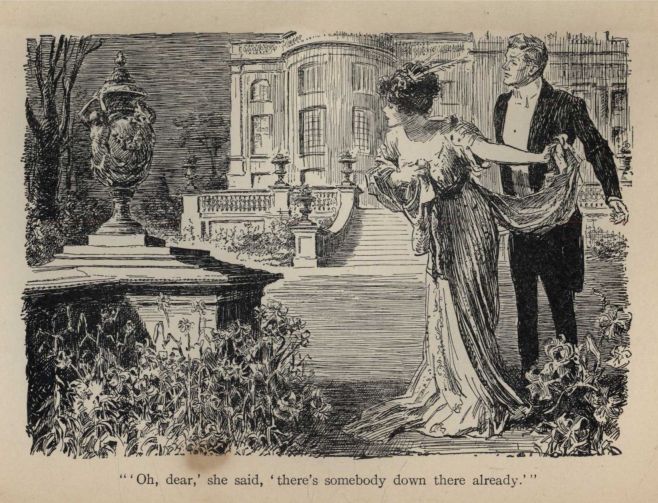
"'Oh, dear,' she said, 'there's somebody down there already.'"
Suddenly Diana's face sparkled. "Oh, dear," she said, "there's somebody down there already—two of them! And—and it looks to me as though they were spooning. What a world this is, Mr. Wallace! I think I'd better go in and play bottle pool."
That night she wrote to Edgerton:
"DEAR JIM:
"You have not answered my letter—but men were made to pardon.
"Somehow—and I don't quite know how—that wretched and melancholy Inwood man, fortified by a gentle push from me, contrived to get up sufficient momentum to carry my little Christine by assault. The darling has just been in here to whisper her happiness to me. We wept together, which is our feminine fashion of uttering three cheers.
"There is, of course, papa to inform. I don't envy Christine. Papa has a will of his own, but so has his infant daughter.
"Even yet I can't understand why this Inwood boy has lost all this time dingling and dangling around Mrs. Wemyss. Evidently he wasn't doing it because he was having a good time. I was inclined to suppose him either blighted or a mooner.
"But you should see the change in your intimate friend now! Why, Jim, he fairly pranced up to me as I was saying good night, and he wrung my hand and said, 'Thanks, awf'lly, Miss Tennant!' And all I had done was to give him a rendezvous with me in an arbor, and then go off to walk with Scott Wallace.
"Scott's a nice boy. You'd like him; he's a terrible tease. It seems that he's really a dead wing shot, and has just been jollying me all this time. I really enjoy him, which is more than I can say for the remainder of the sporting fraternity now investing this place. They're a hard young lot, without, perhaps, being really very hard; but they are a loud, careless, irresponsible bunch of wealthy young men who, as far as I can learn, spend their entire time in shooting at something or other, including clay birds.
"They seem to be Wall Street men when occupied at all, and all betray a very healthy respect for Mr. Rivett. People say he is a factor to be reckoned with in New York; but I don't care. He's nice to me, and his wife is adorable. As for Christine, I dearly love her, Jim. No girl is more fitted for happiness, and I'm glad she's got her Inwood boy at last.
"And now, Jim, dear, there are two matters which very sorely perplex me; and, somehow, I turn to you to help me solve them.... No, only one of them, because I shall not bother about the other matter yet.
"But about the matter which is really nearer my heart, Jim—we must leave this place; and the reason is this: Jack Rivett is making himself miserable over Silvette.
"Silvette doesn't love him; at least, I don't think she does. She couldn't do it honorably, anyway. She told me so, and I quite see it, because she and I are employed here under the Rivetts' roof, practically in a position of trust, and dedicated to their service.
"It is not a loyal thing to permit the son of the house to lose his head, and Silvette tries so hard not to let him. But he's doing it, and she can't keep him from being nice to her; and she and I know perfectly well what his father's plans for him are, and that they include a fashionable marriage.
"Of course, that argues well for Christine. The Inwoods are fashionable people, are they not? But poor Silvie! Alas! her connection with your race isn't near enough to impress Jack's father; besides, Silvette doesn't love him, and the boy is in a bad way all around.
"Now, what ought we to do? If we offer to sever social and business relations with Mr. Rivett, he will ask why we do it.
"Shall we tell him? Is that square to poor Jack? Or shall we lie? Or shall we simply remain and let Jack suffer and make Silvie miserable?
"Oh, wise young sir, inform a suppliant at your knee!
"There is nothing more to tell you about, except that your progress makes me very happy. You are doing only what you would ultimately have done without any impudent advice from me. You have found yourself, Jim; you are climbing the rungs very quickly.
"Jim, I am not yet very old—but I might easily be younger.... I was thinking the other day—and to-night—that sometime I shall be too old and unattractive to practice this not very dignified profession; and I'm disinclined to do anything more strenuous. I don't want to struggle and grub and starve along respectably as a feminine physician. It's too late for that, anyway.
"So I don't know what to do, ultimately, unless I accomplish what I started out to do—marry a wealthy man. I mean the first agreeable one I encounter.
"Well, I won't bother with that problem to-night; my head aches a little.
"Good night, Jim.
"JAPONETTE."
Diana finished her letter, sealed and stamped it, and kissed the superscription. She always did when she wrote his name.
Then she laid her aching temples on her arms and, leaning limply on the desk, thought about him.
Hers was a strange, sweet pride in him—a fierce jealousy lest he should not take the place in the world to which he was entitled, and prove himself every inch a man.
Nor did she pretend to hide from herself what his return among his own friends must ultimately mean. If the love he had offered her had not been totally extinguished by her light mockery and smiling insolence, then this return to his own set would do it ultimately. The standards that measured women there would be fatal to her; nor could he choose but apply them, sooner or later.
She knew this when she sent him back among his own sort. She realized perfectly that if any love for her survived her irony and flippancy—her airy but trenchant scorn—it could not survive very long when he came to his cool-headed and reasoning self, and looked around him at the women, and at the families and relatives of the women among whom he had always lived.
Already he had spoken of little Aliss Ellis—a mere child, of course—yet—yet it was a straw prophesying a change in the wind to her.
She knew; she had accomplished what she had desired. She had done this thing to herself, to her whole life, for his sake. What more could she wish for?
Sick at heart, she lifted her throbbing head and kissed his name once more where she had written it on the envelope. Then she placed it on the desk, and lay down on the bed to wait for Silvette before ringing for the maid who attended them; and after a little while she fell asleep.
CHAPTER XII
NUNC AUT NUNQUAM
Warm weather continued; no flight occurred. The men thrashed about with the dogs after grouse and a few native woodcock bred in the willows along the river, or rode, motored, and played cards. One or two had to give up, and return to the city.
Colonel Curmew was at his best on these gay occasions—gallant, jocose, busy, everybody's friend, including Jack Rivett's, who quietly began to hate him.
In the midst of the general tension and expectancy concerning the long-awaited flight, Christine one morning entered her father's study and found the author of her being conferring with Mr. Dineen.
"This won't do, Christine," he said. "I'm busy."
"No, it won't do," she admitted, looking so significantly at Mr. Dineen that the jolly, big Irishman laughed.
"You want me to go out!" he said, shaking an enormous forefinger at her.
"Please—for a few minutes."
"Sure," said Mr. Dineen with an amused glance at Rivett, who sat inspecting his offspring with a face entirely devoid of expression.
When the big Mr. Dineen had closed the door behind him, Christine, a trifle pale, walked resolutely to her father and laid her hand on his shoulder.
"Dad?"
"What?"
"I've practically asked Billy Inwood to marry me."
Her father's eyes bored through and through her.
"Who did the asking, Chrissy?"
"Both of us."
"What?" he barked.
"It wasn't asking, exactly. I have loved him for a year, and he has loved me. There has been a misunderstanding."
"About what?"
His daughter's eyes never flinched.
"About a point of honor, father," she said quietly.
He grunted.
She went on, still resting her hand on his shoulder.
"We were very unhappy; but the point of honor involved straightened itself out.... I happened to be in the rose arbor that evening. He came in by accident.... After we had talked a little, he told me that he was free to speak if I would listen to him.... Then, somehow, we merely looked at each other, and—and presently—presently we kissed each other.... I don't remember much else ... except that I said I would marry him—before he asked me——"
"Did you also set the date?" inquired her father sarcastically.
"No.... Mother and I are considering.... Are you happy over it, dad?"
"Not violently."
"Why?"
"I don't know anything about him," he snapped.
"Yes, you know that I'm in love with him."
"Certainly; of course. Very worthy young man, no doubt."
"Also," continued his daughter calmly, "you know that Jim Edgerton is his closest friend."
"That," said Rivett, "counts some."
"And mother likes him," concluded the girl.
Her father sat staring at her in silence. Suddenly she put her arms around his neck, and the little man hid his spectacles on her breast for a second.
"Thank you, dad, darling," she whispered.
"Chrissy—Chrissy—so soon! I wanted you awhile yet." ... He jerked his head free, produced a handkerchief, and began busily to polish his eyeglasses.
"All right," he said brusquely, "I'll talk it over with your mother.... She knows.... She knows more than I do. They wouldn't believe that in Wall Street, but it's true."
"Dad?"
"Yes, child."
"Couldn't we live with you and mother?"
"Sure. D'you think I'd let any young jackanapes take you entirely away? You tell him I'll scalp him if he talks that kind of thing to you." ... He laughed harshly. "But I'm a fool, Chrissy; you and I are talking foolish.... You won't come back to stay. You won't want to."
"I will!"
"No, dear; you don't know yet.... Your mother and I made our own home. It was a rough one, Chrissy, but it was ours. You'll do the same ultimately. It's part of the game.... Tell your young man to come here."
The girl slipped away; in a few moments Inwood knocked and entered. Mr. Rivett gave him a level and murderous look.
"How about that complication you got yourself into?" he asked harshly.
Inwood turned scarlet.
"I'm out of it."
"With honor?"
"Honorably."
"What was it?"
"You don't mean to ask me that?"
"Yes, I do! ... But I didn't expect an answer.... Can you support my little girl decently?"
"Decently."
"Not in the style to which I have accustomed her?"
"No, sir."
"All right," he snapped.
After a silence the young fellow said:
"Do you disapprove of me?"
"How the devil can I? I don't know you. If you make my little girl a good husband, I'll love you like a son; if you don't, I'll—kill you. You look all right; but there's no use talking.... You show me what stuff you're made of, and I'll do my part."
"All right," said Inwood, smiling.
Something in his smile interested Rivett.
"Was your mother a Lawrence?" he demanded suddenly.
"She was born Elizabeth Lawrence."
"Betty Lawrence," he repeated, staring at the younger man.
"Did you know her?" asked Inwood.
"I taught her in school.... Betty Lawrence.... Only two people ever smiled like that—you and your mother.... You have good blood in you, Inwood.... I know your father—in Wall Street. We are on good terms.... Don't ever be a fool again, will you?"
"No, sir."
They shook hands seriously. As Inwood left, Dineen came in.
Rivett looked at Dineen without speaking for a full minute, then he said slowly:
"My daughter is going to be married."
"God bless my soul!" ejaculated the big Irishman—"not that child!"
"Yes; I guess she means business, John."
"When?—in the name of the saints!"
"When she's ready, I presume.... She's a good girl.... They're good children. They've stayed as long as they could. Their time is nearly up.... But the smallest hut is a big barn when the children have taken wing.... I wish I could have seen more of my father and mother.... But I had to go out into a lean world and hunt a living."
"The best of us have passed that way," observed Dineen; and, after a moment: "Who's the lucky divil, Jacob?"
"Young Inwood."
"Stuart Inwood's boy?"
"That's the one."
Dineen lit a cigar and, drawing it into vaporous action, ruminated with enormous thumbs joined.
"It's good stock," he said, finally; "none better betwixt the Bowling Green and Patroon Van Courtlandt's old shebang. There's money, too; and an opera box and a bit of a shack at Newport. What kind of a lad is it?"
"He can look me in the face," said Rivett. "Otherwise he looks like everybody else of his sort, and probably resembles them, too. Ah!"—he broke out angrily—"these sleek-headed, tailor-made, smooth-faced young pups from New York, with their pleasant manners when they want anything, and their ways and means and by-ways and ten-cent brains—God! Dineen, do they really ever turn into men? Answer me that! You've lived long enough to see a new-born snob grow to be thirty. Do they ever turn into anything except the harmless fools they're born?"
Dineen slowly revolved his thumbs and squinted at a sunbeam, while the smoke from the cigar in his cheek rose to the ceiling in a straight, thin column.
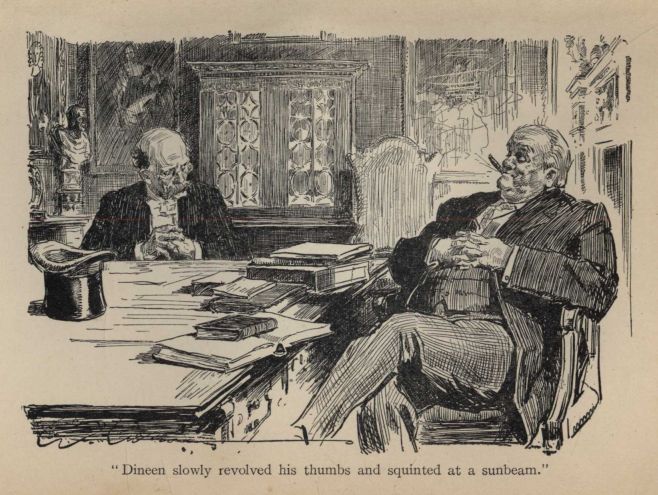
"Dineen slowly revolved his thumbs and squinted at a sunbeam."
"Some of them become men," he said deliberately. "The most o' them is born spots and rots; or, if they're not, college addles 'em. But, God be praised! if it wasn't for them the good people of Reno, Palm Beach, and Paris, France, would starve entirely.... Jacob, they say there's a use even for the San José scale; and cursing would become a lost art barring the mosquito."
"What do you know about young Inwood?" asked Rivett.
"Nothing; he's a broker."
"Then we've nothing to learn, I guess," said Rivett dryly, "unless he gets into the papers.... Well, my wife likes him.... She's always right, John. I'll go and talk to her presently.... What were you saying about young Edgerton before my daughter came?"
"I said that he's the same as all the Edgertons. By jimmy! I started him on ink wells to see would he stand for it, and he was there every morning at seven; and he cleaned those ink wells and desks till nobody knew them—with his busted arm and all. Then I set him at the ledgers, and I let him stew for a week. A week was enough to see a good man wasting his fist and eyes at fifteen per.
"'G'wan into the designing room,' I said to him, using Doolan as meejum for my remarks; and I let him stew there with his compass and his tracing paper, doping out the work of worse than he.
"Then I gave Williamson the kitty-wink. 'Give us a pair of gates for a gentleman's estate,' said Williamson, very damn polite, knowing who was backin' the lad for a place.... They're using the sketch now."
"I told you so," said Rivett calmly.
"Ah, go on! I told you so! Let it go at that, Jacob. So I talked to Everly, and Everly sent him into the laboratory. When he isn't there he's nosing around the shops, or asking questions of Cost and McCorkle over in Jersey, or he's investigating the Holmes Construction plant."
"He's got his eye on the game."
"Sure; it's in him. There's iron in every Edgerton. They're all full of ore. He's taken longer to open his eyes than the usual litter, that's all.... Got playing the art game, you say—like a kitten with a paper ball.... There's art in him, too, I guess. Those gates were all right.... But—you mean to give him his chance?"
Rivett nodded. "I am Edgerton, Tennant & Co. I'd like to have Edgerton go back there some day.... They were square people.... I might have used them a little easier.... My wife likes Edgerton.... She wishes it."
"She wants him to have his chance," mused Dineen.
"What she wants, I want," said Rivett.... "And I might have been easier on Edgerton, Tennant & Co.... I would have been—if we hadn't needed the plant."
Dineen nodded gravely.
"Sure! A poor corporal of industry like you, Jake, needs what he can pick up out o' the ash can."
For a full minute neither spoke. A slight flush faded from Rivett's cheek bones.
"You damned Irishman," he said, wincing, "when are you going back?"
"To-night, I think.... There's an ash can I haven't raked over—the Carrol-Baker Company."
"You'd better fix that," said Rivett dryly; "there may be a lump of slag or two we can use for filling in ballast."
Dineen winked, rose, deposited the ashes from his cigar on the window ledge, and sauntered forth—to meet Jack walking swiftly and firmly toward his father's study.
"Hello, young man!" exclaimed Dineen, "is the house afire, or has the brown jug below run dry?"
"No fear," said the young man, smiling, but continuing on his way. Dineen looked after him with shrewd, blue eyes.
"I'm a monkey," he said to himself, "if that young man isn't on some such errand as took his sister to the same place an hour ago. If he is, God help him! for Jacob's still sore all over with the news from the front stoop."
Jack knocked, and his father, who had settled himself for five minutes' hard thinking, rapped out: "Who's there?"
"It's Jack. May I come in?"
"Come on," said his father grimly, "I am—" but catching sight of his son's face he stopped short.
"Father?"
"What?" snapped Rivett senior, instinctively squaring his shoulders.
"May I talk to you as two men ought to talk together, or must I assume the attitude of a child to its father?"
"Talk as you feel. I had a notion that you were still my son—maybe I'm mistaken. In that case you may try to bully me if you care to. Go on."
"I didn't mean that, dad."
"I know you didn't; but you've come in here with your mind already made up that I won't do what you want me to do. That's no good, Jack. Go into everything cocksure that you'll win out. It's the only way you stand any chance at all. Proceed."
The boy sat down and gazed absently out of the window; after a few moments he turned his head and looked at his father.
"Dad," he said, "I'm in love."
Rivett senior regarded him in angry amazement, for a second only; then the grim mask of a face resumed its weasel-eyed and expressionless immobility.
"Babies have to go through teething, too," he observed.
Jack said pleasantly: "Wouldn't you rather I came to you and told you about it?"
"Yes; a boy is all right who tells his parents. Who is the girl?"
"Silvette."
An unaccustomed color dyed Mr. Rivett's pallid temples.
"Oh! Have you informed her?"
"Yes."
Rivett's teeth met under the walrus mustache, parted, met, and ground together; but his son saw only the jaw muscles move slightly in the lean face.
"Silvette is a—an interesting young girl," said Rivett with an effort; "but she is one of my employees, and not the sort of woman I wish my son to marry."
"So she says," observed Jack quietly.
"Who says what?"
"Silvette said exactly what you have just said—that she is your employee, and her sense of honor will not permit her to listen to me."
"Oh! ... She said that, did she? ... Oh! ... Did she tell you to tell me her answer?"
"No; she told me that if I uttered one word on the subject to you, she would leave your service in twenty-four hours."
His father's eyes fairly bored into him like augers.
"And yet you've done it?"
"I've taken the chance—yes."
"Why?"
"Because I love her."
"You'll have that kind of pip several times before you pick the right one, Jack."
"No; I'm like you."
"What's that?"
"I say that I am like you, dad.... I don't believe there was ever anybody but mother. Was there?"
"How about that little Beaumont girl you met at Hot Springs?" asked his father.
"I taught her to shoot a pistol. I liked her, but that was all. Silvette is different."
Somehow, the memory of a girl he had once taught came into Mr. Rivett's mind—Betty Lawrence—who smiled as nobody else ever had smiled except her own son—years afterwards—years and years afterwards.
He raised his sunken head and looked hard at his son.
"I don't want you to marry her, Jack," he said.
"Why?"
"I had other plans for you. There are girls in New York who——"
"There are girls everywhere, but only one Silvette Tennant; and I am like you, father."
"You don't show it now," retorted Rivett sharply. "Do you think I'd spoil my chances—no, my certainty in New York, as you are trying to do?"
"You only got as far as Mills Corners, dad; and you had not even seen New York."
"I don't want you to marry her," repeated his father doggedly.
"Why?—once more."
"Because—I don't know anything about her. She gambles, too!"
"Would you care whether the girl you meant to pick out for me plays cards for stakes?"
"I certainly—" He stopped abruptly, then: "She smokes and drinks like a man!"
"Get some woman to ask you to dine with her at the Convent Club some evening," said Jack, smiling.
"Who is Silvette Tennant, anyway?" demanded his father.
"You ought to know something about the Tennants, dad. You reorganized their firm."
"I never heard of her or her sister before I hired them," said his father, reddening.
"Dad, be square with me. Do you like her?"
"What?"
"Do you like Silvette?"
"I like her sister."
"And Silvette?"
"Yes, damn it, I do!"
Jack laughed.
"So do I," he said; "but she has refused me."
"She knew enough to do it; she is a girl of sense. Certainly, I like her. She knows well enough that she has no right to encourage you."
"She knows something else, too."
"What's that?"
"She knows that she doesn't care for me anyway," said the boy with a quiet simplicity that, somehow, left a confused and restless resentment in Mr. Rivett's breast.
"Doesn't care for you?" repeated his father slowly. "She'd care for you fast enough if she dared."
"Dared!" Jack laughed. "If she had cared for me, she'd have told me—and sent me about my business all the same; don't worry about that. But she doesn't care about me.... I think, sweet and generous as she is, she does not consider our family as particularly desirable for an alliance."
"What! My employee!"
"Why, dad, our employing her puts us at her mercy. Didn't you realize that?"
The elder man sat silent, glaring at his son through his great convex spectacles.
"So that is why this girl wouldn't listen to you?" he said.
"Her reason was that she, being in your employment, occupied a position of trust, and that it would be dishonest in her to take advantage of it by encouraging your only son."
"Did she say that?"
"Almost word for word."
"When?"
"Long ago."
"Oh! So this has been going on a long while?"
"I've bothered her a long while; I've contrived to make her miserable. She does her best to keep away from me. I don't know what to do," said the boy miserably.
"Well, you've done it now, anyway; you've come to me, and told me against her orders. Now, she'll go—if I tell her."
"I shall tell her; I couldn't do this without being honest enough to tell her that I've done it."
"But—you say she'll go away."
"She certainly will, unless you ask her to remain."
"I?"
"Yes; you, dad."
"Do you think I'm going to deliberately bite my own head off?"
Jack smiled forlornly. "If you don't ask her to stay, you'll be biting my head off; but I won't need a head if she goes, so bite away, dad, if you're going to."
Rivett stared at him in stony silence.
"Do you know what your sister has done?"
"Yes; Inwood is a corker. I'm terribly glad."
"Oh, are you!"
"Aren't you?"
"Confound it! how do I know whether I'm glad or not to see the house emptying itself of all your mother and I care for—" He stopped with a dry catch in his throat, then resumed more cautiously:
"I thought Chrissy's tale of woe was sufficient for one morning, but here you come galloping in with one that beats hers to a batter! How do you suppose I like it? I expected to have my children with me for a while.... Yesterday you were in the cradle.... To-day you're up and off and out into the world with a girl I never saw before last June! Jack! Jack! what the devil's the matter with everything!"
"Isn't everything about as it was when you were my age, father?"
"No, it isn't. If anybody had predicted these times, he'd have been locked up for a lunatic! What with luxury, and fashions, and folderol, and high finance, and cards, and cocktails, and cigarettes——"
"I don't mean the details, dad; but isn't it all about the same—the birth, growth, courtship, parting? Isn't it?"
The older man was silent.
Jack rose and stood by the window watching the big clouds drifting across the sky.
"Jack," said his father, "why did you come here to tell me this?"
"Mother said I had better."
"Your mother!" he exclaimed, horrified.
"Yes; I told her first, of course—even before I spoke to Silvette."
"She never said—one—word to me," murmured Rivett vacantly.
"She promised not to before I would tell her."
"Do you mean to say that your mother approves?"
"She said she would if you did.... And all I ask of you is to invite Silvette to overlook what I've said and done, and request her to remain."
"If she doesn't care for you," said Mr. Rivett, "what do you want her to remain for?"
Jack's eye met his father's.
"So that I can have a chance to win her," he said doggedly, "with my parents' full approval."
Rivett rose, furious.
"You stay here until I've talked to your mother!" he barked, and went out slamming the door.
Jack sat down prepared to wait, but it was not five minutes before his father came in.
"I've seen your mother. Clear out of here! That young lady of yours is coming."
"Here?"
"Yes, here. If you don't go out, I'll drop you out of the window—old as I am."
"Dad! You're a brick!"
"Well, you'll get that brick in the neck if you don't hustle!"
Jack laughed and held out his hand; his father took it, tried to speak—only succeeded in swearing. The boy went out. When the girl entered, Mr. Rivett was standing by the window, wiping his glasses for the second time that morning.
He turned, nodded, placed a chair for Silvette, but remained standing.
"I don't suppose you've any notion why I've asked you to come in here. Have you?"
"Not the slightest," she said, smiling.
"I suppose you think it's on business?"
"Naturally."
"Why naturally."
"Because," said Silvette, laughing, "our relations are on a business basis."
"Do you consider them entirely so?"
"I—am obliged to, am I not?"
"Don't you like us?" he asked bluntly.
"What an odd question! Of course, I do. I'm in love with your wife."
"Not with me?"
She laughed gayly. "You've evidently discovered that Diana and I like you immensely."
"Do you? Really?"
"Of course; you've been very charming to us. As for Christine, we care a great deal for her—very sincerely and deeply, Mr. Rivett."
"What about Jack?" asked Mr. Rivett casually.
A slight tinge of color rose and spread in the girl's pretty cheeks.
"Everybody likes Jack," she said briefly.
"Do you?"
"Certainly."
"That's what I wanted to find out. That's why I asked you to come here."
The girl looked at him, startled, incredulous of her own hearing.
"I don't understand," she said.
"Then I'll be plainer. Jack has told me that he wishes to marry you."
The crimson stained her from throat to temple, but she rose with perfect self-possession.
"I think," she said quietly, "that this severs our business relations."
"Not unless you wish it."
"I do wish it."
"Why?"
"Because I warned Jack that one word of this matter to you would mean my leaving Adriutha."
"Why?"
"Because I am employed here by you, and Jack is your son," she said coldly.
"Do you mean to leave us?"
"I must."
"You need not."
"You are very kind, but my service is of no further value."
"I ask you to remain," he said slowly. "You have already rendered me service I could never pay for. I ask you to remain with us—as our guest, if you must; as Jack's betrothed, if you will."
She flushed again, brightly, astonished.
"But—but I don't—I am not in love—with Jack!" she stammered. "He knows it. I have told him so.... I like him immensely.... he is a dear boy—generous, clever, charming, considerate.... I never liked any man better.... But I don't love him, Mr. Rivett."
"That's up to him, isn't it?" asked Rivett dryly. "I can't make you love my boy; neither can his mother. Mothers can do most things. Probably Jack is young enough to think she can make you love him; but I can't help that, Miss Tennant. All I can do is to ask you to remain.... And to say—that if you ever come to care for Jack, my only boy, his mother will welcome you as our daughter—and so will I."