Front matter (continued 2)
Reading edition
"You carry on like the deuce now, sister," said Silvette, laughing.
"I don't do it enough," retorted Diana fiercely; "what have I got to look forward to, after all?—a homeless life of social employment, an old age of gossip and cards!—or, if I win out, a loveless middle age wearing some wealthy man's name and pearls, and all the rest dashed out—the brightness, the youth of things, the hope of things, children——"
"You don't want children!" exclaimed Silvette, horrified; "grubby little things! I thought you hated them!"
"Grubby little things," repeated the girl slowly; "so I do, in theory."
"You don't know anything about them practically."
"Except at the Maternity Hospital.... Oh, Silvie, it is ghastly.... It's horrid! horrid!—it's devilishly unfair! ... Young girls in the springtide of youth crept in and out of that dreadful place like the white ghosts of murdered souls! If maternity didn't slay them, it killed the better part of them. Then the world ended for them—youth, hope, freedom ended with the first thin cry of the tyrant that dooms all women.... Yes, I—hate children!" She stood a moment, slim hands on her hips, head lowered with the brown locks clustering against her cheeks; then, looking up:
"But I mean to have one of my own sometime. Life to the full, dregs and all, before I die. That is my programme."
Silvette laughed. "This is a new and recent development, isn't it?"
"I'm developing like lightning."
"Lightning develops quickly, but it doesn't last, dear."
Diana, lost in retrospection again, smiled vaguely. Then, lifting her pretty eyes:
"Did you ever see starlings feeding their young? A pair nested opposite the studio. I found their evolutions rather interesting."
"No doubt," said her sister. "Is that what has aroused the maternal instinct? Come, who is to bathe first. Pull down the shade and turn on the electricity, and ring for the maid, dear. She ought to lay out our gowns at once."
Diana did as she was bidden; then, on impulse, sat down at the little fly-away desk and scribbled a note:
"Take it to Mr. Edgerton," she said to the maid.
Edgerton, dressing leisurely, read the note where he stood under the electric cluster:
"DEAR JIM: The rain, the world, and things oppress me. So do you sometimes.... There's a long future ahead of me. I dread it—who was eager for the plunge a few days since. I seem to be standing on the threshold of things in general, waiting for my cue to enter, but with little heart for the stage now. Alas, I am already tired before the overture has ended.
"If we dance to-night, ask me. Probably I'm the only girl in the house who could stand a dance with you—and I'm not so certain about myself.... But if we play Bridge, continue not to sit at our table. I ask it of you for reasons which are none of your business. Indulge my whim, please.
"JAPONETTE."
He finished dressing, then scribbled a note to her, and sent it by the valet:
"Japonette, dear, I'm as rotten at cards as I am dancing. I won't permit indiscreet infatuation to interfere with your Bridge.... And, by the way, in this sort of a house the chances are they'll play for stakes—probably high stakes. My limit is a cent a point—or was in days of affluence—but our host will scarcely expect us to risk our salaries, I fancy. So even if you have no objection to playing for stakes—which probably, however, you have—you need not feel obliged to. Our duties here do not include losing money to Mr. Rivett's assorted guests, you know. Feel perfectly at liberty to let the table carry you and Silvette.
"Shall I wait and go down with you both?
"J.E."
She read the note; then handed it silently to Silvette, who read it also in silence.
"You see," said Diana, "it's exactly what I told you. He doesn't wish us to play for stakes."
"He says nothing here about his wishes.... Besides, it would be an impertinence for him to make any such suggestion to either you or me."
"His attitude is plain enough—if you think it impertinent."
"I don't think it is. He indicates that he supposes we do not play for stakes, and adds that, anyway, we need not if we don't wish to. That is all the note expresses. Anyway, it doesn't matter, does it?"
Diana shook her disheveled head, seated herself and wrote a hasty answer, sending it away by the valet, who was waiting outside the door.
"Don't wait for us; we're not hooked up yet. We're quite accustomed to play for stakes, you funny boy, so that need cause you no uneasiness.... And please don't forget to ask me, if they dance."
Edgerton stood thinking for a moment before his fireplace after reading the missive; then struck a match and lit the two notes, holding them together until almost consumed, and lingered still to watch the edge of yellow flame on the hearth licking up the remaining margins of the paper.
Then he went downstairs and into a green and gold drawing-room, where his hostess received him shyly, almost timidly—a small gray-haired woman all over jewels whose thin little hand trembled slightly in his.
It was a frail hand, fragile of bone, yet never the hand of generations of leisure, for the joints were hard and accented, and the fingers rather worn than thin—as though once not unaccustomed to household labor; and, without knowing just why, he retained the diamond-laden hand in his firm, warm clasp for a moment as though to reassure her.
"It is nice of you to ask us," he said gently. "You have made everything very easy and comfortable for us. My cousins will be down in a few moments; they asked me to come first."
The little gray woman looked up into his pleasant, well-cut face as though confused; he smiled down at her, still retaining her hand.
"My husband has told me who you are," she said. "I didn't expect you to be just like this.... You and your cousins are our very welcome and honored guests.... Our guests," she repeated almost tremulously, "and none more welcome under our roof."
"It is gracious and kind of you to say so," he said, touched by the simplicity and the mild, faded face upturned.
Then Mr. Rivett came forward, cautiously treading the velvet, his two burned-brown eyes fixed behind the big concave eyeglasses.
"It's wet weather," he said, shaking hands. "I hope your quarters are comfortable."
"Most luxurious, thank you—with a beautiful outlook."
Mrs. Rivett's gentle voice sounded at his elbow presenting him to her daughter and son, and after that to several others who, for the moment, he made no effort to distinguish one from another except that he recognized Colonel Curmew in superb form and obtrusive pearl studs decorating a fluted shirt front.
A moment later Silvette and Diana entered, slender and youthful, with all the softly flushed charm of eighteen and the winning composure of a wider experience than eighteen years can ever lend.
Colonel Curmew presently outflanked Silvette, forcing her skillfully into a momentary retreat toward the recess of a window, where he blockaded her and curled his mustache with satisfaction and shot his cuffs, and prepared to drive in her outer pickets.
Diana remained in quiet conversation with Mrs. Rivett, the latter shy, wistful, and ill at ease by turns; the former sweet and deferential, yet all the while composedly taking the measure of the others in the room, and of the room itself, vaguely aware in her apparently smiling preoccupation that she was winning a perplexed and timid heart.
Cocktails were served—unusual ones that had a scent like the original Ricky, that is, the aromatic odor of wild blossoms.
The little gray woman barely tasted hers, with that same inborn instinct, perhaps, that impelled those old-time hostesses in the days when viands and wines sometimes proved fatal.
Then Edgerton relieved her of her scarcely touched glass; took Diana's, too, which was still half full. Mrs. Rivett rose and gave him her arm, to his surprise; Mr. Rivett took in Diana, his son Silvette. The name of Edgerton had counted heavily.
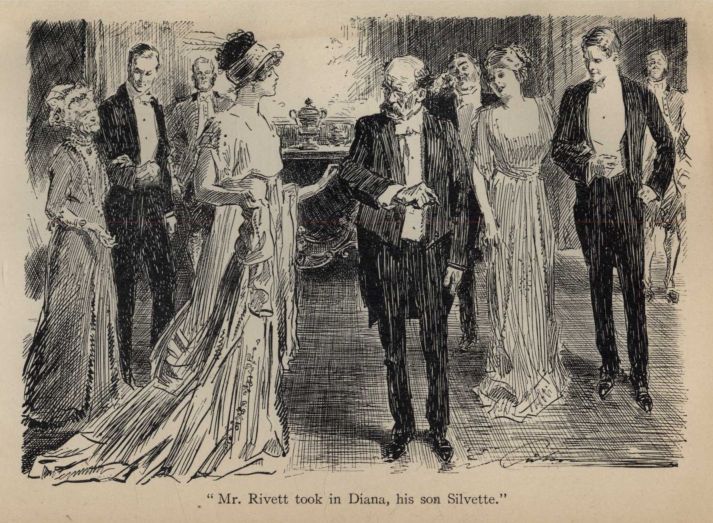
"Mr. Rivett took in Diana, his son Silvette."
In the dining room everything was grossly overdone except the cookery—the sort of thing most calculated to annoy and bore the very man most accustomed to it in town; profusion akin to the plethora which offends; effort impossible to disguise which stirs even in the most good-natured and generous an unwilling contempt.
Edgerton let his eyes rest for a moment, outside the silver and crystal-set circle of light, on gold, heavy carving, gilded tapestry and picture, and withdrew his gaze gravely. Men servants swarmed, bothering him; the scent of greenhouse blossoms, forced before their time; the heavy magnificence out of place—all slightly disgusted him, though much of it was about what he had expected of such people.
Little Miss Rivett, on his left, dissected her terrapin with the healthy attention of youth and hunger; and presently he turned to look at her with amused but wholly amiable curiosity.
He saw a small, plump, dainty maid, with exceedingly clear and bright brown eyes, and a softly brilliant complexion, looking back at him with unconcealed interest.
There was a moment's silence, then they both smiled.
"Do you think you'll like us?" she asked saucily; "or do you hate us already?"
"Not the slightest doubt of my liking you, Miss Rivett; but how about your liking us?"
"Your cousins are most bewitching and bewildering.... You seem to be nice—are you?"
"Very," he said, laughing. "I'm glad you gave me an opportunity of saying so, because otherwise it might not have been perfectly clear to you."
"I am rather fastidious," she said. "How well do you dance?"
"My grace in that praiseworthy pastime is ursine."
"Really?"
"Unbearably."
"You are very British, aren't you?"
"Do you refer to my little play upon words?"
"No, generally; that was merely a touch of local color. Naturally, also, you fishshootridetohoundsandplaypolo; do you?"
"Also gawf, dear lady."
"Perfectly symmetrical and indistinguishable from others of your kind. I thought so. Crocky, too?"
"Certainly, crocky," he admitted; "also no bank account. You may call me m'lud with impunity."
"Perhaps you're not entirely qualified. How do you stand on the heiress question, Mr. Edgerton?"
"I can't qualify there."
"Then you're a sham. Besides, you're neither clever nor gallant. I am an heiress."
"Then I qualify at once as a fortune hunter," he said, laughing, "and I'll cable for my solicitors."
"What are you saying?" asked Mrs. Rivett in her gentle, uncertain voice.
"Mother, Mr. Edgerton and I are going to be friends. Perhaps he isn't sure of it, but I am. Tell him what happens when I am sure of anything."
"Dear, perhaps Mr. Edgerton doesn't quite understand your manner of saying things."
"That's just it; he does understand! He is going to turn out exceedingly nice, mother; watch him!"
"Christine! Please be a little less personal and abrupt."
They turned, smiling, toward the other end of the table where much laughter sounded. Evidently Diana and Silvette were becoming very popular, and, somehow, it occurred to Edgerton that perhaps this great room had not often resounded with mirth.
But the chatter and laughter were incessant now; so were the servants' ministrations, and Edgerton was glad enough to give his arm to the faded little woman beside him and take her to her great, gilded chair in the drawing-room, and follow the men to another room, where blue smoke from cigars presently floated to the ceiling.
Jack Rivett, rather too plump and smooth, moved into a chair beside Edgerton; and the latter, who had prejudged him from his appearance, was slightly surprised to find the youth widely read, widely traveled, with a mind and even a wit entirely his own, and an original but sometimes callow comment for any subject brought up.
In a desultory conversation it presently transpired that young Rivett was a candidate for the Patroon's Club.
"You're a member, I believe; are you not?" he asked Edgerton.
"I have resigned."
"Oh! I thought that was the one club from which nobody ever resigned. I beg your pardon, Edgerton!" he added, turning red; "don't think me a cad."
"No offense," smiled Edgerton; "I resigned because I couldn't afford it. It's a good club; hope you make it soon."
"I hope I do.... But we're rather recent additions—if we are additions—to New York. You never can tell what New Yorkers will do to people like us," he added laughingly.
"New York is practically composed of recent residents," said Edgerton, smiling.
"They're the most pitiless to newcomers. I wouldn't be very much afraid if we had only your sort to encounter. If you old residents like a man, he gets his hat check ultimately, and passes in; but it lies with the sidewalk speculators now. The seats of the mighty are in their hands."
Edgerton was much amused.
"Not entirely," he said; "even we older residents are asked about now and then."
"Into which of the three circles—Smart, Knickerbocker, or Old Testament?"
Edgerton was laughing so frankly that Rivett senior turned his convex glasses on him; and, deciding that the laughter was genuine and not included in services, went on with his business conversation with a Mr. Snaith—a large, soft-skinned gentleman deeply immersed in oil and cotton.
Colonel Curmew came over briskly, expelling smoke.
"What are you youngsters playing this evening? Auction or Chinese Kahn?"
"However, they choose to make up the tables," said Jack Rivett lazily. Then, as though on an after thought: "I doubt whether Mr. Edgerton bothers with cards; do you?"
"I don't mind, except that I've cut out playing for stakes," replied Edgerton, perfectly aware of Jack Rivett's kindly consideration in giving him a chance to escape gracefully, and a trifle amused, too, that the young man should suppose he cared what anybody in the place might think of him.
Servants were now arranging the old-fashioned colonial card tables in the noticeably old-fashioned colonial card room. A young girl or two appeared at the arched doorway, lingering on the threshold as several of the men came out to gossip.
Then the hostess appeared with the others; groups formed, shifted, and gradually subsided into seats; seals of fresh packs were broken, scores penciled, the first hands dealt at auction.
Diana, Colonel Curmew, a very pretty Mrs. Wemyss, and Mr. Rivett sat together; at another table Silvette, Mr. Snaith, Christine Rivett, and a Mr. Dineen—a gentleman weighing some two hundred pounds and wearing an attractive snub nose and a pair of merry gray-blue eyes.
And the awful hush of auction descended without a sound.
Edgerton and his hostess and a Judge Wicklow and a Mrs. Lorrimore—a fair, fat, blue-eyed thing with a cupid-bow mouth as sweet as the smile that abode there—settled themselves to Chinese Kahn, a game spelled in various ways and played in several more.
"Stakes?" inquired Mrs. Lorrimore with businesslike directness.
"Your pleasure," replied Judge Wicklow in the deep, thick voice celebrated and feared where judicial procedures are thickest and most unimportant.
"Neither Mr. Edgerton nor I care to gamble—I think," said Mrs. Rivett timidly.
The judge turned his bovine countenance on Edgerton. The only anomaly in it seemed to be his eyebrows. Cows have no eyebrows.
"I'm sorry," said Edgerton.
The judge seemed sorry, too, but he shuffled the two packs in his enormous and hairy hands, dealt, and deposited the surplus in a pile with a single card separate and face upward—the ace of hearts.
Mrs. Lorrimore promptly picked it up, laid down three aces, four fours, a small sequence interiorly made possible by a joker, and sat back triumphantly with her depleted suit in her gemmed fingers, which were pressed comfortably to an ample bosom.
"Discard," rumbled the judge.
"Oh, I beg pardon!" She laughed, and laid down a nine.
Nobody ever wants a nine, somehow. The judge snorted, helped himself, discarded, and turned his heavy countenance on his hostess.
"Dear me," she said in her humble little voice, "I—I'm afraid—afraid I'm going out!"
"What!" thundered his honor. "Nobody ever goes out first hand, madam!"
But she timidly did that very thing to the suppressed fury of his honor, who had cherished a long sequence, according to rule, and was further nursing the other joker and three kings.
"It's too bad," she ventured, looking around at Edgerton, whose entire hand was being minutely counted by Mrs. Lorrimore.
"I don't mind!" said the young fellow, laughing; and he leaned a trifle nearer and added under his breath: "But suppose I had played for stakes!"
Into her timid and faded eyes came the ghost of a glimmer—the momentary sparkle of fun, and went out very quickly.
But it had been there for a second; and thereafter Edgerton found a curious pleasure in making it come back at intervals. She even laughed—even ventured to provoke his laughter—rather scared at trying until his quick mirth set her at momentary ease again.
Luck bedeviled his honor; the fair Mrs. Lorrimore won steadily without the least respect for the law and no consideration at all for the sanctity of the bench; and the judge became peevish. He was a very rich man.
Presently he had enough of it—letters to write for the morning mail—and got himself out and upstairs with the dignity of a fly-pestered ox.
"Horrid old screw," observed Mrs. Lorrimore in Edgerton's ear, and laughed her peculiarly sweet and captivating laugh as a servant returned with his honor's check in an angrily scrawled envelope.
Mrs. Rivett had passed into a farther room, where the high gilded pipes of an organ glimmered in the subdued light. Edgerton saw her seated there—a thin, bejeweled little figure beneath the tall gothic majesty of the pipes.
After a while the low harmony of an old-time hymn stole into the card room.
Those at the bridge tables remained silent and absorbed, except Mr. Rivett, who cautiously turned his sphinxlike countenance toward the farther dusk where his wife was seated.
Edgerton stood behind Diana's chair, watching. Presently he went over to Silvette, lingered for a while, then came back to Diana again.
An hour later Mr. Rivett said abruptly: "Does anybody care to dance?"
The effect was like a pistol shot on lotus eaters. Slowly the players came out of their absorption; color returned faintly to white, tense faces.
"I suppose I may ask it?" added Mr. Rivett dryly. "I'm a heavy loser."
"Sure thing, dad," said Jack with a laugh. "I'm about even, and I venture to ask it, too. Does anybody here want to dance? You surely won't object," he added mischievously to Silvette.
"I have no right to say anything at all," she laughed.
"Every right—the right of the conqueror! Accept my bow and spear—and speak! ... How is it with your sister?"
"I'm afraid I haven't any voice in the matter, either," said Diana serenely. "It is for the losers to decide."
They decided to dance. Mrs. Rivett came from the dim music room and stood watching them with her little worn hands folded, while servants lighted and cleared the larger drawing-room, designed for a ballroom, with its little gilded balcony aloft and the great concert grand in its carved and gilded foliations sprawling like a bedizened elephant in the corner.
A servant was sent for "mademoiselle"—evidently somebody who lived somewhere in the house whose duties included dance music. Meanwhile Edgerton sat down at the piano, and began a fascinating Spanish waltz.
"Traitor," whispered a fresh, young voice at his elbow, and he looked up into the winning eyes of Diana.
"Hello," he said; "how went the battle?"
"The cards?"
"Yes."
"As usual, thank you."
"Oh! And how do they usually go with you, fair cousin?"
"Well enough," she said briefly.
She stood leaning on the piano.
"You play cleverly," she observed.
"Oh, yes—cleverly. There's nothing else to anything I do."
"Isn't that enough?"
"Is it, Diana?"
"Enough as far as music is concerned," she said impatiently. "Did you ever see a musical virtuoso whom a real man didn't want to kick? And as for you," she added, "you are a traitor. You said you would ask me to dance. Now, if you ask me, I won't!"
Still playing, he continued to look up at her smilingly.
"What do you really care about me anyway?" he said. "I wish you'd tell me, Diana."
"Honestly, or flippantly?"
"Honestly."
"Masks off, you mean?"
"Yes—as far off as they'll come."
"I care a lot about you."
"You say it too frankly," he laughed.
"What I say, I say.... Did you find Christine Rivett agreeable at dinner?"
"She's interesting."
"Is that all!" evidently disappointed.
"Well, she's very fetching."
"That is far more serious."
"Indeed, it is. I've qualified as an aspirant for her hand and fortune already."
"I don't doubt it," she returned calmly. "That's one reason her father decided to employ us."
She said it unsmiling, and after he had looked up at her once or twice he said: "Of course you are joking."
"Ob, yes; it's one kind of a jest. Meanwhile here comes a young person in black—doubtless mademoiselle.... I'm not going to dance with you; don't compose your features in that smug fashion. You're a traitor, and I won't."
She turned on her heel and advanced leisurely toward Colonel Curmew, who immediately began to twirl his mustache and shoot his cuffs, when, without warning, she sheered off into the receptive arms of Jack Rivett, and was presently drifting across the room in a Viennese waltz.
Others were dancing now; Edgerton went over and asked his hostess—an old New York custom now obsolete—who colored and smiled at him, explaining that she had renounced that art with the advent of rheumatism. So, after a while, he took out her daughter Christine—also an obsolete custom—who soon, however, had enough of him as a dancer, and took him into the conservatory.
The others danced until supper time; midnight found them separating on the stairs. Edgerton and Christine Rivett had rather a prolonged leave-taking, then shook hands cordially in plain view of everybody.
Diana, passing with Silvette, said a careless good night to him. Silvette, retaining her sister's arm, detained him for a moment in conversation; then they went away together, Diana dismissing him with an inattentive nod.
But, as he was prepared for his pillow, a servant brought an envelope to his door and tucked it under the sill.
Inside was a single line:
"Good night, Jim."
The handwriting was now familiar to him.
CHAPTER VI
PACTA CONVENTA
Guests arrived and guests departed from Adriutha, but the original gathering remained.
The people who came and went were about the kind that Edgerton had expected to encounter—people identified with nothing in particular except money, and not always with that.
For, into the social mess at Adriutha an author or two was occasionally stirred as seasoning; sometimes an artist became temporarily englutenized over a week-end, emerging on Monday well fed and satiated with hope of material results from cohabitation with wealth—which never materialized.
Edgerton was inclined to take them all as cheerfully as he found them—at their face value; and they were not always pretty.
Loyalty to obligation was inherent in his race, perhaps the strongest trait in him; and all his inclinations toward what was easiest, his content with the superficial, his tendency to drift, had not yet radically altered this trait, nor perhaps other qualities latent under the froth.
For a few days in the beginning, humorous curiosity, the novelty of his anomalous position, the very rawness of the experience, amused him; but the veneer of everything soon wore thin, revealing the duller surface underneath. Then came uneasiness and impatience; but loyalty to his bargain and to his kindred were matters of course, and he determined to find in these people something to interest him and render his sojourn among them at least endurable.
After that first stormy night in June, the splendor of a limpid, rain-washed morning had revealed to him the gross outward impossibility of this place of millions—the vast, new "villa," red-tiled and yellow-walled, hideous in its multiplicity of roofs, angles, terraces and bays, with outlying works of rubble, concrete, and railroad-station floral embellishment.
Scarring the green crypt of nature, staining the glass of the stream with painted reflections of its architectural deformities, Adriutha Lodge sprawled monsterlike and naked in the summer sunshine.
Garage, hothouses, stables, barns, a farm, a model dairy, like grewsome spawn of a common architectural dam, affronted the woods and meadows of this little valley set among the remote Berkshires.
There was no reticence left in that desecrated valley all vibrant with the scream of discordant color, texture, and design. Motor cars, too, were noisy along the road; all day the silver-mounted trappings of horses flashed in the sun. Staccato echoes from power boats on the artificial lake offended. The House of Rivett challenged the Eternal patience with a hundred lightning rods.
Edgerton, walking his horse beside Diana's, suddenly drew bridle with an uncontrollable gesture of disgust.
"Listen to me," he said; "where man's despoiling labor pollutes nature, sadness and resignation make heavy the hearts of her true lovers, but where man's abominable ignorance desecrates, reigns a more shocking desolation which no modest heart ever forgives!"
Diana, surprised by the sudden and unexpected outburst, drew bridle beside his standing horse.
A moment previous they had been amiably exchanging idle gossip from their saddles, gradually falling back behind the others—Silvette, Christine, Jack, and Colonel Curmew—who had cantered on forward; and now, suddenly out of a clear sky, not apropos of anything, Edgerton had flashed out the bolt of his contempt for the House of Rivett—for his ox, his ass, his servants, and all that was Rivett's.
"Jim," she remarked, "isn't it rather bad taste of you to say that?"
"Why? I am paid for being here." But he realized that she was right, and it made him sullen.
"His roof shelters you none the less," she said quietly.
"Yours is rather a fine-drawn sense of hospitality, it seems to me," he retorted.
"I can't snap at the hand that feeds me."
"Good Lord! May a man not have his own ideas?"
"Under lock and key, yes."
"All right," he said, reddening; "only I supposed I could be frank with you."
"Are we actually on any such footing?" she asked quietly.
"I thought so—even a footing on which I permit myself to accept such a rebuke from you."
She turned in her saddle.
"Permit yourself?" she repeated. "Do you mean condescend?"
"I mean what I say," he retorted sulkily, still smarting under her rebuke.
Her cheeks were bright with anger, her lips compressed as though silence had become an effort. Presently, however, she looked across at him with perfect sweetness and composure.
"No, you don't mean what you say, Jim. If you did, you would be at a disadvantage with me, and you don't want to be that; nor do I wish to be, ever."
He said obstinately: "I'm getting sick of this Adriutha business."
"I predicted you would."
"Well, I am.... It isn't false pride; I don't care what they think about me. If I chose to be a waiter in a Broadway café, their opinion wouldn't concern me.... I'm simply weary of the place, the majority of the people—what they think and do, their private life, their mere coming in and going out.... It isn't the pitiable absurdity of their offensive environment alone, the horror of the architecture, the gilded entrails of their abode—it's the whole bally combination! ... I'm sick—sick! And that's the truth, Diana."
"I think," she said, smiling, "that you are also a little bit bored with us."
He looked up at her, perplexed, already beginning to be very much ashamed of his outburst, already conscious of a painful reaction from his unrestraint.
"Diana," he said impulsively, "I'm just a plain brute, and rather a vulgar one; but, do you know, there isn't anybody else in the world I'd have permitted to hear that outburst—whether you take it as a compliment or not."
"You mean you don't care what I think of you?"
He thought for a moment. "I can't mean that, of course."
"You might, very easily."
"I couldn't; I do care what you think of me. Probably what I meant was that I—dare say things to you; that I've a sort of instinct that I can come to you in an emergency——"
"In other words, that I'll stand anything from you?" she said, smiling. "I don't know about that, my friend."
He looked at her curiously. "I believe you'll stand a good deal from me—and still like me. I, somehow, count on it."
She met his gaze directly, unsmiling now.
"A hair divides my sentiments concerning you," she said. "Extremes lie on either side."
"Extremes?"
"I think so. It would take very little to fix definitely my opinion of you."
Sobered, but still curious, he sat his saddle more firmly while the horses paced forward, shoulder against shoulder, along the forest road.
"I didn't suppose you had any very violent opinions concerning me one way or another," he said lightly.
"I haven't—yet."
"Or would ever develop them, either," he added, laughing.
"I probably never shall."
He said, after another silence: "What was it about a hair dividing your sentiments, and that extremes lay on either side?"
"I said that, Jim."
"Extremes of what?"
"Dislike—friendship—I suppose.... I'm a person addicted to extremes."
"Hatred is one extreme. Did you mean that, Japonette?"
"It is conceivable, fair sir."
"And—the other extreme?"
"Which?"
"The opposite extreme to hate.... Is that conceivable, too?"
"Do you mean love?" she asked coolly.
"Yes, love, for example."
"Well, for example, ask yourself how likely I am to entertain that sentimental extreme in your regard."
"Oh," he said; "then all you threaten me with is hatred!"
"Absolutely all, cousin James."
"Hobson's choice for mine. No matter how agreeable I may be, placid friendship is my only reward; and if I'm not agreeable, hatred. Is that it?"
"Are you not satisfied?" she asked, lifting her prettily shaped eyes.
He made no reply.
Yet, he had been satisfied, except at intervals during the first flush of their unconventional friendship, when she was still a fascinating novelty to him, when the charming memory of the surprise was still vivid.
But since then, recently in fact, other matters, somehow, had intervened—the dawning distaste for his own position, the apparent absence of any future prospect, the gradual conviction that he had no real capacity for decently earning a living, no ability—perhaps no character.
His silence seemed to be her answer now; she spurred forward, accepting it. He put his horse to a canter, to a gallop, and they raced away through the woods until they came in sight of the others. Colonel Curmew joined her; Edgerton rode forward with Christine Rivett.
That afternoon there was some tennis played; a number of commonplace and very rich people departed, leaving as residue the original house party which Edgerton and his cousins had found there on their arrival, and who now knew one another well enough to separate into sympathetic groups.
Thus, Judge Wicklow, Mrs. Rivett, and Mrs. Lorrimore played Chinese Kahn under the terrace awning; Colonel Follis Curmew, who had been rash enough to discard his coat and reveal an unlooked-for excess of abdomen, played tennis with Silvette against Jack Rivett and Mrs. Wemyss; Mr. Rivett and Mr. Snaith indulged in laborious clock golf and talked of oil; and Christine and Edgerton, down by the river's edge, continued a conversation begun the evening previous, and which was near enough to meaning something to stimulate their attention.
From his clock golf on the lawn above, Mr. Rivett turned his convex glasses on them occasionally; from one card table on the terrace, her mother, drawing the white wool shawl closer around her slight shoulders, watched her daughter from moment to moment.
Later, the game ended, Mrs. Lorrimore victorious, and his honor unusually peevish. Mrs. Rivett rose and, advancing to the terrace edge, gazed down at the river bank, where her daughter and Edgerton still sat in the floating canoe, holding it inshore by grasping willow branches overhead.
For a few moments the little old lady watched them, one hand gathering the fleece shawl over the magnificent sapphire at her breast; then she turned quietly away into the house, wandering through it from one gorgeous room to another, until at last she came to the high organ.
Here her husband found her in the semi-dusk, sitting motionless and silent under the tall pipes, hands folded in her lap.
"Well, mother?" he said in a voice which nobody else ever had the privilege of listening to.
She lifted her head, smiled, and laid one hand over his as he seated himself beside her in the demi-twilight.
"Are you happy?" he asked, patting the worn fingers.
"Yes, Jacob—when you and the children are."
"Does that damn Sims bother you?"
No, the housekeeper did not bother her; neither did Noonan, general superintendent.
"Are you sure you are feeling perfectly well?"
"Yes, dear."
"And you are enjoying the people?"
"Yes.... The Tennant girls are so kind to me."
"Why the devil shouldn't they be?" he said harshly. "They never met a better woman!"
"Jacob, dear, don't speak that way."
"Well, then—don't be so eternally surprised if people are nice to you, mother. They'd better be!"
She smiled. "I am a rather plain and unattractive old woman to young people—to most people. I have little to say, but Diana Tennant and her sister are very sweet to me. Poor, motherless girls! I wonder—it troubles me—sometimes—a great deal——"
"What?" he asked grimly.
"Their being so entirely alone, and so unusually attractive.... And they're good girls, Jacob."
"I assume that they are," he said dryly.
"They are; a woman knows at once.... They've made everybody—all our guests—enjoy their visits so much. Don't you think so?"
"They've earned their salaries.... People seem to like 'em.... I'm wondering how much Jack likes the younger one—Silvette."
"Have you thought so, too?"
"I'm asking you, Sarah."
There was a silence; then she said timidly:
"Do you know anything more about them?"
"They're rather learned," he said grimly. "One, I understand, is entitled to practice medicine—the other law.... They scarcely look it."
"Those babies!"
"Certainly. Snaith was at Keno on business last winter; he heard of 'em there. Also—I've inquired."
"You have learned nothing to their discredit, I am sure," she said confidently.
"No; as the fast world wags, they're respectable enough——"
"Fast! Jacob!"
"Oh, Sarah, I didn't mean it in any sinister sense.... They're merely rather gay—into everything everywhere—dancing all night, riding, motoring all over the shop.... They're pretty girls, and good ones, too, I guess.... But the world has gone by us, mother. It's developed speed. That's what I mean by fast."
"If it were not for the children's sake, I would be glad to be left behind," she said, smiling.
"So would I. Damn this gim-crack fol-de-rol!"
"Jacob!"
"Excuse me.... We'll do what we ought to; the children want New York, and I'm going to give it to them if I can.... So I guess you'd better caution Jack about that girl."
"About Miss Tennant?"
"Silvette; yes. Tell him to keep away."
"But she is Mr. Edgerton's cousin."
"It's too far off to count; besides, it's not a good enough gamble. As far as that goes, I'm not satisfied that Jim Edgerton is good enough."
"Oh, Jacob! You said——"
"If I'd stuck to all I've said, you'd still be doing the family cooking, dear. Jim Edgerton does, or did, go everywhere in New York.... I wonder how far he could take our daughter with him? ... Wait, Sarah—I'm not reflecting on Christine; I'm only speculating. How do I know about the customs and habits of the New York fauna? I want to go slow. I don't care how little money he has, or even how much he might have had; I'll do that part. But, first, I want to know exactly where he can take Christine. The knot hole may be too big for her."
"They sent you a report from New York, dear. You have a full list of all his relatives."
"I know—I know. If he had none, I wouldn't be afraid. It's a man's relatives who act nasty, not his friends.... Does Christine seem to like him?"
"The child is frankly devoted to him.... I don't know if it means anything more than friendship. Christine is a strange girl. There was young Inwood——"
"Everybody's beau! Glad she shipped him.... But to return to Jack—what's your opinion?"
"I don't know. He is with Silvette so much; he is such a dear boy——"
"Tell him plainly we don't want her. I like her myself, but there's better material.... Other things aside, I don't want my boy to marry a girl who plays cards the way she does."
"Jacob! You don't mean——"
"No, no! She's as square as a die; but she wins too much, stakes too much—smokes too much, drinks too many cocktails—she and her sister, too. Why, they've won steadily at cards from the beginning. They've a genius for it. I never saw such playing. Poor cards don't worry them; and they never take the shadow of advantage, never whine, never ask questions; there's never an impatient word, a look of protest—and the judge and the colonel are beasts to play with!—and if there ever seems to be the slightest doubt or indication of a dispute over any point, those girls instantly concede it—cheerfully, too! They're clean-cut sports—thoroughbred.... But, by God! I don't want Jack to marry a gambler!"
He stood up, his glasses glistening, his little burned eyes fixed on space.
"No," he said; "I've done all the gambling that will be done in this family. I'll do a little more—enough to put the bits on one or two men in New York whose wives could make it easy for my children, if they cared to. Then I'm done, mother."
She bent her head, and her lips moved.
"What?" he said, hand to his ear.
"I was only thinking, Jacob, that I would be happy when you have finished with—business."
"Don't worry, dear." He put one arm around her—a thin arm in its loose coat sleeve, thin as a tempered steel rod. She laid her faded face against it, comforted by its inflexibility.
"Some day," she said, "when the children are happy—with their families——"
"Yes, yes," he nodded; "a smaller house for you and me—just a little one." He smiled; few people ever had seen him smile. "Just a little house for two little old people," he said; "only one horse to take us about, one servant to feed us—eh, Sarah?"
She looked around her, smiling vaguely at the magnificence.
"I like to dust," she said, coloring up prettily, "and to make jelly.... I've wanted to a long while."
"You shall do it; I swear you shall. By God! I'll be glad when that chef is fired!"
"You know, Jacob," she said timidly, "with knitting and dusting and—and a little kitchen work—and you—the day passes very nicely."
"Some day you'll make some more of those crullers!" he predicted; "mark my words!"
"And the cinnamon shells," she added, slightly excited.
"Oh, Lord! Why can't that fool of a chef make 'em!" he burst out. "Well, I'll wait.... It gives us something more to wait for, doesn't it?"
He laughed. Only his wife had ever heard the dry cackle which was his manifestation of mirth.
Contented, she lifted her face, and he kissed her.
He went to New York that evening to remain over Wednesday as usual.
In the small company remaining at Adriutha a certain intimacy had developed, enough to make any effort at entertainment superfluous. There was now a decided inclination to laziness in the evening, and a preference for the billiard room and its easy informality.
It was a big room with open fires and the inevitable trophies of somebody else's chase—the heads of big game mounted, staring at nothing out of their glass eyes; weapons of a vanished age on the oaken wainscoting, modern guns in racks as well as cues, and leather lounges and seats and wide-armed chairs everywhere.
Hither Mrs. Rivett now brought her embroidery or knitting; and around her, within a radius more or less distant, the others gathered or circled in temporary orbits, and games were played and music made and youth flirted and age gossiped much as they did when she was a young girl in Mills Corners, and her husband taught in the red schoolhouse next door.
Sometimes Diana came and sat beside her and knitted a tie destined, she admitted, for nobody in particular; sometimes Edgerton drew his chair beside hers and told her of student life in Paris—watching always for her delightfully timid smile, the shy laugh that she sometimes ventured, the curiously pretty flush that came at times into her cheeks, making them and the faded eyes almost beautiful.
Once or twice it happened that Christine settled herself on a footstool on the other side of her mother to listen, too; and the little old lady experienced a furtive content with the situation as Edgerton and her daughter exchanged pleasantries and volleys of gay badinage across her knitting.
But listen as demurely as she might, feign inattention and unconsciousness as she might, she could detect in neither her daughter nor in Edgerton any hint of a subtler understanding, any omen of anything for the future beyond a frank camaraderie and the undisguised pleasure in it.
And she sighed sometimes—not understanding, not venturing even to admit to herself the desire that was beginning to establish itself in her gentle breast.
As for Edgerton and Christine, they were now on terms of intimacy almost careless. With Diana he was different.
The day of his bitter outbreak when riding with Diana, Edgerton, terribly ashamed of himself, had gone once more to her and admitted that her rebuke was a just one; that he was an ungrateful dog, disloyal to the hand that fed him, and not worthy of Diana's regard.
And the girl had forgiven him very sweetly, not with much enthusiasm, for his rapidly advancing intimacy with Christine had begun to perplex her, nor could she exactly understand his apparently happy acquiescence in conditions lately so irritating.
Not that he neglected her; in his amiable way he was charming to her and to Silvette; was often with them; drove, rode, walked with them; and often, when the opportunity happened, met them in family conclave to discuss future prospects for business.
But his intimacy with Christine advanced very swiftly; so rapidly that Diana became fully aware of it only when it was already in complete flower.... And she wondered a little—and, looking at the girl, wondered less. Also, knowing Edgerton less than she supposed she did, the wonder as to his motive began to trouble her.
Whatever Diana really thought of Edgerton, she did not think him unusually strong in character; was not absolutely convinced of his sincerity—was not any too sure of his motives. Yet, to doubt him always hurt her, and to question his sincerity now made her ashamed of herself. But Christine Rivett was very, very rich, and the only thing she did not have was a name like Edgerton's to insure her future for all time. Thinking of this, the girl was ashamed to think it, and put it resolutely from her mind; but it returned at intervals, even when he was most charming to her sister and herself.
Meanwhile a silent but decisive little duel had been fought in her vicinity, and Jack Rivett definitely replaced Colonel Follis Curmew at Silvette's side; and that warrior, being unfamiliar with the fortunes of war, first sulked, then began to appear frequently in Diana's vicinity—sending out, as it were, pickets of observation and foraging parties, and finally appearing in superb force with warlike intentions not to be misunderstood, although Diana contrived entirely to misunderstand them.
"Do you know," she said to Silvette one night as they were preparing for bed, "I believe that he is actually falling in love with me."
He was; but, nevertheless, Diana entirely misunderstood him.
And so the early summer days passed at Adriutha, and Edgerton, always prone to accommodate himself to circumstances, found it easier and easier to keep his pact with Mr. Rivett.
Perhaps he was too easily colored by his surroundings; for this place and these people—toward whom, under other circumstances, his instinct would have been antagonistic—were becoming very agreeable to him, and he had handy no standards of comparison from his own world—merely memories, which are always inadequate.
He never became entirely reconciled to the architecture of Adriutha, but the interior magnificence disturbed him less and less; besides, he had very little real love for decoration, and knew little about its harmonies. All the art that was in him consisted in a cleverness and facility for expressing what was actually of slight importance.
So he became amiably reconciled to his surroundings, to his own position. Probably the lack of responsibility and the pleasant idleness had much to do with it.
Still, he really liked Jack Rivett and Christine. In prosperous days the chances would have been against his ever giving himself the opportunity of liking them. But chance had taken charge of his career for the moment; he had met them, and liked them—was inclined to like Rivett senior, too, and began to experience a certain tenderness toward his frail little hostess—something he had never noticed in himself since his mother's death many years ago.
For the others he had no particular feelings. He knew, without troubling himself to think about it, that Colonel Curmew was what his own friends would call a bounder; and the remaining guests were of no greater importance to him than strangers inclined to be civil.
As for Silvette and Diana, they were not only kindred, and so to be automatically cherished, but they also were very charming and delightful young girls; and Diana aroused his curiosity.
During the first days of their acquaintance, the circumstances of his encounter with Diana had inclined him to sentiment. Now that had been merged into a nice friendship—a friendship so frank and pleasant that, in his idea, it permitted privileges of an intimacy which at first perplexed and disturbed Diana, and which, presently, she began to silently resent without exactly knowing why.
What her ideas concerning Edgerton really were, she herself had not entirely decided. She had been as vividly conscious of the charm of their first encounter as had he; being a woman, she still remembered it vividly, whereas, with him, it had dissolved into the mistiest of dream-tinted memories—charming, but vague.
Too, she remembered his attitude toward her in those first three days in the studio—the golden magic of them, the little roof garden, the starlings, the sunset beyond the river. Under such circumstances, the things men say and look, men usually forget; but women remember longer.
Then she remembered, too, the first days of their arrival at Adriutha.... There was nothing in particular to recall—a note or two from her to him, from him to her.... Perhaps a something in his voice and eyes which, somehow, had died out since.... Yet, had it been anything in particular? And, granting that it had, what had she done to encourage it?
She had fallen into the habit of thinking about these things in her bedroom while preparing for the night. She often thought, too, about this new friendship of his for Christine Rivett. It perplexed her, saddened, irritated her by turns, and it distressed her to even question his motives.
But Silvette said one evening, after they had undressed and the maid had left:
"Wouldn't it be odd if Jim married that girl?"
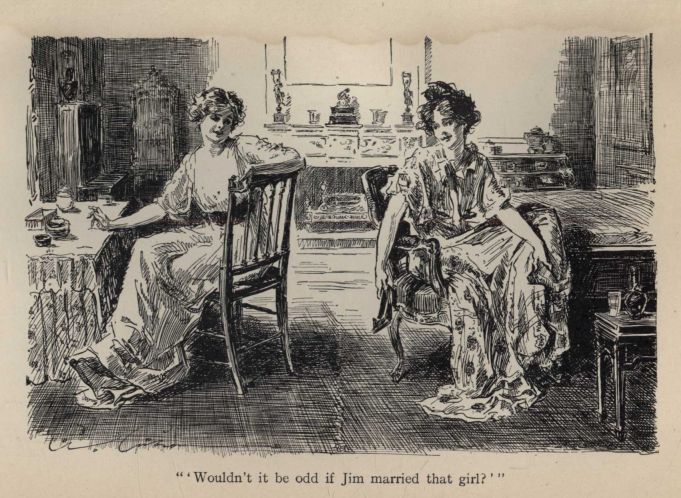
"'Wouldn't it be odd if Jim married that girl?'"
"Married—her?" repeated Diana, startled out of a reverie not entirely happy.
"He's becoming very attentive to her. She is pretty, of course," Silvette smiled.
"Why shouldn't he marry her if he finds that he cares for her?" asked Diana with some heat.
"I was merely surprised that he should care for her in that way. She is not his sort."
"Sort! sort! What does that matter!" said Diana hotly. "It never stopped a thoroughbred from mating. He can afford to love where he chooses, I fancy."
"Or marry what he chooses, anyway."
"Silvie! Do you imagine he'd do a thing like that—not loving her!"
"I don't know," said Silvette coolly; "he's a dear boy, and nice to us, but I don't credit him with superhuman qualities.... And she inherits millions."
"It isn't in him to do it.... And there are plenty of his own sort who would be glad enough——"
"Why do you become so animated, Di? Have you noticed any particular strength of character in Jim Edgerton?"
"Yes.... He is as true as steel, underneath the amiable exterior of a drifter and dilettante.... He has ideals.... I am not one of them—I know that."
"Do you care particularly?"
"No.... I don't know whether I do or not.... I never seem to know what to say to him these days. We talk together like two men. I'd like to know what he thinks about me—the kind of woman I am, compared to others in his own set.... I'd like to know what he thinks about my gambling and cocktails and cigarettes, which you and I have got to stop! What he really thinks of our position in this house—in the world! I don't believe he thinks much of it."
"Does his position differ from ours?" asked Silvette gently; "why are you so excited, little sister?"
"I'm not excited.... Things—various matters have occurred to me—recently; and I've made up my mind that I don't like to see him here. This is no place for him, no position. He is capable of doing better things, more important things, nobler things. He slips into a life like this too easily; he is too easily reconciled, too quickly content."
Silvette seated herself on a rocking chair and, leaning back, sat rocking and inspecting her sister, who stood by the bed, her brown locks clustering against her cheeks.
"There is something to Jim," she insisted. "He can do things—respectable, dignified things—and make his living. It humiliates me to see him here in such a capacity——"
"As ours?" added Silvette, smiling.
"Yes, as ours. He is a man, and it does not become him."
"We are respectively physician and lawyer, but our talents and fortunes lie in this profession."
Diana flushed. "If we were anything except the frivolous, ease-loving, and pleasure-craving little beasts that we are, we wouldn't be here."
"No; we'd starve, respectably, in our several offices. Do you want Jim to starve?"
"I don't know," said Diana, almost fiercely; "I'd rather see him in want, I think, than doing this kind of thing."
"I don't believe he will do it very long—on a salary," laughed Silvette. "Christine evidently adores him."
Diana was silent; her sister laughed, and rose, putting one arm around her.
"Don't be sentimental over Jim Edgerton," she said; "he is a lightweight, Di."
"You are wrong; and I am not sentimental."
"Well, I believe you did get over it; but you're a loyal and generous little thing, Di, and you're worrying over a man who is entirely capable of looking out for himself."
"That's what I want him to do."
"He's doing it, very gracefully. Later, with equal and fetching grace he'll let some wealthy girl do it for him."
"That would be contemptible; he isn't."
"Now, does the world so consider an advantageous marriage, little sister? Besides, that is exactly what we have planned for ourselves, isn't it?"
"We? What are we, anyway, compared to a man who can count in the world!" flashed out Diana, surprised at her own vehemence, aware that her sister was even more astonished and chagrined.
"What on earth are you saying?" she exclaimed. "Are you in love with that man?"
"No."
"One might infer as much."
"You may infer it if you choose."
"Di!"
"What?"
"Why do you speak to me that way?"
"Because—I don't—know."
She turned and moved toward the bed, encountered the soft, open arms of her sister. They closed around her; she laid her head on Silvette's shoulder.
"Darling! Little Di!" whispered Silvette in sorrowful consternation. "Has this really happened to you?"
"I don't know—I don't know.... I am not happy; I don't understand.... At moments I cannot believe it.... He is not my ideal of a man; I am stronger in many ways—I am wiser than he. He is only a boy, Silvie—careless, ease loving, with nothing but smatterings—nothing but the social experience of a man of his class behind him. Nothing real has ever happened to him in life.... And, somehow, I know—I know that if it only did, he would become a man—a real man. I know it; I can't bear to see him waste his life—fall into easy ways of thinking—make no effort.... I want him to strive; I want him to fight life.... He ought to. The making of him is in a battle with circumstances. This life is ruin to him—this house, these people, any people who will employ him in such a capacity!"
She caught her breath, almost in a sob.
"I have cared for him—a little—from the very first.... I am not—fitted for him—in many ways."
"Di!"
"I am not! I care for him unselfishly. I don't know why I should, but I do; and he ought not to marry me even if he—ever—wished to."
"You are talking wildly, darling! You—not good enough for him! What a silly——"
"Not good enough, I tell you!" repeated the girl fiercely. "I care too much for what he finds agreeable—all this ease and relaxation.... I wish I were different. I wish I could arouse him; I'd do it. I'd do it somehow—I'd do it now if I could——"
She caught her breath, stood perfectly motionless a moment, then Silvette felt her tremble slightly.
After a while she lifted her head from her sister's shoulder.
"I am going to do what I can for him," she said excitedly. "I am going to see what can be done to arouse the man in him. All he needs is the initial shock—a—a stinging one."
"What do you mean? If there was anything in him, the shock of the firm's failure would have brought it out."
"It was not enough. It was only the loss of money! There are worse things——"
"Di! What are you going to do?"
Suddenly the girl's face grew radiant.
"I know now," she said breathlessly.
"What?"
But Diana only kissed her sister, laughing, flushed, excited, and, extending her arm, turned off the light, plunging the room and her brilliant cheeks in darkness.
CHAPTER VII
FLOS VENERIS
Edgerton and Christine, ensconced in the corners of a window seat, and partly visible through the leaded panes, were too deeply absorbed in each other to be aware of the curious glances shot toward them from the tennis court outside, where Silvette, Colonel Curmew, Mrs. Lorrimore, and Jack Rivett were playing, while Diana, perched aloft with her knitting in the umpire's seat, resolutely ignored the spectacle in the window, which was plainer to her than to anybody else.
Perfectly oblivious to any extraneous interest they aroused, sitting almost nose to nose and knee to knee in the deep recess, Christine and Edgerton remained in close consultation, preoccupied, possibly indifferent, to view or comment. Christine bent forward, and drew a carnation through his buttonhole, saying:
"Anyway, you are a perfect dear, Jim Edgerton. Somehow or other, I haven't any blushes for what I've taken so many weeks to tell you. I never thought I could know anybody well enough to say such a thing to, but you are different; there's nobody like you, Jim. Do you wonder I adore you?"
"You sweet little thing, I've a mind to kiss you for that!"
"I may let you at the psychological moment. Do you think me absolutely shameless?—but I've asked you that before about a dozen times.... You don't think so, do you?"
"If other women displayed the common honesty and common sense that you display, there'd be a good deal less unhappiness in the world."
"But how can other women, when there is only one Jim Edgerton! Oh, I liked you so much—as soon as I saw you; and before I had known you a week, I was ready to tell you anything—and now I've done it!"
"It took several weeks before you came to the point," he said, laughing.
"I know, but, oh! it was such a terrible thing to do!—I don't even now understand how I ever came to tell you."
"You didn't; I extracted it, seeing that you were in pain."
She blushed.
"Yes, it was pain.... Not one of my own family suspected it. Father doesn't dream of such a thing; Jack doesn't, of course. As for dear little mother, you know what she thinks about you and me."
Edgerton smiled almost tenderly.
"She is very nice to me," he said. "I almost wish I could verify her charming theory."
"Concerning us?"
"Certainly.... As it is, I believe I'm more than half in love with you, anyway, Christine."
She blushed again, looking at him with her pretty, frank, brown eyes; and they both laughed happily.
"It's the first time in all my life that I've been of any use in the world," he said.
"You did ask father?" she inquired, still charmingly flushed; "didn't you?"
"I certainly did. He said: 'Is young Inwood such a particular friend of yours?' I said: 'He is!' He said: 'All right; ask my wife.' So I asked your mother, and she said: 'Oh, please, Mr. Edgerton, invite anybody you wish to.' So I wrote Billy Inwood, and your bully little mother inclosed my letter in the sweetest note of her own; and now he has telegraphed——"
"Telegraphed?"
"I've just received the message."
He fished it out of his coat pocket, and handed it to her, and she read:
"On my way!
"BILL."
"Is that all?" she asked, half laughing, half excited.
"He telegraphed your mother the substance of a moderate-sized letter. She's probably in her room now, reading it. She showed it to me in amazement, but I didn't have time to follow all his polite and grateful meanderings."
"I wish to see it!" said the girl excitedly.
"Go ahead; your mother has it. I was anxious to let you know how matters had turned out, first."
"You're a dear!" she repeated, and her voice was not any too steady. "I am happy; I am happier than I've been for—" She checked herself, and bent her head for a moment; he pretended to reread the telegram.
"It will be all right now," he observed.
"I wish I knew," she said under her breath.
"Don't you?"
She lifted her honest eyes to his. "How can I know, Jim? I don't know how men are. It all happened over a year ago.... I was no wiser than a schoolgirl. What experience had I—with such episodes—such conditions—or with anything?"
"You did act like a schoolgirl—to send him about his business," said Edgerton with a shrug.
"I wouldn't have if I hadn't—hadn't——"
"Cared for him?"
"Loved him," she said steadily.
"You're a corker, Christine!" he said in genuine admiration.
"Am I? Thank you, Jim."
"Yes, you are; and so is Billy Inwood—the real Billy. Young men like to chase about with married women. They love to delude themselves into the pleasing belief that they are sad dogs——"
"There was more to it than that," said the girl; "he went to Keno to see her. That is what confounded me."
"While she was getting her divorce?"
"Yes."
"Then you can bet that there was nothing in it, you little goose.... Who was she, anyway?"
"A Mrs. Atherstane. Do you know her?"
"No," said Edgerton; "and you certainly did act like a schoolgirl."
"I know I did, and I was twenty.... I asked him to come, to Hot Springs; she requested him to go to Keno. He took his choice; he had a perfect right to.... And then I wrote him that letter, dismissing him."
"Ought never to have done it, sweetness," said Edgerton gravely. "There are no fetters to hold a man like absolute freedom. He was probably bound to her in various ways, innocently enough, of course; but she was probably lonely and in trouble—and—noblesse oblige. I tell you a young man has to pay for sympathizing with an unhappily married woman! And she usually sees that he does."
Christine sat back, nursing her knees, eyes downcast.
"He was right," she said. "She was his friend."
"Perhaps he was more right than you realize, Christine. When a man's man friend is battered and used up, the man still clings to him—anyway, until he borrows money; but when his woman friend becomes slightly the worse for wear, he is inclined to discard her as naïvely as he would a worn-out coat. That is the rule—romance to the contrary.... Inwood proved the exception, that's all."
"Yes," said the girl in a low voice.
"He proved the exception to me, too," said Edgerton, smiling.
"To you, Jim?"
"Certainly; wanted to lend me money when I arrived in town on my uppers."
The girl smiled.
"Oh, he's all right," said Edgerton; "I've known him since he was six and I twelve."
"He—is—all—right," repeated Christine slowly; "but—am I, Jim?"
"You know you are—kleine Fischerin!"
"But I wrote him that wretched letter. If it hurt him as it hurt me—" She ceased abruptly, and turned her face toward the window.
"You were years younger, then."
"One year," tremulously.
"Years, sweetness.... Do you think your father will ever stand for him?"
"He scarcely knows him. He did not understand why Mr. Inwood never came to Hot Springs, or why I never again saw him. Probably he supposes I lost interest."
"So your father believes that you are all over that affair, doesn't he?"
"Yes; but he probably remembers that Mr. Inwood was to have come to Hot Springs, and didn't. Fathers usually remember such things, and sometimes ask why."
"Well, Christine," he said, smiling, "you'll have to fix it with your father; and I think you can."
"Why do you think so?"
"Because there is much of your father in you—steel under the velvet skin of that pretty figure, or I miss my guess."
The girl said thoughtfully: "I am, perhaps, more like father than Jack is.... That is not really what concerns me.... Has Mr. Inwood changed—in appearance?"
"Within a year? No! Nor otherwise, I'll wager."
"Do you—think——"
"I don't know; I don't know, little girl. Men are protean creatures; God knows what incarnation they'll assume next! ... But if a woman really cares for a man, and if he isn't in love with anybody else, it ought to be a cinch—even if he had as many incarnations as Albert Chevallier!"
"Jim!"
"Well, I know my sex," he said; "the cleverest of them are boobs in the hands of yours——"
"Jim! You are becoming horrid!"
"That means I'm becoming truthful. Hooray! I see Bill's happy finish." He picked up her soft little hand and kissed it. "Velvet and steel," he said—"the hand that rocks the world! Yes? No? Good-by, you little wretch! I'm going canoeing with my cousin Diana."
"Did you say that mother has that telegram?" she asked naïvely, sliding from the window-sill to the floor.
"Yes; and it's a mile long—a bally serial, Christine—to be continued this evening, I expect."
They clasped hands at the threshold; then she ran upstairs, and he sauntered out to the tennis court, where Diana still sat on her high perch knitting the silken tie, although below her the game had ended and the players had gone to the terrace for iced tea.
"Well, of all pretty monuments!" he exclaimed. "You have the other one on the Madison Square tower beaten to a froth!"
"Beware of my arrows," she said, smiling, as the wind blew her scarf into a silvery arc from her shoulders.
"Arrows? No, I'm wrong; you look like the Angel of the Central Park Fountain."
"I feel like the dickens," she said, folding her knitting and descending the steps.
"Headache?"
"No; I merely sat up too late, and I'm sleepy. It's perfectly horrid that you can't stop when you're winning.... What did you wish me to do, Jim—canoe with you?"
"I thought you wanted to."
"Is that why you asked me?"
"I wanted to, also. Why do you always put me in wrong, Diana?"
"Jim, do I put you in wrong, as you call it?"
"Sometimes."
"Well, it's horrid of me. Forgive me. I do try to be such good friends with you, and somehow I don't succeed."
"You—we are good friends," he said; "you know perfectly well how I feel about you."
They had walked as far as the river's edge, where several green-hulled canvas canoes lay on the grass.
"Suppose we walk," she said; "shall we? I'm too lazy to paddle. I'm sleepy, Jim. A walk ought to wake me up."
"I know a ledge where you can take a cat nap," he said. "Accept forty winks from me, and we'll paddle afterwards."
So they strolled along the river path, fragrant with mint and vine and blossom; and presently the cool green of the woods enveloped them, and their feet pressed the moist, springy leaves of a forest path that led over little brooks and up a slope of young growth, all checkered with sun spots, to a vast overhanging ledge of rocks.
"Just look at that moss!" exclaimed Diana. "I believe I'll sit down on it this minute. Jim, do sit down. It's like velvet, and there's miles of it; and here is the most enchanting silver birch tree for my back to rest on, and some wood lilies to look at.... Isn't this heavenly!"
"Out of sight," he said lazily, stretching himself at her feet and glancing up at her. "Go ahead with your cat nap. I'll time you half an hour."
After a moment he laughed, and her eyebrows went up in a silent question.
He said: "I never noticed it before. It's odd."
"Noticed what?"
"How funny they are in outline—your eyes, I mean."
"Thank you, Jim."
"Oh, they're most engaging eyes, Diana."
"More thanks, thank you!"
"I mean that they tip up a trifle—just a trifle, Japonette."
"They don't!"
"They do. Like a pretty Japanese girl's. Only yours are blue.... They're very blue—unusually—like the sky—that sort of blue."
"Young man," she said with mock seriousness, "don't you know what comes of speculating in ladies' eyes?"
"Bankruptcy of the heart," he nodded.
"Then choose some safer and preferred stock, please."
He lay smiling up at her, watching the shades of expression varying in her youthful face—watching the delicate shape of her mouth, which had always fascinated him with its unspoiled purity.
"Do you know," he said, partly to himself, "that when I first set eyes on you, Japonette, I knew I had never seen anything half as beautiful."
"You didn't think so long," she returned, laughing. "Christine is goddess of beauty just now."
"I have always thought so," he repeated.
"Then—why don't you ever say it to me?"
His smile changed a little.
"What would be the use of my telling you that you are beautiful?"
"Use?"
"What good would it do for me to become sentimental over your beauty?"
"Lots of good—to me, Jim. You can't tell a girl too often that she is pretty—when you really think so.... And I almost believe you do think so." She glanced at him sideways, laughed a little, then her blue eyes wandered and she leaned back, pensive, twisting a green oak leaf between idle fingers.
"Do you know," he said after a moment, "that, just now, you are like Japonette again. I haven't seen you so like the real Japonette for a long while."
"How can I be Japonette again? I lack the sandals and butterfly sash and the peonies over my ears, Jim. And—that was about all you saw in Japonette, wasn't it?"
"Almost all. Her face was only a shadowy flower against the sunshine, and its enchantment turned the world to fairyland."
"Alas! the spell was temporary. The victim of my spells fled to the roof, and told me stories about starlings and—and children.... But, somehow, I let him get away from me, and I don't know how to find him again."
Edgerton watched her. She had plaited a sash out of green oak leaves and fitted it around her slender waist; and now, absently, she was placing in her hair, above each little close-set ear, a scarlet wood lily.
Presently she caught his eye, and made him a pretty gesture.
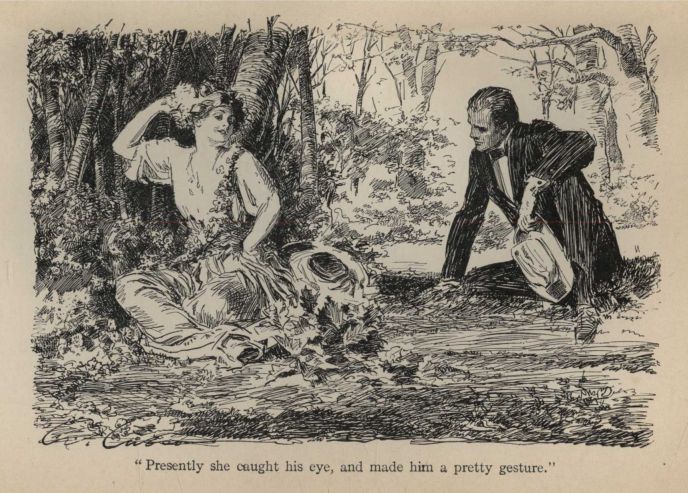
"Presently she caught his eye, and made him a pretty gesture."
"You see I am trying my best to return with you to yesterday.... It is a long path—back over the hours and minutes to yesterday, back to a land of dreamy suns and forgotten skies, and unremembered thoughts.... Shall I try to guide you?"
"Yes," he said, not smiling.
"We may lose our way among the phantoms," she warned him gayly; then became preternaturally solemn, resting her chin in one hand.
Her seriousness enchanted him—her youthful grace as she bent slightly above him, one warning finger uplifted as when a nurse speaks of mysteries to a child in the quiet of twilight.
"Join hands with me in spirit, and I'll try to lead you," she said.... "Now, follow me, while we make our way through the throng of strange faces, treading a path silently, discreetly, avoiding this pretty girl with her bright brown eyes."
"Christine," he thought, and started to speak.
"Hush!" she cautioned him; "for we mustn't speak yet—not until we're in the land of yesterday.... And we are passing over the minutes and hours and days and weeks—and it's like treading on formless mist; so hold tightly to my hand, and follow me—through a golden ballroom, around a great gilded piano, then out into the June rain, Jim.... Have you let go my hand?"
"No."
"Then we are very near the land of yesterday.... I thought I heard a starling whistle. Surely! and there is the sunset over the river—and now we are in the house, Jim. And it is not sunset, after all; it is sunrise—the sunburst of Japan! And there, against it——"
"You!" he said in a voice not very firm.
"Hush! Those two figures we see are only phantoms. Let us stand here by the door and listen to what they might have said."
"They did say things!"
"Ah! but it is to what they might have said that we must try to listen. Be very silent, now. Look at that girl in her silk and sandals and the flowers in her hair! Look at that young fellow, rooted to the floor, amazed at the apparition! Can you hear what he might have said to her in his astonishment?"
"He might have said: 'Your loveliness confounds me. You are the most beautiful vision I have ever dreamed.' ... What does she say, Japonette?"
"She says: 'For a moment I was afraid you'd filled your suit cases with our silver; but you are so obviously nice that I am not alarmed any more. I'm merely ashamed to be caught here in this theatrical dress.' What might he have said to that, Jim?"
"He might have said: 'Is it a heavenly possibility that you are real, and not a vision? Allah is merciful to the believer in dreams. Your name is Youth and Beauty; I will call you Japonette, but the high white gods have named you Diana.' ... And what does she say, Japonette?"
"She might have answered: 'O youth with the engaging smile, out of my breast you have charmed the winged heart, and it is fluttering there above you, restless, uncertain—just beyond your reach.' ... And what does—might he have answered, Jim?"
"He might have said: 'I love you, but my outward self does not know it yet—will not know it, even on the roof garden—even when the sun hangs low and the starlings pipe, and all the west is a glory of gold and rose; and I shall never know it until you lead me back from to-morrow, through the magic path of days and hours, to the true world of yesterday.' ... What answer does she make Diana?"
His voice had grown very unsteady; he lay there looking at her, the smile stamped on his lips. And her faint smile had become fixed, too.
"She made no answer," said Diana.
"She might have.... Remember, all this is what they might have said."
"And did not.... I don't know what she might have said." ... Suddenly she flung the green sash of leaves from her body, tore the scarlet wood lilies from her hair, and flung them away with a gay, little laugh.
"What an idle, silly pair we are," she said. "I've had my nap. I'm awake, now."
"Was all that a dream?"
"You know it was.... It began with a fable—which sent me off to sleep."
"It ended in truth—and an awakening—for one of us."
"Jim, you're not pretending to be serious, are you? Goodness!" she added impatiently; "can't I pretend with you, and not be misunderstood?"
He sat up, sprang to his feet, and began to pace the moss.
She, resting against the silver birch, watched him, already a little frightened, her heart beginning to beat high and fast.
Suddenly he came back and, resting on one knee, bent over beside her.
"Did you mean nothing of that? Nothing?"
"Nothing; why should you be silly enough to suppose——"
"I did suppose for a moment."
"Jim, you are not pretending to court me, are you?"
"Not pretending.... No, I'm not doing it.... How can a beggar think of such a thing as courtship?"
"Beggars court most ardently—sometimes," she said, laughing tremulously. "But it's not hearts they usually court."
He knelt there, thinking a moment, head bent. Then he looked up at her.
"I have no reason to believe that you care for me," he said—"more than for any other man, I mean."
"You have no reason to believe so," she repeated, now thoroughly alarmed at what she'd done; and yet it was what she had deliberately set out to do. Her breath came unevenly. She strove to retain her composure, to recover the ground he seemed to have gained.
"Jim," she said, "you are too easily affected by your surroundings. A few trees, a summer sky, and a girl are destruction to you."
"You don't think that," he said quietly.
"I do, indeed. Witness my fate, and the plight of Christine."
He said, watching her: "Do you suppose that there is any sentimentality between Christine Rivett and me?"
"Oh, Jim! don't shuffle——"
"She is in love with another man," he said.
"Nonsense!" But a strange thrill shot through and through her, and, confused, she bent forward, looking him straight in the face.
"Diana! Diana!" he said under his breath, "did you care?"
"I?" she said, reddening. "Jim, I am not a baby.... I thought—as everybody thought—but it was of no consequence—except that she is a sweet girl, and you are my friend."
She recovered herself with a little laugh—or would have, had his hand not closed on hers. She gave it a friendly and vigorous pressure, and attempted to drop it; but he placed the other hand over it, inclosing her slender fingers, which frightened her into pretense of unconsciousness.
Now she stood on the threshold. Now she was on the eve of that daybreak from which she had prayed that the shadows might flee away; and she shrank from the coming light, afraid, while dawn threatened her with what, as yet, she had left undone. And even through the confused sense of expectancy and consternation ran a fierce flame of happiness.
Then, unable to endure it longer, she flung the mask from her, facing the tempest she had sown.
"Let me go, Jim," she said in a colorless voice.
But he held her hand closely imprisoned, and the next moment her body. The rapid racket of her heart seemed to stifle her; she tried to speak—lay inert, crushed against his shoulder, dumb, scarlet, under his kiss.
"I love you," he said; "I've always loved you.... I'm a blackguard to say it—penniless nobody that I am—without much chance to be anything else, apparently. But I say it for better or worse.... I love you. You like me, but you think lightly of me.... With sufficient reason, God knows.... And I have no right to touch you—no right in decency or law, Diana."
She forced herself away from him, but, somehow, held his hands clasped convulsively in hers.
"You—shouldn't have kissed me," she managed to say. "You mustn't do it again—ever."
He laid his face against their clasped hands; her own tightened.
"Nevertheless," he said, "I love you."
"You mustn't speak that way—" She dropped her flushed face; he lifted it, and kissed her again.
When he released her, she leaned back against the silver birch, head lowered, silent and did not move her hands from the moss as he bent and kissed them, too.
When at last she found her voice, she spoke so low that he bent his head closer to listen.
"That is the one imprudence I have never before committed—contact with any man. You must not do it to me again.... I don't know how to take it. I can't love you. You know that." She looked up at him. "Don't you know it?"
"Yes," he said stubbornly.
"You do know that I can't; don't you? And that you cannot really love me?"
"I suppose it ought to be that way; but it isn't."
And now the moment had come to make her desire a certainty—and finish what she had set herself to do—for this man's sake. She said:
"You can't care for me, Jim! What am I anyway? A shallow, pleasure-loving nobody, who sells her frivolous social gifts because it is pleasanter and easier to make a living that way than to exercise a decent profession. How can such a man as you really fall in love with such a woman?"
She rose to her feet and stood leaning against the tree; and he rose, too, releasing her fingers.
She touched her hair, passed her hands slowly over her eyes, let them fall idly by her side; then, after a moment, looked up at him, faintly smiling.
"Melodrama is no use, is it?" she said. "You are not impressed by it; I can't act it. Life is less serious than the stage. Shall we come back together along the road to yesterday, and find our old, safe footing? ... And—shall I forgive you what you've done this summer day?"
"I want you to marry me," he said between compressed lips. "I'll make good, yet."
"What!" she exclaimed in apparent amazement. "You!"
"Will you marry me?"
How she forced the light laughter she never understood; and she saw her gayety bring the blood to his face like a whip lash.
"Marry! No, I won't marry you," she laughed. "Mercy on the man! Does he suppose I wish to marry a professional entertainer?—a generally useful gentleman—a big, strong, healthy, well-built, intelligent fellow, too indolent to rouse himself and make a respectable living?—too self-indulgent to start in a manly career and fight the world—take it by the throat and shake a decent living out of its sinful old pockets?"
A deeper flush of astonishment and mortification swept his face, settling to the roots of his hair.
She did not seem to notice it or his silence.
"Nonsense," she laughed; "a girl, with any humor, simply couldn't love such a man, even if she wanted to, Jim. Because, how can she respect him? ... You're a dear, generous fellow—nice to everybody, perfectly sweet to Silvette and to me, and I do like you—even love you, in a certain sense—and I didn't really mind being kissed any more than as though Silvette had done it. But I'm simply not fashioned to lose my head over a man who is hired by the month to be socially pleasant." She laughed again, and laid her hand carelessly on his arm; and under her touch she felt it was rigid and hard as iron.
"You see, don't you?" she said sweetly. "You're not grown up yet, Jim. It takes more than you yet are to satisfy me."
He managed to force his voice out of his quivering throat.
"You're right," he said. "I didn't know what I was talking about. You are worth trying for."
They turned away together; she slipped one hand confidently through his arm, leaning on him lightly as they walked.
"You're not hopelessly offended, are you, Jim?"
"No—good God, no."
"I'd love you if I could," she said soothingly, "but the instincts of mating with anything resembling servitude are wanting in me. Besides, two slaves are enough for one family—Silvette and I.... You are not hurt or angry at my very horrid frankness?"
"No.... What you said is all right." He lifted his eyes and looked his punishment squarely in the face; and her heart failed her, so that she turned her head swiftly, the tears stinging her throat.
They walked soberly on through the meadow up to the house. She gave him her hand at parting; then went leisurely to her room to dress for dinner.
And Silvette found her there alone on her knees beside the window, partly undressed, her head buried in her arms, the brown locks clustering against her pale and tear-stained face.
"Diana!" she exclaimed softly. "What is the matter, child?"
"'Diana!' she exclaimed softly."
The girl got up wearily, keeping her face out of the flood of light from the electric brackets.
"Nothing much," she said; "I've only been very horrid to Jim."
"I thought you were going to be kinder," said Silvette, astonished.
"I have been; but he doesn't know it."
Her sister stood silent, looking at her with sorrowful eyes.
"Don't sympathize with me; I—I can't bear it, Silvie."
"No—if you don't wish it, dear.... Shall I fix your bath? ... And—who do you suppose is downstairs?"
Diana looked up inquiringly.
"The man you flirted with so outrageously at Keno!"
"Which?" asked Diana naïvely.
"Billy Inwood!"
Diana brightened a little.
"At least," she said with sad satisfaction, "I can occupy my mind with him for a while. He got away before he was thoroughly disciplined. I believe there was another girl somewhere.... I think I'll obliterate her—unless I approve of her. There's the making of a man in that boy, Silvette."
But she decided otherwise a few moments before dinner was announced, when Inwood made his appearance in the drawing-room and greeted his hostess. Then, catching sight of her, he came hastily toward her with both hands outstretched.
"Diana!" he exclaimed; "isn't this jolly! I'm terribly glad to see you again... And Silvette! Oh, this is simply too delightful! I——"
Speech stopped, perhaps froze on his lips; then he turned fiery red as he stepped forward to greet Mrs. Wemyss. A year ago she had been a comparatively slim and pretty divorcée; to-day even the embarrassing opulence and prodigality of her charms had not altered the doll-like perfection of her features. He knew her instantly, and, in his brain, chaos menaced him.
"How do you do," he said; "this is most delightful and surprising. Lilly——"
"Charming," murmured Mrs. Wemyss; and, under her smile, she lowered her voice: "I'm Lilly Wemyss; I've taken my maiden name. Don't forget, and call me Mrs. Atherstane."
He nodded, the fixed smile imprinted on his features; and it remained there as they stood in conversation until dinner was announced.
He took in Christine. The girl's arm rested lightly as a feather on his sleeve. During dinner she talked to him pleasantly, but without animation; and, somehow, all seemed to go wrong with him, for he found scarcely anything to say to Christine—anything that was not trite and banal. And his haunted eyes reverted again and again to Mrs. Wemyss.
"Oh, Lord!" he thought, "what a horrible mess; and is Lilly going to expect me to—to——"
But his scared wits could speculate no farther, and he sat beside Christine, worried, unhappy, penitent, too miserable to enjoy the moment to which he had looked forward so impetuously all day long—a moment which, two days ago, he dared not believe would ever again come into his life.
CHAPTER VIII
MILLE MODI VENERIS
A number of matters had been slightly disturbing Colonel Curmew's intellect and digestion. One thing, he had lost money at cards—a thing he hated as heartily as Judge Wicklow hated it. Another matter—Jack Rivett had fairly driven him out of Silvette's vicinity. True, an easily transferred devotion to her sister already consoled him; the one was as ornamental as the other, but he liked young Rivett no better.
He desired to ingratiate himself with Jack because the boy had never liked him, and he neither understood why nor became reconciled to it; and he was always making advances and assuming, under the jocular familiarity of an older man, that there existed between himself and Jack a delightful and cordial understanding, which Jack coolly ignored; and the colonel disliked him the more.
Then, there was another matter which occupied him—had occupied him, now, for several years. He meant to marry Christine Rivett some day. For the present he was satisfied to treat her with the same jovial familiarity with which he treated her brother; and now it seemed to him that Christine, whom he feared might become too much interested in Edgerton, was veering toward this young Inwood fellow who had just arrived.
Colonel Curmew was not actually alarmed; he was merely bored, and now and then a trifle uneasy, because he had to take this and other matters into his calculations in being attentive to Diana Tennant.
No, he was not worried. He Lad become cheerfully convinced that both these matters could be properly attended to. Let Christine have her fling and grow up. Her fortune kept pace with her, anyway.
But about Diana Tennant he had not yet entirely made up his mind—and yet he had made it up, too, after a fashion.
There were, including Diana's youth and beauty, several things about her which were likely to attract the attention of such a man as Follis Curmew. First of all, she was poor. Also, she was self-supporting and alone in the world except for a similarly situated sister who didn't count, and a very distant relative who didn't really count, either.
She was beautiful and clever; men appreciate such women. Such women, he also believed, deeply appreciated the kind of things they could not afford.... And, furthermore, he did not hesitate to believe that such women were perfectly capable of appreciating middle-aged military gentlemen of discretion, fortune, and liberality in reason.
So he contrived to get as close to Diana as he could on all occasions; and very often, to her surprise, she found him at her heels or seated unnaturally near her, pale eyes slightly protruding, his curling mustache and little side whiskers faintly redolent of brilliantine.
Amused, and not yet uneasy, she mentioned his assiduity to her sister, and thought nothing further of it; nor did Silvette, preoccupied with an episode of her own which threatened to become something approaching a problem.
Instinct told her that Jack Rivett preferred her to anybody at Adriutha; and she liked him well enough to find his attention agreeable. But little by little it became more marked—to her, if not to others—and she experienced a slight uneasiness concerning this very rich and idle only son, the ambition of whose father had now become plain to her.
So Silvette at first very pleasantly discouraged him, and kept out of tête-à-têtes as much as possible, in which maneuvers she was not very successful. For the girl found in this lazy, witty, good-humored, self-indulgent young fellow a cool and confident adversary—resistless because of his charming manner toward her and his unvarying cheerfulness under rebuffs which were becoming more frequent and more severe—and, alas, more useless.
About a week after Inwood's arrival, while writing a letter in the rose-garden pavilion, a shadow checkered the lattice work and fell across her note paper; and, glancing up, she beheld Jack Rivett, hands in his coat pockets, the breeze ruffling his blond hair.
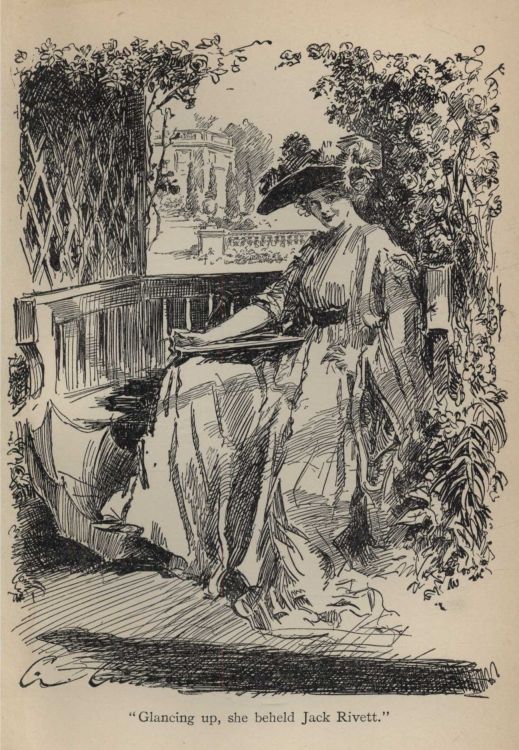
"Glancing up, she beheld Jack Rivett."
"I'm writing," she said, annoyed.
"I'll sit down on the sundial," he rejoined with a bow and a smile as though accepting a delightful invitation.
"But I'll be writing about two hours," she observed coldly.
"Writing about two hours?" he repeated. "But why write about hours at all, dear lady. An hour is an arbitrary division of time, interesting only to the unhappy."
"Very witty," she said. "Go and scratch it on the sundial."
And she resumed her letter, trying not to be aware of the blond young man seated just outside the summer house, where the sun gilded his hair and the wind mussed it into a most becoming mop.
Several times she bit the pearl tip of her penholder, frowning; but he always seemed to catch her eye at such moments, and her deepening frown only produced on his face an expression which was so very humble that it became almost mischievous.
"Jack!"
He hurriedly rose, and looked all around him among the roses as though eagerly searching for the person who had called him.
"Jack!" she repeated emphatically.
He pretended to discover her for the first time, and hurried joyously to the lattice door.
"Jack—you perfect idiot! I want to write, and I simply can't, with you sitting around in that martyred manner."
"How far away shall I retire?" he inquired, so sad and crestfallen, that between amusement and annoyance she did not reply, but merely sat tapping with her pen and inspecting her letter.
As she did not speak again, very cautiously—and holding up one hand as an unwelcome dog holds up one beseeching paw to ward off calamity—he ventured to seat himself on a bench outside the summer house.
She was perfectly aware of the inimitable pantomime, and a violent desire to laugh seized her, but she only bit her lip and resolutely dipped her pen into the ink once more.
She wrote obstinately, knowing all the while that she'd have to rewrite it. His excessive stillness began to get on her nerves; and, after a quarter of an hour's preternatural silence, she could endure it no longer.
"Jack!"
"Dear lady?" he replied patiently.
"Why don't you say something?"
"I was forbidden the exquisite consolation of noise."
"It's horribly hot and still out here. Why don't the birds sing?"
"They're moulting, dear lady. All their little pin feathers have become unfastened, and their bills are probably full of pins while they make themselves tidy again."
"So that is why they don't sing in July?" she said.
"That is why," he explained seriously.
"Well, then, why don't you sing? You are not untidy."
"Nothing could suit my pensive and melancholy mood better," he said sadly.
A moment later, sitting outside her door, he began with deep emotion to sing one of Kirk's melting melodies:
"With head bowed low a dentist stood
Before his office chair;
A handsome lady customer
Into his eyes did stare.
He tried to fake a careless smile
And hide his drooping jaw,
But all in vain because his guilt
Was plainly to be saw.
His voice was choked with shame and fear,
He said, 'Forgive me, miss!'
But when he begged her pardon there
The lady then did hiss:
Chorus.
"'Take back them teeth you made me! I
Won't wear them in my face!
Go hang them in your parlor as
A badge of your disgrace.
You swore them crowns was solid gold!
You're false—like teeth and men!
Take back them teeth, you lobster!
Never speak to me again!
Take back—take ba-ack—take ba-a-a——'"
"Jack!" she exclaimed, "that is the most—most degraded thing I ever heard you utter!"
"I'm accustoming you, by degrees, to my repertoire. With infinite precautions you will, in time, be able to endure much worse than this," he explained kindly. "Now, what shall we try next, dear lady? I have a little song called: 'Only a pint of shoe strings!'"
"Don't you dare attempt it! ... Jack, please go away. Won't you, when I ask it?"
"She mutters the unthinkable," he said, shaking his head. "My music has unseated her reason. By and by she will begin to moan and revive."
"It's perfectly outrageous," she said, tearing up what she had written, and moving aside a little so that sufficient space remained for—her sister, perhaps. So he entered the summer house and waited for an invitation, bland, cheerful, irresistible.
"I had no idea I was so pitiably weak-minded," she said.
He accepted the avowal as his invitation, and seated himself.
"Silvette," he said genially, "what are we going to do to-day?"
"Who?"
"Why, you and I. Who cares what the others do in this mad world, dear lady?"
"I don't know about the world," she said, "but there's one girl in it who is mad; and she's going to her room to write letters."
"When?"
"Now!"
"Don't."
"Indeed, I shall!"
"Shall, or will?" he inquired, guilelessly, "People mix up those two auxiliaries so persistently that there's no telling what anybody really means in these days."
She considered a moment, then turned and looked at him.
"Jack," she said sweetly, "don't follow me about?"
"I? Follow you! That's more madness, dear lady. Who on earth ever whispered to you that I could ever do such a——"
"Won't you be serious, please?"
Her pretty, dark eyes were serious enough, even appealing. He became solemn at once.
"You have forced me to say this," she ventured. "I didn't wish to; I thought you'd understand, but you don't seem to. So I am compelled to say to you that—it is—better taste for you to—not to——"
She hesitated, glanced up at him, colored brightly.
"You know perfectly well what I mean! And there you sit, letting me try to tell you as nicely as I can——"
"About what, dear lady?"
"About you and me!" she said, incensed. "You know perfectly well that I've been obliged to avoid being alone with you."
"Why?"
"Because," she said, intensely annoyed, "I am employed by your parents, and you are an only son of Mr. Jacob Rivett.... Is that unmistakable?"
He said nothing.
She went on: "You know I like you, Jack. You seem to like me. If you do, you'll understand that this—this continually seeking me out, separating me from the others, isn't fair to me.... I'm trying not to talk nonsense about it. I know you mean nothing but kindness; but it isn't wise, and it is not agreeable, either. So let us enjoy our very delightful friendship as freely among others as we do when alone together—" She stopped abruptly, blushed to her hair, furious at herself, astonished that her tongue could have blundered so. The next instant she understood that he was too decent to notice her blunder. Indeed, to look at him, she almost persuaded herself that he had not even heard her speak, so coolly remote were his eyes, so preoccupied his air as he sat facing the far hills, blue in the July haze.