Volume 16 — [288] CHAPTER V [XII]
Reading edition
[288] CHAPTER V [XII]
Kaskaia Hunting Party—Indian Encampment—Unfriendly Behaviour of the Kaskaias—Some Account of their Persons and Manners—Salt Plains—Cumancias.
Wednesday 9th. We breakfasted on the last of the horse, which, having been killed on the 5th, and the weather since unusually warm, had suffered from long keeping. We ate it cheerfully, only regretting that we could not promise ourselves as good for dinner. All our party, who are marksmen, were kept constantly out in search of game, but for several days had met with no success in hunting.
In the morning our course was east, thirteen and a-half miles, at the end of which we found a large spring of transparent and almost pure water, where we halted to dine. Our sufferings from want of provisions, and from the apprehension of still more distressing extremities, were now so great, that we gave little attention to any thing except hunting. Unfortunately for us the wind had been high during the morning, and had blown from west to east, nearly in the direction of our route, so that whatever animals might have been in the way, had received early intimation of our approach. We were glad to observe considerable numbers of wolves, jackals, and carrion birds, as they afforded an almost certain indication of the proximity of herds of bisons. The recent tracks of a herd of these animals had been discovered, from which we learned that they had crossed the river within a day or two, in a crowded and hurried manner, as if pursued by hunters. In the afternoon we pursued on nearly the [289] same course, and halted for the night at a late hour, much exhausted with fatigue, hunger, and the heat of the day, the mercury at noon having stood at 96°. Distance twenty-eight miles.
At about 10 o'clock on the morning following, the hunters who had preceded the party, discovered on the opposite side of the river a solitary bison, of which they went immediately in pursuit. The party had made their breakfast of about two ounces of sugar and some grapes which had been found near the camp, and having been for several days reduced to a scanty allowance of provisions, they encamped immediately, and awaited with great anxiety the return of the hunters, who soon joined us, bringing in the greater part of the carcass of the bison, so extremely lean and ill-flavoured, that nothing but the most urgent necessity could have induced us to taste it. It was indeed sufficiently evident that the animal was diseased, and had lingered behind the herd for want of strength to travel. Our situation, however, afforded us not the power of choosing, and from the occurrence of this one, we were induced to hope we should soon meet with others in better condition.
We had passed on the preceding day for the first time, a small creek discharging some water into the river, and shortly afterwards the sandy bed of another, sixty yards in width, with an extensive valley, but having no water visible above the sand. This morning we also crossed a tributary affording a little water, and a dry channel communicating opposite to our encampment with the bed of the river, which is filled with small stones, occasioning an inconsiderable fall. Throughout the day the weather was extremely warm, and at sunrise on the following morning, the mercury was standing at 71°.
We had not proceeded far on our way when we discovered on the opposite side of the river a large party of Indians, approaching in an irregular and interrupted line which extended more than a mile from [290] the opposite bank. They had, as was evident, already discovered us, and their outriders were seen plunging into the river at various points, and several soon came up to shake hands with us. The foremost scarcely allowed themselves time to finish this hasty ceremony of salutation, when they rode to reconnoitre some points of bushes and patches of low grape vines on our left, manifestly to ascertain if the whole strength of our party was collected. The main body of the Indians crossed the river more slowly, and as we halted on an elevation near the point where they ascended the bank, the whole passed in review before us. They were all on horseback, and the squaws and children, composing by far the greatest part of the cavalcade, passed us without halting. Every squaw appeared to have under her care a greater or less number of horses, which were driven before her, some dragging lodge-poles, some loaded with packs of meat, and some carrying children. We were surprised to observe many small children too young to be able by their own strength to sit upon a horse, lashed by their legs to the saddle, and riding on in entire unconcern. As they passed the deepest part of the river, many of the squaws stooped to fill their vessels with water. These were of the most primitive kind, being formed, almost without exception, of the stomach or bladder of a bison or other animal.
At length the chief, who was one of the last to cross the river, came up, and shaking each of us by the hand, with some appearance of cordiality, invited us to accompany him a short distance on his route, to a place where his party would encamp for the remainder of the day and the ensuing night. The chief was accompanied by an old man who could speak a little Spanish, by which language we communicated with him. He informed us his band were a part of the tribe of Kaskaias, or Bad-hearts, as they are called by the French; that they had been on a [291] hunting excursion to the sources of the Rio Brases and the Rio Colorado of Texas,57 and were now on their way to meet the Spanish traders at a point near the sources of the river we were descending. They in their turn demanded who we were, whence and whither we were travelling, and were apparently satisfied with our answers, though, as afterwards appeared, they did not entirely credit what we had told them of the purposes of our journey.
To our inquiries concerning the river they answered without hesitation, that it was Red river; that at the distance of ten days' travelling in the manner of Indians with their lodges, (about one hundred miles,) we should meet with the permanent village of the Pawnee Piquas, that a large band of Cumancias were hunting on the river below, whom we should fall in with in two or three days. Having described to them the route we had pursued, and the great and frequented road on which we had travelled, they said, that when we were at the point where that road first crosses the river, we were three days' ride from Santa Fé, which was situated behind a low and distant range of hills, which we remembered to have seen from that place.58
We hesitated a little to comply with the request of the chief, enforced as it was with some insolence, that we would return and encamp with his party. As, however, we wished to purchase horses and provisions, and to make the best use of an opportunity to become acquainted with the savages, we at length consented. The ground they chose for their encampment was a beautiful open plain, having the river in front, and a small creek on the left. We were somewhat surprised to witness the sudden manner in which this plain became covered with their tall conic lodges, rising "like an exhalation" in perfect silence and good order.
For our accommodation, a lodge was spread, enclosing as much space as possible in a semicircular [292] area in such a manner that the skin covering afforded a shade, which was all the shelter needed. In order to enlarge this tent as much as possible, the covering was raised so high upon the poles, that its lower margin did not extend to the ground by a space of several feet. To remedy this the squaws brought bushes from a neighbouring thicket, which they placed around the base of the lodge in such a manner as effectually to exclude the sunshine. We were sorry to find afterwards, that this had been done not more from motives of hospitality, than to aid them in their design of pilfering from our baggage.
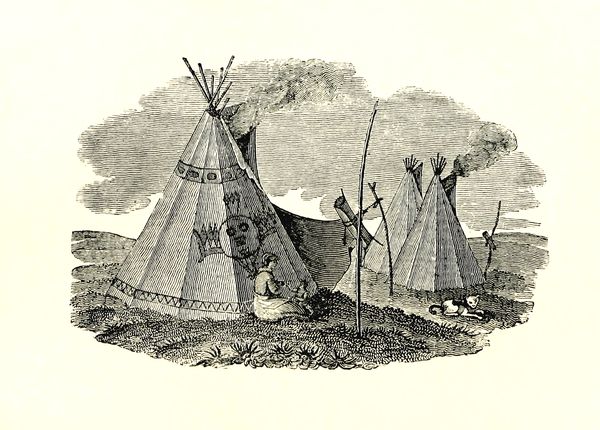
These skin lodges, the only habitations of the wandering savages, are carried with them complete in all their marches. Those of the Kaskaias differ in no respect from those we have already described, as used by the Otoes and others of the Missouri Indians. The poles which are six or eight to each lodge, are from twenty to thirty feet in length, and are [293] dragged constantly about in all their movements, so that the trace of a party with lodges is easily distinguished from that of a war-party. When they halt to encamp, the women immediately set up these poles; four of them being tied together by the smaller ends, the larger resting on the ground, are placed so far apart as to include as much space as the covering will surround. The remaining poles are added to strengthen the work, and give it a circular form.
The covering is then made fast by one corner to the end of the last pole which is to be raised, by which means it is spread upon the frame with little difficulty. The structure, when completed, is in the form of a sharp cone. At the summit is a small opening for window, chimney, &c. out of which the lodge-poles project some distance, crossing each other at the point where the four shortest are tied together. This tent seems to be sufficient to protect its occupants from the rain; it must however be greatly inferior in point of comfort, particularly in the winter season, to the spacious mud cabins of the settled Indians.
The poles necessary for the construction of these movable dwellings, are not to be found in any part of the country of the Kaskaias, but are purchased from the Indians of the Missouri, or others inhabiting countries more plentifully supplied with timber. We were informed by Bijeau, that five of these poles are, among the Bad-hearts, equal in value to a horse.
The chief of this band is called the Red Mouse. He is of a large stature, is somewhat past the middle age of life, and no way deficient, in his person and countenance, of those indications of strength, cunning, and ferocity, which form so important a part of greatness in the estimation of the Indians. Immediately after he had dismounted from his horse, on the halting of his party, a small wooden dish was brought [294] him, containing some water. He had received a wound some time before, apparently from an arrow, which had passed through the arm, glancing upon the humerus. Placing the dish on the ground before him, he dipped his hand repeatedly in the water, then seizing a small image of an alligator, profusely ornamented with white and blue beads, he pressed it for some time with all the strength of his disabled arm. This we saw him repeat a great number of times. The alligator appeared to be the "great medicine," on which he relied for the cure of his wound. No dressing or application of any kind was made immediately to the affected part.
As soon as we had placed our baggage in the tent provided for us, we commenced negotiations with Red Mouse, for the purchase of horses. When the articles we proposed to barter were exhibited, he appeared dissatisfied, supposing probably we had still others in reserve, which he would be able by a little obstinacy to extort from us. He accordingly insisted that more of the packs should be opened, and undertook at last to extend his inquiries to our private baggage. This we found it necessary to resist, and a little scuffle ensued, at which many of the Indians, with a throng of women and children who surrounded us, took fright and ran off with the utmost despatch. They appeared all somewhat surprised and intimidated, and the few who remained in our lodge entreated us not to be angry at the insolence they had shown, saying we should frighten their women, and that they had mistaken us for traders. We had good reasons for wishing not to carry our resentment farther than was necessary, and accordingly relinquished the attempt to trade with them; informing them at the same time that we were hungry. Having received us in a friendly manner, we expected they would, according to custom of most Indians, have shown their good-will, by inviting us to a feast. We had, [295] therefore, waited with some impatience for their good cheer so long, that hope began to fail us. It will be recollected, we had for some days been almost in a starving condition; and we perceived that the Indians had very plentiful supplies of jerked meat. In compliance with our repeated requests, the wife of the Red Mouse at length brought us a little half-boiled bison meat, from which we had observed her to select the best pieces and give them to the children. After we had eaten this, we returned the wooden dish, on which it had been brought, at the same time asking her for more. This second demand procured us a little more jerked meat, which came, however, with such an ill grace, that as our hunger was somewhat appeased, we resolved to ask them for no more.
Some one of the party having asked for water, the paunch of a bison was brought, containing three or four quarts, from which we all managed, though with some difficulty, to drink. Little care or labour had been bestowed on the preparation of this primitive vessel. The papillous coat which formed the internal surface of the stomach of the animal, had not been removed, nor had it lost, from long use, its original smell. The organ is suffered to retain its original form as far as is consistent with the uses to which it is applied. One of the orifices is brought nearly in contact with the other, where it is retained by a stick passed through the margin; the depending part is a sack sometimes large enough to contain six or eight gallons of water. It may well be supposed practice is required to enable a person to drink with ease and adroitness from one of these vessels; and the Indians appeared somewhat amused at our awkward attempts, in which we spilt more water in our bosoms, than was conveyed into our mouths.
When filled, these sacks cannot be set upon the ground without suffering the loss of their contents. To remedy this, the Kaskaias carry with them, as an [296] indispensable article of furniture, a sort of tripod, consisting of three light poles, tied together at one end, and sharpened at the other, by which they are driven into the ground, and the water-sack is suspended between them. One of these was placed near the entrance of almost every lodge in this encampment.
We had scarcely finished our scanty repast, when the wife of the Red Mouse showing her trencher, to signify that we were her debtors, began to beset us for presents; as we were, however, little pleased with her hospitality, we treated her demands much as she had done ours. A number of small articles were pilfered from us, and the Indians seemed determined to show us little respect, until they perceived we were putting our guns in order for immediate use; at this they expressed some apprehension, and behaved afterwards with less rudeness.
There were thirty-two lodges, and probably about two hundred and fifty souls, including men, women, and children. Among them we could number only twenty-two armed men; and these kept constantly about us. They were armed exclusively with bows and arrows, and, as we believed, had some fear of us, though we were less than half their number. It was probably owing to our perceiving, or at least appearing to perceive this, that we escaped from them uninjured. They had many horses, probably more than five hundred, and some of them very good.
Towards evening the chief withdrew from our lodge, when we observed his squaw prepare some food for him, pounding the jerked meat to a powder with a stone pestle, using a piece of skin instead of a mortar. When reduced to very fine fragments, it is mixed with bison tallow; a little water is added, and the whole boiled together. After he had finished his meal, a council was held between all the men of the band. They met behind the chief's lodge, and we were not greatly pleased to perceive, that they [297] seemed anxious to conceal their meeting from us. At night we determined to collect all our horses, and, placing them as near as we could around our lodge, to watch them during the night; but, upon examination, a few of them only could be found, the remainder, as we believed, having been seized by the Indians. The crowd which had been assembled about us during the day, dispersed as the evening advanced, and at dark all became still in and about the encampment. At this time the chief, whose lodge was near ours, standing at the entrance of his dwelling, harangued with great vehemence, in a voice sufficiently loud and clear to be heard by all his people, who had now retired to their several lodges. As we had no interpreter of their language, we could understand nothing of the import of his speech. Every thing remained quiet during the night, and as soon as the day dawned on the following morning, a loud harangue, similar to that in the evening, was pronounced by the chief, and immediately afterwards the whole camp was in motion. The lodges were taken down, the packs placed upon the horses, and the whole body were in a short time ready to move off. As several of our horses, our kettles, and other articles of the greatest importance to us were missing, we were unwilling to part from our hosts in the hasty and unceremonious manner they seemed to intend. We accordingly summoned the old Indian interpreter, and made our complaint and remonstrance to the chief. He told us our horses had strayed from camp, and that several of his people were then out searching for them, and made other excuses, evidently designed to gain time until his band could move off. Perceiving we had no time to lose, Major Long ordered horses and other articles, corresponding to those we had lost, to be immediately seized. This prompt and well-timed measure produced the desired effect. Their whole camp had been some time in motion; the women [298] and children, with all their baggage, except what we had detained, had moved to a considerable distance; and we found ourselves, at this unpleasant state of the dispute, surrounded by their whole armed force. We observed they had a greater number of arrows in their hands than on the preceding day, and were not without our fears, that they intended to carry the dispute respecting our horses and kettles to greater lengths than we could wish. We were, however, agreeably disappointed, to learn that all our lost property had been found. It was accordingly restored to us, and we parted from the Kaskaias as friends.
The time we spent with this band of savages was so short as to afford little opportunity of becoming acquainted with their manners. Their dress is nearly similar to that of the Pawnees, but consists more exclusively of leather. The women, instead of the robe, wear a loose sort of a frock without sleeves. It has an opening for the neck, just large enough to admit the head, and descends from the shoulders, hanging like a bag about the body, and reaching below the knees. When eagerly engaged in their employments, this inconvenient article of dress is thrown aside, and there remains the squabbish person of the female savage, disfigured only by a small apron of leather worn round the waist. The young females appear to be in some measure exempted from the laborious services performed by the married women, and consequently possess a degree of lightness and elasticity in their persons, which they soon lose after they begin to bear children, and subject themselves to the severe drudgeries of a married life. Their breasts become so flaccid and pendulous, that we have seen them give suck to their children, the mother and the child at the same time standing erect upon the ground. This fact is sufficient to prove that they do not, at least in some instances, wean their children at a very early age.
[299] Like all savages, they suffer themselves to be covered with filth and vermin, notwithstanding which some of the young ones are far from disgusting in their appearance. They have well turned features, aquiline noses, large and regular teeth, and eyes, which though usually rather small, are clear and brilliant. Some of the men of this band have larger and finer teeth than we remember to have seen heretofore among savages. In the general structure of their features, and the complexion of their skins, they resemble the Missouri tribes, being of a clearer and brighter red than many of the eastern Indians. In stature and in symmetry, and elegance of form, they are inferior to the Otoes, Pawnees, and to most of the Missouri Indians who reside in permanent villages. They seemed to have had little intercourse with the whites, as some among them appeared to take great pleasure in exhibiting to their friends the skin of our arms, which they requested us to show for that purpose. It was probably by means of a mistake on the part of one of the interpreters, that we received the intimation that they had never heard before of such a people as that to which we belonged. We saw among them few articles of foreign production; these they had probably received from Spanish traders. In the whole encampment we saw but one kettle, which belonged to the chief, and their great eagerness to steal our tin cups and other similar articles, sufficiently evinced that such things are scarce, and of great value among them. They have some beads, most of which are bestowed in ornamenting the dress of the children; also some pewter and brass rings, worn principally by the women. They are acquainted with the use of tobacco, and smoked with us according to the universal custom of the Indians, but expressed by signs that they found the smoke of unmixed tobacco too strong for them. One of their young men, who was in his ordinary dress when we met the party, visited us soon after we had encamped, [300] dressed in leggings and breech cloth, with a striped worsted vest and a silver-headed bamboo, which he sported among us with the air of a great traveller.
A child was shown us who spoke Spanish, and who was said to be a prisoner from the Spanish settlements; he was not, however, distinguished from the Kaskaias by any difference of colour or of features. He spoke frequently of the Christians, which convinced us that he had at least been among the half civilized Indians of New Mexico, who have some acquaintance with the Spanish language, and have been taught enough of the Christian religion to make use of the sign of the cross.
This band of Kaskaias occupy the country about the sources of the Platte, Arkansa, and Rio Del Norte, and extend their hunting excursions to Red river and the sources of the Brases. The great numbers of images of the alligator, which they wear either as ornaments or as amulets for the cure or prevention of disease and misfortune, afford sufficient proof of their extending their rambles to districts inhabited by that reptile. These images are of carved wood covered with leather, and profusely ornamented with beads. They are suspended about the neck, and we saw several worn in this manner by the children as well as by adults. It was observed likewise, that the rude frames to the looking-glasses, carried by several of the men, were carved so as to approximate towards the same form.
It is perhaps owing to their frequent exposure to the stormy and variable atmosphere of the country about the Rocky Mountains, that these Indians are subjected to numerous attacks of rheumatic and scrofulous diseases. We saw one old woman with a distorted spine, who had probably suffered, when young, from rickets. A young man, of a fine athletic frame, had his neck covered with scrofulous ulcers. While he was with us he was constantly endeavouring to conceal with his robe this afflicting spectacle. He [301] remained but a short time among us, and did not make his second appearance.
An old man came frequently with a diseased leg, informing us by signs, that it had repeatedly formed large abscesses, which had discharged much matter, and afterwards healed. His frequent applications seemed to be made with the hope that we would do something for his relief. The men of this band wear the hair long, and suffer it to hang negligently about the shoulders. Some of them have a braid behind, which is garnished with bits of red cloth, small pieces of tin, &c. and descends nearly to the ground, being sometimes eked out with the hair of a horse's tail. Among the old men were several who had suffered a number of scattering hairs on the face to become of considerable length, a violation of good manners, and a neglect of personal neatness, not often met with among the Indians, and excusable only in the old. In their conduct towards us, they were guilty of more rudeness and incivility than we had been accustomed to meet with among the savages of the Missouri. Soon after we had encamped with them, one of our party who had brought along a roasted rib of a bison which had remained of our breakfast, had produced this bone, and was engaged in eating from it; an Indian who observed this came up, and without ceremony taking the rib out of his hand, carefully scraped off and ate all the meat, and returned the bone.
Though we saw much to admire among this people, we cannot but think they are among some of the most degraded and miserable of the uncivilized Indians on this side of the Rocky Mountains. Their wandering and precarious manner of life, as well as the inhospitable character of the country they inhabit, precludes the possibility of advancement from the profoundest barbarism. As is common among other of the western tribes, they were persevering in offering us their women, but this appeared to be [302] done from mere beastliness and the hope of reward, rather than from any motive of hospitality or a desire to show us respect. We saw among them no article of food except the flesh of the bison; their horses, their arms, lodges, and dogs, are their only wealth.
In their marches they are all on horseback; the men are expert horsemen, and evince great dexterity in throwing the rope, taking in this way many of the wild horses which inhabit some parts of their country. They hunt the bison on horseback with the bow and arrow, being little acquainted with fire arms. One of them who had received a valuable pistol from a member of our party, soon afterwards returned, and wished to barter it for a knife. They begged for tobacco, but did not inquire for whiskey; it is probable they have not yet acquired a relish for intoxicating liquors. In their persons they are all uncommonly filthy, and many of the women spent a great part of their time in catching and eating the lice from the heads of their children.
At eight o'clock on the morning of the 12th of August we took our leave of the Kaskaias, having recovered from them all the articles they had stolen, except a few ropes, halters, and other small affairs, which not being indispensably necessary to us, we chose to relinquish, rather than submit to a longer delay among a people we had so much reason to dislike.
They had shown a disposition so far from friendly towards us, that we were surprised to have escaped without having found it necessary to use our rifles among them; and as we thought it by no means improbable some of their young men might follow us to steal our horses, we moved on rather briskly, intending to travel as far in the course of the day as we conveniently could.
The river valley spread considerably a little below the point where we had encamped. In many places we found the surface a smooth and naked bed of [303] sand; in others, covered by an incrustation of salt, like a thin ice, and manifestly derived from the evaporation of water which had flowed down from the red sandstone hills bounding the valley. These hills were here of moderate elevation, the side towards the river being usually abrupt and naked. The sandstone is fine, of a deep red colour, indistinctly stratified and traversed in various directions by veins filled principally with sulphate of lime.
We had seen among the Indians on the preceding day quantities of salt in large but detached crystalline fragments, greatly resembling the common coarse salt of commerce. It had evidently been collected from some place like the one above mentioned, where it had been deposited from solution in water. When we inquired the particular locality of the Indians, they pointed to the south, and said it was found near the sources of a river heading in that direction.
At the place of our evening encampment, we saw the red-necked avoset (recurvirostra americana), the minute tern (sterna minuta), and several other strand birds which we could not approach near enough to distinguish the species. There is also a very evident similarity between the plants found here and many of those growing in saline soils along the sea coast. We saw here several species of atriplex, chenopodium, salsola, kochia, and anabasis, all delighting in a saline soil, and affording on analysis a greater proportion of soda than most inland plants.
The day had been unusually warm. During all our mid-day halt, protracted, on account of the sultriness of the weather, to an unusual length, the mercury had remained at 100°, the thermometer being suspended in the closest shade we could find. It is to be remarked, however, that in almost every one of the numerous instances when the mercurial column had indicated so high a temperature as in [304] the one just mentioned, a fair exposure could not be had.
We often found it necessary to halt upon the open plain, where the intensity of light and heat were much increased by the reflection of the sun's rays from the sand. The temperature indicated by the thermometer, suspended in the imperfect shade of our tent, or of a small tree, was however somewhat lower than that to which our bodies were exposed; and it will be believed our sufferings from this source were great, both on our marches and while encamped in the middle of the day. Our tent being too small to afford its imperfect shade to the whole party, we sometimes suspended blankets, using, instead of poles, our rifles and gunstocks, but the protection these could afford against the scorching glare of a vertical sun, was found extremely inadequate.
At sunset we crossed what appears to be at some seasons of the year the bed of a large river at least two hundred yards wide, but at this time not a drop of water was found in it. It has a wide valley, and in every respect but the occasional want of water, is a large stream. A little beyond this we encamped for the night, having travelled twenty-eight miles.
August 13th. The course of the river had now become considerably serpentine, so that our route along its valley was of necessity somewhat circuitous. Wishing to avoid the unnecessary travelling thus occasioned, we turned off from the river and ascended the hills, hoping to meet with an Indian trace leading across the country by the most direct route. Our search was however unavailing, only affording us an opportunity of examining a portion of the country remote from the river. This we found much broken with irregular hills, abrupt ravines, and deep valleys. At ten o'clock we met with a small stream of water running towards the river we had left, and crossing it, perceived the trace of a large party of mounted Indians which had ascended [305] the creek within a few hours previous. We supposed they must have been the band of Cumancias spoken of by the Bad-hearts; and, notwithstanding some fears we have had reason to entertain, that they would have treated us no better than the Kaskaias had done, we considered ourselves unfortunate in not having met them. Much confusion and uncertainty attends the limited information hitherto before the public concerning the wandering bands of savages who occupy the country between the frontiers of New Mexico and the United States. Some who have spoken of these Indians, seem to have included several of the erratic hordes already enumerated under the name of Hietans or Cumancias. From their wandering mode of life, it unavoidably happens that the same band is met by hunters and travellers in different parts of the country at different times, consequently they receive different appellations, and the estimate of their numbers becomes much exaggerated. Of this band we have no other information to communicate, than that they appeared, from the tracks of their horses and lodge-poles, to have been rather more numerous than the party of Bad-hearts we had lately met. A recent grave was discovered by one of our hunters at no great distance from the river, in which it was supposed one of this band had been buried. At one end of the grave was erected a pole about ten feet in length, crossed near the top by another two feet long. To the foot of this rude cross was tied a pair of mockasins, newly soled and carefully prepared for the use of the departed in that long journey on the road of the dead to which the good wishes of some friend had accompanied him.
Where we halted at noon were some trees, and several of these were covered with grape vines, loaded with ripe and delicious fruit. The Osage plum was also common, and now beginning to ripen. The temperature of the air inside of our tent, partially shaded by some small trees, was sufficiently [306] high to keep the mercury at 105° Fah. from twelve o'clock to three P. M. A suffocating stillness prevailed in the air, and we could find no relief from the painful glare of light and the intense heat which seemed about to reduce the scanty vegetation to ashes.
In the afternoon a thick grove of timber was descried at a distance below, and on the opposite side of the river. This cheering sight was like the discovery of land to the mariner, reminding us of the comparative comfort and plenty which we had learned to consider inseparable from a forest country, and exciting in us the hope that we should soon exchange our desolate and scorching sands for a more hospitable and more favoured region. As this little grove of trees, appearing to us like the commencement of an immense forest, gave us reason to expect we should soon meet with some small game at least; Mr. Peale, with one man, went forward to hunt. Soon after arriving at the wood, they discovered a flock of turkeys, and the rifleman dismounting to shoot, left his mule for a moment at liberty. The animal, taking a sudden advantage of the opportunity, turned about, and made the best of his way out of the wood, pursued by Mr. Peale. This chase continued about five miles, and ended in putting the mule on the recent trace of the party, which there was no reason to fear he could be induced to quit, until he had rejoined his companions. Mr. P., who was exhausted with the pursuit, followed on but slowly, and neglecting to follow carefully the path of the party, he passed us, after we had turned aside to encamp, still travelling on in the direction of our course. At dark, believing we were still before him, and knowing we must encamp near the river, he betook himself to the sand-bars, which were now naked, occupying the greater part of what was sometimes the bed of the stream. Along these he travelled, occasionally discharging a pistol, and looking [307] about in constant expectation of seeing the blaze of our evening fire, until the moon began to sink behind the hills, when finding the light insufficient to enable him to continue his search, he tied his horse to a tree, and laid down to await the return of daylight.
At camp, guns were discharged, as large a fire kindled as we could find the means of making, and other measures taken to give notice of our situation; and late in the evening, the man whose mule had been the occasion of the accident, joined us, but was unable to give any account of Mr. Peale or the mule, which had, however, arrived before him.
At seven o'clock on the morning following, Aug. 14th, Mr. P. returned to us, having convinced himself, by a careful examination of the river valley, that we were still above. He accordingly retraced his course, until he discovered the smoke of our encampment. He had been much harassed in the night by mosquitos; and bisons having recently occupied the shade of the tree under which he slept, the place afforded as little refreshment for the horse as for himself. Delaying a little to allow him time to make amends for his long absence, we left our camp at a later hour than usual; and moving along a wide and somewhat grassy plain, halted to dine near an old Indian breast-work by the side of a grove of cotton-wood trees, intermixed with a few small-leaved elms. This breast-work is built like that described on the Platte, a few days' march above the Pawnees. We have met with the remains of similar works in almost every grove of trees, about the base of the mountains; near some of them, we have noticed holes dug a few feet into the ground, probably as caches or depositories of provisions; the earth which was raised having been removed to a distance, or thrown into the river, that it might not lead to the discovery of the concealed articles. We have met with large excavations of this kind, having an entrance comparatively small, and so placed as to be [308] easily concealed; made by white hunters to hold their furs, and whatever else they might wish to deposit in safe keeping.
The occurrence of the elm, the phytolacca, the cephalanthus, and other plants not to be met with in a desert of sand, give us the pleasing assurance of a change we have long been expecting to see in the aspect of the country. The blue jay, the purple martin, a deer, and some turkeys, were also seen near this encampment.
The bed of the river is here eight hundred yards wide, but the quantity of water visible is much less than in some places above. The magnetic variation ascertained at this camp was 12° 30′ east.