Volume 16 — [39] CHAPTER IX [III]
Reading edition
[39] CHAPTER IX [III]
The Party Proceed upon their Route—Thunder-storm—Some Account of the Kiawa, Kaskaia, Arrapaho, and Shienne Indians—New Species of Toad.
Monday, 24th. After the departure of so great a portion of our numbers, combined with whom we could hardly be regarded as sufficiently powerful to contend successfully with a force which we were daily liable to encounter, we were well aware of the necessity of exerting an increased vigilance, and of relying still more implicitly upon our individual means of defence, than we had hitherto done. Our small band now consisted of Captain Bell, Lieut. Swift, Mr. Seymour, Mr. Say, and the interpreters Bijeau, Ledoux, and Julien, with five soldiers.
We were cheered by the reflection, that we had successfully performed a very considerable and most important part of our expedition, harmonizing well [40] with each other, and unassailed by any urgent visible dangers, such as had been anticipated by ourselves, and predicted by others. We could not however look forward to the trackless desert which still separated us from the utmost boundary of civilisation, and which we had no reason to believe was less than a thousand miles in breadth, traversed in many portions of its extent by lawless war-parties of various nations of Indians, without an emotion of anxiety and of doubt as to the successful termination of our enterprize.
We were this afternoon assailed by a very severe thunder-storm, and Julien, who had skirted the timber for the purpose of hunting, was electrified by a flash of lightning, which entered the earth within a few yards of him. The wind was violent, and blew the drops of rain with so much force into our faces, that our horses refused to proceed, constantly endeavouring to turn themselves about from the storm; we at length yielded to their obstinacy, and halted upon the plain. The storm did not abate until we were thoroughly drenched to the skin, when, after being delayed some additional space of time, until a straggler had joined us, we continued our journey.
Wednesday, 26th. Late in the afternoon we saw, at a great distance before us, evident indications of the proximity of Indians, consisting of conic elevations, or skin lodges, on the edge of the skirting timber, partially concealed by the foliage of the trees. On our nearer approach we observed their horses grazing peacefully, but becoming suddenly frightened, probably by our scent, they all bounded off towards the camp, which was now full in view. Our attention was called off from the horses by the appearance of their masters, who were now seen running towards us with all their swiftness. A minute afterwards we were surrounded by them, and were happy [41] to observe in their features and gestures a manifestation of the most pacific disposition; they shook us by the hand, assured us by signs that they rejoiced to see us, and invited us to partake of their hospitality. We however replied, that we had brought our own lodges with us, and would encamp near them. We selected for this purpose a clear spot of ground on the bank of the river, intending to remain a day or two with this little known people, to observe their manners and way of life. We had scarcely pitched our tents, watered and staked our horses, before presents of jerked bison meat were brought to us by the squaws, consisting of selected pieces, the fattest and the best, in sufficient quantity for the consumption of two or three days. After the usual ceremony of smoking, they were informed to what nation we belonged, and that further communication would be made to their principal men to-morrow, whom we wished summoned for that purpose. About sun-down they all retired, and left us to our repose. The Indians were encamped on both sides of the river, but the great body of them was on the opposite bank, their skin lodges extending in a long single line; the extremities of which were concealed from our view by the timber of the islands in the river, whilst about ten lodges only were erected on the side we occupied, and within a quarter of a mile of our camp.
Soon after our arrival, an Indian well stricken in years inquired if we had seen a man and squaw within a day or two on our route: we described to him the appearance of the calf and his squaw. "That is my wife," said he, "who has eloped from me, and I will instantly go in pursuit of them." He accordingly procured a companion, and both were soon on their way, well armed and mounted.
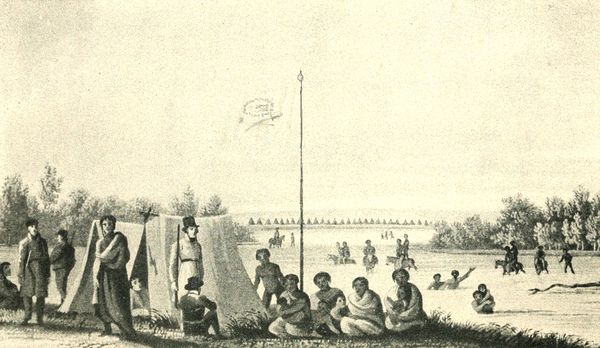
Kiawa Encampment
Thursday, 27th. Notice having been sent to the opposite party of our arrival, and of our wish to see [42] the principal men, four chiefs presented themselves at our camp this morning at an early hour, as representatives of the several bands, of the same number of different nations, here associated together, and consisting of Kiawas, Kaskaias or Bad-hearts, Shiennes (sometimes written Chayenne), and Arrapahoes. Several distinguished men accompanied them. We had made some little preparation for their reception, by spreading skins for them to sit on, hoisting our flag, and selecting a few presents from our scanty stores. They arranged themselves with due solemnity, and the pipe being passed around, many of them seemed to enjoy it as the greatest rarity, eyeing it as it passed from mouth to mouth, and inhaling its fragrant smoke into their lungs with a pleasure which they could not conceal. One individual of a tall emaciated frame, whose visage was furrowed with deep wrinkles, evidently rather the effect of disease than of age, after filling his lungs and mouth topfull of smoke, placed his hands firmly upon his face and inflated cheeks as in an ecstacy, and unwilling to part with what yielded the utmost pleasure, he retained his breath until suffocation compelled him to drive out the smoke and inhale fresh air, which he effected so suddenly and with so much earnestness, and singular contortion of countenance, that we restrained ourselves with some effort from committing the indecorum of a broad laugh. We had the good fortune to find one of them who could speak the Pawnee language tolerably well; he had acquired it in his early youth, whilst residing in a state of captivity in that nation; so that, by means of our interpreters, we experienced no difficulty in acquainting them, that we belonged to the numerous and powerful nation of Americans,96 that we had been sent by our great chief, who presides over all the country, to [43] examine that part of his territories, that he might become acquainted with its features, its produce and population; that we had been many moons on our journey, and had passed through many red nations, of whose hospitality we largely partook, &c. This was translated into French, then into Pawnee, and afterwards into Kiawa, and the other languages, by their respective interpreters. In reply, a chief expressed his surprise that we had travelled so far, and assured us that they were happy to see us, and hoped that as a road was now open to our nation, traders would be sent amongst them.
We assured them, that traders would be soon amongst them, provided we could report on our return that we had been hospitably treated while travelling through their country.
A few presents, such as knives, combs, vermilion, &c., were then laid before the chiefs, who, in return, presented us with three or four horses, which terminated the proceedings of the council. We afterwards understood that our guests thought we gave but little; and it is perhaps true, that the value of their presents was far greater than ours, yet our liberality was fully equal to our means.
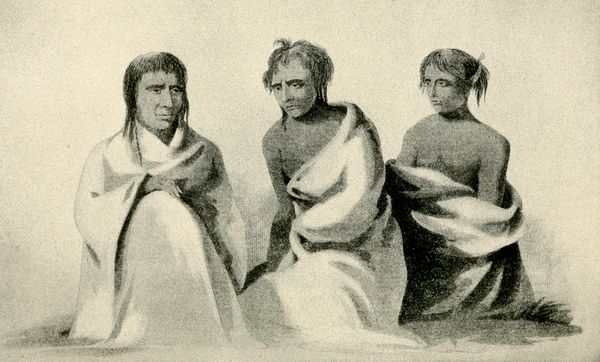
Kaskaia Shienne, Chief Awappaho
The whole population had now deserted their edifices and crowded about us, and, agreeably to our wishes, which were announced in the council, the women brought jerked meat, and the men skin and hair ropes for halters, to trade with us for trinkets; and we were enabled to obtain a sufficient quantity of each, at a very moderate price. The trading being completed, we expected the crowd to diminish, but it seemed rather to augment in magnitude and density, until, becoming a very serious inconvenience, we requested the chiefs to direct their people to retire, which they immediately complied with, but, with the exception of the Shienne chief, were not obeyed. All the Shiennes forthwith left us, in compliance with [44] the peremptory orders of their chief, who seemed to be a man born to command, and to be endowed with a spirit of unconquerable ferocity, and capable of inflicting exemplary punishment upon any one who should dare to disobey his orders. He was tall and graceful, with a highly-ridged aquiline nose, corrugated forehead, mouth with the corners drawn downward, and rather small, but remarkably piercing eye, which, when fixed upon your countenance, appeared strained in the intenseness of its gaze, and to seek rather for the movements of the soul within, than to ascertain the mere lineaments it contemplated. The other chiefs seemed to possess only the dignity of office, without the power of command; the result, probably, of a deficiency of that native energy with which their companion was so pre-eminently endowed. They scarcely dared to reiterate their admonitions to their followers, not to press so closely upon the white people, but to limit their approaches to the line of our baggage. Still our tents were filled, and our persons hemmed in by the ardent and insatiable curiosity of the multitude, of both sexes and of all ages, mounted and on foot. To an observer of mankind, the present scene was abundantly fruitful and interesting. We could not but remark the ease and air of security with which their equestrians preserved their equipoise on the naked backs of their horses, in their evolutions beyond the crowd; nor could we restrain a smile, in the midst of vexatious circumstances, at the appearance of the naked children, mounted on horses, sometimes to the number of three or four on each, carelessly standing erect, or kneeling upon their backs, to catch a glance, over the heads of the intervening multitude, at the singular deportment, costume, and appearance of the white strangers.
In the rear of our tent, a squaw, who had become possessed of a wooden small-toothed comb, was occupied [45] in removing from her head a population as numerous, as the individuals composing it were robust and well fed. She had placed a skin upon her lap to receive the victims as they fell; and a female companion who sat at her feet alternately craunched the oily vermin between her teeth, and conversed with the most rapid and pleasant loquacity, as she picked them up from the skin before her.
Our attention was now arrested by a phenomenon which soon relieved us from the crowd that pressed upon us. A heavy and extensive cloud of dust was observed in the north, obscuring the horizon, and bounding the range of vision in that direction. It moved rapidly towards us. An animated scene ensued; the Indians fording the river with as much rapidity of movement as they could exert, towards their encampment, horse and foot, the water foaming before them. It soon became obvious that the dust ascended into the atmosphere under the influence of a violent current of air; we therefore employed a few moments of interval in strengthening our feeble tenements to resist the influence of the approaching tempest. Within, they were now so nearly filled with our red brethren, that we wedged ourselves in with some difficulty amongst them. It soon became necessary to exert our strength in holding down our tents and supporting the poles, which bowed and shook violently under the pressure of the blast. Thunder, lightning, rain, and hail succeeded. During this play of the elements, our guests sat in stillness, scarcely articulating a word during the prevalence of the electrical explosions.
Our tents were much admired, and previously to the fall of rain (which exposed their imperfection, in admitting the water, modified into the form of a mist) one of the natives offered to exchange an excellent mule for that in which he was sitting; and as the commonalty could not distinguish us in their minds [46] from traders, another offered two mules (valued equal to four horses) for a double-barrelled gun; and a third would willingly have bartered a very good horse for an old and almost worn-out camp-kettle, which we could by no means part with, though much in want of horses.
These Indians differ, in many particulars, from those of the Missouri, with whose appearance we had been for some time familiar. Their average stature appeared to us less considerable; and although the general appearance of the countenance was such as we had been accustomed to see, yet their faces have, perhaps, somewhat more latitude, and the Roman nose is obviously less predominant; but still the direction of the eye, the prominence of the cheek bones, the form of the lips, teeth, chin, and retreating forehead, are precisely similar. They have also the same habit of plucking the hair from various parts of the body; but that of the head, in the females, is only suffered to attain to the shoulders, whilst the men permit theirs to grow to its full extent. They even regard long hair as an ornament, and many wear false hair fastened to their own by means of an earthy matter, resembling red clay, and depending in many instances (particularly the young beau) to their knees, in the form of queues, one on each side of the head, variously decorated with ribbon, like slips of red and blue cloth, or coloured skin. Others, and by no means an inconsiderable few, had collected their long hair into several flat masses, of the breadth of two or three fingers, and less than the fifth of an inch in thickness, each one separately annulated with red clay at regular intervals. The elders wore their hair without decoration, flowing loosely about their shoulders, or simply intermixed with slender plaited queues. In structure and colour it is not distinguished from that of the Missouri Indians, though, in early youth, it is often of a much lighter colour; and a young man, of [47] perhaps fifteen years of age, who visited us to-day, had hair decidedly of a flaxen hue, with a tint of dusky yellow.
Their costume is very simple, that of the female consisting of a leathern petticoat, reaching the calf of the leg, destitute of a seam, and often exposing a well-formed thigh, as the casualties of wind or position influence the artless foldings of the skirt. The leg and foot are often naked, but usually invested by gaiters and mockasins. A kind of sleeveless short gown, composed of a single piece of the same material, loosely clothes the body, hanging upon the shoulders, readily thrown off, without any sense of indelicacy, when suckling their children, or under the influence of a heated atmosphere, displaying loose and pendant mammæ. A few are covered by the more costly attire of coarse red or blue cloth, ornamented with a profusion of blue and white beads: the short gown of this dress has the addition of wide sleeves descending below the elbow; its body is of a square form, with a transverse slit in the upper edge for the head to pass through; around this aperture, and on the upper side of the sleeves, is a continuous stripe, the breadth of the hand, of blue and white beads, tastefully arranged in contrast with each other, and adding considerable weight as well as ornament to this part of the dress. Around the petticoat, and in a line with the knees, is an even row of oblong conic bells, made of sheet copper, each about an inch and a half in length, suspended vertically by short leathern thongs as near to each other as possible, so that when the person is in motion, they strike upon each other, and produce a tinkling sound. The young unmarried females are more neatly dressed, and seem to participate but little in the laborious occupations, which fall chiefly to the lot of their wedded companions.
The dress of the men is composed of a breech cloth, skin leggings, mockasins, and a bison robe. In [48] warm weather the three latter articles of dress are sometimes thrown aside as superfluous, exposing all the limbs and body to view, and to the direct influence of the most ardent rays of the sun. Such are the habiliments that necessity compels the multitude to adopt; but the opulence of a few has gained for themselves the comfortable as well as ornamental and highly esteemed Spanish blanket from the Mexican traders, and of which we had previously seen two or three in the possession of Pawnee warriors worn as trophies. Another species of garment, in their estimation equally sumptuous with the blanket, is the cloth robe, which is of ample dimensions, simple in form, one half red and the other blue, thrown loosely about the person, and at a little distance, excepting the singular arrangement of colours, resembling a Spanish cloak.
Some have, suspended from the slits of their ears, the highly prized nacre, or pearlaceous fragments of a marine shell, brought probably from the N. W. coast.
The Shienne chief revisited us in the afternoon. He informed us, that one of his young men, who had been sent to ascertain the route which the bison herds had taken, and their present locality, had observed the trail of a large party of men, whom, by pursuing the direction, he had discovered to be Spaniards on their way towards the position we then occupied, where they must very soon arrive. As we were now in a region claimed by the Mexican Spaniards as exclusively their own, and as we had for some days anticipated such an event as highly probable, we involuntarily reposed implicit confidence in the truth of the intelligence communicated by the chief, who regarded that people as our natural enemies. Nevertheless his story was heard by our little band, as it was proper that it should have been in our situation and in the presence of Indians, with the appearance of absolute apathy. The chief seemed not to have [49] accomplished some object he had in view, and departed evidently displeased. When he was out of hearing, the Indian interpreter, who had become our friend, told us, that the story was entirely false, and was without a doubt the invention of the chief, and designed to expedite the trade for a few additional horses that we were then negociating.
Mr. Say (accompanied by an interpreter), who made a short visit to the small group of lodges near us, was kindly received, though hooted by the children, and of course snarled and snapped at by the dogs. The skin lodges of these wandering people are very similar to those of the Missouri tribes, but in those to which he was introduced, he experienced the oppression of an almost suffocating heat, certainly many degrees above the temperature of the very sultry exterior atmosphere. A very portly old man, whose features were distinguished by a remarkably wide mouth and lengthened chin, invited him to a small ragged lodge, to see the riches it contained. These consisted of habiliments of red and blue cloth, profusely garnished with blue and white beads, the product of the industry and ingenuity of his squaw, from materials obtained last winter from some white traders, who made their appearance on Red river. The present members of this family were the old man, one wife, and four children, the latter as usual in a state of nudity. The baggage was piled around the lodge, serving for seats and beds; and a pile of jerked meat near the door served also for a seat, and was occasionally visited by the dirty feet of the children. A boy was amusing himself with that primitive weapon, the sling, of an ordinary form, which he used with considerable dexterity; the effect of which he appeared disposed to try upon the stranger, and was not readily turned from his purpose by a harsh rebuke and menacing gesture.
He was informed, that the party of traders who had last winter ascended Red river to their country, were [50] Tabbyboos (a name which they also applied to us, and which appears to be the same word which, according to Lewis and Clarke, in the language of the Snake Indians, means white men; but it was here applied particularly to the Americans). These traders offered various articles, such as coarse cloths, beads, vermillion, kettles, knives, guns, powder, lead, &c. in exchange for horses and mules, bison-robes, and parchment or parfleche. Such was the anxiety to obtain the merchandize thus displayed before them, that those enterprising warriors, whose stock of horses was but small, crossed the mountains into Mexico, and returned with a plentiful supply of those animals for exchange, captured from the Spanish inhabitants of that country. This illicit trade in horses was conducted so extensively by that party of traders, that he was told of a single Indian who sold them fifty mules, besides a considerable number of horses from his own stock.
At his return to camp he was informed, that an old Indian had been there, who asserted that he never before had seen a white man; and on being permitted to view a part of the body usually covered by the dress, he seemed much surprised at its whiteness.
These Indians seem to hold in exalted estimation the martial prowess of the Americans. They said that a battle had lately been fought in the country which lay very far down Red river, between a handful of Americans and a great war-party of Spaniards, that the latter were soon routed, retreating in a dastardly manner, like partridges running through the grass. They were at present at war with the Spaniards themselves, and had lately killed many individuals of a party of that nation near the mountains.97
In the evening, squaws were brought to our camp; and after we had retired to our tent at night, a brother of the grand chief, Bear Tooth, continued to interrupt our repose with solicitations in favour of a squaw he had brought with him, until he was peremptorily [51] directed to be gone, and the sentinel was ordered to prevent his future intrusion.
The Bear Tooth is the grand chief of the Arrapahoes, and his influence extends over all the tribes of the country in which he roves; he was said to be encamped at no great distance, with the principal body of these nations. He is said to be very favourably disposed towards the white people, and to have afforded protection and a home in his own lodge to a poor and miserable American who had the good fortune to escape from the barbarity and mistaken policy of the Mexican Spaniards, and from the horrors of a Spanish prison, to find an asylum amongst those whom they regard as barbarians, but to whose commiseration his wretchedness seemed to have been a passport.
Friday, 28th. This morning at sunrise we were called from our tents by the cry of Tabbyboo, proceeding from two handsome mounted Arrapahoes, who appeared delighted to see us; they had passed our camp in the night, on their way from the camp of the Bear Tooth, with a message from that chief to our neighbours. In consequence of this information or order, the lodges on both sides of the river were struck at six o'clock, and the whole body of Indians commenced their march up the river, notwithstanding the threatening aspect of the heavens, which portended a storm. We could not but admire the regularity with which the preparations for their journey seemed to be conducted, and the remarkable facility with which the lodges disappeared, and with all their cumbrous and various contents were secured to the backs of the numerous horses and mules. As the long-drawn cavalcade proceeded onwards, a military air was imparted to the whole, at the distance at which we contemplated it, by the activity of the young warriors, with their lances and shields, galloping or racing along the line for caprice or amusement.
[52] The Kiawa chief, and a few attendants, called to make his parting visit; an old man, rather short, inelegantly formed, destitute of any remarkable physiognomical peculiarity, and like other chiefs without any distinction of personal ornament. In common with many of his tribe, his system was subject to cutaneous eruptions, of which several indications, besides a large ulcer near the angle of the mouth, exhibited the proof. We were soon all driven into our flimsy and almost worn-out tents, which afforded us but a very partial shelter from the fall of a heavy shower of rain from the N. W. Here we obtained some additional information from the chief, who was disposed to be communicative, to augment the considerable mass which we had already collected from other Indians, and particularly from Bijeau, respecting these wandering herds. The chief seemed to take a pleasure in pronouncing to us words of the Kiawa language, and smiled at our awkward attempts to imitate them, whilst we were engaged in committing them to paper. This vocabulary, as well as that of the Kaskaia language, which we had previously obtained from the Calf, had been for some time the objects of our wishes; as Bijeau persuaded us that they were more difficult to acquire than any other language, and that although formerly he resided three years with those nations, he never could understand the meaning of a single word, not even their expression for Frenchman, or tobacco. Nor does this observation, though perhaps unintentionally exaggerating the idea of the abstruse nature of the language, appear absolutely destitute of foundation, since these nations, although constantly associating together, and united under the influence of the Bear Tooth, are yet totally ignorant of each other's language; insomuch that it was no uncommon occurrence to see two individuals of different nations sitting upon the ground, and conversing freely with each other by means of the language of signs. In the art of thus [53] conveying their ideas they were thorough adepts; and their manual display was only interrupted at remote intervals by a smile, or by the auxiliary of an articulated word of the language of the Crow Indians, which to a very limited extent passes current among them.
These languages abound with sounds strange to our ears, and in the noisy loquacity of some squaws, who held an animated debate near our tents yesterday, we distinguished pre-eminently a sound which may be expressed by the letters koo, koo, koo.
The Shiennes, or Shawhays, who have united their destiny with these wanderers, are a band of seceders from their own nation; and some time since, on the occurrence of a serious dispute with their kindred on Shienne river of the Missouri, flew their country, and placed themselves under the protection of the Bear Tooth.
These nations have been for the three past years wandering on the head waters and tributaries of Red river, having returned to the Arkansa only the day which preceded our first interview with them, on their way to the mountains at the sources of the Platte river. They have no permanent town, but constantly rove, as necessity urges them, in pursuit of the herds of bisons in the vicinity of the sources of the Platte, Arkansa, and Red rivers.
They are habitually at war with all the nations of the Missouri; indeed, martial occurrences in which they were interested with those enemies formed the chief topic of their conversation with our interpreters. They were desirous to know of them the names of particular individuals whom they had met in battle, and whom they described; how many had been present at a particular engagement, and who were killed or wounded. The late battle, which we have before spoken of, with the Loup Pawnees, also occupied their inquiries; they denied that they were on that occasion aided by the Spaniards, as we understood [54] they had been, but admitted their great numerical superiority, and the loss of many in killed and wounded. Their martial weapons are bows and arrows, lances, war-clubs, tomahawks, scalping-knives, and shields.98
Tobacco being very scarce, they do not carry with them a pouch for the convenience of having it always at hand, an article of dress invariably attendant on the Missouri Indian. Bijeau informed us, that the smoking of tobacco was regarded as a pleasure so sacred and important, that the females were accustomed to depart from the interior of a lodge when the men indulged themselves with the pipe. The Shienne chief, in consequence of a vow he had made against using the pipe, abstained from smoking whilst at our council, until he had the good fortune to find a small piece of paper which some one of our party had rejected; with this he rolled up a small quantity of tobacco fragments into the form of a segar, after the manner of the Spaniards, and thus contented himself with infringing the spirit of his vow, whilst he obeyed it to the letter.
The rain having ceased, our guest and his attendants took their leave.
These Indians might readily be induced to hunt the beaver, which are so extremely abundant in their country; but as yet, these peltries seem not to have entered amongst the items of their trade.
In the afternoon we struck our tents and continued our journey; we were soon overtaken by a thunder-storm, which poured down upon us a deluge of rain, which continued with partial intermissions during the night.
Saturday, 29th. The sun arose with renewed splendour, and ushered in another sultry day. Two of the horses which had been presented by the chiefs ran off, and were soon observed to rise the bluffs, and disappear; men were despatched in pursuit of them, who, after a long and fatiguing chase, returned about [55] noon unsuccessful. We reconciled ourselves as we might to this privation, and after dining proceeded onward. The alluvial margins of the river are gradually dilating as we descend, and the mosquitoes, which have of late visited our camp but sparingly, are now increasing in number. A fine species of toad (bufo)99 inhabits this region. It resembles the common toad (B. musicus daud.), but differs in the arrangement of the colours, and in the proportional length of the groove of the head, which in that species extends to the nose; it is destitute of large verrucose prominences intervening between the verrucæ behind the eyes, and of the large irregular black dorsal spots edged with white, observable upon the musicus. In the arrangement of the cinereous lines, it presents a general resemblance to B. fuscus saur. as represented on pl. 96. of the Encycl. Method. It thus resides in a country almost destitute of timber, where, as well as a variety of the musicus, it is very much exposed to the direct rays of the sun.