Front matter (continued 4)
Reading edition
She put her arms around my neck and pulled my face down to hers, smothering her mouth in my kisses.
"Oh, Jack, why did you say it—see it? Why did you not let me fool myself—fool you? Why—and—oh, if you had only not seen it—not let me know you saw it! Love? Don't you know now that the kind I said I'd have is as I said it was? Worth life—worth death—worth all—worth all—then God help me, Jack, if I sin—God forgive me, but I'd rather hold it to my heart a helpless cripple that I am—hold it never to satisfy it—never to know what it means, helpless, bed-ridden cripple that I am than to be the well, strong thing I was without it. Oh, Jack, don't you know now what I mean?"
She kissed me again and again, holding my cheek to hers.
"Good-by, you'll not see me again, Jack, so good-by, Jack, forever. And in time, though you'll never forget me nor cease to love me, you will do as I said; for yours is youth and love and strength, and they must be mated. When you can think of me without tears, without sorrow or pity, but as one who has lived and is gone—only as the memory of a sweet dream that might have been—then, dear, dear Jack, remember the last request I made of you, remember to make Elsie happy; and in time—in time, Jack, oh, what a love-maker he is! be happy yourself. Hold me a moment, just a moment to your heart—then—kiss me again and say with me the little prayer Aunt Lucretia used to make us say, holding hands in the long ago."
Holding her face against mine, and with clasped hands as of old, we said:
"Now I lay me down to sleep,
I pray the Lord my soul to keep;
If I should die before I wake,
I pray the Lord my soul to take."
Although the words of Eloise came to me again and again as I rode home that night, I was never so happy, nor so hopeful. Yet she had said, "Good-by, good-by, Jack, I shall never see you again."
"I shall see her to-morrow night," my heart kept saying over and over. "I will not give her up; I will marry her, if I have to carry her in my arms through life!"
But the next night when I rode over my grandfather met me at the door. He greeted me with petulant indifference. Both Eloise and Aunt Lucretia had left that morning—where, he did not know. She was a hopeless cripple with a broken spine, and was carried away in a cot to some institution where she might be cared for properly for the balance of her life. I forgave the old man because he was old—the reiterated statement that he had made allowance for her care himself, for although she was no blood kin, and had no claim upon him, she had been with him all her life, and was a ward of his daughter.
I could learn nothing from the servants. Aunt Lucretia, Eloise, and the nurse had gone. They had carried Eloise in a cot to the train and boarded it. It was Thomas, the driver, who gave me Aunt Lucretia's letter. She wrote, "I have thought it all over, Jack, and this is the only thing to do. All of them are agreed, that she can never walk again. To keep her at home will only make life a tragedy to you both. It is best that you never see her again, nor she you. Sentiment is one thing, and life another. Sometimes they go together, and it is well. But when they cannot, when sentiment lives and that love of nature which reproduces life is dead, it is folly to quibble, for the loss of being is the loss of life. Be sensible, brave, and manly as you have always been and forget Eloise. Changed conditions change one's life. You must change yours. I have a request to make. I shall be at home in a month, but I do not want you ever to mention Eloise to me, for I shall not tell you where she is. This is hard, but I am doing it for your good, as I have always done, my dear boy. When I return if she is alive you may write to her, since she has begged me so, and this is the only one happiness the poor child will have in her stunted life, and I will see that she gets the letters, though she can never reply. It is best to forget."
The little note Eloise sent brought tears. It was a heart's-ease that Aunt Lucretia had evidently gathered for her, and under it was written, "I am widowed of love but I am wedded. Forgive me, forget me, but love me always, Jack, as I shall you—Eloise."
CHAPTER II
A DREAM AND ITS ENDING
In my grief at the going of Eloise I remember little of what I did in the next few days. Then I received a note from Colonel Goff asking me to ride over to The Manor, as both he and Elsie wanted to see me.
On the way I stopped to see Tammas and Marget. In their worship of Elsie I believe they thought only of her and her happiness. They had certainly not understood about my relations with Eloise. Their happiness was plain to be seen, the very laughter which at times broke over their honest faces told me clearly their pride and happiness in the turn affairs had taken with Elsie and me.
But despite my efforts not to show what was crushing my heart, they perceived that something was very seriously wrong with me.
"Ay, Jackie, 'tis a hard time you have been having, my lad," said Tammas, "and it's unreasonable to think the old General would turn you out of home like this; but the final word in the book of every honest man's life is the word good, and you'll not be losing out in the end—na, na."
"I think you are going now to see our lassie," said Marget, smiling slyly, "and sure, Jackie, if ever man had recompense in the sweetness of love 'tis you. Never have I seen anything sae near an angel of light in spirit and sae beautiful in body, since she came up the hill to us that evening with her doubts all gone; ay, it is Tammas and I who are as happy as you, Jackie!"
She sighed. "I dinna ken that it's a' gladness," she went on; "for the Earl is preparing to leave soon for his estate in the auld country, and he wants us to gang wi' him—of course—but—" and she looked at me gravely as if seeking answer.
But I only shook my head sadly. "I do not know, Marget—I do not know. My plans—you see—Aunt Lucretia and Eloise—that awful accident!"
Marget started to speak, but Tammas stopped her quickly, whispering to her, "Wheest, wumman, dinna ye see, dinna ye understaun—she was as his ain sister. It's that that's saddening him." And then he added louder, "Eh, but it was a terrible thing—she that was sae young an' daring and sae bonnie—to be an invalid a' her days—the bold beautiful thing that loved life sae weel! An' it's a' but upset the Earl. I hae never kent him to be sae troubled, for he was unco fond o' her, an' a grand Countess she wad hae made him. An' to think it was his ain horse! The puir man is nearly daft!"
I was silent. I could not speak. For once the kindly talk of these two good folks annoyed me. Marget saw this, and with a motherly tenderness that touched me deeply, said, "Weel—weel, Jackie, dinna take it sae to heart. When you go to her ain land an' see what you have won in oor lassie, ye'll be sayin' with Rabbie Burns that 'tis the only place to live and love in. But awa' ye gang," she said, giving me a gentle push; "it's near supper time a' ready an' fine I ken that she an' the Earl are wanting ye at The Manor. For three days she has come ower here, wondering whit wey ye had na come; she kens aboot the accident an' is sorrowfu', tae, but she's sae keen to see ye, Jackie, an' she'll be a bit o' comfort till ye if ye will."
Colonel Goff was already making preparations for his going. I found him more quiet and serious than I had ever seen him. I understood that he would give anything in the world to undo the accident, and that he now found that he cared more for Eloise since she was lost to us than he had himself known, and that, like me, he was in total ignorance as to where Aunt Lucretia had taken her.
"Jack, Jack!" he kept repeating as he walked the floor, "I can never forgive myself! That beastly, beastly ride! To have loved horses as I have all my life, to have done so much for them and their sport and to have my pride in them all thrown away and the whole of my life changed like that! ... There is Elsie—go with her, Jack—the child wants you!" he added as he headed towards his stable.
I pitied him, but I pitied myself more. For, looking at him, hearing him talk, I saw that he did not know and would never know. God had not made him to know as Eloise and I knew, not even as Elsie would know. In spite of all that had passed before him, and all that he had seen, he did not know that as he talked of Eloise it was I who was suffering most. He did not even see remotely that it was I who loved her, not he.... There are fish in the deep sea which carry their own electric light.... There are others there which have not even eyes! ...
Elsie was openly happy all the afternoon with me. Such dreams as she had dreamt of our future! Such dreams as had come true even in her own castle!
I let her talk and plan for our future. I did not know what it all meant, whither Fate was hurrying me. I could not see the end, but I knew that the end would be well. For the real architect of our lives is God. The very shadow of our doubt becomes pictures done in beauty.
It takes shadows to make pictures. In the foreground of every shadow already stands the picture from His hand. And as for the sorrows sent of Him, they are not sorrows; rather are they crowns of Great Joy for brows chosen of Martyrdom.... So I let her dream and love and plan, knowing that whatever was coming to me would be good, that behind the Wish of our own little dreams lay the larger Will of the Great Dreamer....
In the afternoon I had slipped away to a place where two great maples threw their shadows across the lawn. I was tired, and my heart was full of conflicts. I wanted to think of Eloise.
It was a quiet, sweet place. Then I heard Elsie coming, full of happiness, to judge from the very tread of her feet on the grass.
I was lying half propped against a tree. Looking up I saw she was kneeling above me, her eyes laughing as she shyly peeped from behind the trunk. There was a sofa pillow in her hands and she was trying to place it under my head. "You must sleep, now," she said softly. "You are so tired and hollow-cheeked, Jack, my bonnie Jack. I am going to begin to learn now to take care of you. I will come to waken you in an hour, then we are going to drive into town, father and you and me!"
She lingered a moment slyly; then stooped to kiss my forehead and was gone.
I had not come to sleep, I had come to think of Eloise, to dream of her once more. I took her note from my pocket; I kissed it and with tears I read it. "I was widowed of love but I am wedded. Forgive me, forget me, but love me always, Jack, as I shall you,—Eloise." How strange it is, this joy-sorrow! There can be but one explanation of it: down the endless chain of our ancestry so much sorrow has come that the taint of it lies sweetly in the pedigree of our own breast.
I kissed the withered heart's-ease. Later I must have fallen asleep...
It was Colonel Goff who wakened me, coming on a run.
"Quick, Jack!" he cried.
I was up in an instant. He stood beside me panting, almost faint. He held a little slip in his hand. His face was white, his lips drawn, but a battle coolness that went like cold steel into my own soul was in his voice.
"Elsie, Jack! Stone's River bridge—you may save her yet! She is drowning herself! Your horse, quick! I'll follow as best I can!"
Instantly I understood. I glanced down. Eloise's note was gone. Elsie's hat lay on the grass instead.
Satan had been saddled for my ride to town and stood at the rack. In two quick leaps I was by his side. The next minute I held the reins.
"If you ever rode in your life," I heard her father saying behind me, "if you ever rode in your life, Jack! You may save her yet—straight down the pike to the bridge!"
The horse seemed to know. He wheeled as the reins went over his head, pivoted, as I'd seen him so often do, on two legs, for quickness, up into the air, wheeling.
I held a good clutch on the pommel and as I rose his own great bound jerked me like a bolt into the saddle. I saw the old butler, bare-headed, running to open the gate, and Colonel Goff panting, helpless, crossing the grass. But even Satan knew we'd lose if we waited. It was only a four-foot rock wall; it was play for him to clear it. He landed squarely and already in a full run.
The bridge was a mile away. It was made of iron and its sides were protected by a railing. It was high where the pike reached it, spanning a gorge cut through the hills.
A rock fence ran along the pike up to the bridge on each side. There the bluff was sheer twenty feet straight down to the river. Satan ran like a tube of quick-silver down the long white pathway of the pike. As we flashed up the slope leading to it, I caught just a glimpse of a white gown going over the bridge from the middle railing. I had to throw all my weight on his left rein to send him over the rock fence at the foot of the bridge and I knew when he felt my heel go into his flank and my pull that shot his great game head into the fence, that he thought I was crazy, was sending us both to death!
But he never faltered. It all depended on how he cleared that four-foot fence and the twenty feet down to the river. I knew when he rose for the leap that he expected firm ground on the other side. Would he balk, falter and fail me when he saw?
I drove my heel into him. I felt him quiver just a moment beneath me. Then I held my breath. A white figure floated midway of the river before me. Up went his head, the water only flashed beneath him twenty full feet below. I watched the play of his ears for his thoughts. If they fluttered, wavered, showed fright, I knew he would balk and quit. For an instant I saw them flutter back and forth, little tell-tales of surprise, then down they came angrily, glued to his neck as one grits one's teeth in a crisis, and he shot over the wall, balanced squarely, holding himself superbly, down!
I clutched the pommel with both hands, locking my legs under his chest as we struck the stinging, biting waters and went under. It seemed long before we came up and I could see the white gown going down again. I clutched it with one hand, drawing her head clear of the water against my breast. I felt the horse moving easily beneath me. Would he see the great bluffs and understand, or would he strike straight across for them and drown us all, whirling round and round, trying to find a passway up straight walls of rock? It all lay with him. It was correct instinct now or death.
I threw the reins over his head, crying, "Go out—your way, Satan!"
It was his good sense that saved us, his instinct rather, that is greater than sense. He lost no strength in useless floundering against steep walls for a landing. He seemed to know instantly. I felt him moving beneath me down stream while I held Elsie safe. Two, three, four hundred feet he swam, the great game chap, till we passed the bluff; then he floundered up and out on the bank like a great dog, shaking himself.
CHAPTER III
THE AWAKENING
It was Colonel Goff who met me at the door of The Manor when I called the next night. Marget and Tammas were both there, silent, and with awed, sorrowful faces. Two doctors were in the house, for Elsie's life and mind lay in the balance, and it seemed that a straw would turn them either way.
It was Marget who spoke first. "Ay, Jackie—Jackie—'tis as I hinted to you, lad," said she, "it was in the blood of the Carfaxes, and but for your ride and leap, lad, our lassie had done what two of her grandames, two of the ladies of Carfax, did before her."
Tammas, tears standing in his eyes, could only hold my hand.
Colonel Goff led me into the library. For a while he was silent, his stolid face expressionless. Then he said very quietly, "Jack, the chances are all against her, one way or the other; it looks as if my little lassie is doomed to go the way of her house. If she survives the shock I am afraid her mind will not; that is what is hinging now, that is why we have sent for you again. It is only a chance—one chance in ten—but the doctors thought—as the shock that unminded her came through you, that you might—"
I nodded. "I understand. I would give my life for her."
He pressed my hand, his voice choking. "You proved that, my boy, you proved that. How you escaped, how that horse ever cleared that fence and cliff—
"Jack," he went on, turning impulsively, "I am a blunt man, plain and not farseeing in things like all of these, that have come to me so swift and fast. I don't mean these accidents—I'm used to them—life and the whole little game of it is all a blind chance. I have taken mine all my life—and—and—well, they've always been against me, Jack—always, even now. I've lost—always—even as I shall lose now—Elsie. The great hand of Fate that flings the dice for us has always thrown them loaded for me—Jack."
He was silent. I thought of God and the Butterfly. I pitied him, seeing nothing as he did.
"No, I am not farseeing—not farseeing—in things like the other side of all this—not the blind chance side which has always been mine—but the side you make yourself, someway, somehow, like this."
He drew a blurred and crumpled note from his pocket. It was Eloise's. I had seen it last when, holding it to my breast, I had fallen asleep that afternoon under the trees.
"This kind of a little thing, Jack," he said, handing me the little relic. "I am a blundering fool—and I have to tell you so—to tell you what an unseeing fool I have been. I see it all now—and yet I'd never have seen. I found this clutched in Elsie's hand. This was her shock—this was my folly—my unseeing folly. No, no," he cried quickly, seeing I was about to say something. "No, no, Jack, I see it all—don't say a word. You've been a man all through it—a white man, Jack. I am not talking to put you on trial. I'm passing judgment on myself for your sake, my boy; that you may understand what a selfish, unseeing fool I have been.
"Well, it's down to this—it's all past—let it go," he added. "But Elsie—she is of the living present. You must help me, help me a little yet awhile Jack—till—till the crisis is past."
I pressed his hand silently. "Thank you," he said simply, "and now just a word of explanation. This trouble of hers runs in the blood of the Carfaxes. My grandmother, my own sister, went this way. They are keyed high, and if a shock like this comes, it's death or an unbalancing. When she read that," he said, "which unseeing one that I have been, was all my fault, when she read it, Jack, she lost her reason, she was temporarily insane when she made that leap. She is conscious now and stronger; but still she remembers nothing up to that mental shock, the shock of that note, that showed her all, and—oh well, I'm only a blunt kind of a man—I can't tell it—you alone could do that. But it's this now, Jack, you go in and talk to her. You stay with her—till we get her right—and we've a chance to yet—Jack, until we get her right—just let her believe—believe— Oh, you know, Jack!"
The tears were in his eyes as he led me into Elsie's room.
Tammas and Marget were by the bed. Elsie lay amid her pillows, a strange startled look in her eyes.
"You and the old people, Jack," whispered the doctor, rising and taking Goff by the arm, "you all just talk to her, get her back to the dairy and the old ways again, if you can. If she can be quieted and her mind bridged over the shock, she'll be all right again. And to-night will tell," he added quietly, "so be very calm. I have given her all the morphine she'll stand, tried everything, but if she can't be made to sleep she'll lose her mind and if she doesn't sleep to-night her mind is doomed."
I was not certain, but I had always suspected that I possessed the power of suggestion. I had felt it in dealing with dumb animals and weaker people.
I sat by her, talking to her in the old way. "It is Jack, Elsie," I said, "your own Jack. We've met in our old trysting place. We are under our old trees, and Tammas and Marget are here and you are tired and are going to sleep while your head is on my lap. I'll watch you sleep—sleep now," I said softly, stroking her forehead.
There was a deep sigh, then the frightened wild look died out of her eyes and with a smile like her old one she slept.
The doctor beckoned me. "That's good," he said in the hallway. "Just let the nurse and Marget stay with her, let her sleep all night if she will."
"But I will have to waken her," I said.
He smiled. "Oh no; she'll waken herself."
"I'll stay here all night, Colonel Goff," I assured her father.
"Thank you, Jack," he said, his face brightening for the first time. "Of course you will stay with her."
"The crisis will come with her awakening," said the doctor. "She will awaken sound of mind and at death's door, or she will awaken to live, her mind gone. It is all in her sleeping, and to-night will decide it. I will retire, waken me if I am needed."
All night Colonel Goff and I sat up. Every little while we went into her room to see Elsie sleeping, Marget by her side, the nurse asleep on the cot.
Twice the doctor came in. "Her pulse and temperature are normal," he would say. "That's good. Let her sleep."
But Colonel Goff and I could not sleep. All night he smoked, talked and walked the floor. He told me his life's story, and in the hopefulness of Elsie's sleeping he seemed to have taken a new hold of things. "If the hand that has flung the loaded dice for me all my life will only give me one clean deal now," he cried, as he paced the floor with his steady military stride.
"It will," I said, "Colonel Goff. It gives a clean deal to a clean heart always, and yours is a different heart now. I see it; you are a different man now. Now, I would give my very life for you and my poor little Elsie."
There was deep emotion in the man before me, his eyes were moist. "Great God, Jack, do you mean that, man? Do you know you have said it? It is even so—I see it—have seen it all night—wondering, how—
"God help me," he went on, "and save Elsie as He has saved me—from myself—through it all. I see it now—through all my life—my own fool will, my obstinacy, madness, sin—unseeingness: brought me through it all, back to my own, my family name, my earldom—my own—Great God, think of it—what has been done to unseeing, uncaring me! How much I have received—how little I have earned!"
I left him a strong man pacing the floor, his face aglow with a new life.
Elsie had slept twelve hours.
"We can't awaken her," said the doctor as I went in after a short sleep. "I suspect you possess unconsciously hypnotic power, Jack. It all looks like it. You must awaken her if you can. I don't wish to use heroic means."
"If I have," I said, "I am not aware of it. But let me talk to her. And if you please I would rather only Marget stayed."
"Surely," he said nodding. "If she wakens we want no one with her but you. And you'll just keep her thinking she's at her old place by the dairy."
I sat down by her, taking her hand in the old way. She was smiling in her sleep. Then I said laughingly in her ear, slapping her cheek with the back of my hand, "Wake up, little Heart's Ease; we are going to the spring. It's Jack. I will not go unless you go with me, to gather the Bluebells of Scotland on the hills—come—wake up!"
Instantly she sat up, her blue eyes resting calmly on me.
"Jack," she said, putting her arms about my neck, "I had wondered—I have worried because—for so long a time I seem not to be able to remember—where you were."
I laughed. "Nonsense; you have only dreamed a bad dream last night," said I.
Marget was bustling around the room pretending to clean up. Her voice choked so that she could scarcely speak and yet she said bravely, "Surely, Elsie. It is as Mr. Jack says. You've been sick a little and had bad dreams."
Elsie clung to me sobbing. "Jack, my bonny Jack," she said, "it's good of you, but I am all right now; I am strong again, so much stronger than you would ever believe."
"You must not let yourself think of anything unpleasant," I said quietly, "for my sake now, Elsie, and daddy's."
"I couldn't, Jack," she said with all her old frank candor, "with you here. It all came because I thought you were gone. Call Daddy in," she said firmly, "I want to talk to you all."
Colonel Goff was already in the room, the smile on his face telling of his great joy. He knelt by the bedside, kissing her. He was laughing boyishly. "Bless me, but my Lady Elsie is feeling fine, isn't she?" said he.
Elsie nodded happily.
"And you and I have been so blind, Daddy," she said, laying her hand on mine. "So blind, both of us. Now, you know what we are going to do? I am going to be very strong and well in a few days and then we are all going to our English home, you and me, Marget and Tammas, and we are going to find Eloise. Find her, Daddy, and make her well—for Jack—if it takes half of all that earldom of yours."
Colonel Goff kissed her again and again, and reaching out, gripped my hand. "Thank God, Jack! Elsie," he added, "you're not to talk now, but sleep again. I'll do as you say."
"Now look here," she said in her old teasing way, "don't you for a moment—don't you try any funny things on me. I'm as well as any of you, and I'm going to get up, right soon. And I don't want ever to hear of that dream I had again," she said, raising a commanding little finger at us.
"We have both been very foolish, Daddy, you and me," she went on, "foolish and unseeing; but now we're both going to be very sensible and brave, so you'll all go out but Marget, and Mr. Jack." She turned to me, her eyes smiling in the old way, "You'll kiss me good-by now till you come to see us at Carfax Hall—you and—and—" She clasped my neck, kissing me quickly, "Good-by, my bonny, bonny Prince! I'll bring her back to you, see if I don't!"
CHAPTER IV
THE CALL OF THE DRUM
The Tennessee troops were to make a last parade before leaving for the war in the Philippines.
All the night before they left a strange, weird feeling had been upon me. For hours I could not sleep, and when I did it seemed as if I were going down a dimly remembered path, hearing a far-off call in far-away mountains, the battle cry of my ancient Aryan people rallying against the Mongrel and the Mongol. Then I awoke with the fire of battle in my heart and the hot sweat of the conflict beaded over my face, to call it a dream. But it was no dream. There are dreams, and there is that which is more than dreams. There is the spirit's walk into wayside lands.
I rose and dressed. I went out for calmness among my trees. They had been my friends, my thousand-voiced leaf-whispering friends. But in this strange feeling, this fighting mood which, despite all my efforts, had overwhelmed me, I cared for them no longer. And they scorned me. Not one leaf whispered to me. I had not one friend among them. They were no longer my brothers in green. They were merely trees. My soul had been torn up to its very roots by the Hand that had planted it and told to grow into another soul or die!
Everything I had held to in life had reversed itself on me. Every star-enthroned truth which I had worshipped had fallen to earth, a clay idol to mock me with its grinning lying lips of dirt! I had been turned out from my home unjustly; the love of my very life was gone, dead, perhaps; and Elsie—
Nothing since the tragedy that had fallen to Eloise had cut into my soul like that nightmare leap over a rock wall into cold air and the stinging whirl of yellow water and the glory of her courage and unselfishness as she had said, "I'll bring her back to you, Jack—see if I don't!"
And there had been the good-by of Tammas and Marget. Tammas could not speak, he could only hold my hand with tears in his eyes. But Marget spoke, kissing me for the first and last time. "Ay, but our Jackie, good-by, 'tis God that stirs up the nest of His eagles. An' so God bide ye, lad. God bless and God guide ye—for 'tis God that leads ye, Jackie!"
At the cabin Dr. Gottlieb had tried to explain to me the great book he was writing, which was called "The Effect of the Insect Pollen-Gatherers on Flower Life."
But I would have none of it. I could not listen. I slipped out, knowing he could read it all night to the big arm chair I had sat in, and not know it was empty.
The drum was calling to me—I who had been for peace, for trees, for love, for poems, I knew I must now fight or my soul would die within me, die like a Chinese foot in its wooden shoe.
I saddled Satan and rode over to the Hermitage. Was it this horse, this brave-souled, unafraid brute that had sent the fighting spirit into me, since my first touch of him? For on him I felt that I could ride over a regiment. I walked alone in the moonlight over the grounds of the Hermitage.
How bulwarked, restful and yet martial-walled was the old brick mansion! And down the long avenues of cedars which ran from the gate to the home, I met the fighting ghosts of my ancestors.
Was it a dream or not? But what is the difference, since they are the same. What is the difference?
If a child comes into your home, smiling, from out the sunshine, is it any more your child than the one which enters from out the still, dead night, motherless and homeless, a fantastic waif, but your very own?
I had walked through the old-fashioned garden, rose bordered and lined with hollyhocks and rare old pinks that Aunt Rachel loved. And I had stood bareheaded before the tomb of the old warrior and his bride. I had gone across the meadow to the log cabin they had loved best of all....
Then, very plainly I saw the great fireplace light up with the blaze of hickory logs, and the shadows come and go across the smoked rafters above. And before that fire sat the slim, grim, sword-faced fighter and lover, with a child on one knee and a lamb on the other, even as old Parton had told it.
He turned, smiled, and reaching, took his sword from the wall behind him and, beckoning to me, pointed to the west....
I rushed toward him. The solid door met me, knocking me to my knees on the grass. I arose stunned, but thrilled. My doubts had gone, the spirit of Andrew Jackson pointed me the way. On the grass I knelt for a moment before that hut which is a shrine. A lamb and a child and the sword of the Lord and of Gideon: I thank thee, Lord; for it takes them all to make a man! ... I had not slept but had ridden into town to see the Tennessee troops go by in their last parade.
They came by in battalions, the old battle flag of Jackson at their head, and beside it rode old Hawthorne, sitting his horse as gallantly as when in younger days he rode with Forrest and Morgan.
He saw me, smiled, and saluted.
I watched Braxton Bragg go by at the head of his company, and I saw him look covetously at the beautiful horse I rode.
Following an old custom, a fife and drum corps followed. I heard them coming and my blood leaped fiercely as they marched by, playing "The Girl I Left Behind Me."
It was their last call for enlistment, and as they passed I stepped in behind the big drum, throwing my silver dollar into its head.
So I enlisted for the war.
The old drummer smiled and nodded, the crowd cheered—I looked up—Old Hawthorne had ridden back and sat his horse smiling down on me. "God bless you, Jack, Jack!" he cried. "Do you know that I rode back to see you do it? I knew you would do it—'tis the call of the drum—the blood of the men of your tribe who could both pray and fight! Come, you shall be on my staff. Captain Jack Ballington from the home of Old Hickory."
I smiled. "General, you are good to me, too good. But let me prove my own worth, if there is any in me. No soldier was ever made except by merit. Give me a chance to make myself. I am going to the war and I am going with you. But under two conditions: that this horse I am riding goes with us, is yours. This is Eloise's," I added softly, "and I loved her. 'Tis the only horse in Tennessee fit to carry our General. She gave him to me. I give him to you."
He was silent; he understood.
"And the other is that you give me a rifle in the ranks." ...
After I had enlisted I wanted to see the homestead again, the hickories that Eloise and I had loved, and to bid my old grandsire farewell.
He was sitting under his favorite elm tree smoking when I rode up. I did not see who was with him until I had dismounted and stood before him, hat off, holding my horse's reins.
Then I saw that it was Braxton Bragg who was talking excitedly and loudly; and I knew that he had been drinking. He did not speak to me nor see me. The old man did not know me in the gathering darkness.
"I am Jack, Grandfather, Jack Ballington. And I have come to bid you good-by."
"Ah, Jack—Jack—" he repeated—"and you are my grandson—ha-ha. I'd about forgotten it. And you have come to tell me good-by—why I thought you had gone, somewhere—ha-ha."
I heard a short laugh from Braxton Bragg. I saw the sneering smile that was unconcealed in his face. I turned on him with fighting anger, cut to the heart. And then I remembered the first lesson of every soldier is to command himself. Very calmly I said, "I have not gone far, sir; only to Dr. Gottlieb's; but to-morrow I am going to the war. I have enlisted with the First Tennessee, and I felt that it was my duty, sir, to call and tell you good-by."
Instantly he was on his feet, holding to a crutch he now carried.
"Going to the war! Enlisted with the First Tennessee? By God, sir, do you really mean that?"
"I am, sir," I said.
He pulled me to him and clasped me. "Jack, Jack, my boy!"
He turned to Braxton Bragg. "Braxton, now by God, sir, this boy is indeed my grandson; the lost has been found, the prodigal has returned! I knew the old Rutherford blood would redeem him yet!"
He laughed happily, still holding me to him. "Braxton, take him by the hand, for 'by the Eternal,' as Old Hickory would say, he is the same blood kin as you, and I am going to give him the same chance! Hey there, Thomas! Oh, Thomas!" he called to his old body servant. "Bring me a light, and paper and pencil! I'll drop a line to Hawthorne—to put you on his staff as Captain. And my check book, Thomas! By God, sir—Jack—my grandson, Jack, I'll give you a little ready money, only a thousand dollars to see that you go like a soldier and a Rutherford—ha-ha—damn him, I knew he'd do it!"
"I'm going as a private, Grandfather; General Hawthorne has already offered me the rank you suggest—but—"
"You damned mooning fool, you shall not do it!" he cried. "No Rutherford ever went to any war a private. Tut—tut—I'll fix that. You are now my grandson, Jack."
His voice fell. He spoke through tears. "Your mother, Jack—Emily—ay, my boy—I can see her now with her sweet dreamy eyes of poetry, the finely chiseled half sad face of religion, the heart of romance and of sorrow. I loved her best of them all—Jack—and you are her son—my grandson."
"Grandfather," I said, "I thank you, and I shall try to be worthy of you and of my mother and my father who died a gentleman. But I shall ask only for this horse, for our General to ride, and that he shall be near me, for I promised Eloise I would always care for him. She gave him to me," I added.
Instantly Braxton Bragg was on his feet.
"Eloise never owned him. Why, it's what I have come by for, Grandfather. What you had just promised me I could have when he rode up." He came up to me, catching at the reins. "No sir, you shall never ride him off this place, he is mine."
My grandfather rose and stood between us. "Sit down, Braxton Bragg," he said angrily. "You've been drinking and you've not too much sense when you are sober. Now, I had forgotten—I forget so much of late: come to think of it, it was Eloise's horse, no one else could touch him, and the way that girl could ride him—no—no—if she gave him to Jack he shall have him."
"He has lied," Braxton Bragg cried, pushing the old man angrily aside to shoulder up to me. "He is lying. She didn't give him the horse—"
My fist shut the rest of his words in his mouth. I felt the cut of his teeth where my knuckles struck them as I sent him suddenly full length on the ground.
He tried to rise, drawing his Colt's. But my grandfather struck it from his hand with his crutch, knocking the weapon across the road.
Cursing he tried to rise, but I was on him, my knee on his breast, his two arms pinned to the ground.
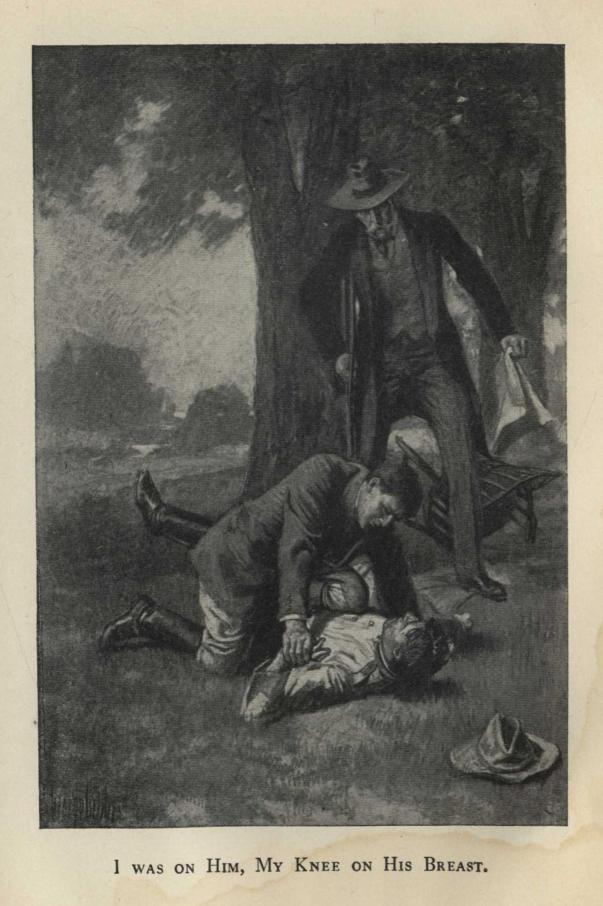
I WAS ON HIM, MY KNEE ON HIS BREAST.
"Grandfather," I said, "I don't want to hurt him, but you heard him give me the lie."
"I did," said the old man grimly. "I did, and I waited to see if you would strike. If you had not, I was going to knock you down with my crutch! Mount your horse and go to war, Jack Ballington, my grandson; for by the living God I know now I'll have a fighter in that war worthy the name of Rutherford when this cur turns coward and quits!"
CHAPTER V.
THE FIRST TENNESSEE
I do not know where you are, Eloise. I do not even know that you are alive; but if you are, I have the promise of Aunt Lucretia that this letter shall go to you; and Aunt Lucretia, you know, does not break her promises.
And if you be dead, Dear Heart, as I do deep in my mind fear, for I have not heard from you, nor Aunt Lucretia since that June day was turned into December in a night—that day when I went to the old familiar, sweet places, to find no longer there her who had made them sweet—why, what matters so much? For the passing of the soul of a dear one, when we see that it is passed, is such a natural thing at last, such a little change to make so great a transition! While they lived and life looked full and wholesome, it all seemed so large, their life and ours. But they go in a night, in a breath's draught. And then we see how small it was: a little finger-width zone across the world of things. A little too much heat, a little too much cold, a tiny vein broken, a severed cord, and it is whiffed out. Even in the fullness of strength and brave life a dash at bars on a great game horse....
Forgive me, dear one, if you be alive to read this; for I would not remind you now of a time you were different. 'Tis God's way, and since He has kept in my heart my love of you, and through your accident showed me your love for me, have we not His two greatest gifts for our very own?
And as to that other world, do you know what instinct tells me it is? That there we will have a hundred senses where we now have but five; and there we shall see the Thought as well as the Thing: every thought, every dream, every hope, every love, these we know not as words but as beautiful beings whom we shall meet face to face. And its only law is Balance, Compensation, Recompense, Poise; the Equation of the Universe. We wonder here why there should be such things as sin and sorrow and injustice. But there we shall know that sin is not sin, but the prism which shows us goodness, that sorrow is not sorrow but the prism of gladness, and that death, as we now know it, is not a stopping, but the prism through which we see another light. Here, on our little earth, with only our five small senses, we see only the prism. There we shall see the rays. It is the difference between the star and its light.
And if we hold the prism of sorrow here, Dear Heart, as I do now, shall I not hold a handful of the joys which stream through it there? For here 'tis a poem written, but there the meaning of it. Here 'tis the sun rising, there the dawn. Here the giving of alms, there the joy of the giving. Here it is the instrument that makes music, there the music. Here 'tis only a picture, there the soul that made it.
And if you be passed, Eloise, if you be passed, even yet will I keep writing to you. For if letters be written with one's heart's blood, I know, in my soul of souls, that our dead will read them. For though I have lived but a little while according to the span of things, and less according to the knowledge of things, yet the little span and the little knowledge have made known to me the greatest of all truths: that I do not know: that even with my little knowing I have seen things come to pass which were more wonderful than those which I thought could ever be; that we live on the borderland of a world wonderful, mysterious; that we are clasping hands with eternity, and need only the language that will yet come to spell out the touch for us. And so I shall write to you even though you are dead, write to you, sweetheart, a love letter for your heaven, knowing that not only will you read it, but that I, in the writing, as in all giving, will at last be the one who will get.
It is selfishness in me at last, Eloise, selfishness that I may hold through life and forever this love of you in my heart, now that it has only memory and not your own sweet self to live on. And no greater love and more constant can there be than that which lives on memory. For the living-love, being flesh, must change with the years. But memory-love, being eternal, can never change.
I am at Iloilo; and the gap is great since that long ago June, that June of Tennessee blue grass and roses, and the old home and you, sweetheart.
* * * * *
There is little to tell of my leaving; of my quick decision to fight for my country and for you, Eloise. For, cast from my father's house there was nothing left but my country's, and losing the love of my kindred there was only your own great love left me, yours and my country's. For these I am fighting. But at the last—I know you will want to hear it all—at the last our old grandsire seemed strangely touched, and the memory of it has burned my heart, once strangely amid flying Filipino bullets on the firing line, and once amid the thunders of the great thirteen-inch guns from the Monadnoc. And right glad I believe he will be when he learns, that though he called me a fool for refusing a soft place as aide to dear old Hawthorne, and a greater fool because I refused a commission which he himself could have got for me for the asking, and took a musket in the ranks instead, that I have risen from a private to the Captaincy of the crack company of the First Tennessee. So say the Regulars of the Bloody Fourth that we backed to a fight to the death against the Filipino trenches. So says old Hawthorne himself—God's blessing on his old white head!—now commanding our brigade, who led us in with the rebel yell in his throat! And riding Satan, Dear Heart; cannot you see the picture, such a man on such a horse! And you should have seen how Satan loves the firing line and how he hates the smell of a Filipino and his pony!
* * * * *
But this story must be told straight even in a love letter to my unseen love in an unknown land.
When I left home I only took my father's sword and Satan. I took him because of my love of you, and that old Hawthorne, our General, might have a horse to ride into battle that should be worthy of his rider. For if you have ever thought of it, sweetheart, you will know that no great soldier ever owned a mean horse.
I joined a company of the First Tennessee. In the company next to me was Braxton Bragg, commanding it by the influence of our old grandsire.
My first promotion came in San Francisco, where we camped for a month before sailing for Manila, via Honolulu. Our Captain was a Tennessee lawyer who knew little of the game. It was I who drilled the company, my German work stood me in good stead, and we won on dress parade drill. We were the best drilled company of the First Tennessee. Then our Captain resigned to practice law in San Francisco, and I was made First Lieutenant.
We dropped anchor off the city of Manila, November 28. It was an inspiring sight as we sailed into the Bay, to see the sunken Spanish ships, and Dewey's flag ship with Old Glory flying, proclaiming Republican Liberty for the first time to the waters of the great Far East.
Our first fight came early in February. We had lain outside of the walled city on the Lunetta Driveway for nearly three months. We knew that Aguinaldo, with eighty thousand men, armed with guns we had given him, and those of the Spanish, was in our front, feeling his way.
It was nine o'clock Saturday night, February 4th, when the attack began. We heard shots from the enemy, then three in rapid succession from our pickets. It meant help. The men, who had been grumbling for three months for fear they would have to go back home without a scrap, sprang like school boys to a playground. Then the front lit up with a crackle of fire. Our rear was another sheet of it from the fleet in the bay, firing over our heads.
It was a hot fighting front, the First Colorado, Tenth Pennsylvania, Thirteenth Minnesota, Fifty-First Iowa, and First North Dakota standing the brunt. We chafed all night, standing in line down by the beach, away in the rear, the very base of our half-circle battle line. All night we stood hoping that we might go into it before it was over, our blood stirred by the battle and roar in front, and the thunder behind.
At breakfast Sunday morning we still stood in line, expectant, keyed to a fiddle's string, eager. The cook passed our Sunday fare up the line, chicken and hot coffee. How little things stick in excitement! Then we saw a courier come out of the smoke and flame, and old Hawthorne rode Satan to our front.
"Boys," he said quietly, "they have asked us to take the Filipino trenches, and we are going to take them. Attention, regiment! right shoulder arms, fours right, march!"
A Utah battery and the Nebraska boys supported us as we charged over San Juan bridge under fire and across a rice field.
We kept step to the boom—boom—boom—of the thirteen-inch shells firing over us from the guns of the Monadnoc. Down the bloody lane we charged, the bullets humming like hornets.
"Listen, boys," said a man in my company, "listen how they hum!"
An old sergeant of the Regulars passed us, going to the rear. He was binding a handkerchief around his arm, from which the blood was squirting. But he laughed and called to us, "Oh, don't worry about those that you hear humming—them you hear won't hurt you!"
Then the trenches grinned in our front, spitting fire. We prepared to charge. Behind us were Regulars, and in the crisis of it all I saw Braxton Bragg. I hate to write this of the blood of a Rutherford. My shame, my sorrow was greater than his. His nerve had simply left him. He had got down from the hissing bullets behind a sandhill. He had quit before his own men. They did not shoot him, they did not have time; they charged with me, backing my own company. It was a quick rush and soon over. The Filipinos left their breakfast of rice in the trenches. But we left some of our bravest there, too.
But battered and tired as we were, the real fight was just on. In sweeping the Filipinos out of their trenches we had hurled them to the left on our own water-works that supplied the city and the army. If these were held by the Filipinos and our supply cut off our fight would be in vain. It is said that twenty thousand of them stood between our water and our line. Luck again was with us. The First Tennessee happened to be nearest to them and it was we who cut through, and only four hundred, a battalion, at that. In a quick bloody charge we took the works. Old Hawthorne and Satan led us as if on dress parade, a target for twenty thousand Filipino rifles, and not a bullet touched them. With cheers we followed the white hair of the old Confederate on his black horse with the north star on his head. We were holding a perilous place, for we were in the rear of the Filipino army, with our backs against the water-tanks, and foes in front and rear. But we held it for two days until help came. And the first battalion and third battalion had equally as good a record when the fighting was over.
A week afterwards old Hawthorne came to my tent. He was holding a telegram from the Secretary of War. "Jack," he said, "I am a Major General, and you are the Captain of Braxton Bragg's company. The boys of it wired petitions and elected you. They said you led them twice to victory. They want you to lead them always."
Our hardest fight was at Iloilo last week. We took the city, but once out of the water we had to fight down barricaded walls, hemmed in and shot at from walls and house tops. For two hours we were busier than a bull-terrier in a den of cats. They were the best fighters we struck. They were officered, we learned, by the brave and brainy little Japs.
At the Lapaz sugar mill they tried to cut off some of the Regulars. We were nearest. It was merely our luck. Any other regiment would have cut through the enemy to save their comrades. At Naglocan they made a stand and there we finished them.
* * * * *
That was written a month ago. I will finish and let it all go together, finding you if it can; and if not, well my heart has found yours somewhere, sweetheart; in the writing my thoughts have met, somewhere, yours.
We stay and hold Iloilo, but General Hawthorne with a battalion of our boys went a month ago to Cebu to help out the Twenty-third regiment of Regulars who were hemmed up there in the mountains and fighting for their lives.
Would you like to hear how close I came to death yesterday, and not on the firing line at that? It was a nasty close call I had and the horror of it still twangs on my nerves. It is that, and not knowing what the morrow may bring, that has brought me to the writing of this last love letter should either of us pass into the shadow of things.
On the nearby Island of Mindanao live the savage fanatics, the Moros. These people have been a terror to the Spaniards and are the nightmare of our own men. They are Mohammedans, and the fiercest, most treacherous fighters of all the Philippine Islands. They cannot be civilized, they cannot be conquered, they can only be killed. There is a bloody tradition about them and the Spaniards; how, hemmed up for slaughter, when their warriors have all fallen, the women have been known to rush on the Spanish lines with their babes in their arms, and, as the Spaniards would meet them with their bayonets, hurl their babes onto the steel, blocking both it and the fire behind it, and cut down the soldiers with the deadly borangs of their dead husbands. Then there with their babes on the bayonets they would die.
Of these Moros, there is one the soldier dreads more than the firing line of death, more than the panther that springs at night, or the rattlesnake that strikes in the grass. It is the Juramentado.
When one of the Moros is adjudged guilty of thieving, impurity or half a hundred other crimes and sentenced to death he becomes a Juramentado. Strange, mystic ceremonies are performed over him by the priest in the black wood of the black night. Cruel tortures are inflicted; his head, face, eyebrows, and mustache are shaved clean, his face painted, his body left half naked.
There is but one atonement for him. He must kill as many Christians as he can before dying himself. Dying in the act he is transplanted to Paradise.
They are great sailors and are liable to run amuck and then float out to distant places, to any place where they can find a Christian. Stealthily they creep into a camp, or town, or church, or wherever there is a gathering. Their keen borang is sheathed between two bamboo reeds; its blade is a razor, its weight that of lead. With a blow they have cut heads clean from shoulders, or split a soldier from neck to hip.
At a word they will turn in a crowd and kill all those around them. The Spaniards tell how five of these fanatics slipped up to a company of their men peacefully, and then in sudden frenzy killed nineteen soldiers before they could shoot them down.
Our orders are strict concerning them: a soldier must never be out of lines without his side arms. And so nameless a danger is in their very name that it is the unwritten law of the camp to courtmartial any soldier who cries out for a joke, Juramentado!
I was visiting the camp of the Regulars and as I went through the gate a file passed out for guard mounting. A Juramentado had paddled over from Mindanao, slipped in, and suddenly attacked a soldier of the Eighteenth Regulars, as he was returning on a pony from some duty. The first blow of the borang took off the man's arm at the shoulder. Clapping spurs to his pony he rushed for the main entrance just as I passed out, with the file of soldiers behind me. In an instant the frenzied, howling, painted thing was on us.
I heard the officer in charge cry "fire," and a dozen Krags snarled their smokeless call, sending twelve steel-jacketed bullets into the charging demon whose painted face, and sharp black teeth were grinning like a wolf in my very face, and whose borang was at my throat.
The bugler got him with his Colt's 45. Twelve steel bullets had cut twelve clean pin-point holes through him, and not one had stopped him, not being in the brain.
The Krag is a failure. It shoots too clean and hard to kill quick. That old time Colt 45 saved my life. I saw the dead snarling thing all night. When I waked his black painted teeth grinned in my face. I was never un-nerved before.
And so I am writing you, Dear Heart, for I realize now how near to death I have been, how nearer I may yet be. And maybe another thing makes me write to-night. It is such a story as Clarke, our First Lieutenant, has brought back to me to-night. It has set me to dreaming, and made the camp and men and guns sleeping under the mango trees seem like ghosts from another land. Like ghosts, Dear Heart, for in the dream which is always more real than the real, it is you and Old Tennessee that I see to-night, not slumbering guns under mango trees, nor tropical mountain tops, smoking mistily to the moonlighted skies, nor the palm trees, sentineling the ghostly beach.
Clarke has filled my thoughts to overflowing to-night. So I have left him and the sleeping camp. And I lie alone on the beach looking across the ocean toward home.
He told of a girl in Cebu, where our main hospital is, one of the Red Cross nurses from the States. She came over a month ago. Clarke has talked of her till I can see only you. If I did not know you were ill I'd swear it could be only you, peerless, bravest, gamest, most beautiful woman that ever was. She is a trained nurse, but she rode with old Hawthorne, rode Satan, too, to the relief of the Twenty-third Regulars.
Who could have done what she did but you and Satan, clear a ten-foot fissure of a yawning volcanic abyss, outfooting the Filipino ponies when they thought they had cut her off? And her shooting! Again I saw the brown stubble of Tennessee wheatfields, the blue hills circling the sky line, the flush and whir and the crack of the sweet little twenty gauge! If you are not dead or in the hospital it was you—the only one in all the world—there can be no other!
But I shall not see her, for we leave for the States in the fall. They are sending other boys to relieve us, others who want to serve their country.
I shall go home then to my work. I shall take up the life I left, the life of labor and of love, of love, Dear Heart, love of all loves, love of a Memory. And now good-night and for my pen, good-by, Eloise! ...
CHAPTER VI
THE BATTLE IN THE BACAUE MOUNTAINS
I wrote you last from Iloilo, but no word has come back to me. And toward the late fall, our term of service having expired, and so many others crowding for a chance to serve, we were mustered out and ordered home. The big transport Indiana stood by for our home-taking.
It was good news for the boys, but sad for me. They were going home to wife or sweetheart, but I had no home.
There is one great thing about war, the steel it puts into the heart to stand things, to die smiling and unafraid, to take life as a battle, and fight it out on the firing line. There are many living, but few on the firing line of life. They think they are soldiers, but they are sutlers.
In a short time we sighted Cebu. Our General, Hawthorne, and a battalion of us were there, as I wrote you before, sent to help out the Regulars. We were ordered to pick up this battalion; it completed what was left of the First Tennessee, for some would sleep forever under far-off Pacific skies.
Cebu is a little city on the island of the same name in the center tier of the Archipelago. Bitter and desperate are the inhabitants and savage in the extreme, and to take the place has cost us a hard battle; and to hold it almost cost the life of the Twenty-third, for they had been cut off in the mountains and all but lost when Hawthorne came to their aid, three months before.
It is a long narrow island with a backbone of volcanic mountains, in the recesses of which live a race of savage fighters who do not quibble to rush, half naked, and with bolos and spears, upon lines of steel and Gatlings.
Their mountain fastnesses are all but impregnable. The volcanic mountains run sheer up straight and the level plateaus yawn with the most dangerous and sudden chasms.
Here were the forts and fortifications of the savage Insurgents, and here they had again threatened portions of the Sixth, Nineteenth and Twenty-third Regulars under General Snyder.
It was night when we heard it; we had anchored and prepared to take General Hawthorne and our boys on the homeward journey.
Then like a bolt came the news: portions of the Nineteenth Regulars were surrounded and cut off in the mountains by ten thousand yellow savages. They were doomed.
And Hawthorne and his battalion, instead of being on the beach to embark for home, had already gone back to the mountains to fight.
I drew up our men in line of dress parade on the Indiana's decks. "Men," I said, "we have been mustered out! We are no longer soldiers but citizens of the Republic, homeward bound, with all it means to every man of you who has done his duty as you all have. No man of you may be ordered to go one step from this transport's deck till you reach your own land. But news has come that the enemy has attacked and cut off our comrades. Our General and a small battalion have already gone to their aid. I ask no man to follow me. I am going, and every man who would go with me take two steps forward."
The First Tennessee to a man moved two steps forward on the deck.
At daybreak we were off for the mountains eight miles away. All forenoon we marched under the hot sun, passed mango trees and squalid huts over ashes of dead volcanoes. We established headquarters on Elpado Mountain across the Labanyon Valley. Along the low mountains in our front ran the forts of the Filipinos, a rude fringe to the crest of the hills.
A detachment of the Sixth and Nineteenth Regulars had been over-daring. They had got in behind the enemy, and being a new regiment sent to relieve us, they had not known the true situation. They were surrounded in front and rear. It was for us to cut through to them.
They are peculiar little mountains. Volcanic in origin they have been shaken by earthquakes until often their sides are precipices; on top there are narrow plateaus, and along their whole length bristle the savage fortifications.
There we found old Hawthorne waiting for us. He knew we would come!
At his word we began the ascent. It was a hand over hand climb, from rock to rock, from scrub to scrub, with a spear or a bolo at any time from above or behind any rock. And at unlooked for intervals would come avalanches of rock and volcanic stones, rolled down by the savages above.
It was five hundred feet up, but it took us all the afternoon to reach the first plateau, and half the night to derrick our cannon up with rope and pulley. The tired men had had no sleep for eighteen hours and at daylight they must fight. We camped within three hundred and fifty yards of their fortifications, with all lights out. We made the assault at daylight.
Our guns knocked their forts down around their ears and when we charged they went over the other ridge to the last line of what was left of the forts.
At the bloodiest angle of it when I came back to report to the General our burying squad was already busy:
"This," said a tough old sergeant to me as he pointed to their dead piled up, "is a cordwood of good Filipinos."
Such are the genialities of war.
Our fiercest fighting was before us. Hand over hand and holding to trees we went up to the next fort in an avalanche of stones, arrows, bolos, and spears.
We fought from rock to rock. Often a Krag or a Colt would speak straight up, and a dead Filipino would come vaulting down to our feet.
Again came the derricking of guns. Then we went through a deep aisle where only one man could rush in at a time, with Filipino sharp-shooters above us. But our last fight cut them from our front and we reached the Regulars. They had held their place and escaped death only because they had lain for two days in an old fissure with empty shells beside it and canteens as dry as the old volcano. But weak as they were they charged with us after the Filipinos, scattering them like mountain goats over the hills.
There was a tropic moon that tropic night. The Mango trees circled the farther mountain sides and the bamboos stood in groups in the valley below. The kingly palms towered high over all. The weird tropic night sounds were borne to us on the breeze. The tired battle line of my brave boys lolled by camp fires in one long line of sentinel light with the last wrecked forts of the beaten enemy at their backs. The field guns, rapid of fire, poked their long blue noses out into the night. "Still smellin' for the varmints loike blood houns for nagurs," said Moriarty, our fighting Irishman, and the wit of the regiment.
Then he would walk over and pet the blue steel beauties, for they were his. Moriarty it was who had brought them over mountain side and crevasses where no man dreamed they could go.
"An' it's aisy it is," he would laugh and say when I praised him to his face. "It's aisy, Cap'n; I've done nothin' but pet 'em, an' so they jus' foller me loike dogs."
Half a mile out a line of pickets faced the way the beaten enemy had fled. Our fighting was over. Cebu's island would no longer be troubled with Insurgents. And the next day would be the Indiana and home!
Our General had thrown off his sword belt and come over to my camp, and together we had smoked and talked of home and the war, of everything but you, sweetheart. But when he left he smiled and said a puzzling thing to me. "I've a surprise for you to-morrow, at Cebu, Jack, that will knock the war and even the homegoing out of your head."
Then he twisted his gray mustache and smiled delightedly. Had the old man, as we all loved to call him, received word of another promotion for me, I wondered. For myself I wanted no more war. I wanted only you, Eloise, somewhere, somehow, living; or the memory of you amid my own Tennessee trees.
"General," I said, "there are worthier men here than I for any promotion you may have. I will go back to my land and my work; but if you could arrange for Moriarty here—" I added, pointing to the game little Irishman.
"Oh, Pat's fixed already," he answered. "He has brought these guns over hills, through fissures, and the walls of hell. He'll be First Lieutenant in the regular army as soon as I can wire this day's work to the President. But you, Jack,—"
I pressed his hand. "General, dear General, believe me, I want nothing more, nothing but a chance to work and make a home in Tennessee."
I was serious almost to that old gripping in the throat. But he laughed and pressed my hand.
"To-morrow, Jack, to-morrow! You are tired now; I want you to sleep. You have earned your reward this day, my boy, and it shall be yours to-morrow, a promotion that you will love."
I followed him to his own tent door. A black horse stood haltered near by, saddled as he had been for two days and nights.
I took the General's whistle, the one I had used to train Satan to my call in the old days, and which on the firing line the General himself used in calls for his aides and orderlies. I blew softly the three blasts I had taught him to know in the forest. He had not seen me for months. He did not know I was there; but his head went up quickly with the old devil fire in his eyes. The next minute he had thrown his great weight back on the halter, snapping it.
His head was on my shoulder, and he was whinnying.
The General laughed. "It beats the world, Jack, that horse's love for you. Take him to your own tent to-night, he'll rage like a hyena around here all night, now that he knows you are here."
It was true. But tethered at my own camp he was quiet. The confusion had been so great and my men were so scattered that when I came back I ordered Moriarty to call the roll before taps. He came back quickly with word that Ross and Billings of our company were absent. I was surprised. Investigation among the men, tired and half asleep, showed that they had not stopped when we took the last fort, but had been swept on with a squad of the Regulars after the flying Filipinos, carried away with the excitement of it.
I went quickly to the bivouac of the Regulars. They remembered the two men, but thought they had returned, as they went off toward the right of the little village Colena, two miles in our front and through which the enemy had fled.
"If they aren't here now," said an old sergeant, "no use to look for 'em again; when we come back through that village, there wasn't a sound, not a kid, nor a chicken, nor a coon, nor a dog; and when you don't hear nothin' in a Filipino village, when you go through, look out for hell when you come back."
I looked at my watch. It had been full three hours since the Regulars had returned.
"I am going after them," I said, turning to go.
"Ballington," it was the swarthy old Captain, of the Nineteenth who spoke, "you'd be a fool to risk it." He pointed silently to a faint glow across the valley on the side of the mountain beyond. I had thought it was a rising star. "Yonder," he said, "see that other one on the mountain top, that's the signal fire of the little yellow hyenas, that means guerrilla bands in them mountains, they go in packs like wolves, and the night is their time. They know every foot of the mountain, every gorge, valley and crevasse. Why, two men lost over there ain't got no more show than a pair of fool goats in a jungle. Why, if them little hyenas couldn't see 'em, which they can—for they see better by night than by day—they can smell 'em, like all jungle breeds."
"Boy," he said again, looking at me kindly and smiling an apology for the title which we both bore, "I wouldn't let you go. I'd go to old Hawthorne and have you arrested first. You Tennessee fellows," he said, laying his big rough hand on my shoulder, "have done the whitest thing ever done in this war. It ain't often we old Regulars that never go home and have to serve 'till the last taps, takes much notice of you volunteer fellows that fights awhile for fun and quits when the time is up; but when you biled out of that transport and came over them mountains an' cut through to us, you done a thing that'll warm the cockles of our boys till the last tattoo and the taps. Now I ain't goin' to let you go out there in no such fool thing. I'm an old soldier, I fought with Miles and Cook on the plains, and I tell you now, Sitting Bull and his Sioux were lambs to them little mountain savages. You go back now," he said kindly, taking my hand in his own, "go back and go to sleep. You are a boy yet, though you proved you are full grown to-day, my lad, and ain't even got up a beard. Of course you have got a sweetheart waiting in Tennessee. Go back to her, and the next year send old Brawley of the Nineteenth a picture of her and the kid. He ain't never had no time to marry, it's been fighting all his life with him from hell to breakfast."
I smiled, saluted, and went back to camp.
Moriarty was waiting for me, and, when Moriarty does not smile, I know what to expect.
"Cap'n," he said, "it's not Moriarty that can sleep peaceful the night till we find them, dead or alive."
"And I, too, if you please, Cap'n," said Davis, my corporal, who had been listening.
"There is no need for a call then, men," I said, "we three will go down to the village, we will doubtless find them near it. A Krag for rapid firing and two Colts each," I added, "and plenty of shells. Don't let the other men know; we'll be back by midnight."
As we slipped out of the lines of camp I saw a thing that touched me. Moriarty had stopped at the long, slim, blue-barreled rapid fire and for a moment, lingering over it, one arm around it, he laid his cheek against its lips. It was Moriarty's farewell kiss to the only bride he had ever known.
CHAPTER VII
THE JURAMENTADOS
There was a mistiness among the mango trees as we went out into the moonlight. It was a mist from the ocean, but it made an uncanny milkiness in the air, which seemed to cling to the long dew-damp leaves of the tropic trees as we descended into the Labanyon Valley; and that queer uncanniness stayed with me. I could not throw it off.
At the picket line I left a note to be carried back with the relief. It was to my First Lieutenant, explaining my absence and stating that, if I were not back by daylight, he was to assume the command. And if, before daylight, he heard any continual rapid fire, he was to send the company to the sound of it, for it would mean that we needed help.
The picket would be relieved at midnight. I asked him not to awaken Lieutenant Clarke until then.
"Captain," said the picket, touching his cap, "excuse me, but if you weren't here I'd arrest Moriarty and Davis and send them back into camp. 'Tis a fool thing they are doing."
"But what about our comrades out there, cut off, doubtless, and surrounded by these savages?"
"Then why not take a company?" he asked respectfully.
"They'd be butchered," said Moriarty. "It's the three of us slippin' around an' nosin' in that can save 'em if we find 'em. And with these rifles and six Colts we'll be all of a company for arrows and bolos."
"Look," said the sentinel, "do you see that?" He pointed to a dim red star, glowing just above the mountain top. "That's a signal fire—and that, and that. Captain," he pleaded earnestly, "go back and let the boys all go with you. It's a fool thing, but if you will go—now listen—when I hear you shoot, if shooting is on, I am going to fire and waken the camp; the boys will want to come to your relief."
Moriarty laughed. "Now don't let your old gun go off too suddent loike. We'll be back without firin' a shot!"
But I, Eloise, as I went down into that valley, became for a moment all but a weakling when I thought of you! We went quietly out into the moonlight, slipping along from the shadow of one great mango to another. Sometimes these trees made a continuous shadow—so thick they were—and our going was easy. But when we emerged into a moonlit space we stooped and crawled through the high grass, for we were an easy target for their sharpshooters on the peaks above.
We were fully a mile from camp before we crossed a crevasse, about twelve feet wide, spanned by a culvert or small bridge. I remember noticing the little bridge and thinking that if it should be burnt by the enemy in our rear, we would never be likely to get back into our camp again.
There was a Filipino village which lay off to the left in a mountain gorge, and, scouting carefully around the side of the mountain, we approached it over the last one-hundred yards, crawling through the grass and under mango and cocoanut trees up to within fifty yards. It lay before us, a dozen shacks on bamboo cane shocked with the coarse straw of the rice stalk. The usual squalor and emptiness was around, but there was not a sound, not a living thing. Moriarty nudged me. "There's hell in there somewhere, Cap'n," he whispered, "it looks too peaceful loike."
It was a Filipino cur that gave us the first clue. They are a half wild breed but little beyond the wild things from which they came. As we lay in the grass listening, this dog which had come back for some morsel he knew of, smelt us, and, barking, bolted down a wooded path to the right. We saw him clearly as he ran up a hillside and over into a gorge beyond.
"There's where we'll find the family," said Moriarty. "We'll cut around and go into the rear."
It took us a good hour to do it, crawling through bamboo and cane, under mango and desert palm, through the tall grasses, and over crevasses. Often we lay quiet in them, resting.
It was a weird and unexpected sight that we saw. Before us lay a little cup in the mountain gorge, a natural amphitheater, framed by a small grove of palms and cocoanuts. Savage figures were going through queer rites.
We stopped, puzzled. "That isn't the village people," whispered Davis. "There are no women or children there, they are headmen and warriors, and that is some ceremony they are performing."
We crawled up within fifty yards, and then I wished I had not come, for Moriarty gripped me quickly, and pointing to two naked men bound and laid out on the ground, whispered, "Ross and Billings!"
"We're too late, Captain, they've been killed and now they are fixing to mutilate them, cut off their heads and cut out their hearts and fill their stomachs with stones."
I nodded. It was the savage's way of mutilating all our dead.
We recognized the fighting men easily. There were dozens of them, squatted in a circle, armed with bolos, borangs, and spears. But in the center stood a strange figure in a long black robe, his parted hair hanging down his back. Around him stood six men, fierce savages, with shaved heads, and half naked bodies.
"Juramentado!" I whispered. "That's a Mohammedan priest in the center and he is making Juramentado of the six—look!"
I heard both Davis and Moriarty slip the bolts of their Krags. To say Juramentado to any soldier was like crying wolf to a shepherd and his flock.
We lay still, seeing the mystic savage rite no white man ever saw before. We could hear the words of the priest which, spoken in a mixed Moro-Spanish, we easily interpreted. The six we soon learned were Moros from Mindanao and had sailed over to sacrifice themselves to our army.
It was indeed a weird rite he went through, and strange words he used:—how, if each killed his Christian before dying, it meant first heaven and an houri; and if two Christians a second heaven and two houri, up to the seventh heaven and a harem if they died within our lines with seven of our dead each to his credit.
"And now behead them," he ordered, pointing to the two American soldiers, "and anoint your bodies with their blood!"
Instantly we saw our error in supposing our friends were dead, for when the bound soldiers saw two of the Juramentados seize their borangs, each made a violent effort to break his bonds.
"That priest is mine," said Moriarty, "I've always loved 'em."
We fired together. The priest, two Juramentados, and five warriors lay dead or dying. The others were instantly an awakened den of wolves.
I flinch, Eloise, in writing you this, for it brings the tears even now as I write. Its ending was in blood and the passing of two I loved as only one man learns to love another who has backed him to death in the last ditch. They rushed us quickly, for their leaders were Juramentados and they never retreat, but like a wounded jungle lion charge instantly the men who have wounded them. They were ten to one against us, and fast and furious was their rush, but, though it was only a short distance, we bunched, and shoulder to back shingled the ground with their dead, stopping many of them, who died at our very feet. The others swarmed upon us, led by howling Juramentados, until even now I awake at night with their twanging hyena howl in my ears. Our Colts crackled fiercely for an instant in their faces. Then Davis fell and I would have followed him had not Moriarty, shooting quick and shouldering between us, blown out the brute's brains with the last shell in his revolver....
I was dazed, bloody, and knocked down into the fissure at our backs by the glancing borang blow of the last of the Juramentados.... When I came fully to myself I crawled for protection under an outcropping rock, and none too soon, for the fanatic above hurled a spear the next instant that quivered in the spot I had just left.
And, emboldened by the frenzied Juramentado, and seeking my blood, I saw other heads, peering from over the fissure side and around boulder and rock.
I was protected for a time under the boulder. I was faint, and hearing running water I drank.
* * * * *
I prayed that I might not faint again. The wound on my head was a clean cut. "If only I do not faint again," I kept saying while I bathed my wound, and, packing my cap with my handkerchief, pulled it tight over my temples to shut off the blood.
Then I became calm and indifferent. I marvel even now to think how undreading of death I was, feeling that I was so soon to die; undreading, for in all the queerness of my head and the dizziness and throbbing and the bitterness of the knowledge of the unequal fight, I thought always of you and of Andrew Jackson, who when shot by Dickinson, clinched his teeth on a bullet to keep from biting his tongue, clinched, stood, and killed his man! ...
Down in that death hole with savages above me waiting for a chance to brain me or bolo me to death, I heard—I'll swear I heard Aunt Lucretia say, "Would Andrew Jackson faint or fight here, Jack?"
Yes, Eloise, believe me or not, but then I knew I would not faint again. I crawled further under the rock, lying flat, face up, and drew both my Colts....
My belt still held the shells. The fight I had with myself must have been long, for they found forty-three empty shells at my side next day.... I don't remember distinctly what happened, for my head would spin every now and then and I had to close my eyes.
Then I fired twice, thrice... A fool was starting down to see where I was, a fool, and he met a fool's fate at my feet... So for hours I shot that way and none dared to try to come down again, none but one who suddenly dropped upon me from the left like a tiger from a cliff, the last of the red painted things who sought death in order to gain Paradise.
He died literally on me; and he died quickly. He did not know that having killed his companions with my right, I was on my back with a Colt also in my left. So died the last of the Juramentados....
I knew this would end it, and I was glad, for I was beginning to forget, with the fever flame licking amid the fagots of my brain. I had strange deliriums.... Æons passed with me wallowing in the water beneath me, thrusting my burning head into it and not knowing it.... And then came the end of the delirium in the great joy of the volley of shots above me and the cheers of the First Tennessee. I heard our General telling me I was all right, and then the dreams returned, for I saw you on Satan, in khaki, riding with the firing line; and then my head was in your lap, and you were crying over me and kissing me, before all the boys. And like one in a nightmare, when strange things happen, I told them it was not real, that I was touched of a borang in my head, and was a double weakling for dreaming and then being such a fool as to weep over a dream. But they only cheered me and laughed.
* * * * *
I remember very distinctly when I awoke in the hospital at Cebu. It was night and the tropic moon lay half masted in the sea. I saw the gunboats out in the bay and Old Glory floating from fort and mast head. But I did not see the Indiana. I knew I was feverish and yet so sane, so sane that it hurt as does all great saneness which follows a great sleep. Then a sea-gull cried as it swept past my window, and that lone sea-gull's cry quite overcame me: for then I remembered my first dream, and you, and now I awoke and you were not there.... I turned my face to the wall. Then I felt someone kneeling by me, her arms around me, her kisses on my cheek. I heard someone saying, "Jack, Jack, be still, and be very calm, for it is I, Eloise, your Eloise. I have nursed you a month—I have slept by your side, darling, right here by your side, your own Eloise. And now it is all right and so sweet that—hold my hands—Jack—tight—tight Jack—we are going to say again our little prayer, thanking God together as of old...."
Then the next day when I was stronger and the danger had passed, we spent the morning alone in the little hospital ward holding hands sillily, talking always, and kissing when we could. And you told me how it had all been: how Elsie and her father had found you and taken you home with them to the great English surgeon who had cured you: how, knowing I was here in the Philippines you had come as a trained nurse to be near me: and how it had been fixed between the General and you that we were to meet the very day that came so near being my last. And you told of the strange dream you had that night, of my call that seemed to come to you, and how, mounting a pony and dressed in khaki that you might pass the line as a soldier, you rode to our camp alone through the night, following the army's path over the mountain, reaching our last line at daylight, to find the battalion gone since midnight, to our rescue. Taking Satan you followed: and it was Satan and you who found me: for they had rescued Ross and Billings and found the bodies of poor Davis and Moriarty, but they could not find me. All day they had ridden and searched; and all day, delirious and fever stricken, I had lain in the fissure under the boulder: and in the still of the evening, when the boys had all but despaired, and you, heart-wrung and broken, had rested a moment in the General's fly, suddenly there came a strange whistling up the canyon, and Satan had broken loose going to it, the boys following: and they had found me in wild delirium, but dreaming of home and blowing the call of old for Satan with the whistle I had forgotten was in my pocket. Even as you told me all this, old Hawthorne came in with the familiar twinkle in his eye and bending over me stroked my forehead as my dead sire would have done, saying, "Well, Colonel Ballington, how do you feel to-day?
"Jack," you cried, "he shall not tell you first! I hadn't got to that, General. Please let me tell it all to him, my own self."
The General laughed and nodded, enjoying our happiness as if it were his own.
"It is all too good, Jack," you went on, "but the President himself has appointed you a Colonel in the regular army. And see—we have saved it till you wakened—our dear old General and I—here is the message President McKinley sent when he heard you had led them from the Indiana's deck to the rescue of the Regulars."
Then you read the message yourself, with tremor and tears:
"No more splendid exhibition of patriotism was ever shown than was shown a few days ago in the Philippines. That gallant Tennessee Regiment from our Southern border, that had been absent from home and family and friends for more than a year, and was embarked on the good ship Indiana homeward bound—when the enemy attacked our forces remaining near Cebu, these magnificent soldiers disembarked from their ship, joined their comrades on the firing line and achieved a glorious triumph for American arms. That is an example of patriotism that should be an inspiration to duty to all of us in every part of our common country."
"It is good of him," I said, "God bless him—the sweetest, gentlest man who ever sat in that chair. But if I get well I am going home and to my trees."
But still the old General stood smiling, and I knew there was more to come. And, seeing it, you came over, smiling funnily yourself, and with little tears, too; and kneeling, you laid your face against mine. "Jack, forgive us, it was a mean thing to do, but you have been married a month to-day and don't know it! But when we brought you here, you talked all right—though you were a little flighty—and begged so hard for me to marry you then—and—and—somebody had to sleep right here with you, nursing you day and night, for the surgeon said it would all be in the nursing and a mighty poor little chance at that—Jack—for it was a terrible blow, cutting to your brain—and you begged so—and—I didn't want ever to leave you again while you lived, and after the Chaplain married us holding your hands in mine and kneeling here just as I am now—it looked as if marrying had killed you, Jack—you went down so quickly and deeply into the valley—and now to see you well—"