Front matter (continued 2)
Reading edition
"And I may seal it with a kiss surely, Aunt Lucretia," I said, "for once."
"No, not for once. That silly performance has caused more trouble in the world than all the sins of Satan combined. We will never have a decent race of people till kissing is cut out," she exclaimed. "There, no more at present—march!"
And she marched us into my room.
"Isn't this fine!" I said, looking around at the old room, glad to be home again.
It was twenty by twenty, the pioneer size, with a great fireplace, built of oak and ash. In a corner was my old mahogany tester bed, big posted and canopy-topped. The little cherry writing desk stood near, and so did the quaint mahogany bureau, resting on dragon claws, with great drawers for a base, and ending pyramid-like in a top of granite finish, set off by a little mirror, and with a tiny shaving drawer for my razors. Big windows looked out on all sides.
After Eloise had left Aunt Lucretia sat quietly thinking, looking now and then at a pedigree of Eloise which she had once made and hung over my mantel. It was framed in walnut and decorated with fancy letters. At last she smiled.
"Isn't she a thoroughbred, Jack?"
"I haven't really got my breath yet, Aunt Lucretia," I answered. "I never dreamed she would grow into a being so beautiful. Don't you really believe you might er—er—hurry up this—er—affair—" and I stopped, blushing.
Aunt Lucretia broke out in her rare, good-humored laugh.
"Poor boy! Jack, you must be careful. You talk as if you had a real case of the silly, unsensible thing."
"Always had it, Aunt Lucretia," I smiled weakly.
"Jack, that would be very unfortunate. I want you to marry on common sense—not love."
"You know how I have always loved her," I went on. Aunt Lucretia glanced sharply at me. "I mean how I've cared for her," I amended. "But do you—do you honestly believe, Aunt Lucretia, that she loves me—cares for me that way?"
"Tut—tut," she said sharply, "what nonsense you talk! What does it matter? This silly love business has spoiled more good pedigrees and brought more fools into the world, I tell you, than anything else under the sun. What a fine breed of folks we'd have had in the world by now if so many idiots had not fallen in love and married without a moment's thought of results. You ought to be grateful to me, Jack," she continued after a while; "you will be grateful, I am sure, some day, that you had me to select a wife for you and didn't just happen to fall in love. That's an accident often as fatal as happening to fall down the steps.
"It is awful, Jack, this haphazard of humanity!" she went on in a moment. "No wonder only one in a hundred is born who has got any brains in his head. Think of it, Jack, our race is so pig-headed from thoughtless marryings that it took them three hundred years after they invented a saddle before it dawned upon them that they needed stirrups to complete it. Rode three centuries on bare saddles for lack of sense enough to invent stirrups! Some day for the benefit of humanity I am going to open a human Registry. I want to do this because I think it is our duty to try to teach people to take as much interest in their own children's pedigree as they do in their horses' or dogs'. Many a man falls in love with and marries a woman whose qualities and character, and pedigree, if she were a horse, he wouldn't be caught trading a blind mule for! And many a woman, under the same divine influence, marries some vicious brute of a man for no other reason than because she has just fallen in love with him, or maybe wants to reform him, who, if he were turned into a buggy horse she wouldn't be caught risking her neck behind.
"And this is the way I'd go to registering my people," she continued. "In all registration there must be a foundation stock. For man, I'd let Truthfulness, Bravery, Honesty, Manliness, and Ability to Do Things, count as Foundations. This would change the present social system radically and let into good society and life a flood of good blood that is at present badly needed but is shut out, unless it suddenly happens to get rich and comes in under a dress suit. I would make accomplishments, the Ability to Do Things, from the Ability to do Poetry, Art, Drama, Music—everything that is worth while—to the ability to make two blades of grass grow, the greatest of them all, count as my classes, and it wouldn't take me long to straighten out Old Humanity and breed a race of people, who, in a few generations, as old Horace says, would strike the stars with their uplifted heads!"
She laughed. "Look, Jack, here it is. I have worked it all out, just for fun." She unrolled a parchment, as immaculately executed in decorated letters as Eloise's pedigree had been. Then she read, glancing over her glasses now and then to emphasize her remarks.
"A STANDARD OF HUMAN REGISTRATION.
When white men and women meet the following requirements and are duly registered, they shall be accepted as standard bred, and shall be permitted to marry:
FIRST: Any white man, who has a home of his own and is honest, industrious, and truthful, and sound in wind, limb and eye.
SECOND: Any white woman, who can cook a good meal, make her own clothes, keep a home clean, lives a pure life, and has some moral standard for herself and children, and will agree to raise them under it.
THIRD: Every man who is the father of a great man or woman.
FOURTH: Every woman who is the mother of a great man or woman.
NON-STANDARD:
The following shall be Non-Standard, and neither they nor their children shall be registered.
FIRST: Fools.
SECOND: Liars.
THIRD: Cranks.
FOURTH: Idiots.
FIFTH: Geniuses. They are freaks merely, and fools in another form.
SIXTH: Sissy men.
SEVENTH: Consumptives, the cancerous, the insane.
EIGHTH: Impure women.
NINTH: Society people wherever found, and their one child.
TENTH: Married men who lead Germans.
ELEVENTH: The children of women who play cards for money and prizes.
TWELFTH: Evangelists who preach slang from the pulpit.
THIRTEENTH: Praying lawyers.
FOURTEENTH: Trading preachers.
FIFTEENTH: Professional politicians.
SIXTEENTH: Bank cashiers who run Sunday Schools.
SEVENTEENTH: Doctors who cut open people quickly, or dope them with much medicine.
LUCRETIA RUTHERFORD,
Registrar."
I laughed. "It wouldn't do any harm to try it awhile, Aunt Lucretia; but—referring again to Eloise—"
"We'll not refer again to Eloise," she said, seeing what I was coming to; "this thing is settled. You two will marry this fall, and until then I want no foolishness around me."
"But, suppose she—" I began.
"She is not to suppose anything—nor you. Get her a beautiful ring the next time you go to town. I'll attend to the rest of it."
We talked for an hour or two. I could see how glad she was that I was at home again, for, with all of her stern ways, my Aunt Lucretia was very fond of me.
"And to think of your being the man you are, Jack," she said finally, "and that lameness all gone. Ah, but that is what I'm telling you—the Germans are the greatest thinkers in the world—because—well, because they have been bred to think. Yes, it is good to see you here again, Jack, and sound, and you will earn your oats from now on, young man, remember that."
CHAPTER VI
THE MAKE-BELIEVE
After Aunt Lucretia had gone there was a faint tap at my window, which I knew of old. When I raised the sash Eloise stood outside, smiling at me. On the veranda she slipped her arm through mine, and led the way to our old seat under the hickories.
"Jack," she began, and her serious tone seemed to bode no good, "I just couldn't go to sleep until I had talked with you. Aunt Lucretia thinks I'm in bed; just as she used to think we both were when we weren't, Little Brother." She smiled half tenderly. "I think I ought to speak to you. This thing is getting serious, don't you think?"
"It's been that way with me all the time," I said earnestly, "if I could only get you to look at it seriously—"
For reply she thumped my cheek with her thumb and forefinger. It was a trick Aunt Lucretia had used when I had been naughty as a boy, and Eloise knew that nothing made me madder.
"Now, Jack—no nonsense—listen. We must do something—about—"
"Our marriage this fall?" I interrupted.
Eloise laughed. "Isn't it nonsense?"
"Well, I don't know," I said. "She has always said so, and we have always done as she said. I have always found it was the best thing for me," I added.
Eloise pretended indignation. "Well, now, let me tell you, Jack, this is my funeral as well as yours, and for once this isn't the right idea!"
"Oh," said I, "maybe you've grown big enough since I saw you to defy Aunt Lucretia. Well, I haven't; and dear, dear Little Sister," I went on, taking her slim hand in mine with more warmth than she seemed to like, "I have learned to hold my own among men, but Aunt Lucretia is a very different thing! I am not going to defy her, or go contrary to her wishes—I've tried it and know better! And you?"
"Of course I am," she said, moving a little away from me; "the idea! Why, Jack, it is absurd! Jack—" and instantly she stopped. Her voice dropped with a sad little wilt, and she laid her head upon my shoulder.
I knew that she was brave and never cried, or else I would have believed she was in tears.
"Dear Little Sister," I said consolingly, "why, what is it? What has happened since I left? This has been Aunt Lucretia's dream all her life, and mine too," I said, tenderly kissing her cheek.
Eloise sighed; then after a while she answered. "Of course, Jack, she has said that always, ever since we were children, and being children, why we couldn't say anything, for our very home and living depended on it. But Jack, I see it all now. I'm ashamed of it—though I couldn't help it—this—this awful buy-and-sell way, this bartering me because I am poor and an orphan, this closing the chance of the great dream of my life for me—that one dream which every woman loves more than life, Jack. It's—why, I've treated you so badly. I wonder that you care for me at all. But—oh, Jack, I had such ideas of love, and now to be mated off like her cattle!"
"I know it," I said, "only you were never as mean as you say. Young as we were I felt it, too, and that is why I didn't blame you. But it never made any difference with me, Eloise—I have loved you always, and I'm as proud of you now as anyone can be."
"Oh, you dear boy," said she. She laid her head upon my shoulder, then reached up and kissed me on the cheek. She was silent and I was never so happy, with her head lying there, and the perfume of her hair in my face.
At last she laughed. "Jack, you neglected me shamefully while you were away, studying."
"I wrote you a love letter every week!" I exclaimed.
"But people in love write to each other every day," she said. "You don't really love me, Jack!"
"Eloise, I couldn't write every day, but I thought of you the last thing every night before I went to sleep, and I slept with your picture under my pillow, and I used to play that we were married, and that my dressing gown in the chair was you."
"O, Jack," and she clasped my hand in hers, "you dear boy! And I must say I never dreamed you'd be so big and handsome!"
I seized her hands, holding them in mine: "And let me tell you, Eloise, you almost took my breath when I saw you for the first time this morning!"
There was a long silence before Eloise spoke. "Jack, what are we going to do about—about—Aunt Lucretia?"
"Why, I tell you there is nothing to do but to do as she says—marry—you know how she has planned this all her life. It would break her heart; and mine," I added softly.
"Listen now," said Eloise earnestly. "Jack, that is nonsense. I don't love you that way nor you me. I don't care what she says. Love is made from higher, nobler motives, and true marriages should be made in heaven as they say. I," she went on with a sigh, "Jack, I have given up; I was not made for love like that—as you want to love me. I am too selfish, I care too much for the fine world around me, for my own self, for pleasure. I love to will, to conquer, Jack. I don't want to love, to give myself up to any man and his whims unless—"
"Unless what?" I asked eagerly.
"Well, two things," she said. "First; unless I loved him—oh, if I only could! How I would love him! And if not that—well, for—for—it would have to be compensation of another kind, such as great wealth, and all that, to have a great name like that of the Countess of Carfax."
"The Countess of Carfax?" I asked.
She was looking at me very earnestly. I felt her eyes on my face. Something unpleasant began to dawn upon me.
"Jack, I cannot deceive you. I do not, I cannot love anyone that way—that one sweet way. It is not in me. I might have loved you that way, Jack, it is the truth, but Aunt Lucretia has thwarted the chance you had with me, with her blooded stock idea of it. That is why I've treated you so all my life; it was not I, it was Love resenting this profanity of itself."
I could not speak. Eloise, I saw, had much to tell that I did not know.
"Four years is a long time to be away, and after you left I was so lonely, I had no comrade, no Little Brother in my summer vacations. And you were far away, and Colonel Goff—you know how queerly he has always persisted in wanting to marry me some day—not quite as bad as Aunt Lucretia's way, but almost as bad—because, well, I think for no other reason than because I ride well—" she was speaking brokenly. "Aunt Lucretia wants me to marry you because I've got a good pedigree, and Colonel Goff wants me to marry him because I ride well, but I want to marry someone because I love him. You know how grandfather is about Colonel Goff, Jack? Oh, I can't tell it all, but he has made it so unpleasant for me since you left, worrying me about—that I should marry Colonel Goff—that I had nothing, and how great a man Colonel Goff was—and—oh, he has seemed to become childish of late, so irritable and strange, and so he has almost driven me away from home or into marrying Colonel Goff; and you were far away, Jack. And so when Colonel Goff—well, he was as persistent as grandfather, and so kind always and good to me—Jack, you see how I was placed between them—"
"Well?" I said bitterly, "go on."
"And so when Colonel Goff asked me, I—"
The great trees above me seemed to reel, and my heart to stop, and then thump fiercely in my throat.
"Eloise, please don't," I begged. "Do you—you don't love that man!"
"Of course not," she answered coolly, and very quietly, "but—and this is my secret, Jack. Promise me—it isn't known yet, but it will be before long. You know since he came home from the war with grandfather and lived here he has been at outs with his people in England. You know how he had to leave them. Well, it seems that all of his brothers over there have died but one, and that Colonel Goff is next heir, and that he has received a letter from the physician asking him to come and see his brother before he dies, that he wants to arrange about the estates, for they are large, and the brother is the Earl of Carfax."
I had dropped her hand, and my head was bent. I knew what was coming.
"But you don't love him, Eloise, surely—" I arose, the stars whirling above my head, the great trees soughing as in sorrow. She came up in the starlight and put her arms around my neck. She tried to laugh and pull me back to our seat.
"Jack," she said, "I want you to help me—will you not do something—the last something I shall ever ask you for?"
"I love you enough to give you my life," I said.
"You were always so good to me. It is this, Jack—our secret: Colonel Goff and I will be married as soon as he can arrange to go back to England, in a month or two. I don't want any scene with Aunt Lucretia, and so, and so, Jack, we'll just make-believe—let her believe it is all right—that we are carrying out her plans up to the very day."
"I'll say nothing," I answered; "you and Aunt Lucretia can arrange it."
"You'll have to act as if you loved me, Jack."
"I cannot act any other way," I said.
She laughed, her voice floating up triumphantly. "And you will have to send me that diamond ring, you know—"
"Eloise," I said again, after a moment, "this is desecration! You know you don't love that old man!"
"I like him enough to be the Countess of Carfax. If I've got to be sold to anyone, Jack," she said with bitterness, "got to be traded off like a Jersey, why I'd rather be traded off as the Countess of Carfax than any other way!"
I flushed hot.
"But Jack, think of grandfather. It is that or be turned out."
"Eloise," I cried, "you know I wouldn't stand for that!"
"No," she whispered softly, "not if you could help. But Jack, I forgot to tell you, you are already out."
I could only look my astonishment.
"I wanted to write you," she went on, "but I was afraid. I learned it all from Braxton Bragg."
"What did he have to do with it?"
"You know he has had a silly idea that he was going to marry me himself some day, though you know how I have always despised him. Well, Jack, you'll never know what he has done; because you don't know the conditions on The Home Stretch. I, myself, didn't, till Braxton Bragg showed me the papers the very month you left. You know how grandfather has always kept that secret drawer in his safe locked? But you remember how we children learned all about it?"
"I remember Braxton showed it to me," I said. "I never knew how he found it out."
"Nor I, nor how he stole the parchment from it, the one that grandfather kept from all eyes, even Aunt Lucretia's, for she knows nothing of it yet. But he did, and he showed it to me, thinking—well, you'll guess why. Jack, we're outcasts, you and I, we have nothing."
She hesitated a moment, then went on. "It seems that the first John Rutherford, the Old Indian fighter, who was killed at New Orleans, left a secret paper with his will, in which he begged the heir who inherited from him, your great-grandfather, John Rutherford, second, who fought in the Mexican war, you know, to bequeath the estate to that son of his who should be a soldier, and that it should be passed on in that way secretly to each generation. Now John Rutherford the second, had only one son, your grandfather, and his son, Braxton's father, was killed in the war.
"Oh, I see now," I said amazed, "and that was why he wanted me to go to West Point."
"And why Braxton Bragg, who is a coward," she cried indignantly, "did go to West Point, after he stole that parchment and read it. And as proof of it, when grandfather was trying to persuade me to listen to Colonel Goff, he told me he was going to leave The Home Stretch so that it would go to Braxton Bragg after Aunt Lucretia's death."
In an instant I saw it all. I understood things that I had given no serious thought to before.
"Yes, I am out," I agreed.
"Jack, Little Brother, I hope I haven't made you unhappy on your first night at home."
I did not speak; she sighed.
"And so I am going to marry Colonel Goff, Jack, and be the Countess of Carfax, and you'll do as I say—you'll make-believe with me. I'd so hate to have Aunt Lucretia know now."
"I'll go on as if it were I," I said bitterly. "I'd do anything for you, Eloise—and—and I do hope you'll be happy yet."
She shook her head: "Jack, you do not know me—that kind of happiness that I have craved all my life is not for me, and it is so hard that it should be, for I have always had such beautiful dreams of that kind of happiness—I, who could love so if I only might—I who wish it so, to be widowed of it all my life."
"I could make you if you'd only wait—give me a chance to prove mine—to make you love me, Eloise."
"It is too late. O, Jack, you deserve better of me than this; you do not deserve so poor return as this make-believe—a make-belief—only this—a little sisterly kiss," and she held up her face in the starlight to mine.
But I sat silent. My heart—it would not take such a make-believe tribute.
I rose from our seat. "Good night, Eloise, I wish now that I had stayed in Germany," I said as I walked in.
"Jack, come back, don't be angry with me. I've done the best I could."
I saw her turn defiantly, like one who, receiving a hurt, fights back. I left her sitting under the trees.
CHAPTER VII
THE CHIMES OF THE WISTERIA
I was up and out the next morning before Aunt Lucretia or any of the servants. I wanted to get to the dairy in time to see Tammas milk. I longed to see his whitewashed cottage and the clean, stone dairy under the hill, near the spring.
I walked through the lot where the Jersey herd had lain the night before, leaving shimmering shapes of themselves impressed in the hollow mold of blue grass, crushed and shining for lack of dew. Nearby was the brood-mare paddock, sloping downward to the meadow. Beyond, the tree-covered hills.
It was a perfect picture; the sun flushing the green of the hills, the air damp and tainted with the earth-odor of early day. But I had not beaten Tammas nor Marget, his good wife; nobody ever beat them up, not even the cows. He was calling them to the barn in the same way as of old, in the voice that I had heard ever since I could remember. He stood squarely in the barn door, blocky and bowed of legs, his broad Scotch face split wide across with a big, kindly mouth from which came, like the deep tones of a cathedral's bell down the valley: "Coom, lassies—coom, noo!"
Like children called into supper they obeyed; silver grays, fawns, chocolates, red-fawns and pied, crumpled of horns and slim of tail, marching solemnly down. One, a three-year old heifer, with her first calf, answered him like a school girl, whirling half around in awkward romp and elephantine effort to kick up her stiff heels even as she had seen the standard-bred filly do!
How restful and natural Tammas's cottage looked! I could see Marget bestirring herself for greater cleanliness of an already over-clean cottage. She was humming, and I guessed it was one of her old kirk hymns or maybe Bobbie Burns. For it was Marget who could read Bobbie Burns! How rich and grand the lines came in her broad dialect! I was a child when she had begun to read Bobbie Burns to me; and though I knew not what she said I hung upon her numbers, and a queer, fine feeling swept over me. I was nearly grown before I learned the dialect myself, from hearing them talk to each other, and knew the greatness of Bobbie Burns in the original.
Tammas and Marget were good people, as genuine as the rocksalt they gave the herd to lick, hiding it in the deep grasses of the meadow, where the thirsty cows would come upon it in unexpected places. Once when I found a cube of it, gleaming in the grass for the cows, I thought how much their own lives were like that pure cube of comfort, doing their work in kindliness and obscurity. Then the clamoring tongues of the beagles thrilled me as of old, as the game little fellows came down the slope of the hill. They had followed me from the house and struck the trail of an early stray rabbit. Across the hills they went, their little piping tongues echoing slowly as they nosed along.
For many years Tammas and Marget had run my Aunt's dairy in the hollow where the great stream came tumbling down from the hills. I looked at it there in the valley, and I tasted again in anticipation the cottage cheese, the buttermilk, and the Scotch rye bread.
Now I saw Marget bestirring herself and again up the valley I heard the call, "Coom, lassies, coom, noo!"
In changing their home, Tammas and Marget had changed little else. Even after twenty-five years of life at The Home Stretch they still spoke to each other in their native tongue, though to others they often spoke English with their broad brogue. Even then, Scotch words would break in on their English with the suddenness and sweep of a tidal wave flowing in from the firth. Though they could speak English purely, and were well read in their way, their earnestness might always be gauged by the number of Scotch words which crept into their talk.
Marget had not yet seen me. I went up the path to the little cottage porch, over which wisteria, in full bloom, hung in purple bunches, and whorls of clustering chimes. As I stood there listening, I seemed to hear their chimes, for the odor of the wisteria is a chime of memory. I heard the melody of other days, faint and yet so clear, memories that were almost legendary, of the little boy, motherless, and who had never seen his father, always a nature-worshiper, and a tree-lover; of his Aunt Lucretia; of his adopted sister, Eloise; of his fighting old grandsire, who had been the right hand to Stonewall Jackson when he swept clean the valley of the Shenandoah; and of these two good Scotch people who had taken him to their hearts even as their own. Here had he dreamed and grown up, loving them and the things they loved, and his dreams had been of writing, of poetry, of music; and not of war, as his grandsire had wished. Young as he was he had seen war with clear eyes. How it took the bravest and the best,—and left the weaklings to reproduce themselves. It reversed all the laws of Nature. If Nature had done the same thing for the flowers, not a larkspur purpling the meadows in blossoming ladders, not a wild lupine in whorls of stars, not a nodding head of clover blossom, not a stone-crop of the early spring, nor the flushes of wild hepatica would have survived to-day.
Dog fennel alone would inherit the earth!
Marget, her keen black eyes lighting up with that joy I knew so well, came to meet me. She seized my hands in both of hers, and shouted to Tammas: "Tammas, whaur are ye, Tammas? Come quick an' see whit I hae to show ye!"
"Weel, weel, I'm comin', wumman," said Tammas, wobbling up in his great awkward way, his broad mouth smiling. He grasped both my hands in his. "It's Jack, oor Jack! Whit wey did ye no' tell me ye were here? Eh, Marget, but jist see whit a man oor Jack is!"
I felt Marget's keen eyes sweep over me. "Ay, Tammas, but is na he a wee bit shilpit like? I dinna like to see him sae pale like."
I laughed. "Oh, Marget, you and Tammas, come, you make me think of the lecture room and the discipline of the German drill-master. I smell those Scotch scones right there upon the table, and the cottage cheese, I haven't had any for four years."
"Oh," laughed Marget, "he's jist like he aye was, oor laddie. His appetite and his heart were aye the biggest pairts o' him. Eh, but I'm that glad tae see ye laddie, if ever I kissed ony that was o' the male gender, it's you I'd be kissing. Come on ben."
They led me in, Marget holding my hand and beaming up into my face. "Wha ever wad hae thocht it, oor wee Jack," she kept saying proudly to Tammas.
"Wheest," said Tammas, vainly trying to say one thing and mean another, "Wheest wumman, it's Mr. Jack noo."
For answer I stopped and looked at him with feigned pain, and Marget clapped her hands and laughed.
"Where is Elsie?" I said, suddenly remembering. "Has she grown any?"
I thought Tammas's smile would spread over the rest of him when I asked for his granddaughter.
"Has she grown any? My, my! Why listen, Jack, 'tis four years since you saw her—she was twelve then—our little lassie, and four years make a deal o' difference in a lassie."
"She has jist gane oot to the dairy to get some cream for breakfast," said Marget. "See, yonder she comes. Look an' tell me if she's the same," and Marget pointed with a smile.
I saw a tall girl coming down the little path, carrying a pitcher of cream in one hand and twirling a Scotch sunbonnet in the other. Her dark red-brown hair fell in two school girl braids down her back. Her every line showed gentleness of breeding; and her beauty of face was really wonderful.
"She's jist pat on ane o' her low necked morning gowns, an' she's that thin that they show ower muckle o' her neck," said Marget apologetically.
"She is lovely," I said; "you should have named her Annie Laurie," and I hummed the old song:
"Her cheek is like the snow drift,
Her neck is like the swan."
"Dae ye really think she is that bonnie?" Tammas smiled, pleased that I should have compared her to Annie Laurie.
"It is not exactly beauty so much, Tammas," I said; "it is something like royalty. She looks like some Greek nymph of the woods that has stepped out of a water lily."
Marget was smiling at my praise.
"Ay, but it's jist as ye say, Jack," said Tammas. "Oor lassie looks that way." He stopped and his voice dropped. "An' her bonnie mother, oor daughter,—it is that like her that Elsie is,—aye, the very twin star o' oor ain bairn, Marget."
"Look," said Marget, "dae you ken I canna mak her wear her shoes yet, when there's nobody aboot, and the pools o' the spring sae inviting. Look ye, if ever there was a child," and she laughed, pulling Tammas and me to the door to see better.
Elsie had stopped, and sat down on the grass above the pool, her pitcher beside her, and was splashing her feet in the water.
"She may be grown, Tammas, but she is the same child I've known always. I remember the funny little thing when she was two years old."
"Three," corrected Marget, "that was when we took her after the passing of oor bonnie lassie."
"And how she loved to follow me around like a kitten."
I had never asked Tammas and Marget for Elsie's history. I knew it had been sad to them.
"I did not tell you about her. I did not tell you, lad, it was all too sad," said Marget, as if guessing my thoughts, "but noo that it is so long ago and you have grown, you and Elsie, I think it only fair that we tell you only a bit of it, so that you may not misjudge her, nor us," and she looked inquiringly at Tammas.
Tammas nodded.
"She was oor only daughter," she said, "we never saw him. He stole oor lassie when she lookit jist as ye see yon ane, and nae aulder, an' because she wasna' o' his station, his graun' folk scorned her and her bairn. Aye, but he was true, tho', standing up for oor lassie till—till. Weel, there was a tragedy, an' he had to flee for his life. He gaed to the war somewhere—we never saw him—an' we dinna ken. Then she died, and syne we cam' here wi' Elsie."
I saw the tears start into her eyes. "E-lsie, E-lsie, here's our Mr. Jack come back," she called.
Instantly there was a flutter of feet withdrawn from the pool. The pitcher was left on the bank, and the hat also. She came running, her blue eyes smiling at me, quite unembarrassed, and even singularly calm.
She came up, put both her hands into mine, and her blue eyes flashed at me.
"Kiss him," laughed Marget, "it's oor ain Mr. Jack."
She instantly obeyed, touching me lightly on one cheek. Then in an earnest little voice she said, "Mr. Jack, I'm so glad you have come home. How I have missed you these four years!"
"If I had dreamed that you had grown to be so beautiful," I said teasingly, "I'd have come home sooner."
She glanced at me quickly and seriously. "Oh, I've forgotten my cream and it's time for breakfast," she said hastily, and ran back down the path.
"I should say so, Marget," I said. "How hungry I am!"
"It's good to be here again," I added, as I sat down to the little table; "and, Tammas, there is Elsie back with the cream. Put on some of that clotted cream in the pot, cream thick, for it is a long lost brother that I've been separated from."
"Ay, but the cottage cheese. Don't forget that is your appetizer," cried Marget authoritatively, as she pushed a great saucer, flaked up to white foaminess, toward me.
For answer I fell to.
"Hold!" cried Tammas, his hand going up and the great fun-loving mouth changing to quick solemnity. Often as a boy I had seen his hand raised most unexpectedly, and never had I failed to obey. My head bent. Then Tammas, his great knotted hand uplifted, prayed in Scotch, as was his wont:
"'Oh, Thou wha kindly dost provide,
For every creature's want!
We bless Thee, God o' Nature wide,
For a' Thy goodness lent:
An' gin it please Thee, heavenly guide,
May never waur be sent;
But whether granted or denied,
Lord, bless us wi' content!'
And to-day thanks be added, greatest of all, that our Jackie is with us again. Amen!"
"Amen," chimed in Marget.
I looked over the table at the Scotch scones, the poached eggs, the funny little cuts of butter, miniature loaves of it pressed and decorated. "I see you've got the same bill of fare, Marget," I said.
"Well," she answered, falling again into English, "we are two old people set in our ways, and it seems to suit us."
"Noo, if you'd only told us you were coming," said Tammas, trying to speak ironically, "I'd 'a had some o' thae auld things ye're sae fond o', Jackie, such as sliced Indian turnips like ye got up in the lodge of the rocks on the hill yon day," and he laughed as he recalled the burning my lips got from the raw turnip.
I laughed. "Tammas, it must not go back to Aunt Lucretia that I ate my first breakfast with you."
"It's a mile to the hoose," said Marget, "an it's only sax o'clock, sae there's a graun' excuse for ye to eat anither breakfast, when ye gang back." She smiled with that funny little smile I had known of old when she wanted one to know that she was meaning the opposite, but was too Scotch to express it.
"Weel, we winna say onything about it," said Tammas. "Jackie, lad, if ye've got onything like ye're auld appetite, ye'll be ready for anither at the hoose when ye get back. Dae ye mind hoo ye used to dae that when ye were jist oor wee laddie, running aboot the dairy an' dipping your fingers on the sly in oor cream pots?"
So I let him launch into his favorite subject, the cows, and the wonderful record they had made since I left. Of Gladys Gaily, who had made her pound of butter from less than five pounds of milk.
"Aye, lad, 'tis the ould Top Sawyer bluid that's doing it," he said proudly. And that I would find it all in the last "Butter Tests of Jersey Cows." Several of my old friends had died and one—"Ou, but it hurts me sadly, my boy, to tell it—Gladys Gaily, herself, has passed with that milk fever. Aye, but it takes only the rich ones."
CHAPTER VIII
THE STONE-CROP
I remember that April day when I first saw the stone-crop in bloom.
Across the valley from the dairy is the blue grass pasture of the cows; and on a hillside studded with dwarf cedars, Nature's first efforts to cover up her nakedness after man's ax has passed, runs a streak of bare, brown limestone, winding across the hills an acre wide. Above it the grass and cedars grew down to the bare rocks, and then they stopped short, for no soil was there. Years before, pioneer men, fighting, unthinking, world-conquering, with the primal instinct of the Aryan wander-lust in their blood, had stripped that spot of earth of its clothing, leaving the naked ground beneath, lifeless and bare. In all the beautiful blue grass pasture this was the one scar: on this green shield of Nature, the one rent. The birds, which love the deep shade of the cedars, stopped at its borders and flew back from the strip of brown desert.
The rabbits, hiding in the tangled thickets above, and whose spring-water ran in the glen below, made a path around it, through the concealing grass and cedar boughs that brushed their furry coats. None would cross this bare spot, hot to their feet in summer and freezing to them in winter, where they would be stared at by every bird, or hunted by the eyes of men.
Even the crows drew their line there, and would not fly over it; for the crow makes no path in the sky above that does not parallel a path of supplies below. Often had I seen the Jersey herd, brown and gray and chocolate, browsing in a phalanx, following the earliest grass which grew closest to the rocks, come to the very border of this scar in the cheek of the earth and then in sudden anger plunge in and seek the cedars on the hill, anywhere to forget this outrage on Nature!
I remember the spring I first saw the stone-crop. The winter had been long and raw. Even the blue grass had had a struggle to keep green, and the cedars' stems had become black under the bite of frost. But blacker yet lay the earth's scar beyond them.
Then one day in the spring I went over the hill to Tammas's home. As I came up from the slope and out from the great lindens, and looked across at the other hill for the ugly scar, I stopped thrilled with a strange and nameless beauty. I have no word for the exultation that swept over me.
But I remembered when Elizabeth Browning was dying—she so unbeautiful in face and so star-like in mind,—she uttered a poem which seemed to me to surpass all that great woman ever wrote. For the characters in it were she, her husband, and her God: and the subject was The Beauty of Immortality.
"How do you feel, dearest?" he asked, holding her in his arms and looking into her dying face.
"Oh, I feel beautiful," she said, as she smiled back into his face and died.
Oh, frail little woman, who never wrote a weak line! O, earth-bound and earth-found one, who never created save of heaven! O, little homely one, whose portrait I did not till then even love to recall, so different it seemed from the soul which could write as it wrote: now it hangs the most beautiful thing on my study wall.
I stood there, looking, steeped in the thrill of it. I thought a pink rainbow had fallen across the hills.
Then the nobility of this pink flower went into me, for there is nobleness even among flowers and trees. The blue grass is the aristocrat, who sits only at the richest tables, with cedars to wait on him, refreshed with the waters of a thousand hills. The bermuda runs hither and yon, sending its stolons after the fat things of earth; and the redtop grows only where it can reach the richest granaries. The stone-crop alone clings to this bare brown rock, shielding its poverty.
Seeing this, I gloried in the chance that faced me, the chance to be another type of pioneer, and to undo the wrongs and ravages of my forbears. For this I had sacrificed the love of my grandsire, the General, who had wanted me to be a soldier, and of my Aunt Lucretia, and even of Eloise, it seemed, that one sweet dream of my life. For in the four years I had been gone from her I had lost my chance to win her. What did her talk of the night before mean but that she meant to wed another?
CHAPTER IX
THE TRANSPLANTED PINE
Tradition, that greatest of all historians, had it, that the first settlers on the lands of The Home Stretch had been a young pioneer and his bride from Virginia; and that she, leaving her old home for a new one in the wilderness, yielded to the pretty sentiment of her girl's heart, and brought away with her a young pine from under her own roof tree. Nursed and watered through all the long journey, over mountains, wilderness and river, she planted it among the great oaks and poplars of her western home. Tradition told how, when the young husband had built his double log-cabin from the solid trunks of the black walnut and thatched it with the rich red hearts of the cedar shingles, the little bride cherished the pine. The story was full of pathos; she and her baby had died that first year, and both were buried in the same grave under the little pine. It was a great pine now, but lonely. It had been a great pine since I could remember. It had always appealed to me, standing alone amid the other trees. For miles I could see it, towering above all the others. And always a little tremor of loneliness came, as one who passes a deserted schoolhouse door where once children have played. The great trees around it, oaks, elms, poplars, maples, seemed at home. This was their soil, these were their friends and kindred. But the pine was not of them. It had been transplanted. Were trees men, the pine would be a Highlander of the clan McGregor. And away from its clan, in a valley where it belonged not, in soil that made for fatness and richness but not for religion and art, it was lonely. For trees are but men who are dumb.
Often, as a boy, staying with Dr. Gottlieb in his cabin, I would awake at night and hear the pine sighing. Once I remember there had been a fierce storm, and as it swept through the forest it maddened the other trees until they roared in their wrath. But the lonely pine tree had called above the roar of the others. One would not look in the Swiss mountains for the cherries of the valley, nor for the cedars of Lebanon in the rich loam of the rivers. This pine was the Scotch McGregor in an English court. It was Bonaparte on Elba. It was Thomas Carlyle in Gaiety street. It was a tree without a country....
Dr. Gottlieb lived among the trees in a double log-cabin, and had lived there since I could remember. My Aunt Lucretia's heart was as big as her farm, and for many years she and Dr. Gottlieb had been friends. He, being a scholar and a botanist, a very babe in a strange land in spite of all his learning, had been easily parted from what little he had brought to America, and had actually come to sickness and want. Then it was that my Aunt Lucretia took him in and gave him this cabin on her farm. Since then he had grown famous, and was known over two continents as one of the greatest living botanists. In fall and winter he was dean of that department in a noted college, but in spring and summer nothing could keep him from his walnut log-cabin by the great pine in the little valley, where his wild flowers grew in the hills behind him and the trees were his friends and comrades.
His story was like that of many who claim America as home. In the discontent of the Bavarians in their struggle for a more liberal government, many republican ideas were advanced. Gottlieb, then a student in Munich, with a number of other young men, attempted to celebrate Washington's birthday in the Bavarian capital with speeches so revolutionary that they brought on a riot. In the fighting his roommate and best friend killed a police officer. Gottlieb's family was influential and stood high in royal favor. But the boy who had done the killing was not so fortunate. To be found out meant certain death for him. So Gottlieb pleaded guilty for his friend's sake, and would have been executed, but for the influence of his family. Even they could not save him from banishment, and so he had lived with us, as great a patriot as I ever knew, loving his country so that the thought of it would bring tears to his eyes, loving his Fatherland, and yet himself a man without a country.
Now I stood looking down on the double log-cabin that was his home. All around it was peace and calmness. Here had I learned under Dr. Gottlieb to love the flowers, and the trees, and his books.
What a picture his home made! A great wooded blue grass hill rose gradually, slope on slope, above it, and on a little plateau sat the solid log-cabin. At the foot of the slope and running like a horseshoe around it, was a bubbling stream, coming from the hills to the north, circling around and running into the valley below. Over this, a rustic foot-bridge led to the house. The meadows lay in front of it all. I stood back and wondered how that young pioneer had known so accurately and artistically where to place this cabin? Had it been placed ten yards either way, to right or left, it would have ruined the center of the background of trees beyond, and fifty feet further in front would have placed it too far down the dead level of the center.
In stately distances around stood maples, beeches and poplars, some towering high above the cabin. Lengthwise to the rustic bridge it stood, a beautiful, solid home of walnut, and the red heart of the cedar, its dark, rich logs chinked with the white cement of the lime hills. Clear across the front ran the big porch, solid floored; both ends flanked with purple stars of clematis, hanging overhead, and drooping low over the entrance its great masses of bloom.
The orchard, of apple, peach, plum, and cherry trees, lay off to the right. The old-fashioned flowers were all to the right and the pine tree towered over them all.
I raised the latch and entered. Dr. Gottlieb stood before me, framed by shelves of dried flowers and herbs, a small man with a large head, kind blue eyes. The broad brow wrinkled into its smile as he saw me. I pointed to the stone-crop running across the hill. "Oh, Dr. Gottlieb," I cried, "what is it that in one night makes the bare spots so beautiful?"
He quit his books and came forward, taking both of my hands in his. "Jack, Jack, my boy, you have come back to us again—and from the Fatherland—the Fatherland! ... Let me hold your hand—it has touched the soil of the Fatherland—let me look into your eyes, they have seen the Rhine!" There were tears in his blue eyes.
"Do you remember how it changes every spring, Dr. Gottlieb?" I asked, pointing to the distant crowned hills, the rainbow of stone-crop beneath, and the level stretches of pasture land.
He smiled as he looked across at the crimson covering of the bare hillside. "Ay; but I've not been idle, Jack, since you left. You remember what I had done before you went away—fifteen hundred species all catalogued in my book." He turned and pointed to the glass shelves around. "Now I have added four hundred more."
We talked long over our pipes. He had saved some rare old German ale in cobwebbed bottles, and these we broke in honor of my return. I had to go over my entire life in Germany, and all the four years' work there. As I dwelt on this, as I told of the old places and scenes, he sat with his head down, and I suspected tears.
I cannot remember when Dr. Gottlieb was not in love with my Aunt Lucretia, though he had never spoken to her on the subject. He spoke only to me, and that always in the same way. So I knew what was coming. I had heard it before, and when I arose to go I could not help but smile as he said, "Ah, Jack, but your Aunt Lucretia! That most beautiful and charming of women! Did you know that each of us has our prototype in a plant or flower; did you know that she resembles the great red wood lily—lilium Philadelphicum? Ah, Jack, it has always been my favorite."
CHAPTER X
CONQUERING SATAN
Eloise and I had always enjoyed riding over The Home Stretch with Aunt Lucretia. Since I could remember she had ridden the same horse, a great raw-boned sorrel pacer, full seventeen hands high, and so powerful that he carried my aunt, large woman though she was, as if she had been a child. "His beauty is in his gait," she used to say; "there is but one saddle gait fit for business, and that is the nodding fox-trot, and Tempest has that perfectly."
It was amusing to watch them in action. With his head down and nodding with every stride, Tempest seemed fairly to butt his way into space, reeling off the miles like a great machine in motion, and Aunt Lucretia, in her great, high-pommeled side saddle, double girthed and double decked, sat him as comfortably as if she were in her rocker.
Her saddle-bags, thrown over the saddle, were in themselves unusual, for they held everything needed in an emergency on the farm. In one pocket were the hatchet and nails, for she never rode by a loose plank but she nailed it on again, and in the other were her medicines, everything needed on the farm from a hypodermic syringe to a package of salts.
The day after I came home I rode over the farm with her. "It's good to ride Little Sister," I said, stroking her crest. "What a beautiful saddle mare she has made."
"Eloise did it," said my Aunt. "Jack, do you know she was always foolish about that mare after you left?"
She squared her big horse up to me. "Jack," she whispered, "I don't believe in the stuff, of course. It is all foolishness and not fit to marry on, but there is a great vein of sentiment in that girl in spite of her make-believe and her indifference. After you left she wouldn't ride anything but that mare and I knew it was because of you, and the clever way you did up those two old braggarts of ours in that race."
"Did she, Aunt Lucretia?"
She looked at me cuttingly and then burst into a laugh. "Jack, what shall I do with you? You are so in love with Eloise that it's positively painful. You must overcome it before you marry her; it's not good policy, not manly nor becoming. The greatest race of men was in the days when a man took his wife by force, conquered her and beat her into submission. He couldn't own her until he proved he was a better man than she. Now, the woman rules in everything. Take your silly weddings; they're a glorification of the bride. To see them one would think the poor devil of a groom was a kind of matrimonial valet, a second fiddler, used chiefly to make a background for the bride to show off on—he is not marrying—oh, no, it is the woman—and it's the same everywhere. The women are writing our novels, our magazines, our poetry, running our conventions, starring in our theatres and churches, and doing everything else worth while except making the money. The men have become unconsciously so enslaved that the few of them who do write novels or poetry write effeminate things because the age is under the influence of woman. There is no man-poetry any longer, that's why I never read it. If we don't get a man-age into the world again," she added vehemently, "we are all going to the devil, going to be wiped out by some heathen man-race of the Nibelungen woods, not yet born!"
I smiled guiltily, for I saw Eloise coming out of the house and my heart fluttered queerly at sight of her. She came forward and I saw Goff's roses pinned on her breast.
"This is like old times, Jack," she said laughing, "but where is my horse?" She looked around, glancing at the little pony-mare we had saddled for her.
"I thought you'd like to ride the pony-mare again," said Jim, who stood holding the reins, "like you useter ride with Mr. Jack," he added.
Eloise tossed her head. "No, no; now, Jim, you may saddle Satan for me. Why, I've been dreaming of this for months, a chance to show the splendid fellow and his paces to Jack. I wouldn't miss it for anything."
Jim stood scratching his chin thoughtfully. "Dat devil horse, he ain't a good horse, this mohnin', ma'am, 'specially for ladies."
"Jim," she said sternly, "look me in the eye! What have you been doing to Satan?"
Jim grinned apologetically. "I had to ride him las' night for some med'cine for my sick chile."
"And I told you never to ride him, that he hated the very smell of a negro."
Jim still grinned.
"But you tried him?" she went on.
"Yes'um, and he flung me!"
Eloise laughed. "Served you right. You know that horse doesn't like you."
"An' when I went into the stall to saddle him, he remembered it."
"Of course he did. I told him never to let you or anyone else ride him—no one but me."
"That horse," said Aunt Lucretia, as we followed Eloise to the barn, "is dangerous. I have been expecting to hear of him killing her. It's all in his pedigree, Jack; he can't help being mean. His sire was a rattle-headed but game and iron horse—fast, but utterly unreliable. You may remember how fast he was, but would go crazy, and ran away in a race, running into another horse and getting a sulky shaft driven through his heart. All of his colts I ever saw are crazy, fast and game—but cruelly mean when roused. Still I'm to blame for this one. I thought Little Sister's brain and sweet temper might overcome it in the sire."
"Little Sister is his dam, then?" I said, patting the neck of the mare I was riding.
"Yes, he was foaled the year after you left for school, and is now three," she answered.
I heard Satan before I saw him. He was walking the length of his halter, now and then neighing, then whinnying to Eloise softly. It was the sound of her voice that had softened him. Above the anger which shook his frame, maddened at the sight of the groom who had offended him, he had heard the soothing voice of Eloise, and responded with a gentle whinny.
She smiled. "Just listen to him! Dangerous—he's an angel! Bring him out, Jim." She winked at Aunt Lucretia and me.
Jim grinned sillily. "'Scuse me, Miss 'Leeze; you's jes' sayin' that to guy me. He loves my leetle boy, an' he feeds him an' keers for 'im," he added, "but it looks like he thinks I put an insultment on him. 'Scuse me, Miss Leeze, but I wouldn't go in there for no money."
It was true. At the sound of Jim's voice, Satan's eyes had kindled, and he threw back his head, trying to break his halter to get to him.
"You try him, Jack," said Eloise; "I'm sure he loves you. I never knew one that didn't."
I opened the door. Never had I looked upon so superb a horse: a great star stood out beneath the tangled foretop of his mane, on a great square, broad forehead, so black it was silken. The rest of him, too, was midnight, except one white satin foot. His tail was a heavy hemp of black, shiny silk; his shoulders sloped in the line of strength. His chest was splendid, his muscles, fore and aft, bunched above the cleanest of bony legs. There was great strength, brain, and self-will in his head.
He was watching me keenly, as a wild beast eyes a new keeper. An animal knows friend or foe instantly. Their instinct is unerring and surpasses man's reason. I saw his eyes light up doubtfully, hesitate, and then gleam when I put my hands out and rubbed his cheek. "You splendid fellow; mean? It's not true. Did Jim put an insultment on you, old boy?" I laughed.
Then he rubbed my shoulder with his clean-cut nose.
Eloise laughed behind me. "I knew he'd love you, Jack."
Satan came out playing. Rearing, he stood on two legs like a great boy, showing off before another. Then he came up, rubbing his nose on my shoulder and reaching for the apple Eloise had for him. Meanwhile Aunt Lucretia sat smiling doubtfully.
I saddled him, and when Eloise sprang up they looked superbly splendid, the horse proud of his rider.
"Well, we'll go," said Aunt Lucretia, starting off.
We turned to go to the left. Satan made two quick leaps, playfully, as if to follow, and then, taking the bit he wheeled to the right despite Eloise's protest. He saw Jim holding the gate open for us. He wheeled and refused to go through it; he laid back his ears and quivered with rage at the sight of the negro.
Aunt Lucretia stopped. I pulled up sharply. Eloise sat white with anger on her uncontrollable mount.
"Oh, don't be angry with him," said Aunt Lucretia. "You will have to go as he says."
Eloise touched him with her whip and he reared, leaping high into the air. I caught my breath when she came down firmly with him. He stood backing his ears at Jim. Again she urged him, again he refused. She brought her whip down sharply.
"Don't, Eloise," I cried, "he's dangerous."
Again he leaped high in the air, tossing his head.
Eloise slid down, white with anger. "Jack, put your saddle on him," she said quietly.
"I think we'd better," I said. "I'll ride him for you for a while. It's Jim. He'll never forget him."
"You have a sharp knife?" asked Eloise, after I had put my saddle on the horse. She took the reins in her hands. "No, no, I'll hold him. Don't put my saddle on your mare. Wait."
"What do you mean?" I asked.
"Eloise," said Aunt Lucretia, "you shan't get up on that horse again."
But Eloise did not notice her; her lips were set; her face white. I knew the meaning of old.
"Jack," she said quietly, "grasp my skirt at the hem, petticoat and all, and cut it clean down from above my knees. Don't listen to Aunt Lucretia. Please, Jack, it is life and death with the horse and me. I'd rather die than have him conquer me."
I knew from her voice that she meant it.
Grasping her skirts at the hem in an instant I had ripped them through.
"Now behind," she said; "it's my old riding skirt, Jack."
In an instant it, too, was split.
She smiled, a flash of her old humor behind her sternness. "Now, turn, Jack."
When I turned back again she had slipped both her garters over her divided skirts, so that they were held firmly to her ankles. The next instant she was in my saddle, astride.
"You, dear, sweet, old, stubborn Satan," she said softly, "I am sorry I must punish you. Shut the gate, Jim; I am going to make him do his best stunt to pay for this."
At the first blow from her whip he sprang up in anger, but the whip fell fast and with fury. Her lithe body sat him easily, like a part of him, her two heels buried in his flanks. He made leap after leap, but still she sat him, cutting his sides into whelks. He leaped high to dismount her; he wheeled suddenly, but never caught her off her guard. The whip never let up. Frighted, angry, he bolted for the plank fence. The gate was shut, but Eloise gave him the whip at every jump.
"Stop her—he'll kill her!" I cried, as I saw him rise for the leap.
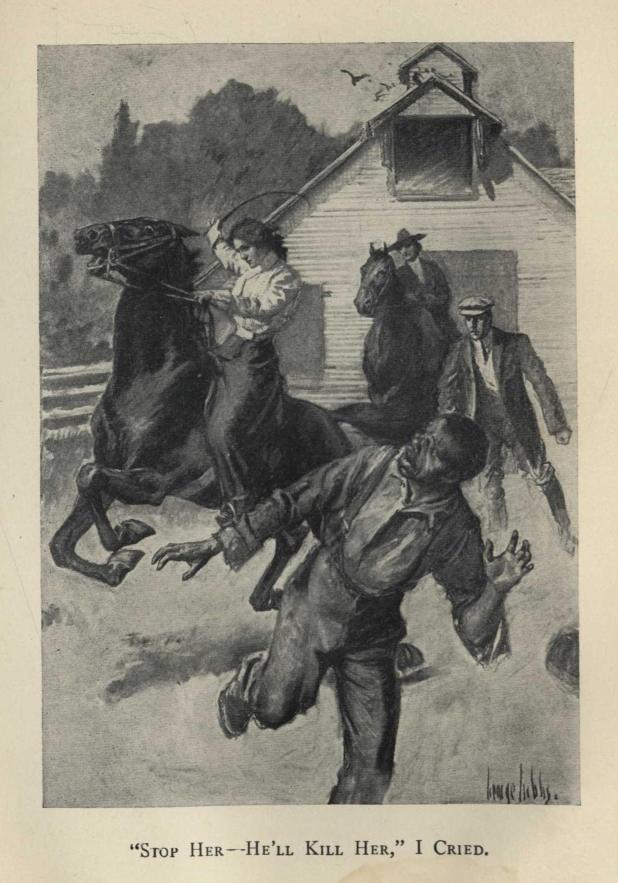
"STOP HER—HE'LL KILL HER," I CRIED.
I expected to see him strike the fence midway, and come back on her in a heap. Instead I saw Eloise lift him, with a quick firm hand, straight up towards the sky and I saw the horse land on the other side clean, and clear, without losing a stride. Then they vanished in a whirl of dust up the pike.
"I'll ride after her," I cried to Aunt Lucretia. "He'll kill her yet."
"Don't worry," she smiled, "she's more apt to kill him. But that jump, Jack, that jump—did you see it?"
My Aunt's eyes were ablaze with a kindled fire. I had seen it often when a race was on. She rode up to the fence. "Five feet six, Jack," she said laughing; "why, the record cross-country is five feet six—that's the record held by Colonel Goff's horse—" and she laughed again meaningly.
It was fifteen minutes before we saw Satan coming back! He came in a gentle canter, his great head held high in pride, because Eloise was laughing and joking with him, patting his mane and calling him sweet names. "You darling Satan," she cried, as she leaped down, "I did so hate to punish you!"
They say horses do not weep, but there were tears in the eyes of Satan as he rubbed his head against her breast, and nibbled the apple she held out to him.
Up the road cantered a horseman in haste, riding an English hunter. Eloise looked up and smiled. "I can't go with you to-day, Jack. Here comes Colonel Goff. I wanted you to see that jump. Isn't he great? He's done it a dozen times, and yet Colonel Goff really thinks he owns the champion." She laughed, her eyes shining. "I must run in and change my habit for the scolding I know is coming."
I turned sullenly in my saddle and rode off. I did not wish to see Goff take her away from us.
I did not enjoy the ride over the farm. The sick brood mare, with the young colt, which nickered so distressingly for Aunt Lucretia, alone excited my sympathy. I was heartsick myself. I did not even enjoy seeing Tammas and Marget.
As we rode away from the dairy we met Elsie coming down the wooded path, a smile on her pretty lips.
"That girl," said my Aunt, "is a fine creature, and do you know, Jack, if I know anything of breeding, she's got rare blood in her. It shows in a hundred ways. Now, watch her."
She was dressed in white, her hair hanging in two plaits down her back. "I am playing at being in Scotland," she said as we came up, "and I have gathered these Scotch wild flowers for Mr. Jack." She handed them up to me, and when my eyes met hers in thanks Aunt Lucretia saw the blush that flushed her face. She looked sharply at me a moment and then smiled. I walked to the barn gate, Elsie going with us, and telling me of the Scotch flowers and trees. "I would be quite happy here," she said, "if we only had the heather on these hills."
Aunt Lucretia turned at the gate. "You must come up to the house some night this week, and we'll have a Bobbie Burns evening," said she.
"Oh, thank you," Elsie answered, smiling at me instead of at Aunt Lucretia.
"Who was that you were talking to before we met you?" I asked. "The gentleman who rode off when he saw us coming?"
"That was Captain Braxton. He has asked my hand in marriage, but I dinna think I shall," she added, with a little sigh. "I dinna like him as I should, but I dinna say yet, for I shall think it over. He's noo like Mr. Jack." Her little Scotch words would slip in now and then.
I flushed and looked at Aunt Lucretia, who sat biting her lips as if in anger. Elsie was all frankness. She put her hand in mine trustingly, and instantly I knew why she had told me.
"No brother could love you more than I do," I said. "Tammas and Marget raised me, too, so I'm really your brother." I laughed to hide my anger at Braxton Bragg and the turn affairs had taken.
She had lifted my hand with a loyal little gesture and pressed it to her cheek before I could withdraw it. "You'll come to see me, often, won't you, Mr. Jack? I need you to help me."
"Jack," I said, smiling at her, "just Jack from now on."
"Oh, but that's not respectful, and I'd not be wanting in respect for you for the world."
"I'll not call you Elsie then, any more," I answered, "nor make the request of you I'm going to make."
"Jack, then," she said. "And your request—it is already granted."
"That you'll not see Braxton Bragg alone until—well, until I have talked with you," I said earnestly.
"O—h," and her eyes opened wide. "Jack, why, of course. If he writes to me again I'll send the letter to you before I answer it."
"Bring it," I said; "I want to see it right away."
We rode back to the house.
"Jack," said my aunt, "he is the most contemptible reversion to a scrub that ever came from a good pedigree! But if he tries that game on that child—he has played it recklessly since you left—I'll kill him myself—damn him!"
I soon forgot Elsie. I caught sight of Eloise entertaining Goff in our old bower, and I could see that as he sat there, smoking and watching her, he already thought she was the Countess of Carfax.
CHAPTER XI
TWO WAYS OF LOVE
I knew that Colonel Goff would not only stay the afternoon but the evening also. He had been doing it ever since the war, for he regarded his General's home as his also. The assurance of the man incensed me. The divine right of his old kings seemed to have been born in him; and now that he had won Eloise, she and The Home Stretch and all that it contained were his whenever he chose to have them.
Eloise would tease him in pure wantonness, and scorn him, and even ridicule him; for all of which he worshipped her, as is apt to be the way with men. Yet I very quickly noticed the little touch of sadness, which, despite her efforts, fell over her so suddenly. To her wit and repartee, her fun and humor, his only answer would be flashes of his fine teeth, and his favorite exclamation, "Fawncy now, but isn't that a blooming good one?" I was convinced that he loved Eloise and was proud of her; but I thought it was such a feeling as he might have for any beautiful animal, the same worship he might easily have bestowed upon an Arab mare of the desert.
It was not long before Colonel Goff and Aunt Lucretia were in their usual dispute about horses and he was scolding her for letting Eloise ride Satan: "Ah, that unregistered fool! Really, my dear madam, you should not let her go near him, he'll be the death of her yet. Now, there is my imported Irish hunter; he's got a head as well as legs; say now—suppose I just send him over for her," and he looked at Eloise to see what she would say.
Eloise threw up her fine head significantly.
"The idea, Colonel Goff! Why, I wouldn't be caught riding him! That big thing better than Satan! Why His Satanic Majesty can gallop rings all around him."
Colonel Goff laughed. "Fawncy!"
"Yes, fawncy!" said Eloise, mimicking him, which made him flush again and then look at her admiringly.
Aunt Lucretia broke in. "He can," she said very firmly. "I wonder, Colonel Goff, why you should send to England for a horse when you have better ones at home?"
Colonel Goff laughed loudly.
"Why you even think that bang-tailed son of Nestor can jump," went on Aunt Lucretia, laying her trap quietly for him.
This was the one strong point of the son of Nestor, and the one thing about him that his owner had published on his arrival.
"Madam," he said with great seriousness, a bit offended, "madam, I think I told you before that he held the championship for cross-country at Melton-Mowbry."
"Oh, so you did," said my Aunt Lucretia, ever so sweetly, "and yet I believe Satan can beat him both at the distance and over the hurdles."
Goff laughed, but not as though pleased. He was too well-bred to reply to Aunt Lucretia in her kind. So he only tapped his boot, and looked at Eloise, who smiled sweetly at him, as if urging him on.
"I was talking the other day to Secretary Roswick of our State Fair," went on Aunt Lucretia calmly, "and was entering some of my own things. Now, Roswick, you know, makes me put up about half of his programmes. He has asked me to get up some novelties on the side. We'll just have a hurdle race if you say so."
"Capital, capital!" said Goff, for the first time showing excitement. Then he quieted down suddenly. "What am I thinking about? What, in this unregistered country, could go against Nestor, champion hurdler of his class?"
"Satan," said Aunt Lucretia, smiling sweetly.
"Fawncy!" shouted the Colonel decisively.
"I'll lay you five hundred that he can," said my Aunt, "and I don't know a thing in the world about your game."
"Madam," said Goff, quietly, "I have never taken an unfair advantage of a woman."
"Colonel Goff," said my Aunt very seriously, "you know as well as you know anything, that if I know anything it is horses, that I am of age, and that I am good for all my obligations. I'll bet you five hundred dollars that Satan will beat your horse at his own game."
"Do you know, madam," said Goff, "that a jumping horse is born to jump? Not one in a thousand can go over a three-foot hurdle, and this brute of yours—"
"Brute?" said Eloise, icily. "Brute, Colonel Goff, he is an angel! He can do anything."
"And you will ride him?" he asked.
"Nobody else can," said my Aunt. "Yes, she'll ride him and beat you, too."
"I'll take your bet," said he. "I'd give five hundred dollars to ride once in a race with the only girl in America who is really English. How she ever got into this blooming country I can't see!"
I left my Aunt and the Colonel arranging their new game for the Cumberland meeting. I did not take much interest in Eloise riding against him!
I had ordered my horse, intending to ride over to Ned's; I wanted to see my pets there, Little Sister, and Captain Skipper and the new arrival. Eloise followed me through the wood lot. She came up and slipped her arm through mine, and its very touch carried a sadness, it seemed as if the quick electric pulse was gone. In her eyes there was a weariness, an indefinable longing. It touched me to see her so, my live, light-hearted, foster sister of old.
"Jack," she sighed, "I am—I am—" She stopped and looked up into my face.
"What?" I asked. "I should think you would be happy, so soon to marry an Earl."
"It is sooner than you suppose," she said seriously. "He does not wish it known yet because the proper notification has not come from his attorneys in England, but—but—Jack—Jack, his brother is already dead and he wants me to marry him. I have already promised to marry him next month."
I knew she saw me pale. I could have cursed myself for the weakness.
She went on. "When I promised him six months ago it was all so vague, so far off, and I was so miserable, Jack—so homeless and badgered, and dependent, it was all so far off, I thought—waiting for his brother to die, and now! You know how these English are, they take these things so seriously, their marriages and promises, they are so matter-of-fact about it, and so consistent: why, Jack, he looks on me already as his bride. He is just as busy planning for our future, arranging how the estate is to be remodeled, what home we are to have, I couldn't get out of it honorably even—Jack, even if—"
"Even if you should happen to love me?" I said, looking very earnestly into her eyes.
She nodded, her head dropped low. For the first time in her life I saw tears in her eyes.
"Oh, Jack, I am miserable! It was all so far off once,—now—only next month,—and you know I'd die before I'd deceive him—big boy that he is, and trusting and worshipping me, Jack. Yes, that is what hurts me—worshipping me as he does—I couldn't. I couldn't, Jack! If I have any one strong thing in me, you know it is—"
"Keeping your faith with your friends," said I. She nodded. "Do you think I am wicked to marry him this way? Won't you come, in after years, to despise me?"
For answer I stooped and kissed her. She put both her arms around my neck. "Please stay with me," she cried, "I do so need you. I just heard it to-day. It was why he came and stayed so long. Please stay and be with me till he leaves. Just stay with me, Little Brother, this time."
"Why," I said, "this time? Surely he will resent it. Any man would want this night of all others to be with you."
"Jack, you don't understand. I am miserable. That is why I rode Satan as I did. When I put him at that fence I hoped—it is wicked I know—but I hoped that he would kill me."
She was sobbing in my arms.
"Eloise, don't," I said; "let me go. Don't you know that it is harder on me than it is on you? Do you think I am made of stone—of wood—to come home expecting sweetness and find it all rue—my dreams about you—"
"Just to-night, Jack. You'll—you'll laugh at me when I say why, but, but, you know how punctilious these Englishmen are, and he thinks I must kiss him to-night when he goes."
I felt the hot blood rush to my heart. It was instinct, the reversion of a past ancestor who fought another man for kissing his wilderness bride.
"Eloise, you wouldn't?"
"If you'll kiss me again, Jack, as you did just now. I never felt so before—until—but it you'll kiss me again—that way, I'll never kiss him—never!"
I held her in my arms. I kissed her eyes, which were moist. I kissed her mouth, and it seemed as though my soul went into hers; for when, in desperation, in an exhilaration which was all but madness I broke away I heard her cry faintly, "Jack, Jack!" ...
I saw her arms around the great fatherly tree, her head against it.
CHAPTER XII
WORK AND MINE ACRE
There is but one balm for a heartache, and that is work.
Nothing in all my life had left me so stranded; had killed so utterly the sweetness of all my dreams as this giving up of Eloise. And with no dream there is no life.
I felt that she was lost to me now: if she were not engaged to Colonel Goff, there was nothing in me now, I thought bitterly, that could awaken in her the real love she had never felt for anyone. Yet with all her spirit, her apparent indifference, and even recklessness, I knew she had a throne in her heart of hearts for love on a higher plane than those who love easily. I knew that only one side of her had ever been revealed, either to herself or to the world; that beautiful as she was there was a yet more beautiful side to her; and that brave as she was there were yet deeper depths of bravery within her, a moral bravery which under the spur of her soul would take another leap, as far greater than that she took on Satan as the brave leap of Pegasus over the clouds. I had known her always. I knew what she did not know: that I was loving an Eloise that was yet, and forever would be, an unseen star in an unknown heaven, above the head of the man who had never yet learned to look up. Should I sit still and let him take her, let him do this irreparable wrong both to himself, and to her and to me? My heart cowered a moment at the thought of its hopelessness. Then—how wonderful is the word of the soul unto the soul, the passed soul to the passing soul, the absent soul to the present soul,—I thought of the words of Aunt Lucretia: "What would Andrew Jackson do, Jack?" Into my soul came the steel of Andrew Jackson. With the quickness of the thought came the change. "Aye, my unseeing old grandsire," I said, "you shall see whether I am a fighter or not! ... For Eloise."
From that moment I resolved to fight. God's blessings on the memory of Andrew Jackson!
But I would fight in my own way. For I knew that Eloise's idea of love was a love of life and death: she who would ride a mad horse over a five-foot fence for the conquering instinct of a mastering nature, what would she not do for love—her love—and she a woman? For let it be writ both of history and life, 'tis woman at last who loves. Man knows not love. Even as his own life came to him the babe of Love and Passion, so only can he give that unto another. But she who gave it being, her name was Love! Oh, to win such a love as I knew Eloise would bring to me; which she herself knew not was there.
I lost my bitterness of it all when it came clear to me. Before, I had been maddened to think she would barter this love of hers for title and wealth and the place it bought. But now I saw clearly, now I knew that she was blameless, because never having had that love, she knew not what she was giving away. Like an Indian princess, who owned an island of pearls, but did not know their value, she would give them to the first foreigner, coming down in ships, for the baubles of his forecastle.
But I would show my Princess what her pearls were worth. I would string them in globes of beauty around her neck, and brow, and belt, and I would put my crowning Great Pearl of Sacrifice into the diadem of her hair, and then I would lead her down to the sweet glassy sea of her own unbartered, unbought home, her own sweet kingdom of kindness and content, and by the still waters, in God's own groves, I would lead her until her feet dipped into the mirroring pools, and, kissing her, bid her look for the first time and behold Love crowned.
Would she barter herself for baubles then? Would she not know the difference between pearls and paste beads? I, yes, happy I, would show it to her; I would introduce Eloise to herself—Eloise loveless to Eloise in love.
I laughed now in the happiness of my little conceit. Very distinctly I could hear my Aunt Lucretia say: "Sure, Jack, that is the way Andrew Jackson did—took her from the toad who had deceived her, right out of his arms, and then killed every other toad who croaked about it. Sure!" ...
There was much for me to do, both of love and duty. My duty was work, and that came first. For I had faith both in God and myself, and if I did my duty and my work, God would give the rest to me.
Work—the glory and sweetness of it! And to find one's work in one's life—that One Work which fits the One Life: this to me has always been the greatest gift of the Giver.
There was so much for me to do. I was the pioneer of a great truth in the world's greatest country. In all great causes it is the pioneer who is the sacrifice, it is he who is held up to contempt and scorn. Strange that it should be so! That he who sees first the Great New Truth, the Blessing that has been withheld because of no one to see it, the Great Invention uplifting through one man all men into a new world, that it is he who must suffer....
The hurt does not matter from those who love us not. I was willing that the herd should think of me as it would, as its own little light permitted, but I had that pride of race which every honest man has, and I wanted the love of my fighting old grandsire. And he openly despised my profession, and he secretly despised me. "What's the use of worrying about making more on an acre of this rich soil?" he would say. "Ain't The Home Stretch rich enough? And fiddling about saving trees—why damn it, ain't there too many of them already? Didn't I have all the hard work of my life clearing some of the land, and my father before me, that it might make us a living!"
He would never understand me, of course. The discoverer is never understood, and the forester falls in the same class, more maligned than any of them. He would never understand that it was not a sentimental dream to save trees because they are trees, but to grow them and harvest them in the right way, even as wheat is harvested: that we did not want to see rich acres, the homes of unborn people, covered only with trees, when the land was needed for bread, but the unfertile hillside, and the heads of our water streams. There, we insisted, trees should remain because that was Nature's own way of protecting the land from droughts and floods. Nor could I hope to make him understand that rich as the land was—even as a man of genius—it should have a chance to bring forth all the fruit that was in it. That our waste was something appalling, our methods crude, and that our people, with all their plenty, were only half fed; that while we were rich and The Home Stretch was a garden, the poor farmers of the hills and less fertile places were living only half lives, they and their families, because there was no one to show them something better.
My Aunt I knew was sorry for me; but I could see she hoped and believed I would yet get over it. And in my own heart I felt that if I had chosen West Point, perhaps Eloise—
I flushed, ashamed. How prone our little weak Self always is to play Arnold with our Soul!
I began at once to work. It is what one does with one's own acre, not what one preaches should be done to the acres of others, that convinces his neighbors at last, and settles the standard of his life's text among them.
I started it on a gullied hillside of The Home Stretch. These gullies I filled. Young trees were easy to transplant from the over-crowded growth of the woodland. Nature is at last her own greatest doctor. I gave her the soil she had been begging for, and very quickly she studded it with little pioneers of the game black locust, to hold back that which she had, to shadow it with coolness and damp that grass might grow beneath, and mold form, and the blistered soil have yet another chance, and that later the trees might rear their great heads high, stealing from the clouds the moisture for the earth.
My neighbors knew me, had known me from a boy, and it was not difficult to get them to meet me at the little schoolhouse once a week and hear my talk. Now talks all depend upon one's honesty and earnestness, not on one's brightness; in a month they became interested and were one with me. They had always looked upon a forest as a necessary evil, as a great wood put there to be cut down, burnt, destroyed, that man might till the land. Indeed, from their pioneer fathers, whose greatest burden was clearing the land, there had come down to them the instinct of forest hatred, just as had come their instinct of Indian hatred, bear and wolf and panther hatred. But at the same time I knew that they had in the heart of their pedigrees another and sweeter instinct, and that it came from their forest-loving Briton and Saxon and even remote Aryan sires, whose ancestors before them, had long ago gone through the same fight with the primeval forest, but whose children after them for a thousand years, from the North Sea to the Mediterranean, were forced to go back to tree-planting, to forest preservation, or die with their soil. It did not take much to make this forest preserving, land-preserving, life-preserving instinct outcrop again among their children here. It was a revelation to them when I explained that the true forester was he who assisted the farmer and the lumberman in rearing more trees and better trees where they should be, and destroying the worthless ones, even all of them if need were, where they should not be. In their prejudice they thought a forester was a dreamer, an impractical person, who preached forest preservation from sentiment, and would let the trees grow where children ought to grow. I won them all when I explained that a tree, when ripe, should be garnered, just as corn or wheat, or any other product of the soil. But during the years while it ripens for the saw, the young things beneath it, which should take its place, must be protected, and their life preserved in the harvesting of the ripe trees; or if the land was to be cleared for tilling, other places on the farm, especially the unproductive hillside, and the sources of the stream, should be given over to forestry. This would save the hillsides from washing and depositing their flinty soil over the rich valleys below, and guarding the water head, preserve the springs. But when the tree is ripe it should be harvested, unless it stood in some park or yard or town for a street ornament or shade. If it were in any of these places it should die in the ripeness of beautiful old age, a younger one taking its place. It was not long before I had a class of forestry, and there was much of the German methods I had learned in every branch of farming which I gave them for nothing, that helped me greatly. It is what one gives for nothing that brings in the greatest returns at last.
But my greatest help was in a flood early in May. The headwaters of the Cumberland lie in the Appalachian range, that great wooded mountain strip which mothers the headwaters of the Ohio, the Tennessee, and the Cumberland, and so of all the states they water. That long ridge of wooded slope had been a sponge, the gauge that controlled the flow from half the tillable Union. On the Tennessee, the forest had been brutally butchered, and on the Cumberland as badly treated. The flood came. There was but little to hold, and check it, and we had a deluge such as was never known before. Even my grandsire, seeing it, admitted what I said. The seemingly wasted word had fallen as the drift of the elm tree's shaft had taken root in a corner of the old field.
CHAPTER XIII
THE UNATTAINABLE
My work took me daily to Tammas's cottage. There was nothing so restful to me as these two good people, and their sweetness and cheer, and Elsie held my interest. I had always been fond of her, and now that she had grown into this rare, delicate flower, so sensitively turned, so romantically original, I found the greatest pleasure in studying her, and, in humoring her, as everybody did who came into her sphere. She commanded obedience as readily as she gave it. Every day was a different mood, and always a romance with her. One day she had on a large white apron, and was helping Tammas with the churning.
"I am playing a new game, to-day, Jack," she said, pulling me to a corner of the dairy where the spring water whirled through the stone troughs. "You'll laugh when you hear it," she added, her eyes shining into mine.
"I'll not," I said, "I'll be more apt to play with you. What is the game to-day?"
She laughed merrily. "Well, to-day I am a duke's daughter, who was secretly exchanged in her cradle with the dairyman's baby. Now only three people know it; the dairyman, who is old, and about to die; and who is so sorry that he ever did it, but he did so want his own daughter to be a lady in the land; and me, whom he has told at the last minute, and the bad, bold knight, very dashing, who has bribed the dairyman to tell him, and who wishes very much to marry me. But I want to marry my own bonny prince, you see."
"I should think he'd be proud and loyally love his dairymaid bride," I laughed, pinching her cheek.
"But, Jack, you are so stupid," she said, pouting. "You don't catch on. I can't play a game by myself. I want you to play the prince."
Tammas stood looking on, his face in its favorite Scotch grin. "Weel, weel, did ye ever hear the like o' that, an' it's no' leap-year either!"
I could see that he was pleased and proud.
"And it is the prince I'll play from now on, my ane braw lassie," I said, dropping into her own dialect. "Isn't that what you call them in Scotch?" I asked.
"An' noo," said Tammas, "a' lasses get unco thrang when their lovers are aboot, to gar them think they are unco worthy."
Elsie laughed and went vigorously to work, molding butter pounds. I stood watching her while I talked to Tammas. She was not all a child. There was a certain queenliness, a quiet dignity about her that was very attractive. In her fine-cut face, deep down in her great blue eyes, in her very poise there was a quiet naturalness, a pretty aloofness which spoke of reserve forces, that seemed to soothe me. God only knew how I needed it!
After an hour with her and Tammas I felt, as I went down the wooded path, under the great trees of the dairy lot, as I had when I heard for the first time, in the deep hours of the night, the chimes of the bells of Munich. I had not cared for the service with all its symbols and, to me, its meaningless metaphors; but I had loved its music, the great bells which calmed my soul.
I wish to join a new church. I am tired of these which preach. I want to join one where there is no preaching, no talking, nothing but music, music which makes you feel God. Why all this preaching anyway? God and talk do not go together. Religion is not a science to be proven, not a thesis to be demonstrated, not a problem to be solved, but a silent Soul-Force to be felt.
Preachers and priests in their vanity to be heard, or their zeal to proselyte, or their over-humanness just to talk, talk, talk, have robbed the church of half its sweetness and power. Will they never learn that God's house was made for God's children and in it they should do as God does,—be silent and worship? And if there be a voice to break it, let it be the Voice of that which is nearest to God on earth—Music.... It was this feeling that Elsie gave me—of calmness, of restfulness, of devotion. There are those who irritate us, and they cannot help it; there are those who provoke us, anger us, madden us by their very presence. There are others who stir us up for trade and money-making; the sound of whose very voice makes us wish to own land, or buy stock or build houses; and there are those—God help them—whose talk, be it ever so brief, falls over us like an unwholesome thing.