Front matter (continued 3)
Reading edition
Elsie read much of romance, and her small library was choice; but the love-poems of Burns she knew best of all, and she always read them to me when I was about to leave, as if she would hold me longer. Then I would remember them far into the night and the radiant-faced, spiritual girl with the deep eyes, reading them. I needed the restfulness which Elsie's friendship gave. I needed her sweetness that calmed me, her fresh friendship that was like a great rose at the window of my soul. In her utter unseekingness, her loyal trustfulness, I saw that she did not even suspect that I loved Eloise.
I stayed all day at the cottage and she flitted around with her great white apron on, now and then calling me her bonny prince, especially if Tammas and Marget were not around. I humored her, seeing how much pleasure she took in it.
"If I am your Prince," I said, when I had her alone in the butter room, "I am going to call you my Heart's-Ease."
She looked up quickly and a faint blush came into her face. She did not reply, but busied herself about the house, while Tammas and I talked of the new test of Lass o' Lowrie, one of his cows, which, from five gallons of milk daily was making three pounds of butter.
"Dae ye ken Mr. Jack, whit's daeing it?" said the old man. "It's nae ither than the auld Top Sawyer bluid!"
Elsie, daintily gowned in a pretty white frock and for the first time with her hair up in a comical little Scotch top-knot, walked with me down the wooded path to the parting of our ways. A tiny heart's-ease had just thrust out its fragrant leaves in the rich mold under the trees. She plucked the leaf, and there was the faintest trace of a twinkle in her blue eyes as she came up and pinned it on my lapel.
"Here is your heart's-ease, my Prince," she said slyly.
I felt a flush upon my cheek. She was silent, and then she said slowly, "Do you know Mr. Jack—Jack, that I believe every prince at times has need of a heart's-ease friend, and—and—well, maids need a prince to help them."
I looked at her quickly.
"I am your good Knight always if I can help you, Elsie."
She flushed and turned her face aside that I might not see it.
"And you won't misunderstand?" she asked.
"I don't think I could misunderstand you, Elsie. I don't think anybody could."
She came up closer.
"Well, it's this, Jack. Sit down here by me. I have no one I can confide in but you. You know how kind you have always been to me. Ever since I was a wee bairn in a strange land. I can't talk to Tammas about it, but I feel there is something strange between Colonel Goff and me. I feel that there is—"
I started. She was pale, but went on.
"Well, you know, I didn't come here with them. I didn't come here with them—with my grandparents; that was so long ago I don't remember what is back of it. Anyway, soon after I came I remember Colonel Goff. And do you know," she went on, "he has been so good to me that—that I cannot understand it at all—only I feel when I am with him that I am drawn to him so! Oh, I have seen so much in him that others don't see—and when I see him watching me so closely and saying nothing, it hurts me."
She did not finish, but looked down the path, up which Colonel Goff, himself, was riding towards us.
Elsie paled and then flushed quickly. He was smiling at us, his little eyes twinkling kindly. He gave us a quick military salute.
"My word, a tête-à-tête, and a bloomin' fool it is who'd break in on it. Hello, lassie—Jack!"
He got down from his horse, shaking hands with us gravely. I noticed that he was watching Elsie, and she, knowing it, was reddening.
"You are a good guesser, Colonel," I said, with feigned lightness, for I felt that he was taking it too seriously, "and pray tell me who would not like to be with so fine a lassie?"
He looked at me quickly. "If you mean that, Jack," he said, in his blunt, unseeing English way, "here is my hand."
Elsie broke into a little confused laugh. "The idea of pinning Mr. Jack down like that," she said, looking bravely into Goff's eyes. "What else could he say? Now give me that box of candy. I see it sticking out of your pocket."
Goff pulled out the box of candy, and catching her to him, kissed her on the cheek.
"She is my own lassie, Jack," he said, holding her an instant in his arms. "I have loved her since she was so high." He paused. "Well, perhaps it was because I was an exile in your country, and she is the Scotch flower I found blooming here. Eh, lassie?"
Elsie kissed his cheek.
"You have been mighty good to me, Colonel Goff. But go your way. Tammas said he wanted to see you if you came by and—well—Mr. Jack and I want some candy!"
For a moment he looked at us queerly, trying to smile. He glanced into my eyes, but I met his squarely and unflinchingly. He was not a man whose mental action was quick. He saw but one side of things at a time. I saw that he was embarrassed in his slow way. Very awkwardly he left us, going up to Tammas's cottage. Elsie walked on with me.
The wind blew her hair around her temples and the reflection of the blue hills of Scotland was in her eyes. "This is such an inconsistent world, Jack," she said after a while. "I can't ever learn it, and I get so lonely up here with only Tammas and Marget, I often wish that they would tell me more of myself. I should so love to know who my father is."
"Did it ever occur to you that it might not be at all pleasant for you to know? They love you and they want you to be happy."
She paled. "I had never thought of that. I had never thought of that—oh, why didn't I think of it!"
"Elsie," I said, taking her hand in mine, and drawing her to me as I had when she was a child, and I her big brother, "you have no better friend than I. Tell me what it is that is troubling you?"
"You would hate me, Jack," she said, looking up quickly into my face with great, earnest eyes.
"Hate you? Nonsense," and I laughed, pinching her ear. "Tell me," I pleaded, smiling.
"Nay, nay, bide a wee—bide a wee," she said abstractedly falling into her childhood's dialect as she so often did when she forgot. "And first," she went on, "why, first I'd have to kind of explain it, Jack; but it is like this now: suppose one was not satisfied with one's lot and had those feelings I have been telling you of."
I nodded.
"And suppose—now this is the worst of it—now suppose one really loved another—one found one's soul dream," she paused, blushing.
"Soul dreams, Elsie, ay, I think I understand," I said. "I too have them—they are the great, unattainable things of our life. Do you know I think that their being unattainable is what makes them great?"
She looked up. "If it is worth so much—this unattainable thing—why then does it hurt so?"
"Ay, ay, that's it. It is the things that hurt which count. 'Our sweetest love is always sweetest pain,'" I said, quoting the line of a poem.
"Oh," she said, clasping my arm. "You have said it, Jack."
I looked at her quickly.
"Elsie," I said, "you once told me—do you remember what you said to me and Aunt Lucretia—about your hand being sought in marriage? Is it the same person you now speak of?"
"It is Captain Rutherford," she said, her face drawn tensely.
I started, angry, flushed.
"Elsie, this will never do. Do you love him at all?"
"No, Jack, not as compared to the other—the unattainable. Well, I should say about as the difference between a—well—say a star and a little firefly."
A dry, fighting anger clinched my throat and I could scarcely speak. I could have throttled Braxton Bragg then!
"Tell me, Elsie," I said, controlling my anger and trying to speak calmly, "tell your big brother all."
But she was silent, her face turned from me; at last she said, "It is all so strange, Jack; those we love, love us not, and those we do not love want to marry us even if they are not fit to."
"Not fit to hold your shoe, let alone your heart," I added angrily.
She put her hand over my mouth.
"Have I done wrong? Have I said too much? Come, I must go. I see the Colonel waiting for me."
I took her by both hands, holding her before me, for I was strangely worried and I wished to know—I looked earnestly into her eyes.
"Do you love me, Elsie?"
She blushed crimson. In an instant her arms were around my neck.
Shamed and stricken with my own thoughtlessness I tore her arms from me.
"Elsie, forgive me, you don't understand!"
In reply she gave me one shamed, hurt look and fled up the path. I saw Goff waiting for her.
CHAPTER XIV
GOD AND A BUTTERFLY
I saw a race for life the other day. It occurred in mid-air in a kingdom not of earth—not of our own; but the air was sweet where the fight was on, and the fields were green, and the woods lay calm and soothing beneath, and the great, kind sun was above.
It was the pursuit of a golden-winged butterfly, one of those filmy creatures that is more of sky than of earth, made of rainbow and a rose, of light and a lily's blossom. It seemed strange to me that this beautiful thing, thrown off from the rim of a rainbow, living on the nectar of a flower, sleeping on the bosom of a nodding lily and floating on the breath of a zephyr, so spiritual it was, should fall under the cruel laws of life, and be forced to fight for its brief but beautiful existence.
Who were its enemies? Two glorious mocking birds that had sung like spirits from an heavenly choir around the house all spring and summer, that had been permitted to live and rear their young in contentment and happiness and should have held no grudge against any other creature.
Golden-Wings was in the garden, and he was content until that which sustained life gave out—food. Ay, there is the rub! We would all be angels if it were not for food, we would be saints but for our stomachs. He had sucked every flower in his pasture, he must go to pastures fresh or die. The distance was only a few hundred yards of air, but he knew that in that air was death. He thought of it a long time as he hovered from flower to flower; of life, of his mate, of death. Had he been all spirit he would have stayed forever among the flowers, but he was like all of us, half spirit and half flesh, and the flesh of him was rebelling and begging for food. He must go. He rose slowly, and with uncertain wing, frightened, straight up, every sense awake, every nerve keyed, his eyes on the lookout for his enemy. Up, up he rose, quivering, scared, frightened, then he winged his way across the ether in a flight which proved to be for his life.
The mocking bird is a flycatcher, but not an expert one. Compared with the swallow, the martin, the crested flycatcher or the bold king bird he is a poor imitation; but the mocking bird is also a poet and everything is grist that comes to the poet's mill, from the grasshopper on the ground to the butterfly in the air.
The male bird saw Golden-Wings and gave him the first heat for his life; up in the air he darted, circled and swooped. Golden-Wings, terrified, ducked, dived and escaped. The poet dropped to a twig in disgust and his mate took up the fight. Golden-Wings saw her coming and his heart swelled with fear; he stood quivering in the air, he knew not which way to turn. She darted straight and all but caught him; for a moment in mid-air they whirled, twisted and tumbled, Golden-Wings, panting and fluttering for a chance once more for home and love and life, and the poetess for a morsel to eat. It ended in the butterfly getting above the bird, which always seemed to be his tactics, and the latter dropped down in disgust to her mate.
Then, maddened, they both started after Golden-Wings, and it looked as if this flight was to be his last.
It was a terrible chase that the two poets gave him, the tumbling, darting, circling of the birds in maddened earnestness. Their wings were often so close that they fanned him about like a whiff of gold tissue paper in the wind. Twice they got above him, dropped and missed! Then he was lost altogether, and only by watching the circling of the birds could one guess where he was. When seen again he had got above his enemies, and was steadily pursuing his zigzag, frightened, graceless, paper-fluttering flight for the distant trees and life!
"Luck to you, O Golden-Wings!" I cried. "For already you have taught me a lesson for Life. Let us keep above our enemies if we would be safe, not beneath them—for there we are a prey to their talons, besmirched with dirt; nor on their level, for there we are no better than they; but above them where they cannot reach us, and where we may go on to our destiny with only the sunlight around us and the unseen stars above."
The birds dropped down, baffled, to rest in the top of a sugar-maple tree. Like all poets, in losing their game they had lost their temper, and now between panting and hard breathing they could be heard quarreling. "It was you," said the wife, "you conceited thing; it is all your fault! I had him once if you had let me alone." "Oh, you had him, did you," sneered the mate; "if your talents only equaled your tongue you would be better off!" They almost spat upon each other; they were beaten and angry and they took it out that way.
Golden-Wings was safe. He was high up in the air. His very flight was now the flight of victory. Twenty yards more and he would drop down into the great splotch of green below where his wife was waiting him on the blossom of a wild cherry.
I was about to cheer him with the silent approval of true applause when I saw a lightning bolt of red drop from the jagged bar of the dead limb of a great oak near by, in the midst of the forest and high above the weary, yet happy Golden-Wings. I paled at the sight, for I knew that no butterfly would ever escape this new-comer. Even Golden-Wings recognized his fate, and, paralyzed with fear, stopped his flight in mid-air in a few yards of his home, and lay quivering in hopeless fear. Well he might, for the red and white bolt was a red-headed woodpecker, a very king in the tribe of the flycatchers. Often I had seen him poise above an air-bound moth, then drop like a dead bird in the air and no moth would be there.
The hand of the world is against the marauder, be he bird or man. But they revere the man who robs by rule.
Straight at Golden-Wings he went. The race was up. He used the same old tactics: above the butterfly he soared, then, gauging the distance from his own great beak to butterfly beneath he folded his wings and dropped like a plummet of lead.
I was out that morning with the twelve gauge, smokeless shells and seven and a half chilled shot. It was thieving crow I had come after, thinking I might get a shot. To the marauder my thought was as lightning, for when I caught the first flash of his crimson head, this went distinctly through my mind: "Nature is Nature even to tooth and claw, and yet there is that which says even when a butterfly shall fall. He makes our lives and marks out our destiny. Sometimes amid injustice, He calls himself Retribution. And then He has been known to raise up a man, and a gun, invent smokeless powder and deadly chilled shot, give accuracy of aim, and, most wonderful of all, the Voice of a Purpose to say that harm shall not happen to a Butterfly."
There was no smoke from the report, and so I distinctly saw Golden-Wings drop joyfully among the green leaves. But a red marauder lies in the field where he fell.
CHAPTER XV
HICKORIES AND OLD HICKORY
June, and June as it breaks only over the Middle Basin.
There had been great rains, saturating the leaves and grasses until they were almost blackened in their deep greenness. There had followed, flushing the grass on all the hills around the Hermitage, the mauve tints of coming dandelions, followed by the red, white, and blue flags of the clovers, until across deep valleys and on distant slopes there was a pale light much like moonlight.
I had been very busy. There was much for me to do, and I sought it eagerly, for I wished to forget and not to see. It is what we fail to forget that hurts. And so I worked.
Colonel Goff, as was his race, had acted straight-forwardly in the matter of his marriage to Eloise. Over a month ago he had sought out Aunt Lucretia and told her frankly that he sought the hand of her ward in marriage, that he wished to marry her and take her at once to England. He said that his brother, the Earl of Carfax, had died without heirs, and that he inherited the estate. The family name, he told her, was Goff, and he had kept it while in America. In the early fall his attorneys would have every legal provision complete for his return, and for immediate occupation of his estate. And he told her with equal frankness why it could not be done sooner, that in his younger days he had married out of his class, and had been blacklisted by his family for it, especially by his elder brother; that they had had not only hot words but a stand-up fight in which he had all but killed, and had really maimed the older brother for life. "I had to get out," he said brusquely, "and get out quick. As it was they tried to disinherit me, but England's laws are greater than England's men. My wife was to follow, but she died."
My Aunt was a woman of great sense and said nothing. But I noticed that she thought much, because she was very silent, and that she grew suddenly very tender to me. When Eloise had gone to Washington my Aunt went with her. Two things happened before they left, which I remember quite distinctly.
My Aunt's admiration for the character and achievements of Andrew Jackson bordered on the idolatrous. As a boy she would take me often to the Hermitage, and tell me of the wilderness giant who lived there. She knew more about him than anyone I ever met. She understood the thousand sides of this man's great nature, from his horse-racing to his religion. In the spot where he had lived so long there was, of course, a world of tradition. It came down from lip to lip. Of these stories my Aunt remembered all. A few days after Goff had talked with her as my Aunt and I were going over the grounds she stopped before the log-cabin in the pasture near the great spring where Jackson lived before he built the present Hermitage.
"Jack," said she, "Andrew Jackson was the gamest thing God ever gave to humanity, and the gentlest. It is staggering to think what he had to overcome to do his life's work. The fights, the sicknesses, the suffering, the slander, the insults, the lies, the butcheries they called battles, starvation, mutinies of his own men, all met and overcome by one tall, slim, sallow, pain-wracked man, on one thoroughbred horse, with a gun in his hand, and two in his eyes. Talk of Indian fights—Mills, and Cooks and Custers—they were child's play to the great Creek Nation Jackson had to fight. And England behind them—selfish always and forever wanting that of others."
She looked at me quickly, and went on: "But he waited and then hit them hard. No one, from Hannibal to Cæsar and Bonaparte, would ever have attacked Keane and his troops, just landed and in an open plain with New Orleans at their mercy before them, in the night-time as did Jackson and his ragged, half-armed militia. No one would ever have risked it but Jackson; he was greater than them all! For that seemingly foolhardy night attack saved him. He cut the very vitals out of them in the dark. He hacked them as a game cock does when he sticks his gaffs into the very heart of his foe. That was why on January eighth they could not go over his breastworks, even with the combined force of Packenham and Gibbs and the troops that afterwards won Waterloo. He had gaffed them in the ditch in the dark. He cut them into giblets. It was hell with the lid on. They say it was a useless battle, but they lie, Jack. If Jackson hadn't stopped them, they would never have given up the Louisiana Purchase until we drove them out with another war. There are two kinds of men, Jack—talkers and doers. The talkers are all orators—they are all liars. They began with Aaron, whom God made a mouthpiece to Moses. Moses was the doer, but he could not talk. Aaron, the orator, talked for him, but it is Moses who lives. Jackson was a Moses, Clay an Aaron, a dead one, Jack, as all Aarons are, and growing deader every year. All orators, being liars, fool people while they live. Dead, they do not even fool themselves.
It was Clay and Crawford who let the British make that treaty of December twenty-fourth in which they said that they would not be bound by Bonaparte's constructions. At that time Lord Castlereagh had every reason to believe that Packenham, sent out November twenty-fourth, with the best army and navy that ever left Portsmouth for a foreign shore, had taken the 'crown colony of Louisiana,' as they called it. And under that treaty they would have held it. It was Jackson who stopped them, just one day before that treaty was signed.
"Yes, Clay is dead," she said laconically; "he ought to be.
"They wanted New Orleans, and they wanted it bad. 'Booty and Beauty' was the word they passed down the line when they landed and started across the Chalmette plain, to take the fair Creole City. They were going to take her and then rape her as they did the cities of Spain, and they would if Jackson had not gaffed their very vitals out in that night attack of December twenty-third."
She turned suddenly on me, her eyes ablaze. "Do you think, Jack, if he had loved a girl and an Englishman wanted her bad enough to take her right out of his arms that he would have given her up?"
I looked up quickly and her face flushed with fighting fire.
"And he was the tenderest, Jack," she went on calmly. "Old Parton tells a pretty story about him. One bitter, sleeting March day, an early lamb had all but died in the field here, and his little adopted grandchild, a tot of four, found the lamb and cried for it; and so Jackson brought them both to the house, and by the fire; and to comfort the child he took them both into his arms and so sat here, before this great hearth, holding them both in his arms.
"He, who had killed bad men as he had dogs, who had cut to death the pick of the army that later won Waterloo, he sat coddling a lamb and a child and thinking of his dead wife, and she,—oh, Jack, I all but shed tears when I think of it! The night she died, and he would not have it so, but lay all night beside her, holding her in his arms, and trying to get her warm again, with the great love of his own great heart."
There were tears in Aunt Lucretia's eyes. Oh, the depths of her stern heart! It is like the mountain capped with snow. But when the snow melts and the flowers come up among the crannied rocks there are no flowers in the valleys below that equal them.
The other recollection was of Eloise. It was the night before she left for Washington. Colonel Goff, who had spent the evening with her, had ridden off. I, pretending to work, was really listening for her footstep, as she came back to her room up the great steps.
"Jack," she said, standing just outside the window, "come." And she beckoned to me.
We sat down under the wisteria vine, which grew over the porch.
"Jack," she said, "I want you to do me one favor. No one loves Satan here but you and me. Won't you take care of him while I am gone? Ride him whenever you can, the harder the better, for he is made of iron and needs it."
"He and I are good friends," I said. "I have ridden him daily. We understand each other," I added softly; "we both love you."
"And Jack," her hand was instantly in mine in the old way, "in after years you won't think evil of me for selling myself this way, will you?"
"Why, no," I said seriously. "I have been thinking of it, and all life is just a barter and trade."
I saw her face in the starlight.
"I've no right to make you wretched like this, Jack," she said, rising. "I am going in; and when I return do you be gone Jack, somewhere—anywhere." Her voice trembled. She stood quiet, and I by her, dazed and helpless.
"There is one thing I am going to take to England with me, Jack," and she pulled out from beneath her gown yoke, a little token I had forgotten. I recognized the locket and the chain I had given her years ago. "And this little picture in it is you, Jack. You gave them both to me the day I helped you lick Braxton Bragg."
Then she turned quickly and left me.
"Jack," said my Aunt, as we parted the next day at the station, "I am afraid things are all against us. Father, I see, is going to will The Home Stretch to Braxton Bragg. If I were you—"
"I have already done it," I said. "I am going to move to-day to Dr. Gottlieb's; there I shall work out my plans."
My Aunt smiled grimly. "I want you to remember one thing when I am gone. Don't give up—remember Old Hickory."
I looked up at her quickly. I saw something in her eye that gave me heart again. I bade her good-by. I dared not say it to Eloise. I slipped away, but I watched the train of cars die away behind the trail of smoke in the distance as I rode back home, and it seemed as if my whole afterlife lay clouded in that path of smoke. It was hard to give up my home, the old home, every tree I knew, and with them Eloise and my life-dream....
One's dream and one's home—what else is there which grips so the very tendrils of one's soul. To give up one cuts deeply into the roots of the heart, but when the blow is doubled, there is only one thing that can make one stand upright and not fall, and that is the Spirit Within. People have different ideas of God as their souls reveal. It runs all the way from the pitiable, crude, faint conception which comes to the savage in cloud, a sun, or star or image of stone, to the higher mind which perceives Him in the Great Spirit of the Universe. None of these is my idea of God. I have never been able to dissociate God from my own self. I have never been able to conceive of Him as apart from me.... And not always the same, but always there.... In my meaner self so little of Him is there, so tiny a spot of the divine light ... so faint, so seemingly nothing. And this is the greatest of it—this is the test—the very divinest evidence. He is always there; and when a blow comes, humbling the material, the meaner of me, then He claims His own—my nobler self—taking it unto His care, flooding it with His presence. It is then, searching yourself and your own heart that you find Him—that you know that you are a part of God because He is there!
Riding home it all swept over me so. In my innermost soul I knew it: like a flash came the inspiration of it, the old Prophet of Deuteronomy: "As an eagle stirreth up her nest, fluttereth over her young, spreadeth abroad her wings, taketh them, beareth them on her wings." Did God mean in this, the wrecking of my nest, that I should fly—even as a young eagle?
"And remember Satan, Jack, to keep him fit," I heard Eloise's voice say.
CHAPTER XVI
HEART'S-EASE
Never was there a quieter, better place to work than at Dr. Gottlieb's, whither I had gone after Aunt Lucretia and Eloise had left. In a short while I had become reconciled, in my hard work, to my lot; for to live with Dr. Gottlieb meant to work, to classify, to probe into things, and this meant to put aside all else, even for awhile one's heart's trouble for the hard mental strain of it. I remember those study nights well and with such pleasure. I can recall the little quiet man with his books, his abstraction, his quaint comments, the learned deductions that fell now and then from his lips as if he were unconscious that he was speaking. From studying the pollen of a flower he would look up abstractedly and drawl, "Ah, Jack; and Miss Lucretia—that most beautiful and charming of women! Did I ever tell you that each of us has our prototype in a plant? And how much to my mind—ah, Jack, and to my heart, how much she resembles the beautiful red wood lily!"
He would put down his book, and look longingly out over the hills. It was the only foolish thing he ever did, I thought, and so I forgave him, knowing that each of us has at least one foolish thought within us.
He always had a smile for me; often he would walk around all the evening thinking abstractedly, or puttering among his books and plants and geographical specimens, and then start into real work at midnight. And I would work with him; for, besides studying my forestry, I was carrying on some experiments, testing the various effects of fertilizers on the soil of The Home Stretch. Dr. Gottlieb would say: "It is not the time, it is the inspiration, Jack; catch it when it comes."
Exercising Satan daily as I did, I became as attached to the great game fellow as did he to me. He was a singular horse, of a type entirely his own. The harder the ride, the more difficult the feat, the stubborner, gamer he grew. Not every horse is an individual, in fact few are; they are horses merely. But Satan was one, almost human in his idiosyncrasies. If he had been a man he would have been one of the world's leaders. There was nothing he would not do for me after he learned to love me.
Even in my heartache, in my despair at giving up Eloise, I thought often of Elsie; for, having known her since she was a tot of three years, when she came to live with Tammas and Marget, riding her, a wee girl in front of me on my pony, going with her, a little maid, over the hills to hunt for some Scotch flowers, I had that attachment for her that one has for a little sister. She had developed far more beautifully than I had dreamed of, both spiritually and in body; for the connection between them at last is the same. I had never thought before that there was any mystery about Elsie. Tammas and Marget, with all their apparent frankness, had the greatest inherited trait of their race, a shrewd secretiveness when it was best. Heretofore I had thought of Elsie only as their orphaned grandchild. I supposed her father was some sturdy Scotchman of their own class, who, perhaps, died after his wife, or, if alive, had given her to her grandparents. But now I saw differently; perhaps her beauty, and the romantic turn events had taken; the Juliet outpouring of her own exquisite nature had touched in me some subtle instinct.
It was this affair of Braxton Bragg which worried me most of all. I had not seen him since I returned. I did not want to. There are those born into our lives who seem always to oppose, thwart, counteract what we do. Braxton Bragg had played this part in my life. I could not escape him, try as I would. Even when I was in Germany, with an ocean between us, had he not cheated me of my own birthright? He was with his company in the city of Nashville, where the Tennessee troops were mobilized for the war. They expected orders to sail for the Philippines any day. All his life Braxton Bragg, weak as he was in character and mind, with that conceit which often goes with weakness, had really believed that, after he had acquired The Home Stretch, or a greater military reputation in the army, he would marry Eloise. All his life he had openly proclaimed it. His mentality was not great, and he had not yet learned that in real love monies, farms, reputation, fame, are the least that count.
Goff had won her. Braxton Bragg now knew that. Goff had always befriended him, and bore with him more than anyone else. Goff had confided in him and trusted him. Braxton Bragg was as immoral as he was weak. Therefore I reasoned this matter lay in one of two ways. Either he was recklessly scheming to deceive and ruin Elsie, or else he had found out something that none of us knew and was scheming to marry her on account of it. Besides deceiving my grandsire, as he had all his life, I now learned that he had further deceived him:—that, graduating from West Point, he had been appointed to the army, but even before he went on duty, he had been caught in an act unbecoming a soldier and gentleman, and to escape courtmartial had resigned. My grandfather's influence had saved him and got him elected captain of a company which my grandsire had himself raised and equipped for the war.
Absorbed in my own affairs, numbed by the wreckage which had come to my soul's dream, I had neglected Elsie of late. When I realized it, and what it meant to a sensitive nature such as hers, I went over at once, fearing that, since our last meeting she might have misunderstood my absence, and brooded over imaginary wrongs to her own hurt. I found it was high time when I learned the real situation.
Tammas met me, his face weary; for the first time in all our greetings with no broad smile.
"Tammas," I said, "where is Elsie? I want to see her."
"Come, Mr. Jack," said he, taking off his big butter apron; "we'll gang ben into Marget's room, for we baith want to talk to you."
I found Marget quite as troubled as Tammas.
"I feel that I've been neglecting you," I said, trying to talk cheerfully, "but—I have—there have been great changes in my life—I have gone to live with—"
"Ay, we ken aboot it," said Marget, "and though we didna understand, we thocht ye'd come ower in your ain guid time to tell us."
"If we can help you, Mr. Jack," began Tammas quietly, "we will be glad to do it."
"Thank you, good friends," I said, taking his hand. "I can't explain it all now; only this," I went on, forcing a smile that I did not feel, "there has been scheming against me all around, everywhere, since I left home, and—well," I smiled, "I've been turned out of home, and—and—everything."
Marget's eyes flashed: "They'll no' turn ye oot o' onything," she cried hotly, "no' as long as we're here, Tammas an' me. Ye'll jist come ower and bide wi' us. Here's your room, Mr. Jack. An' Tammas an' me—we love ye as much as we dae oor ain bairn. I ken fine wha it is. Tammas, didna I tell ye? It's juist that Braxton Bragg! He's been plotting against ye ever since he was a wee bairn, an' ye're no' the only one that he's mistreating; an' it breaks ma heart to think that ony man in this country whaur we and oor lassie hae lived so correctly, should be sae bold as to write this, an' it's been wanting to see ye we have, an' to show it to ye. Ye are a' we hae to protect her, Jack; we are truthful folks, an' oor lassie is a sweet and pure lass, that has been a' her life here in this valley, like as to ony lily in it, an' we dinna think she should be insulted by the like o' that."
She had taken a note from her bosom and handed it to me.
"Haud on a wee, afore ye read it," said Tammas. "Afore ye cam' hame," he went on, "I didna like his attention to oor lassie, an' the untoward way he had o' trying to meet her secretly gin she but gaed oot o' oor sicht, an' ye ken Mr. Jack, hoo fond she was since a bairn, to hunt flo'ers an' birds on the hills aroun'. Sae very frankly I gaed to him, as I thocht it my duty to do, an I tell't him we had oor ain plans for the lassie, an that he was in anither class frae her, an' any attention he showed her wad be to the hurt o' the lassie, an' it wad be maist unbecoming in him as a gentleman to persist. Eh, but it maddened me to hear him explain and pass it a' aff as a joke, an' the flattery o' him fair scunnert me, it did. But for a' I said till him he didna stop it, but kept dogging the steps o' the lassie an' writing her love notes. Sae I gaed till him again an' maist pintedly I made him understaun', that I wad appeal to his grandfaither for protection. I am a man of peace, but this maitter has reached its leemit, an' noo we're gaun to turn it ower to you. Marget an' masel' hae thocht it a' oot, because if ever Elsie had a brither it's oor Jack," he added. "There's only ae thing mair I'll be asking ye afore ye act, an' it's jist this, that seeing the matter's sae delicate an' talking aboot it micht injure oor lassie, I'll jist ask ye to consult wi' Colonel Goff in the maitter."
"Ay, an' ae day ye'll ken the reason," said Marget very quietly, nodding approval to Tammas's remarks.
I never was so angry as when I read the letter. I was fighting mad, no other word will do.
"Where is Elsie?" I asked, controlling myself. "I must talk with our little lassie."
"Weel, ye see," said Marget, "Jack, I dinna ken. The puir bairn is a' but crushed—she's just like a lily that has grown a' simmer in the valley, an' opens for the first time ae morning to find there's such a thing in God's worl' as rain an' hail."
Tammas came up to me whispering quietly. "We maun tell ye this, Mr. Jack, it's only fair that ye should ken. We hae keepit' oor ain counsel a' these years about oor lassie, an' that which we wad like ye to ken aboot her Colonel Goff will tell ye. But this ye maun ken, there is behind her on her faither's side that verra intensity of nature so highly keyed for joy or sorrow, that it has sent mony o' her forbears amang the gentle leddies o' her hoose to early deaths, even to taking their ain lives. Ay, Elsie is jist sae like her faither's sister, the bonnie ane that suicided for love. Eh, but oor hearts are wae aboot oor bairn. She's shut hersel' in her room a' day, but jist afore ye cam' she gaed off to the wood ower yonder."
"Ay, ay, if there's ony ane in this worl' that can help us it's you, as I said to Tammas afore ye cam'. The Lord be thankit for your coming!"
"Ay, but the lassie;—Mr. Jack, would you let them that raised you be plain to your face as becomes honest folks with those they love?"
I nodded. "Then Elsie cares na' a bawbee for this bold rascallion—it's you she loves, Mr. Jack, an' wi' a' respect and deference for so delicate a thing, you'll sune ken that ye hae the love o' a lassie wham the highest in England and Scotland wad be prood to mate wi'."
At first I could not find her. She was hidden in her favorite place, a natural arbor of low dogwoods overgrown with a beautiful root of tangled wild-grape.
I was never before more calm, for the seriousness of it all was on me. Not only was her own reputation, her future happiness and life at stake, but that of others also. The hint given me by Marget made things clear. If I ever needed tact I needed it now. I was ready for any concession to save her from the position she was in, even to forget Eloise, if I could.
I decided that it was best that she should not know that I knew anything. My first glance showed me how seriously she was taking her trouble. I had never seen such sorrow in her eyes, eyes which now fought defiantly the gloom that was settling in them, as a child's when it knows for the first time its mother has died.
I sat down beside her, and without speaking drew her to me. "My little Heart's-Ease," I said, "you'll let your prince help you?" I let her cry on my shoulder until she cared to talk—stroking her hair.
"I thought you had forgotten me," she said. "Where have you been so long?"
"Oh, I had much to do—to think about—that needed doing quickly. First I had to move and get settled. I live with Dr. Gottlieb now—well—it is a long story, but I'm—I have no home now, Heart's-Ease."
"You shall live with us if you wish—if you will—Tammas and Marget and me."
I laughed boyishly. "I will if it comes to a rub."
"I am so glad you've come. I have been so troubled, Jack. Just before you came I was sitting here, and I thought I saw Ophelia in that pool down there where the spring branch goes into the deep hole under the willows, like my picture in Shakespeare."
"Nonsense," I said, drawing her to me. "Tell me what you ate for supper last night? I believe you are in love."
She turned white, and her lips were drawn.
"No one loves me," she said, and she blushed crimson, "no one in the right way. It is just like Ophelia, and so I was thinking—"
"No one shall love you any other way," I said, "unless they first reckon with me, for I love you," I added tenderly, for I pitied her so much.
She looked up, smiling through her tears.
Then both of her arms were around my neck. "Jack, Jack!"
Her hands were in mine: her eyes, looking up to mine, had tears in them. I saw that she had misunderstood, but I saw that if I were to save her I must save her through love. I felt the hot blood rush, for very shame, into my face, stinging it red for punishment.
"Forgive me, Elsie," I began, my throat choked with shame, "I can't explain, I didn't—"
For answer she kissed me, both arms around my neck, as she said, "Oh, I am so happy."
She was silent, her hands in mine. They burned me, yet to turn them loose, to tell her truthfully, and she keyed so to the sensitiveness and unthinking romance—I thought of the pool and Ophelia.... She laughed happily: "Tell me, Jack, your Elsie, when did you find that you loved me so? Was it because of my thoughts of you in the horror and folly of my flirtation with Braxton Bragg?"
"Never mind," I said; "you are never to mention that name to me."
"Oh, Jack," she hid her face on my bosom.
"You are not to speak of anything disagreeable. Only we'll just love each other, Elsie."
"Oh, please, please, just let me tell you a little, so that you will always understand me—your silly Heart's-Ease. It was this way, Jack: suppose now, suppose you were placed this way—that you were very lonely—always had lived in a cabin, and so much you wished to see the world—that in you was a strange, queer longing, a feeling that you had been born for higher things—and—all at once right out of the sky—that which you longed for came—the star of your soul."
She hid her head on my arm. She was weeping.
"Go on, child," I said; "I am listening.
"And he—he would not tell you he was your prince; then you felt that strange feeling again, only worse—to go away—to leave yourself—well, then another comes—I do not know, only he did—I had only seen him twice, and each time he was very kind, but so fulsome and so bold, that well—I would not meet him again and so he wrote...."
She was silent for a moment and then she spoke suddenly. "Oh, I fear I did wrong to see the other—to answer his note. I was so unhappy then—so wretched then, for I did not know that—that—you loved me—then!"
"Elsie, promise me—" I began.
"Please don't, Jack, dear Jack, it is all right now. I have written him already. I wrote him I'd never see him again and never to write me."
"And if he does, will you tell me, turn his note over to me?"
She laughed. "Why, Jack, of course I will."
The setting sunlight streamed on her hair till it looked like banked western clouds. The very skies of Heaven were in her eyes, and her dignity and poise were like a queen's.
She took off the heart's-ease she had pinned on my coat.
"You don't need this now, my sweet prince."
"Don't, Elsie," I said; "my God, I can't explain, but, child—I need it now more than I ever did in my life."
For a moment she looked at me with pretended offended eyes.
"Ay, ay, I see; but you shall have me when you will, and you will need it, my bonny prince, until I am there," and she pinned it back between hot flushes and tears. "And you will see me soon, Jack, right here in our sweet trysting place?
"Good-by," she said in time. "You will see me soon, Jack?" Then taking my hand before I could prevent, she pressed it to her bosom, kissing it.
"Elsie, Elsie, don't—I would die to save you pain! I would die to save you pain! Don't!"
"I am so happy. Good-by, Jack."
"Elsie!" I called. "Oh, you misunderstood me—you don't understand."
But she only laughed back gladly as a child would, throwing kisses to me as she ran like the doe of her own heather up the hill.
I saw Marget and Tammas at the door, smiling; and I knew that they saw Elsie's happiness.
CHAPTER XVII
"LADY CARFAX"
I knew that I must save Elsie from the false, unthinking fate her own romantic nature and Braxton Bragg's infamy might thrust upon her. I loved Elsie as my own sister and knew that now I stood in a false position toward her. Once as I strode home in the gathering darkness I was tempted to turn back. I would right myself. I could not stand my false position even until to-morrow. I had but a few days to act. Elsie had gone home happy—I, miserable—hating myself. Always before me was the glad smile I saw on Tammas' and Marget's faces as Elsie went up the path—the smile of hopes fulfilled, of Elsie safe, of a great wish come to pass.... How they stabbed me now—Elsie's words: "You shall have me when you will, your Heart's-Ease."
And yet if I did? Great God! I might be a murderer! I saw how much Elsie was like Ophelia. I saw it all: the pale, conscience-stricken, helpless little soul, the proud spirit scorned, the unthinking creature, of romance and of hopes destroyed. The deep pool in the valley might hide her in its waters before another day. So I went on, choosing what seemed to be the lesser of two wrongs.
As I rode Satan over to The Manor after supper I thought of all my past life in which Braxton Bragg had figured. I remembered him first as a large, bullying, overgrown boy, three years older and much larger than I. I remembered his small, bullet-shaped head, the fat, heavy jowls, the short neck, and the loud laugh. From the first he had teased and derided me. I did not understand it then, but it was plain now. Young as he was, he had set his plans to work to discredit me with my grandsire; to own The Home Stretch himself, and to win Eloise. The conceit of him! Only one great thing Braxton Bragg had in him, his aim. That was something to his credit: but without brain and heart behind it, of what availed the aim? He was like a wharf-rat, stealing on board a man-of-war, to shoot a thirteen-inch gun at the moon! He had never been a boy, a real playmate to me. He had always been cruel to the little negroes around us, and to dumb animals, and in everything he had been a coward and a bully. I had never taken his designs on Eloise seriously, nor had she. Yet his persistency was notable, even up to now, when her engagement to Colonel Goff had been announced.
Braxton Bragg, I decided, meant to deceive Elsie, to play with her, this little creature of fun and love, this pure little flower that was as much of The Home Stretch as the flowers on the hills, the locust blossoms that perfumed all the air in spring.
He had beaten me out of my birthright by deceit and make-believe. I could stand that. I could make my own Home Stretch, as every man must make his, whether he will it or not, if he and his home shall ever become two halves that make one. And he must make it by work of heart as well as of brain and of body if he hold it truly: for God is inexorable, and His law of possession is: if you have not earned it, you shall not hold it! In vain do men subterfuge with that law, by gifts, inheritance, entail, by trustees and trusts; shambling along they may go a generation: then God and His Higher Court decrees, and the little tenants by courtesy pass out. The little mice who have not the love of it, which has been born of labor, the pride of it begot of sacrifices given, find themselves food in the claws of the great eagles which work and dare.
This last act of Braxton Bragg roused me to an anger I had never felt before in all my life. I had always been for quietness and peace. I did not know it then, but I know now that there are Three of me—Me, Myself, and my Soul—which are almost as distinct one from another as three separate personalities.
In grief and despair, in times of crisis only, do we see them most distinctly; or, after a sweet sleep at night you do not quite waken in the morning, they are then all so plainly distinct: there is Me—the carnal one, selfish one, the animal one: the lowest: and there is Myself, that is part of both, that would be spiritual, would be good, only that not always may it be. And highest and loftiest, and altogether greatest, and incomprehensible, and exclusive, standing alone, and aloof above Me and Myself, the Supreme Judge of the others, and the final arbiter of all their little efforts and aims is I, the Spiritual, God-given small, silent-voiced I.
It governs, controls, is king.
Me—is a man merely: given to eating and drinking, to stomach troubles and pills; to subterfuges and make-believes; to vacillations—changes: to thinking this one day and that another—full of policies and conceits and deceits; of whims and caprices: changeable; consistent only in one thing that it is always animal, deceiving its own self all the time, and Myself half the time, but deceiving I—never!
I only smiles, and lets the other two go on till they need the judgment and the whip—then they get them.
ME—a miserable, little animal that came from the fishes, or perhaps what is left of my anthropoid ancestors, full of fun one day and to-morrow a lion full of fight, always an animal, sensual; money-getting, love-getting, land-getting, place-getting, fame-getting—always and forever, with an eye out for ME and My Chance.
ME—a thing with a liver and two legs—Me! And above that is the second Me, Myself—half spirit and half flesh.
It is this that weeps, laughs or curses the acts of the First, yet has no power to change them; it can arrest him somewhat, haul him up a little while before the court—a kind of a police officer for a brief trial—but only the Supreme Judge—only I may pass the act that stops him. When the First has groveled in the dust of things, it is This that fights back with the spirit's disgust, giving due notice to the flesh that it is not all supreme, not all in all, that there is really something else, somewhere, somehow, or else we would not have sorrow after sin, penitence after pain, fear after a fall.
MYSELF, my little soul—a half-bred mongrel Compromising Thing it is—a bird with gills and a bladder, a chrysalis that has yet to burst and be a butterfly; a tadpole with a tail unshed, which one day may be dropped in that metamorphosis to a higher state and yet more likely to die a tadpole!
And then there is I, the still, small, silent I. ME, it talks, and struts and brags; and MYSELF and its little soul is full of whines and little pretenses, of platitudes to Men and Things. But I—it never speaks, never sleeps, never compromises, but always commands.
It exercises its authority as it is needed in great sorrows, or the great crises of the other little lives. And it comes sweetest and clearest (which is proof positive that it exists) before even the others are awake, in the first dawn of day, or in the still night watches of dreams; and it fairly crushes you with the sweetness of its presence, in that quiet kingdom through which you loiter, and then pass through—that Kingdom between the Dawn and the Daylight. Suddenly we awake enough to know that we are there—It is there—in another world—painfully, awfully, preciously there. Then we see how truly Me and Myself—my little body of ME may die and pass away, and be as naught—but that I, the still, small, silent I of Me has come from Æons to go on to Eternities; and after all the little plans of me, and the braggart, this I will do and that I will not do of Me, this I will be and that I will not be of Me, and after all my resolves and final decisions, and my well-laid plans of Me—I, the kingly I of Me has only to appear, sitting silent as a burning flame in the throne room of my soul, and all My's plans both of doing and being, and all of my soul's resolve of purpose—the great decisions of my very soul—become as slaves to fall down before and crawl to do its bidding! ...
Braxton Bragg's perfidy had aroused me to an anger that I had never known before: I had been a quiet boy, I loved not strife, "Oh, he won't fight, not one of them will," I caught myself mimicking my grandsire, and in hot forgetfulness, I struck the big horse I was riding with a quick touch of my heel—I was almost unseated with the leap he made.
"Steady, quiet, forgive me, old boy!" I cried, stroking his crest to calmness—"that only means I see things differently; that in this little world our ethics is one thing, our little religions, laws, our civilization is one thing, and God and His laws are another. One says if he smite you, turn your other cheek; the other says, if he strike you, strike back harder. One says peace—the other says it is war, even in the name of peace; one says Justice and her scales, the other says the Eagle and the Battleship. There is a time in every honest man's life when he must fight or die. Satan, old boy, I am going to fight awhile!"
I was lusty and twenty—ME.
So I pondered as I rode over to see Colonel Goff. I found him in the library of The Manor, and was soon seated with him. I noticed the sterling beauty of the furniture, the trophies of the chase, both in India and America, and a full portrait of Eloise over the mantel. I had been a boy to Colonel Goff until my return. Now I imagined that my sudden change into a full-grown man had never quite come home to him, remembering me only as he had known me last.
"You have given me an unexpected pleasure, my boy," he said with a touch of cordiality in his voice. "I have been beastly lonely since Eloise left." He eyed me through his half-closed lids as he lighted a cigar and watched me light mine.
I flushed, and I fear he noticed it. Then I broke abruptly into my subject. "It is your help and advice I want to-night, sir. I have come to talk of Elsie."
He looked at me surprised, holding a half-lit match in his finger. Instantly the match was snuffed out with a sudden twist and a smile broke over his face.
"It's all right, Jack," he said warmly; "I think I can guess—I have seen for a month that you have cut me out—all of us—why—"
"I fear you are mistaken, Colonel Goff," I said quietly. "I know how much you think of her, that you are her friend, and I thought the two of us together might help her out of an unfortunate affair."
He turned on me quickly.
"Why, what has happened? I saw her to-day; she was all right."
"Nothing has happened yet," I said; "nor is it likely to now, since I am going to do some acting myself, with your help."
I handed him the note. I had heard my old grandsire say that in critical places Goff was always coolest. He smoked while he read, not a muscle moving.
"This thing is so out of all our English ideas of sense and decency, and so unusual, that I'm lost in it," he said quietly at last. "It seems that he has actually induced my romantic little girl to agree to a secret clandestine marriage with him, and his regiment leaves for the Philippines to-morrow, marry her secretly, and claim her when he comes back!"
Instead of being angry Goff laughed, half ironically but with intent behind it. He rose and walked to the door, calling his butler. "Tell James to saddle my horse at once," I heard him say. Then he closed the door and came up to me. "Jack, this is the damnedest piece of blackguardism I ever had to kick out of my mind; we'll settle it in a jiffy with him,—just as I'd kick a little cur out of my pack of running hounds. You'll ride with me, of course, and witness it."
"I will, Colonel Goff," I said sullenly, "if you'll let me do it in my own way. It is I who want you to witness it."
He slapped me on the shoulder.
"You're all right, Jack, I've always known that: and if it is nothing rash—you see if it were, why, the child would be talked about. Oh, yes, damn him, if it wasn't for her I'd kill him myself."
"Colonel Goff," I said rising, "I'm going to thrash him to-night before I go to bed. I'm going to do it in my own way."
He laughed outright and grasped my hand. "You must not," he said, "and I will tell you why; you've earned it. This is my great secret. I've seen all along that you have loved her—and, well, it's plain she loves you. But I see through this affair much further than you because you don't know. I'll tell you, you have earned both my friendship and my gratitude. First, there is no insult here, in this note. I've been the scoundrel's friend all his life. He had so few, and I told him in confidence what I've never told anyone—did not intend to tell till the announcement of my marriage next month—Elsie is my daughter—she is Lady Carfax by birthright and by title, and this little scoundrel has taken advantage of my confidence. He has always had a sneaking idea that he would marry Eloise, and now that he can't, he loves me so much he'd like to be my son-in-law, though he ruined my daughter's chances in life to do it, with his fool secret marriage."
He stopped and looked at me, thinking quietly for a moment.
"You'll excuse me, Jack, for plainness, but we've no time for anything else, and I mean it all kindly. But you, yourself, are mostly to blame for this. I have read it in Elsie, but I thought you'd never see it, never tell her of your love. Now, it's this way, my boy; and I'll be frank. I am going to take Lady Carfax home and finish her education, and give her the chance her place demands. You are always welcome to come and be with us at any time as long as you choose, and if, on her majority, she still loves you, and you her, why—" he stopped, smiling kindly.
"Colonel Goff," I said rising, "you certainly misunderstand me. All that I'll talk to you about later. I'm in a mood to-night I've never been in before. Get your horse and go with me. I want you to see that I have a fair fight."
"It won't do, Jack," he said. "I'll not even let you go with me. It's Elsie I'm thinking of, Elsie and you. The quieter this thing is settled, the better for all. I see through it—as I told you. I'll ride over to see him. I'll catch him to-night, and when I have finished with him, he'll never mention Elsie again, let alone try to marry her secretly. I saw her to-night just before you came. Jack, my little girl is happy. It pleases me—let her stay happy, and you shall be, some day, if you will—"
I did not reply. We rose to go. At the parting of the road I galloped home, he to the city.
CHAPTER XVIII
THE LAST DANCE
It was a night in early June. The Home Stretch was all a-glitter, its porches and the great trees on the lawn lighted with rows of colored lanterns.
My Aunt and Eloise had returned; the Cumberland races, the social event of the year, began the next day, and in accordance with her custom my Aunt was giving her annual ball. This time it was to serve a two-fold purpose; for it was also in honor of Eloise and Colonel Goff and was to be the formal announcement of their coming marriage.
I rode over early. If I was needed I wanted to help as of old; and I had seen neither of them since they had returned a week ago, for I had been away for several weeks, in an adjoining county, earning my first fee in forestry. I had been employed by a corporation to pass upon a large tract of timber, to report its millage and availability, but best of all I was to put my plans into effect in its harvesting, cutting out only the ripe trees, and preserving the young ones beneath from death and mutilation.
I had spent two weeks among them. There were many different kinds, and they had become almost like children to me, and like children, they each had different temperaments—these trees—different forms, dispositions, dreams, and they always talked to me, through their little leaves, but sweetest of all in the night, even as children do, when, full of themselves and of life, they gossip so friendly in the balm of the June moon. They told me like village gossipers, of their every little affair, their little vexes, turmoils, the very little scandals of their wood. And in more stirring moods when the night winds would arise and sweep through them the writers, minstrels and poets, stirred to historic flights, quivered with their greater dreams, sang their tales of tree tragedies, of wars had, of fights for life and of martyr and hero deaths.
And I had lain and listened, and felt my heart grow big with throbbing even as when I first read of the wanderings of Ulysses.
I came from out among them older, braver, better. I came with higher motives for my own life and eyes which saw clearer into the future and read more kindly the lives of others.
And gladly would I have stayed in the wood among them, to go back—rather than to see what I must see—Eloise betrothed to another. No tree tragedy could be more cruel than that which had killed the love of my own life.
In withholdingness and sorrow I left them: "duty" not as someone has said, "is the sublimest word in the English language" because duty is often done in pleasure, but the real sublimity of duty is the duty done in pain. To fail to go were cowardice, and I was no coward even if my grandsire did think so.
But when I went into the great hall of The Home Stretch, filled with chattering guests, the contrast was poignant. It was as if deep in the sleeping and silent forces a cloud of chattering birds had landed suddenly among my trees.
"It is good to see you home again, Jack."
It was Eloise who spoke. Her eyes told me that she had been waiting, and a brave lingering smile went with her words. There were little tired, hard lines around her sweet mouth. She looked tired but game, as when, in a long day's hunt after quail and the route home was long, and our luck nil, it needed a good heart to smile.
She stood with Goff in the reception room, as though she were Countess of Carfax already. The hand I held trembled for the first time in mine.
"Glad to see you back, Jack," said Goff, his face aglow with the pride he felt.
"Where have you been, Jack? I thought you were never coming to see me again?" Eloise asked.
She gradually moved away with me from the crowd in the center of the room until we stood apart in the large bay window.
"Come," I said teasingly, "you have got away from your lord; he will miss you."
It was not fun to her. Her face flushed, then paled. "Jack, you must dance with me once to-night—our last dance. I have something to tell you then."
"I don't think you ought to punish me any more than you have already, Eloise," I said frankly.
"Maybe I am punishing myself more," she said softly.
"Eloise, Eloise—"
But she had turned and was receiving the newly arrived and merry crowd behind us.
My Aunt held to some customs which she permitted none of the innovations of society to alter. One was that her balls must open with the Virginia Reel. I saw her coming and understood.
"Jack," she nodded, commandingly, "we are ready, you and Eloise open it up."
Eloise stood behind her smiling. She placed both her hands in mine and together we glided to the head of the line. We stood holding hands and waiting for the music. Coming closer, my Aunt smiled and whispered, "I wish you two children could see what a fine pair you make. Pedigree counts even in a Virginia Reel, and you two were bred for it."
We both laughed.
"Look into that mirror across yonder," she laughed, "and see how much better I am at pairing off people than they are themselves."
We glanced across and saw Goff and a fat lady from town.
"They are matched perfectly," said my Aunt Lucretia, "both grass-fed."
"Please don't, Aunt Lucretia," said Eloise, "that isn't fair. You are trying your best to keep me from being a countess." Then she added suddenly, "Oh, Jack, tell me about Satan. You don't know how I've missed him. Where have you two been?"
"In the wood together. No—n-o—you shall never have him, such a horse—such a comrade."
Eloise pouted. "You'll see. Why Colonel Goff has promised I shall take him to England with me. And Jack—how about his exercise? My heart is set on beating him in that hurdle race, and Aunt Lucretia would have apoplexy if she lost that bet."
"Oh, he's hard enough. I rode him two hundred miles to Obion County and back. I honestly believe he could run across the county to-morrow; and jump! I am glad you mentioned it—-it was wonderful—he is foolish about me. It is because he knows I love you, dear," I said, whispering in her ear.
"Please don't, Jack, you only hurt me."
"I was across a small ravine from him one day, had hitched him and was looking at some timber. He broke his halter and came to me. I heard his calling neigh and I answered him, and he came to me, clearing a ten-foot ravine in a jump."
Eloise clapped her hands, and my Aunt, who had come up and heard it, smiled. Then she said, with her usual red-tape accuracy, "I hope you took the measurements. Was it really ten feet, Jack?"
"I measured it," I said, "and it was nearly bottomless. If one foot had missed—"
My Aunt nodded to Eloise. "That little branch in Cumberland Park is only ten across from bank to bank. Oh, we'll play it on his lordship fine! Come!"
There was a crash of music. With radiant cheeks and eyes that I saw many a night afterwards in my dreams, and a proud smile she went with me down the line.
There was a pretty surprise for us at the supper. We had filed into the dining hall. My grandfather sat alone, his hair white under the candles. On the right of him stood Eloise and Colonel Goff, and the long line of expectant guests stood around down the long table.
My grandfather rapped, and, raising his glass, proposed a toast to the future Earl and Countess of Carfax. There was a burst of applause. The guests lifted their glasses.
"My friends," said Colonel Goff, bravely, when the room became quiet, "I came to you years ago, an exiled Englishman, and I found a home here, following my old commander from the war. I came lonely and alone. I go back with a sorrow in my heart at leaving many friends behind, but instead of going alone, I return taking with me one who will be the peer of any countess of the long line of Carfax."
He turned, bowing grandly to Eloise, who, pale, and with trembling lips listened. I could see her breast faltering with quickened breathing. Her parted lips panted for air, even though she stood beaming graciously to the greeting. "I have another announcement to make," he went on very quietly, "and I think it right that I do it now, that I may be just to myself, to the good people who have reared her, and to my child whom I love. My coming here was not altogether purposeless. You will understand when I introduce to you my daughter, Lady Elsie."
There was a stir at the lower end of the table, and I saw my Aunt Lucretia open the folding doors and Tammas followed by Marget enter. Elsie followed, her face ablaze with that beauty which was always hers when excited. She was more like an angel of light than a girl, and around her neck and in her hair were the jewels of the house of Carfax.
Goff met and kissed her, and very simply and sweetly she advanced and kissed Eloise, graciously, almost unconsciously, a kiss both of love and tribute. She stood between them, bowing and smiling so graciously down the table that her breeding was evident.
All who knew her loved her, and for the next ten minutes they thronged around her with kisses and congratulations.
I did not go, for there were tears in my eyes and a great choking in my throat. When I looked up Tammas and Marget were standing by me, Tammas making a bold effort at winking his tears away and smiling. He mopped his brow vigorously, and said mechanically, "'Tis a bonny night for us, a bonny night and a glorious for our lassie!"
"Ay, weel," said Marget between her sobs, "but dinna she look it—like her ain sweet mother? Oh, but she was that bonny, and 'tis she, our lassie, Tammas, can be looking down on her this blessed minute, her bairn who has come into her own."
Then Elsie saw us and came quietly forward. She clasped me impulsively around the neck and kissed me, whispering, "Oh, it is mine, Jack, that I felt but could not tell. 'Tis the unattainable come true, and now, Jack, dear Jack, that I am Lady Elsie, now that I am worthy of you—" she could not speak. Her lips were deadly white as if with faintness. I held her, stroking her hair.
"You were always worthy of anyone, sweet one. Be brave, be brave, now," I whispered, "and go back to your father's side."
I looked up to find Eloise's eyes upon me, and a strange understanding in their depths.
"I am staying with papa, at The Manor now," said Elsie as she left me and Marget. "You will not let it keep you from coming to see me often, will you, Jack?"
"Ay, weel, to be sure, lassie," broke in Tammas, and I caught the pleased look that seemed part of his countenance that night as if now his heart's desire had already come to pass, "ay, weel, to be sure, for our Mr. Jack will always be our Mr. Jack to us, lassie." ...
It was the last waltz. Eloise beckoned to me, and when I reached her, she opened her arms and I took her in mine. I could not speak, my heart beating almost strangled me. I held her tight, and into the sweetness of the music and the lure of the waltz came again all the past sweetness from her girlhood up, all blending in memory with the perfume of her hair, the whiteness of her throat, and the firm supple touch of her lithe, strong body against mine. Again she was my Little Sister and comrade of the long past. My life, my love, my all that I dreamed and hoped, danced with her in that last dance....
I felt her heart beating against mine. Her breathing was a sob. I felt her wilt, her limbs give way beneath her, her arms hang limp, her head fall back. I carried her in my arms to the sofa....
"A little ice water," said my Aunt Lucretia. When I looked up Colonel Goff stood over her bathing her face. "I should not have let her dance so much—it was all too much for her." He bent again, stroking the beautiful hair. I could not see more for my anger.
In the cool air outside I came to myself. My anger died, all but my own bitterness. I saw the long line of carriages and the men sleeping on boxes, and then I heard a nicker, a friendly little recalling whinny from Satan's stall, and the next instant I had swung into his saddle, and touched my heel to his flank.
I saw the grooms on the boxes sit up, and stare into the night, for straight to the banks of a little creek I rode him, not down the old road. He leaped high into the air, enjoying even more than I did the glory of the risk and jump. He swept like a whirlwind through the gate. The mad ride home soothed me.
CHAPTER XIX
THE HIGH JUMP
From the crush of the great crowds around the grand stand at the race-course, lining up far down the in-field, and jamming the betting sheds, I saw my Aunt Lucretia forcing her sorrel horse through the gathering. She had been a familiar figure at every fair and race meeting as far back as I could remember. No secretary for twenty years had questioned her judgment or her orders; they were too glad to have her help. I was in the judges' stand helping them out. I had ridden over early, leaving Satan to my Aunt's stable boy, who had already worked him out with a stiff gallop of two miles, and rubbed him down for the hurdle race and the high jump.
My Aunt Lucretia rode up close to the little canopied stand and beckoned to me. "Ever see such a crowd?" she said, smiling proudly. "I told Roswick this special high jump and hurdle would draw 'em. I'll bet there are twenty thousand people in that crowd."
"What is the programme?" I asked indifferently, though I knew it as well as she. I had come out under protest with myself as it were; I would rather have been deep in the heart of my wood where I might not see Eloise. I had tossed all night on my bed. If I dozed it was only to awaken, feeling that I held Eloise fainting in my arms. I did not want to see her, for in my heart, since I last danced, there had been such a tempest of conflicting emotions as made me pace the floor all night; and by day I knew not my own mind. Yet somehow it was not all sorrow. For I knew now that Eloise loved me and at thought of it my heart almost burst with gladness. Gladness was mingled so with sorrow that I wondered if both were not sweeter for the mingling.
"Colonel Goff and I have put up a few three-foot hurdles," my Aunt said, sweeping the track with her hand, "and he and Eloise and a few of the younger people are going to gallop over them just for fun. Goff really wants to show off his record-breaking jumper and his fiancée at the same time," she said, smiling carelessly at me. "The hurdles will be for any of them who care to go over them, but the high jump," and she pointed to a movable gate of bars, flanked with high panels on each side, "will be put across the wire at the finish for Goff and his hunter only," and she laughed, winking at me slyly. "The record is five feet six; Goff thinks that is what he is going after again; but I've put up another bar for fun. I want to see Goff's imported record-breaking 'lepper,' as he calls him, break his blooming knees on that top bar."
I turned impatiently. "Aunt Lucretia, that's dangerous, six feet—and under the whip, after a mile dash!"
Aunt Lucretia smiled. "None of them is supposed to go after the high jump but the Colonel, and he swears he can do it. H-u-s-h!" she whispered. "Not a word of this. Just let Eloise fix him. I've been twenty years arguing with him about importing these worthless brutes and the superiority of our own horses, now I am going to make him pay for his obstinacy—s-sh! There they come now," and she pointed to the in-field, through which a jolly group of riders came, society people mostly, girls and boys and members of the hunting club who were out for the mile gallop over the short hurdles.
"There are ten couples of them in all," she said, "our smartest boys and girls. Many of them will not even try the low hurdles and none of them the high jump except the Colonel."
"You ought not to try it," I said resolutely. "Don't you know that nothing can keep Eloise and Satan from trying that gate of bars?"
"Of course," said my Aunt, "but Goff doesn't know it, and that is where he will part with his ducats. He has even forgotten the bet, he has been so happy; but I'll remind him. He hasn't the least idea that Satan could jump over his shadow in the road. O-h, no!"
As we talked they rode up. "Now see here," said Colonel Goff to his crowd, as he lined them up, "some of these hurdles are going to take a bit of going, and you boys must give the ladies the front, for your dust might blind the horses to the hurdles and make them rush over them with chances for bad tumbles and broken knees. We'll finish the last quarter flat; but I'll go over the gate and bars here for exhibition. It's a pretty stiff affair and will take a bit of going, so the rest of you will please be so kind as to give me the lead here and an open field; just hack around this last quarter, following me, and dodge the gate. There's plenty of room."
The Colonel sat his horse near me as I stood, watch in hand in the judges' stand. Eloise had not looked my way. She sat her great, steel-limbed mount as unconcernedly as if she were going on a fox chase. The others were laughing and excited, the untried horses nervous and restless, but Satan stood still, looking as if carved out of the black granite of the hills. Eloise glanced up and saw me. I turned my head quickly, but she came over, her face pale, but her eyes smiling kindly into mine. The old fun was in them, the old daring, colt-breaking fun I had not seen there since my return.
"Jack," she said, laughing, "if I could only get you behind the barn to split my skirts again; this side-saddle is too heavy." She was looking me bravely in the eye, laughing as she said it. Then all at once I saw all the make-believe go out of her face and her eyes fall before mine.
Riding up softly she whispered, "Jack, do you remember the Story of Atalanta?"
I nodded.
"If he doesn't beat me this mile, and over that high jump he shall never have me, I have told him so."
There are little things even in big events that count more than the big things themselves. I sat utterly wretched. I heard her calling her horse pet names, and saw her rubbing his neck with her whip. I saw the old daring nervousness that showed in the very shoulders of her, the keen, fine play of her eyes, and the white lines that lay like a rim of moonlight around the red of her lips. The next five minutes were spent by the starter telling of the record of Goff's horse.
They lined up ready for the word. It was I who gave it. Instantly from Eloise, even in the thunder of the great leap of her horse I saw two fingers fly to her lips in a kiss to me in her old daring, fun-loving way. "Go!" I had cried.
"But I am coming back, Jack. Good-by."
The Colonel's horse, trained as he was, strode easily ahead of the noisy, awkward bunch. I saw Eloise turn Satan loose, and in an instant he had collared the imported one. They went over the first hurdle like a pair, the field behind Nestor and Satan running neck and neck. With my glasses I could see that Goff was smiling in the delight of the race she was giving him. They were not going fast—it was more of a gallop—for the Colonel set the pace to suit the slower field of amateurs behind him. They mounted the last hurdle together, and came into the back stretch for the last quarter of the mile. The six-foot gate sat in the middle of the track. The judges rose and stood with their timers in their hands. I heard the grand stand hum and buzz with expectancy.
"Now, hold back!" shouted Goff to all as he turned his horse loose in the stretch. "Give me the right of way!"
He came the last quarter with great speed, and then I saw the grand stand rise to its feet, and a wild roar followed, for Eloise had passed him as a full-set yacht a tug, headed straight for the bars. I heard Goff shouting to her; he had lost his head in the fear for her safety. They rose for the leap, Eloise two lengths ahead. I saw Satan rise high, true to his stride, high up—straight up, his great form silhouetted against the sky, Eloise smiling, triumphantly, beautifully, splendidly lifting him over.
It was Goff's horse that did it. In the excitement his rider did not hold him true; he wavered a moment, dodged faint-heartedly, ducked, shied the perilous leap before him, and, bolting, struck the nigh post of the movable gate, hurling it forward ten feet, full under the flanks of Satan, who had cleared it. It caught him cruelly as he came down, under the flanks, making him turn a summersault, hurling Eloise into the fence. I heard the grand stand groan.
It was I who held her lifeless form in my arms....
I remember but little of the tent and the surgeons. I heard someone say, "She'll die, her back is broken!"
A horse, riderless, had followed us to the tent's very door; he had thrust his head in, whinnying. It broke my heart to feel his cold nose against my cheek. It was then I led him away, so blinded by tears that I did not see where we went.
III
THE HICKORY'S SON
CHAPTER I
"LOVE IS NOT LOVE THAT ALTERS WHEN IT ALTERATION FINDS"
Three weeks after Eloise was injured and while her life was yet despaired of by the physician, my Aunt Lucretia came to me. I was sitting on the rustic bench beneath the hickories. Night after night I had sat there, watching the light from her window, and the coming and going of the physician and nurses. To-day there had been a consultation. My Aunt had sent for a famous surgeon of Philadelphia, and all afternoon he had been in the sick room. When I saw my Aunt I knew that his decision had been reached, and though I sat still, apparently calm, my heart was smothered within me. She said very distinctly, "It's her spine, Jack, he says she will never walk again."
I found myself an hour afterwards taking the old path to the dairy. I saw the light from Tammas's cottage shining far out into the night. I was wandering around numbed, stunned. As I passed the paddock I heard Satan whinny appealingly to me. From the little window in his stall he had thrust out his great head. This was the horse we had all feared, and had cruelly misnamed. The great vicious horse that had almost killed the groom, that had only been conquered by one woman, had his head on my shoulder and was whinnying softly. I knew that he was begging for news of Eloise, and for sympathy; and, dumb as he was, he knew that I would understand.
"She insists that she must see you to-night," said my Aunt Lucretia, when I reached the house.
She led me up the old, familiar stairs, and down the great hall to Eloise's room. She stopped at the door.
"You will find her very brave," said my Aunt, "very brave, and so must you be," she added, giving me a quick look.
Then she opened the door, and I stood looking at Eloise, with drawn, tied lips, and a great choking in my throat, trying to return the smile she was giving me from among her pillows. I stood still, I could not move, my limbs seemed to have caught the dead numbness of my heart.
"I want you right here by me a moment, Jack," she said calmly. "You'll let him sit on the side of the bed, Miss Rose, just a moment. I'll not exert myself."
She was more beautiful than ever. Her brave body had lost none of its suppleness and grace; her face shone, and over the pillow her hair was massed in great red-gold waves against the white of the linen.
"See," she said, taking my hand, "see, Jack, I can move my head and both my arms. Isn't that fine? And the doctor says I shall always be able to do that, and, well—" she smiled, "he says there is no reason why I should not outlive all of you to be an old woman. A crippled old woman—"
I turned my head quickly. As she had spoken I saw again the brave, beautiful creature, coming in head-long flight at the six-foot bar, and the triumphant smile that lit her face, sky-lined forever in my memory, as she lifted her horse almost straight up towards the sky.
She was speaking now to the nurse. "If you please, just a moment Miss Rose—Aunt Lucretia, I would like to speak to Jack alone. I shall not exert myself." I heard them go out. "There! I have been thinking, Jack, all these weeks—one can think so very much lying in bed, and see so very, very far. I have been thinking and seeing, Jack. It's so easy to think and so hard to see. But—but—I have prayed, too, about it—to help me see. Praying is seeing's eyesight, Jack. I want you to promise me something. It is what I have seen in my prayer—it is the last thing I shall ever ask of you—for you have done me so many favors, dear Jack."
I could not speak.
"The Earl—Colonel Goff—they let me see him to-day. It hurt me more than my own hurt to see the poor man suffer so in the blame he puts upon himself for the accident. He won't see, Jack,—he can't—that it was God's way of settling it—God's way. For He alone knew how foolish I was—how wicked to sell myself as I did—and how my heart, though I did not know it till that day, Jack—has always been yours!"
I took her in my arms, my face pressed against her cheek.
She lay still, patting my face with her hand and saying: "I am—it is—well, it seems also to be one of God's ways:
'We look before and after
And pine for what is not.'"
I heard her try to laugh in her old, brave way. She was looking again into my eyes, and I sat holding her hand.
"But Colonel Goff," she went on, "gentleman that he is, thinks he must settle the account for his blundering ride, and begs me to marry him anyway; I, a cripple for life. He forgets that God balanced it when he stopped me from the sin of selling my heart for—for—his bauble—
"I have sent him away satisfied, Jack. I believe he would love me truly," and she smiled, "now that he sees that I cannot ride. Love me for myself and not for my riding; but I shall love only you, Jack, till I die—the old crippled woman."
She was silent for a moment. "And the compensation for my admitting it—you know it is costing me something—you don't know how hard it is for me to say it first, Jack; but the compensation I claim, will you give it to your little lame girl? It is this, and now nod your head, say 'yes' Jack. I've seen—Elsie loves you, and you must—you must marry the child. She is everything you want, and you half-way love her already. It will be easy now, Jack, promise it; for your sake—for both your sakes, I'm asking. Promise me, Jack, I want to see you happy."
She had my hand against her cheek, fondling it. Her eyes had never seemed so beautiful.
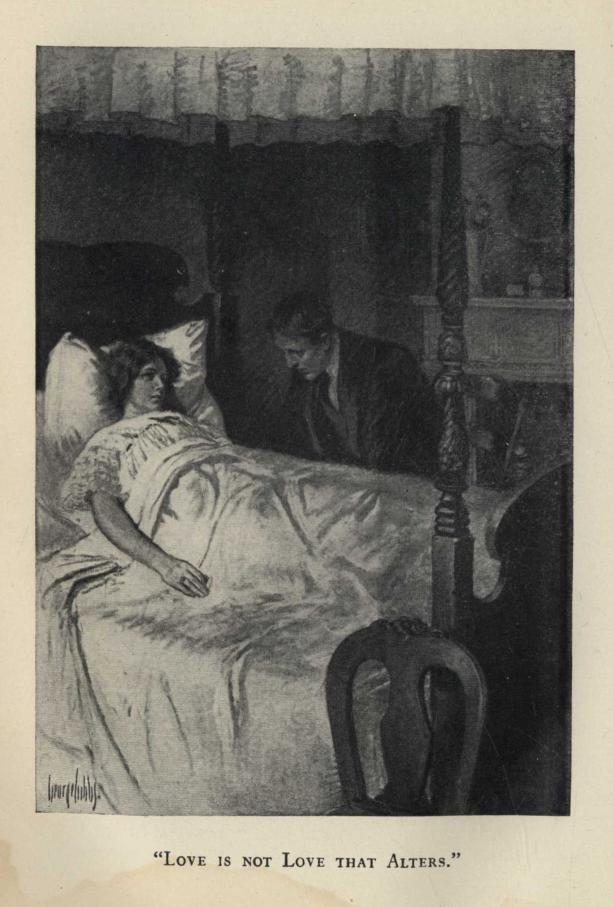
"LOVE IS NOT LOVE THAT ALTERS."
"Do you remember the kind of love I said I had for you that first night after I came home?" She pressed my hand against her cheek again. "And the kind you said you'd never felt, but would give your life to feel?" Again I felt the pressure. "That kind which I told you of, and which I have had for you all the time, is that kind that Shakespeare told of when he said:
"'Love is not love that alters when it alteration finds.'
"That's the kind I have for you, Eloise—have always had; and do you remember the love you said you wanted, you'd give your life for, yourself, your soul and your body. 'I, who wish it so, to be widowed of it all my life'—those were your words. How they cut into my heart—that love, Eloise, can't you see? Don't you know that it is yours and you are widowed of it no longer?"