Chapter V
Reading edition
SOCIAL CONTACTS
I. INTRODUCTION
1. Preliminary Notions of Social Contact
The fundamental social process is that of interaction. This interaction is (a) of persons with persons, and (b) of groups with groups. The simplest aspect of interaction, or its primary phase, is contact. Contact may be considered as the initial stage of interaction, and preparatory to the later stages. The phenomena of social contact require analysis before proceeding to the more difficult study of the mechanism of social interaction.
"With whom am I in contact?" Common sense has in stock ready answers to this question.
There is, first of all, the immediate circle of contact through the senses. Touch is the most intimate kind of contact. Face-to-face relations include, in addition to touch, visual and auditory sensations. Speech and hearing by their very nature establish a bond of contact between persons.
Even in common usage, the expression "social contact" is employed beyond the limits fixed by the immediate responses of touch, sight, and hearing. Its area has expanded to include connection through all the forms of communication, i.e., language, letters, and the printed page; connection through the medium of the telephone, telegraph, radio, moving picture, etc. The evolution of the devices for communication has taken place in the fields of two senses alone, those of hearing and seeing. Touch remains limited to the field of primary association. But the newspaper with its elaborate mechanism of communication gives publicity to events in London, Moscow, and Tokio, and the motion picture unreels to our gaze scenes from distant lands and foreign peoples with all the illusion of reality.
The frontiers of social contact are farther extended to the widest horizons, by commerce. The economists, for example, include in their conception of society the intricate and complex maze of relations created by the competition and co-operation of individuals and societies within the limits of a world-wide economy. This inclusion of unconscious as well as conscious reciprocal influences in the concept of social relations brings into "contact" the members of a village missionary society with the savages of the equatorial regions of Africa; or the pale-faced drug addict, with the dark-skinned Hindu laborers upon the opium fields of Benares; or the man gulping down coffee at the breakfast table, with the Java planter; the crew of the Pacific freighter and its cargo of spices with the American wholesaler and retailer in food products. In short, everyone is in a real, though concealed and devious, way in contact with every other person in the world. Contacts of this type, remote from the familiar experiences of everyday life, have reality to the intellectual and the mystic and are appreciated by the masses only when co-operation breaks down, or competition becomes conscious and passes into conflict.
These three popular meanings of contacts emphasize (1) the intimacy of sensory responses, (2) the extension of contact through devices of communication based upon sight and hearing, and (3) the solidarity and interdependence created and maintained by the fabric of social life, woven as it is from the intricate and invisible strands of human interests in the process of a world-wide competition and co-operation.
2. The Sociological Concept of Contact
The use of the term "contact" in sociology is not a departure from, but a development of, its customary significance. In the preceding chapter the point was made that the distinction between isolation and contact is not absolute but relative. Members of a society spatially separate, but socially in contact through sense perception and through communication of ideas, may be thereby mobilized to collective behavior. Sociological interest in this situation lies in the fact that the various kinds of social contacts between persons and groups determine behavior. The student of problems of American society, for example, realizes the necessity of understanding the mutual reactions involved in the contacts of the foreign and the native-born, of the white and the negro, and of employers and employees. In other words, contact, as the first stage of social interaction, conditions and controls the later stages of the process.
It is convenient, for certain purposes, to conceive of contact in terms of space. The contacts of persons and of groups may then be plotted in units of social distance. This permits graphic representation of relations of sequence and of coexistence in terms both of units of separation and of contact. This spatial conception may now be applied to the explanation of the readings in social contacts.
3. Classification of the Materials
In sociological literature there have grown up certain distinctions between types of social contacts. Physical contacts are distinguished from social contacts; relations within the "in-group" are perceived to be different from relations with the "out-group"; contacts of historical continuity are compared with contacts of mobility; primary contacts are set off from secondary contacts. How far and with what advantage may these distinctions be stated in spatial terms?
a) Land as a basis for social contacts.—The position of persons and peoples on the earth gives us a literal picture of the spatial conception of social contact. The cluster of homes in the Italian agricultural community suggests the difference in social life in comparison with the isolated homesteads of rural America. A gigantic spot map of the United States upon which every family would be indicated by a dot would represent schematically certain different conditions influencing group behavior in arid areas, the open country, hamlets, villages, towns, and cities. The movements of persons charted with detail sufficient to bring out variations in the daily, weekly, monthly, and yearly routine, would undoubtedly reveal interesting identities and differences in the intimacy and intensity of social contacts. It would be possible and profitable to classify people with reference to the routine of their daily lives.
b) Touch as the physiological basis of social contact.—According to the spatial conception the closest contacts possible are those of touch. The physical proximity involved in tactile sensations is, however, but the symbol of the intensity of the reactions to contact. Desire and aversion for contacts, as Crawley shows in his selection, arise in the most intimate relations of human life. Love and hate, longing and disgust, sympathy and hostility increase in intensity with intimacy of association. It is a current sociological fallacy that closeness of contact results only in the growth of good will. The fact is, that with increasing contact either attraction or repulsion may be the outcome, depending upon the situation and upon factors not yet fully analyzed. Peculiar conditions of contact, as its prolonged duration, its frequent repetition, just as in the case of isolation from normal association, may lead to the inversion of the original impulses and sentiments of affection and antipathy.[117]
c) Contacts with the "in-group" and with the "out-group."—The conception of the we-group in terms of distance is that of a group in which the solidarity of units is so complete that the movements and sentiments of all are completely regulated with reference to their interests and behavior as a group. This control by the in-group over its members makes for solidity and impenetrability in its relations with the out-group. Sumner in his Folkways indicates how internal sympathetic contacts and group egotism result in double standards of behavior: good-will and co-operation within the members of the in-group, hostility and suspicion toward the out-group and its members. The essential point is perhaps best brought out by Shaler in his distinction between sympathetic and categoric contacts. He describes the transition from contacts of the out-group to those of the in-group, or from remote to intimate relations. From a distance, a person has the characteristics of his group, upon close acquaintance he reveals his individuality.
d) Historical continuity and mobility.—Historical continuity, which maintains the identity of the present with the past, implies the existence of a body of tradition which is transmitted from the older to the younger generations. Through the medium of tradition, including in that term all the learning, science, literature, and practical arts, not to speak of the great body of oral tradition which is after all a larger part of life than we imagine, the historical and cultural life is maintained. This is the meaning of the long period of childhood in man during which the younger generation is living under the care and protection of the older. When, for any reason, this contact of the younger with the older generation is interrupted—as is true in the case of immigrants—a very definite cultural deterioration frequently ensues.
Contacts of mobility are those of a changing present, and measure the number and variety of the stimulations which the social life and movements—the discovery of the hour, the book of the moment, the passing fads and fashions—afford. Contacts of mobility give us novelty and news. It is through contacts of this sort that change takes place.
Mobility, accordingly, measures not merely the social contacts that one gains from travel and exploration, but the stimulation and suggestions that come to us through the medium of communication, by which sentiments and ideas are put in social circulation. Through the newspaper, the common man of today participates in the social movements of his time. His illiterate forbear of yesterday, on the other hand, lived unmoved by the current of world-events outside his hamlet. The tempo of modern societies may be measured comparatively by the relative perfection of devices of communication and the rapidity of the circulation of sentiments, opinions, and facts. Indeed, the efficiency of any society or of any group is to be measured not alone in terms of numbers or of material resources, but also in terms of mobility and access through communication and publicity to the common fund of tradition and culture.
e) Primary and secondary contacts.—Primary contacts are those of "intimate face-to-face association"; secondary contacts are those of externality and greater distance. A study of primary association indicates that this sphere of contact falls into two areas: one of intimacy and the other of acquaintance. In the diagram which follows, the field of primary contacts has been subdivided so that it includes (x) a circle of greater intimacy, (y) a wider circle of acquaintanceship. The completed chart would appear as shown on page 285.
Primary contacts of the greatest intimacy are (a) those represented by the affections that ordinarily spring up within the family, particularly between parents and children, husband and wife; and (b) those of fellowship and affection outside the family as between lovers, bosom friends, and boon companions. These relations are all manifestations of a craving for response. These personal relationships are the nursery for the development of human nature and personality. John Watson, who studied several hundred new-born infants in the psychological laboratory, concludes that "the first few years are the all-important ones, for shaping the emotional life of the child."[118] The primary virtues and ideals of which Cooley writes so sympathetically are, for the most part, projections from family life. Certainly in these most intimate relations of life in the contacts of the family circle, in the closest friendships, personality is most severely tried, realizes its most characteristic expressions, or is most completely disorganized.
Fig. 3 A, primary contacts; x, greater intimacy; y, acquaintanceship; B, secondary contacts
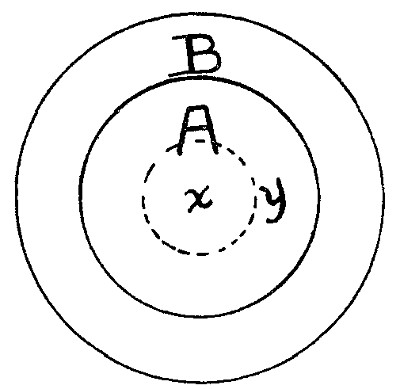
Just as the life of the family represents the contacts of touch and response, the neighborhood or the village is the natural area of primary contacts and the city the social environment of secondary contacts. In primary association individuals are in contact with each other at practically all points of their lives. In the village "everyone knows everything about everyone else." Canons of conduct are absolute, social control is omnipotent, the status of the family and the individual is fixed. In secondary association individuals are in contact with each other at only one or two points in their lives. In the city, the individual becomes anonymous; at best he is generally known in only one or two aspects of his life. Standards of behavior are relative; the old primary controls have disappeared; the new secondary instruments of discipline, necessarily formal, are for the most part crude and inefficient; the standing of the family and of the individual is uncertain and subject to abrupt changes upward or downward in the social scale.
Simmel has made a brilliant contribution in his analysis of the sociological significance of "the stranger." "The stranger" in the sociological sense is the individual who unites in his social relations primary and secondary contacts. Simmel himself employs the conception of social distance in his statement of the stranger as the combination of the near and the far. It is interesting and significant to determine the different types of the union of intimacy and externality in the relations of teacher and student, physician and patient, minister and layman, lawyer and client, social worker and applicant for relief.
A complete analysis of the bearing upon personal and cultural life of changes from a society based upon contacts of continuity and of primary relations to a society of increasing mobility organized around secondary contacts cannot be given here. Certain of the most obvious contrasts of the transition may, however, be stated. Increasing mobility of persons in society almost inevitably leads to change and therefore to loss of continuity. In primary groups, where social life moves slowly, there is a greater sense of continuity than in secondary groups where it moves rapidly.
There is a further contrast if not conflict between direct and intimate contacts and contacts based upon communication of ideas. All sense of values, as Windelband has pointed out,[119] rests upon concrete experience, that is to say upon sense contacts. Society, to the extent that it is organized about secondary contacts, is based upon abstractions, upon science and technique. Secondary contacts of this type have only secondary values because they represent means rather than ends. Just as all behavior arises in sense impressions it must also terminate in sense impressions to realize its ends and attain its values. The effect of life in a society based on secondary contacts is to build up between the impulse and its end a world of means, to project values into the future, and to direct life toward the realization of distant hopes.
The ultimate effect upon the individual as he becomes accommodated to secondary society is to find a substitute expression for his primary response in the artificial physical environment of the city. The detachment of the person from intimate, direct, and spontaneous contacts with social reality is in large measure responsible for the intricate maze of problems of urban life.
The change from concrete and personal to abstract and impersonal relations in economic and social life began with the Industrial Revolution. The machine is the symbol of the monotonous routine of impersonal, unskilled, large-scale production just as the hand tool is the token of the interesting activity of personal, skilled, handicraft work. The so-called "instinct of workmanship" no longer finds expression in the anonymous standardized production of modern industry.[120]
It is not in industry alone that the natural impulses of the person for response, recognition, and self-expression are balked. In social work, politics, religion, art, and sport the individual is represented now by proxies where formerly he participated in person. All the forms of communal activity in which all persons formerly shared have been taken over by professionals. The great mass of men in most of the social activities of modern life are no longer actors, but spectators. The average man of the present time has been relegated by the influence of the professional politician to the rôle of taxpayer. In social work organized charity has come between the giver and the needy.
In these and other manifold ways the artificial conditions of city life have deprived the person of most of the natural outlets for the expression of his interests and his energies. To this fact is to be attributed in large part the restlessness, the thirst for novelty and excitement so characteristic of modern life. This emotional unrest has been capitalized by the newspapers, commercialized recreations, fashion, and agitation in their appeal to the sensations, the emotions, and the instincts loosened from the satisfying fixations of primary-group life. The raison d'être of social work, as well as the fundamental problem of all social institutions in city life must be understood in its relation to this background.
II. MATERIALS
A. PHYSICAL CONTACT AND SOCIAL CONTACT
1. The Frontiers of Social Contact[121]
Sociology deals especially with the phenomena of contact. The reactions which result from voluntary or involuntary contact of human beings with other human beings are the phenomena peculiarly "social," as distinguished from the phenomena that belong properly to biology and psychology.
In the first place, we want to indicate, not the essence of the social, but the location, the sphere, the extent, of the social. If we can agree where it is, we may then proceed to discover what it is. The social, then, is the term next beyond the individual. Assuming, for the sake of analysis, that our optical illusion, "the individual," is an isolated and self-sufficient fact, there are many sorts of scientific problems that do not need to go beyond this fact to satisfy their particular terms. Whether the individual can ever be abstracted from his conditions and remain himself is not a question that we need here discuss. At all events, the individual known to our experience is not isolated. He is connected in various ways with one or more individuals. The different ways in which individuals are connected with each other are indicated by the inclusive term "contact." Starting, then, from the individual, to measure him in all his dimensions and to represent him in all his phases, we find that each person is what he is by virtue of the existence of other persons, and by virtue of an alternating current of influence between each person and all the other persons previously or at the same time in existence. The last native of Central Africa around whom we throw the dragnet of civilization, and whom we inoculate with a desire for whiskey, adds an increment to the demand for our distillery products, and affects the internal revenue of the United States, and so the life-conditions of every member of our population. This is what we mean by "contact." So long as that African tribe is unknown to the outside world, and the world to it, so far as the European world is concerned, the tribe might as well not exist. The moment the tribe comes within touch of the rest of the world, the aggregate of the world's contacts is by so much enlarged; the social world is by so much extended. In other words, the realm of the social is the realm of circuits of reciprocal influence between individuals and the groups which individuals compose. The general term "contact" is proposed to stand for this realm, because it is a colorless word that may mark boundaries without prejudging contents. Wherever there is physical or spiritual contact between persons, there is inevitably a circuit of exchange of influence. The realm of the social is the realm constituted by such exchange. It extends from the producing of the baby by the mother, and the simultaneous producing of the mother by the baby, to the producing of merchant and soldier by the world-powers, and the producing of the world-powers by merchant and soldier.
The most general and inclusive way in which to designate all the phenomena that sociology proper considers, without importing into the term premature hypotheses by way of explanation, is to assert that they are the phenomena of "contact" between persons.
In accordance with what was said about the division of labor between psychology and sociology, it seems best to leave to the psychologist all that goes on inside the individual and to say that the work of the sociologist begins with the things that take place between individuals. This principle of division is not one that can be maintained absolutely, any more than we can hold absolutely to any other abstract classification of real actions. It serves, however, certain rough uses. Our work as students of society begins in earnest when the individual has become equipped with his individuality. This stage of human growth is both cause and effect of the life of human beings side by side in greater or lesser numbers. Under those circumstances individuals are produced; they act as individuals; by their action as individuals they produce a certain type of society; that type reacts on the individuals and helps to transform them into different types of individuals, who in turn produce a modified type of society; and so the rhythm goes on forever. Now the medium through which all this occurs is the fact of contacts, either physical or spiritual. In either case, contacts are collisions of interests in the individuals.
2. The Land and the People[122]
Every clan, tribe, state, or nation includes two ideas, a people and its land, the first unthinkable without the other. History, sociology, ethnology, touch only the inhabited areas of the earth. These areas gain their final significance because of the people who occupy them; their local conditions of climate, soil, natural resources, physical features, and geographic situation are important primarily as factors in the development of actual or possible inhabitants. A land is fully comprehended only when studied in the light of its influence upon its people, and a people cannot be understood apart from the field of its activities. More than this, human activities are fully intelligible only in relation to the various geographic conditions which have stimulated them in different parts of the world. The principles of the evolution of navigation, of agriculture, of trade, as also the theory of population, can never reach their correct and final statement, unless the data for the conclusions are drawn from every part of the world and each fact interpreted in the light of the local conditions whence it sprang. Therefore anthropology, sociology, and history should be permeated by geography.
Most systems of sociology treat man as if he were in some way detached from the earth's surface; they ignore the land basis of society. The anthropogeographer recognizes the various social forces, economic and psychologic, which sociologists regard as the cement of societies; but he has something to add. He sees in the land occupied by a primitive tribe or a highly organized state the underlying material bond holding society together, the ultimate basis of their fundamental social activities, which are therefore derivatives from the land. He sees the common territory exercising an integrating force—weak in primitive communities where the group has established only a few slight and temporary relations with its soil, so that this low social complex breaks up readily like its organic counterpart, the low animal organism found in an amœba; he sees it growing stronger with every advance in civilization involving more complex relations to the land—with settled habitations, with increased density of population, with a discriminating and highly differentiated use of the soil, with the exploitation of mineral resources, and, finally, with that far-reaching exchange of commodities and ideas which means the establishment of varied extra-territorial relations. Finally, the modern society or state has grown into every foot of its own soil, exploited its every geographic advantage, utilized its geographic location to enrich itself by international trade, and, when possible, to absorb outlying territories by means of colonies. The broader this geographic base, the richer, more varied, its resources, and the more favorable its climate to their exploitation, the more numerous and complex are the connections which the members of a social group can establish with it, and through it with each other; or, in other words, the greater may be its ultimate historical significance.
3. Touch and Social Contact[123]
General ideas concerning human relations are the medium through which sexual taboo works, and these must now be examined. If we compare the facts of social taboo generally, or of its subdivision, sexual taboo, we find that the ultimate test of human relations, in both genus and species, is contact. An investigation of primitive ideas concerning the relations of man with man, when guided by this clue, will lay bare the principles which underlie the theory and practice of sexual taboo. Arising, as we have seen, from sexual differentiation, and forced into permanence by difference of occupation and sexual solidarity, this segregation receives the continuous support of religious conceptions as to human relations. These conceptions center upon contact, and ideas of contact are at the root of all conceptions of human relations at any stage of culture; contact is the one universal test, as it is the most elementary form, of mutual relations. Psychology bears this out, and the point is psychological rather than ethnological.
As I have pointed out before and shall have occasion to do so again, a comparative examination, assisted by psychology, of the emotions and ideas of average modern humanity is a most valuable aid to ethnological inquiry. In this connection, we find that desire or willingness for physical contact is an animal emotion, more or less subconscious, which is characteristic of similarity, harmony, friendship, or love. Throughout the world, the greeting of a friend is expressed by contact, whether it be nose-rubbing, or the kiss, the embrace, or the clasp of hands; so the ordinary expression of friendship by a boy, that eternal savage, is contact of arm and shoulder. More interesting still for our purpose is the universal expression by contact of the emotion of love. To touch his mistress is the ever-present desire of the lover, and in this impulse, even if we do not trace it back, as we may without being fanciful, to polar or sexual attraction inherent in the atoms, the φιλια of Empedocles, yet we may place the beginning and ending of love. When analyzed, the emotion always comes back to contact.
Further, mere willingness for contact is found universally when the person to be touched is healthy, if not clean, or where he is of the same age or class or caste, and, we may add, for ordinary humanity the same sex.
On the other hand, the avoidance of contact, whether consciously or subconsciously presented, is no less the universal characteristic of human relations where similarity, harmony, friendship, or love is absent. This appears in the attitude of men to the sick, to strangers, distant acquaintances, enemies, and in cases of difference of age, position, sympathies or aims, and even of sex. Popular language is full of phrases which illustrate this feeling.
Again, the pathology of the emotions supplies many curious cases where the whole being seems concentrated upon the sense of touch, with abnormal desire or disgust for contact; and in the evolution of the emotions from physiological pleasure and pain, contact plays an important part in connection with functional satisfaction or dissatisfaction with the environment.
In the next place, there are the facts, first, that an element of thought inheres in all sensation, while sensation conditions thought; and secondly, that there is a close connection of all the senses, both in origin—each of them being a modification of the one primary sense of touch—and in subsequent development, where the specialized organs are still co-ordinated through tactile sensation, in the sensitive surface of organism. Again, and here we see the genesis of ideas of contact, it is by means of the tactile sensibility of the skin and membranes of sense-organs, forming a sensitized as well as a protecting surface, that the nervous system conveys to the brain information about the external world, and this information is in its original aspect the response to impact. Primitive physics, no less than modern, recognizes that contact is a modified form of a blow. These considerations show that contact not only plays an important part in the life of the soul but must have had a profound influence on the development of ideas, and it may now be assumed that ideas of contact have been a universal and original constant factor in human relations and that they are so still. The latter assumption is to be stressed, because we find that the ideas which lie beneath primitive taboo are still a vital part of human nature, though mostly emptied of their religious content; and also because, as I hold, ceremonies and etiquette, such as still obtain, could not possess such vitality as they do unless there were a living psychological force behind them, such as we find in elementary ideas which come straight from functional processes.
These ideas of contact are primitive in each sense of the word, at whatever stage of culture they appear. They seem to go back in origin and in character to that highly developed sensibility of all animal and even organized life, which forms at once a biological monitor and a safeguard for the whole organism in relation to its environment. From this sensibility there arise subjective ideas concerning the safety or danger of the environment, and in man we may suppose these subjective ideas as to his environment, and especially as to his fellow-men, to be the origin of his various expressions of avoidance or desire for contact.
Lastly, it is to be observed that avoidance of contact is the most conspicuous phenomenon attaching to cases of taboo when its dangerous character is prominent. In taboo the connotation of "not to be touched" is the salient point all over the world, even in cases of permanent taboo such as belongs to Samoan and Maori chiefs, with whom no one dared come in contact; and so we may infer the same aversion to be potential in all such relations.
B. SOCIAL CONTACT IN RELATION TO SOLIDARITY AND TO MOBILITY
1. The In-Group and the Out-Group[124]
The conception of "primitive society" which we ought to form is that of small groups scattered over a territory. The size of the groups is determined by the conditions of the struggle for existence. The internal organization of each group corresponds to its size. A group of groups may have some relation to each other (kin, neighborhood, alliance, connubium, and commercium) which draws them together and differentiates them from others. Thus a differentiation arises between ourselves, the we-group, or in-group, and everybody else, or the others-groups, out-groups. The insiders in a we-group are in a relation of peace, order, law, government, and industry, to each other. Their relation to all outsiders, or others-groups, is one of war and plunder, except so far as agreements have modified it. If a group is exogamic, the women in it were born abroad somewhere. Other foreigners who might be found in it are adopted persons, guest-friends, and slaves.
The relation of comradeship and peace in the we-group and that of hostility and war toward others-groups are correlative to each other. The exigencies of war with outsiders are what make peace inside, lest internal discord should weaken the we-group for war. These exigencies also make government and law in the in-group, in order to prevent quarrels and enforce discipline. Thus war and peace have reacted on each other and developed each other, one within the group, the other in the intergroup relation. The closer the neighbors, and the stronger they are, the intenser is the warfare, and then the intenser is the internal organization and discipline of each. Sentiments are produced to correspond. Loyalty to the group, sacrifice for it, hatred and contempt for outsiders, brotherhood within, warlikeness without—all grow together, common products of the same situation.
Ethnocentrism is the technical name for this view of things in which one's own group is the center of everything and all others are scaled and rated with reference to it. Folkways correspond to it to cover both the inner and the outer relation. Each group nourishes its own pride and vanity, boasts itself superior, exalts its own divinities, and looks with contempt on outsiders. Each group thinks its own folkways the only right ones, and if it observes that other groups have other folkways, these excite its scorn. Opprobrious epithets are derived from these differences. "Pig-eater," "cow-eater," "uncircumcised," "jabberers," are epithets of contempt and abomination.
2. Sympathetic Contacts versus Categoric Contacts[125]
Let us now consider what takes place when two men, mere strangers to one another, come together. The motive of classification, which I have considered in another chapter, leads each of them at once to recognize the approaching object first as living, then as human. The shape and dress carry the categorizing process yet farther, so that they are placed in groups, as of this or that tribe or social class, and as these determinations are made they arouse the appropriate sympathies or hatreds such as by experience have become associated with the several categories. Be it observed that these judgments are spontaneous, instinctive, and unnoticed. They are made so by immemorial education in the art of contact which man has inherited from the life of the ancestral beasts and men; they have most likely been in some measure affirmed by selection, for these determinations as to the nature of the neighbor were in the lower stages of existence in brute and man of critical importance, the creatures lived or died according as they determined well or ill, swiftly or slowly. If we observe what takes place in our own minds at such meetings we will see that the action in its immediateness is like that of the eyelids when the eye is threatened. As we say, it is done before we know it.
With this view as to the conditions of human contact, particularly of what occurs when men first meet one another, let us glance at what takes place in near intercourse. We have seen that at the beginning of any acquaintance the fellow-being is inevitably dealt with in the categoric way. He is taken as a member of a group, which group is denoted to us by a few convenient signs; as our acquaintance with a particular person advances, this category tends to become qualified. Its bounds are pushed this way and that until they break down. It is to be noted in this process that the category fights for itself, or we for it, so that the result of the battle between the immediate truth and the prejudice is always doubtful. It is here that knowledge, especially that gained by individual experience, is most helpful. The uninformed man, who begins to find, on the nearer view of an Israelite, that the fellow is like himself, holds by his category in the primitive way. The creature is a Jew, therefore the evidence of kinship must not count. He who is better informed is, or should be, accustomed to amend his categories. He may, indeed, remember that he is dealing with a neighbor of the race which gave us not only Christ, but all the accepted prophets who have shaped our own course, and his understanding helps to cast down the barriers of instinctive prejudice.
At the stage of advancing acquaintance where friendship is attained, the category begins to disappear from our minds. We may, indeed, measure the advance in this relation by the extent to which it has been broken down. Looking attentively at our mental situation as regards those whom we know pretty well, we see that most of them are still, though rather faintly, classified into groups. While a few of the nearer stand forth by themselves, all of the nearest to our hearts are absolutely individualized, so that our judgments of them are made on the basis of our own motives and what we of ourselves discern. We may use categoric terms concerning our lovers, spouses, or children, but they have no real meaning; these persons are to us purely individual, all trace of the inclusive category has disappeared; they are, in the full sense of the word, our neighbors, being so near that when we look upon them we see nothing else, not even ourselves.
Summing up these considerations concerning human contact, it may be said that the world works by a system of individualities rising in scale as we advance from the inorganic through the organic series until we find the summit in man. The condition of all these individuals is that of isolation; each is necessarily parted from all the others in the realm, each receiving influences, and, in turn, sending forth its peculiar tide of influences to those of its own and other kinds. This isolation in the case of man is singularly great for the reason that he is the only creature we know in the realm who is so far endowed with consciousness that he can appreciate his position and know the measure of his solitude. In the case of all individuals the discernible is only a small part of what exists. In man the measure of this presentation is, even to himself, very small, and that which he can readily make evident to his neighbor is an exceedingly limited part of the real whole. Yet it is on this slender basis that we must rest our relations with the fellow man if we are to found them upon knowledge. The imperfection of this method of ascertaining the fellow-man is well shown by the trifling contents of the category discriminations we apply to him. While, as has been suggested, much can be done by those who have gained in knowledge of our kind by importing understandings into our relations with men, the only effective way to the betterment of those relations is through the sympathies.
What can be done by knowledge in helping us to a comprehension of the fellow-man is at best merely explanatory of his place in the phenomenal world; of itself it has only scientific value. The advantage of the sympathetic way of approach is that in this method the neighbor is accounted for on the supposition that he is ourself in another form, so we feel for and with him on the instinctive hypothesis that he is essentially ourself. There can be no question that this method of looking upon other individualities is likely to lead to many errors. We see examples of these blunders in all the many grades of the personifying process, from the savage's worship of a tree or stone to the civilized man's conception of a human-like god. We see them also in the attribution to the lower animals of thoughts and feelings which are necessarily limited to our own kind, but in the case of man the conception of identity gives a minimum of error and a maximum of truth. It, indeed, gives a truer result than could possibly be attained by any scientific inquiries that we could make, or could conceive of being effectively made, and this for the following reasons.
When, as in the sympathetic state, we feel that the neighbor of our species is essentially ourself, the tacit assumption is that his needs and feelings are as like our own as our own states of mind at diverse times are like one another, so that we might exchange motives with him without experiencing any great sense of strangeness. What we have in mind is not the measure of instruction or education, not the class or station or other adventitious circumstances, but the essential traits of his being. Now this supposition is entirely valid. All we know of mankind justifies the statement that, as regards all the qualities and motives with which the primal sympathies deal, men are remarkably alike. Their loves, hates, fears, and sorrows are alike in their essentials; so that the postulate of sympathy that the other man is essentially like one's self is no idle fancy but an established truth. It not only embodies the judgment of all men in thought and action but has its warrant from all the science we can apply to it.
It is easy to see how by means of sympathy we can at once pass the gulf which separates man from man. All the devices of the ages in the way of dumb or spoken language fail to win across the void, and leave the two beings apart; but with a step the sympathetic spirit passes the gulf. In this strange feature we have the completion of the series of differences between the inorganic and the organic groups of individualities. In the lower or non-living isolations there is no reason why the units should do more than mechanically interact. All their service in the realm can be best effected by their remaining forever completely apart. But when we come to the organic series, the units begin to have need of understanding their neighbors, in order that they may form those beginnings of the moral order which we find developing among the members even of the lowliest species. Out of this sympathetic accord arises the community, which we see in its simple beginnings in the earlier stages of life; it grows with the advance in the scale of being, and has its supreme success in man. Human society, the largest of all organic associations, requires that its units be knit together in certain common purposes and understandings, and the union can only be made effective by the ways of sympathy—by the instinctive conviction of essential kinship.
3. Historical Continuity and Civilization[126]
In matters connected with political and economical institutions we notice among the natural races very great differences in the sum of their civilization. Accordingly we have to look among them, not only for the beginnings of civilization, but for a very great part of its evolution, and it is equally certain that these differences are to be referred less to variations in endowment than to great differences in the conditions of their development. Exchange has also played its part, and unprejudiced observers have often been more struck in the presence of facts by agreement than by difference. "It is astonishing," exclaims Chapman, when considering the customs of the Damaras, "what a similarity there is in the manners and practices of the human family throughout the world. Even here, the two different classes of Damaras practice rites in common with the New Zealanders, such as that of chipping out the front teeth and cutting off the little finger." It is less astonishing if, as the same traveler remarks, their agreement with the Bechuanas goes even farther. Now, since the essence of civilization lies first in the amassing of experiences, then in the fixity with which these are retained, and lastly in the capacity to carry them farther or to increase them, our first question must be, how is it possible to realize the first fundamental condition of civilization, namely, the amassing a stock of culture in the form of handiness, knowledge, power, capital? It has long been agreed that the first step thereto is the transition from complete dependence upon what Nature freely offers to a conscious exploitation through man's own labor, especially in agriculture or cattle-breeding, of such of her fruits as are most important to him. This transition opens at one stroke all the most remote possibilities of Nature, but we must always remember at the same time that it is still a long way from the first step to the height which has now been attained.
The intellect of man and also the intellect of whole races shows a wide discrepancy in regard to differences of endowment as well as in regard to the different effects which external circumstances produce upon it. Especially are there variations in the degree of inward coherence and therewith of the fixity or duration of the stock of intellect. The want of coherence, the breaking up of this stock, characterizes the lower stages of civilization no less than its coherence, its inalienability, and its power of growth do the higher. We find in low stages a poverty of tradition which allows these races neither to maintain a consciousness of their earlier fortunes for any appreciable period nor to fortify and increase their stock of intelligence either through the acquisitions of individual prominent minds or through the adoption and fostering of any stimulus. Here, if we are not entirely mistaken, is the basis of the deepest-seated differences between races. The opposition of historic and non-historic races seems to border closely upon it.
There is a distinction between the quickly ripening immaturity of the child and the limited maturity of the adult who has come to a stop in many respects. What we mean by "natural" races is something much more like the latter than the former. We call them races deficient in civilization, because internal and external conditions have hindered them from attaining to such permanent developments in the domain of culture as form the mark of the true civilized races and the guaranties of progress. Yet we should not venture to call any of them cultureless, so long as none of them is devoid of the primitive means by which the ascent to higher stages can be made—language, religion, fire, weapons, implements; while the very possession of these means, and many others, such as domestic animals and cultivated plants, testifies to varied and numerous dealings with those races which are completely civilized.
The reasons why they do not make use of these gifts are of many kinds. Lower intellectual endowment is often placed in the first rank. That is a convenient but not quite fair explanation. Among the savage races of today we find great differences in endowments. We need not dispute that in the course of development races of even slightly higher endowments have got possession of more and more means of culture, and gained steadiness and security for their progress, while the less endowed remained behind. But external conditions, in respect to their furthering or hindering effects, can be more clearly recognized and estimated; and it is juster and more logical to name them first. We can conceive why the habitations of the savage races are principally to be found on the extreme borders of the inhabited world, in the cold and hot regions, in remote islands, in secluded mountains, in deserts. We understand their backward condition in parts of the earth which offer so few facilities for agriculture and cattle-breeding as Australia, the Arctic regions, or the extreme north and south of America. In the insecurity of incompletely developed resources we can see the chain which hangs heavily on their feet and confines their movements within a narrow space. As a consequence their numbers are small, and from this again results the small total amount of intellectual and physical accomplishment, the rarity of eminent men, the absence of the salutary pressure exercised by surrounding masses on the activity and forethought of the individual, which operates in the division of society into classes, and the promotion of a wholesome division of labor. A partial consequence of this insecurity of resources is the instability of natural races. A nomadic strain runs through them all, rendering easier to them the utter incompleteness of their unstable political and economical institutions, even when an indolent agriculture seems to tie them to the soil. Thus it often comes about that, in spite of abundantly provided and well-tended means of culture, their life is desultory, wasteful of power, unfruitful. This life has no inward consistency, no secure growth; it is not the life in which the germs of civilization first grew up to the grandeur in which we frequently find them at the beginnings of what we call history. It is full rather of fallings-away from civilization and dim memories from civilized spheres which in many cases must have existed long before the commencement of history as we have it.
By the word "civilization" or "culture" we denote usually the sum of all the acquirements at a given time of the human intelligence. When we speak of stages, of higher and lower, of semi-civilization, of civilized and "natural" races, we apply to the various civilizations of the earth a standard which we take from the degree that we have ourselves attained. Civilization means our civilization.
The confinement, in space as in time, which isolates huts, villages, races, no less than successive generations, involves the negation of culture; in its opposite, the intercourse of contemporaries and the interdependence of ancestors and successors, lies the possibility of development. The union of contemporaries secures the retention of culture, the linking of generations its unfolding. The development of civilization is a process of hoarding. The hoards grow of themselves so soon as a retaining power watches over them. In all domains of human creation and operation we shall see the basis of all higher development in intercourse. Only through co-operation and mutual help, whether between contemporaries, whether from one generation to another, has mankind succeeded in climbing to the stage of civilization on which its highest members now stand. On the nature and extent of this intercourse the growth depends. Thus the numerous small assemblages of equal importance, formed by the family stocks, in which the individual had no freedom, were less favorable to it than the larger communities and states of the modern world, with their encouragement to individual competition.
4. Mobility and the Movement of Peoples[127]
Every country whose history we examine proves the recipient of successive streams of humanity. Even sea-girt England has received various intruding peoples, from the Roman occupation to the recent influx of Russian Jews. In prehistoric times it combined several elements in its population, as the discovery of the "long barrow" men and "round barrow" men by archaeologists and the identification of a surviving Iberian or Mediterranean strain by ethnologists go to prove. Egypt, Mesopotamia, and India tell the same story, whether in their recorded or unrecorded history. Tropical Africa lacks a history; but all that has been pieced together by ethnologists and anthropologists, in an effort to reconstruct its past, shows incessant movement—growth, expansion, and short-lived conquest, followed by shrinkage, expulsion, or absorption by another invader. To this constant shifting of races and peoples the name of historical movement has been given, because it underlies most of written history and constitutes the major part of unwritten history, especially that of savage and nomadic tribes.
Among primitive peoples this movement is simple and monotonous. It involves all members of the tribe, either in pursuit of game or following the herd over the tribal territory, or in migrations seeking more and better land. Among civilized peoples it assumes various forms and especially is differentiated for different members of the social group. The civilized state develops specialized frontiers—men, armies, explorers, maritime traders, colonists, and missionaries, who keep a part of the people constantly moving and directing external expansion, while the mass of the population converts the force once expended in the migrant food-quest into internal activity. Here we come upon a paradox. The nation as a whole, with the development of sedentary life, increases its population and therewith its need for external movements; it widens its national area and its circle of contact with other lands, enlarges its geographical horizon, and improves its internal communication over a growing territory; it evolves a greater mobility within and without, which attaches, however, to certain classes of society, not to the entire social group. This mobility becomes the outward expression of a whole complex of economic wants, intellectual needs, and political ambitions. It is embodied in the conquests which build up empires, in the colonization which develops new lands, in the world-wide exchange of commodities and ideas which lifts the level of civilization till this movement of peoples becomes a fundamental fact of history.
Otis Mason finds that the life of a social group involves a variety of movements characterized by different ranges or scopes: (1) The daily round from bed to bed. (2) The annual round from year to year, like that of the Tunguse Orochon of Siberia who, in pursuit of various fish and game, change their residence within their territory from month to month, or the pastoral nomads who move with the seasons from pasture to pasture. (3) Less systematic outside movements covering the tribal sphere of influence, such as journeys or voyages to remote hunting or fishing grounds, forays or piratical descents upon neighboring lands, eventuating usually in conquest, expansion into border regions for occasional occupation, or colonization. (4) Participation in streams of barter or commerce. (5) And, at a higher stage, in the great currents of human intercourse, experience, and ideas, which finally compass the world. In all this series the narrower movement prepares for the broader, of which it constitutes at once an impulse and a part.
Civilized man is at once more and less mobile than his primitive brother. Every advance in civilization multiplies and tightens the bonds uniting him with his soil, makes him a sedentary instead of a migratory being. On the other hand, every advance in civilization is attended by the rapid clearing of the forests, by the construction of bridges and interlacing roads, the invention of more effective vehicles for transportation whereby intercourse increases, and the improvement of navigation to the same end. Civilized man progressively modifies the land which he occupies, removes or reduces obstacles to intercourse, and thereby approximates it to the open plain. Thus far he facilitates movements. But while doing this he also places upon the land a dense population, closely attached to the soil, strong to resist incursion, and for economic reasons inhospitable to any marked accession of population from without. Herein lies the great difference between migration in empty or sparsely inhabited regions, such as predominated when the world was young, and in the densely populated countries of our era. As the earth grew old and humanity multiplied, peoples themselves became the greatest barriers to any massive migrations, till in certain countries of Europe and Asia the historical movement has been reduced to a continual pressure, resulting in compression of population here, repression there. Hence, though political boundaries may shift, ethnic boundaries scarcely budge. The greatest wars of modern Europe have hardly left a trace upon the distribution of its peoples. Only in the Balkan Peninsula, as the frontiers of the Turkish Empire have been forced back from the Danube, the alien Turks have withdrawn to the shrinking territory of the Sultan and especially to Asia Minor.
Where a population too great to be dislodged occupies the land, conquest results in the eventual absorption of the victors and their civilization by the native folk, as happened to the Lombards in Italy, the Vandals in Africa, and the Normans in England. Where the invaders are markedly superior in culture, though numerically weak, conquest results in the gradual permeation of the conquered with the religion, economic methods, language, and customs of the newcomers. The latter process, too, is always attended by some intermixture of blood, where no race repulsion exists, but this is small in comparison to the diffusion of civilization. This was the method by which Greek traders and colonists Hellenized the countries about the eastern Mediterranean and spread their culture far back from the shores which their settlements had appropriated. In this way Saracen armies, soon after the death of Mohammed, Arabized the whole eastern and southern sides of the Mediterranean from Syria to Spain, and Arab merchants set the stamp of their language and religion on the coasts of East Africa as far as Mozambique. The handful of Spanish adventurers who came upon the relatively dense populations of Mexico and Peru left among them a civilization essentially European, but only a thin strain of Castilian blood. Thus the immigration of small bands of people sufficed to influence the culture of that big territory known as Latin America.
Throughout the life of any people, from its fetal period in some small locality to its well-rounded adult era marked by the occupation and organization of a wide national territory, gradations in area mark gradations of development. And this is true, whether we consider the compass of their commercial exchanges, the scope of their maritime ventures, the extent of their linguistic area, the measure of their territorial ambitions, or the range of their intellectual interests and human sympathies. From land to ethics, the rule holds good. Peoples in the lower stages of civilization have contracted spatial ideas, desire and need at a given time only a limited territory, though they may change that territory often; they think in small linear terms, have a small horizon, a small circle of contact with others, a small range of influence, only tribal sympathies; they have an exaggerated conception of their own size and importance, because their basis of comparison is fatally limited. With a mature, widespread people like the English or French, all this is different; they have made the earth their own, so far as possible.
Just because of this universal tendency toward the occupation of ever larger areas and the formation of vaster political aggregates, in making a sociological or political estimate of different peoples, we should never lose sight of the fact that all racial and national characteristics which operate toward the absorption of more land and impel to political expansion are of fundamental value. A ship of state manned by such a crew has its sails set to catch the winds of the world.
Territorial expansion is always preceded by an extension of the circle of influence which a people exerts through its traders, its deep-sea fishermen, its picturesque marauders and more respectable missionaries, and earlier still by a widening of its mere geographical horizon through fortuitous or systematic exploration.
C. PRIMARY AND SECONDARY CONTACTS
1. Village Life in America (from the Diary of a Young Girl)[128]
November 21, 1852.—I am ten years old today, and I think I will write a journal and tell who I am and what I am doing. I have lived with my Grandfather and Grandmother Beals ever since I was seven years old, and Anna, too, since she was four. Our brothers, James and John, came too, but they are at East Bloomfield at Mr. Stephen Clark's Academy. Miss Laura Clark of Naples is their teacher.
Anna and I go to school at District No. 11. Mr. James C. Cross is our teacher, and some of the scholars say he is cross by name and cross by nature, but I like him. He gave me a book by the name of Noble Deeds of American Women, for reward of merit, in my reading class.
Friday.—Grandmother says I will have a great deal to answer for, because Anna looks up to me so and tries to do everything that I do and thinks whatever I say is "gospel truth." The other day the girls at school were disputing with her about something and she said, "It is so, if it ain't so, for Calline said so." I shall have to "toe the mark," as Grandfather says, if she keeps watch of me all the time and walks in my footsteps.
April 1, 1853.—Before I go to school every morning I read three chapters in the Bible. I read three every day and five on Sunday and that takes me through the Bible in a year. Those I read this morning were the first, second, and third chapters of Job. The first was about Eliphaz reproveth Job; second, benefit of God's correction; third, Job justifieth his complaint. I then learned a text to say at school. I went to school at quarter to nine and recited my text and we had prayers and then proceeded with the business of the day. Just before school was out, we recited in Science of Things Familiar, and in Dictionary, and then we had calisthenics.
July.—Hiram Goodrich, who lives at Mr. Myron H. Clark's, and George and Wirt Wheeler ran away on Sunday to seek their fortunes. When they did not come back everyone was frightened and started out to find them. They set out right after Sunday school, taking their pennies which had been given them for the contribution, and were gone several days. They were finally found at Palmyra. When asked why they had run away, one replied that he thought it was about time they saw something of the world. We heard that Mr. Clark had a few moments' private conversation with Hiram in the barn and Mr. Wheeler the same with his boys and we do not think they will go traveling on their own hook again right off. Miss Upham lives right across the street from them and she was telling little Morris Bates that he must fight the good fight of faith and he asked her if that was the fight that Wirt Wheeler fit. She probably had to make her instructions plainer after that.
1854, Sunday.—Mr. Daggett's text this morning was the twenty-second chapter of Revelation, sixteenth verse, "I am the root and offspring of David and the bright and morning star." Mrs. Judge Taylor taught our Sunday-school class today and she said we ought not to read our Sunday-school books on Sunday. I always do. Mine today was entitled, Cheap Repository Tracts by Hannah More, and it did not seem unreligious at all.
Tuesday.—Mrs. Judge Taylor sent for me to come over to see her today. I didn't know what she wanted, but when I got there she said she wanted to talk and pray with me on the subject of religion. She took me into one of the wings. I never had been in there before and was frightened at first, but it was nice after I got used to it. After she prayed, she asked me to, but I couldn't think of anything but "Now I lay me down to sleep," and I was afraid she would not like that, so I didn't say anything. When I got home and told Anna, she said, "Caroline, I presume probably Mrs. Taylor wants you to be a missionary, but I shan't let you go." I told her she needn't worry for I would have to stay at home and look after her. After school tonight I went out into Abbie Clark's garden with her and she taught me how to play "mumble te peg." It is fun, but rather dangerous. I am afraid Grandmother won't give me a knife to play with. Abbie Clark has beautiful pansies in her garden and gave me some roots.
Sunday.—I almost forgot that it was Sunday this morning and talked and laughed just as I do week days. Grandmother told me to write down this verse before I went to church so I would remember it: "Keep thy foot when thou goest to the house of God, and be more ready to hear than to offer the sacrifice of fools." I will remember it now, sure. My feet are all right anyway with my new patten leather shoes on, but I shall have to look out for my head. Mr. Thomas Howell read a sermon today as Mr. Daggett is out of town. Grandmother always comes upstairs to get the candle and tuck us in before she goes to bed herself, and some nights we are sound asleep and do not hear her, but last night we only pretended to be asleep. She kneeled down by the bed and prayed aloud for us, that we might be good children and that she might have strength given her from on high to guide us in the straight and narrow path which leads to life eternal. Those were her very words. After she had gone downstairs we sat up in bed and talked about it and promised each other to be good, and crossed our hearts and "hoped to die," if we broke our promise. Then Anna was afraid we would die, but I told her I didn't believe we would be as good as that, so we kissed each other and went to sleep.
Sunday.—Rev. Mr. Tousley preached today to the children and told us how many steps it took to be bad. I think he said lying was first, then disobedience to parents, breaking the Sabbath, swearing, stealing, drunkenness. I don't remember just the order they came. It was very interesting, for he told lots of stories and we sang a great many times. I should think Eddy Tousley would be an awful good boy with his father in the house with him all the while, but probably he has to be away part of the time preaching to other children.
December 20, 1855.—Susan B. Anthony is in town and spoke in Bemis Hall this afternoon. She made a special request that all the seminary girls should come to hear her as well as all the women and girls in town. She had a large audience and she talked very plainly about our rights and how we ought to stand up for them, and said the world would never go right until the women had just as much right to vote and rule as the men. She asked us all to come up and sign our names who would promise to do all in our power to bring about that glad day when equal rights would be the law of the land. A whole lot of us went up and signed the paper. When I told Grandmother about it she said she guessed Susan B. Anthony had forgotten that St. Paul said the women should keep silence. I told her no, she didn't, for she spoke particularly about St. Paul and said if he had lived in these times, instead of eighteen hundred years ago, he would have been as anxious to have the women at the head of the government as she was. I could not make Grandmother agree with her at all and she said we might better all of us stayed at home. We went to prayer meeting this evening and a woman got up and talked. Her name was Mrs. Sands. We hurried home and told Grandmother and she said she probably meant all right and she hoped we did not laugh.
February 21, 1856.—We had a very nice time at Fannie Gaylord's party and a splendid supper. Lucilla Field laughed herself almost to pieces when she found on going home that she had worn her leggins all the evening. We had a pleasant walk home but did not stay till it was out. Someone asked me if I danced every set and I told them no, I set every dance. I told Grandmother and she was very much pleased. Some one told us that Grandfather and Grandmother first met at a ball in the early settlement of Canandaigua. I asked her if it was so and she said she never danced since she became a professing Christian and that was more than fifty years ago.
May, 1856.—We were invited to Bessie Seymour's party last night and Grandmother said we could go. The girls all told us at school that they were going to wear low neck and short sleeves. We have caps on the sleeves of our best dresses and we tried to get the sleeves out, so we could go bare arms, but we couldn't get them out. We had a very nice time, though, at the party. Some of the Academy boys were there and they asked us to dance but of course we couldn't do that. We promenaded around the rooms and went out to supper with them. Eugene Stone and Tom Eddy asked to go home with us but Grandmother sent our two girls for us, Bridget Flynn and Hannah White, so they couldn't. We were quite disappointed, but perhaps she won't send for us next time.
Thursday, 1857.—We have four sperm candles in four silver candlesticks and when we have company we light them. Johnnie Thompson, son of the minister, Rev. M. L. R. P., has come to the academy to school and he is very full of fun and got acquainted with all the girls very quick. He told us this afternoon to have "the other candle lit" for he was coming down to see us this evening. Will Schley heard him say it and he said he was coming too. Later.—The boys came and we had a very pleasant evening but when the 9 o'clock bell rang we heard Grandfather winding up the clock and scraping up the ashes on the hearth to cover the fire so it would last till morning and we all understood the signal and they bade us good night. "We won't go home till morning" is a song that will never be sung in this house.
September, 1857.—Grandmother let Anna have six little girls here to supper to-night: Louisa Field, Hattie Paddock, Helen Coy, Martha Densmore, Emma Wheeler, and Alice Jewett. We had a splendid supper and then we played cards. I do not mean regular cards, mercy no! Grandfather thinks those kinds are contageous or outrageous or something dreadful and never keeps them in the house. Grandmother said they found a pack once, when the hired man's room was cleaned, and they went into the fire pretty quick. The kind we played was just "Dr. Busby," and another "The Old Soldier and His Dog." There are counters with them, and if you don't have the card called for you have to pay one into the pool. It is real fun. They all said they had a very nice time, indeed, when they bade Grandmother good night, and said: "Mrs. Beals, you must let Carrie and Anna come and see us some time," and she said she would. I think it is nice to have company.
August 30, 1858.—Some one told us that when Bob and Henry Antes were small boys they thought they would like to try, just for once, to see how it would seem to be bad, so in spite of all of Mr. Tousley's sermons they went out behind the barn one day and in a whisper Bob said, "I swear," and Henry said, "So do I." Then they came into the house looking guilty and quite surprised, I suppose, that they were not struck dead just as Ananias and Sapphira were for lying.
February, 1859.—Mary Wheeler came over and pierced my ears today, so I can wear my new earrings that Uncle Edward sent me. She pinched my ear until it was numb and then pulled a needle through, threaded with silk. Anna would not stay in the room. She wants hers done but does not dare. It is all the fashion for girls to cut off their hair and friz it. Anna and I have cut off ours and Bessie Seymour got me to cut off her lovely long hair today. It won't be very comfortable for us to sleep with curl papers all over our heads, but we must do it now. I wanted my new dress waist which Miss Rosewarne is making to hook up in front, but Grandmother said I would have to wear it that way all the rest of my life so I had better be content to hook it in the back a little longer. She said when Aunt Glorianna was married, in 1848, it was the fashion for grown-up women to have their waists fastened in the back, so the bride had hers made that way but she thought it was a very foolish and inconvenient fashion. It is nice, though, to dress in style and look like other people. I have a Garibaldi waist and a Zouave jacket and a balmoral skirt.
1860, Sunday.—Frankie Richardson asked me to go with her to teach a class in the colored Sunday School on Chapel Street this afternoon. I asked Grandmother if I could go and she said she never noticed that I was particularly interested in the colored race and she said she thought I only wanted an excuse to get out for a walk Sunday afternoon. However, she said I could go just this once. When we got up as far as the Academy, Mr. Noah T. Clarke's brother, who is one of the teachers, came out and Frank said he led the singing at the Sunday school and she said she would give me an introduction to him, so he walked up with us and home again. Grandmother said that when she saw him opening the gate for me, she understood my zeal in missionary work. "The dear little lady," as we often call her, has always been noted for her keen discernment and wonderful sagacity and loses none of it as she advances in years. Some one asked Anna the other day if her Grandmother retained all her faculties and Anna said, "Yes, indeed, to an alarming degree." Grandmother knows that we think she is a perfect angel even if she does seem rather strict sometimes. Whether we are seven or seventeen we are children to her just the same, and the Bible says, "Children obey your parents in the Lord for this is right." We are glad that we never will seem old to her. I had the same company home from church in the evening. His home is in Naples.
Christmas, 1860.—I asked Grandmother if Mr. Clarke could take Sunday night supper with us and she said she was afraid he did not know the catechism. I asked him Friday night and he said he would learn it on Saturday so that he could answer every third question anyway. So he did and got along very well. I think he deserves a pretty good supper.
2. Secondary Contacts and City Life[129]
Modern methods of urban transportation and communication—the electric railway, the automobile, and the telephone—have silently and rapidly changed in recent years the social and industrial organization of the modern city. They have been the means of concentrating traffic in the business districts; have changed the whole character of retail trade, multiplying the residence suburbs and making the department store possible. These changes in the industrial organization and in the distribution of population have been accompanied by corresponding changes in the habits, sentiments, and character of the urban population.
The general nature of these changes is indicated by the fact that the growth of cities has been accompanied by the substitution of indirect, "secondary," for direct, face-to-face, "primary" relations in the associations of individuals in the community.
By primary groups I mean those characterized by intimate face-to-face association and co-operation. They are primary in several senses, but chiefly in that they are fundamental in forming the social nature and ideals of the individual. The result of intimate association, psychologically, is a certain fusion of individualities in a common whole, so that one's very self, for many purposes at least, is the common life and purpose of the group. Perhaps the simplest way of describing this wholeness is by saying that it is a "we"; it involves the sort of sympathy and mutual identification for which "we" is the natural expression. One lives in the feeling of the whole and finds the chief aims of his will in that feeling.
Touch and sight, physical contact, are the basis for the first and most elementary human relationships. Mother and child, husband and wife, father and son, master and servant, kinsman and neighbor, minister, physician, and teacher—these are the most intimate and real relationships of life and in the small community they are practically inclusive.
The interactions which take place among the members of a community so constituted are immediate and unreflecting. Intercourse is carried on largely within the region of instinct and feeling. Social control arises, for the most part spontaneously, in direct response to personal influences and public sentiment. It is the result of a personal accommodation rather than the formulation of a rational and abstract principle.
In a great city, where the population is unstable, where parents and children are employed out of the house and often in distant parts of the city, where thousands of people live side by side for years without so much as a bowing acquaintance, these intimate relationships of the primary group are weakened and the moral order which rested upon them is gradually dissolved.
Under the disintegrating influences of city life most of our traditional institutions, the church, the school, and the family, have been greatly modified. The school, for example, has taken over some of the functions of the family. It is around the public school and its solicitude for the moral and physical welfare of the children that something like a new neighborhood and community spirit tends to get itself organized.
The church, on the other hand, which has lost much of its influence since the printed page has so largely taken the place of the pulpit in the interpretation of life, seems at present to be in process of readjustment to the new conditions.
It is probably the breaking down of local attachments and the weakening of the restraints and inhibitions of the primary group, under the influence of the urban environment, which are largely responsible for the increase of vice and crime in great cities. It would be interesting in this connection to determine by investigation how far the increase in crime keeps pace with the increasing mobility of the population. It is from this point of view that we should seek to interpret all those statistics which register the disintegration of the moral order, for example, the statistics of divorce, of truancy, and of crime.
Great cities have always been the melting-pots of races and of cultures. Out of the vivid and subtle interactions of which they have been the centers, there have come the newer breeds and the newer social types. The great cities of the United States, for example, have drawn from the isolation of their native villages great masses of the rural populations of Europe and America. Under the shock of the new contacts the latent energies of these primitive peoples have been released, and the subtler processes of interaction have brought into existence not merely vocational but temperamental types.
Transportation and communication have effected, among many other silent but far-reaching changes, what I have called the "mobilization of the individual man." They have multiplied the opportunities of the individual man for contact and for association with his fellows, but they have made these contacts and associations more transitory and less stable. A very large part of the populations of great cities, including those who make their homes in tenements and apartment houses, live much as people do in some great hotel, meeting but not knowing one another. The effect of this is to substitute fortuitous and casual relationship for the more intimate and permanent associations of the smaller community.
Under these circumstances the individual's status is determined to a considerable degree by conventional signs—by fashion and "front"—and the art of life is largely reduced to skating on thin surfaces and a scrupulous study of style and manners.
Not only transportation and communication, but the segregation of the urban population, tends to facilitate the mobility of the individual man. The processes of segregation establish moral distances which make the city a mosaic of little worlds which touch but do not interpenetrate. This makes it possible for individuals to pass quickly and easily from one moral milieu to another and encourages the fascinating but dangerous experiment of living at the same time in several different contiguous, perhaps, but widely separated worlds. All this tends to give to city life a superficial and adventitious character; it tends to complicate social relationships and to produce new and divergent individual types. It introduces, at the same time, an element of chance and adventure, which adds to the stimulus of city life and gives it for young and fresh nerves a peculiar attractiveness. The lure of great cities is perhaps a consequence of stimulations which act directly upon the reflexes. As a type of human behavior it may be explained, like the attraction of the flame for the moth, as a sort of tropism.
The attraction of the metropolis is due in part, however, to the fact that in the long run every individual finds somewhere among the varied manifestations of city life the sort of environment in which he expands and feels at ease; finds, in short, the moral climate in which his peculiar nature obtains the stimulations that bring his innate qualities to full and free expression. It is, I suspect, motives of this kind which have their basis, not in interest nor even in sentiment, but in something more fundamental and primitive which draw many, if not most, of the young men and young women from the security of their homes in the country into the big, booming confusion and excitement of city life. In a small community it is the normal man, the man without eccentricity or genius, who seems most likely to succeed. The small community often tolerates eccentricity. The city, on the contrary, rewards it. Neither the criminal, the defective, nor the genius has the same opportunity to develop his innate disposition in a small town that he invariably finds in a great city.
Fifty years ago every village had one or two eccentric characters who were treated ordinarily with a benevolent toleration, but who were regarded meanwhile as impracticable and queer. These exceptional individuals lived an isolated existence, cut off by their very eccentricities, whether of genius or of defect, from genuinely intimate intercourse with their fellows. If they had the making of criminals, the restraints and inhibitions of the small community rendered them harmless. If they had the stuff of genius in them, they remained sterile for lack of appreciation or opportunity. Mark Twain's story of Pudd'n Head Wilson is a description of one such obscure and unappreciated genius. It is not so true as it was that—
Full many a flower is born to blush unseen And waste its fragrance on the desert air.
Gray wrote the "Elegy in a Country Churchyard" before the existence of the modern city.
In the city many of these divergent types now find a milieu in which for good or for ill their dispositions and talents parturiate and bear fruit.
3. Publicity as a Form of Secondary Contact[130]
In contrast with the political machine, which has founded its organized action on the local, personal, and immediate interests represented by the different neighborhoods and localities, the good-government organizations, the bureaus of municipal research, and the like have sought to represent the interests of the city as a whole and have appealed to a sentiment and opinion neither local nor personal. These agencies have sought to secure efficiency and good government by the education of the voter, that is to say, by investigating and publishing the facts regarding the government.
In this way publicity has come to be a recognized form of social control, and advertising—"social advertising"—has become a profession with an elaborate technique supported by a body of special knowledge.
It is one of the characteristic phenomena of city life and of society founded on secondary relationships that advertising should have come to occupy so important a place in its economy.
In recent years every individual and organization which has had to deal with the public, that is to say, the public outside the smaller and more intimate communities of the village and small town, has come to have its press agent, who is often less an advertising man than a diplomatic man accredited to the newspapers, and through them to the world at large. Institutions like the Russell Sage Foundation, and to a less extent the General Education Board, have sought to influence public opinion directly through the medium of publicity. The Carnegie Report upon Medical Education, the Pittsburgh Survey, the Russell Sage Foundation Report on Comparative Costs of Public-School Education in the Several States, are something more than scientific reports. They are rather a high form of journalism, dealing with existing conditions critically, and seeking through the agency of publicity to bring about radical reforms. The work of the Bureau of Municipal Research in New York has had a similar practical purpose. To these must be added the work accomplished by the child-welfare exhibits, by the social surveys undertaken in different parts of the country, and by similar propaganda in favor of public health.
As a source of social control public opinion becomes important in societies founded on secondary relationships of which great cities are a type. In the city every social group tends to create its own milieu, and, as these conditions become fixed, the mores tend to accommodate themselves to the conditions thus created. In secondary groups and in the city, fashion tends to take the place of custom, and public opinion rather than the mores becomes the dominant force in social control.
In any attempt to understand the nature of public opinion and its relation to social control, it is important to investigate, first of all, the agencies and devices which have come into practical use in the effort to control, enlighten, and exploit it.
The first and the most important of these is the press, that is, the daily newspaper and other forms of current literature, including books classed as current.
After the newspaper, the bureaus of research which are now springing up in all the large cities are the most interesting and the most promising devices for using publicity as a means of control.
The fruits of these investigations do not reach the public directly, but are disseminated through the medium of the press, the pulpit and other sources of popular enlightenment.
In addition to these, there are the educational campaigns in the interest of better health conditions, the child-welfare exhibits, and the numerous "social advertising" devices which are now employed, sometimes upon the initiative of private societies, sometimes upon that of popular magazines or newspapers, in order to educate the public and enlist the masses of the people in the movement for the improvement of conditions of community life.
The newspaper is the great medium of communication within the city, and it is on the basis of the information which it supplies that public opinion rests. The first function which a newspaper supplies is that which was formerly performed by the village gossip.
In spite, however, of the industry with which newspapers pursue facts of personal intelligence and human interest, they cannot compete with the village gossips as a means of social control. For one thing, the newspaper maintains some reservations not recognized by gossip, in the matters of personal intelligence. For example, until they run for office or commit some other overt act that brings them before the public conspicuously, the private life of individual men or women is a subject that is for the newspaper taboo. It is not so with gossip, partly because in a small community no individual is so obscure that his private affairs escape observation and discussion; partly because the field is smaller. In small communities there is a perfectly amazing amount of personal information afloat among the individuals who compose them.
The absence of this in the city is what, in large part, makes the city what it is.
4. From Sentimental to Rational Attitudes[131]
I can imagine it to be of exceeding great interest to write the history of mankind from the point of view of the stranger and his influence on the trend of events. From the earliest dawn of history we may observe how communities developed in special directions, no less in important than in insignificant things, because of influences from without. Be it religion or technical inventions, good form in conduct or fashions in dress, political revolutions or stock-exchange machinery, the impetus always—or, at least, in many cases—came from strangers. It is not surprising, therefore, that in the history of the intellectual and religious growth of the bourgeois the stranger should play no small part. Throughout the whole of the Middle Ages in Europe, and to a large extent in the centuries that followed, families left their homes to set up their hearths anew in other lands. The wanderers were in the majority of cases economic agents with a strongly marked tendency toward capitalism, and they originated capitalist methods and cultivated them. Accordingly, it will be helpful to trace the interaction of migrations and the history of the capitalist spirit.
First, as to the facts themselves. Two sorts of migrations may be distinguished—those of single individuals and those of groups. In the first category must be placed the removal, of their own free will, of a family, or it may even be of a few families, from one district or country to another. Such cases were universal. But we are chiefly concerned with those instances in which the capitalist spirit manifested itself, as we must assume it did where the immigrants were acquainted with a more complex economic system or were the founders of new industries. Take as an instance the Lombards and other Italian merchants, who in the early Middle Ages carried on business in England, France, and elsewhere. Or recall how in the Middle Ages many an industry, more especially silk weaving, that was established in any district was introduced by foreigners, and very often on a capitalist basis. "A new phase in the development of the Venetian silk industry began with the arrival of traders and silk-workers from Lucca, whereby the industry reached its zenith. The commercial element came more and more to the fore; the merchants became the organizers of production, providing the master craftsman with raw materials which he worked up." So we read in Broglio d'Ajano. We are told a similar tale about the silk industry in Genoa, which received an enormous impetus when the Berolerii began to employ craftsmen from Lucca. In 1341 what was probably the first factory for silk manufacture was erected by one Bolognino di Barghesano, of Lucca. Even in Lyons tradition asserts that Italians introduced the making of silk, and, when in the sixteenth century the industry was placed on a capitalist basis, the initiative thereto came once more from aliens. It was the same in Switzerland, where the silk industry was introduced by the Pelligari in 1685. In Austria likewise we hear the same tale.
Silk-making in these instances is but one example; there were very many others. Here one industry was introduced, there another; here it was by Frenchmen or Germans, there by Italians or Dutchmen. And always the new establishments came at the moment when the industries in question were about to become capitalistic in their organization.
Individual migrations, then, were not without influence on the economic development of society. But much more powerful was the effect of the wanderings of large groups from one land to another. From the sixteenth century onward migrations of this sort may be distinguished under three heads: (1) Jewish migrations; (2) the migration of persecuted Christians, more especially of Protestants; and (3) the colonizing movement, particularly the settlement in America.
We come, then, to the general question, Is it not a fact that the "stranger," the immigrant, was possessed of a specially developed capitalist spirit, and this quite apart from his environment, and, to a lesser degree, his religion or his nationality? We see it in the old states of Europe no less than in the new settlements beyond; in Jews and Gentiles alike; in Protestants and Catholics (the French in Louisiana were, by the middle of the nineteenth century, not a whit behind the Anglo-Saxons of the New England states in this respect). The assumption therefore forces itself upon us that this particular social condition—migration or change of habitat—was responsible for the unfolding of the capitalist spirit. Let us attempt to show how.
If we are content to find it in a single cause, it would be the breach with all old ways of life and all old social relationships. Indeed, the psychology of the stranger in a new land may easily be explained by reference to this one supreme fact. His clan, his country, his people, his state, no matter how deeply he was rooted in them, have now ceased to be realities for him. His first aim is to make profit. How could it be otherwise? There is nothing else open to him. In the old country he was excluded from playing his part in public life; in the colony of his choice there is no public life to speak of. Neither can he devote himself to a life of comfortable, slothful ease; the new lands have little comfort. Nor is the newcomer moved by sentiment. His environment means nothing to him. At best he regards it as a means to an end—to make a living. All this must surely be of great consequence for the rise of a mental outlook that cares only for gain; and who will deny that colonial activity generates it? "Our rivulets and streams turn mill wheels and bring rafts into the valleys, as they do in Scotland. But not one ballad, not a single song, reminds us that on their banks men and women live who experience the happiness of love and the pangs of separation; that under each roof in the valleys life's joys and sorrows come and go." This plaint of an American of the old days expresses my meaning; it has been noted again and again, particularly by those who visited America at the beginning of the nineteenth century. The only relationship between the Yankee and his environment is one of practical usefulness. The soil, as one of them says, is not regarded as "the mother of men, the hearth of the gods, the abiding resting-place of the past generations, but only as a means to get rich." There is nothing of "the poetry of the place" anywhere to check commercial devastations. The spire of his village is for the American like any other spire; in his eyes the newest and most gaudily painted is the most beautiful. A waterfall for him merely represents so much motive power. "What a mighty volume of water!" is, as we are assured, the usual cry of an American on seeing Niagara for the first time, and his highest praise of it is that it surpasses all other waterfalls in the world in its horse-power.
Nor has the immigrant or colonial settler a sense of the present or the past. He has only a future. Before long the possession of money becomes his one aim and ambition, for it is clear to him that by its means alone will he be able to shape that future. But how can he amass money? Surely by enterprise. His being where he is proves that he has capacities, that he can take risks; is it remarkable, then, that sooner or later his unbridled acquisitiveness will turn him into a restless capitalist undertaker? Here again we have cause and effect. He undervalues the present; he overvalues the future. Hence his activities are such as they are. Is it too much to say that even today American civilization has something of the unfinished about it, something that seems as yet to be in the making, something that turns from the present to the future?
Another characteristic of the newcomer everywhere is that there are no bounds to his enterprise. He is not held in check by personal considerations; in all his dealings he comes into contact only with strangers like himself. As we have already had occasion to point out, the first profitable trade was carried on with strangers; your own kith and kin received assistance from you. You lent out money at interest only to the stranger, as Antonio remarked to Shylock, for from the stranger you could demand more than you lent.
Nor is the stranger held in check by considerations other than personal ones. He has no traditions to respect; he is not bound by the policy of an old business. He begins with a clean slate; he has no local connections that bind him to any one spot. Is not every locality in a new country as good as every other? You therefore decide upon the one that promises most profit. As Poscher says, a man who has risked his all and left his home to cross the ocean in search of his fortune will not be likely to shrink from a small speculation if this means a change of abode. A little traveling more or less can make no difference.