Volume 1 — DIVISION A—NORMATIVE SCIENCE
Reading edition
DIVISION A—NORMATIVE SCIENCE
Speaker: Professor Josiah Royce, Harvard University
(Hall 6, September 20, 10 a. m.)
THE SCIENCES OF THE IDEAL
BY JOSIAH ROYCE
[Josiah Royce, Professor of History of Philosophy, Harvard University, since 1892. b. Grass Valley, Nevada County, California, November 20, 1855. A.B. University of California, 1875; Ph.D. Johns Hopkins 1878; LL.D. University of Aberdeen, Scotland; LL.D. Johns Hopkins. Instructor in English Literature and Logic, University of California, 1878-82. Instructor and Assistant Professor, Harvard University, 1882-92. Author of Religious Aspect of Philosophy; History of California; The Feud of Oakfield Creek; The Spirit of Modern Philosophy; Studies of Good and Evil; The World and the Individual; Gifford Lectures; and numerous other works and memoirs.]
I shall not attempt, in this address, either to justify or to criticise the name, normative science, under which the doctrines which constitute this division are grouped. It is enough for my purpose to recognize at the outset that I am required, by the plans of this Congress, to explain what scientific interests seem to me to be common to the work of the philosophers and of the mathematicians. The task is one which makes severe demands upon the indulgence of the listener, and upon the expository powers of the speaker, but it is a task for which the present age has well prepared the way. The spirit which Descartes and Leibnitz illustrated seems likely soon to become, in a new and higher sense, prominent in science. The mathematicians are becoming more and more philosophical. The philosophers, in the near future, will become, I believe, more and more mathematical. It is my office to indicate, as well as the brief time and my poor powers may permit, why this ought to be so.
To this end I shall first point out what is that most general community of interest which unites all the sciences that belong to our division. Then I shall indicate what type of recent and special scientific work most obviously bears upon the tasks of all of us alike. Thirdly, I shall state some results and problems to which this type of scientific work has given rise, and shall try to show what promise we have of an early increase of insight regarding our common interests.
I
The most general community of interest which unites the various scientific activities that belong to our division is this: We are all concerned with what may be called ideal truth, as distinct from physical truth. Some of us also have a strong interest in physical truth; but none of us lack a notable and scientific concern for the realm of ideas, viewed as ideas.
Let me explain what I mean by these terms. Whoever studies physical truth (taking that term in its most general sense) seeks to observe, to collate, and, in the end, to control, facts which he regards as external to his own thought. But instead of thus looking mainly without, it is possible for a man chiefly to take account, let us say, of the consequences of his own hypothetical assumptions—assumptions which may possess but a very remote relation to the physical world. Or again, it is possible for such a student to be mainly devoted to reflecting upon the formal validity of his own inferences, or upon the meaning of his own presuppositions, or upon the value and the interrelation of human ideals. Any such scientific work, reflective, considerate principally of the thinker's own constructions and purposes, or of the constructions and purposes of humanity in general, is a pursuit of ideal truth. The searcher who is mainly devoted to the inquiry into what he regards as external facts, is indeed active; but his activity is moulded by an order of existence which he conceives as complete apart from his activity. He is thoughtful; but a power not himself assigns to him the problems about which he thinks. He is guided by ideals; but his principal ideal takes the form of an acceptance of the world as it is, independently of his ideals. His dealings are with nature. His aim is the conquest of a foreign realm. But the student of what may be called, in general terms, ideal truth, while he is devoted as his fellow, the observer of outer nature, to the general purpose of being faithful to the verity as he finds it, is still aware that his own way of finding, or his own creative activity as an inventor of hypotheses, or his own powers of inference, or his conscious ideals, constitute in the main the object into which he is inquiring, and so form an essential aspect of the sort of verity which he is endeavoring to discover. The guide, then, of such a student is, in a peculiar sense, his own reason. His goal is the comprehension of his own meaning, the conscious and thoughtful conquest of himself. His great enemy is not the mystery of outer nature, but the imperfection of his reflective powers. He is, indeed, as unwilling as is any scientific worker to trust private caprices. He feels as little as does the observer of outer facts, that he is merely noting down, as they pass, the chance products of his arbitrary fantasy. For him, as for any scientific student, truth is indeed objective; and the standards to which he conforms are eternal. But his method is that of an inner considerateness rather than of a curiosity about external phenomena. His objective world is at the same time an essentially ideal world, and the eternal verity in whose light he seeks to live has, throughout his undertakings, a peculiarly intimate relation to the purposes of his own constructive will.
One may then sum up the difference of attitude which is here in question by saying that, while the student of outer nature is explicitly conforming his plans of action, his ideas, his ideals, to an order of truth which he takes to be foreign to himself—the student of the other sort of truth, here especially in question, is attempting to understand his own plans of action, that is, to develop his ideas, or to define his ideals, or else to do both these things.
Now it is not hard to see that this search for some sort of ideal truth is indeed characteristic of every one of the investigations which have been grouped together in our division of the normative sciences. Pure mathematics shares in common with philosophy this type of scientific interest in ideal, as distinct from physical or phenomenal truth. There is, to be sure, a marked contrast between the ways in which the mathematician and the philosopher approach, select, and elaborate their respective sorts of problems. But there is also a close relation between the two types of investigation in question. Let us next consider both the contrast and the analogy in some of their other most general features.
Pure mathematics is concerned with the investigation of the logical consequences of certain exactly stateable postulates or hypotheses—such, for instance, as the postulates upon which arithmetic and analysis are founded, or such as the postulates that lie at the basis of any type of geometry. For the pure mathematician, the truth of these hypotheses or postulates depends, not upon the fact that physical nature contains phenomena answering to the postulates, but solely upon the fact that the mathematician is able, with rational consistency, to state these assumed first principles, and to develop their consequences. Dedekind, in his famous essay, "Was Sind und Was Sollen die Zahlen," called the whole numbers "freie Schöpfungen des Menschlichen Geistes;" and, in fact, we need not enter into any discussion of the psychology of our number concept in order to be able to assert that, however we men first came by our conception of the whole numbers, for the mathematician the theory of numerical truth must appear simply as the logical development of the consequences of a few fundamental first principles, such as those which Dedekind himself, or Peano, or other recent writers upon this topic, have, in various forms, stated. A similar formal freedom marks the development of any other theory in the realm of pure mathematics. Pure geometry, from the modern point of view, is neither a doctrine forced upon the human mind by the constitution of any primal form of intuition, nor yet a branch of physical science, limited to describing the spatial arrangement of phenomena in the external world. Pure geometry is the theory of the consequences of certain postulates which the geometer is at liberty consistently to make; so that there are as many types of geometry as there are consistent systems of postulates of that generic type of which the geometer takes account. As is also now well known, it has long been impossible to define pure mathematics as the science of quantity, or to limit the range of the exactly stateable hypotheses or postulates with which the mathematician deals to the world of those objects which, ideally speaking, can be viewed as measurable. For the ideally defined measurable objects are by no means the only ones whose properties can be stated in the form of exact postulates or hypotheses; and the possible range of pure mathematics, if taken in the abstract, and viewed apart from any question as to the value of given lines of research, appears to be identical with the whole realm of the consequences of exactly stateable ideal hypotheses of every type.
One limitation must, however, be mentioned, to which the assertion just made is, in practice, obviously subject. And this is, indeed, a momentous limitation. The exactly stated ideal hypotheses whose consequences the mathematician develops must possess, as is sometimes said, sufficient intrinsic importance to be worthy of scientific treatment. They must not be trivial hypotheses. The mathematician is not, like the solver of chess problems, merely displaying his skill in dealing with the arbitrary fictions of an ideal game. His truth is, indeed, ideal; his world is, indeed, treated by his science as if this world were the creation of his postulates a "freie Schöpfung." But he does not thus create for mere sport. On the contrary, he reports a significant order of truth. As a fact, the ideal systems of the pure mathematician are customarily defined with an obvious, even though often highly abstract and remote, relation to the structure of our ordinary empirical world. Thus the various algebras which have been actually developed have, in the main, definite relations to the structure of the space world of our physical experience. The different systems of ideal geometry, even in all their ideality, still cluster, so to speak, about the suggestions which our daily experience of space and of matter give us. Yet I suppose that no mathematician would be disposed, at the present time, to accept any brief definition of the degree of closeness or remoteness of relation to ordinary experience which shall serve to distinguish a trivial from a genuinely significant branch of mathematical theory. In general, a mathematician who is devoted to the theory of functions, or to group theory, appears to spend little time in attempting to show why the development of the consequences of his postulates is a significant enterprise. The concrete mathematical interest of his inquiry sustains him in his labors, and wins for him the sympathy of his fellows. To the questions, "Why consider the ideal structure of just this system of object at all?" "Why study various sorts of numbers, or the properties of functions, or of groups, or the system of points in projective geometry?"—the pure mathematician in general, cares to reply only, that the topic of his special investigation appears to him to possess sufficient mathematical interest. The freedom of his science thus justifies his enterprise. Yet, as I just pointed out, this freedom is never mere caprice. This ideal interest is not without a general relation to the concerns even of common sense. In brief, as it seems at once fair to say, the pure mathematician is working under the influence of more or less clearly conscious philosophical motives. He does not usually attempt to define what distinguishes a significant from a trivial system of postulates, or what constitutes a problem worth attacking from the point of view of pure mathematics. But he practically recognizes such a distinction between the trivial and the significant regions of the world of ideal truth, and since philosophy is concerned with the significance of ideas, this recognition brings the mathematician near in spirit to the philosopher.
Such, then, is the position of the pure mathematician. What, by way of contrast, is that of the philosopher? We may reply that to state the formal consequences of exact assumptions is one thing; to reflect upon the mutual relations, and the whole significance of such assumptions, does indeed involve other interests; and these other interests are the ones which directly carry us over to the realm of philosophy. If the theory of numbers belongs to pure mathematics, the study of the place of the number concept in the system of human ideas belongs to philosophy. Like the mathematician, the philosopher deals directly with a realm of ideal truth. But to unify our knowledge, to comprehend its sources, its meaning, and its relations to the whole of human life, these aims constitute the proper goal of the philosopher. In order, however, to accomplish his aims, the philosopher must, indeed, take account of the results of the special physical science; but he must also turn from the world of outer phenomena to an ideal world. For the unity of things is never, for us mortals, anything that we find given in our experience. You cannot see the unity of knowledge; you cannot describe it as a phenomenon. It is for us now, an ideal. And precisely so, the meaning of things, the relation of knowledge to life, the significance of our ideals, their bearing upon one another—these are never, for us men, phenomenally present data. Hence the philosopher, however much he ought, as indeed he ought, to take account of phenomena, and of the results of the special physical sciences, is quite as deeply interested in his own way, as the mathematician is interested in his way, in the consideration of an ideal realm. Only, unlike the mathematician, the philosopher does not first abstract from the empirical suggestions upon which his exact ideas are actually based, and then content himself merely with developing the logical consequences of these ideas. On the contrary, his main interest is not in any idea or fact in so far as it is viewed by itself, but rather in the interrelations, in the common significance, in the unity, of all fundamental ideas, and in their relations both to the phenomenal facts and to life! On the whole, he, therefore, neither consents, like the student of a special science of experience, to seek his freedom solely through conformity to the phenomena which are to be described; nor is he content, like the pure mathematician, to win his truth solely through the exact definition of the formal consequences of his freely defined hypotheses. He is making an effort to discover the sense and the unity of the business of his own life.
It is no part of my purpose to attempt to show here how this general philosophical interest differentiates into the various interests of metaphysics, of the philosophy of religion, of ethics, of æsthetics, of logic. Enough—I have tried to illustrate how, while both the philosopher and the mathematician have an interest in the meaning of ideas rather than in the description of external facts, still there is a contrast which does, indeed, keep their work in large measure asunder, namely, the contrast due to the fact that the mathematician is directly concerned with developing the consequences of certain freely assumed systems of postulates or hypotheses; while the philosopher is interested in the significance, in the unity, and in the relation to life, of all the fundamental ideals and postulates of the human mind.
Yet not even thus do we sufficiently state how closely related the two tasks are. For this very contrast, as we have also suggested, is, even within its own limits, no final or perfectly sharp contrast. There is a deep analogy between the two tasks. For the mathematician, as we have just seen, is not evenly interested in developing the consequences of any and every system of freely assumed postulates. He is no mere solver of arbitrary ideal puzzles in general. His systems of postulates are so chosen as to be not trivial, but significant. They are, therefore, in fact, but abstractly defined aspects of the very system of eternal truth whose expression is the universe. In this sense the mathematician is as genuinely interested as is the philosopher in the significant use of his scientific freedom. On the other hand, the philosopher, in reflecting upon the significance and the unity of fundamental ideas, can only do so with success in case he makes due inquiry into the logical consequences of given ideas. And this he can accomplish only if, upon occasion, he employs the exact methods of the mathematician, and develops his systems of ideal truth with the precision of which only mathematical research is capable. As a fact, then, the mathematician and the philosopher deal with ideal truth in ways which are not only contrasted, but profoundly interconnected. The mathematician, in so far as he consciously distinguishes significant from trivial problems, and ideal systems, is a philosopher. The philosopher, in so far as he seeks exactness of logical method, in his reflection, must meanwhile aim to be, within his own limits, a mathematician. He, indeed, will not in future, like Spinoza, seek to reduce philosophy to the mere development, in mathematical form, of the consequences of certain arbitrary hypotheses. He will distinguish between a reflection upon the unity of the system of truth and an abstract development of this or that selected aspect of the system. But he will see more and more that, in so far as he undertakes to be exact, he must aim to become, in his own way, and with due regard to his own purposes, mathematical; and thus the union of mathematical and philosophical inquiries, in the future, will tend to become closer and closer.
II
So far, then, I have dwelt upon extremely general considerations relating to the unity and the contrast of mathematical and philosophical inquiries. I can well conceive, however, that the individual worker in any one of the numerous branches of investigation which are represented by the body of students whom I am privileged to address, may at this point mentally interpose the objection that all these considerations are, indeed, far too general to be of practical interest to any of us. Of course, all we who study these so-called normative sciences are, indeed, interested in ideas, for their own sakes—in ideas so distinct from, although of course also somehow related to, phenomena. Of course, some of us are rather devoted to the development of the consequences of exactly stated ideal hypotheses, and others to reflecting as we can upon what certain ideas and ideals are good for, and upon what the unity is of all ideas and ideals. Of course, if we are wise enough to do so, we have much to learn from one another. But, you will say, the assertion of all these things is a commonplace. The expression of the desire for further mutual coöperation is a pious wish. You will insist upon asking further: "Is there just now any concrete instance in a modern type of research which furnishes results such as are of interest to all of us? Are we actually doing any productive work in common? Are the philosophers contributing anything to human knowledge which has a genuine bearing upon the interests of mathematical science? Are the mathematicians contributing anything to philosophy?"
These questions are perfectly fair. Moreover, as it happens, they can be distinctly answered in the affirmative. The present age is one of a rapid advance in the actual unification of the fields of investigation which are included within the scope of this present division. What little time remains to me must be devoted to indicating, as well as I can, in what sense this is true. I shall have still to deal in very broad generalities. I shall try to make these generalities definite enough to be not wholly unfruitful.
We have already emphasized one question which may be said to interest, in a very direct way, both the mathematician and the philosopher. The ideal postulates, whose consequences mathematical science undertakes to develop, must be, we have said, significant postulates, involving ideas whose exact definition and exposition repay the labor of scientific scrutiny. Number, space, continuity, functional correspondence or dependence, group-structure—these are examples of such significant ideas; the postulates or ideal assumptions upon which the theory of such ideas depends are significant postulates, and are not the mere conventions of an arbitrary game. But now what constitutes the significance of an idea, or of an abstract mathematical theory? What gives an idea a worthy place in the whole scheme of human ideas? Is it the possibility of finding a physical application for a mathematical theory which for us decides what is the value of the theory? No, the theory of functions, the theory of numbers, group theory, have a significance which no mathematician would consent to measure in terms of the present applicability or non-applicability of these theories in physical science? In vain, then, does one attempt to use the test of applied mathematics as the main criticism of the value of a theory of pure mathematics. The value of an idea, for the sciences which constitute our division, is dependent upon the place which this idea occupies in the whole organized scheme or system of human ideas. The idea of number, for instance, familiar as its applications are, does not derive its main value from the fact that eggs and dollars and star-clusters can be counted, but rather from the fact that the idea of numbers has those relations to other fundamental ideas which recent logical theory has made prominent—relations, for instance, to the concept of order, to the theory of classes or collections of objects viewed in general, and to the metaphysical concept of the self. Relations of this sort, which the discussions of the number concept by Dedekind, Cantor, Peano, and Russell have recently brought to light—such relations, I say, constitute what truly justified Gauss in calling the theory of numbers a "divine science." As against such deeper relations, the countless applications of the number concept in ordinary life, and in science, are, from the truly philosophical point of view, of comparatively small moment. What we want, in the work of our division of the sciences, is to bring to light the unity of truth, either, as in mathematics, by developing systems of truth which are significant by virtue of their actual relations to this unity, or, as in philosophy, by explicitly seeking the central idea about which all the many ideas cluster.
Now, an ancient and fundamental problem for the philosophers is that which has been called the problem of the categories. This problem of the categories is simply the more formal aspect of the whole philosophical problem just defined. The philosopher aims to comprehend the unity of the system of human ideas and ideals. Well, then, what are the primal ideas? Upon what group of concepts do the other concepts of human science logically depend? About what central interests is the system of human ideals clustered? In ancient thought Aristotle already approached this problem in one way. Kant, in the eighteenth century, dealt with it in another. We students of philosophy are accustomed to regret what we call the excessive formalism of Kant, to lament that Kant was so much the slave of his own relatively superficial and accidental table of categories, and that he made the treatment of every sort of philosophical problem turn upon his own schematism. Yet we cannot doubt that Kant was right in maintaining that philosophy needs, for the successful development of every one of its departments, a well-devised and substantially complete system of categories. Our objection to Kant's over-confidence in the virtues of his own schematism is due to the fact that we do not now accept his table of categories as an adequate view of the fundamental concepts. The efforts of philosophers since Kant have been repeatedly devoted to the task of replacing his scheme of categories by a more adequate one. I am far from regarding these purely philosophical efforts made since Kant as fruitless, but they have remained, so far, very incomplete, and they have been held back from their due fullness of success by the lack of a sufficiently careful survey and analysis of the processes of thought as these have come to be embodied in the living sciences. Such concepts as number, quantity, space, time, cause, continuity, have been dealt with by the pure philosophers far too summarily and superficially. A more thoroughgoing analysis has been needed. But now, in comparatively recent times, there has developed a region of inquiry which one may call by the general name of modern logic. To the constitution of this new region of inquiry men have principally contributed who began as mathematicians, but who, in the course of their work, have been led to become more and more philosophers. Of late, however, various philosophers, who were originally in no sense mathematicians, becoming aware of the importance of the new type of research, are in their turn attempting both to assimilate and to supplement the undertakings which were begun from the mathematical side. As a result, the logical problem of the categories has to-day become almost equally a problem for the logicians of mathematics and for those students of philosophy who take any serious interest in exactness of method in their own branch of work. The result of this actual coöperation of men from both sides is that, as I think, we are to-day, for the first time, in sight of what is still, as I freely admit, a somewhat distant goal, namely, the relatively complete rational analysis and tabulation of the fundamental categories of human thought. That the student of ethics is as much interested in such an investigation as is the metaphysician, that the philosopher of religion needs a well-completed table of categories quite as much as does the pure logician, every competent student of such topics ought to admit. And that the enterprise in question keenly interests the mathematicians is shown by the prominent part which some of them have taken in the researches in question. Here, then, is the type of recent scientific work whose results most obviously bear upon the tasks of all of us alike.
A catalogue of the names of the workers in this wide field of modern logic would be out of place here. Yet one must, indeed, indicate what lines of research are especially in question. From the purely mathematical side, the investigations of the type to which I now refer may be viewed (somewhat arbitrarily) as beginning with that famous examination into one of the postulates of Euclid's geometry which gave rise to the so-called non-Euclidean geometry. The question here originally at issue was one of a comparatively limited scope, namely, the question whether Euclid's parallel-line postulate was a logical consequence of the other geometrical principles. But the investigation rapidly develops into a general study of the foundations of geometry—a study to which contributions are still almost constantly appearing. Somewhat independently of this line of inquiry there grew up, during the latter half of the nineteenth century, that reëxamination of the bases of arithmetic and analysis which is associated with the names of Dedekind, Weierstrass, and George Cantor. At the present time, the labors of a number of other inquirers (amongst whom we may mention the school of Peano and Pieri in Italy, and men such as Poincaré and Couturat in France, Hilbert in Germany, Bertrand Russell and Whitehead in England, and an energetic group of our American mathematicians—men such as Professor Moore, Professor Halsted, Dr. Huntington, Dr. Veblen, and a considerable number of others) have been added to the earlier researches. The result is that we have recently come for the first time to be able to see, with some completeness, what the assumed first principles of pure mathematics actually are. As was to be expected, these principles are capable of more than one formulation, according as they are approached from one side or from another. As was also to be expected, the entire edifice of pure mathematics, so far as it has yet been erected, actually rests upon a very few fundamental concepts and postulates, however you may formulate them. What was not observed, however, by the earlier, and especially by the philosophical, students of the categories, is the form which these postulates tend to assume when they are rigidly analyzed.
This form depends upon the precise definition and classification of certain types of relations. The whole of geometry, for instance, including metrical geometry, can be developed from a set of postulates which demand the existence of points that stand in certain ordinal relationships. The ordinal relationships can be reduced, according as the series of points considered is open or closed, either to the well-known relationship in which three points stand when one is between the other two upon a right line, or else to the ordinal relationship in which four points stand when they are separated by pairs; and these two ordinal relationships, by means of various logical devices, can be regarded as variations of a single fundamental form. Cayley and Klein founded the logical theory of geometry here in question. Russell, and in another way Dr. Veblen, have given it its most recent expressions. In the same way, the theory of whole numbers can be reduced to sets of principles which demand the existence of certain ideal objects in certain simple ordinal relations. Dedekind and Peano have worked out such ordinal theories of the number concept. In another development of the theory of the cardinal whole numbers, which Russell and Whitehead have worked out, ordinal concepts are introduced only secondarily, and the theory depends upon the fundamental relation of the equivalence or nonequivalence of collections of objects. But here also a certain simple type of relation determines the definitions and the development of the whole theory.
Two results follow from such a fashion of logically analyzing the first principles of mathematical science. In the first place, as just pointed out, we learn how few and simple are the conceptions and postulates upon which the actual edifice of exact science rests. Pure mathematics, we have said, is free to assume what it chooses. Yet the assumptions whose presence as the foundation principles of the actually existent pure mathematics an exhaustive examination thus reveals, show by their fewness that the ideal freedom of the mathematician to assume and to construct what he pleases, is indeed, in practice, a very decidedly limited freedom. The limitation is, as we have already seen, a limitation which has to do with the essential significance of the fundamental concepts in question. And so the result of this analysis of the bases of the actually developed and significant branches of mathematics, constitutes a sort of empirical revelation of what categories the exact sciences have practically found to be of such significance as to be worthy of exhaustive treatment. Thus the instinctive sense for significant truth, which has all along been guiding the development of mathematics, comes at least to a clear and philosophical consciousness. And meanwhile the essential categories of thought are seen in a new light.
The second result still more directly concerns a philosophical logic. It is this: Since the few types of relations which this sort of analysis reveals as the fundamental ones in exact science are of such importance, the logic of the present day is especially required to face the questions: What is the nature of our concept of relations? What are the various possible types of relations? Upon what does the variety of these types depend? What unity lies beneath the variety?
As a fact, logic, in its modern forms, namely, first that symbolic logic which Boole first formulated, which Mr. Charles S. Peirce and his pupils have in this country already so highly developed, and which Schroeder in Germany, Peano's school in Italy, and a number of recent English writers have so effectively furthered—and secondly, the logic of scientific method, which is now so actively pursued, in France, in Germany, and in the English-speaking countries—this whole movement in modern logic, as I hold, is rapidly approaching new solutions of the problem of the fundamental nature and the logic of relations. The problem is one in which we are all equally interested. To De Morgan in England, in an earlier generation, and, in our time, to Charles Peirce in this country, very important stages in the growth of these problems are due. Russell, in his work on the Principles of Mathematics has very lately undertaken to sum up the results of the logic of relations, as thus far developed, and to add his own interpretations. Yet I think that Russell has failed to get as near to the foundations of the theory of relations as the present state of the discussion permits. For Russell has failed to take account of what I hold to be the most fundamentally important generalization yet reached in the general theory of relations. This is the generalization set forth as early as 1890, by Mr. A. B. Kempe, of London, in a pair of wonderful but too much neglected, papers, entitled, respectively, The Theory of Mathematical Form, and The Analogy between the Logical Theory of Classes and the Geometrical Theory of Points. A mere hint first as to the more precise formulation of the problem at issue, and then later as to Kempe's special contribution to that problem, may be in order here, despite the impossibility of any adequate statement.
III
The two most obviously and universally important kinds of relations known to the exact sciences, as these sciences at present exist, are: (1) The relations of the type of equality or equivalence; and (2) the relations of the type of before and after, or greater and less. The first of these two classes of relations, namely, the class represented, although by no means exhausted, by the various relations actually called, in different branches of science by the one name equality, this class I say, might well be named, as I myself have proposed, the leveling relations. A collection of objects between any two of which some one relation of this type holds, may be said to be a collection whose members, in some defined sense or other, are on the same level. The second of these two classes of relations, namely, those of the type of before and after, or greater and less—this class of relations, I say, consists of what are nowadays often called the serial relations. And a collection of objects such that, if any pair of these objects be chosen, a determinate one of this pair stands to the other one of the same pair in some determinate relation of this second type, and in a relation which remains constant for all the pairs that can be thus formed out of the members of this collection—any such collection, I say, constitutes a one-dimensional open series. Thus, in case of a file of men, if you choose any pair of men belonging to the file, a determinate one of them is, in the file, before the other. In the number series, of any two numbers, a determinate one is greater than the other. Wherever such a state of affairs exists, one has a series.
Now these two classes of relations, the leveling relations and the serial relations, agree with one another, and differ from one another in very momentous ways. They agree with one another in that both the leveling and the serial relations are what is technically called transitive; that is, both classes conform to what Professor James has called the law of "skipped intermediaries." Thus, if A is equal to B, and B is equal to C, it follows that A is equal to C. If A is before B, and B is before C, then A is before C. And this property, which enables you in your reasonings about these relations to skip middle terms, and so to perform some operation of elimination, is the property which is meant when one calls relations of this type transitive. But, on the other hand, these two classes of relations differ from each other in that the leveling relations are, while the serial relations are not, symmetrical or reciprocal. Thus, if A is equal to B, B is equal to A. But if X is greater than Y, then Y is not greater than X, but less than X. So the leveling relations are symmetrical transitive relations. But the serial relations are transitive relations which are not symmetrical.
All this is now well known. It is notable, however, that nearly all the processes of our exact sciences, as at present developed, can be said to be essentially such as lead either to the placing of sets or classes of objects on the same level, by means of the use of symmetrical transitive relations, or else to the arranging of objects in orderly rows or series, by means of the use of transitive relations which are not symmetrical. This holds also of all the applications of the exact sciences. Whatever else you do in science (or, for that matter, in art), you always lead, in the end, either to the arranging of objects, or of ideas, or of acts, or of movements, in rows or series, or else to the placing of objects or ideas of some sort on the same level, by virtue of some equivalence, or of some invariant character. Thus numbers, functions, lines in geometry, give you examples of serial relations. Equations in mathematics are classic instances of leveling relations. So, of course, are invariants. Thus, again, the whole modern theory of energy consists of two parts, one of which has to do with levels of energy, in so far as the quantity of energy of a closed system remains invariant through all the transformations of the system, while the other part has to do with the irreversible serial order of the transformations of energy themselves, which follow a set of unsymmetrical relations, in so far as energy tends to fall from higher to lower levels of intensity within the same system.
The entire conceivable universe then, and all of our present exact science, can be viewed, if you choose, as a collection of objects or of ideas that, whatever other types of relations may exist, are at least largely characterized either by the leveling relations, or by the serial relations, or by complexes of both sorts of relations. Here, then, we are plainly dealing with very fundamental categories. The "between" relations of geometry can of course be defined, if you choose, in terms of transitive relations that are not symmetrical. There are, to be sure, some other relations present in exact science, but the two types, the serial and leveling relations, are especially notable.
So far the modern logicians have for some time been in substantial agreement. Russell's brilliant book is a development of the logic of mathematics very largely in terms of the two types of relations which, in my own way, I have just characterized; although Russell gives due regard, of course, to certain other types of relations.
But hereupon the question arises, "Are these two types of relations what Russell holds them to be, namely, ultimate and irreducible logical facts, unanalyzable categories—mere data for the thinker?" Or can we reduce them still further, and thus simplify yet again our view of the categories?
Here is where Kempe's generalization begins to come into sight. These two categories, in at least one very fundamental realm of exact thought, can be reduced to one. There is, namely, a world of ideal objects which especially interest the logician. It is the world of a totality of possible logical classes, or again, it is the ideal world, equivalent in formal structure to the foregoing, but composed of a totality of possible statements, or thirdly, it is the world, equivalent once more, in formal structure, to the foregoing, but consisting of a totality of possible acts of will, of possible decisions. When we proceed to consider the relational structure of such a world, taken merely in the abstract as such a structure, a relation comes into sight which at once appears to be peculiarly general in its nature. It is the so-called illative relation, the relation which obtains between two classes when one is subsumed under the other, or between two statements, or two decisions, when one implies or entails the other. This relation is transitive, but may be either symmetrical or not symmetrical; so that, according as it is symmetrical or not, it may be used either to establish levels or to generate series. In the order system of the logician's world, the relational structure is thus, in any case, a highly general and fundamental one.
But this is not all. In this the logician's world of classes, or of statements, or of decisions, there is also another relation observable. This is the relation of exclusion or mutual opposition. This is a purely symmetrical or reciprocal relation. It has two forms—obverse or contradictory opposition, that is, negation proper, and contrary opposition. But both these forms are purely symmetrical. And by proper devices each of them can be stated in terms of the other, or reduced to the other. And further, as Kempe incidentally shows, and as Mrs. Ladd Franklin has also substantially shown in her important theory of the syllogism, it is possible to state every proposition, or complex of propositions involving the illative relation, in terms of this purely symmetrical relation of opposition. Hence, so far as mere relational form is concerned, the illative relation itself may be wholly reduced to the symmetrical relation of opposition. This is our first result as to the relational structure of the realm of pure logic, that is, the realm of classes, of statements, or of decisions.
It follows that, in describing the logician's world of possible classes or of possible decisions, all unsymmetrical, and so all serial, relations can be stated solely in terms of symmetrical relations, and can be entirely reduced to such relations. Moreover, as Kempe has also very prettily shown, the relation of opposition, in its two forms, just mentioned, need not be interpreted as obtaining merely between pairs of objects. It may and does obtain between triads, tetrads, n-ads of logical entities; and so all that is true of the relations of logical classes may consequently be stated merely by ascribing certain perfectly symmetrical and homogeneous predicates to pairs, triads, tetrads, n-ads of logical objects. The essential contrast between symmetrical and unsymmetrical relations thus, in this ideal realm of the logician, simply vanishes. The categories of the logician's world of classes, of statements, or of decisions, are marvelously simple. All the relations present may be viewed as variations of the mere conception of opposition as distinct from non-opposition.
All this holds, of course, so far, merely for the logician's world of classes or of decisions. There, at least, all serial order can actually be derived from wholly symmetrical relations. But Kempe now very beautifully shows (and here lies his great and original contribution to our topic)—he shows, I say, that the ordinal relations of geometry, as well as of the number system, can all be regarded as indistinguishable from mere variations of those relations which, in pure logic, one finds to be the symmetrical relations obtaining within pairs or triads of classes or of statements. The formal identity of the geometrical relation called "between" with a purely logical relation which one can define as existing or as not existing amongst the members of a given triad of logical classes, or of logical statements, is shown by Kempe in a fashion that I cannot here attempt to expound. But Kempe's result thus enables one, as I believe, to simplify the theory of relations far beyond the point which Russell in his brilliant book has reached. For Kempe's triadic relation in question can be stated, in what he calls its obverse form, in perfectly symmetrical terms. And he proves very exactly that the resulting logical relation is precisely identical, in all its properties, with the fundamental ordinal relation of geometry.
Thus the order-systems of geometry and analysis appear simply as special cases of the more general order-system of pure logic. The whole, both of analysis and of geometry, can be regarded as a description of certain selected groups of entities, which are chosen, according to special rules, from a single ideal world. This general and inclusive ideal world consists simply of all the objects which can stand to one another in those symmetrical relations wherein the pure logician finds various statements, or various decisions inevitably standing. "Let me," says in substance Kempe, "choose from the logician's ideal world of classes or decisions, what entities I will; and I will show you a collection of objects that are in their relational structure, precisely identical with the points of a geometer's space of n dimensions." In other words, all of the geometer's figures and relations can be precisely pictured by the relational structure of a selected system of classes or of statements, whose relations are wholly and explicitly logical relations, such as opposition, and whose relations may all be regarded, accordingly, as reducible to a single type of purely symmetrical relation.
Thus, for all exact science, and not merely for the logician's special realm, the contrast between symmetrical and unsymmetrical relations proves to be, after all, superficial and derived. The purely logical categories, such as opposition, and such as hold within the calculus of statements, are, apparently, the basal categories of all the exact science that has yet been developed. Series and levels are relational structures that, sharply as they are contrasted, can be derived from a single root.
I have restated Kempe's generalization in my own way. I think it the most promising step towards new light as to the categories that we have made for some generations.
In the field of modern logic, I say, then, work is doing which is rapidly tending towards the unification of the tasks of our entire division. For this problem of the categories, in all its abstractness, is still a common problem for all of us. Do you ask, however, what such researches can do to furnish more special aid to the workers in metaphysics, in the philosophy of religion, in ethics, or in æsthetics, beyond merely helping towards the formulation of a table of categories—then I reply that we are already not without evidence that such general researches, abstract though they may seem, are bearing fruits which have much more than a merely special interest. Apart from its most general problems, that analysis of mathematical concepts to which I have referred has in any case revealed numerous unexpected connections between departments of thought which had seemed to be very widely sundered. One instance of such a connection I myself have elsewhere discussed at length, in its general metaphysical bearings. I refer to the logical identity which Dedekind first pointed out between the mathematical concept of the ordinal number of series and the philosophical concept of the formal structure of an ideally completed self. I have maintained that this formal identity throws light upon problems which have as genuine an interest for the student of the philosophy of religion as for the logician of arithmetic. In the same connection it may be remarked that, as Couturat and Russell, amongst other writers, have very clearly and beautifully shown, the argument of the Kantian mathematical antinomies needs to be explicitly and totally revised in the light of Cantor's modern theory of infinite collections. To pass at once to another, and a very different instance: The modern mathematical conceptions of what is called group theory have already received very wide and significant applications, and promise to bring into unity regions of research which, until recently, appeared to have little or nothing to do with one another. Quite lately, however, there are signs that group theory will soon prove to be of importance for the definition of some of the fundamental concepts of that most refractory branch of philosophical inquiry, æsthetics. Dr. Emch, in an important paper in the Monist, called attention, some time since, to the symmetry groups to which certain æsthetically pleasing forms belong, and endeavored to point out the empirical relations between these groups and the æsthetic effects in question. The grounds for such a connection between the groups in question and the observed æsthetic effects, seemed, in the paper of Dr. Emch to be left largely in the dark. But certain papers recently published in the country by Miss Ethel Puffer, bearing upon the psychology of the beautiful (although the author has approached the subject without being in the least consciously influenced, as I understand, by the conceptions of the mathematical group theory), still actually lead, if I correctly grasp the writer's meaning, to the doctrine that the æsthetic object, viewed as a psychological whole, must possess a structure closely, if not precisely, equivalent to the ideal structure of what the mathematician calls a group. I myself have no authority regarding æsthetic concepts, and speak subject to correction. But the unexpected, and in case of Miss Puffer's research, quite unintended, appearance of group theory in recent æsthetic analysis is to me an impressive instance of the use of relatively new mathematical conceptions in philosophical regions which seem, at first sight, very remote from mathematics.
That both the group concept and the concept of the self just suggested are sure to have also a wide application in the ethics of the future, I am myself well convinced. In fact, no branch of philosophy is without close relations to all such studies of fundamental categories.
These are but hints and examples. They suffice, I hope, to show that the workers in this division have deep common interests, and will do well, in future, to study the arts of coöperation, and to regard one another's progress with a watchful and cordial sympathy. In a word: Our common problem is the theory of the categories. That problem can be solved only by the coöperation of the mathematicians and of the philosophers.
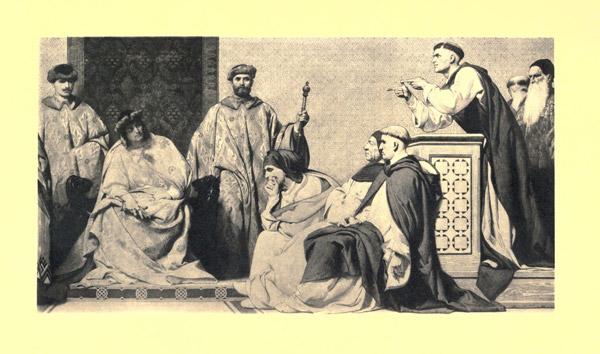
THE UNIVERSITY OF PARIS IN THE THIRTEENTH CENTURY
Hand-painted Photogravure from a Painting by Otto Knille. Reproduced from a Photograph of the Painting by permission of the Berlin Photograph Co.
This famous painting is now in the University of Berlin. Thomas Aquinas, one of the greatest of the scholastic philosophers, surnamed the "Angelic Doctor," is delivering a learned discourse before King Louis IX. To the right of the King stands Joinville, the French chronicler. The Dominican monk with his hand to his face is Guillaume de Saint Amour, and Vincent de Beauvais, and another Dominican are seated with their backs to the platform desk from which Thomas Aquinas is making his animated address. The picture is thoroughly characteristic of a University disputation at the close of the Middle Ages.
DEPARTMENT I—PHILOSOPHY
DEPARTMENT I—PHILOSOPHY
(Hall 6, September 20, 11.15 a. m.)
Chairman:Professor Borden P. Bowne, Boston University.
Speakers:Professor George H. Howison, University of California.
Professor George T. Ladd, Yale University.
In opening the Department of Philosophy, the Chairman, Professor Borden P. Bowne, LL.D., of Boston University, made an interesting address on the Philosophical Outlook. Professor Bowne said in part:—
I congratulate the members of the Philosophical Section on the improved outlook in philosophy. In the generation just passed, philosophy was somewhat at a discount. The great and rapid development of physical science and invention, together with the profound changes in biological thought, produced for a time a kind of chaos. New facts were showered upon us in great abundance, and we had no adequate philosophical preparation for dealing with them. Such a condition is always disturbing. The old mental equilibrium is overthrown and readjustment is a slow process. Besides, the shallow sense philosophy of that time readily lent itself to mechanical and materialistic interpretations, and for a while it seemed as if all the higher faiths of humanity were permanently discredited. All this has passed away. Philosophical criticism began its work and the naïve dogmatism of materialistic naturalism was soon disposed of. It quickly appeared that our trouble was not due to the new facts, but to the superficial philosophy by which they had been interpreted. Now that we have a better philosophy, we have come to live in perfect peace with the facts once thought disturbing, and even to welcome them as valuable additions to knowledge....
The brief naturalistic episode was not without instruction for us. It showed conclusively the great practical importance of philosophy. Had we had thirty years ago the current philosophical insight, the great development of the physical and biological sciences would have made no disturbance whatever. But being interpreted by a crude scheme of thought, it produced somewhat of a storm. Philosophy may not contribute much of positive value, but it certainly has an important negative function in the way of suppressing pretentious dogmatism and fictitious knowledge, which often lead men astray. It is these things which produce conflicts of science and religion or which find in evolution the solvent of all mysteries and the source of all knowledge.
Concerning the partition of territory between science and philosophy, there are two distinct questions respecting the facts of experience. First, we need to know the facts in their temporal and spatial order, and the way they hang together in a system of law. To get this knowledge is the function of science, and in this work science has inalienable rights and a most important practical function. This work cannot be done by speculation nor interfered with by authority of any kind. It is not surprising, then, that scientists in their sense of contact with reality should be indignant with, or feel contempt for, any who seek to limit or proscribe their research. But supposing this work all done, there remains another question respecting the causality and interpretation of the facts. This question belongs to philosophy. Science describes and registers the facts with their temporal and spatial laws; philosophy studies their causality and significance. And while the scientist justly ignores the philosopher who interferes with his inquiries, so the philosopher may justly reproach the scientist who fails to see that the scientific question does not touch the philosophic one....
In the field of metaphysics proper I note a strong tendency toward personal idealism, or as it might be called, Personalism; that is, the doctrine that substantial reality can be conceived only under the personal form and that all else is phenomenal. This is quite distinct from the traditional idealisms of mere conceptionism. It holds the essential fact to be a community of persons with a Supreme Person at their head while the phenomenal world is only expression and means of communication. And to this view we are led by the failure of philosophizing on the impersonal plane, which is sure to lose itself in contradiction and impossibility. Under the form of mechanical naturalism, with its tendencies to materialism and atheism, impersonalism has once more been judged and found wanting. We are not likely to have a recurrence of this view unless there be a return to philosophical barbarism. But impersonalism at the opposite pole in the form of abstract categories of being, causality, unity, identity, continuity, sufficient reason, etc., is equally untenable. Criticism shows that these categories when abstractly and impersonally taken cancel themselves. On the impersonal plane we can never reach unity from plurality, or plurality from unity; and we can never find change in identity, or identity in change. Continuity in time becomes mere succession without the notion of potentiality, and this in turn is empty. Existence itself is dispersed into nothingness through the infinite divisibility of space and time, while the law of the sufficient reason loses itself in barren tautology and the infinite regress. The necessary logical equivalence of cause and effect in any impersonal scheme makes all real explanation and progress impossible, and shuts us up to an unintelligible oscillation between potentiality and actuality, to which there is no corresponding thought....
Philosophy is still militant and has much work before it, but the omens are auspicious, the problems are better understood, and we are coming to a synthesis of the results of past generations of thinking which will be a very distinct progress. Philosophy has already done good service, and never better than in recent times, by destroying pretended knowledge and making room for the higher faiths of humanity. It has also done good service in helping these faiths to better rational form, and thus securing them against the defilements of superstition and the cavilings of hostile critics. With all its aberrations and shortcomings, philosophy deserves well of humanity.
PHILOSOPHY: ITS FUNDAMENTAL CONCEPTIONS AND ITS METHODS
BY GEORGE HOLMES HOWISON
[George Holmes Howison, Mills Professor of Intellectual and Moral Philosophy and Civil Polity, University of California. b. Montgomery County, Maryland, 1834. A.B. Marietta College, 1852; M.A. 1855; LL.D. ibid. 1883. Post-graduate, Lane Theological Seminary, University of Berlin, and Oxford. Headmaster High School, Salem, Mass., 1862-64; Assistant Professor of Mathematics, Washington University, St. Louis, 1864-66; Tileston Professor of Political Economy, ibid. 1866-69; Professor of Logic and the Philosophy of Science, Massachusetts Institute of Technology, 1871-79; Lecturer on Ethics, Harvard University, 1879-80; Lecturer on Logic and Speculative Philosophy, University of Michigan, 1883-84. Member and vice-president St. Louis Philosophical Society; member California Historical Society; American Historical Association; American Association for the Advancement of Science; National Geographic Society, etc. Author of Treatise on Analytic Geometry, 1869; The Limits of Evolution, 1901, 2d edition, 1904; joint author and editor of The Conception of God, 1897, etc. Editor Philosophical Publications of University of California; American Editorial Representative Hibbert Journal, London.]
The duty has been assigned me, honored colleagues, of addressing you on the Fundamental Conceptions and the Methods of our common pursuit—philosophy. In endeavoring to deal with the subject in a way not unworthy of its depth and its extent, I have found it impossible to bring the essential material within less compass than would occupy, in reading, at least four times the period granted by our programme. I have therefore complied with the rule of the Congress which directs that, if a more extended writing be left with the authorities for publication, the reading must be restricted to such a portion of it as will not exceed the allotted time. I will accordingly read to you, first, a brief summary of my entire discussion, by way of introduction, and then an excerpt from the larger document, which may serve for a specimen, as our scholastic predecessors used to say, of the whole inquiry I have carried out. The impression will, of course, be fragmentary, and I must ask beforehand for your most benevolent allowances, to prevent a judgment too unfavorable.
The discussion naturally falls into two main parts: the first dealing with the Fundamental Conceptions; and the second, with the Methods.
In the former, after presenting the conception of philosophy itself, as the consideration of things in the light of the whole, I take up the involved Fundamental Concepts in the following order:—
I.Whole and Part;
II.Subject and Object (Knowing and Being, Mind and Matter; Dualism, Materialism, Idealism);
III.Reality and Appearance (Noumenon and Phenomenon);
IV.Cause and Effect (Ground and Consequence; Causal System);
V.One and Many (Number System; Monism and Pluralism);
VI.Time and Space (their relation to Number; their Origin and Real Meaning);
VII.Unconditioned and Conditioned (Soul, World, God; their Reinterpretation in terms of Pluralism);
VIII.The True, the Beautiful, the Good (their relation to the question between Monism and Pluralism).
These are successively dealt with as they rise one out of the other in the process of interpreting them and applying them in the actual creation of philosophy, as this goes on in the historic schools. The theoretic progress of philosophy is in this way explained by them, in its movement from natural dualism, or realism, through the successive forms of monism, materialistic, agnostic, and idealistic, until it reaches the issue, now coming so strongly forward within the school of idealism, between the adherents of monism and those of pluralism.
The importance of the Fundamental Concepts is shown to increase as we pass along the list, till on reaching Cause and Effect, and entering upon its full interpretation into the complete System of Causes, we arrive at the very significant conception of the Reciprocity of First Causes, and through it come to the Primacy of Final Cause, and the derivative position of the other forms of cause, Material, Formal, Efficient. The philosophic strength of idealism, but especially of idealistic pluralism, comes into clear light as the result of this stage of the inquiry. But it appears yet more decidedly when One and Many, Time and Space, and their interrelations, are subjected to analysis. So the discussion next passes to the higher conceptions, Soul, World, God, by the pathway of the correlation Unconditioned and Conditioned, and its kindred contrasts Absolute and Relative, Necessary and Contingent, Infinite and Finite, corroborating and reinforcing the import of idealism, and, still more decidedly, that of its plural form. Finally, the strong and favorable bearing of this last on the dissolution of agnosticism and the habilitation of the ideals, the True, the Beautiful, and the Good, in a heightened meaning, is brought out.
This carries the inquiry to the second part of it, that of the Philosophical Methods. Here I recount these in a series of six: the Dogmatic, the Skeptical, the Critical, the Pragmatic, the Genetic, the Dialectic. These, I show, in spite of the tendency of the earlier members in the series to over-emphasis, all have their place and function in the development of a complete philosophy, and in fact form an ascending series in methodic effectiveness, all that precede the last being taken up into the comprehensive Critical Rationalism of the last. Methodology thus passes upward, over the ascending and widening roadways of (1) Intuition and Deduction; (2) Experience and Induction; (3) Intuition and Experience adjusted by Critical Limits; (4) Skepticism reinforced and made quasi-affirmative by Desire and Will; (5) Empiricism enlarged by substitution of cosmic and psychic history for subjective consciousness; (6) Enlightened return to a Rationalism critically established by the inclusion of the preceding elements, and by the sifting and the grading of the Fundamental Concepts through their behavior when tested by the effort to make them universal. In this way, the methods fall into a System, the organic principle of which is this principle of Dialectic, which proves itself alone able to establish necessary truths; that is, truths indeed,—judgments that are seen to exclude their opposites, because, in the attempt to substitute the opposite, the place of it is still filled by the judgment which it aims to dislodge.
And now, with your favoring leave, I will read the excerpt from my larger text.
The task to which, in an especial sense, the cultivators of philosophy are summoned by the plans of the present Congress of Arts and Science, is certainly such as to stir an ambition to achieve it. At the same time, it tempers eagerness by its vast difficulty, and the apprehension lest this may prove insuperable. The task, the officers of the Congress tell us, is no less than to promote the unification of all human knowledge. It requires, then, the reduction of the enormous detail in our present miscellany of sciences and arts, which to a general glance, or even to a more intimate view, presents a confusion of differences that seems overwhelming, to a system nevertheless clearly harmonious,—founded, that is to say, upon universal principles which control all differences by explaining them, and which therefore, in the last resort, themselves flow lucidly from a single supreme principle. Simply to state this meaning of the task set us, is enough to awaken the doubt of its practicability.
This doubt, we are bound to confess, has more and more impressed itself upon the general mind, the farther this has advanced in the experience of scientific discovery. The very increase in the multiplicity and complexity of facts and their causal groupings increases the feeling that at the root of things there is "a final inexplicability"—total reality seems, more and more, too vast, too profound, for us to grasp or to fathom. And yet, strangely enough, this increasing sense of mysterious vastness has not in the least prevented the modern mind from more and more asserting, with a steadily increasing insistence, the essential and unchangeable unity of that whole of things which to our ordinary experience, and even to all our sciences, appears such an endless and impenetrable complex of differences,—yes, of contradictions. In fact, this assertion of the unity of all things, under the favorite name of the Unity of Nature, is the pet dogma of modern science; or, rather, to speak with right accuracy, it is the stock-in-trade of a philosophy of science, current among many of the leaders of modern science; for every such assertion, covering, as it tacitly and unavoidably does, a view about the absolute whole, is an assertion belonging to the province of philosophy, before whose tribunal it must come for the assessment of its value. The presuppositions of all the special sciences, and, above all, this presupposition of the Unity and Uniformity of Nature, common to all of them, must thus come back for justification and requisite definition to philosophy—that uppermost and all-inclusive form of cognition which addresses itself to the whole as whole. In their common assertion of the Unity of Nature, the exponents of modern science come unawares out of their own province into quite another and a higher; and in doing so they show how unawares they come, by presenting in most instances the curious spectacle of proclaiming at once their increasing belief in the unity of things, and their increasing disbelief in its penetrability by our intelligence:—
In's Innere der Natur, Dringt kein erschaffner Geist,
is their chosen poet's expression of their philosophic mood. Curious we have the right to call this state of the scientific mind, because it is to critical reflection so certainly self-contradictory. How can there be a real unity belonging to what is inscrutable?—what evidence of unity can there be, except in intelligible and explanatory continuity?
But, at all events, this very mood of agnostic self-contradiction, into which the development of the sciences casts such a multitude of minds, brings them,—brings all of us,—as already indicated, into that court of philosophy where alone such issues lawfully belong, and where alone they can be adjudicated. If the unification of the sciences can be made out to be real by making out its sole sufficient condition, namely, that there is a genuine, and not a merely nominal, unity in the whole of reality itself,—a unity that explains because it is itself, not simply intelligible, but the only completely intelligible of things,—this desirable result must be the work of philosophy. However difficult the task may be, it is rightly put upon us who belong to the Department listed first among the twenty-four in the programme of this representative Congress.
I cannot but express my own satisfaction, as a member of this Department, nor fail to extend my congratulations to you who are my colleagues in it, that the Congress, in its programme, takes openly the affirmative on this question of the possible unification of knowledge. The Congress has thus declared beforehand for the practicability of the task it sets. It has even declared for its not distant accomplishment; indeed, not impossibly, its accomplishment through the transactions of the Congress itself; and it indicates, by no uncertain signs, the leading, the determining part that philosophy must have in the achievement. In fact, the authorities of the Congress themselves suggest a solution of their own for their problem. In their programme we see a renewed Hierarchy of the Sciences, and at the summit of this appears now again, after so long a period of humiliating obscuration, the figure of Philosophy, raised anew to that supremacy, as Queen of the Sciences, which had been hers from the days of Plato to those of Copernicus, but which she began to lose when modern physical and historical research entered upon its course of sudden development, and which, until recently, she has continued more and more to lose as the sciences have advanced in their career of discoveries,—ever more unexpected, more astonishing, yet more convincing and more helpful to the welfare of mankind. May this sign of her recovered empire not fail! If we rejoice at the token, the Congress has made it our part to see that the title is vindicated. It is ours to show this normative function of philosophy, this power to reign as the unifying discipline in the entire realm of our possible knowledge; to show it by showing that the very nature of philosophy—its elemental concepts and its directing ideals, its methods taken in their systematic succession—is such as must result in a view of universal reality that will supply the principle at once giving rise to all the sciences and connecting them all into one harmonious whole.
Such, and so grave, my honored colleagues, is the duty assigned to this hour. Sincerely can I say, Would it had fallen to stronger hands than mine! But since to mine it has been committed, I will undertake it in no disheartened spirit; rather, in that temper of animated hope in which the whole Congress has been conceived and planned. And I draw encouragement from the place, and its associations, where we are assembled—from its historic connections not only with the external expansion of our country, but with its growth in culture, and especially with its growth in the cultivation of philosophy. For your speaker, at least, can never forget that here in St. Louis, the metropolis of the region by which our national domain was in the Louisiana Purchase so enlarged,—here was the centre of a movement in philosophic study that has proved to be of national import. It is fitting that we all, here to-day, near to the scene itself, commemorate the public service done by our present National Commissioner of Education and his group of enthusiastic associates, in beginning here, in the middle years of the preceding century, those studies of Kant and his great idealistic successors that unexpectedly became the nucleus of a wider and more penetrating study of philosophy in all parts of our country. It is with quickened memories belonging to the spot where, more than five-and-thirty years ago, it was my happy fortune to take some part with Dr. Harris and his companions, that I begin the task assigned me. The undertaking seems less hopeless when I can here recall the names and the congenial labors of Harris, of Davidson, of Brockmeyer, of Snider, of Watters, of Jones,—half of them now gone from life. They "builded better than they knew;" and, humbly as they may themselves have estimated their ingenuous efforts to gain acquaintance with the greatest thoughts, history will not fail to take note of what they did, as marking one of the turning-points in the culture of our nation. The publication of the Journal of Speculative Philosophy, granting all the subtractions claimed by its critics on the score of defects (of which its conductors were perhaps only too sensible), was an influence that told in all our circles of philosophical study, and thence in the whole of our social as well as our academic life.
* * * * *
[Here I enter upon the discussion of the subject proper, beginning, as above indicated, with the Fundamental Conceptions. Having followed these through the contrasts Whole and Part, Subject and Object, Reality and Appearance (or Noumenon and Phenomenon), and developed the bearing of these on the procedure of thought from the dualism of natural realism to materialism and thence to idealism, with the issue now coming on, in this last, between monism and pluralism, I strike into the contrast Cause and Effect, and, noting its unfolding into the more comprehensive form of Ground and Consequence, go on thence as follows:]
* * * * *
It is plain that the contrast Ground and Consequence will enable us to state the new issue with closer precision and pertinence than Reality and Appearance, Noumenon and Phenomenon, can supply; while, at the same time, Ground and Consequence exhibits Cause and Effect as presenting a contrast that only fulfills what Noumenon and Phenomenon foretold and strove towards; in fact, what was more remotely, but not less surely, also indicated by Whole and Part, Knowing and Being, Subject and Object. For in penetrating to the coherent meaning of these conceptions, the philosophic movement, as we saw, advanced steadily to the fuller and fuller translating of each of them into the reality that unifies by explanation, instead of pretending to explain by merely unifying; and this, of course, will now be put forward explicitly, in the clarified category of Cause and Effect, transfigured from a physical into a purely logical relation. What idealism now says, in terms of this, is that the Cause (or, as we now read it, the Ground) of all that exists is the Subject; is Mind, the intelligently Self-conscious; and that all things else, the mere objects, material things, are its Consequence, its Outcome,—in that sense its Effect. And what the new pluralistic idealism says, is that the assemblage of individual minds—intelligence being essentially personal and individual, and never merely universal and collective—is the true total Cause of all, and that every mind thus belongs to the order of First Causes; nevertheless, that part, and the most significant part, of the nature of every mind, essential to its personality and its reason, is its recognition of other minds in the very act of its own self-definition. That is to say, a mind by its spontaneous nature as intelligence, by its intrinsic rational or logical genius, puts itself as member of a system of minds; all minds are put by each other as Ends—completely standard and sacred Objects, as much parts of the system of true Causes as each is, in its capacity of Subject; and we have a noumenal Reality that is properly to be described as the eternal Federal Republic of Spirits.
Consequently, the relation of Cause and Effect now expands and heightens into a system of the Reciprocity of First Causes; causes, that is, which, while all coefficients in the existence and explanation of that natural world of experience which forms their passive effect, their objects of mere perception, are themselves related only in the higher way of Final Causes—that is, Defining-Bases and Ends—of each other, making them the logical Complements, and the Objects of conduct, all for each, and each for all. Hence, the system of causation undergoes a signal transformation, and proves to be organized by Final Cause as its basis and root, instead of by Efficient Cause, or Originating Ground, as the earlier stages of thinking had always assumed.
The causal relation between the absolute or primary realities being purely Final, or Defining and Purposive; that is to say, the uncoercive influence of recognition and ideality; all the other forms of cause, as grouped by Aristotle,—Material, Formal, and Efficient,—are seen to be the derivatives of Final Cause, as being supplied by the action of the minds that, as absolute or underived realities, exist only in the relation of mutual Complements and Ends. Accordingly, Efficient Cause operates only from minds, as noumena, to matter, as their phenomenon, their presented contents of experience; or, in a secondary and derivative sense, from one phenomenon to another, or from one group of phenomena to another group, these playing the part of transmitters, or (as some logicians would say) Instrumental Causes, or Means. Cause, as Material, is hence defined as the elementary phenomenon, and the combinations of this; and therefore, strictly taken, is merely Effect (or Outcome) of the self-active consciousness, whose spontaneous forms of conception and perception become the Formal Cause that organizes the sum of phenomena into cosmic harmony or unity.
Here, accordingly, comes into view the further and in some respects deeper conceptual pair, Many and One. The history of philosophic thought proves that this antithesis is darkly obscure and deeply ambiguous; for about it have centred a large part of the conflicts of doctrine. This pair has already been used, implicitly, in exhibiting the development of the preceding group, Cause and Effect; and in so using it we have supplied ourselves with a partial clarification of it, and with one possible solution of its ambiguity. We have seen, namely, how our strong natural persuasion that philosophy guided by the fundamental concept Cause must become the search for the One amid the wilderness of the Many, and that this search cannot be satisfied and ended except in an all-inclusive Unit, in which the Many is embraced as the integral and originated parts, completely determined, subjected, and controlled, may give way to another and less oppressive conception of unity; a conception of it as the harmony among many free and independent primary realities, a harmony founded on their intelligent and reasonable mutual recognition. This conception casts at least some clearing light upon the long and dreary disputes over the Many and the One; for it exposes, plainly, the main source of them. They have arisen out of two chief ambiguities,—the ambiguity of the concept One, and the ambiguity of the concept Cause in its supreme meaning. The normal contrast between the One and the Many is a clear and simple contrast: the One is the single unit, and the Many is the repetition of the unit, or is the collection of the several units. But if we go on to suppose that there is a collection or sum of all possible units, and call this the Whole, then, since there can be no second such, we call it also "one" (or the One, by way of preëminence), overlooking the fact that it differs from the simple one, or unit, in genere; that it is in fact not a unit at all, not an elementary member of a series, but the annulment of all series; that our name "one" has profoundly changed its meaning, and now stands for the Sole, the Only. Thus, by our forgetfulness of differences, we fall into deep water, and, with the confused illusions of the drowning, dream of the One and All as the single punctum originationis of all things, the Source and Begetter of the very units of which it is in reality only the resultant and the derivative. Or, from another point of view, and in another mood, we rightly enough take the One to mean the coherent, the intelligible, the consistent, the harmonious; and putting the Many, on the misleading hint of its contrast to the unit, in antithesis to this One of harmony, we fall into the belief that the Many cannot be harmonious, is intrinsically a cluster of repulsions or of collisions, incapable of giving rise to accord; indeed, essentially hostile to it. So, as accord is the aim and the essence of our reason, we are caught in the snare of monism, pluralism having apparently become the equivalent of chaos, and thus the bête noir of rational metaphysics. Nay, in the opposed camp itself, some of the most ardent adherents of pluralism, the liveliest of wit, the most exuberant in literary resources, are the abjectest believers in the hopeless disjunction and capriciousness of the plural, and hold there is a rift in the texture of reality that no intelligence, "even though you dub it 'the Absolute,'" can mend or reach across. Yet surely there is nothing in the Many, as a sum of units, the least at war with the One as a system of harmony. On the contrary, even in the pure form of the Number Series, the Many is impossible except on the principle of harmony,—the units can be collected and summed (that is, constitute the Many), only if they cohere in a community of intrinsic kindred. Consequently the whole question of the chaotic or the harmonic nature of a plural world turns on the nature of the genus which we find characteristic of the absolutely (i. e., the unreservedly) real, and which is to be taken as the common denomination enabling us to count them and to sum them. When minds are seen to be necessarily the primary realities, but also necessarily federal as well as individual, the illusion about the essential disjunction and non-coherence of the plurally real dissolves away, and a primordial world of manifold persons is seen to involve no fundamental or hopeless anarchy of individualism, irreducible in caprice, but an indwelling principle of harmony, rather, that from the springs of individual being intends the control and composure of all the disorders that mark the world of experiential appearance, and so must tend perpetually to effect this.
The other main source of our confusions over the Many and the One is the variety of meaning hidden in the concept Cause, and our propensity to take its most obvious but least significant sense for its supreme intent. Closest at hand, in experience, is our productive causation of changes in our sense-world, and hence most obvious is that reading of Cause which takes it as the producer of changes and, with a deeper comprehension of it, of the inalterable linkage between changes, whereby one follows regularly and surely upon another. Thus what we have in philosophy agreed to call Efficient Cause comes to be mistaken for the profoundest and the supreme form of cause, and all the other modes of cause, the Material (or Stuff), the Form (or Conception), and the End (or Purpose), its consequent and derivative auxiliaries. Under the influence of this strong impression, we either assume total reality to be One Whole, all-embracing and all-producing of its manifold modes, or else view it as a duality, consisting of One Creator and his manifold creatures. So it has come about that metaphysics has hitherto been chiefly a contention between pantheism and monotheism, or, as the latter should for greater accuracy be called, monarchotheism; and, it must be acknowledged, this struggle has been attended by a continued (though not continual) decline of this later dualistic theory before the steadfast front and unyielding advance of the older monism. Thus persistent has been the assumption that harmony can only be assured by the unity given in some single productive causation: the only serious uncertainty has been about the most rational way of conceiving the operation of this Sole Cause; and this doubt has thus far, on the whole, declined in favor of the Elder Oriental or monistic conception, as against the Hebraic conception of extraneous creation by fiat. The frankly confessed mystery of the latter, its open appeal to miracle, places it at a fatal disadvantage with the Elder Orientalism, when the appeal is to reason and intelligibility. It is therefore no occasion for wonder that, especially since the rise of the scientific doctrine of Evolution, with its postulate of a universal unity, self-varying yet self-fulfilling, even the leaders of theology are more and more falling into the monistic line and swelling the ever-growing ranks of pantheism. If it be asked here, And why not?—where is the harm of it?—is not the whole question simply of what is true? the answer is, The mortal harm of the destruction of personality, which lives or dies with the preservation or destruction of individual responsibility; while the completer truth is, that there are other and profounder (or, if you please, higher) truths than this of explanation by Efficient Cause. In fact, there is a higher conception of Cause itself than this of production, or efficiency; for, of course, as we well might say, that alone can be the supreme conception of Cause which can subsist between absolute or unreserved realities, and such must exclude their production or their necessitating control by others. So that we ought long since to have realized that Final Cause, the recognized presence to each other as unconditioned realities, or Defining Auxiliaries and Ends, is the sole causal relation that can hold among primary realities; though among such it can hold, and in fact must.
For the absolute reality of personal intelligences, at once individual and universally recognizant of others, is called for by other conceptions fundamental to philosophy. These other fundamental concepts can no more be counted out or ignored than those we have hitherto considered; and when we take them up, we shall see how vastly more significant they are. They alone will prove supreme, truly organizing, normative; they alone can introduce gradation in truths, for they alone introduce the judgment of worth, of valuation; they alone can give us counsels of perfection, for they alone rise from those elements in our being which deal with ideals and with veritable Ideas. So let us proceed to them.
* * * * *
Our path into their presence, however, is through another pair, not so plainly antithetic as those we have thus far considered. This pair that I now mean is Time and Space, which, though not obviously antinomic, yet owes its existence, as can now be shown, to that profoundest of concept-contrasts which we earlier considered under the head of Subject and Object, when the Object takes on its only adequate form of Other Subject. But in passing from the contrast One and Many towards its rational transformation into the moral society of Mind and Companion Minds, we break into this pair of Time and Space, and must make our way through it by taking in its full meaning.
Time and Space play an enormous part in all our empirical thinking, our actual use of thought in our sense-perceptive life. And no wonder; for, in coöperation, they form the postulate and condition of all our possible sensuous consciousness. Only on them as backgrounds can thought take on the peculiar clearness of an image or a picture; only on the screens which they supply can we literally depict an object. And this clarity of outline and boundary is so dear to our ordinary consciousness, that we are prone to say there is no sufficient, no real clearness, unless we can clarify by the bounds either of place or of date, or of both. In this mood, we are led to deny the reality and validity of thought altogether, when it cannot be defined in the metes and bounds afforded by Time or by Space: that which has no date nor place, we say,—no extent and no duration,—cannot be real; it is but a pseudo-thought, a pretense and a delusion. Here is the extremely plausible foundation of the philosophy known as sensationism, the refined or second-thought form of materialism, in which it begins its euthanasia into idealism.
Without delaying here to criticise this, let us notice the part that Time and Space play in reference to the conceptual pair we last considered, the One and the Many; for not otherwise shall we find our way beyond them to the still more fundamental conceptions which we are now aiming to reach. Indeed, it is through our surface-apprehension of the pair One and Many, as this illumines experience, that we most naturally come at the pair Time and Space; so that these are at first taken for mere generalizations and abstractions, the purely nominal representatives of the actual distinctions between the members of the Many by our sense perception of this from that, of here from there, of now from then. It is not till our reflective attention is fixed on the fact that there and here, now and then, are peculiar distinctions, wholly different from other contrasts of this with that,—which may be made in all sorts of ways, by difference of quality, or of quantity, or of relations quite other than place and date,—it is not till we realize this peculiar character of the Time-contrast and the Space-contrast, that we see these singular differential qualia cannot be derived from others, not even from the contrast One and Many, but are independent, are themselves underived and spontaneous utterances of our intelligent, our percipient nature. But when Kant first helped mankind to the realization of this spontaneous (or a priori) character of this pair of perceptive conditions, or Sense-Forms, he fell into the persuasion, and led the philosophic world into it, that though Time and Space are not derivatives of the One and the Many read as the numerical aspect of our perceptive experiences, yet there is between the two pairs a connection of dependence as intimate as that first supposed, but in exactly the opposite sense; namely, that the One and the Many are conditioned by Time and Space, or, when it comes to the last resort, are at any rate completely dependent upon Time. By a series of units, this view means, we really understand a set of items discriminated and related either as points or as instants: in the last analysis, as instants: that is, it is impossible to apprehend a unit, or to count and sum units, unless the unit is taken as an instant, and the units as so many instants. Numbers, Kant holds, are no doubt pure (or quite unsensuous) percepts,—discerned particulars,—therefore spontaneous products of the mind a priori, but made possible only by the primary pure percept Time, or, again, through the mediation of this, by the conjoined pure percept Space; so that the numbers, in their own pure character, are simply the instants in their series. As the instants, and therefore the numbers, are pure percepts,—particulars discerned without the help of sense,—so pure percepts, in a primal and comprehensive sense, argues Kant, must their conditioning postulates Time and Space be, to supply the "element," or "medium," that will render such pure percepts possible.
This doctrine of Kant's is certainly plausible; indeed, it is impressively so; and it has taken a vast hold in the world of science, and has reinforced the popular belief in the unreality of thought apart from Time and Space; an unreality which it is an essential part of Kant's system to establish critically. But as a graver result, it has certainly tended to discredit the belief in personal identity as an abiding and immutable reality, enthroned over the mutations of things in Time and Space; since all that is in these is numbered and is mutable, and is rather many than one, yet nothing is believed real except as it falls under them, at any rate under Time. And with this decline of the belief in a changeless self, has declined, almost as rapidly and extensively, the belief in immortality. Or, rather, the permanence and the identity of the person has faded into a question regarded as unanswerable; though none the less does this agnostic state of belief tend to take personality, in any responsible sense of the word, out of the region of practical concern. With what is unknowable, even if existing, we can have no active traffic; 't is for our conduct as if it were not.
So it behooves us to search if this prevalent view about the relation of One and Many to Time and Space is trustworthy and exact. What place and function in philosophy must Space and Time be given?—for they certainly have a place and function; they certainly are among the inexpugnable conceptions with which thought has to concern itself when it undertakes to gain a view of the whole. But it may be easy to give them a larger place and function than belong to them by right. Is it true, then, that the One and the Many—that the system of Numbers, in short—are unthinkable except as in Space and Time, or, at any rate, in Time? Or, to put the question more exactly, as well as more gravely and more pertinently, Are Space and Time the true principia individui, and is Time preëminently the ultimate principium individuationis? Is there accordingly no individuality, and no society, no associative assemblage, except in the fleeting world of phenomena, dated and placed? Simply to ask the question, and thus bring out the full drift of this Kantian doctrine, is almost to expose the absurdity of it. Such a doctrine, though it may be wisely refusing to confound personality, true individuality, with the mere logical singular; nay, worse, with a limited and special illustration of the singular, the one here or the one there, the one now or the one then; nevertheless, by confining numerability to things material and sensible, makes personal identity something unmeaning or impossible, and destroys part of the foundation for the relations of moral responsibility. Though the vital trait of the person, his genuine individuality, doubtless lies, not in his being exactly numerable, but in his being aboriginal and originative; in a word, in his self-activity, in his being a centre of autonomous social recognition; yet exactly numerable he indeed is, and must be, not confusable with any other, else his professed autonomy, his claim of rights and his sense of duty, can have no significance, must vanish in the universal confusion belonging to the indefinite. Nor, on the other hand, is it at all true that a number has to be a point or an instant, nor that things when numbered and counted are implicitly pinned upon points or, at all events, upon instants. It may well enough be the fact that in our empirical use of number we have to employ Time, or even Space, but it is a gaping non sequitur to conclude that we therefore can count nothing but the placed and the dated. Certainly we count whenever we distinguish,—by whatever means, on whatever ground. To think is, in general, at least to "distinguish the things that differ;" but this will not avail except we keep account of the differences; hence the One and the Many lie in the very bosom of intelligence, and this fundamental and spontaneous contrast can not only rive Time and Space into expressions of it, in instants and in points, but travels with thought from its start to its goal, and as organic factor in mathematical science does indeed, as Plato in the Republic said, deal with absolute being, if yet dreamwise; so that One and Many, and Many as the sum of the ones, makes part of the measure of that primally real world which the world of minds alone can be. If the contrast One and Many can pass the bounds of the merely phenomenal, by passing the temporal and the spatial; if it applies to universal being, to the noumenal as well as to the phenomenal; then the absolutely real world, so far as concerns this essential condition, can be a world of genuine individuals, identifiable, free, abiding, responsible, and there can be a real moral order; if not, then there can be no such moral world, and the deeper thought-conceptions to which we now approach must be regarded, at the best, as fair illusions, bare ideals, which the serious devotee of truth must shun, except in such moments of vacancy and leisure as he may venture to surrender, at intervals, to purely hedonic uses. But if the One and the Many are not dependent on Time and Space, their universal validity is possible; and it has already been shown that they are not so dependent, are not thus restricted.