METALLIC ORES AND FLUORSPAR
Reading edition
Lead and Zinc
Lead mining was one of the earliest industries of Illinois. The early settlers’ need for bullets for procuring food and for defense of their lives and property made lead an important commodity, and 10 the deposits of lead ore in the northwestern corner of Illinois were quickly exploited. The ore was the mineral galena (fig. 5), for which the city of Galena in Jo Daviess County is believed to have been named.
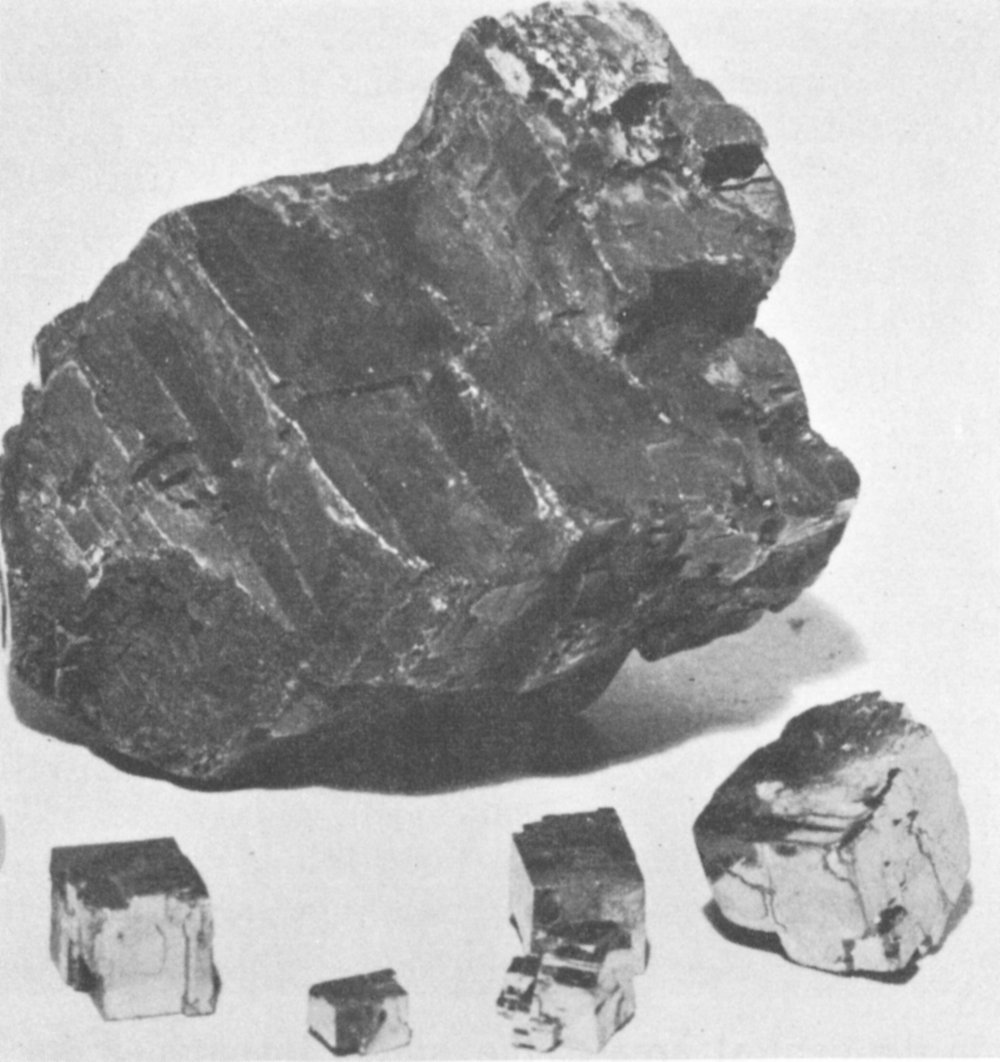
Figure 5—Galena with cubic cleavage blocks in foreground.
Galena is a dark, shiny mineral that breaks readily into cubes or combinations of cubes. It is composed of lead and sulfur (PbS). Galena itself is not suitable for use as a metal; the lead must first be separated from the sulfur.
The earliest method of recovering lead from galena was crude. A pile of logs, smaller pieces of wood, and ore was built on sloping ground. Just below it a pit was dug. When the wood was set on fire, the heat caused the lead and sulfur to separate, and the molten lead trickled down into the pit. The smelting process was later improved, and stone “furnaces” were built to house the operations.
Crevice Deposits and Residual Deposits.—Most of the lead ore mined in the early days of the northwestern Illinois mining district came from crevice deposits in the dolomite bedrock and 11 from residual deposits at or near the surface of the ground. The crevices were vertical narrow joints or fissures. Ore was not continuously present along them but occurred from place to place in “pods” (fig. 6 and fig. 7). Dimensions of the pods varied, but typical ones were about 3 feet wide, 5 feet high, and a few to a few hundred feet long. The galena, for the most part, occurred in a mixture of clay and weathered dolomite that filled, or partly filled, the crevices.
The residual deposits were found where the action of the weather for many thousands of years had dissolved the dolomite from the outcropping parts of a crevice deposit and left behind a residue of brown or red clay containing galena.
Some of the crevice and residual deposits worked by the early miners cropped out at the surface, but most of them were covered by earth. Other crevices were exposed in the bluffs of the Mississippi River and extended back into them for 1,000 feet or more.
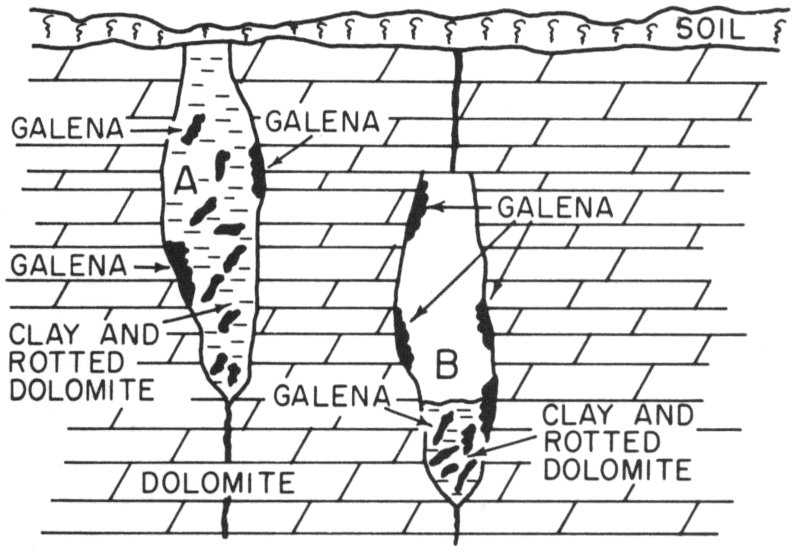
Figure 6—Diagrammatic cross section of two crevice deposits. A reaches ground surface and is filled with clay; B is only partly clay filled. Galena coats parts of the walls and occurs as pieces scattered through the clay. Typical crevices are about 3 feet wide and 5 feet high.
SOIL
A
GALENA
CLAY AND ROTTED DOLOMITE
B
GALENA
CLAY AND ROTTED DOLOMITE
DOLOMITE
When the richer deposits of ore in the crevices were worked out, some mines were deepened into the dolomite bedrock, but usually less rather than more galena was found.
As the amount of galena decreased, however, another mineral, which had been present before in only small amounts, was found in increasing quantities. This was sphalerite—a yellow, brown, or black mineral of resinous appearance that is composed of zinc and sulfur (ZnS). It does not look like a metallic ore.
At first the sphalerite was not used because there were no smelters in the area that could separate the zinc from the sulfur 12 with which it was combined in the ore. Between 1850 and 1870, however, smelters were built in northwestern Illinois and southern Wisconsin and the ore was shipped there. Sphalerite is now the principal ore mineral produced in northwestern Illinois.
The sphalerite and galena of southern Illinois, described later, are similar to that found in northwestern Illinois.
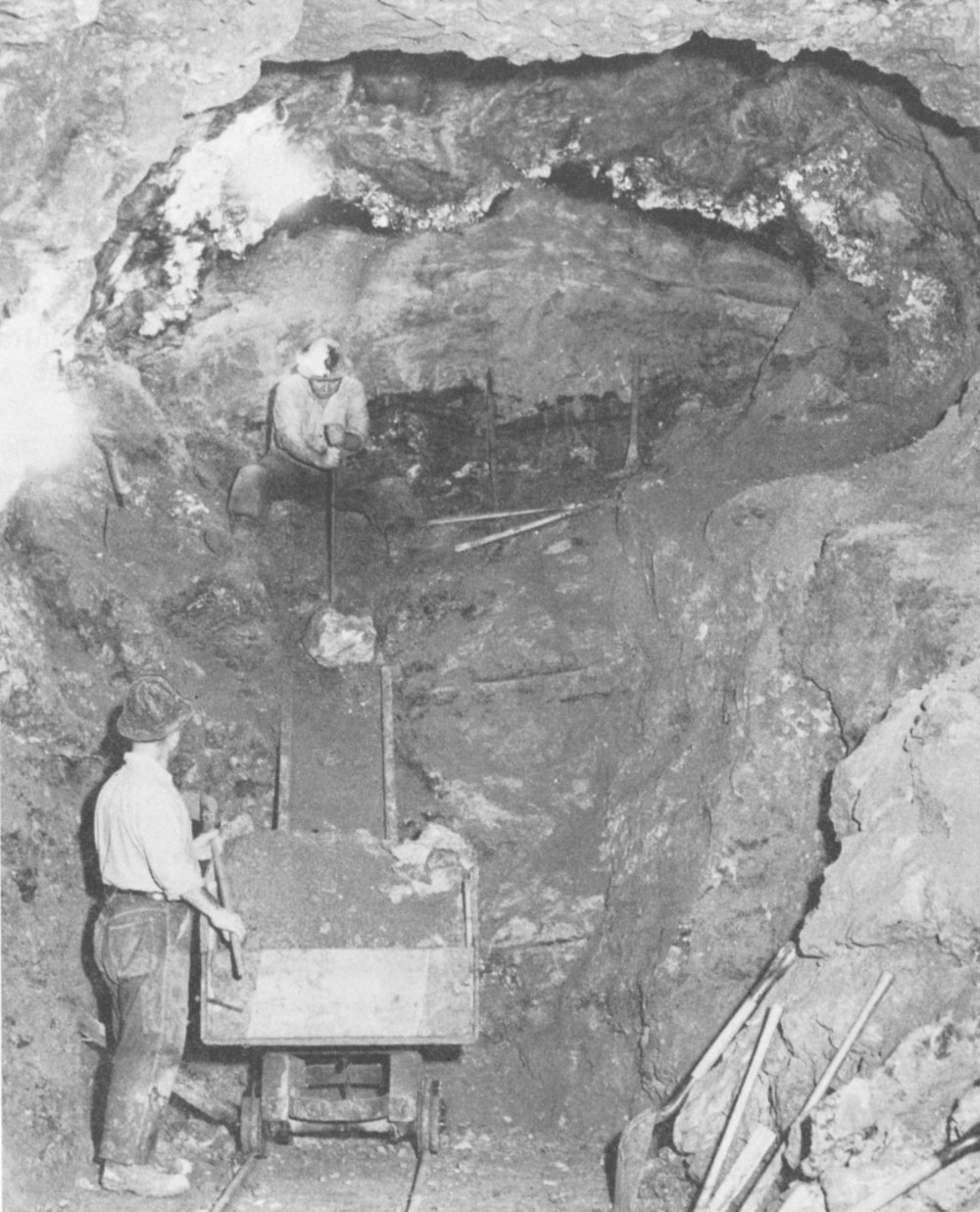
Figure 7—Crevice lead mine. Miner pries ore loose and pushes it into car at bottom of crevice. Shiny galena layer occurs above his head and another at level of his waist.
13
Mining and Milling.—One large mine is producing zinc and lead near Galena at present. Smaller mines operate irregularly. The ore may occur as pockets, irregularly shaped rather flat masses, vertical or inclined veins (fig. 8), or small particles scattered through the dolomite. The principal ore bodies that have been worked in recent years have been of irregular shape, both horizontally and vertically, and usually have been between 50 and 200 feet wide and from a few to as much as 100 feet high. They lie at a depth of roughly 300 feet.
Blasting is required to loosen and break the ore. At the large mine the ore is brought to the surface by a hoist. In some relatively shallow mines an inclined tunnel has been driven to the ore body and the ore brought to the surface in trucks.
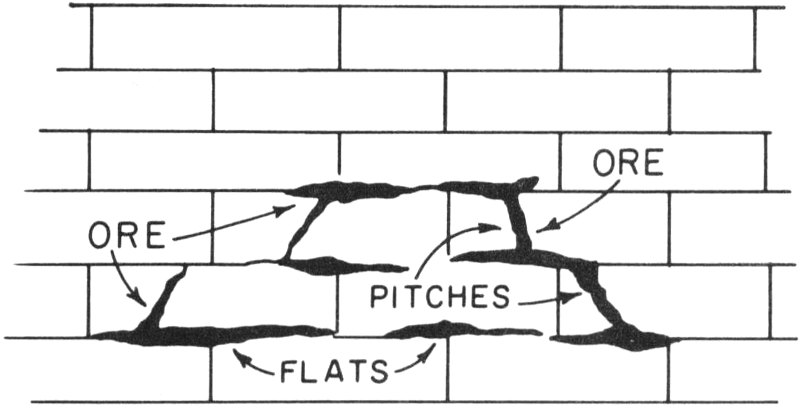
Figure 8—Diagrammatic cross section of a zinc ore deposit showing flats and pitches. The deposit occurs in limestone and dolomite. Much of the ore is a mixture of dolomite, limestone, calcite, and sphalerite. Typical dimensions of such a deposit are about 30 feet high and 100 to 200 feet wide.
ORE
PITCHES
FLATS
Because the ore consists of galena and sphalerite attached to and scattered through dolomite, it must be milled to free and separate the metals from the rock. Crushing, grinding, and other operations are involved. The dolomite is discarded and the galena and sphalerite concentrates are shipped away to be smelted. No smelters have operated in the Galena area for some time.
Aids to Prospecting.—Finding deposits of ore 300 feet underground is not easy. Inspection of the surface usually tells little. To find and outline a commercial ore deposit many holes often must be drilled to explore the unexposed rock strata. Because this is a costly process, every possible means is employed to drill the holes where ore is most likely to be found. This is where geologists are useful—geologists of the mining companies and of the Illinois Geological Survey. Three examples of how their investigations help to find ore are given here.
14
It was noted early in the development of the northwestern Illinois mining district that zinc ore deposits were most common along small downfolds in the bedrock, called synclines, that were a few hundred feet wide and a mile or so long. The synclines were associated with much larger synclines that extended for several miles. A map prepared by the Illinois Geological Survey shows the possible location and extent of many of these downfolds and has had much practical use in the selection of the most promising areas for test drilling to find ore.
The Survey also collects the records of borings made by companies and individuals in their search for ore. The records are on permanent file at the Survey offices and are valuable in several ways. Some indicate where no ore was found and where it is, therefore, useless to drill further; others show only traces of ore but suggest that more drilling in the vicinity might discover a deposit large enough to be mined profitably. Still other records are of borings that encountered rich ore in which mines have been developed.
The third aid to prospecting is the study of ore bodies and their minerals to determine how the deposits were formed. The ore bodies have been and are being studied in the mines. Ore specimens are carefully examined in the Survey laboratories. If geologists can learn how the known deposits were formed, it may be possible to direct exploration into promising new areas.
Fluorspar
In the southeastern tip of Illinois lie deposits of a mineral that contains the chemical element fluorine. This element is used in making the propellant that activates aerosol sprays, a plastic that resists chemicals and oil and is strong enough to be used for bearings, compounds that are said to help to prevent tooth decay, and many other useful chemicals.
The mineral is fluorite (fig. 9), commonly called fluorspar. It is composed of calcium fluoride (CaF₂), a compound of calcium and fluorine, and is a glassy mineral that is generally white or gray but may be purple, rose, yellow, blue, or green. In rare instances it is colorless.
Fluorspar mining in Hardin and Pope Counties began with lead mining. Galena was first discovered there in 1839 in a well being dug at the town of Rosiclare. Mining of galena began in the early 1840’s, and somewhat later ore was being smelted by three furnaces, all of which have long since disappeared.
The veins that were worked for galena also contained fluorspar, but as there was little or no use for fluorspar in the 1840’s 15 it was considered waste. In time, uses developed, however, and about 1870 it was mined and shipped in commercial quantities. Since then the tonnage and value of the fluorspar produced from the Rosiclare area have increased until fluorspar is the major product.
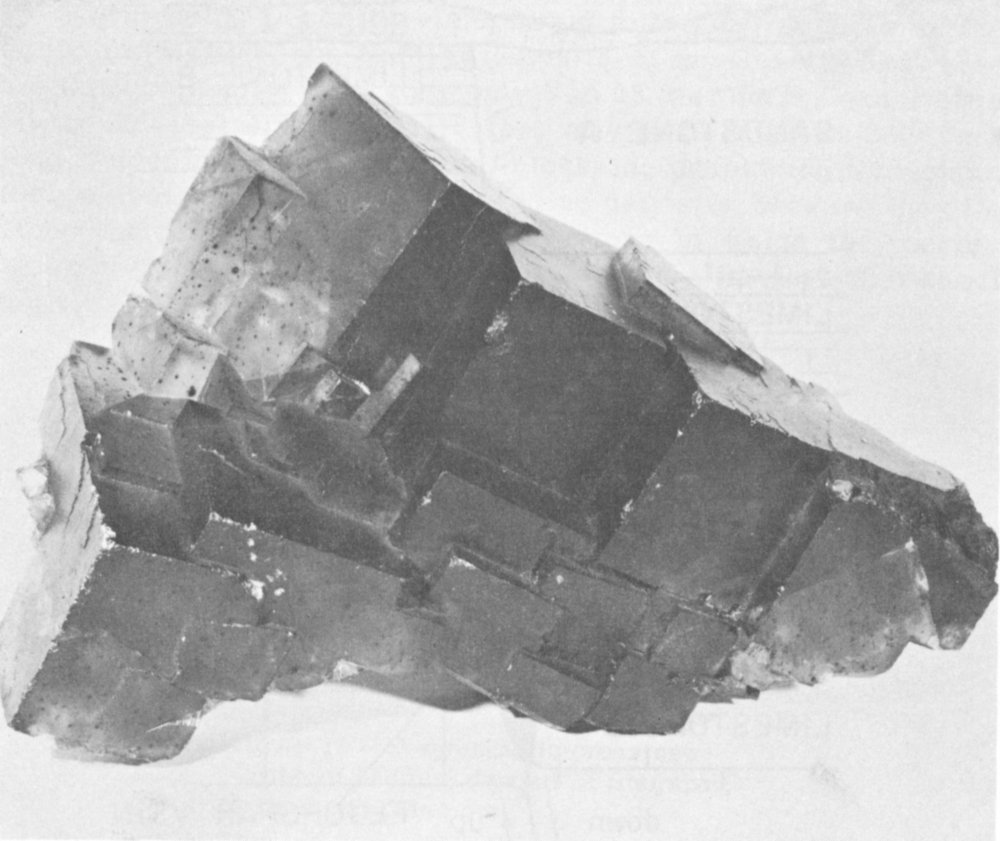
Figure 9—Group of cubic fluorite crystals.
The fluorspar mining district north of the town of Cave in Rock in eastern Hardin County also was an early producer of galena. In that area the fluorspar-galena deposits are elongate and approximately flat. The first miners followed the ore bodies from outcrops by tunneling into the hillsides. In the late 1930’s and early 1940’s, many holes were drilled into the bedrock in search of new deposits. Ore was found that contained not only galena and fluorspar but also important amounts of sphalerite.
Vein Deposits.—In the Rosiclare district, the fluorspar and its accompanying minerals occur as steeply inclined veins a few inches to 25 feet or more wide (fig. 10), usually in limestone strata. The veins are not uniformly thick but widen or narrow from place to place both vertically and horizontally. They occur 16 along faults—planes along which the rocks of the earth’s crust have broken and slipped. A fault may be a single plane of slippage but more often is a zone of broken and displaced rocks. In most of the faults that contain fluorspar, the slippage is vertical, or nearly so. Along one of the faults in the Rosiclare district, the rocks on one side of the fault have moved downward as much as 650 feet in relation to the rocks on the other side. Some faults are more than 10 miles long, and the depth to which they extend into the earth is unknown. Fluorspar has been mined from one of them at depths of 800 feet. Not all faults, nor all parts of any one fault, contain fluorspar.
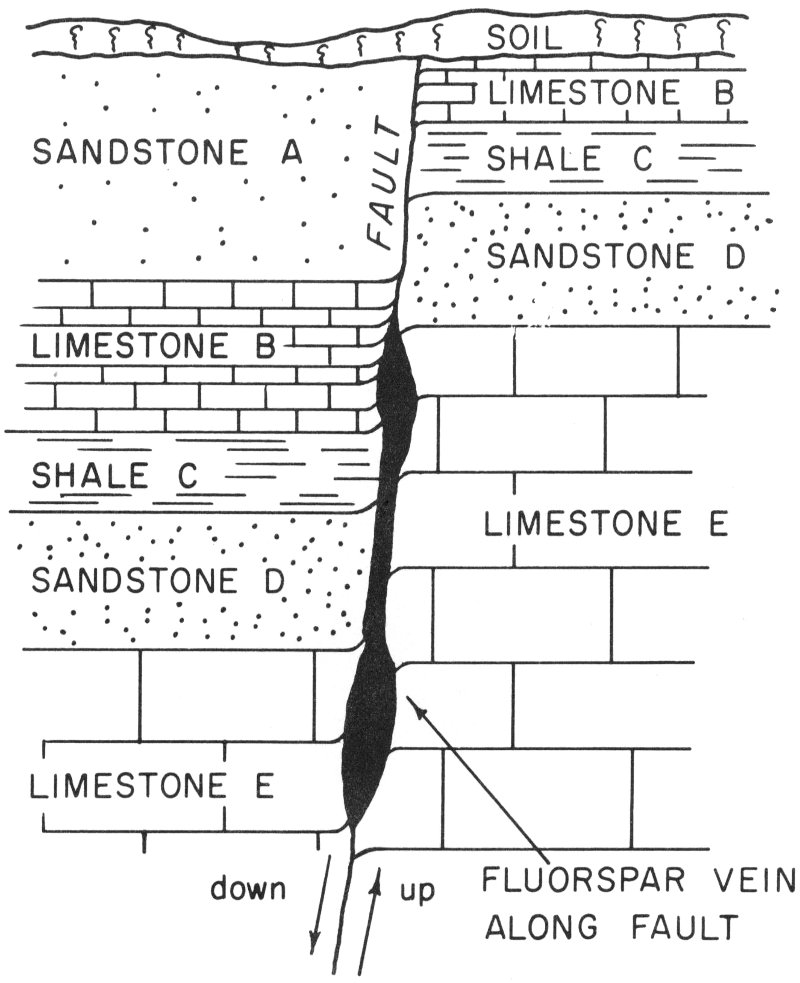
Figure 10—Diagrammatic cross section of fluorspar vein along a fault. The strata on the left side of the fault have moved downward with reference to those on the right side.
SOIL
FAULT
FLUORSPAR VEIN ALONG FAULT
down
SANDSTONE A
LIMESTONE B
SHALE C
SANDSTONE D
LIMESTONE E
up
LIMESTONE B
SHALE C
SANDSTONE D
LIMESTONE E
17
Bedding Deposits.—In contrast to the vein deposits of the Rosiclare district, the bedding deposits of the Cave in Rock area are flat, or nearly flat, commonly 5 to 15 feet thick, and from a few to 200 feet wide (fig. 11). They may be as much as 2000 feet long, widening or narrowing and thickening or thinning throughout their extent. They are called bedding deposits because they lie along the beds or layers of the limestone in which they occur. Most of the ore bodies are associated with a fracture or a small fault.
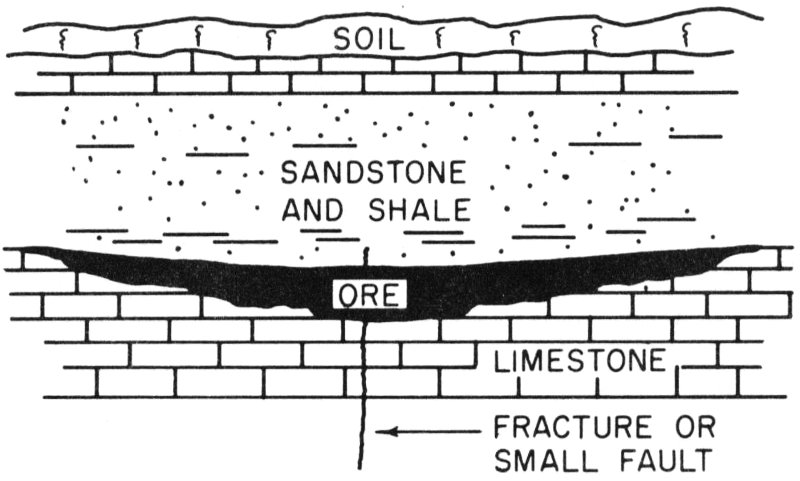
Figure 11—Diagrammatic cross section of bedding deposit of fluorspar, lead, and zinc ore.
SOIL
SANDSTONE AND SHALE
ORE
LIMESTONE
FRACTURE OR SMALL FAULT
Grades and Uses of Fluorspar.—There are three principal grades of fluorspar—metallurgical, acid, and ceramic. The metallurgical spar is used as a flux in making steel and in metal foundries. Acid spar is used to make hydrofluoric acid, which plays a part in the preparation of uranium isotopes and in the production of a synthetic mineral essential in refining aluminum. The acid is also used in the production of high-octane gasoline and is the basis for a variety of important chemical compounds, among them refrigerants and insecticides. Ceramic grade fluorspar is used in making enamels, glazes, and certain kinds of glass.
Mining and Milling.—Fluorspar and its associated ores are mined in different ways in the Rosiclare and Cave in Rock districts because the types of deposits differ. However, in both areas most of the larger mines are entered by vertical shafts. In the mines, explosives are placed in holes drilled by machines and are then detonated to shoot down the ore (fig. 12). Mine cars, trucks, or conveyor belts carry the ore to the bottom of the mine shaft where hoists raise it to the mills at the surface. In the mills a variety of ore-classifying machines separate the galena, 18 sphalerite, and fluorspar from the waste mineral materials (chiefly limestone and calcite) with which they occur. Some fluorspar after the separation process is almost flour-fine. To increase its use, much of this spar is mixed with a binder and made into pellets or briquets one-half to one inch in size.
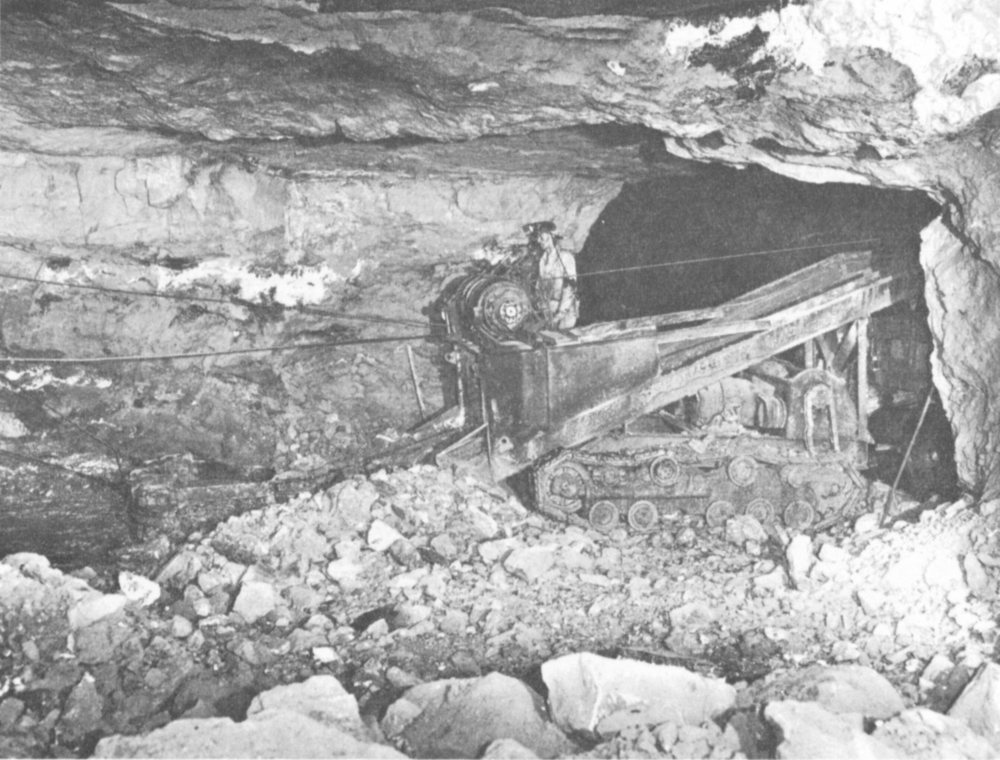
Figure 12—Machine loading fluorspar ore in mine near Cave in Rock.
Geological and Chemical Studies.—Because much of the fluorspar produced in southern Illinois has come from veins along faults, geologists have mapped the faults of the area by investigating the distribution and nature of the various bedrock outcrops. The work was complicated by the mantle of earth and vegetation that covers the bedrock at many places. However, a geologic map was made that shows where the various rock formations—sandstone, limestone, and shale—lie beneath the surface and where the numerous faults crisscross the district.
The first geologic map of the fluorspar district was made in 1920 by the Illinois and U. S. Geological Surveys. New maps on a much larger scale have been made recently by the Illinois Survey to meet the needs of the modern fluorspar industry.
The Illinois Survey also has studied the ores and ore deposits of southern Illinois to determine how they were formed. 19 The records of many borings and pits sunk to find ore have been collected and filed at the Survey to guide future prospecting.
Survey chemists are finding new uses for Illinois fluorspar. Their research has produced new organic fluorine compounds that are being tested for use in agriculture, medicine, and industry. They also have worked out easier and cheaper methods of making certain fluorine compounds. Survey chemical engineers have helped to obtain needed information about the physical properties of the pellets made from fluorspar powder.
Origin of Illinois Ore Deposits
The ore deposits of northwestern and southern Illinois were formed so many millions of years ago that it is possible to propose only theories of their origin. Most geologists think that the minerals, dissolved in warm or hot water, came from deep in the earth. Perhaps the mineral-bearing water came from, or was associated with, rocks that were or had been molten (igneous rocks), but it may have had some other source. Why the ores occur where we now find them is not fully known. The cooling of the solutions and the lessening of pressure as the solutions rose toward the surface may have had a part in ore deposition. Faults and the nature of the rocks encountered by the depositing solutions also appear to have had an influence.
Illinois as a Mining State
Although Illinois is not usually thought of as a mining state, northwestern and southern Illinois together produced in 1963 nearly $5,000,000 worth of zinc, about $600,000 worth of lead, and $6,500,000 worth of fluorspar. The annual total value is about $12,000,000.
The southern Illinois fluorspar district has another distinction—for many years its mines have been the major domestic source of the nation’s fluorspar.