Winona.
Reading edition
PART I. Winona,[1] first-born daughter, was the name Of a Dakota girl who, long ago, Dwelt with her people here unknown to fame. Sweet word, Winona, how my heart and lips Cling to that name (my mother's was the same Ere her form faded into death's eclipse), Cling lovingly, and loth to let it go. All arts that unto savage life belong She knew, made moccasins, and dressed the game. From crippling fashions free, her well-knit frame At fifteen summers was mature and strong. She pitched the tipi,[2] dug the tipsin[3] roots, Gathered wild rice and store of savage fruits. Fearless and self-reliant, she could go Across the prairie on a starless night; She speared the fish while in his wildest flight, And almost like a warrior drew the bow. Yet she was not all hardness: the keen glance, Lighting the darkness of her eyes, perchance Betrayed no softness, but her voice, that rose O'er the weird circle of the midnight dance, Through all the gamut ran of human woes,
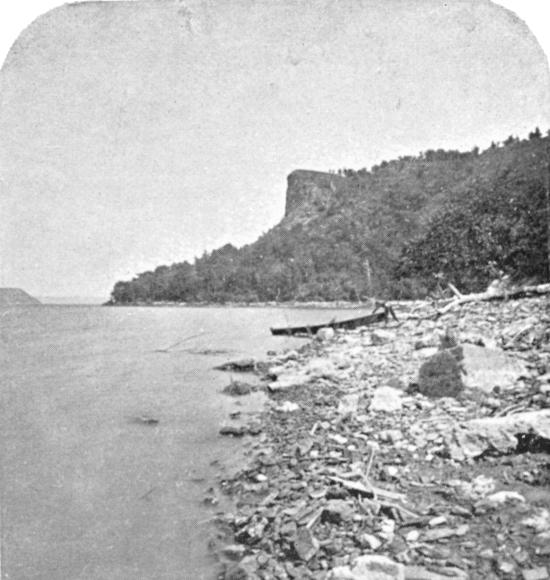
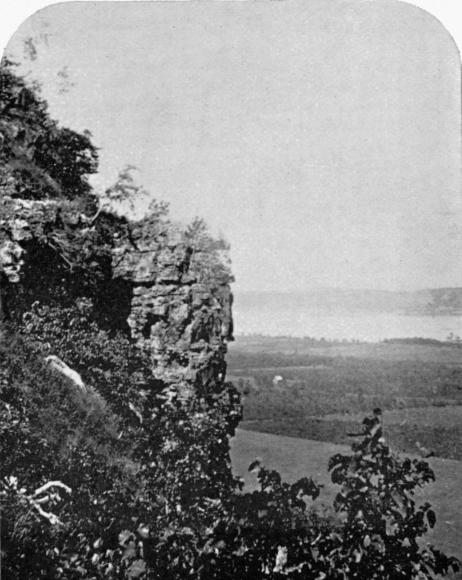
MAIDEN ROCK, LAKE PEPIN.
Passion, and joy. A woman's love she had For ornament; on gala days was clad In garments of the softest doeskin fine, With shells about her neck; moccasins neat Were drawn, like gloves, upon her little feet, Adorned with scarlet quills of porcupine. Innocent of the niceties refined That to the toilet her pale sisters bind, Yet much the same beneath the outer rind, She was, though all unskilled in bookish lore, A sound, sweet woman to the very core. Winona's uncle, and step-father too, Was all the father that she ever knew; By the Absarakas[4] her own was slain Before her memory could his face retain. Two bitter years his widow mourned him dead, And then his elder brother she had wed. None loved Winona's uncle; he was stern And harsh in manner, cold and taciturn, And none might see, without a secret fear, Those thin lips ever curling to a sneer. And yet he was of note and influence Among the chieftains; true he rarely lent More than his presence in the council tent, And when he rose to speak disdained pretence Of arts rhetoric, but his few words went Straight and incisive to the question's core, And rarely was his counsel overborne. The Raven was the fitting name he bore; And though his winters well-nigh reached three-score, Few of his tribe excelled him in the chase. A warrior of renown, but never wore The dancing eagle plumes, and seemed to scorn The vanities and follies of his race. I said the Raven was beloved by none; But no, among the elders there was one Who often sought him, and the two would walk Apart for hours, and converse alone. The gossips, marveling much what this might mean, Whispered that they at midnight had been seen Far from the village, wrapped in secret talk. They seemed in truth an ill-assorted brace, But Nature oft in Siamese bond unites, By some strange tie, the farthest opposites. Gray Cloud was oily, plausible, and vain, A conjurer with subtle scheming brain; Too corpulent and clumsy for the chase, His lodge was still provided with the best, And though sometimes but a half welcome guest, He took his dish and spoon to every feast.[5] Priestcraft and leechcraft were combined in him, Two trades occult upon which knaves have thriven, Almost since man from Paradise was driven; Padding with pompous phrases worn and old Their scanty esoteric science dim, And gravely selling, at their weight in gold, Placebos colored to their patients' whim. Man's noblest mission here too oft is made, In heathen as in Christian lands, a trade. Holy the task to comfort and console The tortured body and the sin-sick soul, But pain and sorrow, even prayer and creed, Are turned too oft to instruments of greed. The conjurer claimed to bear a mission high: Mysterious omens of the earth and sky He knew to read; his medicine could find In time of need the buffalo, and bind In sleep the senses of the enemy. Perhaps not wholly a deliberate cheat, And yet dissimulation and deceit Oozed from his form obese at every pore. Skilled by long practice in the priestly art, To chill with superstitious fear the heart, And versed in all the legendary lore, He knew each herb and root that healing bore; But lest his flock might grow as wise as he, Disguised their use with solemn mummery. When all the village wrapped in slumber lay, His midnight incantations often fell, His chant now weirdly rose, now sank away, As o'er some dying child he cast his spell. And sometimes through his frame strange tremors ran— Magnetic waves, swept from the unknown pole Linking the body to the wavering soul; And swifter came his breath, as if to fan The feeble life spark, and his finger tips Were to the brow of pain like angel lips. No wonder if in moments such as these He half believed in his own deities, And thought his sacred rattle could compel The swarming powers unseen to serve him well. The Raven lay one evening in his tent With his accustomed crony at his side; Around their heads a graceful aureole Of smoke curled upward from the scarlet bowl Of Gray Cloud's pipe with willow bark supplied. Winona's thrifty mother came and went, Her form with household cares and burdens bent, Fresh fuel adds, and stirs the boiling pot. Meanwhile the young Winona, half reclined, Plies her swift needle, that resource refined For woman's leisure, whatsoe'er her lot, The kingly palace or the savage cot.

The cronies smoked without a sign or word, Passing the pipe sedately to and fro; Only a distant wail of hopeless woe, A mother mourning for her child, was heard, And Gray Cloud moved, as though the sound had stirred Some dusty memory; still that bitter wail, Rachel's despairing cry without avail, That beats the brazen firmament in vain, Since the first mother wept o'er Abel slain. At length the conjurer's lips the silence broke, Softly at first as to himself he spoke, Till warmed by his own swarming fancies' brood He poured the strain almost in numbers rude.
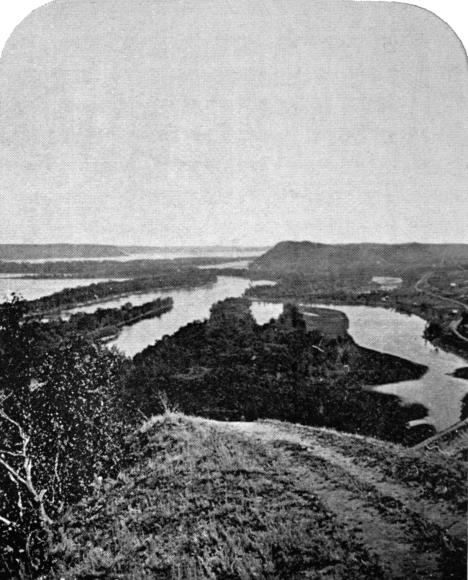
"WHERE THROUGH A LAKE THE MISSISSIPPI FLOWS."
THE COMBAT BETWEEN THE THUNDER-BIRDS AND THE WATER-DEMONS. Gray Cloud shall not be as other men, Dull clods that move and breathe a day or two, Ere other clods shall bury them from view. Tempest and sky have been my home, and when I pass from earth I shall find welcome there. Sons of the Thunder-Bird my playmates were, Ages ago[6] (the tallest oak to-day In all the land was but a grass blade then). Reared with such brethren, breathing such an air, My spirit grew as tall and bold as they; We tossed the ball and flushed the noble prey O'er happy plains from human footsteps far; And when our high chief's voice to arm for war Rang out in tones that rent the morning sky, None of the band exulted more than I. A god might gaze and tremble at the sight Of our array that turned the day to night; With bow and shield and flame-tipped arrows all, Rushing together at our leader's call, Like storm clouds sweeping round a mountain height. The lofty cliffs our warlike muster saw, Hard by the village of great Wabashaw,[7] Where through a lake the Mississippi flows; Far o'er the dwelling of our ancient foes, The hated Water-Demon[8] and his sons, Cold, dark and deep the sluggish current runs. Up from their caverns swarming, when they heard The rolling signal of the Thunder-Bird, The Water-Demon and his sons arose, And answered back the challenge of their foes. With horns tumultuous clashing like a herd Of warring elks that struggle for the does, They lashed the wave to clouds of spray and foam, Through which their forms uncouth, like buffaloes Seen dimly through a morning mist, did loom, Or isles at twilight rising from the shore. Though we were thirty, they at least fourscore, We rushed upon them, and a midnight pall Over the seething lake our pinions spread, 'Neath which our gleaming arrows thickly sped, As shooting stars that in the rice-moon fall. Rent by our beating wings the cloud-waves swung In eddies round us, and our leader's roar Smote peal on peal, and from their bases flung The rocks that towered along the trembling shore. A Thunder-Bird—alas, my chosen friend, But even so a warrior's life should end,— A Thunder-Bird was stricken; his bright beak, Cleaving the tumult like a lightning streak, Smote with a fiery hiss the watery plain; His upturned breast, where gleamed one fleck of red, His sable wings, one moment wide outspread, Blackened the whirlpool o'er his sinking head. The Water-Demon's sons by scores were slain By our swift arrows falling like the rain; With yells of rage they sank beneath the wave That ran all redly now, but could not save. We asked not mercy, mercy never gave; Our flaming darts lit up the farthest cave, Fathoms below the reach of deepest line; Our cruel spears, taller than mountain pine, Mingled their life blood with the ruddy wave. The combat ceased, the Thunder-Birds had won. The Water-Demon with one favorite son Fled from the carnage and escaped our wrath. The vapors, thinly curling from the shore, Faint musky odors to our nostrils bore. The air was stilled, the silence of the dead; The sun, just starting on his downward path, A rosy mantle o'er the prairie shed, Save where, like vultures, ominous and still, We clustered close, on sullen wings outspread; And sometimes, with a momentary chill, A giant shadow swept o'er plain and hill,— A Thunder-Bird careering overhead, Seeking the track by which the foe had fled. While thus we hovered motionless, the sun Adown the west his punctual course had run, When lo, two shining points far up the stream That split the prairie with a silver seam,— The fleeing Water-Demon and his son; Like icicles they glittered in the beam Still struggling up from the horizon's rim. His sleeping anger kindled at the sight, Our leader's eyes glowed like a flaming brand. Thrilled by one impulse, all our sable band Dove through the gathering shadows of the night On wings outshaken for a headlong flight. Anger, revenge, but more than all the thirst, The glorious emulation to be first, Stung me like fire, and filled each quivering plume. With tenfold speed our sharp beaks cleft the gloom, A swarm of arrows singing to the mark, We hissed to pierce the foe ere yet 'twas dark. Still up the stream the Water-Demons fled, Their bodies glowed like fox-fire far ahead; But every moment saw the distance close Between our thirsty spear-heads and our foes. Louder the blast our buzzing pinions made Than mighty forest in a whirlwind swayed; The giant cliffs of Redwing speeding back, Like specters melting from a cloudy wrack, Melted from view in our dissolving track. Kaposia's village, clustered on the shore, With sound of snapping poles and tipis riven, Vanished like swan's-down by a tempest driven. Stung by our flight, the keen air smote us sore As ragged hailstones; on, still on, we strained, And fast and faster on the chase we gained, But neck and neck the fierce pursuit remained, Till close ahead we saw the rocky walls O'er which the mighty river plunging falls,[9] And at their base the Water-Demons lay: The panting chase at last had turned to bay. Then thrilled my nerves with more than mortal strength; A breath of Deity was in the burst That bore me out a goodly lance's length To meet the Water-Demon's son accurst. His evil horn clanged hollow on my shield Just as my spear transfixed him through and through; A moment towering o'er the foam he reeled, Then sank beneath the roaring falls from view. A dying yell that haunts me yet he gave, And as he fell the crippled water coiled About him like a wounded snake, and boiled, Lashing itself to madness o'er his grave. We knew not where the parent Demon fled; None of our spears might pierce his ancient mail, Welded with skill demoniac scale on scale. Some watery realm he wanders, and 'tis said That he is changed and bears a brighter form, And goodly sons again about him swarm; And peace, 'tis but a hollow truce I know, Now reigns between him and his ancient foe. He hates me still, and fain would do me harm, But neither man nor demon dares offend, Who hath the cruel Thunder-Bird for friend.
PART II. Nature hath her élite in every land, Sealed by her signet, felt although unseen. Winona 'mid her fellows moved a queen, And scarce a youthful beau in all the band But sighed in secret longing for her hand. One only she distinguished o'er the rest, The latest aspirant for martial fame, Redstar, a youth whose coup-stick like his name (Till recently he had been plain Chaské)[10] Was new, fresh plucked the feathers on his crest. Just what the feats on which he based his claim To warlike glory it were hard to say; He ne'er had seen more than one trivial fray, But bold assurance sometimes wins the day. Winona gave him generous credit, too, For all the gallant deeds he meant to do. His gay, barbaric dress, his lofty air Enmeshed her in a sweet bewildering snare. Transfigured by the light of her own passion, She saw Chaské in much the usual fashion Of fairer maids, who love, or think they do. 'Tis not the man they love, but what he seems; A bright Hyperion, moving stately through The rosy ether of exalted dreams. Alas! that love, the purest and most real, Clusters forever round some form ideal; And martial things have some strange necromancy To captivate romantic maiden fancy. The very word "Lieutenant" hath a charm, E'en coupled with a vulgar face and form, A shriveled heart and microscopic wit, Scarce for a coachman or a barber fit; His untried sword, his title, are to her Better than genius, wealth, or high renown; His uniform is sweeter than the gown Of an Episcopalian minister; And "dash," for swagger but a synonym, Is knightly grace and chivalry with him. Unnoted young Winona's passion grew, Chaské alone the tender secret knew; And he, too selfish love like hers to know, Warmed by her presence to a transient glow, Her silent homage drank as 'twere his due. Winona asked no more though madly fond, Nor hardly dreamed as yet of closer bond; But chance, or Providence, or iron Fate (Call it what name you will), or soon or late, Bends to its purpose every human will, And brings to each its destined good or ill.
THE GROVE. O'erlooking Minnetonka's shore, A grove enchanted lured of yore, Lured to their deepest woe and joy, A happy maiden and careless boy; Lured their feet to its inmost core, Where like snowy maidens the aspen trees Swayed and beckoned in the breeze, While the prairie grass, like rippling seas, Faintly murmuring lulling hymns, Rippled about their gleaming limbs. There is no such charm in a garden-close, However fair its bower and rose, As a place where the wild and free rejoice. Nor doth the storied and ivied arch Woo the heart with half so sweet a voice As the bowering arms of the wild-wood larch, Where the clematis and wild woodbine Festoon the flowering eglantine; Where in every flower, shrub, and tree Is heard the hum of the honey-bee, And the linden blossoms are softly stirred, As the fanning wings of the humming-bird Scatter a perfume of pollen dust, That mounts to the kindling soul like must; Where the turtles each spring their loves renew— The old, old story, "coo-roo, coo-roo," Mingles with the wooing note That bubbles from the song-bird's throat; Where on waves of rosy light at play, Mingle a thousand airy minions, And drifting as on a golden bay, The butterfly with his petal pinions, From isle to isle of his fair dominions Floats with the languid tides away; Where the squirrel and rabbit shyly mate, And none so timid but finds her fate; The meek hen-robin upon the nest Thrills to her lover's flaming breast. Youth, Love, and Life, 'mid scenes like this, Go to the same sweet tune of bliss; E'en the flaming flowers of passion seem Pure as the lily buds that dream On the bosom of a mountain stream. Such was the grove that lured of yore, Overlooking Minnetonka's shore, Lured to their deepest woe and joy A happy maiden and careless boy,— Lured their feet to its inmost core; Where still mysterious shadows slept, While the plenilune from her path above With liquid amber bathed the grove, That through the tree-tops trickling crept, And every tender alley swept. The happy maiden and careless boy, Caught for a moment their deepest joy, And the iris hues of Youth and Love, A tender glamour about them wove; But the trembling shadows the aspens cast From the maiden's spirit never passed; And the nectar was poisoned that thrilled and filled, From every treacherous leaf distilled, Her veins that night with a strange alloy. Swift came the hour that maid and boy must part; A glow unwonted, tinged with dusky red Winona's conscious face as home she sped; And to the song exultant in her heart, Beat her light moccasins with rhythmic tread. But at the summit of a little hill, Along whose base the village lay outspread, A sudden sense of some impending ill Smote the sweet fever in her veins with chill. The lake she skirted, on whose mailèd breast Rode like a shield the moon from out the west, She neared her lodge, but there her quick eye caught The voice of Gray Cloud, and her steps were stayed, For over her of late an icy fear Brooded with vulture wings when he was near. She knew not why, her eye he never sought, Nor deigned to speak, and yet she felt dismayed At thought of him, as the mimosa's leaf Before the fingers touch it shrinks with dread. She paused a moment, then with furtive tread Close to the tipi glided like a thief; With lips apart, and eager bended head, She listened there to what the conjurer said. His voice, low, musical, recounted o'er Strange tales of days when other forms he wore: How, far above the highest airy plain Where soars and sings the weird, fantastic crane, Wafted like thistle-down he strayed at will, With power almost supreme for good or ill, Over all lands and nations near and far, Beyond the seas, or 'neath the northern star, And long had pondered where were best to dwell When he should deign a human shape to wear. "Whether to be of them that buy and sell, With fish-scale eyes, and yellow corn-silk hair, Or with the stone-men chase the giant game. But wander where you may, no land can claim A sky so fair as ours; the sun each day Circles the earth with glaring eye, but sees No lakes or plains so beautiful as these; Nor e'er hath trod or shall upon the earth A race like ours of true Dakota birth. Our chiefs and sages, who so wise as they To counsel or to lead in peace or war, And heal the sick by deep mysterious law. Our beauteous warriors, lithe of limb and strong, Fierce to avenge their own and others' wrong, What gasping terror smites their battle song When, night-birds gathering near the dawn of day, Or wolves in chorus ravening for the prey, They burst upon the sleeping Chippeway;[11] Their women wail whose hated fingers dare To reap the harvest of our midnight hair; Swifter than eagles, as a panther fleet, A hungry panther seeking for his meat, So swift and noiseless their avenging feet.
Dakota matrons truest are and best, Dakota maidens too are loveliest." He ceased, and soon, departing through the night, She watched his burly form till out of sight. And then the Raven spoke in whispers low: "Gray Cloud demands our daughter's hand, and she Unto his tipi very soon must go." Winona's mother sought to make reply, But something checked her in his tone or eye. Again the Raven spoke, imperiously: "Winona is of proper age to wed; Her suitor suits me, let no more be said." Winona heard no more; a rising wave Of mingled indignation, fear, and shame Like a resistless tempest shook her frame, The earth swam round her, and her senses reeled; Better for her a thousand times the grave Than life in Gray Cloud's tent, but what could she Against the stern, implacable decree Of one whose will was never known to yield? Winona fled, scarce knowing where or how; Fled like a phantom through the moonlight cool, Until she stood upon the rocky brow That overlooked a deep sequestered pool, Where slumbering in a grove-encircled bay Lake Minnetonka's purest waters lay. Unto the brink she rushed, but faltered there— Life to the young is sweet; in vain her eye Swept for a moment grove and wave and sky With mute appeal. But see, two white swans fair Gleamed from the shadows that o'erhung the shore, Like moons emerging from a sable screen; Swimming abreast, what haughty king and queen, With arching necks their regal course they bore. Winona marveled at the unwonted sight Of white swans swimming there at dead of night, Her frenzy half beguiling with the scene. Unearthly heralds sure, for in their wake What ruddy furrows seamed the placid lake. Almost beneath her feet they came, so near She might have tossed a pebble on their backs, When lo, their long necks pierced the waters clear, As down they dove, two shafts of purest light, And chasing fast on their descending tracks, A swarm of spirals luminous and white, Swirled to the gloom of nether depths from sight. Then all was still for some few moments' space, So smooth the pool, so vanished every trace, It seemed that surely the fantastic pair Had been but snowy phantoms passing there. Winona hardly hoped to see them rise, But while she gazed with half-expectant eyes, The waters strangely quivered in a place About the bigness of a tipi's space, Where weirdly lighting up the hollow wave Beat a deep-glowing heart, whose pulsing ray Now faded to a rosy flush away, Now filled with fiery glare the farthest cave. A shapeless bulk arose, then, taking form, Bloomed forth upon the bosom of the lake A crystal rose, or hillock mammiform, And round its base the curling foam did break As round a sunny islet in a storm; And on it poised a swiftly changing form, With filmy mantle falling musical, And colors of the floating bubble's ball, Fair and elusive as the sprites that play, Bright children of the sun-illumined spray, 'Mid rainbows of a mountain waterfall. Then mingling with the falling waters came In whispers sibilant Winona's name; So indistinct and low that voice intense, That she, half frightened, cowering in the grass In much bewilderment at what did pass, Till thrice repeated noted not its sense. She rose, and on the very brink defined, Against the sky in silhouette outlined, Erect before the Water-Demon stood. Again those accents weird her wonder stirred, And this is what the listening maiden heard: "Thy fate, Winona, hangs on thine own choice To scorn or heed the Water-Demon's voice. Gone are thy pleasant days of maidenhood, And evil hours draw nigh, but knowest thou not, That what thou fleest is the common lot Of all thy sisters? Thou must be the bride Of one thou lovest not, must toil for him, Watch for his coming, and endure his whim; Must share his tent, and lying at his side Weep for another till thine eyes grow dim. And he, so fondly loved, will pass thee by Indifferent with cold averted eye; E'en he, whose wanton hands and hated arms Have crushed the fair flower of thy maidenhood, Will weary of thy swiftly-fading charms, And seek another when thy beauty wanes. Aha, thou shudderest; in thy tense veins, Fierce and rebellious, leaps the mingling blood Of countless warriors, high of soul and brave; And would'st thou quench their spirit 'neath the wave? Is Gray Cloud's life more dear to thee than thine? The village sleeps, unguarded is his tent, Thy knife is keen, and unto thee is lent A spell to-night of potency malign. Cradled in blissful dreams alone he lies, And he shall stray so deep in sleep's dominions, He would not waken though the rushing pinions Of his own Thunder-Bird should shake the sky. All freedom-loving spirits are with thee, Strike hard and fear not as thou would'st be free; Lest thine own hatred prove too weak a charm, The Water-Demon's hate shall nerve thine arm." The Water-Demon sank and disappeared, And faint and fainter fell those accents weird, Until the air was silent as the grave, Still as December's crystal seal the wave. Homeward again Winona took her way. How changed in one short hour! no longer now The song-birds singing at her heart, but there A thousand gnashing furies made their lair, And urged her on; her nearest pathway lay Over a little hill, and on its brow A group of trees, whereof each blackened bough Bore up to heaven as if in protest mute Its clustering load of ghastly charnel fruit,[12] The swaddled forms of all the village dead— Maid, lusty warrior, and toothless hag, The infant and the conjurer with his bag, Peacefully rotting in their airy bed. As on a battle plain she saw them lie, Fouling the fairness of the moonlit sky; And heavily there flapped above her head, Some floating drapery or tress of hair, Loading with pestilential breath the air That fanned her temples, or the reeking wing Of unclean bird obscenely hovering; And something crossed her path that halting nigh, At the intruder glared with evil eye,— She hardly heeded passing swiftly by. Leaving behind that hideous umbrage fast, What wraith escaping from its tenement, Winona through the sleeping village passed, And pausing not, to Gray Cloud's tipi went, Laid back the door, and with a stealthy tread, Entered and softly crouched beside his head. Her gaze that seemed to pierce his inmost thought, Keen as the ready knife her hand had sought, And through the open door the slant moonbeams Smiting the sleeper's face awaked him not. He vaguely muttered in his wandering dreams Of "medicine," and of the Thunder-Bird. As if to go, her knife she half returned; Whether her woman's heart with pity stirred, Or superstitious awe, she slightly turned, But gazing still, over his features came The semblance of a smile, and his arms moved, Clasping in rosy dreams some form beloved, And his lips moved, and though no sound she heard, She thought they shaped her name, and a red flame Leaped to her brain, and through her vision passed; A raging demon seized and filled her frame, And like a lightning flash leaped forth her knife: That cold keen heart-pang is his last of life; The Water-Demon is avenged at last.
PART III. She struck but once, no need hath lightning stroke For second blow to rend the heart of oak, Nor waited there to see how Gray Cloud died; Her fury all in that fierce outburst spent, As from a charnel cave she fled the tent; The wolfish dog suspiciously outside Sniffed at her moccasins but let her pass. Her tipi soon she reached, distant no more Than arrow from a warrior's bowstring sent, Paused but to wipe her knife upon the grass, And found her usual couch upon the floor. But not to sleep; she closed her eyes in vain, Shutting away the moonlight from her view; Darkness and moonlight wore the same dread hue, Flooding the universe with crimson stain. She clasped her bosom with her hands to still The throbbing of her heart that seemed to fill With tell-tale echoes all the air; an owl The secret with unearthly shrieks confessed, And Gray Cloud's dog sent forth a doleful howl At intervals; but worse than all the rest, That dreadful drum still beating in her breast, As furious war-drums in the scalp-dance beat To the mad circling of delirious feet.
"THE GIANT CLIFFS OF RED-WING SPREADING BACK."
Early next morning, as the first faint rays Of sunlight through the rustling lindens played, Two children sent to seek the conjurer's aid, Gazed on the sight, with horror and amaze, Of Gray Cloud's lifeless body rolled in blood. Fast through the village spread the news, and stirred With mingled fear and wonder all who heard. The oracles were baffled and dismayed, And spoke with muffled tones and looks of dread: "Some envious foeman lurking in the wood, With medicine more strong than his," they said, "Stole in last night and gave the fatal wound." The warriors scoured the country miles around, Seeking for sign or trail, but naught they found: The murderer left behind no clue or trace More than a vampire's flight through darkling space. The Raven with a stoic calmness heard Of Gray Cloud's death, nor showed by look or word The wrath that to its depth his being stirred. Winona heard the news with false surprise, As if just roused from sleep she rubbed her eyes; When she arose her knees like aspens shook, But this she quelled and forced a tranquil look To feign the calmness that her soul forsook. And when the mourning wail rose on the air, Winona's voice was heard commingling there. She gathered with the other maidens where, On a rude bier, the conjurer's body lay Adorned and decked in funeral array. She flung a handful of her sable hair, And wept such tears above the painted clay[13] As weeps a youthful widow, only heir, Over the coffin of a millionaire. Moons waxed to fullness and to sickles waned. The gossips still conversed with bated breath. The appalling mystery of Gray Cloud's death, Wrapped in impenetrable gloom, remained A blighting shadow o'er the village spread. But youthful spirits are invincible, Nor fear nor superstition long can quell The bubbling flow of that perennial well; And so the youths and maidens soon regained The wonted gayety that late had fled. All save Winona, in whose face and mien, Unto the careless eye, no change was seen; But one that noted might sometimes espy A furtive fear that shot across her eye, As in a forest, 'thwart some bit of blue, Darts a rare bird that shuns the hunter's view. Her laugh, though gay, a subtle change confessed, And in her attitude a vague unrest Betrayed a world of feelings unexprest. A shade less light her footsteps in the dance, And sometimes now the Raven's curious glance Her soul with terrors new and strange oppressed. Grief shared is lighter, none had she to share Burdens that grew almost too great to bear, For Redstar sometimes seemed to look askance, And sought, they said, to win another breast. Winona feigned to laugh, but in her heart The rumor rankled like a poisoned dart. Sometimes she almost thought the Raven guessed The guilty secrets that her thoughts oppressed, And sought, whene'er she could, to shun his sight. Apart from human kind, still more and more, The Raven dwelt, and human speech forbore. And once upon a wild tempestuous night, When all the demons of the earth and air Like raging furies were embattled there, She, peering fearfully, amid the swarm Flitting athwart the flashes of the storm, By fitful gleams beheld the Raven's form. To her he spoke not since the fateful night His chosen comrade passed from human sight, Save only once, forgetting he was by And half forgetting too her care and woes, Unto her lips some idle jest arose. "Winona," said the Raven, in a tone Of stern reproof that on the instant froze All thought of mirth, and when she met his eye, As by a serpent's charm it fixed her own; The hate and anger of a soul intense Were all compressed in that remorseless glance, The coldly cruel meaning of whose sense Smote down the shield of her false innocence. She strove to wrest her eye from his in vain, Held by that gaze ophidian like a bird, As in a trance she neither breathed nor stirred. And gazing thus an icy little lance, Smaller than quill from wing of humming-bird, Shot from his eyes, and a keen stinging pain Sped through the open windows of her brain. Her senses failed, she sank upon the ground, And darkness veiled her eyes; she never knew How long this was, but when she slowly grew Back from death's counterfeit, and looked around, So little change was there, that it might seem The scene had been but a disordered dream. The Raven sat in his accustomed place, Smoking his solitary pipe; his face, A gloomy mask that none might penetrate, Betrayed no sign of anger, grief, or hate; Absorbed so deep in thoughts that none might share, He noted not Winona's presence there; From his disdainful lips the thin blue smoke From time to time in little spirals broke, Floating like languid sneers upon the air, And settling round him in a veil of blue So sinister to her disordered view, That she arose and quickly stole away. She shunned him more than ever from that day, And never more unmoved could she behold That countenance inscrutable and cold. But Hope and Love, like Indian summer's glow, Gilding the prairies ere December's snow, Lit with a transient beam Winona's eye. The season for the Maidens' Dance drew nigh, And Redstar vowed, whatever might betide, To claim her on the morrow as his bride. What now to her was all the world beside? The evil omens darkening all her sky, Malicious sneers, her rival's envious eye, While her false lover lingered at her side, All passed like thistle-down unheeded by. The evening for the dance arrived at last; An ancient crier through the village passed, And summoned all the maidens to repair To the appointed place, a greensward where, Since last year unprofaned by human feet, Rustled the prairie grass and flowers sweet. None but the true and pure might enter there— Maidens whose souls unspotted had been kept. At set of sun the circle there was formed, And thitherward the happy maidens swarmed. The people gathered round to view the scene: Old men in broidered robes that trailing swept, And youths in all their finery arrayed, Dotting like tropic birds the prairie green, Their rival graces to the throng displayed. Winona came the last, but as she stept Into the mystic ring one word, "Beware!" Rang out in such a tone of high command That all was still, and every look was turned To where the Raven stood; his stern eye burned, And like a flower beneath that withering glare She faded fast. No need that heavy hand To lead Winona from the joyous band; No need those shameful words that stained the air: "Let not the sacred circle be defiled By one who, all too easily beguiled, Beneath her bosom bears a warrior's child." Winona swiftly fleeing, as she passed, One look upon her shrinking lover cast That seared his coward heart for many a day, Into the deepest woods she took her way. The dance was soon resumed, and as she fled, Like hollow laughter chasing overhead, Pursued the music and the maidens' song. Just as she passed from sight an angry eye Glared for a moment from the western sky, And flung one quivering shaft of dazzling white, With tenfold thunder-peal, adown the night. Her mother followed her, and sought her long, Calling and listening through the falling dew, While fast and furious still the cadence grew Of the gay dance, whose distant music fell, Smiting the mother like a funeral knell. High rode the sun in heaven next day before The stricken mother found along the shore The object of her unremitting quest. The cooling wave whereon she lay at rest Had stilled the tumult of Winona's breast Along that shapely ruin's plastic grace, And in the parting of her braided hair, The hopeless mother's glances searching there The Thunder-Bird's mysterious mark might trace. So died Winona, and let all beware, For vengeance follows fast and will not spare, Nor maid, nor warrior that dares offend Who hath the cruel Thunder-Bird for friend.