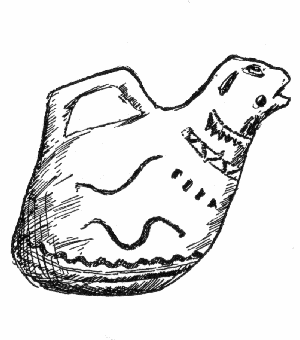
"Mahnusatia."
Reading edition
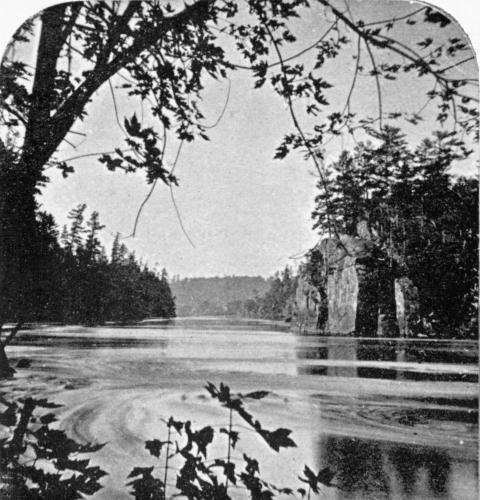
A pine-girt lake, broad spread; a glimpse Of clear-rimmed bay, encroaching lusk Upon a lapse of rocky vale; Beyond, a brunt-browed mountain, set Abrupt against a weary waste Of level, sparse-grown forest plain. Vanguard of Order's birth on Earth's Primeval stage, sphynx-like, the mount From chaos burst upon a world Of sea in space. It kept its head To the sun; it pierced the dense of the mists; It gathered forces, one by one, Until the land by light was kissed. The waters slunk away to Lake Superior's bent, leaving a child At play, on a plateau's breast, content. Marking the march of time, the mount Grew grim and gray, while ages stored Their riches at its feet away:— Ore-of-iron riches deep stowed In vaults of rock, for creature king Of future age to fit the key Of genius in their ancient locks; Stowed wealth to bless a nation, whose Motto: "Onward! Light!" befits it For that mountain's home, which pierced through Inchoate night; stowed signet seal, With which to stamp that fair land's Queen Of States, whose crested monogram, With sheaves of wheat entwined, the North Star scintillates. Guarding the till Of treasure, mountain, grim and gray, Playing with wind and wave, child-lough And lazy bay—Archaic group Are they, whose quiet naught details Of primal epochs; yet, as face Of man with furrowed wrinkles marked And seared, suggests his past life's course, Their presence in itself reveals The trace of annals which their calm Conceals. So Mystery's seeds were sown. Even the simple Indian folk,— Naive indigene of primitive plain,— Beheld with minds to quickened thought Provoked, that single skyward height Break stark upon the main and called It "Wey-do-dosh-she-ma-de-nog." Because, they said, it was the breast Of Mother Earth, which there arose To succor spirit souls in quest Of joyous hunting-grounds, of which Their wise men tell. And not to them Alone has nature from this rare Scene appealed to fancy; for, when Old Father Time, from out his horn Of plenty, had poured the years full Generations high upon the one To which this legend runs, the white Man came, bearing a waving stick, His country's standard, into these Proemial haunts. The lake, wine-stained, He called "Vermilion," but the mount Which broke upon his vision from Under a chastened moon, he named, "Jasper," after glories promised To the kingdom of his own God.
The wild rice bent its fragile stalk Beneath a crown of ripened grain; The birch and oak and maple blazed The Autumn's glory forth, and set aflame With red and gold, the northland pines, Perennial green. The light wind's voice Was muffled in requiem, mournful, low,— A parting song to Summer, sad, soft, And measured slow. Timed to the chant Of death, but tuned to death's sweet hope— Joy-hope of sorrow born—fair birth, A freer life of fuller scope! The sinking sun set all ablush The bosom of the lake. Upon the edge Of twilight rode the specter moon— Swift pinioned bird of noiseless flight— And hung a halo far above Mount Wey-do-dosh-she-ma-de-nog. Along the shard-strewn shore, a band Of Chippeway braves had pitched their camp, To celebrate, with rites of their Medawe, the flooding season's Tide of full-grown grain. In and out Among the shadow-lengthened pines, Their dusky forms moved, one by one, To circle silently around The council fire. And when the tribe Were gathered all, the day was done; Its splendor shifted to the Queen Of Night, that, flushed with triumph, flung Adown the path of sky, beyond Mount Wey-do-dosh-she-ma-de-nog A bridge of golden gleams, to lose Themselves within the darkling depths Of Lake Vermilion's lifeless bay. Then Guteba, like Jacob's son, The favored one of twelve, arose. No warrior paint his tawny skin Bedecked, nor eagle plume, nor claw Of beast adorned his royal head— Base custom that of vulgar herd. He wore a girt of wampum, nor Need had he of other raiment; For form erect, and sinewy frame And kindling eye, bespoke the garb Of manhood. Thus he addressed them: "From yonder window, framed in sky, Swings Ko-go-gau-pa-gon. The God of Life has placed it there. Down-hanging from the happy land, Where spirits go, it forms a bridge, O'er which all ransomed souls must cross.
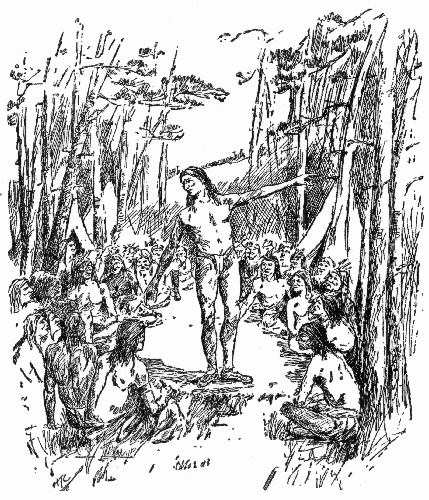
In fineness built, of beam of moon, It sinks and rolls, my children. But The light of foot and brave of heart Fear not. And one thing mark: before An Indian may touch sole upon Those gleaming strands of gold, he first Must navigate the bay, within Whose darkly deep and treacherous bounds The water, shamming, seems to sleep, But only lies, like cunning fox, To snare unwary passers-by And hold them from their homeward way. "The story is not new. It is Told with every year, as I do tell It now, when comes Medawe time; When all the earth was young in youth The mighty Water reigned thereon And breath of life was not. Then, here, Upon the wind was heard a voice In thunder tones, which said unto The Water, 'Kitchie Gumme, I Am Gezha Manitou—of Life The Master Spirit. Lo! I bid Thy waves recede. Here, leading up Past Wey-do-dosh-she-ma-de-nog Unto the Soul's Hereafter, I Have established Ke-wa-ku-na. Thy waters overleap my path So that my children cannot pass. Thou'st gone too far. Retreat to serve Within the spacious metes which I Have set for thee.' Because the waves Would not, Gezha Manitou hurled Them back upon each other, till They sank deeper and deeper and Deeper into perpetual sea. Time does not count backward beyond That struggle, but the water's voice Has ever since been dumb where it Took place; his arms have there refused The birch canoe to cradle, or The fish to succor. There, also He called the Matchie Manitou, The evil ones, to do his will. They slew the buffalo, until The rocks turned red with blood. They stole The souls of them who sought to pass The water grave; and man grew sad And heavy-hearted. Then the voice Of Gezha Manitou again Was heard in words of speech to say: 'When winter snows, and springtime showers, And summer suns have rounded out The moon of ripened grain, light fires To mark the places where your dead Await my messengers to guide Them home. Of meat to eat provide Them none; but shape their arrows strong And true. My buffalo will herd Upon the water, and, along The shores, thy garnered stores of grass And grain must yield them food. Their horns Will golden glimmer on the night To make them easy prey for home Bound souls, and they shall not be harmed By Matchie Manitou. All clothed In serpent skin and sharpened tooth And poisoned tongue, my guides will come. Then, let the living wary be And go not near the tombs after The haze of dusk turns dark of night; For swift my heralds will approach Those ghostly haunts with sure demand For every soul that's found therein, Be it in body dead or quick.' "The month, the day, the hour is here, My children, when the dead may cross To Ke-wa-ku-na less the fear Of harm, and we have come to say The last farewell. Wacumic's tomb, Among the rest, awaits the torch. In council, he was the Wise Man; In war, the Brave Chief, and at home The Best Loved,—his forefathers famed For deeds of valor, virtue, and Wisdom far back as memory takes The trail. His name, interpreted 'The waters ceased and earth began,' Denotes the time to which his line Of lineage runs. His spirit craves The promised land of happy hunt, And chase, and sweetly flowing streams. Our numbers are few, but our hearts Are strong. We are weak from the loss Of many battles, far from home; Our horizon is shadowed by the Sioux; Their echoing songs ring the woodlands Through. Is it wise for us to light The zenith of our skies, e'en tho' It be with flame of sacred fire? Wacumic was my father; you My children are. I have finished." Against the circle's center stake The chieftain placed his wing-trimmed stick— Most curious crozier, which gave Unto the thought of him, whose palm It touched a brilliant speaking tongue; Resumed his honored place the tribe Among. Then stranger far, than track Of wayward bird, or swirling wind, Was Janishkisgan's forward course. A maid of plebeian birth, she did Not ask the leave of public speech— A right to woman not allowed— But from her people, where she sat, With meekness due, stepped out and grasped The staff Guteba had released, Thus arrogating to herself The right of oracle. She said: "I was thy dead chief's handmaid, Friends. Twelve months agone, I was with him Upon the battle-field alone. The Sioux were all around us; their Faces war-red painted; their cries Of vengeance filling all the air. He to his saddle caught me up. The Great Spirit strengthened his arm; The lightning whet his ax; the wind Speeded his pony's hoofs. Through walls Of human blood he cut our way, And on his tomb no single scalp The deed remarks, or notes the slain He left to whiten bones upon The plains. He saved my life. What can I better do with it than use It for him? Arrows ready make; Gather the grass and grain with which To feed the golden horns; prepare The fuel for the sacred fires And I will light and keep them bright Upon the tombs. From my lips Speaks Gezha Manitou. I have done." Upon the silence which her words Produced, the night-hawk's startling cry Succeeded, and, round and round, above Her head a milk-white falcon soared, Now sailing high, now skimming low, As if some mystic orison In exultation it performed. Symbolic bird! Thy course no chance Directed. Talismanic art Thou held by this nomadic tribe: For, when the First Wacumic ruled The band, from all the hosts of field And feathery flock of heaven, thou wert Elected Totem. Favored One! Their fate forever linked to thine; Thy image crested on their shields; Thy every flight prophetic held! Now, watch the trend of savage mind. Even Chief Guteba, who loved The Indian maid, knew that the bird A seal had put upon her, from which Her accomplished task alone would Freedom give; and drove his knife Into the thickness of his thigh Hilt deep, to ease his pain of heart That one so young, so fair and so Much loved withal, must need take thought Of courage. The Great Medicine Confirmed the omen, in these words: "Daughter, thou art chosen: go forth. I give thee holy token, no Woman ever wore before. It is The medicine, which none but brave Of noble birth may wear. Though thou Art not of chieftain father bred, Still yet thou art born noble. Take, Janishkisgan, and to the top Of Wey-do-dosh-she-ma-de-nog. There let thine eye be keen, the path Of open safety to descry;— Use this plume of eagle plucked, To point to us the way. We will Prepare the arrows; grass and grain Arrange, and make the fuel ready for The flame upon the graves. When four And twenty hours have passed, light thou The fires upon the tombs, and keep Them brightly burning till the ripe Rich moon has emptied all its gold." He hung the amulet about Her throat—the medicine, a bag Of dried, misshapen skin, that held The healing herbs—a homely guise That promised for them little worth; For, so are virtues ofttimes clothed. She raised her eyes to heaven, as one Made free of fear and full of faith; Then moved away, while marveled all Who saw her glowing, peaceful face, Not knowing that her heart held court Within its inner self, as thus: "I thank thee, milk-white bird, that guides My path. E'en now Guteba's lips Are ripe to burst with love of me. I see it in his glance; I hear It in his tones. My heart doth not Respond. His presents are prepared With which to buy me from my sire; His wigwam waits his bride, but I Will never follow there. Thou hast Given me right, thou barbarous bird, To say him nay, who loves him not; For, where the handmaid must obey, The maid who lights the sacred fire And bears the medicine shall have Her equal say. And should my life Yield in my task, thou'rt kinder, Death, Than wandering heart from wigwam fire." The Chippeway band to safety moved, Far toward the rising sun, and pitched Their camp anew; then hoped, less hope, For tidings of Janishkisgan, That never came. Guteba's face The while was draped with care, his tongue With sadness locked. To muffled ears His wise men spake, when they implored Him, for his honor's sake, to take A wife—he being counted less Than man by Redskin code, who sits Within his teepee door, without The serving squaw and papoose squawk. Meantime the Great White Bird, from out The North, came riding on the wind, Its wings o'er heaven spread, and shed Its down on hill and plain, the earth In snow deep lying. Fasted then Guteba long, and vowed unto Himself that, cold in death or rich In life, the maiden should be found; Across his shoulder flung his bow And arrow quiver; in his belt Placed tomahawk and battle-ax And lance; to westward sallied forth, Nor of his purpose spoke. Three times the sun went round Its course and still he tarried from His home, while in the Chippeway camp Anxiety grew alarm at his Extended stay, and laggard seemed Each tiny fleeting moment to The last, until, when three times three The days had rolled into the past. A shout was heard, and sound of life And roll of drum and tramp of feet And happy, joyous song proclaimed The sachem's safe return. He came With flowing locks and steady step, And form erect, his people round About him flocking, wild with joy, And full of eager questions, put, Of where he'd been and what he'd seen; To which his only answer was: "Up Wey-do-dosh-she-ma-de-nog." As one possessed by purpose stern, He passed along, nor paused until The halt was made his wigwam door Before, where his aged mother stood To give him greeting. Something more Than sweetness beamed in welcome from His smile the while he took her hand In his and spoke that blessed name Of "Mother." Then, most sudden end Of joy!—into her outstretched arms He sank, as tho' he lent himself To gentle sleep, upon his lips The seal of Gezha Manitou; Else had they told the tale, the which To tell, had given him strength to bear A deep and mortal arrow wound A long march: How Janishkisgan Lingered from her father's tent To nurse the water Medicine Sioux, "Chief Minnepazuka" called, who, though For healing arts renowned, had down Been stricken with the plague upon The mountain top, his wisdom shorn Of power through lack of body strength With which to put it into use. The dead Chief's sense of justice craved The gift of further speech, to tell The facts that lead thereto as all Sufficient in themselves to plead Her pardon. How Janishkisgan Found the Sioux, near the jaws of death, And in her sympathy forgot That she a Chippeway was and he Of hostile stem. She took from him The secret he had wrested from The waves, and mixed a cure thereby With which his life she saved. She kept The fires burning, while waiting on His needs, nor gave him but the time That they required; yet both had learned A lesson, dear as life itself— Each to the other had taught it, And both had learned the same—learned to love With a love so holy, that they Must needs a union plan, in which There, too, should be united all Their severed bands. Guteba heard, With his own ears, the chieftain swear That he would bring from his far home, On western slopes, the richest gifts Of field and forest, to demand His bride from her own father's hand: And, with the rest, bring too, the white Winged dove of peace, nor claim from lips So passing sweet, one tiny kiss Without this all accomplished. Chief Guteba, hid in neighboring shrub, O'erheard these vows, with tomahawk Well aimed against the Sioux Chief's head; And, hanging on the words, felt all His being's manhood stir in plea For nobler action: fall down let The threatening blade, and, chief to chief, Challenged the Sioux to combat with The lance for Janishkisgan's hand; It being current practice, that He who victored in such a fray Was held a friend for aye, by all The vanquished chieftain's people. Hurt With fatal stab, the Chippeway Chief Had hastened home, to urge upon His tribe the well-earned peace, the which Minnepazuka's lance had won. Inexplicable fate! That coined His lofty purpose and effort, staunch, Into the very ill, for whose Opposite good he sought; in death, Closed his lips, still undelivered Of their message, and left instead A gaping wound to cry, "Revenge!" The tribe tore out their hair, and put The blackening pigment on, and sang Their grieving songs; athirst for blood, Unheeding danger, struck their tents And formed for march, in single file, Back, back in gloom, to silent tombs, Beside the dark, deep bay, below Mount Wey-do-dosh-she-ma-de-nog, There to lay their beloved chief's Remains. And, there, Janishkisgan, Filled with the superstition of Her kind, made pillow nightly on Her mother's grave, as well secure As tho' she slept within the wigwam. And there it was, one morning's dawn, The somber funeral cortège found Her. Most certain proof of innocence And guilelessness and conscience all At ease to rest upon a grave At night, was it considered. But thus To be, in calm repose, a smile Transcendent on the lips, as if Good spirits hovered near, almost Were past belief of seeing eye. So moved were they, who saw her there, They stole away in awesome hush Along a trackless trail, beneath A ledge of rugged rock. Above Their heads a bowlder's jutting edge Protruded, where, this early morn, Minnepazuka came to sing A song of love. Alas! That she, Who dreamed of him, had dream so sweet, Her smile to him disastrous proved: For, in that northern wild, no spot So fit for ambush was as this Unbeaten, shrub-grown path of rock To which the Chippeways' impulse Led them; and none so ill-secure From ambuscading foe as this Same barren bowlder, upon whose O'erhanging height, the Sioux reclined. His prelude, played on flageolet, In clear and clarion tones, broke through The still of dawn and fell on ears Of foes, who crept upon him, the while He softly sang: "Oh, my Dove's Eye, Thou dear one, hearest thou not My voice? Thou lingerest far from me. I am the Water Medicine. Rocks Flow living streams if I but call. Thou sharest my secrets, wee one; Thou, too, hast quaffed of Immortal Waters. Why linger far from me? When the fever was upon me, Then wast thou near me, thou Sunbeam. Now, I am strong. To-morrow will I journey toward the setting sun. But I will come back again for thee. My people shall be thine, my own. Hearken to the voice of my song.
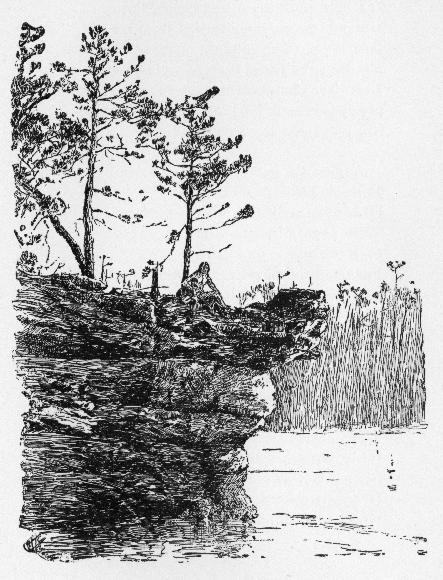
My love is like the shining sun Upon the pure snow of the mount— It would blush upon thy cheek, but It would not destroy thee. Hear me, Gentle one; fear me not. Thou didst Not love the Chief Guteba. Thy Lips have confessed it to me, and My lance drank his heart dry. Now, thou Sleepest upon thy mother's tomb." As like the lightning of the storm Forensic message on the walls Of heaven writes, to fill the earth With pause of tragic dread, so did Guteba's name, on alien tongue For one brief moment holden stay The stealthy steps that stole about The Sioux and closed escaping path Around him. And as thunder lends Unto the tempest's roar a voice More awful because of that but Momentary respite, so with The next succeeding breath, the air Was curdled with the Chippeway cry Of vengeance. Before the Sioux could Change within his grasp the place Of joyous flute for battle-ax He was surrounded by them and made Their royal captive. In thongs bound Down and tortured, Janishkisgan Next beheld him. But love, like theirs, Which hath preserved itself through test In purity, knows not despair. Nor can it hush itself to ease If it can find the chance to act In the beloved one's behalf. So while the maid, well-honored guard Of sacred fires, passed freely round, From friend, to friend, with greetings kind, In measure full returned, her thoughts Were busy with the night. When all Was still beneath the stars, she left Her blanket couch, high-heaped on leaves, And let the prisoner free. Under An old oak tree they said farewell, Not without Minnepazuka's Protestations, who plead as thus: "Oh, come with me, and be my bride; My home is on the prairies wide, Where West sweeps westward, in its pride, To mount the heights of mountain side; Where yellow glows the sunflower's gold, And earth rolls rich in mellow mold; Where cactus bloom and roses blush, And rivers sweep through greensward lush; Where deer and antelope and bear Abound as free as sunlit air; Where buffalo and cayote dwell And perch and trout the clear brook swell. Oh, come; oh, come, and live with me— To serve thee I shall happy be. I'll pluck thee bed of down of swan; Thy cares make light as foot of fawn; I'll build canoe of birch-wood bark To cradle thee, my Singing Lark. I'll rob the white bear for thy frock; I'll bring thee paint from red of rock; I'll note the honey-bee in its flight— Gather its sweets by bright moonlight. I'll coax the fishes from the wave; Thy slightest wish shall bind me slave; My arrow true its bow will fly To draw abundance from the sky; The heavens shall tremble at my voice And thy dear heart rejoice, rejoice. Oh, fly with me, these arms to bless; Rest, rest, my little love, on my breast." "It cannot be, my beaming-eyed, Until our people are allied. My father's step is growing slow, No other child hath he. The snow Upon his head would pile did I But go with thee. I beg thee fly." "No claim so binding is as love— Oh, come, oh, come, my nestling dove— Thy hands have set me free. And all The blame of my escape will fall On thee. Thy father will disown Thee; the children cruel will stone Thee, and——" "And I will think of thee." "Leave thee alone to bear such wrongs! Oh, no. Upon my wrists bind back The thongs. I will not freedom take. 'Twere better far than price like this To perish at the stake. Bind back The thongs." "Thou wouldst spare me pain? Then, Go. Each tiny, lapping flame of fire That fed its tongue on thee, would scorch The life-blood in my heart until Upon the funeral pyre, I'd throw My worthless self. I beg thee go." "Alas! Thy heart is cold to me." "Nay, nay, not so; it all is thine. I give it in this kiss. 'Twill sing To thee from throat of bird; it will Echo on the wind; it will Caress thee from the dew;—'tis all I have; it is thine. Farewell." "Gentle One, thou givest me life, To take it from me. Thou lily heart, Thou art my own, my other self: Thy god declares it unto thee, And mine to me." "And over all Is the Great Spirit. Farewell." "Thou wilt not go?" "Farewell." "Farewell." Sad fate, by human standard judged, The Indian maiden brought upon Herself. Given to eat with dogs, Clothed in rags, disgraced, driven from Her father's door, the power of love Sustained her. Magic Power, Great Architect, Superb Chemist Love! The heart that entertains thee Grows lofty in spirit gentleness, E'en tho' thou deignst to make it but Thy workshop. So Janishkisgan Knew thee. Fearing only to prove Unworthy of her august guest, She walked in the midst of scorn, Contempt, contumely, sneers and stern Displeasure, with that forbearance And kindly dignity, which re-won Her friends, despite themselves; so that At last they gave her pitying peace, And listened with their heart-strings tuned To life's better part, while she sang Her farewell song, each eve beneath The tree. After a time the plague Broke out and lamentations rose On every hand. Old women made Their teas and plied their healing arts; The Great Medicine Men implored Gezha Manitou's aid, and all The vibrant air was resonant With invoking incantations.— Death marched on. Then Janishkisgan Bethought her of her lover's cure; Gathered the balsam root and mixed Therefrom the potent draught, as he Had taught her. Great Medicine It was, that brought the glow of health Into the faded, hollow cheeks, And all the people blessed the maid; Called her, "Mahnusatia," which means The balm that heals. Surrounded by The dread disease, she came and went Unscathed, as if by unseen hands Protected. Where her gentle tones Were heard or where her light step fell, It was as if an angel passed.— Wan faces smiled, and hearts felt hope, And trembling lips found voice to cry: "Mahnusatia! Mahnusatia!" Thus in love was she renamed. Reinstated and reintrenched Deeper then ever in hearts which Had once renounced her, still she lived As one apart. The seasons came And passed, and as they did, the tribe Changed camp, from place to place, with each Recurring Autumn to return To Wey-do-dosh-she-ma-de-nog; But "Mahnusatia" never left The silent village. There she kept Her vigil, night by night, under The old oak tree. Her form became Wasted; her eyes lustrous; her limbs Grew to tremble, but her voice was Sweeter, as on each even's breeze, In rain or shine, in storm or calm, Was heard her fond farewell. Her life's Last breath was spent in that farewell. Her body lay under the oak, whose Spreading branches caught up the sad Refrain, "Farewell, farewell," and gave It back again each eventide. Her spirit lived in a thousand Tongues, for where the Chippeway saw The balsam tree, he turned his face Toward Wey-do-dosh-she-ma-de-nog, As Mahometan to Mecca, and Cried out in reverential tones, "Mahnusatia! Mahnusatia!" It lives to-day, mere chance of fate, Perchance, a monument of fame, Than which nor time, nor nation, nor People have ever better built; A monument of State, that rears Its regal, star-crowned head above Its sisters', in the grandest, most Glorious Union, which the world Has ever known. Yet who shall say, Who hath not infinite knowledge, It is but fortune's accident That honors such fidelity? Who, rather, shall not concede, that, Down the path of time, a fitness,
THE RIVER LAKE.
Everlasting, perpetuates That sweet, sweet Indian name, which, in Nobler accents, English spoken, Echoes the wide, wide world around: "Minnesota! Minnesota!"
MRS. FANNIE L. STONE.