"Tales and Sketches from the Life" (continued 4)
Reading edition
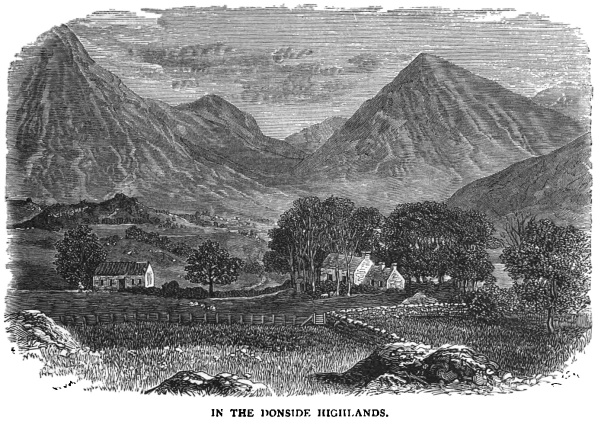
It is a solitary hill—a wild, bold, cliffy mass—yet—
“The clouds love to rest on this mountain’s dark breast, Ere they journey afar o’er the boundless blue sea.”
A solitary hill—and O! if it could but speak, what tales it could tell: eeriesome, drearisome tales, tales of intrigue and plot, plot domestic and plot political, tales of battle and slaughter and strife—for not a glen for miles and miles around it, not a moorland, not a hill the heather on which has not over and over again been dyed with the blood of fiercely fighting foemen.
Nor were the struggles that took place among these hills and forests and glens of merely local importance; for Aberdeenshire has cut as deep notches in the history of this country as any other shire I wot of.
Down yonder is Bruce’s howe, or cave, by the side of the Don at Ardtannies, celebrated in history as the place where the sick king lay, broken in health and fortune, and where he had his memorable interview with the spider, which so raised his hopes that he feared not shortly after to sally forth, give battle to and defeat the fierce, false Cumyn.
Then Bruce laid Buchan waste. After this the whole North of Scotland soon owned his sway, and five years after the sanguinary battle of Inverurie here Bannockburn was fought, and Scotland freed of its would-be conquerors.
But to-day we are seated on the very edge of the great battle-field of Harlaw.
This battle was fought here on a summer’s day in July 1411. The Duke of Albany, then regent of the kingdom, had managed by hook or by crook—more likely it was by crook—to secure the earldom of Ross to his son John Stewart, Earl of Buchan, although by rights it belonged to the wife of Donald, Lord of the Isles. Now Donald did not see any reason why he should submit to so barefaced a robbery. The Donalds and the McDonalds of the Isles have always been a bold and straightforward set of billies. The reader may remember the anecdote that is related of one of these Lords of the Isles. At a royal feast, having entered somewhat late, he had seated himself at the far end of the board, seeing which the king sent a messenger to ask him to come and sit by him, at the head of the table.
“Tell his Majesty,” was the reply, given loud enough for all to hear, “that wherever McDonald o’ the Isles sits is the head of the table.”
Donald of the Isles sent the fiery cross through the length and breadth of his domains, and soon crossed into the mainland at the head of his followers. He fought and conquered at Dingwall. Then captured Inverness, swept through the Highlands, and encamped here at Harlaw, determined to push on next day and attack the Aberdonians in their city of granite.
“Give their roofs to the flames, And their flesh to the eagles.”
Donald had reckoned without his host, however. That host was the bold Earl of Mar, who with a splendid little army of not more than a thousand men, officered by the flower of the county, hurried out and gave Donald battle here on the hill-head of Harlaw. Donald’s wild followers numbered 10,000, though they were badly armed. But it was Greek to Greek, it was Scot to Scot, and the conflict was a terrible one.
As I look around me on this lovely autumn evening, my imagination can easily depict the conflict and people the plain once more with the brave knights, and men-at-arms, the mailed Lowlanders that made up the battalions of Mar, and with the wild kilted warriors that formed the hosts of Donald of the West.
Yonder is Mar himself leading the centre fight, on his right the Gordons, Leiths and Leslies, on his left the Keiths and Forbeses, and many other brave clans; all feuds are forgotten for a time, they make common cause against the foe. The Highlanders fight on foot, armed only with dirk and sword, the Lowlanders ride them down and hew them down in hundreds, but the odds against them are fearful; all day even till nightfall the battle rages, when in the darkness Donald draws off the remainder of his forces and slowly retreats by Ben-na-chie; leaving nearly one thousand dead on the field, while Mar is left presumably master thereof, but too sore beaten and far too weak to leave it.
The terrible nature of the struggle may be gleaned from the fact that of the thousand Lowland knights and men-of-arms, who had entered the battle, hardly four hundred remained alive. What a sad day for the gentry of Angus and Mearns! In many cases every male of the house was slain. Leslie of Balquhain fell with every one of his six bold sons, and besides others, Sir James Scrymgeour, Sir Alexander Ogilvie and son, the Constable of Dundee, the Provost of Aberdeen, Sir Alexander Irvine, Sir Thomas Moray, Gilbert de Greenlaw, Sir Robert Maul, etc, etc.
But Donald was conquered and Aberdeen was saved.
Just a word about the Ury for the reader’s sake, for who knows but these lines I write may lead some tourist who is fond of the romantic, fond of the beautiful, and fond of fishing, to sojourn for a time in these sequestered glens.
The trout-fishing then of the Ury and of many a brawling wee burn around here, and which are literally alive “wi sonsy fish,” can easily be obtained on application to the magistrates, and the kindly landlady of the Kintore Arms has also liberty to grant the boon to those who make her house their home.
“The Ury,” says Skinner, “moves onward in noiseless sweetness, winding and winding, as if aware of its own brief course, and all unwilling to leave the braes that hap the heroes of Harlaw. By-and-by it creeps mournfully past the sequestered graveyard of Inverurie, and kisses the Bass, and is then swallowed up in the blue waters of the Don.”
The Bass is a small round hill evidently made by human hands, and supposed to be the burial-place of an ancient Pictish king. I visit the quiet graveyard. I have reasons for doing so—sad ones. I might say with Thom—
“Move noiseless, gently Ury, around yon grassy bed, And I’ll love thee, gentle Ury, where’er my footsteps tread; For sooner shall thy fairy wave return from yonder sea, Than I forget yon lowly grave and all it hides from me.”
The roads here are glorious, and what matter the hills when the air is so fresh and invigorating; if there are braes that one must walk up, there are also braes down which one can roll, at any speed one pleases without a touch on treadle. And how delightful it is to linger on these breezy hill-tops, and while positively drinking in health with every breath of the ozone-laden air, leisurely, dreamily scan the bold and matchless panorama spread out before us.
Yonder is Ben-na-chie again. You never can get past Ben-na-chie. Go where you like in this region, it is always frowning over your path just before you, or alongside, or on the horizon to the right or to the left.
There is “an ower true story” connected with that mountain which might well and easily furnish subject-matter for a three-volume novel. The Earl of Mar’s Master of Horse at the Harlaw was a Sir Thomas Leslie, of Balquhain, a wild and lawless man of unbridled passions. On the very summit of yonder mountain he built a fortress, to which he was in the habit of carrying off young women of beauty sufficient to attract him. One of these was Chief Allan’s daughter, the Fair Maid of Strathdon. In like manner his son bore away the Fair Maid of Kemnay, who was betrothed to young Sir John Forbes of Drumminnon. Sir John soon after attacked and burned the mansion or castle of Balquhain, and Sir Andrew Leslie, in revenge, sallied down from his fortress and laid waste the lands of the Forbeses with fire and sword. So much for the Fair Maid of Kemnay, and here is the village itself. High up on a table-land it is situated, among pine-woods and quarries, every house is a charming cottage, built of the whitest of granite. Surely poverty is unknown in such a place, and people here must live for a century at the very least! I’d like to come to Kemnay some time and live for a month in perfect peace, far from the bustle and worry of city life; to live and laze, and fish and dream—perchance to write a book.
Almost buried among trees is Monymusk, as primitive in every way as the grand old hills around it, with only one hotel, or rather inn, but a very cosy one; and O! so quiet is everything here, that in the silence of the night, gazing from the coupé when the moon was silvering the mountain-tops, I have positively heard the field-mice sneeze.
About a quarter of a mile from Monymusk is New Paradise, a kind of a sylvan fairy-land. Here are miles of charming walks, here are rustic-seats, and wells, and streams and bridges, and arbours, and a lake, the whole embosomed in woods, in which are many a bosky dell beloved of birds and all kinds of wild forest creatures. There are little glades, where ferns and brackens grow nearly ten feet high; it is sweet to see the soft evening sunshine shimmering down from among the trees, and falling on these, their greenery relieved by patches of warm autumn brown, and by the crimson lights of tall foxgloves.
Do lovers come here in the evening? We never see them. We have the sweet place all to ourselves, and when we want to change the scene we journey farther on, and soon enter a gloomy defile or forest ravine. This is Paradise Old. Its gateway is a huge jawbone of a whale; for anything I know to the contrary, it may have been the identical whale that swallowed up Jonah. The tourist, at all events, feels swallowed up as soon as he has entered. The long avenue that lies before him is one of the most remarkable in Scotland. It is on moss you are walking, at each side are trees—larches, spruces, and firs, as straight as arrows, and fully one hundred and twenty feet in height, the stems of which two men can hardly touch fingers round. To your right, dimly seen, is the roaring Don, beyond it cliffs and braes, covered with forest and fern, heather and blaeberries.
You come at last to a large circle of gigantic beeches and limes, eighteen in all, inside which seats and tables have been placed, though they are now but little used.
The most remarkable thing about these wondrous trees is that they have grown almost straight, their stems are mighty pillars, and even their branches have gone upwards, skywards, as if seeking the light, the result being a vast and leafy colosseum forming a dome for over a hundred feet high.
The silence is unbroken save for the steady hum of the river, or the occasional cry of some wild bird, and as he looks upwards or gazes around him, a feeling of awe steals over the beholder, which cannot be repressed.
There is in the valley of the majestic Don many a village where the tourist might dwell for a time with a certainty of enjoyment. The scenery everywhere is grand and noble; it is all a classic land, and eminently historical; in every glen a battle has been fought, every parish has its castle ruins, every castle has a story of its own, and be you artist, author, actor, or antiquary, or merely an invalid seeking rest and health, you cannot do better than visit—
“The banks and braes o’ bonnie Don.”
Chapter Nineteen.
Back Once More in Bird-Haunted Berks.
“We have wandered in our glee With the butterfly and bee, We have climbed o’er heathery swells, We have wound through forest dells: Mountain-moss has felt our tread. Woodland streams our way have led; Flowers in deepest shadowy nooks, Nurslings of the loneliest brooks, Unto us, have yielded up Fragrant bell and starry cup.”
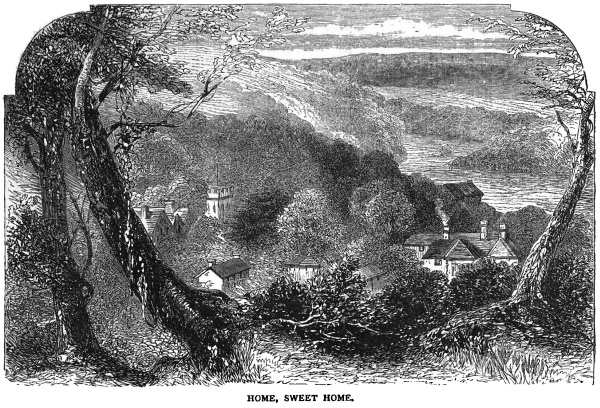
Back in Berkshire once again. Were we glad to return? It was a question many a worthy neighbour asked us. Could we answer it in the affirmative? We could not, and did not. Not even for politeness’ sake.
But we dearly love Berkshire for all that, love its rolling meadows, its fields of waving corn, the trees that go sweeping over its round hills like cloudlands of green; its placid river, its quiet streams, where the glad fish leap in spring and summer; love its birds, love its beasts, all the way up from the timid wee field-mouse to the saucy fox who leads so merry a life in the woods; and love its people, its peasantry—honest and true are they, sometimes rough, but always right. Yes, and I am not sure we have not even a kindly regard for its long-nosed pigs. So there!
But the fact is that, in one sense of the term, we really had never been from home. We had taken our home with us.
And what a long delightful summer and autumn ramble we had had of it to be sure. No single one of us could remember everything we had seen and come through. But when we get chatting together of a winter’s evening, and especially when I get my log-book alongside me, then it all comes back.
I have many log-books, for though I do not consider myself a great traveller, I have sojourned in many lands, and sailed on many seas. And those logs serve often and often to bring me back the past. Here, for instance, is—
A Reverie.
I am sitting alone in my wigwam. This pretty and romantic snuggery stands not anywhere near the forests of the Far West, nor by the banks of the broad Susquehana, nor on alkali plain, or rolling prairie, nor, despite its name, anywhere in the Red man’s country at all. It is built on a green knoll in my orchard, down in bonnie Berks. An old well-thumbed log lies before me.
It is the month of February, and the cold winds moan carelessly through the black and gloomy Scotch pines out yonder, and through the lordly poplars, tall and bare, with a sound that carries one’s thoughts seaward.
I read but a line or two of the dear old log, and lo! the scene is changed, the inky pine-trees, the weird and leafless poplars, the solemn cypresses and drooping yews, grow indistinct and fade away—the very wind itself is hushed. I am back once more in the Indian Ocean, and my Arab boat is quietly gliding over a calm unruffled sea of bright translucent blue.
It is a day that would make a man of ninety years of age feel life in every limb. Was ever sky so bright before I wonder, was ever sea so warm, so soft, so smooth—was ever air so fresh and balmy? The very sea-birds seem to have gone to sleep, and to be dreaming happy dreams, as they float, rising and falling on the gently heaving water.
Revooma, my boy or boatman—everybody has a boy as a kind of body servant who goes gipsying all alone on this lovely seaboard—Revooma, I say, holds the sculls, and I am dreamily steering.
“Gently, R’ooma, gently,” I murmur. “Nay, never row so fast; the day is all before us, to do with as we will. Let the oars touch the water in silence. I would hear nothing harsher than the dripping of the water from their blades, or musical rhythm of rowlock. Now, R’ooma, pause—nay, draw in your oars; we are a good way off yon coral island shore, yet see, we are in water that is almost shoal. Now, look overboard, R’ooma, down through the glassy water to the ocean’s bed. Can’t you, R’ooma, even you, admire that? You do. Is there anything so lovely on shore, R’ooma—anything else so lovely in Nature? I’m a poet, am I? Thank you; but look again, do not talk, but look; have your fill of the gorgeous beauty of that submarine garden, I will, R’ooma. And years and years after this, perhaps, when lying on a sick-bed, I will have but to close my eyes, and that sight will return to cheer me. Have ever you seen flowers that grow on earth like these? Why! every moving—for move they do, as if a gentle wind were for ever stirring them—every moving leaflet, twiglet, twig, or stem, is a flower in itself—alive with light and colour combined. Are they really weeds, or are they living things? Then, look at those anemones. What splendid tints! What gorgeous colouring!
“What a bright, white, clear patch of sand this is down here, R’ooma! How distinctly everything can be seen. See, I drop this pin, and it wriggles, wriggles, wriggles all the way to the bottom, and yonder it lies; somewhat distorted, I admit, but still it is the pin all the same. Look at that black, wrinkled claw, R’ooma, appearing from under the edge of yonder coral rock. And now the body slowly follows, and a strange-shaped, spider-legged, warty old crab stalks forth. How hideously ugly he is, R’ooma; and this very hideousness, I verily believe, is his defence against his foes. But watch him, boy; what is he going to do? He paws the sand. He stamps on it. Is it possible, R’ooma, he is about to dance a kind of a submarine Ghillie Callum? O, but look about a yard ahead now. See the white silvery sand gently, so gently, moved. And the white, warty crab stops dancing and listens, and rolls his stalky eyes around, Handy to have eyes on stalks, you say? You’re right, R’ooma. But, behold, our warty friend has beaten a hasty retreat to his cave, and up from the sand appears another, a facsimile of the first—only more ugly, more warty, and more hideous still. They have been playing at hide-and-seek, R’ooma. That is all just a little game to pass the summer’s day away.
“But, while we have been looking at the antics of these crabs, we have not been noticing the hundred and one other beautiful things that are floating about. Plenty of fishes down there, R’ooma; but we haven’t seen a very large one yet. Lovely in colours all they are, especially those strange, wee, flat fish that sail on an even keel, and are more gaudy in colour than a goldfinch; but most of them are ridiculously grotesque in shape. I am quite certain of one thing, R’ooma, none of them can have very much sense of fun or humour, else they would laugh at each other till they split their sides, and floated dead on the top of the water. Yonder, look, goes a whole flotilla of jelly-fishes, as big as parasols; and watch how the bright blue or crimson light scintillates from their limbs as they kick and float. And here comes a fleet of quite another shape, so far as their tentacles are concerned. Most independent gentlemen these are at sea, R’ooma, and I wouldn’t catch one for the Queen; but when stranded on a lee-shore, they are about the most helpless creatures in the universe. The little nigger boys kick them about, and they soon look more like a dish-cloth rolled in sand than anything alive. I’ve got them out to sea again, after such rough experience of shore-going life as I couldn’t have believed even a jelly-fish capable of surviving, and have seen them revive, and float, and put away to sea once more, with the trifling loss, of perhaps one or more limbs or tentacles.
“They tell me, R’ooma, that those medusae, or jelly-fishes, have hardly any nervous system, but they have very large heads, if they haven’t brains. They always put me in mind of dishonest lawyers, these medusae—they kick and sting for a livelihood. They live on little fishes. They throw out so many feelers all around them, that they are sure to inveigle some small, unwary innocents; and when they do—well, then, I’m sorry for the fishes. But when the medusae, or the lawyer, gets shoaled himself, he is a very pitiless object indeed; all the little fishes gather round, wag their heads or their tails, as the case may be, but no one is a bit sorry for him.
“What for I called de funny fish Metoosah? Is that what you ask, my innocent and unsophisticated body-slave. I will tell you. Once upon a time, R’ooma, far away in the Lybian wilds, and by the banks of a magic lake, there was a beautiful garden, more enchanting by far, boy, than that down under the sea beneath our boat. This garden grew all kinds of luscious fruit, and all kinds of lovely flowers; but there were also trees therein, laden with apples of purest gold. Yes, you may well open your eyes in wonder, R’ooma. But these apples of gold were guarded night and day by a dreadful dragon—a creature bigger than a crocodile, uglier than the iguana, with bat-like wings, as large as the jib-sails of a boat, that enabled it to fly wherever it had a mind to, and its teeth and eyes were frightful to behold. And in the garden, R’ooma, there dwelt three fearful ladies—and one was called Medusa. Her hands and claws were of brass, she had wings that shone like burnished gold. Her body was covered with scales, like the crocodile’s, and her teeth were more formidable than those of the lion of the jungle. And she braided her hair with deadly snakes, that were for ever wriggling in and out, like the tentacles of yonder medusae just floating past us. And so awful were her eyes that, if she looked upon any one, he was turned into stone. She was slain at last, R’ooma; and they say that every drop of her blood changed into a thousand venomous snakes.
“Is dat where all de dreadful snakes come from? you ask me. Nay, boy, nay; never look so frightened, R’ooma. There, pull on shore into that little sandy bay, beneath that ridge of black rocks so beautifully fringed with green. In that cool spot, R’ooma, I would drink my coffee and rest; and there, too, I will tell you a simple story, that I tell all my boys, about Him who made and cares for us all, who gives motion to the air, flight to the birds, leaves to the trees, and life and joy to every creature we see around us. Row, R’ooma, row.”
The above, reader, you may if you choose consider a kind of a reverie, nevertheless it is true in every touch. Poor R’ooma, I wonder where he is now! A good and a childishly innocent lad he was, and loved me so dearly he would have died to please me. That very day, I remember, which I allude to in the above reverie, after a good, long rest, and after telling the story to R’ooma, which I had promised, I went into the warm sea to bathe. R’ooma came too. I had an idea that there might be sharks, and these ground-sharks will not touch a black man. Well, if one had appeared R’ooma might have covered my retreat. I have seen a black man jump into the sea after a sailor’s cap where sharks were in swarms.
We had a long way to walk through shallow water, before getting into a place deep enough to swim with comfort. On our way out, seawards, I came upon an immense univalve shell in about three or four feet of water. I could see that it was alive, and was a volute of some kind. It was by far and away the largest I have ever seen—quite an armful of a volute. I called to R’ooma to stand by and watch it while I bathed. After my swim, I hurried back shorewards to secure my prize, when, much to my chagrin, I found my boy floating about, enjoying himself.
“O, but, sah,” he said to me, “I have marked de place where dat plenty mooch big cowrie sleep. We soon findee he for true.”
My boy had marked the place by putting a piece of seaweed to float over it. So we didn’t “findee he for true.” The “plenty mooch big cowrie” was not to be caught napping, and, doubtless, moved away into deep water as soon as we had left. But I have even dreamed of that shell more than once since then.
In the sides of the cliffs that surrounded the bay where R’ooma and I had coffee that morning, and deeply imbedded in the rocks, were fossil shells, bivalves of some kind, in shape like the Patella, or cockle of our coast, only in size about two feet across. Fancy a cockle two feet across. As big as a turtle! It would make a dinner, I should say, for twenty hungry marines. In the shoal water were immense quantities of the common Holothuria, or sea cucumbers. They were of gigantic size. But the shores of these little uninhabited islands north of Zanzibar abound everywhere with shells of the most beautiful and curious kinds. Many of the islands are covered with wood, and snakes live there, if little else does. How did the snakes get there? Did they swim across from the mainland? Snakes can swim well; but I doubt if they could cross twelve or twenty miles of salt water.
On one of these islands I once had an encounter with a snake that cost me a pair of good shoes, and I had to go barefooted for a week. More about this in my next log-leaf.
R’ooma was a boy of an inquiring turn of mind, so I took a delight in teaching him many things which, perhaps, he remembers to this day. He used to make the oddest remarks about the creatures and things around him, which caused me often to say to him:
“You’re a poet, R’ooma! I declare, R’ooma, that you are a poet!”
R’ooma was not slow in returning the compliment whenever he thought there was a chance.
“You are one poet, sah. I declare to goodness, sah, you are one poet.”
This would be R’ooma’s remark when I said anything he thought clever. Or if I did anything he thought clever, it was just the same. For example, in Lamoo one forenoon a half-caste Arab insulted me. I’m afraid I hit him. At all events he fell, and his turban came off, and he looked ridiculous without it, as he had a shaven skull.
R’ooma laughed till he was obliged to double himself up like a jack-knife to save his sides from cracking.
“O, yah!” he roared, “I declare to goodness, sah, you are one poet.”
Yea, there really are worse places to go gipsying to than the Indian Ocean, and, if time and space permitted, I am sure I could tell you stories of my wanderings on the shores of Africa, in its woods and wilds—stories of its strange birds and beasts and beetles, of its wild beasts and wilder men—that would quite interest.
Some other day, perhaps—who knows?
Well, leaves have a time to fall, and so also have curtains.
Down drops ours, then; our little play is ended, and our tales are told.
But as regards the gipsying part of our story, if one further proof that such a mode of life is enjoyable in the extreme to all who love Nature and an outdoor life, it surely rests in the fact that in this first month of spring I now throw down my pen to go and prepare our great caravan for another thousand miles’ tour through the length and breadth of Merry England.
|
Chapter 1
| |
Chapter 2
| |
Chapter 3
| |
Chapter 4
| |
Chapter 5
| |
Chapter 6
| |
Chapter 7
| |
Chapter 8
| |
Chapter 9
| |
Chapter 10
| |
Chapter 11
| |
Chapter 12
| |
Chapter 13
| |
Chapter 14
| |
Chapter 15
| |
Chapter 16
| |
Chapter 17
| |
Chapter 18
| |
Chapter 19
|