"Tales and Sketches from the Life" (continued 3)
Reading edition
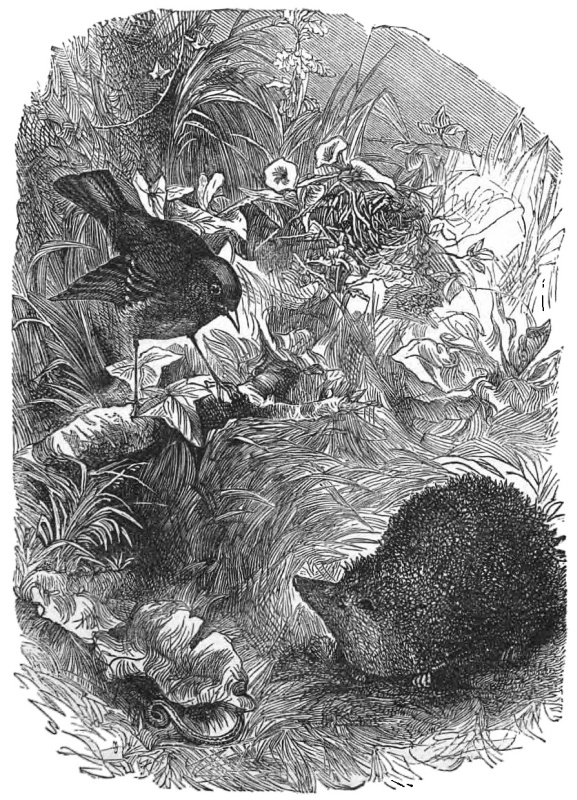
We did not interfere with his natural instincts, but in the evenings we used to have him out for a little run, and very much he seemed to enjoy it. He was afraid neither of dogs not cats, and would allow any of us to smooth him just as much as we pleased, and pat his pretty little brow between and above his pert, wee eyes. There was only room for one finger there, so small was his head, but this was quite enough.
“Don’t hedgehogs sleep all winter?” asked little Inez, my eldest daughter, one day; “and isn’t this winter?”
“Yes, baby,” I replied, “this is winter. It is now well into December, and poets and natural historians have always given us to believe that hedgehogs do hibernate.”
“I’m not going to hibernate,” replied Hoggie, or he seemed to reply so, as he gave a kick with one leg and commenced a mad little trot round and round his yard. “The idea of going to sleep in fine weather would be quite preposterous, as long,” he added, swallowing a large garden worm and nearly choking over it, “as the worms hold out, you know.”
But great was our dismay when one morning we missed Hoggie from his yard. It was nearly Christmas now, and frost had set in, and once or twice snow had fallen.
Our gardens and paddock are quite surrounded with hedges, and trees of all kinds abound; so with the dogs we searched high and low for Hoggie, but all in vain. Eily found a rat, Bob found a dormouse, and rudely awaked it, but no dog found poor Hoggie.
“Poor Hoggie!” the children cried.
“Poor Hoggie!” said the youngest; “I hope poor Hoggie has gone to a better place, pa.”
“Has Hoggie gone to heaven, pa?” this same prattler asked me in the evening.
Now let me pause in my narration to say a word about hoggies in general. I have had many such pets; they get exceedingly tame and quite domesticated. They seem to prefer to live with mankind, and can be trusted out of doors quite as much as a cat can. They are sure to come back, and generally come in of an evening, trotting very quickly and in a very comical kind of fashion, and make straight for the kitchen hearthrug.
“It is so dark and cold and damp out of doors,” they appear to say, “and quite a treat to lie down before a cheerful fire like this.”
Well, hedgehogs are the best-natured pets in the world, and so full of confidence, and are not afraid of any other creature when once fairly tame. You know, I daresay, that one hedgehog will keep the house clear of black beetles. But nastier things than beetles come into country kitchens and cellars sometimes—newts, for instance. Well, hoggie will eat these; indeed, hoggie would eat a snake. I saw a hedgehog one evening in the dusk crossing the road with a snake trailing behind her. It was in summer, and I daresay that the snake was being taken home to feed the young ones.
The young are born blind and white and naked, but the bristles soon come, and by-and-by they begin to run about; then the mother hoggie takes them all out for a run in the cool, dewy evenings of May or June. The father hoggie looks very proud on these occasions, and runs on in front for fear of danger, and to guide his little family to spots and places where plenty of food is to be found.
In the domesticated state, a hedgehog will pick up its food in summer out in the garden; but if kept indoors it must have food gathered for it—worms, slugs, a little green food, and roots, chiefly those of the plantain. Besides this, it should have bread and milk, and perhaps a little cabbage and greens, which it may or may not eat.
I may tell my little readers that tame hedgehogs are very cleanly, and of course they do not bite, nor do they put their bristles out when being petted by those they love.
The hedgehog is the gardener’s best friend, and any man or boy who destroys one, is really guilty not only of cruelty, but of folly.
Now to complete my sketch of our Hoggie. I have a wigwam, although I am not a wild Indian. My wigwam is a very beautiful house indeed, built of wood and surrounded with creepers. It stands in the orchard, on the top of a square green mound, with steps leading up to it.
Well, one day in spring, when the gardener was busy cutting the grass around this wigwam, he told the children something that caused them to come whooping up the path, all in a row, just like American savages.
“Oh, pa!” they shouted, emphatically, “Hoggie’s come back. He is underneath the floor of the wigwam!”
I was as glad as any of them, because I am very much of a boy at heart.
I got a candle, though it was broad daylight, and peeped into a hole beneath my wigwam, and there was Hoggie sure enough, smooth little brow, black little eyes, bristles and fur and all.
Hoggie came out that same night.
“I’ve been hibernating,” he seemed to say, “and ain’t I hungry, just! Got any bread and milk? Got any worms, any slugs, any anything?”
You may be sure we fed him well.
And Hoggie goes and comes, and comes and goes, at his own sweet will. But his home is underneath the wigwam floor, where he has one companion, at all events—a pet toad of mine, a very amusing old fellow, whose history I will tell you some day, if our kind friend the editor will give me leave.
The following two stories were told by Frank and me on this same breezy cliff-top at Dunbar, the most interested portion of our audience being apparently Ida, Hurricane Bob, and Mysie, the caravan cat.
Chapter Twelve.
Danger; A Study in Dog Life.
“Shall noble fidelity, courage, and love, Obedience and conscience—all rot in the ground? No room be found for them beneath or above, Nor anywhere in all the Universe round? I cannot believe it. Creation still lives, And the Maker of all things made nothing in vain.” Tupper.
Danger is a very suggestive name for a dog, especially when that dog happens to be a guard-dog and a bull-terrier to boot. But such was the name by which the hero of this brief biography was always known. The probability is that he was descended from very ferocious ancestors; indeed, the dog had all the external appearance of one that could both tackle and hold, if occasion demanded any such display of his powers. However, one should judge, not even of a dog, from first impressions.
The dog Danger did not advance very high in my estimation at our first meeting. It wasn’t love on sight with either of us. I had gone into a shop in the dusk of a summer’s evening, to buy a small guide-book, being then on a tour through the lovely vale of Don, Aberdeenshire. I found no one in attendance except Danger, whom I did not at once perceive. A low ominous growl soon drew my attention to the spot where he was lying. I could just trace the dim outline of his figure, and see two eyes that glittered like balls of green fire. It would have been quite enough, no doubt, to make a person unaccustomed to dogs feel uneasy, more particularly as the shopkeeper seemed in no hurry to put in an appearance. He came at last, though.
“Is your dog dangerous?” I asked.
“He is very far from that,” was the quiet reply. “I often wish he were a trifle more so. But his name is Danger,” he added, smiling, as he lit the gas.
I had now a better look at the animal. He certainly was no beauty, and I thought at once of the painting by Landseer—“Jack in Office.” Danger was huge and somewhat ungainly, though not really so large as he looked. It was his immense head, and the general cloddiness of his body, that gave him the appearance of size. His ears were small and lopped over gracefully, his nose was both flat and broad, and his eyes did not look a bit more conciliatory in the light than they did in the semi-darkness. He came round behind, and forthwith instituted a very minute investigation of the calves of my legs. This was probably a proof of the dog’s high intelligence, but it was not over-pleasant to me nevertheless.
“There is hardly anything that animal won’t do,” said the shopkeeper.
“I can quite believe that,” I replied, with a furtive glance over my shoulder; “I can quite believe it.”
Danger went away presently, apparently satisfied with the result of his scrutiny, and my mind was relieved.
I had occasion to make many visits to the same shop after this, and Danger and I got to be very friendly indeed. There was something decidedly honest about Danger’s every look and action when you came to know him. Perhaps he had the same opinion about me. I trust he had. At all events he appeared to take to me, and had a quiet, queer way of showing his regard that many people wouldn’t have altogether relished: to wit, if I sat down in the shop, as I sometimes did, Danger would come and lay his great head in my lap; it weighed about ten pounds, apparently; any attempt at getting him to remove it, until he himself pleased, elicited a low growl, which was by no means reassuring. Yet, while he growled, he wagged his tail at the same time, as much as to say:
“I really do not wish to quarrel with you, unless you force me.”
If I stood in the shop instead of sitting, it was much the same, because Danger used to lie down beside me, and put his monster head on top of my foot, and go through the same performance if I attempted to disturb him. Nor would he always obey his master and come away when told; he was like the spirits in “the vasty deep.”
I made the village of V— my headquarters for several months it was so quiet, and I wanted rest. It came to pass eventually that Danger took it into his big head to go with me in my walks and rambles; I did not dare to refuse the convoy, though so forbidding did the animal look, that I was often ashamed to be seen in his company. I flatter myself that there is nothing of the Bill Sykes about my personal appearance; if there were, Danger was just the dog for me. Ladies meeting me and my questionable friend, would often look first at Danger and then at me, in a way I did not at all relish.
Danger was not a young dog; he had certainly arrived at years of discretion. He was well known in V—. Indeed, he was as much a part and parcel of the village as the town clock itself; and a fine, free and independent life Danger led, too. It was also a life of singular regularity. As soon as he had eaten his breakfast of a morning, he used to take a trot down the street, visiting exactly the same places or spots every day. Coming back, he would seat himself at a bend of the road and right in the middle thereof, where he could see all that was going on either up the street or down the street; and hear as well, for he always kept one of his ears turned each way—a very convenient arrangement. Danger spent the greater portion of every forenoon, wet day or dry day, in this way, only on Sundays he never appeared at all.
He was not only well known to every human being in the village, but to every dog and cat also, and no dog ever went past Danger without coming and saying a friendly word or two, or exchanging tail-waggings, which is much the same. I have sat at my window and seen all sorts and all kinds and conditions of dogs come and make their obeisance to Danger of a forenoon—lordly Saint Bernards, noble Newfoundlands, stately mastiffs, business-looking collies, agile greyhounds, foxy Pomeranians, wee, wiry Scotch-terriers, daft-like Skyes, and even ladies’ darlings, the backs of whom Danger could have broken at one bite, had he been so minded.
I am perfectly sure that Danger knew he was not very prepossessing in appearance, and that he looked a fierce dog, though he did not feel it. Occasionally a strange dog would come trotting up the street, and then it was amusing to watch Danger’s tactics. Of course the new dog would not like to pass Danger without making some sign. To do so would have looked cowardly, and no dog cares to show fear, whether he feels it or not. Danger would bend all his energies to getting the new-comer to advance and be friendly. He would not get up, because that might be construed into a menace, but he would positively wriggle on the road and grin. This made him appear more grotesquely hideous than ever, but the other dog seldom failed to understand it.
“I confess I do look terribly ugly and terribly ferocious,” Danger would seem to say, “but I am the meekest-minded dog in all the village. Come along. Don’t be afraid. I never met you before, but I am satisfied we shall be the very best of friends.”
“Well,” the new dog would apparently reply, “you are certainly no beauty, but I think I can trust you nevertheless.”
Now there came to the village one day a large half-bred cur, partly smooth sheep-dog, and partly mastiff. He came swinging up the street in a very independent manner indeed, and as soon as he saw Danger he stopped short, and raised his hair from head to tail. This was meant for a challenge to Danger, but Danger was slow to see it; he simply began to grin in his usual idiotic fashion. But when the mongrel advanced, Danger grasped the situation in a moment. At the same time the cur seized Danger by the neck, and a fierce fight ensued. Five minutes after the mongrel slunk away home, beaten, bleeding, cowed; and Danger lay quietly down again as if nothing unusual had happened.
“Dave,” as the mongrel was called, had had enough of Danger, and used to go past him afterwards as if he saw him not; but he took his revenge on the other village dogs, all the same. There was scarcely one he did not attack and badly use. When, however, Dave one day lamed a Pomeranian, who was a great favourite with Danger, and when that wee dog came limping up and seemed to show Danger his grievous wounds, the latter thought it was quite time to be up and doing. He now purposely threw himself in Dave’s way at every opportunity, and stout and fierce were the battles fought, Danger invariably coming off triumphant.
Dave belonged to a wood-carter, and both man and dog had bad names. When Dave at last took to worrying sheep by the dozen, his master was communicated with in a way he hardly relished, and so Dave was put on chain, and peace in the village canine community was happily restored.
The winter came on, and a wild, bitter winter it was, with high, icy, east winds, sleet and snow. I happened to be passing one day near to the cottage where Dave’s master dwelt, and, hearing a mournful whine issuing from a shed, I peeped in. There lay poor dog Dave, and a pitiable sight he was, and no sign of either water or food was to be seen. My heart bled for the creature. Bad enough he was in all conscience, but to make him suffer thus was revolting. I got little satisfaction at first from his cruel master, who told me he had no time to attend properly to a dog on chain. The promise of an occasional coin brought about a better state of existence for Dave. But this did not last long. Once only I saw him led out on a string for a little exercise. How wretched he looked!—lean and mangy, and trembling like an old aspen-tree, his hocks plaiting and bending beneath him at every step. There was no fight in Dave now! He even wagged his tail to Danger when he met him, and Danger returned the salute with a hearty goodwill, which showed how much of benevolence dwelt beneath that ugly phiz of his.
But I was witness to a still greater proof of the kindness of Danger’s heart, a few days after this. It was a grey, dull day, with a keen wind blowing from the north-east. I was just dressing to go out, when who should I see making his way along the pavement but my friend Danger. He had a great ham-bone in his mouth. I got out as quickly as I could, and followed Danger down the street and down the lane, and straight to the shed where poor Dave lay dying—for dying he undoubtedly was.
I never before had read or heard of so generous an act being done by one dog to another—that other, too, a quondam foe. Dave lay on his miserable bed of damp, unwholesome straw in the woodshed, through every cranny and chink of which the wintry wind was whistling and sighing. Dave was shivering, but more, I think, from sickness than cold. Danger approached with a ridiculous grin on his foolish phiz, and many an apologetic wag of his tail. “Here, Dave,” he seemed to say, “here is a bone I have saved for you; there certainly isn’t much on it, but it may just do for a picking.”
But poor Dave was past even picking a ham-bone, and two days after this the shed had no tenant; Dave was dead. I do sincerely wish that my tale had not so gloomy a finish, but as I am writing facts, I have no power to make it otherwise. Danger’s master lived in a cottage about a mile up the Don, and close to its bank. One night a terrible rain-storm came on, and I was told next day that the river was in “spate;” that many sheep had been carried away, and even cattle and horses. After breakfast I went to see it. There was something even awe-inspiring in the sight; the quiet and placid river of the day before, with its clear, brown, rippling water, was swollen into a wide, yellow, surging, roaring torrent. The sturdy old bridge on which I stood shook and trembled with the force of the water that dashed underneath. Pine-trees, hay, straw, and even the carcases of cattle, came down stream every minute. I left the bridge at last, and walked slowly up along the top of a wooded cliff.
Till this day I regret that I did not go straight home from the bridge, for I shall always remember what I saw. Something was coming floating down the turgid river, right in the centre, and rapidly approaching me, swirling round and round in the current.
It was a small hay-cock. How he had got on I never knew, but on the top thereof was my honest friend Danger. I called him.
The pitiable, pleading look with which he replied went straight to my heart. Danger could not swim!
What made the matter more mentally painful to me was, that there was quite as much of the ludicrous as the pathetic about the situation. For, poor dog, his great solemn face never looked uglier, never looked more distressed than now; and the glance he gave me as he was borne hurriedly onwards to certain destruction—why, I have but to close my eyes to see it even now, as I sit here.
And that was the last that was ever seen of Danger; he never appeared again on the streets of the village of V—.
Chapter Thirteen.
Dicky Dumps: the Parson’s Pony.
“A little water, chaff and hay, And sleep, the boon of Heaven; How great return for these have they, To your advantage, given! And yet the worn-out horse or ass. Who makes your daily gaining, Is paid with goad and thong, alas! Though nobly uncomplaining.” Tupper.
There are, or were, two immortal men, who never spoke without saying something—I refer to Shakespeare and Burns; and when the former remarks so prettily,—
“What’s in a name? That which we call a rose By any other name would smell as sweet.”
we cannot help replying, “That is true.”
But for all that, every one who owns a pet animal of any kind, that he really loves, will be ready enough to admit that seemingly senseless though the names be which we sometimes give them, there is generally some reason in them, albeit there may not be much rhyme. When we talk to animals which we have a great affection for, we often use a deal of ridiculous abbreviations. Never mind—they, our favourites, understand them, and really appear to prefer them. Just one or two examples. There is an immense Newfoundland lying not far from me while I write, an animal who by reason of his beauty, his bounding independence, and his very roguishness, takes all hearts by storm. His name was originally “Robin;” that soon came down to honest simple “Bob.” He is known in what is called the canine world as “Hurricane Bob,” he being a show dog. He derives the sobriquet “Hurricane” from the mad way he rushes round his own paddock when he first gets out of a morning. With his long black hair floating in the wind, he is hardly visible as he races round and round about you. You can just see a black shape, that is all, which you conclude is Hurricane Bob. You can set him off racing round and round at any time by calling—
“Hurricane, Hurricane, Hurricane!”
He has a great sense of humour and of the ridiculous; but if you say to him, “Robert, come here,” he then approaches very gravely indeed.
“What’s up!” he seems to say, “that I am being called Robert? Have I done anything wrong, I wonder?”
Again, if you call him Bobbie, he expects to be patted, caressed, and made much of.
So he has a name for all weathers, as a sailor would say.
“Eily” is the name of a splendid collie of mine. In the course of years her name became Eily-Biley. She prefers this. There is love and affection and pats and pieces of cake, and all kinds of pleasantness associated with the name. Eily is simply her business name, as it were, and there are times when she is called “Bile” emphatically, and on these occasions she knows she has been doing something wrong and is to be scolded, so she at once throws herself at my feet, makes open confession, and sues for forgiveness.
“Yes, dear master,” she seems to say; “it is quite true, I did chase the cock, and I did tree the cat. They did provoke me, but I will try not to do so again.”
I have a great many wild-bird friends. There are several sparrows visit me every day, at and in my wigwam, or garden study. One comes to name. That name is “Weekie!” I heard his little wife call him “Weekie” one day, so the name has stuck to him. We have been friends for years, Weekie and I. He is bold and pert, but affectionate. He roosts in winter among the creepers on my wigwam, and steals morsels of my manuscripts to help in building his nest in summer.
So there is something in pet names at all events. I daresay most of my readers would think that “Dumps” was a queer name to give a pony. Well, and so it is; but the name grew, for he was originally Dick; from Dick to Dickie the transition is natural. “But how about the ‘Dumps’?” you may ask. Well, Dickie belonged to a good old country parson that I knew, who lived some years ago in one of the wildest glens of our Scottish Highlands. If this parson was not, like some one else, “Passing rich with forty pounds a year,” he managed to live and support his family upon not much more than double that sum. But he had a very thrifty wife, and his children were each and all of them as good as they looked, and that is saying a deal. They possessed the kind hearts that are worth more than coronets, and the simple faith that is better far than Norman blood. So poor though Mr Mack, let us call him, was, his home was a very happy one. Mrs Mack rather prided herself on her cookery, and her skill in the art was fully appreciated by all the family—including Dickie the pony. But what Dick particularly loved was a morsel of suet dumpling.
The dining-room window looked over Dick’s field, and was entirely surrounded with lovely climbing roses, as indeed was all the cottage, for great yellow roses could be gathered even through the attic windows, and they actually trailed around the chimneys.
In spring and summer the dining-room window used to be left open, and Dickie would station himself there, and wait with equine patience for his morsel of dumpling. Sometimes he got two or three pieces, and even then would have the audacity to ask for a fourth help. “It is so nice,” he would appear to say, with a low, comical kind of a nicker. “It is dee-licious. Do you know what I’ll do, if I don’t have more dumpling? I’ll crop the rose-leaves.”
“Ah, Dickie, would you dare?” Mrs Mack would cry; for she dearly loved the roses.
“Well, then,” Dick would appear to answer, “give me some more dumpling.”
Even at breakfast-time, if the window were open, Dick would pop his head in, and apparently ask: “Is there any of that dumpling left? I don’t mind taking it cold.”
So there is no great wonder that the pony came to be called “Dickie Dumpling,” and finally, for short, Dumps.
Poor old Dumps, he was such a favourite; and no wonder either that the children all loved him so, for they had grown up with him; the eldest girl, Muriel, was seventeen, and Dumps was at the parsonage when she was a baby.
Dumps had been grey, when in his prime—a charming grey, almost a blue in point of fact; but, alas! he was white enough now, and there were hollows in his temples that, feed him as he would, his master never could fill up. Sometimes, too, Dumps’ lower lip would hang a bit, and shake in a nervous kind of way; and as to his teeth! well, the less said about them the better; they could still scoop out a turnip or bite a bit of carrot, but as for his oats, Dumps had a decided preference for them bruised.
These, of course, were all signs of advancing age; but age had some advantages, for the older Dumps grew, the wiser he got. There was very little that concerned him that Dumps didn’t know, and very little that concerned his master either.
The Rev. Mr Mack was one of the most tenderhearted men I ever knew. Many and many an old pauper blessed and prayed for him. Yes, and he for them; but I am bound in honesty to say that Mr Mack’s blessings often took a very substantial and visible form. There was a large box under the seat of the old-fashioned gig, that the parson used to drive, and Dumps used to drag; and, nearly always, after he had prayed with, read, and talked a bit to some poor afflicted pauper, Mr Mack would go to the door, and stretch his arm in under the seat, and haul something out: it might be a loaf of bread, it might be a bit of cheese, a pot of jam—Mrs Mack was a wonder at making jams and jellies—it might be merely the remains of yesterday’s pie, or it might be—whisper, please—a tiny morsel of tobacco, or a pinch or two of snuff in a paper.
“Don’t go away, Dumps,” the parson would say to the pony, as he returned into the house.
Dumps would give a fond, foolish little nicker, that sounded like a laugh.
“At my age,” the pony would seem to reply, “I’m not likely to run very far away.”
I happened to be practising in Mr Mack’s parish for six weeks, having taken the duties of a gentleman who was gone away to get married. I drove, the parson’s pony.
“Just give him his head,” said Mr Mack on the first day that I went to visit my paupers; “he’ll take you all round.”
Not knowing anything at all about the roads, I was very pleased to leave the whole arrangement of my visits that day to Dumps. He went jogging up the road, half a mile, then down a lane, and finally brought up at a long, low, thatched cottage. Then he jerked his head round to me, as much as to say, “Get out here.”
And in the same way poor Dumps took me everywhere over the parish. Here would be a sick child to see, here a bedridden old woman, here a feeble, aged man, and so on and so forth.
The sun was set, and the stars coming out, and it appeared to me I must have still ten miles to drive before I reached the parsonage, when all at once that dear, rose-clad old cottage stood before me, and there were Mr Mack and two of his charming daughters standing at the gate laughing.
I was indeed surprised. The explanation is this: Dumps had returned by a different road. He had really and truly taken me on a round.
My friend, who had gone to get married, returned at last, and I left the glen. But happening to be on half-pay in the June of the succeeding year, I received a pressing invitation from my brother professional to spend the summer with him, and enjoy some fishing, a sport of which I am extremely fond. It was while I was at his house that a cloud shadow fell on the old parsonage, and its inmates, hitherto so quietly happy, were plunged into grief.
I did not know, nor had I any business to know, the exact history of poor Mr Mack’s trouble. From the little he told me, however, it was pretty evident that it was occasioned or arose from his own kind-heartedness: he had become security for the debts of a friend. O! it is the same old story, you see; the friend had failed to meet certain demands, and they had fallen on Mr Mack. How willingly I would have come to the kindly parson’s relief had it been in my power, and I believe he would have accepted assistance from me as soon as from any one, for I was looked upon as a friend of the family.
I could not help noticing now that it was a case of pinch, pinch, pinch with the Macks. Indeed, I fear their table no longer groaned with the weight of the good things of this life, but rather for the want of them. But for all that—let it be said to his credit—the poor of the parish never went without the dole to which they had been so long accustomed.
Things grew worse instead of better, although, when I expressed my concern, Mr Mack assured me, with a sadly artificial smile on his face, that after a certain day it would be all right again.
“My dear,” said Mr Mack to his wife one evening as she sat sewing after the young folks had all gone to bed, “to-morrow is the fair at B—, and I fear I must go. Poor old Dumps! My heart is as cold as lead at the thoughts of parting with our children’s pet.”
His wife never looked up. She couldn’t have spoken a single word if she had tried to, but the tears rolled down her cheeks and fell thick and fast on the white seam.
Mr Mack was up next morning betimes. I question if he had slept a single wink. He was up before the lark, and long before any one in the house was stirring. He made himself a hasty breakfast, fed Dumps, and started. It was better, he thought, to go ere the family were about.
When Mrs Mack took the children into the study, and explained to them why they were forced to part with Dumps, they showed far less exuberance of grief than might have been expected, and lent their aid individually to console the mother; but—
O! the sorrow was deep, though silent.
The father returned the same evening alone. He looked jaded and wan. Hardly any one touched a bit of supper that night, and, judging from their faces next morning, I feel sure some of the girls mast have cried themselves to sleep.
It would be waste of words to say that Dickie Dumps, with all his droll, wise ways, was sadly missed. Poor old fellow, they would have given almost anything now to see his head popped in through the breakfast-window, or even to see him cropping the rose-leaves. Who, they thought, would give him his morsel of dumpling now? And they hoped and trusted that he might have a good home.
One day the parson came to see me.
“I’ve got bad news to-day,” he said. “O! I wouldn’t that my wife and darlings knew it for all I possess.”
“Nothing very serious, I hope,” I inquired anxiously.
“Some might not think so,” he replied. “My dear old pony! He is working in a coal-mine: slaving away down in the dark and grime; the horse that took my wife away on our marriage tour, the horse that has been my children’s friend all their lives. Don’t think me foolish, Gordon, but only think, the poor old fond creature that loved us all so well, been used to the green country all his life, to sunlight and daisied leas and kind treatment, and now—”
He couldn’t say any more, and I did not wonder; and I tell you, reader, that at that moment I wished to be rich as much as ever I did in my life.
I went away over the hills. I walked for miles and miles. It is a capital plan this, when one is thinking. I was thinking, and before I returned I had concocted a scheme which, if successful, would restore Dumps once more to the bosom of his family. I told the parson of the plan, and he was delighted, and rubbed his hands and chuckled with gladness.
A day or two after, a short series of lectures was advertised to take place in the village school-house, to be illustrated with a magic lantern. Two lecturers were to officiate every night, and together tell stories of their lives and wandering adventures. One was a soldier friend of mine—dead now, alas!—the other my humble self. The lectures were somewhat original in their way, for we not only told stories on the little stage, but we sang songs, and even gave specimens of the dances of all nations, including the savages of America, Africa, and Southern Australia. I daresay we succeeded in making fools of our two selves; but never mind, we made the people laugh and we drew bumper houses, and the best of it all was, that we raised money enough to buy back Dumps.
“Never say a word to anybody,” whispered the parson to me, “till Dickie is back again in the stable.”
Nor did I.
But though Dumps had gone away a white pony, he returned a black one, and what made matters worse was that it was raining hard on the evening I led him round to his old stable at the manse.
I stopped to supper, of course, and as soon as thanks had been returned, Mr Mack went away into the kitchen and came back with the lantern lighted.
“I want you to see something,” he said, “that I have in the stable.”
Ah! but the parson spoiled the whole thing by looking so happy. His wife and children could read his face as easily as telling the clock. There was a regular shout of “Dumps! O! pa, it must be Dumps!”
His wife snatched the lantern out of his hand, and the children, wild with joy, ran after her, so that instead of being first in the stable the parson was the very last.
There was no occasion now to hide tears as they caressed the old pony, for they were tears of joy. Dumps was back, and nickering in the old foolish fond way, and nosing everybody all over in turn.
“Isn’t it first-rate?” Dumps seemed to say; “fancy being back again among you all; and how is the grass, and how is the rose-tree, and how is the dumpling?”
When we returned at last to the parlour, the parson glanced at his family and burst out laughing, and the members of his family looked at each other and laughed too. And no wonder, for what with the rain, and the coal-dust of the pony’s neck, I never before or since have seen a family of faces that more needed washing.
But what did that signify? Wasn’t Dumps in the stable once more?
Chapter Fourteen.
A Quiet Evening—Rover’s Experience.
“Lo! in the painted oriel of the west, Whose panes the sunken sun incardines, Like a fair lady at her casement shines The Evening Star, the star of love and rest.” Longfellow.
“I can’t see them,” said Frank.
“Nor I either,” was my answer.
The sun had gone down some time ago, not as the song says:
“The sun has gone down o’er the lofty Ben Lomond, And left the red clouds to preside o’er the scene.”
There were no red clouds worth the name, only far up in the west a few scarlet feathers. But projecting straight up into the heavens from the spot where Sol had sunk in a yellow haze, was one broad beam or ray. It looked strange, weird-like, and it remained for quite a long time. Meanwhile an orange flush of intense depth spread all along the horizon, and the pine-trees on the distant hills were etched out in darkest ink against it; higher up was all sea-green, then blue, and here shone the evening star.
We had the front door of the caravan open. Frank sat on the driver’s seat—the horses were sung in stable, bedded up to the knees—and I and the children lay among the rugs on the coupé. Our coupé, mind you, was quite a verandah.
How very still it was, how beautiful was the scenery all around us! We were far north of Dunkeld, we had toiled through the pass of Kiliecrankie, and were on the verge of one of the loneliest passes of the Grampian range.
There was hardly a sound to be heard, except the monotonous drowsy hum of a waterfall, hidden among those solemn pine-trees in the glen close adjoining.
“No,” continued Frank, “they won’t come out.”
“What is it?” said Maggie May.
“That tall ray of sunshine,” I answered, “is the nearest approach to what we in Greenland call sun-dogs, and Frank and I were looking for them.”
“What are sun-dogs?”
“A strange kind of mirage, Maggie May, in which the sun is reflected four times in the sky, so that you can actually see four or even five suns—that is, one real, and four unreal.”
“Now,” said Ida, “tell me a stoly.”
“And me a story too,” said Maggie May.
“Get your fiddle and play, Frank.”
Frank did so, and sang too, but the children would not be put off, so I had to begin.
“It is about a little dog—a spaniel, Ida—and it is the poor little fellow himself that is supposed to be speaking. Do you understand?”
“I twite understand; go on.”
Rover’s Experience.
“I’m not tired,” said Rover, for that was the dog’s name, “and I’m not sad, though I sigh—at least, not very sad.”
“O,” he continued aloud, his brown eyes dilating with earnestness, as he began to tell his story, “it was not my dear old master’s fault that he parted with me. He was poor, and tempted by a large price; and the tears coursed down his cheeks as he bade me farewell. I could see them, though he tried to hide them.”
“‘Good-bye, dear old Rover,’ he said, ‘you will be happy where you are.’ The luxury of tears is denied to dogs, but, O! what a big choking lump was at my throat, as, led by a string, I went away with my new master.
“I tried to do my duty by him at first, although I could see he was empty, vain, and foolish. He gave me a new name, he bought me a new collar, such a fine one, and he bought a new silver-mounted whip—dear old master never used a whip. He bought something else—he bought a muzzle!
“‘This,’ he said, shaking it at me and smiling, ‘is to put on you in the dog days, my boy.’
“I shuddered. This man, then, believed in the old worn-out fallacy and superstition that dogs go mad in the dog days. From that very moment I determined to leave him. I would not return to my old master. No; I would not pain him by proofs of my disobedience, but I would go somewhere—anywhere away from the cruelty that now surrounded me. It was the cruelty of ignorance—the cruelty, I might say, of luxury—for my kennel was superb, the dish from which I lapped my milk was china, my chain was of polished steel; but had it been of the purest gold it was still a chain, a fetter. And, alas! while I had plenty of the best meat and bones to eat, I often lacked bread; and although my milk was brought fresh every morning, I often wanted water. All my master cared about was to hear me praised and called beautiful.
“My relief came at last. I was taken down to the copse one day in June; my master had his gun.
“‘See now, good dog,’ he said, ‘if you can’t start a rabbit. In you go.’
“‘With all the joy in life,’ I replied, speaking with my tail. But it is not given to men like him to understand the language of dogs.
“I plunged into the copse, and my master started to walk round and watch. He may be walking round and watching till this day for anything I know, or care. I did not go far till I sat down, to enjoy, to drink in a portion of the life, the freedom, and the joy everywhere around me.
“It was in a little glade carpeted with meadow grass and wild flowers, many with pink eyes peeping through the green, many with blue; then there were tall branching ferns and trailing white-blossomed brambles, and glittering buttercups, starry-flowered fairy bedstraw, and the modest little crow-pea that rivalled the buttercups in richness of yellow. Down in this quiet copse the nightingale and blackcap still trilled their song, and gorgeous birds and butterflies innumerable flew hither and thither, all so happy in their freedom.
“‘Don’t leave the copse till nightfall,’ said a sweet bell-like voice that proceeded from a beautiful moth deep hid among the crow-peas, ‘don’t leave till nightfall—we never do; don’t leave, don’t leave—’ I heard no more; slumber stole over me, a slumber more sweet than any I had enjoyed for many months; and when I awoke the stars were all out, and a lovely moon, and the moths were floating and dancing among the elder blossoms. It was very dreary in that copse, and when I heard the distant village clock chime out the hour of midnight and the owl hoot mournfully, I felt frightened, for all dogs are superstitious.
“Flap! flap! flap! At that moment a great owl flew right over the glade, and I started and ran, and never pulled up until I was miles upon miles away from that eerie, dreary copse.
“I got to a highway at last, and went straight on, and on, and on; but towards morning, when the stars began to pale, I forsook this road, and took once more to the wilds, keeping the direction in which I knew London to lie, for that I determined should be my destination. I had been running since midnight, and was now very tired and very hungry, and glad enough I was, you may be sure, when I came to a humble cottage, from the roof of which the smoke was curling. Here a woman gave me a little milk to drink, and would fain have caught me afterwards; but, though not ungrateful, I was too near the place from which I had escaped; and so I ran on again once more.
“All that day I slept under a wreath of newly mown hay, until the stars once more shone out that I thought were to guide me on to London. Then I had the good fortune to find a plentiful repast, in the shape of a young rabbit. Part of it I ate, and part I took along with me.
“Towards morning I was in quite a wild country. There was not a house to be seen, save one shepherd’s hut, and this I determined to avoid; but Fate willed it otherwise. I caught my leg in a trap that had been set for a fox. How can people be so cruel! My limb was frightfully lacerated, and when towards evening the shepherd’s boy came to my relief, I expected nothing but death. How different was the treatment I received at the hands of the dear boy who found me! He carried me away to his mother’s cot, and for weeks between the two of them they tended and fed me as if I had been a baby. The food I had may have been rough. What of that? I had it regularly, and my drink was the pure water from the neighbouring rill. When at last I was able to follow my kind young protector away over the wild moorland after his fleecy flock, O! I don’t think there could have been a much happier dog than I. I could have lived there for ever. But happiness will not, cannot, last in his world. One day a bird-catcher came over the moor. I went to look at him, he threw me a piece of meat and I ate it. I remembered no more until I found myself tied by the neck with a rope, and the blackness of darkness everywhere about me. How I blamed my greed in not having been contented with the kindly fare my humble master and mistress never failed to place before me. But my life with this bird-catcher was of short duration; he sold me, and before many months were over I was re-sold, and sold and sold again. Sometimes I was owned by rich, sometimes by poor; at times I slept in stables, at times on beds of down; but I cannot say I ever was happy. I was seldom fed with regularity either—indeed, the time on any day at which I dined was merely chance; my water, whenever I had a dish, was seldom pure; and as for exercise, I had to take it whenever I could. Folk little think how cruel such treatment as this is, but the time is coming when they will know, although my poor bones will then be mouldering in the dust. We have but a short life, we poor doggies. I think those who own us, and whom we love and try to serve so faithfully, might often be a little kinder to us than they are. But there—I will not sadden this happy meeting by one word of complaint. The last master I had was one of the best of all, but even he was thoughtless, and I determined if I had the chance to leave him. That chance came. It came with Christmas Eve. I could see that preparations were being made to send me away, and to my joy I heard more than once mention of the name of London. Finally, I was led to the station and consigned to the tender mercies of the railway officials. Never shall I forget the horrors of that journey, for instead of putting me in a clean hamper, properly directed as he ought to have done, my master simply sent me off on a collar and chain. So I was thrust into a terrible box, called ‘the boot,’ with at each end of it a grating; the way was long, the night was piercing cold, I had neither food nor water, nor straw to lie upon, and the wind whistled over me till my very bones felt frozen. But, worse than all, I had to change carriages towards morning. I was taken out, therefore, and tied up at the station at a corner, where the wind blew most fiercely, and the whirling snow almost choked me. The snow was all the refreshment I had for many, many hours; so there I starved and shivered all the livelong day. Rosy-cheeked, happy-looking children and people in holiday attire brushed past me, friends met friends; there were laughing and gaiety and joy on all sides, but no one looked towards poor me. Yes, forgive me if I forgot thee, dear mild-eyed gentle woman, you came and stood in front of me, and I could see a tear quiver for a moment, ere it fell on my head. This dear lady, whom I never saw again, opened her bag and gave me to eat.
“At length came a porter, a rough, hard-handed, cruel man, and undid my chain, but my poor limbs were quite paralysed, and refused to move.
“‘Come, you must,’ he cried, and kicked me.
“But I could not; then he dragged me along on my side by the chain; I was choking, my eyes were starting from their sockets, when at last my champion came.
“Only a railway guard—only a big, burly, bine-coated, brass-buttoned railway guard—but as, lamp in hand, he stood there, square-shouldered and erect, glancing with indignant eyes at the wretched cowering porter, he seemed all a hero.
“‘How dare you use a dog in that way?’ he cried.
“Then he took me in his arms and carried me into his own van, and gave me a bed of warm straw. Heaven bless his brown beard, wherever he is; but for him I should have died.
“I was left to starve again at the London station, and here by sheer force I pulled my head through my collar and fled.
“That is my story then,” said Rover, “and it proves that the world is not all bad, and that there are many good guards on railways who are kind to travelling doggies; and once more I say, Heaven bless their brown beards where’er they may be.”
“A very nice stoly indeed,” said Ida.
“And now me,” said Maggie May.
“Well, Maggie May, I see you have got Mysie there to nurse, so I’ll put a pussy in your story, if you don’t mind.”
“Yes.”
“Then Frank will fiddle again, and after that we’ll all go to bed as gipsies ought to at this time of night.”
Chapter Fifteen.
Just Like Tiny.
“The family friend for ten years or more That basked in the garden and dozed in the hall, And listened for songs on the mat on the door.” Tupper.
“Just like our Tiny!” said little Ada Mair when she first saw the subject of my present sketch. “Just like our Tiny!” repeated her wee sister Ailie, going directly up, throwing her arms about Charlie’s neck and kissing him.
Charlie, you will understand, was the dog’s name, a small black and tan, with a coat as dark as a raven’s wing, and as soft and sheeny as satin. Not, mind you, that it was soft in reality, only it felt so. The tan in Charlie’s cheeks, and eyebrows, and neck and feet, was of the richest mahogany, and his eyes were like the eyes of a young seal, or some lovely gazelle. Altogether we were all very fond of Charlie, and not a little proud of showing off his tricks to strangers, and we were positively astounded when one day we were told by a gentleman who knows a very great deal about dogs, that although our Charlie was “a very pretty fellow,” still he was not quite well enough shaped in the head, too short and broad in fact, to take a prize at a show.
“O! you must be mistaken,” said our maiden aunt, bristling up; “we think him perfection.”
I smiled, but said nothing, for I knew the critic was right.
“And just like our Tiny!” said Ailie again, as she repeated the kiss.
Charlie was seated on a chair, a favourite location of his, because he was out of reach of the old cat’s claws. Tom the cat never agreed with Charlie, and there was no love lost between the pair of them. The truth is Tom was jealous, and took every opportunity that presented itself to make poor Charlie’s life as miserable as it could well be. Tom used to invite Charlie to have a drop of milk out of his saucer sometimes.
“Real new milk!” Tom would say; “have a drop, Charlie, it will do you good.”
“Do you really mean it?” Charlie would ask, talking with those great eyes of his.
“Of course I do,” puss would reply.
About a minute after this, Charlie would be coming flying up the back stairs as if the house were on fire, with Tom behind him, whacking him all the way, and crying:
“I’ll teach you to touch my milk.”
Sometimes Charlie would have a bone, and when done with it, would hide it in a corner. Well, pussy would settle down behind it, and presently when Charlie came back:
“Come away, Charlie,” pussy would say, or seem to say. “Come away, dear; I’ve been watching your bone. Those thieving rats, you know.”
“O, thank you, Tom,” Charlie would say.
But half a minute later Charlie would be once more rushing madly up the back stairs, and pussy after him, clawing him all the way.
Pussy’s favourite seat was the footstool, and in a winter’s evening, when tea was on the table, a bright fire in the grate, the kettle singing on the hob, and Tom half asleep, but singing all the same, on the hassock, our parlour looked so cheerful. But sometimes Tom would say to Charlie:
“I’m going away to the woods to-day, Charlie, for a long, long hunt after the rats and weasels, so you can curl up on my footstool all day.”
“O, thank you!” Charlie would say.
Then away Tom would trot, and Charlie would be up on top of the hassock, and asleep in five minutes, for on the whole Charlie was a shivering little fellow when the weather was cold—just like your Tiny.
Well, pussy would not go farther away than the paddock gate; she would sit there for perhaps ten minutes, making little funny faces at the sparrows, and at cock-robin. Then back she would come.
“He’ll be asleep by this time,” Tom would say to himself, as he came stealing to the parlour.
Next moment there would be another race up the back stairs, and Charlie would be howling most dismally.
This was very naughty of pussy, and it was not at all pleasant for Charlie; no wonder he preferred sitting in the chair.
I’ll never forgot the day Charlie caught and killed his first rat. It was a very big one, and he was as proud as any deer-stalker. He must needs bring it into the parlour and lay it on the rug before us all. Tom smacked him, and took the rat away to a corner, and gloated and growled over it, and told Charlie that all the rats and mice about the place belonged to him.
Charlie could swim as fast as a Newfoundland, he could follow the carriage for miles, and whenever it stopped he used to jump up and sit on the horse’s back, and perhaps go to sleep there, for he was a sleepy little fellow at times—just like your Tiny.
Charlie used to fetch and carry. Does your Tiny do so? He would carry things much, much bigger than himself. A carriage rug, for example. And this was funny, if the rug were very heavy Charlie would stop pulling it and give it a good shaking, growling all the time as if the rug were alive. Then he would stop and look at it for a minute or two, with his head first on one side and then on the other, as much as to say:
“Will you come now, then? I’ll give you more if you don’t.”
Bright, loving, brave, and gentle was Charlie. You see I say “was Charlie,” so you will know that Charlie is not alive now; I will tell you how it happened.
It was a winter evening. Our house, The Grange, is a good mile from the station, across a wild bleak common. It would be quite three miles round by the road, so we seldom go that way. Some of our friends were coming to spend a week with us. They ought to come by the 4:30 fast train, and I was there to meet them. It was eight before they arrived, however, and O! such a dreadful night. The snow had come down and was already fully a foot deep, and lay on the road in great wreaths that no horse could pass. Then the wind blew a perfect hurricane, and the drifting snow almost took our breath away. We must go by the common or remain at the station all night. Our friends were only two, a young lady and her father, but both were very brave.
Alas! we never could have crossed the common that night, had it not been for Charlie. Many a life was lost in that terrible storm, which will long be remembered in our shire. I had not taken Charlie with me, but when in the very middle of the moor, with poor Miss B— all but dead and my friend and I sinking, and not knowing which way to turn—we had probably been going round and round in a circle—I spied something black feathering about among the snow. It was Charlie! I leave you to imagine with what joy we received him.
“Go home, Charlie!” we cried.
And away went our little guide, sometimes quite invisible, but always coming back to encourage us. Half an hour afterwards we were all at home in our bright and cheerful parlour.
But poor Charlie never recovered it. He must have been out in the snow for hours. Next day he was ill, and got rapidly worse. Strange to say that Tom the pussy was now actually kind to him.
“I fear,” I said one evening, “Charlie is worse than ever.”
Charlie was worse—one pleading look at us, one slight shiver, and our pet was no more.
There is a little grassy grave down in the orchard, that the children always cover with flowers in spring-time and summer.
That is Charlie’s.
Chapter Sixteen.
Professor Dick’s Academy: A Strange Adventure.
“Bodily rest is sleep—is soothing sleep, Spirit rest is silence deep, O daily discord! cease, for mercy cease, Break not this happy peace.”
The caravan lay high up on a lonely moorland, amid the solitary grandeur of the Grampian mountains—a thousand good feet and over above the level of the sea.
The scenery around us was desolate in the extreme, for no vestige of human life, no house, no hut, not even a patch of cultivated land, was anywhere to be seen around us. Above was the blue sky, with here and there a fleecy cloud, and yonder an eagle soaring. Around us, as a horizon, the eternal hills, many of them flecked and patched with the snows, that never melt. Far beneath, at one side, was a stream; though not visible, we could hear its drowsy chafing roar, as it tumbled onwards, forming many a foaming cataract, to seek for outlet in some distant lake. On the other side was a good Scotch mile of heathery moor, blazing purple and crimson in the sunshine.
Here and there, on grassy banks, great snakes glittered and basked in the noontide heat, while agile lizards crept over the stones or stood panting on the heath-stems, to stalk the flies.
It was strangely silent up here. We could listen to the lambkins, bleating miles away, and the strange wild cry of mountain plover and ptarmigans, while the song of insects flitting from alpine flower to alpine flower was pleasant music to the ear.
On the right I could see the dark tops of pine-trees. But they were far away. Never mind, I would walk towards them. I so love forests and woodlands.
No, I would have no companion save my trusty friend Bob. A word was sufficient to deter Maggie May from accompanying me in my ramble. That word was “Snakes!” Frank was not so easily shaken off; but when I told him I was probably going to write verses, he refrained from forcing his company on me. So Bob and I set out on our rambles alone. Verses? Well, verses come sometimes when least expected. Better than wooing the muse, is being quiet and letting the muse woo you.
But a sweet spirit of melancholy was over me to-day. I wished for silence, I longed for solitude. A breeze was murmuring and sighing through the weird black trees of the forest when I entered it, and I sat me down on a stone to listen to its wail. Nature seemed whispering some sad tale to my ears alone. This to me was spirit rest.
It was indeed a strange forest. The trees were all dark firs, though not tall and not close together. But I had never seen such trees before. Gnarled and bent and fantastic, taking shapes and casting shadows that positively looked uncanny. I had not walked an hour among them till I fancied myself in some enchanted wood, and almost wished myself out of it and away. I stooped down more than once to smooth and talk to the great Newfoundland, to reassure myself; and once, when passing an ugly brown pool of water, I started almost with fright as some water-birds sprang whirring into the air in front of me.
Still I had as yet no thoughts of retracing my footsteps.
When, at last, I climbed a rocky mound and saw the sun going right away down behind a hill, like a ball of blood, I made up my mind to get homewards at once.
But in which direction did the caravan lie? My answer to this was a very hazy one. However, standing on this mound would not help me, so I set out to retrace my steps.
For fully half an hour I walked in what I considered the right direction, but I did not come to the pond again, and the trees seemed different—more close together, and more weird-looking and uncanny, if that were possible.
I got tired at last and sat down.
I had been pensive when I started, I was now perplexed. No wonder, for night was coming on. Stars were glinting out in the east, a big brown owl flew close over me, with a most melancholy shriek of “tu-whit-tu-whoo-oo,” that made my blood feel cold.
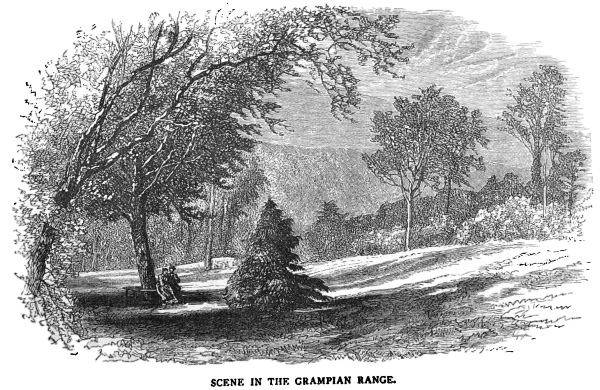
I was lost!
Yes, but what had I to fear? I thought I had been lost before, lost in Afric wilds, on prairie lands, and in Greenland mists: was I going to be baffled by a Highland forest and moorland?
“Tu-whit-tu-whoo-oo!”
A sweet spirit of melancholy is very nice, but one may have too much of it.
“Tu-whit-tu-whoo-oo!”
Bother the bird. His wings too are flapping on the night air, and rustling as they say evil spirits do.
The trees grow more uncanny-looking every minute, and after going on and on for fully twenty minutes more, these ghostly ill-omened pines positively seem to advance to meet me, and wave their gnarled arms in the starlit air as I pass.
“Tu-whit-tu-whoo-oo-oo.”
Horrible!
“Bob, my boy, bark, speak, and scare that awful bird.”
“Wowff—wowff—wowff!”
Listen! Hark!
At no great distance we can hear the sharp “Yap! yap! woo-oo” of a shepherd’s collie. No mistaking it. It cannot be a fox, and there are no wolves about.
I take my bearings by a star that shines over the place from which the barking appeared to come, and Bob and I make straight in that direction. To our great joy and relief, we presently emerge from among the black-branched uncanny trees, and on the moor, at no great distance, see a light streaming from the open door of a hut.
A creature very like a wolf, with hair all on end, comes grumbling and yelping in a most threatening way to meet us.
“Let me settle him,” says Bob.
“No, Bob,” I reply. “He is watching his master’s house. He is right.”
But one glance at Bob is enough for the collie. He disappears—goes bounding away over the hill, evidently to seek his master, for when we enter the one-roomed hut we find it deserted.
There is a bright fire on a low hearth, however, and the smoke finds its way up a real chimney, and not through a hole in the roof, as is the case so often in Highland shepherd huts. There is a pot hanging over the fire, simmering away slowly, and raising its lid a little every now and then to emit a whiff of steam, so savoury that Master Bob begins to lick his lips, and seems to wonder that I do not at once proceed to have supper.
I shake my head, as he looks up in my face inquiringly.
“No, no, Bob,” I say; “that pot does not belong to me.”
“Nonsense,” says Bob; at least he thinks it. “Nonsense, master, all the world belongs to you if you could only believe it. You’re king of the universe, in my mind at all events.”
We sit and look at the pot. There is an old-fashioned wag-at-the-wall clock, tick-ticking away, but no other sound. After a time the clock clears its throat, and slowly rasps out the hour of nine, then goes quietly on tick-ticking again.
A whole hour passes. The clock clears its throat once more and gives ten wheezy knocks.
Bob suggests supper more emphatically. I am getting very weary.
Those we left behind us must think we are indeed lost, or swallowed up in a quagmire. The thought makes me very uneasy, and I begin almost to wish my adventure in the weird forest may be all a dream, that presently the peat-fire, pot and soup and all may vanish, and I may wake in bed.
But while thus musing I am startled very much indeed, and so too is Bob, at hearing a cracked and dismal world-old voice close beside me say with a long-drawn sigh:
“Heigho! I wonder what o’clock it is!”
There is no one in the room, not a soul to be seen.
Next moment, from another direction, but whether above or beneath I cannot be sure, issues a low, half-demoniacal laugh of self-satisfaction.
“Ha! ha! ha!”
The great dog starts up. His hair is on end all along his spine. He growls low and glances fearfully round him as if he expected to see a spectre.
Again the mournful old-world voice and the long-drawn sigh.
“Heigho! Will he ever, ever come!”
The dog looks in my face with terrible earnestness. He expects me to explain. I cannot—I feel uneasy. We listen for many minutes, but hear no more, till the rising wind moans drearily round the house and the fire gets low on the hearth.
“Ha! ha! ha!” The demon laugh again! It is a kind of half-ironical chuckle, impossible to describe. Then a voice in pitiful tones of entreaty:
“Don’t do it. Don’t do it.”
I am really getting frightened. I look towards the door, which had hitherto been open, and stare to see it slowly shut as if moved by some spirit hand. The wind howls now like wild wolves outside.
“What is it? What is it? Ha! ha! ha! What is it?”
Then a wild unearthly shriek, and a yell of “Murder!” rises high above the wind. My nerves are quite unstrung. I verily believe my hair is moving under my Highland bonnet.
I would not stay another moment here for all the world.
I open the door, and rush out into the night, Bob at my heels, and shrieks and laughter resounding in my ears.
Out and away—anywhere, to be free of that uncanny hut.
A big round moon is shining now, and the weird pine-trees are casting weird shadows on the moorland.
Look, though, is that a pine-tree?
No, it is a tall figure, in Highland garb, with a long crook, which it grasps high up, the plaid depending from the uplifted arm.
“Yap, yap, yap—”
That is the collie’s bark, and yonder figure is no doubt that of his master. He advances, and the moon shimmers brightly on the pleasant face and snow-white beard of an old man.
“Welcome, stranger. You’ve lost your way. My dog came to tell me. Come back and share my humble supper, then I will conduct you home.”
I thought it strange to be addressed in such good English. But I was not reassured. Was this a wizard, or a spectre—the spirit of this haunted wood?
“Back!” I cried, with a shudder; “back among goblins!”
“Ha! ha! ha!” he laughed, and I could not help noticing that his laugh was precisely the same as that I had heard in the hut.
“Pardon me,” he said, “but my cockatoos have been talking to you from behind the scenes. Come back, sir, it is all right. See, our dogs are playing together.”
That was true. Bob and the collie were already the best of friends.
From the very moment he mentioned the word “cockatoos,” I felt somewhat ashamed of myself.
So back I went, and shared the shepherd’s soup, and we were soon enjoying a very interesting conversation.
I told him all about myself and caravan, and he explained who he was. A shepherd by choice, because a lover of Nature. A wizard according to some, a poet according to others, because his verses which, he said, were as rough as the heather and the granite rocks on the hillside, found entrée to the Glasgow papers. After supper, he lit a great oil-lamp: we had hitherto had only the fire-light.
Then he pulled aside a screen, and lo! and behold, a dozen at least of cages, each containing a cockatoo, and one a starling.
“What is it? What is it?” said this latter.
“Nothing much, Dick. But you’ve frightened this stranger.”
“Strange!” said Dick.
The old shepherd opened the cage-door, and out flew the bird, and straight on to the supper-table.
“Professor Dick,” said my host, “won’t say another word till he has finished his meal.”
“Professor Dick, you call him?”
“Yes, and I may as well tell you at once how I live and how I manage to get warm clothing, good food, and plenty of books.”
“I see your library is a most extensive one,” I put in.
“It is, for a poor man. I am a hermit by choice; I live all alone in these wilds; I am rent-free, because I have the charge of sheep, and I dearly love the solitudes around me.
“The house or hut I occupy I call Professor Dick’s Academy. Dick is my all in all. The collie comes next in my affections.
“But Dick maintains us.”
“Dick maintains you?”
“Yes, you see all these cockatoos? Well, Dick trains them all to speak. And he trains them tricks, he and I between us. Without Dick I would be nowhere, and perhaps Dick would go to the bad without me.”
“But what becomes of the cockatoos?”
“I sell them. That is the secret of our wealth and happiness. They are Australian hard-bill crestless cockatoos. I pay thirty shillings for each of them. I sell them for ten and even fifteen pounds. There is one there, forty years of age; the most wonderful bird in all the world. Rothschild is very rich, sir, and so is Vanderbilt, but neither possess money to buy that darling bird. No, nor Dick either. But here comes the Professor.”
The bird came hopping towards me, jumped up, perched on the back of a straw chair, and eyed me curiously for quite a minute, using first one eye, then the other, as if to make quite sure of diagnosing me properly.
I thought him somewhat brusque and peculiar at first. He asked me three questions in rapid succession, but gave me no time to answer: “Who are you? What do ye want? Are you hungry?” The Professor and I, however, soon settle down to steady conversation, and talked on all kinds of topics, as freely as if we had known each other for years. Only, like the dictionary, Dick was apt to change his subject rather frequently.
I must say, however, that this pretty bird was the cleverest and best talker I have ever known or heard. There positively seemed no end to his vocabulary, and the ridiculously amusing remarks he made would, I believe, have caused a horse to smile.
“In the name of goodness,” I was fain to exclaim at last to my host, “is this really a bird, or is it some sprite or fay you have picked up in the depths of this weird forest?”
The old shepherd seemed pleased. He nodded and smiled to Dick, and the bird waxed more boisterous and funny than ever.
“I begin to think,” I said, “that I have got into some house of enchantment, and that nothing around me is real.”
The shepherd put Professor Dick to bed at last, and conducted me safely over the moor. He promised to call for us next day, and take us back to the cottage in the forest to hear the Professor teaching his class.
There had been anxious hearts in the caravan during my absence, but Bob went bounding away in front of me to announce my arrival.
Frank was dressed and ready to go off to seek me, stick in hand and plaid across his manly shoulders. But all is well that ends well.
Chapter Seventeen.
The Old Man’s Dogs.
“But there was silence one bright golden day, Through my own pine-hung mountains.”
The sun shone very brightly next morning; the sky was blue; and a silence, broken only by the constant roar of the torrent, brooded over the bills.
We all went to see, or rather seek, for Professor Dick’s Academy.
But for a long time all in vain, and I was beginning to think the events of last evening must all have taken place in dreamland, when, emerging from the trees, the stalwart form of the old shepherd himself was observed coming towards us. In a few minutes more we were in the cottage.
And there, sure enough was Dick hard at work teaching his class. He was loose, his pupils all caged. We were warned to keep silence, and did so as long as we could.
Dick repeated words and sentences over and over again, and some of the pupils were most attentive and apt. And the way some of the more earnest stretched down their necks, cocked their heads and listened, was amusing in the extreme.
But there was one bad boy in the class—a saucy-looking cockatoo, with a red garland round his neck.
“I want a bit o’ sugar,” was all he would say, and he kept on at it. “A bit o’ sugar, a bit o’ sugar; I want a bit o’ sugar.”
The Professor went towards the delinquent’s cage, as if to reason with him; but the naughty bird laughed derisively, and finished off by making a grab at Dick through the bars.
The old man at once threw a black cover over the cage, upon which the bird’s tune was changed, and in the dark he seemed to bitterly bemoan his fate, repeating in a most lugubrious voice the words—“Poor Polly! Poor dear little Polly.”
One of us laughed.
The spell was broken, and the Professor would teach no more.
“My birds will have a half-holiday,” said the old shepherd, laughing.
He came with us to the caravans, and greatly delighted he was. We gave him books and magazines, and that same morning shifted camp farther east, promising, if ever we came that road again, to visit the shepherd and Professor Dick’s Academy.
The story of the evening was—
The Old Man’s Dogs.
“I would not enter on my list of friends (Though graced with polished manners and fine sense, Yet wanting sensibility) the man Who needlessly sets foot upon a worm.”
When a boy at school, of all my favourite authors, Bulwer Lytton was facile princeps. Walter Scott fascinated, and Cooper enthralled me, while the “Arabian Nights” held me spell-bound; but there was a charm to me about all the writings of the first-mentioned novelist and poet that nothing else could equal.
Girls often have what they call “a hearty cry” over the book or story which moves their feelings; boys do not. I do not remember ever putting down a book in order to weep. Such a matter-of-fact way of going to work never occurred to me; yet, while reading, tears have often filled my eyes—yes, and sometimes do—so as to interfere materially with the distinctness of the print I hold before me.
Now, there is in my opinion no one less to be admired than an ungrateful person. One might surely be pardoned for thinking that ingratitude ranks as a great sin in the sight of Heaven. But we are not to judge, far less condemn. It were often better, perhaps, to extend pity rather than anger to one who has been found guilty of ingratitude, for so universal, as an inborn sentiment, is the feeling of gratefulness, not only in man, but in the animals he has domesticated, that the absence of it would seem to denote an imperfection of brain-structure rather than anything else.
Those who have to do with children should not forget that gratitude is a feeling that can be fostered and cultivated, even in those among them in whose minds it exists only in embryo. But if it can be cultivated, so also can it be crushed; that, too, should be borne in mind.
What a power gentle words and kind persuasion have over even the “brute” nature, as it is called! You may always lead, though you cannot always drive. My Newfoundland dog is very fond of being in the house. “Bob” has a temper of his own to strangers, and a strong will of his own at all times. Sometimes it is necessary that he should go to his kennel and mount guard when he would far rather stay indoors. If, on such occasions, I speak somewhat sharply to him, he refuses to move. No force could get him from under the table; but a few gentle pats on the head, and a few kindly words, succeed at once. The great dog jumps up and comes trotting along with me, looking up in my face as much as to say:
“Always talk like that, master, and I’ll go through fire and water to please you.”
Says Phil. G. Hamerton, “Whoever beats a dog gives evidence of his own personal stupidity; for a dog always tries his best to understand, and you can make things clearest to him by gentle teaching, if you know how to teach at all.”
I had to part with a lovely spaniel dog some years ago. We had had many a happy day together in the woods and fields, and the poor animal got exceedingly fond of me. Well, it was two years after that I met him by chance at a great dog show. I had passed his bench three or four times without knowing him. I only noticed that a certain spaniel was making frantic efforts to break his chain, and rush into somebody’s arms; and it was not until I at last stood opposite to him that it occurred to me to look at the catalogue, when I found it was my own old “Beau” that I had not known among the multitude of strange dogs, all of the same colour and shape. Ah! but he had known me in the multitude. But I am so thankful I noticed the dear fellow, and did all I could to make him happy for one short day at least. Suppose I had gone away and never said a word to him—never given one kind word or loving caress; it would have seemed to him so cruel and ungrateful!
On the stormiest winter’s day I seldom wear a hat about my own grounds. And shall I tell you why? It is because I cannot bear to see dogs disappointed, for whenever I do put on my hat, the dogs, with the impulsiveness characteristic of their race, jump to the conclusion that I am going for a walk, and that of course they are going as well.
But referring to Bulwer Lytton’s novels, or Lord Lytton’s, if you prefer it, there is a passage or scene in one of his charming tales that, when a boy, I could not read without the tears rising up and blinding me, and that I cannot think of, even as I write, without emotion.
An old man has none to care for him or tend him on earth save a daughter, whom he tenderly loves. But he finds a letter which proves her worse than false, worse than ungrateful, for she is, in that epistle, coolly reckoning and calculating on his death at no distant day. What a shock to the father! He is no longer any use; is a positive encumbrance; and she, whom he had so thoroughly trusted, she, too, wishes him away. He calls his dogs to him. They come to his knee, and with wistful, wondering eyes gaze up into his face, for they can see poor master is in grief. And his heart feels ready to break, as he pats his poor dumb friends and exclaims:
“Will there be no one even to look after the old man’s dogs when he is gone?”
There is a species of cruelty to animals, happily, I believe, very rare. I refer to that which induces a person to treat harshly and unkindly some dumb creature for the simple reason that it belongs to an enemy. Whatever of harm an animal’s master may have done me, it, at all events, is guiltless of evil. Reference to this is made in Holy Writ, and if we turn to Exodus twenty-three, verse 5, we read the following: “If thou see the ass of him that hateth thee lying down under his burden, and wouldest forbear to help him, thou shalt surely help with him.”
On the other hand, the pets of those we love become doubly dear to us in the absence of their real master or mistress. Yonder, let us say, is little Maggie’s pet canary. Maggie is always the merriest of the merry when she is about the house. It would be difficult indeed to say whether the canary or she sings the louder, or looks the brighter or the happier all day long. But there were tears in Maggie’s eyes on the day she went away, and when she went to the cage and said, “Bye, bye, birdie,” it was all she could do to keep from crying. And the bird seemed sad too, and does not sing so blithely now; and every morning, when any one enters the breakfast-room, he extends a very long neck indeed, for he is looking for and expecting the loved one. Now would it not be cruel if the person in whose charge that birdie is left were not more than kind to it in Maggie’s absence?
Yonder is Johnnie’s rough wee terrier dog. O, what romps and games and rambles far and near Johnnie and that little dog did use to have! But Johnnie has gone to sea. The little dog mourns for him; any one can notice that. But he does not mourn for him as one dead, for often when a step somewhat like his master’s sounds on the gravel, how wildly the little dog rushes to door or window to have a look, and how very low his tail droops as he returns disconsolate to his seat on the hearth. May Heaven send Johnnie safely home again; and won’t he find his doggie sleek and fat? It will not be our fault if he does not.
If any one were to ask me how long I supposed a dog would remember an absent master, I should answer—and I should speak advisedly when I did so:
“A dog will remember and mourn for an absent master until his return, no matter how long that may be; or until the dog’s own loving eyes are closed in death.”
About the mystery of death itself, I question if dogs know very much. They must at any rate imagine that there is a possibility of the dead one returning again to life.
Does the reader remember the story of the gentleman who lost his way among the mountains and was killed, his body being found a quarter of a year afterwards, with his faithful dog still beside it? Or Scott’s beautiful lines on the subject, a few of which I cannot resist the temptation to quote?
“Dark-green was the spot ’mid the brown mountain heather, Where the Pilgrim of Nature lay stretched in decay, Like the corpse of an outcast abandoned to weather. Till the mountain-winds wasted the tenantless clay. Nor yet quite deserted, though lonely extended, For, faithful in death, his mute favourite attended, The much-loved remains of his master defended, And chased the hill-fox and the raven away. How long didst thou think that his silence was slumber? When the wind waved his garment, how oft didst thou start? How many long days and long weeks didst thou number. Ere he faded before thee, the friend of thy heart?”
I was travelling one time in Ireland in a jaunting-car which I had hired for some days. I had no other companion save a large Newfoundland dog, for whose comfort the seat of the car was hardly broad enough. But there was the driver to talk to, and nothing loth was Paddy either to carry on the greater share of the conversation.
It was the sweet summer-time, and whatever my companion the dog did, I know I felt as happy and light-hearted as the birds.
“See them two dogs?” said the driver to me, as we passed an old-fashioned gate, about a mile from the village of C—.
“Yes,” I replied, “pull up a moment, Paddy, till I have a look at them.”
A pair of lovely Basset hounds they were, a dark or liver-coloured and a light one, coupled together by a short chain. They were waiting for some one, apparently; the white one turned his head to look at us, but the other was all eagerness, all attention. He seemed to me to hear a footstep.
“Waiting for some one, I should think,” I said to my driver.
“Indeed, yes, sorr,” replied Paddy. “It is waiting for their master they do be. It is waiting for him they’ll never see again, they are, sorr. They call them ‘the old man’s dogs,’ and every evening at five o’clock out they trot, just as you see them, and there they stand, sorr, and there they listen for hours and hours together; then trot back, with hanging heads and tails, sorr; but they’ll never see him more.”
“Is he dead, then?” I inquired.
“Yes, sorr,” said Paddy; “but we’ll drive on a bit if we’re going to talk.”
I gave one last glance towards the dogs, and the look of eager expectancy in the dark one’s eyes I shall not soon forget.
“It was all owing to treachery, I think, sorr,” said Paddy, as we drew up under a drooping lime-tree.
“But there it was; the old man B— used to stay much in foreign parts, but he came home at last to settle down. He had an only daughter with him, that he loved right dearly, and barring her neither kith nor kin, that ever we could see, belonging to him.
“He was always cheerful, sorr, and she seemed always happy. He used to go to L— every day; his carriage waited him on his return at the station, and them two faithful brutes, sorr, at the old gate. So everything seemed to go as cheerfully as wedding-bells, and just as easy like.
“There was a count, they called him, that used often to stay at the mansion, sorr. Whether he had anything to do with it or not, it’s not myself that can tell you. But I won’t keep you waiting, for it’s a cruel story. The old man came home one day to an empty house. He was never the same after. Broken-down like he was, and didn’t seem to care for anything but them two dogs. Well, just in one month, sorr, the daughter came back. She never saw her father alive, though. He was carried in the same day at the old gate, dead, sorr. He had dropped down in a fit, or, as some do say, of a kind of heartbreak.
“I needn’t tell you more, sorr. There is nobody at the old manor now. She is abroad, and just guess you, sorr, what her feelings are if ever she thinks, as think she must. The house is a kind of tumbledown like, and there is no one ever likely to live there again owing to the ghost, you know.”
“I don’t care about the ghost, Paddy,” I said; “but what about the dogs? Where do they live?”
“Just inside the old gate, sorr, at the gardener’s cottage. And it’s waiting they do be, sorr, waiting, waiting. Hup! mare, hup!”
Chapter Eighteen.
Up the Vale of Don.—A Peep at Paradise.
“Between these banks we in abundance find, Variety of trouts of many different kind; Upon whose sides, within the water clear, The yellow specks like burnished gold appear. And great red trouts, whose spots like rubies fine. Mixed ’mong silver scales refulgent shine.”
The summer sped away.
But early autumn still found us among the bonnie blooming heather.
We were real gipsies now. We had settled down long since to our strangely delightful nomadic life. We were both healthy and happy. There were roses on the cheeks of Maggie May, and—let me whisper it—freckles on her nose.
Frank was as brown as a brick, and even Bob and the caravan cat had increased in size, and looked intensely self-satisfied, and on good terms with themselves.
This chapter finds me fishing in the Don; Maggie May is basking in the sunshine, book in hand, and the rest of our crew are invisible.
“There is something radically wrong, Robert,” I said, casting my fly for the fortieth time, and so coaxingly too, over the very spot where I knew more than one fine finny fellow was hiding.
“Something radically wrong, Bob; either the sky is too clear or the water too bright, or there isn’t wind enough, or I haven’t got the right fly on. But never a bite and never a ghost of a nibble have I had for the last half-hour. I’m tired of it; sick of it. But they are there, Bob, for many a one we have landed on luckier days than this. Besides, what says the old, old poem?”
Bob wagged his immensity of a tail by way of reply, but he never took his eyes off a hole in the bank, that he had been as earnestly watching as I had been flogging the pool.
Whip! Splash! I thought I had one then. And I believe I would have had one, only out of its hole sprang a big black vole, and took to the water. In floundered Hurricane Bob after it, and there was an end to my fishing.
Bob came out of the water presently, and stood between me and the sun, and shook himself several times, causing a rainbow to appear around him each time he did so.
I wound in my tackle, and put up my rod.
Half an hour afterwards, Maggie May, Bob, and I were on the braes above Balhaggarty. We lay ourselves down on a sweet mossy bank, bedecked with many a wild flower; peacock butterflies are floating in the sunshine, and great velvety bees make drowsy music in the air; and not far off, on a branch of a brown-trunked fir-tree, cock-robin is singing his clear, crisp little song. Before us, beneath us, and on every side, is spread out one of the fairest landscapes in all the wild romantic North. Woods and water, hills and dales, stretch away as far as the eye can reach. Yonder is the wimpling Ury, meandering through the peaceful valley to join the winding Don. Near its banks stands, or lies, or rather lies and sleeps, and seems to dream, the village of Inverurie. Very blue are the roofs of its houses in the surrounding greenery, very white are its granite walls, and its spires and steeples look like snow or marble in the autumn sunshine.
That was the village home of one of Scotia’s noblest bards—the gentle, genial Thom. Though six-and-thirty years have fled since they laid him to rest in the moors, there is more than one old man and woman living in the village there yet, who knew him in his prime, and have stories well worth listening to, to tell of the poet of the Ury; but as long as pine-trees shall nod on Scottish hills, as long as the dark plumes of Caledonia’s sons shall wave in the van of battle, so long will Thom’s name be known in the land of his nativity, and among his countrymen all over the world.
Far to the right of the spot where we are reclining, the giant mountain, Ben-na-chie, rears its proud head into the air.
It is a solitary hill, and yet tourists to this land of romance ought to know that from its summit the view obtained on a fine day is probably more beautiful, varied, and extensive than any other I know of in “a’ braid Scotland.”