"Tales and Sketches from the Life" (continued 2)
Reading edition
“I do not think that bears actually hibernate in a dormant state; but in very bad weather they no doubt take long spells of sleep in holes under the snow, and a capital way of passing the time it must be; if mankind could only do the same, then sleep would be the poor man’s best friend. But your Arctic bear is fond of a good nap in the sunshine, even in summer; I was beset for nearly two months once, some little way south and west of the island of Jan Mayen. One day, with Dana’s ‘Two Years Before the Mast’ in my hand, and my binocular slung across my shoulder, I wandered away from the ship. I had neither rifle nor club, not expecting to need either. I found myself at last by the foot of a very tall hummock, composed, I daresay, of bay-ice squeezed up at some time or other and finally snowed over. I like to get on tops of eminences, and this hummock looked like a small tower of Babel in the midst of the flat and wide expanse of snow-clad ice; so up I went, and sat down to read. On looking around me presently, I noticed a yellow mark or spot on the snow some hundred or hundred and fifty yards off. On bringing my glasses to bear on it, I found it was a bear; and he was moving or wriggling. He evidently had not seen me yet, nor scented me. I had no more heart to read Dana just then. I thought the best thing I could do would be to sit still, and keep semaphoring with my right arm and Dana towards the brute; the mate was in the crow’s-nest, I thought, and would be sure to notice me soon, and know something was wrong. But the mate did not notice me. The truth is the steward had taken him some coffee, with a dose of rum in it, a drink of which he was inordinately fond, and he was smacking his lips over that. I semaphored with my right hand until it was temporarily paralysed; then I turned quietly round and semaphored with my left. This change of position necessitated my looking over my shoulder to the ship. On again turning round I was horrified to find that Bruin was up, and evidently wondering who or what I was, and what I meant. He came closer, and stood again to look, for bears are inquisitive. I kept up my motions—there was nothing else to be done, and my heart felt as big as a bullock’s. Presently the bear commenced gyrating his great head and neck, the better to scent me, I suppose; only it looked as if he was mimicking my actions. So there the pair of us kept it up for what seemed to me about five hours, though it might not have been a minute. Then Bruin quietly turned stern and shambled off.
“An old authority describes the pace of a Polar bear as equal to that of the sharp gallop of a horse. I believe a bear can spring as far as a horse can jump, or nearly, but his pace is not even half as fast, nor anything like it.
“I have eaten a great many strange things in my time, but I should be sorry indeed to have to dine off Arctic bear in the seal season. Everybody is not so particular, however, and the Norwegians make many a hearty meal off bear-beef. I was in the cabin of a Norwegian once when they had bear for dinner. There was the captain and first and second mate at table. In the centre stood a dish with an immense hunk of boiled bear on it; by the side of it was placed a large plate of potatoes, cooked in their skins. Nobody used a fork, only the knife; so on the whole it was a pretty sight to see them. I was asked to partake. I begged to be excused, and to escape from the odour of the fishy-fleshy steam, I ran on deck, and lit a cigar.”
Chapter Seven.
“Spring is Coming:—The Storm.—The Fairy Forest: A Tale.”
“The brown buds thicken on the trees, Unbound the free streams sing, As March leads forth across the leas The wild and windy Spring. “When in the fields the melted snow Leaves hollows warm and wet, Ere many days will sweetly blow The first blue violet.”
“I have all my life possessed such a love for nomadic adventure, that I often wondered if I have any real gipsy blood in me.”
This was a remark I made an evening or two after Frank had told us all about his friends the Arctic bears. I was looking at the fire as I spoke, as one does who is in deep thought.
“What do you see in the fire?” asked Frank.
“I see,” I replied, without removing my eyes from the crackling logs and melting sea-coal, “I see a beautifully fitted caravan, drawn by two nice horses, jogging merrily along a lovely road, among green trees, rose-clad hedgerows and trailing wild flowers. It is a beautiful evening, the clouds in the west are all aglow with the sunset-rays. I see figures on the broad coupé—female figures, one, two, three; and I can almost hear the jingle of the silver bells on the horses’ harness.”
“Who are the ladies—can you distinguish them?” asked Frank.
“Not quite.”
“O! I know, it’s me and ma and Maggie May.” This from little Ida.
“Ida,” I said, “your language is alliterative, but hardly grammatical.”
“Never mind about the grammar,” said Frank, laughing. “You’ve got an idea of some sort in your head, so just let us have it.”
“I have it already,” cried Maggie May, springing towards me with a joy-look in her eyes, and a glad flush on her cheek. “I dreamt it,” she added. “The caravan is already built, and you are going to take us all gipsying when summer comes.”
I am not good at equivocation, so I confessed at once that Maggie May was right, and from the amount of pleasurable excitement the announcement gave her, I augured well. Indeed, we all felt sure that from our romantic trip, Maggie May would return home as well as ever she had been in all her little life.
There is nothing to be compared to the joy of anticipating pleasure to come. And from the very day our beautiful caravan rolled into the yard and was drawn up on the lawn, everybody set about doing what he or she could towards the completion of the fittings, of the already luxuriously furnished saloon of the house upon wheels. (Note 1.)
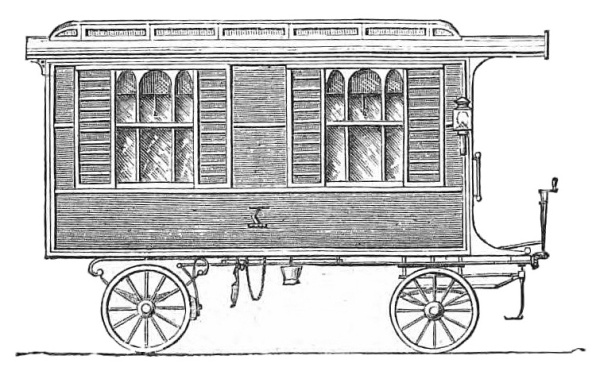
This was indeed a labour of love. There were so many little things to be thought about, to say nothing of decorations, neat and pretty curtains, a lovely little library of tiny but nicely bound books, mirrors, flower vases, etc.
The cooking department had its head centre in the after-cabin; here, however, no bulky open and dusty stove burned, but a pretty little oil range, and the kitchen fittings and pantry fixings would have compared favourably even with those of Lady Brassey’s yacht, the Sunbeam.
Frank and I, being both old campaigners, saw to everything else.
We had a good coachman, two splendid horses, besides an extra smaller covered cart in which Frank himself, who was to be both valet and cook, could sleep at night.
To make sure of not being robbed on the road we had good revolvers, and, better than all, our noble Newfoundland, Hurricane Bob.
When everything was complete and ready for the road, we had nothing to do but sit down and long for spring to come.
“I really believe,” said honest Frank to me one bright beautiful morning in March, “that the child is better already with the thoughts of going on this romantic tour of yours.”
And so indeed it seemed, and that forenoon, when my friend and I prepared to go out for a ramble, Maggie May was by our side, fully equipped and in marching order.
“It really does seem,” she said joyfully, “that spring is coming.”
Spring is Coming.
The birds and the buds were saying it, and the winds were whispering the glad news to the almost leafless trees. The early primroses that snuggled in under the laurels, and the modest blue violets half hidden among their round leaves, were saying “Spring is coming.” And the bonnie bell-like snowdrops nodded their heads to the passing breeze and murmured “Spring is coming.”
Cock-robin, who sang to us and at us now whenever we came into the garden, told the tale to the thrush, and the thrush told it to the blackbird, and the blackbird hurried away to build his nest in the thick yew hedge; he would not sing, he said, until his work was finished. But the mad merry thrush sang enough for ten, and mocked every sound he heard.
The lark, who pretended that he had already built his nest among the tender-leaved wheat, just beginning to shimmer green over the brown earth, sang high in air. You could just see him fluttering against a white cloud, and looking no bigger than the head of a carpet tack. He sang of nothing but spring—such a long song, such a strong song, such a wild melodious ringing lilt, that you could not have helped envying him, nor even sharing some of his joy.
“Oh, skylark! for thy wing! Thou bird of joy and light, That I might soar and sing, At heaven’s empyreal height! With the heathery hills beneath me, Whence the streams in glory spring, And the pearly clouds to wreathe me, Oh, skylark! on thy wing!”
“Spring is coming:” every rippling rill, every sparkling brook, were singing or saying it.
The hedgerows put forth tiny white-green budlets, the elders and the honeysuckles expanded early leaves, those on the former looking like birds’ claws, those on the latter like wee olive-green hands.
We saw to-day, in the woods, early butterflies and early bees, and many a little insect friend creeping gaily over the green moss.
And high aloft, among some gigantic elms, the rooks were cawing lustily, as they swang on the branches near their nests. We heard a mole rustling beneath dead leaves, and to our joy we saw a squirrel run up a branch and sit to bask in a a little streak of sunshine.
“Yes,” said Frank, “sure enough spring is coming.”
The Storm.
March 15.—Why, it is only two days since that delightful ramble of ours. Two days, but what a change! The snow has been falling all night long. It was falling still when these lines were penned, falling thick and fast. Not in those great lazy butterfly-like flakes, that look so strange and beautiful when you gaze skywards, nor in the little millet-seed snow-grains that precede the bigger flakes, but in a mingled mist of snow-stars, that falls O! so fast and looks so cold.
The whole world is robed in its winding-sheet. The earth looks dead. To-day is but the ghost of yesterday. The leafless elms, the lindens and the oaks are trees of coral, the larches and pines mere shapes of snow shadowed out with a faint green hue beneath.
And the birds! Well, the thrush still sings. What a world of hope the bird must carry in his heart! But the blackbird flies now and then through the snow-clad shrubbery with sudden bickering screams that startle even the sparrows. The lark is silent again, and shivering robin comes once more to the study-window to beg for crumbs and comfort.
And this snow continues to fall, and fall till it lies six good inches deep on roof and road and hedgerow. And it is sad to think of the buried snowdrops, of the crocuses, yellow and blue, and the sweet-scented primroses.
March 17.—The pines are borne groundwards, at least their branches droop with the weight of snow; they are very weird-like, very lovely. The snow has melted on the roofs, but the dripping water has frozen into a network of crystal on the rose-bushes that cling around the verandah. It has mostly melted off the tall lindens also, only leaving pieces here and there that look for all the world like a flock of strange big birds.
Everything is beautiful—but all is silent, all is sad.
The sun goes down in a purple haze, looking like a big blood orange; and an hour afterwards, when the stars come out, there is all along the horizon a long broad band of rose tint, shading upwards into yellow, and so into the blue of the night.
I close my study-windows, and go into the next room; how bright the fire looks, how cheerful the faces round it! Hurricane Bob is snoring on the hearth, Ida is asleep beside him, Maggie May has got hold of a picture and wants me to weave a story to it.
Note that she says “‘Weave’ a story.”
“I would have put it plainer,” says Frank, laughing, “and said ‘Spin a yarn.’”
At another time, I might have been inclined to attach some semi-comical signification to the picture Maggie May held coaxingly out to me.
It represented a wide unbroken field of dazzling snow, with the outlines of a pine-wood in the far distance. There were two dark and ugly figures in the centre of the snow-field—an ugly fierce-like boar and a gaunt and hungry, howling wolf. You could see he was howling.
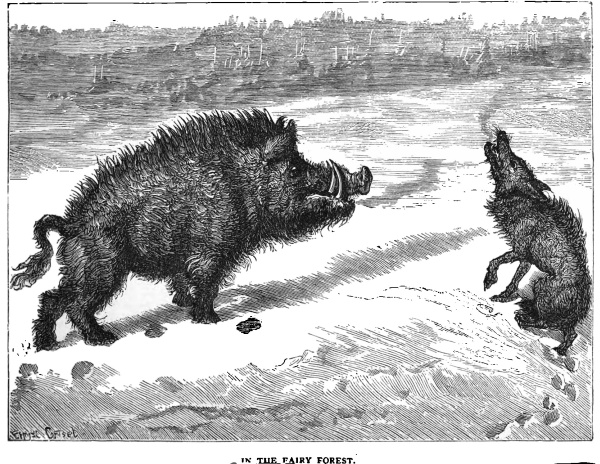
But with the rising wind beginning to moan drearily round our house, and the icicle-laden rose-twigs rattling every now and again against the glass, I could see nothing amusing in Maggie May’s little picture.
The Fairy Forest.
“Had you been walking across that wild wintry waste, Maggie May,” I began, “you would have seen at some distance before you a great pine-wood, half buried in drifting snow, the tall trees bending before the icy blast and tossing their branches weirdly in the wind.”
“Don’t you want slow music to that?” said Frank, pretending to reach for his fiddle.
“Hush, Frank! When you looked again, Maggie May, lo! what a change! The fairy forest has been transformed into a city. There is a blue uncertain mist all over it, but you can plainly distinguish streets and terraces, steeples, towers, ramparts, and ruins; and instead of the mournful sighing of the wind that previously fell on your ear, you can now listen to the music of bells and the pleasant murmur of the every-day life of a great town. Towards this town then, one day, a big wolf was journeying. It was summer then, the sun shone bright, clouds were fleecy, and the sky was blue, and the plain all round him was bright with the greenery of grass and dotted with wild flowers. But neither the beauty of the day, nor the loveliness of the scenery, had any effect on the gaunt and ugly wolf. Not being good himself, he could see no goodness in Nature.
“‘I’m far too soon,’ he grumbled to himself, ‘I must curl up till nightfall; I wish the sun wasn’t shining, and I wish the birds wouldn’t sing so. Moonlight and the owls would suit me far better. I wonder what makes that skylark so happy? Well, I was happy once,’ he continued as he lay down behind a bush, ‘yes I was, but, dear me, it is long ago. When I was young and innocent, ha! ha! I wouldn’t have stolen a tame rabbit or a chicken for all the world; I was content with the food I found in the wild woods, and now I’m lying here waiting for night, that I may fall upon and slay a dozen at least of those pretty lambkins I see gambolling down on yonder lea. I wouldn’t mind being young again though, I think I might lead a better life, I think—’
“He did not think any more just then, for he had fallen sound asleep.
“The hours flew by. The sun went round and down, and a big moon rose slowly up in the east and smiled upon the landscape.
“The time flew by, as time only flies in a fairy forest.
“The wolf moaned in his sleep, then he shivered, and shivering awoke. No wonder he shivers: he had lain down to sleep with the soft balmy summer winds playing around him; now all is cold snow.
“No wonder he shivers, for yonder in front of him, and not two yards away, stands one of the most terrible-looking apparitions ever his eyes beheld. A great grizzly boar!
“‘O! dear me,’ cried the wolf, ‘what a fright you gave me! Who are you at all?’
“‘I’m Remorse,’ was the stern reply; ‘you used to call me Conscience once.’
“‘O! well,’ said the wolf, ‘do go away, you have no idea how dreadful you look. I’ll—hoo—oo—oo!’
“And the wolf laid back his ears, lifted up his head and voice, and howled till the welkin rang, just as you see him in the picture.
“‘I didn’t always look dreadful,’ said the boar; ‘when I was young I was tender, but you seared me and hardened me, and tried to bury me. Do you remember the days when I used to beseech you to do unto others as you would that others would do unto you? Now I’m come to do unto you as you have done to others. Aha!’
“‘Hoo—oo—oo!’ howled the wolf. ‘O! pray go away. Hoo—oo—oo!’
“‘Nay, nay,’ said Remorse, ‘I’ll never leave you more.’
“‘You must be joking,’ cried the wolf, ‘you must be mad. Hoo—oo—oo!’
“‘Must I?’ said Remorse; ‘you’ve led a life of discontent. Your evil deeds are more in number than the bristles on my back.’
“‘Pray don’t mention them,’ exclaimed the wolf, shivering all over.
“‘You’ve led a cruel, selfish, useless life. Do you feel any the better for it now? You don’t look any better.’
“‘O! no, no, no.’
“‘Now look at me.’
“‘I daren’t. Hoo—oo—oo!’
“‘Well, listen.’
“‘I must.’
“‘Yes, you cannot shut your ears, though you may close your eyes. Before you tried to crush and kill me, I was your best friend, the still small voice within you guiding you on to good. What am I now? Your foe, your tormentor—Remorse!’
“‘Mercy, mercy!’ cried the wolf. ‘O! give me back my innocence. Be my Conscience once again.’
“‘Too late!’
“And now a cloud passed over and hid the moon, and next moment, had you looked, neither wolf nor wild boar would you have seen.
“Nothing there save the distant fairy forest, with the wind bending its branches and sighing mournfully across that dreary waste of snow.”
Note 1. A complete description of this caravan is to be found in my book, “The Cruise of the Land Yacht Wanderer,” published by Messrs Hodder and Stoughton, Paternoster Row. The book is at all libraries.
Chapter Eight.
On the Road.—Neptune: A Story of Strange Meetings.
“Love, now a universal birth, From heart to heart is stealing, One moment now may give us more Than fifty years of reason; Our minds shall drink at every pore The spirit of the season.” Wordsworth.
It was on a lovely morning early in the month of June that—after many trial trips here and there across country—we started on our long and romantic tour, away to the distant north.
Come weal or woe, we determined never to turn our horses’ heads southwards until we had reached and crossed the Grampian mountains.
All the village turned out to see us start—the older folks shouting us a friendly farewell, the children waving their arms in the air and cheering.
But in an hour’s time we were away in the lonesome woods, and when we stopped on a piece of moorland to eat our first real gipsy lunch, there was not a sound to be heard anywhere except the bleat of sheep, and the singing of the joyous birds in the adjoining copse.
A blue June sky was above us, June butterflies floated in the soft June air, June sunshine glittered in the quivering beech-tree leaves, June wild flowers were everywhere, and the joy of June was in all our hearts. I had never seen Frank look so buoyant and young as he did now, despite those tell-tale hairs of silver in his brown beard. Some of the roses of June seemed to have settled in Maggie May’s cheeks already, my wife looked calmly happy, and wee Ida madly merry, while Hurricane Bob rolled lazily on his back and pulled up and threw to the winds great tufts of verdant moss.
Ida was Frank’s coupé companion. His caravan came behind ours, and sure enough these two gipsies had plenty to say, and they saw plenty to laugh at.
It is time to tell the reader about one little wanderer that has not been mentioned before—Mysie, the caravan cat. We really had intended leaving Miss Mysie at home in charge of the old cook, but Miss Mysie did not mean to be left. She had watched with the most motherly interest all our preparations for the tour, and at the very last moment in she jumped and took possession of a corner of the caravan sofa, commencing forthwith to sing herself to sleep.
And there she was now, while we sat on the greensward at lunch, walking round big Bob, and rubbing her shoulders against his head, as happy as a feline queen.
For believe me, dear reader, cats are very much what you make them. I have made these animals a study, and found that the old ideas about them which naturalists possessed, and the conclusions they so ungenerously jumped at, are all wrong. I do assure you—and you can easily prove it for yourself—that if you use a cat well, feed her regularly and treat her as the rational being it undoubtedly is, you will find that pussy is not a thief, that she is fonder far of persons than places, that she is true and faithful, loving and good.
As soon as luncheon was over, and we had rested a little and the horses’ mouths were washed out—they had been busy all the time with nose-bags on—we resumed our journey. We had no intention, however, of seeking for, or of sojourning even for a single night, in any large town. As our home by night and by day for months to come would be the caravans, so our bivouac must be in woods and wilds. At all events we must keep far away from the bustle and din, the trouble and turmoil, of towns.
Towards evening we found ourselves drawing near to a cosy little roadside inn, and here we not only got a meadow in which to place our wooden houses, but stabling for our steeds. And while Frank put up the tent and dinner was being prepared, I busied myself looking after the horses, and seeing to their bedding and general comfort. This was to be one of my duties every evening.
The day had not been altogether devoid of adventures, for we lost our way entirely once in a labyrinth of lanes that seemed to lead nowhere, or rather everywhere, through beautiful woods on the banks of the Thames. We got clear at last, however, and soon found ourselves on a hill so steep, that it was with the greatest difficulty our powerful horses managed to drag the caravans up and over it.
But now all our troubles were forgotten; and no wonder, for such a dinner as our cook and valet Frank placed before us in the tent, surely gipsies never sat down to before.
We were all as happy, if not as merry, as larks, for everything was so new to us; and this life of perfect freedom seemed, somehow or other, precisely what each of us had been born for.
When, after the tent had been cleared, and Frank had brought in his violin and commenced to play, it appeared quite a natural thing that the figure of a handsome young man in cyclist’s uniform should come to the doorway to listen.
I beckoned him in, and presently he was squatting in the midst of us.
“Now, Gordon,” said Frank, when he had finished playing a symphony, “we’ll have your story, and then perhaps the young stranger will give us some of his experiences.”
“I’ll be delighted, I’m sure,” said the cyclist, smiling. “That is,” he added, “if I can think of anything.”
“I’ll tell you, then,” I said, “one of my service adventures.”
“Is it true?” asked Ida.
“Quite true, Ida,” I replied.
“I shall call it—
“Neptune: a Story of Strange Meetings.
“‘The world is not so very wide after all!’
“This exclamation, or one somewhat akin to it, we are constantly hearing in these times of rapid travelling. For my own part I am never in the slightest degree astonished at meeting any old friend anywhere, for nowadays there seems but little to prevent everybody from going everywhere.
“I could instance scores of cases of strange and unexpected meetings from the diary of my own life, and some of them would be amusing enough, but one or two must suffice.
“When I first left home to join the service I left Geordie M— ploughing in one of my father’s fields, with an ox and the ‘orra’ beast. I specially mention the ox and the ‘orra’ beast, by way of showing that Geordie was by no means even a first-class ploughman. (Orra, Scotice ‘of all work,’ or ‘for doing odd jobs.’) He was an orra man himself, and couldn’t be trusted with a team of the best horses. He was slow in his motions, and slow in his notions; he wore a corduroy coat, his boots weighed pounds, he never lifted his feet, but trailed them; such was Geordie.
“Just two years after this I was one day sitting forward in the sick bay examining and taking the names of a batch of marines who had come to join us from another ship. It was at Bombay, and the weather was hot, and I was drowsy, so I seldom looked twice at my man, and was not in the best of tempers; but there was one marine in the lot, and a right smart clean-footed fellow he was, who attracted my attention, because he laughed when I spoke to him. He talked in the broadest of Scotch, and the very sound of his voice recalled to my memory Highland hills clothed in blooming heather. I rubbed my eyes and looked at him again. As sure as I live it was Geordie.
“I bade good-by to a medical friend of mine once in Soho Square. He was going away to the country to get married, and settle down in a mining district among the Welsh hills. Years flew by. I was out on the eastern shores of Africa. We were hunting slavers. One rascally old dhow gave us much trouble and a long chase. We ran her at last down to shooting distance, and as she would not stop we brought our big guns to bear on her; still she flew on, and on, fair and square before the wind, till a lucky shot knocked the mainmast out of her. When we boarded her, the very first person seen on deck was the medical friend I had bidden a final adieu to—as I thought—in Soho Square. There was not much mystery about the matter after all. He had not got married. He had not settled down among the Welsh mountains. He was on his way to Zanzibar to join a mission, and had taken passage in this dhow for cheapness’ sake.
“Peter Middleton—this is not his real name—was a blacksmith’s apprentice in my parish. He was clever, too clever, for he often got into trouble for requisitioning hares, rabbits, and such small cattle of the hills. When he took at last to paying midnight visits to the farmers’ fowl-runs, the farmers waxed wroth, and Peter had to run himself, and no more was heard of him in that place. My ship was lying some time after at a town in South Australia, and I received a polite but badly spelt note from a resident medical man requesting me to come on shore for consultation on a difficult case. The house was a smart one and well-furnished, but judge of my surprise to find that the doctor himself was no other than Peter Middleton, ex-poacher and poultry-fancier. It is a strange world!
“But to my tale. I very seldom travel anywhere, by sea or land, without taking as a companion a well-trained and handsome dog. It is nearly always a pure black Newfoundland, a breed for which I have obtained some celebrity. These animals are of such extreme beauty and so prepossessing in manners, and so noble withal, that they never fail to make friends wherever they go. It may seem a strange thing to say, but it is strictly true nevertheless, that my dogs have introduced me to many of those who at the present moment I rank among my most valued acquaintances.
“About two years before the tremendous war broke out between Germany and France, happening to have earned a ‘spell of leave’ as sailors call it, I was very naturally spending it in touring through the Scottish Highlands, my only companion being as usual a noble Newfoundland, who not only performed the duties of bodyguard and sentry over my person, but also those of light porter, for he carried my portmanteau. Had I possessed any desire for exclusiveness on this journey, I should have been quite miserable, for wherever I went—on steamboat, in trains, or walking on foot—my princely companion was the subject of conversation and admiration. If I had tied a slate about my neck and pretended to be deaf and dumb, I might have been allowed to hold my tongue, but I should have had to write.
“Who that has travelled in summer among the Western Isles of Scotland, does not know the grand steamships of the country, with their splendid decks and palatial saloons. One beautiful day my dog and I were on board one of these boats on our way to Portree, the capital of Skye. Nero was looking his best and sauciest, his crimson silver-clasped collar showing off his raven-black colour to the best advantage. I seated myself in an out-of-the-way corner right abaft, with a book to read, and threw my tartan plaid over the dog. I thought we should thus escape observation, and I would not have to answer the same questions over and over again which I had been replying to for the last month. But the book was too interesting. I became absorbed in it, I lost myself, and when I found myself again, I found I had lost my dog. But yonder he was with quite a crowd about him, his beauty greatly enhanced by the rich colours of the plaid that floated from his broad back on each side of him, making him look like some gaily caparisoned elephant or embryo Jumbo. From the laughing and talking I could hear, it was evident he was amusing them by performing his various tricks, such as sneezing, making a bow, saying ‘yes,’ standing on alternate legs, etc, all of which brought him buns and tit-bits.
“‘Your dog’s been ’avin’ a blow out,’ a sailor said to me. ‘I see’d ’im eat the best ’alf of a turkey, besides two pork-pies, and no end of lumps of sugar, biscuits, and buns.’
“I soon stopped the performance, but did not get away until I had told the whole history of the dog, his breed and pedigree, and the points and characteristics, whims and oddities of Newfoundlands, and about fifty anecdotes of dogs in general, given a kind of canine lecture; in fact, I had become used to the rôle of public platformist by this time.
“The dog slipped down that day to dinner with the rest of us, and lay down between a young German gentleman and myself. The steward wished to turn the dog out. I said ‘certainly, by all means.’ The great good-natured dog also said ‘certainly, by all means,’ when the steward addressed him; ‘but,’ the dog added, ‘you’ll have to carry me.’
“As the Newfoundland weighed over nine stone, the steward permitted him to remain. Then the German and I got talking about the weather, the ship, the sea, my country, his country, history, poetry, music and painting. His English was very good and his accent almost faultless, and his conversational powers were great; but though he could speak well, he could also listen, and the earnest look, the smile, or the occasional hearty though well-timed laugh, showed he possessed a soul that could appreciate originality in others, in whatever form it came. Before I was an hour in this young German’s company, I had come to the conclusion that there were only two human beings on board the steamer, and that they were Hans Hegel and myself. I have reason to believe that Hegel himself was much of the same opinion.
“We stayed at the same hotel, and next morning—and a delightful morning it was—as we sat together on the pine-clad hill, with the blue waters of the Loch shimmering in the sunshine far beneath us, and on every side the marvellous rocks and wondrous hills, we agreed to travel in each other’s company for the next three weeks at least.
“When I say that those three weeks got extended to six, it will readily be believed that we enjoyed ourselves thoroughly. Of all romantic scenery it has ever been my luck in life to gaze upon, that of the ‘Winged Isle’ is by far and away the most enchanting. See Skye in summer, and you will have something to think about and dream about until your dying day.
“I was somewhat proud to be able to show my newly found friend all the wild beauties of the island, the mysterious caves among its rocks, the frowning glories of its mountains, the sylvan sweetness that hovers dream-like around bonnie Armadale, and the awesome sublimities of lonely Coruishk. I know Skye so well, and there was not a glen, a hill, a bleak moorland or one mile of surf-tormented beach, on which I could not cause to reappear the heroes and heroines of a bygone age. There was no attempt at effect in anything I said; I told but what I knew, I spoke but what I felt, and if I did sometimes warm to my subject or description, the warmth welled right up from the bottom of my heart.
“Every enjoyment must come to an end at last. I got a letter one morning—a long white service envelope contained it—which demanded my presence on the other side of the world.
“We were reclining on a wild-thyme scented knoll not far from the edge of a cliff, that went down a sheer five-hundred feet to the sea below. We could hear the boulders thundering on the beach, though we could not see them. Beyond this was the Minch, flaked with foam; it was a breezy day, and far away on the horizon the blue outline of the Harris hills.
“‘No,’ he said, in answer to a question of mine. ‘We will not hamper each other with a promise to correspond. This world is full of sad partings. We must bend to the inevitable. I’ll think of you though, sometimes, and Skye, and this lovely dog.’
“‘I have one of his puppies,’ I said, ‘he shall be yours.’
“The Franco-German war was over; even the demon of civilised warfare had been exorcised at last by blood and tears, and peace smiled sadly on the soil of France once more.
“I had been for a short time attached to a corps of German dragoons, in the capacity of correspondent. But there was little more for me to do now, only I think the officers, with whom I had got very friendly, wished me to see their reception at home, and I could not resist the temptation to march along with them. I have often been ‘homeward bound,’ but never saw before such genuine happiness as I now did. How they talked of the mothers, wives, sweethearts, and little ones they were soon again to see, and often too with a sigh and a manly tear or two about the comrades they left behind them under the green sod!
“Our mess was a very jolly one. Sometimes at night the wind rose and roared, causing our tents—we had a tent then—to flap like sails in a storm at sea. Or the rain would beat against it, until the canvas first sweated inside, then dropped water, then ran water, till we were drenched. But, whether drenched or dry, we always sang, oh! such rattling choruses. The villages we passed through had all we wanted to buy, the villagers often scowled, and I think they were usually glad to see our backs. But some fawned on us like whipped hounds for the sake of the money we spent. Yet I must say in justice that the Germans took no unfair advantage, and if any allusion was made to them as conquerors, they but laughed carelessly, muttered something about the fortunes of war, and changed the subject.
“I was riding along one morning early, when I saw several of our fellows on the brow of a hill looking back with some degree of interest, but trotting on all the same.
“I should have followed their example, but the mournful howling of a dog attracted my attention, and went straight to my very heart. So I rode up and over the hill.
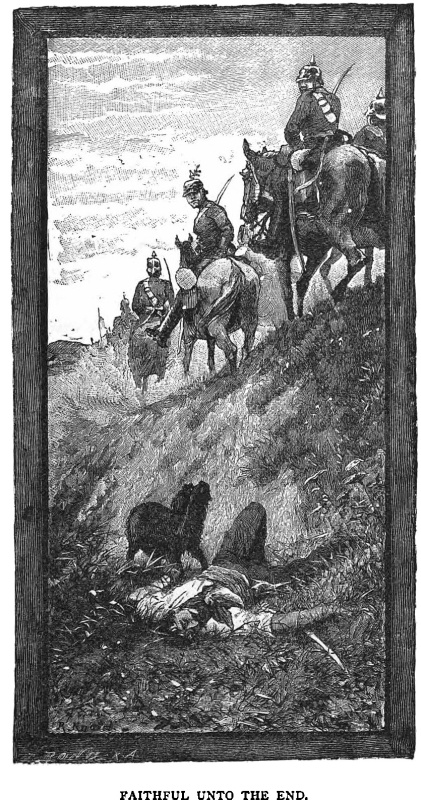
“I was hardly prepared for what I saw. A beautiful black Newfoundland, whining pitifully beside what appeared to be the dead body of a man.
“I dismounted, and the dog came to meet me. He jumped and fawned on me, then rushed wildly back to the side of that prostrate form. But I stood as if one transfixed. I could not mistake those eyes. It was Neptune, that I had given—a seven months’ old puppy—to Hans Hegel three years before.
“And the poor fellow who lay before me with sadly gashed face, upturned to the morning sun, was Hegel himself.
“He lay on his sword, lay as he had fallen, and the absence of the coat, the sash-bound waist, and sleeve up-rolled, told to me the history of his trouble in a way there was no mistaking. He had fallen in a duel.
“But was he dead? No. For, soon after I had raised him in my arms, and poured a little cordial down his throat, he opened his eyes, gazed bewilderedly at me for a moment, then his hand tightened on mine and he smiled. He knew me.
“I should have liked some of those strange people who do not love dogs to have been present just then, to witness the looks of gratitude in poor Neptune’s eyes as he tenderly licked my hand with his soft tongue.
“My regiment went on: I stayed at the nearest village hostelry with Hans Hegel.
“When he was well enough he told me the story of the duel. So far the affair was unromantic enough, for there was not a lady in it. The quarrel had been forced upon him by a fire-eating Frenchman, and swords were drawn on a point of national honour.
“‘I owe my life to you,’ Hegel said.
“‘You owe your life,’ I replied, ‘to Heaven and that faithful dog.’”
“And now, Sir Stranger,” I said as I concluded my story, “we look to you.”
“Well,” said the cyclist, “as you gave a name to your tale, I daresay I must follow suit. Your tale had a dog in it. Mine has a horse, and as the horse’s name was Doddie, so I call my story.”
Chapter Nine.
Old Doddie; the Cyclist’s Story.
“Thro’out the annals of the land, Tho’ he may hold himself the least, That man I honour and revere, Who, without favour, without fear, In the great city dares to stand The friend of every friendless beast.” Longfellow.
“I had dismounted to light my tricycle lamps, and to ‘oil up,’ previously to accomplishing the last part of my day’s ride—a good fifteen miles, through a rough and very lonely bit of country on the borders of North Wales. I had already ridden somewhat over thirty-five miles that day, and the roads were sticky, and in many parts stony, for it was very early in the spring, and the metal that had been put down a month or two before had not yet smoothed down.
“I was not sorry, therefore, to stretch my legs a little and gaze at the sky. The sun had set about an hour before, and the heavens in the south-west were lit up with most singular beauty of tinting. There was nothing stern or harsh about the colouring—no saturnian glare, no sulphureous glow, like what was so often seen during the winter of 1883-84. High up, the sky there was of a palish blue; in that blue shone a solitary star with wonderful brilliancy. Beneath this was pale saffron-yellow. Lower down still this pure yellow melted gradually into a soft tint of carmine, while between that and the horizon was a bar of misty steel-grey.
“‘How lovely!—how inexpressibly lovely!’ I couldn’t help saying to myself, half aloud.
“‘It is indeed beautiful!’ said a voice close by my elbow that made me start and look round. ‘But it bodes no good. You couldn’t see me coming,’ he said, smiling, ‘because I was under the shadow of the hawthorn hedge; and you couldn’t hear me, because I walked on the grass.’
“‘And what did you come for?’ I inquired. ‘But stop,’ I added, before he could answer my question; ‘I have no right to ask you. The road is free to both of us.’
“‘But I’m not on a journey,’ he replied, ‘so I will answer. My house is in here, behind that hedge, though you can’t see it, and there is not another for the next ten miles. You are seventeen miles from L—, where, I presume, you are going. Had you not better come in and rest a bit? The moon rises at eight to-night.’
“‘You are really very kind,’ I said; ‘but my being so far from home makes hurry all the more necessary. I’ll light my lamps and be off.’
“‘As you please,’ he said carelessly.
“Just then I discovered, very much to my astonishment—for I pride myself on the perfectness of my outfit while on the road—that my match-box was empty.
“‘I’ll follow you, thanks,’ I said, ‘and borrow a few matches from you.’
“‘Come on, then,’ said my would-be host pleasantly; and trundling my cycle in front of me, I followed him.
“He was a man apparently about forty—square-shouldered, tall, straight, and manly-looking. He did not look a farmer, but he evidently was, from the appearance of his place—and a farmer, too, of sporting proclivities.
“A boy was drawing water from a deep well; a fine old hunter stood by watching the boy—a dark bay horse, whose hollow temples and somewhat drooping under-lip gave proofs of age. A couple of beautiful setter dogs came careering up to meet their master, and received a fond caress. The old horse left the boy at the well and ambled up, then, laying his head on my host’s shoulder, nickered low but kindly.
“‘Bless his good old heart! Has he had his supper?’
“My heart warmed to a man who could speak thus kindly to a dumb brute.
“‘You love that horse, evidently,’ I said.
“‘I do,’ was the reply. ‘I have good cause to. Down, Doddie—down on your knees to this gentleman.’
“Doddie, as he called him, did at once what he was told to, and there remained while I smoothed his ears and caressed him on the brow.
“‘Trot off now, Doddie, and have a drink.’
“And away went Doddie.
“I was not sorry to rest awhile; the fireside was so pleasant, and the room all so cheerful. The hostess, a fragile little fair-haired body, who must have been bewitchingly pretty a few years back, and who did not look a bit like a fanner’s wife, brought in a tray laden with bread, cheese, and butter, and a mug of home-brewed beer.
“To have refused partaking of this cheer would have been most unmannerly. I did justice to it, therefore, and we soon got quite friendly. Two hours passed very quickly indeed; then I was startled to hear the wind howling in the chimney, and the rain beating against the panes.
“‘I knew it was coming,’ said my host, whose name, I found, was Morris. ‘That is one reason I asked you in; the other was,’—here he smiled very pleasantly—‘a selfish one—I don’t have a talk with a gentleman once in a month. Mary, fill our mugs again—it’s only home-brewed, sir—and I’ll tell the gentleman why we love old Doddie so.’
“Mary sat by the fire quietly knitting, while Mr Morris told me the following particulars of old Doddie.
“‘Been a rover all my life,’ he began, ‘till three years ago, when Mary’s father brought us home here to his native place, bought this little farm for us, then died—poor old soul! He’d been a farmer out in Mexico, but didn’t save much. Like myself, he seemed but to live to prove the truth of the proverb that a rolling stone never gathers moss. But he was never such a rolling stone as I, sir. Bless you! no. I’ve been everything—Oxford graduate, coffee-planter, actor, soldier, trapper, miner, ne’er-do-weel. Eh, Mary?’
“Mary merely smiled, but she gave him one kindly glance that spoke volumes.
“‘Well, sir, my story—and it is short enough I mean to make it—commences, anyhow, in my trapper days, and there are two things it proves: the first is, that even a redskin can be grateful; and the second is, that Tom Morris has been a lucky dog, and drawn, at all events, one trump card in his day.
“‘I was living in a log hut in one of the wildest parts of the north-west of Mexico, and had been for nearly a year. The hut didn’t belong to me. There was nobody in it but a half-starved dog when I came upon it, so I just took quiet possession; but the owner never returned, and from stains of a very suspicions colour all about the doorway, I guessed he had been killed and robbed by the Indians.
“‘I had an idea there was gold somewhere thereabout. I had this idea from the very first, and I wasn’t altogether wrong. I found enough to cause me to stay on and on. I spent most of my time prospecting among the hills, the forests, and the canons, killing enough game and enough fish to keep me alive, with the help of a few sweet potatoes that grew in a patch close by the hut.
“‘I found gold, but I didn’t make a pile. But in my wanderings I came across the cattle ranche that belonged to Mary’s poor old father here. I was surprised to find a white man so far away from civilisation. But Mr Ellis knew what he was about. There was the river not far away, and the forest adjoining, and this river was navigable all the way down to the town of C—, some sixty or seventy miles. At C— was a splendid market for skins and grain. Mr Ellis paid nothing for his cattle, and very little for the labour of farming, and he had no rent to pay, so on the whole I didn’t blame him for staying where he did. He had only one companion, and that was his little daughter Mary here, and his servants, men and women, numbered about ten in all.
“‘The farm buildings must have been a kind of an outpost at one time, when the Indians and the States were hard at it, for they were completely surrounded with a log rampart and a ditch. There had been a drawbridge and a gate, but it was now a solid affair of stone. But over his bridge, please remember, lay the only road into Fort Ellis farmhouse.
“‘Although the fort was twenty miles ’cross country, and more than forty by the regular road, I found myself very often indeed at the farm, and poor Mr Ellis—heigho! he is dead and gone—and I got very friendly indeed.
“‘And Mary and I—ah! well, sir, you cannot wonder that, thrown together thus, and in so wild a country, we got very fond of each other indeed.
“‘But to proceed. The Indians were never very friendly to the white man. They bore a grudge against him—a grudge born, sir, of many and many a broken treaty. So they were not to be depended on even when the hatchet was buried.
“‘There came to my hut, sir, one summer’s day, crawling painfully on bands and knees, an Indian of the tribe I am talking about. He had been bitten by a snake—a moccasin, if my memory served me aright. I took him in out of the sun, and gave him nearly all the aqua ardiente I had in the hut. For days he lay like a dead thing, and I was beginning to think about where I’d bury him, when he opened his eyes and spoke. I gave him the aqua ardiente now in teaspoonfuls. I nursed him almost day and night, hardly ever leaving him. But he was on his feet and well again at last, and if ever tears were in a redskin’s eyes, they were in his when he bade me good-by. I hadn’t been much at the fort during the redskin’s illness, and they were getting alarmed about me, when one forenoon Doddie and I came clattering over the drawbridge.
“‘A few months flew by so quickly, sir, because I was in love, you know; and one evening in autumn the dog barked; next moment my redskin stood before me with a finger on his lip.
“‘Hist!’ he said; and I drew him into the hut.
“‘O! sir, sir! Tom Morris was a madman when he was informed by that poor friendly redskin that at twelve that night the fort would be attacked by a wandering tribe of redskins, every one murdered save Mary, who was to be dragged off into captivity.
“‘I thanked the Indian, blessed him, then hurried to the stable and brought Doddie out. The saddle was broken; it must be a bare-back ride. There was time if we met no accident. It was now eight o’clock, and I mounted, waving adieu to the Indian, and rode away eastwards in the direction of the fort. In an hour I was at the river. Here the main road branched away round among the mountains. There was no time to take that. My way lay across the ford and through the forest, cutting off a long bend or elbow of the river, and coming out at another ford, within a mile of Ellis Fort and Farm.
“‘I headed Doddie for the stream, and we were soon over. I knew the path, and the moon was up, making everything as light as day.
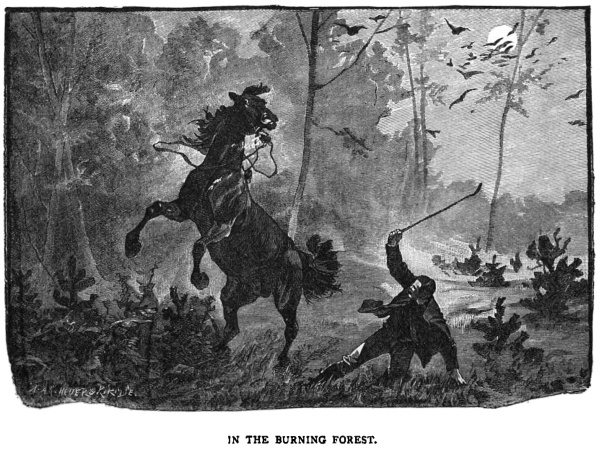
“‘But look ahead! The glare was never the moon’s light. Alas! no, sir; it was fire. The forest was in flames. I think to this day it was done by the savages to intercept me. In half an hour more, sir, the flames were licking the grass within ten yards of our pathway, and running in tongues up the bark of the trees.
“‘Doddie neighed in fright, reared, and I was thrown. Next moment I was alone in the burning forest. To fly from the fire was impossible. I threw myself on my face in despair. O! the agony of those few minutes! But even then I believe I thought more of poor Mary and her father than of my own wretched end.
“‘All at once I started to my feet, for a soft nose had nudged me on the arm. It was Doddie, and in an instant we were flying again through the forest. I think we might have made the ford, but my horse now seemed to lose all control of himself, and I of the horse, for the bridle broke.
“‘Doddie made for the river above this ford, and took a desperate leap into the deep water. But he was quieter now, and it was easy to head him down the stream, and at last we were once again on terra firma, with the broad river between us and the fire.
“‘We blew up the bridge and barricaded the gate immediately on my arrival. And not a whit too soon, for half an hour afterwards the fort was surrounded by howling savages.
“‘Our relief came next evening, in the shape of mounted soldiers; and I feel sure, sir, that it was that grateful Indian who sent them.’
“I have, reader, given a mere epitome of my host’s story, which was altogether interesting and took quite an hour to tell. By the time it was finished, the squall had blown over; the moon shone out bright and clear over the hills, and bidding Mr Morris a kindly ‘good-night,’ I mounted my cycle and resumed my journey.
“But I assure you I did not go until I had patted poor old Doddie on the nose, and given him a lunch biscuit from my cyclist’s wallet.”
The stranger started up as soon as he had finished.
“I must be early on the road,” he said; “and so I suppose must you.”
“Good-night all.”
“Good-night: sound sleep!”
An hour afterwards we were all enjoying that sound repose that only the just, and gipsies, ever know.
Chapter Ten.
Spare the Sparrow.
“Ye slay them! and wherefore? For the gain Of a scant handful, more or less, of wheat. Or rye, or barley, or some other grain.”
On this grand gipsy-tour of ours we had reason to be thankful every day for a good many things. First and foremost, that our horses were so sturdy, strong, and willing; that the great caravan itself was so comfortable, and the smaller one so snug, and both so delightfully and artistically fitted up, that they looked more like the saloon and cabin of some beautiful yacht than the homes of amateur gipsies.
It took us a whole month to get across the borders and well into bonnie Scotland. But a more pleasant month I for one never spent before nor since. We took it easy. We were determined to study the otium cum dignitate and dolce far niente, and at the end of this month it would have been difficult to say which of us was the hardier or jollier. The horses were sleek and fat, Hurricane Bob spent most of his time either lying among rugs on the coupé with the children, or tumbling on the daisied sward, while the cat did nothing but sing and look complacent. We human beings were so happy, we could even afford to laugh and be gay when thunders rolled, when gales of wind blew and rocked the caravan as if she had been a ship at sea, or when the rain came down in torrents.
Maggie May had already ceased to be an invalid, and Ida had got as brown as if she really were a true-born Romany-Rye.
No, we never hurried the horses. For there was so much to be seen, fresh scenery at every turn of the road, beautiful wild flowers to be gathered to fill the vases. The children at lunch-time even made great garlands of them, and hung them round the horses’ necks.
Of course the village children always took us for a show, and ran out to meet and cheer us, but most grown-up folks took us simply for what we were—a party on a pleasant summer tour.
Mysie, strange to say, although she often stopped out of doors all night, was always back in good time for the start in the morning.
I fear she proved a great enemy to the birds.
One evening she brought into the tent a beautifully plumaged cock-sparrow.
Now I am very fond of sparrows. They are historical birds, and birds of Bible times, so I relieved Mysie of her poor prisoner, and let it flutter away.
We then had some talk about sparrows, and I embody my ideas of them in the following sketch.
The British Sparrow: a study in ornithology.
The sparrow, although it undoubtedly belongs to the great natural family Fringillidae, which includes among its members the weavers and whydah birds, the linnet, the goldfinch, and bullfinch, to say nothing of the canary itself, can hardly be said to rank with the aristocracy of the bird world. Quite the reverse; in fact, the Passer domesticus is a bird of low life. He is by no means a humble bird, however. There is nothing at all of the Uriah Heep about my little friend; he has quite as good an opinion of himself as any feathered biped need to have. Yet if it be possible for some classes of birds to look with disdain on the behaviour and doings of others, sparrows are surely so treated by their betters. And no wonder, for they are neither elegant in shape nor appearance; they do not dress well either in winter or in summer; it is not their lot to be arrayed in scarlet or in gold, but in humble brown and russet grey. So much for the appearance of the bird.
In manners and in deportment sparrows are far beneath bon ton; their knowledge of music is exceedingly limited, their appreciation of sweet sounds conspicuous only by its absence—why, they think nothing of interrupting even the nightingale in his song—and if any bird can be said to talk Billingsgate, those birds are sparrows. Should any one doubt the truth of my last statement, let him go and listen for one minute to the wrangling linguamachy that goes on of an evening after sunset, as they are retiring to roost in a tree.
Yet, for all this, many of the tricks and manners of these plebeian birds are well worth watching, and often highly amusing.
It is not, however, merely to amuse the reader that I now write, but quite as much in behalf of the bird itself. For of late years the character of the British sparrow has been aspersed in this country, but more particularly abroad; and I think he ought to have a fair and impartial trial. I therefore stand forward, not, mind you, as the champion, but the counsel both for and against the prisoner at the bar—the said Passer domesticus, who, on this occasion, is not arraigned for the murder of cock-robin, but for a far more heinous offence, namely, that of constituting himself a common nuisance, and doing more harm than good in the world.
For some years back I have had many—nay, but constant—opportunities for studying the habits of sparrows and many other kinds of birds, and I am not unobservant. I live in one of the prettiest and leafiest nooks of tree-clad Berkshire. The village that adjoins me nestles among trees; the gardens all about the houses are masses of shrubbery and flowers; stone fences are utterly unknown; there are hedges everywhere. Our trees are wide-spreading oaks and planes, drooping acacias, leafy lindens, elm, ash, willow, poplar, and what not.
Up the lordly line of splendid poplar-trees that bound my cosy little paddock the green ivy grows, and here sparrows dwell in hundreds. I do not shoot my wild birds, nor do my children chase and frighten them. Linnets build every year in the laurels close by the dog-kennel: robins feed with the dogs, and some older sparrows know names that we have given them, and come to be fed. No need to hang up boxes for them to build in—we live in the bush; but in summer-time they have a bath on the back lawn, and it is a sight to see them in the early morning. Thrushes, blackbirds, finches, sparrows, starlings—they all agree as well as if they had learned Watts’ hymns, and laid them all to heart. More about my birds another day—perhaps. One starling, however, I must mention here; he comes down every sunny morning, with his wife; he sends her in to bathe and splash; he sits on the edge of the bath and receives the drops—that is all the bath he takes. She is a dutiful wife.
The plumage of the domestic sparrow is almost too well known to need description. In one of the very excellent publications of Messrs Cassell and Co.—viz, “Familiar Wild Birds”—the following remarks occur:—
“The difference in the appearance of the plumage of a country sparrow, as compared with his town-bred cousin, would be hardly imagined, the fresh bright plumage of the one displaying the prettily marked black, white, and brown, whilst smoke and dirt hide the beauty of the town sparrow, so that it is sometimes difficult to distinguish the sex at a glance. The male, however, has a brilliant black throat, and is otherwise more determined in colour, the hen being especially deficient in the bright brown of the wings and the chocolate mark over the eyes.”
This is quite true. The author might have added, however, that the black bib which the male sparrow wears is seldom perfect until June, and the birds pair and build long before they have acquired their summer dresses. They are in such a hurry that they do not wait for their wedding-garments.
Now, this is just the place to mention a fact that I have proved again and again, to my own satisfaction at all events. It is this: sparrows are polygamous; house-sparrows are undoubtedly so, and I believe also so are their first cousins, who build in trees. I myself was reared in the woods and wilds of Scotland, and, like most boys, was fond of bird-nesting. It often used to strike us lads as strange that differently marked eggs were found in the same sparrow’s nest. We did not suspect then that these were laid by different birds. Last week a family quarrel arose among some sparrows in the large wistaria that covers the front of my cottage, and during the row an immense hammock of a double nest was knocked down. When I say a double nest I mean two nests joined in one—a kind of a “butt and a ben,” only with separate doors. One nest was empty—only clean, well-lined, and ready for use. The other contained four eggs—two pairs. They have the distinctive colouring and markings of ordinary sparrow’s eggs, but each pair is different, and the gentleman sparrow who owned that semi-detached cottage has two wives; they have built another and private residence some yards from the old site, and it is to be hoped will live happy ever afterwards.
I have a sparrow who answers to the name of “Weekie,” and who comes to call. This sparrow has three wives.
In many ways he is a remarkable bird. For several winters he has slept on the same rose-twig close under the verandah, with his wives—at first he had but two—not far from him. I used to watch Weekie from a top window sending his wives to roost just at sunset and before he retired himself. He would perch himself on the top of a tall cypress-tree and call them, turning his head this way and that as he hailed them, evidently not knowing from what direction they would come. But they always did come, and after some friendly remonstrance went to roost. About ten minutes after Weekie would give himself a little grateful shake, and hop in under the verandah to his favourite twig.
It was Weekie who first taught me that sparrows build for themselves little shelter-nests—any person in the country who takes the trouble to study these birds can prove to his own satisfaction that such is the case. It is only, however, in frosty weather that the sparrows take the trouble to erect these nests of convenience.
Some two or three years ago we had a very severe frost. During the first day or two I observed straws lying about the verandah; then I noticed that Weekie brought a straw with him at night, and on taking the lamp out to look at him—Weekie meanwhile looking down with one wondering bead of an eye—I noticed that he had his straw over his shoulder. Well, there couldn’t have been much comfort in this, but it was a hint to his two wives, and sure enough they took it, and I saw them building a nest of moss and straw, not larger than half a goose’s egg, around and under Weekie’s twig—not above, because there the verandah sheltered him. Weekie was happy now, I suppose, and warm as to his toes. Weekie’s wives are dutiful wives, but mark this: they themselves had no shelter-nests, and all through the terrible frost-spell they cowered by night within a foot or two of their lord and master—but on bare twigs.
I notice now that these shelter-nests are quite common. A cock-sparrow slept in one last winter in the great Gloire de Dijon rose-tree that covers the northern wall of my stable; but this was built above the perching-twig—it was, in fact, a little arbour.
When they don’t build shelter-nests, sparrows crouch at night under eaves, in ivy thickets, in old nests, and in the holes of trees, which they sometimes line.
The great work of the year—building and bringing forth their young—among sparrows commences early in March, or much sooner, if the weather be fine. But long before this married sparrows who have determined upon a change of residence, and bachelor sparrows who intend to set up for themselves when summer comes, go prospecting around, popping into holes, examining eaves, and chimneys, and ivied trees.
The former take their wives with them, whom they seem to consult and try their best to please, often in vain, for the female sparrow appears to derive a genuine pleasure from house-hunting, and keeps it up as long as possible—till probably the warm weather comes upon them all at once, and they are fain to settle down anywhere.
In the early part of the season the nests are not built very rapidly: about June or July they are often run up in three or even in two days.
The birds seem to have a dreamy kind of happiness in building the first nest, and want their sweetness long drawn out. In fact, it is the honeymoon.
Example: A half-built nest in the wistaria-tree just under a huge cluster of sweet-scented blossom. It is noon, a bright March sun is shining, and up in the tree it is almost as warm as summer. The particular sparrow who owns that half-built nest has only one wife; it is his first season, and hers. They are both young and innocent, not to say ignorant. The foundation of the nest is terribly untidy, exceptionally so. The hen sits about a yard from the nest, with her consequential morsel of a bill in the air, giving her body a little jerk every now and then as if she had the hiccup, and saying “po-eete.” The cock is closer to the nest, busy preening his feathers in the sunshine. Presently he hops into the nest, and has a turn or two round by way of seeing how things are going on. This is a hint to the hen, and excites her to a little more activity, and away she goes to look for a mouthful of building material. She stops on the garden-path to pick up a tiny beetle or two, then hops on to the vegetable beds, shakes up a few bunches of dry couch-grass roots, but finally abandons them for a terribly long and terribly strong wheaten straw. Back to the wistaria-tree she flies with this, half frightened at her own temerity in carrying anything so large. She sticks it up at the side of the nest—it hangs a long way down the tree—and retires to look at it. The cock looks at it too. They both study it.
“It is very hard, isn’t it, my dear?” says the cock at last.
“It is a very fine piece of straw though,” replies the hen, slightly piqued.
“Yes,” says the cock, “as a straw it is certainly a very grand specimen. I admit that. The puzzle is how to work it in.”
So they both sit down with their wise wee heads together, and look at that strong straw, and think and wonder in what possible way or shape it can be made use of. They sit there for quite two hours giving vent only to an occasional suggestive “cheep,” and a jerk of their little bodies as if they both had the hiccup. But at last they suddenly awaken to a sense of their folly. Two whole hours of sunshine lost, and all for a straw! That straw is at once cast loose, and both fly off and soon return with something far more useful, if less ornamental. And so the work goes on.
My sparrows build the main portion of their nests principally with hay, straw, and withered weed roots, but this is mixed and mingled with a variety of other material, rags, pieces of old rope or twine; but paper above all things, especially, it appears to me, tracts and bills relating to cheap sales, because the paper on which these are printed is soft. A long string of white or coloured cloth may often be seen fluttering pennant-fashion from a sparrow’s nest. Some believe this is so placed in order to frighten cats and hawks. More likely it is mere slovenliness. Well, a sparrow’s nest outside does look a most untidy wisp. But there is an art in its very untidiness, and the thickness of the nest renders it cool in summer and warm for a shelter-nest during winter. The amount of feathers crammed into a single nest, particularly that of a tree-sparrow, is often quite astounding.
An old nest is sometimes made to do duty over and over again during the season, but it is always overhauled and re-lined.
Sparrows are not invariably wise in the selection of their building sites. Instance: Two sparrows built this summer in the rose-covered spout of my verandah. A terrible storm of rain came, and the young were drowned in the torrent of water that came from the roof. But I daresay these silly birds think such a thing will not occur again—in their time. At all events, they have thrown the dead birds out to the cat, renovated and re-lined the nest, and there are eggs in it now. I was staying last summer for a week or two with a friend not far from here. There were plenty of martens about, and three nests under the eaves right over my bedroom window. For several mornings I had noticed grains of wheat on my window-ledge, and on looking up towards the nest I noticed feathers protruding. Now, had I been Samuel Pickwick, I should have at once taken out my note-book and made the following entry:—“N.B. The house-martens in Hampshire line their nests with feathers and feed their young on wheat and barley.”
I laughingly told honest Joseph G—, my friend’s gardener, of my discovery in natural history. He was too old a sparrow to be caught with chaff, however.
“It’s the sparrows, beggar ’em,” he said, shutting his fist; “they’re at their games agin. I’ll shoot ’em, I will. They waits till the swallers builds their nests, then they goes and turns ’em out and finishes up wi’ feathers.”
“Don’t shoot them,” I said, “they have young.”
“Indeed, sir, but I will,” cried Joseph G—. “What right has they to turn the swallers out, eh? Fair play, I says, fair play and no favour.”
Some years ago I read that the sparrows in Australia had constituted themselves a kind of plague, and in rather a strange way they stole all the hay to build their nests, and every plan, such as smoking them, and turning the garden hose on the nests, etc, had been tried in vain. We must not believe all colonists tell us. They are noted perverters of the truth. Why didn’t they retaliate and turn the sparrows into pies—a sparrow pie, they say, is a dainty dish. I do not care to eat my sparrows. I believe that killing sparrows is like killing house-flies—others come to fill up the death vacancies.
Now there are some things about sparrows that I confess I cannot quite understand. Knowing that they are often bigamists, sometimes polygamists, I am never surprised to see two or three hens helping a cock to build the family nest; but when I notice, as I have frequently done, a sparrow who has only one wife being assisted in the construction of his domicile by another gentleman sparrow, what am I to think? Who, I want to know, is the other fellow who drops round of a forenoon in a friendly kind of way with a weed in his mouth, and even gets inside and “chins” the nest. Is he a brother-in-law, or a father-in-law, or the son by a former marriage, or what? I give it up, but there is the fact, and “Facts are chiels that winna ding.”
It may not be generally known that there are bachelor sparrows, who remain bachelors all the summer from choice, and old-maid sparrows who are obliged to be so, and who sometimes build nests and sit by them looking disconsolate enough, sighing and singing “po-eete” for the poet who never comes.
Here is an anecdote with a little mystery about it that the reader may possibly be able to unravel, for I can’t. It is a little tragedy in one act, and must have been a very painful one to the principals. My splendid Newfoundland, Hurricane Bob, came down to my garden wigwam one forenoon last spring. He was whining and apparently in great distress of mind.
“Come on up here with me, master,” he said, “there are some strange goings on at the front lawn.”
I followed him, and could soon hear the pitiful cries of a sparrow, up near a spout that comes out from under the wooden eave of the tallest gable of the cottage. The dog pointed up there, continuing to whine as he did so, and evidently in grief because he couldn’t fly.
It was not long before I mastered the whole facts of the case. They were as follows:—Close by the funnel-shaped mouth of the descending spout, and supported by some branches of the wistaria, a pair of sparrows had built in the previous spring and raised several broods. It was February now, and they had come round prospecting—impressed doubtless by old associations—to see if the same nest could not be refitted, and thus do duty again. Full of excitement, the cock bird had hopped down between the woodwork of the eave and the spout, and seeing a crack about half an inch wide beneath, had attempted to come out there. He got his head through and one wing, but there he had stuck.
It was quite affecting to witness the agony and perturbation displayed by the hen bird—the poor imprisoned cock did nothing but struggle and flutter—her cries were pitiful, and every now and then she would seize her spouse by head or by wing and try to pull him through.
Meanwhile, on a twig of wistaria not a yard away sat another cock-sparrow, an interested but inactive spectator. He simply looked on, and never volunteered either assistance or a suggestion.
As soon as I could procure a ladder long enough to get up, I went to the rescue, but the poor bird’s head had drooped—he was dead; and so firmly fixed in the crack that I could neither drag him through nor push him back. The hen sparrow and the strange cock sat looking at me some little way off, but the former after this made no further attempt to relieve the cock bird. He was no more, and she must have known it. But who the mystery was the strange cock—the impassive spectator? Was he father, brother, or, dear me! was he a former lover—a rival? Did he sit there mocking the dying agony of the other bird? Did he address him thus:—“You’re booked, old man. You may kick and flutter as much as you please. I tell you you are as good as dead already. When you are gone I’ll hop into your place. This nest will suit us nicely. Us, I say, d’ye hear? It will suit us, and we will soon forget you. Good-by, old man, keep up your pecker.”
I would have torn down the old nest, but I really was curious to know if the dead sparrow’s widow would wed again, and take up house there. Surely she would never bear to pop out and in at the doorway of that nest, with the skeleton of her late lamented husband hanging out through the crack. I left the nest for a month or two, then tore it down, but no birds have ever built there since.
There are more hen than cock-sparrows, and this may account for the prevalence of polygamism in the community. As to old-maid sparrows, I have assuredly often known nests built by hens alone, but am willing to admit that these hens may be relicts, some accident may have happened to the husband. However, it is a fact that there are plenty of bachelor sparrows, who live a free and easy life all the summer, and never dream of becoming Benedicts; you see them in the gardens, and you meet them out in the fields, and they are always in company with other male sparrows of their own way of thinking.
Now every one who lives in the country is perfectly familiar with those little disturbances that often arise all of a sudden among sparrows, when about half a dozen go flying into a bush together, squabbling, bickering, and fighting with fearful ferocity. Some books gravely tell us that these squabbles are in reality courts-martial being held on some erring brother or sister of this genus Passer. I never took this for granted, and for three or four summers I have used my best endeavours to get at the true explanation of the matter, and I am satisfied they are caused by differences of opinion between Benedict and bachelor sparrows, resulting in a match “’twixt married and single,” a free fight, in which the females take part.
Female sparrows often fight most viciously together from bush to bush, but preferably on the ground. I have often seen a stand-up battle between the two wives of a bigamist sparrow. He himself would simply stand about a yard off, and look on.
“It’s no good interfering,” the cock appears to think; “it is a sad state of affairs to be sure, but what can a fellow do? I must try to manage matters differently another year.”
Sparrows may keep the same mates from year to year, and so they may arrange for pairing as early as November or December the year before, flying about with their coming queens, and roosting near them at night. But considering the number of these birds that are killed every year—by our bold sparrow-club men for example, by misguided gardeners, and by bucolic louts who net them in the ivy after nightfall for the purpose of supplying matches with the needed birds—considering the quantities of them that cats and hawks kill, and the numbers that die from frost and starvation, to say nothing of the young birds of last season, the mating time is a very busy one indeed. The cocks are then as full of fight as an Irishman on a fair day, and the hens—well they simply sit and look on.
“None but the brave deserve the fair,” they seem to say to themselves, “and it is certainly very gratifying to one’s self-esteem and respect to know that all these sanguinary battles now raging round the rose-trees and in under the laurel-bushes are about us.”
Here are a few notes I took some months ago:—A bright spring morning in March. Sunshine on the red brick walls of our cottage, sunshine on the wistaria. Wistaria not in blossom yet.—N.B. Blossom comes before leaves, though it is now covered with long soft downy buds, tipped with a suspicion of mauve. The forenoon is quite warm, delightful to be out of doors. Yet at seven o’clock there was hoar-frost on the ground, and thin ice on the dogs’ water. The sparrows are unusually lively, and bickering constantly—especially the cocks. Yonder a fight has commenced, just under the eave; it rages there a few moments, then down tumble the belligerents from a height of twenty feet, holding viciously on to each other’s jaws all the while with the ferocity of bulldogs. Now they struggle together on the lawn, lunging and pecking, and wrestling with wings outspread and legs everywhere. There are beads of blood about their eyes, and tiny drops on the grass. What a serious matter it seems! Death or victory! they think and care for nothing else. I believe I could steal up and put my hat over the pair of them. “England’s difficulty,” says my Persian cat, creeping up, “is Ireland’s opportunity.” No you won’t, puss. Go away at once, or I’ll call for Collie to you.
But see, one sparrow has triumphed. Vae Victis! He chases the conquered and breathless bird from bush to bush, till his own lungs give out, and he returns open-mouthed but glorious, and flies up to the tree where sits the cosy wee hen that all the row has been about. He is going to say something or make a proposal of some kind, when back flies the conquered cock, and the battle is renewed with double vigour. This is a longer fight than last, but victory once more declares itself on the side of the former champion, and back he flies again to the trysting twig—to find what? Why, another fellow who has been actually taking a mean advantage of his absence in the battle-field, and pruning his feathers in front of his hen. There is another fight there and then, and perhaps there may be many more to come. But in the end all things will be well, and the fittest survive.
Round the corner are a pair of birds already matched and mated; they are at peace with all the world, and can afford to sit quietly on their twigs and witness the fighting and the fun.
The cocks this lovely morning seem striving to do all they can to make themselves conspicuous. The hens, on the other hand, sit quietly on their twigs, their morsels of tails at an angle of about 45 degrees, their little beaks in the air, and their feathers all balled out to catch the sunshine.
To one of these independent little mites a black bib sidles up. He addresses her in wretchedly bad grammar, but what can you expect of a sparrow?
“It’s you and me this season, ain’t it?” he says.
She tosses her bill higher in air than it was before, as she replies—
“Oh dear no, sir. I couldn’t think of changing my state.”
“Here, you!” cries another black bib, hopping on to the same twig, “it’s you and me, if you please.”
Then another fearful fight begins between the two black bibs.
And so the fun goes on.
But this I have observed: Before mating actually takes place the male sparrow often gives the female a thrashing. Well, perhaps it is as well they should have their little differences out before marriage instead of after. Quien Sabe?
Early in June my sparrows may be seen hopping or flying about with sprays of blue forget-me-not in their bills. A lady visitor at my house was much struck with seeing this last summer.
“Whatever do they carry flowers for?” she asked laughingly; “your sparrows are more refined in their tastes than any birds I ever even read of.”
But the explanation is simple enough. They cut and carry away the sprays of forget-me-not for sake of the seeds that are already half ripe at the lower end of them.
A little innocent girl asked me the same question, her pretty eyes filled with sweet surprise, and I wickedly replied, “There is going to be a grand fête of some kind to-day among my sparrows, and they are going to decorate their nests.” She simply answered, “Oh!” but she looked believing.
In this short paper I have not said one-half of what I should wish to say about these interesting and independent wee birds that follow and take up their abode with mankind wheresoever he goes in the wide world, but I hope I have said enough to gain for sparrows a little more consideration and a little less cruelty than they generally meet with.
“But they are so destructive?” Yes, I knew some one would say that. Yet I maintain that they do far more good than harm in the world. If space were given me I could prove this. Meanwhile here is an extract from Land and Water, which is well worth reading and considering:—
“What the swallow tribe do in killing innumerable flies in country parks, the sparrow does to some extent in the gardens and squares of London, especially in its more immediate suburbs. All the sparrows have got nests, many containing callow young, a few ‘flyers,’ and some are still sitting on the eggs. An old sparrow might be seen perched on the top of a house, and presently with a graceful motion the bird ‘rises to a passing fly’ and secures the morsel. If the bird or birds had got young in the water-spout hard by, or in the hole often left by builders missing a brick at the end of a row of houses, in ivy, or in the thick foliage of the Virginia creeper, the young birds get the ‘catch.’ Besides this fly-catching, I have noticed for the last few weeks the sparrows working in every evergreen bush, also in jessamines, in lilac-trees, and especially in the crevices of old walls, in search of spiders, earwigs, green-fly, daddy long-legs, etc. The adult birds seem to prefer this wall and bush ‘food’ more than crumbs of bread regularly thrown out for them, except where they have got a nestful of hungry youngsters, and then the latter get some of both. But how hard the sparrows work, and the starlings too!”
Now let us go a little farther from home. Some years ago the English sparrow was introduced into that country of free institutions called the United States. The sparrow has certainly made himself at home there. He has increased and multiplied a millionfold, and now America wants to “Extirpate the vipers.”
But the Americans do not always know what is good for them. Example: They have slain all their big game (where will you find a herd of wild buffalo now?), they have killed nearly all their birds, and well-nigh cut down their last bit of genuine forest.
Yes, the sparrow makes itself at home in America. Some months ago I was sitting in one of the beautiful open squares in New York. The sparrows were plentiful enough all about and enjoyed themselves very much, especially in flying through the playing fountains; it must be delightful to take a bath on the wing. A tall Yankee was sitting near me with outstretched legs. A sparrow alighted on the toe of his boot; he wore Number 10’s. He eyed it curiously and critically. I smiled.
“A cheeky bird,” I couldn’t help remarking.
“Yes, sir,” was the reply, “but—it’s British. That accounts.”
I “dried up” after that.
But even in America the British sparrow has made a few friends, as the following extract from Forest and Stream will prove:—
“A Good Word for the Sparrows.—I send you by this mail a lot of leaves of the maple growing in front of my office, which when gathered were literally covered with insects. What attracted my attention to them was the busy action of some two dozen English sparrows, hopping here and there in the tree, peering under the leaves, and savagely feeding on something. An inspection revealed the cause of their eagerness, and the cause of the early shedding of the leaves. Examine these vermin and tell us what they are. The sparrows were so busy they would scarcely keep out of the reach of my hand. I called the attention of several gentlemen, who watched them for some time. This proves (to me) the insectivorous habits of the English sparrow.”
Sparrows are treated with systematic cruelty by many in this country; they are trapped and shot wholesale and at all seasons, and not only are their nests torn down with the eggs in them, but even when filled with young, and these are allowed to expire—mere little naked things—on the ground.
Sparrow matches are a disgrace to our country, and to those who engage in them. Every reader will surely admit this much. As for members of sparrow clubs, I never saw one, and Heaven forbid I ever may.
Chapter Eleven.
On the Breezy Cliff-Top.—Our “Hoggie.”
“Ah! what pleasant visions haunt me As I gaze upon the sea! All the old romantic legends— All my dreams come back to me.”
One of the sunniest memories to all of us is the time we spent on the cliff-tops of romantic old Dunbar. There is nothing more calculated to give pleasure to a true Briton, unless he happens to have been born by the beach, than a few days spent at the seaside; that is, if he or she can have thereat some comfort. Here at Dunbar was no noise, no bustle, no stir, and, to us, not the worry inseparable from living in lodgings. Our little homes were all our own: we could go when we liked, do what we liked, and there was no landlady at the week’s end to present us with a bill including extras.
The only noise was the beating of the waves on the black rocks far beneath us, and the scream of sea-birds, mingling perhaps with the happy voices of merry, laughing children.
Stretching far away eastwards was the ever-changing ocean, dotted with many a sail or many a steamer with trailing smoke. Northwards was the sea-girt mountain called the Bass Rock, whilst south-eastwards we could see the coast-line stretching out to Saint Abbé Head.
We were so pleased with our bivouac on the breezy cliff-tops of Dunbar that we made the place our headquarters, journeying therefrom, up the romantic Tweed, visiting all the places and scenery sacred to the memory of Scott and the bard of Ettrick.
We did not forget to make a day’s voyage to the Bass Rock, and well might we wonder at the grandeur of this wild rock, with its feathered thousands of birds, that at times rose about like a vast and fleecy cloud.
It was, however, no part of our ideas of happiness to in any way hamper each other’s movements. No, that would not have been true gipsy fashion.
Sometimes, one of us would be quietly fishing from the rocks, while two more might be out at sea in a boat, a little dark speck on the blue. As for me, it was often my delight to—
“Lie upon the headland height and listen To the incessant sobbing of the sea In caverns under me. And watch the waves that tossed and fled and glistened, Until the rolling meadows of amethyst Melted away in mist.”
Often, when she found me all alone, Ida would pounce on me for a story. To this child a tale told all to herself had a peculiar charm. Here is one of our little sketches.
Our “Hoggie.”
One dark, starless night in October, 1883, I had been making a call upon a neighbour of mine in the outskirts of our village. I had a tricycle lamp with me, not so much to show me the way as to show me my dogs, a valuable Newfoundland and a collie. Both are as black as Erebus, and unless I have a light on a dark night, it is impossible to know whether I have them near me or not.
Just by the gate, but on the footpath, as I came out, I found my canine friends both standing over and intently watching something that lay between them.
“It is a kind of a thorny rat,” Eily the collie seemed to say, looking up in my face ever so wisely; “I have kept it in the corner till you should see it; but I wouldn’t put my nose to it again for a whole bushel of bones.”
Eily’s thorny rat was, as you may guess, a hedgehog, and a fine large fellow he was.
Now I should be one of the last people in the world to advise my readers to capture wild creatures and deprive them of their liberty, but I knew well that if the boys of our village found this hedgehog, they would beat it to death with sticks and stones; so for its safety’s sake I went back to my neighbour’s house and borrowed a towel, and in this, much to the dog’s delight, I carried “Hoggie” home with me. The children were not in bed; they were half afraid of it, but very much pleased with the new pet, and set about making a bed for it with hay in an outhouse, and placed cabbage and greens and milk-and-bread sop for it to eat.
When we all went to see Hoggie next morning, he had his head out and took a good look at as with his bright beautiful beads of eyes. He looked as sulky as a badger nevertheless. We offered him nice creamy milk, but he would not touch it; we even put his nose in it.
“No,” he appeared to tell us, “you can take a horse to the water, but you can’t make him drink.”
So we placed a saucerful of bread and milk handy for him, and left the little fellow to his own cogitations, and determined not to go near him till next day. When we did so, we found, much to our joy, that all the bread and milk had disappeared. He was certainly no dainty feeder, for he had had his fore-feet in the saucer, which was black.
We soon discovered that night was the only time he would take food, and that he very much preferred lying all day curled up in his bundle of hay, sound asleep.
It has been said that rats will not come near a place where a hedgehog is. This is all nonsense; we had plenty of conclusive evidence that the rats which swarm about our place kept Hoggie company.
Under one particular tree the earthworms used to swarm, always coming out of their holes at night, and around this tree it occurred to the children to build Hoggie a garden. They fenced it round with wire-work, and put a box and a bundle of hay in it at one corner. Hoggie was now indeed as happy as a king, and he soon grew as tame as a rat, for kindness will conquer almost any wild animal.