IN THE MISTY SEAS (continued 5)
Reading edition
"You've seen the furs are there?" he said.
Jordan took out his wallet, and laid a roll of dollar bills on the table. He had another in his hand when Donegal stood in the doorway signing to him.
"You're wanted out here," he said.
Jordan asked no questions but rose at once, and Appleby, fancying there had been a change of wind, followed him. When they stood outside Donegal laid his hand on the skipper's arm, and Appleby saw that he and Charley both carried their clubs.
"'Tis a trap the beast has laid for us. Will I tell them to shove off?" he said.
"Go on," said Jordan quietly.
"'Tis like this," said Donegal. "When he went in with the light he opened the shutter, and what was he after doing that for? Then he would leave it so any wan could see there was two lights where there was wan before."
Jordan nodded. "The rest—out with it."
"Well," said Charley dryly, "there was somebody running a boat down way back along the beach. They did it kind of quietly, but we could hear them. 'Pears to me it's 'bout time we were getting out of this."
"Somebody coming down the gully," shouted a man below, and there was a faint patter of running feet in a dusky hollow that wound amidst the rocks behind the house.
Jordan swung round. "Motter has sold us to the Russians, boys," he said. "Still, if there's time yet we'll take him along."
They were back in the room the next moment, but Motter had gone, and when another shout came from outside Jordan swung round again with his face showing very grim.
"He'd have had all my dollars in another minute," he said. "Well, we'll be going."
Charley, however, stopped a moment, and taking down the big lamp swung it round his head, while a great blaze sprang up when he hurled it on the floor.
"I guess it will take them all they know to put that out," he said.
Then they blundered down the stairway, and in another moment were floundering across the beach. It was rough and strewn with boulders, while the boats lay some little distance away, and as they tripped and stumbled a hoarse shout rose out of the darkness. Nobody stopped to answer, and a rifle flashed, while a patter of feet became audible behind them.
"They're tolerably close," said Jordan. "We've got to run, boys."
There was for some reason no more firing, but the men behind were evidently used to the boulders and gaining on them. Once Appleby fell heavily, but he lost no time in picking himself up again, and went on with a horrible pain in his side, gasping as he watched the white wash of the surf that seemed to grow nearer so slowly. Just before they reached it Niven went down, and groaned when Appleby seized his shoulder and jerked him to his feet.
"Don't give in, Chriss. You must hold out," he said, and floundered on again, dragging his comrade after him.
"I'm hurt. Only one foot to run with," gasped Niven.
Stumbling and blundering they reached the boats, but the men behind were almost upon them when Appleby, taking his hand from Niven's arm, grasped the nearest. Then there was a breathless shout, and they were floundering down the beach waist-deep in froth as a sea rolled in, while dusky objects came clattering over the shingle a few paces behind them. Two men sprang in over the gunwale, and Jordan's voice rose up.
"Don't fool it by too much hurry, boys. Wade right in until she's clear afloat."
The next sea took them up to the shoulders, and Appleby, gasping with the icy cold, and half-blinded by the spray, saw that Niven was no longer with them.
"Chriss. Hallo! Where are you?" he shouted breathlessly.
He fancied a half-stifled cry answered him, and loosed his grasp on the boat. He did not remember whether he shouted again, or not, for he was only sensible that his comrade had been left behind, but next moment another shout rang out, and he felt his heart throb, as struggling shorewards he recognized the voice.
"Boys, will ye be leaving Mainsail Haul?" it said.
There was a growl in answer, and the boat came surging in almost on top of Appleby. Then men were apparently splashing through the water all about him, and one ran several yards in front of them howling gleefully and swinging a great club. After that Appleby was not quite sure what happened, but there were shouts and blows and a pistol shot, and they were floundering back again, Donegal dragging Niven through the water after him, and most of the men swinging their clubs. The boat lay half-swamped on her side when they reached her, and Appleby wondered afterwards how they got her through the surf, but he knew Niven lay on the floorings, and straining every muscle and sinew he tugged at his oar. Donegal was apparently yelling gleefully still. Then, as they drew out from the shore there was another red flash, and Jordan's voice rose up from the next boat.
"If he can't be quiet, boys, you'd better heave him over. I've no use for letting them know just where to shoot."
"That's sense," said Charley. "Reach out and put some weight on, Appleby. Your partner's all right."
Appleby did as he was bidden, though the spray that whirled about them rendered the boat almost invisible as she lurched over the swell, while his contentment increased when Niven assured him that it was only his foot, that was hurting him. Presently the Champlain ran past the boat with canvas banging, and while they hove her in Stickine drew the skipper towards the rail.
"There's a boat on our bow. Came off 'bout a mile back down the beach," he said. "They pull like white men, so far as I make out."
"Heading straight to windward, too!" said Jordan, quietly. "Well, we'll have the main topsail on her."
The topsail was aloft in another minute, and the Champlain's rail almost awash as she thrashed out to sea, but it was only in short tacks she could work out of the bay, and their pursuers seemed to know it, for they had rowed to windward and could accordingly chose their time for approaching her.
"'Pears to me they mean to come on board," said Jordan dryly. "Well, you'll pass up the clubs and lay them handy on the house, but there'll be trouble for any one who takes one up before he's told to. Is it you, Montreal, at the wheel?"
There was a growl in answer, and Jordan seemed to smile.
"Then," he said, "you'll keep her going and not too high, until I tell you."
They swept on hurling the spray aloft, for though the bay was slightly sheltered the swell worked in, and it was blowing tolerably hard, while, so far as Appleby could see, the boat meant to intercept them when they went about close off a smoking reef. He could just make her out every now and then as she rose with a sea.
"That," said Jordan, "'pears to me uncommonly like a gun-boat's cutter, and by the way they're pulling they've a good many men in her."
They drove on, the boat growing nearer and larger, until she came reeling towards them with oars thrashing up the froth, and Jordan sprang up on the rail. Appleby could see that if they went round now, the boat pulling straight to windward would still close with them when they came about to clear another reef not far away, but Jordan, it seemed, had no intention of coming round.
"It's not my fault I can't run away," he said quietly. "Keep her going, Montreal."
The reef was close to leeward now, the boat nearer still to weather, and already somebody was shouting on board her. She was pulling straight towards the schooner's bows, and would be alongside in another few moments. Appleby felt his heart throbbing painfully. Then the skipper raised his hand.
"Down helm—a spoke or two," he said.
There was another shout from the boat, for it seemed that the schooner had yielded, but if that was its meaning it was premature, for while her headsails rattled she still drove ahead, and Montreal's harsh laugh jarred through the crash and sound of smashing oars below.
"Up again. Fill on her!" roared Jordan, and Appleby, running aft with the rest, saw the boat drive away helpless astern. Nobody was apparently pulling, and he surmised that the rending oars had hurled the men who held them one upon the other.
Then the Champlain came round, and a rifle flashed harmlessly as she once more swept past the disabled craft. Ten minutes later there was no sign of the boat, and they were thrashing out to sea alone.
"I don't quite know what they were, or that I want to, but if they'd been sealers they'd have had us sure," said Jordan, with a little laugh. "Well, we'll fix up how we're going to square this thing off with Motter to-morrow."
CHAPTER XIX
THE SEALERS' RECKONING
The wind fell light next morning, and the haze closed in, but it became evident there were reefs not far away when the Champlain fell in with a herd of holluschackie. The men were in an unpleasant temper, and worked in eager haste when Jordan bade them get the boats over, for to have gone back and swept every seal off the island would have been a relief to them then. Jordan, however, seldom let his feelings overcome his prudence, and he smiled dryly as he watched the men.
"I don't quite know where the beach is, but there are the seals," he said. "If we run the flag up you'll pull back just as quick as you can."
The boats had started in another minute, and with rifles flashing every now and then they swung over the long swell, until the men's arms and backs were aching.
Darkness was creeping in when they came back one by one, and then by the flicker of blinking lanterns the work went on. The deck grew foul with grease and blood, the knives slipped in the tired hands that held them, and the lads would stop gasping a moment or two each time a stripped carcase went over the side, and wonder whether anything would ever free them from the horrible smell. At last it was over, and while the Champlain crept on her way again they sat greasy and slimy in the hold. They were very tired, but there was content in the sealers' bronzed faces, save for that of Montreal, who sat gloomily silent away from the rest.
"You've not been talking much to-day. Feeling sick?" said somebody.
Montreal's brown fingers slowly clenched themselves. "Not in the way you mean. You know what I came up here for, boys, and I've had 'bout enough of this," he said. "How'm I going to find out anything when Jordan yanks me out of every boat that goes ashore?"
Donegal, whose forehead was wrapped in a crusted bandage, shook his head.
"And Ned Jordan knows as well. Can ye not be trusting him?" he said.
Montreal appeared to find some difficulty in checking a groan. "I've waited a long while, boys, and I'm kind of tired," he said.
There was silence for a minute, for the men knew it was a brother their comrade had come to find, and Niven, who lay upon the floorings with one foot tied up, remembering what he had heard in Motter's house, was about to speak when Appleby kicked him on the leg.
"Still," said somebody, "there's nothing you can do."
Montreal glanced round the shadowy hold as though to make sure that Stickine was not there. "Well," he said slowly, "I guess the Champlain will be short of a boat and a man short one morning—and there'll be trouble for some folks yonder if it's dead that man's brother is. It's the not knowing—the knowing nothing, that's killing me."
"One man couldn't do much alone," said Charley dryly.
Montreal laughed mirthlessly, and there was a curious glint in his eyes. "I guess he could," he said. "That is, if he had a rifle, and didn't worry 'bout anything so long as he used up the magazine before they got him down."
Donegal's face lit up under the crusted bandage, and his voice had a little gleeful ring. "And two av them would do just twice as much—and it's two, or more, there'll be, but we'll give Ned Jordan a fair show first," said he.
A little growl of grim approval rose from the men, but none of them said anything further, and they did not seem quite at ease when Jordan and Stickine came down the ladder. The skipper sat down, and looked at them gravely, but if he noticed anything unusual he did not mention it.
"We've got to have a little talk, boys," he said. "You know the kind of trick Motter would have worked off on me. He'd have taken my dollars and then before I got the furs turned the Russians loose on us. He and one of their officers fixed up the thing, and before I got out of their grip I'd have left skins and schooner behind me. Now, I don't like being kicked that way by anybody."
The skipper may have been mistaken, but the men believed him.
"We'll go back and pull his place down," said somebody.
Jordan smiled and shook his head. "And find a squad of bluejackets waiting for you? That's just what Motter would figure on, and there's a gunboat crawling round," he said.
"Are we going to sit down and do nothing?" asked Montreal.
"No," said Jordan with a little twinkle in his eyes. "Now, it's kind of difficult for a gunboat to be in two places at once, and while she's hanging round Motter's watching for us there's nothing to stop us walking right into the sealing post."
He stopped a moment, and looked straight at Montreal. "Well, now, that isn't in the deal you made to go sealing with me, but I heard they had a white man there."
There was a murmur of astonishment, and Montreal stood up quivering a little. "And," he said hoarsely, "you're going for him?"
Jordan nodded. "Oh, yes," he said. "If the boys are willing."
The answer was not effusive, but Jordan, who saw the little darker flush that crept into the bronzed faces and the slow clenching of a brown hand here and there, appeared contented. He knew that he had but to lead and the men would follow.
"Well," he said grimly, "if we've any kind of fortune we'll be there to-morrow."
He nodded to them, and when he went up the ladder Donegal gleefully thumped Montreal on the shoulder.
"It's you and me that's spoiling—just spoiling for to-morrow," he said, and made a run at Appleby who was grinning at him. "And you knew it and never told. Sure I saw ye kicking Mainsail Haul. It's me that would be caressing ye wid a rope end, me darling."
Appleby swung himself up the ladder. "Sure, 'tis no sensible man would go looking for a row when he could run away," he said.
Donegal shook his fist at him. "Ye will stop up there where it's nice and fresh," he said. "No man can be sensible always. 'Twould not be good for him."
Next day they raised a gray blur above the horizon, and Jordan, when he saw it, headed out to sea again. Then he laid the Champlain to, and it was not until dusk was creeping across the waters that they edged in towards the land again. The time passed very slowly, and the men were for the most part unusually silent, though there was a curious anticipation in their faces, and Montreal sat very grim and quiet rubbing out a rifle. It occurred to the lads who watched him now and then that it would not be nice to be the Russians who had ill-used his brother if he came across them.
There was no moon, and the sky was dimmed by driving haze when they pulled ashore, three boatloads of them with rifles, clubs and knives, and no man spoke when they sprang out waist-deep in the long white wash that went seething up the beach. Two stayed behind to watch the boats, and with the stones rattling beneath them the rest went on. Appleby and Niven, who limped painfully, followed too, because Jordan had apparently been too much occupied to notice them. It seemed to the lads that anybody who might be listening must hear the noise they made a mile away, but the sea frothed and roared upon the beaches close behind, and when they wound beneath the face of a crag another sound grew louder. It was the voice of the big bull seals, and while they blundered over the slippery ledges the lads could dimly see that every shelf of rock was packed with curious shadowy objects. Some of them were shambling forward, some lying still with heads held up, but all were roaring, piping, bleating at once, and the din they made was indescribable.
Suddenly two of them flopped over a ledge and came shambling towards the men, one of whom stepped aside, while Appleby, starting a little at the sight of the half-seen shapeless thing heading for him, swung up his club. It looked very big as it came on through the semi-darkness. Somebody, however, laughed and grabbed his arm.
"He's not going to hurt you, sonny, if you get out of his way," a voice said. "Just a bull seal they've shoved out of the rookery. He'll go back and pull one of the rest of them out presently."
The seal flopped away into the shadow or into the sea, and the men finding better footing went on more rapidly, until when Jordan signed to them they stopped breathless on the crest of a rise. Beneath them in the dimness the sea frothed whitely, and a swarm of shadowy objects were apparently shuffling down the slope between.
"Holluschackie!" said Jordan dryly. "It's quite likely we'll take a few of them along. Get the lie of the place into you, boys. You might want to find the boats handy when you come back again."
The lads looked round with the others, but there was very little to see. A low black rise ran up into the haze in front of them, and here and there they caught the glimmer of a patch of snow. All round the darkness seemed closing in, and out of it came the boom of the sea on the beaches and a doleful wail of wind, for the seals were almost quiet again. Appleby could feel his heart beating and his temples throbbing as he wondered what that dimness hid.
"It reminds me of the night we stole Jimmy's duck," said Niven, but his voice was not quite the same as usual. "It will be something to look back upon."
"Oh, yes," said Appleby dryly. "So long as we do it on board the schooner. It wouldn't be quite so nice to remember it in Siberia."
"If I couldn't talk of anything more cheerful I'd shut my mouth tight!" said Niven, who felt the chilly darkness growing curiously unpleasant.
He fancied he could have made a dash at an armed loghouse as well as the rest, but this slow crawling in on an unknown enemy was a very different and much more disconcerting affair.
Just then Jordan raised his hand, and they went on again, blundering over a boulder here and there, and now and then splashing through a little slushy snow, but still there was only sliding haze about them and in front grey obscurity, until the lads commenced to wonder whether they would go tramping on the whole night through. At last, however, they stopped again on the summit of another rise, and Appleby grasped Niven's arm when he made out the dim blink of a light in the fog. The men murmured together, and Jordan seemed to be speaking, but Appleby did not hear what he said. He could only watch the light, while Niven afterwards admitted that he could recollect very little but a feverish desire to get what they had to do over.
Once more the men wont on, a little quicker now, while the soft patter of their feet and the rattle of a rifle as one of them stumbled seemed horribly distinct in the stillness. Nobody, however, appeared to hear them, and at last when the dim outline of a house rose blackly against the night the pace grew faster, until it became a run, and the lads saw the line of shadowy figures split up left and right. Then they heard Jordan's voice.
"In with you. You know what you have to do!"
Appleby's fears seemed to fall from him, and it was with a wild desire to shout that he followed the rest at a breathless run, while Niven floundered along a few paces behind him. The house rose higher and blacker, and still nobody seemed to hear them until a dog commenced growling as they swept round to the rear of it, and stood apart on either side when Montreal with his rifle-butt beat upon the door.
There was a cry of surprise inside, a sound of voices, and footsteps that stopped again, while a deep growl made answer when Montreal once more beat upon the door. Then he stepped back and swung up his rifle.
"No time for fooling, boys," he said. "In she goes."
Appleby saw the weapon whirl high, and another shadowy man standing with the muzzle of his rifle pointed at the door. Then it came down crashing, there was a rush of feet, and he went in with the rest over the shattered door.
A glare of light shone into his eyes, there was a savage growl and a flash as something sprang straight at the foremost of them. A smear of acrid smoke filled the passage, but Appleby fancied he saw a big sealing-club whirl up, and the dog went down, for next moment he stumbled over something that felt soft beneath him. Then with somebody running before them they burst into a room, and the lads long remembered the picture that met them.
Two men who had apparently fled along the passage stood sullenly at the further end of it, and two more who had evidently dragged a table into a corner behind it. They were less than half-dressed, but one who was tall with blue eyes and straw-coloured hair had on a partly buttoned naval uniform. A pistol glinted in his hand, and an inch or two of blue-grey steel shone at his belt. The other man's face was sallow, but he was unarmed, and there was a curious glint in his little dark eyes as he watched the sealers.
For a moment they stood looking at each other, and then another door on the opposite side of the room was driven open and Jordan, rifle in hand, came in. Behind him came Stickine and Donegal. More sealers in shaggy furs and greasy canvas trooped in, but still the blue-eyed officer stood apparently unconcerned. Then Jordan dropped his rifle-butt and held up his hand.
"When I want a man to do anything I'll tell him," he said, and turned gravely to the officer. "You can put that thing down. Nobody's going to hurt you. Can you talk any English?"
The officer who, Appleby surmised, was from the Baltic coast, made a sign of comprehension. "A little—but more easy the French," he said.
"Then," said Jordan dryly, "we'll get ahead. Fetch Brulée in, Stickine."
While Stickine went out the officer laid down his pistol, and with a little deprecatory gesture straightened his uniform and drew tight his belt. Then, to Appleby's astonishment, he took out a little silver box and shook a few cigarettes out from it on to the table. He did not seem in any way disturbed, though the faces of the big bronzed sealers who carried clubs and rifles were very grim as they watched him. This was almost a shock to Appleby, who had hitherto half-instinctively believed that quiet fearlessness and resolute composure in times of stress and peril were only to be expected from Englishmen. Yet here was a Russian helpless in the hands of men whom he knew had a bitter grievance against him and his comrades, and if he felt the slightest fear of them it was at least imperceptible. Appleby was, however, to discover later on that while some lands are considerably more pleasant to live in than others the fact that he was born in England or Russia, or elsewhere, after all makes no great difference in the qualities that become any man.
Then he saw that Stickine had returned, and the officer was speaking. "What you make here, Captain?" he said, getting out the words with evident difficulty.
"He's too slow," said Jordan. "Ask him if he has more men anywhere around, Brulée."
"Two of them at the huts, and 'bout a dozen natives," was the answer.
Jordan nodded, and Montreal stepped forward, his face grey and set, and his fingers trembling on his rifle. "I guess it's 'bout time I did some talking too," he said "Ask if he has seen my brother."
"Get right back until you're wanted. It's me that's running this show," said Jordan. "Ask him if they've got an Englishman there, Brulée."
The officer made a little gesture of assent. "They have one who works," he said.
"Send for him right now," said Jordan sternly. "Four of my men will go along in case there's any blundering."
The dark-skinned man slipped out from behind the table, and when he went out with four of the sealers behind him the blue-eyed officer held out the little box.
"You will do me the pleasure, Captain," he said in French.
Jordan smiled dryly. "No, thanks," he said. "I've no great use for these things, and I don't know that I'm open to take anything of that kind from you just now."
The Russian, who seemed to understand him, laughed a little. "With permission," he said, and lighted a cigarette. "Now you can tell me what you come for, Captain."
"You can tell him 'bout Motter, Brulée. Two of you will keep a look-out outside there," said Jordan, and crossing over sat down on the table.
Then there followed a very anxious interval, and Appleby fancied by the way the men glanced towards the door that they were as expectant as he was himself. Now and then one of them moved restlessly, and the lads could hear the crackle of the stove and the moan of the wind about the building. They caught very little of Brulée's narrative, but long afterwards the scene returned to them, and they could see Jordan sitting very still, with an impassive bronzed face beneath his fur cap, on the table, and the blue-eyed officer languidly watching him while the smoke of the cigarette drifted between them. It also seemed to both the lads that if either of the men let his fear or anger master him a much more deadly vapour would whirl in thicker wreaths about the lonely building. Brulée seemed disposed to make the most of his opportunity, but he stopped at last, and the officer nodded to Jordan comprehendingly.
"Lache. Infame! It was not my affair," he said in French.
After that there was silence, until a tramp of feet grew nearer, and a murmur rose from the anxious men when a voice came out of the darkness hoarse and exultant, "We've got him."
Then, with Montreal and another man in front of them, the sealers came in, and there was once more a murmur when the first two stopped close by Jordan, who held out his hand.
"And you're Tom Allardyce?" he said.
The man's hand seemed to shake as he grasped the skipper's, and his eyes grew a trifle hazy when the rest grinned at him encouragingly and Montreal patted his shoulder.
"Yes," he said. "I was cast away up here 'most two years ago."
"Sit down," said Jordan quietly, with a glance at the Russian officer. "Tell us all about it. Don't worry, and go slow. I've a reason for wanting to know."
The man sat down, and there was another little murmur when the sealers saw his lined and haggard face, for there was on it the stamp of hunger and suffering. His hands were clawlike, and there was a great scar upon his forehead.
"It's good to see you, boys," he said, and his voice died away hoarsely. Then he turned to Jordan. "You're going to take me back with you?"
Jordan laughed a little. "Oh, yes," he said. "Look at the boys. I guess they're not going to let me leave you, if I wanted to."
The lurking fear died out of Allardyce's eyes. "Well," he said, "I was cast away—me and an Indian and Stetson, sealing from the old St. Michael. 'Twas back there on the eastern reefs we came ashore, and when I got him out Stetson's head was crushed in. That left me and the Indian, and the Russians sent us west when the gun-boat came. I don't know how long they kept us yonder, but one night when they sent us down the coast on a schooner me and the Indian got away from her. The boat was a good one, and, for it was blowing fresh, we ran back north before the wind I don't know where, and lived with the natives ashore until the Indian got drowned in an ice crack while we starved through that winter. There's lots of things I don't seem to remember, but I got blown off in a skin boat at last, and when I'd lived most of a week on nothing a schooner fetched me here."
It was a very disjointed story, but the sealers could fill in the cold and hunger of those terrible wanderings which Allardyce, whose face spoke more plainly for him, left out. Brulée rendered it into French, and Jordan turned to the officer.
"Your people take away a white man's liberty and leave him to rot without a hearing?" he said.
The Russian made a little deprecatory gesture. "The Department is slow—or perhaps it is occupied, and he ran away too soon. One waits the instructions, and if the papers do not come—what would you? Sometimes a man is forgotten."
"Did you ever see this man before, Allardyce?" asked Jordan.
"No," said the sealer. "Not until he came here with the gun-boat a week ago."
Jordan nodded, and pointed to the dark-skinned man. "Have the folks here ill-treated you?"
"No," said Allardyce. "I had to work for them, and I was glad I had, but they never did no harm to me."
Jordan turned once more to the Russians. "I guess," he said grimly, "that was quite fortunate for all of you. Now, how long have you been working for them, Allardyce?"
"Since soon after the ice broke up. When that was I don't quite know."
"Well," said Jordan dryly, "we'll fix up the thing. I've had to come here with my schooner for this man, and I'll charge my time to you at forty dollars the day besides what Motter stole from me. We'll figure he has been working here two months, anyway, and he'd have got 'bout two dollars and a half for every day of it in our country. Then there's the months you kept him on the other coast without giving him a show to make out his innocence, and his damaged feelings. That will run to five hundred dollars, anyway, and it's very moderate. You can't do things of that kind to a Canadian without it costing something. Still, the trading folks aren't going to lose anything, because the Government's bound to pay them. Now, have you got any roubles with you?"
"Very few," said the dark-skinned man in French. "We pay the natives in provisions."
Jordan nodded. "Then I'll work it out in seals," he said. "Now I'm wanting that pistol and your sword from you."
The blue-eyed officer laid his hand upon the blade. "You can have my word—a six hour's truce—but this only in one way."
"Well," said Jordan with a little laugh, "I guess I can trust you, because we've got your men's rifles, and I'll leave enough of the boys to take care of you. Montreal, you'll stop with four of them, and the rest will come along with me. It's going to take a good many holluschackie to square this deal."
The Russian nodded, and lighted another cigarette, and the lads went out with the rest into the misty night.
CHAPTER XX
THE NEXT MEETING
The men stopped at last at the head of the slope to the sea, and the lads discovered that the task before them was a good deal less simple than they had fancied. There were the seals—they could see them dimly lying in groups on the shingle or shambling about—but it became evident that their destruction could not be undertaken in a haphazard fashion, for Jordan sent two of the men to work round between them and the sea.
"We'll give them 'bout ten minutes, boys, and then start in. I'm entitled to so many skins, but I've no use for spoiling the whole herd," he said.
Here and there a man beat his hands while they waited, for the night was cold, others lighted their pipes, and Niven, who was glad to rest his wrenched foot, sat down.
"Why don't we go straight in and club them?" he asked Stickine.
"It wouldn't be the square thing," said the Canadian. "A seal knows a good deal, and if we killed 'bout half of them among the rest, those that got away would tell the others, and it would be a long while before they came back to this beach again."
"But seals only do things instinctively," said Niven.
Donegal, who was standing close by, laughed as he asked, "And what is instinct, anyway?"
Niven appeared to have some difficulty in finding an answer, and Appleby grinned at him. "Better tell him you don't know," he said.
Donegal nodded. "Nor any one else, but the holluschackie have brains in their heads, as ye will see before this conthract's through. And what were they given brains for if 'twas not to make use av them? 'Tis the vanity of ignorance would have ye believe there's no sense in the wondherful things in the sea. Sure, Donovitch and his Indians could tell ye better."
This was a new point of view to Appleby, but being aware that his sealer comrades had seen more of the denizens of the waters than all the city men who lectured and wrote about them put together he made no answer.
"Then when are we going to club them?" asked Niven.
"When we've drawn out those we want and driven them nice and slow to a handy place," said Stickine.
Before they had time for further questions Jordan spoke to Stickine, and spreading out they floundered down the slope and then closed in on the seals. The latter made no very great effort to avoid them, and when they had driven them together Jordan separated those he wanted from the rest.
"We'll take these along," he said.
Then while most of the herd went flopping down the slope in a hurry to the sea the men urged the rest slowly towards the higher ground, pushing one here and there with their feet, or prodding them with their rifles. It was dark, but the lads could see the seals more or less plainly, though it would have puzzled either of them to describe their progression. They did not walk, they did not crawl, but every move set their blubber-coated bodies quivering, and nothing more appropriate than flopping occurred to Niven. They also went faster than he fancied they could have done, though the men seemed desirous not to hurry them, and when he asked, Stickine told him the reason.
"If you make them hot before you club them, they'll spoil their pelts," he said. "You could strip the fur right off a seal that had been run too hard with your fingers."
They went on, and when now and then one of the seals made a futile endeavour to get away, or stopped, and, raising itself in a curious fashion, gazed at its persecutors, the lads commenced to be sorry for them. They also felt a squeamishness that was almost too much for them when at last, after they and the seals had rested a little, the men set about the slaughter. After the first few minutes both lads slipped away, for the sight of the limp, quivering bodies and whirling clubs almost sickened them, but they dare not go too far, and the thud of the crushing blows followed them. Niven had seen Donovitch stand over his victims and beat their heads in, and the recollection of it remained with him.
"Of course you can't have seal-skins without killing seals, but they seemed so harmless—and I wish I hadn't come," he said.
His regret was even stronger when Jordan called him, and very much against his wishes he helped to roll round the horribly smelling, greasy bodies while the others flayed them. At every clutch his fingers sank in the warm, shaking blubber, and when at last the work was over his face was white and he shivered from revulsion. It was daylight now, and the men stood about him dabbled here and there with blood, and foul with grease all over, while he fancied that one could have smelt them from the schooner.
"It's beastly," he said to Appleby. "I feel as if I'd eaten no end of things that didn't agree with me."
Then Jordan sent two men back for the Russian officer, and nodded to him when he came.
"I want you to see what we've got. We're 'bout square now," he said.
The officer glanced down at the slaughtered holluschackie with a little gesture of disgust. Then he laughed as he said in French, "It is not my affair. I see you again one day, Captain, and it is perhaps different then."
Brulée made this plain, and Jordan smiled. "If you do it's quite likely I can show as good a fist as you. Anyway, we're going off now, and I'll bid you good-morning. You'll find your men's rifles down there on the beach when you want them."
In another half-hour they were pulling off to the schooner, and when they sat at breakfast in the hold Stickine grinned at the lads.
"Feeling any better now?" he said. "You don't like clubbing holluschackie?"
"No," said Appleby with a little shiver of disgust. "I've been wondering whether it's not going to make trouble for Jordan, too, because somebody will, in all probability, send on the demand to Canada if those folks ask their Government to pay the damage."
Stickine smiled dryly. "It's not quite likely that they will," he said. "The fellows who're responsible do some kind of curious things, and neither they nor the sealers have much use for talking. 'Pears to me that more than one Government is getting tired of us, and the Russian department bosses want a man who knows how to keep out of trouble. If he gets worrying them they're quite likely to find another use for him. Of course, there'll be some writing, but Ned Jordan only took what he was entitled to when he might have swept the island, and it isn't going to suit anybody to drag Tom Allardyce in."
Appleby could not decide then or afterwards whether Stickine was right, but it seemed to him that there was a good deal of reason in his opinion. In any case he had little leisure to consider the affair just then, for Jordan called them up on deck to hoist the topsails, and they spent most of that day watching for a wind. It was as usual dim and hazy, and the lads fancied that Jordan was a trifle anxious, for he swept the sea with his glasses as they rolled slowly east. Appleby was also within hearing when he drew Stickine away from the rest.
"We're in a kind of fix," he said. "There's nothing the Russians wouldn't do to square up the deal with us, and that fellow we left behind will be pulling all he's worth for Motter's to turn the gun-boat loose. If I'd figured we were going to have this weather I'd have set his boat adrift. Send an Indian to the cross-trees to keep a look-out for her."
The wind came, almost too much of it, in the afternoon, and at dusk the Champlain was lying as close as she could to it with her lighter canvas stowed, and a nest of reefs to leeward. The lads could see the white foam flying and the whirling clouds of spray, and were wondering whether the schooner could weather them on that tack when the Indian aloft stretched out his hand, and somebody shouted—
"Boat close in with the surf."
Appleby went up the masthoops, and could just make out something that swung into sight now and then against the whiteness of the surf behind it. It was, he surmised, a boat, and he saw that Jordan was watching her under the main-boom.
"The Russian!" he said. "It don't seem sense to let her get that close in with the rocks to lee."
"Somebody waving!" said Stickine, who had taken up the glasses. "They're used up, and can't pull her out against the sea."
There was silence for at least another minute, while the men stared at the whirling spray and the dusky object that was hove up every now and then, and Niven shivered a little, for he could guess what would happen to worn-out men, hurled upon those fangs of rock by the frothing sea. The reefs would mangle them out of human semblance, in all probability. Then Jordan glanced to weather at the big froth-tipped slopes of water that rolled up towards them, and shook his head solemnly.
"We can't let them drown," he said. "Get your maintopsail up, but let it lie below the gaff, and shake loose the outer jib. We'll want them when we come to beat her out again."
"Square away?" asked Montreal at the helm.
Jordan nodded. "Out main-boom, boys. Slack up everything."
The long boom swung outboard, the schooner swung round, and as she swept in for the reefs with the wind on her quarter now the lads realized as well as the others did, the risks the skipper was quietly taking. It was easy to run for the boat, but to beat out again would be a very different affair, and Appleby fancied that only a very handy vessel would do it once she felt the grip of the sea that grew higher as it swept forward through shallowing water to crumble on the reefs. It was also unpleasantly evident as he watched the white spouting that swimming would not be much use to him if she did not succeed. Still, he had confidence in the lean, grim-faced man who stood quietly by the house. The men in the boat would have taken the schooner from him and ruined him if they could, but Appleby knew that so long as the Champlain's spars and canvas would hold out, Jordan would not let them drown.
In another few minutes it was also apparent that the Russians were in sorest need of help, for each time she swung up the boat seemed closer to the surf. The men were pulling desperately while the spray that blew in from the streaming bows whirled about them, but every one could see they were making no headway, and the reefs were close astern. At last Jordan signed to Stickine.
"You've got to be handy, boys," he said quietly.
Appleby was at the rail, and saw for a moment the straining bodies swing with the thrashing oars and the white upturned faces, as the schooner rushed by the boat. A great wreath of foam frothed about her as she swung over the top of a sea, but in another second she had passed astern, and every man on board the Champlain became busy when Jordan raised his hand. Down went the helm, in came the long boom, there was a great rattle of blocks and banging of canvas, and as the schooner swept round a voice rang through the din.
"Get a holt of them. Up gaff topsail and jib while she's shaking!"
Appleby, as it happened, was at the topsail halliard, and could see very little as they ran the sail up. He, however, knew the schooner had run to leeward of the boat, and now when she lay to, he had a momentary glimpse of the Russians. They were flying towards her with the boat hove up on the back of a sea, but the Champlain rolled heavily and he lost sight of her. In another moment or two there was a thud and a shouting beneath him to lee, and struggling with the topsail tack, he could dimly see black figures leaning down through the shrouds and apparently clutching at something in the sea. Then bedraggled objects came scrambling over the rail, and Montreal was whirling the wheel round while something drove away astern.
"They're here. Haul staysail," said Jordan.
It had taken less than a minute, and now the Champlain, heaving her bows out of a seatop, was going on again nobody seemed to consider that they had done anything unusual, though it was evident that it might still cost them very dearly. The reefs were waiting close astern, there was also an ominous spouting in front of them, and black seas that had grown steeper came seething out of the dimness to weather. The schooner was hove down by her canvas until the lads could scarcely stand upon her deck, but she must carry the last inch of it if she was to beat off shore.
On she went, deluging her jibs at every plunge and drenching her foresail half-way up, until the reef was close ahead, and Jordan signed with his hand. Then with canvas banging she swept round head to wind, and, while the men, who needed no telling, grasped the jib-sheets, hung there a few breathless moments, for everybody on board her knew that if she would not stay, or come round on the other tack, she would be on the reef in another minute. Appleby cast one brief glance at the tumultuous spouting and chaos of crumbling seas, and then turned his eyes away, for he had seen rather more than was good for him.
"Let draw staysail. Lee-sheets," said somebody, and she was coming round with them.
Dripping men grabbed at the ropes, there was a banging of canvas, and she was thrashing out on the other tack when Jordan, turning to the blue-eyed officer, held out his hand.
"It's kind of fortunate we came along just then. I'll fix you up by and by," he said.
There was still just enough light to see by, and Appleby afterwards remembered the cloud of spray that blew into the foresail, the white seething of the reefs, and the two figures beneath the drenched canvas on the Champlain's deck. The Russian stood erect in his wet uniform, Jordan swaying a little, uncouth and ungainly in his spray-wet canvas and greasy furs, but the two shook hands as men and equals, and Appleby dimly realized that a great deal was implied by that grasp. One was, up there, an outlaw, the other an officer of the Tsar, but the likeness between them was greater than the difference of race, and Appleby commenced to understand things he had heard and read that had once been incomprehensible to him. Men, it seemed, were much the same wherever they came from, and neither varying speech nor colour could make them less than men, while the pride that set the nations at each others' throats was an evil thing. Then there flashed into his memory lines he had once been made to learn, and had straightway forgotten, "When the battle flags are furled."
In the meanwhile he was wanted to get another pull on the staysail-sheet, and when that was done all his attention was occupied by the reefs and the schooner. Hove down by her canvas she put her bows in every now and then, and her deck ran water, while the masts were groaning under the pressure, and the surf seemed very little farther away. Once or twice when a white sea smote her it seemed to both the lads who clung tight to what was handiest that she was going over, and Appleby saw that Montreal glanced at Jordan as though asking a question from the wheel. The skipper, however, shook his head.
"We've no time for luffing. She has got to take what comes," he said.
For several minutes it seemed scarcely possible that the Champlain could resist the overwhelming heeling stress of her canvas, and her deck was swept fore and aft during them. Then there was a lull in the wind, and as she lifted her rail a little, Stickine glanced at the boat astern of them.
"She's most swamped, and a big drag on us," he said. "Shall I cut the painter?"
Again Jordan shook his head. "Not unless we have to. We'll want her to-morrow."
For an hour they thrashed to windward before they could clear the reefs, and when at last the horrible white seething swept away behind them, and they swung the topsail and mainsail peak down it was with a great contentment that the lads, who were drenched through, crawled away below. Niven laughed excitedly as he stripped off his dripping clothes.
"I'm glad we got them," he said. "Still, I wouldn't like to do this kind of thing often."
In the meanwhile the Russian officer had gone with Jordan into the cabin, but the bluejackets were put into the hold, and though nobody could understand them they smiled and nodded to the sealers and took all the tobacco that was offered them. Next morning the wind had once more fallen, and a little grey smear, which was apparently an island, showed on the hazy horizon. The lads knew that Brulée had taken an unusually good breakfast into the cabin, and Jordan and the Russians came on deck together. Montreal, at a sign from the former, span round the wheel, and the Champlain came up head to wind. She lay there for ten minutes while the Russians emptied and dried up their boat, then water and a bag of provisions were lowered into her, and Jordan smiled at the blue-eyed officer.
"There's not going to be much wind for three or four hours, and you'll be ashore by then," he said. "It's a good pull, but you'll be that much longer sending the gun-boat after me."
The Russian, who seemed to understand him, laughed and clapped the skipper's shoulder. Then he glanced down at his uniform with a deprecatory gesture.
"It is my affair," he said in French. "But, my captain, what you do for us we others do not forget."
Then he went over the side, and the boat slid away when he spoke to his men. Jordan signed to Montreal and the schooner went on again, but looking aft they saw the blue-eyed officer for a moment standing upright bareheaded, as the boat lurched over a swell. They saw no more of him, but when they sat at dinner Stickine came grinning into the hold.
"That fellow left a little silver box with some pencil writing in it on the cabin table," he said. "Brulée's been down worrying out what it means, and it's quite a long while since I saw Ned Jordan so proud of anything."
CHAPTER XXI
IN VANCOUVER
It was, as Donegal observed, in American waters, but far enough outside them, that the Champlain fell in with the last holluschackie herd, and that day bright sunlight shone down on the gently heaving sea. There was not a boat that returned without its load, and tired as they were the men seemed unusually cheerful as they pulled back to the schooner when dusk was creeping in.
"The seals were a long way out to-day," said Appleby when they stopped pulling for a minute or two. "Except when we first came up we haven't found them so far from the beach before."
Donegal nodded as he shifted his brown hands along his oar. "'Tis getting into training they are. They'll be off south to where they come from by and by, the same as us," he said. "When is it we're taking the road, Stickine?"
Stickine laughed softly as he glanced towards the north across the long heave, and a little cold breeze fanned the lads' faces as they followed his gaze.
"I don't know. Jordan hasn't told me yet, but I guess we'll be shoving her along for Vancouver the first time the wind frees us," he said.
"It's fair now," said Niven with a curious eagerness.
"Is anybody telling you different?" Stickine said dryly. "It's time we were getting our supper, boys."
They went on again, and though they had rowed since morning the stroke was faster than it had been before, while all seemed expectant when they lay waiting for the other boats to give them room close by the rolling schooner. At last they hove her in, and there was a curious silence when Jordan moved a pace or two forward and glanced at the trysail with a little smile in his face. The schooner was just creeping through the water under it and her jibs.
"We'll have it down and the mainsail up. It would be a kind of pity to waste a slant like this," he said, and stopped a moment while the men watched him expectantly with the twinkle showing plainer in his eyes. "I don't know any reason you shouldn't give her the topsails too. She'd be that much nearer Vancouver to-morrow, boys."
In a moment the deck seemed covered with scrambling men. Blocks rattled, brawny backs were bent, great folds of rustling canvas swayed aloft, and as it swelled and banged Stickine's voice rose up, "Blow, boys, blow!"
The peak of the big mainsail tilted faster, with a fresh rattle the foresail stretched out too, and the lads' cheeks were flushed and a light was in their eyes when with voices hoarse from excitement they swelled the roaring chorus—
"Blow, boys, blow for Californio,
For there's shining gold in heaps, I'm told,
On the sunny Sacramento."
It grew louder and faster, and they pulled with feverish eagerness as they sang, while when at last one or two gasped and stopped, their voices were replaced by the wheezing of Brulée's accordion as playing with all his might he capered on the hatch.
"Way oh, Sacramento!" the voices rose again, and stopped when Montreal turned on Niven, who was dragging a sail after him.
"We've no use for that thing. Get the biggest yard header. We're starting home," he said.
Then they sent the topsail up, and the schooner was sliding south with a merry splashing at the bows when the last refrain floated out to leeward, and was lost in the silence that crept up across the sea, from the frozen North they had turned their backs upon.
"Shining gold in heaps, I'm told,
Down there in Sacramento."
"Now I guess we'll fix these pelts up," said Jordan quietly.
Without a thought of weariness they worked most of the night, and the lads did not even notice the horrible smell, while when at last the deck was swilled down Niven went forward and leaned a moment over the rail in the bows. The jibs swung blackly through the night ia front of him, the sea frothed white below, and the breeze was fresh and cold now, but the lad's face was flushed, for with every lurch that flung off the creaming foam the Champlain was bearing him so much nearer home. Then he turned and, because a half-moon hung low in the sky, noticed that there was another dark figure close beside him. It was Tom Allardyce, and when the man moved his head his face still showed worn and drawn, but his eyes seemed to shine, and it was with a curious little sigh that bespoke a great content he stretched out his hand and pointed to the south.
"She's footing it bravely—and taking us home," he said. "Many a time I've wondered what it would feel like—up there—when there wasn't much use worrying over things of that kind."
"It must have been beastly," said Niven, feeling that this very inadequately expressed his sympathy, and the man's voice was a trifle strained as he answered him.
"It's behind me now, and the folks I left down there in Vancouver are alive and waiting for me. It's—kind of wonderful, but Ned Jordan fixed it all. Well, I'm not the only one who'll bless the Champlain and him."
Niven felt curiously moved as he went down into the hold, and long afterwards the memory of the lonely man staring south across the dusky sea from the bows of the Champlain returned to him. Just then, however, his blood was tingling with exultation. He, too, was going home, and there were folks in England waiting to welcome him.
Next day it was blowing tolerably fresh, but though the spray whirled about them and the seas frothed white behind, not an inch of canvas was taken in, and it was with a little smile in his haggard face that Tom Allardyce held the wheel. As it happened the favouring wind swept south with them, and one morning a cry brought every man on deck.
"There, that's British Columbia," said Stickine when the lads stared over the rail. "She'd most have licked the C.P.R. steamer."
Looking east the lads could see a great white rampart lifted high against the sky. Drifting mists cut it off from the world below, and here and there the fires of sunrise burned up from behind it through the hollows between the peaks. No light, however, touched the western snow as yet, and it shone ethereally majestic in its blue-white purity. Then a single golden ray streamed heavenward like a flash of a celestial beacon, and the lads watched it in wondering silence held still almost in awe, and forgot the limitless sweep of prairie, rock and forest that lay between those mountains' eastern slope and Montreal, until Stickine'e voice reminded them that they had still work to do.
"She'd go home faster, boys, with another foot of main-sheet in," he said, cheerily.
It was a week later when one night they crept past Port Parry before a faint wind. Ahead the lights of Victoria blinked at them, and every now and then a smoky haze drove athwart the moon, while Appleby, watching the dusky shore slide by, could almost have fancied it was once more the night he and Niven had been blown away from the Aldebaran. She was not there, however, and though the scene was the same he and his comrade had changed. They had seen things few men have looked upon up in the misty seas, and the spirit of the silent North had set its stamp on them, giving them gravity in place of boyish exuberance, and for the quality Niven had esteemed as dash the sterner, colder courage of steadfastness.
Presently a sailing-boat came flitting towards them, and a man in her waved his liaud.
"Hello, Jordan! Going straight across?" he said.
"Oh, yes," said Jordan, who seemed to recognize the voice. "I'm getting along as fast as I can, though there's not much wind. Have you anything for us?"
"No," said the man. "I just wanted to make sure of you. Holway of Vancouver asked me to wire him if I saw you pass."
"Well," said Jordan, "what has it to do with him?"
"I don't know," said the other man, as the boat dropped astern. "Still, he seemed quite anxious to hear when you were coming."
Jordan turned to Stickine. "There's something I don't understand. I don't owe a dollar to Holway or anybody."
Niven heard a little chuckle, and drew Appleby away as he saw that Donegal was grinning at them. "I fancy Ned Jordan will get a surprise to-morrow. It's you and I Holway is anxious about," said he.
An hour later Jordan called them into the little cabin. "We'll be in to-morrow, and have got to have a talk," he said. "Now, I've a use onboard the Champlain for lads like you, and would be open to take you again next season, but"—and he looked at Niven—"you'll be hearing from your folks in the old country?"
"Yes, sir," said Niven, checking a smile with difficulty, as he glanced at Appleby. "I fancy they will want me home again."
"It would cost a good many dollars to take you there, and this is a great country for a young man who wants to make his living," said Jordan. "You figure they will send you them?"
"Yes, sir," said Niven gravely. "I believe they will."
"Well," said Jordan, "in the meanwhile you can come home with me. That leaves your partner out, and he turned to Appleby. "Now, if you're open to sail north again it's quite likely I might get you something to do this winter on the wharf or in a mill, and I guess Mrs. Jordan could find room in the house for you."
Appleby felt the kindliness which had prompted this offer to one whom the skipper evidently believed to be a destitute lad, and his face flushed a little.
"It is very good of you, sir, but I fancy my contract with the shipowners is binding still," he said. "Anyway, I would like to write and ask Mr. Niven."
Jordan nodded. "One has to do the square thing. Take your time, my lad, and I'll put you in the way of earning your keep in the meanwhile."
Then Niven stood up. "I fancy he will go ashore with me to-morrow, sir," he said. "That is why, as I may not have another opportunity, I want to thank you for the kindness you have shown us both. I believe that others, as well as Appleby and I, will always be grateful to you."
Jordan looked at him curiously, and then made a little gesture of impatience. "Now, that's a kind of talking I've no use for, and you've earned everything you got out of me. You'll let me know what you're going to do to-morrow, Appleby."
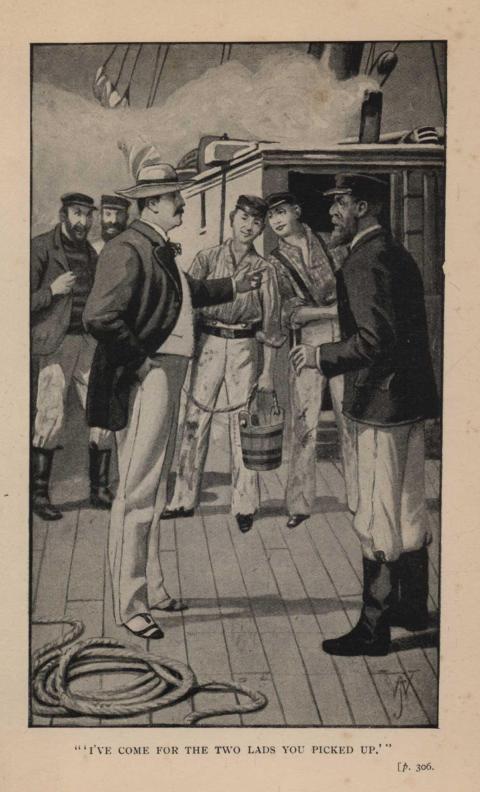
They went back to their duties, Niven chuckling over something with evident delight, and it was next day when they crept past the pines on Beaver Point, into view of the clustering roofs of Vancouver. As they slid into the blue inlet a boat came pulling towards them, and while the mainsail peak swung down a gentleman climbed on board. Jordan, who recognized him as one of the wealthiest merchants of that city, nodded in salute, and then stared at him in astonishment.
"You'll know me, Captain Jordan, though I've not had the pleasure of talking to you before," he said. "I've come for the two lads you picked up, and with your permission I'd like to take them now. Niven's father has asked me to look after them, and you'll find them at my house any time you want them the next few days."
"'I'VE COME FOR THE TWO LADS YOU PICKED UP.'"
Jordan seemed to gasp, Stickine nodded, and Donegal smiled curiously as he glanced at the skipper.
"I could let them off their work to-day, though they're not through yet," said Jordan. "Still, I was figuring on their going along with me. They might worry Mrs. Holway, and my wife is used to lads from the schooners."
The merchant, who laid his hand on Niven's shoulder, laughed a little. "I scarcely fancy they'll go to sea as sealers again," he said. "Boys, we'll go right along, and you needn't worry about your things. We'll get you an outfit at a store in the city."
The lads shook hands with Jordan, who had apparently not yet recovered from his astonishment, and only looked at them gravely when Niven said, "Thank you for letting us off, sir, and I'll just bid you good-morning now, because we're coming down to see you and the boys again."
Then they sprang into the boat, and Jordan shook his head bewilderedly as they pulled away. "Well, I'm jim-banged—and that lad was talking straight all the while," he said. "Going along to stay with one of the biggest men in Vancouver City!"
"Sure," said Donegal, "an' who would take better care av the son av a ducal earl?"
In the meanwhile Niven and Appleby went home with Mr. Holway to a very pretty wooden house on the hill above the city, where they revelled in the luxury of a bath with hot water and clean towels, and new clothes, though it took them an hour or two to get used to the tight collars that galled their necks. The merchant and his wife were also very kind to them, and when they concluded the recountal of their adventures late that night, Niven said, "Now, there's one thing I would like, and that would be to do something for all of them. I feel quite sure my father would be pleased with it."
Mr. Holway nodded. "I believe he would. In fact, he wrote me to make the skipper any recompense that appeared advisable. The trouble, however, is that things are different here from what they are in the old country, and these men earn dollars enough themselves to resent any attempt to pay them for a kindness."
"Still, it could be managed somehow," said Niven.
"Yes," said Mr. Holway, "I believe it could. We can find out if the skipper wants, for example, a good sextant, and I've a notion that the men would be pleased if you gave them a farewell dinner. It would show that you still looked upon yourself as one of them."
"Yes," said Niven, "that would be the best thing."
When they next saw Jordan he was squaring accounts with the men, and apparently too busy to do more than nod to them. They accordingly waited among the rest, who were dressed much as they were in neat, new clothes, and had only the bronze in their, faces and the steadiness of their eyes, to show they were from the sea, until at last he drew his pen through two lines on the roll on the table in front of him.
"Christopher Niven and Thomas Appleby," he said, holding out two little piles of silver coins with a few bills beneath them on a document. "Look through that, and tell me if it's all quite straight before you sign it."
Niven flushed a trifle as he said, "I don't fancy we should take the dollars, sir."
Jordan looked at him somewhat grimly. "I've a good deal to put through, and no use for talking," he said. "You made the deal the night I found you, and they're yours, my lad."
The lads took the dollars, and found Mr. Holway waiting for them when they went out. He glanced at the handfuls of coin, and laughed a little as he asked, "Whose are all those dollars?"
"They're mine," said Niven, with a trace of pride in his smile. "I've earned them, and I fancy it would astonish the folks at home. My father used to tell me now and then that I'd never have a shilling that wasn't given me. Now take me to one of your biggest shops, because I'm going to buy my mother a brooch or a bracelet with the first money I ever earned in my life."
The merchant nodded gravely. "I fancy that would only be the square thing," he said. "Now, I was keeping myself and my sister when I was younger than you."
The bracelet was bought, and during the day Niven sent a note down to the schooner, while on the next evening they and the sealers sat down to a very elaborate dinner in a big room of the Canadian Pacific Hotel. They were all of them present, and nobody appeared in any way uncomfortable or ill at ease in his unusual clothes, for the life they led had made them men, which is very much the same and occasionally a greater thing than gentlemen. In fact, Niven felt curiously abashed when before they went into the dining room he spread out before them the things he had brought. There was a silver-mounted sextant for Jordan, a knife that most sealers coveted with an inlaid handle for Stickine, a watch for Donegal, and boxes of tobacco for every one of the rest.
"I'd like you to take these little things just to remember us by," he said diffidently. "I wouldn't have asked you if they had been of any value, but it would be good of you to keep them, because you have, though of course it isn't for that, done a good deal for Appleby and me."
Donegal's eyes twinkled. "Tis twice, anyway, I've run ye round the deck wid a rope's end, and I would have licked ye often if 'twould have been of any use," he said. "Sure, we'll take them and remember ye. 'Tis not every day the son av a ducal earl goes sealing with me."
Then they went in to dinner, and when Niven had insisted on Jordan taking the head of the table most of them made a somewhat astonishing meal, that is, to those who did not know how the sealers ate and worked. Afterwards there were a few speeches, but these were to the point and short.
"Mr. Niven and boys," said Jordan. "I've had a good company with me this run, and the next time I go to sea I don't want a better one. I'm counting the lads in, and we'll feel kind of lonely without them when they go back to the old country. That's 'bout all. I'm not much use at talking."
Then Donegal stood up and rubbed his coppery hair. "Sure," he said, "'tis rough on me. They're taking my bhoys away—just when me and Stickine was licking them into men. Still, I'll be bearing it better if 'tis credit they're doing us in the old country. Boys, ye will not go back on Donegal, and if sealing has taught ye anything 'tis this that's at the bottom of the scheme: 'Thrue hearts is worth more than silver spoons,' an if that's not quite what the pote said it's what he was meaning."
It was getting late, and there was a pause in the laughter, when Niven rose up. "I wish I could talk as I want to—but now when I've so much to tell you I can't," he said, standing with flushed face and eyes shining at the foot of the table. "Still, before we go I want you to join in a last good wish with me. Boys, here's long life to Ned Jordan."
There was a roar, and the voices rang through it one by one. "The man who beat the Russians and the Americans too. The skipper who never went back on his crew. Ned Jordan of the Champlain who brought me home again!"
Niven long remembered them standing about the long table with the sea-bronze in their faces and the pride in their eyes that were turned on Jordan. At last he once more stood up awkwardly.
"Boys," he said simply, "I couldn't have done nothing without the rest of you, and with the same men behind me it wouldn't be very much to do it all again."
Then they went out, shaking hands with Niven and Appleby, who stood in the great hall of the hotel, to bid farewell to them. Last of all came Jordan, and he stopped a moment.
"I've been wrong a good many times in my life, Mr. Niven, and that makes it the easier to tell you I was more club-headed than usual 'bout you," he said. "Still, I figure there's nothing but good feeling between us now, and you'll not forget Ned Jordan if you come back again."
Then he went down the pathway, and the two lads stood still, until from out of the darkness down by the water-front a voice they knew raised a song and the last of it came faintly up to them—
"Shining gold in heaps, I'm told,
On the bunks of Sacramento."
Niven glanced at Appleby, and his voice was not quite steady as he said, "Starting home to-morrow—and we'll not see any of them again. Well, I'm sorry."
"Yes," said Appleby quietly. "I feel that way too."
CHAPTER XXII
THE RESULT OF THE CHOICE
The Montreal express was waiting to commence its six days' eastward journey when Appleby and Niven stood in the C.P.R. station next afternoon. The lads, however, scarcely noticed the great locomotive and long cars, or the roofs of the city that rose row and row up the face of the hill with the ragged spires of the sombre pines towering high above them. They were looking out on the blue inlet which, streaked in places by the smoke of the mills, lay shining in the sun, with dusky forests and a lofty line of snow beyond. Broad in the foreground rode the Champlain, looking very small and dainty with her bare masts standing high above the sweep of bulwarks, and they could recognize the men stripping the canvas off her. Behind her with the beaver ensign streaming at her peak another schooner was beating in, and Niven smiled curiously as he followed her with his eyes.
"It's the Argo," he said. "We'll be off in a minute or two—and of course I'm glad we're going home. Still, it hurts a little to leave it all behind."
Appleby nodded, for he fancied he knew what Niven was feeling, and it was with a faint sigh he turned towards the cars.
"It will be a long time before I forget the Champlain," he said. "Still, you see we couldn't be sealers."
Then a big bell commenced ringing, and Mr. Holway came up. "Here are your ticket coupons right through to Liverpool, and the Allan boat will sail an hour or two after you get to Montreal," he said. "Better take your places."
They shook hands with him while the big engine panted, and swung themselves on to the platform of the nearest car. It lurched forward, Mr. Holway waving his hand to them, slid away behind, wharf and mill went by, but they still stood out on the platform looking back at the Champlain, until with a sudden roar of wheels the train swept into the shadow of the pines that shut out blue inlet and schooner from their sight. Then Niven sighed a little and Appleby looked at him with a curious little smile.
"That's the last of her, Chriss," he said. "We've got to look forward now."
They were, however, soon too occupied for any vague regrets, and that journey from ocean to ocean over British soil excited their wonder and now and then brought them a little thrill of pride. Hour by hour the cars went lurching through the shadow of great pine-forests, and up an awful chasm with a river foaming far away below, swung over dizzy trestles, and past flashing glaciers through a tremendous desolation of rock and ice and snow that no man's foot had ever trodden. Still, the valleys were sprinkled with little wooden towns from which there rose the scream of saws and the smoke of mines, while when two great engines hauled them slowly in snake-like curves up to the Selkirk passes the lads stood gazing in silent awe at the white peaks above them.
"The men who built this road would stick at nothing," said Niven with a little gasp of wonder as he glanced back at the shining metals which lay apparently straight beneath him.
Later, with a roar of wheels flung back from the dark rocks that had for centuries barred off from the prairie the wild mountain land, they climbed the Kicking Horse defile beside a frothing river, and went roaring down into the rolling hills on the Rockies' eastern side. These, too, swept back and faded, and they were racing eastwards straight as the crow flies across the prairie.
Little wooden stations, herds of sheep and cattle, lonely mounted men seen miles away, were left behind, and still hour by hour the great white levels stretched away. From the dawn that flushed red before them until the sunset flamed behind, the gaunt telegraph poles and shining metals that led straight on came flying back to them, and there was no change in the white waste the moonlight shone upon. Then they ran through yellow stubble where the splendid wheat had been, past lonely homesteads, lines of toiling teams, and clouds of dust and blue smoke where the thrashers were working in the field, until they rolled across a great river into Winnipeg City.
There they stopped an hour or two, and afterwards ran past vast blue lakes into the forests again, swept across wooden bridges over frothing rivers, until the lads clinging to the platform looked down on an inland sea when the dusty cars went lurching along the Superior shore over a road riven out of the adamantine granite that had been paid for with brave men's lives. By and by they came out of the wilderness again, and swept through green Ontario past wooden farms and orchards into Montreal, where they had decided to join the steamer, though they could have done so nearer the sea. They were, however, stiff and aching, and glad to stretch their limbs, while Niven stared about him in wonder as they walked through Montreal and stopped a moment outside the great cathedral.
"It's a city of palaces and churches, and there's no dust and smoke at all," he said. "I never fancied they'd places of this kind in Canada. Well, we'll go on to the steamer as soon as we've worked out the kinks we got in the cars."
The steamer went down the river soon after they reached her, and it was an hour or two before the lads felt at home on board her. She seemed so big and high above the water after the Champlain, and they felt almost abashed and out of place amidst the luxury of the great saloons. That did not, however, last long, and there was much to occupy them, the huge rafts of timber with houses on them, barges piled with hay until they resembled a drifting farmyard, the countless islands they steamed among, and the tin-roofed villages along the wooded shores. Then they stopped where the river narrows under the battlements of Quebec, and saw the crowded roofs of the city climb the slopes of the plateau where Wolfe won that great Dominion for England.
After that the river grew broader, until at last they rolled out past the rocks of Labrador into the Atlantic, and it was scarcely a fortnight since they left Vancouver when one night the liner steamed into the Mersey. Rows of lights blinked at them through the smoke and drizzle, whistles screamed, steamers crowded with passengers went by, and at last the tender swung alongside. Then amidst the bustle and confusion a gentleman forcing his way through the groups of travellers grasped Appleby's hand, and he saw his comrade, who did not seem abashed as he once would have done, being hugged publicly by Mrs. Niven.
In another minute she had turned to Appleby, and Mr. Niven led both of them under a big electric light. He stared hard at them, and then smiled at his wife.
"Well," he said slowly, "these are not the lads we sent away. The sea has done a good deal for them, and if I hadn't been looking for him I would scarcely have known my son."
It was a very happy party the tender took ashore, and for several days Mrs. Niven, who regaled the lads with dainties and fussed over them, would scarcely let Chriss out of her sight. On the third night, however, Mr. Niven called them into his own room.
"And now it's about time we had a little talk," he said with a trace of dryness in his smile, as, lighting a cigar, he laid the box on the table. "You can take one if you like. No doubt you know the flavour by this time, and it would take a good deal to hurt you now."
Chriss grinned at Appleby. "As a matter of fact we found that out at Sandycombe, sir, though the results were very far from encouraging," he said.
"No?" said Mr. Niven.
Appleby laughed. "I lost a good chance of winning the quarter-mile, and Chriss spent two Saturdays writing lines."
"I understand," said Mr. Niven dryly, "that you didn't get many luxuries on board the Aldebaran."
"We didn't," said Chriss. "Still, after a month or so, there wasn't much we couldn't eat except the stuff in one barrel the pickle had run out of. Appleby tried it once when we hadn't had anything worth mentioning for a week. Tom, how long did you revel in that pork?"
"About two minutes," said Appleby. "Eating it wasn't quite as nice as skinning holluschackie."
Mr. Niven nodded, but there was a twinkle in his eyes, and once more he noticed the steadiness with which they returned his gaze, and that though they smiled there was a new gravity in their sea-tanned faces.
"I fancy you have found out how much one can do without, and that is a good deal gained," he said. "Still, all that is beside the question, for I want to know right off how you like the sea, and I've no use for anything but the straightest kind of talking."
Chriss seemed a trifle astonished. "That was just how Ned Jordan spoke," he said.
Mr. Niven laughed. "You may remember that I have been over a good deal of Canada on business and in Vancouver. In fact, you may do so too. It depends on your answer to my question."
Chriss sat silent for almost a minute in place of speaking at once, which is more than he would have done before he went to sea. Then he answered very slowly.
"Well, I like the sea, and would be willing to go back again, but not—if it could be helped—in the Aldebaran. Still, after what I have seen of it, I fancy I could be quite content to live ashore if there were other things for me to do."
"Even if people laughed at you for swallowing the anchor, which I believe is how they put it?" asked Mr. Niven.
Chriss laughed without any sign of confusion or embarrassment, and his father noticed it. "One doesn't mind a little banter after being kicked with seaboots, and growled at all day for weeks. You don't fancy it would matter greatly if they did?"
"Not in the least," said Mr. Niven with dry approval, "In fact, the man who does not mind being made fun of has often the best cause for laughing. So you would go back to sea if I told you to?"
"Yes, sir," said Chriss. "Still, if you fancied it would be better I would stay ashore."
"Then," said Mr. Niven, "we'll decide on the latter. You might after years of hard work, and if you were very fortunate, make five hundred pounds a year at sea, but while there are thousands of lads in the country who would be very content with the prospect of getting it, there are considerably fewer who have your opportunities, and by and by I shall want somebody to take up my business after me. If you are to do it you must begin at once at the bottom, do what you are told, and make your way upwards slowly as you would at sea. Now, then, would it suit you to go down to my office at nine o'clock the day after to-morrow?"
"Yes, sir," said Chriss. "It would."
"Then," said Mr. Niven, "that will do in the meanwhile, though we will have a good deal to talk about later. Now, Appleby, you have heard what I proposed to Chriss, and we can find room for you. I will see you get a fair start in life—and what it may lead to afterwards will depend largely upon yourself."
Appleby's answer was quiet but resolute. "I have to thank you, sir, but I am afraid I should never be quite contented away from the sea."
"Don't be hasty," said Mr. Niven. "It's a hard life, but you know that better than I do. I also fancy that if you serve me well you will be a richer man by and by than you ever would be at sea."
Appleby looked at him steadily. "I've been considering ever since I left the Aldebaran, sir. It's hard enough—but I can't help fancying it is the life that is best for me."
Mr. Niven nodded gravely. "Then you are right in going back, but we'll try to find you a more comfortable ship. Well, we have decided quite enough for one night, and I fancy Mrs. Niven is waiting for you."
The lads went out, and though both of them afterwards found there was now and then need of all their courage and endurance in the lives they led neither regretted the decision they had made. Niven went into his father's office, and Appleby back to sea, while a good many things happened to both of them before the former, who was now a partner, returned on business to Vancouver. The day after he got there he stood on the wharf with Mr. Holway. It was crowded with travellers making for a steamer on the point of sailing, for the Montreal express had just come in, but Niven was watching the trail of swiftly-moving smoke that smeared the blue sky behind the great pines on Beaver Point.
"That will be her by the pace she's making," he said.
Mr. Holway nodded. "Yes. They're wonderful boats," he said. "It's a long way to Japan, but they keep their time like a clock, and they'll not check the engines until she's close up to the wharf."
"Twin screws," said Niven. "Still, with the barque yonder there's very little room to swing a big vessel in, though, of course, he could scrape past the schooner and back one propeller."
Mr. Holway laughed. "You might have been to sea yourself!"
"Well," said Niven dryly, "I have, and they taught me a good deal in the Champlain."
"I had forgotten," said Mr. Holway. "You'll have been glad you left it."
Niven smiled. "There have been times of business anxiety when I've been almost sorry, too. After all, one had nothing to worry over on board the Champlain when his work was done. But she's coming in."
With the blue water frothing at her bows a great white-painted steamer swung out of the shadow of the pines, and while her whistle sent a sonorous scream ringing across the inlet swept towards the wharf. She gleamed like ivory from the purple shimmering in her shadow that was streaked by froth about her water-line to the yacht-like lift of her bows and long sweep of rail, and above it her tiers of houses and rows of boats shone dazzlingly in the sunlight. In every line and flowing curve there was a suggestion of speed and beauty, and Niven was silent as he watched her come on, remembering how the command of such a vessel had once been his most cherished dream. Then as the other steamer splashed away and the liner swung in towards the wharf he saw that one of the officers high up on the bridge was staring at him. Niven knew the brown face under the white cap, and waved his hat, but the officer only raised his hand for a second and then looked straight ahead again. Niven laughed softly as he turned to his companion.
"There's very little difference in Tom Appleby," he said. "It's four years since I've seen him, but if it had been forty I wouldn't have expected him to spare more than a moment from his duties to nod to me."
"That," said Mr. Holway, "is probably the reason he has got on so rapidly, and I know the Company's people here have a high opinion of him. Now sit down. He's not going to thank you for worrying him while he's busy."
It was half-an-hour later when they went on board the great steamer and asked for the second officer. The two young men looked at each other as they shook hands, and each saw a difference in his comrade, for bronzed mate and keen-eyed merchant had both grown used to the yoke of responsibility. They were quieter than they had been, and their faces were graver, while though it was long since they had met, they were not effusive when they spoke.
"Glad to see you, Tom," said Niven.
Appleby nodded. "Of course I needn't tell you the same thing. How did you get here?"
"Allan boat and Canadian Pacific sleeper," said Niven. "I told you I'd been made a partner, and fancied I'd run over to look up some of our customers in Vancouver when I was in Canada. At least, that's one reason. You can guess the other. Now, what's wrong with this Company that you're not commander?"
Appleby laughed. "I've got on so fast already that I can't help fancying friends of mine who put business in the Company's way have as much to do with it as my merits. Now, I'm not quite sure that's good for me."
"Tom," said Niven with apparent severity, though his eyes twinkled, "are you so foolish as to fancy that the men who run a line like this would take a hint from anybody? You climbed up yourself, but if ever I do have any influence I'll know how to use it. Still, we're not going to argue already. Come out. I've got a buggy waiting, and we're going to drive and talk in the woods all afternoon, and then have another dinner at the Hotel. To make it all complete Jordan's coming."
"I'm half afraid I couldn't stay that long," said Appleby, and Niven turned to Holway, who had joined them.
"You're coming right along. Holway has seen the skipper, and he knows better than refuse—him—anything."
They drove through the dusky shadows of the pines all the afternoon, and when evening came they and Jordan sat down to a very choice dinner in the room where they last met. Jordan, however, seemed leaner and grimmer than he had done that night, and his hair was grey, but there was no mistaking the pleasure in his face when he greeted them. Niven made him sit down at the head of a little table by an open window.
"That's your place, sir," he said. "I don't quite know what they're bringing us to eat, but it's not going to be as good as the canned beef you gave us the night you came across us in the Champlain."
He smiled curiously as, glancing round at the glittering glass and silver and the sumptuous decorations of the great dining-room, he remembered the little, stuffy cabin of the schooner that swung with the seas. All this was very pleasant, but he felt he had lost something that could never be regained since then. Appleby seemed to understand, for he nodded.
"There's a difference, Chriss," he said. "We shall never be quite the same again."
"A man can't have quite everything—and you've got the dollars now," said Jordan with a little twinkle in his eyes. "Well, I've made my blunders, like most other folks, but the one I made that night was my biggest one. Still, it was a kind of curious story you told me."
Niven laughed. "I've no doubt I did it badly—but there are times when I wish I was only a lad sailing north again sealing, and I fancy I shouldn't be a partner in a good business now if it hadn't been for a few things that voyage taught me."
While he spoke the dinner was brought in, and for a while they postponed their questions. Then as they sat by the open window looking out across the blue inlet towards the climbing pines and the distant snow Jordan glanced at his cigar.
"I've only had a dinner of this kind once before in my life, and you know who it was gave it me then," he said. "Now, I've a notion Donegal believed you all along."
"I wonder where he is now," said Niven. "I should like to have seen him."
Jordan's face grew grave, and he stretched out one hand pointing towards the north. "He's sleeping sound up there," he said.
Appleby bent his head. "I have not often met his equal—and we both owe him a good deal. How did it happen?"
"Stowing jibs," said Jordan quietly. "Wind turned loose on us sudden one night we were carrying everything, and she lay down with her lee rail in. Outer jib wouldn't run down, downhaul jammed, and Charley was clawing out on the bowsprit when the sail whipped over him. None of us saw what came next but Donegal, and when I had a glimpse of him he was hanging out from the foot-rope grabbing at Charley. Then she put her nose into a sea, and when she swung out of it there was nobody under the bowsprit. We'd gone straight over them."
Jordan stopped a moment, and his voice was a trifle hoarse when he went on again. "It was quite ten minutes before we could get the mainsail off her to wear her round, and a boat over, and an hour anyway before we hove her in again. They'd found nothing, and Charley couldn't swim, but Donegal wouldn't never have let go of his partner. He was that kind of a man."
Appleby nodded gravely, but nobody said anything further for several minutes, and then Niven asked, "Where's Stickine?"
"Coast trading. He was kind of saving. Put the dollars he'd scraped up into a little schooner, and it would astonish me if he wasn't making more of them. Montreal and his brother doing quite well too. Gone back to the carpentering and taking contracts for putting up mining flumes."