IN THE MISTY SEAS (continued 3)
Reading edition
A shower of stinging spray beat into their eyes, and when he could see again, Niven had a disconcerting glimpse of a big frothing comber apparently curling above the schooner's stern. The decks ran water, but when he glanced aloft every sail but the topsail was drawing still, and he clutched the rail when as they swung upwards a blink of moonlight pierced the flying vapours. To leeward of them lay a schooner, her hull just showing faintly black through the white smother that seethed about her, until she hove a breadth of it up streaming in a leeward roll. It appeared insignificant in comparison with the mass of dusky sail that swayed low again towards the rushing froth as she lurched back to weather, and then Appleby glanced aft with a little thrill to the grim set face of the man who stood panting at the Champlain's wheel.
The hiss of the seas that followed, the roar at the bows, the wild humming of the blast and the whirling spray stirred his blood. They were all of them tokens of what man could dare, and the strain, that human nerve could bear, for he knew that already hemp and wire and timber were being taxed to the uttermost, and that if the helmsman gave her a spoke too much or too little the next sea would curl on board or the great black mainsail jibe over and strew the Champlain's decks with ruin. Niven stood beside him, and Appleby saw that although his face was almost colourless in the moonlight, his eyes were shining.
"Oh, it's great!" he said. "Worth all we stood on board the Aldebaran to have a hand in this."
"And how many hands were ye born with when I see two av them holding ye where ye are?" said Donegal, who apparently heard him. "Is ut dollars or diversion a man goes to sea after?"
Niven laughed. "Dollars. Oh, get out! You know you feel it yourself," he said. "You've got everything just throbbing inside you as I have now."
Donegal grinned broadly. "And what if you're right?" he said. "'Tis born in the blood av the likes av me, but if I was the son av a ducal earl it's sorrow on the day would find me on the sea."
He got no further, but grabbed the lad's shoulder and held him fast as the Champlain swerved a little and a sea came in. It swirled about them icy cold as she rolled down to lee, and the scuppers were spouting when with a wild lurch she swung back to weather. Then Donegal thrust the pair of them aft together.
"Get a good hold an' keep it, until we have some need av ye," he said.
Then the blink of moonlight went out and the Champlain was alone, while the two lads shivered and dodged the spray as she swept onwards through the night, until a faint light crept out of the east across the whitened sea. The wet canvas showed black against it, there was a doleful wail of wind, and then when man's strength sinks to its lowest something happened. The Champlain put her bows in, and Jordan sprang suddenly up on the deckhouse gazing astern. What he said was scarcely audible, but the sealers apparently understood it, for the deck was filled with scrambling men. Down came the mainsail's peak, forward a slashing sail slid down, and the outer jib thrashed furiously above the bowsprit. Niven was clawing his way towards it when Stickine grasped his shoulder and flung him back.
"I guess this is going to be work for a man," he said.
Niven, who watched him crawl out along the bowsprit, held his breath when spar and man dipped into the sea, and then floundered aft to where the others were rolling up the foot of the half-lowered mainsail. It slatted and banged above them, and now and then the long boom beneath the foot of it that ran a fathom or more beyond the stern, swung in, for the schooner was coming up to the wind, but the rush and stress of the race had stirred his blood, and when it became evident that somebody was wanted there, he swung himself up on the foot-rope beneath its outer end as he otherwise might not have done. In another moment Appleby was up beside him, and Jordan standing at the wheel glanced dubiously at them. Then he nodded.
"You've got to begin sometime," he said.
It was not easy to keep a grip of the foot-rope, and more difficult still to roll up the sail and tie the reef points round it because both hands were needed and to hold on they must lie across the boom. Still, they accomplished it, and Appleby felt content when Jordan made a little gesture as they sprang down. He was not a man who said more than was necessary, but it was evident that he was pleased with them. Then they hauled at the halliards with the rest, and in a few more minutes they were once more on their way under easy sail.
"She's snug for a while, but we'll have the trysail handy," said Jordan quietly. "Old man Carter was a little slow. They're catching the heft of it on board the Argo."
Appleby glanced down to leeward and saw the Argo. She was hove down with one side lifted high above the sea, and loose canvas thrashing all over her.
"I'll figure he'll just save his masts," said Stickine. "Wouldn't snug her down till we did. Well, I figure Carter couldn't help being born a mule."
Then the Argo grew dim behind them, and they swept on into an empty sea, for the race was over, and there was no sign of the Belle.
CHAPTER X
HOVE TO
At noon next day, Jordan once more brought the Champlain's head to wind, and they put the third reef in her mainsail, while when she swept on again the sea grew steeper behind her, until the combers that raced after her apparently hung frothing above her helmsman's head. She would fling her stern up to meet them and while the man panted over his jerking wheel her bowsprit went down and down. Then she would leisurely lift her nose and surge forward lapped in seething foam, only to sink with a smooth, swift lurch again.
It was dryest aft, though there was water splashing everywhere, and the two lads hung about the mainmast where the little deckhouse partly sheltered them, watching the helmsman's grim face as he swung with his wheel. They knew, by this time, that, while it is a somewhat difficult affair to keep a hard-pressed vessel straight before the sea, unpleasant things are apt to happen to a fore-and-aft one if it is not done.
Still, the man knew his work, and did it, and at last, towards nightfall, when the sea was all spray and foam, Jordan, who came up, stood staring astern. After a minute or two he shook his head.
"We had better round her up while we can," he said. "Get the main-gaff down, and you'll be handy with the trysail."
They were very handy, and there was a good many of them, but Appleby held his breath when the foresail was lowered, and the mainsail peak swung down. Jordan was still looking astern, and he nodded after an especially big sea went smoking past them.
"We'll try it now," he said.
The man beside him swayed with the wheel, the Champlain swung round to windward, and there was a roar when a roller burst into spray upon that side of her. Then she swung further yet, and as the big mainboom came down the little three-cornered trysail went thrashing up the mast. Everybody was doing something amidst a great banging of canvas, and in another few moments there was a wonderful quietness. Appleby gasped, and Stickine who went by dripping grinned at him, while Jordan nodded to the men.
"She'll lie easy now," he said.
In place of running before it the Champlain lay almost head to wind, rising and falling with now and then a little lurch to leeward and a curious buoyancy. The strip of sail above her bowsprit and the trysail aft just sufficed to hold her stationary, and it was with little more than a spray wisp at her bows she bobbed in a curious cork-like fashion to the sea. Except for one or two of them the men crawled away below, and the lads, who were wet through, were glad to climb down into the stuffy warmth beneath the hatch.
It was dark down there now save for the flickering radiance of the lamp which shone upon the wet brown faces and the smears of smoke. The dusky hold reeked with the smell of steaming clothes, but the lads had grown used to odours which would have sickened them before they went to sea. Niven shook off the oilskins Jordan had given him, and as usual commenced his questions.
"The sea looked nasty before we brought her up," he said. "How was it we scarcely shipped any of it?"
"It was," said Stickine dryly. "Still, Ned Jordan knows his business, sonny."
Niven did not care for the epithet, or the grin which usually accompanied it, but he had discovered that one has to put up with a good deal that one does not like at sea.
"Of course!" he said. "But why couldn't we have gone on running?"
Montreal, the man who sat nearest the stove, laughed softly as he raised his head. "Listen to it. That's why!" he said.
There was a moment's silence, and while the Champlain rolled to leeward, and the floorings slanted under them until no man could have kept his footing, all could hear the scream of the rigging ring through the roar of the wind. It was a significant answer, but it left a little that was not quite plain yet, and Stickine nodded when Appleby glanced at him.
"It works out like this. A time comes when she'll run no longer—and then it's too late to heave her to," he said.
"Yes," said Appleby reflectively. "Of course if the sea was too bad to run before it would be too big to bring her up in, because while she was swinging round she'd catch it on her beam. Still, if you had run too long what could you do?"
"Just nothing," said Stickine gravely. "Wait until she ran under and took you down."
He stopped, and there was a thud that sent a little shiver through two of the listeners as the Champlain plunged into a sea, for they had been taught sufficient to see the picture the brief words called up. In the silence that followed Brulée leaned forward with a curious intentness in his eyes.
"Comme ça!" he said, swinging down a brown hand with suggestive suddenness. "I have seen it. We come down from Labrador in the Acadie brig, and it is blow the grand ouragan."
He drew in his breath, and gazed into the dimness as though he saw none of those about him, and then with a little shake of his shoulders stretched out a finger and pointed to Niven. "I was as young as him, and it was in the clear of the moon when the Acadie was hove to, one brought me to the rail to see the Madeleine. She was topsail schooner which load with us, and we had all the friend on board her. Whether she will not heave to, or the captain he is dare too much, I do not know, but she comes up from the spray and pass close, so close. I see the topsails black in the moon, and the jib she lift high. Then she is over run the sea, and I shut tight my eye. It is in a moment I look again—and there is no more Madeleine."
Again there was silence, and Donegal nodded sympathetically when the French-Canadian turned away his head. "Ave!" he said. "For their good rest."
It was a minute or two before Niven, who had shivered a little at the tale, spoke again. "He told us the captain dared too much," he said.
"Sure!" said Donegal. "Is that perplexing ye, an' am I to stuff ye with wisdom so ye can spill it out av ye? Still, that wan's easy. 'Tis the daring ye want at sea, but ye must dare just so far, an' when it's necessary, for the man who does not know when the conthract is too big for him is going to have it shown him what he is. Ye can follow me?"
Niven was not quite sure that he did, but Stickine smiled grimly as he nodded. "It's quite plain figuring. He's a blame fool," he said.
Appleby stared at the speaker with a faint perplexity, for while there were occasions when Donegal the sealer and his comrades talked arrant rubbish they now and then brought truths the lad had scarcely realized home to him in a fashion that carried conviction as well as astonishment with it. He wondered whether the sea had taught them, or there was something that opened the eyes of the thoughtful in the simple life they led. It was one which at least demanded qualities that were an ornament to any man, and more often than not the primitive virtues which humanity cannot rise beyond showed through what some would have deemed his comrades' coarseness. Once or twice as he listened it was dimly borne in upon the lad that while manhood was a greater thing than culture or refinement all that was most worthy in it was founded on a few eternal verities.
Niven, however, could not be serious long, and presently he laughed at Donegal as he turned over to dry his other side before the little stove. He felt luxuriously contented to lie there in the stuffy warmth, and listen to the growling of the seas.
"There was something Stickine was to tell us—about a fifty-year-old schooner, and a crew of starving men," he said.
Donegal nodded. "That ate the rats? Get up on the hind legs av ye, now, an' talk, Stickine."
There was a little murmur from the rest, and the big, lean-faced Canadian looked uneasy. "Pshaw! You've heard that tale before," he said.
"Some av us," said Donegal. "An thim would hear it again. The others has not, and they're waiting on ye anxiously!"
The men murmured approval, and Stickine shook out his pipe with a little deprecatory gesture. "I'll make you very tired, boys, but if you will have it this is how it was," he said. "It was 'bout through with the afternoon watch when the fog shut down on the four of them in the whaler in Russian water. They heard the schooner's bell, but it's kind of difficult to fix a sound in a fog, and when it let up sudden they allowed they'd lost her."
"Sure!" said Donegal. "Mainsail Haul could tell ye that in a fog ye hear the sounds in front of ye behind ye. It is digressing ye are, Stickine, but the boys is wondhering what four sealermen were squandhering their time luxurious for in a whaler."
Appleby understood the comment, for he had seen a couple of whale boats on the beach at Port Parry, and they were costly examples of the boat-builder's skill. Stickine, however, laughed silently.
"Old man Corliss got her for nothing—and she was built for the Government with flooring gratings fore and aft, but we needn't worry 'bout how he did it now. Well, there they were, with a big lump of a sea running, shut in by the fog, and they had to keep her head-to with the oars when the wind came down."
"Fog—and a breeze!" said Niven, and Donegal shook his fist at him.
"'Tis bethraying the ignorance av ye, ye are again," he said. "Up there 'tis fog for ever except when 'tis a gale, an' before it's through with that the fog crawls in again. Ye will not heed the lad, Stickine."
"Well," said the sealer, "they held her head to wind, until just before sun up a gunboat came along, and she come that sudden they'd no time to heave the seals they'd with them over before she was going hard astern close alongside of them. The first look at her kind of sickened them. She was a Russian."
"There was fog—and they stopped there?" said Montreal.
"They did. There was quick-firer turned right down on the boat," said Stickine dryly. "Well, it was all fixed up inside five minutes. The whaler was hove up, and a guard with side-arms marched them before a Russian officer, and he was quite anxious to know where they'd last seen the schooner. Now, it was kind of curious there wasn't one of the boys could remember."
"Had they been sealing inside the limits?" asked Appleby.
"No, sir," said Stickine. "Not that time, anyway. When they last saw the land they were well off shore."
"Then the Russians had no right to seize them, and the Canadian Government could have made them pay up thousands of dollars," said Niven.
A little, grim smile crept into the faces of the men. "That," said one of them, "is where you're wrong. They had all the right they wanted when they had the men and guns, and who's going to believe a poaching sealer when an officer in kid-gloves tells quite a different story?"
"And have British subjects no redress?" asked Appleby with a little flush in his face, and Montreal grinned at him with grim approval.
"Oh, yes, when they can get it—and they do now and then, though they don't usually worry the Government folks at Ottawa," he said. "They took them to Peter Paul, Stickine?"
"They did," said Stickine. "And they kept them most of eight months there cooped up in a loghouse with a little dried fish to eat, and 'bout half enough sour black bread. They wouldn't tell the officer where that schooner was, you see, and when they're not put down on the papers men in prison get kind of forgotten in that country."
"And you believe it has happened—to Canadians?" asked Niven with a little gasp of anger.
The veins swelled up on Montreal's forehead. "Well, there are sealer's boats, British and American, that get lost, and nobody but the partners of the men who pulled in them and a woman or two away down south worries very much," he said. "I had a brother in one of them."
There was silence for almost a minute before Stickine went on again. "Two of them got very sick, and they all got thin, until when the spring came they were walked out every day with a guard to take care of them. Perhaps the officer figured it would be kind of awkward if they died on his hands and then somebody remembered them. Well, one day nigh sundown the mate and a sick man were sitting on the beach looking at the sea, and wondering if their folks in Canada would ever hear of them again. They were to be sent away from that place in a day or two.
"Now, there was an old schooner that must have been getting shaky when the Russians seized her years before moored in front of them. The oakum was spewing from her seams, her bulwarks were worn and weather-cracked so you could put your fingers in the rents in them, and it wasn't much use telling a sealerman what kind of canvas she would have after lying there since the Russians took her in the rain and wind. Still, she looked kind of homely, and they sat there watching her until they heard the boom of gun and there was a Russian soldier signing to them. Now, some of those folks were kind enough, but this was a bad man, and when the sealer who was sick couldn't get along fast enough he kicked him hard, and where it would hurt him."
Montreal drew his breath, and a little grey patch showed in his cheeks.
"But," he said hoarsely, "he didn't do it again!"
Stickine laughed a curious little laugh. "No," he said. "He meant to, but the man who wasn't sick was too quick for him, and the soldier wasn't handy getting his side arm out. The sealer took the point in his arm, and it ripped it to the wrist, but he got his right fist on that soldier's chin, and when he went down he made no great show of getting up again. Then the other two left him, and went back to the prison where a soldier locked them in, and when the rest heard what had happened they did some talking. They didn't take long about it, for the mate had a notion the soldier looked very sick when he left him, and it was quite plain that anything they did must be put through before they were marched away from sea.
"'We've got to light out of this right now,' says one.
"'Well,' says another, 'where are we going to?'
"'That,' says the mate, 'is quite easy. There's a schooner handy and we're going straight to sea.'
"Nobody said any more for a little, and the boys looked kind of solemn. It was a long way to British Columbia, and they knew what that schooner was like because they'd see her. Then one of them gets up.
"'I'd sooner drown out yonder than work in the mines,' says he.
"In 'bout five minutes they'd fixed up the thing, and there was one of them waiting behind the door when a soldier came in. Before he got started talking the man had his arms about him. Then there was a circus that didn't last very long, and the soldier was lying tied up quite snug with his tunic round his head when they slipped out one by one. The moon was getting up, but it was hazy with a little breeze blowing out to sea when two of them lit out for the place where the schooner was lying while the rest went for the beach where it was nearest them. There was a boat or two handy, but they were big, and you can't get a vessel that's been lying by for years off in a minute. When the two stopped abreast of her the water was very cold, and it isn't quite easy swimming in your clothes, but they knew if they took them off they would have to go home naked, and made the best of it they could, though one of them was played out when they fetched the vessel. They couldn't get a holt of her, and the tide swung them along bobbing and clawing at her side, until the mate got his fingers in a crack the sun had made. Then he got up, though he was never quite sure how it was done, and pulled the other one after him, but they fell down on deck and lay there a minute, anyway.
"After that one crawls to the foremast, and it was while he made shift to get the foresail on to her he found out what prison and hunger had done for him. It wasn't a big sail, but he sat down faint and choking when he'd got it up. Then he found where the shackle was on the chain, and smashed his fingers as he pounded it, for the pin was rusted in. He couldn't quite see straight and his hands were bleeding, but he figured they'd got to light out quick, for there was a dog howling and he could hear a boat coming. At last, when he knew another blow would knock out the pin, he let up and he and the other man tried to get the mainsail up, and stopped because they'd 'bout the strength of Mainsail Haul between them. Then while they stood there gasping a boat comes banging alongside, and the rest was crawling over the rail when the mate hears another splash of oars behind.
"'They're coming along with rifles,' says somebody.
"Well, there was nobody wanting to waste any time, and they got the mainsail up with a split you could have ridden a horse through in the middle of it, and 'bout half the staysail to swing her with. When they'd done that much they saw there wasn't much use in hoisting the rest of it, and they pulled the head right out of one of her jibs. The boat was coming up tolerably fast, and somebody hailing them, but they didn't stop to answer, and getting the staysail aback knocked out the shackle-pin. The cable ran out all right, and then they stood still, very quiet and feeling sick, for most a minute, for they could see the boat now, and the schooner wouldn't fall off handy. One or two of them will remember that minute while they live. There was so much in front of them, and, so far as they could see, more behind—and the old schooner was just hanging there with her mainsail peak swung down.
"At last she fell off slowly, but there wasn't one of them fit to howl when she started off before the wind. The mate had a kind of fancy somebody was shooting, but nobody was quite sure then or after, because they were too busy swaying the mainsail peak up and looking for a sound place to bend the halliards to the jibs. They got them up in pieces, but she was off the wind, and when the boat dropped back into the haze behind her the mate fell over on the hatch and lay there until somebody poured water on to him. It was sun up next morning before he remembered very much more, and then that schooner scared him. You could have clawed out pieces from her masts with your nails, and there were more holes than canvas in her sails. No compass, no water, not a handful of grub, and the Pacific to cross.
"They ran down the coast that day, and came to with the kedge-anchor off a village the next one. The folks came off, and brought them dried fish and water for all the odds and ends of rope and ironwork they could spare off the schooner. Then they cleared for sea again, and hung out for two weeks starving on a handful of grub each morning for every man, with only the sun, that wasn't always there, and the stars to guide them."
Stickine stopped a moment, and his face grew very grim while there was silence in the Champlain's hold, and Appleby shivered as he pictured the crazy schooner crawling as it were at random across the face of the Pacific with her crew of starving men.
"It must have been horrible," he said. "Did they lose any of them?"
Stickine shook his head. "Not a man," he said. "Still, two of them were on their backs and the others just ready to lie down when a steamer came along, and they ran slap for the bows of her when they saw the flag she was flying. She stopped, and they felt kind of shaky when she lay there rolling with white men hailing them and a boat swinging out, while when a man came on board they couldn't quite talk to him sensible, and he stared at them and the masts a minute without a word. Then he sized up what they were wanting, and there was grub and coal and water in the schooner besides a compass when the steamer went on. After that it was easier. Somehow they nursed her through two gales, and drove her south-east when they could, and then one morning there was the snow shining high, up in the sky and they knew they were through with their troubles. That's 'bout all there is to it, and I've done quite enough talking!"
"Did the Government get them any compensation, and what became of the schooner?" asked Appleby.
Stickine laughed dryly. "No, sir," he said. "They didn't. Nobody asked them to, and that schooner isn't sailing now."
"But you knew the mate?" said Appleby. "Of course it was he who brought them through."
Stickine did not answer, and Donegal reached out suddenly and grabbed his arm. Taken unawares he could not extricate it, and next moment his sleeve was drawn back and the lads saw a long white scar that ran down to the wrist. Then Stickine's face flushed a trifle, and Donegal grinned. "Ye have heard where he got it—and he swum off to her that night," he said.
The flush faded from Stickine's face, which grew grim again. "I'm owing the folks who did it more than that and the hunger," he said. "We were set down, all of us, as lost at sea, and while I was lying in that prison things had gone wrong. When I got back to Canada I knew they could never be straightened out again."
Appleby noticed how Stickine's big hands trembled, and surmised that some great sorrow he would not speak about had darkened the home-coming of the man who had risen as it were from the dead. He, however, sat still with the rest until Montreal slowly clenched a big brown fist.
"And," he said with a curious quietness, "it's a brother they're owing me."
Then there was a silence that was intensified by the roar of the sea.
CHAPTER XI
AMONG THE HOLLISCHACKIE
The bitter gale they had run before for two days had fallen suddenly, and it was a hazy afternoon when the lads saw St. George of the Pribyloffs lying a faint blur on the rim of the Behring Sea. In between swung long slopes of grey water, that flickered here and there into green, where a pale ray of sunlight shone down. They did not, however, see it long, because the sun went in, and a smear of vapour crawled up from the horizon, for where the warmer waters of the Pacific meet the icy currents from the Pole, the clammy fog follows close upon the gale.
They had still short sail upon the schooner, and she rolled distressfully with a great rattle of blocks and banging of booms, but Jordan stood poised on the house with glasses levelled, and white men and Indians clustered aft and beneath him.
"No smoke anywhere, but we'll have the wind back before night," he said. "How far do you make us off the land?"
"Six miles, anyway," said Stickine, and Jordan nodded.
"I'd have put another half-mile on to that," he said. "Well, you can get the boats over and look for the holluschackie."
Stickine raised his hand, and the men fell to work. He scarcely gave an order, and there was no shouting or confusion, for every one knew what to do and did it with a silent swiftness which the lads had never seen on board the Aldebaran. The hurrying figures seemed everywhere at once, and before Appleby could decide whom to help, the first boat was swinging from a tackle between the masts. Then there was a splash, and when he gained the bulwarks, a copper-faced Indian was crouching in the bows and the oars were out. It was quick work. Boat after boat was hove up, thwarts fitted, rifles put on board, and while the Champlain rolled so that no landsman could have kept his footing, swung into the sea.
Finally when the deck was almost empty Stickine glanced at Jordan. The skipper said nothing for a minute, but once more swept his glasses round the horizon, and his face was a trifle dubious when at last he laid them down.
"You can take Donovitch and Donegal and try what the lads can do," he said. "That leaves two of us to work the schooner, but I don't figure we'll have any wind to speak of for an hour or two."
Stickine nodded as he moved forward, and thrust a rope into Appleby's hands. "Lay hold and heave," he said. "You're not going to be quite so keen on sealing by the time you pull her back again."
The lads gasped and panted as they hauled upon the tackle, but the boat was swung high before they had lifted her stern a foot, and they began to understand that even in such an apparently simple thing it would take them years to attain the dexterity of the men who had preceded them.
Still, they did what they could, while their faces grew red and the veins on their foreheads swelled, and at last the boat fell almost level, when at a sign from Stickine they let her go with a run. Then they dropped from the rail, and, though Niven fell over Appleby, got the oars out and the boat away before the Champlain rolled down on that side heavily. Appleby had lost his cap and his face was flushed, but he kept stroke with Donegal, who pulled on the thwart in front of him, and saw a little twinkle in the eyes of the skipper who looked down from the rail.
"I'd remember the kind of crew you've got, Stickine, though I've seen raw hands make a worse show," he said.
They were well clear of the schooner when Donegal spoke. "'Twas a compliment Ned Jordan paid ye, an' it he had the thraining av ye for ten years I'd have some hopes av ye."
"Ten years!" said Niven with a little laugh that hid the pride he felt. "Well, I fancy I'd have been made into a merchant in less than that time if I'd stayed at home."
"An' who would be afther throwing the likes av you away on a merchant's business?" said Donegal dryly.
Niven said nothing further, and they had pulled for another half-hour when Appleby asked, "Why was the skipper looking for smoke?"
Donegal laughed. "'Tis a diction'ry wid pictures in it to tell ye the meaning av all things ye want to know. Sure now, but what would be afther making a smoke?"
"A gunboat," said Appleby. "But we're a good deal more than three miles off the land."
"An' what av it?" said Donegal. "'Tis not easy to fix your distance at sea without a four point bearing, an' when 'tis a matter of opinion 'tis not the pelagic sealerman that folks will listen to, or where would be the use av the men in uniform who're a credit to their nation an' the prothectors of the American company?"
"Well, now, I've known quite a few sealers who couldn't tell the difference between one mile and three," said Stickine dryly.
As he spoke the Indian grunted in the bows, and Stickine, who bade them stop pulling, stood up for a few minutes while the lads gathered breath and looked about them. When the boat swung upwards they could see the schooner roll with slanted spars down the side of the sea about two miles away. Then they saw nothing but a dark slope of water, until they rose again, and a few little dots that swung into sight and sank became visible scattered here and there along the horizon. A puff of whiteness curled about one of them, and that was all which served to show they were boats sealing. St. George had faded into a bank of vapour, and when the boat was hove aloft again Appleby noticed that the horizon was closer in upon them. Then as a filmy streak of whiteness slid across the sea a few hundred yards away, she seemed to become suddenly very small, and the cold grey water very near them. Stickine did not apparently notice it, and Appleby, glancing over his shoulder, saw the Indian still crouching motionless, rifle in hand, in the bow.
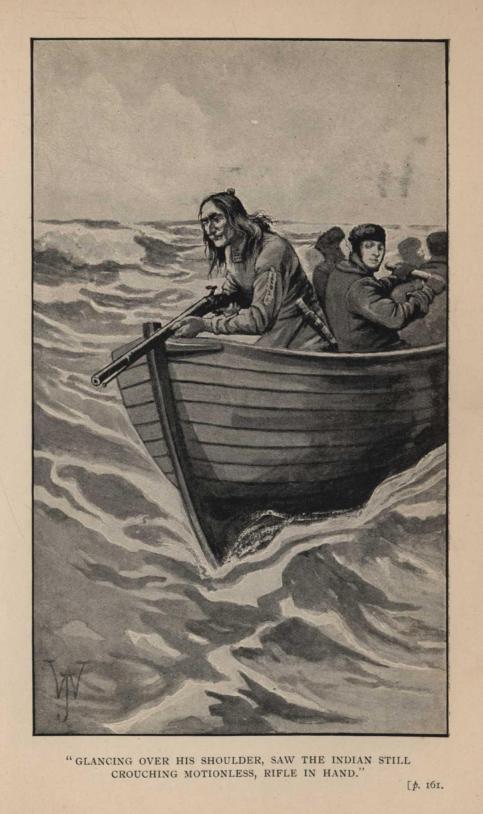
"GLANCING OVER HIS SHOULDER, SAW THE INDIAN STILL CROUCHING MOTIONLESS, RIFLE IN HAND."
Suddenly he spoke, and Stickine moved his oar. "Pull," he said quietly. "Steady and easy."
Appleby had seen nothing move on the long slope of sea, but he felt his heart beat, and his blood pulse faster as he dipped his oar; for the crouching figure in the bows had risen a trifle and the rifle was pitched forward now.
Then he looked aft again watching Stickine, who stood up, swaying with the boat, but otherwise very still, with his eyes fixed forward and a little glint in them. Presently he moved his head, Donegal stopped rowing, and while the lads rested on their oars there was a bang, and a wisp of acrid smoke curled about them.
"All you're worth!" said Stickine sharply, swaying with his oar, and the lads bent their backs with a will. The boat seemed to lift with every stroke, Donegal made a little hissing with his breath, and Niven gasped from strenuous effort and excitement as he heard the swish of water that swirled past them, and strove to keep stroke. He felt that another minute or two would see him beaten, when Stickine flung up one hand, and there was a curious quietness, until something brushed softly against the sliding boat.
"Get hold!" said Donegal, leaning over, and a clumsy, almost shapeless, object came in with a roll.
It was not what they expected, but both Niven and Appleby long remembered the killing of their first seal, and while they sat flushed and breathless, with the salt brine trickling from their oars, the surroundings were of a kind likely to impress themselves on any lad's memory.
In front of them a long slope of grey water rolled up against the hazy sky, and another big undulation that shut out the schooner hove itself high behind. A little, thin, blue smoke still curled from the muzzle of the Indian's rifle as he stood up in the bows with his impassive bronze face cut sharp against the sea, and Stickine was stooping over the hump-shouldered object that lay quivering on the floorings astern, in a fashion that suggested a shaken jelly. It was a dingy grey colour, and covered with long, coarse hair which did not bear the slightest resemblance to the beautiful glossy fur they had been accustomed to in England, and the lads' hands were sticky with the grease of it.
"And that's a seal!" said Niven, glancing disgustedly at his fingers. "I'd sooner claw a dog that hadn't been washed for years. They make ladies' jackets out of that beastly stuff?"
Stickine nodded, and touched the object, which quivered again, with his foot. "Oh, yes," he said, with a little laugh. "That's just a holluschack. The under-hair's quite fine enough, and—you see him shaking—he's got two or three inches of blubber under that."
"What's a holluschack?" asked Appleby.
"Riches," said Donegal. "If ye can catch wan often enough, and, by the token, the Americans who leased those islands yonder made more out av them than their Government paid the Russians for them and the whole of Alaska. How many years was they doing it, Stickine?"
"'Bout two years," said the Canadian. "There was more seals crawling round there then, but they got kind of tired of being clubbed and shot at."
"We don't know what a holluschack is yet," said Appleby.
"Well," said Stickine, "it's just a bachelor seal, so young that the bulls don't have no use for it hanging around, and that's why you find the holluschackie by themselves, which is fortunate, anyway, because it's only them one wants to catch. The cows go free—that is, mostly—and the bulls are that chewed up they're not worth killing."
"What with?" asked Appleby.
"Fighting," said Stickine. "The bull he comes up first and crawls out on St. George there, to look for a nice place for his cows to lie down in. Just as soon as he finds it another bull comes along and wants to take it from him. If he's got grit enough he hangs on to it, and when the cows crawl out of the sea the circus begins. Every bull has to fight for those that belong to him, and for six weeks anyway you can hear them roaring."
"I can't fancy that thing roaring," said Niven, pointing to the holluschack.
Stickine laughed softly.
"Well," he said, "when the bull stiffens up he can do most anything but sing, and you can hear him quite as far as a steamer's whistle. Time we were getting a move on, Donovitch."
The Indian said something the lads did not understand in the Chinook idiom, and they clipped the oars again. For an hour they pulled shorewards, and now and then the sound of a rifle reached them faintly, but the boats were seldom visible, for a filmy greyness was crawling across the sea. Once Appleby had a momentary glimpse of the schooner, a blur of slanted canvas against a patch of hazy sky, but she faded next moment and was not seen again.
Then the Indian spoke softly, and when they stopped pulling at a sign from Stickine, Appleby, twisting himself round, saw something that was a little darker than the water swing with a grey slope of sea. The Indian was now lying huddled in the bows, and the rifle-barrel poked forward over them, while the copper cheek was down on the stock of it. It, however, seemed almost impossible that, as the boat swung up and down, any man could hit the dim moving thing which showed above the water with a single bullet, but while Appleby waited breathless the muzzle jerked upwards, and there was a thin flash. Then stinging smoke curled about him, and the jar of the report was flung back by the heaving slopes of sea. The Indian grunted as the cartridge rattled at his feet, and Stickine grabbed his oar.
"I'm not sure he got him, and a wounded seal generally goes right down," he said. "Still, he might give us another show, and we'll pull ahead somewhat, my lads."
They rowed for what seemed to the lads, who could see nothing but water, a considerable time, twisting now and then to left and right, until the rifle flashed again, and Stickine roared at them. Then for three or four minutes they pulled breathlessly, until there was another shout, and they flung the oars in and grabbed at something that slid past them. It took the whole of them to roll it in, and then there was a little laugh from Donegal, while Stickine stood looking down on the victim disgustedly. It was nearly twice the size of the other, but its fur was loose and thin, and there were big patches where it had been apparently torn away and had not grown again.
"It would take any man all his time to find a dollar's worth of sound hide on him," said Donegal, with a chuckle. "'Tis spectacles ye and Donovitch are wanting, Stickine."
"Well," said Stickine dryly, "a dollar's a kind of handy thing, but we needn't have pulled so far to leeward after a blame old bull."
None of them had apparently had much thought of the weather during the past half-hour, but now when they sat breathless resting on the dripping oars a cold wind chilled their flushed faces, and they saw that there was sliding vapour everywhere.
"She was lying 'bout south and dodging with staysail to windward when we had the last sight av her," said Donegal. "Is it any way likely Ned Jordan would get way on her?"
Stickine shook his head. "If it was clear he might have done, but once the haze shut down he'd stop right where he was so the boys would know where to look for him. We'll try south, anyway."
They bent their backs, for Stickine took his place again, but as they swung up with a sea Appleby wondered how any one could tell where the south might be.
There was no sign of either boat or schooner, only a heaving stretch of water across which the fleecy vapours rolled more thickly. They had pulled for about twenty minutes when it seemed to the lads that the splashes at the bows grew louder and the work harder, while there was no doubt at all that the wind was colder. Then little puffs of spray commenced to fly over their shoulders, and at times there was a white splash on the top of a sea. Appleby could hear Niven panting, and began to envy Donegal, who swung back and forwards with tireless regularity. His own oar was getting unpleasantly heavy.
"Stiffen up," said Stickine. "We've got to get there quick. Wind's coming along right now."
He had scarcely spoken when the splash from Niven's oar blew over Appleby's shoulder and wetted his face, while the slope of the next sea was lined with ripples curiously. Then one frothed angrily on its top, and when the boat plunged over the next one a cloud of spray whirled up. She seemed to stop a trifle, while as the oars went down again Appleby gasped, for Donegal and Stickine were swinging a trifle faster, and he found it almost impossible to keep stroke. He had also a shrewd suspicion that they could, if it was necessary, row as they were doing all through the night, while it was evident that another half-hour would exhaust the last of his strength. Still, he set his lips and tugged at his oar, while as the lurches grew sharper it became more difficult to keep the blade out of the water.
At last when the bows were flung high he missed his stroke and fell backwards upon Niven, while as he scrambled to his feet again Stickine stopped rowing, and twisting round, looked at them over his shoulder. It is more than possible he saw distress in the young faces, for that was a bigger and heavier boat than those generally used for sealing, and Appleby noticed that he shook his head as he glanced at Donegal.
"The schooner's 'bout a mile to windward still," he said. "You've got to wake right up and pull."
His voice was sterner than usual, and the lads, who recognized the difference, shook themselves together and fell to again. They were very tired, but they had discovered on board the Aldebaran that there are times when the overtaxed body must be kept to its task by sheer force of mind, and that worn out, ill or well, men must work at sea. Still, Stickine's stroke was a trifle slower when they went on again, and gasping and panting, while their arms grew powerless and their temples throbbed, they kept time to it. The spray was flying freely, and there was nothing to be seen but dim slopes of water tipped with froth, for the right was smothered in the fog and the dusk which replaces night at that season closing in. Niven was groaning audibly now and then, and Appleby pulled in torment with a horrible pain in his side, when at last the crash of a gun came out of the dimness.
"Over our starboard bow!" said Donegal; and as he swung into faster stroke, the task became grimmer yet.
Now, Niven had been one of the best hares the Sandycombe Harriers had ever known, and Appleby had brought the school boat home first in the local regatta, but they had never taxed their uttermost endurance of mind and body as they did in the wild ten minutes that followed. It was one thing to race for honour or a silver cup, and a very different one to row for their lives, as they felt unpleasantly certain they were doing now. All round them seatops came frothing whitely out of the darkness, but the sound they made was lost in the scream of wind.
At last, however, and with relief unspeakable, Appleby saw the schooner's canvas grow out of the mist. They were close upon her before they could see her hull, and then it was only the dripping bows swung high with a jib hauled to windward above them. She crawled out of the vapour, rolling to leeward, with the streaky backwash streaming down her sides, and while Niven wondered whether it would by any means be possible to get on board her, the boat slid in under her bulwarks as they came swinging down, and Stickine clutched the rope that was flung him.
Niven did not know whether he crawled up or Stickine pulled him, but in another moment he was on board the Champlain with Appleby beside him and a row of men floundering aft along the deck. Then the boat swung in between the masts, and when she dropped upon the hatch he saw that Jordan was talking to Stickine a yard or two away.
"One good one," said the latter. "And a bull. We'll do if we get two dollars for him. Two of the boats away yet?"
"Charley's," said Jordan with a little laugh. "No need to worry over him. He'd fetch her through a gale of wind when he got hungry, but I'm kind of anxious about Montreal and the other one. You and the lads had to row?"
"They're played out, but they pulled quite handy," said Stickine.
Jordan swung round and glanced at Appleby, who leaned against the mast with flushed face and heaving chest, while Niven sat close by on the hatch still gasping heavily.
"I don't know that we've any use for you just now," he said. "You can get your tea from Brulée and crawl down below."
The lads did not want telling twice, and when they sat down with a steaming can of tea before them in the stuffy, curiously-smelling hold Appleby's face relaxed and Niven laughed.
"I'd never have believed I could be glad to get back to a place like this once, but I am," he said. "In fact, I scarcely fancy I was ever so glad to see anything in my life as I was when we got the first glimpse of the Champlain."
Appleby nodded with his mouth full. "I wasn't sorry myself," he said. "Now, it seems to me it isn't the ship but the men you sail with that makes all the difference when you go to sea."
He turned and saw Donegal grinning at him. "An' that's thrue," said he. "Ye will not as a rule make men glad to work for ye by kicking them."
CHAPTER XII
PICKING UP THE BOATS
Warm and snug as it was in the Champlain's hold neither of the lads cared to stay below. They could tell it was blowing hard by the humming of the rigging and the way the deck sloped under them, and their thoughts were with the two boats still out in the fog. The cold struck through them when they crawled out on deck, and little showers of brine blew in from the rail shining in the light that blinked forward through the filmy whiteness. Somebody beneath it was ringing a bell, and its dismal jangle seemed to intensify the doleful wail of wind. Now and then they caught a pale glimmer as a white-topped sea went by, and then for a space there was only a blank wall of sliding fog, until finding the desolation of it all creep in upon them they went aft along the sloppy deck.
A silent man stood almost motionless at the wheel, for the Champlain was lying to under her trysail and jib, making no way through the water, but bobbing with her bow to the sea. Jordan paced up and down behind the house, stopping now and then to gaze into the fog, and the rest were clustered under the lee of it. A lantern flickered above them, and they had evidently been busy over something, for two of them were wiping their knives and there was a horrible sickly smell. Then a man went by carrying a bundle of furs which reeked with the same odour, and Stickine, who saw them, called to the lads.
"Get the bucket and swab up," he said.
It was not easy to fill the bucket, and when at last Niven stood swaying with most of the contents splashing about him he sniffed disgustedly as he glanced at the deck, which was slippery with grease and blood.
"Essence of roses is nothing to this. What is it?" he said.
"Holluschackie blubber," said a grinning man. "You'd have smelt stronger than a scent store if we'd waited until you came up to heave the corpuses over. Hadn't you better start in before you sit down in it?"
Niven swilled on water, Appleby plied the swab, but though they got the deck clean the smell would not wash out, and when they crawled under the shelter of the deckhouse among the rest, Appleby gasped as he flung away his swab. "Does it always smell like that?" he said.
Jordan looked down from the house. "It generally does, but dollars don't lie around in the Vancouver streets," he said. "Dry that swab right out now and hang it up."
"Yes, sir," said Appleby, but his face was a trifle pale in the light from the lantern when he came back. "It about turned me sick—and it's going to take some time to get used to this," he said.
"Well," said a man, glancing at Niven, "it's the more smell the bigger profits when you go sealing. It's different from the things you were taught to do in the old country?"
Niven laughed a little, for the man's tone was ironical, and he had discovered that the less he talked about what he had been used to in England the better it was for him. "We don't have any seals to catch over there," he said. "Still, however do they clean up those things and make them into ladies' jackets? They have to get the smell off them."
"It's done back there in your country, in London," said another man. "Most beasts have two coats on them, anyway, and somebody once told me they pulled the outside half off with little pincers. Then I guess they shave them down and dye them. They're smart people there in London, and they don't let up when the holluschackie can't be had. No, sir. They'll make you a seal-skin jacket out of most anything. It's all in the dressing."
"But do the Americans send their seals to London?" asked Niven.
"Yes," said Stickine. "That's just what they do. Bring them back again dressed, paying a heavy duty, too, and one way or other those seals fetch the States a tolerable big revenue. That's why it galls them to see any other folk catching them."
Just then Jordan sprang up on the house with a flare in his hand, and the lurid wind-blown blaze that streamed above them showed the same look in the faces of the men. It suggested confidence in their skipper and their comrades out at sea, and yet grimly-suppressed expectancy. Then the darkness was intensified as the light went out.
"It's 'bout time you fired the gun again," he said.
A man floundered forward, and presently a long red flash blazed out over the rail, but the thud of the report was probably plainer a mile to leeward than it was on the deck of the Champlain. Then for five minutes nobody spoke and the bell tinkled dolefully, but no answer came out of the sliding fog.
"Thicker than ever!" said Jordan. "Try her again."
Three times at five minutes' intervals the red flash blazed out, and then while they listened a man sprang into the shrouds. "Here's one of them!" he said.
There followed a few moments of tense expectancy until a roar of voices went up as a faint cry came out of the fog. Then there was another silence, even worse to bear, until the man in the shrouds swung up an arm.
"Stand by," he shouted. "Here they come!"
Appleby running forward saw a dim black shape hove up on a sea that swept past the bows, and for a moment the light from the forestay shone down upon the boat. She was lapped about in foam, and while the men, with wet, grim faces, bent their backs as the oars swung through it, a dark ridge with froth about its top rolled up out of the night behind her. Then all was dark again, for she swept in beneath the bulwarks and the schooner rolled viciously. Out of the darkness came a thud and a shouting, black figures fell in over the rail, and while blocks rattled the boat swung dripping high above the bulwarks, until they dropped her neatly inside the other ones. Appleby surmised that the operation would have been almost impossible on board the Aldebaran, and he had heard that it not infrequently takes an hour to get a boat out on board a steamer. Then the men came aft with the water running from them, and Jordan, who once more paced up and down, stopped a moment.
"Where's Montreal?" he asked.
The foremost sealer turned and pointed to the sliding whiteness over the rail. "I don't know," he said. "One couldn't make out much of anything in that."
Jordan nodded. "What have you got?"
"Three holluschackie," said the sealer. "I guess we'll get the boat cleaned up and the hides off them."
Jordan said nothing but paced up and down again, and while a few dark objects moved about the boat the men floundered back into the partial shelter of the house. They did not express their fears in speech, but all of them knew the chances were against Montreal and his crew finding the schooner. If he failed the prospect of his boat living through the gale that was evidently rising appeared very small. To leeward lay St. Paul and St. George, but the sea foams and seethes about them, and any sealer who might make a landing in the dark, which very few men could do, would in all probability find himself a prisoner. Still the men of the Champlain faced such risks almost daily in the misty seas, and when the boat was stripped they and the Indians quietly set about flaying the seals. The fog whirled past them, their knives twinkled in the flickering lantern light, and now and then a brighter beam fell on their impassive brown faces and blubber-smeared hands. Then it would swing away as the schooner rolled, and the lads who stood about with swab and bucket could only see them dimly until it blinked into brilliancy again. The rigging screamed, the bell jangled on, and now and then through the confused sounds rose the thud of the gun.
How long they worked Appleby did not know, but he forgot the smell of the blubber and the horrible sliminess of the swab as he pictured the worn-out men grimly swinging the oars in the fog. Each time the schooner swung her bows aloft the black shape of a man crouching forward in the spray became visible, and now and then Jordan tramped along the deck to speak to him. The lads could guess what his question was, but there was no answer to either bell or gun, until at last the skipper stood still suddenly, and every man who saw him turned and stared across the rail. For a minute nobody moved or spoke, and there was nothing to hear but the wail of the wind in the rigging.
Then Jordan swung himself into the shrouds, and the men went forward with a rush. Clinging to the rail Appleby looked down, and as the flicker of the light fell upon the sea something went by, and he had a glimpse of part of a dripping boat with two men whose faces showed white and set straining at the oars. One of the others had apparently fallen forward, and a fourth was standing erect astern. The attitude of all of them expressed exhaustion. Then as the boat swung round a trifle a sea that rolled up caught her on the bow and the men at the oars made a last effort as she swept astern. Next moment she had passed out of the light, and there was only foam beneath him.
"We've lost them. They'll never pull her up," he gasped.
Jordan sprang down from the shrouds, and his voice rang out, "Down trysail. Sheet your staysail to weather and run it up."
He said nothing to Stickine, who now held the wheel, but Appleby saw him bending over it, and there was a banging and thrashing of canvas as the staysail went up and the trysail came down. Then the schooner slowly swung round, until a shout rose again, "Let draw, and sing out forward if we're running over them!"
The Champlain had her stern to the wind now, and was running before it after the boat which had blown away to lee, while the men stood silent here and there along her rail, until one of them forward shouted, and as Stickine swung with the wheel something half-seen went by. It was lost in a moment as the schooner drove ahead, and Appleby recognized the horror he felt in Niven's voice.
"He can't be going to leave them!" he said.
Donegal, who was standing close by, dropped a heavy hand on his shoulder and held it in a painful grip. "Is it a head or a shroud deadeye ye have that ye do not know Ned Jordan yet?" he said. "Away with ye to the trysail halliards. They'll be wanted presently."
For about a minute the Champlain lurched on before the seas, and then from where Jordan stood in the shrouds a great blue blaze flared out and Stickine pulled round the wheel. Men whose faces showed intent in the streaming radiance floundered towards the mast, and as the Champlain came round the trysail went up. In another moment or two Appleby and Niven were hauling at its sheet among the rest, and presently the schooner lay rolling almost head to the sea. Then there was a brief space of breathless waiting while every man stared over the rail, and Appleby knew that the schooner would lie there scarcely moving through the water until the boat came up with her. He could feel his heart beating as he strained his ears and eyes.
"Here they come!" shouted somebody, and while the blue radiance streamed out across the waters the boat swung into sight.
It was evident that the worn-out men knew they could take no chance of driving down to lee this time, and the lads held their breath as they saw the boat whirl towards them on the top of a sea. One could almost have fancied she would be flung on board over the rail.
"Down helm!" said Jordan. "Luff, if you can. Handy with the tackles there. Make sure of them."
The schooner swung round a trifle, the boat slewed, there was a crash, and she was lost in the shadow below the rail, while black darkness followed as the light went out. Hoarse shouts came out of it, men scurried here and there, and fell from the rail, then there was a rattle of blocks, and Appleby found himself floundering along the deck with panting men behind him and a rope in his hand. The boat they hove up was dropped into her nest, a seal or two flung out, and Jordan, who came forward with a lantern, shook his head as he glanced at her.
"Coming alongside that way is kind of expensive, but I guess you hadn't much choice just then," he said.
"No," said a man who stood, gasping still, with half-closed eyes in the lantern light. "We just had to fetch you the best way we could, and we'd have missed you sure while we tried to round her up to lee. She was 'bout half-swamped and all of us used up considerable."
In another few minutes the lads and most of the others went back into the hold and sat watching the last comers, who wasted no time in talking as they attacked the meal Brulée set before them. One of them, however, sat somewhat limply, and his face, which was tinged with grey, seemed drawn together. He ate nothing and only drank a little tea. Then as the others stretched out their long limbs towards the stove Donegal looked at Montreal.
"And what was it kept ye so long?" he said.
Montreal laughed softly, though the stamp of exhaustion was on his face. "Just the wind!" he said. "We was well away to leeward, and when we'd pulled 'bout a mile Tom there got a kind of kink inside him and had to let up. Then Siwash Bob sprung his oar, and we lost all we'd made the last hour while Tom got his wind again and I was fixing it. After that the boat began to take it in heavy and we had to stop to bale. There wasn't much left in us, and Tom was groaning awful when we heard the gun."
Niven stared at the speaker with a little wonder, and Appleby smiled, for the story was a singularly unimpressive narration of what they knew had been a grim struggle for life. Then Niven saw that Donegal was watching him, and became sensible of a faint embarrassment, for the sealer had an unpleasant habit of guessing what he was thinking.
"You and me could have told it better, Mainsail Haul," said he.
Niven flushed a trifle. He knew he could have made the story a good deal more effective, for there had been times when he had held the dormitory silent and expectant as he narrated some small feat of his at Sandycombe, but he had an unpleasant suspicion that this gift was apt to win its possessor derision rather than respect at sea, where the men who did things that would have formed a theme for an epic poem seemed reluctant to talk about them. Montreal, the sealer who under Providence owed his life to his splendid strength and valour, said nothing about the effort and almost superhuman strain, but only mentioned that they had sprung an oar and his comrade suffered from what he termed a kink inside him.
"Well," said Niven awkwardly, "it's a good while now since I told you anything at all."
"Sure," said Donegal, grinning. "'Tis since I've had the teaching av ye. But ye do not seem quite easy, Tom. Sit up while me and Mainsail Haul pull the clothes off ye."
The man grumbled and protested that there was nothing wrong with him, but Donegal worked on unheeding and shoved him by main force into his bunk.
"Now, you lie right there till I get something from Jordan that will fix you," said Stickine. "If he tries to get up, boys, one of you will sit on him!"
He came back presently with something in a can, and the man, who gulped down the contents, grinned.
"I guess it would take a kink with considerable grit in it to face another dose of that," he said, and turned his face, which was beaded with the damp of pain, from the light.
The others, however, seemed to know what he was suffering from and went on with their talk, while presently Appleby asked a question.
"What would have happened if we'd been blown ashore?" he said.
Stickine laughed a little. "Well," he said, "I don't quite know, but it's kind of likely the Indians would have taken their clubs to us. Anyway, it would have been a long while before we did any more sealing."
It took Appleby several more questions before he elicited much information, and what he got was not very plain to him. It, however, appeared that the seals which bred on the lonely beaches of the misty seas had been growing scarcer, and that one or two of the commanders of the gunboats sent to watch them had now and then exceeded their rights. Three miles to sea is the limit placed to a nation's authority, but it seemed from stories told in the Champlain's hold, boats had been chased when farther than that from land. The men were not very explicit, but Appleby surmised that reprisals were made now and then when a schooner's crew landed on forbidden beaches.
"Still," he said, "if you lose a day or two's sealing when a gunboat's about it means a good many dollars."
A little twinkle crept into Montreal's eyes. "It don't always," said he. "Here you are with the boats all out raking in the holluschackie, and a gunboat comes along. 'Clear out of this or I'll make you,' says her skipper. 'All right,' says you. It's so many seals he's doing me out of now, when he has no right to, and I'm going in to get them where it's easiest when he steams away."
Niven seemed a trifle astonished. "That's here," he said. "Do they do things the same way everywhere?"
There was a little grim laughter, and Montreal pointed towards the west. "No, sir," he said. "When you go where the Russian seals live there's no use for talking of any kind, because you can't understand each other, and you use the clubs. There's men I know have seen other things come in quite handy too. Now old man Harper of the Golden Horn——"
Donegal stopped him. "'Tis talking too much ye are, and, as everybody knows, Ned Jordan is a quiet man," he said. "'Tis curious tales Mainsail Haul will be telling the earl about us when he goes home."
"Let up!" said Niven. "I'm a sealer now, and I only want to know if any one tried to arrest the skipper wrongfully, what would he do?"
Donegal's eyes twinkled. "He would run away like a sensible man, or hide in the fog," he said.
"But if he couldn't, or there wasn't any fog?"
Donegal shook his head. "'Tis persistent ye are," he said. "Peace is a thing Ned Jordan's fond of, but if folks will not let him have it his fist is as big as most."
Nobody said anything further, but there was a curious little smile in the men's bronzed faces, and while Appleby endeavoured to kick his comrade in warning that it would not be desirable to ask any more questions there was a crash above.
"There," said Donegal, grabbing Brulée's shoulder. "'Tis your galley tore up by the roots."
"No," said Stickine. "I figure it's the water tank got adrift. We want a lashing on her before she goes right out through the bulwarks, boys."
They were out of the scuttle in another minute, and when he got on deck Appleby saw a big, black object drive against the mast. Before any one could seize it it had rolled aside again, and in another few moments struck the bulwarks with a heavy thud, for the Champlain was still lying hove to and lurching wildly. How they at last secured it the lads could not quite make out, for the big tank would have crushed the man who got between it and anything, but it was done, and as they were relashing it Jordan came up with a lantern.
"Heave her over, boys. She has started the rivets, and that's going to make trouble for us," he said.
They hove the tank the other side up, and Appleby saw that the skipper's face was grave as he lifted the cover off, but there was apparently no more to be done, and he went below with the other men.
"What did Jordan mean?" he said to one of them. "Of course it would be awkward to run short of water if we were far from land, but there is plenty within a few miles of us."
"Oh, yes," said the man dryly. "But it wouldn't be much use telling the folks ashore you'd only come for water and didn't want no seals. They'd be quite glad to get their hands on us, whatever brought us there!"
"But we can't do without it," said Niven.
"No," said the sealer. "Still, I wouldn't worry. When Ned Jordan's short of water it's quite likely he'll get it if there's any handy."
CHAPTER XIII
ON THE BEACH
It blew hard that night, and seeing there was no hope of sealing next day Jordan beat the Champlain slowly out to sea. He said nothing to any one until when noon came he called the men together.
"We want water, and there's plenty yonder," he said, pointing vaguely across the sea-tops that swung up under the rain. "Still, I don't know that we mightn't have some trouble getting it."
"When you tell us you're ready for it we'll bring that water off," said somebody.
Jordan nodded. "There'll be a big surf on the beaches, but you might do it unless somebody stopped you," he said. "They have a crowd of Aleuts on St. George, and I figure there's a gunboat hanging round somewhere handy. Well, now, if we went east to the Aleutians we could get all the water we wanted with less worry, but it would take us a while getting there, and every day means dollars."
"We'll take our chances at St. George," said Montreal.
"So long as you're willing!" said the skipper. "You've all got a stake in this deal, and I don't know that I'd like to help Mrs. Jordan keep house on nothing if I bring the schooner home without the skins. Still, if the Aleuts got you it's very few dollars you'd make sealing the next year or two."
He spoke slowly, and there was nothing to show that he was asking the men to do a perilous thing. Nor was there anything unusual in their answer returned by Montreal. "We're not sailing around here for pleasure. As soon as it's dusk you can run her in."
The rest of the day passed slowly with Appleby and Niven, but it came to an end at last, and when dusk was closing in the Champlain, under trysail and jib only, crept in towards the land. The sea ran behind her heaving, white-topped out of the gloom, for though there is no actual darkness up there at that season the haze that slid by before a nipping wind was thickened by the rain.
There was nothing now to be seen but the filmy vapours that whirled about them or heard but the splash of the sea, and Appleby wondered at the skipper's daring in running in for the land. At last, however, when the obscurity had grown almost impenetrable the lads heard a deep rumbling sound that came off to them faintly in long reverberations. They surmised it was the roar of surf on a rocky shore, but it was to windward instead of under their lee.
"We were to weather of the island, Stickine," said Appleby.
"Oh, yes," said the Canadian. "But there wouldn't be much left of the man who tried to land on that side of it, and Jordan's running under the lee of it now."
"But it's beastly thick, and we've scarcely seen the land since morning," said Niven.
Stickine laughed. "It's about six hours since I had a glimpse of it myself, but that don't count for much," he said. "Ned Jordan got a bearing, and he'd tell you right off what the schooner had made every tack. Tie him up with a sack round his head, and she'd be just where he wanted her when he brought her up. I guess we've 'bout got there now."
Almost as he spoke Jordan's voice rose up. "Jib to windward, and get the boats over soon as she loses way. Don't hang around a minute after you're through with the water."
"Will we take the rifles?" asked Stickine.
"One," said Jordan dryly. "If you fire quick twice I'll send off another boat to you, but you've got to remember I don't want to. We've nothing against the Americans just now, and I'm not going round looking for trouble with anybody."
They swung two boats over, and Appleby managed to slip on board one before he was noticed by anybody except Niven, who sprang into the last one as the men got the oars out.
The skipper's dark figure showed up for a moment as he looked down from the bulwarks of the rolling schooner.
"You're going for water, boys, and if you bring one holluschack along you'll take it right back ashore," he said. "That's quite plain?"
There was a murmur which did not suggest altogether willing obedience, but no one could mistake the little ring in Jordan's voice, and Stickine signed to the men.
"You heard him, boys? Now, stretch your backs," he said.
They had pulled a few strokes, and the schooner was melting into the haze astern when one of the men looked round.
"Who've we got there in the bows?" he asked.
Appleby, who had hoped to escape their notice for a while, told him. "I fancied my place was in this boat," he said.
"Well," said Stickine dryly, "if I'd seen you before you'd have gone right back with a run. Hello! have you got the other lad, Montreal?"
"Sure!" came back the answer, and Donegal laughed.
"There was no keeping them out," he said. "It would not take a minute to pitch them over."
"We'll try it next time," said Stickine. "Pull in along our wake, Montreal. It's not a nice beach to land on."
After that nobody said anything for a while, and only the splash of oars marked the passage of the boats. Appleby crouched aft on the floorings where he could see the men sway through the dimness above him, while another sound grew louder than the hoarse growl of the seas that seethed about the reefs. It was scarcely like anything he had heard before, though once it faintly resembled the whistling of scores of engines and then swelled into a roar. He surmised it was made by the seals.
"The rookery's just thick with the bulls," said somebody.
"Hold on," said Stickine. "I guess you're here to row, and any talking that's wanted will be done by me."
They lurched on, seeing nothing, into the haze, but Stickine appeared to know where he was heading for, and by the easier rise and fall Appleby guessed they were pulling closer in under the sheltered side of the island.
Still, it was evident by the dull booming sound which grew louder that the swell lapped round to leeward too, and there would be a difficulty in making a landing.
Suddenly, however, the men stopped rowing, and the splash and thud ceased astern, while Stickine sharply turned his head as another sound that none of them had expected to hear came out of the haze. It was a dull grind and a rattle that jarred through the roar of the surf, and then stopped again. Appleby recognized it, and surmised that it meant peril to all of them.
"A gunboat," said Stickine half-aloud. "They're giving her more chain."
They lay on their oars a minute, staring about them and breathing hard, but could only see the sliding haze, and no sound that suggested man's presence in those misty waters reached them now.
"She's to windward. They wouldn't have heard us, boys," said Stickine quietly.
They went on, the oars splashing softly, while they strained their eyes, knowing that it was quite possible the gunboat's officers had gone ashore, and they might blunder upon her cutter. Still, there was no sound but that the seals made and the swelling roar of surf, until a wavy strip of whiteness heaved against the mist in front of them. Then Stickine laughed curiously as he turned his head and stared at the haze.
"I don't know if we'll find a cutter on the beach, but we have got to get the water, and we are going in," he said.
He gave no instructions, and they were apparently not needed, for the men knew their work, and while they bent to their oars a sea that frothed a little swung them high and carried them inshore. When they sank down on the back of it the one behind grew steeper and the boat seemed driven forward by an unseen force as she swept up on its crest. This happened several times, and then a great rattling of pebbles came out of the spray ahead and the last rush was almost bewildering. Then there was a crash, and the foam that seethed about her lapped into the boat, but the men sprang over knee-deep in water, and whipped her out, while almost before they realized that they had got there the lads found themselves standing on dry land. The men who had pulled the boats up were, however, already shouldering little wooden kegs.
"You'll stop right here with the lads," said Stickine, turning to two of them. "Get the boats down as far as you can if you hear us coming back in a hurry. Now, boys, we'll get a move on."
In another minute the men had started, and the lads watched them flounder over the shingle and up a misty slope, until they faded into the dim background and the patter of their footsteps was lost in the growling of the seas. Then they sat down beside Donegal in the shelter of the boat, though the other man stood upright at her bows. There was a chilly wind, and now and then the uproar the seals made, rolled about them. It was also very lonely, and Niven shivered as he crawled closer beneath the boat and wished he was back in the snug hold of the schooner.
"How will they know where to find the water?" he asked at last.
Charley, the man who stood up, laughed. "That," he said, "is quite easy. You see, Stickine has been here before."
"But you don't always damage your water tank, and Jordan wouldn't let them kill the seals," said Appleby.
Donegal nodded. "'Tis as inquisitive as Mainsail Haul ye are," he said. "Now, Ned Jordan never took a dollar that didn't belong to him from any one, and he's carrying no score against the Americans just now."
"Still, you or Montreal told me they'd tried to stop him sealing," said Niven.
"Oh, yes," said Charley. "That's just what they did, but you've heard Donegal. Ned Jordan don't let his debts run on, and he don't like anybody else to owe him anything."
"But from his way of looking at it the Americans owed him a good deal," persisted Appleby.
Donegal laughed. "They don't now, and when Ned Jordan has got what was owing him he don't want any more," he said. "'Tis the man that's never contented who gets into throuble."
This was not very clear, but Appleby fancied he understood, because there was only one way in which Jordan could have paid himself. Appleby was, however, by no means sure that what Jordan had done was altogether warranted, but that was for him to decide, and the lad had already surmised that a man must relinquish his rights or enforce them by the means that came handiest in the misty seas. In the meanwhile, the skipper had been kind to him, and the excitement of the life they led appealed to him. Turning to Niven he laughed a little.
"I wonder what your father would think if he heard we were taken to Alaska in handcuffs for seal poaching, Chriss," he said.
"Well," said Niven dryly, "I hope we're not going to be, and I don't quite think he'd find it so amusing as you seem to fancy. There's not much use in talking that kind of rot!"
They said no more for a little, and Appleby felt inclined to regret his speech. It called up unpleasant reflections, for he had more than a suspicion that the thing he had mentioned might very readily come about.
There were, he had been told, well-armed Aleut Indians on the island, and not far away a gunboat lay hidden in the haze. If Jordan grew impatient and fired his gun the prospect of escape seemed very small for any of them. By and by he turned to Donegal as the din the seals made vibrated about them.
"Do they make that uproar always, and what do they do it for?" he said.
"They'll go on another month, and this is the way av it," said Donegal. "The seals are lying as thick as herrings in the rookery, and 'tis more room every bull is wanting to bring up his family in, while the place that seems nicest to him is just the one his neighbour is lying in. Sure, they're just like men, and when ye hear one roaring he's looking savage at the big fellow that's crowding too near and wondering if he's able to tear the hide off him."
Niven laughed a little. "I never heard of a man wondering if he could do that," he said.
"Then," said Donegal dryly, "'tis a curiosity that is not unknown in Ireland. Is it lambs ye are at the English schools, my son?—Ye do not see them, Charley?"
"No," said the other man, and while they waited the roar of the sea seemed to grow louder and the wind colder, and unpleasant misgivings began to creep upon the lads as they wondered what was happening behind them in the mist. It seemed quite possible that Stickine had blundered into the Aleuts' clutches or that a body of the gunboat's bluejackets had been sent ashore. Charley, however, laughed when Appleby mentioned it.
"It kind of strikes me we'd have heard them," he said. "There would be a circus before they corralled Stickine."
At last the sound of footsteps became faintly audible, and a line of men came out of the haze. They were panting as they floundered down hill under their burdens, and a few moments later Stickine gasped as he laid the breaker he carried into the boat.
"It's 'bout time we were out of this, boys. Heave her off," he said.
They went down the beach at a floundering run as a sea seethed in, splashed knee-deep with the pebbles ringing and rattling under them, and sprang on board just in time to get the oars out before another white-topped slope of water came hissing out of the mist.
"Shove her through!" roared Stickine. "Pull the buttons off you, boys!"
The oars bent as the men swung backwards, there was a plunge and a thud, and seething froth swept about the boat. It splashed into her to their ankles, and then, while Appleby plied the baler, swept away behind, and the boat flung her bows high to meet another comber. They went over this one more dryly, and drawing out from the surf pulled as noiselessly as possible, straining eyes and ears for any sign of the gunboat. There was none, however, and at last, tired with the long pull over the steep heave of sea, they came up with the schooner. It appeared astonishing to Appleby that they had found her, and while he watched the dark hull reel on the long slopes of water he wondered how they would ever get the breakers on board her. The sealers, however, were used to doing even more difficult things, and it was accomplished while the boats swung in towards the schooner, and then off into the fog again. As soon as they were on board Stickine drew the skipper aside.
"There was a gunboat lying 'bout abreast of the head when we were pulling in," he said.
"Then do you figure she isn't there now?" said Jordan.
"I don't know," said Stickine. "Any way, we couldn't see her, and it wasn't quite thick all the time."
Jordan nodded as he said, "We'll have the mainsail on her and the boom foresail, boys."
In five minutes the trysail was below, and though it was blowing tolerably fresh the Champlain was thrashing out to windward under all her lower sail. Two men stood forward in the whirling spray, and Jordan staring to windward through his glasses on the house, but for at least half-an-hour there was nothing visible but the whirling fog and long tumbling seas. Then a man swung up his arm, and Appleby gasped as something blacker than the vapours slid out of the fog. It was not far away to windward and coming on swiftly, for as he watched it the white froth about the shadowy hull grew into visibility, and he held his breath a minute as he made out a funnel and two slanted spars. Black and dark, with no light about her and ominous in her silence, the gunboat lay across their course.
There was, however, no sign of either confusion or consternation, and Jordan's voice was quieter than usual.
"Up helm. Off with the mainboom, boys," he said.
Stickine pulled over the wheel, the long mainboom swung out amidst a rattle of blocks, and the Champlain came round, until instead of sailing close hauled to it she was running before the wind.
"Topsails," said Jordan. "Yard-headers. He hasn't got us yet."
There was no controverting that, but while Appleby knew the pace the Champlain could make when hard pressed it seemed almost impossible that she could out-sail a steamer. Still, the skipper's quiet voice was curiously reassuring, and he remembered that Stickine had told him there were two ways of winning a race. In the meanwhile the gaff topsails went up banging, and the foam was flying white when they were sheeted home. Then the men stood still about the rail, each busy with the unasked question—Had the commander of the gunboat seen them? The Champlain's stern was towards him now, and her mainsail alone would be visible with her masts in line.
They had not, however, long to wait for an answer, for suddenly a blaze of light drove through the haze and smote the straining canvas. Then it sank a little, forcing up the men's set faces and lighting all the deck.
For a moment or two the lads could see every one of them sharp and clear in the dazzling brilliancy, and then there was a bewildering darkness again, for the light went out. The gunboat had also gone with it, and they were once more alone in the fog.
"Seen us sure!" said Stickine.
Jordan laughed softly. "Running!" he said. "She'll not come round with him as we did. Let her come up. Boys, we'll have all sheets in."
In came the mainboom, the foresail and jibs were hauled in too, and the schooner's lee rail was swept by the frothing brine when she came up once more close-hauled to the wind. Still, Appleby wondered, for the gunboat was to windward of them, and Niven, who stood close by him, turned to one of the men to ask a question.
"We're going back straight towards the American?" he said.
The sailor seemed to chuckle. "We're going where she was, but she'll be somewhere else just now," he said. "When they've brought her round they'll steam after us the way they saw us going before the wind, and we're pinched right up within 'bout three and a half points of it. It would take a very smart man to get in ahead of Ned Jordan."
Niven laughed excitedly, for, remembering Lawson's lesson on board the Aldebaran and what he had been taught since, the manoeuvre was now plain to him. If the gunboat steamed away before the wind it was evident that as they were heading at a very small angle to it the vessels would be sailing in almost opposite directions, and there only remained the unpleasant uncertainty whether the pursuer would find them with her light again. Still, the Champlain was driving to windward very fast and the haze was thick.
"What did he switch his light off for?" asked Appleby.
"Well," said the sealer, "I don't figure he did. Seems more likely that something went wrong with it."
Others were doubtless wondering over the same point, for the men were still looking astern, and at last a faint silvery beam moved athwart the fog and then swept back again. Appleby fancied Jordan laughed as he came down from the house and stood by the wheel.
"That fellow's easily fooled. He's going right away to leeward as fast as they can shove her along, and the only thing that's worrying me is the mainmast head," he said. "'Pears to me we wrung it a little in the race with the Belle."
Almost as he spoke the Champlain put her bows in, and the deck was flooded ankle-deep with icy brine, while the lads could understand the skipper's misgivings as they glanced up at the big topsail and long gaff that stretched out the great mainsail's head. It was not difficult to see that the strain they put upon the mast must be considerable.
Stickine nodded from the wheel. "We've got to carry on and take our chances now," he said.
"Oh, yes," said Jordan. "Anyway, for another hour or so."
The time, however, had not passed when as the Champlain swung her bows out of a sea there was a sharp crack overhead, and almost simultaneously Jordan's voice followed it.
"Drop your gaff topsail and get the mainsail off her quick," he said.
Nobody lost any time, and there were many willing hands. In a few minutes the long boom was lying on the quarter and the Champlain jogging slowly to windward with the trysail only on her mainmast. Jordan did not appear by any means disturbed.
"I don't figure that fellow will find us again to-night, and we'll see what's wrong up there when daylight comes," he said. "You'll find me below, Stickine, if you're wanting me."
Then, except those who were needed for the watch, the men crawled below, and the Champlain rolled on into a thicker wisp of fog.
CHAPTER XIV
GOOD WORK
Next morning Montreal, who had been a carpenter, went aloft, and remained a while sitting on a little board the others hoisted up the mast. When he came down he followed Jordan and Stickine into the cabin, and all hands were curious when one of the Indians was sent for, too. Still, nothing transpired beyond that Brulée, who made an excuse for visiting the cabin, informed the rest that they were doing a deal of talking, until when breakfast was brought in Stickine and Montreal joined their comrades. Donegal quietly placed the can of coffee between his feet and signed to Niven to remove the eatables.
"Ye will have something to tell us, and breakfast will come on just as soon as ye have done it," he said.
Stickine laughed. "I don't talk when I'm hungry, and I want that can," he said. "When I've got a holt of it Montreal will start in."
"Well," said the carpenter, "my lot's just this. She's wrung her masthead, and I could splice a new one in with the lump of redwood forward and the irons Jordan found me, but it's a contract one could only put through in smooth water."