IN THE MISTY SEAS (continued 2)
Reading edition
Always the decks were flooded, and the men wet to the skin. The galley fire was frequently washed out, and they got cold provisions, often so soaked with salt water that they could scarcely eat them, while when sleep was possible they lay down as they were, all dripping, too worn out to strip off their clothes. It would not have been advisable to take them off in any case, for they might be turned out at any moment to furl upper topsails or haul down staysails in a sudden freshening of the gale. Canvas was furled and hoisted continually, because a ship will not sail to windward through a heavy sea unless she is sternly pressed, while her crew fight for every yard she makes.
Appleby even in his oilskins looked very gaunt and thin. His face was hollow and bronzed by exposure to bitter wind and stinging brine, while Niven, like many of the others, was troubled with painful sores from sleeping in salt-stiffened clothes. Their hands were stiffened and clawlike, their knuckles bleeding, and from the ceaseless rasp of ropes the undersides of their fingers were very like grain-leather. Worn out utterly and half-fed they were just holding out with the rest of the Aldebaran's company until they could thrash her far enough to the westwards to square away and run north into better weather on the other side of Cape Horn.
"Hallo!" said Niven presently. "That's a nasty cloud. I wonder what fresh beastliness it's bringing us."
Appleby, glancing to windward, saw that the glaring green beyond the seatops had faded out, and the horizon was smeared with grey. It also seemed to be closing in upon them rapidly, and overhead a black cloud with torn edges was swallowing up the strip of blue.
"More wind, any way. She'll scarcely bear upper topsails now," he said with a little groan. "Still, the old man's tolerably stubborn at carrying on."
Niven, glancing aft, could see the skipper's gaunt figure swung high upon the poop against a frothing sea as he too glanced to windward. He was probably as anxious as any one to get round Cape Horn, but it was only by carrying sail to the last moment and making the most of every lull he could hope to do it. Even as he gazed ragged ice fell pattering along the decks, and the daylight died out leaving a grey dimness behind it. Then for a few minutes sea and ship were hidden by the flying hail. It cut the lads' raw knuckles until they could have cried out in agony, thrashed their wet faces and rattled on their oilskins, while the rigging roared above them, and twice in succession the Aldebaran put her whole forecastle in. Then a great sea foamed in almost solid over her weather rail, and through all the uproar rang a high-pitched cry. The words were indistinguishable as they would have been a yard away, but the lads recognized it as the summons to shorten sail. For a minute or two they were busy about the deck, and then while the ship swayed over further the mate lurched by and grabbed the Dutchman, who was working awkwardly with one hand, by the shoulder.
"Lay aloft, and give them a hand up there, you skulking hog," he said.
"Mine arm," said the seaman, "der right one, she is nod of good to me."
Appleby remembered that the fellow had badly hurt his arm, and scarcely wondered at his reluctance to go aloft with only one hand to trust to as he glanced above. The upper topsail had been partly lowered down, but the loose canvas was thrashing between the yards, and these sloped down towards the whitened sea apparently as steeply as the roof of a house. Still, it was evident that every man was needed, for there were other sails to be handled and the Aldebaran was apparently going bodily over. She hove her nose up for an instant, and Appleby had a momentary glimpse of a jib that had burst its sheet thrashing itself to pieces above the bowsprit. Then sight and hearing was lost in a cloud of flying brine.
When he could open his eyes again he saw the mate lift his fist, and the Dutchman glance deprecatingly at the arm that hung at his side.
"Lay aloft," said the former, "before you get a damaged head as well as an arm."
The Dutchman shuffled towards the shrouds, and just then a half-heard shout came down from one of the black figures on the inclined yard. "We're beat. Send us another hand."
It was already evident to Niven that as the yard was higher than it should have been something was foul, and he could see that unless the men had help they would be hurled off it or the sail blown away. It was not his especial duty, but it was no time to be particular when the Aldebaran lay swept from end to end at the mercy of the squall, and he swung himself up into the shrouds close behind the Dutchman with Appleby following. The wind flattened them against the rattlings as they fought their way up, and then almost choked and blinded them as with the swinging foot-rope against their heel and stiffened hands on the slippery spar they crept outwards from the mast along the yard. They were not of very much use there, indeed, most often they were in the way, but they did what they could while the hail lashed their faces and the drenched and stiffened canvas banged about them so that to hear anything else was almost impossible. At times somebody shouted, but the words were blown to leeward and quite incomprehensible.
It was their business to roll up the great flapping sail, and lash it to the yard, but parts of it tore away from them, and blew out with a bang like a rifle-shot every now and then, while the long wet spar they leaned across increased the steepness of its slant. Niven glancing down a moment fancied that the Aldebaran's leeward rail was in the sea, and saw the rigid figure on the weather side of the poop waving a hand to them. He could, of course, hear no voice at all, but surmised the gestures meant it was high time their work was finished. Then the Aldebaran dipped her nose into a sea, and the cloud of spray she flung up hid everything, while in another moment a more furious gust shrieked about them. The yard slanted still further, and he fancied it was impossible the ship could recover.
His hands were stiffened and almost useless, his fingers were bleeding, and his breath was spent, while as he held on helpless for a moment there was a sound like thunder, and as a strip of canvas rent itself from the grasp of those about him he saw the Dutchman clawing desperately at the yard. The man slipped along it a foot or two, and Niven, seeing his fingers sliding, remembered he had an injured arm. He had also evidently lost his footing, for one leg was dangling, and the lad instinctively seized his shoulder. That left him one hand to hold on by, and he gasped with horror as he felt his fingers slipping from the yard and saw a great sea burst into a tumultuous frothing beneath him.
He was too cold and dazed to wonder if any of the others saw what was happening, and could remember only that if he loosed his hold the man he clutched would go whirling down to strike the iron bulwarks or plunge into the sea. So he set his lips, and while his arms seemed to be coming away from their sockets held on for a moment or two.
Then the hand he grasped the yard with slipped a trifle further, and with a sickening horror he felt his clawlike fingers yield, but dazed, half-blinded, and too overwrought with the struggle to think, he still clutched the Dutchman. In another moment the hand came away altogether, and man and boy went down.
Now a second or two earlier Appleby had noticed their peril, but could do nothing because there was a man between them and him. He smote the fellow's shoulder and shouted, but his words were blown away, and no one else had eyes for anything but the banging sail. It was too late before he could shout again, for with a little gasp he saw the two figures whirl downwards beneath him, until, because the Aldebaran lurched a trifle just then, the smaller of them struck a big wire stay with folds of loose canvas about it where it joined the mast, and lay for a second or two across it. The other fell on the top of the deckhouse, and then, while Appleby shivered, rolled off it and down on to the deck below. Almost as this happened Niven slipped from the hauled-down staysail and fell upon the house too, but apparently upon feet and hands together.
Then as Appleby endeavoured to get back to the mast so that he could descend, the man nearest it grasped him and he could not pass. The lad could not hear what he said, but he guessed its purport, and grew sick with horror as he saw that the man was right. There were others below to pick up the fallen if there was any life in them, and with the ship in peril every hand was needed on the yards. Also, while that fact might not have stopped him, he could not pass the man, who barred his way to the mast.
So he stayed, and did what little he could among the rest, until at last they had stowed the sail, and then went down in frantic haste, only to be driven forward by the second mate. The latter was a kindly man, but there are times when the injured or dying must take care of themselves at sea, and there was still strenuous work to do. Thus at least half-an-hour had passed, and the Aldebaran was blowing sideways about as fast as she forged ahead under lower topsails when Appleby reached the deckhouse breathless and dripping. It was almost dark inside it, for driving cloud had blotted the daylight out, but the swinging lamp diffused a sickly radiance which fell on his comrade as Appleby bent over his dripping bunk. Everything in the deckhouse was wet, as was Niven's face, but though it was drawn and white his eyes were open.
"Not quite all smashed up yet," he said with a little smile.
Appleby felt almost dizzy with relief, and his voice shook a trifle as he said, "But you are hurt, Chriss?"
"Well," said Niven feebly, though there was a little twinkle in his eyes, "it wouldn't be astonishing if I was, but I think a good lie down will put me right again. There was a big lump of the staysail under me, and I fetched the top of the house on my hands and toes. Couldn't get up just now, however, if I wanted to."
Appleby could think of nothing fitting to say, and patted his comrade's shoulder while he turned his head away. His eyes were a trifle hazy, and he felt that there are a good many things one cannot express in speech.
"The Dutchman?" he said presently.
Niven seemed to shiver, and shook his head. "I don't know. Couldn't take much notice of anything because I felt all in pieces myself just then, but I saw him come down," he said. "He just seemed to crunch up—as if he was an egg."
Lawson, who was sitting on his chest, made a gesture of impatience. "Now you shut up and lie still," he said. "Any one would fancy you had done enough to take a rest." Then he nodded to Appleby. "Get out. It's quietness he wants, and it's not going to make anything any better to remember what happened to the other fellow. I'll keep an eye on him, and you needn't worry."
Appleby, who knew Lawson could be trusted to do this, went out, and it was an hour or two later when he and the rest sat in the house again over a big can of tea which the cook had by some means contrived to supply them with. They still wore streaming oilskins, and the lamp that swung above them cast flickers of smoky radiance across their wet faces, while from outside came a muffled roar of wind and the crash of falling water as the Aldebaran lurched over the great smoking seas. Niven was evidently a little better, and smiled, though his face was awry with pain, when Appleby lifted his shoulders a little and handed him a biscuit soaked in tea.
"It's nice yellow jellies and grapes I'd be eating if I was laid up at home," said he.
"If you don't stop we'll make you," said one of the other lads. "Who has got any business to talk of those things at sea? What did the old man do to you?"
Niven grinned in a sickly fashion. "He asked me where I felt bad, and I told him everywhere," he said. "Then he and the steward pulled the clothes off me and prodded me with their fists. They didn't seem to find anything broken, but I was sore all over, and I'd sooner be whacked with a horse-girth than go through that again."
"Smacked with a horse-girth!" said Lawson, reflectively. "Now I've been kicked—with sea boots—a good many times, but that would be a new sensation. What does it feel like?"
"If you want to know you can ask Appleby," said Niven. "I fancy he could tell you."
Appleby laughed, for he saw his comrade was recovering. "But what about the Dutchman?" he said.
Lawson shook his head. "I only know the old man went forward to look at him, and he's tolerably bad. He came down bang on his shoulder, you see. Did the mate know he had only one arm that was any good to him, Appleby?"
"Yes," said Appleby slowly. "He was there when the man hurt it, and just before he went up I heard him tell him. I saw the mate double up his fist too—and the Dutchman had to go."
There was silence for a moment or two, intensified by the roar of wind, and the lads looked at one another with a curious grimness which seemed out of place there in their young faces.
"If he doesn't get better it's manslaughter, any way," said somebody. "Now we've had almost enough of this. What's to be done, Lawson?"
Lawson stared at the lamp for almost a minute before he answered. "If the man comes round we can't do anything," he said. "Of course we and the men could make a declaration about ill-usage at Vancouver, but the old man would back the mate up and we'd only be quietly sat upon. If the Dutchman dies it would be a little easier. The old man would have to put down all about it in the log, but he'd fix it the nicest way and then get two witnesses—the mate and the second mate—to sign it."
"Would the second mate do it?" said Appleby.
"I think he would have to," said Lawson dryly.
"Well," said one of the other lads, "where do we come in?"
"You," said Lawson, with a little, mirthless laugh, "don't come in at all, but there's one chance yet. When the men are paid off the old man's account of any death on board is read over, and they're asked if it's all correct and if the man was ill-used at all. If they could only stick to one story they'd get a hearing, and the Government would go into the thing."
"That doesn't sound difficult," said Appleby.
Lawson shook his head. "I'm afraid it's more than they could do," he said. "Every man would tell a different tale and get arguing with the rest until nobody could make head or tail of it, and the skipper who says nothing that isn't dragged out of him would come up on top again. Still, of course, there is just a chance of them being listened to, and that's going to make the mate a good deal nastier in the meanwhile."
Niven, who had lain silent, looked over his bunk. "He will not be nasty to me very long. I've had enough of the brute already. One could get ashore at Vancouver."
Lawson glanced at him impatiently. "Better shut up before you're sorry," he said. "There's only one thing to do, and that's to leave the old man to run the mate out quietly. He's a tolerably tough old nigger himself, but I fancy this kind of thing is a little too much for him. As I've told you before, there's very little use kicking about anything when you go to sea."
Then there was once more silence as the unpleasant veracity was borne in upon the rest. Nobody, it seemed, cared very much what became of them, and there was no one they could appeal to. They must take what came, and grin and bear it, however irksome it might be. The knowledge was especially bitter to Niven, who had possibly been made too much of at home, but Appleby had already a vague suspicion that in any walk of life it would be much the same. Every man had rights, he knew, but he had discovered that it is very little use to make speeches about them when they are unobtainable, and generally wiser to wait in silence for an opportunity and then stretch out a firm hand and take them. Some lads find this out early, though there are men who never discover it at all, and these are not infrequently a nuisance to everybody.
CHAPTER VI
A FAIR WIND
Niven, though severely bruised and shaken, recovered rapidly, and one morning a fortnight after his injury sat under the partial shelter of the weather-rail rubbing tar into a long strip of worn-out canvas with his hands. He had more than a suspicion that the canvas would never be used, and sitting still in a bitter wind while he dabbled his stiffened fingers in the sticky mess was far from pleasant, but the mate frequently found him work of that kind to do, and Niven knew that when he gave an order it was not advisable to argue.
Appleby was sitting close beside him similarly occupied, and every now and then a cloud of spray which swept the rail stung their faces and rattled upon their oilskins. Icy water came on board, too, but because they sat well aft they escaped the frothing deluges which poured over the weather bow and sluiced down the slanted deck to lee. Here and there a dripping man scrambled out of the way of them or clung fast to something in the wilder lurches, for the Aldebaran was still hammering to windward under scanty sail.
There was, however, clear, cold sunlight, and the wet canvas swayed across a patch of blue, while the lads could see the froth of the rollers shine incandescent against the flashing green over the weather-rail. The Aldebaran was shouldering her way through them with heavy plunges that buried her forecastle at times. Then she would swing it up, streaming, high above the sea, and there was a general scramble clear of the water which came splashing everywhere. The sunlight showed that the men's faces were gaunt and worn. They had for more than a month held out stubbornly, living for the most part on uncooked and soaked provisions, toiling the watch through at shifting sail, and then flinging themselves down in their drenched clothing only to be turned out half-dazed by the sleep for which brain and body craved as the screaming gale freshened again. Now they had, thanks to what the steward had gleaned in the cabin and told the cook, reason to believe that if the Aldebaran could make a few more leagues to windward the next day would see them round Cape Horn.
Still, they had been almost as near before only to be driven back to the east again, and haggard faces were turned expectantly towards the hard blueness athwart which the seatops heaved over the weather-rail. Presently Appleby glanced up sharply as the shadow of a sail fell upon him.
"Hallo!" he said, and there was a curious eagerness in his voice. "The topsail leach has come between us and the sun."
"I don't see why that should please you," said Niven. "It only makes it colder, and it's bad enough already, especially when you've had nothing worth mentioning to eat for weeks."
"No?" said Appleby. "Well, if I'm right it means warm weather, dry clothes, sound sleep when your watch is done, and the galley fire lit all day."
Niven looked up. "Oh," he said with a little gasp. "The wind is backing round—or is he only screwing her up a little?"
Both of them glanced from the straining canvas to the figure at the wheel, and the eyes of all on deck were turned in the same direction, for it was evident that only two things could have happened. Either the helmsman was jamming the ship half-a-point closer to the wind, which was unlikely, because the mate would have seen he sailed her as close as possible before; or the wind was going round. As they watched, the canvas swung further athwart the sun, and their hearts throbbed faster because they knew it was the latter. In place of thrashing to windward tack and tack, and frequently losing on one all they had made upon the other, they were now sailing almost in the direction they desired to go.
"I wish I could see the compass," said Niven. "Still, the wind must be backing southerly by the bearing of the sun. Why doesn't the old man let her go while he can?"
It is probable that every man on deck was asking the same question, for the heads of all were turned towards the poop, and nothing would have induced one of them to speak when the skipper appeared out of the companion. He stood quite still for several minutes, and then nodded to the officer of the watch as though contented, but no one moved on deck when he went below, and the attitude of the men suggested what they felt. They were, it seemed, not round Cape Horn yet, and the Aldebaran still held on plunging through the white-topped rollers close-hauled. Hour after hour dragged by, and all on board bore them in tense expectancy, until at last, when the watch was changed again, the skipper came forward to the edge of the poop with a little sour smile on his face. He spoke ostensibly to the mate close by him, but it is possible he meant his voice to carry further.
"Get a pull on the weather-braces, and the topgallants loosed. We'll make a fair wind of it," he said.
The mate came forward shouting, and for once he was very willingly obeyed. Both watches were on deck, for the one relieved had not left it yet, and the men fell over each other in their eagerness to get at the ropes, while Appleby felt his pulses throbbing and the blood surge to his face, as he watched the figure aft pulling at the wheel.
Round went the long, slanting yards, stopped, swung further, and stopped again, while the Aldebaran hove herself more upright and shook the salt wash from her as she brought the wind upon her quarter. Then there was a scurrying of agile figures, stripped of their oilskins now, for the high top-gallant yards, and when the loose canvas blew away from them, wet and weary men broke into a breathless song as they swung and fell about the feet of the masts. They had hoarse voices, and the lips of some were rent and cracked. Their bodies were raw from the constant lash of brine, but there was a light in their gaunt faces and the ring of triumph in their song. Its words were senseless rubbish, but through them the spirit of those who sang was clear, and it was the pride that comes of a hardly-won victory. They had borne almost all that flesh and blood could bear, and now they had won the gale they had defied and beaten was their ally. The Aldebaran seemed to know it, and swept north-west faster at every roll, hurling off vast folds of froth from her hove-up bows, while the foam seethed and flashed past, lapping in places almost to her rail. Still, for a ship will carry more canvas going free than she will close-hauled, her crew were not contented, and while they coiled the ropes away still watched the motionless figure on the poop expectantly.
Once more he raised a hand, and there was another scramble, more eager than before, and a rush towards the weather-shrouds, while presently great folds of canvas came dropping from the long lower yards. They spread out in a vast curve from rail to rail, and the Aldebaran, quivering to the drag of them, sped on faster than ever, with a wake that swirled and seethed far back across the long seas that now came rolling up behind her.
Then a Breton Frenchman solemnly danced upon the deck, and a little Italian cackled with shrill laughter, while a half-articulate growl of victory that was not a cheer went up from the British sailormen. They were flying faster than any but a very fast steamer, away from cold and wet and hunger, northwards towards the sun again.
For two days the Aldebaran drove along, swept by spray, at a pace which occasionally exceeded twelve miles an hour, and then, though her decks dried up and the foam sank lower beneath her rail, the pace did not diminish appreciably, for as the wind fell lighter there was a crowding on of sail. The royals were shaken out in turn, stay-sails in rows swelled between the masts, and while the long heave that was smoother now and dazzlingly blue came rolling up on her beam, she swung along, three towering spires of canvas above a froth-licked hull, with her jibboom pointing to the midday sun. It grew warmer every day, oilskins, pilot-coats and long boots were flung aside, wet berths and saturated bedding dried, and there was no more dining on pulpy biscuit because a sea had washed out the galley as well as the fire.
Then there might have been peace and contentment on board the Aldebaran had not the mate's temper apparently grown worse as the weather grew finer, until the half-cowed, sullen crew were glad to crawl away below out of the reach of his beady eyes when the watch was done. They were kept hard at work at something all day long, chipping iron, painting, scraping spars down, and the man who had only a bitter jibe for the most willing and scurrilous abuse for the tired generally contrived when nothing more unpleasant suggested itself that Niven or Appleby should carry the tar pot, while the blood would surge to their faces at the words which followed, if at any time they let fall one splash of it where it was not wanted.
The work began as soon as there was light enough to see by, and was never done. A good deal of it was brutal and much unnecessary, and it went on without intermission under the scorching sun of the equator, and was apparently no nearer finished when reaching in close-hauled one day they had their first glimpse of the great, snow-crested mountains that rise above the forests of Washington. Then the apprentices envied the men who had only signed on to Vancouver, because they at least would soon be free of the ceaseless small-persecution and hateful tyranny.
At last as they worked into the Straits of San Juan the pines of Vancouver Island lifted themselves above the horizon, and a day or two later the Aldebaran came to an anchor off Port Parry, which is where the warships lie and close to Victoria City. Vancouver, where she was to unload, stands on the Canadian coast about a day's sail with a fair wind further east, but the straits are sprinkled with islands and swept by tides, and because the wind was easterly and the sky dimmed by smoke, the skipper had gone ashore that morning to send off telegrams and if possible engage a tug. He did not return all day, and when evening was closing in Appleby and Niven sat outside the deckhouse, while the mate stood up on the poop apparently to see if there was any signal from the shore.
The evening was chilly, and a fresh breeze streaked the waters with a haze of smoke from some great forest fire which drove in thin wisps across the rising moon and now and then growing thicker blotted out the dark pines ashore. The lads had been working hard helping to send down the lighter canvas all day, and now they were aching in every limb. They were also moody, for do what they would the mate's bitter tongue had not spared them. Somebody was singing forward in the forecastle, and now and then a burst of hoarse laughter came aft, for the men there would be leaving the Aldebaran in a day or two. Niven sighed a little as he listened.
"Those fellows are well off. It's no wonder they're singing," he said. "Things are getting worse every day, and I'm very sick of it, Tom."
Appleby laughed, but there was not much merriment in his face. "Of the sea?"
"Well," said Niven slowly, "the sea is different from what I expected it would be, but that's not what I mean."
"The mate then?"
Niven nodded. "Of course," he said. "Now, he stops with the ship, and we don't know where we're going to from Vancouver. Lawson was telling me the Company's ships are away sometimes four years together. Four years of that mate, Tom. Just fancy it!"
Appleby's face grew a trifle grim. It was not an encouraging prospect, and he could see no way of avoiding it.
"It does not sound nice," he said.
"No," said Niven savagely. "If there's no improvement—and I don't expect there will be—I'm not going to put up with it." Then he glanced at his companion. "Tom, you'll stand in with me?"
Appleby looked grave. "Don't be an ass, Chriss. Wait and see what can be done when you go home."
Niven sat silent for almost a minute, and when he spoke his young face was very determined. "The point is, when are we going home? If we sail from here for England I'll try to put up with him, but if there's to be two or three more years of it I'm going to make for the bush before she leaves Vancouver. There's no use talking. I'm quite decided, and the only question is whether you will come with me!"
Appleby, glancing at his comrade, saw that no arguments could persuade him. Niven could be very obstinate, and Appleby had reasons for believing that the other apprentices also intended slipping away.
"If you go I'll go too, but I don't want to," he said quietly. "You see, there are good mates as well as brutes like this one, while I may never get another chance if I throw away the one your father has given me. I don't like the Aldebaran, but I still like the sea."
"The pater would find you a dozen better ones," said Niven eagerly, but Appleby shook his head.
"I couldn't take another favour from him if I made a bad use of this one."
Niven rose and moved once or twice wearily across the deck. "I'd get him to make you. Then you're not coming?"
"Yes," said Appleby gravely. "Whatever you decide on I shall do, but that will separate us very soon, because I will not ask your father to find me another opportunity."
Niven stopped and stood still with indecision in his face, while his voice was a trifle hoarse as he said, "Tom, you're a good fellow, and ever since I knew you have done your best for me, but now—oh, it's just because you're so decent you're stopping me putting an end to this misery."
"I'm not sorry," said Appleby dryly. "If you go, I'm coming too. Only when your father sends for you I shall stay out here and do anything I can or go on board another ship as seaman."
Niven saw he was beaten, and sat down wearily. "Very well!" he said with a little groan. "Perhaps something will happen, and I don't care what it is. Anything would be better than—this—and I simply can't bear it very much longer. Now the Dutchman's coming round the mate will be more brutal than ever."
He said nothing further, and while he sat still with a hopeless face in black dejection, the mate, who did not know all that he was doing, took his affairs in hand. Coming forward along the deck he stopped before them with a packet in his hand.
"Take the gig ashore, and put these letters in the post," he said. "Wait for half-an-hour, and then if you see no sign of the skipper, come off again. You can take Cally with you."
The lads were almost desperate, or they would not have done a foolish thing, for Appleby did not stand up.
"It's not our watch, sir," he said.
The mate swung round and looked at him with a little glint in his eyes. "You're talking again," he said. "If you're not on board the gig inside five minutes, I'll have my answer ready for you."
Appleby rose up and touched his cap sardonically, but Niven was sullen. "Very well, sir, but the gig's too big for us, and I don't know that we can pull her back against the breeze," he said.
The mate moved a little nearer with an unpleasant smile in his face. "The stream will sweep you off the land unless you do, and it should help you to pull if you remember it," he said. "That reminds me, I want Cally for something else."
Appleby saw that he had made a mistake again. Since he had spoken to the skipper their persecutor had avoided violence and harassed them with a vindictive cunning which left no room for any objection that would not put them in the wrong. So far speech had only lost them the help of a third hand who could have taken his turn at an oar and steered for them, and he grasped Niven fiercely by the shoulder lest he should answer as he turned away. The gig lay astern, and in another minute or two they had climbed down into her, and casting off stepped the mast and ran up the little sail. The wind would carry them ashore, but the gig though light was nearly twenty feet long, and, while they could row tolerably well, both knew it would cost them a strenuous effort to pull her off again.
"He's a pig and a beast!" said Niven, hoarse with rage, as he sat aft with the tiller in his hand while the boat swung over the little splashing sea. "She's not going to fetch the ship under sail coming back, and it will be no end of a fag to pull her, while I'm about done with handling those staysails all day already."
Appleby said nothing, but his face was very sombre as he slacked the sheet a little when a puff of spray flew over the weather gunwale, and the brine lapped perilously near the opposite one. He saw that the breeze was freshening, as an easterly wind often does at nightfall, and did not anticipate any pleasure in rowing back again.
CHAPTER VII
ADRIFT
When Appleby and Niven came clattering down the beach it was growing very cold and night was closing in. They had not found the skipper, and a man had told them that the little tramway between Port Parry and Victoria had stopped running. The lads had also been working hard in the sunshine all day, and because the mate had given them no time to change the light clothes they stood in they shivered a little in the chilly breeze. It came down moaning across the dark pines, crisping the land-locked harbour where two big warships lay, and when they stood on the pebbles there was a clear ringing of bugles.
"Half-an-hour, to the minute," said Appleby. "There's a tolerably stiff breeze."
"You timed us?" said Niven. "Of course, you would. Now, I could never have remembered it."
Appleby laughed a trifle grimly. "Yes," he said. "You see, I didn't want to stay here any longer than was necessary with the wind freshening. It's going to be quite hard enough work to get back as it is."
Niven groaned a little as he helped to thrust off the boat, for he was very tired, and his limbs had stiffened with the cold, while as he was about to step on board a Canadian came sauntering down the beach.
"Are you two lads going off to the barque out there?" he asked.
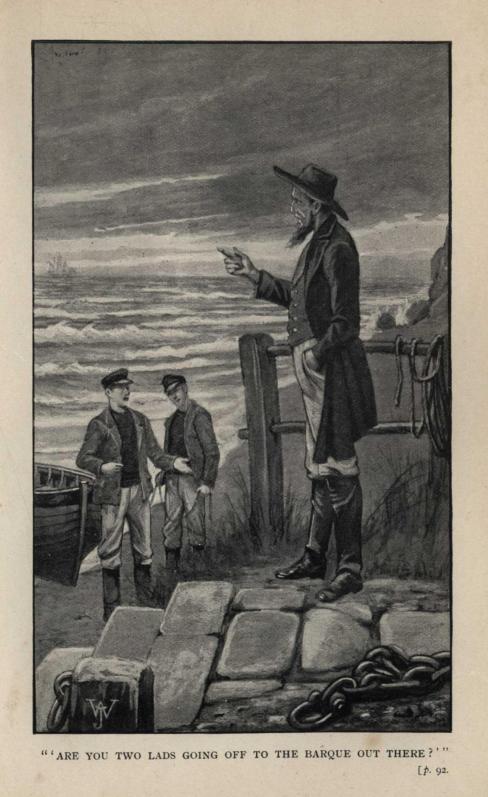
"'ARE YOU TWO LADS GOING OFF TO THE BARQUE OUT THERE?'"
Appleby nodded, and the man glanced towards the swaying trees and the little streaks of froth that showed white against the dimness out at sea. "It's a tolerably big contract," he said reflectively. "You've got to go?"
"Yes," said Appleby. "If you knew what our mate was like you wouldn't ask that question."
The Canadian laughed. "I figure I can guess," he said. "Well, now, you pull up well to windward along the shore where you'll get less breeze and smoother water, and when it strikes you you're far enough to head her across pull fit to split your boots—but don't miss her."
Appleby saw it was good advice, and did his best to follow it, but his back was aching and his arms were stiff; while when Niven missed a stroke, which he did not infrequently, the wind drove them a trifle further off shore before they could pull the gig's head round again. She had been built for four men to row, and while they would have no difficulty in propelling her in smooth water it was different when with the wind against them every little lurch checked her speed. Still, they toiled for half-an-hour or so, making no great progress that Appleby who watched the trees ashore could see, until Niven groaned.
"I'm almost done," he said. "If you don't head across soon I'll double up before we fetch the Aldebaran."
Appleby glanced at the shore, and then at the barque's riding light blinking fitfully half-a-mile away.
It was no great distance, but the breeze that blew slantwise off the shore would be on their side while they headed for her, and if the boat made much leeway they could not reach her. Nor did he fancy they would have the strength to drive the gig back to windward if they once drifted astern of her.
"Shake yourself together, Chriss, and we'll make a shot at it," he said.
Niven said nothing, but he bent his back, and for ten minutes they strained every sinew while the boat lurched and plunged on the little splashing sea as they drew out from the land. Cold as it was the perspiration dripped from them, and the oars slipped in their greasy palms, while both were gasping when a haze of smoke that blotted out everything drove down upon them.
"Head her up a little," said Appleby when the blinking light faded. "Put all you're good for into it, and row. There's nothing but the Pacific before us if we miss the Aldebaran."
For another five minutes Niven rowed desperately, his heart thumping and his breath coming in half-stifled gasps, while the boat plunged more viciously with the sea upon her bow. Then he missed his stroke as the moon came through, and Appleby could not check a little groan of dismay. They were close to the Aldebaran and could see her plainly as a cold blast drove the haze away, but she was well up on their weather instead of under their lee, and he knew it was beyond the power of any two worn-out lads to reach her against the wind.
"It's no use," said Niven hoarsely. "I can't do any more. Shout if you can, though we'd be out of sight before they could get the other boat over."
They made the most noise they could, but it is difficult to shout when exhausted by a strenuous effort, and it is more than possible that the splash of the sea and sighing of the wind drowned their strained voices. Nor is the low dusky shape of a boat easy to discern from a ship's deck on a hazy night. In any case, there was no answer, and for a minute the lads watched the three tall spars and strip of hull that rose black against the moon slide away from them—and that was the last they ever saw of the Aldebaran. Then another gust brought down the haze again, and while the smoky greyness drifted past them they were alone.
"I can scarcely pull," said Niven. "Do you think we could fetch ashore?"
"I don't," said Appleby with grim directness. "Still, we can try, and it's the only thing we can do."
They rowed for about twenty minutes, the splashing strokes growing slower while the plunging grew sharper, and then stopped again as the haze thinned a little. The blink of the barque's riding light was no longer perceptible, nor could they see anything of the shore.
"Well?" said Niven dejectedly.
Appleby laughed, though his voice was not mirthful and there was a curious tremor in it. "You wanted to leave the Aldebaran—and I fancy you've got your wish," he said. "We're blowing out from land, and there's quite a sea getting up."
"Yes," groaned Niven. "That's plain enough. What are we going to do?"
"I don't know," said Appleby. "It's not blowing much, and the proper thing would be to keep her lying head to with the oars until the morning. Then we'd see the land. If we kept pulling easy she wouldn't drift very much. The difficulty is that we're not fit to do it."
"No," said Niven decisively. "No more rowing for me. That's not going to work, anyway. What's the next best thing?"
"Make a sea anchor with the mast and sail and a piece of iron hanging from it, and lie to it with a long cable," said Appleby who had been reading some of Lawson's books.
"Rot again!" said Niven. "We haven't got any iron, and the few yards of rope forward wouldn't be half enough."
"Then," said Appleby with a little hollow laugh, "we can only let her drift, unless the sea gets too big for it. I don't feel like rowing any more myself."
They threw the oars in, and sat down out of the wind on the floorings, feeling very lonely, for an hour or so. The gig was long and narrow with only a few inches of her bottom in the water, and the wind did what it would with her. Now it drove her sideways, now it whirled her round, and all the while the dark slopes of water rose higher and the night grew colder. At last when a little splash of brine fell on Appleby's face he rose to his knees and saw a yellow flicker with a green blink beneath it swinging towards them through the haze.
"Get your oar out—quick! There's a steamer coming up," he said.
Niven obeyed him, but it was another thing to pull the oar. Their tired arms had stiffened, and it is somewhat difficult to row in tumbling water. The wind would also blow the gig's head round in spite of them, and little frothy splashes came in over the bow, but the lights were growing brighter, and when at last they stopped rowing a big, shadowy bow was forging through the water close in front of them.
Twice they sent up a breathless shout, while the bow drew out into a length of dusky hull. They could see the double row of deckhouses showing dimly white, and the big, black funnel high above them, but only the thumping of engines answered their cry, and in another moment the boat reeled and plunged as the steamer's stern went by. Then a little seething rush of foam lapped in over the gunwale, and Niven groaned.
"The brutes—they could have heard us if they had wanted to," he said with hoarse unevenness, and Appleby saw what was going to happen by the way his comrade flung in his oar.
"Hold up!" he said sternly. "Shake it off, and stiffen your back, Chriss. If you're going to give up we can't do anything."
"It can't make any difference," said Niven with hopeless apathy. "You know as well as I do that we can do nothing now."
It was not astonishing that his courage should desert him. He was worn out, and already the gig was taking more than splashes in over her gunwale, for they had blown well out from land and the freshening breeze had raised a little frothing sea in the more open water. It appeared very possible that the craft would roll over presently. Appleby, however, though very near it, was not quite beaten yet.
"That's where you're wrong," said he. "We can get a little sail on her and keep her running. There's not sea enough to hurt her when she's going before it, and we're tolerably sure to pick up a ship or see the land to-morrow."
It was a relief to have something to do, and Niven felt a very little easier in mind when they had stepped the mast, half-hoisted the sail and baled the boat dry. She ran well as long, flat-floored boats do, and, though there was usually a sea that looked unpleasantly big following close behind her, no more water came on board. Niven lay on the floorings by his comrade's feet where the stern kept the wind and spray off him, and Appleby sat at the tiller doing his best to keep the boat before the sea, and watching the froth swirl past her. It raced forward faster than they were travelling, rose above the gunwale on either hand, and then surged on into the darkness and was lost again. He had only this and the chill of the wind that swept over his shoulder to guide him, and by and by, when the gig swerved a little, in place of seething past, the foam lapped into her. Then Niven would stir himself and bale to free the boat of the water before more came on board her. He had, however, no great difficulty in doing it, because a buoyant craft of that kind will, so long as one can keep her straight, run before a tolerably nasty sea without shipping much water, but both lads knew they were driving four or five miles further from the land every hour.
They saw no more steamers, and very little of anything beyond the streaks of froth that went hissing by. Sometimes for a few minutes the moon shone through, but the silvery radiance was promptly blotted out by the haze again, and Appleby grew steadily colder and stiffer at the tiller. He was also getting drowsy, though he knew that if he relaxed his vigilance for a moment and let the gig swerve as she lurched forward with a sea the next would fill her to the gunwales or roll her over. At last when his head would droop a little in spite of his efforts, Niven, who was looking aft just then, rose half-upright.
"Hallo!" he said excitedly. "There's something coming up astern."
Appleby, with every nerve quivering, glanced over his shoulder, which was not wise of him, and saw a tall, dusky shape rush out of the darkness. Then the boat shot up to windward a little, and her weather gunwale was lost in a rush of foam.
"Bale!" he shouted, as he felt the chilly water splash about his ankles.
Niven grasped the baler, for there was evidently no time to lose, but as he did so a banging and rattling came out of the darkness, and a hoarse cry reached them.
"Down sail, and pull her up to us!"
Appleby let the sheet fly, and scrambled forward, and in another moment the flapping sail fell into the boat.
Then while the gig lurched perilously and they struggled to get the oars out a shadowy blur of thrashing canvas swept past them and stopped close ahead. After that he only remembered rowing savagely until a low dark hull that plunged and rolled swayed down upon the boat and smote her heavily. A man sprang down apparently with a rope, another leaning over the bulwarks clutched Niven and dragged him up, and Appleby, who did not quite know how he got there, found himself standing on a little schooner's deck. Somebody was speaking close beside him.
"She's twenty feet, anyway, and there's nowhere we could stow her."
"Then you can let her go," said another man. "Box her round with the staysail, Donegal. She'll fall off now. Let draw, and out with the main-boom again!"
There was no sharpness in the man's voice, and he spoke with a drawl, but Appleby had never seen sail handled as quickly on board the Aldebaran. Here and there a dark object hauled on a rope, and then with a swing to leeward and a swift upward lurch the schooner was on her way again. He did not fancy the vessel was a trader, because she seemed too fast and small for that, and while he wondered what her business might be the man who had spoken touched him.
"Come right along, and we'll have a look at you," he said.
Appleby and Niven followed him into the little house under the mainboom, the floor of which was below the level of the deck, and stood still with the water trickling from them while a lamp swung above them. A little stove burned in one corner, the place seemed very hot, while a curious odour pervaded it. Then Appleby's eyes rested on the man who sat down at one end of the little swing table. He was tall and lanky, and his face was lean, while his skin was the colour of new leather, and a ponderous hand rested on the table in front of him. His hair was slightly grizzled, and there was something that suggested resolution in the set of his lips and the shape of his chin. There was, however, a little smile in his eyes, which were very keen.
"Sit you down," he said. "Kind of cold night for a picnic, and you were making good time for Yokohama when we saw you first."
The lads obeyed him, and the man thumped upon the beam above him when Niven sank huddled into a corner and closed his eyes. Then there was a cold draught as a skylight opened and a man looked in. "Wanting anything?" he said.
"Tell Brulée to worry round and raise a pint or two of coffee—hot," said the man at the table, who glanced at Appleby. "Your partner's played out, but we'll fix him in a minute."
"Are you the skipper of this schooner, sir?" asked Appleby.
The man nodded. "That's just what I am—Ned Jordan of Vancouver, British Columbia, though I kind of figure it's me that's conducting this meeting. It was about the picnic you were going to tell me."
Appleby felt reassured, for the man's voice was good-humoured, though he fancied it would not be advisable to trifle with him.
"There wasn't any picnic, sir," he said. "We didn't come out for pleasure."
"No," said Jordan dryly. "I didn't figure there was. Those things you've got on don't look quite like a city lad's outfit. Still, I was wondering if you were going to put it that way."
Appleby flushed a trifle, for he guessed the man's thoughts. "What do you fancy we are?" said he.
Jordan smiled dryly. "It's me that's asking the questions, but I'm quite open to tell you. You're two English lads from the big barque off Port Parry, and I figure you got tired of her."
"We didn't run away from her," said Appleby.
"Well," said Jordan with a trace of grimness, "whether you did or didn't don't count for much with me, but I've no use for crooked talking on board this packet. Better tell me what started you off for Japan, and put it as straight as you can."
Appleby told his story, and Jordan glanced at Niven, who had opened his eyes again. "You would tell it the same way, too?"
"Of course," said Niven angrily. "Still, I'm not going to do it since you don't believe him."
There was a little gleam in Jordan's eyes, and, as he looked at them in turn, they found his gaze somewhat embarrassing. "Still, you're not worrying because you can't get back?" he said.
"No," said Appleby. "I'm uncommonly glad I can't."
Jordan nodded. "Not much to eat, and plenty kicks?" he said, as a man came in. "Well, here's the coffee, and I figure you could worry through a little grub as well. Whatever they fed you with on board the barque, they didn't make you fat."
He laid a fresh loaf, butter, and a can of meat upon the table, and the lads did not wait for a second invitation, while it was a good many minutes later when Appleby laid his knife down with a little sigh of content.
"We have got to thank you, sir, but it's time we asked where the schooner's going to, and when you can put us ashore?" he said.
Jordan nodded, and pointed to the northern half of the compass fixed in the skylight above him. "That's where she's going—up there into the ice and fog where the fur seals live," he said. "As to the other question, we could land you in Vancouver when the season's over. We're away five or six months as the usual thing."
"But that would never do for us," said Niven with dismay.
"No?" said Jordan dryly. "Well, you see, I wasn't thinking of you very much. I didn't ask you to come here, and there are a few other men as well as myself I've got to suit on board this packet."
Appleby stared at him in silence for a space. "But you can't take us away north unless we are willing to go," said he. "You could haul her on a wind, and put us ashore on the west coast of Vancouver Island to-morrow. My friend's father would pay you well for doing it."
Again the expression Appleby had noticed crept into Jordan's eyes. "Well," he said with a little laugh, "I figure I can, and if I put you ashore on the beach you'd starve in the bush. Now, I don't quite like the way you're talking, because while there's no kicking on board the Champlain, we've no use for more than one skipper—and that's me. When you've got that into your head we'll go on a little. Says you, 'The other lad's father will pay you.' Well, I don't know him, and he's living six thousand miles away, while if he'd sense enough to raise dollars he could heave away, he'd never have sent his son to sea. That's quite plain to me."
"My father is a rich merchant, and a clever one," said Niven indignantly. "The value of a good many schooners like this one wouldn't be much to him."
"Then," said Jordan with a grim smile, "it's quite clear you don't take after him. Folks of that kind know when talking's not much use to them, but it's time we got ahead a little. We were nigh a month behind when we started from Vancouver, and with five boats way up before me, I'm not stopping one hour for anybody, and the Champlain is going north like a steamer while this breeze lasts. You've heard all I've got to tell you as to that. Now it might be two or three months before I could put you on board anything coming south, and in the meanwhile I've got to give you clothes and feed you, while, as I want all the dollars I've got, to do it for nothing wouldn't be square to me. So since you came on board the Champlain, I'm wanting your word that you'll stay there until we get back to Vancouver. You'll get half a man's share in what we make, if we find you useful and willing, and that seems to me a square offer."
Appleby looked at Niven. "It can't be helped—and we couldn't be worse off than we were in the Aldebaran," he said. "There's no use in telling him any more about your father."
Niven sat silent a little, and then nodded. "We'll come, sir," he said.
"Then," said Jordan, "it's a deal. Now those things of yours aren't quite fit to go sealing in, and you can take these along. Stickine will show you how to fix them up to-morrow."
He took out several curiously smelling garments from a cupboard, and shouted, "Stickine!" and in another minute the lads went out on deck and down a hatchway with a big silent man who grinned at them reassuringly.
CHAPTER VIII
THE 'CHAMPLAIN,' SEALER
A streak of sunlight that crept warm across his face and then swung away again awakened Appleby next morning, and for a moment or two he lay still staring about him in dreamy wonder. The Aldebaran's deckhouse was held together by little iron beams, and in place of these great square timbers and ponderous knees ran into the vessel's framing above his head. There was something curiously unfamiliar about them. Then he saw that a long shelf, divided into wooden bunks, extended beyond the one he lay in, and there were more of them on the opposite side of the vessel. Between lay a space of shadow save where a shaft of sunlight came down through an opening, and Appleby remembered suddenly when as he watched it swing to and fro he felt a quick rise and fall which was very different from the long upward lurch of the Aldebaran. Reaching over he laid his hand on Niven's shoulder.
"Turn out! It's eight bells, and they're tacking ship," he said.
Niven was out of his bunk in a moment, and a burst of hoarse laughter greeted him, when he stood swaying, half-awake, on the deck, in the scantiest of attire, with dismay in his face.
"What's—what's all this?" he said. "Wherever have I got to?"
"Well," said the man called Stickine they had seen in the cabin, "I guess it isn't the Aldebaran. Now, hadn't you better get some of those things on to you?"
Niven struggled into the garments the man pointed to, while Appleby sat on the edge of his bunk and grinned at him, and a group of men sitting in the shadow with plates upon their knees watched them both curiously. There were five or six of them, and all had bronzed faces that had been darkened by frost and ice blink, as well as sun and wind, and there was, he fancied, a difference between these men and any he had seen on board the Aldebaran. He came to know them later—as a few gentlemen who watched affairs of State in Vladivostock, Washington, and Ottawa did—as very daring seamen and fearless free lances, who now and then came home rich with fur seal pelts from the misty seas, in spite of the edicts and gunboats of three great nations. In the meanwhile he saw they were getting a much better breakfast than that usually sent forward on board the Aldebaran, and there was an air of good-humoured comradeship about them. Appleby had by this time got into his trousers, and one of the group stood up when he dropped to the deck.
"Clear away for firing practice with the turret gun!" he said.
Niven stared at him a moment, and then guessing what was meant laughed a little. "No," he said "you've missed it this time."
"Be easy while I try him," said another man, and then slammed his hand down on the table. "Eyes front. 'Tinshun company!"
"Wrong again!" said Appleby who, remembering the warships at Port Parry, surmised that they were taken for lads who had quitted their nation's service without permission.
"Sure, an' how was I to know, when the woods is thick with them!" said the seaman glancing round at his comrades deprecatingly. "Then 'tis watch your topsail leaches and mainsail haul, again."
"Yes," said Appleby, grinning, "now you've got it. If you'd had any sense you'd have seen we were too thin for navy lads, and too young for the marines."
There was a chuckle, and the man, who had twinkling blue eyes, stretched out an inviting arm. "Then come along, darling, and ate," he said.
They sat down on a chest, and one of the company gave each of them a can of very good coffee, and pointing to the great piece of fish in a frying-pan tossed a loaf in their direction.
"Ned Jordan will see you earn it, so you needn't be afraid," he said.
Appleby helped himself, and Niven laughed when he saw that the men were watching him admiringly. "They feed you well out here," he said. "We didn't get soft bread and halibut for breakfast on board the Aldebaran."
"This," said a grinning man, "is a great country. Now I'm going to raise you, Donegal. The lad's with me."
The man he spoke to turned with a sparkle in his eyes, and the sun that shone down the hatch glinting on his coppery hair.
"This," he said, "is not a country—'tis the sea, an' the place ye come from is made up of the leavings of the old one. 'Tis the dumping-ground for all them we've no use for yonder—bankrupts, suicides and green-and-red-blind sailors. When a gintleman in my country is too big a nuisance to his neighbours, the boys sind the hat round and prisint him wid a ticket for Canadaw."
He brought out the last word with the accentuation of the French Canadian; but the big, lean sailorman only grinned at him. "An'," he said, "fwhat was ut brought you here thin, Donegal?"
Donegal laughed softly. "A hare," said he. "She would come an' sit on the turf-wall winking—impudent at me, an' with one of the guns that was out in '98 in the cabin, what would anny man of intilligince do? She was a good gun if ye gave her time and had something sthrong to lean her on, but the magistrate—an' me owing him tin pound rint—did not agree with me. There was no Ground Game Act thin, an' ye tuck the chances when ye went shooting in my counthry. Would ye be finding the lads another loaf—one is no use to them—Brulée, and now Mainsail Haul, was it the mate or the skipper who did not agree with ye?"
Appleby realized that speech was direct here and he must hold his own. "I fancy you all know how I came here, by this time, as well as I do," he said, glancing towards Stickine. "That man was about the cabin when I told my story—and they bring you a joint when you're through with your second course in the old country."
"Hear him!" said Donegal. "Sure now, for a sailorman, 'tis Stickine that romances tremenjous, an' he told us the other one was an earl's son from the old country. 'Turn the Champlain round and put me ashore—at once. What's the value of ten schooners to the father av me?' says he."
Niven looked somewhat foolish, but Appleby laughed. "Well, there was an Emperor's relative who went to sea in a merchant ship not very long ago," he said.
Donegal shook his head solemnly. "The man was mad. All thim royal families but our one is," he said.
"In the meanwhile I'd like to know a little more about where we're going and what we're going to do, now I'm one of you," said Niven. "You see, I couldn't ask the skipper too many questions."
"'Tis his condescending modesty," said Donegal. "'One of you,' says he! Sure, 'tis ten years it would take to make a man of ye, an' it takes ten more to make a man into a sealer. Stickine, will ye enlighten the son av the ducal earl?"
Niven fidgeted, for he realized that education is not everything, and that even in speech he had not shown himself the seaman's equal; but Stickine tapped on the table. "It works out like this," he said; "we're going to hear the bear growl, and the eagle scream, and if it's a white-flag gunboat, put a pinch of salt right on the beaver's tail."
"Russia," said Niven, "and America, the beaver's Canada, but what have the gunboats to do with the seals?"
"Sure," said Donegal, "'tis plain they did not teach ye very much at school. Now, the seal, ye will observe, lives most of his time where no man can get at him in the lonely sea, but wanst in the year he crawls out on the rocks of St. Paul and St. George, up in the Behring Sea, and when it is not convenient for ye to find him there ye may call at one or two reefs in Russian water or the Copper Islands."
"Well," said Niven, "where do the warships come in?"
"'Tis patient as well as modest ye are," said the sealer. "Now, 'tis not discreet of a youngster to hurry a grown man, an' that they would have taught ye wid the thick end of a gun whin ye were in the marines!"
"I was never in the marines," said Niven a trifle hotly, and Donegal sighed.
"Sure," he said, "'tis a pity, but I will prolong the discussion. Now, by the laws of the three nations ye may kill the seals at sea, though they will not help ye to find them, that being left—with other things—to the sealerman's devices, an' the sea, ye will remember, is not the sea until it's more than three miles from land."
"That's a little mixed," said Appleby, glancing at the rest of the company.
"No," said Donegal. "'Tis reason. When you are inside the three miles you are in Russia, America, or Canada, because that's just how far a big gun could blow the head off ye."
"There was once an American who figured it was ten," said Stickine dryly.
"Fighting Bob!" said somebody, and there was a hoarse guffaw, during which Donegal said quietly, "An' the lashings of dollars it cost him."
"Now, 'tis strictly prohibited to any one but the American company that rints them Pribyloff islands to kill the seals on land, an' if ye come too close on others I could tell of the Russians are not kind to ye. There was wanst a fifty-year-old schooner came home manned by starving men, an' they'd ate the last tail of the rats aboard her. 'Twas that or Siberia with them, but Stickine will tell ye the tale again."
"Then where do you catch the seals?" asked Appleby.
There was a little quiet laughter, and Donegal shook his head. "Asleep anywhere eight and ten miles out at sea, as 'tis entered in the logbook," he said. "Still, ye may discover that under circumstances unconthrollable the sealerman kills the holluschackie—where he can."
Appleby, glancing at the men's bronzed faces, fancied that their merriment was a trifle grim, but a voice came down through the hatch just then—
"If you are quite through with your talking you might come up and get more sail on her."
They went up in a body, for though Appleby had noticed already that discipline was not especially evident on board the Champlain he was also to discover that nobody loitered when there was work on hand. The lads followed, and the first thing that occurred to them was that the schooner was ridiculously small. After the great length and height of the Aldebaran she seemed a toy ship with two dainty little masts. Still, Appleby saw that they were tall for her length and made of the beautiful figured redwood which affords the maximum of strength. Her bowsprit was tilted high to lift the men who crawled out on it above the icy seas, and the great boom along her mainsail's foot ran out at least a fathom beyond her stern. Then he began to notice her slenderness forward in spite of the breadth of the beam that gave her stability to carry a press of sail, and the lift of the deck towards the bows which the rail carried higher in a bold curve that would keep her dry when she thrashed to windward. Between the masts stood a nest of boats packed one inside the other with their thwarts lifted out, and Niven wondered what so small a vessel did with so many. It was evident she did not carry them as a precaution, for he could see that everything about her suggested strength and safety.
About the boats stood a few Siwash Indians, squat, broad-shouldered men dressed in jean and canvas, and looking, except for their brown colour, very much like the rest of the crew. They were, it seemed, by no means savages, but again Appleby wondered, for they were doing nothing, and the Champlain carried almost men enough to work an English merchant ship. Aft with half his lean height showing above the deckhouse skipper Jordan stood swaying at the wheel, and he swung one hand up when he saw the lads.
"Feeling quite pert this morning?" he said when they came aft. "Well, you can go up and loose the fore-topsail."
Though this was not the kind of order the lads had been used to they went forward, and felt that the skipper's eyes were on them when they stopped abreast of the foremast. There were no rattlings on the Champlain's shrouds, and Appleby was wondering how they were to get aloft when Niven pointed to the hoops the big foresail was bound to which ran like a ladder up the mast.
"I fancy those would do?" he said.
They went up, and it was an easy matter to loose the little three-cornered topsail which stretched when set from the masthead to the end of the gaff. Then they stood still a moment or two perched high on the cross-trees looking down on the slender strip of hull and the white-topped sea. The Champlain was swinging over it, and the foam that roared off from her bows and swept away down the white wake showed the pace at which she was travelling. Niven drew in a deep breath of contentment as he swung in a wide sweep to and fro, the blue of the sky above him and the blue and white of the sea below.
"I'm not sorry the Aldebaran's at Port Parry, and we're here," he said. "She's a beauty, and they feed you well, while I never fancied anything twice her size could tear along like this."
"Hallo! Going to sleep up there?" said somebody, and Appleby glancing down saw a little twinkle in the eyes of Stickine.
"Topsail's all clear for hoisting, sir," he said, and one or two of those about the big man laughed. "What's the quickest way of getting down, Chriss?"
Niven stooped and grasped a rope. "Topsail tack, I think. It should do," he said.
In another second the rope was rasping between his ankles and through his hands, then it yielded suddenly and he fell at least a fathom with Appleby's feet just above his head. It held again, however, and he slid to the deck, while the rest were setting the big maintopsail with a yard along the head of it when he went aft. The skipper glanced at him a moment, and then turned to the men.
"We'll goosewing her, boys. Get your boom foresail over," he said.
He span the wheel a trifle, the long narrow foresail lurched across, and when it swung outboard on the opposite side the Champlain lifted her head a little and the foam that lapped higher swept almost to her quarter-rail.
"She's flying," said Niven. "Going like a train."
Then he felt that the skipper was watching him, and wondered whether he had done anything unfitting when he saw his little, dry smile.
"It was a straight tale you told me—most of it. Stick to that kind of talk," he said.
Niven flushed a trifle, and was about to answer when Appleby kicked him, and he said, "Yes, sir," instead.
Jordan nodded. "Rich men's sons don't go to sea," he said. "Well, now, there's a thing you can remember. Never swing yourself down by anything until you know just what it is and what it's made fast to. We've no use for show tricks on board this packet, and I figure the cook will find something you can do."
They went forward, Appleby grinning, Niven somewhat flushed, and it was that night before they quite understood the skipper's meaning. The wind had fallen and the sky was hazy when they sat talking on the forehatch. Donegal leaned upon the rail not far from them, Stickine swung black against the dimness at the wheel, and the Champlain was sliding slowly north, a vague moving shadow across the great emptiness. It seemed to Appleby that he could feel the sea as he had never done on board the Aldebaran. It was so close beneath him, and life and zest of it throbbed through everything he touched. Niven, however, was looking at the sealer.
"You were aft when the skipper spoke to us, Donegal," he said. "What did he mean by saying he knew we'd told him the right tale?"
The man turned round and regarded him gravely. "Mr. Callaghan—an' Donegal to my friends—an' for the son of a ducal earl there's a lot of things you don't know," he said.
"Then," said Niven, "how am I going to learn them if I don't ask questions?"
"Now," said Donegal dryly, "ye are showing ye have some sinse, an' if it's searching for knowledge ye are, I will enlighten ye. The moral av ut is that while ye speak the truth, the little things ye do don't stand up and conthradict ye. Now, when ye knew where the topsail was that showed ye had been to sea, but they've rattlings on the shrouds av a square-rigger, an' it was easy to see that when ye could not find them it perplexed ye. Then when ye were sleeping Ned Jordan had Stickine bring some of the things ye tuk off into the cabin, an' there was names done nice in red on wan or two of them. 'It's all quite straight but the last ov it, an' there's lads who can't help talking big. Many's the time I've tried to teach my own ones better—wid a fence rail,' says he."
Donegal looked hard at Niven, but Appleby, who laughed softly, kicked his comrade's leg.
"We'll not worry about what he told your skipper any more—but it's true," he said.
Donegal said nothing further, but his eyes twinkled curiously, and there was silence for a space until a blink of light crept out of the dimness astern. The moon had risen, but was hidden by a cloud-bank in the south-east, and there was nothing to be seen but the light that grew steadily higher and brighter. Then a red one became visible, and while a vague black shape grew into form there was a blink of green. Stickine struck the deckhouse with his foot as he pulled over the wheel, and the Champlain swung round a little, but still the lights seemed to follow her.
"A steamer," said Appleby. "What can they be after? Our canvas is plain enough against the sky."
Donegal grunted. "A top-heavy coal basket of a gunboat, sure!" he said. "How is it I know? Well, ye will have a better acquaintance by and by with the ships-of-war, an' any one could see the way she's rolling if he looked at her."
Appleby could see the higher light reeling to and fro, and a long smear of smoke that streaked the sea below. While he watched it the dim hull lengthened out, and he saw the white froth boil beneath the flung-up bows. They came down amidst a spray cloud, and the slanted masts swung wildly as the long roll of the Pacific lapped about the shadowy hull. The steamer was close upon the Champlain's quarter now.
Suddenly there was a faint twinkle of brightness on board her, and then a great shaft of light smote a glittering track across the waters and rested on the schooner's stern. Jordan's lean figure was forced up against it, and Appleby could see the little dry smile in his face as he nodded to Stickine at the wheel. He pulled it over a spoke or two, and the Champlain swerved a trifle, while Jordan's smile became a trifle grimmer, for the light also swinging still blazed upon her stern. Then it beat into the lad's eyes and dazzled them, swept forward and lighted all the foresail when it rested on the boats, flickered up and down the deck, forcing up every rope by its brilliancy, and vanished so suddenly that Niven afterwards said he could hear it snap. Next moment the steamer drew ahead, and the last he saw of her was her shadowy stern lifted high on the shoulder of a long smooth sea.
Jordan laughed a little as he paced up and down beside the wheel. "American," he said. "That fellow will know us if he falls in with us again."
CHAPTER IX
A TRIAL OF SPEED
It was early one morning rather more than three weeks after the lads had fallen in with the Champlain, and a little breeze had just sprung up with the sun when Appleby, who was scrubbing down decks just then, turned upon Niven who stood close by with a dripping bucket in his hand.
"I want the water here, and not all over me," he said, pointing with his bare toes to the sand he had sprinkled on the planking.
Niven grinned, and stooping, rolled his trousers to the knee, after which he commenced a little step-dance up and down the forehatch, and his laugh rang lightly when a drowsy growl rose from beneath.
"You want good thick clogs to do it well, but I fancy this will bring him up," he said. "Did yez sleep all day in the old country, Donegal?"
Now few men would have ventured to do what Niven was doing on board a merchant ship, where the time for sleep is scanty, but as the Champlain carried twice as many men as were apparently needed, they had ample space for rest. Still, as he swung round grimacing with his back to the scuttle in the hatch, a coppery head rose up from it, and a long arm reached out. Then there was a chuckle from Stickine at the wheel, and Niven turned again just in time to receive the contents of the bucket full in his face. After that there was a scurry across the deck, and he swung himself up by the mast-hoops, while a rope-end flicked about the one from which he had just whipped his naked feet, and Donegal sat down on the hatch with a placid grin.
"Ye can stop up there and cool, me son, until Ned Jordan comes up," he said.
Niven sat down on the jaws of the foresail gaff, and wiped his dripping face. "Sure, 'tis an ungrateful beast, an' me just rousing him while the morning's fresh," he said. "Tom, if I had that bucket I could drop it nicely on his head."
Donegal gazed up at the lad reflectively. "'Tis what comes of fattening ye too quick," he said. "There was no thricks of that kind about ye on board the Aldebaran, and ye had a distressful hungry look when we got ye."
Niven could not find a neat rejoinder, and sat still with his arm round the throat halliards high up on the gaff, while the sun that rose with a smoky glare out of the eastern haze shone into his face. It was bronzed to the colour of copper, and it is possible that his friends would at first sight have found it difficult to recognize the lad they had last seen strutting in new uniform. He now wore jean trousers and a thick canvas jacket which Jordan had given him, and while both were considerably too large there were big smears of tar on them. His hands were as hard as a navvy's, and though he had not lost the love of frolic he had found no scope for on board the Aldebaran there was a difference in his face.
The sea had set its stamp upon Niven, and the set of his lips had grown more resolute, while though they could still twinkle his eyes were steadier. Hardship and the need for quick decision and self-reliance had stiffened him, for Niven had been taught a good deal since he left Sandycombe School, and the knowledge that even a rich merchant's son was entitled to nothing he could not obtain by his native wit or the strength of his hand was perhaps the most useful of it all. Money, he had discovered, was not much use at sea, where nobody cared in the least who he was, and it was by the things he did he must stand or fall.
There was less change in Appleby, who had been early cast upon his own resources, but he, who had never been boisterous, was a trifle quieter, and had already added an inch or two to the breadth of his chest. His skin also resembled half-tanned leather, and he was picturesquely arrayed in garments of patched canvas somewhat too large for him.
In the meanwhile Niven glancing aft, and wondering by what means he could avoid Donegal, who appeared disposed to sit where he was all morning, saw the crimson glare of the sunrise beat athwart the sea. It streaked the long smooth undulations that rolled up after the Champlain a coppery red, and the schooner swung over them lazily with half-filled mainsail banging. Under the sun there rolled a bank of smoky vapour, and just as Jordan came up from the little deckhouse, Niven saw something slide out of it. He was not altogether sorry, for although there was no abuse of the men on board the Champlain, he fancied the skipper's toleration had its limits, and when he looked down Donegal flicked a rope-end suggestively.
Next moment Jordan saw him. "Now, I figured you were washing decks. Anybody tell you to go up there?" he said.
Niven looked distinctly sheepish, and Donegal grinned. "Is ut telling that's any use to him, an' me inviting him to come down the last half-hour," he said. Just then the object that crept out of the haze grew clearer, and swinging himself up by the peak halliard, Niven stretched out an arm. "There's a schooner coming up astern, sir," he said. "Another just showing abeam!"
Donegal sprang into the shrouds, Jordan whipped up his glasses, and Niven, who saw they had forgotten him, slipped down. He had scarcely reached the deck when the skipper called out, and two or three men came scrambling out of the scuttle.
"Hand those topsails down, and get up the biggest yard-headers," he said.
There was no scurrying, but the men were very swift, and in a few minutes the little three-cornered topsails they had carried at night were down, and two big ones set. The Champlain quickened her pace a trifle, but it was evident the other schooners were coming up with her. Jordan laid down his glasses.
"The Belle and the Argo. They're bringing the breeze along with them," he said.
The sea was still only faintly rippled about them, and the smoke from the galley eddied in the hollow of the foresail, but the other vessels had grown plainer and were slanting over, while Niven, who resumed his deck scrubbing, fancied that Jordan strode up and down impatiently. Then Brulée, the French-Canadian cook, put his head out of the galley. "The breakfast is quite ready, camarades," he said.
The lads took their places with the rest, and when they sat down Niven glanced at the big lean-faced Stickine.
"What are we running away from those fellows for?" he said.
"Hear him!" said Donegal. "'Tis marvellous, his observation."
"Give the lad a show now and then," said the Canadian. "Well, now, when you see Ned Jordan run away you can figure there's dollars somewhere at the bottom of it, because if he didn't want to it would take quite a fleet of gunboats to put a move on him."
Brulée laughed. "You others are all lak that," he said. "V'la la belle chose—courant en courant—la chasse de dollar. It is so with you also in my country, the Quebec."
"Well, now," said a little man who hailed from Montreal, "there was a time when some of you made tolerably good running down there under Montcalm too. I've seen the place where that chase came off, and it's right behind the ramparts at Quebec."
"They run!" said Niven, who had read of the famous scene on the heights of Abraham, but Donegal stretched out a big hand, and he wriggled backwards with his plate.
"What come well from General Wolfe is a thrifle too big for the size av ye," he said. "They were good men, both Montcalm and him, and 'tis but the makings of one I'm after licking out of ye. Stickine, ye may purceed."
"Well," said the Canadian, "where the fur seals go to when they haul off from the Behring Sea nobody quite knows, but they're coming north, thousands of them, now, and some men can figure better than others where they'll first show up again."
"Is the skipper fortunate at finding them?" asked Appleby.
"Well, I wouldn't put it like that, just because it's tolerably plain figuring that it wants a good big head to make a lucky man," said Stickine. "It's the one who can do the most thinking comes out on top, and the things Jordan knows are the ones that work out the reckoning."
"You've hit it plump," said another man. "Ned Jordan's chased the seals that long he can tell you just what they're thinking."
Stickine nodded. "And think they can; they, and the sea otter, and the salmon they live upon. Well, now, when Ned Jordan has worried it all out for days, he has no use for a crowd of men who're too lazy to do their own thinking, hanging right on to him. No, sir. When the Champlain drops right down on top of the seal herd she'll be there alone."
They went up as soon as breakfast was over, and Niven saw that one of the schooners had drawn close up on the Champlain's quarter. The breeze had freshened, and both vessels were hurling the froth about their bows, and slanting over until the foam was near the rail. Foot by foot the stranger drew up, and Niven saw the reason as he noticed the length of her slanted masts. She sank to her bowsprit at every dip, and the spray whirled half the height of her tall foresail, when she swung her streaming bows up again. A man stood aft with both hands gripping her wheel, and another with a broad grin on his face leaned on her rail. His voice reached them faintly.
"We've been feeling lonely for the sight of you these two weeks," he said. "Now it 'pears to me that as the Belle has got the speed, we're going to have your company."
Jordan smiled grimly as he glanced to weather. "Well, I don't know. There's more wind coming along," he said.
Appleby was sensible of a little thrill of pleasurable excitement, for it was evident that if Jordan desired to fall in with the seal herds alone he must sail for it, and glancing aft at the skipper's lean figure and quiet bronzed face he felt that he was not the man to be lightly beaten.
At noon there was no great distance between the vessels, though the Belle with her tall masts had crept forward a little upon the Champlain's weather-quarter, and the third one lay a quarter of a mile astern. The spray was whirling in sheets, and now and then a frothing green deluge came in, for all three were listed well down to their rails. The sea was also flecked and seamed with white, and it was evident to the lads that no skipper would have driven his vessel so hard had he not men enough to swiftly shorten sail. Then just as Brulée put his head out of the galley, the Champlain heeled further by a screaming blast, buried her lee bow, and when she hove her head clear again all that side of her ran water.
Jordan glanced up at his main topmast, and there was a little twinkle in his eyes as he said, "I figure nobody would blame us for not hanging on to our sail. Boys, we'll have the topsail down."
The big sail swung down below the mainsail gaff, but when Appleby would have laid his hand upon the tack to haul it lower still Stickine laughed as he stopped him. "There's two ways of winning a race," he said. "Let her lie. 'Pears to me Ned Jordan will want her up again."
Appleby did not quite understand, but he saw Jordan's pose stiffen and his face grow intent as the Belle, still carrying everything, forged ahead. Then her topsail also fluttered, and he swung up his hand.
"Sheets in, and stand by your peak halliard to let go with a run," he said.
Then there was a scurry along the deck, blocks groaned and rattled, and the long booms were dragged in as the skipper put down his helm. The schooner came round, and because no vessel will carry the sail on a wind that she will going free, her lee-rail was in the sea and the deck sloped like a roof. Foam and green water seethed over her weather bow, and Appleby thrilled all through as he hung on by a pin with one hand on the peak halliard ready to let the mainsail gaff swing down to ease the pressure. He understood the manoeuvre now, for the Champlain was shooting up across the other schooner's stern for the berth that would give her a free hand upon her weather. It was almost too late when the skipper of the Belle realized this, but he put his helm down pluckily, and then the weight of his tall masts came into play. The Belle seemed buried in a white confusion when she came up, too, and a huddle of dripping figures appeared to wash aft together when she dipped her nose in a sea. Then there was a crash as she swung her jibs out of the foam again, and her foresail blew over to leeward banging, while the Champlain swept up dripping on her weather. A man sprang up in the shrouds shouting ironically, but Jordan shook his head and called him down.
"We've no use for that kind of thing here," he said.
Appleby was dripping with the spray, but his blood tingled, and his face was flushed, while Stickine, who stood close by, nodded to him approvingly.
"Neat, oh, yes. Quite neat!" he said. "Her foresail gaff's gone, and we're well up on her weather where we can do what we like with her. Still, I figure we're not going to hold on to our own sticks very long."
"Square away!" Jordan's voice rang out, and the long mainboom swung out again, while there was by contrast a curious ease of motion when the Champlain, rising more upright, turned her stern to the sea. It no longer thrashed in over her weather bow, but ran forward white-topped on either side of her, but the breeze was even stronger, and Appleby wondered, when the voice rose again.
"Run the gaff topsail back to the masthead, boys!"
It took several of them to do it, and more were needed before they hauled the sheet home. Then the Belle dropped away behind, though the other vessel stayed where she was, half-a-mile under their lee quarter, a pyramid of swaying sail.
Jordan laughed softly as he glanced towards her over his shoulder. "Old man Carter's most as stubborn as a mule," he said. "Well, we'll have more wind by and by, and I'm figuring we'll see things then. I don't know any reason you shouldn't get your dinner in the meanwhile, boys."
They trooped below, and there was no great change when they came up, except that the Belle was farther astern and the sea seemed to be getting steeper. They swept on before it all afternoon, and the men were a little more silent when, with a great rolling in of smoky vapours, nightfall came. It was now blowing tolerably hard, but while the seas frothed white as they surged past high above the rail, the Champlain still drove on under all her lower sails. She was swept by bitter spray, and the man who held her straight was panting at the wheel, but the vapours rolled down thicker and the Belle and the Argo were indistinguishable. Niven was lying in his bunk when Stickine came down, and his face was a trifle grave, while, as he flung off his dripping oilskins, there was a great thud and gurgle forward, and something seethed across the hatch.
"Put her nose in that time," he said. "Well, we've got to shake them off, but we're taking steep chances already, and we can't press her as we're doing very long."
"Could you make the others out?" asked a man, and Stickine laughed silently.
"No," he said. "Still, we will do if the moon comes through. I know old man Carter, and he'd run her under before he'd let us beat him. It wouldn't take them long to get the spare gaff on the Belle."
He flung himself into his bunk as he was, and Appleby, who had heard him, asked no questions. He began to realize that these big, good-humoured sealers could on occasion be very grim, though this was not a cause of much astonishment to him, for he had seen already that it is not, as a rule, the domineering and ostentatious who take the foremost place when the real stress comes. He slept, but it was lightly, for the roar of the sea about the bows and groaning of the hard-pressed hull roused him now and then. At times he seemed to feel the great beams and knees straining above him and the tremulous quiver of the vessel's skin, while when for the fourth time he wakened suddenly a shower of brine came down with a hoarse voice through the scuttle. The light of the swinging lamp showed that Niven was sitting up wide awake, and in a few more minutes they crawled out on deck with several of the men.