EVA MARCH TAPPAN, Ph.D. (continued 4)
Reading edition
On this visit to the Continent, Queen Victoria spent a few days in Belgium with King Leopold; and while she was with him, a young girl was invited to be his guest whom she was especially desirous of meeting. Her name was Alexandra, and she was the eldest daughter of the heir to the throne of Denmark. She had grown up in the quaint old palace in Copenhagen within hearing of the murmur of the sea. When summer came, she was taken to a delightful house in the woods, where she had dogs and ponies and flowers and long walks through the forest; and when friends came from the town, there were picnics and boating and all sorts of good times. Indeed, every day was a kind of picnic, for in the country home the family almost lived out of doors, and there were always her two brothers and three sisters for company.
The life of the children was merry and happy, but it was even more simple than that of the little girl who went from Kensington to the throne of England, both because the father and mother believed that it was best for children to live simply, and also because, especially during the children's earlier years, there was not much money to throw away in luxuries. The little girls put on their nicer dresses, which perhaps their mother had made, when they were going out; but as soon as they came back and were ready to play, the street dresses were exchanged for something more substantial. The children had learned when they were very young that they could not have everything they wanted and that they must be obedient and helpful and punctual. If they were not ready for a meal or for their lessons, they were often sent to their rooms as a punishment. Those rooms had to be in perfect order, for each daughter was required to take care of her own. As they grew older, they were taught to do many things for themselves. If one of them wanted a new dress and her rather slender allowance would not pay the dressmaker, she knew how to make it for herself; and if a new hat was wanted, she could trim it.
This was the way in which the young girl had grown up who was going to visit the Queen of Great Britain when her first year of sorrow was drawing to its close. This was no ordinary visit, for several persons were very anxious that the Queen should like the Princess. They need not have feared. Everyone who met Alexandra loved her, for this bright, cheerful young girl carried sunshine wherever she went, and it shone upon even the lonely heart of the sorrowful Queen.
There had been a great deal of discussion about who would be the bride of the Prince of Wales, and not a little scheming among no lesser people than some of the great dignitaries of Europe; for there were several young princesses whose parents would have been glad to form an alliance with the heir of England's crown. But while the schemers were scheming, the Prince was forming a very definite opinion of his own. At the home of his grand-aunt, the Duchess of Cambridge, he saw one day a portrait of a very beautiful young girl.
"And who is that?" he asked his cousin, the Princess Mary.
"That's Alix," was the reply, "and she is the dearest girl in all the world. You know that grandfather left his palace of Rumpenheim to his six children and asked them to meet there every two years. We all go, and now there are twenty or more of us cousins, but Alix is the prettiest and sweetest and dearest of us all. You must have seen her, for she came to visit me when she was ten years old, and she went to a children's party at Buckingham Palace."
Boys of twelve do not always remember little girls of ten. The Prince of Wales did not say whether he had forgotten "Alix" or not, but while, in 1861, the officials were talking about several other European princesses as well as the Princess Alexandra, he was making it clear to his father and mother that she was the one whom he wished to see. Princess "Vicky" always had her own opinions, and she too had been charmed by the lovely Danish Princess. "Come and visit me, and you shall see her," she wrote. The Prince went to Germany, the Princess was on her way to Rumpenheim, and nothing was easier than to arrange a meeting. Prince Albert wrote, "The young people seem to have a warm liking for each other." Some months after the death of Prince Albert, the two met again; next followed the little visit to Queen Victoria, and the loving welcome to the young girl who then became the betrothed of the Prince of Wales.
Denmark was delighted, and England was no less happy. Prince Christian soon carried his daughter to London to visit Queen Victoria; and then came a busy time, for all the wedding trousseau except the lingerie was to come from England. Princess Mary was delighted to help in selecting, and probably the Prince of Wales had now and then a word to say. While this was going on in England, scores of women in Denmark were cutting and stitching the finest of linen and embroidering on every article a crown and the initials of their beloved Princess. The whole land subscribed to give her a generous dowry, and then the wedding presents began to come. There were many of great value, of course, for all the courts of Europe were interested in the marriage; but the Princess cared most for the gifts that came from her own people, who knew her and loved her. Among those tokens there was a painting of her brothers and sisters in a group, a pair of shoes embroidered in gold from the shoemakers of Copenhagen, and some vases from the villagers who lived near the summer home in the forest. The Danish king gave her a necklace of diamonds and pearls, and King Leopold sent her a most beautiful dress of Brussels lace. At the end of the last sermon that she heard in her own church, the pastor, who had known her from babyhood, gave her a loving benediction and farewell.
The wedding was to be in England, and in February of 1863 the young bride with her father and mother and brothers and sisters went aboard the royal train. The Queen had sent to Antwerp her own Victoria and Albert, the yacht that had so often carried happy people, and after a few days' rest at King Leopold's court, the party crossed the Channel with a little squadron of British men-of-war as escort. As they neared the English coast, the water swarmed with every kind of vessel that would float, from a steamship to a rowboat, for everyone was eager to see the young girl whose beauty had been heralded throughout the kingdom. There was one boat which had the right of way, and soon the Prince of Wales was meeting his bride and giving her a hearty, old-fashioned kiss that satisfied even the hundreds of spectators. Her dress would seem to-day exceedingly quaint, but it must have been wonderfully becoming. It was of mauve poplin, made very full, for those were the days of hoop-skirts. Over it she wore a long purple velvet cloak with a border of sable, and her lovely face was framed in a white "poke" bonnet trimmed with rosebuds.
As soon as she had landed the difficulties began; for the people who had been waiting for hours to see the face that they had heard was the prettiest in the world meant to see it, and they thronged about her carriage in such determined crowds that the police were helpless. There is a story that one inquisitive youth actually twisted his head between the spokes of her carriage wheels to get a glimpse of her in some way; and the legend says that the Princess herself helped him out of his dangerous position. Addresses were presented before she had fairly set her feet upon English soil, one of them signed by the eight hundred Eton boys. Whenever there was a moment's delay, some delegation was always waiting, ready to make a speech of welcome. There were rockets and bonfires and salutes from vessels and forts, and, fascinated as she was, the young girl was thoroughly tired before she was safe at Windsor Castle.
A week later the royal wedding was celebrated in St. George's Chapel. The Prince was in the long flowing purple velvet mantle of the Order of the Garter, which made a rich contrast with the white lace and satin and orange blossoms of his bride. She was loaded with jewels, for the gifts of the Queen, the Prince, and the city of London must all be treated with respect. In her bouquet were sprigs of myrtle that had a history, for they had come from a bush grown from the myrtle in the bridal bouquet of the Princess "Vicky." There was more jewelry that was of special interest, for while the Prince was satisfied with a plain hoop of gold for the wedding ring, the guard was set with stones the initials of whose names formed the word, "Bertie,"—beryl, emerald, ruby, turquoise, jacinth, emerald. The lockets that he gave to the bridesmaids were made after a new fashion, for they were wrought of crystal, and in each were the initials "A. E.—A." intertwined in a design drawn by the Princess Alice. These letters were made of diamonds and coral to display the red and white of the Danish flag.
There was all the brilliancy and gorgeousness that can be imagined, for it was the wedding of the heir to the British crown. There were heralds, drummers, and trumpeters, all in quaint and handsome costumes. The gleam of gold, the flash of diamonds, and the burning glow of rubies made the Chapel a wilderness of color and brightness. Very slowly the beautiful Princess and her bridesmaids moved up the long aisle to the altar, too slowly for the comfort of Prince Arthur and his brother Leopold in their Highland dress, for the small German nephew had been put under their care, and the naughty little Frederick William Victor Albert bit their bare legs whenever they told him to be quiet.
The whole floor of the Chapel was radiant with beauty and aglow with happiness, but in the "Closet," up above the heads of the joyous throng, stood the Queen of England in the deepest mourning, glad in the gladness of her eldest son and in her love for the maiden who was his choice, but with the sorrow at her heart that forbade her to share in the rejoicings of her people.
CHAPTER XII
THE LITTLE FOLK
In the midst of all the royalties that were present at the wedding of the Prince of Wales were the two great novelists of the realm, Thackeray and Dickens; but Tennyson, the Poet Laureate, was not there. Again "someone had blundered," and his invitation had been missent. Both the Queen and Prince Albert felt a sincere admiration and reverence for the poet, and the Prince had asked the favor of an autograph with far more hesitation than most schoolboys would have shown. This is the way in which he made his very modest petition:
"Will you forgive me if I intrude upon your leisure with a request which I have thought some little time of making, viz., that you would be good enough to write your name in the accompanying volume of the 'Idylls of the King'?" Prince Albert was very fond of the "Idylls," and when, only a month after his death, Tennyson brought out a new edition of the poems, it contained a beautiful dedication, which began:
"These to his memory—since he held them dear."
The lines do not sound as if the poet felt obliged to write them because he had been appointed Laureate, but rather as if he meant every word that he wrote. In this dedication he speaks very earnestly of Prince Albert's wisdom and ability and unselfishness, and gives us the exquisite line which everyone quotes who writes of the Prince Consort:
"Wearing the white flower of a blameless life."
The following year, just before the wedding of the Prince of Wales, Tennyson wrote a welcome to the bride, beginning:
"Sea-kings' daughter from over the sea, Alexandra! Saxon and Norman and Dane are we, But all of us Danes in our welcome of thee, Alexandra!"
The Queen was much pleased with the poem and said, "Thank him very warmly, and tell him with how much pleasure I have read the lines, and that I rejoice the sweet and charming bride should be thus greeted."
There is a story that when the Danish Princess was a very young girl, she and three of her girl friends sat together in the forest talking of what they should like to do when they were grown up.
"I want to be famous," said one. "I want to paint a picture that everyone will go to see, or to write a book that all Denmark will be eager to read."
"If I could do just what I liked," declared the second, "I would travel all over the world; so I will wish to be a great traveler."
"I want to be rich," said the third, "and then I can travel whenever I choose, and buy all the books I choose without having to write them, and all the pictures I choose without having to paint them. But what do you want, Alix?"
The Princess Alix had been thinking, and she answered slowly, "If I could have just what I wanted, I would choose that everyone who saw me should love me."
However it was with the others, the Princess Alexandra surely had her wish, for everyone who met her seemed to love her. The Queen called her "the fairy," and so great a dignitary as Dean Stanley thought of her in the same way, for after he had had a long talk with her in the corner of the drawing room, telling her how the service of the Church of England differed from that of the Danish Church, he wrote in his diary, "She is as charming and beautiful a creature as ever passed through a fairy tale." "The little gem of Denmark is the pet of the country," declared the newspapers. The unbounded admiration that had been shown to Queen Victoria in the early days of her reign was given to Alexandra. When the Queen came to the throne, young girls who were small and had fair hair and blue eyes were happy. Now, it was bliss to have any feature that resembled the Danish Princess. She had a custom of letting two curls of brown hair fall on each shoulder, and straightway English fashions demanded that every girl should wear four curls hanging on her shoulders. For months London was at the height of gayety. The Princess represented her royal mother-in-law at the drawing rooms of the season; no easy task, for so many ladies attended the first that it took four long hours for them to pass the throne. All this time the Princess Alexandra and the Princess Alice stood to receive them, except for one little resting time of twenty minutes. There were receptions and most magnificent balls, at which all the dignitaries tried their best to make themselves agreeable to the young Princess.
Of course the Queen had no heart for these festivities, but she was glad to have the people pleased, and for one of the most elaborate entertainments she sent decorations and furnishings from Buckingham Palace. The Princess Alice and Prince Louis were with her for several months before the marriage of the Prince of Wales; and only three or four weeks after the great event, a little Hessian granddaughter was born at Windsor Castle. The chaplain of the Hessian court came to England for the christening of the wee maiden. The usual number of names was given her, but the first two were Victoria Alberta.
In the autumn the Queen made the customary visit to Balmoral; but only a few days after her arrival she took an evening drive that put her into a great deal of danger, for the carriage turned over, and the Queen, the Princess Alice, and "Lenchen," as the Princess Helena was called, were thrown out. Brown, the Queen's favorite Highland attendant, had little regard for court manners at any time, and less than ever in this predicament. He called out, "The Lord Almighty have mercy on us! Who did ever see the like of this before! I thought you were all killed." The Queen had fallen on her face, and was somewhat bruised. Princess Alice, with her usual calmness, held a lantern so that the men could see to cut the horses free. Then while the driver went for help, the monarch of Great Britain sat in the road wrapped up in plaids and using the floor of the carriage for a back. The Princess had brought her page along, a Malay boy whose father had presented him to a traveler in return for some kindness, and little "Willem" sat in front with one lantern, while Brown held another. It was a strange situation, a Queen, with thousands of soldiers at her command, sitting in a broken carriage waiting for horses and guarded by one Highlander and a little black boy. She wrote in her journal for that day: "People were foolishly alarmed when we got upstairs, and made a great fuss. Had my head bandaged and got to bed rather late."
This soldier's daughter could make little of pain, but she could not so easily put away sorrow. Every place about Balmoral reminded her of something that Prince Albert had said or done, and she could not bear that his presence should be forgotten. On the summit of a hill which they had often visited together, she built a great cairn, on which was inscribed, "To the beloved memory of Albert, the great and good Prince Consort; raised by his broken-hearted widow, Victoria R."
She was touched and grateful when the citizens of Aberdeen wished to put up a statue of the Prince, and asked her to be present at the unveiling. It was nearly two years since his death, but she had not yet taken part in any public ceremony, and she dreaded to have the morning come. When it did come, however, she wrote in her journal the words that were the keynote of her courage in meeting difficulties, "Prayed for help and got up earlier." The rain poured, but the streets of Aberdeen were thronged with people. Out of sympathy with her grief, there was no cheering, and no band playing. For more than twenty-five years she had never appeared on public occasions without both cheering and music; and although she appreciated the thoughtful sympathy of the people, the silence only made the contrast greater between the past and the present. The exercises began with an address to the Queen by the Lord Provost. She handed him a written reply. Then he knelt before her; her Minister gave her a sword; and touching the Provost with it on each shoulder, she said "Rise, Sir Alexander Anderson." Mr. Anderson had now become a knight, and would be called Sir Alexander all the rest of his life. After this little ceremony, the bunting was drawn away from the statue, and what the Queen called a "fearful ordeal" was at an end.
The one upon whom the Queen depended most was Princess Alice. She often went on little picnics or drives "because Alice advised." The Princess and Prince Louis spent as much time in England as possible, and when they were in Germany the letters of the Princess gave her mother a great deal of pleasure. They were full of the details of her daily life, some of which might have come from a palace and some from a cottage. One described a gift just received from the Empress of Russia, "a splendid bracelet;" and a few days later, the young mother wrote exultantly that the baby looked about and laughed. This young housekeeper was deeply interested in all the details of her home. She was grateful to her Queen mother for the big turkey pie and the other good things that arrived at Christmas time; and she wrote of her various little dilemmas, ranging all the way from a half-hour's hunt for a pen just after a journey to the whirl of making the dining room into a bedroom to accommodate a guest. One morning she wrote "in the midst of household troubles," as she said, for the Emperor and Empress had just sent word that they were coming to breakfast with her, and "Louis" was out. But of all the bits of home life in her letters, those about the children—for in a year and a half there was also a little Elizabeth—must have given the most pleasure to the royal Grandmamma. On one page the Princess described some political complication between kingdoms, and on the next was the astounding news that little Victoria could get on her feet by the help of a chair and could push it across the room. Before long, she was walking out with her father before breakfast, with her independent little hands in her jacket pockets. Money was not especially plenty in the home at Darmstadt, and the Princess mother wrote at one time of the little Elizabeth's wearing Victoria's last year's gowns, and at another said that she had just made seven little dresses for the children. With a German father and an English mother, the little Victoria spoke at first a comical combination of German and English, and she announced one day, "Meine Grossmama, die Königin, has got a little vatch with a birdie."
There was also a little boy in England who was taking much of the Queen's attention, the baby son of the Prince of Wales. He was born at Frogmore House, and as all the clothes provided for him were at Marlborough, he fared no better for raiment at first than if he had been born in a cottage. The loss was made up to him, however, when he was christened; for then he was gorgeous in a robe of Honiton lace, the same one in which his father had been christened, while over the robe was a cloak of crimson velvet with a lining of ermine. Nothing could be too rich and costly, for some day, if he lived long enough, he would wear the English crown. One matter in which the royal family were most economical was in regard to names, for they used the same ones over and over. This little boy was named Albert, for his English grandfather; Victor, for the Queen; Christian, for his Danish grandfather; and Edward, for his father. Princess "Alix" was as eager to be with her precious baby as the Queen had been to stay with her children, and she looked like a mischievous child when she had succeeded in slipping away from some grand company long enough to give baby "Eddie" his bath and put him to bed.
The little Princess Beatrice was scarcely more than a baby herself, but she seems to have felt all the responsibility of being aunt to so many small people. When she was hardly more than three years old, Princess "Vicky's" second child was born, and then Prince Albert wrote of the little girl to his eldest daughter, "That excellent lady has now not a moment to spare. 'I have no time,' she says when she is asked for anything. 'I must write letters to my niece!'"
Around her and across the Channel were children in whom she was most warmly interested, but the Queen's own childhood was rapidly growing more distant, not only by the passing of time, but also by the death of those who were most closely associated with her early days. Bishop Davys died in 1864, and in 1865 the death of King Leopold occurred. He was well called "the wisest king in Europe," and more than one dispute between kingdoms had been left to him for settlement. He knew all the royal secrets, and he made a judicious and kindly use of his knowledge. Ever since the Queen's accession he had aided her with his counsel, and now there was no one to whom she could look for disinterested advice. In that same year the assassination of President Lincoln occurred. The Queen was not satisfied with a formal telegram of regret; she wrote a letter, not as the sovereign of England to the wife of the President, but as one sorrowing woman to another, expressing her warm sympathy.
Few people realized how much severe mental labor the Queen had to endure. Often in the course of a single year many thousand papers were presented to her, and of these there were few to which she did not have to give close thought. For twenty-one years she had discussed everything with Prince Albert, and when they had come to a conclusion, he would, as in the Trent affair, write whatever was necessary. Then they would read the paper together and make any changes that seemed best. After his death, the Queen had to do all this work alone. She could wear the Kohinoor diamond, and she could build a million-dollar palace if she chose, but there were few persons in the kingdom who worked harder than she. What belonged strictly to matters of state was more than enough for one person, but besides this there were schools, hospitals, and bazaars to open, prizes to distribute and corner-stones to lay. Then there were entertainments, fêtes, receptions, balls, etc., frequently in behalf of some good object, whose success was sure if it could be said that the Queen would be present. The Prince and Princess of Wales could not lessen the weight of the public business that pressed so heavily upon the Queen, but they could relieve her from the strain of these public appearances, and this they did. They were both beloved by the people, but after the Queen had lived for five years in retirement, some of her subjects began to complain.
"What has she to do," grumbled one, "but to wear handsome clothes, live in a palace, and bow to people when she drives out?"
"Yes," declared another, "she has nothing to do. Parliament makes the laws, and she just writes her name."
"She's good to her cottagers in the Highlands," said a Londoner, "but she ought to care a little for the merchants here in London. Everybody likes the Princess, but the Queen's the Queen, and there never were such sales as when she was giving her fancy-dress balls."
"She thinks of nothing but her own sorrow," said another. "She has lost all sympathy with the people."
This last speech was made at a public meeting. Mr. John Bright, the "great peace statesman," was present, and he replied to it. His closing words were, "A woman who can keep alive in her heart a great sorrow for the lost object of her life and affection is not at all likely to be wanting in a great and generous sympathy for you."
Little by little the Queen learned the feelings of her people, and she soon published a response which must have made the grumblers feel ashamed. She said she was grateful for their wish to see her, but so much was now thrown upon her which no one else could do that she was overwhelmed with care and anxiety, and did not dare to undertake "mere representation," lest she should become unable to fulfill the duties which were of real importance to the nation. Some months later, she wrote of herself in a private letter: "From the hour she gets out of bed till she gets into it again, there is work, work, work—letter-boxes, questions, etc., which are dreadfully exhausting."
The Queen wished sincerely not only to do what was best for the people, but also to please them. She could not go to balls and theaters, but early in 1866 she determined to open Parliament in person. The London world rejoiced. They tried to imagine that the old days had come again, and they put on their jewels and their most splendid robes. All the way to the Parliament Building the streets were full of crowds who shouted "Long live the Queen! Hurrah for the Queen!" In the House of Lords there was a most brilliant assembly. Silks rustled and jewels sparkled as all rose to welcome the sovereign. As she entered, the Prince of Wales stepped forward and led her to the throne. The royal Parliamentary robes with all their glitter of gold and glow of crimson were laid upon it, for the Queen wore only mourning hues, a robe of deep purple velvet, trimmed with white miniver. On her head was a Marie Stuart cap of white lace, with a white gauze veil flowing behind. The blue ribbon of the Garter was crossed over her breast, and around her neck was a collar of diamonds. All the radiant look of happiness with which those were familiar who had seen her on the throne before, was gone. She was quiet and self-controlled, but grave and sad. Instead of reading her speech, she gave it to the Lord Chamberlain. At its close, she stepped down from the throne, kissed the Prince of Wales, and walked slowly from the room.
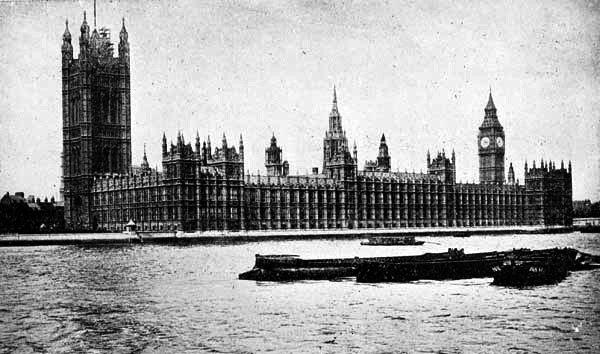
Houses of Parliament.
The Queen's two daughters, Helena and Louise, had attended her in opening Parliament. This must have been a little embarrassing for the older one, inasmuch as the Queen's address declared that the royal permission had been given for the Princess Helena to marry Prince Christian of Schleswig-Holstein; but members of the royal family cannot always consult their own feelings. When they rule different countries, it is not always easy for them even to remain friendly. The fact that the Queen, her daughters, and her Danish daughter-in-law were as fond of one another at the end of 1866 as they were at the beginning of 1864 is proof that the English royal family were very harmonious. Trouble had arisen between Denmark and the German states in regard to the duchies of Schleswig-Holstein, and in 1864 war had broken out between the little kingdom of Denmark and the united powers of Prussia and Austria. Both countries were anxious to win the help of England. Princess "Vicky" and Princess Alice naturally sympathized with the German states; while Princess Alexandra's affection was of course with her own home land, which had now become her father's kingdom. The Emperor of France did not wish to have the German states increase in power, and he was ready to help Denmark, provided England would stand by him. England was willing, but England's sovereign would not hear to any talk of war with Germany, and the Ministers hesitated to act against her decided opposition. Of course the Danish Princess was grieved that the Queen would not consent to help her beloved country. Bismarck was the German statesman who was pushing on the war, therefore he was the man who was most abhorrent to the Princess of Wales. There is a story that the Queen had promised the little Beatrice a present, and that when she asked, "What shall it be?" the wee maiden, who had been carefully tutored by her sister-in-law, replied demurely, "Please, mamma, I'd like the head of Bismarck on a charger."
Two years later, there was a still more difficult condition of affairs in the Queen's family, for now that Prussia and Austria held the Schleswig-Holstein duchies, it was a question to which of the two powers they should belong; and to complicate matters even more, Princess Helena had married Prince Christian. Prussia and the north German states held together, and Austria joined the forces of the south German states. Prince "Fritz" belonged to the north and Prince Louis to the south, and therefore the husbands of the two English Princesses were obliged to fight on opposite sides. The war lasted for only seven weeks, but it was an anxious time for Queen Victoria, who shared so fully in the troubles of her daughters. Princess Alice's two little girls were sent to England to be safe in her care, but in the midst of the war, a third little daughter was born. The boom of the distant guns was heard as she lay in her cradle in Darmstadt. Wounded men were being brought into the town, and the residents were fleeing in all directions. By and by the end came, and then the little dark-eyed baby was named Irene, or peace. Never before had a child so many godfathers, for when Prince Louis said farewell to his cavalry, he delighted them by asking the two regiments, officers and men, to be sponsors to his little girl.
CHAPTER XIII
MOTHER AND EMPRESS
While the German wars were going on the Queen was thinking for her country as a sovereign and feeling for her children as a mother. In the midst of all the claims upon her, she had one aim that she never forgot, and that was to make her country understand and appreciate the talents and character of Prince Albert. She concluded to have a book prepared that should tell the story of his life, for she felt that no one who really knew him could fail to honor him. When the first volume was published, even her children were surprised that she should tell matters of her own private life so fully; but she loved and trusted her people, and she was as frank with them as she would have been with an intimate friend.
The year after this book was brought out, the Queen herself became the author of a book, "Our Life in the Highlands." It is made up of extracts from the journal which she always kept. "Simple records," she calls them, but they often give charming pictures of the merry times at Balmoral. Sir Arthur Helps aided her in preparing the book for the press. "He often scolds me," she said, "because I am careless in writing; but how could he expect me to take pains when I wrote late at night, suffering from headache and exhaustion, and in dreadful haste?" She arranged to have Sir Theodore Martin complete the life of the Prince, and she spent much time in arranging her husband's papers and letters for him to use. She generally chose the selections to be inserted, and she read every chapter as it was written.
About her own authorship the Queen was very modest, and when she sent a copy of her book to Dickens, she wrote in it, "From the humblest of writers to one of the greatest." At Sir Walter Scott's home, she was asked to write her name in his journal; and, although she granted the request, she wrote in her own journal, "I felt it a presumption in me." When Carlyle met her, he said, "It is impossible to imagine a politer little woman; nothing the least imperious, all gentle, all sincere; makes you feel too (if you have any sense in you) that she is Queen."
Her being Queen gave her a peculiar power over the marriages of her children, for they were not legal unless she gave her formal consent. Early in 1871 she was called upon again to exercise her right, for far up in the hills about Balmoral there was a momentous little interview between the Princess Louise and the Marquis of Lorne. "Princess Louise is so bright and jolly to talk with," one of the Scotch boys had said of her when she was a very young girl, and this Scotch Marquis was of exactly the same opinion.
The Queen had guessed before how matters stood with her daughter and the gentleman whom she had once called "such a merry, independent child." The young man had proved his independence by asking for the hand of the Princess, inasmuch as it was three hundred years since a member of the royal family had married a subject, but the Queen paid no attention to tradition. She felt sure that the Marquis would make her daughter happy, and that was enough. Most of her subjects agreed with her; and one of the newspapers said jubilantly, "The old dragon Tradition was routed by a young sorcerer called Love."
The wedding was celebrated at Windsor. It was a brilliant scene, of course, and if all the gentlemen were arrayed as vividly as the Duke of Argyll, the father of the bridegroom, the ladies did not monopolize gorgeousness of attire. The Duke was a Scottish chieftain, and he appeared in Highland dress. His kilt and the plaid thrown over his shoulders were of the gay Campbell tartan. His claymore, a broad two-handed sword, was at his side, and in front there hung from his belt a sporran, or deep pouch made of skin with the hair or fur on the outside. His dirk sparkled with jewels. Altogether he might have stepped out of some resplendent assemblage of the middle ages. After the wedding breakfast, the bride laid aside her white satin and Honiton lace and arrayed herself in a traveling dress of Campbell plaid. The carriage door was closed, and the young couple drove away for Claremont in a little shower of white slippers, accompanied, according to Highland tradition, by a new broom, which was sure to bring happiness to the new household.
The Queen's daughters were now in homes of their own except the Princess Beatrice, a merry little girl of fourteen, who had been radiantly happy in her new pink satin at her sister's wedding. The Queen was devoted to her children, but it would have been easier for her to pass through the next few years if she had been all sovereign and not woman. War broke out between France and Germany, and both Prince "Fritz" and Prince Louis were in the field. Anxious as she was for them, she was even more troubled for the Princess Alice, who was really in quite as much danger as if she had been in the army. For several years she had been deeply interested in lessening the sufferings of the poor in times of illness; and in providing trained nurses for wounded soldiers. While this war was in progress, she not only went to the hospitals daily, but she brought the wounded men to her own house and cared for them herself. She was exposed over and over again to typhus fever and other diseases, but she seemed to be entirely without fear. One of her friends describes seeing her help to lift a soldier who was very ill of smallpox.
Princess Alice little thought of what value her skill in nursing would be to her own family, but near the end of 1871, the Prince of Wales was taken ill with typhoid fever, and her help was of the utmost value. It was just ten years before that Prince Albert had died of the same disease, and to the anxious Queen every day was an anniversary. She hastened to the home of the Prince at Sandringham, and when she saw how ill he was, she sent at once for the other members of the family. The days passed slowly. One day he seemed a little better, and there was rejoicing, as the telegraph flashed the news not only over England, but to Canada, India, to every part of the world. Then came a day of hopelessness. The Queen mother watched every symptom. "Can you not save him?" she pleaded; and all the physicians could answer was, "You must be prepared for the worst. We fear that the end is near."
Bulletins were sent out to the public every hour or two. All London seemed to tremble with fear and anxiety. Stores were open, but there was little of either buying or selling. Day and night the citizens crowded the streets in front of the newspaper offices. They talked of no one but the Prince.
"He's a good boy to his mother," said one, "and she'll miss him sorely."
"He's living yet, God bless him, and perhaps after all he'll mend," declared another of more hopeful spirit.
"Did you ever hear that when he was a little chap and his tutor was going to leave him, the young man couldn't go into his room without finding a little present on his pillow or perhaps a note from the little boy saying how much he should miss him?"
"It'll kill the Queen," said one man. "The poor woman's had all she can bear, and she'll never go through this."
"And the Prince's boy's but eight years old," declared another. "There'll be a regent for ten years, and no one can say what harm will come to the country in that time."
So the days passed. The fourteenth of December came, the anniversary of the day on which the Prince Consort had died. The Prince breathed and that was all. The people about the offices were hushed. Everyone dreaded to hear the next message, but when it came, it said "Better." London hardly dared to rejoice, but the Prince continued to gain, and at last the Queen joyfully granted the wish of her people and appointed a Thanksgiving Day. The special service was held at St. Paul's Church, and there were many tears of joy when the Queen walked up the nave between the Prince and the Princess of Wales.
After the religious ceremony was over, the guns roared out the delight of the people, and a wild excitement of happiness began. At night St. Paul's was illuminated, and everyone was jubilant. The Queen was deeply touched and pleased with the warm sympathy shown by her subjects, and a day or two later she sent a little letter to be published in the papers to tell them how happy they had made her.
Only two days after this letter was written, there was a great alarm, for when the Queen went out to drive a young fellow sprang towards the carriage and aimed a pistol at her. He was seized in a moment and proved to be a half-crazed boy of seventeen whose pistol had neither powder nor bullet. Most of the Queen's personal attendants were Highlanders, and one of them, John Brown, had thrown himself between her and what he supposed was the bullet of an assassin. Both the Queen and Prince Albert were always most appreciative of faithful service, and looked upon it as something which money could not buy. She had been thinking of having special medals made to give to her servants who deserved a special reward, and she now gave the first one to John Brown. With the medal went an annuity of $125.
John Brown seemed to have no thought but for the Queen. To serve her and care for her was his one interest. He cared nothing about court manners, and was perhaps the only person in the land who dared to find fault with its sovereign to her face. Statesmen would bow meekly before her, but the Scotchman always spoke his mind. He even ventured to criticise her clothes. The Queen never did care very much for fine raiment, and in her journal where she narrates so minutely as to mention the fact that a glass of water was brought her, she describes her dress merely as "quite thin things." John Brown thought nothing was good enough for his royal mistress. "What's that thing ye've got on?" he would demand with most evident disapproval, if a cloak or gown was not up to his notion of what she ought to wear; and this Queen, who knew so well what was due to her position, knew also that honest affection is better than courtly manners, and kept Brown in close attendance. She built several little picnic cottages far up in the hills, where she and some of her children would often go for a few days when they were at Balmoral. There is a story that when she was staying at one of these cottages, she wished to go out to sketch. A table was brought her, but it was too high. The next was too low, and the third was not solid enough to stand firmly. So far John Brown had not interfered, but now he brought back one of the tables and said bluntly, "They canna make one for you up here." The Queen laughed and found that it would answer very well.
One cannot help wondering what Queen Victoria's guests thought of her attendant's blunt ways, but they must have often envied her his honest devotion. In 1872 and 1873 she had several very interesting visitors. One of them was David Livingstone, the African explorer.
"What do the people in the wilderness ask you?" queried the Queen.
"They ask many questions," he replied, "but perhaps the one I hear oftenest is, 'Is your Queen very rich?' and when I say 'Yes,' they ask, 'How rich is she? how many cows does she own?'"
Other visitors were a group of envoys from the King of Burmah, a monarch with such strict regard for what he looked upon as royal etiquette that he would not allow the British representative to come into his presence unless the indignant Englishman took off his shoes before attempting to enter the audience room. His letter to the Queen began with the flourishes that would be expected from so punctilious a potentate: "From His Great, Glorious, and Most Excellent Majesty, King of the Rising Sun, who reigns over Burmah, to Her Most Glorious and Excellent Majesty Victoria, Queen of Great Britain and Ireland." He sent among other gifts a gold bracelet which must have been of more value than use, for it weighed seven pounds.
The guest who made the greatest sensation was the Shah of Persia. For more than two months he was on his way to England, and the nearer he came, the more wild were the fancies that people had about him. The newspapers were full of stories about his dagger, whose diamonds were so dazzling, they said, that one might as well gaze at the midday sun. They told amazing tales about the pocket money which he had brought with him, some putting the amount as $2,500,000, others as $25,000,000. "When he walks about, jewels fall upon the ground," one newspaper declared. "He wears a black velvet tunic all sprinkled with diamonds, and he has epaulets of emeralds as big as walnuts," romanced another.
The curiosity seekers were disappointed when he appeared, though it would seem as if he had enough jewelry to make himself worth at least a glance, for up and down his coat were rows of rubies and diamonds. He wore a scimitar, and that, together with his belt and cap, was sparkling with precious stones, while his fingers were loaded with rings.
The Queen came from Balmoral to welcome him. Whether she gave him the formal kiss that was expected between sovereigns, the accounts do not state, but all sorts of entertainments were arranged for him, a great ball, a review of artillery, an Italian opera, and many other amusements. He was much interested in the review, and the troops must have been interested in him, for he rode an Arab horse whose tail had been dyed a bright pink. At this review one of the newspaper stories proved very nearly true, for a member of the Persian suite fell from his horse and really did scatter diamonds about him on the grass. After a visit of a little more than two weeks, the Shah bade farewell to England. Before his departure there was an exchange of courtesies between himself and the Queen. She made him a knight of the Garter, and he made her a member of a Persian order which he had just instituted for ladies. The Queen gave him a badge and collar of the Garter, set in diamonds; and he returned the gift by presenting her with his photograph in a circle of diamonds.
In the midst of this entertainment and display, the tender heart of the Queen was more than once deeply grieved by the death of dear friends. The cherished Féodore, the Princess Hohenlohe, died; then the Queen lost Dr. McLeod, the Scotch clergyman who had so helped and comforted her in her troubles. Hardly two months had passed after his death before heart-broken letters came from Darmstadt. Princess Alice had been away for a short time, counting the hours before she could be with her children again. At last she was at home with them and happy. The two little boys were brought to her chamber one morning, and as she stepped for a moment into the adjoining room, one of them, "Frittie," fell from the window to the stone terrace, and died in a few hours. The heart-broken mother longed to go to her own mother for comfort in her trouble, but she could not leave her home, neither could the Queen come to her.
Warm, tender words of sympathy came from England, from a Queen mother who well knew what sorrow meant. "Can you bear to play on the piano yet?" she asked some three months after the accident; for it was long after the death of Prince Albert before she herself could endure the sound of music. Princess Alice replied, "It seems as if I never could play again on that piano, where little hands were nearly always thrust when I wanted to play. Ernie asked, 'Why can't we all die together? I don't like to die alone, like Frittie.'"
While the heart of the Queen was aching with sympathy for her daughter, she had also to attend to arrangements for the marriage of her sailor son "Affie," now Duke of Edinburgh, with the daughter of the Emperor of Russia. She herself could not go to the wedding at St. Petersburg, but she asked Dean Stanley to go and perform the English ceremony; for as the bride was a member of the Greek Church, there was a double rite. To Dean Stanley's wife she sent a mysterious little parcel containing two sprigs of myrtle, and with it a letter which asked her to put them into warm water, and when the wedding day came, to place them in a bouquet of white flowers for the bride. The myrtle had grown from the slip in the bridal bouquet of the Princess Royal, and in the five marriages of royal children that had preceded this one, each bride had carried a bit of the bush.
When the bride reached Balmoral, a company of volunteers in kilts were waiting to receive her. Just beyond were the tenants on the Queen's estate, all in their best clothes. The pipers were present, of course, and the best clothes of the Queen's pipers were well worth seeing. The kilt was of Stuart plaid, and the tunic of black velvet. Over the shoulder was a silver chain from which hung a silver powder horn. The bag for the pipe was of blue velvet. Ornaments were worn wherever there was a place for them, but the only jewels were cairngorms, and they were always set in silver. The shoes had heavy silver buckles. The bride and all her royal friends drove to the castle, where their health was drunk by a merry company. The end of the Queen's account of this reception of royalty sounds delightfully simple and homelike. "We took Marie and Alfred to their rooms downstairs," she says, "and sat with them while they had their tea."
In so large a family as that of the Queen there was always a birth or a marriage, a coming or a going. Not long after the marriage of his brother Alfred, the Prince of Wales left England to spend some months in India. This journey was not a pleasure trip, it had a state purpose, and that was to pay honor to the native princes who had aided the English in their efforts to govern India. The Prince was well accustomed to being received with cheering and the firing of guns, but his Indian reception was something entirely new. At one place twenty-four elephants painted in different colors trumpeted a greeting. In another, which was ruled by a lady, the sovereign met him, but she could hardly be said to have made her appearance, for her face was thickly veiled. At still another he was carried up a hill in a superb chair made of silver and gold. There was a boar hunt, an antelope hunt, and an elephant fight; there was a marvelously beautiful illumination of surf; there were addresses presented by people of all shades of complexion and all varieties of costume, often so magnificent that some one called the wearers "animated nuggets."
This visit of the Prince of Wales was followed by the Queen's assumption of the title of Empress of India. There was a vast amount of talk about the new title, for many English thought that it was foolish and childish to make any change. On the other hand, "Empress" was the proper title for a woman who ruled over many kings, even kings of India. There were stories afloat that one reason why the Queen wished to become an Empress was because the Russian Princess, who was the daughter of an Emperor, had claimed precedence over the English Princesses, who were only the daughters of a Queen. However that may be, the title was formally assumed in 1876. It was proclaimed in India with all magnificence. Sixty-three princes were present to hear the proclamation. There were thousands of troops and long lines of elephants. A throne that was a vision of splendor was built high up above the plain; and on this sat the viceroy of the Queen, who received the honors intended for her.
Queen Victoria was much pleased with the new title, and soon began to sign her name "Victoria, R.I.," for "Regina et Imperatrix," to all documents, though it had been expected that she would affix it to her signature only when signing papers relating to India. Another title which she enjoyed was that of "Daughter of the Regiment." The Duke of Kent had been in command of the "Royal Scots" at the time of her birth and therefore they looked upon her as having been "born in the regiment." In the autumn of this same year she presented them with new colors, and there was a little ceremony which delighted her because it was evidently so sincere. There was first a salute, then marching and countermarching, while the band played old marches that were her favorites, among them one from the "Fille du Régiment," to hint that she belonged especially to them. Then there was perfect silence. Two officers knelt before her, and she presented them with the new colors, first making a little speech. The Royal Scots were greatly pleased, because in her speech she said, "I have been associated with your regiment from my earliest infancy, and I was always taught to consider myself a soldier's child." In spite of her many years' experience in making short speeches and of her perfect calmness in public in her earlier years, the Queen was never quite at ease in speaking to an audience after Prince Albert died, and she said of this occasion, "I was terribly nervous." She never ceased to miss the supporting presence of the Prince, and she wrote pitifully of her first public appearance after his death, "There was no one to direct me and to say, as formerly, what was to be done."
The Queen was soon to feel even more lonely, for late in the autumn of 1878 there came a time of intense anxiety, then of the deepest sorrow. Princess Alice's husband and children were attacked by diphtheria. "Little Sunshine," as her youngest daughter was called in the home, died after three days' illness. The mother hid her grief as best she could that the other children should not know of their loss. Three weeks later, she too was taken with the same disease, and died on the seventeenth anniversary of her father's death. Little children and poor peasant women of Hesse were among those who laid flowers on her bier and shared in the grief of the sorrowing monarch across the Channel.
The Queen had built a cairn at Balmoral in memory of the Prince Consort. Others had been built from time to time, one rising merrily with laughing and dancing to commemorate the purchase of the estate; others erected to mark the date of the marriage of the sons and daughters of the house. To these a granite cross was now added to the memory of the beloved daughter, "By her sorrowing mother, Queen Victoria," said the inscription.
So it was that the happy circle of sons and daughters was first broken; so it was that the years of the Queen passed on, full of the joys and sorrows that seemed to come to her almost hand in hand.
CHAPTER XIV
THE JUBILEE SEASON
With the exception of Prince Alfred, the Queen's children had married according to the German proverb, "The oldest must leave the house first." The next in age was Prince Arthur, or the Duke of Connaught. He married in 1879 Princess Louise of Prussia with the usual magnificent display at St. George's Chapel. The real home welcome, however, was awaiting them at Balmoral, where they arrived a few months later. When the train came to a standstill, there stood the Queen and Princess Beatrice, with the Royal Scots for a guard of honor. The Queen gave the bride a bouquet of heather, and they set off for the castle. At the end of the Balmoral bridge was an arch of moss and heather with a motto in flowers, "Welcome to Balmoral." There stood the castle guests, and there were all the tenants, the women in their Sunday clothes, the men in kilts, and the pipers playing their best and loudest, while the children tossed flowers into the carriages and shouted their welcome.
Of course a cairn had been begun in honor of the marriage, and two or three days later the happy party went to visit it, the Queen on her pony and the others walking. There was a speech of congratulation made, and the health of the young people was drunk. "The health of the Princess Beatrice ought to be drunk," Brown declared, and that was done with so many cheers that even the dogs objected to the tumult and began to bark. After the cheering, each one of the party walked up to the cairn and laid a stone upon it. One of the stones in the foundation was already marked with the names of the Duke and Duchess and the date of their marriage.
Three years later St. George's Chapel was again ablaze with the splendor of another royal wedding, that of Prince Leopold, the eighth child of the Queen, to Princess Hélène of Waldeck-Pyrmont. In the evening a state banquet was given, and some of the guests were much amazed when, just before the Queen was to rise from the table, her two Scotch pipers in their full Highland costume appeared at the door and marched twice around the room, playing merry Scottish airs.
The home of the newly married couple was to be at Claremont, the place where the little Princess Victoria had so enjoyed herself. It had been granted to King Leopold when he married Princess Charlotte, but on his death it again became the property of the Crown. The Queen now bought it for the King's namesake. She had given to her son the title of Duke of Albany, and some of the superstitious among her subjects shook their heads at that, for so many who had borne the title had met with misfortune or even with early death.
The wedding celebrations were hardly over before the Queen's thoughts were centered upon Egypt. The Khedive of Egypt was a great borrower, and to fill his ever empty purse he had offered England some seven years previously his shares in the Suez Canal for $20,000,000. England had been very ready to buy them and also to guarantee that people who had loaned money to this spendthrift should not lose their interest. In 1882 some of the Khedive's subjects rebelled against him and got control of the government. To maintain taxation and so pay the promised interest, England must support the Khedive and put down the rebels.
The Queen hated war as badly as her predecessor Elizabeth, but as soon as she saw that it was necessary, she had no patience with delay or poor preparation. She sent directions continually to the War Office, now about arms, now about blankets or food or the comforts that would be needed in the hospitals. She never had the slightest sympathy with indecision or lack of promptness, and the moment that she thought of something that ought to be done for her soldiers, she sent a message to the Minister of War. During one day she sent him seventeen.
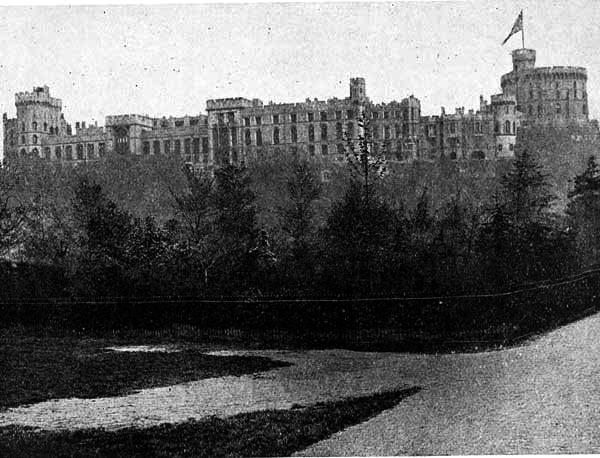
Windsor Castle.
The troops sailed. Telegrams were frequent, and on a Monday morning in September there came to Balmoral one marked "Very secret." It was written in cipher and said, "Determined to attack the enemy with a large force on Wednesday." There could be no report of the battle for two days at least, but the Queen and her family tried hard to be brave and cheerful. More than once the Queen slipped away from them to pray that her son might return to her in safety, for the Duke of Connaught was in Egypt in command of a brigade. Wednesday morning a telegram came, "The army marched out last night." A second arrived a little later, "The enemy has been routed at Tel-el-Kebir, but fighting is going on." "Louischen," the wife of the Duke, was with the Queen. They could think of nothing but the husband and son, far away beside the Nile. Any moment might be the fatal one. They almost fancied they could hear the boom of the cannon. Never was a morning so long, but at last the word came, "A great victory; Duke safe and well; led his brigade to the attack." The Queen hurried to find "Louischen," and threw her arms about her neck. "How glad and proud and thankful we can be!" she exclaimed with tears, not of sorrow but of joy.
That afternoon the Duke of Albany and his wife arrived, and then there was a double rejoicing. After the drinking of healths of bride and bridegroom, John Brown stepped forward and said, "Ladies and gentlemen, let us join in a good Highland cheer for the Duke and Duchess of Albany; may they live long and die happy!" and then there was such cheering as made the woods and hills ring.
Twenty-six years before, when word had come of the fall of Sebastopol, a bonfire had been lighted on the top of Craig Gowan, and now there was another in honor of the Egyptian victory. It was very dark, but no one cared for that. The two princesses and many of the people in the house walked up to the top of the hill with the pipes playing jubilantly. There the bonfire was lighted, and the Queen watched from the windows and listened to the pipes and the cheering. When the princesses came down, they all had a little supper together "in Louischen's room."
With all these family celebrations, indeed with almost every action of the Queen's life, John Brown was closely associated. In private and in public he was the attendant of his sovereign, ever on the watch to save her, not only from danger, but from the least annoyance. On one occasion, the Queen's carriage stopped in a village after dark, and curious people thronged about. One man actually held up a lantern to get a plainer view of her face, but all that met his eyes was the rugged, determined features of John Brown, for the faithful man had calmly put himself between the Queen and her inquisitive subject. On another occasion, a woman pushed up to the carriage and stood leaning upon the wheel and staring at the Queen. John Brown thought it a waste of courtesy to be gentle with such a person, and he growled "Be off with you!" like an angry policeman to a crowd of troublesome ragamuffins. In 1883 this faithful servant died. There could hardly have been a time when the Queen had more need of him, for by a fall on the staircase at Windsor she had become unable to walk or even to stand.
During the months of her lameness, she prepared for publication a volume of extracts from her journal for 1862 to 1882. The dedication read, "To My Loyal Highlanders, and especially to the memory of my devoted personal attendant, John Brown." She was as modest about this book as about the first one, and with the copy that she presented to Tennyson she sent an almost shy little note saying, "Though a very humble and unpretending author, I send you my new book, which perhaps you may like to glance at. Its only merit is its simplicity and truth."
The Queen's lameness did not prevent her from making her usual spring visit to Balmoral in 1884, but the most unusual precautions were taken to insure her safety. Within two or three years the Emperor of Russia had been assassinated, and in London several attempts had been made recently to blow up public buildings with dynamite. Generally when the Queen traveled, her time-table was known, and people were at every station to give her welcome. An engine was always sent before the train to make sure that the road was clear, but this time, however, the time-tables were kept secret, and no spectators were allowed to gather at the stations. Men were usually at work on the road, averaging one to every half-mile. These men were now supplied with flags to wave as the train came in sight. If the engineer saw a white flag, he knew the way was clear for half a mile; but if the red one was waved, he knew there was danger or some obstruction ahead, and that he must stop at once.
The Queen was still so much of an invalid that she could stand only a few minutes when the day came that she had to be told of the sudden death of her youngest son. He was the only one of the nine children who had not been strong, but the Queen loved him all the better for his sufferings. He was much like his father in mind, and she had hoped that he would be able to act as her private secretary. Even when he was ill, he was so merry and unselfish that all who saw him loved him. He never seemed to realize that there was anything in him to call out their affection and he once said very simply, "I can't think why people should always be so kind to me."
The Queen felt that the joy had gone from her life, but she sent to her people the message, "I will labor on as long as I can for the sake of my children and for the good of the country I love so well."
The government of her country gave her little pleasure at that time, for in spite of all that she could do, grave trouble was arising from what she believed was the mistaken course of her Ministers. Egypt had been pacified three years before, but there was revolt in the Soudan. A man named Mohammed had gone about among the wild Arabs declaring, "I am the prophet who was to follow the great Mohammed. For twelve hundred years the world has been awaiting me. Come and fight under my banner." Thousands rose to join him, and Mohammed, or the Mahdi, as he was called, led them against the Khedive. That ruler was helpless to repulse them. England was responsible for the good order of his country, and the Ministers debated the question long and seriously, what to do in Egypt.
"Let us send troops to the Soudan and suppress the rebellion," advised one.
"That is what the Queen wishes," said another, "but it may be that the Soudan is not worth so many lives as would be wasted in conquering the rebels."
"It is not," declared another positively. "Let us attempt nothing but to keep the Mahdi out of Egypt."
"But what of our English and Egyptian garrisons in the Soudan?" That was a grave question, and a long discussion followed. The government then in power was ready to do almost anything to avoid war. The Queen looked upon the matter differently. She was now no girl of eighteen, she was a woman with nearly fifty years' experience in dealing with nations civilized and nations uncivilized. She believed that it was best to hold on to the Soudan; but since her Ministers were determined to abandon it to the revolters, she saw that the only thing to do was to lose no time in confronting the Mahdi with an army so overwhelmingly superior to his own forces that he would not dare to attack the garrisons.
The Ministers did not agree with her. "General Gordon has already shown that he knows how to manage the people of the Soudan," they said, "and he will be able to persuade the Mahdi to let the garrisons go free."
"With an army to support him, yes," said the Queen; "but alone, no."
Nevertheless, General Gordon was sent to cross the desert almost alone. In spite of all that the brave commander could do, the Mahdi could not be persuaded to let the garrisons go, and soon the envoy himself was shut up in Khartoum. "Help us," he pleaded with England. "Send us troops." Still the government delayed, in spite of the Queen's warnings. No help came, and General Gordon then sent a messenger to beg private parties in the British colonies and the United States for money to organize a relief expedition; but the messengers were captured and put to death. The Queen urged and insisted that relief should be given, and the people insisted with her. Troops were sent at last, and they hastened on till they were only a mile and a half from Khartoum. But they were forty-eight hours too late, for the city had fallen, and General Gordon had been slain.
Queen Victoria was a constitutional monarch. She had stood firmly by her Ministers ever since the Bedchamber Plot of the first year of her reign; but she was also a woman, a loving, tender-hearted woman, and she wrote to General Gordon's sister a letter in which sympathy for her loss and indignation for the "stain left upon England" were mingled. She said:
"Dear Miss Gordon,
"How shall I write to you, or how shall I attempt to express what I feel! To think of your dear, noble, heroic brother, who served his country and his Queen so truly, so heroically, with a self-sacrifice so edifying to the world, not having been rescued! That the promises of support were not fulfilled—which I so frequently and constantly pressed on those who asked him to go—is to me grief inexpressible."
General Gordon's diary was found and sent to his sister. Its last entry was, "I have done my best for the honor of our country. Good-by." His Bible was presented by his sister to the Queen. It was placed on a cushion of white satin in an exquisite casket of carved crystal with silver mountings. "This is one of my greatest treasures," the Queen often said, as she sadly pointed it out to her friends.
The Queen was aroused from her sorrow over what she ever looked upon as a disgrace to her country by the approaching marriage of Princess Beatrice to Prince Henry of Battenberg. Their wedding was quite different from those of the other royal children, for it was celebrated at the country church near Osborne. No one knew how to manage a royal wedding in a little village church, and there were all sorts of momentous questions to be settled before the arrangements were complete. It all came out well in the end, however. There was not room for quite so many royalties as usual, but the wedding day was a delightful holiday for the people of the Isle of Wight, for there were fireworks, bands, a dinner and a dance for all the tenants and servants on the estate, and a most beautiful display of sailing vessels and steamers. Tennyson's home was on the Isle of Wight, and the Queen sent him a charmingly informal invitation to the wedding. "It would give me the greatest pleasure," she wrote, "if you would come over for the wedding in our village church, but I fear you won't do that? But pray come and see me when all is quiet again." Tennyson did not attend the wedding, but the Princess must have counted among her choicest gifts his message, "To the royal bride the old poet sends his blessing." This marriage alone of all those in the royal family was not to bring separation, for it was agreed that the Princess and Prince Henry should remain with the Queen.
This Queen and Empress had now been on the throne for nearly half a century, and throughout her dominions there was a feeling that so rare an event ought to be celebrated with fitting magnificence. The Jubilee feeling was in the air. Every town and every little village wished to mark the time by something that should remain as a lasting memorial. Libraries, hospitals, and museums were founded, and parks were purchased and thrown open to the public. Memorial clocks, statues, schools, and towers sprang into being in every corner of the land, and in all the colonies. "God Save the Queen" was sung in Hindustanee on the shores of Asia and in Hebrew in the synagogues of London. Addresses of congratulation and loyalty came in by the score; representatives of all the colonies flocked to England, as sons and daughters hastened homeward to a family gathering.
The part to be taken in the celebration by associations, cities, and kingdoms had all been planned when it occurred to the editor of one of the London newspapers that nobody had remembered the children. "Let us give the boys and girls of London a feast and an entertainment in Hyde Park," he suggested. "You can't do it," declared the grumblers. "It is a foolish, wicked scheme. There will be a crush, accidents will happen, and hundreds will be injured." Nevertheless, people subscribed so generously that soon all the money needed had been provided. When the children came to the Park, they were taken in groups to great tents; and when they came out, each one had a paper bag which contained "a meat pie, a piece of cake, a bun, and an orange." Their little hands must have been full, for besides the eatables, each one received a little medallion portrait of the Queen and a Jubilee mug. The mugs saw hard service among the thirsty little folk, for all day milk, lemonade, and ginger beer were free to every child who presented his empty mug. The children were amused by all sorts of games and shows. Dukes and princes and representatives of powerful kingdoms came to see the good time; and at last the Queen herself came and gave a special greeting, not to the grown folk, but every word of it to the children. Long before bedtime had come, every one of the twenty-seven thousand small people was safe in his own home, and the grumblers grumbled no more.
June 21, 1887, was "Jubilee Day." Fifty years had passed since the young girl had been aroused from her sleep to hear that she was Queen of a mighty nation; and now, in all the glory of her half century of successful sovereignty, she was to go to Westminster Abbey to thank God for his help and protection.
She now represented, not a kingdom, but an enormous empire, and every corner of it wished to do her honor. The streets of London were spanned by triumphal arches. They were made into a fairyland of flowers, banners, drapings of silk and velvet and tapestry. Staging for seats had been put up all along the route, and every seat was filled. Fabulous prices were paid for a house, a window or even a few square inches on a rough plank. Thousands of people had been out since sunrise to secure a place to see the grand procession; and at last it came in sight, moving slowly toward the multitude that waited all a-tremble with excitement and with devotion to the noble woman who was the symbol of home and country.
First came the carriages containing the dark-faced princes of India, robed in cloth of gold, and shaded with turbans glittering with priceless jewels. Many carriages followed, filled with kings, queens, crown princes, and grand dukes. There were equerries, aides-de-camp, an escort of Life Guards, and a guard of honor composed of princes riding three abreast, the Queen's sons, grandsons, sons-in-law and grandsons-in-law. Towering up among them was the superb figure of Prince "Fritz," Crown Prince of a united Germany. His uniform was of pure white, his helmet of burnished steel, and on it was the Prussian eagle with outspread wings. At last the woman for whom all were waiting came in sight. The splendid robes of her coronation were fifty years behind her, but even in her plainer dress she looked every inch a queen. The Princess Alexandra and the Crown Princess of Germany were with her. For twenty-five years the sovereign had so rarely appeared in public that to her subjects this was more than a mere royal procession, it was the coming back to them of their Queen. A great wave of devotion and loyalty swept over the hearts of the throng. "Not the Queen, but my Queen," they said to themselves, and such a greeting was given her as few monarchs have received.
The Abbey had been filled long before. Rich strains of music were coming from the organ. There was a moment's silence, then the silver trumpets of the heralds were blown, and the church resounded with Handel's march from the "Occasional Oratorio." The Queen entered. She was preceded by archbishops, bishops, and deans, all in the most elaborate vestments of their offices. The guard of royal princes walked slowly up the nave, three abreast, the Prince of Wales and his two brothers coming last. Slowly the Queen to whom all the world was doing honor, ascended the steps of the throne. The vast assemblage was hushed, and stood for a moment with heads bowed in reverence.
A short, simple service followed of praise and thanksgiving. Then her sons and daughters, who had been grouped around the Queen, came forward one at a time to bow before her and kiss her hand. As they rose, she gave each of them a kiss, not of state, but of warm, motherly affection that in this crowning moment of her career could not be satisfied with the restrictions of ceremony.
That evening there were fireworks and illuminations in all the principal cities. England shone literally from shore to shore, for a beacon fire was lighted on Malvern Hills, and in a moment, as its distant gleam shone on other hills, other beacons blazed, till from Land's End to the Shetland Islands it was rejoicingly written in letters of fire that for fifty years the realm had been under the rule of a pure and upright womanhood.
At last the day was fully ended. "I am very happy," said the Queen; and well she might be, for this day had shown her that she was sovereign, not only of the land and its treasures, but of the loving hearts of her subjects.
CHAPTER XV
THE QUEEN AND THE CHILDREN
There had been only one drawback to the Queen's happiness during the Jubilee rejoicings, and that was the poor health of her favorite son-in-law, the Crown Prince of Germany. In the procession he had looked superbly well and strong, but his throat was giving him so much trouble that he remained in England the rest of the year, hoping that a change of climate would do him good.
Everyone loved "Our Fritz," as he was called in Germany, both his own countrymen and the English. His father, the Emperor, was over ninety and so feeble that he could not possibly live many months. Ever since that summer day on the hills of Balmoral when the Prince had given the sprig of white heather to the maiden of his choice, the Queen had hoped that Germany would unite under one emperor and that Prince Frederick William would become its ruler. The German states had united, and it was clear that the German throne would soon fall to her daughter's husband; but the physicians declared that his disease was incurable.
For several months the whole world watched for news of the beloved Emperor and his equally beloved son. Early in 1888 the Emperor died, and Queen Victoria's ambition of thirty years had come to pass; her daughter was Empress of Germany. But it was a sad accession to a throne, and the Queen forgot all about her ambitious hopes in her daughter's grief and her own. Hardly a day passed that she did not send some message of sympathy to the sorrowing wife. In three months the end came. The Emperor "Fritz," whose sufferings had been none the less because he sat on a throne, was dead. His son, the Frederick William Victor Albert who had given his young uncles so much trouble at the wedding of the Prince of Wales, now wore the German crown; but the Queen, instead of rejoicing in her daughter's being Empress of Germany, could only try as best she might to help her bear her loneliness.
No one, whether Princess Royal or Highland cottager, ever appealed to the Queen for sympathy in vain. She was always especially interested in the sick. In her Jubilee year, the women of England made her a present of $375,000, and she gave almost all of it to found an institute which should provide trained nurses for the poor in their own homes. When injured soldiers returned to England, she was never weary of going to see them, of walking down the long rows of beds, saying to one man, "I am afraid you are in great pain," to another, "England owes much to her brave soldiers." If she only asked "Where were you wounded?" or looked at a sufferer with that peculiarly sweet smile of which everyone spoke and which the photographers could never catch, he was content. Some of the hospital patients almost believed that her coming would cure them.
"Oh, it does hurt so," sobbed one little girl in a ward for children, "but if the Queen would only come and see me, I know I'd be well."
"Perhaps she will," said the nurse.
"No," cried the little one. "She went right by the door."
Somehow word was carried to the Queen that a little girl who had been terribly burned was crying to see her.
"Is there another ward that I have not visited?" she asked.
"Yes, Madam," answered the Doctor, "but it is at the extreme end of the hospital."
"Never mind," replied the Queen. "I will go and see the child."
After this visit the little girl who had been so honored was the envy of all the other children as she told over and over her story of the royal visit. "She came down just to see me," said the little one, "the Doctor told me she did. She put her hand right on my forehead and she said, 'I have a little granddaughter about as old as you, and I hope you will soon be able to run about as she does.' And then she said 'Good-by,' and she said, 'I shall come to see you again.' I wish she would come to-morrow."
All her life Queen Victoria was fond of children. She liked even the little boy who declared stoutly, "No, I don't like you because you cut Mary Queen of Scots' head off." When she first became Queen, she always managed to have some little folks staying in the palace as visitors, and the ninth child of her own family was just as welcome as the first. In all the displays that were made at her various receptions, she was never more pleased than when throngs of children were gathered together to greet her. She knew how to please children, and when she went to visit a school for boys, she won their hearts by requesting the master to give them an extra week's holiday. She never could bear to disappoint a child. One day when she was driving very rapidly, she caught sight of a little boy by the roadside looking much grieved because he had tried to throw a bunch of flowers into her carriage, and it had fallen into the road. "Drive back," she ordered, and the carriage with its four horses and driver and attendants was turned back. "Will you give me those pretty flowers?" she asked, and the little boy with tears on his cheeks suddenly became the happiest little fellow in the Highlands, as he shyly handed her the rather dusty bouquet. The children of the Balmoral tenants knew that she would never forget her promises, and if she said a toy was coming to them at Christmas, it was as sure to come as the day itself. When the little daughter of the minister in the village nearest to Balmoral was born, the Queen asked that she might be named Alexandrina Victoria for herself. Many gifts were sent to the little namesake, but perhaps the one that pleased her most was the tall sugar ornament from the Queen's birthday cake which the Queen herself brought over to the home of the tiny damsel and presented to her.
As the many grandchildren began to circle around Queen Victoria, she had a warm corner in her heart for everyone. She always wore a bracelet with a place for a miniature, and here the picture of the "new baby" was put, to remain until there was a newer baby whose little portrait should take its place. The numerous grandchildren and great-grandchildren were taught to greet her with the utmost respect, and little boys who could hardly walk would make a bow to her or kiss her hand as gravely as any grown-up courtiers. There the ceremony ended, and the good times began.
Of all the groups of children there were some to whom she was especially devoted. The daughters of the Princess Alice, as she was always called in England, she cared for almost as if they were her own. They made her long and frequent visits, and, little as the Queen cared for handsome clothes, she saw to it that when these orphan granddaughters were to be married, they should have all sorts of fine apparel and many beautiful jewels.
The children of whom she saw most during the last years of her life were those of Princess Beatrice. Two of them were born at Balmoral, first, a little Victoria Eugénie, the first child of the royal family born in Scotland for three hundred years. The tenants felt that this child was really their own, and they put their shillings together and bought her a very handsome cradle. They were all invited to come to the castle and see the baby, and a carriage was sent for any who were too feeble to walk. When the second child, a boy, was born, Craig Gowan again blazed with a bonfire. The pipers played, and all the people on the estate lighted their torches and marched up to the top of the hill for a dance.
It is to be hoped that the Princess Beatrice did not have as much difficulty in managing her own children as she did when she was six years old in commanding the obedience of Prince Frederick William of Germany and his sister. She is said to have gone to Dr. McLeod, declaring indignantly, "Just think, my nephew William and my niece Elizabeth will not do as I bid them and shut the door, and I am their aunt! Aren't they naughty?"
One little grandchild who was especially dear to the Queen was the son of her son Leopold, who died so suddenly. The Duke of Albany commanded the "Seaforth Highlanders," and after his death the little Duke was looked upon as their commander. The story is told that when he was six years old, he was allowed to "review" his troops. Very seriously he set about it, wearing a uniform made just like that of the tall Highlanders. He had been carefully taught how to give some of the orders, and he piped them out as gravely as if the fate of a battle depended upon his words. He was delighted to see how promptly the men obeyed him, and he felt quite like a grown man; but he too had to obey as implicitly as his soldiers, and when he made a boat of a scrubbing brush belonging to a tenant, and it floated off down the river, the small boy was taken straightway to a village store to buy another and pay for it with his own pocket money.
With so many children in whom she was interested the Queen might well have been forgiven if she had forgotten a few of them at Christmas, but such a thing never occurred; and even when the birthdays came around, they were never overlooked. She always had a little pity for her own lonely childhood, and she was very fond of giving her children and grandchildren feasts and entertainments that they could enjoy together. Dancing bears were brought to Windsor to perform for the children; Punch and Judy often gave them a merry hour; and once at least a monkey was "commanded" to appear before the Queen with his owner and the hand-organ. Where other people "invited," the Queen "commanded." Performers were very ready to obey, for besides the price paid them by the palace commissioner, the Queen almost always made them a personal gift of money or jewelry. Moreover, it was an excellent advertisement for them to perform before the royal family. Among other performers Buffalo Bill and his troupe were commanded to Windsor to show her Majesty and the little people what wild life on the plains of America used to be.
Once at Balmoral the Queen commanded a circus to perform before her. It was only a little circus, and the proprietor must have been almost overwhelmed with amazement and delight, but he made ready and set out for a field near the castle. The "Battenberg children" and the little folk from the other two castles which the Queen had built near Balmoral were summoned to come to the show. The little Alexandrina Victoria was invited, and word was sent to all the tenant children. The circus began. The children were happy, and even the performing donkey did so finely that the Queen wished to buy him. Unfortunately he was only a borrowed donkey and could not be sold; but after this fortunate day, it is very likely that whenever he entered the sawdust ring, he was announced as "Donkey in Special to Her Majesty the Queen of Great Britain and Ireland and Empress of India."
The Queen was never bored by these little entertainments, for with all her dignity, she had, as her husband said of his eldest daughter, "the brain of a statesman and the heart of a child." When the circus came to Balmoral, she watched it for two long hours, and was apparently as much amused as her small grandchildren; and when the organ-grinder and his monkey were at Windsor, the Queen laughed as heartily as any of the children as the little creature tried his best to find a way into the castle.
When the Queen was amused, she was very much amused, and sometimes she found it as hard to keep from laughing outright as any young girl. One who was present describes the reception of an embassy from one of the Oriental countries when it was all the Queen could do to "keep a straight face." On the English side everything was very ceremonious, for it was desirable to pay special courtesy to the strangers. The embassy, too, wished to show extreme respect, but no one guessed how they would do it. They entered, and after making all sorts of strange gestures, they "suddenly bowed themselves, apparently as men struggling with acute internal pain, and squeezed their hands together between their knees." The Queen was as motionless as a statue, her face becoming more and more grave as the formalities proceeded. The moment the envoys had left the room, however, she broke down and laughed till her eyes were full of tears. "But I went through it," she cried to her ladies. "I did go right through it."
The Queen was no less kind to her servants than to children; but just as her children were taught to obey her, so her servants were required to give her prompt and excellent service. "I can't afford to be kept waiting," she would say, whether the delinquent was a servant or a court lady. "If I am to get through my work, I mustn't have my moments frittered away." After the housekeeping was once fully in her own hands, there was little more of the irregular, negligent management that had formerly prevailed. Everyone employed had his work and was responsible for its being well done. It is said that she even made use of the ancient expedient of housekeepers whose dusting has not been properly done, and that with her own royal forefinger she once wrote her name on a dusty cabinet. The next day the dust was still there, and then she wrote under her own name that of the servant who was in fault. When the poor girl discovered that she had been reproved by the Queen of Great Britain and Empress of India, she was so overwhelmed with alarm that she ran away. It is a pleasant ending to the story to know that the royal mistress sent for her to come back. The Queen's rule was very strict, but if trouble came to any of her attendants, she was as sympathetic as if she had been one of their own family. She wanted them to have plenty of amusement, and when in 1886 a great exhibition was going on in London, she gave to her Balmoral servants an invitation to spend ten days at Windsor Castle to see the exhibition and the other sights of the city. The Queen demanded the best of service, but when it was given, she never felt that money alone would pay for it, and she was honestly grateful to those who served her well. She had to meet so many strangers that it was a pleasure to her to have familiar faces in her household. When new attendants were to be employed, she was always glad to have members of the families that already served her; and at the death of John Brown, she gave his place to one of his cousins, who was already in her employ. When her servants were ill or unable to work, she always cared for them, and saw to it that they had a comfortable home for their old age.