EVA MARCH TAPPAN, Ph.D. (continued 2)
Reading edition
"Tell the attendant of the Princess Victoria," said the Lord Chamberlain, "that we have come to see her on business of the utmost importance."
The servant withdrew, but no one appeared. They rang again, and at last the attendant of the Princess came to them.
"The Princess Victoria is sleeping," she said, "and she must not be awakened."
Then said the Lord Chamberlain: "We are come on business of state to the Queen, and even her sleep must give way to that."
There was no more delay. The Duchess was called, and she awoke her daughter, who still slept in a bed beside her own. "The King is dead," she said. "Lord Conyngham is here, and he wishes to see you. You must not keep him waiting."
The Princess threw on a long white dressing gown and stopped at the door for her mother to accompany her.
"No," said the Duchess. "He wishes to see the Queen alone."
For the first time the young girl was required to stand by herself, and as she stepped over the threshold she left all her free, girlish life behind her. She went down the stairs in her long white dressing gown, with her fair hair falling over her shoulders. As she entered the room, Lord Conyngham knelt before her, kissed her hand, and presented a paper, the formal certificate of the King's death.
Then the Archbishop said: "Your Royal Highness, Queen Adelaide wished me to accompany Lord Conyngham, for she thought that you would be glad to hear how peaceful and quiet the King was at the last."
To the young Queen the sight of the Archbishop brought no thought of the glories of the throne, but rather of those solemn words that he had spoken to her in the chapel of St. James' two years before. With tears in her eyes she said to him, "I beg your Grace to pray for me."
Messengers had been sent to the members of the Privy Council to summon them to immediate attendance at Kensington. When they arrived, they were shown into the ante-chamber in which were the Duke of Sussex, uncle of the Queen; the Duke of Wellington, Lord Melbourne, the Prime Minister, and a few others. The doors were closed and an address of loyalty was read aloud and then signed by all present.
In the great saloon adjoining were the Queen and her mother. The Duchess withdrew, and when the doors were opened, there stood near the threshold the slender figure of the girl Queen, looking even slighter and younger than she was in her close-fitting dress of black silk. It was perfectly plain; her hair was parted and drawn back smoothly from her forehead; and she wore not a single ornament. The Duke of Sussex stepped forward to meet her, put his arm around her and kissed her. The others kissed her hand. The address was given to the usher, and the doors between the two rooms were closed. Not a word had been spoken.
A little later in the day came the famous First Council. Lord Melbourne had told the Queen just what was to be done and what her part would be. The Council assembled, and the Lord President read the formal announcement of the death of King William. Then he requested the Prime Minister and several others to go to the Queen and inform her also of the King's death. This was done with as much ceremony as if she had known nothing of it before. When they returned, the proclamation of her accession was read. Then the doors into the adjoining saloon were thrown open, and the Queen stepped forward, wearing a plain, simple mourning dress. Her two uncles, the Duke of Cumberland and the Duke of Sussex, went forward to meet her and led her into the room.
At the end of a long table a platform had been placed, and on the platform was the chair of state. The Queen bowed to the Councilors and took her seat in this chair. She read her speech at once, clearly and with as much calmness and dignity as her mother could have shown. It closed, "I shall steadily protect the rights and promote to the utmost of my power the happiness and welfare of all classes of my subjects."
She signed the usual oath insuring the liberty of the Church of Scotland, and then came the solemn swearing of each Councilor to be faithful to her. Her two uncles were sworn first, and as the Duke of Cumberland kissed her hand, she blushed as any other young girl might have done to have an elderly man, her own uncle, kneel at her feet. She kissed him and also the Duke of Sussex. This second uncle was too feeble to make his way to her easily, and she rose from her seat and stepped toward him. After the swearing of the Dukes, the oath was taken by the other members of the Council. When this had been done, she rose and left the room, led by her two uncles.
Never were men more surprised than these experienced Councilors, who thought that they understood all kinds of people and knew what sort of behavior to expect from them.
"I am amazed," said Sir Robert Peel. "She is as modest as a child, but she is firm and self-possessed, and she understands her position perfectly."
Greville, the Clerk of the Council, said: "William IV. came to the throne at sixty-five, and he was so excited that he nearly went mad. The young Queen is neither dazzled nor confounded, but she behaves with all the sedateness and dignity the want of which was so conspicuous in her uncle."
The Duke of Wellington was never weary of praising her behavior. "Lord Melbourne was far more nervous than she," said the Duke. "He did not dare to take his eyes off her for fear she might say or do the wrong thing. He need not have been afraid. She is born to rule, and if she had been ten years younger she would have done it equally well; such a bit of a girl as she is," he added; and he finished by saying emphatically, "If she had been my own daughter, I could not have wished that she should do better."
And the good Baroness Lehzen said with tears in her honest blue eyes, "I knew it, I knew my Princess."
There were yet Cabinet Ministers for the Queen to meet, there were matters little and matters great to think of, and the next morning there was to be another Council meeting and the observance of the ancient custom of proclaiming a new sovereign to the public; but the young girl found time in this first day of her dominion to write a letter of sympathy to her "Aunt Adelaide." She addressed it as usual to "Her Majesty the Queen." When she was reminded that the widow of King William was no longer "Queen," but "Queen Dowager," she replied, "I know that her position is altered, but I will not be the first to remind her of the change."
CHAPTER V
THE CORONATION
When the young Queen awoke on the morning after her accession, she must have fancied for a moment that she had dreamed all the events of the previous day. She had gone to bed expecting a quiet morning of study; she had been aroused to hear that she was a queen. Thus far she had remained in her own home, and had merely received those who had come to her, the Prime Minister, the Councilors, and others; but when she had been Queen for a little more than twenty-four hours, the time had come for her to go to London and be proclaimed sovereign of England in the presence of thousands of her subjects.
Victoria and her mother came out of the palace followed by Lord Melbourne. Both ladies were in mourning. The young Queen wore a black dress with white at the neck and wrists. Her bonnet was black and, in comparison with the great pink one that had so delighted her subjects, it was very small. In front of the royal carriage were the Life Guards, a magnificent body of men, everyone drawing himself up to his full height in his pride that it was his company that was to escort the Queen on her first appearance. She bowed to them first, then to the crowds that thronged about the entrance. She and her mother entered the carriage. More of the Life Guards followed and a long line of carriages filled with lords and ladies.
The carriages did not go rapidly, for every road and lane and passage way was full of people, who cheered and waved banners and shouted "God save the Queen!"
When they arrived at St. James', the officers of state stood waiting to receive them, and they were escorted to a window overlooking the quadrangle below, which had long been filled with a great crowd of enthusiastic people.
"Make way for his Grace, the Garter King-at-Arms!" cried the heralds, and that officer advanced, escorted by the Earl-Marshal, gave one look over the assembled people, then waved his scepter for silence, and read the formal proclamation of Victoria as Queen of Great Britain and Ireland. He was glittering in all the insignia of his office, but the eyes of the people were not on him; they were turned toward an upper window where against a background of crimson curtains stood the slender figure of the Queen, accompanied by her mother and the Prime Minister. The last words of the proclamation were "God save the Queen!" and "God save the Queen!" repeated the bands in a great outburst of martial music. The trumpets sounded, the cannon in the park roared, and the cannon in the Tower roared in response. The people in the court cheered, and the people outside the court cheered. They waved their handkerchiefs, hats, canes, umbrellas, anything that they could wave. They could not be induced to leave the place, and thousands hung about the entrance to the palace for hours, hoping for just one glimpse of their sovereign.
Not long after this proclamation, the Queen presided over another Council meeting, and did it, so said one who was present, "as if she had done nothing else all her life." This was not the end of the day by any means, for now the reception of archbishops, bishops, and judges followed. She met them with the most perfect dignity; but she was a merry young girl as well as a queen, and after she had received the bishops and had withdrawn from the room with a most stately demeanor, they were greatly amused to see her running down the corridor like a child just let out of school. Her Majesty had forgotten that the door was made of glass!
While all this rejoicing was going on, the dead King lay in state at Windsor Palace, shrouded in a crimson pall and under a purple canopy. The crowns of England and of Hanover lay above him. There were banners and imperial escutcheons. Around him were nobles, admirals, and guardsmen. Nearest stood the feeble old Duke of Sussex in his scarlet uniform. The Dead March sounded, and the long line moved slowly on and down to St. George's Chapel. The last honors were duly paid to the dead King, but the thoughts of all the land were with the young Queen.
Before the day had closed, Victoria and her mother were escorted back to Kensington by the Life Guards to spend a short time before the Queen should take up her abode in Buckingham Palace. "I do not want to go there," she said to the Duke of Sussex. "I love the old Kensington Gardens, where I can wander about as I please. Buckingham Palace is far too big and too grand for me."
Other people may choose their homes, but sovereigns are less free, and there was nothing to do but to leave the homelike Kensington, where her greatest troubles had been an occasional hard lesson, and go to Buckingham, or the New Palace, as it was called, which was to be her London residence.
The New Palace was not yet completed, but men had been working night and day to prepare it for the Queen. It stood on a desolate sand-flat. There were dirty alleys and mud-puddles and dingy little hovels around it, but the coming of the Queen was to make it gorgeous. A splendid new throne, all dazzling in its crimson and gold, was built for her.
"Is it as your Majesty would have it?" inquired the builder.
"It's the most comfortable throne I ever sat on," replied the merry young sovereign.
Buckingham was not lonely by any means. From over the whole country came delegations from universities, corporations, and all kinds of societies. One of these delegations was composed of Quakers, who believe that to uncover the head is to show to man a reverence that should be shown to God alone, and they marched up the stairway without removing their broad-brimmed gray hats. This could not be allowed, but the delegates could hardly be forbidden to see their Queen. Someone was quick-witted enough to discover a way out of the dilemma. "The Quakers won't take off their hats," he whispered, "but it is against their principles to resist violence and they won't object if we do it for them." Two of the attendants then respectfully raised each man's hat as he passed between them, and returned it to his head when the audience had come to an end.
At the death of a sovereign, Parliament is always dissolved, and a new election is held. Victoria had stood by her "Aunt Adelaide's" side and seen the grand procession which marked the prorogation, but now the time had come for her to take the principal place in the procession.
"It would be better to remain away and allow your speech to be read for you," said both her mother and her physician. "Remember how much you have been through within the past month, and avoid this unnecessary excitement."
The little Queen was wiser than her watchful advisers. She knew well that her subjects had thronged every road leading to Buckingham because they wanted to see her, and she meant to gratify them and appear in all the splendor that a prorogation demanded. As to being exhausted by these ceremonials, she laughed at the idea of such a thing. "I like it all," she said. "I have lived so quietly that it is new to me. It isn't tiresome, it is amusing."
Therefore "Victoria Regina" was written in letters of gold about a beautiful new throne in the House of Lords. Mr. Davys, her "good, kind master," as she called him, heard her practice her speech; then she was made ready for the ceremony. There were no more simple white muslin dresses for her. She wore a kirtle of white satin and over it a crimson velvet robe with border of ermine. The kirtle flashed with gold embroidery, and the velvet robe was confined by a heavy golden cord and tassels. Diamonds glittered and sparkled in her bracelets and coronet and on her stomacher. A few years before, the young girl had walked to the milliner's and home again, carrying her new bonnet in her hand; but now she seated herself in the royal carriage and was drawn by eight cream-colored horses. The Yeomen of the Guard rode before her; and so she went to the House of Parliament.
The band played "God Save the Queen," as she entered the House of Lords and was conducted to the throne on which "Victoria Regina" was written. It was fortunate that she had no farther to walk, for before she seated herself the lords-in-waiting laid upon her shoulders the heavy parliamentary mantle of purple velvet.
The brilliant company of peers and bishops remained standing. "My lords, be seated," said the Queen. The usual forms of business were followed, but all interest centered in the speech of the sovereign. Mr. Davys had tutored her well, and when she had finished, Fanny Kemble, the greatest actress of the day, declared, "I never heard any spoken words more musical in their gentle distinctness." Charles Sumner wrote, "I never heard anything better read in my life;" and the Queen's kind old uncle, the Duke of Sussex, could only wipe his eyes and murmur, "Beautiful!"
It was not long before the court moved to Windsor Palace. The ordinary routine of the Queen's day was breakfast with her mother between eight and nine, followed by an hour or two with Lord Melbourne attending to matters of state. Then came an audience with the Cabinet Ministers, whenever there was business to be transacted. About two o'clock the Queen and some twenty or thirty of the ladies and gentlemen of the court took a horseback ride of two hours or longer. After this came music or amusement of some kind until the dinner hour. If there were any children in the palace, the Queen was always ready to spend this time with them, and their company must have been a great relief after the formalities of the day. Dinner was at about half-past seven. After dinner came music, games, dancing, and conversation. This was the order of the day when it was not broken into, but it was almost always broken into, for there were balls, receptions, concerts, banquets, and the reception of delegations.
One visit which was soon paid to the court of England gave the Queen special delight. It was that of her uncle, King Leopold, and his Queen. Victoria had never played the hostess before, but there could have been no one else to whom she would have been so glad to show honor; and now there was a merry time, indeed, for the English Queen planned picnics, dinner parties, sailing parties, and all sorts of gayeties.
Those who looked on from the outside thought of the Queen as a light-hearted young girl enjoying to the full what was almost her first taste of gayety and pleasure, but there was quite another side to her life. More was required of the sovereign of England than to sit on a throne and wear handsome dresses and jewels. There was much hard work for her to do, and this merry little Queen had no thought of attempting to escape it. Those morning hours with Lord Melbourne were hours when she must give her keenest thought and closest attention. At an age when many girls have little more responsibility than to learn a lesson or to choose a dress, this girl had to read complicated papers, to listen to arguments on difficult subjects, and sometimes to decide whether a man proven guilty of crime should live or die. Of course she might have made all this much easier for herself by simply writing her name wherever her Ministers advised, but she would not sign any paper without reading and understanding it.
"Your Majesty," said Lord Melbourne one day, "there is no need of your examining this paper, as it is of no special importance."
"But it is of special importance to me," replied the Queen, "whether I sign a paper with which I am not thoroughly satisfied."
Papers of all sorts were showered upon her. Sometimes after listening to Lord Melbourne's advice she would come to a decision on the first reading, but often she would say, "I must think about this before I sign it." Never was a sovereign so overwhelmed with papers, and her friends began to suspect that some of the officials who wished to have matters go their own way were trying to disgust her with public business hoping that after a little while she would become so tired of it that she would sign whatever was sent her. They did not know that they were dealing with a Queen who had had to finish her haycocks when she was a little girl. Even Lord Melbourne used to say laughingly, "I'd rather manage ten kings than one queen."
There could hardly have been a better man than Lord Melbourne for the difficult position of adviser to a young woman who was also a queen. He was three times her age, and while his manner to her was always one of most profound respect, he showed an almost fatherly feeling for the fatherless young girl. He was her Prime Minister and was also her trusted friend. Before she became Queen, he had won her confidence in a remarkable way, by opposing her desires and those of her mother. In one of those constantly recurring differences between King and Duchess, he had stood firmly for the King's wishes, because he was the King's servant, although he knew that in a few months at most the Princess would be on the throne. Victoria was wise enough to see that the man who would be faithful even at the probability of his own loss was the man whom she might safely trust, and she did trust him implicitly.
Another member of the Queen's household was the honest Baron Stockmar. He had been sent by King Leopold, as soon as his royal niece had attained her eighteenth birthday, to guard her interests and advise her if it should be necessary. With people in general he was quiet and reserved. At table he "ate nothing and talked less," according to the description of one who was at the court; but all felt that the Queen was especially frank with him, and that he and Lord Melbourne were in perfect agreement. One other duty he had at the English court which was known only to himself and King Leopold and that was to prepare the way for the marriage that the King hoped would come about between his niece and his nephew. The two young people were really in training for sovereignty. King Leopold kept Prince Albert with him for nearly a year after Victoria's accession He saw to it that the young man should acquire a good knowledge of English and of the English constitution. Baron Stockmar was in the meantime teaching the Queen the rightful position of the sovereign of England. "The sovereign must belong to no party," he said. "Whatever party is in power has been put in power by the nation, and has a right to claim the loyalty of the Queen."
Of course the devoted Baroness Lehzen had followed her beloved pupil, for one of the first acts of the Queen was to appoint her private secretary. The Baroness said: "I copy all her private correspondence just as I used to do when she was my Princess, and she is as frank with me as when she was a child; but she has never shown me a state document or said a word to me about any state business. She knows that such matters should go to her advisers, and not to me or any other woman."
Surely the little Queen was not without good friends. There were King Leopold, the wisest sovereign in Europe; Baron Stockmar, the "only honest man"; Lord Melbourne, who seemed to have no thought but for her, and Baroness Lehzen, who had loved her from her babyhood. The position of her mother was very peculiar and not agreeable in all respects. For eighteen years her only aim in life had been to prepare her daughter for the throne of England. The daughter was now on the throne, and the Duchess felt that her occupation was gone. She realized that matters of state must be discussed with the councilors only, and for this she was prepared; but it was not a pleasant surprise to find that the young girl who less than a year before her accession had meekly left the ballroom for bed at her mother's bidding was now manifesting very decided opinions of her own. The Duchess had the fullest confidence in one of the executors of her husband's will, and she would have been glad that he should hold some office in the new government. The Queen treated her mother with the most tender affection, and she willingly granted the gentleman a generous pension, but she refused to have anything to do with him.
Victoria had ascended the throne, but she had never yet worn the English crown, for though a young girl may become a queen in a moment, a coronation is a different matter. "The King is dead, and therefore Victoria is Queen," declared the Council, and she was Queen; but the preparations for a coronation require more time than does the writing of an address of loyalty, and it was a whole year before these preparations were completed. It was not an easy task to decide just what ceremonies should be observed. One matter to be seriously deliberated upon was whether the left cheek of the young girl should be forced to endure six hundred kisses of state from the six hundred nobles and bishops. There was not even a crown suited to the occasion, for the old one weighed seven pounds, and the most devoted admirers of the ancient usages could not ask that the "little Queen" should carry that load on her head. After many lengthy consultations, these momentous questions were decided. The tradesmen were assured that there would be enough ceremony to bring about large sales, the peers and bishops were told that they would not be allowed to kiss the pink cheek of the Queen, and the crown jewelers were bidden to set to work on a new crown that should weigh only half as much as the old one.
The day came at last, June 28, 1838. London evidently meant to make the most of it, and as soon as the eager watchers saw the first glimpse of dawn, a salute of twenty-one cannon was fired. It was only a little after three o'clock, but the earliness of the hour made little difference to the thousands that had been up all night. Some had stayed up to be sure of securing a good place to see the procession, some because the services of the hairdressers were in such demand that, when a head was once in order, no risk of disarrangement could be ventured upon, and some had been kept awake by pure excitement and nervousness. There was no sleeping after daylight for anyone, for those who were far enough from the Tower to drowse through the firing of cannon were aroused by the ringing of bells which followed, as every church tower rang out its merriest chimes. At five o'clock Westminster Abbey was opened, and this was none too early, for the people who were fortunate enough and rich enough to obtain tickets had long been thronging the entrance. These people in the Abbey had a long time to wait, for it was fully ten o'clock before the salute of twenty-one guns from the park gave the signal that the procession had started from Buckingham Palace.
Such a procession as it was! First came the trumpeters, then the Life Guards, bands, foreign ambassadors in most gorgeous carriages, more Life Guards, the carriage of the Duchess of Kent, the Duke of Sussex, and others of the royal family, the officers of the royal household, and the Yeomen of the Guard. Then all the thousands along the way were agape, for the eight cream-colored horses were seen drawing the chariot of state, wherein sat the pretty little maiden who was the center and cause of all this magnificence. A circlet of diamonds was on her head. She wore a dress of gold tissue, and a mantle of crimson velvet trimmed with gold lace and lined with ermine. Pearls and diamonds gleamed and flashed at every motion. With her rode the Mistress of the Robes and the Master of the Horse. A body of cavalry followed her.
The procession was nearly an hour and a half in reaching the Abbey, for the Queen would not go by the shortest way. All that time people were shouting, and banners were waving, for every house along the line of march was brilliant with as much decoration as its owner could afford. Half a million strangers were in London, and many houses were rented at enormous rates. Five or six thousand dollars was not looked upon as a rental at all exorbitant, and some were let at a much higher price.
At the door of the Abbey, the Queen was met by the chief officers of state. She walked slowly up the aisle, but not alone by any means. Heralds, clergy, and officers of state came first; then a noble bearing the coronet of the Duchess of Cambridge, followed by the Duchess herself, with her long train of purple velvet. Another coronet was borne on a silken cushion, and after it came the Duchess of Kent. Then came six nobles, each carrying some piece of the regalia. There were dukes and earls and marquises and generals and field marshals and bishops, all in their most brilliant array. A little whisper, "The Queen, the Queen!" ran through the long lines of peers and peeresses and ambassadors and judges. It was followed by the waving of handkerchiefs and scarfs and such shouts of applause as shook the Abbey to its foundations, and Victoria advanced, escorted by three bishops. Eight young girls in white silk and silver, with blush roses, carried her train. Then came members of the royal household, gentlemen-at-arms, lords-in-waiting, and other officials without number.
All this time the choir were singing "I was glad when they said unto me, Let us go into the house of the Lord." Then they sang "God save the Queen!" and the trumpets sounded the accompaniment. A most impressive moment followed. The trumpets ceased, every voice was hushed, not a sound was heard among all the thousands in the vast Abbey. The Queen had passed through the door looking "like a young girl on her birthday," but now her face was grave, and she knelt before the altar for a moment of silent prayer. By an ancient privilege, the Westminster schoolboys had the right to give the first greeting to the sovereign, and as she rose, the Abbey rang with their shouts, "Victoria! Victoria! Vivat Victoria Regina!"
The next part of the ceremony is known as the "Recognition"—that is, the recognition of the new sovereign as the lawful sovereign. The Queen and the Archbishop of Canterbury turned to the north, and the Archbishop said:
"Sirs, I here present unto you Queen Victoria, the undoubted Queen of this realm; wherefore, all you who are come this day to do your homage are you willing to do the same?" "God save Queen Victoria!" the people cried. The Archbishop and the Queen then turned to the south, to the east, and to the west, and the same words were repeated with the same response. This signified that the people of the land had formally accepted her as their sovereign.
After this, the Queen, followed by the eight train-bearers, walked to the altar, and she made an offering of a golden altar cloth and a pound's weight of gold. This was only the beginning of the four-hours' ceremony, and next came a long sermon preached by the Bishop of London, followed by the solemn oath of the Queen to be just and govern according to the law.
Then came the act of coronation, but for this Victoria was not to appear in jewels and ermine. She was escorted to one of the chapels and robed in a flowing gown of fine white muslin. Over this was thrown a robe of gold brocade worked with the rose, the shamrock, and the thistle emblematic of England, Ireland, and Scotland. In this quaint and ancient costume she knelt before the altar. The Archbishop led her to the famous old chair of St. Edward, wherein was the stone of Scone, and touched her head and hands with the holy oil. The scepter, orb, sword, and other things signifying power and authority in either Church or state, were handed to her, each with a few words from the Archbishop, exhorting her to use it properly. The ruby ring was placed upon her finger, and the cloth-of-gold mantle upon her shoulders. Then the Archbishop slowly lifted the crown, which was blazing with diamonds, sapphires, rubies, and emeralds, and placed it upon her head. The next moment all the peers and peeresses lifted their coronets and put them on. The whole building flashed and glittered until one might have fancied that it was raining diamonds. "God save the Queen!" echoed and re-echoed. The thousands who stood outside the Abbey caught up the cry, the bells of all the churches in London began to ring, and the guns of all the garrison towns were fired.
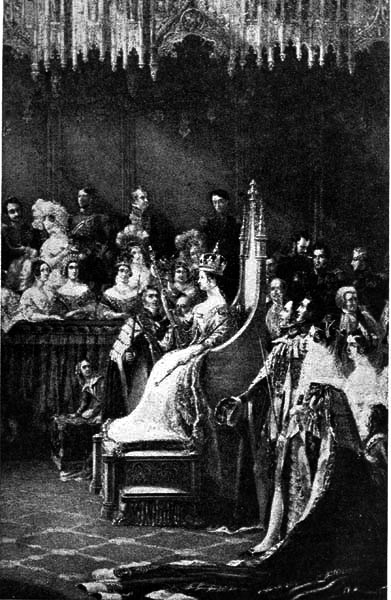
The Coronation of Queen Victoria. (From painting by Sir George Hayter.)
The ceremony of homage followed. The Archbishop, the two royal dukes, and many other dukes, marquises, earls, viscounts, and barons knelt and, kissing her hand, said: "I do become your liege man of life and limb, and of earthly worship, and faith and truth I will bear unto you, to live and die against all manner of folk, so help me God!" One of the peers was so aged and infirm that he tried twice in vain to ascend the steps. The Queen rose and moved toward him and extended her hand to him as simply and naturally as any other young girl might have done who was not sitting on a throne. After the homage, she received the Holy Sacrament; the "Hallelujah Chorus" was sung; and then the procession re-formed and went slowly over the way to Buckingham Palace.
When George III. was crowned, he complained of some blunders that were made, but he could hardly have been much comforted by the reply that matters would "go better next time." Even though Victoria was the third sovereign crowned since the time of George III., there were still some mistakes. England was accustomed to crowning strong men, but not slender young girls, and the orb was made so heavy that holding it was very wearisome, while the ruby ring was made for the little finger and had to be forced upon the ring finger as best it could be. When the peers did homage, they were required to touch the crown; and the Queen said it was fortunate that she had had it made as tight as possible, for many of them knocked it, and one actually clutched it.
After such a day as this, Victoria must have felt that she was "really and truly" a queen; but with all her dignity and her royalty, she was still a frank, natural young girl, and the story is told that when she entered Buckingham Palace and heard the bark of her favorite dog, she exclaimed, "Oh, there's Dash! I must go and give him his bath."
The English were proud of their Queen, of her dignity and her royal bearing, but it was these touches of frankness and simplicity that won their hearts, and made them feel that with all her jewels, her velvets, and her ermine, she was, after all, one of themselves. It was at this time that the Duke of Sussex wrote to a friend:
"The girl Queen is becoming more and more popular. You would simply idolize her if you saw that bright little face, with clear blue eyes, winning all hearts and making us all say, 'God save the Queen!'"
CHAPTER VI
THE COMING OF THE PRINCE
The coronation ceremonies in Westminster Abbey were, indeed, magnificent, but it must not be supposed that England was satisfied with no further celebration of so joyful an event. Throughout the realm there were for several days fairs, balls, and entertainments of all kinds. London was illuminated, and the theaters were made free to all who chose to attend them. People's hearts and purses were opened. The rich were not satisfied with having a good time themselves; they wanted the children of the land and the poor to have a good time also. In many places feasts were given, and one of the most famous of these was held in a great open field in Cambridge, where more than fourteen thousand persons were entertained.
In the center of the field was a space for the band, and around it a platform. Much money had been subscribed for the feast, but the committee felt sure that large numbers of people would be ready to pay from seventy-five cents to one dollar and a half for the privilege of walking about on this platform and seeing what was to be seen. They were right, for there was "a most fashionable and select company," who promenaded around the circular platform and watched the feasters.
Sixty tables, each two hundred and thirty feet long, stretched out from the central platform like the rays of a star; and when the signal was given, the fourteen thousand persons, poor people and children of all ages, marched to their places. It must have been an amusing procession for each one was obliged to bring his own plate, knife, fork, and mug for beer. There was roast beef, and there were various other good things; but the member of the committee who wrote the account of the dinner seems to have been especially interested in the puddings. "Beautiful puddings," he says they were, and he tells just where each one was boiled. He states, too, that 2475 pounds of raisins were put into them.
At the end of the dinner, pipes, tobacco, and snuff were passed to the grown folk. There was a salute of nineteen guns in honor of the Queen's nineteen years. A balloon, which the enthusiastic committeeman calls a "stupendous machine," was sent up, and the health of the Queen was drunk. The Sunday-school children sang a song of better intention than rhyme, which began:
"Victoria! Victoria! We hail thy gentle rule; Victoria! the Patroness Of every Sunday school."
After the singing, came various games and contests. Men tried to climb a well-soaped pole to get a leg of mutton which was fastened to the top. Others were tied into sacks, and jumped as far as possible in the attempt to win a pair of boots. There was a wheelbarrow race run by ten blindfolded men. A pig was offered to the man who could catch the animal and swing it over his shoulder by the well-greased tail. Men grinned through horse-collars to see who could make the ugliest face and so win a pair of new trousers. Six boys with their hands tied behind their backs were given penny loaves and molasses, and a new hat was waiting for the one who ate his loaf first. Other boys with their hands tied were "bobbing for apples"—that is, trying to lift apples with their teeth from a tub of water—and another group of boys were struggling to see who could first swallow a pennyworth of dry biscuit, and so win a new waistcoat. There were foot races and donkey races and hurdle races, and races among men each with one leg tied up. At last the day came to an end with fireworks, and all the happy, tired people went home, fully convinced that under this new sovereign their country would be more prosperous than ever.
It seems very strange that this Queen who was worshiped by her people in the summer of 1838 should in the course of a few months have become exceedingly unpopular with some of her subjects, but so it was. There were in England two political parties, the Whigs and the Tories. Queen Victoria's sympathies were with the Whigs. They were in power when she came to the throne, but in the spring of 1839 the Cabinet proposed an important bill which Parliament refused to make a law. Under such circumstances it is the custom for the Prime Minister and the Cabinet to resign, because such a refusal is supposed to signify that the people, whom Parliament represents, do not approve of their acts.
When Lord Melbourne told the Queen that he must resign, she felt very badly. She must stand at the head of a great nation, and the one in whose advice she had trusted could advise her no longer. The leaders of the Tories were "the Duke," as the Duke of Wellington was called, and Sir Robert Peel; and Lord Melbourne told her that her wisest course would be to ask the Duke to become her Prime Minister and select a Cabinet of Tories. The Duke had declared before this that he did not know what the Tories would do for a Prime Minister if they should come into power. "I have no small talk," he said, "and Peel has no manners?" but when the Queen sent for him, of course he obeyed. She asked him to be her Prime Minister, and said to him honestly: "I cannot help being very sorry to make a change and give up my Ministers, especially Lord Melbourne, for he has been almost a father to me."
The straightforward old soldier was delighted with her frankness, but he said: "I am somewhat deaf, and I am too old a man to undertake this work and serve you properly. Moreover, it would be much better for one who can lead the House of Commons to be your Majesty's Prime Minister. I advise you to send for Sir Robert Peel."
Now, this girl of nineteen did not like the man who had "no manners," but she was a lady as well as a Queen, and when Sir Robert appeared—in full dress, as was required—she received him so courteously that he went away much pleased, having promised to obey her command and form a Cabinet. This was easily done, and the next morning he brought her a list of names.
"But you must not expect me to give up the society of Lord Melbourne," she said.
"Certainly not," was Peel's reply. "Moreover Lord Melbourne is too honorable a man to attempt to influence your Majesty in any way against the existing government." Sir Robert then suggested several men whom he knew that she liked for various positions of honor in the royal household. Finally he said, perhaps a little bluntly, "It will be desirable to make some changes in the ladies of your Majesty's household." Then a storm arose.
"I shall not part with any of my ladies," declared the Queen.
"But, your Majesty," said Sir Robert, "most of these ladies are closely related to the former Cabinet Ministers." The Queen would not yield, but she was willing to discuss the subject later with him and the Duke. When they appeared before her, they said: "Your Majesty, the ladies of the household are on the same footing as the lords."
"No," declared the Queen, "I have lords besides and I have let you do with them as you chose. If you had just been put out of office and Lord Melbourne had come in, I am sure that he would not have asked me to give up my ladies."
"There are more Whigs than Tories in the House of Commons," said Peel, "and if these ladies who are closely related to prominent Whigs are retained, all Europe will look upon England as the country that is governed by a party which the sovereign dislikes and in which she has no confidence."
"I give you my lords," replied the Queen steadfastly, "but I keep my ladies." The two nobles were in a dilemma. According to the British constitution, "The Queen can do no wrong"—that is, not she, but the Prime Minister is held responsible for every public act. Sir Robert could not remain Prime Minister if the Queen positively refused to yield to a course which he thought necessary.
While the Tory leaders were trying to plan some way out of the difficulty, the Queen sent a letter to Lord Melbourne which was written in much the same way that an indignant young girl would write to her father. "Do not fear," she said, "that I was not calm and composed. They wanted to deprive me of my ladies, and I suppose they would deprive me next of my dressers and housemaids; they wished to treat me like a girl, but I will show them that I am Queen of England."
Lord Melbourne called his Cabinet together in such haste that one member had to be brought from the opera and another from a dinner party. He read them the Queen's letter, and asked, "What shall we advise?"
"Advise her to give up two or three of her principal ladies," suggested one, "and perhaps that will satisfy Peel."
"Does anyone know exactly what Peel wants," queried another, "and how many ladies he demands shall be removed?" This was an exceedingly sensible question, and if it had been taken to Peel for an answer, the trouble might have been brought to an end. He would probably have been satisfied with the resignation of two or three of the strongest partisans and principal talkers among the ladies; and, although the Queen was insisting upon what she believed was her right, yet much of her indignation arose from her belief that Peel meant to deprive her of all who were then her attendants perhaps even the Baroness Lehzen. The question was not taken to Peel, however, and the discussion in the Cabinet went on.
"Let us write a letter for the Queen to copy and send to Peel," was the next suggestion, "saying that she will not consent to a course which she believes to be contrary to custom and which is repugnant to her feelings." This suggestion was adopted. The letter was written, and the Queen copied it to send; but before it reached Sir Robert, he resigned his position, and Lord Melbourne was again Prime Minister.
This was the famous "Bedchamber Plot," and it aroused all England. Lord Melbourne and the Whigs said:
"It is a small matter that the Queen should be allowed to retain her favorite attendants."
Sir Robert and the Tories replied:
"The Prime Minister is responsible for the acts of the Queen, and it is a large matter if she refuses to follow his advice when he believes that the good of the realm demands a certain course. She is not the Queen of the whole country, she is only the Queen of the Whigs, and the whole thing is a plot to keep the Whigs in power."
"We are loyal to our sovereign," declared the Whigs.
"We stand by the constitution of Great Britain not by the whims of a girl of nineteen," retorted the Tories. The amusing part of the struggle was that the Whigs had always prided themselves on standing by the constitution and the rights of the people, while the Tories had favored increasing the power of the sovereign; but in those days the question was too serious to strike anyone as amusing.
As the weeks of the summer and the early autumn passed, matters only grew worse. Victoria was spoken of most contemptuously, and was even hissed in a public assembly. Mr. Greville wrote in his journal: "The Tories seem not to care one straw for the crown, its dignity or its authority, because the head on which it is placed does not nod with benignity to them." Peel was, of course, above such behavior as that of some of his violent partisans, but he must have been somewhat surprised at developments. He had been afraid that the Queen's opinions and judgment were so weak that she would be influenced by the talk of a few ladies in attendance and would be unable to judge questions fairly and without prejudice; but he had found that, whatever might be the faults of the young lady on the throne, she could never be accused of having no will of her own.
During the first two years of her reign, the friends of the Queen were watching her with much anxiety. She was an unusual girl, with an unusual training, but, after all, she was only a girl, and she had responsibilities to meet from which, as Carlyle said, "an archangel might have shrunk." Her position was all the more dangerous because she was too young to realize her difficulties; and when trouble arose, there was no one in the land of whom she could ask counsel without arousing the enmity of someone else. Everyone who was capable of advising her was prominent in one political party or the other. If she had discussed any of her hard questions with even her own mother, and it had become evident that suggestions had come from the Duchess of Kent, there would have been talk at once of "foreign influence."
Meanwhile, "foreign influence" in the person of the wise King Leopold was busily at work. The young Queen had reigned for more than two years, and the first novelty of her position had passed. At first it had been delightful to her to feel that she was "the Queen," and that she could do precisely as she chose. Even the Bedchamber Plot had resulted in her having her own way, in keeping her ladies and the Whig Cabinet; but so clear-minded a woman as Queen Victoria must have seen—as, indeed, she declared some years later—that she had not behaved like a constitutional monarch, and she knew that thousands of her subjects were indignant with her.
Never was a loving uncle more shrewd in his affection than this "wisest sovereign in Europe;" for just at this time, when his niece was feeling far less self-sufficient than she had felt some months earlier, he proposed that Prince Albert and his brother Ernest should pay her a visit. The young men came, bringing with them a letter from the King which spoke of them in most matter-of-fact terms as "good, honest creatures, really sensible and trustworthy." The point of the letter was in its closing sentence, "I am sure that if you have anything to recommend to them, they will be most happy to hear it from you."
The Queen knew very well what this sentence signified, and she was more ready to "recommend" than she would have been some months before. She had seen her cousins only once, and that was more than three years earlier. Prince Albert was then a lovable boy, and the Princess was willing that her relatives should understand that she would marry him some day. When nearly two years had passed and she had become Queen, she felt much older and more mature; but she thought of her cousin as still a boy. She expected to marry him some time in the future, but she was not willing to permit even any formal engagement at that time. King Leopold wrote urging her to make some "decisive arrangement" for the following year. The Queen replied: "Albert and I are both too young to think of marriage at present. He does not know English well enough, and there are other studies which he needs to pursue."
King Leopold saw that it was of no use to press the question further at that time, and he told the Prince that the marriage would have to be postponed for a few years. The Prince saw the truth in Victoria's objections. He knew that his position in England would demand all the skill and knowledge that he could acquire, and he admitted that her arguments were strong.
"You understand, and you will wait?" asked his uncle.
"Yes," answered the Prince, "I will wait, if I have only some certain assurance to go on; but I do not want to be left in the ridiculous position of Queen Elizabeth's suitors. I do not want all Europe talking for years about my marriage and then laughing at the announcement that Victoria never meant to marry me."
Another year passed. Then came the Bedchamber trouble. King Leopold watched every item of news from England. "Now is the time," said the sagacious King to himself, and he proposed the visit.
There had been little correspondence between the cousins. Prince Albert had sent the Princess sketches of the places that he had visited in his travels, and when she became Queen, he wrote her a somewhat formal little letter, reminding her that the happiness of millions lay in her hands, and closing rather primly, "I will not be indiscreet and abuse your time." Victoria must have had in her mind a picture of her cousin that was a strange combination of a serious young man somewhat given to sermonizing and the stout, merry boy of seventeen who had slipped down to the floor of his carriage and pushed his dog's head up to the window when people pressed around to see the Prince.
With these two conflicting notions in her thoughts, the Queen went to the head of the staircase in Windsor Palace to welcome her "two dear cousins." The stout boy had vanished but in his place stood a tall, manly, handsome young man, with a cheery, thoughtful face. Two days later a letter went from the Queen to "Uncle Leopold," which said, "My dear Uncle, Albert is fascinating." Then she remembered that she had two cousinly guests and added, "The young men are very amiable, delightful companions, and I am very glad to have them here."
King Leopold wrote at once, "I am sure you will like the cousins the more, the longer you see them." Then he talked about the Prince. "Albert is full of talent and fun and draws cleverly. May he be able to strew roses without thorns on the pathway of life of our good Victoria! He is well qualified to do so."
While the hopeful uncle was writing this letter, Victoria was talking with Lord Melbourne.
"My lord," she said, "I have made up my mind at last, and I am ready to marry Prince Albert whenever he wants me."
"I am very glad of it," replied her fatherly friend. "You will be much more comfortable; for a woman cannot stand alone for any time, in whatever position she may be."
"Do you think that my people will be pleased?" she asked.
"I believe that they will," he replied, for he knew very well how eager they were for her marriage. No one liked the Duke of Cumberland, who was now King Ernest of Hanover, but if the Queen died without children, he would come over to England and wear the English crown as well as that of Hanover. The feeling against him was so strong that it had even been proposed in Parliament to make a law forbidding him ever to occupy the throne.
On the fourth morning of their visit, the two Princes went hunting. It was a long forenoon to the Queen, for she had what she afterwards called a "nervous" thing to do. They came back at noon, but they had hardly time to change their hunting clothes before a message was brought to Prince Albert that the Queen wished to see him.
Now, royal etiquette forbade that this Prince of a little German duchy should ask the sovereign of Great Britain for her hand; so when Albert reached the Queen's apartments, he was obliged to wait until she had spoken.
"I think you must know why I wished you to come," she said shyly. The Prince had still to keep silent; he could only bow, but his bow must have expressed a great deal, for she went on bravely: "It will make me very happy if you will consent to what I wish."
In just what form the Prince made his reply the Queen did not reveal, but it was evidently satisfactory, for she wrote, "He is perfection in every way." That very day she sent a letter to King Leopold in which she said: "I am so much bewildered by it all that I hardly know how to write. But I do feel very happy."
A few weeks before this time she had written Baron Stockmar that she could not think of marrying for three or four years, but that very day she wrote him: "I do feel so guilty, I know not how to begin my letter, but I think the news it will contain will be sufficient to insure your forgiveness. Albert has completely won my heart, and all was settled between us this morning I feel certain that he will make me very happy. I wish I could say," continued the modest little sovereign of Great Britain, "that I felt as certain of making him happy, but I shall do my best."
Prince Albert, too, had some letters to write; and as Victoria had written to King Leopold, his first was to Baron Stockmar. After telling of his happiness and of his love for the Queen, he wrote: "I cannot write more, I am too much bewildered." It certainly was bewildering. He had been told not long before that the Queen was determined not to marry for three or four years at any rate, and that she would not consent to any formal engagement. He had come to England with a determination to insist either that she should recognize the informal engagement between them or that it should be broken off.
The Duchess of Kent had loved Albert from the first, and she was very happy in the thought of the marriage. She and the Baroness Lehzen, together with Lord Melbourne and Prince Albert's brother, were the only ones in England who knew the secret until five or six weeks had passed. Then came a difficult five minutes for the young Queen. She had to meet her Council of eighty middle-aged men and tell them of her engagement. It is no wonder that she "hardly knew who was there." The picture of the Prince in her bracelet gave her courage, and though Lord Melbourne was far down the room, she caught a kind look from him and saw the tears of sympathy in his eyes. Her fingers trembled, but she soon controlled herself and read: "It is my intention to ally myself in marriage with the Prince Albert of Saxe-Coburg and Gotha." She went through the rest of the paper with her usual clear, sweet voice, and one of the Councilors wrote of the event: "Certainly she did look as interesting and as handsome as any young lady I ever saw."
When the reading of the paper was finished, the Lord President asked: "Have we your Majesty's permission to publish this declaration?" The Queen bowed and left the Council Chamber. About two months later she had something even harder to do; she had to open Parliament and ask that an income should be granted to the Prince. Another matter also had to be settled, and that was what position he should hold in England. Whether he should enter a room before or after dukes, earls, and members of the royal family was a question that gave rise to much discussion. These two questions were not settled as the Queen wished, for the sum granted to the Prince was but three-fifths of what her Ministers had asked, and Parliament refused to pass a law giving him precedence next to herself. The Duke of Wellington said, "Let the Queen put the Prince just where she wishes him to be;" and this she did, as far as England was concerned, by issuing an order in Council that he should stand next to herself. Some of her royal relatives were indignant and King Ernest declared positively that he would never give precedence to the younger brother of a German duke. "I won't give way to any paper royal highness," he declared. The Queen was both hurt and angry at these decisions but Prince Albert's only fear was lest they indicated objection to the marriage on the part of the English, and he wrote: "While I possess your love, they cannot make me unhappy."
A little more than a week after this letter was written, the day of the wedding came. It had been the custom to celebrate royal weddings in the evening, though other weddings must by law take place before noon; but on this, as on most other subjects, the Queen had a very definite opinion. "I wish to be married as my subjects are married," she said, "and the ceremony must be at noon."
"Is it the will of your Majesty that the word 'obey' be omitted from the promise that you make to the Prince?" asked the Archbishop of Canterbury.
"No," she answered with decision. "I am not to be married as a queen, but as a woman."
The wedding day was stormy, but that made little difference to bride, groom, or any of the brilliant company assembled in the Chapel of St. James'. The Prince wore the uniform of a British field-marshal, with the collar of the Garter, and looked exceedingly handsome. As he came into the Chapel, the organ burst out into the strains of "See, the Conquering Hero Comes." He stood by the altar waiting for his bride, and in a short time she appeared, escorted by the Lord Chamberlain. She wore a dress of heavy white satin, woven in England. Her veil had made scores of poor women happy, for she had ordered it of the lace-makers of Honiton in Devon. She wore no crown, but only a wreath of orange blossoms. She had diamond earrings and necklace, and a few diamonds in her hair. Twelve bridesmaids in white tulle and white roses bore her train; and a hard time they had, for, although it was six yards long, they found it too short for so many bearers. One of them wrote: "We were all huddled together, and scrambled rather than walked along, kicking each other's heels and treading on each other's gowns."
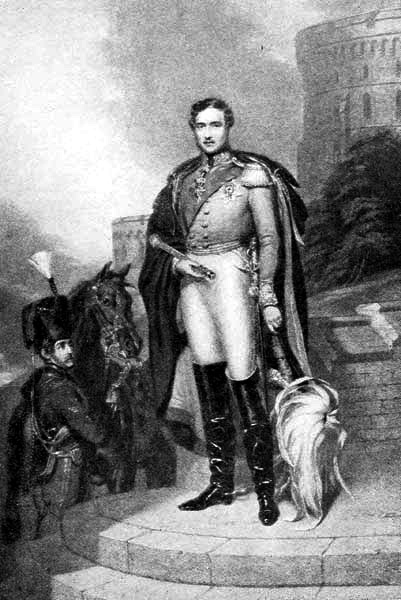
Albert, Prince Consort, in the uniform of a field marshal.
At the moment the ring was placed on the Queen's finger, the guns in the Park and at the Tower were fired, and the bells rang out their merriest peals. When the ceremony was over, the party returned to Buckingham Palace for a wedding breakfast. The bridesmaid who wrote the account of the wedding said that Prince Albert "seemed a little nervous about getting into the carriage with a lady with a tail six yards long," but they all reached the palace in safety. After the breakfast the sunshine at last beamed down upon them, and the young couple sped away for their honeymoon at Windsor Castle.
CHAPTER VII
HOUSEKEEPING IN A PALACE
Common people may make a wedding tour, but kings and queens are too fully occupied to afford such luxuries. The sovereign of England could spend her honeymoon in Windsor Castle, but it must be a honeymoon of only four days. Those four days, however, were marked by a freedom which she had never enjoyed before. For the first time in her life she could talk with someone of her own age without having to be on her guard lest what she said should be repeated and do harm.
One of the subjects that needed to be discussed and to be reformed was the royal housekeeping. Many a woman living in a two-room cottage is quite as comfortable as the Queen of Great Britain was in 1840. Three men, the Lord Steward, the Lord Chamberlain, and the Master of the Horse, were supposed to have the management of the household. These persons were men of high rank, and their offices were given them in reward for their political services rather than for their ability to manage the domestic affairs of a palace. Of course they were entirely too stately to take any charge themselves of the housekeeping, and they did not delegate their power to anyone in the palace. Some of the servants were under one of these three, and some were under another. No one was at the head of the house, and everyone did about as he chose. If the Queen rang a bell for a servant, the servant might answer it, or he might be absent from the palace, just as it happened, and the Queen was helpless, for the only one at all responsible was some aristocratic nobleman who was, perhaps, far away on a yachting trip. When the Prime Minister of France was a guest at Windsor, he wandered over the palace for an hour trying to find his bedroom, for there was no one on duty to point it out to him. At last he was sure that he had it, and he opened the door. Behold there stood a maid brushing the hair of a lady who sat at a toilet table, and could see in the glass the embarrassed gentleman as he hurriedly retreated. The next day he discovered that the lady before the glass was her Majesty. Baron Stockmar wrote that cleaning the inside of the windows belonged to one department and cleaning the outside to another. It is quite probable that when the little Princess Victoria asked Queen Adelaide to let her clean the windows there was visible need of such work. The servants of one department brought the wood and laid the fire, but it was not their work to light it, and for that duty a servant from another department must be called. A pane of glass could not be mended without the signatures of five different officials. No one was responsible for the cleanness of the house or even for its safety; and if the man whose business it was to guard an entrance preferred to do something else, there was no one to interfere with his pleasure. The doors were indeed so carelessly guarded that one night a boy was found under a sofa in the room next to the Queen's bedroom. He could not be punished as a thief, for he had stolen nothing. He was not a housebreaker, for he had simply walked in through open doors, and no one had been on guard to prevent such intrusions. It was finally decided that he was a vagabond, and he was imprisoned for three months.
Prince Albert was very anxious to have better management of the household, and he laid the matter before the Prime Minister.
"But men of high rank are now eager to hold these offices in the royal household," was the reply "and it will make trouble if anyone is put over them, or if there is any interference with their departments."
"True," replied the Prince, "but the household machinery is so clumsy and works so ill that, as long as its wheels are not mended, there can be neither order nor regularity, comfort, security nor outward dignity in the Queen's palace." Reforms began, but the Prince had to work very slowly, and some years passed before either the Queen or her guests could live in comfort.
If the Queen had insisted upon these changes being made at once, many of them could probably have been carried out; but the Bedchamber Plot had taught her that the sovereign must not act contrary to the wishes of her people. There was especial need of care at the time. Within hardly more than half a century, the American colonies had freed themselves from England and become a republic; France had had a terrible revolution; throughout Europe people were thinking of change, of more power for the people and less for the government. In England there was little probability of a revolution, but it was more than two hundred years since there had been any general and lasting enthusiasm for the monarch of the realm; and both Prince Albert and the Queen felt that the only way to make the throne strong and enduring was to win the affection of the people. This was the teaching of Baron Stockmar, the faithful friend and adviser of the royal couple. They appreciated his devotion, and all the more because they could do nothing for him. He did not care for money or office, and he was absolutely independent. When dinner was over, he did not trouble himself to go to the drawing room unless he felt inclined. He would generally spend the winter with the Queen, but he disliked good-bys, and when he wanted to go home to his family, he left the palace without a word of farewell.
Baron Stockmar had good pupils. Prince Albert was not yet twenty-one at the time of his marriage, and the question had arisen whether, as he was not of age, he could legally take the oath that was required of every member of the Council. Soon after the marriage, King Leopold asked an English lady about him.
"Do the English like him? Will he be popular?" inquired the King.
"They call him very handsome," was her reply, "but the English are always ready to find fault with foreigners, and they say he is stiff and German."
As the months passed, however, the English learned that this young Prince was a remarkable man in his grasp of politics, his talent for art and music, and his honest and unselfish devotion to the good of the realm. What was more, they showed their appreciation by an act of Parliament. The country was not yet at rest about the succession to the crown. If the Queen should have a child and die before the child was of age, a regent would be necessary. Parliament discussed the question, and named the Prince, "the foreigner," as regent. "They would not have done it for him six months ago," declared Lord Melbourne with delight.
The Queen had always been loved by the Whigs, and just about this time a great wave of devotion to her swept through not only their ranks but also those of the Tories. A boy of seventeen tried to shoot her, not because he hated her, but because he wished to be notorious. The Queen was in her carriage with the Prince when the attempt was made. She drove on rapidly to tell the Duchess of Kent that she was safe, then she returned to the park, where hundreds of people had gathered, hoping to see her and make sure that she was not injured. She was received with cheers and shouts of delight, and all the horseback riders formed in line on both sides of her carriage as if they were her bodyguard. When she appeared at the opera a few days later, she was greeted with a whirlwind of cheers and shouts. The whole house sang "God Save the Queen!" Then they pleased her still more by crying, "The Prince! The Prince!" and when Prince Albert stepped to the front, he was cheered so heartily that she knew he was fast winning the hearts of her people.
Operas and popularity were not the only things to be thought of in those days. The royal couple, barely twenty-one years of age, were working hard on constitutional history. They were very anxious, too, about the possibility of war with France on account of trouble in regard to Turkey and Egypt, and when their little daughter was born, in November, 1840, the Queen said: "I really think she ought to be named Turko-Egypto."
The little girl was not named Turko-Egypto, but Victoria Adelaide Mary Louise, and she had to wait three months for her name, as the christening did not take place until February. She was baptized with water brought from the River Jordan. The font was not taken from the Tower, as it had been for her mother's baptism, but a new one was made of silver, marked with her coat-of-arms and also those of her father and her mother. She was a very decorous little Princess, and the proud father wrote home to Coburg that she "behaved with great propriety and did not cry at all."
There was much rejoicing at the birth of this Princess Royal; but when, a year later, a Prince was born, then the delight of the nation knew no bounds. He was the heir to the throne, and it was impossible to do too much to celebrate his birth. Punch said:
"Huzza! we've a little Prince at last, A roaring Royal boy; And all day long the booming bells Have rung their peals of joy. "And the little Park guns have blazed away And made a tremendous noise, Whilst the air has been filled since eleven o'clock With the shouts of little boys."
One or two questions in regard to the celebration had to be settled by the courts of justice. It was an old privilege that when an heir to the throne was born, the officer on guard at St. James' Palace should be promoted to the rank of major. In this case the child was born at Buckingham, but the guard at St. James' demanded his promotion nevertheless. The matter was complicated by the fact that the change of sentry had chanced to occur just at the time of the birth of the Prince, and whether the old or the new guard actually held the keys was a difficult question to determine. Another difficulty of the same kind arose at Chester. The Prince had the title of Earl of Chester, and the mayor of that city declared that by ancient right he had claim to a baronetcy. Exactly the same question arose as with the sentinels, for at about the moment when the keys were transferred the new mayor was taking the oath of office.
All England rejoiced; but across the water, in Germany, was a man who was not at all pleased to hear that a son and heir was born to Victoria, for he had always had a lingering hope that he might yet become King of Great Britain. His aide-de-camp said that King Ernest was generally ill-natured when he heard from England; and he was indignant enough when he was not asked to become his grandnephew's godfather. Who should be the chief sponsor was a weighty matter but Baron Stockmar's advice was followed, and the King of Prussia was invited to take the place of honor. The Queen wished the little Prince named Albert for the husband who was so dear to her, and Edward for the father whom she could not remember, and these names were given him. This small Prince was an expensive baby, for it is said that the festivities at his christening cost at least $1,000,000. The Queen gave him the title of Prince of Wales when he was only a month old by signing an interesting bit of parchment which declared that she girded him with a sword and put a golden rod into his hands that he might direct and defend the land of the Welsh.
In all these regal honors and rejoicings the little baby sister was not forgotten, and the Queen wrote in her journal: "Albert brought in dearest little Pussy in such a smart merino dress, trimmed with blue, which mamma had given her, and a pretty cap. She was very dear and good."
The children's father and mother would have been very glad to forget all outside cares and splendors and live quietly by themselves, but that could not be. There was much to think of and many subjects concerning which they felt anxiety. One of these was the change of government, for a little before the birth of the Prince the event took place which the Queen had dreaded so long, the victory of the Tories and the resignation of Lord Melbourne. Never was a retiring Minister more generous to his opponents and more thoughtful of the comfort of his sovereign. Soon after his resignation he had a little conversation with Mr. Greville about the Tories.
"Have you any means of speaking to these chaps?" he asked.
"Certainly," answered Greville.
"I think there are one or two things Peel ought to be told," said Lord Melbourne, "and I wish you would tell him. When he wishes to propose anything, he must tell the Queen his reasons. She is not conceited; she knows there are many things which she does not understand, and she likes to have them explained."
Sir Robert was grateful for the advice and followed it. It was not pleasant for him to become Prime Minister, for, although the Queen treated him with the utmost courtesy, he knew that she looked upon him as responsible for cutting down the grant to Prince Albert and for opposing her wish to give the Prince precedence next to herself. Peel had done exactly what he thought was right, but he could not help feeling sensitive when he was brought into so close relationship with the Queen and knew that this relationship was not welcome to her. "Any man with the feelings of a gentleman would be annoyed at having unavoidably given her so much pain," he said. Moreover, he was exceedingly shy, "so shy that he makes me shy," said the Queen. Fortunately, Sir Robert and Prince Albert found that they had much in common in their love for literature and art, and the Queen could not help liking the man who showed such warm appreciation of the husband whom she adored. Very soon Peel paid him a compliment that completely won her heart. The new houses of Parliament were to be decorated, and there was a strong desire felt by all who were interested in art that they should be so artistic as to be an honor to the country. Peel invited the Prince to become the chairman of the commission which was to control the matter. This position gave him the best of opportunities to become connected with the prominent men of the country, and both Prince and Queen were grateful to Peel for his thoughtfulness. The Queen came to appreciate the Tory Premier; then she saw that the Tories were not so black as they were painted; and before the end of 1841, Victoria was no longer "Queen of the Whigs," but Queen of all her people.
The Queen had no easy life. "She has most of the toil and least of the enjoyments of the world," wrote her husband. She had also much of the danger. Without an enemy in the world, she was shot at twice during the summer of 1842 by men who seemed to have no motive for such a deed. When Peel heard of the attempt on her life, he hurried to the palace to consult with the Prince. The Queen entered the room, and the shy, cold, self-contained Minister actually wept tears of joy at her safety. After that, there was no question about the friendliness between the Queen and her Premier.
Just how these would-be assassins should be punished was an important matter, and here the common sense of the sovereign found a way out of the dilemma. "It is a mistake," she said, "to treat such attempts as high treason, for it dignifies the crime, and makes the criminals feel that they are bold and daring men." Parliament learned from her wisdom and passed a bill punishing any attempt upon the sovereign's life by imprisonment and flogging. This had so good an effect that the Queen saw seven years of peace before another attempt was made to injure her.
In spite of all these dangers and political responsibilities, Victoria was radiantly happy. The home life was all that she could have asked. She and the Prince were not only husband and wife, they were the best of comrades. Whenever they could win a little leisure from the cares of state, they read and sketched and sang together. Music gave them both the most intense pleasure, and both had rare musical ability, which had been carefully cultivated. Mendelssohn describes a visit to them which he seems to have enjoyed as much as they.
The great composer says that he found Prince Albert alone, but as they were looking at the new organ and trying the different stops, the Queen came in, wearing a very simple morning gown.
"I am glad that you have come," she said. "We love your music, and it is a great pleasure to have you with us."
"I thank your Majesty," replied the guest, and he went on to speak of the beauty of the organ.
"Yes, it is indeed fine," said the Queen, "but then I think any instrument fine when the Prince is playing on it. But what confusion!" she exclaimed, glancing around the room. The wind had scattered leaves of music over the floor, even on the pedals of the organ, and she knelt down and began to pick them up. Prince Albert and Mendelssohn started to help, but she said, "No, go on with the stops, and I will put things straight."
"Will you not play something for me?" begged Mendelssohn of the Prince, and added, "so I can boast about it in Germany?" The Prince played, while the Queen sat by him listening and looking perfectly happy. Then Mendelssohn played his chorus, "How Lovely Are the Messengers," but before he was at the end of the first verse, his royal hosts were singing with him.
"It is beautiful," said the Queen. "Have you written any new songs? I am very fond of your old ones."
"You ought to sing one for him?" suggested the Prince.
"If you only will," pleaded Mendelssohn.
"I will try the 'Frühling's Lied,'" she said, "if it is here, but I am afraid that all my music is packed to go to Claremont." Prince Albert went to look for it, but when he returned, he reported that it was already packed.
"But could it perhaps be unpacked?" suggested Mendelssohn daringly.
"It shall be," said the Queen. "We must send to Lady Frances." The bell was rung, and the servants were sent to find the music, but they were unsuccessful.
"I will go," the Queen declared, and she left the room. While she was gone, the Prince said: "She begs that you will accept this present as a remembrance," and he gave the composer a beautiful ring marked "V. R. 1842."
When the Queen returned, she said, "It is really most annoying; all my things are gone to Claremont."
"Please do not make me suffer for the accident," begged Mendelssohn, and at last another song was chosen. "She really sang it charmingly," he wrote in a letter, but when he told her so, she exclaimed, "Oh! if I only had not been so frightened."
The Prince sang, and Mendelssohn gave them one of his wonderful improvisations; then the musician took his leave. "But do come to England again soon and pay us a visit," said the Queen earnestly, as he made his farewells.
Running about to see the world was not so common an amusement in the first half of the nineteenth century as it is to-day, neither were railroads as common, and the Queen of England was twenty-three years of age before she ever made a journey by rail. This new way of traveling produced quite a disturbance among some of her attendants. The Master of Horse said that as it was his business to arrange for her journeys, he must assure himself that the engine was in proper condition; and, much to the amusement of the engineer, he appeared at the railway station several hours before the train was to start, that he might inspect the engine, as if it were a horse. There was even more difficulty in satisfying the claims of the coachman. "When the Queen travels, it is my business to drive for her," he declared; "therefore, I must at least be on the engine." He was permitted to ride on the pilot engine, but the dust and cinders made such havoc with his scarlet livery and his white gloves that he concluded not to press his claims quite so urgently in future.
This famous journey was only twenty-five minutes long, and in spite of the gorgeousness of crimson carpets laid from the royal carriage to the train, it could not have been especially comfortable, for airbrakes and good roadbeds were inventions yet to come. Nevertheless, the royal lady was not discouraged in her desire to travel, and in the autumn of 1842 she and the Prince made a journey to Scotland.
Much that she saw was almost as new to her as it would have been to any village maiden who had never left her home, and she was interested in whatever came before her. She was especially delighted with Edinburgh. "It is beautiful," she wrote; "totally unlike anything else I have ever seen." As she entered the city, she was met by the Royal Archers Bodyguard. This was an association formed by one of her royal ancestors more than two hundred years before. Its special business was to protect the sovereign, and in the old days its members were covered from head to foot with armor. Long before Victoria's time the armor had vanished, but in memory of the olden customs each man carried a bow in one hand and had arrows stuck through his belt. As soon as the Queen appeared they began to perform their ancient office, walking close beside the carriage all the way through the town.
In this journey the Queen and Prince Albert were received by various noblemen, but the most picturesque greeting was at the home of Lord Breadalbane at Taymouth. As they drove up to the castle, the gates were thrown open, and there stood their host in a Highland dress, at the head of a company of Highlanders, who were gorgeous in the bright-colored tartan of the Campbells. Pipers were playing on the bagpipes, salutes were fired, the soldiers and the crowd of country folk cheered over and over again. When the royal guests went into the house and were escorted up the wide stone staircase long lines of Highlanders in kilts stood on both sides of the hall and the stairway. It is no wonder that the Queen wrote in her journal that it seemed like the old feudal times. In the evening the gardens were illuminated. There were no electric lights then, but she says there was "a whole chain of lamps along the railing, and on the ground was written in lamps, 'Welcome, Victoria—Albert.'" Bonfires were kindled on the tops of the hills, and fireworks were set off. Then the bagpipes began to play, torches were brought on the lawn in front of the house, and by their wild and flaring light the Highlanders danced the gayest, merriest reels that can be imagined. The visitors spent several days in this charming place. A ball was given for them, but the Queen seems to have enjoyed much more heartily the quiet drives that she took about the country, the row up the lake, with two pipers sitting in the bow of the boat, piping and singing weird Gaelic boat songs; and perhaps most of all, the little picnics they had and the walks that they took, for there was no one to stare at them, and they roamed about in perfect freedom, guarded only by two Highlanders who, according to the ancient custom, followed them with drawn swords wherever they went.
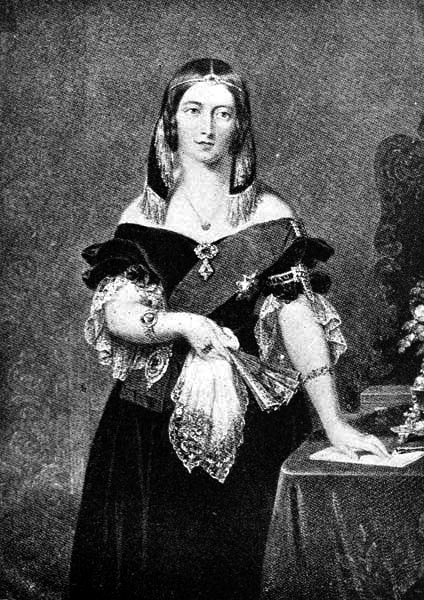
The Queen in 1845. (From a painting by John Partridge.)
During the next two or three years, the Queen and Prince Albert seized every opportunity for travel, short though their journeys had to be. They visited not only several of the lordly mansions of England, but they also spent a few days in Belgium and made a short stay at the court of the French King. In 1844, they went again to Scotland, and this time "Vicky," as they called the Princess Royal, was old enough to go with them. There were two more children in the royal nursery by this time, and the Queen wrote in her journal that "Alice and the baby and good Bertie" came to bid the travelers farewell. She was quite delighted that "Vicky" stood at the window of a little inn and bowed to the people outside. One of her hosts on this visit to Scotland was the Duke of Argyll. She describes in her journal his son, the two-year old Marquis of Lome, and calls him "such a merry, independent little child."
One of the disadvantages of being a sovereign is that the simplest acts are looked upon as being of political significance. Victoria wished to meet the French King, to whom Prince Albert was distantly related, and she did not wish to talk politics. On her visit to France she was interested in seeing the King's barge and its many oarsmen in white, with red sashes; in the royal chapel, the first Roman Catholic church that she had ever entered; in the little picnic that the King ordered in the forest; in the picturesque white caps of the peasant women, their bright-colored aprons and kerchiefs; and she noted even the tone of the church bells, and said that it was much prettier than that of the bells in England. She enjoyed her visit heartily; but far away in Russia the keen-eyed Emperor Nicholas was watching her movements, and he was not quite pleased. "The government of Turkey will soon fall to pieces," he said to himself, "and if it does, France would like to secure a piece of that country. If England should help her, she might be able to do so, and this visit looks as if England and France were becoming too friendly." The result of the Czar's meditations was that word was sent to the Queen that he was on his way to visit her and might be looked for at once. Queen Victoria had expected him to come the following year, but he liked to make visits in this sudden fashion, and there was nothing to do but to prepare for him as best she could in forty-eight hours, for she had no longer time in which to make ready.
The Queen had not been especially anxious for the visit, she feared there would be "constraint and bustle;" but she soon found that quiet, simple ways of living were most pleasing to her guest, and she wrote to King Leopold, "He is very easy to get on with." His greatest interest was in military matters, and he was so much of a soldier that he said he felt without his uniform almost as if he had been skinned. He was taken to a review, of course, and this he thoroughly enjoyed. "Won't you allow me to ride down the line," he asked the Queen, "so I can see my old comrades?" Down the line he went, and was greeted everywhere with enthusiastic cheers. When the Duke of Wellington appeared, the crowd began to hurrah for him, for the man who had won the battle of Waterloo was the nation's idol. "Please don't, please don't," he said, riding along close to the crowd. "Don't cheer for me; cheer for the Emperor."
This military Emperor had his own ideas about what the bed of a soldier should be, even if the soldier was at the head of an empire, and before he took possession of his bedroom at Windsor Castle, he had his camp-bed set up, and sent to the stables for straw to stuff the leathern case that formed his mattress.
The Emperor was delighted with his visit, and when the Queen invited him to come again, he said rather sadly: "You do not know how difficult it is for us to do such things." Then he kissed the royal children and the hand of the Queen, and made his farewells. The Queen kissed him, as sovereigns are expected to do at the beginning and end of a state visit, and the reception of the mighty Czar was over. "By living in the same house together quietly and unrestrainedly, I not only see these great people but know them," said the Queen as simply as if she herself were not one of the "great people."
CHAPTER VIII
A HOME OF OUR OWN
It is very delightful to live in palaces and entertain kings and emperors; but Queen Victoria's palaces belonged to the English nation and not to herself, and, as has been said, their royal tenants had to suffer many inconveniences because they were not at liberty to manage their own housekeeping as they chose. "If we only had a home of our own!" said the Queen and Prince Albert to each other, and at last they decided to buy one. They talked the matter over with Sir Robert Peel, whom they had come to look upon as a faithful friend, and he told them of a beautiful estate which was for sale.
This property was situated on the Isle of Wight. It was far enough from London to assure them of privacy, and it was so near that there need be no delay in matters of government. In this charming place there were trees and valleys and hills, a wide stretch of sea-beach, with the woods growing almost to the water's edge; and, best of all, the royal family could walk and drive and wander about without feeling that they were on continual exhibition. There was a palace at Brighton which the Queen had sometimes occupied for the sake of being near the sea; but Brighton had become so much of a city, and the houses had clustered so closely about the palace, that there was no longer any view of the ocean from the lower windows, and no member of the royal family could go outside of the grounds without being followed by inquisitive crowds. At Osborne, as the new purchase was named, there was perfect freedom. Perhaps the "grown ups" of the household appreciated the liberty indoors quite as much as that out of doors, for here there were no "departments" to consult, and if a pane of glass was broken, there was no need of sending over the kingdom for the signatures of five men before it could be mended.
The house was pretty, but it was too small, and a new one had to be built. Prince Albert made all the plans for it, and he was as eager as the Queen to get into a home of their own. Nevertheless even in his eagerness he did not forget the good of others. The longer the work of building and beautifying the grounds lasted, the better it was for the workmen; and so when harvest time came, he discharged large numbers of his men, saying: "Work in the fields now; then, when the harvest is in, come to me, and you shall have work here again."
The cost of the house came from the Queen's own purse, from the regular grant made her by Parliament, though most sovereigns have called upon the nation to build whatever dwellings they thought desirable. The people of the kingdom were pleased to hear the English Court called the most magnificent in Europe, and many statesmen expected that when a new palace was to be built or a royal guest to be entertained, the sovereign would ask Parliament for a special grant of money to pay the expense. Frequently far more was expected of members of the royal family than their purses could provide, and then came debts. King Leopold had not been able to live within his grant, and the Duke of Kent had left indebtedness at his death. The little Princess, who had not been allowed to buy a box until she had the money to pay for it, meant, now that she was on the throne, to carry out the principle on which she had been brought up. The first thing that she did was to pay her father's debts, and while living in as much splendor as her people desired, she managed her income so well that she could afford to build a palace if she chose. Prince Albert heartily approved of this wise economy, and he carried out the same plan in managing the farm of the new estate; he spent lavishly in improving the land, but unlike most "fancy farmers," he made his costly improvements so skillfully that they were paid for in the generous increase in crops.