EVA MARCH TAPPAN, Ph.D. (continued 3)
Reading edition
When the new house was done, there was a joyful homecoming. As the Queen passed through the door, one of the maids of honor threw an old shoe after her, "to bring good luck," she said. To the Prince, entering into the new home brought memories of his childhood in Coburg, and after the first dinner he said, "We have a hymn in Germany for such occasions. It begins:
"Bless, O God, our going forth," Bless Thou, too, our coming in."
So it was that the new house was opened. Not only the grown folk, but the merry little company of princes and princesses, were very happy in it whenever a few days could be spared for its pleasures. As they grew older, a Swiss cottage was built for them, and this was their house. There was a charming little kitchen, with a cooking stove, so that the girls could try all sorts of experiments in the cooking line; and happy they were when they could persuade their father and mother to partake of a "banquet" of their own preparing. The boys had a forge and a carpenter's bench, where they built small boats and chairs and tables and wheelbarrows. Every child had a garden, and there he raised not only flowers, but fruit and vegetables. In this little paradise the children did what they liked, but they were shown the best way of doing it. A gardener taught them how to manage their gardens, and whenever their vegetables were a success, they either gave them away or sold them at market price to the royal kitchen. Prince Albert himself taught the boys how to use tools, and helped them to begin a museum of insects, minerals, and all sorts of curiosities like the one that he and his brother Ernest had had in Coburg when they were boys.
Not only at Osborne, but wherever the royal children were, they were brought up as simply as the Queen herself had been. Whatever material was bought for their clothes had to be shown to the Queen, and if it was rich or expensive, she would refuse to allow it to be used. As soon as the princes and princesses were old enough, they were taught to take as much care of their clothes as if they had been a poor man's children. One of their nurses wrote that they had "quite poor living—only a bit of roast beef and perhaps a plain pudding;" and she added, "The Queen is as fit to have been a poor man's wife as a queen." Baron Stockmar was consulted on all nursery questions, and he said that it was more difficult to manage a nursery than a kingdom.
The Queen tried to make her children understand that they were no better than other children just because they were princes or princesses, and they were obliged to behave with perfect courtesy to the servants of the palace as well as to kings and emperors. It is said that once upon a time two of the children thought it very amusing to take possession of the brushes and blacken the face of a woman who was cleaning a stove; but when the Queen mother discovered their prank, she took the small culprits by the hand and led them to the woman's room and made them apologize most humbly. The little Princess Royal "Vicky" was so independent a young lady that she would sometimes break through her mother's teachings. The story is told that one day a sailor lifted her on board the royal yacht, saying as he sat her down, "There you are, my little lady." "I'm a princess I'm not a little lady," the child retorted; but the watchful mother was listening, and she said, "That is true. Tell the kind sailor that you are not a little lady yet, but that you hope to be some day." Occasionally this willful little Princess preferred to bear a punishment rather than give up her own way. The Queen and the Prince addressed Dr. Brown as "Brown," and the small child followed their example. "You will be sent to bed if you do that again," said the Queen, but the next morning when Dr. Brown appeared, the little girl said with special distinctness: "Good morning, Brown, and good night, Brown, for I'm going to bed, Brown," and, with her saucy little head high in the air, she marched off to bed.
Happy as the Queen and the Prince were in their home life, one subject in connection with her husband always troubled the loving wife, and that was the annoying question of precedence. She wrote of him in her journal: "He is above me in everything really, and therefore I wish that he should be equal in rank to me." In England she could "put the Prince where she wished him to be," but Parliament had given him no rank, and therefore out of England some sovereigns, like King Ernest, positively refused to grant him any honors that were not due to the younger son of the Duke of Coburg; and when precedence was accorded him, the Queen had to express gratitude as for a personal favor to herself. Unknown to the Prince, she had a long talk on the subject with Baron Stockmar.
"I wish him to have the title of King Consort," she said earnestly.
"A king consort without the authority of a king would be a novelty," replied the Baron, "and the English people do not like anything for which there is no precedent. Queen Anne's husband was never called king."
"But Queen Anne's husband was stupid and insignificant," declared the Queen. "There has never been a case like ours before. Albert and I reign together. He is sovereign as much as I. We discuss all matters and decide together."
"True," admitted the Baron, "but the constitution does not provide for such a condition of affairs. I will talk with Peel about it."
Peel felt as Stockmar did, that it was not wise to propose such a title. The subject arose again some years later, and the shrewd Baron wrote to the Prince in his usual straightforward fashion: "Never abandon your firm, powerful position to run after butterflies. You have the substance; stick by it." The title was never given him, but it was true that he had "the substance." The Queen no longer met her Ministers alone; the Prince was always with her to help and suggest. Whenever either she or the Prince spoke to the Council the word "I" was not used; it was always "We think so-and-so should be done."
Not only the Council but the whole country were gaining in knowledge of the Prince's wisdom and devotion to the good of the kingdom, and in 1847 a valued mark of appreciation was given him in his election as Chancellor of the University of Cambridge, one of the greatest honors that could have been bestowed upon him. The Queen was delighted, because she knew that the position was not given out of compliment to her, but was something that he himself had earned. Soon after the election, came the installation. The magistrates and Yeomanry went to the station to meet the Queen, and then marched before her into the town. She was escorted into the Great Hall of Trinity College and led to an armchair which stood on a platform under a canopy. Soon after she had seated herself, the new Chancellor entered at the farther end of the hall, followed by the long line of university dignitaries. He wore a robe of black and gold, so long that it had to be held up by two gentlemen. When he stood in front of the armchair that represented the throne, he made a low bow and delivered his address. "The situation was almost absurd for us," said the Queen afterwards, but the Prince read his address with perfect command of his countenance and the Queen was quite serious until she caught his eye for a moment at the end of the speech. She half smiled, but in an instant she was again the dignified sovereign, and she declared with a little emphasis that brought forth shouts of applause, "The choice which the university has made of a Chancellor has my most entire approbation."
Not long afterwards the new Chancellor and his royal wife paid another visit to Cambridge. It was a little muddy, and the Queen hesitated a moment before getting out of the carriage. Instantly one of the students threw his gown upon the ground for her to step on, and others followed his example.
When Victoria thought of her husband and her children, she was supremely happy, but when she thought of the different kingdoms of Europe, and even of her own realm, there was much in 1847 and 1848 to make her unhappy. All Europe was restless and uneasy. Revolt had broken out in Italy, France, Germany, and other countries. The reigning sovereigns in most of these kingdoms were related to her either by blood or by marriage, and she could but feel grief for their trials, and, in some instances, fear for their safety. Indeed, the King and Queen of France had to flee to England and they spent the remainder of their lives at Claremont. In Victoria's own realm, there was trouble. Ireland was suffering from a terrible famine. Thousands of Irish were dying of either starvation or fever. In England there was no starvation, but everyone felt the hard times more or less. Those who had money did not dare to invest it, because business was so unsettled that they were afraid of loss. As capital was not invested, there was little work to be had, and the poor suffered severely. The rich as well as the poor felt the general stagnation. Greville said that his income was only half the usual amount, and even in royal palaces strict economy was practiced.
There was a special reason for great uneasiness in London. According to the laws at that time, no one could become a member of the House of Commons who did not own land enough to receive from it an annual income of $1500. This law had been made in the belief that a man who owned land would be more interested in the welfare of his country than a man who had none. Thousands of workingmen were not allowed even to vote. When work was plenty, and they were comfortable and busy, they did not think so much about their rights; but when work failed, they began to say to one another: "This is all the fault of the laws. If everyone could vote, and if poor men as well as rich men could become members of Parliament, laws would be made for the good of the whole nation and not merely for the landowners."
These men held meetings to discuss such matters, and they concluded to send in a petition to Parliament, setting forth their wrongs and demanding that changes should be made. The plan was explained in what was called the People's Charter, and therefore its supporters were spoken of as Chartists.
No one would have objected to having as many petitions sent to Parliament as the house would hold, but among the people were many hot-headed persons who had much to say about "oppression" and "revolution." The crowds sometimes became noisy and turbulent, and one evening some of them rushed wildly toward Buckingham Palace. The only harm that they did was to break some street lamps; and when their leader was arrested by the police, he made no resistance, but began to cry. Nevertheless, people felt very uneasy, and when it was reported that on the 10th of April the petition would be presented by 1,000,000 men, there was much alarm in the city. Shops were barricaded, weapons were put where they could be caught up in a moment, and old muskets that had not been used for half a century were brought down from the garrets and put in order for the riots that were feared. The Duke of Wellington, as commander-in-chief of the army, made very wise preparations. There was no display of soldiers or cannon, but Buckingham Palace and the public buildings were quietly filled with armed men, and gunboats were brought up the river. The Queen had shown again and again that she was no coward, and she would have stayed in London, but her Ministers persuaded her to take her three-weeks'-old baby to Osborne House. All London trembled when the 10th of April arrived; but when night came, those who had feared most laughed heartiest. The whole affair had ended in a few thousand men starting for Parliament with the petition. "You cannot cross the bridge in mass," said the police, and the Chartists went home meekly, sending their petition in cabs.
The Queen had long wished to go to Ireland, and in 1849 she and the Prince and the four older children went to that country in the yacht Victoria and Albert. Now, however indignant the Irish might be at England's rule of their country they would not give the Queen any but the most cordial greeting; and when the yacht sailed into the mouth of the River Lee, the people of the place called Cove of Cork asked that she would step ashore, if only for a moment. "We wish to change the name of our town," they said, "so that it may mark the place where the Queen first set her foot on Irish soil." The flag was run up on which was written the word "Cove," but as soon as the Queen had gone back to the yacht, the flag was dropped, and another was run up marked "Queenstown."
The Victoria and Albert went on to Cork, and the party also visited several other places in Ireland. Wherever they went, the crowds pressed to the water's edge with cheering and shouts of welcome. Cannon were fired and bells were set to ringing. Every little cottage had its flag, or at least a wreath of flowers and evergreens. All were interested in the royal children, and at Kingstown an old lady cried out: "Oh! Queen dear, make one of them Prince Patrick, and all Ireland will die for you."
When the Irish visit had come to its end, and the Queen was about to leave for England, the crowds on the shore cheered her more wildly than ever, and both the Queen and the Prince climbed the paddlebox and waved their handkerchiefs again and again. "Go slowly," ordered the Queen, and the boat moved very slowly along, keeping close to the pier. The crowds cheered with more enthusiasm than before, and three times a return was given to their salute by lowering the royal standard. One of the Queen's party said: "There is not an individual in the town who does not take the Queen's going on the paddlebox and lowering the royal standard as a personal compliment to himself."
The year following the visit to Ireland the Queen's seventh child was born, a boy.
"Now we are just as many as the days of the week," cried the brothers and sisters joyfully.
"But which of us shall be Sunday?" asked one.
"The new baby," answered Princess "Vicky" decidedly, "because he's just come, and we must be polite to him and give him the best."
The little boy was named Patrick, as the old woman in Ireland had suggested, but his first name was Arthur, for the Duke of Wellington, on whose eighty-first birthday he was born.
The days of the Queen were full of joys and sorrows that came almost hand in hand. Her home life was perfectly happy, but her duties as a sovereign took much time that she would have gladly given to her family. "It is hard," she said, "that I cannot always hear my children say their prayers." She had the warmest, most devoted friends, but in the six years preceding 1850, she had lost several who could never be replaced. Sir Robert Peel and Lord Melbourne had died, the opposing Ministers who had both won her confidence and gratitude; and the "good Queen Adelaide," who had loved the little Princess Victoria as if she had been her own child, was also gone. The sorrow which Prince Albert felt at the loss of his father had been to his wife a grief almost as deep; and both she and the Prince were saddened by the loss of the Coburg grandmother, who loved him so that she was almost heartbroken on his leaving her to make his home in England, and called piteously after his carriage, "Oh, Albert, Albert!" The three who had been nearest to the Queen in her childhood were living, her mother, Dr. Davys, and Baroness Lehzen. The kind, scholarly clergyman she had made Bishop of Peterborough, and she saw him from time to time. After the marriage of the Queen the Baroness Lehzen returned to her friends in Germany, but the busy sovereign found time to send her long and frequent letters.
The losses of the Queen were many, but with Prince Albert by her side, she felt that she could bear whatever came; and it was a great happiness to her that the better he was known in the country, the more highly the nation thought of him. They could hardly help esteeming him, for he seemed never to have a thought of himself; all was for the Queen and for her people. For several years he had had a plan in his mind for a great industrial exhibition. When he first laid the scheme before the public, the people were wildly enthusiastic. Then, as the difficulties arose, there was much criticism. The building would cost $1,000,000, and subscriptions were slow. Punch brought out a cartoon inscribed, "Please to remember the Exposition." It represented a boy holding out his cap for pennies Under the picture was written:
"Pity the sorrows of a poor young Prince —— Whose costly scheme has borne him to your door; Who's in a fix—the matter not to mince— Oh, help him out, and commerce swell your store."
Prince Albert laughed heartily at the cartoon, added it to his collection, and worked all the harder for the exposition.
There was much opposition to admitting foreign exhibits, for many English manufacturers had a wild fancy that the sight of them would prevent the English from patronizing home products. "All the villains of the Continent will be here," declared the grumblers. "They will murder the Queen and begin a revolution." In Parliament, one of the members invoked the lightning to fall from heaven and destroy the half-finished building. Nevertheless, enormous masses of goods were constantly arriving, and the mighty structure continued to rise. It was made of iron and glass, and was like an enormous greenhouse. Thackeray wrote of it:
"And see, 'tis done! As though 'twere by a wizard's rod, A blazing arch of lucid glass Leaps like a fountain from the grass To meet the sun."
The Crystal Palace, the people called it, and no better name could have been given. It stretched out one thousand feet in length, and part of it was one hundred feet high, so high that two elm trees which had been growing on its site grew on in freedom under its glass roof. The ironwork was painted a clear, bright blue. There were scarlet hangings, fountains, statues, banners, tapestries, flowers, palms, everything that could make it bright and beautiful.
May 1, 1851, had been named as the day of opening. In the royal family the day began with birthday gifts for the little Arthur—toys from the parents, a clock from the Duchess of Kent, and, strange presents for a baby, a bronze statuette and a beautiful paper-knife from the Prince and Princess of Prussia. Long before noon, the Queen, the Prince, and the two older children drove to the Crystal Palace. As they entered, there was a flourish of trumpets, followed by tremendous cheering. The Queen was radiant with happiness as she walked down the broad aisle with her husband. She wore a pink silk dress of Irish poplin, and on her head was a diamond tiara. She led by the hand the Prince of Wales, a bright, handsome little fellow. The Princess Royal wore a white dress, and on her head was a wreath of roses. She held her father's hand. The cheers grew louder and louder, then the deep tones of the organ broke in upon them. The music of two hundred instruments and six hundred voices followed, leading the thousands present in the National Hymn. After this the Prince left the side of the Queen, and, returning at the head of the commissioners, he read her the formal report. She made a short reply. The Archbishop of Canterbury offered up prayer, and the wonderful "Hallelujah Chorus" resounded through the lofty arches. While this was being sung, a Chinese mandarin, who had been walking about most perfectly at his ease and quite indifferent to the gazing crowds, now took his stand before the Queen and made a very profound obeisance. He proved to be of considerable use a little later, for when the long procession of distinguished Englishmen and foreigners was formed, it occurred to someone that China was not represented, and the dignified mandarin was taken possession of as an addition to the train. He made no objections, but marched along with his former tranquillity, thinking apparently that all foreigners were treated in such manner by those remarkable people, the Englishmen.
The Duke of Wellington was in the procession and the walk around the building was to him a triumphal progress, for the women waved their handkerchiefs and kissed their hands, while the men cheered and shouted, "The Duke! The Duke!" In the midst of all his glory, he did not forget his little year-old namesake and godson and later in the day, his eighty-second birthday, he called at Buckingham Palace with a golden cup and some toys of his own selection for the little boy.
So ended what Victoria called "the proudest and happiest day of my life, a thousand times superior to the coronation." In her journal she wrote: "Albert's name is immortalized, God bless my dearest Albert, God bless my dearest country!"
CHAPTER IX
NIS! NIS! NIS! HURRAH!
Few men in England worked as hard as Prince Albert, the uncrowned King. If a corner stone of a school, a hospital, or a public building was to be laid, a missionary society to be formed, some new docks to be founded, a museum to be opened, Prince Albert must be present. He must attend naval reviews, councils to discuss reforms at Cambridge, dinners of scientific men, and first meetings of societies to aid superannuated servants. He must not only be seen, but he must be heard, for he was expected to make a speech on every occasion. In fact, whenever he opened the door of his own rooms, some delegation seemed to be waiting to ask him to attend a meeting and make a speech.
All these demands upon his time took him away from the Queen, and every absence made her lonely. She wrote to King Leopold: "You cannot think how forlorn I am when he is away; all the numerous children are as nothing. It seems as if the whole light of the house and home were gone." Prince Albert never let a day pass during any of these absences without writing to her. Once when he went to an important meeting of scientific men, he sent back the same day a little note that said: "I have locked myself in to send you two lines as a token of my life and love. You will be feeling somewhat lonely and forsaken among the two and a half millions of human beings in London, and I too feel the want of only one person to give a world of life to everything around me." The following day he sent her another letter, although it could reach her only two hours before his own arrival. However pressing his business might be, he always found time to write a word to her. One of these notes read:
"Your faithful husband, agreeably to your wishes, reports:
"1. That he is still alive;
"2. That he has discovered the North Pole from Lincoln Cathedral, but without finding either Captain Ross or Sir John Franklin;
"3. That he has arrived at Brocklesby, and received the address;
"4. That he subsequently rode out, and got home quite covered with snow, and with icicles on his nose;
"5. That the messenger is waiting to carry off this letter, which you will have in Windsor by the morning;
"6. Last, not least (in the dinner-speeches' phrase), that he loves his wife, and remains her devoted husband."
In the midst of all these engagements, the home life and the education of the children were not neglected. Lord Melbourne and Baron Stockmar had been consulted in regard to tutors and nursery arrangements as earnestly as on important political actions. Bishop Davys lived so simply that the Queen could not disturb him by a royal visit, but whenever she passed through Peterborough, she had her train delay so that he could come to her, and she could talk with him about the children and have his advice in regard to their training and their future. Lessons were important matters in the royal family, and if the governess was ill, either the Queen or the Prince heard the children recite, so that there should be no loss. There is a story that when a clergyman, who was hearing them say the catechism, remarked, "Your governess has taught you very thoroughly," they cried, "Oh, mamma always teaches us our catechism." She was interested in every detail of their lives, and when the man who made the clothes of the sailors on the Victoria and Albert made a tiny sailor suit for the little Prince of Wales, she seemed as pleased as if one suit a year was the limit of the royal purse.
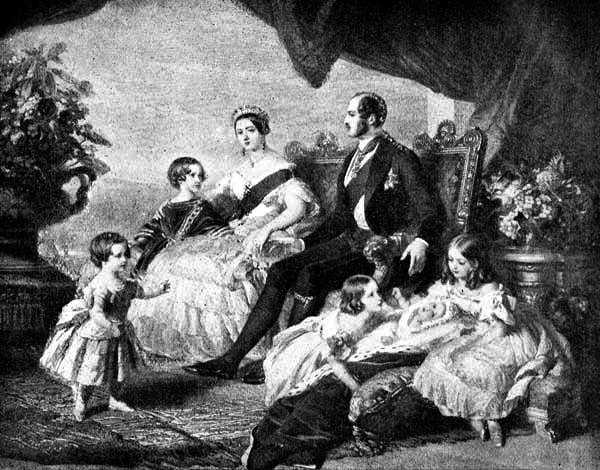
Queen Victoria; Prince Albert; Victoria, Princess Royal; Albert Edward, Prince of Wales; Prince Alfred; Princess Alice; Princess Helena. (From painting by F. Winterhalter, 1848.)
Besides the calls of home and state, many other responsibilities fell upon the sovereign of England. In the latter part of 1851, trade was very dull in London, and the Queen decided to give a great fancy ball at Buckingham Palace so that sales might be increased. All the guests were asked to come in the costume of the time of the Stuarts, and this was so gay and picturesque that the ballroom must have been a most brilliant sight. The Queen wore a gray dress, but it was hardly as simple as one would expect from those two words, for it was glittering with gold and silver lace, while clusters of diamonds flashed forth from bows of rose-colored ribbon. The front of the dress opened to display a cloth-of-gold stomacher and underskirt made gorgeous with large emeralds. Strings of pearls were braided in with her hair, and upon her head she wore a small crown of diamonds and emeralds. Her gloves and shoes were heavily embroidered with gold. The costume of the Prince was a veritable rainbow, for he was all aglow in an orange coat, with its sleeves turned up with crimson velvet, breeches of crimson velvet, and stockings of lavender silk. This was not all by any means, for there were pink epaulets, pink satin bows, gold lace, a silver baldric, and a hat with long white ostrich feathers.
The Queen and the Prince retained their seats while the guests entered, each one making a low bow in passing. No one would have thought a royal ball complete without "the Duke," and he appeared in the dress of a Stuart general, his scarlet coat adorned with gold lace and point lace, and its sleeves slashed with white satin. Blue velvet trunks, crimson silk sash, white hat with blue plumes, and gold lace wherever there was room for it, completed his costume. So much he would concede to the state ball, but he utterly refused to appear in the long curls of the Stuart period, and in spite of all his gay trappings, he was still the stern old commander.
Another great ball given by the Lord Mayor of London followed this one, and it is no wonder that Queen and Prince were glad to leave London for a little rest. This time and many other times they went to Scotland. They loved Osborne, but the Prince was feeling the strain of his intense work, and the physicians thought that the air of the mountains would be better for him than that of the sea. Therefore they went to Balmoral, a charming little gray castle that they had bought. It stood on the banks of the swiftly flowing River Dee, in the midst of hills and forests. The life at Balmoral was far more simple than that of many non-royal families. Of course a Cabinet Minister was always in attendance, and messengers with boxes of state dispatches were continually coming and going; but there was much greater freedom than the Queen could enjoy elsewhere. In the early years at Balmoral, the English court consisted of the Queen, the Prince, their four children, the two teachers, and four other persons, secretaries and ladies in attendance.
At Balmoral they climbed mountains, searched for crystals and cairngorms, took long walks through the woods, made little picnics far up in the hills and built a cairn, or great pile of stones, each person placing one in turn, to mark the new ownership of the place. At dinner, the Prince wore the Scotch dress, and the Queen often wore over her shoulder a scarf of Stuart plaid. While the Prince was out shooting in the morning, she frequently ran about among the cottages, chatting easily and comfortably with the cottagers, comparing the height and weight of the latest royal baby with the latest baby of the neighborhood, going to the little stores in the village to buy dresses for poor people and toys for their children. On Sunday she went to the kirk like a true Scotchwoman, and one day she wrote in her journal enthusiastic praise of Dr. McLeod's sermons, because they were so "simple and eloquent," she said. She was never pleased to have a minister pay her any special attention in his sermons; she liked to have him look upon her as only one more of his people; but she wrote that when Dr. McLeod prayed for her and the Prince, and then said "Bless their children," it gave her "a lump in the throat."
In their everyday life the royal family were Scotch when they were in Scotland. The English children of the palace wore kilts and tartans, they played in the brooks with the Scotch children of the cottages; and the Princess Royal of England walked into a wasps' nest and met the same fate that would have befallen any little Scotch girl who had done the same thing. A Highland dancing master and a fiddler were engaged to come to Balmoral and teach the Queen and her court how to dance Scottish reels and strathspeys. One evening, after an early dinner, the court set off for a fourteen-mile drive to see a Scotch ball at a neighboring castle. It must have been a weird and beautiful sight. The dancing floor was out of doors, and all around it stood Highlanders in their gay plaids, holding blazing torches, while seven pipers provided the music. One of the reels was danced by eight Highlanders, each bearing a torch. Another interesting sight was the sword dance. In this two swords crossed were laid upon the ground, and the performer must dance around them without touching them.
As in the case of Osborne, it was soon apparent that the pretty little gray castle was not large enough for the Queen's housekeeping. "Every bed in the house was full," wrote Mr. Greville when he had been spending a night at Balmoral. A new house was decided upon, and when the corner stone was laid, there was one of the little family celebrations that were so delightful to both Queen and Prince. The sun shone brightly on the stone, as it hung over the place that it was to occupy. The servants of the castle stood in a semicircle on one side, and the workmen behind them. The royal family and their guests came out of the house together and took their places on the opposite side. A clergyman offered up a prayer for a blessing on the work and on the new home. A parchment giving the date on which the stone was laid was signed by every member of the royal family and put into a bottle, together with the current coins of the country. The bottle was sealed and placed in the cavity; the architect gave the Queen a trowel to spread the mortar; and the stone was lowered. The Queen then struck the stone with a mallet, and said: "I now declare that this corner stone is laid." She poured oil upon it in token of plenty, and wine in token of gladness; the pipers played; the workmen had a feast and a dance; and the new house was begun.
When the house was partly done, the builder came to Prince Albert and said:
"The price of materials has risen so greatly that keeping this contract will ruin me."
"Tell me just what the prices are now and what they were when we made the contract," said the Prince. The builder made a rapid list and gave it to him.
A few days later, the Prince sent for the builder and said:
"I find that you are right, and so I have burned my copy of the contract. I will be the builder myself, and if you will superintend the work of building, I will pay you the same amount that you expected to make on the contract."
Only a few days after one of the simple, merry evenings at Balmoral, a telegram broke into the happiness of the household, saying that the Duke of Wellington was dead. "One cannot think of this country without the Duke," wrote the Queen. "Not an eye will be dry. He was Britain's pride, her glory, her hero, the greatest man she had ever produced." A public funeral was given him by order of Parliament. His body lay in state in a great hall whose walls were heavily draped with black, relieved only by the banners that he had captured in battle. Guardsmen as motionless as statues stood at intervals along the passage, leaning upon their muskets, which rested, muzzles down, on the door. On the coffin lay the Duke's sword and his cocked hat, and around the bier stood officers on guard, whose scarlet uniforms shone out of the darkness in the light of the tall wax candles that outlined the bier. Finally the body of the Duke was borne to St. Paul's on an iron gun-carriage, followed by the dead commander's horse with its empty saddle and by a long line of soldiers representing every regiment. Thousands of people lined the street through which the funeral cortège marched. They stood with bared heads and in such perfect silence that not a sound was heard but the steady tramp of feet and the roll of the funeral drums. So it was that the great soldier was buried amid the grief of the nation.
Never was he needed more, for the sound of war was coming near. The Emperor Nicholas, whom the Queen had called so "easy to get along with," proved to be somewhat less easy than he had been when on a visit. He had declared that he should protect the Christians in Turkey from the outrages of the Turks; but France and England believed that what he was really aiming at was to get possession of Constantinople. If he succeeded in this, no ship could enter the Black Sea against his will, and it would not be impossible for him to gain control of the Asiatic lands then ruled by Great Britain. If this came to pass, Russia would be far more powerful than any other state in Europe. This was the belief of England and France, and they wished to oppose him.
The Queen was always against war, but when it was finally declared, early in 1854, she did everything in her power for the success of England. When the first regiments that were ready to go to the Crimea marched through the courtyard of Buckingham Palace, she and the Prince stood on the balcony as enthusiastic as the troops. Then she hastened to Osborne to say farewell to the warships that were starting for the Baltic. Prince Alfred had already made up his mind to be a sailor, and the Duke's little namesake was destined to follow the Duke's example and be a soldier, but they were as yet only small children, and the Queen exclaimed, "How I wish I had two sons in the army now and two in the navy!" Nothing that affected the war was too great or too small for her to notice, and she had a definite opinion on every subject.
"Your Majesty," said Lord Aberdeen, the Prime Minister, "it is proposed to have a day of humiliation and fasting for the success of our arms."
"I approve most heartily of a day of prayer," declared the Queen, "but not of calling it a day of humiliation. We are not humiliated. It is not our wickedness, but the selfish ambition and want of honesty of the Emperor which have brought on this war. We believe that our cause is just, and that we are contending for what is right."
"But it has long been the custom to call such days times of fasting and prayer," the Prime Minister suggested.
"We will thank God for the blessings we have enjoyed," said the Queen, "and ask His help and protection, but it is my particular wish that we call the day one of prayer and supplication."
The war was begun, and during the two years following, no one in the land suffered more intensely than the Queen. A powerful nation is always inclined to expect that its enemies may be crushed at a blow, but Russia was not so easily crushed.
The Queen was prepared for battles lost and battles won, but not for blunders and poor management; and to a woman as prompt and as careful of details as she, such faults were unpardonable. Before many months came the report of the Charge of the Light Brigade, which Tennyson has made famous in his poem. This useless charge by which six hundred men were sent to attack an army was caused by a mistake. "Someone had blundered." Thousands of copies of the poem were printed and sent to the soldiers who were besieging Sebastopol.
The Queen was in constant anxiety. Telegrams were false and misleading, and if one brought good news in the morning, she dared not rejoice lest it should be contradicted before night. It was then that the work of the "special correspondent" began, for a physician who was at the scene of the war sent letters to the London Times, and for the first time, the people at home knew the daily life of their soldiers.
The story told in the columns of the Times was a narration of terrible suffering, which was all the worse because so much of it was unnecessary. It does not seem possible that such stupid blunders could have been made. Food was sent that was not fit to eat. A whole shipload of much-needed shoes braved the storms of the Atlantic and Mediterranean—and proved to be all for the left foot! Clothes, blankets, and medicines in generous quantities lay in the holds of English vessels off Balaklava Bay, while men were dying for the lack of them. Shiploads of cattle arrived at Balaklava, and instead of being driven to the front, where there was sore need of beef, they were killed at once, and then came a long delay in arranging for transportation. The trouble was that it was no one's business to transport the stores, and no one had the right to interfere. The hospitals were so inefficient that nine-tenths of the men who died, perished of disease and mismanagement, and not from the bullets of the Russians.
When such news as this reached England, the whole country was aroused, but it was helpless. There was no time to change the organization of the conflicting "departments," and the Minister of War finally decided to do exactly what the Romans used to do in times of great difficulty: he appointed a dictator, with full power to go to the Crimea and do precisely as she thought best in making arrangements for the sick and wounded soldiers. This dictator was a woman named Florence Nightingale. She had a large fortune and a beautiful home, but she cared more for helping the sick than for living in luxury. For more than ten years she had been studying nursing, not only in England, but in France and Germany. Late in 1854 she went to the Crimea, taking forty-two nurses with her. It was no small task that she had undertaken, for in a short time ten thousand sick men were in her charge. The sanitary arrangements of the camp and the hospital were all in her hands. She was a gentle, modest woman, by nature shy and retiring, but where the comfort of her soldiers was concerned, she would never yield a point to anyone. "She had a voice of velvet and a will of steel," they said of her; and as she walked down the long aisles of the hospitals—in one of them the rows of beds stretched along for nearly two and a half miles—the poor sufferers kissed her very shadow. It was of her that Longfellow wrote:
"And slow, as in a dream of bliss, The speechless sufferer turns to kiss Her shadow, as it falls Upon the darkening walls."
Meanwhile, the Queen was doing all in her power for the soldiers and their families. A Patriotic Fund was begun, and it soon reached $5,000,000. The "Soldier's Daughter" and her older girls sewed and knit for the army, the Prince of Wales, who was now thirteen years of age, painted a picture to be sold for the fund—no small contribution, for it brought nearly three hundred dollars—and the two older Princesses talked, as they sat knitting, about Miss Nightingale, and wished they could go to the Crimea and work by her side. At the opening of Parliament, the Queen began her speech bravely, but when she spoke of the war, her self-control failed her, and she struggled through the sentences as best she could with her eyes full of tears.
News of victories came, but nothing could be decisive except the capture of Sebastopol. "If we could only take Sebastopol!" she was always saying to herself, and one of her children said to a general who was starting for the Crimea, "Do hurry and take Sebastopol, or it will kill mamma." In September, 1855, the royal family and the Duchess of Kent were at Balmoral, when late one evening on the third day after their arrival, two telegrams were brought in, one for the Queen, and one for the Cabinet Minister.
"Good news," exclaimed the Queen. "This tells the details of the destruction of the Russian ships."
"But I have still better news," said the Minister. "Mine reads, 'Sebastopol is in the hands of the allies.'"
"Come and light the bonfire," cried Prince Albert, and he started up Craig Gowan, the hill opposite the house, where material for a bonfire had been piled up nearly a year before in the hope that Sebastopol would fall before the Queen had to return to London.
The gentlemen of the court hastened after the Prince, in full evening dress as they were. The little Princes were awakened and hurriedly dressed, and they followed after their father. The servants followed, the keepers, the workmen, the whole population of the village. The fires blazed out and shone on all the peaks round about. The people in the valleys knew what it meant, and they too hurried to the top of the hill. There was cheering, dancing, shouting, playing of bagpipes, and firing of guns. "It was a veritable witches' dance," declared the Prince when he came down. He was soon followed by the rest of the people, and when they were under the Queen's window, they sang to the music of the bagpipes, they fired guns, and then they cheered the Queen, the Prince, the Emperor of France, and last they gave a deafening "Nis! nis! nis! hurrah, for the fall of Sebastopol!"
It would seem as if this was excitement enough for one month, but four days later, the young Prince Frederick William of Prussia came to Balmoral to make a visit; and before the visit had lasted two weeks, there was a pretty little scene on the mountain side when he gave Princess "Vicky" a piece of white heather, the emblem of good fortune, and contrived to make it clear to her that the best fortune which could happen to him would be the gift of her hand. A few days before this, the father and mother and their guest had agreed that nothing should be said to the Princess for six months, but the secret had found its way out.
The Princess Victoria had always been Baron Stockmar's special favorite, and she as well as her father wrote their good friend at once, and sent him the news that the kindly old match-maker had been waiting for since the Princess was a little child, for such a marriage would make a strong alliance between England and Prussia, the two great Protestant powers of Europe. Prince Albert wrote, "The Prince is really in love, and the little lady does her best to please him. Come to us soon. We have so much to talk over." A little later, he wrote again of his hope that he should soon hear the children say, "Do you know, papa, that the Baron is in his room below?" He closed, "We positively must have some talk face to face."
The Princess was to be confirmed in the spring, and until that event was past, nothing was to be said in public of the engagement. The marriage was not to take place until at least a year after the confirmation, but Prince Albert felt that the time was far too short for the preparation that her future position would make desirable; and, busy man as he was, he set apart an hour every evening to talk with her on historical topics, and listen to the papers which she prepared on subjects that he had given her. In the spring came her confirmation, which was preceded by an examination in the catechism held in the presence of her father and mother, the Duchess of Kent, and the Archbishop of Canterbury.
This betrothal of the eldest daughter brought to the Queen mingled feelings of pleasure and pain; pleasure, because the alliance with Prussia, so desirable an arrangement for both countries, was to be brought about by a marriage that promised the happiness of her daughter; pain, because that marriage was the first break in the family circle. Nevertheless, in joy or in sorrow, the public life of the sovereign must go on. Many of the soldiers who had been severely wounded were sent home. The Queen had often visited them in the hospitals, and one day she said to her Minister:
"Those brave men ought to have medals that they can hand down to their children, and I have ordered a number to be made."
As the day appointed for the distribution of the medals drew near, the Minister asked if she would have them sent to the men.
"No," replied the Queen with decision, "I want to put those medals into their hands myself. I feel as if those men were my own children."
It was a pitiable company of sufferers that she met. There were men with deep red scars, men with empty sleeves, men tottering up to her on crutches to touch the hand of their Queen. Many of them would not give up their medals to be marked with their names, lest they should not receive again the very ones that the Queen had given them. One man was wheeled up in a chair. He had lost one leg and the foot from the other, but he had refused to give up the command of his battery till the fight was over, and had given his orders as calmly as if he had not been touched.
"Such bravery as that," cried the Queen, with tears in her eyes, "calls for more than a medal, and you shall be one of my aides-de-camp."
"That pays me amply for everything," he replied. The Queen wrote the account of this incident to King Leopold. "One must revere and love such soldiers as those," she added.
She was never weary of visiting the hospitals and camps. As the regiments returned from the Crimea in the spring and summer of 1856, there were reviews without end. On one occasion she reviewed eighteen thousand troops. She was dressed in the uniform of a field marshal, with a dark blue skirt; and as she rode down the front and returned by the rear, the thousands of men presented arms, and the bands of twenty regiments gave her a joyful greeting. Then she rode to a little mound from which she watched her troops as they filed past her.
There was no limit to the enthusiasm and loyalty which were aroused by the presence of the Queen. One review was held in a pelting rain. The evolutions were spoiled, and the men had every reason to feel gloomy and disappointed but the Queen saved the day, for she rose in her carriage and made them a warm-hearted little speech of welcome that was like a flash of sunshine. When she closed with, "I thank God that your dangers are over, while the glory of your deeds remains," there was a wild outburst of cheers. The men waved their hats, their sabers, anything and everything that would wave, and shouted till the hills echoed.
The sailors were no less loyal. During this same summer, there was a superb naval review off Spitshead which the Queen witnessed from the royal yacht. Two hundred and forty ships of war were assembled, but that was not all, for the Queen's suite alone consisted of thirty steamships, and there were many hundred private steamboats and sailing vessels. Every foot of the shore that would give a view of the warships was crowded with spectators, and they had a sight well worth the seeing. Ships and steamers were beautifully decorated with flags and crowded with guests. The men-of-war were drawn up in a double line, and the royal yacht steamed slowly along between them. Every vessel manned its yards and fired a royal salute as the Queen passed. The most enthusiastic cheering echoed and reëchoed. Then came a mimic naval attack on Southsea Castle, and the brilliant day was at an end.
One thing more the Queen planned to do for her soldiers, and that was to give a badge of special honor to those who had been especially distinguished by some deed of rare bravery. This badge was the Victoria Cross, which was then bestowed for the first time. With it went a pension of fifty dollars a year. More than one hundred thousand people assembled in Hyde Park to see the sixty-two chosen heroes receive their Crosses. The Queen was now in the scarlet jacket of the army. Prince Albert rode on one side of her and Prince Frederick William on the other side. She remained on horseback during the whole ceremony, leaning forward as one brave fighter after another was led up to her, and pinning the Cross on his breast.
The woman whose battles had been, not with Russians, but with mismanagement and inefficiency, lingered in the Crimea until she had seen every soldier leave for home, then she herself returned as quietly as if she had been on a pleasure trip. She seemed to have entirely forgotten that thousands of men in England would have been lying in Crimean graves had it not been for her; but the men remembered, and England gave her such a welcome as even the Duke of Wellington had hardly received. She was an honored guest at Balmoral. Everyone was longing to do something for her, but what should it be? "Make her a gift," said the people, "and let her do with it as she will." Two hundred and fifty thousand dollars was raised by popular subscription and presented to her. She did with it as she would; she endowed schools for the training of nurses to carry on the work that she loved.
CHAPTER X
THE ROYAL YOUNG PEOPLE
Many people had thought that the Russians hoped to get control of India. If they had succeeded in doing so, the Queen would have been saved the sorrow that came to her from a revolt of her Indian troops which was known as the Sepoy Mutiny. The commanders of the troops were English, but most of the rank and file were either Mohammedans or Hindus. The Mohammedans looked upon the cow as sacred, and the Hindus regarded the hog as unclean, therefore, when cartridges were given them greased with a mixture of tallow and lard, the soldiers of both peoples were very angry. Another trouble was that the English government had declared that no one should lose his property on account of any change in his religious belief, and this decree aroused the wrath of the native priests. The revolt was one of the most fearful events known in history, for even women and children were murdered as brutally as if the Sepoys had been wild beasts.
January, 1858, was the time that had been set for the marriage of the Princess Royal, and although India was not entirely subdued, the Sepoys were so nearly under control that England could join heartily in the wedding rejoicings. Buckingham Palace was crowded with guests, so many princes and princesses that when they went to the theater, they made, as the Queen said, "a wonderful row of royalties." "Macbeth" and three other plays were performed in honor of the occasion. For a week, eighty or ninety persons sat at the Queen's dinner table every day. There were operas, dinner parties, dances, concerts, and a great ball at which one thousand guests were present.
When the wedding gifts began to arrive, the large drawing room of the palace became a veritable fairyland, as table after table was piled with presents. "Fritz," as the family called Prince Frederick William, had brought to his bride a necklace of pearls, which the Queen said were the largest she had ever seen. This was only the beginning. The Princess and her mother went for a little walk in the palace garden, and when they came in, there were more tables and an entirely new display of gifts; they went to their own rooms, and when they returned, still more gifts had arrived. There were pictures, candelabra, diamond and emerald bracelets, brooches, necklaces, everything in the shape of jewelry that can be imagined, and, what especially pleased the housewifely tastes of the Queen, there were quantities of needlework from many ladies of the kingdom, for the Princess was a special favorite, and rich and poor were eager to send her some token of their love. The young girl was in ecstasies; then she remembered that going with "Fritz" meant leaving her father and mother, and she burst into tears.
At the end of the festal week came the wedding day. The Queen said, "I felt as if I were being married over again myself, only much more nervous," and when just before the ceremony, she was daguerreotyped with "Fritz and Vicky," she trembled so that her likeness was badly blurred.
Early in the morning the bells began to ring, but long before their first peal, thousands were out in the streets, too excited to sleep or even to remain in their homes. The procession was formed just as it had been eighteen years before at the marriage of the Queen, and the long line of carriages drove from Buckingham Palace to the Chapel Royal of St. James. Trumpets were blown, banners were waved, and the whole city reëchoed with the shouts of the merrymakers. The Queen bowed to her people as graciously as ever, but she could not forget for a moment that her oldest daughter was about to leave her, and she wrote afterwards, "The cheering made my heart sick within me."
The procession was even more beautiful than that on the wedding day of the Queen, because in this one there were so many children. First came the members of the royal family, the Duchess of Kent nearest to the Queen and her children, looking very handsome in her gown of violet velvet trimmed with ermine. Then came the Prime Minister bearing the sword of state. He was followed by "Bertie," who was now a tall young man of sixteen, and "Affie," the sailor boy of fourteen, both in Highland costume. Everyone was looking for the Queen, and she came directly after her two older sons. She was resplendent in a moiré skirt of lilac and silver with a long train of lilac velvet, and was all ablaze with diamonds. The two little boys, the namesake of the Duke of Wellington, and Leopold, who was not yet five years old, walked one on either side of their mother. They as well as the older boys were brilliant in Stuart plaid, which made a glowing contrast with the lilac velvet. Behind the Queen walked hand in hand the three royal girls, Alice, who was fifteen, and the two younger ones, Helena and Louise. They were in pink satin with cornflowers and marguerites in their hair. The nine royal children were present, with the exception of baby Beatrice, who was not yet one year old. The Queen and the royal family took their places in the "Royal Closet," a room opening into the chapel.
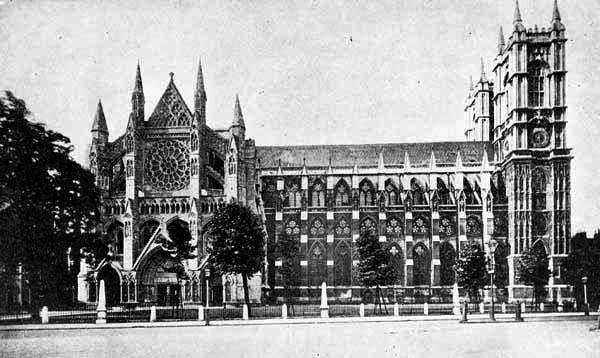
Westminster Abbey.
All the guests had assembled long before the entrance of the procession, and now they were all watching eagerly for the Prince of Prussia and the Princess Royal of England. The Prince, in his dark blue uniform, looked thoroughly a soldier. He made a profound bow to the Queen, knelt in prayer for a few minutes, then stood waiting to receive his bride. After the gorgeous colors worn by those who had preceded her, the white moiré dress and the wreath of orange blossoms and myrtle made the Princess look very childlike. She walked between her father and King Leopold, her train borne by the eight young girls who were her bridesmaids. They were in white tulle with pink roses. Among the roses were sprigs of white heather, for even in the excitement of this wedding season, the Queen did not forget her Scottish home.
The Prince was much more calm than the Archbishop of Canterbury, for the clergyman was so nervous that he left out some passages from the marriage service. At the moment that the ring was put on the finger of the bride, the cannon were fired as at the marriage of the Queen; but now the people of Germany must not be forgotten, and as the first gun sounded, a telegram was sent to Berlin. The last words of the service were read, "The Lord mercifully with his favor look upon you," and the "Hallelujah Chorus" burst forth, followed by Mendelssohn's "Wedding March," as the bride and bridegroom went forth from the chapel hand in hand.
All London was keeping holiday, and throngs had gathered about Buckingham Palace, ready to greet the returning party with most tumultuous applause. The honeymoon was to be spent at Windsor, and the Eton boys, who always claimed a share in royal rejoicings, dragged the royal carriage from the railroad station to the castle.
A few days later came the final good-bys, and these were much harder than if the bride had not been of the royal family, for kings and queens can make few visits. It was a very tearful time, "a dreadful day," wrote the Queen. "I think it will kill me to take leave of dear papa," the bride had said to her mother, but the moment of parting had to come. The snow was falling fast, but all the way to the wharf at Gravesend were beautiful decorations and crowds of people, and on the pier were companies of young girls wearing wreaths and carrying flowers to strew before the feet of the bride. "Come back to us if he doesn't treat you well," called a voice from the crowd, and the steamer moved slowly away from the wharf. Prince Albert watched it for a few minutes, then returned to the Queen, who was lonely in her great palace, so lonely that even the sight of baby Beatrice made her sad, reminding her that only a few hours before the little one had been in the arms of the beloved eldest daughter.
"The little lady does her best to please him," Prince Albert had written on the day of the Princess's engagement; but now she had thousands of people to please, and the father and mother at home waited anxiously for letters and telegrams and reports of friends to know what welcome the Germans had given to their daughter, for so much of her future comfort among them depended upon the first impression that she made. "Dear child," wrote Prince Albert to her, "I should have so liked to be in the crowd and hear what the multitude said of you." He had already received a proud and jubilant telegram from "Fritz,"—"The whole royal family is enchanted with my wife." The Princess Hohenlohe, the Queen's beloved half-sister, wrote from Berlin, "The enthusiasm and interest shown are beyond everything. Never was a princess in this country received as she is."
Later in the year, the royal father and mother contrived to make a fortnight's visit to Germany, and found the "Princess Frederick William" "quite the old Vicky still." Prince Albert's birthday was celebrated during their stay. The children at home were also celebrating it with the Duchess of Kent. They recited poems and played their pieces of music and exhibited the pictures that they had drawn. Several days earlier, they had all sent birthday letters to Germany, and these letters were given a prominent place on the "presents table." The Queen's gift to her husband was a portrait of baby Beatrice, done in oil. The Princess did not forget the Scotch home that she loved, and among her gifts to her father was an iron chair for the Balmoral garden.
The farewells had to be said much too soon. Then came the return to England and the other children. They were growing up fast. The Prince of Wales was at Oxford, not idling his time away, but working so hard that the irrepressible Punch called him "A Prince at High Pressure." Alfred, who was now fourteen, had just passed his examination and received his midshipman's appointment. The examiners would have been satisfied with fifty correct answers, but the Prince had presented eighty; and when his father and mother landed at Osborne, there he stood on the wharf in his naval cadet's uniform, half-blushing, and looking as happy as a boy who was not a prince would have looked after coming out of a three-days' examination with flying colors. Several months earlier, Prince Albert had watched him reef a topsail in a strong breeze, and said it almost took his breath away to see him "do all sorts of things at that dizzy height."
The circle of children soon began to widen, for early in 1859 Princess "Vicky" became the mother of a boy, and the Queen, not yet forty years of age, was a grandmother. The child was named Frederick William Victor Albert. Ever since her marriage, the Princess had kept up a constant correspondence with home. She wrote her mother every day, sometimes twice a day, telling all the little events of her life. To her father she sent every Monday long letters on general topics, and he always sent a reply two days later. No one knew better than he the difficulties that lay before her in making her home in a foreign country, and often his letters gave her bits of advice that had come from his own experience. Sometimes they were little pictures of home life. Once he told her of a "splendid snowman" that the children had made, with a yellow carrot for a nose and an old hat of "Affie's" on his head. After the birth of Frederick William Victor Albert, the letters from Germany never forgot to tell the latest news about the little German baby; and the English letters quoted the sayings of baby Beatrice, whom Prince Albert called "the most amusing baby we ever had." One day he wrote of this little one, "When she tumbles, she calls out in bewilderment, 'She don't like it, she don't like it.' She came into breakfast a short time ago with her eyes full of tears, moaning, 'Baby has been so naughty, poor baby so naughty,' as one might complain of being ill or of having slept badly."
While Buckingham Palace had still its merry group of children, the two older sons, "Bertie" and "Affie," were on their way across the ocean. Prince Alfred was making a voyage to the Cape of Good Hope, and the Prince of Wales was going to Canada. During the Crimean War, the colony had raised and equipped a regiment to aid the mother country, and had most urgently invited the monarch to visit her lands in the west; but because of the exposure and fatigue it was not thought wise for her to accept the invitation. Canada had then asked that one of the Princes should be appointed governor. They were far too young for any such position, but the promise was made that the Prince of Wales should visit the colony. In the spring of 1860 it was decided that he should go early in the autumn.
The Prince was delighted with the expedition, and was ready to be pleased with whatever came to hand. In Newfoundland a ball was given for him, and he danced not only with the ladies of the official circle, but with the wives and daughters of the fish-merchants, and had the tact to make himself liked by all. "He had a most dignified manner and bearing," said the wife of the Archdeacon. "God bless his pretty face and send him a good wife," cried the fishermen. His visit to Canada was not all amusement, for he had the usual royal duties to perform. He opened an exhibition, laid the last stone of the Victoria Bridge over the St. Lawrence, and laid the corner stone of the new parliamentary buildings at Ottawa. No fault could be found with his manner of attending to such duties, but he won the hearts of the people less by laying corner stones than by such bits of boyishness as singing with the band one day when they chanced to play some of his favorite airs. He saw Blondin walk across Niagara Falls on a tight-rope. "I beg of you, don't do that again," he said earnestly to the performer. "There is really not the least danger; I would willingly carry you over on my back," replied Blondin, but the Prince did not accept the offer.
When Mr. Buchanan, President of the United States, heard that the Prince of Wales was coming to Canada, he wrote to the Queen, inviting the Prince to visit him at the White House, and assuring her that her son would receive a very cordial greeting from the Americans. The city of New York meant to have a royal visit all to herself, and therefore sent a special invitation for him to come to that city.
The United States showed no lack of interest in the young man. Reporters from the leading American papers followed him about in Canada; and when he crossed to Detroit, he found the whole city illuminated, and the streets so crowded that he had to slip into his hotel by the side entrance. He visited the grave of Washington, and planted a tree by the tomb of the man who had prevented him from becoming the ruler of all North America. His visit to the White House lasted for five days, and at its close, President Buchanan wrote to the Queen: "In our domestic circle he has won all hearts."
In New York a ball was given for him which he enjoyed; but he was far more enthusiastic over a parade of the New York Fire Department. Six thousand firemen in uniform turned out one evening, all with lighted torches except those who manned the ropes. A delightful trait in both his parents was their feeling that honors shown them were not merely actions due to their position, but were marks of courtesy and kindness; and the Prince showed this same characteristic, for at the review he cried with grateful delight, "It is splendid, and it's all for me, every bit for me!"
On the Prince's return voyage he was so delayed by contrary winds that two warships were sent out to search for him. He reached home late in November, and on his return a letter was written to President Buchanan by the Queen, expressing her gratitude for the kindness shown her son and speaking very warmly of the friendship between England and the United States.
While the Prince of Wales was receiving the honors of the western continent, the midshipman brother was on his way to South Africa. When he landed at Cape Town, the English governor accompanied him on a short tour through the English possessions, during which he laid the first stone of the famous breakwater in Table Bay. He was cheered and feasted and received with all the honors that could be devised so long as he was on land; but when he returned to his vessel, he was no longer treated as a prince; for on shipboard he was simply a midshipman and in no wise different from the other naval cadets. When the chief of an African tribe came to visit the ship, he saw the young Prince bare-footed and helping the other midshipmen to wash the decks. The chief went away wondering, and a little later, he and his councilors sent to the English a most interesting letter. It read:
"When the son of England's great Queen becomes subject to a subject, that he may learn wisdom, when the sons of England's chiefs and nobles leave the homes and wealth of their fathers, and with their young Prince endure hardships and sufferings in order that they may be wise and become a defense to their country, when we behold these things, we see why the English are a great and mighty nation."
When the two brothers returned to England, they found that their sister Alice had followed the example of the Princess Royal and had become engaged. The fortunate man was Prince Louis of Hesse. Prince Albert wrote to his daughter in Germany of "the great Alician event," saying, "Alice and Louis are as happy as mortals can be."
Not long after these cheerful times, a deep sorrow came to the loving heart of the Queen. In the midst of the days that were so full of care for her children, her home, and the duties of state not only in England, but also in Africa and Asia, the constant thought of the Queen had been her mother's comfort. When the daughter could not be with her mother, letters were sent every day, and frequently several times a day, and nothing was neglected that could add to the Duchess's ease and happiness. For some time she had not been well, and in the spring of 1861 came the dreaded summons to her bedside. In a few hours she was gone. "Oh, if only I could have been near her these last weeks!" wrote the Queen to King Leopold.
Save the sovereign herself, there was no woman in England whose death would have affected the whole country so deeply. Statesmen recalled the days when the Duchess of Kent was left alone in a strange land, without means, disliked by the reigning king, and weighed down by the responsibility of educating a child to stand at the head of the nation. In the character of their sovereign, they saw proof of the able, devoted, conscientious manner in which this sacred duty had been performed; and the address of sympathy sent by Parliament to the sorrowing Queen was as sincere as if it had been written by a personal friend, and not by a body of lawmakers. "It is a great sorrow to me not to have Féodore with me now," wrote the Queen to King Leopold; but neither he nor the Princess Hohenlohe was able to be present at the last services.
"I cannot imagine life without her," said the Queen sadly; but nevertheless, life had to go on. Others may sometimes stop to mourn, but the duties of a sovereign may not be neglected even for sorrow. A new cause of anxiety had arisen that came nearer home than even the sufferings of the Crimean soldiers. War had broken out in the United States, and the supply of cotton to England was rapidly diminishing. If the cotton supply failed entirely, the mills of England would have to stop; many thousands of spinners and weavers would have no work; and the sufferings of the manufacturing districts would be intense. The government made an earnest effort to increase the amount of cotton imported to England from India; but the emergency was so sudden that even during the first few months of the war, there were many honest, hard-working people in England who were sorely in need.
When autumn came, the Queen was free to go for a little while to the beloved Balmoral for the rest and quiet which she so greatly needed. The simple life of the Highlands did more for her than anything else could have done. On this visit, Prince Albert, the Queen, the Princess Alice, Prince Louis of Hesse, with Lady Churchill and General Grey in attendance, went on two of what the Queen called "Great Expeditions," that is, trips of two or three days by carriage and by pony. To the Queen these trips were as fascinating as they were novel. The party tried to keep their identity a secret, and sometimes they succeeded: Prince Albert and the Queen called themselves Lord and Lady Churchill: the real Lady Churchill was now Miss Spencer, and General Grey became Dr. Grey. They were as excited as children in a new game over playing their parts properly, and the struggles of the two men-servants to remember not to say "Your Majesty" and "Your Royal Highness" amused them immensely. "The lady must be terrible rich," whispered an awe-struck woman to one of the servants, "for she has so many gold rings on her fingers." "And you have many more than I," said the aggrieved monarch to Lady Churchill. Two or three times they stayed all night at little village inns. The Queen wrote in her journal that at one of them the bedroom given to her and the Prince was hardly more than large enough for the bed, but she found no fault with it, and called it "very clean and neat." The dinner was "nice, clean, and good" according to her description, for this sovereign of Great Britain, with several magnificent palaces of her own, was so ready to be pleased with what was done for her that she could be contented in the tiny inn of a Highland village. At a second inn, which seems to have been particularly poor, she admits that there was "hardly anything to eat," but closes her account less like the ruler of millions than like a half amused and half disappointed little schoolgirl, "No pudding and no fun. We soon retired."
The efforts to avoid being "found out" were like a continual frolic. The royal party trembled when they heard the distant sound of a drum and fife, but felt safe again on being told by a little maid at the inn that it was "just a band that walked about twice a week." Sometimes they came to tiny villages where they were "suspected;" and at last, on getting up one morning, they heard the tread of somewhat irregular marching, led by a drum and fife and bagpipe. There was no escape then, for they were found out at last. A company of volunteers was drawn up in front of the door to do them honor; the women of the village stood by with bunches of flowers in their hands; and the landlady was glorified by a black satin dress with white ribbons and orange blossoms. There was nothing to do but to bow with all gratitude and drive away as fast as possible.
Such a woman was Victoria of England, ready to be pleased with the smallest things, praising what was good, saying little of what was not good, and enjoying every little pleasure with a childlike zest and simplicity. And yet, this gentle little lady understood so perfectly her rights and duties as monarch of Great Britain that when her Secretary of Foreign Affairs persisted in being quite too independent in his methods of transacting business, she did not hesitate to write to him the following very definite sentences:
"The Queen thinks it right, in order to prevent any mistake for the future, to explain what it is she expects from the Foreign Secretary. She requires:
"1. That he will distinctly state what he proposes in a given case, in order that the Queen may know as distinctly to what she has given her royal sanction.
"2. Having once given her sanction to a measure, that it be not arbitrarily altered or modified by the Minister. She expects to be kept informed of what passes between him and the Foreign Ministers, before important decisions are taken, based upon that intercourse; to receive the foreign dispatches in good time, and to have the drafts for her approval sent to her in sufficient time to make herself acquainted with their contents before they must be sent off."
It is worth noting that the royal lady who wrote this epistle had sufficient self-control to delay for five months forwarding it to the offending Secretary, hoping that his methods would be amended and that so severe a rebuke would become unnecessary.
CHAPTER XI
THE QUEEN IN SORROW
It had certainly become clear to all her Ministers that Victoria was no mere figurehead, for while she yielded if their judgment was against her, yet she never failed to have an opinion and a reason for her opinion. In 1861, the fact that both she and Prince Albert were able to think for themselves and had come to a wise conclusion proved to be a matter of the utmost importance to two countries, England and the United States. Everyone in England was thinking about the war in America. The English government had declared that England would be neutral, that is, it would do nothing to assist either the United States or the seceded States. The United States Government was indignant at this declaration, because it spoke of the seceded, or Confederate States, not as if they were rebelling against the government, but as if they were an independent power. The Confederate States, however, were much pleased, and thought it quite possible that England might be persuaded to help them. Their chief argument was—cotton. These States were the ones that raised cotton, and with the United States warships blockading their ports, there would be little chance for cotton to reach England. Would not England, then, help the seceders, put an end to the war, and have all the cotton that her mills wished to use?
The Confederates decided to send two men, named Mason and Slidell, across the ocean for aid, the first to England, the second to France. It was not easy to get away from a southern port, but they contrived to escape to Havana, and from there they went on board a British mail steamer named the Trent. They supposed that all difficulties were over when they were once on board a British vessel; but before the Trent had been out twenty-four hours, a United States warship fired a shot across her bows. The Trent was not armed so that she could make any resistance, therefore she stopped, and Lieutenant Fairfax was sent aboard with a strong guard of marines.
"My orders from Captain Wilkes are to ask to see the list of your passengers," he said.
"That list cannot be shown," was the reply of the English captain.
"I am here to arrest Messrs. Mason and Slidell," Lieutenant Fairfax stated, but the Captain only bowed.
"It is well known to the United States authorities that they are attempting to make their way to Europe as envoys from States in rebellion against the government," said the Lieutenant, "and, therefore, I demand their surrender."
Then Commodore Williams, who was in charge of the mail, said indignantly:
"The two gentlemen are passengers in a British vessel which is carrying the mail from one neutral port to another. On board this ship I represent her Majesty's government. This thing is an outrage, and I tell you that you and your North shall suffer for it. Does your Captain Wilkes do this on his own responsibility or on that of your government?"
"On his own," was the reply.
"It is an insult to England and a violation of international law," declared the Commodore; but nevertheless the men were seized and carried to Boston.
When the news of this action reached England, there was wild excitement. Troops were sent to Canada at once. The Canadian harbors were frozen, and England had to ask permission of the United States to land them at Portland, Maine. Permission was granted, and no one seemed to see how amusing such a request was. Thousands of Englishmen were ready to declare war upon the United States without a moment's delay. Fortunately governments move more slowly than individuals, and war could not be declared without first asking whether the United States had given authority for the seizure or approved of it. Mr. Slidell's wife and daughter had gone on to England in the Trent; and they said Captain Wilkes did not claim to have any government authority, and that the United States would probably set the envoys free as soon as they reached Washington. The Prime Minister did not believe such would be the result, and he wrote a somewhat curt demand to the United States for an apology and the freedom of the two men.
Neither the Queen nor the Prince Consort, for that title had been granted to Prince Albert long before, was satisfied with this paper, and the following morning he wrote a statement to be sent to the Prime Minister to the effect that the paper ought to mention the friendship between the two countries and the hope and expectation of England that the United States would say the seizure was not done by government authority. Prince Albert and the Queen read the statement over together. She made two or three small changes in the wording, then copied it and sent it to the Prime Minister. He admitted at once that the Queen and the Prince were in the right, and wrote another dispatch to send to the United States, saying, of course, that an apology and the surrender of the men were expected, but wording the demand in a most courteous and friendly manner.
In the United States, as soon as President Lincoln heard of the capture, he said, "This won't do. Captain Wilkes is exercising the 'right of search,' and we fought England in 1812 on that very ground. Those men must be given up." There were thousands, however, who were so excited that they were ready to fight anybody for anything or for nothing, and if the Prime Minister's first dispatch had been sent, it would have been hard to prevent hostilities; but in so moderate a request for fairness, even the most hot-blooded could find little excuse for demanding a declaration of war.
So it was that Prince Albert and the Queen saved the two countries from bloodshed, and if the Prince had done nothing else in his twenty-one years of acting as chief adviser to the Queen, that one act would have been glory enough. But when one remembers the vast number of matters which he had to consider, it does not seem as if one man's mind could have held them all. Laying corner stones, unveiling statues, presiding over learned societies, guiding the education of his children, planning palaces, and managing large estates—all this was but a small part of his labors. He carried out reforms in the navy, he studied on commercial treaties between England and other countries, he reorganized the army, he wrote on improved methods of agriculture, he constructed better national defenses, he kept himself well informed concerning the condition of the United States, India, South Africa, and every country of Europe. After twenty-one years of such intense work as this, it is no wonder that he was exhausted. He rarely spoke of his weariness; but here and there in his letters and in his conversation with the Queen, a word was dropped that showed how weak and tired he felt. He slept little, yet he never thought of sparing himself, and he wrote the letter about the Trent affair with a very feeble hand. "I could hardly hold my pen while writing," he told the Queen, and at last he admitted that he was thoroughly miserable.
Then came day after day of illness. Sometimes the Prince would listen to his wife or his daughter Alice while they read him one of Scott's novels; once he asked for music a long way off, and a piano was brought into another room so that the Princess Alice could play his favorite chorale. Sometimes he was confused and recognized no one. "We are much alarmed," said the physicians, "but we do not give up hope." Every day found him a little weaker, and soon the evening came when, as the Queen bent over him and whispered, "It is your own little wife," he could not speak, he could only bow his head and kiss her, and in a little while he was gone.
At midnight the mournful tolling of the great bell of St. Paul's spread the sorrowful news through the city of London, and the telegraph told the children of the royal family who were away from England of the loss that had befallen them.
The Princess Victoria was not alone, for her husband and her child were with her to give her comfort; but far away in the warm climate of Cannes was Prince Leopold, the delicate little boy of only eight years, with not one of his own family beside him. The child was already grieving sorely over the death of the gentleman in whose charge he had been when the telegraph brought the news of his crushing loss. "Oh, mamma, mamma," he cried. "Do take me to mamma. I want my mother. I want my mother."
The warmest sympathy was felt for the sorrowing Queen in her own land and in all lands. Even from some chiefs in New Zealand came an address, which began:
"Oh, Victoria, our mother, we greet you! All we can now do is to weep with you, oh, our good mother, who have nourished us, your ignorant children of this island, even to this day."
Every honor that could be shown was given to the dead Prince Consort. The Queen chose a sunny spot at Frogmore for the beautiful mausoleum that was to be built for the body of the one who had been dearest to her of all the world. Seven years earlier, she had said, "Trials we must have, but what are they, if we are together?" but now the time had come when she must bear alone whatever might befall her. Her greatest comforter was the Princess Alice, the girl of eighteen, who seemed no longer a merry young girl, but a sympathetic, self-controlled woman. She and the other children went with the Queen to Osborne, and there passed the first three months of the lonely woman's sorrow. King Leopold and the Princess of Hohenlohe came to her; but the weight of her grief was hers alone, and no one could lessen it.
Crushed as she was by suffering, she did not cease to feel for others. Within a month after the death of the Prince, a terrible colliery accident occurred by which many lives were lost, and the Queen sent at once a generous gift and the message, "Tell them that the Queen's own misery only makes her feel the more for them." In her own heartbreak, she could not neglect the state business, whose delay would cause many difficulties, but she could not bear to meet others than her children and a few of her nearest friends. Again it was the Princess Alice upon whom she and the whole country relied, and this girl of eighteen went back and forth between the sovereign and the Ministers with such strength of mind, such thoughtfulness and tact, that the whole realm was amazed and grateful.
It would have been a comfort to the loving mother if she could have kept her oldest son with her during those sad months; but, even to lessen her loneliness, she would not break in upon the plans that his father had made for him. It had been decided that he should travel in the Holy Land, and not many weeks after the death of the Prince, he set out with Dean Stanley and others for the East.
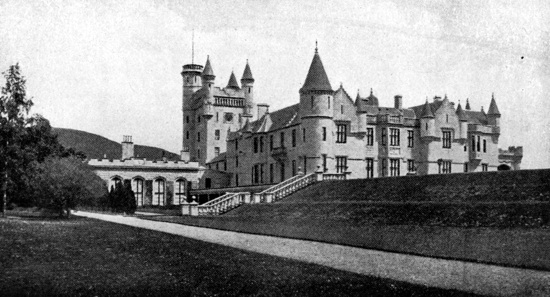
Balmoral Castle.
It had long been the custom in the royal family to spend at Balmoral the Queen's birthday, in May, and the birthday of the Prince, in August, and even during this sad year of 1862, the usual May visit was made. Hard as it was for the Queen to go without the Prince to a place that had been so dear to him, there was comfort for her in going among the cottagers. She loved the Scotch because, while they had a profound respect for her, they had also respect for themselves, and would talk with her without the subservience that she disliked. She taught her Scotch tenants to look upon her as a friend to whom they might come for help in time of trouble. In sickness they were encouraged to send to the castle for whatever they needed. When the Queen went to London, she did not forget them, and whenever a marriage or a death or the arrival of a new baby occurred among her Balmoral people, it was reported to her at once.
During the last visit of the Prince Consort to Balmoral, the husband of one of the cottagers was very ill, and the Queen was continually sending him delicacies from her own table, and not always by the hands of servants, for the Princess Louise was often her messenger. The story is told of the young girl's taking some dainty from one of the pockets of her jacket and asking, "Can't he eat this?" and then, when the wife shook her head sadly, of her taking something else from another pocket and saying, "Surely, he can eat this." The husband died, and when the Queen arrived at Balmoral on this first visit without the Prince, she went at once to see the widow. Both women burst into tears.
"I ask your pardon," said the cottager humbly. "I ought not to cry in your presence."
"Oh, it does me good," replied the Queen in the midst of her own tears. "I am so thankful to cry with someone who knows just how I feel. It was all so sudden, so sudden."
This visit to Balmoral was in May, and in July the brave-hearted Queen gave away her chief comforter, for she did not think it right to allow the marriage of the Princess Alice to be postponed longer. Many preparations for it had already been made before the illness of the Prince. The Highlanders were all interested in the marriage, for the Princess Alice was a great favorite among them; and in the autumn of 1861, many wedding gifts had been made by the Princess to the cottagers, for in the Queen's family it was the custom to make presents as well as receive them at the wedding seasons.
The marriage took place at Osborne. The day which all had expected to be so bright and happy was sad and lonely for the want of the dead Prince. There was no rejoicing, for everything was so associated with him that no one could be merry. Even the wedding dress of the bride was of lace whose pattern he himself had chosen.
In a few days Prince Louis and the Princess Alice left England for their German home. According to what had become a custom among the Queen's children, the Princess wrote to her mother almost every day. Her life in Darmstadt was far more simple than the Queen's had been immediately after her marriage. The usual time of rising was half-past seven or a little earlier. Coffee was drunk at eight, and generally the next two hours were spent out of doors in riding or walking. From ten to twelve, the Princess wrote or worked with her private secretary, and some time in the morning she read the newspapers, an occupation which she called "a great bore." Breakfast took the time between twelve and one. At two, people began to come to call upon her. Dinner was at four. After dinner came a little leisure, then a drive "somewhere for tea." By half-past ten the day was over. The Princess lamented that she had so little time for her music and drawing, and when she was away from the city, she made many sketches, but she was in a wooded country, "And the trees are my misfortune," she said, "as I draw them so badly." After a few months, the twelve-year-old brother Arthur went to visit her. He was a bit of home, and she was delighted to have him. "He has won all hearts," she wrote to the Queen, "and I am so proud when they admire my little brother." When September came, the Princess and her husband went to Thuringia to meet the Queen; and there, much to the Queen's pleasure, it was decided that her daughter and Prince Louis should spend the winter in England, though the Princess with her ready sympathy wrote that she should regret not remaining in Germany for the one reason that the people would feel her absence so much. "They are most kind," she added, for she shared the feeling of her mother that the devotion of the people was not a thing that they could demand, but was a personal kindness shown to them.