Chapter XIII
Reading edition
VERY OLD GRAVESTONES.
A remarkable instance is afforded by Absalom, the son of David, who himself set up a stone to record his memory: "Now Absalom in his lifetime had taken and reared up for himself a pillar, which is in the king's dale: for he said, I have no son to keep my name in remembrance: and he called the pillar after his own name: and it is called unto this day, Absalom's place" (2 Samuel, chapter xviii. verse 18).
Professor Stuart indeed declares that there is no custom in the history of human progress which serves so much to connect the remote past with the present period as the erection of pillar stones. We meet with it, he says, in the infancy of history, and it is even yet, in some shape or other, the means by which man hopes to hand down his memory to the future. The sculptured tombs of early nations often furnish the only key to their modes of life; and their memorial stones, if they may not in all cases be classed with sepulchral records, must yet be considered as remains of the same early period when the rock was the only book in which an author could convey his thoughts, and when history was to be handed down by memorials which should always meet the eye and prompt the question, "What mean ye by these stones?"
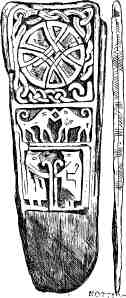
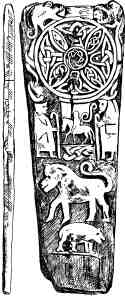
THE BRESSAY STONE FIG. 100.
OGAM AND RUNIC INSCRIPTIONS.
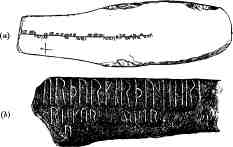
The inscriptions upon such stones, when they are inscribed, are usually in Ogam or Runic characters. An example of the Ogam writing is shewn on the edges of the Bressay stone (Fig. 100), and also on the front side of the Lunnasting stone (Fig. 101a). The Ogam style was used by the ancient Irish and some other Celtic nations, and the "Ogams," or letters, consist principally of lines, or groups of lines, deriving their signification from their position on a single stem, or chief line, over, under, or through which they are drawn, perpendicularly or obliquely. Curves rarely occur; but some are seen in the inscription on the Bressay stone, which has been thus interpreted by Dr. Graves, Bishop of Limerick: "Bentire, or the Son of the Druid, lies here." "The Cross of Nordred's daughter is here placed." This stone was found by a labourer about 1851, while digging in a piece of waste ground near the ruinous church of Culbinsgarth at Bressay, Shetland. The design is said to be thoroughly Irish, and the inscription a mixture of Irish and Icelandic. The stone measures 4 ft. by 1 ft. 4-1/2 in. by 2 in. It is attributed to the ninth century.
The stone 101a is a slab of brownish sandstone, 44 in. by 13 in. by 11/2 in., from Lunnasting, also in Shetland. It was found five feet below the surface in 1876, and, having probably lain there for centuries, was in excellent preservation. The authorities, however, are unable to make a satisfactory translation. The cross or dagger is also of doubtful explanation; and Mr. Gilbert Goudie thinks it is a mere mason's mark. It is, however, admitted on all hands that the stone is of Christian origin, and probably of the period just subsequent to the termination of the Roman rule in Britain. It has been suggested that most of these ancient gravestones were carved and set up by the Irish missionary monks not earlier than A.D. 580. The Ogam inscription on the Lumasting stone has been made by one expert to read:
EATTUICHEATTS MAHEADTTANNN HCCFFSTFF NCDTONS.
A strange and inexplicable aggregation of consonants.
The stone represented below, 101 b, bears an inscription in Runic characters. Runic is a term applied to any mysterious writing; but there were three leading classes of "runes"—Scandinavian, German, and Anglo-Saxon—all agreeing in certain features, and all ascribed by some authorities to the Phoenicians. The stone 101 b was found in 1865, at Kilbar, Barra, a remote island of the outer Hebrides, off the north-west coast of Scotland. It measures 6 ft. 5-1/2 in. in height, and its greatest width is 15-1/2 inches. Mr. Carmichael has conjectured that it was probably brought from Iona about the beginning of the seventeenth century, and erected in Barra at the head of a grave made by a son of McNeil for himself. But it is believed to have been in any case a Norse memorial in the first instance, though certainly Christian, for it reads:
This practice is quite consistent with the principles upon which the Christian conversion was established by the early missionaries. Thus, Gregory, in a letter from Rome, in 601, directed that the idolatrous temples in England should not be destroyed, but turned into Christian churches, in order that the people might be induced to resort to their customary places of worship; and they were even allowed to kill cattle as sacrifices to God, as had been their practice in their previous idolatry. Hence also arose the system of establishing new churches on the sites previously held as consecrated by heathen worship.
Of the five old gravestones in the British Museum, four are from Ireland and one from Fardell in Devonshire. The Fardell stone was found about the year 1850, acting as a footbridge across a small brook at Fardell, near Ivybridge, Devonshire—a district once inhabited by a Celtic tribe. It is of coarse granite, 6 ft. 3 in. high, 2 ft. 9 in. broad, and from 7 to 9 inches thick. It bears an Ogam inscription on two angles of the same face, and debased Roman characters on the front and back. It reads, according to Mr. Brash, in the Ogam, "Safagguc the son of Cuic;" and, in the Roman, "Fanon the son of Rian."
The three Irish Ogam stones were presented to the British Museum by Colonel A. Lane Fox, F.S.A., who dug them out of an ancient fort at Roovesmore, near Kilcrea, on the Cork Railway, where they were forming the roof of a subterranean chamber. No. 1 cannot be positively deciphered or translated; No. 2 is inscribed to "the son of Falaman," who lived in the eighth century, and also to "the son of Erca," one of a family of Kings and Bishops who flourished in the ancient kingdom of Ireland; and No. 3, which is damaged, is supposed to have been dedicated to a Bishop Usaille, about A.D. 454. All the stones came probably from some cemetery in the district in which they were found.
It has been remarked that the distribution of these old stones marks clearly the ancient history of our islands; their frequency or rarity in each case corresponding accurately with the relations existing in remote times between Ireland on the one side, and Wales, Cornwall, and Scotland on the other. Further enquiry into the subject is scarcely to be expected in this rudimentary work.
To seek for the germ of the gravestone is indeed a far quest. Like the ignis fatuus, it recedes as we seem to approach it. In the sculpture galleries of the British Museum there are several examples preserved to us from the ancient Empire of Assyria, and one described as the "Monolith of Shahnaneser II., King of Assyria, B.C. 850," is almost the exact counterpart of the headstones which are in vogue to-day. It stands 5 ft. 6 in. high, is 2 ft. 9 in. wide, and 8 inches thick. Like the Scottish stones of the eighteenth and nineteenth centuries it is inscribed on both faces.