Chapter X
Reading edition
OLD GRAVESTONES IN IRELAND.
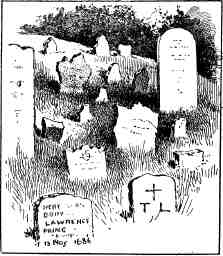
The cross and "T.L." scratched on one of the stones appears to be recent work, and the wonderful preservation of the stone to Lawrence Paine, of 1686, can only be accounted for by the supposition that it has long lain buried, and been lately restored to the light. The stone is of the same perishable kind as the others, and it is certain that it could not have survived exposure to the atmosphere, as its date would imply, for upwards of 200 years. It may even be found that the weather has chipped off the edges of the stones which now appear so jagged, shapeless, and grotesque; but, from recent evidences gathered elsewhere, it is but too probable that these rude pillars have been, and still are, set up as they come from the quarry, without dressing and free from any carving or attention whatever.
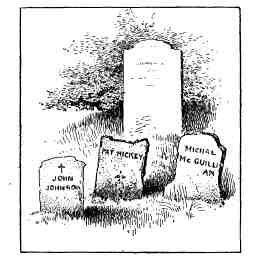
Many instances may be found in which slabs of stone, or even slate, have been erected quite recently, the edges untrimmed, and the name of the deceased simply painted upon them more or less inartistically, as in the sketch from Drogheda (Fig. 89). Such crude examples are the more remarkable in a busy and thriving port like Drogheda, and amid many handsome monuments, than among the peasantry of the villages; and it is easy to imagine that if nothing more durable than paint has been employed to immortalize the dead in past times all traces must have speedily disappeared. The illustrations from Drogheda give the whole inscription in each case, neither having date nor age, nor any other particular beyond the name. The memorial on the left hand is of slate—the other two of freestone; and the slate in the northern parts of Ireland is the preferable of the two materials.
There are at Bangor, ten miles west of Belfast, many such slate records, which have endured for more than a century, and are still in excellent preservation. One which attracted my especial notice at Bangor was of the professional character here depicted, and in memory of one of those bold privateers who were permitted to sail the seas on their own account in the old war times.
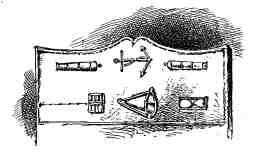
FIG. 90.—AT BANGOR, IRELAND.
The following is the epitaph, as clearly to be read now as on the day when it was carved on this slab of Irish slate, more than a century since:
"Born to a course of Manly action free, I dauntless trod ye fluctuating sea In Pompous War or happier Peace to bring Joy to my Sire and honour to my King. And much by favour of the God was done Ere half the term of human life was run. One fatal night, returning from the bay Where British fleets ye Gallic land survey, Whilst with warm hope my trembling heart beat high, My friends, my kindred, and my country nigh, Lasht by the winds the waves arose and bore Our Ship in shattered fragments to the shore. There ye flak'd surge opprest my darkening sight, And there my eyes for ever lost the light. "Captain George Colvill of the Private Ship of War 'Amazon,' and only son of Robert Colvill of Bangor, was wrecked near this ground 25th February 1780, in ye 22nd year of his age."
A possible explanation of the long endurance of this slate slab may be found in the practice which prevails in this and some other churchyards of giving all such memorials a periodical coat of paint; of which, however, in the case here quoted there is no remaining trace.
Altogether, primitive as they may be, the gravestones of the last century in Ireland, so far as I have seen them, compare favourably with the works of the hedge-mason in England which we have seen in earlier chapters. Even the poor pillar of rough stone, unhewn, ungarnished, and bare as it is, represents an affectionate remembrance of the dead which is full of pathos, and has a refinement in its simplicity which commands our sympathy far above the semi-barbarous engravings of heads and skulls which we have previously pictured. The immaturity of provincial art in Ireland is at least redeemed by an absence of such monstrous figures and designs as we at the present day usually associate with the carvings of savages in the African interior.
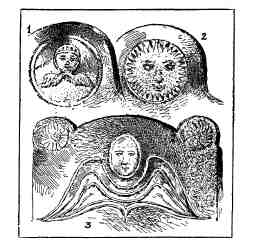
I leave to the ethnologists the task of accounting for these abnormal carvings in the South of Ireland, and associating them with the like productions of the same period in the South of England. Or perhaps I ought rather to excuse my insufficient researches, which, though spread over a broad area, are yet confined to but a few of the many spots available, and may very probably have passed by unexplored the fruitful fields. But, in the words of Professor Stephens, the apostle of Runic monuments, I claim for this work that it is "only a beginning, a breaking of the ice, a ground upon which others may build." My pages are but "feelers groping out things and thoughts for further examination."