Chapter XI
Reading edition
OLD GRAVESTONES IN SCOTLAND.
A very peculiar interest attaches to the old stones which survive in the burial-grounds of Scotland. Regarded generally they are of a description quite apart from the prevalent features of their English and Irish prototypes. Taking the same period as hitherto in limiting our purview of the subject, that is from the latter part of the seventeenth to the early part of the nineteenth century, it may perhaps be said that the Scottish headstones are tablets of Scottish history and registers of Scottish character during a long and memorable time. The one all-prevalent feature everywhere is indicative of the severe piety and self-sacrifice of an age and a people remarkable for one of the simplest professions of faith that has ever existed under the Christian dispensation. The rigid discipline, contempt for form, and sustained humility of the old Covenanters are written deeply in the modest stones which mark the green graves of their faithful dead during a period of fully two hundred years. The vainglory of a graven stone to exalt the virtues of imperfect men and women was to them a forbidden thing; the ostentation even of a name carved on a slab was at variance with doctrine; the cravings of a poor humanity to be remembered after death had to be satisfied with bare initials, and initials are all that were written on the gravestones in many thousands of cases, probably ninety per cent, of the whole, throughout the eighteenth century and approximate years. But the rule was not without its exceptions, often of novel and peculiar description. The skull and crossbone series, so common in the south, have no place in North Britain; while the symbol of the cross, so frequent in Ireland, is very rarely to be found in any shape whatever within the boundaries of a Scottish burial-place. I present four specimen types from the old chapel-yard at Inverness.
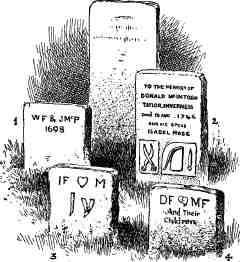
FIG. 92.—AT INVERNESS.
On the stone No. 2 the tailor's tools—shears, goose, and bodkin—are clear enough, and I was told that the figures on the stone in the lower left-hand corner (No. 3) are locally recognized as the shuttle and some other requisite of the weaver's trade. Inverness had spinning and weaving for its staple industries when Pennant visited the place in 1759. Its exports of cordage and sacking were considerable, and (says Pennant) "the linen manufacture saves the town above £3000 a year, which used to go to Holland."
In the 1698 example (No. 1) the short "and" (&) leaves no doubt that W.F. & J. McP. (probably McPherson and his wife) are there buried; and the similar information is almost as certainly conveyed in the manifold cases in which appears the sign which occupies the same position in the two lower stones (Nos. 3 and 4). These, however, are all of later date, and may be set down as developments, or rather corruptions, of the original form. The same signs, however, constantly occur in all the northern graveyards.
Scotland has also its cruder form of memorial in the rough unhewn slabs of native freestone, which are used in all parts of the British Isles wherever such material is readily procurable.
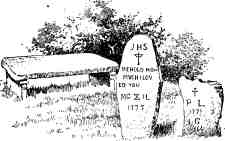
FIG. 93.—AT BRAEMAR.
Two of these slabs of different degrees are seen in my Braemar sketch, but both seem of one family and serve to shew us the unconscious evolution of a doctrinal law into a national custom. The employment of initials, originally the sacrifice and self-denial of a dissentient faith, is here, as in other instances, combined with the Catholic emblem of the Cross. This little graveyard of Braemar, lying among the moors and mountains which surround Balmoral, and accustomed to receiving illustrious pilgrims whose shoe-string the poor gravestone tramp is not worthy to unloose, is still used for indiscriminate burials, and furnishes several examples of Roman Catholic interments. Wherever such are found in Scotland, bearing dates of the eighteenth century, they are usually of the rough character depicted in the sketch. The recumbent slab in the same drawing is given to illustrate the table or altar stone, which throughout Scotland has been used all through the Covenantic period to evade the Covenantic rule of the simple anonymous gravestone, for such memorials are almost invariably engraved and inscribed with designs and epitaphs, sometimes of the most elaborate character. But these are not mere gravestones: they are "tombs."
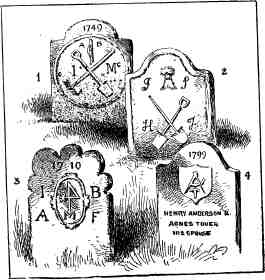
FIG. 94.—AT STIRLING.
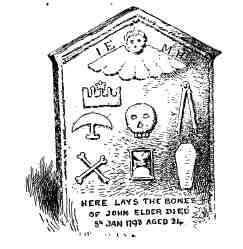
FIG. 95.—AT BLAIRGOWRIE.
Erected by William Brown to his Father John Brown, etc., etc.