Front matter (continued 4)
Reading edition
As we regained our composure, two tall forms appeared in the light of the head lamps, and one of them held up his hand. I recognised a police patrol.
"That's the car right enough," said one of them. He advanced to my side. "I want your name, please. I summons you for furious driving on the high road, without lights, a while ago, and refusing to stop when called on to do so. Go round and take the number, M'Caffery."
When, a few days later, the story flowed over and ran about the country, some things that were both new and interesting came to my ears.
Flurry Knox said that Bobby Bennett had sold me her old mare by moonlight in the Temple Braney yard, and it was a great credit to old McRory's champagne.
Mrs. Knox, of Aussolas, was told that I had taken Mrs. McRory for a run in the car at one o'clock in the morning, and on hearing it said "De gustibus non est disputandum."
Some one, unknown, repeated this to Mrs. McRory, and told her that it meant "You cannot touch pitch without being disgusted."
Mrs. Cadogan, my cook, reported to Philippa that the boy who drove the bread-cart said that it was what the people on the roads were saying that the Major was to be fined ten pounds; to which Mrs. Cadogan had replied that it was a pity the Major ever stood in Temple Braney, but she supposed that was laid out for him by the Lord.
IX
PUT DOWN ONE AND CARRY TWO
The promise of that still and moonlit December night, wherein we had bean-feasted with the McRorys, was shamelessly broken.
The weather next morning was a welter of wind and mist, with rain flung in at intervals. The golden fox on the stable weathercock was not at peace for a moment, facing all the southern points of the compass as if they were hounds that held it at bay. For my part, I do not know why people go out hunting on such days, unless it be for the reason that many people go to church, to set an example to others.
Philippa said she went because she had done her hair for riding before she could see out of the window—a fiction beneath the notice of any intelligent husband. I went because I had told my new groom, Wilson (an English disciplinarian), that I was going, and I was therefore caught in the cogs of the inexorable wheel of stable routine. I also went because I nourished a faint hope that I might be able to place before the general public, and especially before Flurry Knox, an authentic first version of the McRory episode. Moreover, I had a headache; but this I was not going to mention, knowing that the sun never sets upon the jests consecrated to after-dinner headaches.
As we rode away from Shreelane, and felt the thick small rain in our faces, and saw the spray blown off the puddles by the wind, and heard the sea-gulls, five miles inland, squealing in the mist overhead, I said that it was preposterous to think of hunting at Lonen Hill in such weather, and that I was going home. Philippa said that we might as well go on to the meet, to exercise the horses, and that we could then come straight home. (I have a sister who has said that I am a lath painted to look like iron, and that Philippa is iron painted to look like a lath.)
The meet was in shelter, the generous shelter of Lonen Hill, which interposed itself between us and the weather. There is just space for the road, between the shore of Lough Lonen and the southern face of the hill, that runs precipitously up into the sky for some six hundred feet, dark with fir-trees, and heather, and furze, fortified with rock—a place renowned as a fastness for foxes and woodcock (whose fancies as to desirable winter residences generally coincide). One would have thought that only a pack of monkeys could deal with such a covert, but hounds went through it, and so did beaters—or said they did.
We found the hounds waiting in an old quarry under the side of the hill, and, a little farther on, a very small and select company of waterproofs was huddled under the branches of a fir-tree that hung over the road. As we neared them I recognised Miss Bennett's firm and capable back: she was riding the black mare that she had come over to "pass on" to old McRory. It was Philippa who pointed out that she was accompanied by Miss Larkie McRory, seated on a stout and shaggy animal, whose grey hindquarters were draped by the folds of its rider's voluminous black macintosh, in a manner that recalled the historic statue of the Iron Duke. Farther on, Mrs. Flurry and her mother, the redoubtable Lady Knox, were getting out of a motor and getting themselves on to their horses.
"There's room under the umbrella for Mrs. Yeates!" called out Miss Bennett hospitably, "but the Major must find one for himself, and a very big one, too!"
"We could make room for him here," said Miss Larkie McRory, "if he liked to come."
I maintained, I hope, an imperturbable demeanour, and passed on.
"Who is that?" said Lady Knox, approaching me, on her large and competent iron grey.
I informed her, briefly, and without prejudice.
"Oh, one of that crew," said Lady Knox, without further comment.
Lady Knox is not noted for receptive sympathy, yet this simple statement indicated so pleasingly our oneness of soul in the matter of the McRorys, that I was on the verge of flinging overboard the gentlemanlike scruples proper to a guest, and giving her the full details of last night's revel. At this moment, however, her son-in-law came forth from the quarry with his hounds, and his coadjutors, Dr. Hickey and Michael, and moved past us.
"Yeates!" he called out, "I'd be obliged to you if you'd take that point up on the hill, on the down-wind side, where he often breaks." He looked at me with a serious, friendly face. "He won't break down, you know—it's only motors do that."
This witticism, concocted, no doubt, in the seclusion of the quarry, called for no reply on my part—(or, to be accurate, no suitable reply presented itself). There was an undoubted titter among the waterproofs; I moved away upon my mission at a dignified trot: a trot is seldom dignified, but Daniel has dignity enough for himself and his rider.
Daniel stands sixteen hands two inches in his stockings, of which he wears one white one, the rest of his enormous body being of that unlovely bluish-dun colour to which a dark bay horse turns when clipped. His best friend could not deny that he "made a noise"; his worst enemy was fain to admit that he was glad to hear it in front of him at a nasty place. Some one said that he was like a Settled Religious Faith, and no lesser simile conveys the restful certainty imparted by him. It was annoying, no doubt, to hear people say, after I had accomplished feats of considerable valour, that that horse couldn't make a mistake, and a baby could ride him; but these were mere chastenings, negligible to the possessor of a Settled Religious Faith.
I trotted on through the rain, up a steep road seamed with watercourses, with Lonen Hill towering on my left, and a lesser hill on my right. Looking back, I saw Flurry dismount, give his horse to a boy, and clamber on to the wall of the road: he dropped into the wood, and the hounds swarmed over after him, looking like midgets beside the tremendous citadel that they were to attack. Hickey and Michael, equally dwarfed by the immensities of the position, were already betaking themselves through the mist to their allotted outposts in space. Five-and-twenty couple of hounds would have been little enough for that great hill-side; Flurry had fifteen, and with them he began his tough struggle through the covert, a solitary spot of red among pine-stems, and heather, and rocks, cheering his fifteen couple with horn and voice, while he climbed up and up by devious ways, seemingly as marvellously endowed with wind as the day itself. I cantered on till, at the point where the wood ended, it became my melancholy duty to leave the road and enter upon the assault of the hill. I turned in at a gap beside the guardian thorn-bush of a holy well, on whose branches votive rags fluttered in the wind, and addressed Daniel to his task of carrying thirteen stone up an incline approximating to a rise of one in three.
A path with the angles of a flash of lightning indicated the views of the local cow as to the best method of dealing with the situation. Daniel and I accepted this, as we had done more than once before, and we laboured upwards, parallel with the covert, while the wind, heavy with mist, came down to meet us, and shoved against us like a living thing. We gained at length a shelf on the hill-side, and halting there in the shelter of a furzy hummock, I applied myself to my job. From the shelf I commanded a long stretch of the boundary wall of the wood, including a certain gap which was always worthy of special attention, and for a quarter of an hour I bent a zealous and travelling gaze upon the wall, with the concentration of a professor of a Higher Thought Society.
As is not unusual in such cases, nothing happened. At rare intervals a hint of the cry of hounds was carried in the wind, evanescent as a whiff from a summer garden. Once or twice it seemed to swing towards me, and at such moments the concentration of my eyeglass upon the gap was of such intensity that had the fox appeared I am confident that he would instantly have fallen into a hypnotic trance. As time wore on I arrived at the stage of obsession, when the music of the hounds and the touches of the horn seemed to be in everything, the wind, the streams, the tree branches, and I could almost have sworn hounds were away and running hard, until some vagrant voice in the wood would dispel the mirage of sound. This was followed by the reactionary period of pessimism, when I seemed to myself merely an imbecile, sitting in heavy rain, staring at a stone wall. Half an hour, or more, passed.
"I'm going out of this," I said to myself defiantly; "there's reason in the roasting of eggs."
It seemed, however, my duty to go up rather than down, and I coerced Daniel into the bed of a stream, as offering the best going available. It led me into a cleft between the hill-side and the wall of the covert, which latter was, like a thing in a fairy tale, changing very gradually from a wall into a bank. I ascended the cleft, and presently found that it, too, was changing its nature, and becoming a flight of stairs. Daniel clattered slowly and carefully up them, basing his feet, like Sir Bedivere, on "juts of slippery crag that rang sharp-smitten with the dint of arméd heels."
We had reached the top in safety when I heard a thin and wavering squeal behind me, and looking back saw Miss Larkie McRory ascending the rocky staircase on the grey cob, at a speed that had obviously, and legitimately, drawn forth the squeal.
"Oh, gracious! The brute! I can't stop him!" she cried as she rushed upon me.
The grey cob here bumped into Daniel's massive stern, rebounded, and subsided, for the excellent reason that no other course was open to it. Miss McRory's reins were clutched in a looped confusion, that summoned from some corner of my brain a memory of the Sultan's cipher on the Order of the Medjidie: her hat was hanging down her back, and there was a picturesqueness about her hair that promised disaster later on. Her hazel eyes shone, and her complexion glowed like a rose in rain.
"Mr. Irving's fit to be tied!" she continued. "His horse jumped about like a mad thing when he saw those awful steps——!"
Sounds of conflict and clattering came from below. I splashed onwards in the trough between the hill and the fence, and had emerged into a comparatively open space with my closely attendant McRory, when the impassioned face of Mr. Irving's Meath mare shot into view at the top of the steps. The water in the trough was apparently for her the limit of what should or could be endured. She made a crooked spring at the hill-side, slipped, and, recognising the bank as the one civilised feature in a barbarous country, bounced sideways on to the top of it, pivoted there, and sat down backwards into a thicket of young ash and hazel trees. A succession of short yells from Miss McRory acclaimed each phase of the incident; Mr. Irving's face, as he settled down amongst the branches, was as a book where men might read strange matters, not of an improving nature.
It was probably the reception accorded to the bay mare by the branches and briars in which she had seated herself that caused her to return to the top of the bank in a kangaroo-bound, as active as it was unexpected. Horses can do these things when they choose, but they seldom choose. From the top of the bank she dropped into the trough, and joined us, with her nerves still in a state of acute indignation, and less of her rider in the saddle than is conventional, but a dinge in his pot-hat appeared to be the extent of the damage. Miss McRory's eye travelled from it to me, but she abstained from comment. It was the eye of a villain and a conspirator. I had by no means forgotten the injuries inflicted on me by her brothers, nor did I forget that Flurry had said that there wasn't one of the family but was as clever as the devil and four times as unscrupulous. Yet, taken in conjunction with the genuineness of her complexion, and with the fact that Irving was probably twenty years my junior, "I couldn't"—as the song says—"help smiling at McRory O'More" (behind the back of young Mr. Irving, D.I.).
It transpired that Irving, from some point of vantage below, shared, it would appear, with Miss McRory, had seen the hounds running out of the top of the wood, and had elected to follow me. He did not know where any one was, had not heard a sound of the horn, and gave it as his opinion that Flurry was dead, and that trying to hunt in this country was simply farcical. He bellowed these things at me in his consequential voice as we struggled up the hill against the immense weight of wind, in all the fuss, anxiety, and uncertainty out of which the joys of hunting are born. It was as we topped the ultimate ridge that, through the deafening declamations of the wind, I heard, faint as a bar of fairy music, distant harmonies as of hounds running.
The wind blew a hole in the mist, and we had a bird's-eye view of a few pale-green fields far below: across one of them some pigmy forms were moving; they passed over a dark line that represented a fence, and proceeded into the heart of a cloud.
"That's about the limit," shouted Irving, dragging at his mare's mouth, as she swerved from a hole in the track. "It's only in this God-forsaken country that a fox'd go away in the teeth of a storm like this!"
To justify to Mr. Irving the disregard of the Lonen Hill foxes for the laws of the game was not my affair. It seemed to me that in piloting him and Miss McRory I was doing rather more than humanity had any right to expect. I have descended Lonen Hill on various occasions, none of them agreeable, but never before with an avalanche travelling hard on my heels—a composite avalanche that slid, and rushed, and dropped its hind-legs over the edge at bad corners, and was throughout vocal with squeals, exclamations, inquiries as to facts of which Providence could alone be cognisant, and thunderous with objurgations. The hill-side merged at length into upland pasture, strange little fields, composed partly of velvet patches, like putting-greens, predominantly of nightmare bunkers of rocks and furze. We rushed downwards through these, at a pace much accelerated by the prevalence of cattle gaps; the bay mare, with her head in the air, zigzagging in bounds as incalculable as those of a grasshopper; the grey cob, taking sole charge of Miss McRory, tobogganing with her hind feet, propping with her fore, and tempering her enthusiasm with profound understanding of the matter. Finally, a telegraph-post loomed through the fog upon us, and a gate discovered itself, through which we banged in a bunch on to the high road. A cottage faced us, with a couple of women and an old man standing outside it.
To them we put the usual question, with the usual vehemence (always suggestive of the King's Troopers in romance, hotly demanding information about a flying rebel).
"I didn't see a fox this long while," replied the old man deliberately, "but there was a few jocks went west the road a while ago."
The King's Troopers, not specially enlightened, turned their steeds and went in pursuit of the jocks. A stone gap, flung in ruins among black hoof-marks, soon gave a more precise indication, and we left the road, with profound dubiety on my part as to where we were going and how we were going to get there. The first fence decided the matter for Irving, D.I. It was a bank on which slices of slatey stone had been laid, much as in Germany slabs of cold sausage are laid upon bread. The Meath mare looked at it but once, and fled from it at a tangent; the grey pony, without looking at it, followed her. Daniel selected an interval between the slabs, and took me over without comment. Filled by a radiant hope that I had shaken off both my companions, I was advancing in the line of the hoof-tracks, when once more I heard behind me on the wind cries as of a storm-driven sea-gull, and the grey cob came up under my stirrup, like a runaway steam pinnace laying itself beside a man-o'-war. Miss McRory was still in the saddle, but minus reins and stirrup; the wind had again removed her hat, which was following her at full stretch of its string, like a kite. Had it not been for her cries I should have said, judging by her face, that she was thoroughly enjoying herself.
Having achieved Daniel's society the cob pulled up, and her rider, not without assistance from me, restored her hat, reins, and stirrup to their proper spheres. I looked back, and saw Irving's mare, still on the farther side of the fence, her nose pointing to the sky, as if invoking the protection of heaven, and I knew that for better for worse Miss McRory was mine until we reached the high road. No doubt the thing was to be: as one of our own poets has sung of Emer and Cuchulain, "all who read my name in Erin's story would find its loving letters linked with" those of McRory. The paraphrase even rhymed—another finger-mark of Fate. Yet it was hard that, out of all the possible, and doubtless eager, squires of the hunting-field I should have been chosen.
The hoof-tracks bent through a long succession of open gaps to a farmyard, and there were swallowed in the mire of a lane. I worked the lane out for every inch it was worth, with the misty rain pricking my face as it were with needles, and the intention to go home at the earliest possible opportunity perfecting itself in my heart. But the lane, instead of conducting us to the high road, melted disastrously into a turf bog. I pulled up, and the long steady booming of the sea upon the rocks made a deep undertone to the wind. There was no voice of hound or horn, and I was on the point of returning to the farmhouse when the mist, in its stagey, purposeful way, again lifted, and laid bare the sky-line of a low hill on our left. A riderless horse was limping very slowly along it, led by something that seemed no higher than a toadstool. Obviously we were on the line of the hunt, and obviously, also, it was my duty to enquire into the matter of the horse. I turned aside over a low bank, hotly followed by the grey cob, and the wail to which I was now becoming inured. As Miss McRory arrived abruptly at my side, she cried that she would have been off that time only for the grab she got of his hair. (By which I believe she meant the mare's mane.)
Fortune favoured us with broken-down fences; we overtook the horse, and found it was Flurry Knox's brown mare, hobbling meekly in tow of a very small boy. In one of her hind fetlocks there was a clean, sharp cut that might have been done with a knife.
In answer to my questions the small boy pointed ahead. I polished my eyeglass, and, with eyes narrowed against the wind, looked into the south-west, and there saw, unexpectedly, even awfully near, the Atlantic Ocean, dingy and angry, with a long line, as of battle-smoke, marking its assault upon the cliffs. Between the cliffs and the hill on which we were standing a dark plateau, striped with pale grey walls, stretched away into the mist.
"There's the huntsman for ye," squeaked the little boy, who looked about six years old.
I descried at a distance of perhaps a quarter of a mile a figure in a red coat, on foot, in the act of surmounting one of the walls, accompanied by a hovering flock of country boys.
"The dogs is out before him," pursued the little boy at the full pitch of his lungs. "I seen the fox, too. I'll go bail he has himself housed in the Coosheen Grohogue by now."
"Gracious!" said Miss McRory.
I said he probably had a simpler telegraphic address, and that, no matter where he was, it was now my duty to overtake Mr. Knox and offer him my horse; "and you," I added, "had better get this little boy to show you the way to the road."
Miss McRory replied confidently that she'd sooner stay with me.
I said, as well as I remember, that her preference was highly flattering, but that she might live to regret it.
Miss McRory answered that she wished I wouldn't be spying at her through that old glass of mine; she knew well enough she was a show, and her hair was coming down, and she'd as soon trust herself to the cat as to that little urchin.
As I made my way downwards over the knife-edged ridges of rock and along their intervening boggy furrows, I should myself have been grateful for the guidance of the cat. Even the grey cob accepted the matter as serious, and kept the brake hard on, accomplishing the last horrid incident of the descent—a leap from the slant of the hill on to the summit of a heathery bank—without frivolity, even with anxiety. We had now arrived at the plateau above the cliffs—a place of brown, low-growing ling, complicated by boggy runnels, and heavily sprinkled with round stones. The mist was blowing in thicker than ever, Flurry and his retinue were lost as though they had never been, and the near thunder of the breakers, combined with the wind, made an impenetrable din round me and Miss McRory.
After perhaps a mile, in the course of which I got off several times to pull down loose walls for the benefit of my companion, I discovered the rudiments of a lane, which gradually developed into a narrow but indubitable road. The rain had gone down the back of my neck and into my boots: I determined that if Flurry had to finish the run on all-fours, I would stick to the lane until it took me to a road. What it took me to was, as might have been foreseen in any County Cork bohireen, a pole jammed across it from wall to wall and reinforced by furze-bushes—not a very high pole, but not one easy to remove. I pulled up and looked dubiously from it to Miss McRory.
"D'ye dare me?" she said.
"I bet you sixpence you take a toss if you do," I replied firmly, preparing to dismount.
"Done with you!" said Miss McRory, suddenly smiting the grey cob with a venomous little cutting whip (one that probably dated from the sixties, and had for a handle an ivory greyhound's head with a plaited silver collar round its neck).
I have seldom seen a pole better and more liberally dealt with, as far as the grey cob's share of the transaction went, and seldom, indeed, have I seen a rider sail more freely from a saddle than Miss McRory sailed. She alighted on her hands and knees, and the cob, with the sting of the whip still enlivening her movements, galloped on up the lane and was lost in the mist.
"Well, you won your sixpence," said Miss McRory dauntlessly, as I joined her. "I suppose you're delighted."
I assured her with entire sincerity that I was very much the reverse, and proceeded at high speed in pursuit of the cob. The result of this excursion—a fairly prolonged one—was the discovery that the lane led into a road, and that it was impossible to decide in which direction the fugitive had gone. I returned in profound gloom to my young lady, and found her rubbing herself down with a bunch of heather.
"So you couldn't ketch her!" she called out as I approached. "What'll we do now?" She was evidently highly amused. "I'll tell the Peeler it was your fault. You dared me!"
My reply need not be recorded: I only know it was by no means up to the standard to which Miss McRory was accustomed.
I took what seemed to be the only possible course, and established her seated sideways on my saddle, with her foot—and it is but fair to say, a very small foot—in the leather instead of the stirrup, and her right hand knotted in Daniel's mane. I held the off stirrup, and splashed beside her in the ruts and mud. The mist was thicker than ever, the wind was pushing it in from the sea in great masses, and Miss McRory and I progressed onward in a magic circle of some twenty yards in diameter, occupied only by herself and me, with Daniel thrown in as chaperon.
On arriving at the road I relied on the wind for guidance, and turning to the right, let it blow us in what was, I trusted, our course. It was by this time past three o'clock, we were at least nine or ten miles from home, and one of my boots had begun to rub my heel. There was nothing for it but to keep on as we were going, until we met something, or some one, or died.
It is worthy of record that in these afflicting circumstances Miss Larkie McRory showed a staying power, attained, probably, in the long and hungry bicycle picnics of her tribe, that was altogether commendable. Not for an instant did she fail to maintain in me the belief that she found me one of the most agreeable people she had ever met, a little older, perhaps, than Irving, D.I., but on that very account the more to be confided in. It was not until the pangs of hunger recalled to me the existence of my sandwiches that I discovered she had no food with her, nor, as far as could be gathered, had she had any breakfast.
"Sure they were all snoring asleep when I started. I just got a cup o' tea in the kitchen——"
This, I suppose, was a point at which I might suitably have said something incisive about the feats of her brethren on the previous night, but with deplorable weakness I merely offered her my sandwiches. Miss McRory replied that she'd fall off in a minute if she were to let go the mane, and why wouldn't I eat them myself? I said if there were any shelter left in Ireland I would wait till I got there, and we could then decide who should eat them.
Æons of mist and solitude ensued. I must have walked for an hour or more, without meeting anyone except one old woman, who could only speak Irish, and I had begun to feel as if my spur were inside my boot instead of outside, when I became aware of something familiar about the look of the fences. It was not, however, until I felt shelter rising blessedly about us, and saw the thorn bush with the rags hanging from it, that I realised that our luck had turned, and we had blundered our way back to the holy well under the side of Lonen Hill. The well was like a tiny dripping cave, about as big as a beehive, with a few inches of water in it; a great boulder stood guard over it, and above it stooped the ancient and twisted thorn bush. It seemed indicated as a place of rest, none the less that my heel was by this time considerably galled by my boot.
Miss McRory glissaded from my saddle into my arms, and was assisted by me to deposit herself on a flat stone beside the well, stiff, wet, but still undefeated. We shared my sandwiches, we drank whisky mixed with the water of the holy well, and Miss McRory dried her face with her handkerchief, and her complexion looked better than ever. Daniel, slowly and deliberately, ate the rags off the thorn bush. I have been at many picnics that I have enjoyed less.
By the time we had got to the gingerbread biscuits I had discovered that Mr. Irving thought she had talked too much to me after dinner last night, and that it was a wonder to her how men could be so cross about nothing. I said I was sorry she called it nothing, at which she looked up at me and down again at the gingerbread, and did not reply. After this I felt emboldened to ask her why she had been called so inappropriate a name as "Larkie."
Miss McRory agreed that it was indeed a silly old name, and that it was a friend of one of her brothers, a Mr. Mulcahy, who had said that she and her sisters were "'Lorky little gurls with lorge dork eyes.' He had that way of speaking," she added, "because he thought it was grand, and he always kept his watch at English time. He said he ran over to London so often it wasn't worth while to change it."
She herself had never been out of Ireland, and she supposed she'd never get the chance.
I said that when she married Mr. Mulcahy she could keep her watch at Irish time, so as to equalise things.
Miss McRory suggested that I should give her a watch as a wedding present, and that, English or Irish time, it would be all hours of the night before we were home.
I realised with a slight shock that the position had indeed become inverted when one of the House of McRory had to remind me, after about four hours in her undiluted society, of the flight of time. It was now past four, which was bad enough, and a still greater shock awaited me in the discovery that I was dead lame, the interval of repose having been fatal to my damaged heel.
I have always asserted, and shall continue to do so to my dying day, that the way out of the difficulty was suggested by Miss McRory. I mounted Daniel, Miss McRory ascended the boulder by the holy well, announcing that she was as stiff as fifty crutches, and that once she got up she'd be there for life. The thing was done somehow, thanks to the incomparable forbearance of Daniel, and with Miss McRory seated behind me on his broad back, and her arms clasped round my waist, I once more, and very cautiously, took the road.
Daniel continued to conduct himself like a gentleman, but considering how precarious was the position of Miss McRory, it was unnerving to feel her shaken by silent and secret laughter.
"You'll fall off," I warned her.
She replied by a further paroxysm, and asked me what size I took in stays—she supposed about forty inches.
Dusk was now an accomplished fact: thickened with fog and rain, it was even turning to darkness as we descended the long hill. But, humanly speaking, the end was in sight. There was, I knew, a public-house a couple of miles farther on, where a car might be hired, and there I proposed to bid a long farewell to Miss Larkie McRory, and to send her home by herself, to have rheumatic fever, as I assured her.
We moved on and on, at a careful foot-pace: we were out in the wind again, and it was very cold. It was also quite dark. Silence fell upon us, and, after a time, the sustained pressure of Miss McRory's hat-brim against my shoulder suggested that it was the silence of exhaustion, if not of sleep. I thought of her with compassion. I believe I formulated her to myself as a poor little girl, and found myself asserting with defiance to imaginary detractors that no one could say she hadn't pluck, and that, in spite of her family, she really had a soul to be saved.
Again we found ourselves in shelter, and a greater darkness in the darkness told that we were in the lee of a wooded hill. I knew where I was now, and I said to Miss McRory that the pub was just round the corner, and she replied at once that that was where they always were, in Dublin anyway. She also said she thought she heard horses' hoofs coming up behind us. I pushed on.
We turned the corner, and were immediately struck blind by the twin glare of the lamps of a motor, that lay motionless, as in ambush, at the side of the road. Even the equanimity of Daniel was shattered; he swung to one side, he drifted like a blown leaf, and Miss McRory clung to me like a knapsack. As we curveted in the full glare of the limelight, I was aware of a figure in a pot-hat and a vast fur coat standing near the motor. Even as I recognised Lady Knox three or four muddy hounds trailed wearily into the glare, and a voice behind me shouted, "'Ware horse!"
Flurry came on into the light: there was just room in me for a sub-conscious recognition of the fact that he was riding the missing grey cob, and that this was a typical thing, and one that might have been expected.
At the hunt dinner that took place soon afterwards some one sang a song, one that I have ceased to find amusing. The first verse runs as follows:
"Throttin' to the Fair, Me and Moll Moloney, Sittin', I declare, On a single pony——"
By a singular coincidence, the faces of all those present turned towards me.
X
THE COMTE DE PRALINES
"I had forgotten how nice London is!" purred Philippa, as we moved beautifully across the threshold of Bill Cunningham's club, and were conducted to the lift with a tender deference that was no more than was due to our best clothes.
The Ladies' Tea-room at Bill's club was a pleasant place, looking forth, high above the noise, upon trees that were yellow in the hazy October afternoon. In a very agreeable bow-window were Lady Derryclare and the tea-table, and with her were her son, and a small and ornamental young man, who was introduced to us as Mr. Simpson-Hodges.
"Front name John, known to a large circle of admirers as 'Mossoo,'" supplemented Bill, whose hands were so clean that I found it difficult to recognise him.
"So called because of the incredible circumstance that he can speak French, in spite of the best Public School education," said Lady Derryclare. "When I think of the money that has been wasted on you! You good for nothing creature!"
"It's more his looks," pursued Bill, "his dark foreign beauty——"
"These humorists!" said Mr. Simpson-Hodges indulgently, showing a set of white teeth under a diminutive black moustache. "Please, Lady Derryclare, let's talk of something pleasant."
"Ask him about the chickens you made him get from the Chicken Farmers for the dance his regiment gave," said Bill to his mother.
"Oh, that was rather a bad business," said Mr. Simpson-Hodges apologetically, with an eye on Philippa, who, in a new hat, was looking about five-and-twenty. "I'm sure no one wants to hear about it."
"Mossoo ran the supper and he ordered three brace," said Bill, "but they never turned up till the week after the show! The postman was viewed coming up to the Mess towing something after him on a long painter. The painter was superfluous. The chickens would have followed him at a trot if he had been kind to them. They kept them for the drag, I believe. Didn't you, Mossoo? He's one of the Whips, you know."
"They'd have been quite useful," admitted Mr. Simpson-Hodges.
"How interesting to be a Whip!" said Philippa, looking at him with egregious respect.
"Rather too interesting, sometimes," replied Simpson-Hodges, expanding to the glance in a way not unfamiliar to me. "Last time we were out the fellow with the drag started from the cross-roads where we were going to meet, and was asinine enough to take it a bit down the road before he went into the country, and, as it happened, we were bringing the hounds up to the meet by that particular road. They simply put down their heads and ran it heel for all they were worth! The First Whip and I galloped our best, but we couldn't get to their heads, and we all charged into the middle of the meet full-cry!"
"Oh! I wish I had been there!" said Philippa ardently.
"We wished we were anywhere else," replied Mr. Simpson-Hodges; "the Brigadier was there, and everybody. We heard all about it afterwards, I can tell you!"
"That ought to have happened in Mr. Knox's country, Major Yeates!" said Lady Derryclare, whose interest in fox-hunting was more sympathetic than technical.
"We don't run drags, Lady Derryclare," I said reproachfully, but Lady Derryclare had already entered upon another topic.
Simpson-Hodges, however, did not end there.
A week afterwards Philippa and I crept home, third class, with full trunks and empty pockets, sustained only by the aphorism, evolved by my wife, that economies, and not extravagances, are what one really regrets. It was approaching the end of November before we next heard of Simpson-Hodges. The Derryclares had come down for their first woodcock shoot, and Bill swooped over one morning in the big Daimler and whirled us back with him over the forty intervening miles of bog and mountain, to shoot, and to dance on the carpet after dinner, and to act charades; to further, in short, the various devices for exercising and disciplining a house party. Mr. John Simpson-Hodges was there, no less ornamental than in London, and as useful as he was ornamental. He shot well, he danced beautifully, and he made of the part of a French Count in a charade so surprising a work of art that people said—as is the habit of people—that he ought to be making a hundred a week on the stage.
Before we left the Derryclares Philippa told me that she had arranged with "those boys"—by which she referred to Mr. Cunningham and the French Count—to come over next week and have a hunt with Flurry Knox's hounds. Something whispered to me that there was more in this than met the eye, but as they were to provide their own mounts the position was unassailable, and I contented myself with telling her that a predilection for the society of the young was one of the surest signs of old age.
It was not till we were all seated at breakfast on the morning of the meet (which was to be at Castle Knox), that it was suggested, with all the spontaneity of a happy thought, by Bill, that "Mossoo" should be introduced to the members of the Hunt as a Frenchman who was unable to speak English.
"Call him the Comte de Pralines," said Philippa, with suspicious promptitude.
"You can call him Napoleon Buonaparte if you like," I said defiantly, "I shall stay at home!"
"All the Curranhilty people will be there," said Philippa softly.
The thought of introducing the Comte de Pralines to Miss Bobbie Bennett was certainly attractive.
"I refuse to introduce him to Lady Knox," I said with determination, and knew that I had yielded.
A meet at Castle Knox always brought out a crowd; there were generally foxes, and always luncheon, and there was a touch of the G.O.C. about Lady Knox that added a pleasing edge of anxiety, and raised the meet to something of the nature of a full-dress parade. I held to my point about Lady Knox, and did nothing more compromising than tremble in the background, while Bill Cunningham presented the Comte de Pralines to the lady of the house, supplementing the presentation with the statements that this was his first visit to Ireland, and that he spoke no English.
The Comte de Pralines, in the newest of pink coats, and the whitest of breeches, and the most glittering of boots and spurs, stood on the step below Lady Knox, with the bridle of his hireling over his arm, and his shining silk hat in his hand. Still with his hat in his hand, and looking, as Miss Larkie McRory whispered to me, "as pretty as a Christmas card," the Count rippled forth a stream of mellifluous French, commenting upon the beauty of the day, of the place, of the scene.
Lady Knox's face deepened to so apoplectic a crimson, and her eyes became so fixed that I, watching the scene apprehensively, doubted if it were not my duty to rush at her and cut open her hunting-stock. When the Count ceased, having, as far as I could gather, enquired as to when she had last been to Auteuil, and if she had ever hunted in France, Lady Knox paused, and said very slowly:
"Er—j'espère que nous aurons un bon jour aujourdhui." Then, rapidly, to me, "Take your friend in for a drink, Major Yeates."
My heart bled for her, and also quaked for myself, but I was into it now, up to my chin.
During the next ten minutes Bill Cunningham, feebly abetted by me, played the game remorselessly, sparing neither age nor sex. In the hall, amidst the sloe-gins and the whiskies and sodas (to which the Count, for a foreigner, took remarkably kindly), introductions slipped between cup and lip, poisoning the former and paralysing the latter. The victims took it variously; some sought refuge in bright smiles and large foreign gestures; some, in complete mental overthrow, replied in broken English to Mossoo's sugared periods; all were alike in one point, they moved as swiftly as might be, and as far as possible, out of the immediate neighbourhood of the Comte de Pralines. Philippa, who, without any solid attainment, can put up a very good bluff in French, joined spasmodically in these encounters, alternately goading Mossoo to fresh outrages, and backing out when the situation became too acute. I found her, affecting to put her sandwiches into the case on her saddle, and giving way to her feelings, with her face pressed against her mare's shoulder.
"I introduced him to Bobbie Bennett," she said brokenly; "and he asked her if she spoke French. She looked at me as if she were drowning, and said, 'Seulement très petit'!"
I said, repressively, that Lady Knox could see her, and that people would think, firstly, that she was crying, and secondly, that she was mad.
"But I am mad, darling!" replied my wife, turning a streaming face to me.
I informed her of my contempt for her, and, removing myself from her vicinity, collected myself for the introduction of the Count to Flurry Knox and Dr. Hickey. By this time most of the Field were mounted, and the Comte de Pralines bent to his horse's mane as he uncovered with grave courtesy on his presentation to the Master and the First Whip, and proceeded to express the profundity of his gratification at meeting an Irish Master of Hounds. The objects of the attention were palpably discomposed by it; Flurry put a finger to his cap, with a look at me expressive of No Surrender; Dr. Hickey, in unconscious imitation of the Count, bowed low, but forgot about his cap.
"He has no English, I'm told," said Flurry, eyeing the Count suspiciously.
I stopped myself on the verge of bowing assent, so infectious was the grace of the Pralines manner.
"Is he come to buy horses for the German Army?" went on Flurry. (It need hardly be said that this occurred before the War.)
I explained that he was French.
"You wouldn't know what these foreigners might be up to," returned Mr. Knox, quite unconvinced. "I'm going on now——"
He too moved expeditiously out of the danger zone.
The Field straggled down the avenue, and progressed over tracts of tussocky grass in the wake of the hounds, towards the plantation that was the first draw. The Keeper was outside the wood, with the assurance that there was a score of foxes in it, and that they had the country ate.
"Maybe they'll eat the hounds, so," said Flurry. "Let you all stay outside. You can be talking French now for a bit——"
I looked round to see who were availing themselves of this permission. The Count had by this time been introduced to Miss Larkie McRory; Philippa was apparently acting as interpreter, and Miss McRory was showing no disposition to close the interview. The Field had withdrawn, and had formed itself into a committee-meeting on the Count.
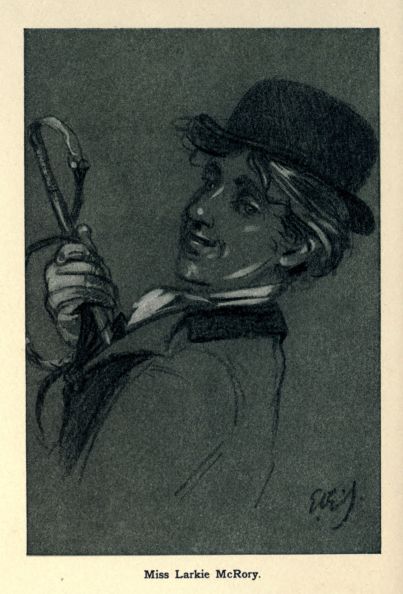
Miss Larkie McRory.
It was warm and sunny in the shelter of the wood. Although the time was November there were still green leaves on some of the trees; it was a steamy day after a wet night, and I thought to myself that if the hounds did run—Here came a challenge from the wood, answered multitudinously, and the next minute they were driving through the laurels towards the entrance gates, with a cry that stimulated even the many-wintered Daniel to capers quite unbefitting his time of life, or mine. The Castle Knox demesne is a large one, and being surrounded by a prohibitively high and coped wall, it is easier to find a fox there than to get away with one. Mighty galloping on the avenues followed, with interludes in the big demesne fields, where every gate had been considerately left open, and in which every horse with any pretensions to savoir faire stiffened his neck, and put up his back, and pulled. The hounds, a choir invisible, carried their music on through the plantations, with whimpering, scurrying pauses, with strophe and anti-strophe of soprano and bass. Sometimes the cry bore away to the demesne wall, and some one would shout "They're away!" and the question of the Front Gate versus the Western Gate would divide us like a sword. Twice, in the undergrowth, above the sunk fence that separated us from the wood, the quick, composed face of the fox showed itself; at last, when things were getting too hot in the covert, he sprang like a cat over the ditch, and flitted across the park with that gliding gait that dissimulates its own speed, while I and my fellows offered a painful example of the discordance of the human voice when compared with that of the hound, and five or six couple pitched themselves out of the wood and stretched away over the grass.
It was fortunate for the Comte de Pralines that his entirely British view-holloa was projected for the most part into my ear (the drum of which it nearly split) and was merged in the general enthusiasm as we let ourselves go.
"For God's sake, Major Yeates!" said Michael, the Second Whip, thundering up beside me as we neared the covert on the further side of the park, "come into the wood with me and turn them hounds! Mr. Flurry's back on another fox with the body of the pack, and he's very near his curse!"
I followed Michael into the covert, and was myself followed by a section of the Field, who might, with great advantage, have remained outside. In the twinkling of an eye Michael was absorbed into the depths of the wood; so also were the six couple, but not so my retinue, who pursued me like sleuth-hounds, as I traversed the covert at such speed as the narrow rides permitted. I made at length the negative discovery that it contained nothing save myself and my followers, a select party, consisting of the Comte de Pralines, Miss McRory, Miss Bobbie Bennett, Lady Knox's coachman on a three-year-old, and a little boy in knickerbockers, on a midget pony with the bearing of a war-horse and a soul to match. We had come to a baffled pause at the cross-ways, when faint and far away, an indisputable holloa was borne to us.
"They've gone out the West Gate," said the coachman, from among the tree-trunks into which he had considerately manoeuvred the kicking end of the three-year-old. "It must be they ran him straight out into the country——"
We made for the West Gate, reached it without sight or sound of Flurry or anyone else, and, on the farm road outside it, pulled up to listen.
The holloa was repeated; half a mile ahead a gesticulating figure signalled to us to come on. I wish to put it on record that I said I could not hear the hounds. The Comte de Pralines (excitable, like all Frenchmen) spurred his hireling at the opposite bank, saying, as he shot past me:
"It's no damned use humbugging here any longer!"
As I turned Daniel to follow him, my eyes met those of Miss Larkie McRory, alight with infernal intelligence; they challenged, but at the same time they offered confederacy. I jumped into the field after the Count; Miss McRory followed.
"I'll tell Lady Knox on you!" she murmured, as she pounded beside me on the long-legged spectre, who, it may be remembered, had been described as "the latther end of a car-horse."
The holloa had come to us from the side of a smooth green hill, and between us and it was a shallow valley, neatly fenced with banks that did credit to Sir Valentine Knox's farming. The horses were fresh, the valley smiled in the conventional way, and spread sleek pastures before us; we took the down grade at a cheerful pace, and the banks a shade faster than was orthodox, and the coachman's three-year-old made up in enthusiasm what he lacked in skill, and the pony, who from the first was running away, got over everything by methods known only to itself. The Comte de Pralines held an undeviating line for the spot whence the holloa had proceeded; when we reached it there was no one to be seen, but there was another holloa further on. The pursuit of this took us on to a road, and here the Castle Knox coachman, who had scouted on ahead, yelled something to the effect that he saw a rider out before him, accompanying the statement by an application of the spurs to the dripping but undaunted three-year-old. A stretching gallop up the road ensued, headed by the little boy and the coachman, who had both secured a commanding lead. The pace held for about a hundred yards, when the road bent sharply to the left, more sharply indeed than was anticipated by the leaders, who, as their mounts skidded as it were on one wheel round the corner, sailed from their saddles with singular unanimity and landed in the ditch. At the same moment the rider we had been following came into view; he was a priest, in immaculate black coat and top-hat, seated on a tall chestnut horse, and proceeding at a tranquil footpace on his own affairs.
He had seen the fox, he admitted (I am inclined to think he had headed him), and he had heard a man shouting, but no hounds had come his way. He was entirely sympathetic, and, warm as I was at the moment, a chill apprehension warned me that we might presently need sympathy.
"It's my belief," said Miss Bennett, voicing that which I had not put into words, "we've been riding after the fox, and the hounds didn't leave the covert at all!"
An elaborate French oath from the Count fell, theatrical as a drop-scene, on the close of the first act. Miss Larkie McRory looked at him admiringly, and allowed just the last rays of her glance to include me.
It was when we had retraced our steps to the bend of the road that we had a full view of the Castle Knox coverts, crowning in gold and brown those pleasant green slopes, easy as the descent to Avernus, down which we had galloped with such generous ardour some fifteen minutes ago. Outside the West Gate, through which we had emerged from the demesne, were three motionless figures in scarlet; Lady Knox and her grey horse were also recognisable; a few hounds were straying undecidedly in the first of the grass fields that we had traversed.
A note of the horn leaped to us across the valley, an angry and peremptory note. One of the scarlet figures started at a canter and turned the hounds. Another and longer blast followed. As if in obedience to its summoning, the coachman's three-year-old came ramping, riderless, down the road; he passed us with his head high in air and his flashing eye fixed upon the distant group, and, with a long shrill neigh, put his tail over his back and directed his flight for his owner and her grey horse.
"God help poor Tierney!" said Miss Bennett, in a stricken voice, "and ourselves too! I believe they saw us all the time, and we galloping away on the line of the fox!"
"I'm going home," I said. "Will you kindly make my apologies to the Master?"
"I'll kindly do no such thing," replied Miss Bennett. "I'll let Flurry Knox cool off a bit before I meet him again, and that won't be this side of Christmas, if I can help it! Good-bye, dear friends!"
She turned her mare, and set her face for her own country.
There now remained only the Count, Miss McRory, and myself, and to remove ourselves from the field of vision of the party at the gate was our first care. We had, no doubt, been thoroughly identified, nevertheless the immediate sensation of getting a furzy hill between us and Flurry was akin to that of escaping from the rays of a burning-glass. In shelter we paused and surveyed each other.
The Comte de Pralines, with his shiny hat very much on the back of his head, put down his reins, shoved his crop under his knee, and got out his cigarette case.
"Well," he began philosophically, striking a match, "our luck ain't in——!"
He broke off, the match went out, and a lively glow suffused his unsheltered countenance.
"Vous voyez mon cher—" he resumed, very rapidly. "J'ai appris quelques petits mots——"
"What a lovely English accent he has!" interrupted Miss McRory rapturously; "it's a lot nicer than his French one. To look at him you'd never think he was so clever. It's a pity he wouldn't try to pick up a little more."
"Now, that's hitting a man when he's down," said the Comte de Pralines. "I want some one to be kind to me. I've had a poor day of it; no one would talk to me. I stampeded them wherever I went."
"I didn't notice Miss McRory stampeding to any great extent," I said.
"Wait awhile!" rejoined Miss McRory. "Maybe the stampeding will be going the other way when you and he meet Lady Knox!"
"I shan't wait an instant," said the Comte de Pralines, "you and Major Yeates will explain."
The horses had been moving on, and the covert was again in sight, about a quarter of a mile away on our left. There was nothing to be seen, but hounds were hunting again in the demesne; their cry drove on through the woods inside the grey demesne wall; they were hunting in a body, and they were hunting hard.
At each moment the cry was becoming more remote, but it was still travelling on inside the wall. The fear of Flurry fell from us as a garment, and the only question that presented itself was whether to return to the West Gate or to hold on outside. It was a long-accepted theory at Castle Knox that the demesne wall was not negotiable, and that the foxes always used the gates, like Christians; bearing this in mind, I counselled the Front Gate and the outside of the wall. A couple of lanes favoured us; we presently found ourselves in a series of marshy fields, moving along abreast of the invisible hounds in the wood. They were in the thickest and least accessible part of it, and Flurry's voice and horn came faintly as from a distance.
I explained that it was impossible to ride that part of the wood, but that, if they held on as they were going, the Front Gate would make it all right for us, and of course Flurry would——
"Oh! look, look, look!" shrieked Miss McRory, snatching at my arm and pointing with her whip.
A short way ahead of us a huge elm tree had fallen upon the wall; the greenish-yellow leaves still clinging to its branches showed that the catastrophe was recent. It had broken down the wall to within five or six feet of the ground, and was reclining in the breach that it had made, with its branches sprawling in the field. I followed the line of Miss Larkie's whip, and was just in time to see a fox float like a red leaf from one of these to the ground, and glide straight across our front. He passed out of sight over a bank, and the Count stood up in his stirrups, put his finger in his ear, and screamed in a way that must have been heard in the next county. I contributed a not ineffective bellow, and Miss McRory decorated the occasion with long thin squeals.
The hounds, inside the wall, answered in an agony that was only allayed by the discovery that the trunk of the tree formed as handy a bridge for them as for the fox. They came dropping like ripe fruit through the branches, and, under our rejoicing eyes, swarmed to the fox's line, and flung on, in the fullest of full-cry, over the bank on which we had last seen him. I have not failed to assure Flurry Knox that anything less suggestive of "sneaking away with the hounds" than the manner of our departure could hardly be conceived, but Mr. Knox has not withdrawn the phrase.
It may be conceded that Flurry had grounds for annoyance. Had I had the fox in one hand and the Ordnance Map in the other, I could hardly have improved on the course steered by our pilot. Up hill for a bit, when the horses were fresh, with gradients just steep enough to temper Daniel's well-sustained tug of war, yet not so steep as to make a three-foot bank look like a house, or to guarantee a big knee at each "stone gap." Then high and dry country, with sheep huddled in defensive positions in the corners of the fields, and grass like a series of putting-greens, minus the holes, and fat, comely banks, and thin walls, from which the small round stones rattled harmlessly as Miss McRory's car-horse swept through them. Down into a long valley, with little sky-blue lakes, set in yellow sedge; and there was a helpful bog road there, that nicked nicely with the bending line of the hounds through the accompanying bog, and allayed a spasm of acute anxiety as to whether we should ever get near them again. Then upwards once more, deviously, through rougher going, with patches of low-growing furze sprouting from blackened tracts where the hillside had been set on fire, with the hounds coming to their noses among brakes of briars and bracken; finally, in the wind and sun of the hill-top, a well-timed check.
We looked back for the first time, half in fear that we might find Flurry hot on our track, half in hope that he and his horn were coming to our help; but neither in the green country nor in the brown valley was there any sign or sound of him. There was nothing to be seen but a couple of men standing on a fence to watch us, nothing to be heard except cur dogs vociferating at every cottage.
"Fifteen couple on," said the Count professionally. "How many does Knox usually have out?"
"All he's got," I said, mopping my brow.
"I don't see the two that have no hair on their backs," said Miss McRory, whose eyes, much enhanced by the radiant carmine of her cheeks, beamed at us through wisps and loops of hair. "I know them, they're always scratching, the poor things!"
That Miss McRory and her steed kept, as they did, their place in what is known to history as the Great Castle Knox Run, is a matter that I do not pretend to explain. Some antiquarian has unearthed the fact that the car-horse had three strains of breeding, and had twice been second in a Point-to-Point; but I maintain that credit must be ascribed to Miss Larkie, about whom there is something inevitable; some street-boy quality of being in the movement.
We were now on a heathery table-land, with patches of splashy, rushy ground, from which the snipe flickered out as the hounds cast themselves through it. Presently, on the top of a hard, peaty bank, a hound spoke, hesitatingly, yet hopefully, and plunged down on the other side; the pack crowded over, and drove on through the heather. Daniel changed feet on a mat of ling with a large stone in it, and therefrom ramped carefully out over a deep cut in the peat, unforeseen, and masked by tufts of heather. The hireling of the Comte de Pralines had, up to this, done his work blamelessly, if without originality; he had an anxiousness to oblige that had been matured during a dread winter when he had been the joint property of three subalterns, but he reserved to himself a determination to drop economically off his banks, and boggy slits were not in his list of possibilities.
How the matter occurred I do not know, but, when I looked round, his head alone was visible, and the Count was standing on his in the heather. Miss McRory's car-horse, who had pulled up in the act of following the Count, with a suddenness acquired, no doubt, in the shafts of a Cork covered-car, was viewing the scene with horror from the summit of the bank. The hounds were by this time clear of the heather, and were beginning to run hard; it was not until I was on the further side of the next bank that I cast another fleeting look back; this time the Count was standing on his feet, but the hireling was still engulfed, and Miss McRory was still on the wrong side of the slit. After that I forgot them, wholly and heartlessly, as is invariable in such cases.
As a matter of fact, I had no attention to spare for anyone but myself, even though we went, for the first twenty minutes or so, as on rubber tyres, through bland dairy farms wherein the sweet influences of the dairy-cow had induced gaps in every fence, and gates into every road. The scent, mercifully for Daniel, was not quite what it had been; the fox had run through cattle, and also through goats (a small and odorous party, on whose behalf, indeed, some slight intervention on my part was required), and it was here, when crossing a road, that a donkey and her foal, moved by some mysterious attraction akin to love at first sight, attached themselves to me. Undeterred by the fact that the mother's foreleg was fettered to her hind, the pair sped from field to field in my wake; at the checks, which just then were frequent, they brayed enthusiastically. I thought to elude them at a steep drop into a road, but they toboganned down it without an effort; when they overtook me the fetter-chain was broken, and clanked from the mother's hind-leg as if she were a family ghost.
There came at length a moment, outside a farm-house, when it seemed as if the fox had beaten us. Here, on the farther side of Castle Knox, I was well out of my own country, and what the fox's point might be was represented by the letter X. Nevertheless it was here that I lifted the hounds and brought off the cast of a life-time; I am inclined to think that he had lain down under a hayrick and was warned of our approach by the voices of my attendant jackasses; my cast was probably not much more of a fluke than such inspirations usually are, but the luck was with me. Old Playboy, sole relic of my deputy Mastership, lifted his white head and endorsed my suggestion with a single bass note; Rally, Philippa's prize puppy, uttered a soprano cadenza, and the pack suddenly slid away over the pasture fields, with the smoothness and unanimity of the Petits Chevaux over their green cloth.
It was now becoming for Daniel and me something of an effort to keep our proud and lonely place in or about the next field to the hounds. The fields were coming smaller, the gaps fewer; Daniel had no intention of chucking it, but he gave me to understand that he meant to take the hills on the second speed. And, unfortunately, the hills were coming. The hounds, by this time three fences ahead, flung over a bank on the upgrade, a bank that would give pause for reflection at the beginning of a run. I tried back, scrambled into a lane, followed it up the hill, with the cry of the hounds coming fainter each minute, dragged a cart wheel and a furze bush out of a gap with my crop, found myself in a boggy patch of turnips, surrounded by towering fuchsia hedges, and realised that the pack had passed in music out of sight.
I stood still and looked at my watch. It was already an hour and twenty minutes from the word "Go!" and the hounds were not only gone but were still going. A man who has lost hounds inevitably follows the line of least resistance. I retired from the turnip field, and abandoned myself to the lane, which seemed not disinclined to follow the direction in which the hounds had been heading. Since the hayrick episode they had been running right-handed, and the lane bent right-handed over the end of the hill, and presently deposited me on a road. It was one of the moments when the greatness of the world is borne in upon the wayfarer. There was a spacious view from the hill-side; three parishes, at least, offered themselves for my selection, and I surveyed them, solitary and remote as the evening star, and with no more reason than it for favouring one more than another. A harrowing, and, by this time, but too familiar cry, broke on my ear, an undulating cry as of a thing that galloped as it roared. My admirers were still on my trail; I gave Daniel a touch of the spurs and trotted on to the right.
No human being was visible, but some way ahead there was a slated house at a cross-roads; there, at all events, I could get my bearings. There were porter-barrels outside it, and from some distance I heard two voices, male and female, engaged in loud and ferocious argument; I had no difficulty in diagnosing a public-house. When Daniel and I darkened the doorway the shouting ceased abruptly, and I saw a farmer, in his Sunday clothes, making an unsteady retreat through a door at the back of the shop. The other disputant, a large, middle-aged woman, remained entrenched behind the counter, and regarded me with a tranquil and commanding eye. She informed me, as from a pulpit, that I was six miles from Castle Knox, and with dignity, as though leaving a pulpit, she moved from behind the counter, and advanced to the door to indicate my road. I asked her if she had seen anything of the hounds.
"There was one of your dogs looked in the door to me a while ago," she replied, "but he got a couple of boxes from the cat that have kittens; I d'no what way he went. Indeed I was bothered at the time with that poor man that came in to thank me for the compliment I paid him in going to his sister's funeral."
I said that he certainly seemed to feel it very much. At which she looked hard at me and said that he was on his way to a wedding, and that it might be he had a drop taken to rise his heart. "He was after getting a half a crown from a gentleman—a huntsman like yourself," she added, "that was striving to get his horse out of a ditch."
"Was there a lady with him?" I asked.
"There was, faith! And the two o' them legged it away then through the country, and they galloping like the deer!"
So, in all love, we parted; before I reached the next turning renewed sounds of battle told me that the compliment was still being pressed home.
My road, bending ever to the right, strolled through an untidy nondescript country, with little bits of bog, and little lumps of hill, and little rags of fields. I had jogged a mile or so when I saw a hound, a few fields away to my right, poking along on what appeared to be a line; he flopped into a boggy ditch, and scrambled from it on to a fence. He stood there undecidedly, like any human being, reviewing the situation, and then I saw his head and stern go up. The next moment I also heard what he had heard, a faint and far-away note of the horn. It came again, a long and questing call.
The road was flat and fairly straight; far away upon it something was moving gradually into my scope of vision, something with specks of red in it. It advanced upon me, firmly, and at a smart pace; heading it, like the ram of a battleship, was Mr. Knox. With him, "of all his halls had nursed," remained only the two hounds with the hairless backs, the two who, according to Miss McRory, were always scratching. Behind him was a small and unsmiling selection from those who, like him, had lost the hunt. Lady Knox headed them; my wife and Bill brought up the rear. The hound whom I had seen in the bog had preceded me, and was now joining himself to his two comrades, putting the best face he could upon it, with a frowning brow and his hackles up. The comrades, in their official position of sole representatives of the pack, received him with orthodox sternness, and though unable, for obvious reasons, to put their hackles up, the bald places on their backs were of an intimidating pink.
My own reception followed the same lines.
"Where are the hounds?" barked Flurry, in the awful tones of a parent addressing a governess who, through gross neglect, has mislaid her charges.
Before I had had time to make up my mind whether to be truculent or pacific, there was a shout away on our left. At some little distance up a by-road, a man was standing on a furze-plumed bank, beckoning to us with a driving-whip. Flurry stood in his stirrups, and held up his cap. The man yelled information that was wholly unintelligible, but the driving-whip indicated a point beyond him, and Flurry's brown mare jumped from a standstill to a gallop, and swung into the by-road.
The little band of followers swung after him. When Lady Knox was well ahead, I followed, and found myself battering between high banks behind Philippa and Bill Cunningham.
"Where's Mossoo?" my wife said breathlessly, as Daniel's head drew level with her sandwich case. "We met the man who pulled him out of the ditch—up in the hills there——"
"Yes, by Jove!" said Bill, "Flurry asked him if it was a Frenchman, and the chap said, 'French or German, he had curses as good as yourself!' I told Flurry it must have been you!"
"I don't mind Flurry, it's Lady Knox——" began Philippa.
Here we all came to a violent full-stop. Flurry's advance had been arrested by a covered-car and horse drawn across the road; the horse was eating grass, the driver, with the reins in his hand, was standing with his back to us on the top of the bank from which he had hailed us, howling plaudits, as if he were watching a race. There were distant shouts, and barking dogs, and bellowing cattle, and blended with them was the unmistakable baying of hounds.
I daresay that what Flurry said to the driver did him good—did Flurry good, I mean. The car lurched to one side, and, as we squeezed past it, we saw between its black curtains a vision of a scarlet-faced bride, embedded in female relatives; two outside cars, driverless, and loaded with wedding guests, were drawn up a little farther on. Flurry, still exploding like a shell, thundered on down the lane; the high bank ended at a gateway, he turned in, and as we crushed in after him we were greeted by a long and piercing "Who-whoop!"
We were in a straggling field with furzy patches in it. At the farther end of it was a crowd of country people on horses and on foot, obviously more wedding-guests; back of all, on a road below, was a white-washed chapel, and near it, still on the chestnut horse, was the priest who had headed the morning fox. Close to one of the clumps of furze the Comte de Pralines was standing, knee-deep in baying hounds, holding the body of the fox high above his head, and uttering scream upon scream of the most orthodox quality. He flung the fox to the hounds, the onlookers cheered, Miss McRory, seated on the car-horse, waved the brush above her head, and squealed at the top of her voice something that sounded like "Yoicks!" Her hair was floating freely down her back; a young countryman, in such sacrificial attire as suggested the bridegroom, was running across the field with her hat in his hand.
Flurry pulled up in silence; so did we. We were all quite outside the picture, and we knew it.
"Oh, the finest hunt ever you see!" cried the bridegroom as he passed us; "it was Father Dwyer seen him shnaking into the furze, the villyan!"
"Worry, worry, worry! Tear him and eat him, old fellows!" shouted the Comte de Pralines. "Give the hounds room, can't you, you chaps! I suppose you never saw them break up a fox before!" This to the wedding guests, who had crowded in, horse and foot, on top of the scuffling, growling pack.
Flurry turned an iron face upon me. His eye was no bigger than a pin's head.
"I suppose it's from Larkie McRory he got the English?" he said; "he learnt it quick."
"The McRorys don't speak English!" said Lady Knox, in a voice like a north-east wind.
"Seulement très petit!" Philippa murmured brazenly.
Whether Lady Knox heard her or not, I am unable to say. Her face was averted from me, and remained as inflexible as a profile on a coin—a Roman coin, for choice.
The faculty of not knowing when you are beaten is one that has, I think, been lauded beyond its deserving. Napoleon the Great has condemned manoeuvring before a fixed position, and Lady Knox was clearly a fixed position. Accepting these tenets, I began an unostentatious retirement, in which I was joined by Philippa. We were nearing safety and the gate of the field, when a yearning, choking wail came to us from the lane.
"The Bride?" queried my wife hysterically.
It was repeated; in the same instant my admirers, the jackasses, mère et fils, advanced upon the scene at a delirious gallop, and, sobbing with the ecstasy of reunion, resumed their attendance upon Daniel.
For a moment the attention of the field, including even that of the Roman coin, was diverted from the Comte de Pralines, and was concentrated upon our retreat.
XI
THE SHOOTING OF SHINROE
Mr. Joseph Francis M'Cabe rose stiffly from his basket chair, picked up the cushion on which he had been seated, looked at it with animosity, hit it hard with his fist, and, flinging it into the chair, replaced himself upon it, with the single word:
"Flog!"
I was aware that he referred to the flock with which the cushions in the lounge of Reardon's Hotel were stuffed.
"They have this hotel destroyed altogether with their improvements," went on Mr. M'Cabe between puffs, as he lit his pipe. "God be with the time this was the old smoking-room, before they knocked it and the hall into one and spoilt the two of them! There were fine solid chairs in it that time, that you'd sleep in as good as your bed, but as for these wicker affairs, I declare the wind 'd whistle through them the same as a crow's nest." He paused, and brought his heel down heavily on the top of the fire. "And look at that for a grate! A Well-grate they call it,—I'd say, 'Leave Well alone!' Thirty years I'm coming to Sessions here, and putting up in this house, and in place of old Tim telling me me own room was ready for me, there's a whipper-snapper of a snapdragon in a glass box in the hall, asking me me name in broken English" (it may be mentioned that this happened before the War), "and 'Had I a Cook's ticket?' and down-facing me that I must leave my key in what he called the 'Bew-ro.'"
I said I knew of a lady who always took a Cook's ticket when she went abroad, because when she got to Paris there would be an Englishman on the platform to meet her, or at all events a broken Englishman.
Mr. M'Cabe softened to a temporary smile, but held on to his grievance with the tenacity of his profession. (I don't think I have mentioned that he is a Solicitor, of a type now, unfortunately, becoming obsolete.) He had a long grey face, and a short grey moustache; he dyed his hair, and his age was known to no man.
"There was one of Cook's tourists sat next me at breakfast," he resumed, "and he asked me was I ever in Ireland before, and how long was I in it. 'Wan day,' says I!"
"Did he believe you?" I asked.
"He did," replied Mr. M'Cabe, with something that approached compassion.
I have always found old M'Cabe a mitigating circumstance of Sessions at Owenford, both in Court and out of it. He was a sportsman of the ingrained variety that grows wild in Ireland, and in any of the horse-coping cases that occasionally refresh the innermost soul of Munster, it would be safe to assume that Mr. M'Cabe's special gifts had ensured his being retained, generally on the shady side. He fished when occasion served, he shot whether it did or not. He did not exactly keep horses, but he always knew some one who was prepared to "pass on" a thoroughly useful animal, with some infirmity so insignificant that until you tried to dispose of him you did not realise that he was yours, until his final passing-on to the next world. He had certain shooting privileges in the mountains behind the town of Owenford (bestowed, so he said, by a grateful client), and it had often been suggested by him that he and I should anticipate some November Sessions by a day, and spend it "on the hill." We were now in the act of carrying out the project.
"Ah, these English," M'Cabe began again, mixing himself a glass of whisky and water, "they'd believe anything so long as it wasn't the truth. Talking politics these lads were, and by the time they had their ham and eggs swallowed they had the whole country arranged. 'And look,' says they—they were anglers, God help us!—'look at all the money that's going to waste for want of preserving the rivers!' 'I beg your pardon,' says I, 'there's water-bailiffs on the most of the rivers. I was defending a man not long since, that was cot by the water-bailiff poaching salmon on the Owen. 'And what proof have you?' says I to the water-bailiff. 'How do you know it was a salmon at all?' 'Is it how would I know?' says the bailiff, 'didn't I gaff the fish for him meself!'"
"What did your anglers say to that?" I enquired.
"Well, they didn't quite go so far as to tell me I was a liar," said Mr. M'Cabe tranquilly. "Ah, telling such as them the truth is wasting what isn't plenty! Then they'll meet some fellow that lies like a tooth-drawer, and they'll write to the English Times on the head of him!" He stretched forth a long and bony hand for the tumbler of whisky and water. "And talking of tooth-drawers," he went on, "there's a dentist comes here once a fortnight, Jeffers his name is, and a great sportsman too. I was with him to-day"—he passed his hand consciously over his mouth, and the difference that I had dimly felt in his appearance suddenly, and in all senses of the word, flashed upon me—"and he was telling me how one time, in the summer that's past, he'd been out all night, fishing in the Owen. He was going home before the dawn, and he jumped down off a bank on to what he took to be a white stone—and he aimed for the stone, mind you, because he thought the ground was wet—and what was it but a man's face!" M'Cabe paused to receive my comment. "What did he do, is it? Ran off for his life, roaring out, 'There's a first-rate dentist in Owenford!' The fellow was lying asleep there, and he having bundles of spurge with him to poison the river! He had taken drink, I suppose."
"Was he a water-bailiff too?" said I. "I hope the conservators of the river stood him a set of teeth."
"If they did," said M'Cabe, with an unexpected burst of feeling, "I pity him!" He rose to his feet, and put his tumbler down on the chimney-piece. "Well, we should get away early in the morning, and it's no harm for me to go to bed."
He yawned—a large yawn that ended abruptly with a metallic click. His eyes met mine, full of unspoken things; we parted in a silence that seemed to have been artificially imposed upon Mr. M'Cabe.
The wind boomed intermittently in my chimney during the night, and a far and heavy growling told of the dissatisfaction of the sea. Yet the morning was not unfavourable. There was a broken mist, with shimmers of sun in it, and the carman said it would be a thing of nothing, and would go out with the tide. The Boots, a relic of the old régime, was pessimistic, and mentioned that there were two stars squez up agin the moon last night, and he would have no dependence on the day. M'Cabe offered no opinion, being occupied in bestowing in a species of dog-box beneath the well of the car a young red setter, kindly lent by his friend the dentist. The setter, who had formed at sight an unfavourable opinion of the dog-box, had resolved himself into an invertebrate mass of jelly and lead, and was with difficulty straightened out and rammed home into it.
"Have we all now?" said M'Cabe, slamming the door in the dog's face. "Take care we're not like me uncle, old Tom Duffy, that was going shooting, and was the whole morning slapping his pockets and saying, 'Me powder! me shot! me caps! me wads!' and when he got to the bog, 'O tare an' ouns!' says he, 'I forgot the gun!'"
There are still moments when I can find some special and not-otherwise-to-be-attained flavour in driving on an outside car; a sense of personal achievement in sitting, by some method of instinctive suction, the lurches and swoops peculiar to these vehicles. Reardon's had given us its roomiest car and its best horse, a yellow mare, with a long back and a slinging trot, and a mouth of iron.
"Where did Mr. Reardon get the mare, Jerry?" asked M'Cabe, as we zigzagged in successive hairbreadths through the streets of Owenford.
"D-Dublin, sir," replied the driver, who, with both fists extended in front of him and both heels planted against his narrow footboard, seemed to find utterance difficult.
"She's a goer!" said M'Cabe.
"She is—she killed two men," said Jerry, in two jerks.
"That's a great credit to her. What way did she do it?"
"P-pulled the lungs out o' them!" ejaculated Jerry, turning the last corner and giving the mare a shade more of her head, as a tribute, perhaps, to her prowess.
She swung us for some six miles along the ruts of the coast road at the same unflinching pace, after which, turning inland and uphill, we began the climb of four miles into the mountains. It was about eleven o'clock when we pulled up beside a long and reedy pool, high up in the heather; the road went on, illimitably it seemed, and was lost, with its attendant telegraph posts, in cloud.
"Away with ye now, Jerry," said M'Cabe; "we'll shoot our way home."
He opened the back of the dog-box, and summoned its occupant. The summons was disregarded. Far back in the box two sparks of light and a dead silence indicated the presence of the dog.
"How, snug you are in there!" said M'Cabe; "here, Jerry, pull him out for us. What the deuce is this his name is? Jeffers told me yesterday, and it's gone from me."
"I d'no would he bite me?" said Jerry, taking a cautious observation and giving voice to the feelings of the party. "Here, poor fellow! Here, good lad!"
The good lad remained immovable. The lure of a sandwich produced no better result.
"We can't be losing our day with the brute this way," said M'Cabe. "Tip up the car. He'll come out then, and no thanks to him."
As the shafts rose heavenwards, the law of gravitation proved too many for the setter, and he slowly slid to earth.
"If I only knew your dam name we'd be all right now," said M'Cabe.
The carman dropped the shafts on to the mare, and drove on up the pass, with one side of the car turned up and himself on the other. The yellow mare had, it seemed, only begun her day's work. A prophetic instinct, of the reliable kind that is strictly founded on fact, warned me that we might live to regret her departure.
The dentist's setter had, at sight of the guns, realised that things were better than he had expected, and now preceded us along the edge of the lake with every appearance of enthusiasm. He quartered the ground with professional zeal, he splashed through the sedge, and rattled through thickets of dry reeds, and set successively a heron, a water-hen, and something, unseen, that I believe to have been a water-rat. After each of these efforts he rushed in upon his quarry, and we called him by all the gun-dog names we had ever heard of, from Don to Grouse, from Carlo to Shot, coupled with objurgations on a rising scale. With none of them did we so much as vibrate a chord in his bosom. He was a large dog, with a blunt stupid face, and a faculty for excitement about nothing that impelled him to bound back to us as often as possible, to gaze in our eyes in brilliant enquiry, and to pant and prance before us with all the fatuity of youth. Had he been able to speak, he would have asked idiotic questions, of that special breed that exact from their victim a reply of equal imbecility.
The lake and its environs, for the first time in M'Cabe's experience, yielded nothing; we struck up on to the mountain side, following the course of an angry stream that came racing down from the heights. We worked up through ling and furze, and skirted flocks of pale stones that lay in the heather like petrified sheep, and the dog, ranging deliriously, set water-wagtails and anything else that could fly; I believe he would have set a blue-bottle, and I said so to M'Cabe.
"Ah, give him time; he'll settle down," said M'Cabe, who had a thankfulness for small mercies born of a vast experience of makeshifts; "he might fill the bag for us yet."
We laboured along the flank of the mountain, climbing in and out of small ravines, jumping or wading streams, sloshing through yellow sedgery bog; always with the brown heather running up to the misty skyline, and always with the same atrocious luck. Once a small pack of grouse got up, very wild, and leagues out of range, thanks to the far-reaching activities of the dog, and once a hermit woodcock exploded out of a clump of furze, and sailed away down the slope, followed by four charges of shot and the red setter, in equally innocuous pursuit. And this, up to luncheon time, was the sum of the morning's sport.
We ate our sandwiches on a high ridge, under the lee of a tumbled pile of boulders, that looked as if they had been about to hurl themselves into the valley, and had thought better of it at the last moment. Between the looming, elephant-grey mountains the mist yielded glimpses of the far greenness of the sea, the only green thing in sight in this world of grey and brown. The dog sat opposite to me, and willed me to share my food with him. His steady eyes were charged with the implication that I was a glutton; personally I abhorred him, yet I found it impossible to give him less than twenty-five per cent. of my sandwiches.
"I wonder did Jeffers take him for a bad debt," said M'Cabe reflectively, as he lit his pipe.
I said I should rather take my chance with the bad debt.
"He might have treated me better," M'Cabe grumbled on, "seeing that I paid him seven pound ten the day before yesterday, let alone that it was me that was the first to put him up to this—this bit of Shinroe Mountain that never was what you might call strictly preserved. When he came here first he didn't as much as know what cartridges he'd want for it. 'Six and eight,' says I, 'that's a lawyer's fee, so if you think of me you'll not forget it!' And now, if ye please," went on Mr. Jeffers' preceptor in sport, "he's shooting the whole country and selling all he gets! And he wouldn't as much as ask me to go with him; and the excuse he gives, he wouldn't like to have an old hand like me connyshooring his shots! How modest he is!"
I taunted M'Cabe with having been weak enough thus to cede his rights, and M'Cabe, who was not at all amused, said that after all it wasn't so much Jeffers that did the harm, but an infernal English Syndicate that had taken the Shinroe shooting this season, and paid old Purcell that owned it ten times what it was worth.
"It might be as good for us to get off their ground now," continued M'Cabe, rising slowly to his feet, "and try the Lackagreina Valley. The stream below is their bounds."
This, I hasten to say, was the first I had heard of the Syndicate, and I thought it tactless of M'Cabe to have mentioned it, even though the wrong that we had done them was purely technical. I said to him that I thought the sooner we got off their ground the better, and we descended the hill and crossed the stream, and M'Cabe said that he could always shoot this next stretch of country when he liked. With this assurance, we turned our backs on the sea and struck inland, tramping for an hour or more through country whose entire barrenness could only be explained on the hypothesis that it has been turned inside out to dry. So far it had failed to achieve even this result.
The weather got thicker, and the sport, if possible, thinner; I had long since lost what bearings I possessed, but M'Cabe said he knew of a nice patch of scrub in the next valley that always held a cock. The next valley came at last, not without considerable effort, but no patch of scrub was apparent. Some small black and grey cattle stood and looked at us, and a young bull showed an inclination to stalk the dog; it seemed the only sport the valley was likely to afford. M'Cabe looked round him, and looked at his watch, and looked at the sky, which did not seem to be more than a yard above our heads, and said without emotion:
"Did ye think of telling the lad in the glass box in the hall that we might want some dinner kept hot for us? I d'no from Adam where we've got to!"