Front matter (continued 3)
Reading edition
"I think we'd better make a hare of you," said Flurry, fixing expressionless eyes upon Captain Larpent. "It mightn't be hard."
The double edge of this suggestion was lost upon Andrew, who accepted it as a tribute, but said he was afraid he didn't know the country well enough.
"That's your Egyptian darkness," said Flurry with unexpected erudition.
Andrew glanced sideways and suspiciously at him over the bridge of his sunburnt nose, and said rather defiantly that if he could get hold of a decent horse he wouldn't mind having a try.
"I suppose you ride about 11.6?" asked Flurry, after a moment or two of silence. His manner had softened; I thought I knew what was coming. "I've a little horse that I was thinking of parting..." he began.
A yell, sharp and sudden as a flash of lightning, was uttered outside the door, followed by a sliding crash of crockery, and more yells. We plunged into the hall, and saw Julia, the elderly parlourmaid, struggling on the floor amid ruins of coffee cups and their adjuncts.
"The rat! He went in under me foot!" she shrieked. "He's in under me this minute!"
Here the rat emerged from the ruins. Simultaneously the drawing-room door burst open, and the streaming shrieks of Minx and her son and daughter were added to those of the still prostrate Julia.
The chase swept down the passage to the kitchen stairs, the pack augmented by Bob, the red setter, and closely followed by the dinner party. A rat is a poor performer on a staircase, and, at the door leading into the turf-house, the dogs seemed to be on top of him. The bolt-hole under the door, that his own teeth had prepared, gave him an instant of advantage; Flurry had the door open in a second, someone snatched the passage lamp from the wall, but it was obviously six to four on the rat.
The turf-house was a large space at the very root of the house, vaulted and mysterious, bearing Shreelane on its back like the tortoise that supports the world. Barrels draped with cobwebs stood along one wall, but the rat was not behind them, and Minx and her family drove like hawks into a corner, in which, beneath a chaotic heap of broken furniture and household debris, the rat had gone to ground. We followed, treading softly in the turf-mould of unnumbered winters. We tore out the furniture, which yielded itself in fragments; the delirium of the terriers mounting with each crash, and being, if possible, enhanced by the well-meant but intolerable efforts of the red setter to assist them. Finally we worked down to an old door, lying on its face on something that raised it a few inches from the ground.
"Now! Mind yourselves!" said Flurry, heaving up the door and flinging it back against the wall.
The rat bolted gallantly, and darted into an old box, of singular shape, that lay, half open, among the debris, and there, in a storm of tattered paper, met his fate. Minx jumped out of the box very deliberately, with the rat across her jaws, and a scarlet bite in her white muzzle. With frozen calm, and a menacing eye directed at the red setter, she laid it on the turf mould, and stiffly withdrew. Her son and daughter advanced in turn, smelt it respectfully and retired. There was no swagger; all complied with the ritual of fox-terrier form laid down for such occasions.
I was then for the first time aware that the ladies, in all the glitter and glory of their evening dresses, had each mounted herself upon a barrel; in the theatrical gloom of the vaulted turf-house, they suggested the resurrection of Ali Baba's Forty Thieves.
"Look where he had his nest in among the old letters!" said Flurry to Philippa, as she descended from her barrel to felicitate Minx and to condole with the rat. "That box came out of the rumble of an old coach, the Lord knows when!"
"There's some sort of a ring in the floor here," said Andrew, who was rooting with a rusty crowbar in the turf-mould where the door had lain. "Bring the light, someone——"
The lamp revealed a large iron ring which was fixed in a flat stone; we scraped away the turf-mould and found that the stone was fastened down with an iron bar, passing through a staple at either end, and padlocked.
"As long as I'm in this place," said Flurry, "I never saw this outfit before."
"There's a seal over the keyhole," said Andrew, turning over the padlock.
"That means it was not intended it should be opened," said Meg Longmuir quickly.
I looked round, and, bad as the light was, I thought her face looked pale.
Andrew did not answer her. He poised the crowbar scientifically, and drove it at the padlock. It broke at the second blow, releasing the bar.
"No trouble about that!" he said, addressing himself to the gallery, and not looking at Miss Longmuir. "Now, then, shall we have the flag up?"
There were only two dissentients; one was Flurry, who put his hands in his pockets, and said he wasn't going to destroy his best evening pants; the other was Miss Longmuir, who said that to break an old seal like that was to break luck. She also looked at Andrew in a way that should have gone far to redress the injuries inflicted during dinner. Apparently it did not suffice. Captain Larpent firmly inserted the end of the bar under the edge of the flag. Bernard Shute took hold of the ring.
"All together!" said Andrew.
There was a moment of effort, the flag came up abruptly, and, as abruptly, Bernard sat down in the turf-mould with the flag between his legs. The crowbar slipped forward, and vanished with a hollow-sounding splash down a black chasm; Andrew, thrown off his balance, also slipped forward, and would have followed it, head first, had not Flurry and I caught him.
The chasm was a well, nearly full; the water twinkled at us, impenetrably black; it made me think of the ink in the hollowed palm of a native who had told my fortune, up at Peshawur.
"That was about as near as makes no difference!" said Bernard. "You've cut your cheek, Larpent."
"Have I?" said Andrew vaguely, putting up a rather shaky hand to his face. "I think my head took the edge of the well."
We covered the hole with the old door, and Andrew was taken away to have his wound attended to. It was not a severe wound, but the process was lengthy, and involved the collaboration of all the ladies. It seemed to the three neglected males, waiting for a fourth to play bridge, that this mobilisation of ministering angels was somewhat overdone.
Andrew came down to breakfast next morning with a headache, and said he had slept badly. Had he discovered the source of the Nile in the turf-house the night before, my wife and Miss Longmuir could not have been more adulatory and sympathetic, nor could the projects, based upon the discovery, have been more ambitious. I went forth to my work and to my labour without so much as a dog to wave me farewell; all were in the turf-house, surrounded by visionary force-pumps, bath-rooms, and even by miraged fountains in the garden.
When I drove the car into the yard on my return that afternoon, I was confronted by a long chestnut face with a white blaze, looking at me out of the spare loose-box—the face, in fact, of "the little horse" of whom Flurry had spoken to Andrew. There was also, added to the more familiar heaps of mortar, gravel, and stones, a considerable deposit of black and evil-smelling sludge. It seemed, as was not uncommonly the case, that a good many things had been happening during my absence. The stone floor of the hall was stencilled with an intricate pattern of black paw-marks, and was further decorated with scraps of torn paper; a cold stench pervaded the smoking-room (which was situated above the turf-house); far away, a sound as of a gramophone in the next world indicated that Captain Andrew's affaire de coeur was finding an outlet in song.
I followed the sounds to the drawing-room, and found Andrew and Miss Longmuir at the piano, in a harmony obviously world-forgetting, though not likely to be by the world forgot. Philippa was sitting by the oil stove, and was, I hope, deriving some satisfaction from inhaling its fumes, its effect upon the temperature being negligible.
Andrew's song was a Hungarian ditty, truculent and amorous, and very loud; under cover of it my wife told me that he, assisted by Walkin' Aisy and the quarrymen, and attended by Miss Longmuir, had baled out the newly discovered well, and that the quarrymen had exacted whisky to sustain them during the later stages of the process, and that the sludge would be ideal for the roses. They believed the well was filling again beautifully, but they had to leave it because Flurry came over with the horse for Andrew for the paper-chase, and Andrew and Meg went out schooling.
"What paper-chase?" I interpolated coldly.
"Oh, they've got one up for Monday," said Philippa airily. "The children have been tearing up paper all day. I found—rather with horror—that Flurry had given them those old letters out of the turf-house to tear up—I said you and I would ride, of course"—she looked at me with apprehension veiled by defiance, and I said it was thoughtful of her.—"But I want to tell you about old Mrs. Knox," she said, hurrying on. "She told Flurry that the well had never been used since the time of the Famine, when they got up a soup-kitchen here, and the day after they opened the well she said the servants flew in a body out of the house, like wild geese!"
"I don't wonder, if it smelt as it does now," I said. "Was that why they flew?"
"Flurry said he didn't know what lifted them. But Flurry never says he doesn't know unless he does know and doesn't want to tell!"
The following day was Saturday, and for the first time for many weeks a Sabbath stillness prevailed on the roof. Walkin' Aisy was absent; no explanation was forthcoming, and I diagnosed a funeral in the neighbourhood. It was on Sunday afternoon that I was roused from my usual meditation—consequent upon Sunday roast beef—by the intelligence that Mrs. William Shanahan wanted to speak to me. Mrs. Shanahan was a fair freckled woman, with a loud voice and a red face and the reputation of ruling Walkin' Aisy with a rod of iron. It appeared that Walkin' Aisy was confined to his bed; that he had had a reel in his head after getting home on Friday, and that whatever work it was that young gentleman gave him to do, he wasn't the better of it.
"And he was as wake in himself and as troubled in his mind as that he couldn't walk to Mass. I told him he should mind the chickens while I'd be out, and when I came in the dog had three of me chickens dead on the floor, and where was himself, only back in the room, and he kneeling there with the two hands up, sayin' his prayers! 'What ails ye?' says I, 'ye old gommoch, that ye'd let the dog kill me chickens?' 'Sure, I was sayin' me prayers,' says he; 'That the Lord mightn't hear your prayers!' says I. God forgive me, I had to say it!"
I recalled her to the question of the chimneys, pointing out that the gable chimney was half down, and could not be left as it was.
To this Mrs. Walkin' Aisy replied at great length that William's father had given him an advice not to go in it, and that the father was dark these scores of years, and it was what he blamed for it was the work he done in Shreelane House in the time of the Famine. It was after that the sight went bandy with him.
She declined to offer any opinion as to when Walkin' Aisy would return to work, and withdrew, leaving me to consider my position under the Employers' Liability Act in the event of her husband's demise, and to wish, not for the first time, that Andrew (now strolling at his ease with Miss Longmuir, reviewing a course for the paper-chase), had been at Jericho, or any other resort of the superfluous, before he interfered with the tranquil progress of the chimneys towards dissolution.
There were strange lapses at dinner,—delays, omissions, disasters, and Julia the parlourmaid had a trembling hand and a general suggestion of nerve-storm. After dinner it was reported to Philippa that Anthony was not well, and after a prolonged absence she returned with the information that he had had a nightmare, and that there was a rumour in the house that all the servants were going to give warning the following morning. Their reason for this was obscure, but was somehow connected with Mrs. Walkin' Aisy's visit, and the fact that the swing-door leading to the turf-house had opened and shut twice, of its own volition. We did not mention these matters to our guests, and retired to rest in perturbation. I admit that at some time during the night, which was a still one, I heard the turf-house door groan on its hinges, and slam. I went downstairs and found nothing; it was certainly unusual, however, that Bob, the red setter, had abandoned his lair in the smoking-room, and was spending the night on the mat outside my dressing-room door.
Next morning Philippa, considering that a thrust was better than a parry, held a court of enquiry in the lower regions, and, according to her own report, spoke seriously on the grave responsibility incurred by those who frightened other people about nonsense. Julia's version of the proceedings, I heard at a later date. She said that "the Misthress spoke to us lovely, and the Priest couldn't speak better than her. She told us that the divils in hell wasn't worse than us."
PART III
It has been said of Ireland that the inevitable never happens, and that the impossible invariably occurs. When on Monday morning I learned that Flurry was to be one of the hares, and beheld him mounted on his best horse, as covered with bags as a postman on Christmas Day, I recalled the epigram. Another confirmation of the law of the unexpected was the fact that Meg Longmuir, on the "maroan" pony, was his fellow hare, very smart, much elated, and quite unaware that she had been substituted for Sally Knox at the last moment, in order that she might be as a millstone hung round the neck of Flurry. That this arrangement was not what Captain Larpent had desired was sufficiently apparent to the naked eye: why Flurry submitted to it was less obvious.
About a dozen riders had been whipped up to take part in this preposterous affair, and were standing about on the grass in front of Shreelane, cutting up the turf as much as the hardness of the ground would permit, and making as much noise as a pack of hounds at feeding time. The April sun glared hot, the better part of a north-easterly gale was blowing, the horses had over-eaten themselves with the bread of idleness, and were fat and frisky.
"Is he any good?" said Flurry to me in a low voice, with his eye on Andrew, who was sitting, shrouded in gloom and remoteness, on the chestnut horse.
"Ask Miss Longmuir," I said. "She was schooling with him on Saturday."
"I'll have plenty to do minding her, without asking her questions that she couldn't answer," returned Flurry. He resumed his survey of Andrew. "I wonder will he be able to hold that horse in a snaffle? He catches hold an odd time."
"Stand by!" said Doctor Hickey, his watch in his hand. "Fifteen seconds more before the hares start!"
"Well, if Larpent goes as big as he talks, he'll do," said Flurry, gathering up his reins.
The ten minutes of grace ebbed slowly away, and preposterous though I still held the affair to be, I do not deny that I was aware of an inward simmering of impatience.
"I'll have the face worn off my watch looking at it if you don't let us start soon!" said Miss Larkie McRory to Hickey.
She was mounted on a long-legged animal that had been summarised by Flurry as "the latter end of a car-horse," and was certainly in need of all the time it could get.
"Don't excite yourself now, or I'll be having to order you a cooling draught!" returned the Doctor, but I perceived that he, in common with everyone else, was edging his horse towards the point of departure.
"Go!"
In the riot of the break-away, I was able to think of nothing but of keeping Daniel from bucking me over his head, but during the hustle at the avenue gates I observed Andrew riding off Bernard, and getting to the front with pale and ferocious determination. The "scent" took us along the road; we followed it over a stony bank and across two fields, at steeplechase pace, and then it ceased. By this time any lingering sense of absurdity had ceased also. We cast ourselves feverishly, like hounds; we galloped great circles; someone found the paper again, and yelled like a maniac. We all yelled in response, a variety of yells, from "Tally Ho" to "Cooee," as, like Bedlam let loose, we rushed to the discoverer. We were up on high land now, and the wind was whirling in our ears, snatching our voices away to infinity, and blowing up the temperatures of horses and riders like a bellows. It had caught away the torn paper and flung it to leeward, into furze brakes, against the sides of the banks, and checks were many, and the horses, convinced that the hounds were somewhere ahead, pulled double. In the bare fields, with their scanty April grass, everything showed up; we were deceived by white stones, by daisies, by dandelion puff-balls, by goose-feathers; most of all we were deceived by country-people, whom, I have no doubt, Flurry had instructed to mislead us.
We had had a long check, consequent on a false trail, when, three fields away, Andrew held up his hat.
"Look at him now, running mute!" giggled Sally Knox in my ear, as we battered down a road. "He's too cross to shout. He's frantic because he's not the hare, and Meg Longmuir was sent with Flurry! And poor Flurry, who's going such a nice safe line!"
"I suppose we may thank Miss Longmuir for the safe line?" I responded with some difficulty, because Daniel was enjoying himself on the road, according to the idiotic manner of horses.
"No! You may thank the chestnut horse!" ejaculated Flurry Knox's wife, as she hoisted out of the road over a loose wall.
Remembering that Andrew was intended to buy the chestnut horse, the deduction was a simple one. It was also quite clear that, disappointing as it might be, and contrary to the most cherished convention, Andrew was going as big as he talked, and even bigger.
"'Them that's in love is like no one'!" I quoted to Mrs. Flurry, as Captain Larpent, taking the shortest way to a drift of paper on a hillside, charged a tall, furze-tufted fence, and got over with a scramble. We followed, less heroically, by a gap, and ascended the hill, with the torn paper scurrying in front of us in the gusty wind. We had now been going for thirty-five minutes, and were all, horses and riders, something blown; Miss Larkie's car-horse could have been heard down-wind for half a mile, and I would have backed Daniel to out-roar any lion in the den.
Nothing but the checks held us together. Doctor Hickey, and Irving, the District Inspector, were taking the matter seriously, and were riding hard to catch Andrew, for the honour of the country. Bernard Shute and two or three other heavy-weights were afoot, dragging their dripping horses over a bank with an up-hill take off; Miss McRory and the car-horse were making an extremely gradual progress in the rear, and Philippa had pulled back to give her leads, with an unselfishness that was not only futile, but was also a reproach to me and my fellow-men.
We had been going in a big ring, and from the top of the hill we could again see Shreelane, below us among its trees. It was there also that we caught the first sight of the hares, now heading for home and safety. The wind had strengthened to half a gale, and the wild and composite yell with which the hounds viewed their quarry was blown back into their throats. The maroan pony had fulfilled her mission as a handicap; twice we saw Flurry dismount and pull down a gap; once, at a bank, he got behind her and whipped her over like a peg-top. Another field took them to the high road. A puff of white paper fluttered out, and Miss Longmuir looked back and flourished a defiant whip; they turned, and galloped in a cloud of dust along the road for Shreelane.
It was not a nice hill to get down in a hurry, and I should think the chestnut horse dreams of it now, somewhere in the level English Midlands, after he has over-eaten himself on fat English oats. For my part, I remembered a humble but useful path, that links a little group of cottages with the rest of the world.
The paper lay thick on the road in the shelter of the fences; everyone began to ride for a finish, and after a quarter of a mile of pounding in the dust at the heel of the hunt, I considered that Daniel and I had satisfied the demands of honour, and ignobly turned in at the back way to the stable yard, permitting the chase to sweep on to the front gates without me.
In the stable yard I found several objects of interest. The hares were there, dismounted, very hot, and uncaptured; Mrs. Knox was there, seated in her phaeton; there was a cluster of servants at the back door; there were McRorys, leaning on bicycles; there was Cecilia Shute, in her motor, with unknown rank and fashion billowing in motor veils beside her.
All were gazing at a mass of sooty bricks and shattered chimney-pots that lay, scattered wide, in and about the black dredgings of the turf-house well.
"That's the gable chimney," said Flurry coolly; "it got tired of waiting for Walkin' Aisy. We heard the roar of it as we came in the front gate!" He turned his mail-bag upside down so that its ultimate dregs were blown far and wide. "How did the chestnut horse go with——?"
As if in reply, hoofs clattered outside the yard, and the white nose of the chestnut shot into the opening of the yard gate. He plunged past me, with Andrew lying back and tugging at the snaffle. The Shreelane yard was fairly spacious, but I began to think that the thing wasn't as funny as it looked. The horse swerved at Mrs. Knox's phaeton, swerved again as Flurry turned him from his stable door with a flourish of the mail-bag. Andrew wrenched his head straight for the open back gate, and might have got him out without disaster, had not the widespread ruin of the chimney intervened. The chestnut once more tried to swerve, his legs went from under him, and he fell, striking fire from the cobble stones of the yard. Andrew stuck to him to the last instant, but was shot clear, and was flung, head first, into the heap of stones and black mud.
It seemed long, long hours between this catastrophe, and a sufficient subsidence of things in general, for me to be able, without inhumanity, to envisage a whisky and soda. Old Mrs. Knox watched me with approval.
"I'm tired of looking at young men drinking tea," she commented. (It was Mrs. Knox's pleasing idiosyncrasy to look upon me as a young man.) "They were like a pack of curates at a school-feast! Not that I was ever at a school-feast, thank God!" she added, with an abandoned chuckle.
We were sitting in a corner of the dining-room, surrounded by empty cups and crumby plates; tides of tea and of talkers had ebbed and flowed, but Mrs. Knox had sat on—to hear my personal report of Andrew, she said.
"Upon my honour, he escaped very well! A dislocated shoulder is nothing, and the young lady is there to 'tend the wounded Deloraine!'"
She paused, and put her head on one side, as if waiting for the prompter. "How does it go? 'She thought some spirit of the sky had done the bold mosstrooper wrong!'"
She paused again, and looked at me; the evening light shone on her spectacles, and made them impenetrable.
"Now I'm going to give you a piece of advice; "'And I'll not take it!' says Major Yeates, R.M.!"
I protested that I had said nothing of the kind. She prodded me in the knee with a goblin finger.
"Close that well! Put on the flagstone, and seal it down again!" She fumbled in her shawls, and pulled out a thin old gold chain. "Here's the seal, the same one that my father sealed it with at the time of the Famine!"
I said that I was ready to do anything that she told me, but it would be interesting to know why.
Mrs. Knox detached the seal from her chain, to which it was knotted by something that I darkly suspected to be a bit of bootlace. It was a cornelian seal, made in the grand manner; massively wrought, the gold smooth from age.
"I daresay you never heard of Major Apollo Riggs? He drove up to this house one fine day in a coach-and-four. Next day the coach-and-four drove away, but Major Apollo Riggs was not in it!"
"He found himself a success at Shreelane?" I suggested.
"Not so much with his host as his hostess!" returned Mrs. Knox portentously.
"A duel?" I asked.
"He was never seen again, my dear!" replied Mrs. Knox. (There are moments, in Ireland, when this term of affection is used not so much affectionately as confidentially.)
At this point the door opened. Mrs. Knox put the goblin finger on her lips, as Philippa, still in her habit, slid into the room.
"The patient and Meg are extremely self-sufficing," she said, dropping into a chair. "His face is turning all colours of the rainbow, and one eye has disappeared, but the other is full of expression and is fixed on Meg!"
"There's not much colour about you," I said. "You ought to have a whisky and soda."
"Nonsense!" said Philippa, waving me away; "we've got most of the black stuff out of his hair; even his waistcoat pocket was full of it! And bits of the torn paper had stuck to it, like confetti."
"That suggests a wedding," I observed.
"Quite," said Philippa. "But the absurd thing was that one of the confetti—obviously a bit of those old letters that the children tore up—had the word 'Apollo' on it! It was stuck on to him like a label."
Mrs. Knox clasped her hands, and lay back in her chair.
"I said it was, of course, a tribute to his beauty, but Meg was not at all amused. She thought it was 'lèse majesté.'"
"She'll get over that in time," I said, putting the seal in my pocket.
VII
WHEN I FIRST MET DR. HICKEY
There was a wonderful chandelier in the hotel dining-room. Fine bronze it was made of, with mermaids, and Tritons, and dolphins flourishing their tails up towards the dingy ceiling-paper, and beaked galleys, on whose prows sat six small lamps, with white china receptacles for paraffin, and smoky brown chimneys. Gone were the brave days when each prow had borne a galaxy of tall wax candles; the chandelier might consider itself lucky in that it had even the paraffin lamps to justify its existence, and that it still hung from a ceiling, instead of sharing the last resting-place of its twin brother, in the bed of the tidal river under the hotel windows.
James, the hotel waiter, knew the family history of the chandelier, as he knew that of most people and things in the county. I commented upon it to a young gentleman with a pointed beard, who sat next to me at dinner, and said that it looked to me like Renaissance. The young gentleman suggested, alternatively, that it looked more like bronze. I did not dispute the point, but I think he found the subject precarious, as he turned to the young lady on his left, and I heard him embark upon a new theme.
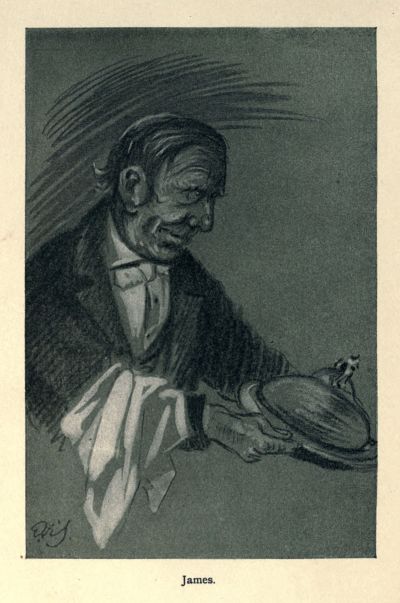
James.
"I was half dead with the toothache all day," he observed.
The young lady replied sympathetically that toothache was a fright.
"Well, indeed, that's true," said James, smoothly entering the conversation from behind my chair. "I got my own share of it. Sure there was one time I used to be roaring like a Banshee all night with it."
"Were you so?" said the gentleman, with a wink at me. "That must have been a long time ago, James."
"Well, indeed, it is too, Doctor," replied James meditatively, "going on forty years, I daresay. I went to Dublin, and I went to a great dentist that was in it that time, and he pulled all the teeth I had, and he gave me a new set entirely."
"Oh, my!" said the young lady, "that must have been very expensive."
"It was so," said James, not without pride. "Twenty pounds I gave him."
"That was awful," said the young lady, feelingly; "it was well to be you that had it to spend."
"Well, it wasn't all out so bad," said James; "sure I only wore them a few times—I wouldn't be bothered with them, and a doctor that was a friend of mine gave me ten pounds for them."
"I suppose they were a fit for a patient of his?" said the doctor.
"They were a bad fit for me, anyway," returned James, glancing over his shoulder at the clattering operations of his two female subordinates, with the eye of the sergeant-major—the eye that always contains a grievance. "I was a footman with the old Lord Garretmore that time. Sure that was where the chandelier came from. A grand house it was, too—big slobs of marble on the tables, and gold legs under them, and ye'd bog to the knees in the carpets. Well, it was the first night after me getting the teeth, there was a gentleman stayed for dinner, and he was to go away by the night train. Forty horses were in the stables, and there wasn't one but was out at grass, and I had to go out beating the bushes for an old mare that was round the house always, herself and her foal, to put her under the side car. 'Prua! Prua!' says I, calling the mare in the dark, and with that the teeth lepped out of my mouth, with respects to you!"
"Oh, fie!" said the mother of the young lady.
"What did you do then, James?" inquired the Doctor.
"I took the white tie off me, and I tied it to the bush that was next me, for a token, and 'twas that way I got them again the next morning, thanks be to God."
Having concluded his story, James started on a perfunctory tour of the table with the wine card. He stopped to pull the turf fire together, and, with a furtive eye at the glass over the chimney-piece, he rearranged the long lock of hair that draped his bald pate. It was dyed, of that peculiar shade of chestnut that disdains subterfuge, and the fact and its suggestions were distressing where an old servant was concerned; so also was the manner in which he hobbled on his heels.
"His walk's full of corns," said the young doctor, eyeing him not without sympathy. "He's a great old character. I believe they keep him here to talk to the tourists."
It is a melancholy fact that in Ireland, in these later days, "characters" have become aware of their position, and palpably live up to their reputation. But James was in a class of his own.
I said didactically, even combatively, that "characters" were free and easy, but that James was easy without being free.
"I'll bet he's not easy in his feet, anyhow!" said the Doctor brutally. "Have you any more soup there, James?"
The mother of the young lady, who had hitherto preserved a silence, broken only by the audible assimilation of her soup, here laid down her spoon and said in cryptic disparagement:
"Tin!"
"Well, I'd say it was the best we had yet," said the Doctor. "I'd undertake to pull a puppy through distemper with it."
"That's the soup she has always for th'assizes," said James. "Grand soup it is, and I declare to ye, she makes it out of egg shells and every old rubbish!"
The young lady's mother emitted a short laugh, but her empty soup-plate told heavily against her.
The meal wore slowly on. A sea fish, of a genus unknown to me, and amazingly endowed with bones, was consumed in distracted silence.
"I hear you have a fish shop opened in Ballinagar, Mrs. M'Evoy," remarked the Doctor, taking his last fish bone out of action with professional adroitness, and addressing the mother of the young lady, "That's very up-to-date. There wasn't one I met from Ballinagar but was bragging of it."
"It was the Hoolahanes that had it," said Mrs. M'Evoy. "It's closed."
"Oh dear, why so?" said the Doctor. "Why did they do that, I wonder?"
"They said that morning, noon, and night people were bothering them for fish," returned Mrs. M'Evoy, to whom this triumph of the artistic temperament presented no exceptional feature.
"Unless it might be on a fast day, I'd never ask to taste a bit of fish," remarked James, giving a helping hand to the conversation. "There was a man I knew from this place got his death in Liverpool from a bit of fish. It stuck to the upper gum. 'Bill,' says he to the one that was with him, 'so help me God,' says he, 'I'm dyin',' says he; and sure that's how he met his death! It was in some grand hotel he was, and he was too shy to give the puff to send out the bit."
"I'd like to send that to the 'B.M.J.'," said the Doctor gravely. "Maybe you could give me the man's name, James?"
"There was them that could swear to it," said James, depositing a syphon on the table in a determined manner, "but they were before your day, Doctor Hickey."
"How young he is!" said Miss M'Evoy archly. "Don't be flattering him, James."
"Indeed I'll not flatter him," returned James, "there's plenty doing that."
It was at about this point that a dish containing three roast ducks was placed in front of me. Circumstances had decreed that I sat at the end of the table; it was my task to deal with the ducks, and during the breathless and steamy struggle that ensued, I passed out of the conversation, which, indeed, had resolved itself into a more personal affair between Dr. Hickey and Miss M'Evoy.
It was somewhere in the reposeful period that came with the cheese, that Dr. Hickey ordered a bottle of port, of which he very handsomely invited the ladies and me to partake. He leaned back in his chair.
"Was this in the cellar the time of the flood?" he said, putting down his glass. "I don't mean Noah's flood, James; you mightn't remember that; but the time the river came up in the town here."
"If it was Noah's flood itself," said James, instantly accepting combat, "it couldn't get into our cellars. But, faith, it was up in this room you're sitting in, and I had to get up on the table from it, and it ruz to the table, and I had to hang out of the chandelier, and a boat came into the room then and took me out. Sure that was the time that the porpoise came up the river, with the dint of the flood, and she was in it for a week, in front of the hotel."
"In compliment to the visitors, I suppose?" said the Doctor. "And what happened her, James?"
"She was in it till a whale came up the river," replied James, with the simplicity of Holy Writ, "and b'Jove he banished her!"
"It's a wonder you'd let him treat a lady that way, James," said Dr. Hickey.
It was still twilight when we left the dining-room, and strayed to the open hall door, and out into the September evening. In the east a rose-pink moon was rising in lavender haze, and a faint wind blew from it; the subtle east wind of September, warmed by its journey across the cornfields, turf-scented by the bogs. There was a narrow garden between the hotel and the river, a place where were new and already-neglected flower-beds, and paths heavy with coarse river gravel, and grass that had been cut, not too recently, with a scythe. A thatched summer-house completed the spasmodic effort of the hotel to rise to smartness. The West of Ireland cannot be smart, nor should any right-minded person desire that it should be so.
Dr. Hickey and I sat and smoked on the parapet wall above the river, while the slated and whitewashed town darkened into mystery. Little lights came slowly out, and behind the town the grey shape of Dreelish mountain lowered in uncompromising abruptness, a brooding presence, felt rather than seen. In the summer-house James was lighting a Chinese lantern, of a somewhat crumpled and rheumatic outline.
"Well, now, that's a great notion!" said Dr. Hickey, with the lethargic and pessimistic humour of his type. "That'll be in the prospectus—'Hotel grounds illuminated every night.' I wonder did they buy that at the Jumble Sale after the Fancy Fair in the Town Hall?"
We sat there, and the moon and the round red Chinese lantern looked at each other across the evening, and had a certain resemblance, and I reflected on the fact that an Irishman is always the critic in the stalls, and is also, in spirit, behind the scenes.
"Look at James now," said the Doctor. "He's inviting the ladies out to have coffee in the summer-house. That's very fashionable. I suppose we should go there too."
We sat with Mrs. and Miss M'Evoy in the summer-house, and drank something that was unearthly black in the red light, and was singularly unsuggestive of coffee. The seats were what is known as "rustic," and had aggressive knobs in unexpected places; the floor held the invincible dampness of the West, yet the situation was not disagreeable. At the other side of the river men were sitting on a wall, and talking, quietly, inexhaustibly; now and then a shout of laughter broke from one of them, like a flame from a smouldering fire.
"These lads are waiting to go back on the night mail," said the Doctor; "you wouldn't think they're up since maybe three this morning to come in to the fair."
Here a railway whistle made a thin bar of sound somewhere out under the low moon, that had now lifted herself clear of the haze. A voice called from the hill-side:
"Hora-thu! Tommeen! Let yee be coming on!"
The men tumbled on to the road, and hurried, heavy-footed, in the direction of the station.
"Sure, they've half an hour yet, the creatures," said Mrs. M'Evoy.
"They have, and maybe an hour before they have the pigs shunted," said James, re-entering with a plate of biscuits, adorned with pink and white sugar.
"Ah! what signifies half an hour here or there on this line!" said Dr. Hickey. "I'm told there was a lady travelling on it last week, and she had a canary in a cage, and the canary got loose and flew out of the window, and by George, the lady pulled the communication cord, and stopped the train!"
"Well, now, she showed her sense," said Mrs. M'Evoy, with an utterance slightly muffled in pink biscuit.
"She and the guard went then trying to catch the canary," continued Dr. Hickey, "and he'd sit till they'd get near him, and then he'd fly on another piece. Everyone that was in the train was hanging out of it, and betting on it, from one carriage to another, and some would back the lady and some would back the bird, and everyone telling them what to do."
"It's a pity you weren't in it," said Miss M'Evoy, "they'd have been all right then."
"It was that bare bit of bog near Bohirmeen," pursued Dr. Hickey, without a stagger, "not a tree in it. 'If he have a fly left in him at all,' says a chap out of a Third Smoker, 'ye'll get him in Mike Doogan's bush.' That was the only bush in the country."
"'Twas true for him," said James.
"Well, they got him in the bush," proceeded Dr. Hickey, "singing away for himself; but they had some trouble crossing the drains. I'm told the guard said the lady lepped like a horse!"
"You had it right, all to the singing," commented Mrs. M'Evoy, advancing as it were to the footlights. "I have the little bird upstairs this minute, and she never sang a note yet!"
Mrs. M'Evoy here permitted herself to subside into fat and deep-seated chuckles, and Miss M'Evoy, James, and I gave way suitably to our feelings.
"Well, now, I thought it was a nice idea, the canary to be singing," said Dr. Hickey, emerging from the situation as from a football scrimmage, in which he had retained possession of the ball. "The next time I tell the story, I'll leave that out, and I can say that the lady that lepped like a horse was Mrs. M'Evoy. They'll believe me then."
"Why wouldn't you say the canary was an eagle?" said Miss M'Evoy. "There used to be plenty eagles in these mountains back here."
"Well, indeed, I might too," said Dr. Hickey. "I remember it was somewhere in these parts that an uncle of mine was staying one time, and a man came to the hotel with an eagle to sell to the tourists. My uncle was like Mrs. M'Evoy here, he was very fond of birds; and the man said the eagle'd be a lovely pet. Whatever way it was, he bought it." He paused to light a cigarette, and James pretended to collect the coffee cups.
"He gave the eagle to the Boots to mind for him," resumed the Doctor, "and the Boots put it into an empty bedroom. It wasn't more than seven o'clock next morning when my uncle was wakened up, and the waiter came in. 'There's a man in the kitchen, your honour,' says he, 'and he has a great fighting aigle, and he says he'll fight your honour's aigle in the passage.' They had a grand fight between the two o' them in the spare room, and in the end my uncle's eagle went up the chimney, and the man's eagle went out through the glass in the window. My uncle had a nice bill to pay for all that was broken in the room, and in the end he gave the eagle to the Zoo."
"Faith, he did not!" shouted James suddenly. "He left him stuck in the chimbley! And sure it was I that got him out, and meself that sold him to a gentleman that was going to Ameriky. Sure, I was the waiter!"
Dr. Hickey threw himself back in his rustic chair.
"Holy smoke! This is no place for me," he said; "every story I have is true in spite of me."
Soon afterwards the ladies went to bed, and Dr. Hickey and I smoked on for a time. He explained to me that he was here as "locum" for a friend of his; it wasn't much of a catch, but he was only just after passing for his Medical, and you'd nearly go as locum for a tinker's dog after you had three years' grinding in Dublin put in. This was a God-forsaken sort of a hole, not a hound within fifty miles, nor anyone that would know a hound if they saw one, but the fishing was middling good. From this point the conversation flowed smoothly into channels of sport, and the dual goals of Dr. Hickey's ambition were divulged to me.
"There was a chap I was at school with—Knox his name was—that has a little pack of foxhounds down in the South, and he's as good as promised me I'm to whip in to him if I can get the Skebawn Dispensary that's vacant now, and I might have as good a chance of it as another."
My own ambitions were also, at the moment, dual, being matrimonial, with a Resident Magistracy attached, but I did not feel it necessary to reveal them. I mentioned that I was having a day's fishing here on my way to Donegal to shoot grouse, but did not add that Philippa, to whom I was newly engaged, was implicated in the grouse party, still less that it was my intention to meet her the next afternoon at Carrow Cross Junction, an hour away, and proceed with her to the home of her uncle, an hour or so further on.
"You might have three hours, or maybe four, to wait at Carrow Cross," said Dr. Hickey, as if tracking my thought; "why wouldn't you drive out to the Sports at Carrow Bay? It's only four miles, and there's a Regatta there to-morrow, and when the tide goes out they have races on the sands. I believe there's a trotting-match too, and an exhibition of crochet."
It did not seem to me that I wanted to go to Carrow Bay, but it was not necessary to say so.
Trucks at the station were banging into their neighbours, with much comment from the engine; I thought of Tommeen and his comrades, up since 3 A.M., and still waiting to get home, and it suggested the privileges of those who could go to bed.
It was over a whisky and soda in the heavily reminiscent atmosphere of the smoking-room that Dr. Hickey told me he was going to take the ladies to the Sports, and mentioned that there would be a train at eleven, and a spare seat on the car from Carrow Cross. It required no special effort to see the position that I was to occupy in relation to Mrs. M'Evoy; I followed the diplomatic method of my country; I looked sympathetic, and knew certainly that I should not be there.
I leaned out of my window that night, to look at the river, with the moon on it, hustling over the shallows, and thought of the porpoise, who had been so unchivalrously banished by the whale. I also wondered when the English post got in. I was presently aware of a head projecting from a window just below, and a female voice said, as if in continuance of a conversation:
"We should coax James for the cold duck to take with us."
"That's a good idea," replied the rotund voice of Mrs. M'Evoy; "we'll get nothing out there that a Christian could eat, and there might be that gentleman too." (That gentleman closed one eye.) "Come in now, Ally! There's an east wind coming in that would perish the crows."
The guillotine slam of the sash followed. The river warbled and washed through the stillness; its current was not colder, more clear, than "that gentleman's" resolve that he would not grace the luncheon party at Carrow Bay Sports.
I breakfasted late and in solitude, ministered to by one of the female underlings of James; the voice of James himself, I heard distantly, in war and slaughtering, somewhere behind the scenes. The letter that I wanted had not failed me, and I smoked a very honeyed cigarette over it in the garden afterwards. A glimpse of Dr. Hickey at the hotel door in a palpably new tie, and of Mrs. and Miss M'Evoy in splendour in the hall, broke into my peace. I quietly but unhesitatingly got over the wall of the garden, and withdrew by way of the river bank.
When the 11 o'clock train had left I returned to the halcyon stillness of the hotel; my own train left at 1.30; it was a time favourable, and almost attractive, for letter writing. As I wrote, I heard the voice of James demanding in thunder where was Festus O'Flaherty, and why hadn't he the chickens plucked. A small female voice replied that the Doctor and the ladies had left their lunch after them, and that Festus had run up to the station to try would he overtake them with it, and the thrain was gone.
"And if it was themselves they left after them," retorted James, still in thunder, "what was that to him?"
To this conundrum no answer was attempted; I bestowed upon Mrs. M'Evoy some transient compassion, and she and her company departed, hull down, below the horizon of my thoughts.
A few hours afterwards, I trod the solitudes of Carrow Cross Junction, and saw the train that had brought me there bend like a caterpillar round a spur of hill, and disappear. When I looked round again the little bookstall was shuttered up, and the bookstall lady was vanishing down a flight of steps; the porter had entrenched himself in the goods store; the stationmaster was withdrawn from human ken with the completeness only achievable by his kind. I was suspended in space for three hours, and the indifference of my fellow-creatures was unconcealed. A long walk to nowhere and back again was the obvious resource of the destitute.
The town of Carrow Cross lay in a hollow below the station, with the blue turf smoke stagnant above its muddle of slate and thatched roofs; I skirted it, and struck out into the country. I did not find it attractive. Potato fields in September are not looking their best; there were no trees, and loose, crooked walls overran the landscape. The peak of Dreelish mountain was visible, but the dingy green country rose high between me and it, like the cope on the neck of a priest. I walked for an hour; I sat on a wall and read Philippa's letter again, and found, with a shock, that I had only one cigarette left. A fatuous fear of missing the train turned me back in the direction of the station, slightly hungry, and profoundly bored. I came into the town by a convent, and saw the nuns walking flowingly in twos, under chestnut trees; asceticism in its most pictorial aspect, with the orange leaves and the blue September haze, and the black robes and white headgear. I wondered how they managed to go on walking neatly to nowhere and back again with such purpose, and if they felt as jaded as I, and as little enlivened by the environs of Carrow Cross.
The town was an unprepossessing affair of two or three streets, whitewash and thatch squeezed between green and gold pubs, like old country-women among fashionable daughters. Everything was closed; as I looked along the empty street an outside car drawn by a dun pony turned into it at high speed, the pony forging with a double click-clack. As the car swung towards me some one flourished a stick, some one else a red parasol.
"We got a bit tired waiting for the sports," Dr. Hickey said, as he assisted Mrs. M'Evoy to alight at a house labelled Lynch's Railway Hotel, in royal blue; "it seemed that the tide wasn't going out as fast as the Committee expected. It might be another hour or more before the race-course would be above water, and we thought we might as well come on here and get something to eat at the Hotel."
"It has the appearance of being closed," said Mrs. M'Evoy, in a voice thinned by famine.
"That might be a fashion it has in the afternoon, when themselves does be at their dinner," said the car-driver.
The front door was certainly closed, and there was neither knocker nor bell, nothing but a large well-thumbed keyhole. Dr. Hickey hammered with his stick; nothing happened.
"They're gone to the races so," said the car-driver.
In the silence that followed it seemed that I could hear the flagging beat of Mrs. M'Evoy's heart.
"Wait awhile," said Dr. Hickey; "the window isn't bolted!"
The sill was no more than two feet from the ground, the sash yielded to pressure and went up; Dr. Hickey dived in, and we presently heard him assail the front door from inside.
It was locked, and its key had apparently gone to the races. I followed Dr. Hickey by way of the window, so did Miss M'Evoy; we pooled our forces, and drew her mamma after us through the opening of two foot by three, steadily, as the great god Pan drew the pith from the reed.
We found ourselves in a small sitting-room, almost filled by a table; there was a mature smell of cabbage, but there was nothing else to suggest the presence of food. We proceeded to the nether regions, which were like a chapter in a modern realistic novel, and found a sickly kitchen fire, the horrid remains of the Lynch family breakfast, an empty larder, and some of the home attire of the race-goers, lying, as the tree lies, where it fell.
"There's a sort of a butcher in the town," said Dr. Hickey, when the search-parties had converged on each other, empty-handed, "maybe we could cook something——"
"If it was even a bit of salt pork—" said Mrs. M'Evoy, seizing the poker and attacking the sleepy fire.
"Let you get some water, and I'll wash the plates," said Miss M'Evoy to Dr. Hickey.
I looked at my watch, saw that I had still an hour and a half to play with, and departed to look for the butcher.
Neither by sign-board nor by shop front did the Carrow Cross butcher reveal himself. I was finally investigating a side street, where the houses were one-storeyed, and thatched, and wholly unpromising, when a heavy running step, that might have been a horse's, thundered behind me, and a cumbrous pale woman, with the face of a fugitive, plunged past me, and burst in at a cottage door like a mighty blast of wind. A little girl, in tears, thudded barefooted after her. The big woman turned in the doorway, and shrieked to me.
"Thim's madmen, from th' Asylum! Come inside from them, for God's sake!"
I looked behind me up the street, and saw a small, decorous party of men, flanked by a couple of stalwart keepers in uniform. One of the men, a white-faced being in seedy black, headed them, playing an imaginary fiddle on his left arm, and smiling secretly to himself. Whether the lady had invited me to her house as a protector, or as a refugee, I did not know: she herself had vanished, but through the still open door I saw, miraculously, a fragment or two of meat, hanging in the interior. I had apparently chanced upon the home of the Carrow Cross butcher.
A greasy counter and a chopping-block put the matter beyond doubt; I beat upon an inner door: a wail of terror responded, and then a muffled voice:
"Come in under the bed to me, Chrissie, before they'd ketch ye!"
There was nothing for it but to take from a hook a grey and white fragment that looked like bacon, place half-a-crown on the counter, and depart swiftly.
"I gave a few of the Asylum patients leave to go to the Sports," said Dr. Hickey, a little later, when we were seated between the large bare table and the wall of the little sitting-room, with slices of fried pork weltering on our plates. "I saw the fellow waltzing down the street. Ah! he's fairly harmless, and they've a couple o' keepers with them anyway."
"The only pity was that you left the half-crown," said Mrs. M'Evoy; "a shilling was too much for it."
Mrs. M'Evoy was considerably flushed, and had an effective black smear on her forehead, but her voice had recovered its timbre. There was a tin of biscuits on the table, there was a war-worn brown teapot, and some bottles of porter; it was now four hours since I had eaten anything; in spite of the cold and clear resolve of the night before, I was feeding, grossly yet enjoyably, with Dr. Hickey and his friends.
"This is a Temperance Hotel for the past year," remarked Dr. Hickey, delicately knocking off the head of a porter bottle with the sitting-room poker. "That's why it was upstairs I found the porter. I suppose they took the corkscrew to the Sports with them."
"How did they lose the license at all?" said Mrs. M'Evoy; "I thought there wasn't a house in Carrow Cross but had one."
"It was taken from them over some little mistake about selling potheen," replied Dr. Hickey, courteously applying the broken neck of the bottle to Mrs. M'Evoy's tumbler. "The police came to search the house, and old Lynch, that was in bed upstairs, heard them, and threw a two-gallon jar of potheen out of the top back window, to break it. The unlucky thing was that there was a goose in the yard, and it was on the goose it fell."
"The creature!" said Miss M'Evoy, "was she killed?"
"Killed to the bone, as they say," replied the Doctor; "but the trouble was, that on account of falling on the goose the jar wasn't broken, so the bobbies got the potheen."
"Supposing they summons you now for the porter!" said Mrs. M'Evoy, facetiously, casting her eye through the open window into the bare sunshiny street.
"They'll have summonses enough at Carrow Bay to keep them out of mischief," returned Dr. Hickey. "It's a pity now, Major, you didn't patronise the Sports. They might have put you on judging the cakes with Mrs. M'Evoy."
"Why then, the one they put on with me was the man they had judging the vegetables," said Mrs. M'Evoy, after a comfortable pull at the contraband porter. "'That's a fine weighty cake,' says me lad, weighing a sponge-cake on his hand. 'We'll give that one the prize.'"
"I wish you brought it here with you," said her daughter, "as weighty as it was."
"They put me judging the row-boats," said Dr. Hickey, "but after the third race I had to give up, and put five stitches in one of the men that was in the mark-boat."
I said that the mark-boat ought to have been a fairly safe place.
"Safe!" said Dr. Hickey. "It was the hottest corner in the course. I thought they were sunk twice, but they might have been all right if they hadn't out-oars and joined in the race on the second round. They got in first, as it happened, and it was in the course of the protest that I had to put in the stitches. It was a good day's sport, as far as it went."
"Ah, there's no life in a Regatta without a band," said Miss M'Evoy languidly, with her elbows on the table and her cup in her hand. "Now Ringsend Regatta's sweet!"
"I'm afraid Miss M'Evoy didn't enjoy herself to-day," said Dr. Hickey. "Of course she's used to so much attention in Dublin——"
"It's kind of you to say that," said Miss M'Evoy; "I'm sure you're quite an authority on Dublin young ladies."
"Is it me?" said Dr. Hickey; "I'd be afraid to say Boo to a goose. But I've a brother that could tell you all about them. He's not as shy as I am."
"He must be a great help and comfort to you," returned Miss M'Evoy.
"He's very romantic," said Dr. Hickey, "and poetical. He was greatly struck with two young ladies he met at the Ringsend Regatta last month. He mistook their address, someway, and when he couldn't find them, what did he do but put a poem in the papers—the Agony Column, y'know——"
"We'd like to hear that," said Mrs. M'Evoy, putting her knife into the salt with unhurried dexterity.
"I forget it all, only the last verse," said Dr. Hickey, "it went this way:
'You are indeed a charming creature, Perfect alike in form and feature, I love you and none other. Oh, Letitia—Here's your Mother!'"
As Dr. Hickey, his eyes modestly on his plate, concluded the ode, I certainly intercepted a peculiar glance between the ladies.
"I call that very impident," said Mrs. M'Evoy, winking at me.
"It was worth paying a good deal to put that in print!" commented Miss M'Evoy unkindly. "But that was a lovely Regatta," she continued, "and the music and the fireworks were grand, but the society's very mixed. Do you remember, M'ma, what happened to Mary and me that evening, the time we missed you in the dark?"
"Indeed'n I do," said Mrs. M'Evoy, her eyes still communing with her daughter's, "and I remember telling you it was the last evening I'd let you out of my sight."
"It was a gentleman that picked up my umbrella," began Miss M'Evoy artlessly.
Dr. Hickey dropped his knife on the floor, and took some time to pick it up.
"And he passed the remark to me that it was a nice evening," went on Miss M'Evoy. "'It is,' said I. Now, M'ma, why wouldn't I give him a civil answer?"
"That's according to taste," said Mrs. M'Evoy.
"Well indeed I didn't fancy his looks at all. It was pitch dark only for the fireworks, but I thought he had a nasty kind of a foreign look, and a little pointed beard on him too. If you saw the roll of his eye when the green fire fell out of the rockets you'd think of Mephistopheles——"
"There's no doubt Mephistopheles was one of Shakespeare's grandest creations," said Dr. Hickey hurriedly. His eyes besought my aid. It struck me that this literary digression was an attempt to change the conversation.
Miss M'Evoy resumed her narrative.
"'That's a pretty flower you have in your button-hole,' said he. 'It is,' said I."
"You didn't tell him a great deal he didn't know," said her mother.
"'Maybe you might give it to me?' said he. 'Maybe I might not!' said I. 'And where do you live?' said he. 'Percy Place,' says Mary, before you could wink. Anyone would have to believe her. 'Upon my soul,' said he, 'I'll have the pleasure of calling upon you. Might I ask what your name is?' 'O'Rooney,' says Mary, 'and this is my cousin, Miss Letitia Gollagher.' Well, when Mary said 'Gollagher,' I burst!"
Miss M'Evoy here put down her cup, and to some slight extent repeated the operation.
"I suppose the foreign gentleman told you his own name then?" said Dr. Hickey, whose complexion had warmed up remarkably.
"He did not," said Miss M'Evoy; "but perhaps that was because he wasn't asked, and it was then M'ma came up. I can tell you he didn't wait to be introduced!"
"I have a sister-in-law living in Percy Place," said Mrs. M'Evoy, passing her handkerchief over her brow, and addressing no one in particular, "and it was some day last month she was telling me of a young man that was knocking at all the doors down the street, and she thought he was a Collector of some sort. He came to her house too, and he told the girl he was looking for some ladies of the name of Gollagher or O'Rooney."
She paused, and regarded Dr. Hickey.
"I wonder did he find them?" asked Dr. Hickey, who was obviously being forced on to the ropes.
"I thought you might be able to tell us that!" said Mrs. M'Evoy, delivering her knock-out blow with the suddenness that belongs to the highest walks of the art.
Miss M'Evoy, with equal suddenness, uttered a long and strident yell, and lay back in her place, grasping my arm as she did so, in what I am convinced was wholly unconscious sympathy. She and I were side by side, facing the window, and through the window, which, as I have mentioned, was wide open, I was aware of a new element in the situation.
It was a figure in blue in the street outside; a soft and familiar blue, and it bore a parasol of the same colour. The figure was at a standstill; and very blue, the burning blue of tropical heavens, were the eyes that met mine beneath the canopy of the parasol. Even before my own had time to blink I foreknew that never, in time or in eternity, should I be able to make Philippa accept thoroughly my explanation.
Philippa's explanation was extremely brief, and was addressed rather to the empty street of Carrow Cross than to me, as I crawled by her side. There had been, she said, half an hour to wait, and as I was not at the station—the blue eyes met mine for a steely moment—she had gone for a little walk. She had met some horrid drunken men, and turned into another street to avoid them, and then——
A brimming silence followed. We turned up the road that led to the station.
"There are those men again!" exclaimed Philippa, coming a little nearer to me.
In front of us, deviously ascending the long slope, was the Asylum party; the keepers, exceedingly drunk, being assisted to the station by the Lunatics.
VIII
THE BOSOM OF THE McRORYS
Since the day when fate had shipwrecked us at the end of the Temple Braney shrubbery, and flung us, dripping, into the bosoms of the McRorys, we had been the victims of an indissoluble friendship with the family. This fulfilled itself in many ways.
Gratitude, what is known as Common Gratitude (which is merely a hollow compliance with the voice of conscience), impelled us to lunch Mr. and Mrs. McRory, heavily and elaborately (but without any one to meet them); to invite the whole family to a lawn-tennis party (and the whole family came); and, at other people's tennis parties, to fawn upon them (when it was no longer possible to elude them). It was a despicable position, and had I at all foreseen, when the picnic sank at Temple Braney pier, that the result would have been dinner-parties, I should unhesitatingly have left Philippa to drown.
The intimacies imposed by Common Gratitude had, under the healing hand of time, become less acute, and might, indeed, have ceased to affect us, had not fate again intervened, and cemented the family friendship in the most public way possible. There befell a Harvest Festival in Skebawn Church, with a Bishop, and an Anthem, and a special collection. To it the McRorys, forsaking their own place of worship, came in power, and my wife, very superfluously, indicated to Mrs. McRory a seat in our pew. The pew is a front one, and Mrs. McRory became at once a figure-head to the rest of the congregation—a buxom figure-head, upholstered tightly in royal blue satin, that paled the ineffectual fires of the pulpit dahlias, and shouted in a terrible major chord with the sunflowers in the east window. She creaked mysteriously and rhythmically with every breath; a large gold butterfly, poised on an invisible spring, quivered and glittered above her bonnet. It was while waiting for the service to begin that Philippa was inspired to whisper to Mrs McRory some information, quite immaterial, connected with the hymns. The next moment I perceived that Mrs. McRory's butterfly had fixed its antennæ into some adjunct of my wife's hat that was at once diaphanous and sinewy, with the result that the heads of the two ladies were locked together. A silent struggle ensued; the butterfly's grappling-irons held, so also did the hat-trimming, and Philippa and Mrs. McRory remained brow to brow in what seemed to be a prolonged embrace. At this point Philippa showed signs of collapse; she said that Mrs. McRory's nose, glowing like a ruby within two inches of her own, made her hysterical. I affected unconsciousness, while my soul thirsted for an axe with which to decapitate one or both of the combatants, and subsequently to run amok among the congregation, now, as the poet says, "abashlessly abandoned to delight." The butterfly's vitals slowly uncoiled, and were drawn out into a single yet indomitable strand of gold wire; the Bishop was imminent, when a female McRory in the pew behind (known to the Fancy as "Larkie") intervened with what were, I believe, a pair of manicure scissors, and the incident closed.
It was clear that our blood-brotherhood with the McRorys was foreordained and predestined. We evaded two invitations to dinner, but a third was inescapable, even though an alarming intimacy was foreshadowed by the request that we should come "in a very quiet way."
"Do they expect us to creep in in tennis shoes?" I demanded.
"I think it only means a black tie," said Philippa, with the idea that she was soothing me.
"If I have to go to a McRory Free-and-Easy, I shall not act as such," I returned, slamming myself into my dressing-room, and dragging forth ceremonial attire.
As, with a docility that I was far from feeling, I followed my wife into the drawing-room at Temple Braney, and surveyed the semicircle of McRorys and unknown notabilities (summarised as "Friends from Dublin") that silently awaited us, I felt that neither freedom nor ease would be my lot. But few things in life are quite as bad as one expects them to be—always excepting sea-sickness. In its dreary circuit of the room, my eye met that of my old friend Miss Bobby Bennett, of the Curranhilty Hunt, niece of its Master, and consultant and referee in all its affairs. My friendship with Miss Bennett was of an ideal nature; when we met, which was seldom, we were delighted to see one another; in the intervals we forgot one another with, I felt sure, an equal completeness. Her social orbit was incalculable; she resembled a fox of whom I heard an earth-stopper say that you "couldn't tell any certain place where he wouldn't puck out." Whether it was at Punchestown, or at a Skebawn Parish tea, or judging cakes and crochet at an Agricultural Show, wherever she appeared it was with the same air of being on top of the situation and of extracting the utmost from it.
To me befell the onerous task of taking the Lady of the House in to dinner, but upon my other hand sat Miss Bennett (squired by a Friend from Dublin of apparently negligible quality), and before I had recovered from the soup—a hell-broth of liquid mustard that called itself mulligatawny—I found that to concentrate upon her was no more than was expected of me by both ladies. Mrs. McRory's energies were indeed fully engrossed by the marshalling of a drove of heated females, who hurried stertorously and spasmodically round the table, driven as leaves before the wind by fierce signals from their trainer. Opposite to me sat that daughter of the house whose manicure scissors had terminated the painful episode of the butterfly. I had always maintained that she was the prettiest of the McRorys, and it was evident that Irving, the new District Inspector of R.I.C., who sat beside her, shared my opinion. He was a serious, lanky young man, and at such moments as he found himself deprived of Miss McRory's exclusive attention, he accepted no alternative, and devoted himself austerely to his food.
Miss Bennett's intention was, I presently discovered, to hunt with Flurry Knox's hounds on the following day: she had brought over a horse, and it became clear to me that her secondary intention was to return without it.
"Larkie McRory's going to take up hunting," she said in her low swift voice. "The new D.I. hunts, you know."
Miss Bennett's astute grey eyes rested upon the young lady in question, and returned to me laden with inference.
"He's got a horse from a farmer for her to ride to-morrow—goodness knows what sort of a brute it is!—I hope she won't break her neck. She's the best of the lot. If the old man had sense he'd buy my mare for her—he's full of money—and I'd let her go cheap, too, as I have a young one coming on."
It is worthy of mention that I have never known Miss Bennett's stable composed of anything save old ones to go cheap and young ones coming on. I asked her what she would give me if I didn't tell Mr. McRory that her mare was touched in the wind.
"I'll give you in charge for defamation of character," replied Miss Bennett, with speed comparable only to the dart of an ant-eater's tongue. "Anything else you'd like to know? But look at Larkie now, I ask of you! Quick!"
I did as desired, and was fortunate enough to see Miss McRory in the act of putting a spoonful of salt in Mr. Irving's champagne, what time he was engaged in repulsing one of Mrs. McRory's band of flaming ministers, who, with head averted in consultation with a collaborator, was continuously offering him melted butter, regardless of the fact that he had, at the moment, nothing in front of him but the tablecloth.
"There's Miss Larkie's Dublin manners for you," said Miss Bennett, and passed on to other themes.
I should say theme, because, speaking broadly, Miss Bennett had but one, and all roads sooner or later led to it. During the slow progress of the meal I was brought up to date in the inner gossip of the Curranhilty country. I learned that Mrs. Albert Dougherty had taken to riding astride because she thought it was smart, and it was nothing but the grab she got of the noseband that saved her from coming off every time she came down a drop. I asked for that Mr. Tomsy Flood whose career had twice, at vital points, been intersected by me.
"Ah, poor Tomsy! He took to this, y'know," Miss Bennett slightly jerked her little finger, "and he wouldn't ride a donkey over a sod of turf. They sent him out to South Africa, to an ostrich farm, and when the people found he couldn't ride they put him to bed with a setting of ostrich eggs to keep them warm, and he did that grand, till some one gave him a bottle of whisky, and he got rather lively and broke all the eggs. They say it's a lay-preacher he's going to be now!"
Across a dish of potatoes, thrust at me for the fourth time, I told Miss Bennett that it was all her fault, and that she had been very unkind to Tomsy Flood. Miss Bennett gave me a look that showed me what she still could do if she liked, and replied that she supposed I was sorry that she hadn't gone to South Africa with him.
"I suppose we'll all be going there soon," she went on. "Uncle says if Home Rule comes there won't be a fox or a Protestant left in Ireland in ten years' time; and he said, what's more, that if he had to choose it mightn't be the Protestants he'd keep! But that was because the Dissenting Minister's wife sent in a claim of five pounds to the Fowl Fund, and said she'd put down poison if she didn't get it."
Not thus did Philippa and old McRory, at their end of the table, fleet the time away. Old McRory, as far as I could judge, spoke not at all, but played tunes with his fingers on the tablecloth, or preoccupied himself with what seemed to be an endeavour to plait his beard into a point. On my wife's other hand was an unknown gentleman, with rosy cheeks, a raven moustache, and a bald head, who was kind enough to solace her isolation with facetious stories, garnished with free and varied gestures with his knife, suggestive of sword-practice, all concluding alike in convulsive tenor laughter. I was aware, not unpleasantly, that Philippa was bearing the brunt of the McRory bean-feast.
When at length my wife's release was earned, and the ladies had rustled from the room in her wake, with all the conscious majesty of the Mantle Department, I attempted some conversation with my host, but found that it was more considerate to leave him to devour unmolested the crystallised fruits and chocolates that were not, I felt quite sure, provided by Mrs. McRory for the Master of the House. I retired upon the D.I., my opinion of whom had risen since I saw him swallow his salted champagne without a change of countenance. That he addressed me as "Sir" was painful, but at about my age these shocks have to be expected, and are in the same category as lumbago, and what my dentist delicately alludes to as "dentures."
The young District Inspector of Irish Constabulary has wisdom beyond his years: we talked profoundly of the state of the country until the small voice of old McRory interrupted us.
"Major," it said, "if you have enough drink taken we might join the ladies."
Most of the other gallants had already preceded us, and as I crossed the hall I heard the measured pounding of a waltz on the piano: it created an impulse, almost as uncontrollable as that of Spurius Lartius and Herminius, to dart back to the dining-room.
"That's the way with them every night," said old McRory dispassionately. "They mightn't go to bed now at all."
Old McRory had a shadowy and imperceptible quality that is not unusual in small fathers of large families; it always struck me that he understood very thoroughly the privileges of the neglected, and pursued an unnoticed, peaceful, and observant path of his own in the background. I watched him creep away in his furtive, stupefied manner, like a partly-chloroformed ferret. "'Oh, well is thee, thou art asleep!'—or soon will be," I said to myself, as I turned my back on him and faced the music.
I was immediately gratified by the spectacle of Philippa, clasped to the heart of the gentleman who had been kind to her at dinner, and moving with him in slow and crab-like sidlings round the carpet. Her eyes met mine with passionate appeal; they reminded me of those of her own fox-terrier, Minx, when compelled to waltz with my younger son.
The furniture and the elder ladies had been piled up in corners, and the dancing element had been reinforced by a gang of lesser McRorys and their congeners, beings who had not been deemed worthy of a place at the high table. Immured behind the upright piano sat Mrs. McRory, thumping out the time-honoured "Blue Danube" with the plodding rhythm of the omnibus horse. I furtively looked at my watch; we had dined at 7.30, and it was now but a quarter to ten o'clock. Not for half an hour could we in decency withdraw, and, finding myself at the moment beside Miss Larkie McRory, it seemed to me that I could do no less than invite her to take the carpet with me.
I am aware that my dancing is that of ten years ago, which places it in the same scrap-heap class as a battleship of that date, but Miss McRory told me that she preferred it, and that it exactly suited her step. It would be as easy to describe the way of a bird in the air as to define Miss McRory's step; scrap-heap or no, it made me feel that I walked the carpet like a thing of life. We were occasionally wrecked upon reefs of huddled furniture, and we sustained a collision or two of first-rate magnitude: after these episodes my partner imperceptibly steered me to a corner, in which I leaned heavily against whatever was most stable, and tried to ignore the fact that the floor was rocking and the walls were waving, and that it was at least two years since I had exceeded in this way.
It was in one of these intervals that Miss McRory told me that she was going hunting next day, and that he—her long hazel-grey eyes indicated Mr. Irving, now slowly and showily moving a partner about the room—had got a horse for her to ride, and she had never hunted before. She hoped to goodness she wouldn't fall off, and (here she dealt me the fraction of a glance) she hoped I'd pick her up now and again. I said that the two wishes were incompatible, to which she replied that she didn't know what incompatible meant; and I told her to ask Mr. Irving whether he had found that salt and champagne were compatible.
"I thought you only wore that old eyeglass for show," replied Miss McRory softly, and again looked up at me from under her upcurled Irish eyelashes; "it was out of spite he drank it! A girl did that to my brother Curly at a dance, and he poured it down her back."
"I think Mr. Irving treated you better than you deserved," I replied paternally, adventuring once more into the tide of dancers.
When, some five minutes afterwards, I resigned my partner to Irving D.I., I felt that honour had been satisfied, and that it was now possible to leave the revel. But in this I found that I had reckoned, not so much without my host, as without my fellow-guest. Philippa, to my just indignation, had blossomed into the success of the evening. Having disposed of the kind-hearted gentleman (with the pink cheeks and the black moustache), she was immediately claimed by Mr. De Lacey McRory, the eldest son of the house, and with him exhibited a proficiency in the latest variant of the waltz that she had hitherto concealed from me. The music, like the unseen orchestra of a merry-go-round, was practically continuous. Scuffles took place at intervals behind the upright piano, during which music-books fell heavily upon the keys, and one gathered that a change of artist was taking place, but the fundamental banging of the bass was maintained, and the dancing ceased not. The efforts of the musicians were presently reinforced by a young lady in blue, who supplied a shrill and gibbering obligato upon a beribboned mandoline, and even, at some passionate moments, added her voice to the ensemble.
"Will this go on much longer?" I asked of Miss Bennett, with whom I had withdrawn to the asylum of a bow window.
"D'ye mean Miss Cooney O'Rattigan and her mandoline?" replied Miss Bennett. "I can tell you it was twice worse this afternoon when she was singing Italian to it. I never stayed here before, and please goodness I never will again; the wardrobe in my room is crammed with Mrs. McRory's summer clothes, and the chest of drawers is full of apples! Ah, but after all," went on Miss Bennett largely, "what can you expect from a cob but a kick? Didn't Tomsy Flood find a collection of empty soda-water bottles in his bed the time he stayed here for the wedding, when you found him stitched up in the feather bed!"
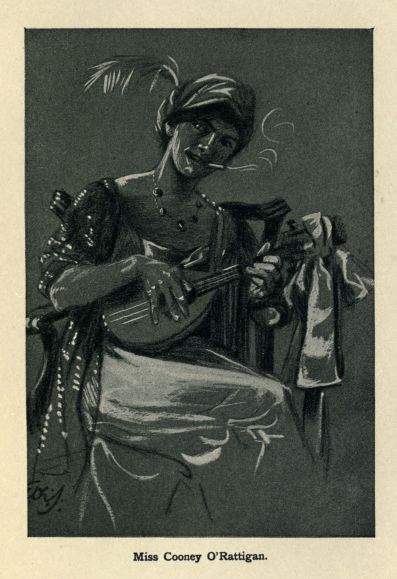
Miss Cooney O'Rattigan.
I said that the soda-water bottles had probably prepared him for the ostrich eggs, and Miss Bennett asked me if it were true that I had once found a nest of young mice in the foot of my bed at Aussolas, because that was the story she had heard. I was able to assure her that, on the contrary, it had been kittens, and passing from these pleasing reminiscences I asked her to come forth and smoke a cigarette in the hall with me, as a preliminary to a farther advance in the direction of the motor. I have a sincere regard for Miss Bennett, but her dancing is a serious matter, with a Cromwellian quality in it, suggestive of jack boots and the march of great events.
The cigarettes were consolatory, and the two basket-chairs by the fire in the back-hall were sufficiently comfortable; but the prospect of home burned like a beacon before me. The clock struck eleven.
"They're only beginning now!" said Miss Bennett, interpreting without resentment my glance at it. "Last night it was near one o'clock in the morning when they had high tea, and then they took to singing songs, and playing 'Are you there, Mike?' and cock-fighting."
I rose hastily, and began to search for my overcoat and cap, prepared to plunge into the frosty night, when Miss Bennett offered to show me a short way through the house to the stableyard, where I had left the car.
"I slipped out that way after dinner," she said, picking up a fur-lined cloak and wrapping it about her. "I wanted to make sure the mare had a second rug on her this cold night."
I followed Miss Bennett through a wheezy swing-door; a flagged passage stretched like a tunnel before us, lighted by a solitary candle planted in its own grease in a window. A long battle-line of bicycles occupied one side of the passage; there were doors, padlocked and cobwebbed, on the other. A ragged baize door at the end of the tunnel opened into darkness that smelt of rat-holes, and was patched by a square or two of moonlight.
"This is a sort of a lobby," said Miss Bennett. "Mind! There's a mangle there—and there are oars on the floor somewhere——"
As she spoke I was aware of a distant humming noise, like bees in a chimney.
"That sounds uncommonly like a motor," I said.
"That's only the boiler," replied Miss Bennett; "we're at the back of the kitchen here."
She advanced with confidence, and flung open a door. A most startling vista was revealed, of a lighted room with several beds in it. Children's faces, swelled and scarlet, loomed at us from the pillows, and an old woman, with bare feet and a shawl over her head, stood transfixed, with a kettle in one hand and a tumbler in the other.
Miss Bennett swiftly closed the door upon the vision.
"My gracious heavens!" she whispered, "what on earth children are those? I'm sure it's mumps they have, whoever they are. And how secret the McRorys kept it!—and did you see it was punch the old woman was giving them?"
"We might have asked her the way to the yard," I said, inwardly resolving to tell Philippa it was scarlatina; "and she might have given us a light."
"It was this door I should have tried," said my guide, opening another with considerable circumspection.
Sounds of hilarity immediately travelled to us along a passage; I followed Miss Bennett, feeling much as if I were being led by a detective into Chinatown, San Francisco. A square of light in the wall indicated one of those inner windows that are supposed to give light mutually to room and passage, and are, as a matter of fact, an architect's confession of defeat. Farther on a door was open, and screams of laughter and singing proceeded from it. I admit, without hesitation, that we looked in at the window, and thus obtained a full and sufficient view of the vie intime of the Temple Braney kitchen. A fat female, obviously the cook, was seated in the midst of a remarkably lively crowd of fellow-retainers and camp-followers, thumping with massive knuckles on a frying-pan, as though it were a banjo, and squalling to it something in an unknown tongue.
"She's taking off Miss Cooney O'Rattigan!" hissed Miss Bennett, in ecstasy. "She's singing Italian, by way of! And look at those two brats of boys, Vincent and Harold, that should have been in their beds two hours ago!"
Masters Vincent and Harold McRory were having the time of their lives. One of them, seated on the table, was shovelling tipsy-cake into his ample mouth with a kitchen spoon; the other was smoking a cigarette, and capering to the squalls of the cook.
As noiselessly as two bats Miss Bennett and I flitted past the open door, but a silence fell with a unanimity that would have done credit to any orchestra.
"They saw us," said Miss Bennett, scudding on, "but we'll not tell on them—the creatures!"
An icy draught apprised us of an open door, and through it we escaped at length from the nightmare purlieus of the house into the yard, an immense quadrangle, where moonlight and black shadows opposed one another in a silence that was as severe as they. Temple Braney House and its yard dated from what may be called the Stone Age in Ireland, about the middle of the eighteenth century, when money was plenty and labour cheap, and the Barons of Temple Braney, now existent only in guidebooks, built, as they lived, on the generous scale.
We crossed the yard to the coach-house in which I had left my motor: its tall arched doorway was like the mouth of a cave, and I struck a match. It illuminated a mowing-machine, a motor-bicycle, and a flying cat. But not my car. The first moment of bewilderment was closed by the burning of my fingers by the match.
"Are you sure it was here you left it?" said Miss Bennett, with a fatuity of which I had not believed her capable.
The presence of a lady was no doubt a salutary restraint, but as I went forth into the yard again, I felt as though the things I had to leave unsaid would break out all over me like prickly heat.
"It's the medical student one," said Miss Bennett with certainty, "the one that owns the motor-bike."
The yard and the moonlight did not receive this statement with a more profound silence than I.
"I'm sure he won't do it any harm," she went on, making the elementary mistake of applying superficial salves to a wound whose depths she was incapable of estimating. "He's very good about machinery—maybe it's only round to the front door he took it."
As Miss Bennett offered these consolations I saw two small figures creep from the shadows of the house. Their white collars shone in the moonlight, and, recognising them as the youngest members of the inveterate clan of McRory, I hailed them in a roar that revealed very effectively the extent of my indignation. It did not surprise me that the pair, in response to this, darted out of the yard gate with the speed of a pair of minnows in a stream.
I pursued, not with any hope of overtaking them, but because they were the only clue available, and in my wake, over the frosty ground, in her satin shoes, followed that sound sportswoman, Miss Bennett.
The route from the stable-yard to the front of Temple Braney House is a long and circuitous one, that skirts a plantation of evergreens. At the first bend the moonlight displayed the track of a tyre in the grass; at the next bend, where the edge was higher, a similar economy of curve had been effected, and that the incident had been of a fairly momentous nature was suggested by the circumstance that the tail lamp was lying in the middle of the drive. It was as I picked it up that I heard a familiar humming in the vicinity of the hall door.
"He didn't go so far, after all," said Miss Bennett, somewhat blown, but holding her own, in spite of the satin shoes.
I turned the last corner at a high rate of speed, and saw the dignified Georgian façade of the house, pale and placid in the moonlight; through the open hall door a shaft of yellow light fell on the ground. The car was nowhere to be seen, yet somewhere, close at hand, the engine throbbed and drummed to me,—a cri de coeur, as I felt it, calling to me through the accursed jingle of the piano that proceeded from the open door.
"Where the devil——?" I began.
Even as I spoke I descried the car. It was engaged, apparently, in forcing its way into the shrubbery that screened one end of the house. The bonnet was buried in a holly bush, the engine was working, slowly but industriously. The lamps were not lighted, and there was no one in it.
"Those two imps made good use of their legs, never fear them!" puffed Miss Bennett; "the 'cuteness of them—cutting away to warn the brother!"
"What's this confounded thing?" I said fiercely, snatching at something that was caught in the handle of the brake.
Miss Bennett snatched it in her turn, and held it up in the moonlight, while I stilled the fever of the engine.
"Dublin for ever!" she exclaimed. "What is it but the streamers of Miss Cooney's mandoline! There's the spoils of war for you! And it's all the spoils you'll get—the whole pack of them's hid in the house by now!"
From an unlighted window over the hall door a voice added itself to the conversation.
"God help the house that holds them!" it said, addressing the universe.
The window was closed.
"That's old McRory!" said Miss Bennett in a horrified whisper.
Again I thought of Chinatown, sleepless, incalculable, with its infinite capacity for sheltering the criminal.
"—But, darling," said Philippa, some quarter of an hour later, as we proceeded down the avenue in the vaulted darkness of the beech-trees (and I at once realised that she had undertaken the case for the defence), "you've no reason to suppose that they took the car any farther than the hall door."
"It is the last time that it will be taken to that hall door," I replied, going dead slow, with my head over the side of the car, listening to unfamiliar sounds in its interior—sounds that did not suggest health. "I should like to know how many of your young friends went on the trip——"
"My dear boy," said Philippa pityingly, "I ask you if it is likely that there would have been more than two, when one of them was the lady with the mandoline! And," she proceeded with cat-like sweetness, "I did not perceive that you took a party with you when you retired to the hall with your old friend Miss Bennett, and left me to cope single-handed with the mob for about an hour!"
"Whether there were two or twenty-two of them in the car," I said, treating this red herring with suitable contempt, "I've done with your McRorys."
I was, very appropriately, in the act of passing through the Temple Braney entrance gates as I made this pronouncement, and it was the climax of many outrages that the steering-gear, shaken by heaven knows what impacts and brutalities, should suddenly have played me false. The car swerved in her course—fortunately a slow one—and laid her bonnet impulsively against the Temple Braney gate pillar, as against a loved one's shoulder.