Front matter (continued 2)
Reading edition
"Here, Jeremiah," said the Diver.
The satellite came on deck with the single sinuous movement of a salmon.
The Diver motioned him to the windlass. "We'll take a turn at this first," he said.
They took each a handle, they bent to their task, and the anchor rose at their summons like a hot knife out of butter.
Every man present, with the exception of the Diver and the satellite, made the simple declaration that he was damned, and it was in the period of paralysis following on this that a fresh ingredient was added to the situation.
A giant voice filled the air, and in a windy bellow came the words:
"Nice lot you are!"
We faced about and saw "Ronnie's torpedo-boat" executing a sweeping curve in the mouth of Eyries Harbour.
"Couldn't wait any longer!" proceeded the voice of the Megaphone. "We've got to pick up the others outside. Thanks awfully for luncheon! Top-hole!"
T.B. No. 1000 completed the curve and headed for the open sea with a white mane of water rising above her bows. There was something else white fluttering at the stern. I put up the field-glasses, and with their aid perceived upon the deck a party of four ladies, one of whom was waving a large pocket handkerchief. The glasses were here taken out of my hand by Chichester, but not before I had identified the Flapper.
What Chichester said of Ronnie was heard only by me, and possibly by Jimmy, who did not count. I think it may have saved his life, being akin to opening a vein. That I was the sole recipient of these confidences was perhaps due to the fact that the Sheila, so swiftly and amazingly untethered, here began to fall away to leeward, with all the wilful helplessness of her kind, and instant and general confusion was the result. There were a few moments during which ropes, spars, and human beings pursued me wherever I went. Then I heard Lord Derryclare's voice—"Let go that anchor again!"
The sliding rattle of the chain followed, the anchor plunged; the status quo was re-established.
Chichester went ashore with the Diver to catch the outgoing mail-car. The telegram that had arrived with Bill was brought into action flagrantly, and was as flagrantly accepted. (It was found, subsequently, on his cabin floor, and was to the effect that the cartridges had been forwarded as directed.) The farewells were made, the parting regrets very creditably accomplished, and we stood on the deck and saw him go, with his suit-case, his rods, his gun-case, heaped imposingly in the bow, his rug, and his coats, the greater and the less, piled beside him in the stern.
The wind had freshened; the Diver and Jeremiah drove the boat into it with a will, and the heavy oars struck spray off the crests of the waves. We saw Chichester draw forth the greater coat, and stand up and put it on. The boat lurched, and he sat down abruptly, only to start to his feet again as if he had been stung by a wasp. He thrust his hand into the pocket, and Philippa clutched my arm.
"Could it have been into the pocket of his coat that I put the teapot——?" she breathed.
IV
HARRINGTON'S
Breakfast was over; Philippa was feeding the dogs. Philippa's cousin, Captain Andrew Larpent, R.E., was looking out of the window with that air of unemployment that touches the conscience of a host like a spur. Andrew did not smoke, a serious matter in a male guest, which means that there are, for him, no moments of lethargy, and that, when he idles, his idleness stands stark in the foreground against a clear sky, a reproach and a menace to his entertainers.
It was a cold day about the middle of September, and there was an unrest among the trees that commemorated a night of storm; the gravel was wet, the lawn-tennis ground was strewn with sycamore leaves.
"I suppose you'll say I'm drunk," said Andrew, "but the fact remains that I see two Natives coming up the drive."
In the green tunnel that was the avenue at Shreelane were two dark figures; both were dressed in frock-coats, of which the tails fluttered meagrely in the wind; their faces were black; with the half-hearted blackness of a leg in a black silk stocking; one of them wore a tall hat.
"This is what comes of leaving Calcutta without paying your bills," I suggested; "or perhaps it's a Missionary Deputation——"
The Natives advanced into the middle distance.
"It's the Sweep!" exclaimed Philippa. "It's my beloved Cantillon!"
She flung open the window.
"Oh, Cantillon!" she cried, invoking the gentleman in the top-hat as if he were an idol, "I've been longing to see you!"
The leading Native halted beneath the window and curtseyed.
"I partly guessed it, my Lady!" he replied modestly, and curtseyed again.
"Then why didn't you come before?" screamed Philippa, suppressing with difficulty the indignation of the dogs.
"I had the toothache, my Lady, and a howlt in my poll," returned the sweep, in dignified narrative. "I may say my hands was crackin' with the stren'th of pain, and these four days back there was the rumour of passpiration all over me, with respex to ye——"
"I'll see you in the kitchen," said Philippa, shutting the window abruptly. "My poor friends," she continued, "this means a cold luncheon for you, and a still colder reception for me from Mrs. Cadogan, but if I let Cantillon escape me now, I may never see him again—which is unthinkable!"
I presume that white is the complimentary colour of a sweep. In half an hour after the arrival of Mr. Cantillon the sitting-rooms were snowed over with sheets, covering alike floor and furniture, while he and his disciple moved from room to room on tiptoe, with ostentatious humility, leaving a round black spoor upon the snow. My writing-table was inaccessible, so also was the piano, which could usually be trusted to keep Andrew quiet for an hour of the morning. Perhaps it would be more accurate to say it kept him occupied. Captain Larpent had not been many years in the service of his country, yet it was already told of him that "From Birr to Bareilly," undeterred by hardships, his intrepid piano had accompanied him, and that house-rents fell to zero within a half-mile radius of his vicinity. Daily the walls of Shreelane shook to the thunder of his practising; nightly his duets with my wife roared like a torrent over my sleeping head. Sometimes, also, he sang, chiefly in German (a language I do not understand), and with what seemed to me superfluous energy. But this, I am told, means "temperament."
Haunting as a waltz refrain the flavour of soot stole through the menu at dinner; it was whispered in the soup, it was muttered in the savoury, and in the coffee it abandoned subterfuge and shouted down all opposition. Next morning, at breakfast, Philippa asked if the car wanted exercise, because it seemed to her a day marked out by Providence for calling on the Chicken Farmers. We might start early, take sandwiches, show Andrew something of the country—the programme was impulsively sketched in, but none the less I divined that an indignant household had demanded a day of atonement in which to obliterate the memory of the sweep.
It was, as well as I remember, in the preceding spring that the Chicken Farmers had come before the swallow dared, and had taken—in addition to the winds of March—a small farm about midway in the wilderness between us and the Derryclares. They were two young women who had recently been commended to our special attention by Lady Derryclare; they were, she said, Pioneers, and were going to make their fortunes, and would incidentally set an example to the district. Philippa had met them on the Derryclares' yacht.
"One of them is very pretty," she explained to Andrew, "and the other is a doctor."
"I wonder which of them does most damage?" said Andrew. "I think I'll stay at home."
None the less he came.
It was not until the car was at the door that I found we were to be favoured with the society of my eldest son, Anthony, in consequence of the facts that (1) the day before had been his ninth birthday, (2) that he had not cried when he met the sweep in the passage, and (3) that for lack of the kitchen fire he had had no birthday cake. Minx, also, was one of us, but as she came as a stowaway, this did not transpire till later, when explanations were superfluous.
It was at the moment of departure that I perceived a donkey-cart, modestly screening itself behind the evergreens on the way to the yard, and one of Flurry Knox's men approached me with Mr. Knox's compliments, and would I lend him the loan of the long ladder? Some two years ago, in a moment of weakness, I had provided myself with a ladder wherewith to attain to the eaveshoots of Shreelane, since when I had found myself in the undesired position of public benefactor. How life without a long ladder had hitherto been possible for my neighbours I was at a loss to imagine, and as I was also at a loss for any valid excuse for refusing to lend it, the ladder enjoyed a butterfly existence of country-house visiting. Its visits to Mr. Knox had been especially lengthy and debilitating. It is, as Mrs. Cadogan is wont to say, the last straw that puts the hump on the camel. The blood suddenly mounted to my brain, and with it came inspiration.
"You can tell Mr. Knox that the eaveshoots of this house are leaking like sieves, and I want the ladder myself."
In the glow of satisfaction kindled by the delivery of this message I started the caravan. The western breeze fanned my brow agreeably, the car purred her satisfaction with our new and only stretch of steam-rolled road, and Anthony was still in the condition of Being Good (a condition, nevertheless, by no means to be relied on, and quite distinct from Goodness).
We ran west, we ran north; we skirted grey and sounding bays of the Atlantic; we climbed high among heathery, stone-besprinkled moors; we lunched by the roadside in the lee of a rick of turf, and Anthony, by this time emerging from the condition of Being Good, broke the Thermos, and flashed his birthday electric torch in Minx's face until she very properly bit him, and Philippa slurred over the incident with impartial chocolate, and said it was time to start.
The region in which the Chicken Farmers had established themselves suggested the nurture of snipe and sea-gulls rather than chickens. It was an indeterminate patchwork of stony knobs of hill and pockets of bog, among which the road humped and sagged, accepting pessimistically the facts of nature. Hardy, noisy hill-streams scurried beside it, or over it, as seemed good to them; finally a sharp turn, a high horizon of sea, and a steep down-hill grade, ending on the shore of a small, round lake. There was a little pink box of a house on its farther side, with a few bunches of trees round it, and among them a pigmy village of prim wooden huts.
"That's the place," said Philippa, who had been there with Lady Derryclare. "And those are the last cry in hen-houses. Now remember, both of you, one of them is a doctor, Scotch, and a theosophist, or something mysterious of that sort; and the pretty one was engaged to a gunner and it was broken off—why, I don't know—drink, I fancy, or mad—so you had better be careful——"
"I shall be guarded in my condolences," I said, turning in at the little gate, with the sensation of being forcibly fed.
"As far as one can gather," said Andrew, "there remains no topic in heaven or earth that——"
"Music and poultry," said Philippa in a breath, as I drew up at the hall door.
Andrew rang the bell, and a flock of white ducks hurried up from among the trees and gathered round him with loud cries of welcome. There was no other reply to his summons, and at the second essay the bell-wire came out by the roots with generous completeness.
"The ladies is gone to th' oxtion!" cried a voice from among the hen-coops, and the ducks lifted up their voices in ardent reply.
"Where is the auction?" Philippa called, when a comparative silence had fallen.
"In Harrington's, beyond at the Mines!" replied the oracle, on a well-sustained high G.
"Put the cards on the hall table," said Philippa, "we might go back that way."
Several things combine in the spell that an auction casts upon my wife, as upon many others of her sex; the gamble, the competition, the lure of the second-hand, the thrill of possible treasure-trove. We proceeded along the coast road towards the mines, and I could hear Philippa expounding to her first-born the nature and functions of auctions, even as the maternal carnivore instructs her young in the art of slaughter. The road with which we were now dealing ran, or, it would be more accurate to say, walked, across the stony laps of the hills. The cliffs were on our right; the sea was still flustered after the storm, like a dog that has fought and is ready to fight again. We toiled over the shoulder of a headland, and there caught sight of "Harrington's."
On a green plateau, high above the sea, were a couple of iron sheds and a small squat tower; landward of them was a square and hideous house, of the type that springs up, as if inevitably, in the neighbourhood of mines, which are, in themselves, among the most hideous works of man. One of the sheds had but half a roof; a truck lay on its side in a pool of water; defeat was written starkly over all.
"Copper, and precious little of it," I explained to Andrew; "and they got some gold too—just enough to go to their heads, and ruin them."
"Did they put it in their mouths—where you have it, Father?" enquired Anthony, who was hanging on my words and on the back of my seat.
"Suppose you shut yours," I replied, with the brutality that is the only effective defence against the frontal attacks of the young.
We found the yard at Harrington's thronged with a shabby company of carts, cars, and traps of many varieties; donkey-carts had made their own of the road outside, even the small circle of gravel in front of the hall door was bordered by bicycles; apparently an auction was a fashionable function in the region of the Lug-na-Coppal copper-mines. Dingy backs bulged from the open door of the hall, and over their heads as we arrived floated the voice of the auctioneer, demanding in tragic incredulity if people thought his conscience would permit him to let an aneroid barometer go for half-a-crown. Without a word Philippa inserted herself between the backs, followed by her son, and was lost to view.
"Thank you, madam!" said the voice, with a new note of cheer in it. "Five shillings I am bid! Any advance on five shillings?"
"That's a good weather-glass!" hissed a farmer's daughter with a plumed hat, to a friend with a black shawl over her head. "An' I coming into the house to-day I gave it a puck, and it knocked a lep out o' the needle. It's in grand working order."
"I'm told it was the last thing in the house poor Mr. Harrington left a hand on, the day he made away with himself, the Lord save us!" remarked a large matron, casually, to Andrew and me.
"I thought the Coroner's Jury found that he fell down the shaft?" I returned, accepting the conversational opening in the spirit in which it was offered.
The matron winked at me with a mixture of compassion and confederacy.
"Ah, the poor fellow was insured, and the jury were decent men, they wouldn't wish to have anything said that 'd put the wife out of the money."
"The right men in the right place, evidently," said Andrew, who rather fancies his dry humour. "But apart from the climate and the architecture, was there any reason for suicide?"
"I'm told he was a little annoyed," said an enormous old farmer, delicately.
"It was the weather preyed on him," said the matron. "There was a vessel was coming round to him with coal and all sorts, weather-bound she was, in Kinsale, and in the latther end she met a rock, and she went down in a lump, and his own brother that was in her was drownded."
"There were grounds for annoyance, I admit," said Andrew.
The big farmer, who had, perhaps, been one of the jury, remarked non-committally that he wouldn't say much for the weather we were getting now, and there was one of them planets was after the moon always.
We moved on to the yard, in which prospective buyers were prowling among wheelbarrows, coils of rope, ladders, and the various rubbish proper to such scenes, and Andrew discoursed of the accessories that would be needed for the repair of my eaveshoots, with the large-mindedness of the Government official who has his own spurs and another man's horse. He was in the act of assuring me that I should save half a man's wages by having a second long ladder, when some one in the house began to play on a piano, with knowledge and vigour. The effect on Captain Larpent was as when a hound, outside a covert, hears the voice of a comrade within. The room from which the music came was on the ground floor, the back door was open, and Andrew walked in.
"That is one of those young ladies who have come here to make their fortunes with poultry," observed a melancholy-looking clergyman at my elbow, "Miss Longmuir, I expect; she is the musician. Her friend, Dr. Catherine Fraser, is here also. Wonderful young ladies—no wish for society. I begged them to come and live near my church—I offered them a spare corner of the churchyard for their hen-coops—all of no avail."
I said that they seemed hard to please.
"Very, very," assented the clergyman; "yet I assure you there is nothing cynical about them. They are merely recloozes."
He sighed, on what seemed to be general grounds, and moved away.
I followed Andrew into the house and found myself in the kitchen. The unspeakable dreariness of an auction was upon it. Pagodas of various crockeries stood high on the tables, and on benches round the walls sat, rook-like, an assembly of hooded countrywomen. A man with a dingy pale face was standing in front of the cold fireplace, addressing the company. On my arrival he removed his hat with stately grace, and with an effort I recognised Cantillon the sweep, in mufti—that is to say, minus some of his usual top-dressing of soot.
"It's what I was saying, Major Yeates," he resumed. "I'm sweeping those chimneys thirty years, and five managers I seen in this house, and there wasn't one o' them that got the price of their ticket to Cork out o' that mine. This poor man was as well-liked as anyone in the world, but there was a covey of blagyards in it that'd rob St. Pether, let alone poor Mr. Harrington!"
The company assented with a groan of general application, and the ensuing pause was filled by the piano in the next room, large and heavy chords, suggestive of the hand of Andrew.
"God! Mrs. Harrington was a fine woman!" croaked one of the rooks on the bench.
"She was, and very stylish," answered another. "Oh, surely she was a crown!"
"And very plain," put in a third, taking up the encomium like a part in a fugue, "as plain as the grass on the hills!"
I moved on, and met my wife in a crowd at the door of the dining-room, and in an atmosphere which I prefer not to characterise.
"I've got the barometer!" she said breathlessly. "No one bid for it, and I got it for five shillings! A lovely old one. It's been in the house for at least fifty years, handed on from one manager to another."
"It doesn't seem to have brought them luck," I said. "What have you done with Anthony? Lost him, I hope!"
"There have been moments when I could have spared him," Philippa admitted, "especially when it came to his bidding against me, from the heart of the crowd, for a brass tea-kettle, and running the price up to the skies before I discovered him. Then I found him upstairs, auctioning a nauseous old tail of false hair, amidst the yells of country girls; and finally he tried to drop out of the staircase window—ten feet at least—with a stolen basket of tools round his neck. I just saw his hands on the edge of the window-sill."
"I think it's time to go home," I said grimly.
"Darling, not till I've bought the copper coal-scuttle. Come and look at it!"
I followed her, uttering the impotent growls of a husband. As we approached the drawing-room the music broke forth again, this time in power. Three broad countrywomen, in black hooded cloaks and brown kid gloves, were seated on a sofa; two deeply-engrossed backs at the piano accounted for the music. There is no denying the fact that a piano duet has some inescapable association with the schoolroom, no matter how dashing the execution, how superior the performers.
"Poor old 'Semiramide'!" whispered Philippa; "I played that overture when I was twelve!" Over her shoulder I had a view of Andrew's sleek black poll and brown neck, and an impression of fluffy hair, and a slight and shapely back in a Norfolk jacket.
"He seems to have done very well in the time," I said. "That's the pretty one, isn't it?"
I here became aware that the hall was filling with people, and that Mr. Armstrong, the auctioneer, with his attendant swarm of buyers, was at my elbow.
"That's a sweet instrument," he said dispassionately, "and, I may say, magnificently played. Come, ladies and gentlemen, we'll not interrupt the concert. It might be as good for me to take the yard next, before the rain comes."
He led away his swarm, like a queen bee; "Semiramide" stormed on; some people strayed into the room and began to examine the furniture. The afternoon had grown overcast and threatening, and I noticed that a tall man in dark clothes and a yachting cap had stationed himself near the treble's right hand. He was standing between her and the light, rather rudely, it seemed to me, but the players did not appear to notice.
"That was rather a free and easy fellow," I said to Philippa, as we were borne along to the back door by the tide of auction.
"Who? Do you mean Mr. Armstrong?" said Philippa. "I'm rather fond of him——"
"No, the tall chap in the yachting cap."
"I didn't notice him—" began Philippa, but at this moment we were shot into the yard by pressure from behind. Mr. Armstrong took his stand on a packing-case, the people hived in round him, and I saw my wife no more.
Coils of fencing wire and sheets of corrugated iron were proffered, and left the audience cold; a faint interest was roused when the auctioneer's clerk held up one of a party of zinc pails for inspection.
"You'd count the stars through that one!" said a woman beside me.
"You can buy it for a telescope, ma'am!" said Mr. Armstrong swiftly.
"Well, well, hasn't he a very fine delivery!" said my neighbour, regarding Mr. Armstrong as if he were a landscape.
"Hannah," said the woman on my other hand, in a deep and reproachful contralto, speaking as if I did not exist, "did ye let the kitchen chairs go from you?"
"There wasn't one o' them but had a leg astray," apologised Hannah—"they got great hardship. When Harrington 'd have a drop taken he'd throw them here and there."
"Ladies! Ladies!" reproved Mr. Armstrong. "Is this an oxtion or is it a conversassiony? John! show that ladder."
"A big lot of use a forty-foot ladder'd be to the people round this place!" said a superior young farmer in a new suit of clothes; "there isn't a house here, unless it's my father's, would have any occasion for it."
Hannah dug me hard in the ribs with her elbow and put out her tongue.
"Five shillings I am bid for a forty-foot ladder!" said Mr. Armstrong to the Heavens; "I'd get a better price at a jumble sale!"
"Look at the poker they have in it by the way of a rung!" continued the young farmer. "I wouldn't be bothered buying things at oxtions; if it was only gettin' marr'ed you were you'd like a new woman!"
"Seven and six!"
To my own astonishment I heard my voice saying this.
"Seven and six I am bid," said the auctioneer, seizing me with his eye. "Ten shillings may I say? Thank you, sir——"
The clergyman had entered the lists against me.
I advanced against him by half-crowns; the audience looked on as at a battle of giants. At twenty-five shillings I knew that he was weakening; at thirty shillings the ladder was mine.
I backed out of the crowd with the victor's laurels on my brow, and, as I did so, a speck of rain hit me in the eye. The sea was looking cold and angry, and the horizon to windward was as thick as a hedge. It was obviously time to go, and I proceeded in the direction of the car.
As I left the yard a remarkable little animal, which for a single wild instant I took for a fox or a badger, came running up the road. It was reddish brown, with white cheeks and a white throat; it advanced hesitatingly and circled round me with agitated and apologetic whimpers.
"Minx!" I said incredulously.
The fox or badger flung itself on its side and waved a forepaw at me.
"It's hunting rabbits below on the cliffs she was," said a boy in a white flannel jacket, who was sitting on the wall.
"Oh, there you are," said Philippa's voice behind me; "I wanted to remind you to remember the aneroid. It's on the dining-room table. I'm feeling rather unhappy about that child," she went on, "I can't find him anywhere."
"I'll go in and find him," I said, with a father's ferocity.
"I hope he's there," said Philippa uncomfortably. "Good gracious! Is that Minx?"
I left the boy to explain, and made for the house, getting through the crowd in the doorway by the use of tongue and elbows, and making my way upstairs, strode hastily through the dark and repellent bedrooms of "Harrington's." Anthony was not there.
In the dining-room I heard Andrew's voice. I went in and found him sitting at the dinner-table with two ladies, one of whom was holding his hand and examining it attentively.
She had pale eyelashes, and pale golden hair, very firmly and repressively arranged; she was big and fresh and countrified looking, and her eyes were water-green. She looked like an Icelander or a Finn, but I recognised her as the second Chicken Farmer, Dr. Fraser.
"I was looking for Anthony," I said, withholding with difficulty an apology for intrusion. "We've got to get away, Andrew——"
"I was having my fortune told," said Andrew, looking foolish.
"I saw your little boy going across the field there, about half an hour ago," said Dr. Fraser, looking up at me with eyes of immediate understanding. "The white terrier was with him."
"Towards the cliffs?" I said, feeling glad that Philippa was not there.
"No, to the right—towards the tower." She went to the window. "There was some one with him," she added quickly. "There he is now—that man in a yachting cap, by the tower——"
"I don't see anyone," I said, refixing my eye-glass.
Miss Fraser continued to stare out of the window. "You're short-sighted," she said, without looking at me. "Perhaps if the window were open——"
Before I could help her she had opened it, and the west wind rushed in, with big drops in it.
"I must be blind," I said, "I can see no one."
"Nor can I—now," she said, drawing back from the window.
She sat down at the table as if her knees had given way, and her strong white hand fell slackly on Philippa's purchase, the old aneroid barometer, and rested there. The other girl looked at her anxiously.
"Hold up, Cathie!" she said, as one speaks to a horse when it stumbles.
Her friend's eyes were fixed, and empty of expression, and the fresh pervading pink of her face had paled.
"Perhaps we had better go and look for that kid," said Andrew, getting up, and I knew that he too was aware of something uncomfortable in the atmosphere. Before we could get out of the room, Dr. "Cathie" spoke.
"I see tram-lines," she said gropingly, "and water—I wonder if he's asleep——"
She sighed. Andrew and I, standing aghast, saw her colour begin to return.
Her friend's eye indicated to us the door. We closed it behind us, and shoved our way through the hall.
"I say!" said Andrew, as we got outside, "I thought she was going to chuck a fit, or have hysterics, or something. Didn't you?"
I did not answer. Cantillon, the sweep, was hurrying towards me with tidings in his face.
"Mrs. Yeates is after going to the cliff looking for the young gentleman—but sure what I was saying——"
I did not wait to hear what Cantillon's observations had been, because I had caught sight of Philippa, away in a field near the edge of the cliffs. She was running, and the boy with the white flannel jacket was in front of her. It seemed ridiculous to hurry, when I knew that Anthony had been accompanied by a large man in a yachting cap (in itself a guarantee of competency).
None the less, I ran, with the wind and the heavy raindrops in my face, across country, not round by the road, and ran the faster for seeing my wife and her companion sinking out of sight over the edge of the cliff, as by an oblique path. My way took me past the tower; there was a little plateau there, with a drooping wire fence round it, and I had a glimpse of the square black mouth of the disused shaft.
"Near the tower," the girl had said; but she had also said there was a man with him.
I ran on, but fear had sprung out of the shaft and came with me.
A hard-trodden path led from the tower to the cliff; it fell steeper and steeper, till, at a hairpin turn, it became rocky steps, slanting in sharp-cut zigzags down the face of the cliff. On the right hand the rocks leaned out above my head, yellow and grey and dripping, and tufted with sea pinks; on the left there was nothing except the wind. A couple of hundred feet below the sea growled and bellowed, plunging among broken rocks. I did not give room to the thought of Anthony's light body, tossed about there.
At a corner far below I had a glimpse of Philippa and the boy in the white jacket; he was leading her down—holding her hand—my poor Philippa, whose nightmare is height, who has vertige on a step-ladder. She must have had a sure word that Anthony had gone down this dizzy path before her. A mass of rock rose up between us, and they were gone, and in that gusty and treacherous wind it was impossible to make better speed.
The damnable iteration of the steps continued till my knees shook and my brain was half numb. They ceased at last at the mouth of a tunnel, half-way down the vertical face of the cliff; there was a platform outside it, over the edge of which two rusty rails projected into space above a narrow cove, where yellow foam, far below, churned and blew upwards in heavy flakes. Philippa and her guide had vanished. I felt for my match-box, and plunged into the dark and dripping tunnel.
I pushed ahead, at such speed as is possible for a six-foot man in a five-foot passage, splashing in the stream that gurgled between the tram-rails, and stumbling over the sleepers. Soon the last touches of daylight glinted in the water, they died, and it was pitch dark. I struck a match, sheltering it with my cap from the drips of the roof, and shouted, and stood still, listening. There was no sound, except the muffled roar of the sea outside; the match kindled broad sparkles of copper ore in the rock, but other response there was none.
Match by match I got ahead, shouting at intervals, stooping, groping, clutching at the greasy baulks of timber that supported the roof and sides, till a cold draught blew out my match. My next revealed a cross-gallery, with a broken truck blocking one entrance. There remained two ways to choose between. It was certain that the tram-rails must lead to the shaft, but which way had Philippa gone? And Anthony—I stood in maddening blackness; some darkness is a negative thing, this seemed an active, malevolent pressure. I counted my matches, and shouted, and still my voice came back to me, baffled, and without a hope in it. There were not half a dozen matches left.
A faint, paddling sound became audible above the drippings from the roof; I struck another of my matches, and something low and brown came panting into the circle of light. It was Minx, coming to me along the gallery of the tram-rails. She paused just short of the cross-ways, staring as though I were a stranger, and again a circling wind blew out my match. A fresh light showed her, still motionless; her back was up, not in the ordinary ridge, but in patches here and there; she was looking at something behind me; she made her mouth as round as a shilling, held up her white throat, and howled, thinly and carefully, as if she were keening. I cannot deny that I stiffened as I stood, and that second being that inhabits us, the being that is awake when we are asleep (and is always afraid), took charge for a moment; the other partner, who is, I try to think, my real self, pulled himself together with a certain amount of bad language, thrust Minx aside, and went ahead along the gallery of the tram-lines.
It needed only a dozen steps, and what Minx had or had not seen became a negligible matter. A white light, that turned the flame of my match to orange, began to irradiate the tunnel like moonrise, defining theatrically the profiles of rock, and the sagging props and beams. It came from an electric lamp, Anthony's electric lamp, standing on a heap of shale. The boy in the flannel jacket was holding a lighted candle-end in his fingers, and bending low over Philippa, who was kneeling between the tram-lines in the muddy water, holding Anthony in her arms. He was motionless and limp, and I felt that sickening drop of the heart that comes when the thing that seems too bad to think of becomes in an instant the thing that is.
"Tram-lines and water—" said a level voice in my brain. "I wonder if he is asleep——"
I wondered too.
Philippa looked up, with eyes that accepted me without comment.
"Only stunned, I think," she said hoarsely. "He opened his eyes an instant ago."
"The timber fell on him," said the country boy. "Look where he have the old prop knocked. 'Twas little but he was dead."
Anthony stirred uneasily.
"Oh, mother, you're holding me too tight!" he said fractiously.
From somewhere ahead vague noises came, rumblings, scrapings, hangings like falling stones—
"It must be they're putting a ladder down in the shaft," said the boy.
Anthony had broken his collar-bone. So Dr. Fraser said; she tied him up with her knitted scarf by the light of the electric torch; I carried him up the ladder, and have an ineffaceable memory of the lavender glare of daylight that met us, and of the welcome that was in the everyday rain and the wet grass. In the relief of the upper air I even bore with serenity the didactics of Andrew, who assured me that he had seen from the first that the shaft was the centre of the position, though he had never been in the slightest degree uneasy, because Dr. Fraser had seen some one with Anthony.
Dr. Fraser said nothing; no more did I.
"See now," said Cantillon the sweep, who, in common with the rest of the auction, was standing round the car to view our departure, "it pinched me like death when they told me the Major had that laddher bought!"
Being at the time sufficiently occupied in preparing to get away, I did not enquire why Cantillon should have taken the matter so much to heart.
"But after all," he proceeded, having secured the attention of his audience by an effective opening, "wasn't it the mercy of God them chaps Mr. Knox has at the kennels had it lent to the Mahonys, and them that's here took it from the Mahonys in a hurry the time Mr. Harrington died! And through all it was the Major's ladder."
Andrew had the ill-breeding to laugh.
"Sure it'd be no blame for a gentleman not to know the like of it," said Cantillon with severity. "Faith, I mightn't know it meself only for the old poker I stuck in it one time at Mr. Knox's when a rung broke under me——"
It is a valuable property of the motor-car that it can, at a moment's notice, fill an inconvenient interval with loud noises. I set the engine going and jumped into the car.
Something, covered by a rug, cracked and squashed under my foot. It was the aneroid.
When we reached a point in the road where it skirts the cliff I stopped the car, and flung the aneroid, like a quoit, over the edge, through the wind and the rain, into oblivion.
V
THE MAROAN PONY
It had taken ten minutes to work the car over the bridge at Poundlick, so intricate was the crowd of people and carts, so blind and deaf to any concerns save their own; a crowd that offered sometimes the resistance of the feather bed, sometimes that of the dead wall, an intractable mass, competent to reduce the traffic of Piccadilly to chaos, and the august Piccadilly police to the point of rushing to the nearest lunatic asylum, and saying, "Let us in! We are mad!"
The town of Poundlick is built at so accommodating a tilt that it is possible to stand on the bridge at its foot, and observe the life of its single street displayed like a poster on the hillside; even to compare the degrees of custom enjoyed by its public-houses, and to estimate the number of cur dogs to the square yard of pavement. I speak of an ordinary day. But this hot twentieth of September was far from being ordinary.
The Poundlick Races are, I believe, an ancient and annual function, but, being fifteen miles from anywhere, I had hitherto been content to gauge their attractions by their aftermath of cases in the Petty Sessions Court next following the fixture. There is, however, no creature more the sport of circumstances than a married man with a recent motor; my attendance, and that of the car, at the Poundlick Races had been arranged to the last sandwich before I had time to collect objections (and this method, after all, saves some wear and tear).
The races are held on the banks of the Arrigadheel River, within hail of the town, and are reached—as everything in Ireland is reached—by a short cut. We—that is to say, my wife, her cousin, Captain Andrew Larpent, R.E., and I—were gathered into the jovial crowd that straggled, and hustled, and discoursed over the marshy meadows of the river, and ploughed through the brown mud in the gaps without a check in pace or conversation. The Committee had indeed "knocked" walls, and breached banks, but had not further interfered with the course of nature, and we filed at length on to the course across a tributary of the river, paying a penny each for the facilities offered by a narrow and bounding plank and the muddy elbow of a young man who stood in mid-stream; an amenity accepted with suitable yells by the ladies (of whom at least ninety per cent. remarked "O God!" in transit).
The fact that there are but four sound and level fields within a ten-mile radius of Poundlick had simplified the labours of the Committee in the selection of a course. Rocky hills rose steeply on two sides of the favoured spot, the Arrigadheel laid down the law as to its boundaries, and within these limitations an oval course had been laid out by the simple expedient of breaking gaps in the banks. The single jump-race on the programme was arranged for by filling the gaps with bundles of furze, and there was also a water-jump, more or less forced upon the Committee by the intervention of a ditch pertaining to one of the fences. A section of the ditch had been widened and dammed, and the shallow trough of pea-soup that resulted had been raised from the rank of a puddle by a thin decoration of cut furze-bushes.
The races had not begun, but many horses were galloping about and over the course, whether engaged in unofficial competitions or in adding a final bloom to their training, I am unable to say. We wandered deviously among groups of country people, anchored in conversation, or moving, still in conversation, as irresistibly as a bog-slide. Whether we barged into them, or they into us, was a matter of as complete indifference to them as it would have been to a drove of their own bony cattle.
"These are the sort of people I love," said Philippa, her eyes ranging over the tented field and its throngs, and its little red and green flags flapping in the sunshine. "Real Primitives, like a chorus in Acis and Galatea!"
She straightened her hat with a gasp, as a couple of weighty female primitives went through us and passed on. (In all circumstances and fashions, my wife wears a large hat, and thereby adds enormously to the difficulties of life.) Among the stalls of apples and biscuits, and adjacent to the drink tent, a roulette table occurred, at which the public were invited to stake on various items of the arms of the United Kingdom. The public had accepted the invitation in considerable numbers, and I did not fail to point out to Philippa the sophisticated ease with which Acis flung his penny upon "Harp," while Galatea, planking twopence upon the Prince of Wales' plumes, declared that the last races she was at she got the price of her ticket on "Feather."
We passed on, awaking elusive hopes in the bosoms of two neglected bookmakers, who had at intervals bellowed listlessly to the elements, and now eagerly offered me Rambling Katty at two to one.
"Boys, hurry! There's a man dead, north!" shrieked a boy, leaping from the top of a bank. "Come north till we see him!"
A rush of boys went over us; the roulette table was deserted in a flash, and its proprietor and the bookmakers exchanged glances expressive of the despicable frivolity of the rustics of Poundlick.
"We ought to try to find Dr. Fraser," said Philippa, hurrying in the wake of the stampede.
"I did not know that the Chicken Farmers were to be among the attractions," I said to Andrew, realising, not for the first time, that I am but an infant crying in the night where matters of the higher diplomacy are toward.
Andrew made no reply, as is the simple method of some men when they do not propose to give themselves away, and we proceeded in the direction of the catastrophe.
The dead man was even less dead than I had expected. He was leaning against a fence, explaining to Dr. Catherine Fraser that he felt all the noise of all the wars of all the worlds within in his head.
Dr. Fraser, who was holding his wrist, while her friend, Miss Longmuir, kept the small boys at bay, replied that she would like a more precise description. The sufferer, whose colour was returning, varied the metaphor, and said that the sound was for all the world like the quacking of ducks.
"You'd better go home and keep quiet," said Dr. Fraser, accepting the symptom with professional gravity.
I asked my next door neighbour how the accident had occurred.
"Danny Lyons here was practising this young mare of Herlihy's for Lyney Garrett, that's to ride her in the first race," said my neighbour, a serious man with bushy black whiskers, like an old-fashioned French waiter, "and sure she's as loose as a hare, and when she saw the flag before her on the fence, she went into the sky, and Danny dhruv in the spur to keep the balance, and with that then the sterrup broke."
"It's little blagyarding she'd have if it was Lyney was riding her!" said some one else.
"Ah, Lyney's a tough dog," said my neighbour; "in the Ring of Ireland there isn't a nicer rider."
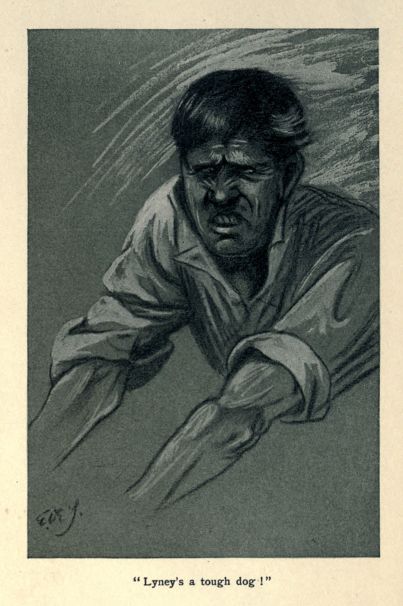
"Lyney's a tough dog!"
"There might be men as good as him in Poundlick!" said an ugly little black-muzzled fellow, suddenly and offensively, "and horses too! As good as any he'll throw his leg over!"
Dr. Fraser's patient stood up abruptly.
"Oh, oh, oh!" said the man with the bushy whiskers, placing himself in front of the invalid. "Let you be said by the lady, Danny, and go home! Have behaviour now, Peter Lynch!"
The matter hung for a moment; a bell began to ring in the middle of the course, and the onlookers flung the situation from them like a squeezed lemon, and swept en masse towards the summons, bearing with them the invalid.
"Off the stage I have never seen people clear out so fast," remarked Andrew. "Now that we've seen Dr. Fraser's Lightning Cure, I suppose we may as well go too."
His eyes, by a singular coincidence, met those of Miss Longmuir, which were very pretty eyes, dark and soft.
"I must go and hunt up our pony," she said, with a very businesslike air; "we've entered her for the third race, you know."
She put back her hair as it blew across her forehead, and the gold in it glinted in the sun.
"How sporting of you!" we heard Andrew say, as they walked away together.
My wife and Dr. Fraser and I turned as one man, and went in the opposite direction.
We steered for an island of furze and grey boulders that had been flung into the valley like a vedette from the fortified hill-side, and was placed, considerately, at the apex of the oval course. Half a dozen men were already grouped upon the boulders, like cormorants. We clambered to a higher étage, and there spread forth ourselves and our belongings upon the warm slabs. The sun was hot, yet not too hot, the smell of trodden turf was pleasant in the air, the river sparkled and gurgled beside us; the chimneys of Poundlick sent up languid spires of blue smoke; its yellow and pink and white houses became poetic in the September haze. The first delicate pangs of hunger were stealing upon us, and I felt reasonably certain that nothing necessary to our welfare had been forgotten. I lit a cigarette and pulled my cap over my eyes, and listened to a lark, spiring, like the smoke, into the blue, while my wife clattered in the luncheon basket. It was a moment of entire well-being, overshadowed only by the prospect of having to take an interest in the racing.
I said as much to Dr. Fraser, who was dismembering a cold chicken with almost awful surgical dexterity.
"You must wake up for our race," she said. "I'll call you in time."
"Must I? I hope you're going to ride."
"Heaven forfend!" replied Dr. Fraser. "Nothing more spirited than a weight-carrying bicycle! I'm not in the least horsey. Meg was dying to ride, but as we bought the pony from the great Lyney, and he had won any number of races on her, he was distinctly indicated."
"Quite right too," I said, with dowager-like propriety. "And I should wish it to be clearly understood that if, at the last moment, your friend Mr. Lyney should be too drunk to ride, I will not take his place."
"He doesn't drink," said Dr. Fraser, who has an unsympathetic way of keeping to the point. "He's been a great friend of mine ever since I mended a broken finger for him."
There was a stir among the cormorants on the lower tier of boulders, a shot was fired at the far end of the course, every one began to shout, and an irregularly shaped mass was detached from the crowd, and resolved itself into a group of seven horses, pounding towards us at a lumbering canter. One of the riders had a green jacket, the others were in shirt sleeves, with coloured scarves over their shoulders; all were bareheaded. As they neared the first jump, I found myself on my feet on my boulder, with two unknown men hanging on to me to steady themselves.
"That's no throuble to them!" shouted one of my attachés, as each horse in turn galloped over or through the barrier of furze in the gap.
"Which is Lyney Garrett?" I asked.
"That's him on the chestnut mare—the jock that have the dhress on him." He pointed to the wearer of the green jacket.
"Ah ha! Lyney's the boy! Look at him now, how he'll stoop and leave the horse to go for herself! He'll easy the horse, and he'll easy himself!"
"That Rambling Katty he's riding's a nice loose mare—she has a good fly in her," said another.
"Lyney's built for it. If there's any sort of a spring in a horse at all, he'll make him do it."
"He'd make a donkey plough!" flung in another enthusiast.
As they neared the flags at the turn of the oval—and an uncommonly sharp turn it was—the pace improved, each man trying to get the inside station; I could already see, written on the countenance of a large young grey horse, his determination to pursue an undeviating course of his own.
"Now, Lyney! Spare him in the angle!" shouted my neighbour, hanging on to my sleeve and rocking perilously.
Lyney, a square-shouldered young man, pale and long-jawed, bored determinedly on to the first flag, hit it with his right knee, wrenched Rambling Katty round the second flag, and got away for the water-jump three lengths ahead of anyone else.
"Look at that for ye—how he goes round the corner on one leg!" roared his supporter. "He'd not stop for the Lord Leftenant!"
The remaining riders fought their way round the flags, with strange tangents and interlacing curves; all, that is to say, save the grey horse, who held on unswervingly and made straight for the river. The spectators, seated on the low bank at its edge, left their seats with singular unanimity. The majority fled, a little boy turned a somersault backwards into the water, but three or four hardier spirits tore off their coats, swung them like flails in front of the grey, and threw their caps in his face, with a wealth of objurgation that I have rarely heard equalled.
"The speed was in him and he couldn't turn," explained one of my neighbours, at the top of his voice, as the grey, yielding to public opinion, returned to the course and resumed the race.
"That horse is no good," said a dapper young priest, who had joined our crowd on the rock. "Look at his great flat feet! You'd bake a cake on each of them!"
"Well, that's the case indeed, Father," replied a grizzled old farmer, "but he's a fine cool horse, and a great farming horse for ever. Be gance! He'd plough the rocks!"
"Well, he'll get a nice view of the race, anyway," said the young priest, "he has it all before him."
"They don't seem to be getting any delay with the water-jump," said some one else regretfully.
"Ah, what's in it but the full of a few tin cans!" said my adherent.
"Well, for all, it knocked a good lep out o' Rambling Katty: she went mountains over it!"
"Look south! Look south! They're coming on again, and only five o' them in it——"
The cheering was hotter this time, and it was entirely characteristic that it was the riders who were shouted for and not the horses.
"They'll win now this turn—there's three o' them very thick, that's a nice tidy race," said the old farmer.
"Good boy, Kenny! Go on, Kenny!" bellowed some one on a lower ledge.
"Who's second, coming up to the flag now?" panted Philippa, who was hanging on to the collar of my coat and trying to see over my shoulder.
"That's Jimmy Kenny," responded the man below, turning a black-muzzled face up towards us, his light eyes gleaming between their black lashes in the sunshine, like aquamarines. I recognised Peter Lynch, whom we had met earlier in the day.
"It's young Kenny out of the shop," explained the old farmer to me; "he rides very nate."
No one was found to endorse his opinion. The horses came on, sweating and blowing, the riders, by this time very red in the face, already taking to their whips. By some intricate process of jostling, young Kenny got the inside place at the first flag.
"Now is he nate! What was I saying!" exulted the old farmer.
"Lyney! Lyney!" roared the faithful gallery, as the leaders hustled round the second flag and went away up the course.
"Up, Kenny!" replied the raucous tenor of Peter Lynch in solitary defiance.
Last of all, the grey horse, who would plough the rocks, came on indomitably, and made, as before, a bee-line for the river. Here, however, he was confronted by a demonstration hurriedly arranged by his friends, who advanced upon him waving tall furze-bushes, with which they beat him in the face. The grey horse changed his mind with such celerity that he burst his girths; some one caught him by the head, while his rider hung precariously upon his neck; some one else dragged off the saddle, replanted his jockey upon his broad bare back, and speeded him on his way by bringing the saddle down upon his hind-quarters with an all-embracing thump.
"It's only the age he wants," said a partisan. "If they'd keep him up to the practice, he'd be a sweeper yet!"
Tumult at the end of the course, and a pistol-shot, here announced that the race was over.
"Lyney have it!" shouted some men, standing on the fence by the water-jump.
"What happened Kenny?" bawled Peter Lynch.
"He was passing the flag and he got clung in the pole, and the next man knocked him down out of the pole!" shouted back the Field Telegraph.
"Oh pity!" said the old farmer.
"He didn't get fair play!" vociferated Peter Lynch, glowering up at the adherents of Lyney with a very green light in his eye.
The young priest made a slight and repressive gesture with his hand. "That'll do now, Peter," he said, and turned to the old farmer. "Well, Rambling Katty's a hardy bit of stuff," he went on, brushing the rock-lichen from his black coat.
"She is that, Father," responded my late adherent, who, to my considerable relief, had now ceased to adhere. "And nothing in her but a fistful of bran!"
"She's the dryest horse that came in," said the young priest, descending actively from the rock.
With the knowledge that the Committee would allow an hour at least for the effects of a race to pass off before launching another, we climbed to the summit of the island, and began upon the luncheon basket; and, as vultures drop from the blue empyrean, so did Andrew and Miss Longmuir arrive from nowhere and settle upon the sandwiches.
"Oh, I can't eat our own game, can I?" said the latter, with a slight shudder, as I placed the chicken before her. "No—really—not even for your sake!" She regarded me very pleasingly, but I notice that it is only since my hair began to turn grey over my ears that these things are openly said to me. "I had to feed four dozen of the brutes before we started this morning, and I shall have to do it all over again when we get home!"
"I don't know how you stand it, I should let 'em starve," said Andrew, his eyes travelling from her white forehead to her brown hands. "I don't consider it is work for ladies."
"You can come and help the ladies if you like," said Miss Longmuir, glancing at him as she drove her white teeth into a sandwich.
"Do you mean that?" said Andrew in a low voice.
"She's blown him to pieces before he's left the covert," I said to myself, and immediately withdrew into blameless conversation with my wife and Dr. Fraser.
We had gone pretty well down through the luncheon basket, and had arrived at a second and even more balmy—being well-fed—period of peace, before it occurred to Miss Longmuir to look at her watch, and to spoil the best cigarette of the day with agitations concerning the non-appearance of her pony. I suggested that she and Captain Larpent should go in search of it, and for a brief interval the disturbing element was eliminated. It returned, with added agitation, in a quarter of an hour.
"Cathie! I can't find Nancy anywhere! We've been all round the course," cried Miss Longmuir from below. "And John Sullivan is nowhere to be found either, and I can't get near Lyney, he's riding in the Trotting Race."
"You'll find the pony is somewhere about all right," I said, with the optimism of combined indolence and indifference.
"That seems probable," said Andrew, "but the point is, she's somewhere where we're not."
"The point is, she ought to be here," said Miss Longmuir, with a very bright colour in her cheeks as she looked up at us.
"Heavens! They're very angry!" I murmured to Dr. Fraser.
"Well, what do you want us to do?" enquired Dr. Fraser lethargically.
"You might take some faint shadow of interest in the fact that Nancy is lost," replied Miss Longmuir.
"I think we'd better organise a search-party," said Philippa (who does not smoke).
We rose stiffly, descended from our sun-warmed boulders, and took up the White Man's Burden.
A sweeping movement was inaugurated, whose objects were to find the pony or her attendant, John Sullivan, or Lyney.
"Should you know the pony if you saw her?" I said confidentially to Dr. Fraser, as she and I set forth together.
"We've not had it very long," she replied dubiously. "Luckily it's an easy colour. John Sullivan calls it maroan—a sort of mixture of roan and maroon."
We advanced from field to field, driving like twin darning-needles through the groups of people, but neither John Sullivan nor the maroan pony transpired.
"Come on, come on! The Stepping Match is starting!" shouted some one.
Dr. Fraser and I were caught in the tightening mesh of the crowd, as in the intricacies of a trammel net; an irregular thumping of hoofs, and a row of bare and bobbing heads, passing above the heads of the crowd, indicated that the Stepping Match was under way. Lyney's dour face and green jacket were in the lead, and, as before, had he been Diana of the Ephesians, he could not have been more passionately called upon. As it was obviously useless for us to do so at this juncture, we climbed on to a bank near the winning post, and watched the race. Lyney was riding a long-backed yellow animal with a face as cross as his own, and a step as fast as the tick of a watch.
"Anny other man than Lyney wouldn't carry that old pony round," said one man.
"She has a score o' years surely, but she's as wicked as a bee," said another.
"Lyney's very knacky; he couldn't be bate," said the first man.
"Well, well, look at Jimmy Kenny and his father, and the two o' them riding!" went on the commentator. "Faith, I'd give the father the sway. Jimmy's riding uneven. When the nag is rising, he's falling."
"Sure he has his two elbows into his ears! Go on, Lyney boy!"
The horses pounded past, splashing through the shallow flood of the water-jump, and trampling over such furze-bushes as had withstood the vicissitudes of the steeplechase. They passed from our view, and Dr. Fraser and I agreed that we should be justified in staying where we were till the finish. Three times they passed us, enveloped in a travelling roar of encouragements, and with each passing the supporters of Lyney and Kenny bayed and howled more emulously. The competitors, now, to all practical intent, reduced to the Kennys, père et fils, and Lyney, again disappeared on their last round, and the volleys of incitement became a dropping fire of criticism.
"Kenny's mare is the one, the others is too crippled."
"She'll not bate Lyney! Divil blast the bate she have in her! she's too dropped and too narra!"
"What horse is first?"
"I d'know; only one, I think."
"Look at young Kenny coming up on the father now!"
"Ah, there's more in the owld fella, never fear him!"
"Come on, Lyney! Come on, Kenny! Lyney! Lyney!"
Lyney won. The bee-like wickedness of the yellow mare apparently served her as well as youth, and despite the fact that she was but little over fourteen hands and was carrying twelve stone, she finished a dozen lengths in front. The interest of the race was at once transferred to the struggle for second place between the Kennys.
"Come on, Tom! Come on, Jimmy! Begor' the father have it!" yelled the crowd, as Kenny père, flourishing his whip over his grey head, finished half a length in front of his son.
"Them two tight wheels at the corner, 'twas there he squeezed the advantage on the son."
"No, but the father had a drop taken, 'twas that that gave him the heart."
Dr. Fraser and I got off our fence and steered for Lyney.
He was in the act of throwing the reins on the pony's neck and himself off her back as we arrived.
"Here!" he said to the owner, "take your old skin!"—he tossed his whip on to the ground—"and your old whip too!"
The owner took the "old skin" by her drooping and dripping head, and picked up the whip, in reverential submission, and the ring of admirers evidently accepted this mood of the hero as entirely befitting his dignity.
Dr. Fraser advanced through them with the effortless impressiveness of a big woman, and made her enquiries about the pony. Lyney dropped the hero manner.
"I don't at all doubt but John Sullivan's gone up to Lynch's for her, Doctor; you needn't be uneasy at all," he said, with a respect that must have greatly enhanced our position in the eyes of the crowd. "I told him he shouldn't bring her too soon for fear she'd sour on us. We have an hour yet."
Soothed by this assurance we moved on, and even, in this moment of unexpected leisure, dallied with the roulette table. I had, in fact, lost ninepence, when the remainder of the search-party bore down upon us at speed.
"The pony is not here!" said Miss Longmuir, regarding our outspread coppers with an eye of burning indignation, "and Sullivan's brother doesn't know where he is—says he went up to the town two hours ago. I'm going up to look for him, but of course if you'd rather stay and play roulette—" Her voice shook. I need hardly say that we went.
On our arrival at the town of Poundlick we found it to be exclusively inhabited by grandmothers. Lynch's public-house was garrisoned by a very competent member of the force, who emerged from the kitchen with an infant in her arms, and another attached to her clothing. She knew nothing of the pony, she knew nothing of John Sullivan. There was certainly a young lad that came in, and he having drink taken, and wherever he got it, it wasn't in this house, and what did he do but to commence jumping the counter, you'd think he'd jump the house. She paused, and I murmured to Dr. Fraser that she was like a Holbein, and Dr. Fraser replied that she did not believe one word she said, which was rather my own idea, only more so. It appeared that her son Peter had, an hour ago, expelled the young lad from the house (lest its fair fame should be sullied), and as for Peter, the dear knew where he was, she didn't see him since.
Miss Longmuir and Andrew here left the shop, very purposefully; we pursued, and saw them open the gate of Lynch's yard and stride in. The yard was a small one, littered with cases of bottles, and congested by the outside cars and carts of race-goers; such level spaces as it possessed had been dug out of the side of the hill, and slatternly stables and outhouses were perched on the different levels. Through a low-browed doorway might be seen the horses of race-goers, standing "ready dight," like the steeds of Branksome Hall, with heads hanging, in resigned depression, before empty ranks and mangers. But of the maroan pony there was no sign.
Fierce as terriers on a rat-hunt, Miss Longmuir and Andrew dashed in and out of the dark sheds and outhouses, till there remained unexplored but one hovel, whose open door revealed only semi-darkness, edged with fern-litter. None the less, the leading terrier determined to make good the ground. A sharp yelp told of a find, and Miss Longmuir emerged, holding aloft a new check horse-sheet, with the initials "M.L." large upon it.
"They must have taken her down to the race-course, after all—" I began.
"Thoughtless of them to take her without her saddle or bridle," said Andrew bitingly. "Here they are behind the door!"
The silence that followed this discovery was broken by Philippa.
"I hear some one snoring!" she said in a conspirator's whisper. "Do come away. I'm sure it's a drunken man."
"Quite so," said Andrew, who had been pursuing his researches. "Allow me to introduce Mr. John Sullivan."
In the dark corner behind the door lay a stout youth, comfortably extended, with his flushed face half hidden in the dry and tawny bracken, and his open mouth framing long and quiet snores. He was obviously at peace with all the world.
Some heartless assaults on the part of Captain Larpent had no appreciable result, so inveterate was the peace, so potent the means by which it had been invoked. The ladies had retired during the interview, and, as we rejoined them in the yard, we all became aware of muffled and thunderous sounds near at hand; they were suggestive of a ponderous and chaotic clog-dance, and proceeded from an outhouse, built against the bank that formed the upper side of the yard, with its gable askew to the other buildings.
"'Lots of things is coor'us,' as Anthony said when I told him about Jonah and the Whale," remarked Philippa, who, throughout, had not taken the affair as seriously as it deserved. "I suppose the party that John Sullivan was at is going on up there."
Miss Longmuir darted round the gable of the house, a wild and summoning cry followed, the call of the terrier who has run his rat to ground.
We found her at the foot of a low flight of irregular stone steps (in telling the story I have formed the habit of saying that there were ten of them) that led to a doorway in a loft. In the doorway, with a cabbage leaf in her mouth, was the maroan pony, looking down at us with an expression of mild surprise.
We all said unanimously, and with equal futility, "How—on—earth——?"
After which Andrew, who dislikes miracles, arranged that she had, of course, got into the loft from the back, where the ground was high. Unfortunately the theory did not work, an inspection of the loft revealing nothing but four walls, a large store of dried bracken, and a donkey-panier filled with cabbages.
"These mountainy ponies climb like monkeys," said Philippa, with her inevitable effort to shelter the discomfited, as Andrew returned with the ruins of his theory, "she must have walked up the steps!"
Miss Longmuir, snatching out her watch, said she didn't care how the pony got there, the point was to get her down as quickly as possible. "If people would only do something and not talk!" she added, under her breath.
"If she walked up she can walk down," said Andrew firmly.
He mounted the steps and took the pony by the halter. The pony immediately backed thunderously out of sight, taking Andrew with her. Miss Longmuir flew up the steps to his assistance, and unseen sarabands pummelled the floor of the loft.
"Go up and help them, you great lazy thing!" said Philippa to me.
"There's no room for any one else," I protested.
Here the combatants reappeared in the doorway, gradually, with endearments on one side, and suspicious snortings on the other. The steps were broad and not too intimidating; the pony advanced almost to the sill, repented in haste, and in her retreat flung Andrew against the panier of cabbages. A donkey's panier is made to resist shocks; in this case it apparently gave more than it took; Andrew said nothing, but he dragged the basket over the sill and hurled it down the steps with considerable emotion. I joined the party in the loft, and Philippa collected the cabbages, and laid them in rows upon the steps as if it were a harvest festival, in the hope of luring the pony to the descent. The lure was rejected with indignation, and I proceeded to offer a few plain truths. That the floor would come down before the mare did. That it would take six men, and planks, and cartloads of straw, to get her out. Finally, that her race was due to start in twenty minutes.
"We're done," said Miss Longmuir tragically, addressing Philippa and Dr. Fraser from the top of the steps, as if they were a stage mob. "These brutes have beaten us! Don't you remember that Lyney's father said, 'Let ye keep out from them lads in Poundlick'? And after all our trouble, and the training, and everything—" She turned abruptly away from the door.
Dr. Fraser stood still, with her hand to her forehead, as though she were trying to remember something. Then she too came up into the loft. The pony had now backed into the pile of bracken; Andrew, whose back teeth were evidently set tight, was tugging at her halter, and she was responding by throwing her nose in the air and showing the whites of her eyes.
"Meg," said Dr. Fraser, at the doorway, "I've remembered something that I was once told—" She peered into the darkness of the loft. "May I try?" she said, advancing quietly to the pony's head.
"By all means," said Andrew, as chillingly as was possible for a man who was very red in the face and was draped with cobwebs.
Looking back now to the affair, I cannot remember that Dr. Fraser did anything in the least remarkable. She took hold of the halter with one hand and with the other patted the pony's neck, high up, near the ears. She also spoke to it, the sort of things anyone might say. For the life of me I could not see that she did more than anyone else had done, but Nancy lowered her head and put her ears forward.
Dr. Fraser gave the halter a gentle pull, and said, "Come on, old girl!" and the pony started forward with a little run.
At the doorway she stopped. We held our breaths. Dr. Fraser patted her again and placidly descended the first step; the maroan pony placed a trembling foot upon the threshold, steadied herself, poked her nose forward, and dropped her forefeet on to the second step.
"She'll come down on top of her!" said Andrew, starting forward.
"Don't touch her!" exclaimed Miss Longmuir, grasping his arm.
With the tense caution of an old dog, the pony let herself down from step to step, planting her little hoofs cunningly on the rough-set stones, bracing herself with the skill learned on the rocky staircases of her native hills. Dr. Fraser kept a step in advance of her. Thus, with slow clattering, and in deep gravity, they joined Philippa in the yard.
Five people cannot advantageously collaborate in putting a saddle and bridle on a pony, but we tried, and in the grim hustle that resulted no one asked questions or made comments. Amongst us the thing was done, and there were still seven minutes in hand when Andrew shot out of the yard on her back. Hard on her heels followed Philippa and Miss Longmuir, with scarcely inferior velocity. I returned to the remaining member of the party and found that she had seated herself on the steps.
She said she was tired, and she looked it.
"I daresay getting that beast down the steps was rather a strain?" I said, spreading the pony's rug for her to sit on.
"Oh, that was nothing. Please don't wait for me."
I said in my best ironic manner that doctors were of course impervious to fatigue, and indeed superior to all human ills.
She laughed. "I admit that I was rather nervous that the thing wouldn't work, or would break down half-way."
"What thing?" I demanded. "The pony?"
"No. The secret. It is a secret, you know. My grandfather gave Rarey thirty pounds for it. I've never had much to say to horses, but I have started a jibbing hansom horse in Oxford Street with it." She laughed again, apologetically.
"You needn't believe it unless you like. I must say I was afraid it mightn't include a flight of steps!" She paused and put back her abundant fair hair. "How hot it was up in that loft! I wonder if you could get me a glass of water?"
I told her that I was old enough to believe anything, but added that after what she had told me I would get a second glass of water, with sal volatile in it, for myself.
The Holbein grandmother was standing at the back door of the house, with the baby still on her arm. She and the baby fetched the glass of water. She said wasn't the pony a Fright for ever after the way he came down them steps, but why wouldn't the lady take him out through the other door into the field above?
I made no reply, but while Dr. Fraser was drinking the water, I went up into the loft, and cleared away the bracken that had been piled in front of the "door into the field above." I opened the door, and walked out into the field, and viewed the small hoof-prints that led to the door of the loft.
I returned to Dr. Fraser, and very gently broke the news to her.
*****
Of course Lyney and the maroan pony won the race. Had this not been a foregone conclusion it is possible that John Sullivan might have scored less heavily in the matter of free drinks.
As I was conducting my exhausted but triumphant party off the course, the Poundlick Sergeant of Police met me and asked me if I would sign a few summonses for him, as he was after taking some parties into custody for fighting.
"Drunk, I suppose?"
The Sergeant admitted it, and said the dispute had arisen between the Kennys and the Lynches on the one side, and the partisans of Lyney Garrett on the other, out of "circumstances connected with the last race." The Sergeant's eye rested for an instant, with what may be described as a respectful twinkle, upon Miss Longmuir.
"It was mostly heavy offers and small blows, Major," he concluded.
"Look here, Sergeant," I said oracularly, "take them all to the water-jump. Build up the furze in front of it. Make them jump it. Anyone that gets over it may be considered sober. Anyone that falls in will be sober enough when he gets out."
I have not, in my judicial career, delivered a judgment that gave more satisfaction to the public.
VI
MAJOR APOLLO RIGGS
PART I
The leave of Captain Andrew Larpent, R.E., was expiring, dying hard, "in rings of strenuous flight," (and my motor) on the road between Shreelane and Licknavar, which is the home of the Chicken Farmers. Philippa, who regards a flirtation with an enthusiasm that is as disinterested as it is inexplicable, assured me that the state of affairs was perfectly unmistakable. She further said that the male determination to deny and ignore these things was partly sympathetic secretiveness, partly the affectation of despising gossip, and mainly stupidity. She took a long breath after all this, and, seeing Andrew approaching along the garden path in apparently romantic meditation, enjoined me to be nice to the poor thing, and departed.
The sun was bright, with the shallow brightness of early October, and the Virginian creeper made a conflagration on the weather-slated end of the house. The poor thing deposited himself beside me on the garden seat. I noticed that his eye rested upon a white chicken with a brilliant scarlet comb; it was one of several, purchased from the Chicken Farmers. I would not for worlds have admitted it to Philippa, but there was undoubtedly sentiment in the glance.
"I hear they're having beastly weather at the Curragh," he said, leaning back and looking gloomily up into the melting blue sky. "Stunning that red stuff looks on the house!" He surveyed it, and sighed; then, suddenly, sentiment faded from his glance. "D'you know, old boy, that chimney up there is well out of the perpendicular. It'll be down about your ears some day."
I replied that it had maintained that angle for the seven years of my tenancy.
"It won't do it much longer," returned my guest. "Look at that crack in the plaster!"
"Which crack?" I said coldly. (Mr. Flurry Knox is my landlord, and it is my misfortune to have a repairing lease.)
"Take your choice," said Andrew, scanning the chimneys with the alert and pitiful eye of the Royal Engineer. "My money's on the northern one, under the jackdaw."
"Oh, confound you and the jackdaws!" I said pettishly. "The chimney draws all right."
But the matter did not end there. Before luncheon, Andrew and I had made a tour of the roof, and he had demonstrated unanswerably, and with appalling examples from barracks that he had repaired in Central India, and built in Wei-hai-Wei, that nothing but habit and family feeling induced any one of the chimney stacks to stand up.
At luncheon he told Philippa that he hoped she would insure the children before the next westerly gale. Philippa replied by asking if he, or anyone else, had ever heard of a chimney falling, unless it had been struck by lightning, in which case it wouldn't matter if it were straight or crooked; and though this was manifestly worthless as an argument, neither Andrew nor I could remember an instance in support of our case. That the case had now become mine as well as Andrew's was the logical result of illogical opposition, and at Philippa's door I deposit the responsibility for a winter of as varied discomforts as it has been our lot to endure.
The matter matured rapidly. In the mellow moment that comes with coffee and cigarettes, I began, almost pleasurably, to lay out the campaign.
"I can't see any point in wasting money on a contractor," said Andrew airily. "Any of your local masons could do it if I explained the job to him. A fortnight ought to see it through."
It was at this point that I should have sat heavily upon Andrew. I was not without experience of the local mason and his fortnights; what could Andrew know of such? I had a brief and warning vision of Captain Larpent, seated at an office table adorned with sheets of perfect ground-plans and elevations, issuing instructions to a tensely intelligent Sapper Sergeant. I saw the Sergeant, supreme in scientific skill (and invariably sober), passing on the orders to a scarcely less skilled company of prompt subordinates—but my "worser angel" obliterated it. And that very afternoon, on our way to Aussolas, we chanced to meet upon the road the local mason himself, William Shanahan, better known to fame as "Walkin' Aisy." He was progressing at a rate of speed that accorded with his sub-title, and, as I approached him, a line of half-forgotten verse came back:
"Entreat her not, her eyes are full of dreams."
Nevertheless, I stopped the car.
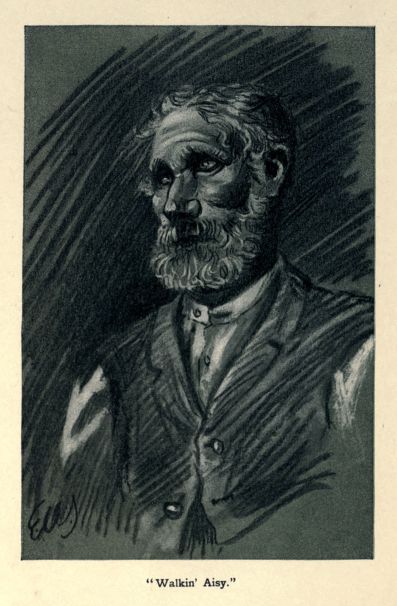
"Walkin' Aisy."
In answer to enquiries, he mused, with his apostolic countenance bent upon the ground; after a period of profound meditation, he asked me why wouldn't I get one of the big fellas out from the town? I have never known Walkin' Aisy to accept a job without suggesting that some one else could do it better than he (in which he was probably quite right). This may have been humility, due to the fact that his father had been that despised thing, "a dry-wall builder"; it may have been from coquetry, but I am inclined to think it was due to a mixture of other-worldliness and sloth.
On pressure he said that he had still a small pieceen of work to finish, but he might be able to come down to-morrow to travel the roof and see what would be wanting to us, and on Monday week, with the help of God, he would come in it. His blue eyes wavered towards the horizon. The interview closed.
"'Fair and young were they when in hope they began that long journey,'" cooed Philippa, as we moved away. The quotation did not, as I well knew, refer to our visit to the Knoxes.
At Aussolas I aired my project to my landlord. Flurry is not a person to whom it is agreeable to air a project.
"Rebuild the chimneys, is it? Oh, with all my heart. Is there anything the matter with them?"
Andrew explained the imminence of our peril, and Flurry listened to him with his inscrutable eye on me.
"Well, it'll be some fun for you during the winter, Major, but be careful when you're cutting the ivy!"
I was betrayed into asking why.
"Because there's only it and the weather-slating keeping the walls standing."
"If I may presume to contradict one so much younger than myself," said old Mrs. Knox, "Shreelane is as well built a house as there is in the county." Her voice was, as ever, reminiscent of a bygone century and society; it was also keen-edged, as became a weapon of many wars, ancient and modern. She turned to me. "In the storm of '39 I remember that my father said that if Shreelane fell not a house in Ireland would stand. Every one in the house spent that night in the kitchen."
"May be that was nothing new to them," suggested Flurry.
Mrs. Knox regarded her grandson steadfastly and continued her story. It has already been noted that when he and she were of the same company they considered no other antagonist worthy of their steel.
"It was my great-grandfather who built Shreelane in honour of his marriage," she went on. "He married a Riggs of Castle Riggs, a cousin of the celebrated Major Apollo—and thereby hangs a tale!" She blinked her eyes like an old rat, and looked round at each of us in turn. I felt as if I were being regarded through a telescope, from the standpoint of a distant century.
"They knew how to build in those days," she began again. "The basement story of Shreelane is all vaulted."
"I daresay the kitchen would make a nice vault," said Flurry.
His grandmother looked hard at him, and was silent, which seemed to me a rather remarkable occurrence.
On the following day, Andrew and Walkin' Aisy "travelled the roof," and I accompanied them—that is to say, I sat on the warm lead, with my back against the sunny side of a chimney, and smoked torpidly, while Andrew preached, firmly and distinctly, from the top of a ladder. Walkin' Aisy stood at the foot of the ladder, submissive, with folded hands, and upturned bearded face, looking like an elderly saint in the lower corner of a stained-glass window. At the conclusion of the lecture he said that surely the chimneys might fall any minute, but, for all, they might stand a hundred years; a criticism almost stupefying in its width of outlook.
The following day Captain Larpent departed to the Curragh, and, as is often the way of human beings with regard to their guests, we partly breathed more freely, and partly regretted him. On the whole it was restful.
A fortnight passed, and I had almost forgotten about the chimneys; I was in the act of making an early start for an absence of a couple of days at the farther side of my district, when I encountered Walkin' Aisy at the hall door.
"I'm here since six o'clock this morning, but I had no one to tend me," he began.
I was familiar with this plaint, and proffered him the yard boy.
"The young fella's too wake," replied Walkin' Aisy, in his slow and dreamy voice, "and they takes him from me." His mild eyes rested upon me in saddened reverie. "And there should be morthar mixed," he resumed slowly, "and there's not a pick of gravel in the yard."
I said, as I pulled on my gloves, that he could have Johnny Brien from the garden to minister to him, and that there was no hurry about the mortar.
"Well, it's what I was saying to the gardener," returned Walkin' Aisy very slowly, "I have no business coming here at all till those chimneys is taken down. The sahmint that's on them is very strong. It's what the gardener said, that quarry-men would be wanting."
"Why the devil didn't you say this at first?" I demanded, not without heat. "You and Captain Larpent told me that the old cement had no more hold than the sugar on a cake."
"Well, the Captain knows best," replied Walkin' Aisy gently, "we should do what he says."
"Well, get the chimneys down; I don't care who does it."
I drove away, and from the turn of the drive saw Walkin' Aisy, in motionless trance, looking after the car as if it were a chariot of fire.
The well-known routine followed; the long and airless day in the Court-house, the roar of battle of the rival solicitors, the wearisome iteration of drunks and trespasses, the intricacies of family feuds; the stodgy and solitary dinner at the hotel, followed by the evening in the arid smoking-room, the stale politics of its habitués, the stagnant pessimism of the proprietor, the same thing over again next day and the day after.
It was not until the afternoon of the third day that I found myself serenely gliding homeward, with the wind behind me, and before me the prospect of that idleness that, like the only thirst worth having, has been earned. I was in the straight for the hall door, when I saw my wife dart from the house, gesticulating, and waving her handkerchief as if to check my approach. She was followed, at no great interval, by an avalanche of rubble and bricks from the roof, that fell like a portent from heaven, and joined itself to a considerable heap by the steps.
"You never know when it's coming!" she cried breathlessly. "I've been watching for you. It's impossible to make them hear from below, and I can't find any of the men—they're all on the roof."
The restoration had begun, but that fact might not have occurred to a stranger. Next day, and for many days—six weeks, to be exact—the house shook as from the blows of a battering-ram, in response to the efforts of the quarrymen to remove from the chimneys the cement that had no more hold on them than the sugar on a cake, and at frequent and uncertain intervals various debris rumbled down the roof and fell heavily below. There were days when it fell in front of the house, there were days when it fell in the flower garden; where it fell, there it lay, because there was no one to take it away; all were absorbed in tending Walkin' Aisy, and the murmurs of their inexhaustible conversation came to us down the chimneys like the hoarse cooing of wood pigeons. There were also days when by reason of storms and rain nothing was done, and black and evil floods descended into the rooms down the ruins of the chimneys, and through the slates, broken by the feet of the quarrymen. At Christmas the kitchen chimney alone remained in action, and we ate our Christmas dinner in fur coats and a fireless dining-room. Philippa refrained from any allusion to the quotation from Longfellow that she had made after that first interview with Walkin' Aisy. She even denied herself the gratification of adding its context:
"Faded and old were they when in disappointment it ended," but I knew that she was thinking it.
PART II
It was somewhere towards the end of March that one chimney stack re-entered the list of combatants, trim in new cement, and crowned with tall and hideous chimney-pots. They all smoked, a thing that had never occurred before, but Walkin' Aisy said that the chimneys were cold, and that they wouldn't do it when they'd come to themselves; and (this was a little later on) that any chimney would smoke in an east wind. It was true that a period of east wind and drought had set in. The pump in the yard went dry; carts had to be sent half a mile for water, and it was reported to me that the masons had as much water put astray, mixing mortar and all sorts, as would drown a herring.
Other unpleasant things occurred. The housemaid gave half-an-hour's warning, and married one of the quarry men, and Mrs. Cadogan then revealed that it wasn't once nor twice during the winter that she had given that particular quarryman the full of the poker, to put him out from under her feet when she'd be dishing up the dinner. Shreelane was twice drawn blank by Flurry Knox's hounds, and their master said that as long as I had every idle blackguard in the country tending Walkin' Aisy, and making short cuts through the covert, how would I have foxes there? I ignored the conundrum, and hoped that the quarryman's yellow dog would remain where I had last seen him, in the ashpit, till Flurry had left the premises.
It was some little time after this that Captain Larpent advanced upon us on a week's leave from the Curragh; he wrote to say that I evidently wanted a Clerk of the Works, and that he would see if he couldn't get a move on Shanahan. I was away when he arrived, and on my return Philippa met me in the hall.
"Meg Longmuir is here!" she said, not without a touch of defiance. "Doctor Catherine had to go to Scotland, so I asked Meg here for a few days. She'll play duets with Andrew. She's up on the roof with him now."
"Better have a string band up there at once," I said, "and open it as a public recreation ground."
"And the Flurry Knoxes and Bernard Shute are coming to dinner," continued my wife, ignoring this jeu d'esprit; "the smoking-room chimney is all right, and we can have the oil stove and some music in the drawing-room."
With this agreeable prospect in store, we sat down to dinner. We were too many for general conversation, and the table was round, which is unfavourable for tête-à-têtes. Yet it was not round enough to frustrate Miss Meg Longmuir's peculiar gift for duets, and I was presently aware that she was unwarrantably devoting herself to Bernard Shute, leaving Captain Larpent derelict, and that the latter was, after the manner of derelicts, becoming a danger to navigation, and was laying down laws and arguing about them acridly with Mr. Knox. I realised too late that there should have been champagne. Whisky and soda is all very well, but it will not warm wet blankets.
Meg Longmuir, however, was doing remarkably well without either; she wore something intricate that was either green or blue or both, and glittered. I recognised it as the panoply of war, and knew that the tomahawk was concealed in its folds. So also was Andrew's scalp; I don't know why I felt some pleasure in remembering that it had a bald patch on it.
After the ladies had gone, Bernard, to whose head Miss Longmuir had mounted as effectively as if she had been the missing champagne, rejoined the lesser world of men by asking Flurry why he had shut up the season so early, and suggested a by-day, if only for the sake of giving the horses something to do.
Flurry put the end of his cigarette into his finger-glass, and lit another at the flaming tongue of my tame Chinese dragon.
"I didn't know you had one that would carry a lady?" he said.
"Oh rot!" said Bernard helplessly.
"I haven't one that will carry myself," went on Flurry. "There's five lame legs among three of them this minute. Anyway the hounds are in sulphur."
The discussion progressed with the prolixity proper to such themes; I think it was Andrew who suggested the paper-chase. He had, he said, ridden in paper-chases in Egypt, and he gave us details of the stark mud walls and fathomless water-courses that were common-places of these events. We were left with the impression that none of us had ever seen obstacles so intimidating, and, more than that, if we had seen them we should have gone home in tears.