Front matter (continued 4)
Reading edition
Last summer we went back to the land for a week-end. As a result of our experience we wish to state that we now approve of the land as an institution. But you have to go back to it right. Everything depends on that.
Years and years ago when we were younger and foolisher than we will ever be again, we trust—as a matter of fact, we were fresh out of college, very fresh—we went back to the land. The experience embittered our nature for years. We made the mistake of going back to work on the land. Never, never do that. That way misanthropy lies.
Brutally heedless of our "B.A." and our other scholastic honors, big, coarse farmers bullied us around from four o'clock in the morning till ten at night. The rest of the time was our own. We went out at dewy dawn and hitched two or three imbecile horses to a rusty old plough, and spent the day tearing irregular gashes in the scenery till it looked like a crochet pattern, and till our head swam and our knees wobbled.
When we tottered in at twilight, an old and broken man, we had to go and chase home several festive cows who did the Maxixe and Tango and several other dances quite unknown to human beings at that time—they are still unknown to all but dancing professors. It usually took an hour at least to shoo them into the barn and hog-tie them so they wouldn't kick us through the pail, or the pail through us—they didn't care which.
We were supposed to be doing this for our health. We had never been robust, though always very sound as to appetite, and the family said the fresh air and joyous work of the fields would do us so much good, poor boy. It nearly did us for good and all. When we got home to mother after a year of it, with callouses on our hands and on our soul, the house-dog sat up and howled in anguish of mind, and the town-undertaker licked his lips and measured our length and breadth—there wasn't much breadth—with his eye. We could see him wondering whether the family would stand for solid silver handles or just the plain oxidized kind.
For years afterwards the mere mention of the word "farm" would cause us to tremble from head to foot and perspire clammily at every pore. We couldn't look at a cow without wanting to heave a brick at her, or a hired man without a sudden desire to go over and shake his honest hand and murmur a few words of sympathy.
So when a wealthy friend of ours—we make a point of picking 'em rich—called us up last summer and suggested that we should go out to his "little place in the country" for the week-end, we feared the worst. We realized in a moment that his hired man had quit or had died of over-exertion, and that he was trying to work us in as a substitute—for our keep. But we couldn't think of any decent excuse to give, so we yielded a dismal consent.
"You mustn't expect too much," he warned us, "it's the simple life, you know—no fol-de-rols, but just good plain farm fare."
Our heart sank at the words. Not that we have ever been so stuck on fol-de-rols. We don't mind an occasional fol-de-rol—a fol-de-rol for two, say, with a quart of "extra dry" in a tin pail of ice alongside. But we have never hankered for them as a steady diet. At the same time the warning sounded ominous. Plain farm fare!—we could see the platter of pork and cabbage and the slab of marmoreal pie.
He called for us—or rather, we stood on the street-corner and he picked us up in a ten-thousand-dollar limousine, lined in grey silk, with a big bouquet of roses concealing the chauffeur from the gaze of the occupants.
This cheered us up somewhat, but we had a feeling that our doom was merely postponed. We had a notion that we were being lured. We had heard of people who had been made "white slaves" that way. And if a farm-hand is not a white slave, we would like to know who has any better right to the title. Not that he is so very white, but....
With the engine purring softly and the cushions heaving voluptuously, we swiftly glided—or should it be "glid" or "glode?"—out past the last suburban lot, meaning about thirty miles. It was a beautiful pastoral region, occupied mostly by golf-clubs and villas. Long rows of peonies and Canterbury-bells and flowering shrubs were the nearest approach to farming we could see—these and a few cows of the domestic-pet variety.
Our host was very chatty all the way, and his talk was of the beauties of the simple life and the general rottenness of civilization as evidenced by stock-exchanges and clubs and all-night restaurants.
"Luxury and indolence," he assured us over and over again, "are eating the heart out of modern society. We are all living too fast and too high. We have too much money—that's what's wrong with people in our class."
We said he was quite right and that too much money was certainly the cause of gout and divorce and all the other ills to which we were heir. We spoke with as much conviction as we could, while we listened to the merry clinking in our right-hand trouser-pocket of the six dollars and eighty-odd cents which we had received that morning along with the I.O.U's in our pay-envelope.
"Look at what we eat," said our host, "and look at what we drink!"
Of course, our host was one of the lucky ones who still have some drink to look at. He could therefore afford to adopt a somewhat deprecating attitude on the subject of beverages.
Suddenly the limousine whirled off the high-road and shot along a beautiful private driveway under swaying elm-trees. We were on the farm! Wildly we gazed about for the fields of grain, the hog-lot and the cow-pasture, the big red barn, and, and all the other familiar stage-properties of our agricultural tragedy of years before. But we saw none of these things.
Instead our eye rested on well-groomed apple-orchards and cherry-groves, on clumps of pines and Japanese summer-houses, on strawberry-patches and vegetable gardens. The vegetable gardens may seem to the reader to suggest farming. But the "kitchen-garden" on a real farm is merely a frowsy patch where "table truck" is grown. This particular vegetable garden was the work of a landscape artist. Judging by the amount of toil which had been put into designing it and weeding it and picking bugs off it, every potato or carrot would cost about forty cents each.
The big car swung on a wide curve, and "round the cape of a sudden came the Lake!" Browning!—we know. We do that sort of thing now and then just to show that we are a literary editor in the half of the week that we don't spend farming with our friends among the idle rich.
There was good old Lake Ontario shimmering in the glimmering sunlight, or glimmering in the shimmering sunlight—it works either way. And there was the thirty-thousand-dollar farmhouse nestling in the midst of ten acres of lawn. There, too, was the farmer's wife on the steps to welcome us—she was clad in a simple little importation from the Rue de la Paix. It was a lovely rural scene.
"Well, and what do you think of the farm?" asked our host.
Farm! Good Lord! Our thoughts leaped back to the real farms we had known, and in a broken voice we tried to tell him that this was the sort of farm we had dreamed of but never worked on. This was farming as it should be—farming de luxe.
We began farm-life that very afternoon on the grounds of the adjacent golf-club, where we planted several balls in various parts of the landscape and couldn't find them again. There would be a very decent little grove of rubber-plants on that course in a year or so, if they would let us play there a few times.
Then we went back to the farm for dinner and had a sample of the farm-fare. It was a simple repast of seven or eight courses. One of the farm-hands, a butler, waited on table. Most of the food was of the sort that we try to conceal on the menu-card from a lady, in case she should order it and we would have to leave our watch with the waiter.
In the midst of the meal there was a solemn pause. We felt dimly that some marvel of the culinary art was about to appear. In came the butler with an air of importance and a silver dish containing six or seven anæmic radishes.
"Grown on the place!" said our host in the tone of a man who expects to astonish. He glanced with pride at his wife and she glanced back in affectionate joy at him. Theirs was the delight with which young parents exhibit their first-born.
We nibbled a little piece out of one, while they leaned back and waited confidently for our words of almost incredulous admiration. We are a bad liar as a rule—persistent, that is, but unsuccessful—but we would have cut off our right hand rather than disappoint that good man and that dear lady, so charming both of them in their simple faith. It had taken fifty or sixty thousand dollars and several years of thought and labor to produce those poor runts of radishes. So we forgot all the lessons of truthfulness that we had learned at our mother's knee—perhaps we should say, while laid across our mother's knee—and swore that they were the finest radishes we had ever tasted, and that no joy in life was equal to eating the vegetables grown on one's own door-step, so to speak.
"You're right, my boy, you're right," beamed our host. "The only truly happy and independent man on earth is the farmer."
The next day they showed us over the farm. We saw the aristocratic cows, whose ancestry went back as far as that of the kings of Ireland. Their milk, at a low estimate, must have cost about as much as a vintage wine.
We were particularly interested in the hens. They all belonged to the royal families of hendom. Most of them had been exhibited and had won ribbons or medals or whatever it is they give hens. They certainly were beautiful in a poultry way, but they seemed cold and proud. Our host said they didn't lay very well. We suggested it might be for the same reason as prevents people in the smart set from having any children.
"No, I don't think it's that," said our host very earnestly. "I believe it's because they haven't enough to interest them. I read in a poultry book the other day that hens must be kept bright and cheerful."
We recommended comic selections on a gramaphone. We also asked him if he had ever tried reading our articles to these haughty fowl. We felt that might draw a cluck or two of amusement out of them. But he treated our remarks with the silent contempt they no doubt deserved. We would like to tell a lot about life on that farm—about the trip in our host's big motor-boat, and the dance in the evening, and the horse-back rides on high-stepping horses that chinned themselves at every step and were always going up when we were coming down. We would like to tell also about the tennis and the billiards and the canoeing.
We would like to do all this, but we haven't the heart. Some real farmer might read this article, and go right out to his barn, and fasten a bit of rope between his neck and a beam, and kick the box over. Our only hope is that if one should happen to see this, he will merely grunt to "maw" that we are another of "them dern slick liars in the city," and refuse to believe a word of it. We don't wish to spoil his life.
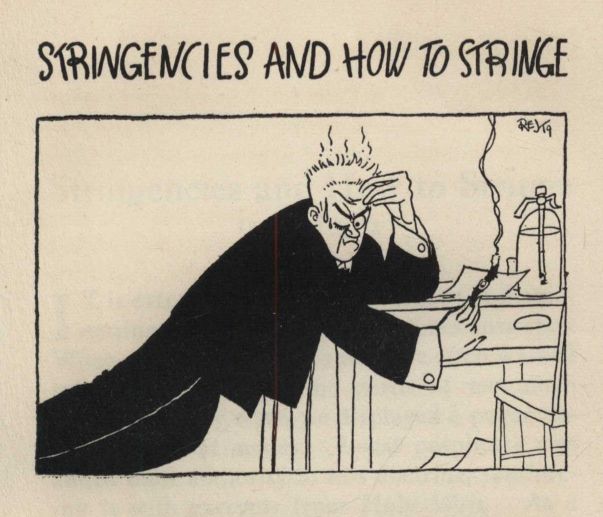
STRINGENCIES AND HOW TO STRINGE
Stringencies and How to Stringe in Them
It is extraordinary and also somewhat disconcerting how prayers are sometimes answered. When we were a little boy we were often warned by pious relatives of the perils of too much wealth—usually when we displayed a pagan desire for pocket money. Local pulpiteers also added their authority to this doctrine, reinforcing it with excerpts from Holy Writ. As a result our young soul was filled with horror at the thought of millionaires and camels trying to crawl through the eyes of needles. And, being a very earnest-minded little boy, we prayed that we might never be rich.
This prayer has been answered. We are not rich. Moreover, present indications are that we will never be rich. Whether or not our character has been benefited by the chronic depression which has been the outstanding feature of our financial career, we are in no position, and are far too modest, anyway, to state. There are times, however, when we would like to test our moral fibre by exposing it to the seductions of wealth. We might even like to succumb once or twice, or three or four times or oftener, just to show that we are one of those supermen who can "take it or leave it alone." But these opportunities for moral "swank" have been denied us.
We prayed for poverty and we got it. We have prayed for a lot of other things in our time, which we haven't got. But the celestial Committee on Prayers certainly O.K'd that poverty-petition of ours. They gave it to us "good and plenty," in the vulgar idiom. Of course, there is no use at this late date in explaining to the Powers that we were only praying against becoming a millionaire—half a million would more than satisfy our modest requirements. The thing is settled. As a result we have become mighty careful what we pray for. There is always a chance that we might get it.
This introduction is by way of letting the reader know that stringencies, such as the one through which we have all been passing ever since peace started, are no new thing with us. We are quite undismayed by the present state of the markets of the world. We are facing the situation with unruffled brow and the assured air which bespeaks long experience. We know how to deal with stringencies. We have tackled many of them. In fact, we have reason to regard ourself as one of the best little stringe-ists in this part of the country; and we are prepared to stringe with anyone of our financial weight for a reasonable purse and a modest side-bet.
There was that time, for instance, Friend Reader, that we went broke in 'Frisco, many, many miles from home and mother and the bed in the spare room. In a week we were acquainted with every free-lunch counter and ten-cent restaurant in the City of the Golden Gate. As a result of the acquaintance we developed a horror of "boiled beef Spanish," which has remained with us to the present day. And we ended up on a dairy ranch—thirty per and our keep! But let us draw the veil—we hate to think of the way we used to talk to those cows.
Stringent experience such as ours is a very valuable thing at a time like this, and we feel that it is in the nature of a public duty for us to lay before our readers—the whole five of them—the ripe results of our painfully acquired wisdom. Of course, we may be compelled to make revelations of a personal nature; but we don't mind. We can stand it. We have no social position that we need be worried to lose.
The trouble with the general public is that so few people know how to tackle a stringency. They are impulsive and unscientific. They go at it in a precipitate, not to say temerarious, manner.
Take, for instance, all those eager little housewives who rushed right out on the news of the declaration of war and tried to corner all the flour the grocer had, and all the bacon in the butcher-shop, forgetting that by the time the family had eaten about one-fifth of the supply, the flour would make a Limburger cheese seem like sweet hay for aroma, and the bacon would be scratching at the cellar door to get out. They even bought crates of eggs and oranges and cart-loads of vegetables!
Men's notions of economy are frequently not much better. We have a friend—oh, we still manage to keep one or two—who announced not long ago that he had given up cigars. He said they cost too much. We were rather sorry to hear of his decision, for he is one of those large, expansive fellows who are becoming to a cigar—he smokes them with the band on. We expressed our surprise.
"Not giving up smoking altogether, are you?" we asked. "Won't you find it difficult to think without nicotine to act as a...."
"Certainly I'm not giving up smoking! I've taken to a pipe, and believe me, my boy, it's the only smoke that...."
But you know how they all talk the first few days.
He showed the pipe to us. It was a beautiful thing, meerschaum, all dolled up with gold and amber. And it reposed in the cutest little case—one of those plush and papier-maché affairs that add a dollar and a half to the cost of any pipe. They are really worth about seven cents.
He showed us also a new tobacco pouch—grained leather, with gold monogram and rubber lining. Eight dollars, if it cost a cent!
Under his arm he carried a tin of tobacco that looked as big as a hat-box, and his pockets were full of pipe-cleaners, special ash-trays, and a patent combination arrangement of tools with which you could tamp the tobacco down in your pipe, gouge holes in the wad if you got it too tight, scrape the charcoal off the sides, and dig the pipe out when you had smoked it. All the thing lacked was a compartment in the end for ice to cool your tongue.
Altogether the outfit cost about twenty-five or thirty dollars. We said nothing. The thing was too pathetic. Three days later we met him smoking a cigar—still with the band on. He looked us straight in the eye with a truculent air, as though daring us to make a comment. We didn't. We knew how he felt. We had been through it all ourself.
Personally we have taken to smoking cheaper cigars, ever since that last increase in taxes. In our days of affluence we used to walk into the shop of our favorite tobacconist, and throwing down a quarter with a reckless hand, would say, "Gimme three!" Now we slip into a drug-store—we cannot bear to abate a jot of our lordly air in the presence of our tobacconist—and dejectedly buy a "five-cent straight," though they cost ten cents now.
(No, girls, the cigars are not always straight, nor are they always made of straight tobacco—on the contrary! We presume that they were called "five-cent straights" because they were bought by people in straightened circumstances, in dire straits, so to speak.)
In happier days if we had dared to smoke five-centers around the office, we would have been subjected to nasty personal remarks from the other members of the staff. But nobody says anything now. They are smoking stogies themselves, or consorting with pipes of ill-repute. The Financial Editor in the room next door smokes a villainous briar that growls even at its owner. We hate to say this, but only the other day we put our hand too near it as it lay on his desk asleep, and it almost got our little finger.
Not only are we smoking cheaper cigars, but we are making them last longer. How do we do this? Easily, dear reader, easily. We don't light them, that's all! We bite the end off very carefully, and insert the cigar at a rakish angle in the middle of our expression, and carry it around like that for nearly an hour before we touch a match to it. That way two cigars can be made to do the work of six. The worst of lighting a cigar is that it becomes oxidized so quickly. After that it isn't any good, except possibly as tooth-powder.
Another economy we indulged in during last fall was the buying of a straw hat. Of course, it may at first seem rather late in the season for one to start in and buy a "boater." But we got this one for ninety-eight cents—a three-dollar hat, the salesman assured us. But more of that anon.
You see, we had met our old friend Bjones on the street, carrying under his arm a box about the size of those they crate oranges in.
"G'wan in and buy one before they're all sold," he gasped, "greatest bargain I ever saw!"
"But what are they?" we asked, displaying an indulgent interest by ceasing to twirl our silver-mounted cane—(yes, a present from a lady).
"Hats, of course—ninety-eight cents—worth three and a half or four! Just bought six of them. Everything going up—got to keep supplied, you know."
We never stopped to reflect that Bjones would take the next six years to wear those hats out, and that his wife would probably divorce him if he tried. In fact, that may have been part of his plan. But we caught the fever from him. We hunted up the store and rushed right in. There was a big table of sailor straws, with about thirty men grabbing them up and trying them on. The lot didn't contain our exact size, so we took the nearest we could get. It was a little small, and it sat up on our head in a way that suggested an amateur performance of "H.M.S. Pinafore." But it was a very nice hat. That is, we thought it a nice hat.
Candor, however, compels us to state that we showed it to a friend in the hat business whom we met while we were triumphantly carrying it home. We asked him if he didn't think it was a mighty nice hat.
"Oh, yes, it's a nice hat all right," he answered cordially. "Why, those hats cost forty-nine cents each, buying them by the dozen wholesale!"
We tried to ascribe his words to professional jealousy. But somehow we took a sudden scunner against that hat. In fact, we tried a few days later to give it to the office-boy. But he declined. He sports a six-dollar one himself. Besides, his head is bigger than ours.
We have also been looking at some celluloid collars lately—just looking, you understand. Of course, we wouldn't think of wearing one of the things, but it is just as well to keep them in mind, for you never can tell, with the price of laundering where it is. Besides, they aren't so bad—a little blue and shiny, perhaps, and with peculiar button-holes. But with the washer-ladies buying closed cars, and the stringency becoming more stringent all the time, it is well to know of collars that can be done up with a tooth-brush or simply left on the neck when taking a bath.
But we have no intention of wearying the reader with a further account of those symptoms of a financial depression which has long since become chronic with us. We are no more depressed now than we ever were, except inasmuch as any kindly and sensitive heart must be depressed at the sight of widespread destitution—especially among millionaires.
Depression—and when we speak of depression we naturally refer to financial depression and not to the state of a man's liver or conscience—depression, we repeat, is largely a relative matter. A man is depressed or otherwise in comparison with the high-water mark of his prosperity. A financial status which would make the hairs of John D. Rockefeller's Sunday wig rise up in separate and individual horror, might cause us in sheer exuberance of joy to buy and stock a "Winter Garden" just for ourself alone. In view of the jeopardy which would ensue for our eternal salvation, we are glad—or should be that this is not immediately imminent.
It is really the rich who suffer most in a period of stringency. The mental anguish of hardened stringe-ists like ourself is nothing to what must be endured by the people who have never before had to ask the price of anything. We met one of them not long ago on the street. He is not a regular millionaire—only an intermittent, so to speak. Every little while he manages to chin himself on the trapeze of wealth, though he never quite succeeds in climbing securely into it. He was looking very gloomy, his suit needed pressing, and the diamond in his tie seemed smaller and less brilliant than of yore.
"Hello, old pirate, why so glum?" we asked insolently—we always make a point of being rude to millionaires. "What's the trouble?—those naughty stocks misbehaving again, or does some fresh Aleck of a legislator propose to investigate you?"
He looked at us with a melancholy and lack-lustre eye. There was none of the old bounce and condescension in his manner.
"It's all right for you chaps to make bum jokes," he grumbled. "You're on Easy Street. What difference does the depression make to you? You haven't promised a new touring-car to your wife as I did. And now the poor little girl has to worry along on last year's model. And I could only give her a pearl pendant for her birthday instead of the diamond sun-burst she wanted. While you...."
But we hurried away. Far be it from us to stand idly by and gaze upon a strong man's agony. The vision of that defeated and broken man has followed us ever since. Not even the little sunburst she wanted—gawd, can such things be! Why doesn't someone start another war so that he can get back into the munitions business? There must be dozens of others like him. And while these deserving millionaires are in this state of comparative destitution, here are gay, care-free fellows like ourself swaggering about town, jingling the quarter against the small change in our pocket, and wondering whether we will blow it on two cigars or on three. It doesn't seem fair, does it?
It has been said thousands of times—therefore, we have no hesitation in repeating—that one-half the world doesn't know how the other half lives. Not that millionaires constitute half the world—God forbid! They are not even the emerged tenth, if we may say so. But it is none the less true that the rest of us don't know how they live.
You may see the magnificent, yea, verily, the palatial residences they have built after the model of famous prisons and royal stables abroad. You may hear the accents and see the spats of their sons who have been to Oxford—in fact, you can almost see the accents and hear the spats. You may gaze upon their daughters at theatre-parties, clad in feathers and the rail of the box, with nothing between them and lumbago but the backs of their chairs. You may be dazzled by the flash of the twenty-carat headlight in fawther's dress-shirt, or by the soft refulgence of mother's stomacher of pearls. You may witness all this—you may even envy it. But little you know the breaking heart that may lurk in the limousine.
To look at the average millionaire you would never suspect what worm may prey upon his damask cheek—or should we say, damaged cheek? The gilded sausages of his double watch-chain may be as ponderous and resplendent as ever. The crease in his trousers and the shine on his shoes may still show the skill and energy of an expensive valet. He may curse at the waiters in his old lordly manner, even though he no longer is able to order his cocktails in a tumbler. But he is not at peace within.
If you are a shrewd observer you will notice that his sixty-cent cigar is not quite at the old aggressive, betcha-million-dollars angle. And the familiar wad of mazuma in the right-hand front pocket of the pants is not so swollen as of yore. We should say it is thinner by several one-hundred-dollar bills. In fact, it may be padded up with fives and tens and other bills of small denomination just to make it look good.
In a word, the average millionaire is not the man he was only two or three years ago, when the war was on, and orders were flowing in, and he was picking what crumbs of comfort he could—and also quite a few nice, bright little nuggets—out of the general chaos. It may seem to you that he is going as strong as ever. You may suppose that once a week he still has a lorry back around to the side entrance to take his profits down to the bank to be weighed and shoveled into the vaults. You may imagine that he still spends his leisure hours clipping the nimble coupon. But such is far from being the case, as you would realize if you could only get him to open his heart to you.
Try asking him to increase your salary—this is a really good way to find out. Then you will discover that most of his business day is devoted to running around with his hat in his hand begging hard-hearted bankers to let him have just a few more hundred thousands—surely a man has a right to this pittance—so that he may pay his bills and be able to look the world in the face once more. You will be horrified to learn of such hideous octopuses—(thank you, Professor, we should have said "octopi")—as Labor Unrest, Overhead Charges, Depreciation, and Stagnant Markets. Secure in your weekly envelope with its usual twenty dollars—unless like ourself, dear reader, you draw an occasional I.O.U.—you may care little for the vagaries of any other market than the one at which your wife or landlady buys the family meat and vegetables. But this great and good man has to bear the brunt of the fight. Is he complaining? No, friend, he is not.
"It is not for myself," he tells you in a voice quivering with emotion and considerable brandy-and-soda—they can still get it, of course. "It's not for myself, my boy. I must keep the old plant going for the sake of the men and their families."
Just about then you burst into tears and beg his pardon for ever having even thought of such a thing as more pay.
"You have no idea how delicate and complicated these financial problems are," he assures you in a burst of confidence, "You don't realize, for instance, that if I were to raise the wages of everyone in the institution a dollar a month, I'd simply have to shut the old place up. And I couldn't bear to do that—the associations, you know."
You have a vision of him in his poverty-stricken old age, out of work, condemned to spend all his time at Palm Beach or the Riviera. If you are a man of real feeling, you will tell him you think you could get along on ten dollars a month less, and would he please take it to help tide him over his difficulties?
It is experiences like this which convince a man that these are indeed times of depression. And everything deepens the feeling. See the lines of people waiting to buy the best seats for musical comedies and hockey-matches! See them crowding into the cabarets at midnight! And the jolly little dance-and-supper parties after the show in homes where the cellar has not yet been entirely despoiled of its treasures!
All this is merely a proof of general anguish of mind. They are seeking for respite and nepenthe and surcease of sorrow. They are dying game, so to speak. If they were to sit down quietly at home and think things over, they might become so desperate as to cut down their expenses. So they roll out the old touring-car instead, and collect a few congenial spirits, and possibly some more spirits under the cushion of the back seat, and go—but it doesn't matter so much now where one goes. All towns are alike.
Of course, there are financial giants, whose position is so secure that no money panic can ever disturb their equilibrium or equanimity. We called on one the other evening—two floors up over a grocery store. It was a cold night, the heat was off, he was wearing his overcoat in the house, and was feeding old newspapers into the parlor grate. In the intervals he was reading Anatole France in the original, and consulting a big French dictionary every line or so.
"Come in," he roared, "and help feed the fire. I've left the hero in a delicate and somewhat improper position, and I want to see if anything happened. I'll tell you in a minute." And he reached for the dictionary.
We intimated that we would certainly like to know if anything of an indelicate nature occurred, so that we might rush right out and report the matter to the proper authorities.
"But how can you be interested in such things as that," we enquired, "when hundreds of your fellow-millionaires and near-millionaires—they are human beings after all—are writhing in financial agony? Have you any European holdings, any Russian roubles, or anything of that sort?"
"I'm not holding 'em any longer," he said with a shameless grin. "I gave them to the butcher as an instalment on last month's bill."
"But you must have some stocks on margin—are they properly covered?" we persisted. That's the kind of fellow we are, always looking for information—the more unpleasant the better.
"Huh, what's that?" he grunted, after a long pause during which he had been hunting feverishly for a word. "What's that, margins? Are my margins covered? Sure, they're covered, old top—and so are the missus's and the kid's. Our margins are all protected from the weather—also our chests and such other places as one usually takes cold in."
But what's the use of talking to a man like that? He shut the book with a bang and reached for the tobacco-jar.
"Now what do you know about that?" he groaned. "Nothing happened after all. Just as things were at their liveliest, and the hero held out his arms, and the heroine—well, just then the old Abbé blundered in and...."
But there is something criminal and callous about such indifference as this.
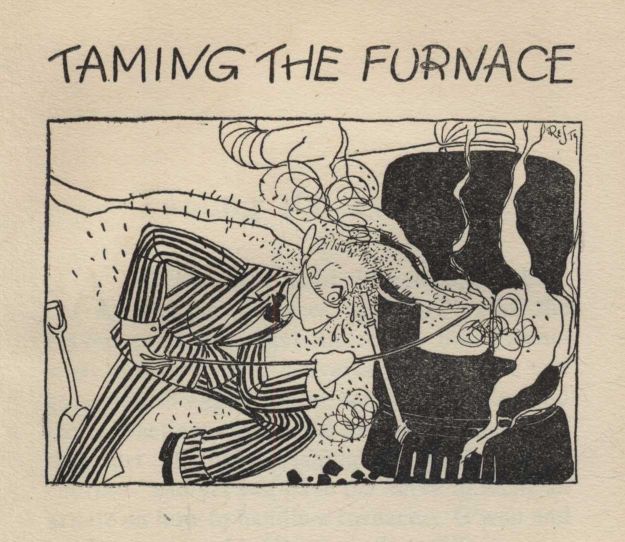
TAMING THE FURNACE
Taming the Furnace
"And what the devil do you know about taming furnaces, anyway?" asks the reader, presuming that the reader has a somewhat abrupt style in conversation. "Here you go around bragging about being a bachelor and having inclinations for the monastic life and all that sort of rot"—meaning the bragging, of course—"and yet you have the nerve to write an article on how to handle a furnace. G'wan and teach your grandmother to suck eggs!"
Thereupon, the reader in torrid indignation drops the book and goes down into the cellar, and seizing a short shovel with a broken handle tosses half a ton of coal into the maw of the steel dragon there—a dragon which consumes its own heat and lets none of it get as far as the radiators.
Incidentally, why should it be regarded as the height of absurdity to teach one's grandmother to suck eggs? Why should one's grandmother be expected to know all about sucking eggs? Is one's grandmother a weasel that she should be universally regarded as a supreme exponent of this art? We are aware that this paragraph is in the nature of a digression, but we have all our life been puzzled to account for this curious tradition that grandmothers know everything to be known about removing the contents of eggs by the primitive process of suction. We feel quite sure that both our own personal and private grandmothers knew nothing about it. We are also sure that we would never have had the nerve to teach them how to do a thing so obviously vulgar and futile. Furthermore, no one's grandmother could afford to suck eggs at the present market quotations. So what would be the use, anyway, even if she did know how? Altogether this seems to us a very silly proverb.
But, to return to furnaces, we really do know something about them—not everything (what man does?), not even a great deal, perhaps, but still something. And we ought to know something, for we have wrestled in spirit and otherwise with every one of the fifty-odd varieties—hot air, hot water, steam, and everything that lies between. Some men are born furnace-tenders. Some learn it from plumbers. But we have had our knowledge forced upon us.
One of our earliest and least-treasured recollections is of an enormous old furnace in our grandfather's house—a mediæval contraption, all bricked-in, as big as a cottage, with a mouth the size of a pair of folding doors, and a capacity for coal which would make a twin-screw steamship turn a dark bottle-green. We used to be held up to the door of it when we had been very naughty, and have it explained to us that naughty boys were sent to a place bearing a general resemblance to that bed of red-hot coals. We do not recall that we had much joy of the prospect.
Later on, when we had got to the point of having Holy Writ retailed to us with expository remarks—our preceptors usually picked out something infernally gruesome—we used to associate that old furnace with the various trials by fire mentioned in the Old Testament. Especially could we see those three brave young Hebrews, who were condemned by old Nebuchadnezzar to be burned to death, standing smilingly on the familiar coals—each with a fire-insurance policy in his pocket, as we presume now. Else why be so cheerful about it?
Even as a boy at grandfather's place we began to form that intimate acquaintance with furnaces which has been the bane of our young life. When the furnace man did not turn up—usually as a sequel to a nocturnal endeavor to make the distilleries enlarge their plants—we had to shovel coal into that grinning old monster until our back and arms ached, and we would cheerfully have thrown in a few sticks of dynamite if there had been any handy.
But, of course, that sort of thing is part of the penalty of being a member of a family. We have no complaints to make. If a fellow will permit himself to be dragged into a family he must pay the price thereof. What we really object to is that since we have attained the dignity of manhood and the responsibility of a vote in provincial and federal affairs, we are still obliged to toil in cellars with a coal-shovel—a black-and-white slave, so to speak.
It would be different if we were married. We would expect to look after a furnace. And, anyway, to a married man what is a little trouble more or less?—he has lots of it. But freedom from worry about the furnace should be one of the most sacred privileges of the bachelor. We have been deprived of our rights. Instead of "the" furnace, we have several to think about. We are one of the busiest little amateur stokers in town.
There must be something in our appearance which suggests that we have a masterful way with furnaces, that we can make them eat right out of our shovel. It has become a habit with our lady friends when we call on them in the evening—naturally we have social duties to perform—to pat the radiator in a reflective sort of way, and then smiling brightly at us to say in a casual but wheedling tone something to the following effect:
"Oh, Mister O'D."—a few of them call us Peter in a sisterly way—"I just hate awfully to bother you, but paw is at the lodge and—well, you are such a good hand with a furnace. It's such a comfort to have a man who is really handy around the house, and—just a shovelful—thanks!"
So we bid a temporary farewell to the company and to all the delights of polite conversation, and retire to the cellar to give first aid to a rusty demon of a furnace whose vital spark is almost extinct. Laying our coat neatly folded on the bottom step of the cellar-stairs, we first seize a long lever which comes out every moment or two on our toe, and we shake enough ashes out of the grate to stifle Pompeii. Then groping our way to the coal-bin—away at the other end of the cellar—we proceed forcibly to feed the furnace with a broken scoop-shovel. About half of each shovelful misses the little opening—why the dickens do they put such small doors on the things?—and by the time we have accomplished the chore we are knee-deep in anthracite. Great stuff for a nice, new serge suit, that!
When we come upstairs again we are coated with a soft covering of powdered ash, our collar is melted, our hands suggest that we have been working on a slag-pile, and the young lady insists on sitting on a little narrow chair instead of on the sofa as usual. Every time we stir she glances nervously at the rug and the upholstery. The social atmosphere grows chillier and chillier, though the water is boiling in the "rads."
About an hour later "paw" comes home from the lodge, disappears into the subterranean depths, and emerges in a moment to ask in a loud belligerent voice who th'ell has been and gone and put all that coal on the furnace, and if people are aware that coal costs fifteen dollars a ton, and if people wouldn't be better advised to mind their own business. Whereupon daughter blushes violently and rushes out to him in the hall. There is a brief dialogue which is brought to a conclusion by "paw" grunting, "Oh, him, is it?" in a manner not altogether flattering.
Even at home in the flat where we lived for two somewhat cramping years—we swept the pictures off the walls every time we put on our shirt—we could not get away from furnace troubles. The thing was an obsession, that's all. Our proprietor, that inaccessible local divinity, was supposed to supply heat, which naturally implies a furnace and a furnace-man. There really was a furnace and also a furnace-man, but the two were seldom found in conjunction.
Down in the cellar there was an enormous structure of cast iron, with twisted pipes sticking out of it in all directions as though it were some sort of mechanical octopus. And down in the very heart of it there were usually half a dozen coals smouldering away. That was its ordinary condition. But two or three afternoons a week a local financier, who had about thirty furnaces on his visiting list, used to call and pour a ton or so of coal down its throat. Then he opened wide all the drafts and went rejoicing on his way to the bank to deposit his latest dividend.
About midnight on such days we were all awakened by a noise which seemed to combine the roar of the angry surf with a riot in the Ford automobile plant. There were also suggestions of a volcano in active eruption. The furnace was boiling! Then one hustled into a dressing-gown and one hurried down to the cellar to shut the thing off; and, as one passed bashfully by, one saw sights through open doors that no gentleman would ever speak of.
We have a friend, however, who has mastered the furnace problem—about as well, that is, as mortal can hope to do it. He has devoted years of thought and much bullion and energy to the task. He has a huge furnace all encased in white asbestos—it sheds its nighty every now and then and has to get a new one—and on this furnace he has more electric attachments than would run a suburban trolley system. All he has to do before he goes to bed is to wind up two or three clocks and set half a dozen hands on as many dials, and the furnace does the rest. It keeps the house at a certain specified heat—unless, of course, it goes out, which it does every so often—and moreover, it will turn on the heat at any specified time in the morning. Instead of having to get up in a chilly house and wander dismally down to the cellar to open the blamed thing up, he has only to lie awake in bed and listen if the regulator is working properly—and three times out of five it is. But, of course, this is rather hard to hear, and if it shouldn't be working and he didn't notice it—well, on those mornings he eats his breakfast in his coon-skin coat.
Naturally he has to remove the ashes and shovel in the coal, but that only takes an hour or so a day. Besides, it is fine exercise. Nothing like putting on your furnace-clothes and tying a damp silk handkerchief over your face and going down for a little bout of græco-roman with the furnace to give you an appetite. And the thirst!—but what's the use of talking about that nowadays?
It may be thought that we are prejudiced against furnaces. We are. We admit it frankly. And we have good reason to be. If it hadn't been for a furnace that went out, we might to-day be a happily married man and the father of a large—oh, well, perhaps that is taking a little too much for granted. But we might have been married, at any rate.
She was a druggist's daughter, a lovely girl of about eighteen summers. That is, she claimed eighteen summers, though perhaps a few summers were so short and so cold that she forgot to count them. Her father lived and had his shop in a Prohibition town—this was before there was no other kind of town. Naturally he was the principal citizen of the place and the popular saver of many masculine lives. Father used to prescribe for gentlemen for miles around, the prescriptions being usually taken in the back of the store. No one ever bought anything out of the show-case except cigars.
We used to drop into the store occasionally to ward off a chill or a fever or something of that sort—we were always strong for preventive medicine—and it was there we met daughter. It was a case of one good long look, a few words about the weather we were having, and then we went straight home and tore up all the pictures on our chiffonier. Not long after we got into the habit of taking her out in father's buggy—it had a large top and the horse could be trusted.
So we whiled away the autumn. At Christmas we sold something and blew the proceeds on a couple of dozen of those red, red roses, which are almost as significant as an engagement-ring. Gwendoline—'t was thus she loved to be called—told us several times with thrilling emphasis that she "just loved those roses to death." Everything seemed to smile upon our suit.
The night we went with our mind made up to settle the matter conclusively—even to the date of the ceremony and the nicest place to spend the following week—was a bitterly cold one. In fact, the parlor where we sat waiting for Gwen to come down seemed decidedly chilly. But she floated in looking radiantly beautiful to the eye of affection, and the light was low, and—oh, dash it all, we forgot about the temperature entirely. It is a poor lover who can't furnish his own heat.
Conversation was graceful and animated, but with an undercurrent of serious purpose. We felt that something was expected of us, but naturally a man of tact and romantic feeling doesn't plunge into a proposal of marriage as though it were the purchase of a dog-collar. It is a thing to be led up to; and we were casting about in our mind for the most graceful and effective way of doing so, when we began to realize that the room had grown strangely cold and that the lady was looking rather blue—with a tendency to redness about the nose. Also she was gazing at us in a curiously critical way, and we remembered that we never look our best when we are chilly. There is a certain spottiness—but these details are unnecessary.
It grew colder and colder. Gwendoline got a shawl, and we turned up our coat-collar as unobtrusively as possible and put our hands in our pockets. The lady became absent-minded, and in spite of ourself our thoughts wandered to tall glasses with something hot in them and pieces of lemon floating around.
There is no use dragging out this account of the disaster. The whole thing simply fizzled out. A masterful man might perhaps have saved the day—or the evening, to be accurate—by seizing the lady, slamming her against his throbbing heart, and warming her up at the fire of his own ardor. But we let the psychological moment shiver by. She passed us with a curt nod on the street next day, and six months later was married to a chap in the bank. Her father took him into the business at once—she was an only child.
Do you wonder we hate furnaces?
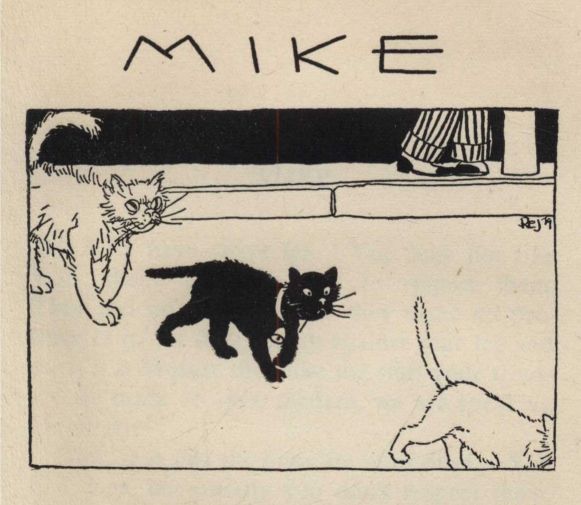
MIKE
Mike
Cats have character. You may not like them, but you have to respect them. They feel no affection, and they make no pretence of it. If they rub up against your leg and purr, it is because they like the stuff your trousers are made of—yes, madam, we are speaking for ourself!
Now, it is just the opposite with dogs. You like dogs, but usually you don't respect them. They are not sufficiently self-centred and independent. They lack poise and that repose of manner which is the unfailing sign of the aristocrat.
Dogs are too fond of you—in itself an evidence of a lack of discrimination—and too demonstrative. One of the meanest-souled human weasels that ever slunk home from his office in the evening to be nasty to his wife and slap the children has a dog. And that dog watches for him for hours, and comes tearing down the street to greet him, barking his head off and turning somersaults in delirious joy.
Now, who ever saw a cat come tumbling and barking down the street to greet anyone? The finest and ablest man in the Empire—Lloyd George, Haig, or even Sir Arthur Currie or the virtuous Newton Wesley Rowell—couldn't get a flicker of a cat's whisker, if they came home after six months' absence all covered with medals. The only arrival to make a cat sit right up and mew in salutation is the milkman in the morning.
That's the fascination and mystery of cats—their independence and their inscrutability. Furthermore, they have utterly no morals, and they are perfectly unabashed about it. If a dog does something he knows to be wrong, he hangs his head and his tail and crawls around on his stomach and presents a ridiculous spectacle of contrition and self-abasement, till you let him know he is forgiven. Then he probably jumps into your lap, and licks your glasses off your nose, and sticks his paw in among the cigars in your vest-pocket. The only safe way to forgive a dog is from the top of a high ladder.
But a cat doesn't care whether you forgive her or not. She feels no compunction and shows no gratitude. She will walk off with a porter-house steak or present the household with a family of war-kittens with equal nonchalance and aplomb—we always make a point of using French words when discussing these matrimonial irregularities, such is our delicacy.
Of course, Mike wasn't that kind of a cat—to present the household, that is. He might figure as the injured husband or the co-respondent in these regrettable affairs, but never as the fair, frail one. Though, as a matter of fact, the family at first was under the impression that he was a tabby.
Mike was an under-sized and very quiet black kitten, with a pair of the worst bow legs we have ever seen on anyone but Harry Lauder. His back legs were straight enough, but he looked as if he had been run over by a motor lorry in front, or brought up with his head under a low beam. They gave him a curious resemblance to a somewhat battered prize-fighter—whence the war-like title, "Mike."
It has never been clearly established in the family who was responsible for bringing Mike into its bosom and its milk-pitcher, so to speak. Mike arrived, that's all—probably he liked the air of cultured serenity about the house and walked in. With a promptness which is a strong tribute to his fascination of manner, even at this early age, he won our landlady's heart, and was formally adopted under the name of Yvonne.
Personally, we were always opposed to Yvonne as savoring too much of coquetry or hauteur. We wanted something simple and homely like Mary Elizabeth or Emma Jane. But Yvonne it was, and Yvonne it remained till it became generally apparent that the name didn't fit Mike's gender or his mode of life.
We would like to devote a great deal of space to telling the reader what a cute little rascal Mike was in his Yvonnehood, so to speak, and how we loved to come down in the morning and find him sitting in our Toasted Pine Flakes, or stuck in the cream-jug—he used to come right up from the cellar to be with us.
We would like to tell all this, so that our unmarried lady-readers could write in to us about their own cats and their cunning ways, and all we girls could have a perfectly lovely time together—they might even bring the cats down. But tempus fugit—these French phrases will break in—and we must on to the mournful and disheartening story of Mike's adult life, with the sad light it throws on the impotence of pure and beautiful surroundings to correct a naturally evil character.
The beginning of Mike's downfall was staying out o' nights. While still a kitten Mike had been accustomed to take an evening stroll, but his notion of bedtime grew hazier and hazier. He became distinctly less and less retiring. Finally Mike had to be stalked like a chamois every evening and dragged by the tail off some perilous peak of fence.
It was then that we got a brilliant idea, one of those flashes, you know. We reminded our landlady that Mike always came running when he heard anyone whet the carving knife on the steel, knowing that it was a musical prelude to dainty tidbits of meat.
"Why not go to the back-door and rub the knife on the steel?" we asked, modestly trying to appear unconscious that we were getting off something rather dazzling. "Then when he hears it, he'll rush up and you can—"
The suggestion was so obviously sensible that, in spite of its coming from us, our landlady adopted it at once. Other suggestions of ours had not worked out quite according to specifications, but this one looked good. Our landlady was even moved to say that she hadn't expected so much wisdom from us.
She got a chance to try the ruse soon after. It was a warm dark night, when the feet of even the wisest cat might stray from the paths of piety, and Mike's had very evidently wandered. In fact, it seemed to us that the strong but lyric tenor voice singing of love down the lane might well belong to him. But we couldn't be sure. There was a good deal of singing going on, mostly of a sentimental nature.
We cheerfully undertook to do the knife-grinding, being an adept at any operation connected with eating. Squaring our elbows in a professional manner, we gave three or four slashing cuts on the steel that would have earned us a job in any packing-house. We made a noise like a duel in romantic comedy—some of that matinee idol stuff, you know, "Have at ye, caitiff knave!" lunging in tierce and quart, and then a quart or so in the dressing-room after the act.
Did it work? Yes, friend reader, it worked. It brought Mike all right—also every other cat off every other fence in that block. Before the landlady could slam and bolt the door, about ten frenzied felines hurled themselves into that quiet and orderly kitchen and immediately started trying to throw one another into the stove or drown one another in the sink.
While it lasted—and it was some minutes before the landlady's screams brought sufficient assistance, including the Chinaman out of the laundry across the way—it was the liveliest little scramble one could see outside the Petrograd Soviet. In ten seconds that kitchen looked like the plucking room of an otter-shop. Those cats just grabbed the fur in handfuls and threw it away. We got it in our porridge for weeks after, giving to that wholesome breakfast dish a still further resemblance to soft mortar.
Mike finally took to staying out all night. It was about this time that we began to entertain doubts as to his sex and morals—we were still calling him Yvonne in moments of friendship. He also wore a bow of red ribbon and a bell, the bell being for the purpose of tracking him around the house when he elected to go up and sleep in someone's bed.
The bell must have been an awful nuisance to Mike. Perhaps that is why he never could catch a mouse. We saw him tracking one in the grass one night. Every time he got ready to spring the infernal bell would tinkle, and Mike would sit up and moan. It was no use, and Mike definitely gave up mouse-catching as a steady job—stone-deaf mice being presumably rare.
His bow and bell, no doubt, made him unpopular with the other Toms. The decoration was not particularly becoming—he was about as pretty as a prize-fighter in a rose necklace—but his confrères probably regarded it as a sign of a vain and uppish disposition. So they used to chasten him—three or four at a time, we should judge from Mike's mussed appearance when he came home for breakfast.
His bandy front legs must also have been a handicap at first in these nocturnal affrays, but he learned how to use them to good effect after a while—they were probably all right for upper cuts and short hooks from either side. We noticed that as time went on he used to bring more of his fur back with him in the morning, and we judged he was working well up towards the top of his class—welter-weight, we should say. Mike never got beyond medium size, and he was always rather lean.
His voice, however, was superb. He was the Caruso of the block. His range was tremendous, with great power and fine quality all the way. His upper register especially was quite wonderful. There were tenor notes in Mike's voice on still summer nights that could be heard for six blocks in all directions. We have no doubt that a greater number of useful articles, such as boots, hairbrushes, perfume bottles, and shaving mugs, were thrown at Mike than at any other ten cats in that end of town.
But he wasn't stuck up about it. He remained the same simple, unassuming fellow—no professional airs whatever, and always willing to sing. He loved his art, that's all.
Mike is gone, however. He hasn't turned up for a week, and we write this article in the hope that if any reader sees a black Tom with a red bow and a brass bell, the reader will please destroy him in some speedy and sure way. Poor Mike, we may never look upon his like again—such is our heartfelt prayer!
The last time we saw Mike was about two a.m.—we had been detained at the office. As we neared the house, mentally debating whether or not we would take off our boots downstairs—the last time we did so we absent-mindedly hung them on the hat-rack—we noticed a nice grey tabby stepping daintily across the deserted street ahead of us.
It had just occurred to us that this was no hour for a well-brought-up cat to be strolling around, when we noticed Mike pussy-footing along about three yards behind—no doubt with some chivalrous intention of seeing that she got home all right. He was wearing his bell and an expression of concentrated interest.
And right behind Mike came the biggest and dingiest tomcat we have ever seen. With a few dabs of paint he would have made a very fair panther; and he had much the same glare in his eye. It seemed to bode ill for Mike, and we felt vague stirrings of pity, which a moment's reflection caused us sternly to repress. We decided to let justice take its course.
We have never seen Mike since.
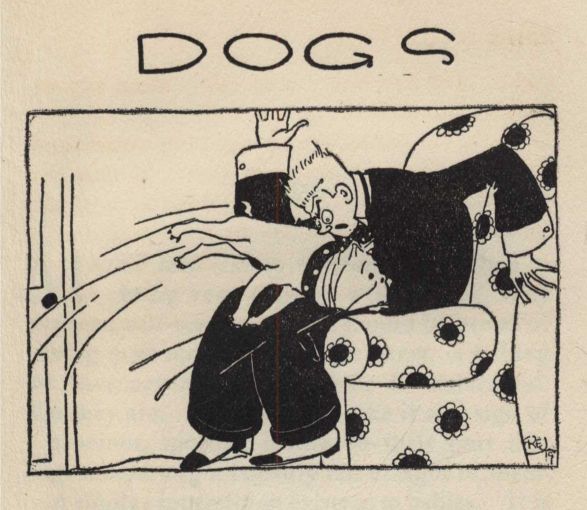
DOGS
Dogs
Most men like to represent themselves as being very popular with dogs. Why any sane, self-respecting man should be proud of having dogs notice him on the street, is a thing we have never quite been able to understand. But they are. They seem to take it as a sign of a generous, sporting nature on their part that dogs should wag a friendly tail at sight of them.
A similar superstition exists as to babies. It is quite true that it is sometimes deuced embarrassing for a man to have a baby conceive a sudden passion for him. But even the victim is proud of it. The onlookers, especially the parents—oh, God bless us, yes!—regard it as an absolute certificate of character. They would hardly find it in their hearts to blame that man if they afterwards heard he was a burglar and a wife-beater. He might be indiscreet, but still "how Baby took to him!"
Now, personally, we get on pretty well with babies—also with grandmothers. Up to the age of six and after the age of sixty the girls seem to love us. Affection for us appears to be a characteristic of childhood—first or second. It would do your heart good to see the little dears grab for our watch and bang it on the arm of the chair or the top of the table, or anything that is handy and hard.
Grandmothers, too, are always very nice to us, and laugh at our jokes—especially if they are a little off color (the jokes, not the grandmothers). But girls of sixteen, say, or twenty-six, make it clear from their manner that they consider us a tiresome old stiff, afflicted with a pathetic hallucination that we are funny. There is something a little depressing about this.
As for dogs—well, frankly, we don't get on with them at all. The best we receive from them is a cold neutrality. Of all the dogs we know not one has a gosh-darn bit of use for us—except when we are sitting at their master's dining-table. Then they come and fix us with a threatening eye and black-mail us out of half our dinner. In fact, we have a suspicion that nothing but a certain leanness and stringiness in our lower members prevents them from eating out of our leg.
There is a house, for instance, where we dine almost every—well, as often as our hostess will let us. We like eating there. The cooking and the conversation are excellent. Also they don't regard the wine-cellar as a place to keep the winter's coal and ashes in.
But they have a dog—a big, black, furry dog, with feathers on his legs, and the ability to sit up and beg for hours at a stretch. He has also the biggest mouth we have ever seen on a dog of his size. When he opens it he splits himself apart right down to his hind legs. Some day in a moment of forgetfulness or excitement he is going to take our right arm off at the elbow. But still we go on feeding him. We don't dare stop.
In addition to getting most of our beefsteak and our lamb and our veal, that dog has got our goat. He sits right up beside us and counts every mouthful we take, looking all the time as if he hoped it would choke us. If we don't "come across" promptly with what he considers his proper "rake-off" on our food—the brute regards us as a parasite, anyway—he howls in fury.
"My dear," says our hostess to our host with characteristic thoughtfulness, "I think your dog is misbehaving himself—hadn't you better put him out?"
"Oh, the dog's only a little playful," says our host, eyeing us with the cold disapproval of a man who has his own opinion of a fellow who would sit in front of a big plate of roast beef and trimmings and let a poor dog suffer. "You don't want him put out, do you?" says he to us.
"Not for worlds!" we roar in counterfeit horror at the thought, and chuck a slab of sirloin into the gap at our elbow—it's as big as a manhole in the street. After that, whenever we catch this nice little doggie's eyes, we give him whatever happens to be on our fork, all the time hoping that he will go out on the street next day and eat a sausage full of arsenic, or some ptomaine pork.
If we don't catch his eye often enough, he pats us on the arm with a paw the size of a Virginia ham. He did that once when we were drinking a cup of coffee, and we poured it over a new pair of striped pants. We never cared to wear them afterwards—in fact, we didn't care to wear any at all for several days, until the new skin formed.
Talking of clothes reminds us that we were mistaken when we said no dog ever loved us. One did—Lord, how that dog worshipped us! He was a brindle bull belonging to an uncle of ours, who had an undershot jaw, one ear gone, a broken tail, and a record of seventy-odd murders—that is, Mutt had, not uncle.
Mutt was in many respects a very tough dog, but he loved us dearly. He dogged our footsteps, and he dogged us when we sat. In fact, when we were visiting uncle, which was fairly often—uncle always kept a few bottles on ice—that darn dog did nothing but dog us. He was the doggonest dogger we have ever known.
But we had little joy of his affection. We would rather have had him form a taste for anyone else on earth. We wouldn't have cared if he had taken up with the niggers down around the barn. In fact, when uncle wasn't looking, we used to punch him in the face and kick him behind the ears—even farther behind than that. But he regarded these caresses as proofs of affection, and would leap upon us and slobber in a riot of emotion till we were reduced to soggy helplessness.
That was the whole trouble—the slobbering. A friendly bulldog is a moist beast at best. If he loves you he drools on you, and the more he loves you the more humid he gets. But this brute was the dankest, wettest, coziest, sloppiest bulldog that ever drivelled his affection on a fancy vest. His finer feelings were a perfect swamp. His welcome was an inundation.
If, in a moment of forgetfulness or exhaustion, we so far relaxed our vigilance as to sit down, Mutt would waddle up with tears of love in his eyes and lay his head in our lap. He would gaze at us in worship as though we were a god or a side of beef, and in two minutes we would be soaking from the waist down. The trenches in Flanders had nothing on Mutt for sogginess.
Once, after we had been away for some months, we were visiting uncle, and were sitting in a nice, deep, easy chair—you know, those chairs that are so hard to get out of in an emergency. Suddenly the door burst open and seventy pounds of slobbering enthusiasm hurled itself upon us. There was no escape. Mutt took us fair in the chest and knocked our breath and all thoughts of resistance out of us in one agonized grunt.
Before they pulled him off our hair was licked into tufts, our collar was melted, the colors had run in our new tie, and we were wet to the skin. We couldn't go home that night for fear of catching double pneumonia. Mutt was a grand dog in his way, but if he took a fancy to you, you weren't safe in anything but a bathing suit or a raincoat.
Nearly all our friends have dogs—Airedales mostly. Now we have nothing against Airedales. They are good enough dogs in their way. It is true that they are as ugly as a moth-eaten buffalo in a zoo, as boisterous as Billy Sunday, and as quarrelsome as a female peace-advocate. But they are good dogs—let it go at that.
There are no less than six Airedales on the staff of the paper we work on—that is, six dogs more or less definitely recognizable as such. In fact, if you were to take the whole six of them—one dog's ears and another's tail and another's legs and another's coat—you would almost have a real Airedale, which is pretty good going with average Airedales these days.
One of them got lost the other day. They are always getting lost. Airedale books and salesmen will tell you that you can't lure an Airedale away from home. The suggestion is that if you were to invite a neighbor's Airedale out for a walk he would knock you down and bite a piece out of your Adam's apple.
Well, all we can say is that every postman or butcher boy or grocer's man in town is escorted on his rounds by two or three Airedales belonging to the best families. We even used to know one that came down-town and spent his days in the back room of a saloon. We saw him there ourself, but he cut us dead—perhaps because we didn't treat him.
The Staff Airedale that got lost is principally distinguished by the possession of a thoroughbred tail. So the owner claims, at any rate. He has frequently called our attention to it, and asked us to note the correctness of the angle at which it is held. But we could never see much in a shaggy stub of that sort, no matter how perpendicular. Now, if it was a nice, long curly tail—but then, of course, it wouldn't be an Airedale. And this dog was bought for an Airedale, the price being the principal evidence of pure breeding—that and the tail.
Well, when the dog left home, the owner immediately advertised for his recovery. Personally, we would have moved at once to another street to prevent him finding us again. But the owner advertised; and for the past two or three days we have spent most of our time listening to him answer enquiries over the 'phone. He is called up every twenty minutes by someone who has an Airedale which he is sure must be the one wanted.
The thing begins to sound like a conspiracy. Are people trying to work off a lot of second-hand Airedales—model 1916—for the sake of the reward? Or do they just want to get rid of their own dogs, and are too kind-hearted to shoot them? Anyway, this is how it sounds—his office is near our own:
"Hello!—yes, an Airedale—where did you find him, hey?"
A long pause, during which the person at the other end of the line tries to prove honesty of character and purity of intention.
"What sort of a tail has he, hey?—is it a good tail?—what do I call a good tail, hey?—well, a good tail stands up straight with a little bend in it—oh, about four or five inches long and pretty thick."
Another long pause, while the person at the other end of the line drops the receiver, goes out to the barn to study the dog's tail, and comes back to report.
"It isn't standing up now, hey?—well, did it stand up before?—does it stand up most of the time, hey?"
Usually the answer is favorable. Naturally a man with a dog he doesn't want speaks as well of its tail as he can. Thereupon our friend seizes his hat, rushes out of the building for the nearest car line, and comes back two hours later to expatiate on the crass stupidity of people who find dogs.
The tail, it seems, is never the perfect tail he is looking for—thick, shaggy and perpendicular, with a slight bend. Half the time the dogs are not even Airedales. The last one he went to look at—seven miles away in the suburban slums—proved to be a Scotch terrier, a bandy-legged, little black chap.
We told him he ought to have taken it anyway. But he is a persistent beggar, and he is still answering "ads." He is weakening, however, and we are laying bets that he will take whatever the next person who 'phones in has to offer—A Persian cat, perhaps, or a Belgian hare.
ON BEING HANDY WITH TOOLS
On Being Handy With Tools
We are not handy with tools. We state this with all solemnity and knowing full well the nature of an oath. But even if we were handy with tools we would perjure ourself rather than admit it—we know what that admission leads to.
We have a brother, dear reader—a tall, broad-shouldered, handsome fellow, as you might guess, with a very open face. That is the chief cause of his troubles, his face is so very open. And in his tender youth he used to open it regularly and widely about the things he could do with tools.
There was nothing that boy couldn't make or mend. There was no domestic emergency which he couldn't meet with the appropriate tools—either the family tools or the neighbors'. Did a tap need a washer? Frank was right there with a rubber disk in one hand and a monkey-wrench in the other. Were the electric lights on the blink, or was the gas-stove doing its best to suffocate the cook? Did the family dog, a descendant of several shaggy breeds, require a hair-cut or a shampoo? Had the horse kicked the side out of his stall?—we are not bragging, friend reader, as you would realize if you had ever seen that ancient charger. Or was the barn itself in need of a coat of paint? In any and all of these cases Frank was electrician, gas-fitter, barber, carpenter, painter, or whatever the circumstances called for.
And what was the result of all these various services so far as he was concerned personally? Did he get any special consideration because of them? Was he the favorite child of the family? Did anyone kill even a lean calf for him, or clothe him in a coat of many colors? Not that the rest of us ever noticed. About the only way we ever showed any gratitude or any acknowledgement of his skill and energy was by saving up jobs for him.
No matter what the emergency might be, no one else ever touched a hammer or a saw or a paint-brush for fear of breaking in on Frank's personal preserves and so hurting his feelings—at least, that is the way we put it. If ever he went out of town for a few days, he had to work nights and Sundays when he came back, so as to catch up with the chores and odd jobs. And because he had always done them he went on doing them. He might grouse about it, but you know how it is once you have established a family tradition. The laws of the Medes and Persians are nothing to it for permanence.
All this happened because he was handy with tools and fancied himself as an amateur mechanic. The boy was clever at it, too, but this is something one should never admit about one's self. If a job should turn up to be done around the place and you should be asked if you can do it, deny it utterly. Say you know not neither do you understand a darn thing about it. If they ask you again, deny it again. Then if one come up to you saying, lo, this is a handy man, curse and swear and say that the only nail thou canst hit with a hammer is that which groweth upon thy thumb. Even so wilt thou find peace.
You must be eternally watchful, if you would keep yourself clean from the taint of handiness. There is something balefully fascinating about tools. They are so shiny and efficient-looking, or so rusty and inefficient-looking, that one is tempted to try them in either case, just to see how they work. And they are always lying about within easy reach—except perchance when you want some particular tool very badly. Then, if so be you desire a tack-hammer, you will find many gimlets and screw-drivers and eke a saw or two. But aye verily we say unto you, you won't know where th'ell the tack-hammer is, but will be obliged to tack down that bit of linoleum with a sad-iron—perhaps that is what makes the irons so sad. If, on the other hand, thou shouldst require a gimlet in thy business, then surely will there be tack-hammers in every drawer, but the gimlets will have crawled off into a hole somewhere to play with the young rats.
Even young children are inoculated with the virus of handiness. Little boys at Christmas-time are presented by silly old uncles—generally uncles who do not have to live in the same house—with sets of little tools all nicely arranged in gaudy boxes. Then the little boys, having bright and enquiring minds, proceed to saw sections out of the piano-legs and drive nails into mother's Circassian-oak dresser. The result is usually much pain for the little boys, though not in the parts of their anatomy which they use for purposes of sawing and hammering.
When we were a little boy, we were even as other little boys in this respect, though much more beautiful and clever—we state this on the authority of our maiden aunts. Having been presented by some reckless relative with a set of tin tools, we went right out to the family shed and built a nice little house with a real fireplace in it made out of two or three half-sections of brick. Then we started a fire in it, and when it got going nicely, we ran off to tell some of the other boys in the block about it.
There could be no question about that fire. It wasn't a big fire as fires go nowadays, but it was a lively one. It took two hose-reels and a chemical engine half an hour to put it out. We don't know what grandfather told the insurance company, but even over the lapse of years we distinctly remember what he told us. You see it was grandfather's shed, and grandfather at that period of our life was acting towards us in loco parentis—certainly there can be no doubt about the amount of loco which he put into the role of parent on that particular occasion.
Our natural genius for mechanics was nipped in the bud by that unfortunate occurrence. Ever since we have struggled manfully and—with a few exceptions—successfully against any inclination to monkey with tools. Taps have wheezed and leaked in our presence for weeks on end, but we have carefully ignored them till such time as a plumber or brother Frank was around. Coal-bins have broken down, but never have we taken saw and hammer in hand to put them up again. We have sworn off tools.
It is true that we have sometimes been compelled to run a lawn-mower. But then a lawn-mower is not properly a tool. It is more in the nature of a plague, something like typhoid fever or Prohibition.
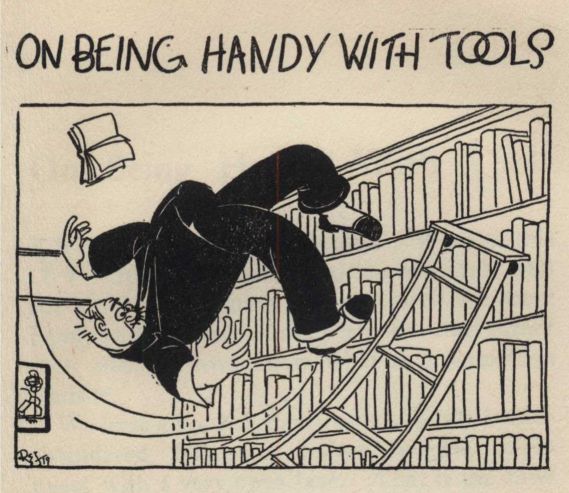
We have stated that there were two or three exceptions to our abstinence from tools. Alas, yes, we succumbed to temptation or pressing need, and the result was in each case deplorable. Worst of all was the little ladder we constructed so as to reach certain high book-shelves in the room which the family calls "the study"—probably because no one would dream of doing such a thing there. It was a pretty little ladder, a bit of work we were proud of. But it cost us an inheritance—not actual, you know, but prospective.
We made the ladder out of a couple of pieces of scantling and parts of an old packing-case. We planed and fitted and nailed it, till it was goodly to the eye and fairly sound to the feel. Then we painted it an art-green, and put nice round knobs of leather on the ends that leaned against the wall. It was really an ornament, the sort of thing that people years ago used to gild and hang up with pink ribbons. But unfortunately it was not a very reliable ladder. It would do everything but ladd, so to speak.
Uncle Aleck was in the house one day, and having nothing particular to do formed an evil desire for a book on the top shelf. This particular uncle, be it understood, is regarded as a wealthy old bachelor—though personally we can't be sure to what extent he is either single or rich. Anyhow, he always professed a special affection for us personally, on the curious ground that we were the image of himself at our age—a reflection which furnished us no pleasure from the point of view of physical pulchritude, however flattering it might be as a financial prospect. We were regarded by the family generally as his heir—alas, that we should have to say we "were" regarded.
Naturally Uncle, seeing this book which he shouldn't have wanted to read—at his age, too, the old rascal!—seized that infernal ladder and climbed up. It let him get right up to the top rung, and then it bucked or shied or kicked or something equally effective. When they got the splints off Uncle's leg and he was able to move around on crutches, he sent for his lawyer. Ever since he has regarded us with ill-concealed dislike. Whenever we see a short ladder from that fateful day to this we get a curious "gone" feeling under the middle button of our vest.
This is the sort of luck we have had with tools, but, of course, there are people who have had worse. We have a friend, for instance, who is an absolute victim to them. He has a fine home and a charming wife, not to mention the dog. But he is gradually undermining his health and wrecking his own happiness and theirs by his insane conviction that he is a plumber, a carpenter, an electrician, a cabinet-maker, a plasterer, and a stone-mason combined. There are three or four other trades as well, but these will do to go on with.
When he built his house, he had a large room constructed down in the basement adjoining the boudoir occupied by the furnace and the coal-bin. It is a really beautiful room, a little low as to the ceiling, perhaps, and a little dim as to the light. But there is a fine cement floor, fine big beams in the ceiling, and splendid brick walls in all their natural beauty of cool grey. It is his workshop. He tries to persuade his wife that some day it will be the billiard-room. But she, poor woman, knows better. It is his workshop now and forever, till his last tool is rusted and his last finger busted and—well, there are "dusted" and "crusted" left to rhyme with.
He has that place simply jammed with tools of all sorts and work-benches and the like. He keeps a regular harem of hammers and hatchets and saws cooped up down there, each in her own little cubicle. Not even the Sultan himself in all his matrimonial glory was ever half so jealous of his better halves—perhaps one should say, his better ninety-nine one-hundredths—as our friend is of these same tools. Why, if he were to catch anyone cutting with a chisel of his, or planing with a plane from his seraglio, he would be liable to bowstring the poor tools and throw them into the Bosphorus, as represented by the sewer or a neighbor's backyard or some similar abyss of oblivion.
Sunday afternoons and any evening when his wife has company, he disappears down into this den of hardware, and the noise of hammering and sawing which emerges from it—the place sounds like a busy shipyard on the Clyde—indicates that he is having much joy of his chilled-steel darlings. Every now and then he comes up to have a piece of court-plaster put on a new place during the temporary absence of cuticle. Then he goes back with the solemn and determined expression of a man who at great personal sacrifice is accomplishing a sacred duty.
What does he do down there? Generally speaking, Heaven only knows. We have heard him talk in vague terms of the new set of storm-windows and storm-doors he is making for the house. But that was over two years ago, and there have been some very tidy little storms since then. But never yet have we seen sash or panel of those doors and windows.
It is true he did make a set of window-boxes for the flowers in the sun-room—so-called because you can sit in there and look at the sunlight outside. But even a union carpenter could have made those boxes in half an hour, and members of the union have never been accused of undue and ill-considered haste in such matters.
It is when our friend comes up out of the cave, however, to do a job in the upper regions of the house that things really happen. There was a tap in the bath-room, rather a nice tap as taps go—a very handsome tap, in fact. But, in the case of taps, handsome is as handsome pours. And pouring was one thing this particular tap refused to do—thought it vulgar, perhaps. So our friend one bright Sunday afternoon—these things seem always to happen on Sunday—got an idea in his mind and a big monkey-wrench in his hand, and went up to the bath-room and took a half-nelson on the handle of that tap. He gave one twist—just one. It was all that was needed. The tap came away with a jerk, and a solid jet of water as thick as your wrist took him in the face.
Gurgling yells of agony brought everyone in the house to his assistance. Naturally we had to be right there among the shock-troops, heedless of the nice new suit we were wearing for the first time. We dashed in and found our friend standing in front of the pipe into which he was vainly endeavoring to stick his thumb—mindful, perhaps, of the famous exploit of the little hero of Haarlem. We succeeded in prying him away, but our new suit never looked the same again. If we had had any sense we would have left him there till he was washed away. The trouble was that no one else knew where to shut off the water, and—well, we simply had to drag him away to do it.
The next day a battalion of plumbers, plasterers, and decorators did what they could to repair the damage to the house. It took them about a week. But our friend is still hopeful. He still thinks he is a mechanical genius wasted as a mere lawyer. Only the other morning we dropped into his office. He was laboriously trying to make a piece of black court-plaster about the size of a war-map stick to the back of one hand by holding it down with the bandaged thumb of the other. There was a lump on his forehead and one of his cheeks was badly scratched. But he was in excellent spirits.
"Tell you what, old man," he burbled in his enthusiasm, "there's nothing like being able to do the odd-jobs around the house. Why, only last night I went down into my workshop, and I——"
We wiped away a furtive tear. There is something very pathetic about a fine mind falling into such decay as this.
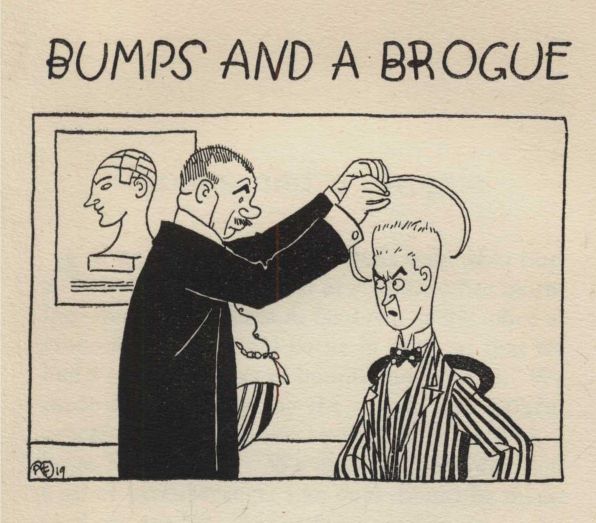
BUMPS AND A BROGUE
Bumps and a Brogue
As we were combing our hair somewhat hurriedly in our boudoir at 8.58 the other morning—we are supposed to be down at the office at nine—it was suddenly borne in upon us that we had a remarkable set of bumps on our head. We made this discovery by the simple and painful process of running into several of them with a large, sharp comb. We thereupon decided that a set of protuberances like ours should be measured at once by a competent phrenologist.
We had seen the Professor's notices in the "want-ad" departments of the local dailies; and our attention had been drawn to them by their diagrams of extraordinarily bumpy heads, and the peculiar line of language in which the Professor advanced his modest claims to be regarded as a benefactor of the human race and one of the greatest phrenologists of all time. Besides, the Professor's protuberance-parlors were on our way down to the office. They have a central location, so that phrenological patients can run in every now and then and have a new bump examined, we presume.
We read the handsome and dignified brass plate on the door, and we knocked a respectful knock. After two or three minutes of waiting we knocked again—less respectfully. After we had knocked several more times, with constantly diminishing respect and constantly increasing force, the door was opened by a blond and comely young woman who explained that the Professor's hours were from three to five in the afternoon, and from seven to eight in the evening—to accommodate people who might drop in on their way to the theatre, no doubt. Did we want a chart as well as a reading?
"How much does the Professor set one back for a chart?" we inquired, as we toyed with the forty cents left out of our weekly envelope of the Saturday before. Two dollars for a reading and five dollars for a chart.
We stated firmly that we would have two dollars' worth, and that we would come for it at three o'clock in the afternoon. We were going to see this thing through if we had to hock something. As we bowed our adieu smilingly, the young lady pressed upon us one of the Professor's cards, in which we were advised to "get my new great chart and be helped—as many also numerous worried, etc., have—for life." On the back of the card there was more of the Prof's best phrenological English, which promised among much else that "marriage adaptions" would be explained. Immediately we resolved that we would see him that very day or expire in the effort.
We got there at three. The same blond and comely young woman let us in. Would we take off our hat and coat and sit in the parlor till the Professor got through examining the bumps on someone else's cranial arch? We would and we did. We sat down by a table on which there was a pile of calling cards—presumably left by grateful persons whose protuberances had been explained—and also a bound copy of the Professor's famous chart. We opened it and glanced through a few long passages on amativeness and combativeness and philoprogenitiveness and other polysyllabic characteristics, as indicated by convexities on the skull.
While we read there floated down to us from the mysterious regions above a rich Hibernian voice and the most superb brogue we had heard in many a long day. It was one of those thick, mashed-potatoes-and-buttermilk brogues which usually go with a semi-circular rim of reddish whiskers and a prehensile upper lip. We dropped the book and listened. We didn't pay any particular attention to what was being said—far be it from us to display an ungentlemanly curiosity as to the meaning of anyone else's bumps! We just listened to the voice. It made us think of St. Patrick ordering the snakes out of Ireland.
The voice came downstairs and accompanied someone to the front door. "Goodboy and good luck to yez both," said the voice—perhaps some cautious young man was having his fiancee's head studied—and then we were told that the Professor awaited us in his sanctum. We hastened out just in time to see a pair of short, thick legs scurrying upstairs ahead of us. We joined them in a neat little office at the top—where legs are usually joined—and found that they and the voice belonged to the Professor, in whose hands we had come prepared to place our head and a two-dollar bill.
The Professor looked us over, and we in turn gazed at him with the respectful and somewhat timid interest due to his professional insight into human character and destiny. But we must confess to a distinct disappointment. We had expected to see a large and impressive personage, with the face of a seer, piercing eyes, flowing locks—also a flowing robe, covered with cabalistic signs. We had expected him to be a sort of cross between a medicine man and an ancient alchemist. Instead we saw a round-faced, plump little Irishman, with close-cropped hair, a bristling mustache, and a decided leaning towards rotundity in the abdominal profile.
"Well, young man, and what can Oi do for ye?" asked the Professor, as though we might have come to get a tooth filled, or be measured for a new pair of pants.
We explained that we had come to have our head read, with a view to finding out what business in life we were best fitted for, and also to have our "marriage adaption" explained.
Without a word the Professor sat us in a chair in the middle of the room. Still without a word he seized a pair of callipers that were unpleasantly suggestive of ice-tongs. Then in ominous silence he proceeded to pick up our head by the ends, by the sides, by the front, by the back, under the ears, and in several other painful places where heads are not usually picked up. We felt as though our head were a block of ice, which was being carried up several long flights of stairs. And each time the Professor seized it in the tongs, he carefully scrutinized the scale at the top of them. Some measurements he took several times, either to verify them, or to make it plain that he was working hard on our case.