Front matter (continued 2)
Reading edition
Occasionally, of course, a hen will forget herself and the social exigencies of city life and will lay an egg. Now and then they are even known to have a chicken—in extreme cases, two or three. But families of this unfashionable size are extremely rare. At a moderate estimate—allowing only a reasonable interest on capital invested, the house, hens, food, etc.—the eggs cost three dollars and a half each, and the baby chickens six and a quarter. But every time one arrives the proud owner goes about for days telling all his friends what a convenience and economy it is to grow your own eggs and spring chickens right there on the premises.
There is something pathetic about the way the moral character of chickens deteriorates in town. We have often wondered, in fact, why the parsons do not draw stern ethical lessons for their sermons from the way decent, well-behaved country chickens take to evil courses in large cities.
Time and time again we have seen innocent and energetic young roosters from the farm come into our neighborhood—rather a respectable neighborhood, too, as neighborhoods go—nice, young roosters of good habits, who always got up at the proper time in the morning and went to bed early o'nights and crowed with fidelity and discretion.
And what happened? Why, those roosters wouldn't be exposed to the pernicious influence of city life for more than a month before they would be staying up all night, crowing at the electric lights, and keeping the hens up, too. What becomes of family life under these conditions? What sort of future is there before a hennery where the rooster sleeps all day and the hens sit around and hold mothers' meetings without an egg or a chick in the place?
There is a rooster in our block just now, who has gone absolutely to the demnition bow-wows. We first knew him as a kindly young cockerel from one of the small provincial towns, good humored, honest, and orderly. But you ought to see him now—especially you ought to hear him. The brute crows his head off every time in the night that an automobile goes by; and he spends his afternoons sitting on the side fence watching the girls in the tight skirts—with the nastiest leer in his eye! We often hear the hens calling to him; but what does he care about his family responsibilities?—not a kluck!
The neighbors are all talking about that rooster. They are also shying things at him whenever he gets within range. This brings up another unpleasant feature of keeping hens in town. The neighbors are very apt to be cross about it. They never seem able to take the same idyllic view of chickens that the owner does—very narrow-minded people, neighbors, as a rule.
Even the best-behaved fowl are likely to fly over the fence occasionally into a neighbor's yard and dig worms out of the gravel walk or make impromptu salad of his geraniums and young onions. And you have no idea how annoyed the neighbor gets over these little outbreaks of playfulness. Think, too, of the eggs that must result from it. Just imagine, friend reader, an egg with a geranium shell and a flavor of young onion!—or heliotrope and carrot tops!—or burdock and tomato can! The possibilities are unlimited.
This reminds us of a man we knew once who lived back of a brewery. We didn't seek out his acquaintance and make ourself a friend of his just because he lived back of a brewery—it happened that way, that's all. We couldn't very well cut a man just because he lived back of a brewery, could we?
He also kept chickens. We didn't let this interfere with our friendship either. But he had certainly the gosh-darndest time with his chickens of anyone we ever knew. There were about fifty of them—four roosters—and they had a nice, roomy hen-house with separate beds and great big perches to sit around and talk on, every comfort in fact.
But did those chickens stay at home and lay eggs and rear large families and attend to the other duties of their station in life? No, they did not. They took to drink. We can hear the reader snort in disgust as he reads this—if he does. The reader no doubt thinks we are lying. Not knowing the sterling honesty of our nature, the reader doubts our word. But fortunately we have court records to back us up, for our friend sued the brewery for damages.
You see, the brewers used to throw out their used malt and the lees of the beer-vats in a huge pile just back of our friend's fence. One day an enterprising young rooster, whose moral upbringing had been neglected, hopped over the fence and tried some of the malt. It tasted good. Little did he know, poor bird, that he was getting into the clutches of the Demon Rum. He ate fermented malt till he couldn't jam down another grain.
Did it go to his head? Did it?—dear reader, that young rooster accumulated the loveliest load of lush, the most beauteous and bountiful "bun" ever seen in that district—and it is a district rather famous for its "buns."
It was long after dark when the young rooster got home—trying to find the key-hole, no doubt—and he aroused the whole hennery. He staggered around crowing comic songs, insulted all the most respectable hens in the place, started out to whip the other roosters, and put the whole place on the blink generally.
Our friend was aroused by the uproar, and rushed out, thinking that a rat or a stray dog had got into the hen house. He said that it was the finest representation of a hilarious "jag" in an old ladies' home that he ever saw. But, of course, he didn't know at the time what was wrong with the young rooster. He thought he was sick, and went out next morning and gave him some bread and milk—or whatever it is one gives sick roosters. But the rooster would have none of it. He didn't want bread and milk. What he wanted was some bromo-seltzer or a "Collins."
Was the young rooster enlightened as to the evil of his ways? Did he take the pledge and climb on the water-bucket? Alas, no! What that young rooster did was to fly right back over the fence that very afternoon and tank up once more. Worse still, he brought the other roosters with him.
That night there was another rough party in the hennery—four times rougher than the other, for there were four roosters in it. They went in for close harmony in their choral work, and also did a little close scrapping. They even tried to whip our friend the owner when he went out to restore order.
Talk about drunkards' homes and temperance lessons!—that hennery would have furnished the W.C.T.U. and the Prohibitionists generally with arguments for a five years' campaign. In a few days every chicken in the place had developed a taste and capacity for beer that would have filled half the population of Bavaria with envy. Life for them became just one big "bust" after another.
Instead of hopping cheerfully from bed at the first peep of dawn, those chickens slept in till noon. They didn't care who got the early worm. Then they piled over the fence to the malt pile, and stayed right there till closing time and after. They stayed, in fact, till our friend went over and carried them back. He said it made him feel like a police van on the Twelfth of July.
Nothing could keep those hens away from the booze. Our friend built the fence higher; but they dug a tunnel under it. When he blocked that up, they flew over into the neighbors' yards and got around that way. They would even go out by his front gate and walk around the block, and come staggering back at all hours of the night in a way that would give any house a bad name.
Finally he sued the brewery for alienating his hens' affections—they only laid one egg in three months, and when our friend tried to eat it it went to his head it was so full of alcohol. But the Judge said that a man who kept hens in town should be shut up somewhere and have his property managed for him.
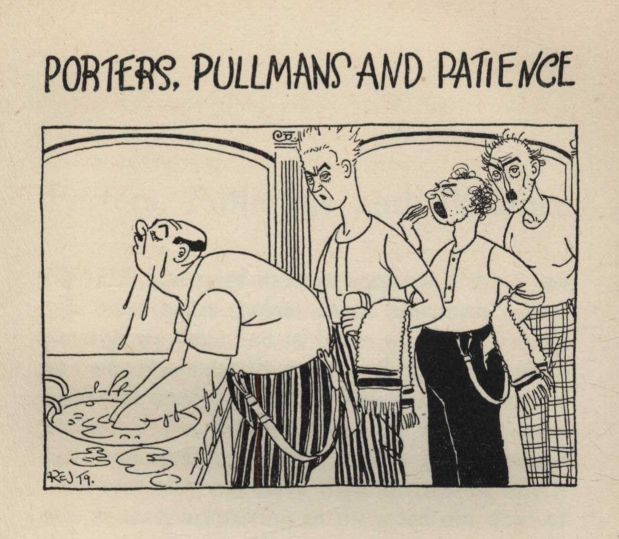
PORTERS, PULLMANS AND PATIENCE
Porters, Pullmans and Patience
The luxury of modern travel is a thing one often hears spoken about nowadays. Personally, we have had to listen to it for so long, and we are so heartily convinced that it is a piece of arrant humbug, that we are finally moved to protest. "The luxury of modern travel"—pish tush, and again pish! There ain't no such thing.
Travel may not have been luxurious, but it was at least interesting in the good old days of the mail-coaches. We like to think of them rolling with a tremendous clatter of hoofs and a flourish on the guard's horn through grey villages dozing among their elms, right up to the doors of glorious old inns where the hostlers tumbled out with fresh horses and journeying gentlemen tumbled in for a glass of mulled port.
That was travelling, bless you! There was some sport to that, some exhilaration. A man might well be moved to song on the top of one of those old coaches of a fine spring morning with the hedge-rows all in tender green. Even we ourself, who have a voice that causes people to turn around and scowl when we join in a chorus, even we might be led to troll a rollicking catch under such circumstances as that.
But who ever heard of anyone singing in a Pullman car—unless it should be a traveller in the smoking-room who had travelled not wisely but too well? And even those days are past now. Singing isn't done, that's all. There is no excuse for it, except inebriety or a brainstorm—and we have ruled out inebriety, more or less. Besides, the man who manages to get an extra Scotch or so nowadays doesn't make a fuss about it. He keeps the fact a dark and happy secret. So, instead of singing in a Pullman car, one simply sits and grouches until that blessed moment of release when the porter has brushed all the dust off one's coat into one's eye, and one can seize one's grip and totter out into the open air once more.
The misery of modern travel starts from the moment the traveller, laden with disheveled impediments of all sorts, plunges madly out of the house watch in hand—this is difficult but it can be done—to the taxicab which has come just twenty minutes late. The driver says it is because the people at the garage gave him the wrong address, the intimation being that he had finally arrived at the right one by some process of complicated and inspired ratiocination. The real truth is that he stopped to talk to a "ladifren."
Personally, we plunge out and catch a streetcar. We are a democratic cuss. Also they don't make one wait so long. Moreover, it is so exciting to stand on the back platform and pull out one's watch—it is ten minutes fast, though one doesn't suspect it—and break into a cold sweat every time anyone stops the car either to get on or off.
The car-line we usually take crosses railroad-tracks in two or three places. This may seem to the reader an irrelevant detail, but it wouldn't seem so if the reader had to take it. Invariably when one is in a bigger hurry than usual, a shunting-engine and a crew of leisurely fiends in dingy overalls are engaged in chivvying a bunch of freight-cars backwards and forwards over the crossing, while one notes the second-hand of one's watch slipping merrily around and one mentally calls on all the lurid reserves of language.
Rushing into the depot—dear reader, did you ever rush into the Toronto Union Depot? Did you ever sprint madly, with your bag banging against your knees, down that interminable corridor—it seems a mile and a half long at the very least—from the main entrance to the door where a cool ruffian in a uniform insists on stopping you and seeing your ticket, though you have just four seconds to catch your train and you know on what track it is just as well as he does? And when you have finally got by him, did you ever slide down one of those flights of iron steps into that damp and dismal tunnel where the trains stand? If you have ever done any of these things, you can sympathize with us when we repeat with an intonation of melancholy contempt, "The luxury of modern travel!"
But somehow or other in a fashion which strengthens our belief in a kindly Providence, we catch the train. We always do. Just as the porter picks up his little stool and climbs aboard, we hurl ourself and our bag into the vestibule after him. Then, when the conductor and brakeman have lifted us off our ebony brother in livery, we are shown to our berth. Removing our overcoat and picking out of our bag a book and such cigars as have not been reduced to fine-cut, we adjourn to the smoking-room.
There is a general notion, principally among ladies, that the smoking-room of a sleeping-car is a place of extraordinary hilarity and indecorous enjoyment. They have visions of men sitting around in their shirt-sleeves playing poker, drinking out of pocket-flasks, and exchanging amid clouds of smoke stories that would make even the porter blush. But, alas, it is not thus.
Our own experience of Pullman smoking-rooms is that they are the dullest holes on earth. The smoke is there all right, dense clouds of it. And such smoke!—any old thing that will burn, native shag, Turkish cigarettes, five-cent cigars, pipes of every age and degree of disrepute, all mixed up together. But of conversation there is none, except when a couple of commercial travellers start a competition in mendacity as to the number of orders they have taken in the towns along the line. As for stories—we haven't heard a new one yet.
So far as cards are concerned, we once saw a man play solitaire. And on two or three occasions in the more convivial past, crude but friendly souls have drawn from hip-pockets pint-flasks which they have timidly proffered by way of brightening the general gloom. We always hated to refuse—exhibitions of hospitality were so rare there. If an African chief came in and wanted to rub noses—we believe that is the usual expression of friendly interest in Ashantee—we would hardly have had the heart to decline.
About midnight, when one has no decent excuse for putting it off any longer—especially as the porter, who sleeps in the smoking-room, comes in and scowls every few minutes until one gives it up to him—we drag ourself to our berth. That is, we stow ourself away in a dark cubby-hole, too short for us by three inches actual measurement, and just high enough to bruise the top of our head every time we sit up. There we proceed to divest ourself of our garments and lay them away in places where they will fall down on our face at intervals during the night—the intervals being whenever we start to doze.
We would like to go into the details of our divestiture, with a view to comparing notes with other tall gentlemen who have been compelled to remove their habiliments—mentionable and otherwise—within the confines of a berth. In view, however, of the somewhat intimate nature of the case, we are obliged to let it go with the general statement that the performance is a highly acrobatic one. We get our things off somehow or other—probably we give anyone coming along the aisle the impression that a sea-lion or a dromedary has got into our compartment. And then, our final frantic struggle having made us free, we address ourself to sleep.
Sleeping-cars are so named because you try to and can't. Some people can, of course. When they can, they always snore—fiendishly. Invariably there is a man across the aisle with one of those going-down-for-the-third-time snores, the kind that suggest a muffled shriek of agony. All night long you keep hoping against hope that he is really strangling. But he never is. Next morning he always bobs up smiling and rubicund, and informs everyone in the wash-room that he slept like a top—meaning, of course, a racing automobile with the muffler cut out.
Somehow the night goes by. It is one of the melancholy compensations of life that everything passes. Just about dawn you drop off into the first decent nap you have been able to get; and twenty minutes later the porter reaches in and punches you in the ribs or pounds on the roof of the berth to let you know it is time you were up. As a matter of fact, you have a full hour or more before you arrive. But he believes in getting people up early. It gives him a chance to roll up the berths and stow them out of sight in the mysterious recesses the Lord and Mr. Pullman have provided for that purpose. Besides, it is a display of authority, and this is always dear to the porteresque heart—most people's hearts, in fact.
So you sit up suddenly and bang your head. Being thus thoroughly awakened, you glance out of the window and study the fence-posts or the clay banks past which you are speeding. Then you poke a frowsy head into the aisle through the curtains, and promptly drag it back as a large lady in a flowered kimona bears down upon you with an angry glare. It is obvious that she thinks you have been sitting there for half an hour peeping into the aisle till you could get that chance to look at her in her dishabille. Naturally you can't explain. What is there to say? Least of all can you tell her the simple truth, which is that if you had known anything like that was prowling around the car you wouldn't have peeped out for a flock of limousines—or should it be "covey?"
Will someone kindly tell us, will someone please explain, why it is ladies assume that frigidly severe attitude when anyone happens to look at them during their matutinal parades up and down the aisle? If we ourself catch anyone glancing at us while we meander towards the wash-room with our toothbrush and our other collar—anyone, that is, of the opposite sex, and it is surprising how very opposite some of them are—we merely blush in simple-hearted confusion. We may wonder why the lady should look at us. But it would never occur to us to be indignant over the matter, not even if we were wearing a flowered kimona and carried our toilet tools in a cute little silk bag.
In the wash-room you stand for half an hour behind a row of gentlemen with their heads in basins. Every now and then one comes up to breathe, and then he goes down again for another five minutes during which he throws soap-suds all over you. When finally you manage to get a basin yourself, the car gives a sudden lurch and it empties itself gracefully into your lap.
When you have contrived at last to wiggle into your clothes—they always look as if you had spent the night tying knots in them—you go back and sit on the end of your suit-case in the aisle, or somebody else's suit-case, while the porter brushes everybody in sight and takes a quarter away from each of them. We don't mind the quarter. We'd gladly give much more than that if he would only leave us alone. But he won't. He fixes us with his shiny eye; he beckons to us; and we walk away down the aisle to meet him. There he turns our coat-collar back, sifts an ounce or two of coal-dust down our neck, deftly blows the rest of it into our ear, knocks our hat all out of shape, seizes the coin which we feverishly proffer him as the price of our deliverance, and then drops us for the next victim.
"Montreal—this way out!"
One staggers painfully from the car down to the station platform. There a horde of "red caps" descend upon you in a flying phalanx. Taking your luggage and your breath at the same time, they vanish, only to reappear ten minutes later at the station door—you have just about decided they have absconded with your bags—and there they demand salvage for them.
"The luxury of modern travel"—O Lord!
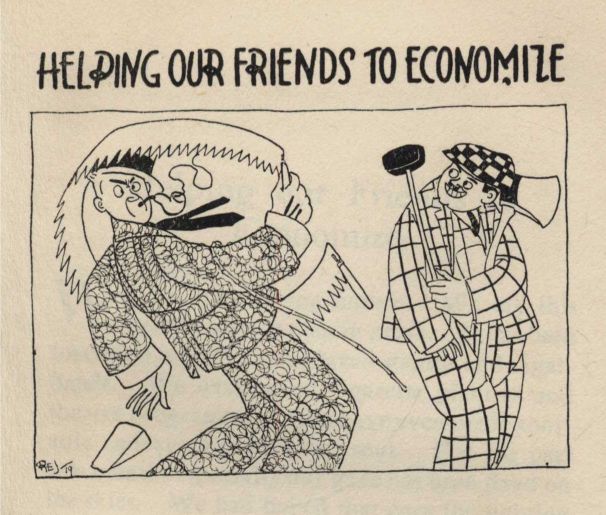
HELPING OUR FRIENDS TO ECONOMIZE
Helping our Friends to Economize
We are of a saving nature. We say this more in sorrow than in pride. It has been forced on us. We have saved stamps and cigar-bands. We have saved cigarette pictures and theatre programmes. We have even made sporadic endeavors to save our soul. For the past few months especially our gaze has been fixed on the skies. We had hoped that once the fighting was over—but peace hath her battles no less than war. So we turn our eyes to those celestial abodes where the Bolsheviki cease from troubling. Our only hope is in heaven. In fact, even a nice, quiet corner in hell—but, hush, let us not think of such things!
When we speak, however, of our saving nature, we refer principally, if not exclusively, to money. We have a disposition to save money. We would like to put away huge jars of it. We would enjoy sneaking down to the vault in the middle of the night to count our gold and gloat over it. We would do it even at the risk of getting our new pyjamas all dirtied up with gold-dust.
Not that we have ever been able to accumulate any vast amount of coin, specie, mazuma, cush, dust, rhino, bullion, long green—in short, money. No trust companies grow plethoric with our securities. No vaults strain at their rivets with our lacs of rupees. But the disposition is there on our part. We would save if we had the wherewithal.
That is why we have such a kindly feeling for others who are trying to save—especially now when the high cost of living has combined with the high cost of killing, as represented in war-taxation, to put such a crimp in a fellow's income that it looks like a French pea to a famished ostrich. That is why we never feel aggrieved when our friends don't invite us to dinner, or give us cold mutton or stew when they do. That is why we never make any remarks on the age of their hats or complain of the cold in their houses or express wonder that they don't light the furnace sooner. They are cutting down expenses and we sympathize with them.
We like to see people save. We smile benignly, as one who murmurs, "Bless you, children," when we catch them laying by for a rainy day. We believe in economy. At the same time, it should not be carried to extravagant lengths—at least, not at our expense. We are willing to help our friends to economize, but there are reasonable limits. They must not crowd the kindly mourner too far.
For instance, there is Binks—awfully nice chap, Binks. You must know him, short, fairly stout, wears lavender ties, and rides down to the office every morning on the rear platform of the street-car for the sake of the air. Great fellow for hygiene is Binks. Plays a good game of tennis, too.
Binks invited us over to dinner one Saturday not long ago.
"Tell you what," said Binks in his buoyant way, "come on over early—say, about two o'clock—and we'll walk out to my new lot in the West Annex if it's a fine day and get back in nice time for dinner. Great for the appetite—you'll feel like a prize-fighter after you've strolled around through the woods for a few hours."
It sounded good, and the day was fine, and we were there at two sharp—difficult as it is for us to be anywhere at anything sharp. We were neatly but inconspicuously clad in our walking clothes, Norfolk jacket, green hat, and pipe. We also wore a tan cane and chamois gloves. Nothing elaborate, you know, but grace in every line.
Binks, on the contrary, had on the worst suit we have ever seen out of the furnace room. A greasy old peak-cap reposed on his head, and his trousers were patched and frayed. We didn't mind that. We are not snobbish. But we did object to the tools.
Binks had a cross-cut saw, a sledge-hammer weighing approximately twelve pounds, an axe, and two steel wedges weighing about five pounds each. We looked long and hard at them, and longer and harder at Binks. He had the grace to blush.
"I hope you don't mind, old man," he said with affected lightness, "but there's a bit of a tree fallen down on the lot, and I thought it would be good sport to cut it up this afternoon. Great exercise, you know—brings all the muscles of the back into play. Besides, the wood will come in handy in the grate this winter. Stringency, you see—got to save every penny these times, eh, what?"
We are weak. We gulped once or twice, but what was there to say? We could do nothing but fall in with the plan, and let on that we were overjoyed at the prospect of bringing the muscles of our back into play. It did occur to us, however, that there might be jollier methods of doing so than cutting up fallen trees.
"You better carry the saw," said Binks, "it's light. I'll pack the rest of the stuff—unless you could carry one of the wedges. It's only a short way to the car, you know."
It was only a short way to the car, true enough. But, friend the reader, have you ever tried to carry a cross-cut saw? This particular one was about six feet long, and it had a full set of two-inch teeth, the suppleness of a boa-constrictor, and the temper of a worried weasel. It was simply a long thin band of steel with a heavy wooden handle at each end and enough elasticity to curl around you twice and reach up and bite the top off either ear.
The instant that we put the infernal saw oh our shoulder we realized that we had made a mistake. It slashed around in the air a couple of times to get the exact range, and then it dived down and chewed a neat triangular piece out of our trouser-leg. It would probably have kept right on through our own leg, if we had not by some happy chance or unconscious skill managed to get our cane in the way. This saved the leg, to which we not unnaturally attach a certain value, but it was the last of a very fine piece of malacca. That ferocious saw gnashed its teeth just once, and there were two canes where only one had grown before—two nice little canes each about twenty inches long and cut somewhat on the bias.
This was only a starter. In two seconds that saw had us tied up in a complicated knot, with one handle gouging us just under the left ear, and the other playfully wandering about our frame, while the teeth nipped off exposed pieces of cuticle here and there in an arbitrary and capricious manner. When we got a chance to examine ourself that night in the chaste seclusion of the boudoir, we looked as if we had been tied up in the cellar and the mice had got at us.
We shrieked to Binks to pull the thing off us. After some time and effort—also a few light casualties of his own—he finally did manage to extricate what was left of us. We were going to quit on the spot. We told Binks so with what he must have regarded as a great deal of unnecessary emphasis. But he is a very persuasive cuss, and—well, as we said before, we are weak. We consented to see the thing through. But we declined firmly to carry that saw another foot of the way. We finally compromised, however, and each took a handle. It was awkward but safe enough. The thing bucked occasionally and made frantic efforts to jump on one or other of us; but we held it tight and we got it to the car without further bloodshed.
When we tumbled on board, the conductor took one good look at our equipment and immediately became distinctly unpleasant. He asked us if we had mistaken the car for a motor-lorry, and whether or not we intended to bring a few trees along, too. He said it seemed too bad to leave them behind when there was all that room in the aisle. He also suggested that we should put the saw on the roof and let the handles hang down at each end of the car—he said it was less likely to kill anyone up there.
Our position was most embarrassing—even Binks almost lost his temper, though that wouldn't have done any good. The worst of it was that the passengers seemed to consider the vulgar brute funny, while we couldn't think of anything crushing to say in reply till we had got off and the car was blocks away. Then we realized that we should have said—but perhaps we had better save this up. We may need it some day.
We reached the lot at last after tramping through so-called woodland scenery for miles and miles. The landscape was a tumbled stretch of scrubby bush which had never been fit for anything once the original big trees had been cut off. So a soulless real-estate agent had sliced it up into suburban lots and sold it to enthusiastic asses like our friend Binks. Twenty years from now it will, no doubt, be a thriving and even fashionable suburb, but not now—Lord, no! It is possible, however, that we are somewhat prejudiced against this particular landscape. Who can enjoy scenery while tramping through it with a twelve-pound sledge, a five-pound wedge, and the handle of a cross-cut saw—sounds almost like a refrain, doesn't it?
How the mischief Binks was able to tell his own lot in that wilderness will always remain a marvel to us. But he picked it out all right, and there, sure enough, was the tree. It was the biggest, knottiest, meanest-looking jack-oak we have seen in years. No wonder the lightning struck it. The only wonder is that it didn't burn it right up.
"Isn't she a beauty?" gloated Binks insanely. "Won't those gnarled logs crackle fine in the grate this winter?"
We looked at him in gloomy wonder. Did the poor idiot think we were going to help dissect that ligneous monstrosity entirely? We didn't mind cutting off a limb or two, but no more—not in one day. Little did we suspect the fate that was hanging over us.
"And now to work," said Binks with the imbecile cheerfulness of his kind. "We'll cut this old rascal into handy lengths in a couple of hours or so, and then the carter will come along with the team, and we'll ride home on the load—just like one of those old pictures of forest-life, you I know."
But we were in no mood to enthuse. Slowly and sadly we pulled off our Norfolk jacket and folded it neatly. We turned a wistful and lingering regard on the landscape; and then we betook us dismally to our toil. We were helpless in the grip of Bink's will, a regular slave of the lamp.
That afternoon will remain a nightmare for years to come. Whenever after this we go into gilded dens of folly and eat lobster à la Newburg, whenever we commit indiscretions with mince-pie or home-made whiskey, we know the form our penitential dreams will take. We will see ourself standing at one end of that awful saw with Binks at the other, and we will go on forever and ever shoving the saw away from us and pulling it back again through a cast-iron log with Bessemer-steel knots, which will shriek in agony at every stroke. And Binks will be wearing a red suit of tights and a pair of cute little horns and a spiked tail.
It was a terrible experience. What Binks said about bringing our back muscles into play was perfectly true. We brought them into play with a vengeance. We brought into play muscles that we never dreamed of possessing. But we didn't like the way they played. There was something very rough about it.
The shades of night fell softly upon us, and still we sawed. The hoot-owls hooted at us in derision, but still that fiendish saw rasped on. In the beginning we had suggested rest a few times, but Binks merely assured us that once we got our second wind we would be all right.
We got our second wind, but it wasn't long before we used it up. Then we called out our third line of reserves, our pulmonary landsturm, so to speak, and we exhausted that, too. By the time we finally quit we were using only the extreme upper lobe of each lung, and all we could do was to gasp and hang on to the handle of the saw lest the thing should leap at us and sink its teeth in our jugular.
Finally Binks stopped. We had cut through the last knot of the last limb of the last length of that interminable trunk—by this time it seemed seven miles long. Binks stopped, and we fell in our tracks. We dropped where we stood, right there in the saw-dust.
"Tell you what," said Binks mopping his brow—we could barely see him in the darkness—"tell you what, there is nothing like this fine, simple, open-air life to make a fellow feel like a king."
The creature was inexorable. His remark was a gratuitous insult; but we were beyond the desire or even the possibility of reply. We could only lie there on our back and look up longingly at the stars, and think how mother used to steal in and kiss us in our little white cot, and how horrified Binks would be when he discovered that we were dying.
"Great Jumping Jee-hosophat!" shouted Binks a moment later. He had struck a match and looked at his watch. "It's a quarter to eight, and we were to have been back at dinner at seven. And that damn carter hasn't come yet!"
He said a lot more about the carter, and the carter's family for some generations back, and the carter's prospects in the future life. Binks is not exactly a cussing man, but he gave a very fair imitation of one—it would do till a real cusser came around.
We heard him, but we heeded not. We just lay there and smiled blandly at the Milky Way. We had reached the point where we didn't care a darn if the race of carters became utterly extinct, and we were extinguished with them. All we wanted was to be left alone.
Binks, however, was indomitable. That man's energy was positively terrifying. He got us on our feet, put our coat on us in spite of our feeble resistance, stuck one end of that fatal saw in our hand, and dragged us two miles or more through the bush and the darkness to the street-car. With the help of the conductor he lifted us on and propped us up in the end of a seat. We remember that we moaned when they took the handle of the saw away from us. We had grown attached to it.
We don't recall much about the trip on the car, except hearing the conductor tell Binks that people who couldn't carry liquor any better than we seemed able to do shouldn't be allowed to have any. He said that sort of thing was what started Prohibition movements. And Binks agreed with him!
When we got to Bink's house, the dinner had long since been burned to a crisp, and Mrs. Binks registered about six hundred pounds pressure on her temper-gauge. It was a terrible meal. We don't remember what we ate, or whether we ate at all. All we know is that when it was over, we stumbled right over to our hat and then back to Mrs. Binks.
"Goo' night—lovely time," we said. "Hope you're the same!"
Binks saw us to the door. As a matter of fact, we had started to walk into the fire-place. He seemed to feel the need of some explanation.
"Sorry, old man, about that infernal carter," he said, "but tell you what we'll do. Some day next week we'll stroll out to the lot and have the fun of loading up, and then...."
We are not quite clear what it was that we said to Binks, but we must have said something fairly significant, for neither Binks nor his wife has spoken to us since.
Of course, we are sorry that Binks and his wife feel that way about it. But after all the first law of life is self-preservation, and we can't afford to run that sort of risk again. We didn't heal up for a week or more after that dreadful grapple with the cross-cut saw. In fact, we had some notion of going to a surgeon and having the bites cauterized.
Even this was nothing to the soreness in our legs and arms and the famous "back-muscles" that Binks brought into play. We spent all our evenings for the next fortnight rubbing arnica into them—also a wonderful liniment which our landlady gave us. It must have been a fine liniment for it smelled so strong that people turned around and looked after us on the street, as if they thought we ought to be quarantined and were in two minds about calling a policeman. And we didn't dare visit our friends. But then what's the use of going to see a lady if you moan in pain every time you try to put your arm around—well, around the back of the chair?
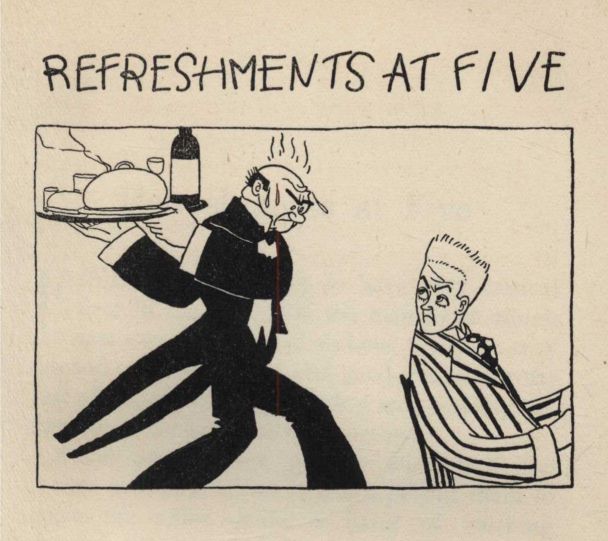
REFRESHMENTS AT FIVE
Refreshments at Five
Five o'clock appears to be a very critical time in the day. On the manner in which the next three-quarters of an hour are spent may depend one's well-being and good temper for the rest of the day and the evening and possibly the first couple of hours of the morrow.
Some people—low persons who need the money or whose bosses will not permit them to leave the office—make a habit of working through till six, or whatever time it is that they punch the clock and go home in a street-car strap. Naturally such persons have no place in an article of this character.
To sensitive and cultured people who have spent the afternoon playing bridge or in the cellar brewing the family liquor—that, we believe, is the intellectual pastime of the moment—or in mahogany-furnished offices persuading innocent folk with money to buy Nicaragua banana-lands or bunk stocks on punk margins, five o'clock is the blessed hour of surcease and repose. It is balm in Gilead, cool rains after the heat of the day, a friendly hotel after walking across a "dry" county, divorce after—oh, g'wan and make your own metaphors!
Personally we are an ardent and determined five-o'clocker. We have played it every way there is—straight, for place, for show, and across the board. There is no kind of five-o'clock performance—in accordance, that is, with the purity and piety of our character and upbringing—that we have not done or witnessed. We have attended teas of every description and shade of color, pink, yellow, mauve, and with dashes of cerise. We have gone to the tango kind, and to those discreet teas in sequestered corners of tea-rooms to which one conducts fair students of the drama after the matinee.
In older and perhaps happier—certainly freer—days, we were a frequent guest and occasional host at little informal five-o'clock functions, where one inquired of the rest of the company what they were having and requested the attendant to "fill 'em up again, Jawn!" We attended such functions in clubs, cafes, and those democratic places of resort which were entered by swinging doors—up to eleven on ordinary nights and seven on Saturdays. And we did this as part of that systematic study of humanity—including the things they eat and the drinks they drink—which is recommended so earnestly by the philosophers.
All this is by way of letting the reader see how thoroughly qualified we are by nature and training to write on this important subject of five-o'clock refreshments. We say "important" advisedly and with no ironic intent. We have devoted to the question of how best to spend the time between five and a quarter to six much time, energy, and serious thought—not without considerable difficulty and several vigorous rows with persons we have at various times consented to work for. And, as a result of our studies, we are convinced that rest and refreshment at five are a human necessity, whether you take it with two lumps or with soda, and whether you eat out of the "curate" or off the free-lunch counter.
Of course, this whole institution of five-o'clock refreshment is an intensely modern and hyper-civilized development—at least, here in Canada. It represents a reaction from the nerve-stresses of up-to-date urban existence. Our sturdy forefathers knew it not, and verily there are still many places where people do not practice it. Farmers as a class, for instance, have still maintained their ancient prejudice against eating and drinking till it is too dark or the weather is too bad to do anything else.
Naturally there would have been something absurdly incongruous in our great-grandfathers stopping in the midst of shooting bears or Indians or burning out a clearing, in order to tramp back to the log-cabin for a pimento sandwich or a cup or two of oolong. But, even at that, we would hate to believe that the old boys didn't occasionally knock off for a few minutes about five, and drag the old cider-jug from its place of concealment in a hollow stump, and have a pull or two at the juice that cheers and eke inebriates—if it is "hard" enough.
Five-o'clock refreshments, however, as we know them, are a peculiarly modern institution. We got the habit from England, where we get our spats and our knighthoods, our green hats and our Governors-General. In England they all do it, and it won't be long before we are all doing it, too. Talk about the effects of the War on our soldiers!—if you could see the splendid fellows now pouring their own in the tea-rooms, you would fear the worst.
A friend of ours who occasionally—and even oftener if things are slow at home—takes a run over to London to refresh his accent and to study life in its more dignified and also its lighter phases, has told us of a visit he paid to a great English factory. As he was being shown over the plant by the owner—jolly old dog, too, egad!—a gong sounded suddenly. Everybody instantly dropped their tools and climbed down from their machines; a gang of waiters burst upon the scene carrying huge trays of steaming cups with two little crackers on the side of each saucer; and everybody had tea. Even the boss, just to show what a democratic old cuss he was, had a cup with the rest—the clawsses drinking with the mawsses, so to speak.
Once in our journalistic youth—we felt about a hundred and eighty in experience of life—we had occasion (meaning we were sent by a profane and peremptory city editor) to interview the heads of a great business corporation regarding the financial situation. It was a time of panic, and this particular concern was reported to be in a bad way. A heavy sense of responsibility weighed upon us as we loosed our pencil in its patent sheath, and entered the office of the two brothers who directed the destinies of the company.
They were at tea! A fat, perspiring waiter—why do waiters always perspire?—had just carried in from a neighboring cafe a large tray bearing a tea-pot, a jug of hot water, plate of sandwiches, ditto of cute little cakes, and all the various accessories of tea-making and drinking. Our heart sank. We felt that this particular company was doomed. It wouldn't have been a greater shock to us if we had discovered them playing marbles—in fact, we would have been more likely to regard marbles as an amiable eccentricity.
They hospitably insisted that we should join them, but we declined with decision. We felt as if we had been invited to take out our sewing and while away a pleasant hour with the rest of the girls doing embroidery and eating marshmallows. But our contempt for these particular gentlemen was slightly modified by their producing cigarettes—very good cigarettes, too—after tea and lighting up. Naturally we joined in that. And our feelings were changed to something like genuine respect when we discovered what rattling good "copy" they could talk. Oh, they weathered the financial gale all right, in spite of the tea. And the experience made us more tolerant of the vice.
As for the ordinary sort of pink tea—you know the kind of thing where the dear boys in morning-coats pass the vittles to the dear girls in feathers and a string of beads—we are a hardened and weary veteran. We used to be one of the best young amateur waiters you ever saw, and could juggle a "curate" with a grace and efficiency that would have been the despair of Beau Brummel, if he had survived to witness it. But never again!
Incidentally, why are those three-storey arrangements called "curates?" Is it because they are always planted among the girls? Or because social events are not really respectable without one around? Or is it simply because they can hold so much cake?
Whatever the reason for the name, we became an out-and-out expert at wielding the things. Handing cups of tea with the right hand, and with the left dealing from the top or bottom deck of the "curate" with equal ease, we must have been a genteelly inspiring sight. But we have no joy of the recollection. Think of a healthy man spending his time like that!
Of course, we still go to teas occasionally—even the most fertile and mendacious excuser is sometimes caught without an alibi. Not that these social evasions are lies exactly, but you know the way one says: "Next Thursday did you say, my dear? So good of you, and I would just love to, but I'm all filled up for next Thursday," etc., etc. And being "all filled up," naturally one cannot be expected to fill up any more. But sometimes it is not so easy to get out of it, and we are occasionally caught by a sudden flank attack. But we are never a willing prisoner—we go down fighting desperately to the last.
As a matter of fact, teas long ago ceased to hold any delight for us. Like Martha we chose the worser part; but this was back in the wicked days before Prohibition descended on us all like a bomb from a Zeppelin. Every now and then—not every day, for we were not unabashed in our delinquency—a friend or two would drop in about five. We would discuss the weather in a dispassionate and scientific manner, as well as the Mexican situation—it was the only war on at the time—and the prospects for the baseball or hockey championship, according to the time of year. We talked of many things, but all in the same cool and detached way, as of men whose minds were elsewhere and busy with more vital matters. Then suddenly we would all rise up as one man and go silently away to a place we wotted of, where the clerk knew us by name, and asked us if we were having "the same old poison." Or better still, he would nod in a friendly way and without waiting to ask would set out the materials on the ba—no, no, counter!—with calm assurance bred of an intimate knowledge of our preferences.
It is a curious trait in human nature but the average man used to take much joy and pride out of having a refreshment-clerk—and when we say "refreshment" we use the word in its most dynamic significance—call him by name and hand him out his favorite brand without asking. It did him more good than if the president of the bank he made his over-draughts on had picked him up in the presidential limousine as he was walking down to the office of a morning.
Perhaps we should not speak about these things now that they are over and done with and everyone is reformed and uncomfortable; but how is the coming generation to know anything about the habits of us their ancestors, unless someone tells them the thirsty truth? As a matter of fact, it is more than likely that the reader of fifty years from now, coming on this book among some empty bottles in a dark corner of the attic, won't know what the dickens we are talking about. Poor old John Barleycorn may have ceased to be even a memory, and—but then again perhaps he won't. Very hardy old chap, John!
We do not wish, however, to close this veracious and useful disquisition on what might be called the Bacchic note—though Bacchic in the most gentlemanly and respectable sense, of course. Besides, all this talk of teas has reminded us of one which we like best—though it is a wistful pleasure—to remember. You see, it was quite a long time ago, and—but let us get on with the story.
To begin with, we had telephoned to the house—Heaven only knows about what! Any old excuse was a good excuse in those days. And she said, after a certain amount of persiflage and badinage—you know the sort of thing people talk over the 'phone in the spring—she said to come up and have a cup of tea with her.
It was right in office hours and we had a lot of work to do. But did we go? Yes, Friend Reader, we did. We rushed out clutching our hat in our hand, nearly broke a leg catching a car, and every time it stopped to let anyone on or off, we indulged in a line of mental profanity which must have created a faint blue aureole around our head like a mediæval saint.
They were all out—the family, that is—even to the servant-girl. But we didn't mind. In fact, our relief was such that we realized at once it would be unseemly to show it. Our recollection is that we expressed a certain mild regret for their absence—Lord, what a liar a man can make of himself at times! Then having behaved like a really nice boy, we had an apron tied on us, for we had to help make the sandwiches. A pair of very pretty arms reached round us from behind and hung a silly little arrangement of linen and frills upon our manly waist, after a great deal of tugging and squeezing, which was rather complicated by our irresistible inclination to twist around and watch the strings being tied in the middle of our back—obviously a difficult feat of an acrobatic nature.
The sandwiches were finally made—we remember we were told we had spread the butter too thick. Then we carried the tray in beside a grate-fire, just an ordinary gas-grate, but if it had been the fires of the eternal dawn it couldn't have seemed any more cheering. Sunlight streamed in through the window on a big bowl of daffodils, themselves like a great splash of sunshine. Outside in the street youngsters were at play. We never even yet eat a certain kind of sandwich that we don't remember....
But, oh, pshaw, what's the use? What's the use? Besides, think how much freer and more solvent we are in our present celibate condition. But there are times and moods, mere trifles like a glimpse of flowers in the spring or a robin's song or the odor of wet lawns, which bring her back to us again and make us wince once more as we recall that her name is now Mrs. Spoffkins.
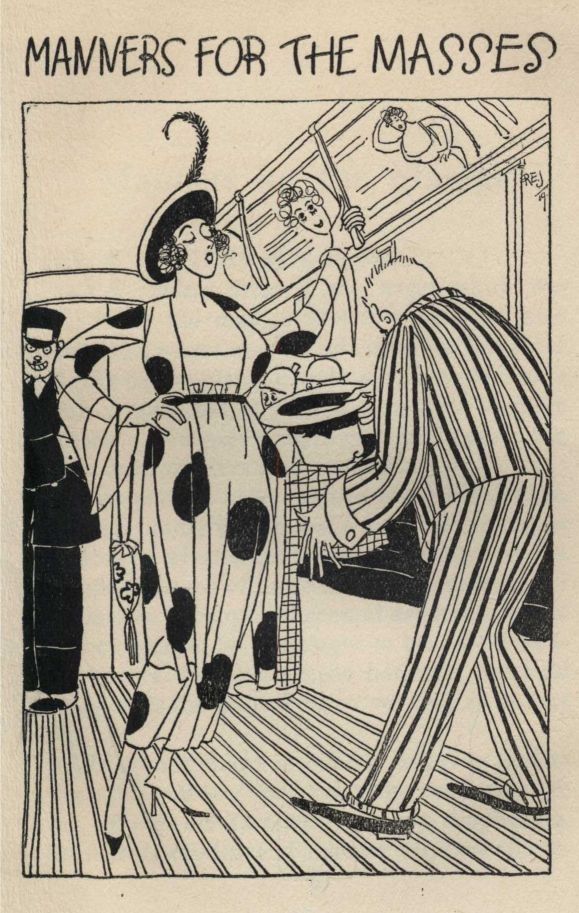
MANNERS FOR THE MASSES
Manners for the Masses
"Manners Makyth Man."
How often in our eager youth was that hoary old maxim quoted to us with stern insistence, what time we had seized the last piece of cake on the plate, or were absorbing our soup with a noise like that of a punctured vacuum cleaner. Manners makyth man, perhaps; but in those days manners made us tired.
Now that we have attained manhood's estate, however, and grey hair and a nice discrimination in Scotch, when there is any to practice on, we realize the need of more manners—manners for the masses. People in general are not so polite as they used to be and ought to be. Street-car conductors, for instance, do not treat us at all times with the consideration we feel to be our due.
We do not object so bitterly to being told to "step lively there," or having the conductor jab the end of the fare-box into our diaphragm. Such little crudities of manner are perhaps inseparable from his rather trying profession. But the other day we handed a conductor by mistake a quarter of suspicious antecedents—metallurgically speaking, of course. Money we can't pass is the only sort of tainted money we recognize. We fear this particular coin contained more than the usual amount of alloy. As a matter of fact, we hadn't intended giving it to him at all. We had laid it aside for a church collection, or a tag-day, or the first pretty Salvation Army lass we should see with a "self-denial-week" box at a street corner. But it got into the wrong pocket.
We handed it to the conductor and said, "Blue, please!"—alluding to the cerulean hue of the tickets. He turned it over two or three times in his hand, glared at us, walked down to the rear platform to see it in the better light there, asked two or three men what they thought of it, and then carried it back to us between the thumb and index finger of the right hand as though he were holding something dead by the tail. The whole car watched him drop it with a thud into our grey-suede palm.
"The Company don't let us take nothin' but silver quarters," he remarked in a loud voice and with quite undue emphasis on the "silver."
We had to hunt through our pockets for a five-cent piece to put in the box. It was a very painful moment, and naturally the only nickle we owned hid itself amid a mass of coppers—we had enough of them to bust our suspenders. And while we hunted, the conductor stood there and shook the box belligerently under our nose.
Therefore, we repeat, let us by all means have more manners—manners for street-car conductors and plumbers and elevator-men and the masses generally. Not even bank-clerks are altogether above reproach in this respect. We have had several rather regrettable experiences with bank-clerks—usually in connection with slight over-draughts. And yet bank-clerks are generally regarded as the budding Chesterfields of the financial world.
Talking of Chesterfield reminds us of that period in our development at which his "Letters" burst upon us as a brilliant and a guiding star. We were about sixteen, and our voice still oscillated between a squeaking treble and a booming bass. We were also having considerable difficulty in keeping our extremities decently within the compass of our clothes.
Our manners at that time were those of a breezy but well-intentioned caveman. No effete conventions for us!—no, sir, nothing but the simple, unaffected utterance of the heart. It was our aim to be a rough diamond, a fellow whose shaggy exterior concealed a beautiful soul, and whom people would come to understand and love after a long time—maybe, after we were dead. We could see ourself smiling peacefully in our padded coffin, while the family wept all over the oxidized-silver plate bearing our name and two dates—n-n-nothing m-m-more!
Perhaps this shaggy-breast-and-heart-of-gold business was not "getting across" as successfully as we had hoped. Perhaps we had grown weary of doing little acts of kindness and of love in a rude, untutored way. Or perhaps the time was merely ripe for a new phase of our social development. Anyhow, we one day picked up Lord Chesterfield's "Letters to My Son," and at a bound became a suave and graceful man of the world, concealing under a smile of wistful charm a cynical and disillusioned heart. Whatever might be the bitterness of our regrets, as befitted a man who had known life and women and had suffered, no shadow disturbed the serenity of our brow. We continued to smile and bow with the old nonchalant grace, as though it were roses, roses all the way. This was the impression we tried to convey, at any rate.
The family received our change of heart and manner in a spirit of levity against which our new ideals were not always proof—but you know the gentle way of families. Instead of teaching the young idea how to shoot, they are apt to suggest that it ought to go out and shoot itself. Naturally we suffered, and not unresentfully. In fact, we so far forgot ourself as to try to lick our younger brother—a very un-Chesterfieldian endeavor, and not entirely successful. He had a rushing style of fighting which—but there are bygones which had best be has-beens.
Of course, we have long since realized that it isn't wise to carry even so good a thing as manners to an over-elaborate extreme. Not long ago we had an instance of this—which brings us back to a street-car again. Wonderful how much one can learn in those humble but interesting conveyances! It was a crowded car, and we got up when a statuesque young woman in a very tight skirt stood right in front of us. We got up as gracefully as the movement of the car would permit, and hanging on a strap with the skill of long practice we adroitly removed our hat and bowed. We wanted to let her know that our action was the expression of a distant but chivalrous respect.
The statuesque young woman never quivered a hair of her expensive willow-plume, but stared penetratingly at a male collar-ad just over her head. Perhaps she had not seen us in her reverie. Perhaps the face of the young gentleman in the dreadfully conspicuous collar reminded her of someone she knew or loved or both—though we have never known any human being to look like those faces, and certainly would not think of loving him if he did.
Whatever the reason she certainly did not see us. We waited for a block or two, and then we made bold to touch her arm just above the chain of her beaded bag—it looked like something the Shah of Persia would wear.
"Madam," we said in our most mellow and flute-like tone, "won't you take this seat?"
She flashed on us a pair of large, dark pupils—belladonna, we presume—and said in a voice like the drip of an icicle in a cemetery, "I don't care to sit down."
That was all—no "Thank you" or "Much obliged" or any other of the ready phrases of casual courtesy. Just, "I don't care to sit down."
It was an unfortunate and deucedly embarrassing experience. We didn't like to sit down again—in our confusion we would probably have sat in someone else's lap. And yet it seemed frightfully silly for the two of us to go on standing there in front of that empty seat. So we stopped the car and got off half a mile from home.
Now, why did she do that? Was she afraid that if she sat down and said, "Thank you," we might presume on her graciousness to make a few timely remarks about the weather, and after a brief survey of the Russian situation or the newest thing in "movies," should end up by offering her some gum? Or, on the other hand was she a suffragette who refused to be put on a basis of inequality and treated as a member of a weaker sex? Did she see in our action the gloating superiority of man the master?
Then again she may have been unwilling to sit down because—well, because—oh, dash it all, you know how tight those skirts are! Besides, occasionally in shop-windows and while hurrying modestly past certain "circles" in department-stores, we have inadvertently seen articles of feminine attire (warranted pure whalebone) which would seem to make the operation of sitting down a difficult and painful feat of compression. We feel a certain delicacy in mentioning this, and not for worlds would we dream of using the language in which these garments are described in the newspaper ads—the accompanying photographs almost make it impossible for us to read them. But the fact remains that the statuesque young lady in the car may not have been able to bend any more than her neck, which was quite bare and untrammelled halfway down the lungs.
Of course, Lord Chesterfield and all the books of etiquette since his time have been strong for self-possession. A man, they say, should be self-possessed under any and every circumstance—the more surprising and unpleasant they are, the more self-possessed he should be. It is the secret of good manners.
Now that is just the sort of excellent and utterly futile advice that we are always getting. Be self-possessed—sure! But how? That's what we want—specific directions, not general advice. We would welcome a few concrete illustrations for maintaining one's self-possession when meeting one's recently divorced wife, for instance, or after dropping a soda-check in the collection plate, or while mother is showing pictures of one as a baby, or while purchasing long silk hose and explaining that auntie is having a birthday. Situations such as these are apt to occur in the most skilfully regulated lives, and naturally we would like to know what to do—meaning, what to do with our hands and the perspiration on our brow and the blushes on our face.
Just as a case in point—we went into a department-store some months back to buy a thimble. We do a little sewing now and then, you know—nothing fancy, just buttons and repairs of a temporary and intimate nature. It occurred to us that we ought to have a thimble. A bed-post is all right, if it is handy. But you are not always near enough to be able to shove the needle against it; and naturally one can't very well carry a bed-post around with one, can one?
So we decided to buy a thimble and went into a department-store for the purpose, having previously steeled our breast and made brazen our countenance. But we didn't have the courage to ask anyone, least of all a floor-walker, where the things were sold. For fifteen minutes we wandered about peering at the various "circles," and rousing the worst suspicions of the shop-detectives. There were at least two men shadowing us by the time we finally saw a tray of thimbles and rushed at it with a gasp of relief.
Our relief, however, was premature. There was a girl standing back of the tray—not the usual beauty in a lace blouse, who toys with her back-hair and stares through a man with devastating indifference. We were prepared for that sort, and had several curt and peremptory things ready to say. But this was a nice, motherly girl, the kind of girl who makes a man feel that he is just seven years old and is about to have his face washed. These are overwhelming!
"A thimble?—you want a thimble?" she asked with an air of bustling solicitude. "What size? But, of course, a man never does know the size. Let me see your finger."
Now, we had started out with an insane notion that we would say the thimble was for our wife, who was too ill to come down-town and wanted a thimble for a little crochet-work or something to while away the time. You know the sort of silly yarn a man would naturally invent. But we realized at once that it was no use here. We felt that this girl knew we were a bachelor; knew the sort of sewing we do; and probably knew just what buttons were missing on just what coat, and all about that rip in the waist-band of our trousers.
So we held out our finger—our index finger! Patiently she put it back and took the next one to it, holding it very firmly while she tried two or three thimbles on it in rapid succession. We felt like a June bride watching the bridegroom fiddle with the ring.
"Will you take this thimble?" she finally asked.
"I w-w-will!"
The infernal phrase slipped out in spite of us, in a voice which we in vain endeavored to make assured. It was an absurd predicament. All that was lacking was a parson and that tum-tum-tiddee thing from "Lohengrin."
"But isn't it a little loose?" she persisted. Then she took it off and tried on a few more. By this time three or four other girls had come up, and were inspecting us with a detached and somewhat contemptuous interest—all except a little fool who blushed and giggled. If the maternal one hadn't had such a tight hold on our finger, we would have run. We could feel the perspiration sizzling on our burning cheeks.
"Ah, that's better," she said at last, after she had tried on about fifteen. "Men always like them tight, you know. And now you want some thread, don't you?—some nice, strong, black and white thread."
We did, but we wouldn't have admitted it for anything in this world—or the world to come either. Not if we had to fasten our suspenders with clothes-pins. We simply seized that infernal thimble and hurried away in such a blind agony of shame that we forgot our change and nearly knocked a floor-walker down.
Self-possession—gawd!
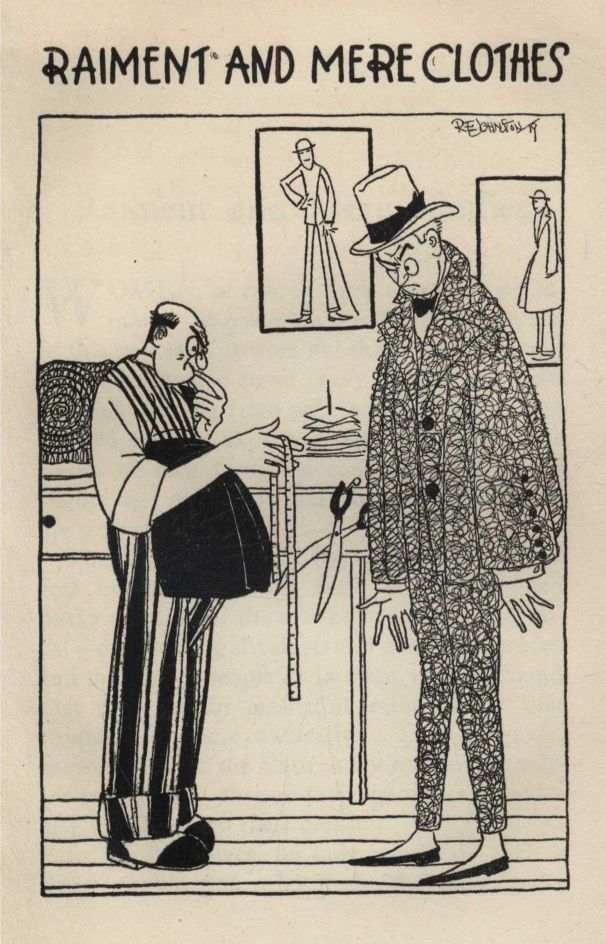
RAIMENT AND MERE CLOTHES
Raiment and Mere Clothes
Women, of course, dress to annoy one another. We wouldn't be guilty of a truism of this nature, if it were not that a lot of worthy people have gone about lately talking and writing and warning from pulpits as though women dressed for the express purpose of luring the minds of men from the contemplation of the higher and more spiritual things to which they are naturally inclined.
There has even been a Papal Bull—or if not a real honest-to-goodness Bull, at least a good husky yearling of the sort known as an Encyclical—condemning slit skirts and demi-tasse waists and the dances people do in them, on the ground that they put in masculine minds ideas that wouldn't be there naturally. This, however, shows how little the Vatican knows about feminine psychology—though their ignorance is naturally very much to their credit.
In the first place, no lady would do such a thing—would you, girls? In the second, the average man is too unobservant. And in the third, the women are too busy considering how to "put it over" one another, to have time to worry about the effect of the things they wear—or don't—on their male entourage (with the accent on the "—rawzh," the Society Editor assures us). As we said above with epigrammatic force and brilliancy, women dress to annoy one another. The mere fact that someone else or several may have said the same thing before does not lessen the truth of the aphorism or the pleasure we take in it.
Whatever their motive, women devote a lot of thought, time, and some man's money to the subject of dress. Most people are agreed on this. With men, however, it is supposed to be very different. There is a curious theory that men don't give a dern—whatever that may amount to—about their clothes. People generally seem to have an idea that a man waits till his suit is torn, or so shiny that he gives the effect of an animated heliograph, before he orders another. And when he does, he is supposed to rush in to his tailor for half a minute between important business calls, or he rings him up on the 'phone.
"Send me up a new suit," he shouts, or something to this hasty effect. "What color?—oh, any old color you got. Something that will wear a long time. Solong!"
That is the way most women and a few men think the average man buys his clothes. But they are wrong. If you want to know how wrong, you have only to go into a tailor's place, Friend Reader—supposing you keep a tailor and not a bargain-counter—while some fat old boy with mutton-chops and a protuberant abdominal profile is raising the dickens because the poor tailor can't take the strain off the trouser-band and put it on the top buttons of the vest. Then you will learn that the shaping of collars and shoulders is a matter of supreme masculine concern, and that the hang of a trouser-leg is a thing on which the happiness of years may depend. Then possibly you will come to the conclusion that the average man thinks a great deal more about his attire than you have ever suspected.
Not that the average man's clothes are numerous or conspicuous—not at present prices, anyway. On the contrary, they are usually quite few and inconspicuous—except possibly from age. But the fewer they are the more attention he has to devote to them. That is the paradox of the thing.
A wealthy Adonis—or one with a good line of credit, at least—can adopt a careless attitude towards his clothes. He may even keep a valet to worry about them. When he orders a new suit he orders two or three. His shirts and ties and socks he buys by the dozen. Suits he doesn't like, he doesn't have to wear. If he grows weary of a certain color or pattern—one of those shepherd-plaids you can play chess on, for instance, or a nice hot brown that would melt the film of a camera—he tosses it to his man or an itinerant Hebrew and turns to one of a dozen other outfits in the wardrobe. Why should he worry? He doesn't.
The man, however, who gets a couple of suits a year—or more probably only one—has a quite different problem to face, calling for the finest qualities of artistic and economic judgment. With what anxiety he studies the various samples of cloth! Will this wear well? Will that one gloss? Will the grey go with his brown overcoat?—perhaps not, but then the green is so striking that people will notice it next year and remember.
Then as to the cut. It must be in the style, but not too pronounced. Those lapels are too wide, or the slit in the back isn't long enough, or the cuff on the trousers isn't sufficiently deep. One has to be careful, for—dash it all!—the suit has to do two years. So he worries the life out of his tailor for an hour a day through a fortnight or more, brings the coat back three times for alterations, and then pays for the suit in small instalments.
If a man's troubles were over once he got his suit, it wouldn't be so bad. But the older a suit gets the more trouble it gives. For one thing, you have to keep it pressed. Coats will get wrinkled, and human knees are obviously intended by nature to put bags in trousers. Occasionally, too, while playing approach shots with the soup or making short putts in the pudding sauce, a gentleman is liable to foozle and get it all over his vest—unless, of course, he makes a habit of tying his napkin around his neck. Incidentally, this is a much more sensible system than draping it over his right knee. Who ever spilled anything on his right knee, anyway?
These are serious questions to resolve. What should one do about it?—have a fellow in livery and a Ford call around once a week and carry one's garments off and bathe them in benzine and manhandle them with electric-irons? This is handy, of course, but in a few months it costs more than the suit is worth. Tip the cook, then, to press your trousers, and trust to heaven and a patent-hanger to keep the coat in shape? Sometimes this works, but naturally a lot depends on the cook.
Once we entrusted the trousers of our "other" suit to the cook, a colored lady of unblemished character and cheerful disposition. We were going out informally that evening, but we wanted to make a good showing, and we needed those trousers pressed in a hurry. She pressed them all right. She pressed them so hard she almost split the cloth on the edges. But when we saw them—modestly stretching a bare arm for them around the corner of the door—we smiled bravely, thanked her for her exceeding goodness, and then closed the door and wept feebly upon them. She had put the creases in the sides! Since then we make a point of keeping our "other" trousers under the mattress that they may be ready in cases of sudden emergency.
Another difficulty is in the matter of the buttons to be sewn on and the occasional rents to be mended. These are more slings and arrows of outrageous fortune which noble bachelor minds are called upon to suffer. Landladies are sometimes kind-hearted and can be flattered into displaying other domestic virtues than those connected with the making of beds and the frying of matutinal bacon. But usually they are too busy. Of course, a man can always get married, but ... and you don't always get your buttons sewn on, at that.
Personally, after much worry and embarrassment, we have acquired a very decent skill with the needle—nothing fancy, you know, but substantial. We can't use a thimble yet with any confidence, but there is usually a bed-post handy to shove the needle against. Not even during the patriotic activities of the war did we have any occasion to sew in hotel-lobbies or at concerts or in street-cars. What sewing we do is done in the privacy of the boudoir, and only when vitally necessary.
We have a friend, rather a dandy, who says that the ideal of good dressing—no, not the kind that comes with a turkey, girls—is that a man's personality should show through his clothes. This, of course, is very æsthetic and quite as it should be. But the thing must not be overdone. Occasionally a man's personality shows through too clearly, and then the only thing to do is to take a large needle, double the thread, and sew the place up.
Some day we hope to have a million—honestly acquired, we trust, but still a million. When that happy time arrives, we will dress as we darn well please. We will wear old clothes and let our pants bag at the knees. We will cease to pinch our feet in tight boots, or half-strangle ourself with high stiff collars. And people will not despise us for our shabby exterior. On the contrary, they will admire us for it, and think we are a democratic old cuss, and forgive us for owning so much money.
Till that period of affluence arrives, however, we will be forced to go on devoting too much time and attention and money to our habiliments. Not that we are a "knut," Friend Reader—the mere thought fills us with horror. On the contrary, our whole endeavor is to avoid the garish and extreme. We aim at elegant discretion. It is our ideal to give the impression that we are a wealthy amateur who has taken up journalism as a hobby.
A time there was, however, when we cherished other notions of journalistic attire. It was when we had first left our alma mater—one's alma mater may be anything from a night-school to five years at Oxford—and had entered on the high mission of moulding public opinion at "twelve per." Then it was our ambition to be Bohemian. We wore very wide-brimmed hats, and low collars with generous openings in front so as to display the Adam's-apple in all its unfettered freedom. We never brushed our clothes, and we kept our hair rather long. We wanted to look like an eager young genius, whose gaze was on far and high things, and who spurned such petty distinctions as are conferred by creases in the front of one's pants.
One night our theory of sumptuary beauty received an awful jolt. The discovery was forced upon us that other people did not see eye to eye with us in the matter of the æsthetics of dress. There was one suit we owned—one of the two, that is—which we hated with a whole-hearted hatred. It was too much even for us. We bought it from a friend who had just gone into the tailoring profession. It was probably his first case, and the operation was not a success—he was nervous, perhaps. The cloth was a heather-mixture—that is what he called it, at any rate, though the color suggested that a number of chameleons had committed suicide on it. The cut was indescribable. The coat was dimly reminiscent of a Roman toga—we had told him to make it loose—and the trousers were obviously modelled on those of Micawber in old illustrated editions of "David Copperfield."
Being unable to afford the relief of throwing the thing away, we tried to get a certain amount of wear out of it under an overcoat. One evening when we were surreptitiously taking it for a walk under a mackintosh, we met an artist friend of ours. He was all muffled up to the throat, as though he, too, were concealing a sartorial mishap.
"Come on over to the Art Gallery," said he, "there are some rather nice things over there—imported."
We like pictures, especially those foreign ones—"Lady with Green Stocking," you know the sort—so we hastened gladly along with our friend, only stopping twice on the way. It was before the advent of Prohibition, and—well, if we had known what we were going to run into at the Art Gallery, we would have had about a quart, neat.
When we reached the place and our friend struggled out of his overcoat, we saw that he was in evening clothes. We were surprised, but thinking he was perhaps saving his business suit—besides, you never can tell how an artist will dress—we said nothing. But when we got into the gallery we understood. It was opening night, private view, by invitation only—the complete formal caper, b' Jove!—and every blessed soul in the place was in full regalia. Every woman present seemed to be "posing for the bust"—that, we believe is the technical phrase—and the gentlemen could be distinguished from waiters only by the wrinkles in their clothes and the faint aroma of camphor and moth-balls.
We would have cut and run if we had been given the chance; but our friend was a hospitable chap. He grabbed us by the arm and dragged us about from picture to picture, while we perspired agony at every pore and everybody in the gallery glared at us as though we were the tattooed man clad only in our illustrations. Art-lovers are supposed to be an unconventional set. If you want to find out how unconventional they are, go to an "opening night" in business clothes, and see!
Finally we made our escape—we pleaded illness or a twisted ankle or something of that sort. We hurried home and as soon as we got there we pitched that suit out of the window. It caught in the branches of a tree where it stayed till the family made us get a ladder and take it down—they said it gave the public the idea that the gentlemen in the house ran around without any clothes on.
We never did wear it again. The very next day we went out and bought a set of open-faced formal clothes. For months afterwards we wouldn't go out for a walk in the evening without them. We didn't feel safe. Mere clothes might be all right for millionaires and geniuses, but sumptuous raiment for ours! We couldn't afford to wear less.
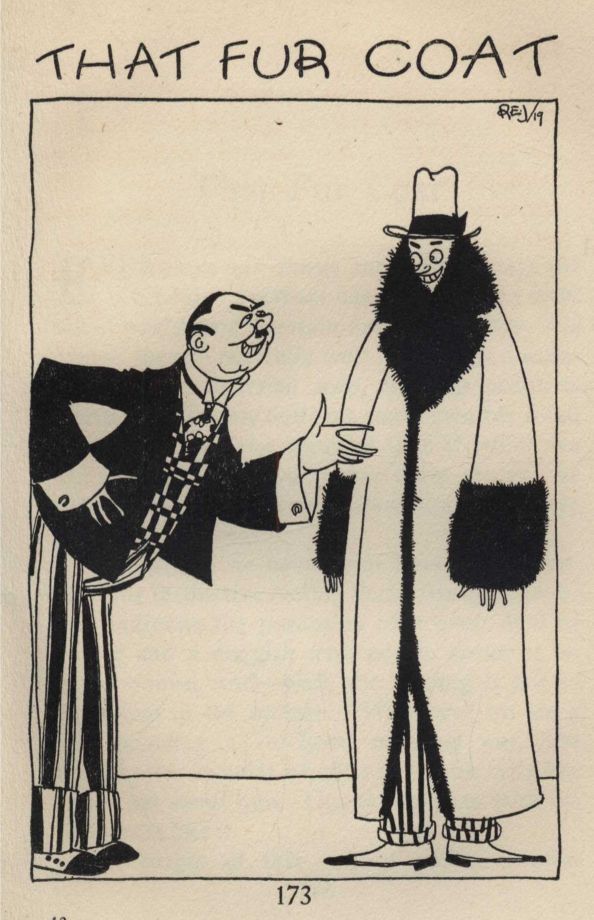
THAT FUR COAT
That Fur Coat
Ever since our downy and callow youth the fur-lined overcoat has been for us a symbol of wealth and a certain dashing deviltry. Of course, we are perfectly well aware that a number of tame married men, holding positions worth about twenty dollars a week, own fur-lined coats. Even on the editorial staff of which we are the bright particular star there are two or three overcoats lined with something definitely recognizable as fur.
Nevertheless we have never been able to conquer our instinctive feeling that a fur-lined overcoat indicates the possession of a great deal of money and a doggish tendency to spend it on wine, women, and—well, the singing is not so important in the picture. Whenever we see a man sporting a fur-lined overcoat our first thought is to wonder whether or not his wife has found out about him. Our second is to wish we had a coat like it.
The origin of this curious and somewhat pathetic feeling about fur-lined coats is probably to be found in the days of our adolescence, when we wore deliriously exotic ties and attended the presentations of refined melodrama. We devoted much thought in those days to the subject of masculine attire—possibly with some obscure notion of attracting the weaker sex by the brilliancy of our plumage—and the villain always fascinated while he revolted us. We had much joy of his clothes.
To see the handsome devil swing across the stage with his light but fiendish ha-ha, his cigarette, and the dress-suit which is the national costume of villains, always gave us a thrill which the chaste embraces of the hero and heroine seldom provided. Even to this day we wouldn't give a darn to watch some other fellow hugging a comely young woman.
Usually the villain wore a fur-lined coat at some stage of his hellish machinations—preferably at the height of them, when he was about to boil the heroine's baby, for instance, or was engaged in tying that long-suffering and virtuous lady in the path of the onrushing train. It was at such moments that he threw open the coat loaned by the well-known firm of local furriers—as the programme never forgot to state—and displayed the mink lining of luxurious sin. We always wondered how the heroine found the strength of mind to resist his wicked advances to her.
Incidentally, we noticed that no matter what liberties the hero might take with the person of the villain—the hero was usually a muscular blond—he always forebore to lay the hands of avenging justice on the fur-lined coat. He might pitch the tr-r-raitor-r off a cliff, or slowly choke him to death after a furious grapple, or shoot him in the nick of time and the chest, but never with the coat on. If the villain forgot to take it off, the hero always taunted him into doing so. Whereupon the villain, knowing full well that he had come to the end of his evil tether, either hung the coat carefully on a handy hook or folded it neatly on a chair. The owner might be down in the orchestra seats.
Such scenes bred in us a superstitious reverence for fur-lined garments. It became the dream of our young life to possess such an overcoat, a gold cigarette-case, and three or four wives whom we had married for their money. But you know how disappointing these dreams are apt to be. We didn't even get the wives.
The nearest we ever came to a fur-lined coat was owning one with a Persian-lamb collar. We never cared much for that coat. There was an air of superficiality about it. Not that we have anything against Persian-lamb collars so far as they go. But they don't go very far. Besides, they make one look like a police-lieutenant or a chauffeur.
Mind you, it was a swagger garment in its way. In addition to the fur collar it had a double-breasted front, and was fastened with barrel-shaped arrangements instead of buttons. It had everything pertaining to a fur-lined coat, except the fur-lining.
Of course, you wouldn't notice that vital defect unless we opened the coat or took it off. And we never did either in public. We have sat in street-cars up near the stove with that coat buttoned up to our chin, until people have moved away from us under the impression that we had the measles. We have almost had to thrash butlers to prevent them helping us off with it—if there is anything obstinate on earth, it is a butler with the idea that you are hiding something from him. We have even retired into dark doorways to get a cent out of our pants-pocket to buy a paper, rather than open the coat on a busy corner.
In spite of these precautions, we always had the feeling that people knew about that coat and discussed it. They had a way of looking at it as though they thought the collar had been put on with safety-pins. We grew to hate the coat. Finally the moths got it. That is, they bored holes in it—probably looking for the lining.
Still our thwarted ambition to possess a real fur-lined coat has persisted. We want it as badly as we ever did. It is nothing to us that they have gone out of exclusive style. We care not that every second man on the street has a coat with some sort of hairy stuff on the collar and the interior draped with the mortal remains of the commoner sort of muskrat. We are still faithful to our early love.
From time to time we have gone into one or other of the various local emporiums—or should it be "emporia?"—of skins, peltry, fleece, hides, and fur, and have priced the garment of our longing. We have looked at mink-lined ones, rat-lined, rabbit-lined, and even seal-lined. We have tried them on and talked sagely to salesmen about them. But we have bought not, neither have we paid down in instalments. We have sighed, jingled the quarter against the small change in our pocket, and said we would call again soon.
The trouble is that the only coats we like are those ranging from about four hundred up—up as far as you can see, and then some! The seal ones we definitely gave up. No one but a former manufacturer of munitions or an inventor of booze-substitutes should aspire to those. It isn't only the initial expense but the way you have to live up to them—taxicabs, diamonds, and half a dollar to the hat-boy every time he helps you on with it.
That left mink, and mink we resolved it should be, in spite of its scarcity. You see, the mink is a small animal of retiring nature and celibate instincts. At least, the mink does not seem to run to large families. The rabbit takes up fatherhood as a profession—but nothing like that for the mink! One or two little minks, and that's all. The mink is a sort of natural Eugenist. "Better babies" is his slogan, not "More babies." As a result minks are hard to get, and correspondingly expensive.
Frequently have we cast eyes of longing on mink-lined coats in fur-store windows, as we strolled along to the office on cold mornings in our combination raincoat and winter ulster. They have been handsome coats, too, many of them, but there has always been something about them we didn't like—sometimes the collar, occasionally the shell (how those military terms will creep in even yet!), and nearly always the small tag hanging from the upper righthand button-hole and proclaiming the price.
But one fine day during that very cold snap we finally saw the fur-coat of our youthful vision. There it hung, or rather stood, in the window, spreading its mink lining to the ravished gaze and ruffling its otter collar in tantalizing beauty. That collar had been peeled off the emperor of all the otters—or the crown prince, at the very least—and Heaven alone knows how many minks had delivered up their fluffy integument to furnish forth that sumptuous lining.
It was a beautiful thing, God wot, and the price was right—only two hundred and fifty iron men, simoleons, bucks, bones, or spondulicks. Not that we take a light view of a sum which in the old days would have bought two thousand cocktails, and if judiciously expended on "lush" would have enabled one to laugh at Prohibition for many happy weeks. But what is two hundred and fifty dollars for a fur-coat which was originally five hundred as the tag explicitly declared, and had come down through successive stages to this absurdly inadequate figure?
We rushed right in and made a clerk drag it out of the window. He did it a little doubtfully, it seemed—evidently unaware how many moneyed men dress very plainly, not to say shabbily. But our enthusiasm finally impressed him. He held it up for us, and we slipped with a sigh of tremulous delight into its soothing embrace. Lordy, how that coat fitted! How gently it caressed us, and how gracefully it hung upon the angles of our frame! There is something positively sinful in such comfort as that.
Of course, it wouldn't do to let the clerk see how delighted we were with it—he might raise the price again. So we controlled our voice as best we could, and asked him if the skins were all right. We even tried to look disparaging.
"All right?" he almost shouted. "Why, if it wasn't for the stringency and all that, this coat would be selling at three times—but you can see for yourself. Just look at those skins—everyone of them taken in the middle of winter!" And in his indignation at our attitude, he grabbed a couple of minks and crumpled them up as if he were going to tear them out of the coat and throw them away.
That's a peculiar thing about fine furs. The finer they are, the more the connoisseur seems to abuse them. Poor skins have to be handled with great care, we presume, but when your real expert gets hold of a good piece of fur, he shakes it and beats it and tries to pull the hair out of it.
It was also very nice to know that the minks had been taken in the winter when they had all their fur on. In the summer, when the minks are wearing nothing but their swimming-trunks, so to speak—but the thing doesn't bear thinking of.
It was just the coat we had always wanted—the clerk said we looked great in it—but after a hasty recollection of our bank-balance as it appeared when we last put a dint in it, we told him we would call again. And we kept calling. We called about a dozen times. We simply couldn't keep away from that fur-coat. And every time we went we brought a friend or two with us to look it over and give us advice. We put the coat on and walked around the store in it to show how it hung, and then we took it off and adjourned to the nearest cigar-stand or blind-pig to discuss the matter. The coat cost us about twenty dollars in a couple of weeks.
Our friends all admired the coat, but curiously enough, they all advised against us buying it—perhaps from a conscientious objection to seeing so much money tied up in mere fur. They always warned us that if we once wore it, we'd have to go on wearing it all the time for fear of catching cold. They said that's the worst of fur-coats—one doesn't dare leave them off. But naturally, if we got that coat, we intended to go on wearing it till about the middle of June. When it got too hot to wear it open, we'd carry it on our arm with the lining turned out.
Lately the clerk had been getting quite sniffy. The last time we were in, he intimated that the coat was beginning to look rather used from being worn around the store so much. We finally had to discontinue these visits, but we hated to tear ourself away from that glorious garment. The first thing we knew some butcher might buy it.
But perhaps some rich relative of ours, turning up rather unexpectedly—we don't insist on any close consanguinity so long as he is rich—may see this pathetic screed and feel that here is a chance to help genius in distress. What's the use of erecting monuments to us after we are dead? How much better and kinder it would be to buy that coat and send it down to the office while we are still comparatively alive. In fact, this is our idea in writing this article.
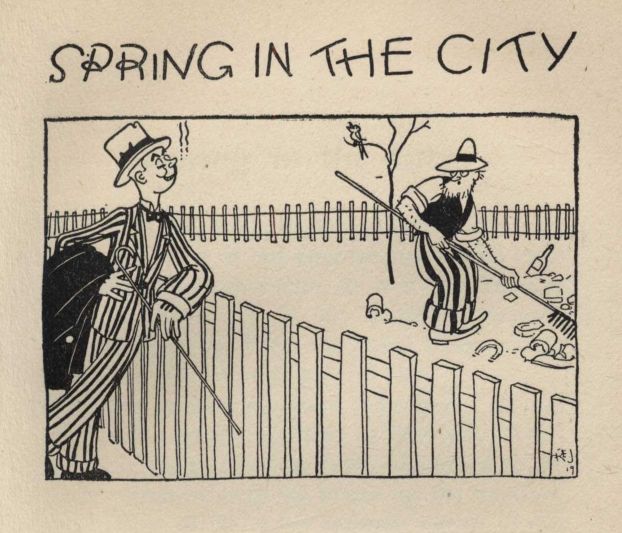
SPRING IN THE CITY
Spring in the City
A thick, creamy, white lather covering that part of our countenance which indicates strength of character, showed that we were about to shave. It is our matutinal custom. Poised in our hand was the lethal weapon with which we perform this painful rite.
At that moment we heard the robin! At that very instant of the morning of Saturday, April the sixth, the voice of the robin was heard in the block. Immediately we threw up the window, and careless of the rather intimate nature of our habiliments, we leaned out over the ledge.
There was no robin in sight. No glimpse of red-breast gladdened our heart. We looked in vain at each of the miniature plots of mud which residents on our street refer to as the "lawn." Nowhere could we see Cock Robin sturdily dragging a large, thick worm from his lair, or waiting with dignified alertness for breakfast to poke up its head. But his voice filled the street, clear and high and vibrant with delight—the very voice of triumphant spring!
"Some class to that whistlin'," said someone below us.
We looked down and saw a dingy man with a bag of tools on his shoulder, who was frankly watching us and grinning with disgusting familiarity. Plumbers never are in a hurry.