Front matter (continued 3)
Reading edition
"Makes a fella feel like chuckin' his work, don't it?" he persisted.
"It does," we burbled through the lather, and drew in our head with reckless haste. We afterwards discovered some of our back-hair still clinging to the lower edge of the window-frame. But not even the painful presence of a protuberance on our skull where none had been before could banish our joy in that robin's song.
Spring was here at last! It is true there was still much ice in our backyard, and in our neighbor's backyard, and in the backyard beyond his. It is true also that icicles hung from the roofs, and that the water in our bath-tub was still of a temperature to produce curiously mottled effects on our general complexion. But we were happy and we sang as we splashed about, for we knew that spring was here.
Therefore did we kick into a corner with joyous abandon the thick, fuzzy garments—warranted pure wool and unshrinkable (base deception!)—with which we had armed ourself as with triple brass against the onslaught of old Boreas. And from a camphored recess in our trunk we drew forth tenuous and elastic vesture which clung to our manly form and restored to it its summer slimness.
When the coal-man's bill arrived in the morning mail, we threw it carelessly aside for our landlady. Our attitude towards coal-men had suddenly changed from anxious propitiation to bored indifference. The strike news in the papers moved not our Olympian serenity. We sympathized with the miners. We felt that if we were a miner ourself, we would strike at once and stay struck till the dog-days caused us to long for subterranean coolness.
Then draping our light overcoat in a jaunty way over our arm, we walked down town. It wasn't a case of going out with the avowed intention of walking, and then sprinting after the first street-car we saw. No, we really walked, inhaling large breaths of vernal ozone. And a lot of other men were similarly engaged. Fellows that we used to see morning after morning furtively slipping into a street-car—the same car that we slipped into ourself—now swung along with their chests swelling out of their coats and a good-to-be-alive expression on their faces. We also noticed that they seemed to take more than the normal masculine interest in the spring dresses which flitted by—especially those affectionate gowns which cling so alluringly to their fair owners. Verily it was the spring.
In a bit of ground where the mud had been pounded to the shiny consistency of overdone chocolate blanc-mange, three very dirty and very serious-minded urchins played marbles. Further on a spoiled darling of fortune who possessed a top spun it with studied indifference—and with a cord, too, of course—while a couple of other youngsters less favored of the gods looked enviously on.
A garden patch littered with sticks and wet leaves and the water-logged aftermath of winter held a resolute little old man with an immense rake, who was endeavoring to introduce some order into his chaotic cosmos. He was having a very busy time, something like a pup who had got into a boneyard. He scratched and tugged and grunted, and here and there he managed to get the stuff gathered into piles. He may have had some notion of burning it, but it would take many sunny days before the stuff would be dry enough to burn anywhere but in a very hot and active volcano.
We leaned on the fence and sniffed the moist rich odors of the dead leaves. They brought to mind pleasant pictures of the approaching time of planting, when enthusiastic amateurs, heedless of the mud on the knees of their trousers, would be jabbing holes in every available bit of ground and sticking seeds and bulbs into them. And we reflected sadly on the sardonic humor of fate which had made us a book-reviewer instead of a happy farmer lad carolling to the sun as we went about the simple and healthful duties of our husbandry. We thought of striding out to the fields with the sun turning the frosted grass to silver filigree, and then we noticed that the old gentleman was contemplating us with the cold and wary eye of a disillusioned sparrow.
"Are you looking for work, young man?" he asked, "or are you merely looking at it? Because, if you really want a job, there is one right here that I would like...."
But we were already on our way. We suddenly recalled that the mail must be piled up on our desk, and that our presence was urgently needed at the office. Did we want work? And so in an instant we were brought back from the golden meadows of dreamland, where we saw ourself wandering a flushed young god in the morning of the world, and became once more a middle-aged office-man, somewhat stooped from bending over a desk.
The spring was in our blood, however, and our spirits revived at the first park we came to. On such mornings one makes a point of walking through the parks, and Allen Gardens lay right on our line of march. They were a scene of joyous activity. Chief gardeners and assistant and deputy-assistant gardeners ran about in amiable confusion. There was a tremendous raking up of straw and mulch—mulch being the technical name for everything that is thrown on a flower-bed, from bricks to sardine-tins.
Around the fountain a lot of blithesome little toddlers pulled one another's hair, or made frantic efforts to drown themselves, while the nurse-girls exchanged confidences as to the precise tone in which "he said" and the elegant vivacity with which "I said to him."
The benches were out and they were occupied. Perhaps it is enough to say that the benches were out. They are never left unoccupied on a nice day of spring. Gentlemen of shabby leisure abhor a vacant seat. One is led to wonder where the men who sit in parks go during the winter—into cracks in the wall, possibly, like the flies. But the day was warm and the bench-boarders were out. There they sat blinking their eyes in drowsy contentment and sniffing hopefully the breezes of spring.
We paused to make some of the kindly and philosophic reflections which are dictated to us on such occasions by our whimsical genius. We looked about us with just such a keen and humorous expression as we felt Montaigne would have worn under similar circumstances. We were preparing to say something rather clever to ourself about the life of man, which is as a spring day, etc.
"Well, the long winter is over at last," said a voice at our elbow, or rather at our left shoulder-blade. It was a melancholy voice, a voice which intimated that the owner doubted he would ever see another spring. But a large face of more than usual redness caused one to question the likelihood of a demise so immediate.
"Yes," we admitted, "it seems to be over, and it is about time."
"Ah, the spring is a great season for them as is young and strong and handsome."
The wistful expression with which this battered, red-faced, watery-eyed person regarded us indicated that he thought we were all these things. We blushed slightly, and to hide our embarrassment—we are not used to such compliments, implied or otherwise—said in a voice of great heartiness:
"Ho, yes—nothing like the spring! Makes a fellow glad to be alive."
"Yes, yes," he agreed still more wistfully, "it makes a handsome young gentleman's heart expand—it makes him free-handed and generous." A sudden cold suspicion seized our vernal ardor and strangled it. Could it be possible that ... yes, it could! And that rubicund old scoundrel proceeded to inform us that the "temporary loan—(the printer will please emphasize temporary")—of half a dollar would cause him to recall our memory with gratitude at frequent intervals for the rest of his life.
If we had had half a dollar in our pocket, we might ... but what man who is paid on Saturdays ever had any money to bring down to the office Saturday morning? We hinted discreetly at our destitution, but the red-faced man merely grunted and turned away. We fear he did not believe us.
We regretted his distrust, of course, but, as Emerson might have said, it is great to be misunderstood in the spring. In a few minutes we forgot our embarrassment and remembered the ruddy one merely as a humorous episode of the jovial day. We chuckled all the way down to the office as we thought of the open and unabashed admiration with which he had regarded us, till he discovered that we were a good Samaritan without the price.
At the office everybody was glad to see us. Even the Managing Editor was amiable. He said nothing about the hour we got in—he seemed to think it was very nice of us to come down at all. And then he sat on the corner of our desk and talked about the beauty of living in the country, and waking up in the morning with the calves bleating around you and the hens and all that, and walking out in the fields to see the fine, healthy farmer lads turning up the sod and reaping and harrowing and everything.
Of course, it was immediately obvious to us that the Managing Editor's idea of country life had been gained from the reading of sentimental verse. Unfortunately, we find it difficult to share this enthusiasm for rural life. You see, we worked on a few farms when we were a wild lad just out of college—we were seeking inspiration in the soil. So we know just how a farm looks and smells in the spring when they are enriching the ground. But we didn't disillusion the M.E.—we wanted everyone to be happy.
* * * * *
It is true that winter rose again Sunday morning. It is true that Monday was cold and blustery, that there was a thick covering of snow on the ground Tuesday morning, that we had to get out our woollens once more, that in the interval we caught a cold in the head. We knew it, but we heeded not. Our eyes had seen the glory of the coming of the spring.
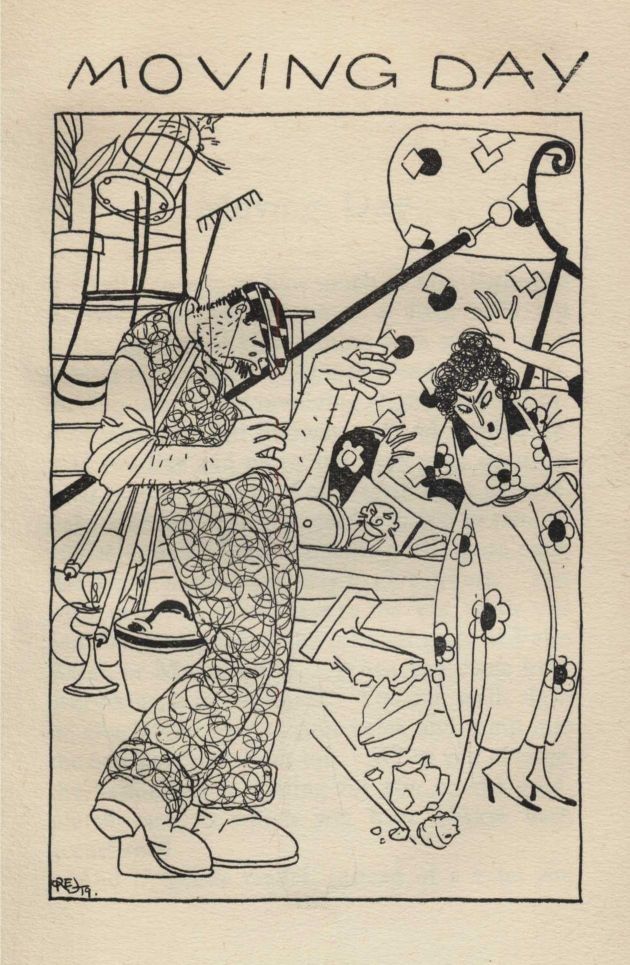
MOVING DAY
Moving Day
It all depends on how much or how little you have to move—the much or little referring to the amount of impediment with which your habitat is furnished. At either end of the scale moving is a matter involving slight personal inconvenience. But midway toil and trouble lie.
If you live and move and have your meals in what reporters are fond of describing as a "palatial residence," and if it occurs to you to remove yourself and all that is yours to a still more palatial mansion, you have only to give orders. The work and worry you leave to the 'elp, while you and the family spend the interval gaily at Palm Beach or Monte Carlo. When you come back everything is in readiness. You can walk right in, chuck your grip to your valet, and jump into the new porcelain bath-tub. When you emerge, the bath-towel is waiting for you on the gold-plated rack to which you have always been accustomed.
And if, gentle reader, instead of a valet you should have a maid—even among the most modern women maids are still usual—it makes no difference in the general readiness of the new home. You trip joyously into your boudoir, she unhooks your gown, and you—but, of course, at this point visitors are always asked to wait in the library. But these details are irrelevant. The main thing is that all the work has been done for you. All the worry has been borne by someone else. It only remains for you to accustom yourself to your new surroundings.
In the same way at the other end of the social scale, moving is equally a matter calling for little thought and less trouble. The mover puts his tooth-brush and his comb in his vest-pocket; he throws his other pair of trousers into his bag along with his other shirt and the pair of shoes he had half-soled; and then he slips quietly away while his landlady is not looking. It is not that he is running away exactly, but that he is sensitive and shy, and dreads the emotional strain of bidding farewell. Parting is such sweet sorrow that she might not let him go without keeping his grip as a souvenir—just to remind her of that "ten" he promised to give her at the end of the week.
Gentlemen who make these periodical migrations do not worry much about it. Even if they did pay their bills, they would still grow tired of staying in the same place. So they pack up and move, suddenly and with light-hearted unconcern. They don't call it "moving." They refer to it as "making a getaway."
It is not our intention, however, to treat of either the wealthy or the "stony broke" in this serious consideration of the crises in the affairs of house-holders known as "moving-days." The wealthy don't move often enough, the "busted" move too often, and both move too easily to make the operation an important factor in their lives. But the fellow on a one-cylinder salary who uses a fifty-dollar-a-month house for purposes of domicile—he is the man to whom moving is all that General Sherman declared war to be. It is a revolution, a cataclysm. He dates important events as occurring in "the year we moved" from this house to that other. Moving-days mark off periods of existence the way the Olympian games served for the ancient Greeks.
Why then do people do it? Sometimes because they can't help it. Landlords have a way of handing over their property to syndicates to build apartment-houses on the site. At other times landlords, whose actions no man can foretell, decide to raise the rent. Or they may object to the playful ways of the tenant's children—perhaps the little dears have dug a cave or two in the wall of the living-room, or have in childish glee filled the plumbing with half-bricks and gunny-sacks.
Then there are landlords who have acquired the please-remit habit to such an extent that a trifling delay of a couple of months with the rent leads to intense unpleasantness. They won't even take it in kind—except Scotch, perhaps. And that, of course, is too good for landlords. In fact, there are a thousand and one things which may cause friction between the man who lives in the house and the man who merely owns it. As the landlord generally refuses to leave, the tenant has to.
This explains a good many movings, but not all, nor even the greater number of them. Most people, as a matter of fact, move for the simple reason that hope springs eternal, and man never is but always to be. Every house has its faults and drawbacks. Even the palaces which cost eighty-five dollars a month serve to remind their occupants that there are beauties and comforts which even their comparative affluence cannot command. And naturally the lower one drops in the financial scale the truer this truism—the truth of truisms is our chief objection to them.
Man wants but little here below—just a nice, twelve-room house, hot-water heating, lawn all around, commodious shed where he can stow the lawn-mower and the spade during the period of hibernation, enamel bath, electric lighting, and such other necessities of the simple life as improved by Edison. But he wants that little a long time before he gets it—for fifty dollars a month. Therefore he moves.
Probably the house he already lives in has a hot-air furnace that goes into a state of coma on cold nights, the kind of plumbing that has to be operated on every few days by a surgeon in over-alls, and a roof that permits every thunderstorm to come right down and jump into bed with him. Probably the girl next door plays "I'm Always Chasing Rainbows" till midnight every night of the week, except Sunday when she plays hymn-tunes. But he has hopes. He feels that the next house is going to possess all the beauty and comfort of Aladdin's fairy palace, and that the landlord will be one of those dear old boys with white whiskers, who will answer every complaint with, "Just have the work done and send the bill to me." There is no such landlord, but the tenant keeps on looking for him. He moves. And lo, in another little while he moves again. He keeps right on moving, poor chap, till that final move when they put plumes on the moving-van.
Your old experienced mover starts in early. He makes a real occasion of it. After he and his wife and the baby-carriage have strolled around town for about six weeks, they finally select a prospective residence. It is just about the same as the old house—they are lucky, in fact, if it isn't worse. But they see the new one through pink spectacles. Everything looks like a sunset-scene in a musical comedy.
"Oh, how happy we're all going to be!"
Exit dancingly. Then they go home and start packing up.
The first thing you always do when you pack is to take up the carpets and oil-cloths. You don't bother picking up the tacks. They are picked up in instalments by members of the family in the early morning and late at night. No electro-magnet ever had half the allurement for a tack that a bare foot exerts. A defenceless big toe will draw them right across a room.
The next move is to drag all the trunks and packing-cases out of their lairs in the attic or cellar and place them in the upper and lower halls in the most unexpected places. Then one is always sure to find them in the dark. Uncle especially, coming home rather late from the lodge meeting—but this is a tragic theme. We have been in uncle's place.
Pictures are then taken off the walls and laid in readily accessible places on the floor. In this way one can put one's foot through a lovely seascape, or tread upon the features of defunct relatives in enlarged photographs, with the minimum of exertion. Personally, we prefer walking into mirrors—the pieces look so much prettier.
Gradually the house assumes the appearance of a place in the devastated area of Flanders. Furniture is piled up in barricades everywhere. Bales of linen and curtains and that sort of thing are built up into parapets. All they need is a firing-step and a periscope or two to look like the real thing. Behind these obstructions the family cowers as it eats its meals—if the food may be so described—and seeks shelter from the prying eye when it goes to bed. You see, the windows are all bare and one can't be too careful of the observer in the sniping-post across the way. Probably the best course is to sit on the side of one's bed and undress in the dark. Not only would this plan of action be more likely to commend itself to the Moral Reform League, but it has the further advantage of avoiding the tacks. One is not so apt to give an impromptu imitation of a man who has inadvertently stepped on a porcupine.
At last the great day arrives! You are awakened by a large hairy man, who wants to know when you are going to get out of your bed so he can take it apart and load it into the van. Hurriedly you jump into the oldest and most primitive clothing permitted by the rules of society and the state of the weather. And you get busy—Homerically busy!
It is true that you have hired a couple of men and a huge waggon. But these gentlemen are professionals. They direct the operation. They are the headquarters' staff, so to speak. Occasionally they take a hand in the game and then you wish they hadn't. You beg them to be careful with the piano—rented—and promptly they carry off half the front porch on the end of it. The enormous walnut whatnot, which has been "an old family possession" ever since you bought it second-hand, is made to look like part of the steerage furniture of the Ark.
Some artistic friends of ours had a fine cast of the Venus of Milo. It was the only thing in the house to be proud of, and they were. They loved it so much that they had never even pawned it, no matter how bitter the temporary stringency. Then one sad moving-day, a horny-handed cyclops with fusel oil instead of brains picked it up and dropped it. If Venus had disputed the right-of-way with an armored car she couldn't have been reduced to more or smaller pieces.
"Oh, how could you—how could you be so stupid?" sobbed the lady of the house.
"Ah, it ain't worth makin' all that fuss about," growled the son of Anak, "sure the darn old thing was bust anyhow."
Finally all the household effects are piled out on the sidewalk, while the neighbors sit on their stoops and make remarks about the quantity and quality of your equipment. Of course, no furniture would look good under such circumstances. If the fittings of Buckingham Palace were piled up on the front lawn, they would hardly be impressive. And you are keenly conscious that your furniture has nothing on King George's. The only thing to do is to pretend that you don't see your neighbors while your sofas and chairs stand on their heads on the sidewalk, kicking their ancient legs in the air, and showing with painful frankness the places where they have been mended.
In the meantime, you keep travelling between the old house and the new one. As the pile keeps diminishing in front of your home that has been, it keeps growing in front of your home to be. There, too, the neighbors are on the watch, and as your old mattresses are carried in, bleeding excelsior from a dozen wounds, you can see their anticipations of your desirability as an addition to the society of the block going steadily down to below the freezing point.
At last the work is done. Everything you can think of has been piled up higgledy-piggledy at the new place. The family sits forlornly in the midst of it—camping out in a strange house!
"Where's the baby?" shrieks mother suddenly in the midst of the weary silence.
Then you remember that you left the little innocent in the bath-tub in the old house for safe keeping. As you tear madly off to retrieve him, you keep wondering if he has turned on the water and drowned himself.
And yet, the following spring, your fancy lightly turns to thoughts of still another move.
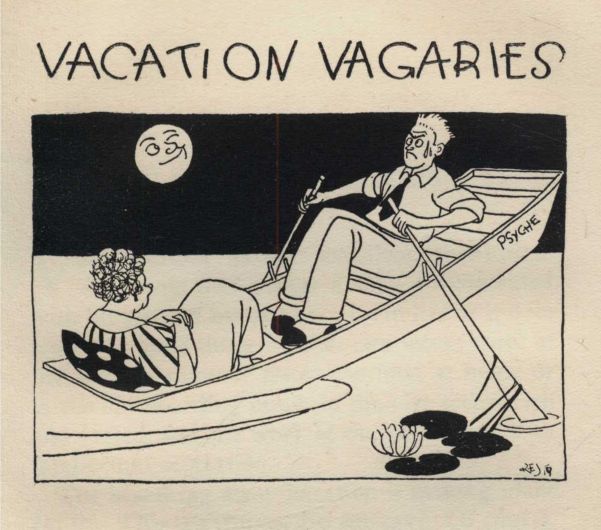
VACATION VAGARIES
Vacation Vagaries
Vacation is an excellent institution. Anything that makes a man so contented with his job and his ordinary lot in life as it does must be a good thing. After two weeks spent at the average summer resort the food at home or in the old boarding-house in the city seems rich and varied, and the work at the office proves an intellectual recreation.
The best thing about vacation is making plans for it. This is a truism, did you say? Of course, it is a truism. Occasionally we indulge in truisms, though our natural preference is for "isms" that are not true.
When we say "making plans," we mean plans only in the most general and romantic sense. Once you come down to details all the poetry is squeezed out of the thing. The business of writing to hotelkeepers and railway passenger-agents and other rich but dishonest people for information is a bore and a burden. So also is packing up.
Honestly, now, as one man to another, dear reader—or as one woman to a man, or whatever the circumstances may require—did you ever bring half the things you wanted, and did you ever use half the things you brought? Did you? No, of course not. No one ever does.
Personally, we have travelled light, and we have travelled heavy, and the result has always been the same. The year we took a trunk with raincoats and overcoats and various weights of underwear, and all the other encumbrances of civilization, the weather was fine and warm throughout, and all we really needed was a couple of shirts and some duck trousers. Even our toothbrush was useless, for we got practically nothing to eat.
The next time we decided to limit our impedimenta very strictly, and we carried our belongings in our pocket and a brown-paper parcel. That year we encountered every one of the fifty-odd varieties of weather and temperature, and two freight-cars couldn't have carried all the clothes we needed. The irony of things?—yes, also the tinnery and leadery, and any other base metal you can think of.
Therefore, we repeat, the practical details of getting ready for a vacation are a weariness and an abomination. But the general plans, the vague and glowing dreams—ah, the pictures of one's self poised like a god in the path of the breakers while the peaches on the beaches gaze longingly upon one, or again smiling carelessly while one steers canoes containing beautiful ladies down dangerous rapids, or still again singing amorous madrigals by moonlight while one drifts in the shadow of the pines! These visions are well worth the disillusion which follows.
Every young man—whether fifteen or fifty—has cherished these or similar dreams of the joys that await him in the days of vacation. And nearly every young man has had the same experience of going up to the same old summer hotel or boarding-house, where you sleep on a lumpy bed with a crazy quilt, battle with the flies for your food, and spend your evenings rowing a fat girl around a pond in a flat-bottomed boat.
Are we pessimistic?—well, perhaps we are pessimistic. But we have had some experience of summer resorts. We have sat on the porch with the married ladies in the evening, and listened to the merry crash as character after character fell in ruins to the ground. We have gone fishing for mythical bass and trout in famous fishing-grounds, where there hadn't been a fish within the memory of man—driven out by the mosquitoes, probably.
And the girls of summer resorts! We have walked with them, and read poetry to them, and eaten ice-cream cones with them, and discussed with them whether marriage is possible where true love is not. We have paddled them around on hot afternoons, and retrieved the balls which they drove into the river when we played tennis together. We have even proposed to—but we must not carry these confidences too far. Suffice it to state, that even those who accepted us let us see clearly that they regarded the eternal affection we swore to one another as being subject to recall with due notice. Sometimes they didn't even bother to give us the notice.
It was all vanity, vanity! But we cannot help remembering that some of the vanity was of a rather pleasant variety. There was that blonde up at—oh, never mind where!—a little thin, you know, but very soulful. She "adored" Browning, and claimed to understand "Sordello"—which was a lie, of course. And the little brunette, brown eyes and reddish hair—very "chick," eh, what?—with an abnormal appetite for brandied chocolates. Nice girls both. But time passes and one forgets. We don't even remember where they work!
If a man—almost any unattached male will do—wishes to feel the joys of being sought after and an object of general female attention, let him hasten away to a summer hotel, especially in one of the less fashionable resorts. At the fashionable ones there are always a few gilded youth about, who own motor boats and look divine in flannels. Their glory would be apt to make his seem like a star in the presence of the sun.
But at the others, those quiet family-hotels, to which people go ostensibly because the air is so much better, and they dislike the noise and fashion of the other places, but really because the board is five times cheaper—at these seminaries of bored spinsters a rash bachelor who intrudes can easily persuade himself that he is a combination of Richard the Lion-Heart and Don Juan.
What gay and girlish groups will be formed about him! How they will laugh at his jokes and listen with awe to his opinions! With what warmth they will admire his atrocious ties and homicidal socks—the colors are so striking and virile you know. They may even sit still while he sings.
The only objection is that popularity of this sort is apt to send a man back to the office a mental and physical wreck. Even a year of loafing on the boss's time hardly qualifies a man to paddle canoes, play tennis, walk miles, go for hay-cart drives, eat canned goods, and dance the foxtrot till one every morning, and then retire to fight for his life with a dozen big husky mosquitoes that have been sitting on the foot of his bed waiting for him in bloodthirsty fury for hours.
Talking of mosquitoes, have you ever seen any mosquitoes or flies to equal for size and ferocity those that flourish at any summer hotel or boarding-house? And the poorer the place the more various and highly developed are the entomological specimens.
There are mosquito-nets on the windows, of course, but they seem merely to annoy those birds of prey, and exacerbate their naturally hasty temper. After being obliged to bite his way through two or three folds of pink or blue gauze, no wonder a mosquito sits on your pillow and shrieks insanely in your ear what he is going to do to you. He then proceeds to do it, worse luck!
As for the flies, deserting in the most heartless manner the cows and horses they have lived with all winter, they rush with a glad shout into the dining-room, and standing with their hind feet in your bacon-and-eggs, reach over and lap up your coffee, or whatever it is people serve under that alias. Very chummy those flies, much more democratic than flies in town. The simple life of the country probably accounts for that—also for the way they wade into the butter like a hired man.
But if you really want to know what flies and mosquitoes—not to speak of ants and beetles and caterpillars—can really do, you ought to go "roughing it." As if the ordinary summer boarding-house wasn't rough enough for anything but the most exotic taste! "Roughing it" is a disease to which Canadian youth between the ages of eighteen and twenty-five is peculiarly liable.
We succumbed once. We went with a canoe and a tent and some beans and a couple of fellows who said they were old woodsmen and knew how to cook. Some day we may be able to bring ourself to write up that trip in detail. But it is only ten years ago, and the memory still rankles too bitterly.
After two weeks of carrying loads over portages, washing dishes, eating the bread and pancakes those two murderers baked, and sitting up nights to stab the bugs that crept upon us in the dark, we had almost to be sent to a sanitarium to recuperate. But good nursing and cod-liver oil brought us around again in a month or so. Roughing it?—yes, only "rough" seems a mild word to apply to it.
Everyone has his own notion of the perfect vacation. We have ours, and that is the vacation which takes one home to a small town a long way off. This, of course, implies considerable foresight in picking out one's ancestral seat. You must also arrange to have a mother there waiting for you—preferably with white hair. Always mention the color of the hair when ordering a mother. White is best, and perhaps next to that iron-grey.
Let us suppose that you haven't been home in a couple of years or more. You have written a number of letters and telegrams telling them the exact hour you will arrive, and so when you finally chug-chug into the little station on the same old stub-line which is always half an hour late, you find them all drawn up to meet you.
For a few minutes the world becomes one blur of arms that go around one's neck, and faces held up to be kissed. And then you are gravely passed in review, the cut of your clothes and the color of your hat, and whether or not you have got stouter or leaner or greyer than before.
In the ordinary world where you live and move and have your job and vote, you may be a man of standing, a well-known politician or banker or editor. But here, whether captain or clerk, you are just "Mollie's boy, Bill," or "Annie's boy, Pete," or whatever may be your mother's first name and your own. Here you are never permitted to grow up. Here you are liable to be called "Willie" or "Babe" to your death at eighty.
Outside the station the same old family horse is rubbing his ear against the same old battered telephone pole to which he is hitched. He gazes with mild indifference on the confusion and bustle around him. He has long ceased to show interest in anything but oats.
As you drive up the main street you notice with extraordinary interest that old man Johnson has put a new plate-glass front in his store, and young Brown has hung his shingle up as a doctor. You pass by the one street-car waiting to make its half-hourly trip, and the motorman yells joyfully, "H'lo, Pete, when did yuh get back?"
At the house the dinner is waiting—ah, a dinner that really is a dinner! There are all the things you used to like, and have ever since wistfully dreamed of in city restaurants, the fried chicken and the pumpkin-pie and all.
"And now," says mother, as you lay down your knife and fork and come up to breathe, "how is your Aunt Kate, and have you seen Cousin Maggie lately, and have you heard how Lizzie is getting on with that fellow she married, and when were you last in—?"
And you begin and talk for two weeks.
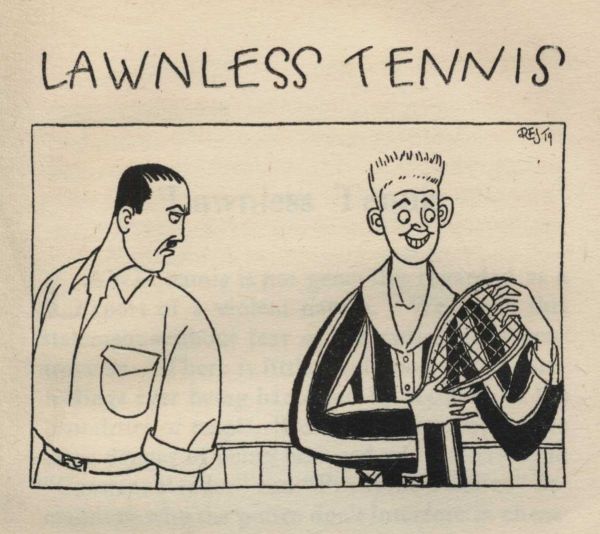
LAWNLESS TENNIS
Lawnless Tennis
Lawn tennis is not generally regarded as a sport of a violent nature. We make this statement without fear of contradiction or controversy. There is little likelihood of our finer feelings ever being harrowed by accounts of the brutalities of tennis. Editors of newspapers are in no danger of being besieged with letters from "Constant Reader" and "Pro Bono Publico" demanding why the police don't interfere in championship tennis matches and bind the participants over to keep the peace.
No, tennis is not usually a violent or brutal sport. In fact, it is frequently associated in the popular mind with weak tea and girls and beg-pardons and curates and other evidences of the amenities of life. Rough persons who play lacrosse or football are apt to class tennis with tiddlywinks or casino.
We had some such idea ourself before we took it up. We could see ourself treading daintily across a verdant lawn and popping a nice white ball, covered in wool so it wouldn't hurt anyone, over a nice white net to a nice white young lady on the other side. If we should have the misfortune to put it in a place where she couldn't pop it back to us, we would apologize in a profuse and genteel manner, and then would go blushingly to the other side of the court and pop it over again.
Somehow or other the picture did not at first appeal to us. Was thy servant a bank-clerk that he should do this thing? And yet we needed exercise, gentle exercise. Not that we were getting fat—we are not of a stout habit—but we could feel our arteries hardening from day to day, and rheumatism working slowly but surely into many of our most useful joints.
We decided to do something to arrest the progress of senile decay—something easy and pleasant. Besides, we knew a fellow who belonged to a tennis club, and he insisted on us joining it. We succumbed at last, but it was a long time before we admitted as much to our newspaper associates. One is so apt to be misunderstood.
The first day we went up to the tennis club Harry accompanied us. Harry was a nice chap who wore glasses and spoke grammatically, and we felt we were in safe hands. He was also very fond of music, and we had some dim notion that perhaps he played the mandolin and sang in the shade between "sets." We made up our mind that we wouldn't sing ourself, no matter how much the company insisted. The way we came to know what a "set" meant, was that we had been preparing ourself by reading several volumes on the history and practice of the game, with short biographies of about a hundred champions. We had decided to become one.
The first shock came in the club-house when we were taken into the locker-mom. It was just like the locker-room of any athletic club. Wire lockers were ranged along the walls, and the benches were of somewhat battered wood. Somehow we had expected silk curtains and cushions and natty little bows of pink ribbon.
On the benches a number of gentlemen in various stages of dishabille, and with varying claims to manly beauty, were getting into or out of tennis clothes. When they didn't like their own clothes, they took some out of someone else's locker—just like the pirates who occupy their leisure with rougher games. If Harry had not been there we would have felt sure we had got into the wrong place.
Every now and then a man would stagger into the room in very damp ducks or flannels, would tumble out of them, and would totter over to a shower where he would yell with inarticulate rage as the cold water struck him. Sometimes they were very pale, and sometimes very red in the face. But always they were perspiring and exhausted, and we could not help wondering what the dickens they had been doing to get themselves into that condition. Too much tea, perhaps!
We got into our own outfit—all nice and new and unspotted of the world. We had brought it along in a suit-case. We had white ducks and white shoes and a white shirt, low in the neck. We felt like a young girl high-school graduate just about to receive her diploma. Also we had a blazer. Possibly the reader does not know what a "blazer" is. We would hate to think so, but we will explain. A "blazer" is a striped sack-coat, which was originally designed as part of a costume to ride zebras in, or to prevent dangerous convicts from escaping—we are not sure which. Anyway, it makes the man who wears it look like a party-brick of ice-cream—you know the way they deposit the stuff in gorgeous layers.
Our blazer was composed of stripes of purple and black, each about two inches wide. We selected it because it was so quiet compared to the others. When we put it on that first day, however, we had an unpleasant consciousness that two or three gentlemen in our immediate neighborhood said something about "hell." Possibly a little theological controversy. Just the same, we never wore it again. We lost our taste for it.
Being both togged out in our tennis outfit, we stepped through the door leading to the courts. Personally we gave one wild look around and turned to Harry with a gasp of dismay.
"But where's the lawn?" we asked.
Harry seemed annoyed, but we couldn't help it. We had expected to see a wide smooth lawn, with shady elms and tea-trays and gentle curates and all the rest of it. We thought that was why the game was called "lawn tennis." What we actually saw was a great big backyard with a pounded clay floor. A series of dingy nets ran down the centre of it, and it was crossed and recrossed by a gridiron of half-obliterated lines.
It was easy to see what had obliterated the lines, for some eighteen or twenty active young men in badly rumpled attire were tearing up and down in clouds of dust, working like demons, jumping and rushing and dodging about, and all the while banging away with fury at balls which we afterwards discovered did not possess a particle of wool to cover them. It had all been knocked off. Gentle popping?—good lord!
Surrounding the courts was a lovely vista of other backyards with clothes hung out to dry. Extraordinary the amount of washing the people in that block seemed to do! Every day was wash-day in that neighborhood. During the weeks that followed we became thoroughly acquainted with the clothes of its inhabitants. We discovered who wore red flannel petticoats, and who leaned toward gay and passionate pyjamas. We also knew who wore—but perhaps we had better stop right here. There are things which no gentleman should discuss—certainly not in the cold light of public print. But it was astonishing how life-like they used to look—especially in a breeze.
Over that first game with Harry we would like to draw a veil, a good thick veil—say, several plies of sack-cloth. We did not shine, or, if we did, it was rather as a conflagration than a star. We turned red with the very first ball we hit—we knocked it on to a neighboring housetop—and we slowly became a richer and richer maroon during the progress of the match. Somehow or other we seemed to be too strong for the game. When we hit a ball, which wasn't often, we put it into the bleachers for a home run, or tore a hole in the net with it.
The rest of the time we fanned the atmosphere in a ferocious manner which was not without its humorous features. We didn't notice the humor ourself, but a number of our new fellow-members did. They stopped playing and crowded around to see us. They were very encouraging, but we were a little confused by their coaching. They kept counting us out on strikes, or when we got a hit would beseech us to stretch it into a three-bagger or slide into the home plate. They got us so worked up that we actually called "Ball!" like a baseball umpire when Harry served out of the proper court. Presumably we were waiting for four before taking our base. It was a very trying game—very!
Of course, this was only the beginning. We wouldn't write about tennis at all, if we couldn't give the reader a better account of ourself than this. Our first game filled us with rage, but also with determination. After that we were up at the courts every day the weather permitted, and a few that it didn't. And we worked—Heavens, how we worked! If we had worked like that in the office, we would own the plant by now. When we came in day after day out of the dust and smother, we used to be too tired even to holler in the cold shower. There was no hot water—it was considered effeminate.
Did we make ourself a great player? Well, we are a modest cuss, and although it is with the greatest reluctance that we deny the charge of greatness, we still deny it. Of course, dear reader (presuming that you have been sufficiently interested in our tennis career to read thus far), if you didn't know anything about tennis and were to see us smashing out some of those brilliant drives of ours which always land just a few inches out of the court, or getting that meteoric service over the net—sometimes we rully do, rally!—you might think we were great. But 't is not for us—you understand the delicacy of our position.
As a matter of fact, we did begin to suspect that we were a winner. Not that we got into the habit of bragging about our playing at all, but occasionally we would tell our ladifrens that we thought Norman Brookes and McLaughlin were greatly overrated, and that we wished our club would send us over to Wimbledon to take part in one of the tournaments. They would always assure us that they felt we must be a very fine player, for we were so well built for tennis, so tall and active and such a long reach. Nice girls!
Just when our self-confidence was at its height, we spent a week-end at a place on the Lake where they had a good court. They also had a couple of pretty girls in the family. There was another chap, too, a weedy little Englishman with a blond moustache and a tenor voice that was almost a soprano. The conversation turned on tennis—we believe that we brought it around to that point ourself—and we gave a dramatic account of an awful beating we had handed out to a fellow at the club only a day or so before. We even contributed living pictures of several of our most deadly strokes.
"You play tennis, too, don't you, Mr. Blyth?" asked one of the girls, more by way of bringing him into the conversation than anything else.
He blushed and said he did—a little. Then nothing would do them but that he should play a match with us. He seemed very unwilling, and the more unwilling he was, the more anxious we became to play. Finally we gave our word of honor that we would not drive very hard. He said it was awfully decent of us, and he borrowed one of the girls' rackets, while we drew our gold-medal beauty from its nifty leather case.
Did we drive hard? No, we didn't drive hard. We didn't get a chance. His first ball paralyzed us. Then that little blond brute would get into the middle of the court, and he would place the ball just an inch inside the left-hand line. If we got it back—by a miracle we occasionally did—he would place it just an inch inside the right-hand line, varying the programme with smashes which a man twenty feet tall couldn't handle. He had a service which broke in all directions except where our racket was; and he could pick the ball off the ground or jump ten feet in the air and kill it with equal ease. He drove till our knees wobbled and our head swam; and then he popped over little lobs with a cut on them, which made us look like a cinnamon bear trying to catch butterflies.
We could hardly eat any dinner that evening. For the rest of the week-end the girls sat at that little bounder's feet and begged him to show them how to "serve," how to hold their rackets for the back-hand stroke, etc., etc.
Later we learned he was champion of half a dozen English counties.
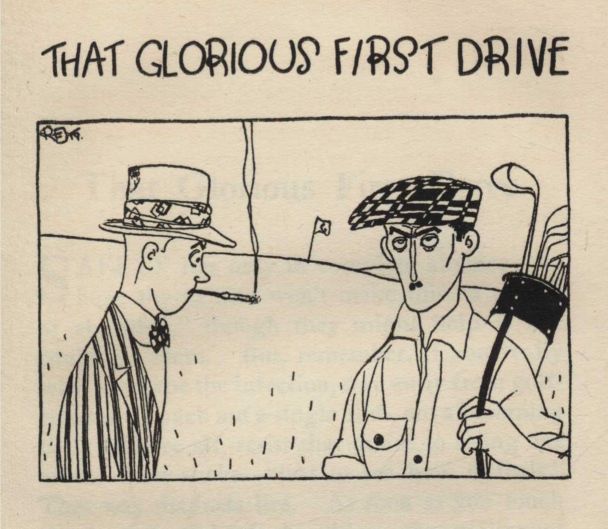
THAT GLORIOUS FIRST DRIVE
That Glorious First Drive
Safety lies only in complete absence—we hope the printer won't make this "a couple of absinthes," though they might help if one could get them. But, remember, if you really wish to escape the infection, stay away from golf-courses. Touch not a single club, not a blooming ball. Above all, resist that desire to swing one of the darn sticks—"just to see how it feels." That way madness lies. As soon as you touch the leather end of the thing, the malignant animal magnetism gets to work and you are lost. After that there is nothing for your family to do but appoint a guardian for you.
Do as we say, don't do as we did. For we, who write this in sack-cloth and ashes—we speak metaphorically, of course, though we do notice a little cigar-ash on our vest—we neglected this simple precaution and are suffering accordingly. We let ourself be lured to the links. We picked up a driver and waggled it about a few times, and now we are suffering from an acute and very distressing form of the disease. This is how the calamity occurred.
An old and esteemed friend of ours, for whom we feel the respect which one able man feels for another, said to us not long ago: "Doing anything Saturday afternoon, old man?" He spoke with an affected carelessness, but we have since had reason to suspect that his casual manner covered a seething ocean of vindictive purpose. It was his intention to infect us with the virus of dementia golfiana.
"Oh, nothing special," we said, after pausing for a few moments to give the impression that we were mentally conning over a long list of important social engagements. "Oh, nothing special"—fatal words!
"Good! Come on down and walk around the course with me at Barborough"—that isn't the name exactly, but it will serve—"they're getting it into nice shape now. It'll do you good to get out into the country a bit. Will you come?"
He spoke with an appearance of cordial good-fellowship. We believed in the entire friendliness of his intentions—alas, ours has always been a trusting nature! We said we'd go.
"All right—catch the two-fifteen radial. I'll be waiting for you at the club-house. You can't miss it."
We caught it, along with two hundred and sixty-seven children, women, and men, who were likewise wooing the country breezes at points along the road. Several of the children made the trip in our lap. The little dears seemed to know instinctively how much we hated it. When we got there our trousers had a large number of creases, in addition to those which our valet puts in them. But fortunately we were wearing our other suit.
When we had walked back half a mile or so from where the curmudgeon of a conductor put us off, we discovered the club-house. It is a very handsome building, impressively combining the characteristics of a munition-magnate's bungalow and a summer hotel. Obviously it had been built long before Prohibition became a serious menace.
We looked all about for our friend. He was nowhere in sight. Several gentlemen in soiled negligee roamed aimlessly about the grounds, dragging what looked at a distance like short lengths of drain-pipe. We discovered afterwards that they were golf-bags and these gentlemen were doing their own caddying—the caddies, we presume, being all engaged as bell-hops in the club-house.
Finally, a very hot and dusty and particularly disreputable gentleman, dragging a reluctant bag by the nape of the neck, came towards us. We recognized our friend. He looked tired and unhappy, and his eye had the dull stare of a somnambulist. We have since learned it was merely a mild form of golf-face.
"Come on over to the tee," he said.
We brightened up at once—our throat really was rather dry. But that wasn't the sort of tea he meant. Instead, he took us over to a little square terrace. Gouging a handful of damp sand out of a box, he made a tiny mound and set the ball on top of it. Somehow or other it looked very small and pale and pitiful—especially as it was already pretty badly scarred up. Then he wiped his hands on his trousers—in view of their condition perhaps it would be more accurate to call them pants—and drew out of his bag a long stick with a wooden head about the size of a small cocoanut. It was certainly an awesome weapon.
Stepping up to that miserable ball, he carefully assumed one of the most awkward positions we have ever seen a human being adopt. His feet were about a yard apart and his toes were pointed with elaborate care. Then he laid the cheek of that murderous club alongside the ball, waggled it a few times, gazed long and earnestly at a point in the landscape a mile or so away, and finally brought his eye back again and fixed it on the ball with a hypnotical glare. We thought we could see the ball tremble. Our own heart was palpitating frightfully. We had no idea of the strain of watching a man play golf.
Slowly that ponderous club arose. Higher and higher it went. But never for a fraction of an instant did our friend cease to glower at that unfortunate globule. Then, just as the strain was about to become unendurable, he swung. The mighty knob on the end of that stick shrieked through the air. It made a complete circle and a half and nearly threw our friend off his feet. We have since learned to recognize this as the "follow-through."
So interested were we in our friend's extraordinary movements—we had never seen him act like this before—that it was almost a full minute before it occurred to us to look for the ball. It was still there. Missed? Could it be that he had really—but no!
"I always make a trial swing," he said with a smile decidedly wan and unconvincing. "Helps a fellow to get the force into it, you know." We didn't know, and we had strong suspicions, in spite of our entire ignorance of golf.
Once more he went through the performance, waggles and all. Once more the big club swung up, and once more it came down. This time it hit the ball—hit it with a vengeance. Tearing a nasty gash in the top of that miserable pellet, the club sent it bounding in agony along the ground for about forty yards.
Our friend grew violently red in the face, and he said—but, on second thoughts, it doesn't really matter what he said. There are times when even the best of men.....
We followed meekly as he strode after the offending spherule with a homicidal gleam in his eye. Hurling his bag of clubs to the ground, after he had picked out a thing with an iron head which no man should be allowed to carry around in a law-abiding country, he sneaked up on the ball and hit it a clout which drove it clear out of sight over an intervening hill.
"Ha! ha!" he said, with a chortle of maniacal glee, "that's better. That's more in my style." But personally we felt as though we had aided and abetted a murder.
Then we both went and looked for that blessed ball. We hunted under every bush and blade of grass, but it had crawled away wounded to die alone. Fifteen minutes later he decided to drop one on the edge of the green. He finally got it into the hole all right after several lovely putts.
We have no intention of giving a minute description of our friend's game. We have since found reason to believe that it was not exactly an awe-inspiring exhibition. But, as he explained to us several times in the course of play, we should have been there earlier to see his work during his first round. So far as we could judge from his description, it would have made Harry Vardon jealous enough to quit the game and get a job delivering meat.
"You should have seen my shot from the third tee—the Devil's Drive, we call it. It was a lallapaloosa! By the way, what is the record drive? I've forgotten for the moment."
We told him not to ask us, as we wotted not of such things. He smiled at us with what seemed an expression of great relief, as though he felt he could speak with confidential frankness.
"Well, whatever it is," said he, "mine was at least three hundred and sixty yards! How about that?"
We said that it was very fine; and no doubt it is. But we noticed that he lowered his voice as he spoke—perhaps because of the impressive nature of the statement, perhaps because he was afraid someone would overhear him, someone who knew better.
As we said above, it is not our intention to enter into the details of our friend's game, or to give a verbatim report of the language he was led to use on several regrettable occasions. Our whole purpose in writing this article is to tell what we ourself did in a moment of recklessness. We are telling it to serve as a warning to others who still are unbitten by the dread microbe of "gawf."
We had gone right around the course, and had finally got back to the club-house and the first tee. We had duly admired the scenery of the grounds, which were really far too beautiful to be delivered over to a lot of feeble-minded golfers. Our friend threw down his bag of clubs with a grunt of relief.
"Better take a shot or two," he said, "while I slip into the office to have a word with the secretary."
That was the moment of doom. That was the time when, breathing a brief prayer to such of the saints as we still have a pull with, we should have sprinted down the road to the car-line. We should have begged our friend to take the things away with him. We should have broken every stick in the bag and burned the pieces. We should have thrown ourself down in a fit. We should have done anything rather than run the risk we actually took. Alas, we knew not what we did.
Heedless of impending doom, we laid our new hat on the ground. We playfully extracted the big club with the swollen head and the brass bottom. We clawed out of the box a handful of wet sand and made with it a neat little pyramid, on the top of which we carefully placed the ball. Then we stepped back and contemplated it. It was a very pretty thing—a nice little pyramid and a nice little white ball. It looked shamefully easy.
The club felt rather queer, and it wobbled in our grasp. If we had recognized the omen, there might still have been hope for us. But we were cheerfully, idiotically irresponsible. No time was lost on the proper "stance." We stood any old way. Our only desire was to knock that ball off that silly little pile of sand; and we simply made a swipe at it—crack!
Did we hit that ball?—O Lord, did we hit it! The birds around Barborough must still tremble when they think of the way that blessed ball went whizzing among the clouds. Don't ask us how we did it. We don't know. We just swung the club as hard as we could at the ball, heard a nice, crisp crack, turned around two or three times, almost putting our legs out of joint in the process, and then recovered in time to see that locoed spheroid sailing along like a racing aeroplane, a mile high and going due north. Just missing a crow, it vol-planed to earth and lay shimmering like a diamond in the sun. How far away? We won't tell you—you wouldn't believe us if we did.
"Some drive!" said a voice at our back. It was the club professional! Our cup of pride filled up with a rush and slopped all over our soul. Hastily seizing an iron, we ran after the ball. We didn't hit it hard. We didn't want to break the windows in the club-house. But a couple of brisk taps dropped it dead on the tee again. We weren't trying to play the hole, of course, but were merely batting the ball around. If we had tried to play it, we would probably have done it in about three.
Naturally, we repeated the performance several times. We were in a fever of delighted excitement. We couldn't miss the ball if we tried. We had it tamed and domesticated. It would eat right out of our hand, sit up and beg, and lie dead. And all the time we didn't suspect for a moment that this exhilaration was merely the first symptom of that dreadful and incurable disease—gawfitis!
We have since learned that this is not at all unusual with beginners. Every golfer we have discussed the matter with tells us that he had a somewhat similar experience. In fact, one fellow assured us that the first time he ever had a club in his hand he played the first four holes in par—he was holing putts forty feet long as though there was no place else for the ball to go. But we didn't know this. We didn't suspect that the demon of golf lures his victims on. We simply took it for granted that we were a natural master of the game, and that all we had to do was to devote an occasional afternoon to it and we would soon have our room filled with silver cups big enough to bath the dog in.
Our friend came out of the club-house and stood for a few minutes with the professional watching our work. But the presence of a "gallery" did not disturb us. We were beyond all that. We had Colonel Bogey down and were thumping the life out of him. When we had finally and reluctantly finished—it was time to go in and get something to eat—our friend told us that the professional had said: "That man has the makings of a real golfer in him."
It may seem to the reader that it was very nice of our friend to pass this compliment on to us—especially after the exhibition of golf he himself had given. But it wasn't nice. It was the refinement of cruelty. Then and there our doom was sealed. The mid-iron was in our soul. That glorious first drive had done it. A few days later we went out with another friend and played our first game. But that is quite another story.
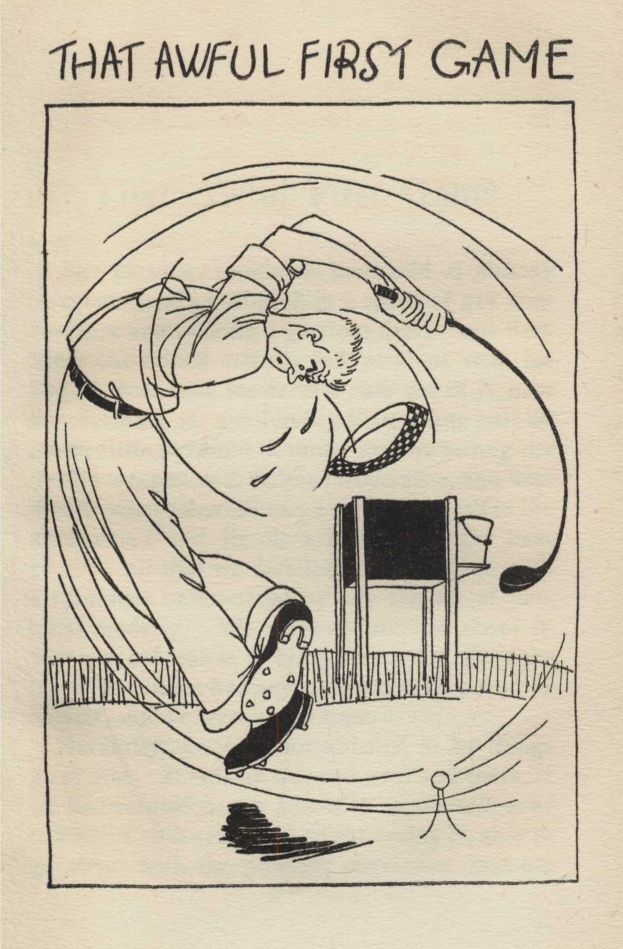
THAT AWFUL FIRST GAME
That Awful First Game
In a previous article we have told of picking up a friend's golf-club in a spirit of gay nonchalance and making a glorious drive—our first. How our friend artfully left us alone with his bag of tools, how we drew a club out of it, how we carelessly set a quivering little white ball on a neat little pyramid of sand, how we swung the deadly weapon with serene insouciance, and how that doomed spheroid tore a shrieking gash in the atmosphere and lit on a hillside in the next county—all that we detailed to our friends with a frankness untempered by any feeling of personal modesty. We were not modest about it. We saw no reason to be modest. On the contrary, we felt we had every reason to be proud of ourself, and we were at the time.
Naturally, we were not satisfied to let things go at that. If we had stopped then and there, if we had refused firmly and with cuss-words ever to touch a club again, we might to-day be able to go about with the pleasant conviction that we were a champion in possibility. When people talked of young Ouimet, as they still do occasionally—it is a great man who is famous for more than a few months in these bustling times—we could smile in a thoughtful way and ask casually if we had ever told them of that time when we had picked up that club and placed that ball, etc., etc.
Of course, they would probably be bored by the recital—especially after we had told it a few dozen times—but think of the satisfaction it would be to us to know that if we turned our giant intellect and steel muscles to the subject of golf, we would have Ouimet wishing that his parents had apprenticed him to a grocer or a plumber instead of making him a little caddy.
Unfortunately, we did not refrain from golf. We allowed ourself to be persuaded into going out and playing a game—starting a game, that is—and now whenever we hear the word "golf," we turn a peculiar bright salmon pink, and get a trembling all over us. That first game of ours was a thing no man who respects himself could look back on with anything but agony. Nothing but our passion for truth, even at the risk of exposing all the weakness of our nature—it is the same determination with us as with St. Augustine and Rousseau and the other great confessors—nothing but this could lead us to mention the game at all. But our favorite motto is, "The whole truth and then some." So with trembling pen we tear the veil from this crying gash on the milestones of memory—there seems to be something wrong with this metaphor. But never mind. On with the tale, let truth be unrefined!
A few days after that famous first drive we dropped into a friend's office to discuss several important matters of business—such as the weather and the market quotations in the leading blind-pigs. Our real purpose, however, was to tell him, quite incidentally, how we picked up that club and placed that ball, etc., etc., etc.
"Ah, ha, sounds like a pretty nice drive," said Bjones—let's call him that, anyway—when we had finished our modest little recital of how we had established a new record for the course. "You must come out and have a game with me at Boozedale to-morrow afternoon—hope I can give you a game all right."
As a matter of fact, this friend of ours is a mighty golfer. He's the sort of player that spends a bad night every time he takes more than eighty-five to go around in. And when he plays he drags around with him a leather barrel—or rather, the caddy drags it—containing enough carnal weapons to arm a division of the Bolshevik army. To see him coming to a decision between a jigger and a driving mashie, to see him taking his stance and addressing the ball, would fill the breast of the least reverent with awe. Napoleon playing his famous approach-shot with the Old Guard at Waterloo had nothing on our friend Bjones dropping one dead on the eighteenth green. But, alas, it was only later on that we discovered all this.
"Hope I can give you a game," said he.
We knew not the irony that lurked in his suave tones. It ran right off the umbrella of our self-satisfaction. We could see in it nothing but deference to our huge natural genius for the game. Besides, we were delighted at this chance to give free rein to our golfing abilities. We felt that to refuse the invitation would be flying in the face of Providence, which had obviously designed us for a champion. We did not accept too eagerly, however. We felt a certain reluctance about taking a fellow out to his own club and making a holy show of him. But finally we allowed ourself to be persuaded. The hour was named and the car.
Next day at the appointed time we were on the job. It was a lovely day, not too warm and not too cold—just the right temperature to call out the best that was in us. We felt that we would make our previous driving record look like something that had been done in the palæozoic age. When we caught sight of Bjones, however, we felt twinges of regret. Bjones seemed to look older than usual. And his stoop was more apparent than ever. We thought we could see lines of anxiety on his face.
When we made that famous first drive we were, of course, in our ordinary street-clothes—not that they are so ordinary, you know, not at all—but still the garb of convention. This time, however, we removed our civilized habiliments and got into a curious assortment of garments that Bjones dug out of his locker for us. They must have been in his family a long time. There was an old khaki shirt, and a pair of lavender trousers with a tendency to open-work effects. The boots had evidently been worn for years by a gigantic policeman, till a blacksmith came along and filled the soles full of horse-shoe nails. Bjones said they were fine for side-hills. Perhaps they were, but they made us feel like a touring-car travelling in chains.
After Bjones had succeeded in making us look like a tramp that had just been run off a farm by a couple of bull-dogs, he led us out to the first tee—right in front of the verandah where a number of ladies were sitting. They smiled at us and seemed to wonder if our escape had been noticed, or if we had been discharged as cured. It was a mortifying position. We found consolation, however, in the thought that our first stroke would show them that a champ' is a champ' for a' that.
A couple of men who were ahead of us drove off and hurried down after their balls into the valley below. After a suitable pause Bjones teed his ball up and whacked it into space in the general direction of a little white flag on the other side of the valley. But we waited. We could see the pair ahead of us putting on the first green, and we weren't taking any chances of slaughtering a fellow-creature, even if he did take four to the hole—mentally we allowed ourself about two.
Finally they holed out and disappeared on their way to the next tee. Carelessly we jabbed down a little lump of wet sand, set the ball on it, took a good look at the flag in the distance, waggled the club a few times in a business-like manner, and swung. There was no joyous crack. We gazed off over the landscape, but could see no ball wildly careering.
"Ahem, you were a little too hurried, old man," said Bjones.
We retrieved the ball. It had rolled about six inches under the impulse of the wind raised by the club. It was a painful moment, and we murmured a few words which we hope will not be remembered against us in the day of final reckoning. Then we erected a slender column of moist sand, somewhat on the model of the tower of Babel. It was a miniature campanile. On the top we carefully set the ball.
This time we were cautious—there could be no question about that. We were still confident, but were running no risks. Half a dozen times did we change our grip. For a full minute we wobbled the club about the ball, picking out the exact spot where we were going to hit it. Then slowly we brought the club back, higher and higher. Keeping our eye glued with maniacal intensity on the globule, we finally made a tremendous swipe at it and—carefully cut the sand from under it, so that it came down kerplunk! We had driven it just two inches—straight down. Bjones said nothing. There are times when silence is more precious than radium. And the caddy—the caddy was beyond speech.
We don't know how we finally managed to persuade the ball to vacate the tee and seek the green expanse of the valley below. But we did at last, and stumbled down the hill after it with vengeance in our eye. Selecting the ugliest-looking iron club in the bag Bjones had given us, we remorselessly drove that ball and a number of sods right up to the edge of the green—in eight, we believe. Or was it eighteen?
"Now, a nice little tap, a wrist-shot," said Bjones, who had holed out and had smoked half a cigar in the meantime.
It was a nice little tap. Tearing a hole in the flag and just missing the caddy's head by a fraction of an inch, that perverted pellet plunged screaming into an oak-forest, where it buried itself and will probably in the course of time grow into a cork-and-rubber plant.
"Hard luck, old man," Bjones murmured. But there was something very wistful in his smile. You see, that ball was brand new, and had cost Bjones just one dollar. The next ball he gave us was not quite so new—not by several gashes.
We have no intention of going into all the painful details of that game. Suffice it to state that after three hours of play and seven balls we had made eight holes. We didn't count our strokes. It would require one of those patent calculating machines that can add up three columns of figures at a time. When we hit the ball a good wallop, it invariably sought refuge in the woods or in a creek. The rest of the time it just dribbled along.
"Your game isn't so bad," said Bjones in answer to our apologies, "if you could only get it distributed properly. The trouble seems to be that you do all your putting from the tee and on the fairway, and all your driving on the green. If you could only reverse that, you would be a real winner." But, of course, that was precisely what we couldn't do.
One hole was an especially depressing experience. The tee is on the edge of a cliff, at the foot of which a little bubbling brook burbles beauteously. Now, any human being with the full use of one leg could kick a golf-ball over that stream without the slightest difficulty. So could we. But we made the mistake of going at it with a driver. We swung with savage determination, nicked the ball neatly on top, and had the pleasure of seeing it describe a pretty parabola and plunge with a gurgle to a watery grave. That, if we remember well, was the fourth ball. Of course, about thirty or forty pairs went "through" us. That is, some sixty or eighty gentlemen in more or less mussy garments came up behind us, watched us cynically, and then with grins more or less politely disguised went on ahead. Again and again, when we had just made a wicked drive of several yards, a fat duffer old enough to be one of our remote ancestors, with a red face and a girth that indicated years of reckless indulgence in pork and port, would come along, watch us for a moment, and then, growling apologetically, would drive like a rifle-bullet straight for the green we wouldn't reach for half an hour. And we have always rather fancied our lithe and athletic build!—or so we like to describe it.
Bjones was awfully decent about the whole thing. Bjones is a thorough-bred. He kept framing excuses for us, blaming the clubs he loaned us and the clothes he had induced us to wear. He even spoke harshly of the state of the turf in several places. We must admit that it did look pretty rough—after we got through with it.
In the end even he fell silent—that was when we had broken the second club. Unbroken gloom settled like a pall on our soul. We were too depressed even to swear. Besides, we had used up all the expressions we had been treasuring up for a time of mental stress, and we ceased to find consolation in the repetition.
The only sensible thing for us to do was to put the clubs—those that remained of them—back in the bag and refuse to take another swing. But no one is ever sensible at golf. We still kept hoping that the next shot would reveal the superb natural genius for the game that we had possessed only a few days before. And now and then a shot really would go right—usually when we lost our temper completely and simply took a savage swing at the ball without any formalities whatever. But the next stroke always plunged us into more horrible depths than ever. When we had finally managed to dribble and stagger our way to the last green, we felt so sick and lonesome and helpless that we could have lain right down there on the velvet sward and cried into the little cup—only we probably would have missed it even with our tears.
The only hole we could have played in really masterly fashion was the nineteenth—the one they used to keep in the club-house. Only it wasn't there any more. The Prohibitionists have seen to that. Driving right on to the green carpet, we would have putted discreetly with our right hand, and would have holed out with a quart bottle and a glass in two. Vardon himself couldn't play it any better than we would have done if—oh, those "ifs!"
We might moralize easily and at great length on this experience of ours, but what's the use? Besides, the moral is obvious. It is this. Once you have made a fine drive in a moment of reckless inspiration, either keep your hands off golf-clubs for the rest of your life, or go away somewhere and practice in secret for several years with an instructor to whom you have given hush money, before you display yourself and your golfing skill on the links. Otherwise, you will fill the caddy's soul with loathing—-we did.
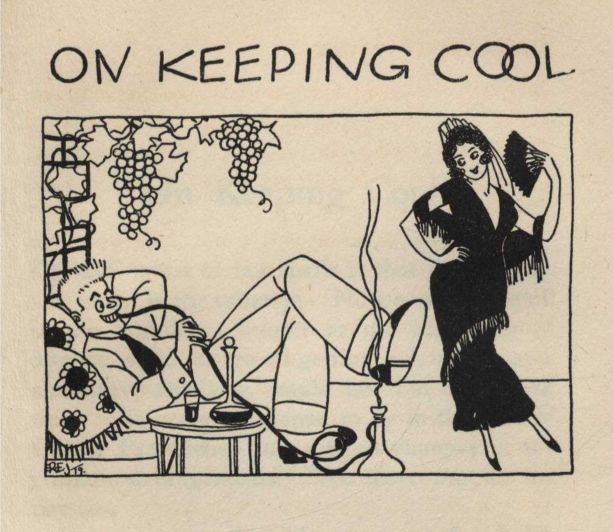
ON KEEPING COOL
On Keeping Cool
The worst of hot spells is that they always occur in the summer. Now a nice hot spell in the middle of winter or the beginning of March, when we are all getting sick of the snow and heavy woollens, would be—but enough of this! We are not the man to fly in the face of Divine Providence and suggest changes in the climatic arrangements. We leave that to the parsons.
It is quite possible, of course—in fact, with our usual luck in such matters, it is highly probable—that by the time this has been printed, bound, and inflicted on the public, the public will be sitting in front of a grate-fire with a shawl and a cold in the head, having been caught in the sleet on the way home from the office. The public will therefore regard our advice on the best way to keep cool as an impertinence and an imposition. And we hate to have the public think us a jackanapes or a darn fool. Of course, the public is bound to find us out some time, but we would like to postpone the dread day as long as possible.
Whatever the weather may be like at the time of reading, at the time of writing and for some days back we have been going through a period of torridity during which keeping cool has been an art—a lost art, we regret to state. Having devoted to it all the powers of our mind and all the energy we had left after the business of perspiring, we feel qualified to speak on the subject with assurance and authority. Not that we have ever considered it necessary for us to feel qualified before speaking, but it is just as well.
As soon as the heat-wave hit us in our office-chair, we took off our coat, vest, collar and tie, and knotting our suspenders around our editorial waist, we sent out for all the heat-literature that could be obtained for love or money—preferably for love. And then we plunged with characteristic impetuosity into the task of mastering this subtle science or esoteric philosophy or whatever it is. Only we didn't master it.
We never in all our life became so hot as we did reading the various directions for keeping cool. When we got through we were stuck to the back of our chair, the pattern of our shirt had been roughly transferred to our epidermis, and we had gone into liquidation to the extent of several pounds—avoirdupois, not sterling. But we had the satisfaction of feeling that we knew all there was to be known about keeping cool, all the hints, surmises, suggestions, and epizootic bosh generally.
Advice on how to keep cool, so far as we can find out, usually concerns itself with clothes, food, rest, and the state of one's mind. The crest of the heat-wave is always littered with suggestions as to what one should wear and eat and drink—especially what one shouldn't—how much one should rest, and how peaceful and serene one's mind, or what one uses in its place, should always remain. This last is considered very important. Perhaps if one can only get cool, a cool mind will help one to keep so. But we never get—not till the hot spell is over.
Concerning clothes we are told that we should wear as little as possible—as little, that is, as the crossing-policemen will let us get by with. And what little we do wear should be of silk or linen or thin flannel, and very light in color, preferably white.
Now, so far as the girls are concerned, this is easy. They have already at the dictate of fashion removed all the lower strata of clothing, retaining only the extreme outer layer. And even this they have cut so low and slit so high, that there is practically no obstacle in the way of the weakest zephyr that ever zephed. And, as for mosquitoes, a really sporting mosquito would scorn to take opportunities so easy.
But men are somewhat handicapped. We still retain vestiges of primitive reticence. Or perhaps it is only that we do not think we would look so well in transparent garments. The thought of wearing muslin trousers tastefully slashed to the knee causes us to shrink painfully. Nor would we like our shirts cut low to display our collar-bone and Adam's-apple. There is something crude and ungainly about masculine architecture when exposed in that unabashed way.
Of course, there are linen suits and mohair suits. Now and then one even sees a silk suit—very seldom, though, for few men are dare-devils of this unfaltering type. But, though cool enough in a way, there are disadvantages to all such clothes. We know, for we have tried them.
Five or six years ago, we recall, there was a hot spell of the good old blast-furnace type. In its tropical glare one's ordinary suit felt like the winter garb of an Esquiman. Fat men became slim, though not graceful, in a single afternoon. It was like being rendered in one of those German plants for producing glycerine.
Personally, we became desperate. Not that we are of a fat or particularly full-blooded type. But then neither are we a lightning-rod—not, except in the most figurative sense. We rushed out to our barber and had him reduce our dome of thought somewhat to the appearance of a stubble-field. We got a pair of canvas shoes and a Panama hat. We tried beer. Then we tried ice-cream sodas. Then we tried beer again—this time we gave it a really good trial. Still no relief. As a last resort we bought two linen suits. We were desperate, that's all! The idea in buying two was to wear one while the laundry was hanging, drawing, and quartering the other.
They were nice suits—not a doubt about it! On the stage they would have caused matinee-girls to dream about us. But for private life, especially such a modest and retiring private life as ours, they were rather pronounced. One of them was made out of a genteel sort of gunny-sacking; while the other was smooth with hair-line stripes at wide intervals. But both had the same general color-effect. It suggested a sick canary—yellow, you know, but not up to its usual form.
The first time we put one of them on, we sneaked out the back way. We didn't dare step out where the neighbors could see us. Of course, there would not be the same occasion for nervousness nowadays, when suits of this airy character have become so much more familiar. But this was five or six years ago, when masculine tastes were less Arcadian.
While we stood waiting for a street-car—we felt as though we had been waiting several hours—hot blushes coursed over us from head to foot. The perspiration fairly sizzled on our cheeks. We couldn't have felt hotter in a coon coat.
As the car bore down upon us, we noticed that the motorman kept his eye fixed on us with withering contempt. He fairly snorted with indignation as he applied the air-brake. We put it down to jealousy. He was wearing one of those nice serge suits, blue and shiny, made of cloth weighing half a pound to the square foot, and bound with leather at the wrists, as is popular in municipal-traction circles. A coat like that is about as pervious to air as a zinc roof. We tried to persuade ourself that he envied us.
The conductor, while he held out the box for our yellow ticket—no, we didn't choose it to match the suit—studied us as though we were a new and exotic specimen at the local zoo. Then he went up to the front of the car, and as he went the motorman turned halfway round and said in a stage-whisper that carried easily the full length of the car: "Fer gawd's sake, did yuh see what got on?" Then they talked seriously together for a moment or two. They seemed to be considering whether or not they ought to throw us off. It was very difficult to look unconcerned, but we tried.
There are many painful recollections connected with that day. We bore up against the flood of contumely and ridicule as best we could. But in the end it was too much for us. We passed a group of boys on a street-corner. We had passed several such groups during the day, and had been obliged to listen to many personal remarks of a vulgar character utterly lacking in true wit. As we went past this last group the usual derisive comments were made, but we neither slackened nor hastened our stately progress. Then in the midst of them a shrill voice suddenly piped up: "Oh, you Votes-for-Women!"
It was too much. Our cup was full—in fact, it was sloshing over our anguished soul. We hurried home and tore the suit off, and were only prevented by fear of our landlady from burning it in the corner of our room. We never wore it again.
As we pointed out before, however, the public attitude towards garments of this sort has changed very considerably in the past few years. A man may now clothe himself like the lily—the orange lily, that is—without causing people on the street to suspect him of being a poet or a professional fox-trotter. Think of the vogue of the Palm Beach suit in the past few years!—which reminds us.
We were sitting in the office the other day—a real sizzler, too!—with the door locked for protection and most of our clothes piled up on the extra chair. Oh, it's all right. We had arranged with the office-boy to ring a bell when he saw anyone coming towards our door, so we could put some of them on again.
Well, we had hastily scrambled into our coat and an expression of alert dignity when a fat man was ushered in. He is a friend of ours who had dropped in to show us a nice new Palm-Beach suit he had bought for ten dollars and a quarter the day before—heaven alone knows what the quarter was for! In fact, at the first glance we wondered what the ten dollars was for.
To be perfectly frank—always an interesting and perilous endeavor—we took a scunner against that suit. In the first place it was so darn baggy; and then the color! It hung on him in folds like an elephant's skin—a light tan elephant who had been crossed in love. We wouldn't wear a suit like that—not, if we had to go around in our pyjamas. But naturally we didn't tell him so—there is such a thing as tact. We said all we could for the suit. We remarked that there seemed to be a good deal of cloth in it for the money, and it would be a nice invisible shade for sitting around the beach in the evening. Even the sand-flies would hardly be able to find him.
If we had let the matter rest right there, we would have been all right. He wasn't flattered exactly, but he was satisfied. Unfortunately, in our desire for information, we asked him if the waiters in the better-class restaurants made any objection to serving him.
You should have heard that fat man talk—that is, when he ceased to foam and his rage became articulate. What he said about us and our clothes we would hate to admit in the police court, let alone print in cold type here. He wound up with the statement that the only reason we hadn't been sun-struck before now was because there was nothing in our noodle for the sun to strike. And this was flattering compared to some of the things that went before.
Finally we were forced to remind him that he was exhausting what little air there was in our office. As a matter of fact, we don't know of anything that will exhaust the air of an ordinary room so quickly on a hot day as a fat man in one of those pale, porous suits.
The immediate chill that ensued in our conversation was very grateful to us. It was the first chill we had had in days, and we were looking for chills. Night after night we kept hoping some burglar would break into the house, or a good gruesome ghost start strolling around, so we could have a few authentic chills chasing one another up and down our spinal column. But no luck! You couldn't hire a burglar in such weather—not if you doubled the regular rates of the Burglars' Union. And as for ghosts—well, they found it cooler, no doubt, even in the place where the naughty ones are sent.
By way of finishing with the subject of summer clothes, we may as well confess that we bought a mohair suit once. It was very nice stuff, a little shiny, but quite cool. All went well till we were caught in a shower. Then that suit did things we had never before thought possible for anything but a snake or a contortionist. It tied itself into incredible knots. The trousers climbed up one leg, and twisted frantically in an endeavor to break the other. The tails of the coat curled up, presumably with a view to getting around our neck and strangling us. It took a couple of our friends to pry the suit off and restore our circulation. We never felt the same towards it afterwards.
So much for the heat-suggestions about clothes. And the advice they give you in the matter of food is almost as bad—nothing but milk and eggs and salads. Spoon-feed and garden truck! Fine stuff to expect a man to do his work on. Not that we are so set on working that we eat solely with that end in view. But one must hold one's job, if one is obliged to have such a thing at all. And holding a job implies, so far as we are concerned, a certain number of steaks and slices of roast-beef-rare.
"Ah, but, my friend," says the heat-suggester, "you must not over-exert yourself. You must repose, especially during the heat of the day. You may do a little work in the early morning and again in the evening. But from eleven to four—nay, nay, 't is very unwise." And then he proceeds to dwell at length on that beautiful Southern custom of the siesta.
It is a beautiful custom all right. Far be it from us to deny it. For years we have been dreaming of nice little siestas out in the grape-arbor with a bubble-pipe and a couple of senoritas singing Spanish love-songs to the silvery tinkling of the mandolins. We realize that the bubble-pipe is not especially Spanish, but it is cool and that is the principal thing.
We have never dwelt on this ambition to the Managing Editor. We do not believe he possesses a romantic imagination—not sufficiently romantic, at any rate. But what do hot-weather tipsters care about managing editors?—pish-tush and less! What do they care for jobs, or even positions? They simply refuse to take them into account. All they ever stop to consider is temperature.
In the same way they take no stock of human infirmities and foibles. They ruthlessly cut out all the pleasures of life, innocent or otherwise—especially otherwise, as you might expect, but the innocent ones, too. For instance, you mustn't smoke. That raises your blood-pressure! We presume that having one's blood-pressure raised is a very serious thing, something like having one's taxes raised. Anyway, we are warned against it.
The same applies to drink—only much more so. God bless us, yes! Of course, when we say "drink," the reference is to fluid of a sociable and cheering character, not to iced tea or well-water or such other insipid means of internal refrigeration. But then the Prohibitionists have cut drink off, too—and much more effectually, alas!—so the warnings of the health-cranks find us unresigned but acquiescent. We may even be soothed by their assurances that "booze" is bad for us in the summer, though personally we have never found much consolation in reflections of this nature.
The thing is done, however—at least, for the present, whatever hopes one may entertain for referendums in the future—and we must accept our thirsty destiny. So farewell the jovial Collins and the smooth and voluptuous Gin Fizz, whether silver or golden. No longer must we soar on the bounding High Ball to celestial regions where the heat-waves cease from troubling and the mercury is at rest. The pungent and appetizing Cocktail is not for us, nor the enticing Rickey. Even the mild and genial Shandy-gaff must we shun, for it contains Beer, and the name of Beer is anathema in anything but negligible percentages.
Their merry reign is over, and all their kingdom is given up to plebeian beverages like Sarsaparilla and Soda-Pop. But those of us who are royalists at heart will still continue to look forward to a restoration of the old regime. They have gone, but their memory is green in our hearts—green with sprigs of mint.
BACK TO NATURE IN A LIMOUSINE
Back to Nature in a Limousine
There has been in recent years a good deal of talk about "going back to nature"—perhaps we should make that a capital "N." Even some of the highest-class magazines have been devoting to it so much space that we begin to suspect the advertisers must have asked to be put next to extra-pure reading matter. It is true that most of it was written at so much a line or an inch or a column by chaps living in hall-bedrooms, but it is none the less an indication of a genuine back-to-the-land movement. We know for we have taken part in it ourself.