LOUISE IMOGEN GUINEY (continued 5)
Reading edition
‘“The age[224] is out of joint. O cursèd spite, That ever I was born to set it right!”
‘Vivas, valeas, et Apostolicus fias. I shall be back in May.’
Sir James Stephen was very wroth with Froude for his attitude towards the slaves of the West Indian Colonies, deducing that attitude from some allusions of Froude’s own to ‘anti-slavery cant.’ The Editors of the Remains attest that Hurrell did not suffer (as later Mr. J. A. Froude was said to do, from other alleged causes) from negrophobia. But certainly his speech about ‘the niggers’ does not always sound 170 reassuring. Perhaps in this, as in other matters, he leans upon the reader’s general knowledge of him, and requires that to supply the marginal comment.
It is a common jibe against reformers, though not always a true one, that their range of ideas is disproportioned or partial. Members of the Anti-Vivisection Society are supposed to be indifferent to wife-beating. Perhaps, if known, Hurrell’s tendre for his only Roman Catholic, Monsignor Wiseman, and for ‘Roman Catholic sentiments,’ as he calls them, would seem enough to account for his limitations of sympathy on an island where he spent an unwilling year-and-a-half. It is interesting that to a Wilberforce, of all persons, he confides his final impressions, still pessimistic enough, of ‘our brothers carved in ebony.’ The Bill for the total abolition of slavery in the British dominions had received the Royal assent on August 28, 1833, and had come at last into full operation as Froude wrote. He was not wont, in other matters, to judge of the justice of a measure by its practical workings, or by the local material it had to work upon.
Hurrell approaches Keble in his most lucid and mischievous argumentative mood on the same day.
‘I have a miscellaneous jumble of things that I want to talk to you about, if I can but arrange them in any sort of order…. And first, I shall attack you for the expression “The Church teaches” so-and-so, which I observe is in the Tract[225] equivalent to “The Prayer-Book etc. teach[es] us” so-and-so. Now suppose a conscientious layman to inquire on what grounds the Prayer-Book etc., are called the teaching of the Church: how shall we answer him? Shall we tell him that they are embodied in an Act of Parliament? So is the Spoliation Bill. Shall we tell him that they were formerly enacted by Convocation in the reign of Charles II.? But what especial claim had this Convocation to monopolise the name and authority of the Church? Shall we tell him that all the clergy assented to them ever since their enactment? But to what interpretation of them have all, or even the major part of the clergy assented? For if it is the assent of the clergy that makes the Prayer-Book etc. the teaching of the Church, the 171 Church teaches only that interpretation of them to which all, or at least the majority of the clergy have assented; and in order to ascertain this, it will be necessary to inquire, not for what may seem to the inquirer to be their real meaning, but for the meaning which the majority of the clergy have, in fact, attached to them! It will be necessary to poll the Hoadleians, Puritans, and Laudians, and to be determined by [the] most votes. Again, supposing him to have ascertained these, another question occurs. Why is the opinion of the English clergy, since the enactment of the Prayer-Book, entitled to be called the teaching of the Church, more than that of the clergy of the sixteen previous centuries; or, again, than the clergy of France, Italy, Spain, Russia, etc., etc.? I can see no other claim which the Prayer-Book has on a layman’s deference, as the teaching of the Church, which the Breviary and Missal have not in a far greater degree…. I know you will snub me for this…. Surely no teaching nowadays is authoritative in the sense in which the Apostles’ was, except the Bible? nor any in the sense in which Timothy’s was, except that of Primitive Tradition? To find a sense in which the teaching of the modern clergy is authoritative, I confess baffles me.[226] …
‘Next, as to The Christian Year. In the Fifth of November—[as to]
‘“There present in the heart Not in the hands,”—
how can we possibly know that it is true to say “not in the hands”?[227] Also, on the Communion … you seem cramped 172 by Protestantism. I desiderate something in the same key with
‘“Shall work a wonder there Earth’s charmers never knew,”
and
‘“When the life-giving stream,” etc.[228]
So much for quarrelling. I have attacked N[ewman] for some of the Tract Protestantism…. However, the wiseacres are all agog about our being Papists. P. called us the Papal Protestant Church, in which he proved a double ignorance: as we are Catholics without the Popery, and Church-of-England men without the Protestantism…. It seems to me that even if the laity were as munificent as our Catholic ancestors, they could do nothing for the Church, as things are, except in their lifetime. Any Churches they might build, any endowment they might make, would be as likely as not to become in another generation propagandas of liberalism. Certainly we cannot trust the Bishops for patrons…. I don’t feel with you on the question of tithes. They cannot be a legal debt and a religious offering at the same time. When the payment began to be enforced by civil authority the desecration took place…. The Wesleyan system is voluntary … they are the strongest, and most independent of their congregations, of any existing society in the United States, and, I believe, in England….’
To the Rev. J. H. Newman, March 4, 1835.
‘… My dearest [Newman], I suppose by this time you will have learned to think as little of my inconsistent reports as I do when making them! I see [that] on one and the same day I must have sent my father a cheerful account, and you a dismal one. I am forced to say something, but have no data to judge by, and so talk at random. Certain indeed I am that my pulse is still progressively calming, 173 and that now it is scarcely more irritable than it ought to be; but in nothing else can I be sure that I change at all…. Favus distillans labia tua, as someone said to John of Salisbury.[229] What can have put it into your head that your style is dull? The letter you sent me in the box was among the most amusing I ever received. I have now made up my mind to come back [in] the packet after the next, so as to be in England the middle of May, and am not wholly without hope that the voyage may do something for me. The notion of going to Rome with Isaac is very gratifying. I must learn French for it, though; for I have no notion of trusting “Providence,” as I did last time. The sun has already got almost to his full strength, though the earth is of course [only] beginning to collect its stock of caloric, and the experience of last year assures me that the less I have of it the better…. I am most sincerely sorry to hear of Mr. K[eble’s] death.[230] I suppose if there ever was anyone to whom death was like going to bed, it would be Mr. K[eble]. I have written lots of stuff since I have been out here, some of which I must inflict on you on my return; but none of it will do to publish. When I look over anything long after I write it, I see such jumps and discontinuities as make me despair of ever being intelligible. How I wish to see you all again!’
Shortly after this letter was sent to post, Hurrell left Barbados for good. No personal records of him exist there, and all memories of him have faded away. His face was set at last towards another island where his few remaining days could be crammed full of intelligent toil, and played at their full value. From Bristol, on May 17, he was able to announce: ‘Fratres desideratissimi! here I am, benedictum sit nomen Dei, and as well as could be expected. I will not boast, and indeed, have nothing[231] to boast of, as my pulse is still far from satisfactory….
174 ‘When we asked our pilot “Who was Speaker?” he did not know; but after much cross-examining he recollected that he had heard it cried about the street that the old one was turned out; who “the other gentleman” was, he could not tell. Our next informant was the Custom House officer, who boarded over night, when we anchored, to see that nothing was taken out of the ship. All he knew was that “there had been a jabbering” about a change of Ministers.[232] The day is as dull and gloomy as possible; but after the torrid zone, any English May day is “a sight for sair e’en.” … I hope to get a sight of you soon. And now goodbye both! also I[saac] and R[ogers], and all that are within reach.’
This is Newman’s narrative note, drawn, thirty years after, from his own retentive memory:
‘R. H. F. made his appearance in Oxford on Tuesday, May 18. On the morrow occurred the Convocation in the Theatre, when the proposed innovation of a Declaration of Conformity to the Church of England, instead of Subscription to the Articles, was rejected by 459 to 57. It was the last vote he gave…. He left Oxford, never to return, on June 4. During this time Bowden was in Oxford; and for the first and last time saw R. H. F.’
Miss Anne Mozley, too, remembered in old age her only sight of Hurrell Froude.
‘It happened to [me], passing the coach office, in company with Mrs. Newman, to see Froude as he alighted from the coach which brought him to Oxford, and was being greeted by his friends. He was terribly thin, his countenance dark and wasted, but with a brilliancy of expression and grace of outline which justified all that his friends had said of him. He was in the Theatre next day, entering into all the enthusiasm of the scene, and shouting Non placet with all his friends about him. While he lived at all, he must live his life.’
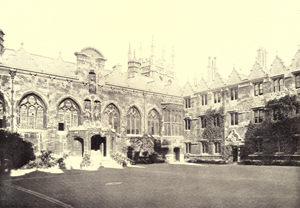
ORIEL COLLEGE, OXFORD (BEFORE RESTORATION)
Frederic Rogers was of the company at Convocation who 175 protested against a local Repeal of the Test and Corporation Act. He had no very hopeful feelings about the much-welcomed immigrant, and wrote to his sister from Oriel on May 2:
‘Wilson, Ryder, Wilberforce, Harding, spent several days here, with a quantity of other contemporaries, and Hurrell Froude arrived just in time from Barbados to cut into the middle of it. It quite surprises me how little people change! All these gentry, married and single, were so exactly what they always had been, that I could hardly believe I was not a freshman again. The only painful thing was that I fear Barbados has not done much for Froude. I was quite shocked to see him, but I suppose I had been too sanguine; his wretched thinness struck me more than it had ever done. They say, however, that no one ever gains flesh in the West Indies, but that it tells when they come back: I most earnestly trust it may be so. He talks of spending the winter at Rome again, going straight there, and coming straight back. He certainly cannot spend it in England. I cannot describe the kind of sickness I felt in looking at him when just the first meeting was over. I suppose it is a hopeful sign that his spirits are just as high as they always were; at least, were so when he first came here: for I am afraid we must look for a change in that, as Newman tells me he has heard to-day that his sister who was so ill is given over. I have not seen him since his hearing the news. However, I am getting mopish.’[233]
William Froude was still in Oxford also, having moved into Hurrell’s vacant rooms. Says the Rev. Thomas Mozley, in his most entertaining book:[234]
‘William Froude gave his heart in with his brother’s work at Oriel, though his turn even then was for science…. He was the chemist, as well as the mechanist of the College. His rooms on the floor over Newman’s were easily distinguishable … by the stains of sulphuric acid (I think) extending from the window-sills to the ground. The Provost must sometimes have had to explain this appearance to his inquiring guests, as they could not but observe it from his drawing-room window.’
176 With Hurrell and William, during these May days, was Anthony Froude, a boy of seventeen, coming up to Oriel with his private Tutor (with whom he was reading in the neighbourhood) in order to see his eldest brother.
‘When I went into residence at Oxford my brother was no longer alive. He had been abroad almost entirely for three or four years before his death; and although the atmosphere at home was full of the new opinions, and I heard startling things from time to time on Transubstantiation and suchlike, he had little to do with my direct education. I had read at my own discretion in my father’s library.’[235]
Anthony matriculated during the early December of this very year, two months before Hurrell died. Perhaps not many College rooms have known three such notable successive occupiers of one family, each of strong idiosyncrasy, and alike in nothing whatever but in personal charm.
The happy three weeks ended, Hurrell set out for Devon, with Mr. Keble for companion part of the way. People who had known him ‘looked horribly black at me, at first,’ until they became ‘accustomed to my grim visage,’ he tells Newman, five days later. Doubtless it was a harrowing thing in the pastoral neighbourhood, this continual spectacle of young faces at the Parsonage visibly withdrawing from the summer air. And another indomitable dying Froude was there, poor Phillis Spedding, the tradition of whose pathetic beauty yet lingers about the Cumberland hillsides whither she came as a bride.
To the Rev. J. H. Newman, Dartington, June 11, 1835.
‘Dulcissime, I got home Friday evening before dark very comfortably. My poor sister is perfectly cheerful, and free from pain, but daily declines in strength. Indeed, she is now very visibly weakened since I first saw her. It is impossible she should live many days. She is quite aware of her state, and seems to be as composed, and almost [as] happy, as if she was going to sleep…. There is something very indescribable in the effect which old sights and smells produce in me here 177 just now, after having missed them so long. Also, old Dartington House, with its feudal appendages, calls up so many Tory associations as almost to soften one’s heart with lamenting the course of events which is to re-erect the Church by demolishing so much that is beautiful! “rich men living peaceably in their habitations.” On my way from Oxford, Keble talked a good deal about Church matters, and particularly about the ancient Liturgies, and my analysis of Palmer,[236] which had put the facts to him in rather a new point of view.’
And he reverts, in his animated vein, to the propaganda never out of his thoughts, saying encouragingly to Newman:
‘I have heard from my sisters and the Champernownes of the efficacy of your opuscula in leading captive silly women. One very curious instance I heard the other day of an exceedingly clever girl who for the last two or three years has been occasionally laid up with a very painful illness, and suffered severely. Nobody that she lives with can have acted as channels for infecting her,[237] as they are all either commonplace sensible people, or Evangelical, or lax. But she has got it into her head that there is a new party springing up in the Church, which she calls “the new men,” and has been pumping my sisters about you, and whether your notions are spreading, etc…. They say she has been working the Dartmouth Evangelicals with your Sermons, and made one of the parsons knock under! I have also heard of a learned lady (a very good and sensible person, by-the-bye), poking away most industriously at your Arians, and saying that her views had been much cleared by it.’
Phillis Spedding did not long survive her return to England. She died at Dartington three days after the date of Hurrell’s letter, on June 14, 1835, in her twenty-sixth year. Her one little child, Edward Spedding, then aged eighteen months, grew up only to attain his majority, and to be buried in January, 1855, at Bassenthwaite, not with his mother. 178 Thomas Story Spedding, living on at the manor which he had so romantically inherited, married again.
Meanwhile, in Littlemore, Mrs. Newman was about to lay the corner-stone of her son’s Early English chapel, with the plans of which the architectural zeal of Mr. Thomas Mozley, the Vicar’s future brother-in-law, had much to do. The rumour that Hurrell Froude had designed it got some currency; and there is a mirth-provoking growl on the subject in the pages of that watchful worthy, the Rev. Peter Maurice of Yarnton, Chaplain of New College.[238] Upon the return of Newman and Froude from Rome in 1833, he says, ‘we soon found that the malaria of the Pontine marshes, the nondescript fogs of the fatherland of all heresy, began to develop their miasmata in a new diagnosis…. That edifice [Littlemore Church] was constructed from outlines and plans sketched out for the architect by an amateur friend of [Newman’s] own: the Rev. R. H. Froude. It was in a particular style of Church architecture which they were plotting to introduce. It was, in fact, the very first Church in modern times[239] that was ever consecrated with a stone altar, a stone cross, and credentia.’
Hurrell, however, at this very time, 1835, was busying himself with artistic needs nearer home. After his death, Archdeacon Froude wrote to Newman in one of his letters, which affectionately begged for a visit: ‘I hear you have a splendid Altar-table at Littlemore. That which dear Hurrell designed, and had executed for my chancel, is now in its proper place.’ This was in December, 1836. Hurrell’s Altar, practically modelled on the High Altar of Cologne Cathedral, has always been preserved as his gift at Dartington, and constantly used; it has undergone no alteration except that it had to be raised for convenience, after Archdeacon Froude’s death, as he was short, and both his successors have been very tall men. It was 179 brought from the old Church to the new. Hurrell also changed the place of the chancel-screen in the Church now destroyed, moving it eastward, from the entrance to the choir, to enclose the rail at the Altar-foot, so that none but communicants passed beyond it: an irregular proceeding for an ecclesiologist. But it seems clear that he meant by the action to emphasise the sacredness of the Altar itself.
He was ever on the move, physically and mentally, in and about his father’s parish. Neighbours and social equals found it a bracing pleasure to see and hear him again, after absence; he had the greatest possible influence with them; those of his own age, fifty years later, and scattered all over England, were still quoting him. He dearly loved children, whom he met upon equal terms. Wherever there were children, Hurrell was always testing their metal, while romping with them. Would they run away from a comrade in danger? Would they throw blame on others? Would they break promises? He knew of what stuff every lamb of them was made, and it has been quite impossible for any of these, either, to forget him. This sweet solicitude, comeliest in one auquel une grâce particulière a révélé le prix et la beauté de la virginité sacerdotale,[240] played in and out among his graver cares. That, and the old preoccupation with architecture, stood for his best diversions, during his final year. It would appear that he also visited London. The admirable critic of the Movement just quoted lays some stress, in passing, on Hurrell’s interview with Dr. Wiseman; he even surmises that it was caused by spiritual anxieties of one sort or another.[241] But he forgets that Hurrell’s intention then was to return to Rome, and to historical work in the Vatican Library, and that, long before, Dr. Wiseman had promised his aid and interest in obtaining for him facilities for research.
The Gothic plotter (no more Gothic, Mr. T. Mozley thinks, 180 than he should be), was employing his July of 1835 in outdoor devices. He tried to allure Newman as far as Torbay. ‘I am sure the lark will do you good, and the money (£2, 15s.) will not be grossly misspent.’ To which his friend replies on July 20: ‘… I should like of all things to come and see you, but can say nothing to the proposal at present, being very busy here, and being, in point of finances, in a very unsatisfactory state. I am at present at Dionysius and the Abbé, whom Oh! that I could despatch this vacation!’
This is the Abbé Jager, the Rev. Benjamin Harrison’s Parisian friend, a lively, learned, and apparently provoking controversialist, author of Le Protestantisme aux Prises avec la Doctrine Catholique. Newman received his reply promptly from Paignton, though he put off the visit. ‘Frater desiderate,’ says Hurrell, ‘speak not of finances, since all the people here are ready to subscribe for you; as for the Abbé, you can work him here as well as anywhere. It is exquisitely pleasant here: a hot sun with a fresh air is a luxury to which I have long been a stranger. If you were to stay here a fortnight, you might get on with your controversy, and be inspired for the novel! I give out in all directions that you mean to write it, and divulge the plot.’
Miss Mozley thus comments on this inciting of a new literary activity in Newman. ‘There is nothing in the papers before [me] to show that any ground whatever, in fact, existed for the novel Froude here talks of. In the Postscript to Callista, the author speaks of being stopped at the fifth chapter “from sheer inability to devise personages or incidents.” Was the attempt to express the feelings and mutual relations of Christians and heathens in early Christian times already an idea in the author’s mind?’ The intrinsic evidence is certainly strong against the likelihood of Newman’s earlier story, Loss and Gain, or anything remotely resembling it in subject or framework, being contemplated in 1835. Attentive readers of that very Oxonian book will recall, incidentally, that Devonshire becomes the home of the Redings, and may even, without being too fantastic, detect some faint irregular adumbration of Hurrell Froude, Froude deduced as Newman would fain have him, in the phantom figure, so illusive and 181 attractive, of Willis.[242] Perhaps ‘the novel,’ the plot of which Froude was so pleased to divulge, was but an original inspiration of his own. He had long before formed a critical, if rather despiteful interest in fiction, as the unwelcome supplanter of poetry in a decadent age; and perhaps he had invited Newman to write a story as Newman had invited him to dream of the Indian Bishopric: all ad majorem Dei gloriam. At any rate, five weeks before, Froude had mentioned what is apparently the same ‘novel’ as his own affair, in a letter to Newman printed in the Remains but not in the Newman Correspondence. ‘My ideas about the novel,’ he says, ‘are but cloudy, as I have no books of reference to get details out of. Would that the stars may let me return to Oxford before long, to work at things,[243] and rub up my intellects!’ It would be pleasant, were there any sure grounds for it, to associate the profound spiritual passion, as Mr. R. H. Hutton calls it, of Callista, with the emulating and holy friendship of John Henry Newman and Hurrell Froude.
Newman had been bringing forward in print something very dear to both: the monastic ideal. With his usual scrupulousness, he had begun to fear that he was laying too great a burden upon his well-wishers in leaving them to accept and defend a thesis so inexpedient, because so hostile to the spirit of the time; and Hurrell strikes out against the expressed misgiving before ending the letter of July 31 just quoted. His father, as ever, was his standard of wise moderation.
‘… As to your Monasticism articles in The British Magazine,[244] my father read the offensive part in the June 182 one, and could see nothing in it that any reasonable person could object to; and some persons I know have been struck by them. I cannot see the harm of losing influence with people when you can only retain it by sinking the points on which you differ with them. Surely that would be Propter vitam vivendi, etc.? What is the good of influence except to influence people?’ To Mr. Keble, at the same time, Froude expresses a generous envy of Newman’s ‘taking’ utterance (what Newman himself calls his ‘mere rhetorical or histrionic power’), and admits again the difficulty of winning any such command over souls in England, with his own very elliptical genius. ‘I find myself so ignorant of the way to get at people, that I never know what to assume and what to prove!’ Froude’s straightforward case was Jeremy Taylor’s of old, of whom Chillingworth regretfully said: ‘Hee wants much of the ethickall part of a Discourser, and slights too much, many times, the Arguments of those hee discourses with.’
Newman tells his dear sister Jemima, on August 9: ‘I think I shall go down to Froude for ten days. I am very unwilling to do it; but it is so uncertain whether he will be able to come to Oxford at all, that I think I ought to secure seeing him before he goes abroad.’ And again, to the absent comrade, a fortnight after: ‘I am sick of expecting a letter; for the last week I have every day made sure of one, and been disappointed. I cannot help fearing you are not well…. I must (so be it!) come down to you before Vacation ends, to get some light struck out by collision.’ For Newman had been trying to work out alone ‘whether Tradition is ever considered by the Fathers, in matters of faith, more than interpretative of Scripture.’ To Mr. Rogers, at the same time, he speaks of the contemplated move. ‘I have little to show, this Vacation, in point of work done. The time seems to have slipped away in a dream. Perhaps it would be as well to go down to Froude, were it only to adjust my notions to his. Dear fellow! long as I have anticipated what I suppose must come, I feel quite raw and unprepared. I suppose one ought to get as much as one can from him, dum licet.’
Newman himself was again over-busied and ailing. No reader can fail to notice the deepening tenderness of the 183 correspondence between the two during these last months, where yet sportiveness and candour, and a certain mutual deference, keep their old due order. Words go quickly and lightly, without emphasis or strain, as if driven willingly on the rising wind which is the eternal silence.
‘My dearest Newman,’ opens the awaited missive of Sept. 3, ‘I am afraid you will have been grumbling in your heart at me…. But really, I am not to blame, as I have not put pen to paper for a fortnight, except yesterday, when I began a letter to you upside down. I cannot explain what has been the matter with me; but I am sure that the apothecary into whose hands I fell made a fool of himself…. As to our controversies, you are now taking fresh ground, without owning, as you ought, that on our first basis I dished you! Of course, if the Fathers maintain that “nothing not deducible from Scripture ought to be insisted on as terms of communion,” I have nothing more to say. But again, if you allow Tradition an interpretative authority, I cannot see what is gained. For surely the doctrines of the Priesthood and the Eucharist may be proved from Scripture interpreted by Tradition; and if so, what is to hinder our insisting on them as terms of communion? I don’t mean, of course, that this will bear out the Romanists (which is perhaps your only point?), but it certainly would bear out our party in excommunicating Protestants…. You lug in the Apostles’ Creed, and talk about expansions. What is the end of expansions? Will not the Romanists say that their whole system is an expansion of the Holy Catholic Church and the Communion of Saints?’
Finally, on the 10th, arrives Newman’s definite word: ‘I propose coming to you next week,’ coupled with anxious inquiries about his health. Hurrell replies at once:
‘We shall be ready for you whenever you come. Dr. [Yonge] and a young doctor called Hinkson, who has paid much attention to the stethoscope, examined my chest all over; and they both told my father they never examined a chest in which there was more complete freedom from bad symptoms. Yet they say the disorder in my throat is dangerous unless stopped. Dr. Yonge is decided that I am not to go abroad this winter.’
184 Newman reached Dartington on the 15th, and was most happy there, among scenes and faces ‘loved long since,’ for nearly a month. Every one who has ever come across it remembers the phrase in which he briefly sums up the end of the visit: ‘I left, and took my last farewell of R. H. F. on Sunday, October 11, in the evening, sleeping at Exeter. When I took leave of him his face lighted up, and almost shone in the darkness, as if to say that in this world we were parting for ever.’ The angel, the ‘beautiful young man girded,’ who knew well ‘the way to the country of the Medes,’ had turned homewards, his mission over, and was to walk with Tobit no more.
Travel was an unconscionably slow business then, especially in the south-west. On the following Thursday Newman wrote from Southampton to Mr. Rogers at Oriel:
‘I have just got here from Lyndhurst, and find the Oxford coach full. Nothing therefore is left for me but to go up to London, and try to get to Oxford in that way. Be so good as to make my excuses to College for my non-appearance: it is the first time, I believe, I ever was away any day of an Audit, (except when abroad) since I have been Fellow. I trust I shall be with you to-morrow.
‘Dear Froude is pretty well, but is languishing for want of his Oxford contubernians. I trust I have been of use, in this way, in stimulating his spirits. So strongly do I feel this, from what I see and hear of him, that I mean almost to make myself responsible for some intimate going down to him at Christmas. He is allowed to read now, which is a great comfort. I am to send him a lot of books. It is wonderful, almost mysterious, that he should remain so long just afloat, and as far as it is mysterious, it is hopeful. Really, it would seem as if he were kept alive by the uplifted hands of Moses: which is an encouragement to persevere [in prayer].’
The delayed traveller wrote to Hurrell the day after his arrival at Oxford:
‘St. Luke’s Day, 1835.
‘I have been obliged to come round by London, and having business there, I did not regret it. Rivington will publish a 185 third volume [of Sermons]; and please will you manage to get for me your father’s leave to dedicate it, in a few words, to him? Keble was married on the 10th, and told no one. The College has but heard from him that he resigns his Fellowship on that day, without a year of grace.[245] I engage to undertake and pledge myself to provide a visitor for you next Christmas: Rogers, or [Tom] Mozley, or Williams. But if no one comes, I shall come myself, which would be too great a pleasure: for I cannot put into words, or rather I do not realise to myself, how much the genius loci of Dartington Parsonage draws. I could be very foolish did I allow myself! All my own reminiscences of the place are sad, and I am almost debarred from them; and I seem to have no right, alienigena, to intrude elsewhere.’
Newman adds his parenthesis long, long after. ‘This feeling is expressed in the verses I wrote on my first visit to Dartington, in 1831:
‘There strayed awhile, amid the woods of Dart.
I have never seen Dartington since I saw Hurrell there.’[246] He shared to the full, as we have seen, Hurrell’s own passion for the place, a place even yet, despite the profane railway along the very bank of the Dart, of romance and peace; but he held his dedicated heart aloof from it in 1835 as in 1831, as a passage in a letter to his elder sister shows: ‘This country [Devon], is certainly overpoweringly beautiful and enchanting, except to those who are resolved not to be enchanted.’
To the Rev. J. H. Newman, Die Omnium Sanctorum, 1835.
‘Carissime: After all this delay I write without being able to report progress;—but don’t be hard on me. For a long time the weather has been so very bad as to confine me entirely to the house, which has dullified me, partly by its inherent dulness, and partly by making me rather worse, to such a degree that, till the last two days, which have rather revived me, I have been up to little more than thinking in my 186 arm-chair, or listening to a novel. Yesterday I got a drive, and to-day a ride, which I hope have done me good; and if I can go on so for a week, I shall be as well as when you went, I have no doubt; and in a diligent humour I am willing to hope…. Don’t be conceited if I tell you how much you are missed here in many quarters. Now you are gone, I clearly see that a step has been gained. Even I come in for my share of the benefit, in finding myself partially extricated from an unenviable position hitherto occupied by me: that of a prophet in his own country….
‘Before I finish this, I must enter another protest against your cursing and swearing[247] [at the end of the first Via Media] as you do. What good can it do?—and I call it uncharitable to an excess. How mistaken we may ourselves be on many points that are only gradually opening on us! Surely you should reserve “blasphemous,” “impious,” etc., for denial of the articles of the Faith.’
This latter passage is well known from its incorporation in the Apologia. Again, Hurrell resumes on the 15th:
‘You will be in a rage with me when I tell you I have not answered [Boone].[248] If I was sure of being able to think and write whenever I chose, I should not have hesitated for a moment to promise the [article] in a week or two. But this is far from my case; and I was in a particularly do-nothing way, the day I got your letter. I don’t know whether you know the sensation of a pulse above 100°? If you do, I think you will admit it not to be favourable to mental exertion. So you see I can’t count on myself, or make promises, and wish much I was not committed at all. As to the review of Blanco White, it is an amusement to me, for which I am grateful to you; but being tied up about time, correcting the proofs, etc., are my bothers. I may, indeed, be up to business-like work soon, and I hope I shall; but I am no prophet. So I have almost a mind to tell Boone that I will let it stand over till the next.’
Newman’s instant reply was reassuring:
187 ‘… I shall write to Boone to-night to tell him that you think you could not get the article done in time for January. I will take it through the press, if you will trust me. Do not fuss yourself, or think yourself pledged….
‘Keble was thrown from his horse, and broke a small bone in his shoulder, but is better. He will not be editor of the Tracts….
‘M. Bunsen has pronounced upon our views, gathered from the Arians (!), with singular vehemence. He says that if we succeed, we shall be introducing Popery without authority, Protestantism without liberty, Catholicism without universality, and Evangelism without spirituality. In the greater part of which censure you doubtless agree!’
The all-but-dying invalid finished the long, able, dispassionate review, entitled ‘Mr. Blanco White: Heresy and Orthodoxy,’ for the printers. It appeared in time, in The British Critic for January, 1836. It ends: ‘We must now, however, leave our argument imperfect, hoping very shortly to recur to it.’ This is the colophon from Hurrell Froude. It is diligent and collected, and keeps the colours boldly flying after a fashion wholly characteristic. The manuscripts went in sections to Newman.
‘In the last five days I have written forty of the enclosed sixty-three pages. If the humour lasts, I may do the rest in a jiffy. I have spent a week with Dr. Yonge…. [He] was not satisfied with the effect of steel, and changed it for I know not what, three days ago; since when I am decidedly stronger. But the Bishop of Llandaff[249] has warned us against confounding succession with causation. If Rogers will bring my Breviary, I shall be obliged. I shall be delighted if Mozley comes with him. They will meet Wilson, though but for a day.’
The Breviary is the celebrated identical book, first studied under Blanco White’s direction, the history of which is briefly given in the Apologia, and which is, to Dr. Abbott, so important an agent in determining Newman’s after-career. It may be assumed that Mr. Rogers forgot to take it, that Christmastide, to Dartington, as it was on the shelves of Hurrell’s rooms at Oriel when he died, and when Archdeacon Froude asked Newman 188 to choose a keepsake there. It is still at the Oratory in Edgbaston.
A long letter to Newman from the Rev. R. F. Wilson, on Dec. 19, contained, incidentally, no very cheery news of their friend, succumbing to consumption of the throat.
‘It was a great pleasure to me to meet poor Froude, though he looks sadly, and without any abatement of those symptoms which must make his friends most anxious about him, appears weaker [by] a great deal than when he was in Oxford. To me, he was a more interesting person than ever, because I find that his peculiar way of thinking, and manner of expressing himself, which I thought might only belong to him in health and strength, continue just the same. I saw also Rogers there, for a day.’
Froude himself ‘continues just the same,’ on paper. He was busily hoisting sail in the offing, and quite calm about it. ‘I don’t know that it does one any harm,’ he had written eighteen months before, ‘to have the impression brought seriously before one that one is not to see out the changes which seem to be at hand.’
He keeps on rallying Newman in his old animated strain, on Dec. 21, winning the quick official contradiction: ‘As to our being out of joint here! No, no; we are doing well.’
‘By Rogers’ account, things don’t go exactly as they ought at Oxford. Golius[250] has rebelled, he says; and Ben Harrison[251] has jibbed; and the Theological meetings go flat; and old Mozley[252] won’t work. Harpsfield is the writer on the Breviary services whose name I could not remember. Rogers says that Sancta Clara is rich. Wilson,[253] for your comfort, is much less tender in the finger’s end than he was last spring, though I hear Keble does complain of his being rather soft. I very much wish to hear of your putting into execution your plan of a campaign in London, and enlarging the basis of operations.
189 ‘… When you write, tell me if you think there was any of the “nasty irony”[254] you used to complain of? I tried to avoid it…. I am entirely confined to the house, which we succeed in keeping very warm, though out-of-doors it is a sharp windy frost.’
Frederic Rogers wrote to Newman from Dartington, where, according to Newman’s arrangement, he was spending Christmas with Hurrell:
‘I am excessively amused at the alternations of treatment Miss Froude is subject to from Hurrell and Mr. B[ogue].[255] In fact, I can hardly help being in a constant half-laughter when anything is going on between Froude and his sister.’
‘Mary Froude,’ adds Newman’s annotating hand in or about 1860, ‘was one of the sweetest girls I ever saw. She was at this time engaged to Mr. B[ogue]. He used to come with a great consciousness of his situation, much gravity, and great reverence for her. Hurrell, on the other hand, treated his sister, in a good-humoured way, as a little child, calling her “Poll,” and sending her about on messages, etc., to Mr. B[ogue’s] seeming scandal and distress. Mary Froude all the while was the very picture of naturalness and simplicity, receiving with equal readiness and equability the homage of the one, and the playful rudeness of the other.’ Mr. Bogue won his bride only to lose her. Her strength had been greatly impaired by her devoted attendance on her favourite brother; nor did she long outlive him. She was the youngest of Archdeacon Froude’s three daughters. The inscription over the vault in the old beautiful churchyard next Dartington Hall, on the slope of the hill, thus includes her name:
‘Also Mary Isabella Froude, wife of the Rev. Richard Bogue, [who] died August 7, 1836, in her 22nd year.’
Shortly after the loss of his young wife, Mr. Bogue bought the patronage of Denbury from the Duke of Bedford, and enlarged the old Rectory House. He was Curate there for a good while to Archdeacon Froude.
190 ‘The most important year in the history of the Oxford Movement was the year 1836,’[256] the Hampden year. The great fight at Arques was coming on, with ‘brave Crillon’ far away. Newman duly wished a Happy New Year to Hurrell at Dartington. Sadly welcome are such conventions, when nothing less may be said, and nothing more can be said. He sends divers comments, with a postscript: ‘T. Mozley cannot come to you. His brother is going to marry my younger sister.’[257] There was the usual prompt answer, touching on the testimonial to Wellington, then Chancellor of the University, as ‘abominable’ and doctrinaire; and on the 16th Mr. Rogers wrote from Bridehead, as he knew well that Newman would be anxious for personal news, as soon as might be:
‘I have left Froude, who professes to remain much as he has been, rather weaker than when you were with him, from never being in the open air, but not worse than he has been from the beginning of his confinement. I am afraid, too, he is not quite in such good spirits as he used to be. You ought to send Harrison down to him, to take lessons on the subject of the Reformers; for certainly he has a way of speaking which carries conviction in a very extraordinary way, over and above the arguments he uses. Did Froude tell you that some good lady who has read you wonders how it is that you and Arnold should have any difference between you, your sentiments and general tone so perfectly agreeing? (!)’
As the young host at Dartington had always loved the younger guest, it is natural to find the praises of the latter in Froude’s notes to Newman. Thus on Jan. 12: ‘Rogers leaves us on Thursday, having been the greatest of acquisitions, in the eyes of everyone.’ ‘The greatest of acquisitions’ of course meant an acquisition to the Cause: Mr. Rogers’ own worth being properly valued, and that valuation added as so much credit to local impressions of the 191 Movement. Hurrell had no merely social triumphs in mind. He had paid Newman, as guest and passive proselytiser, the same compliment.
Again: ‘R[ogers] left us on [Thursday]. We had many arguments and proses,[258] in the former of which he was generally victorious, but in the latter I think I may boast of having succeeded. I do believe he hates the meagreness of Protestantism as much as either of us.’
One who had never spared himself scrutiny and blame could, without affectation, arraign his dying languor as ‘selfishness’ and ‘idleness.’ Poor Hurrell’s capacity for work and perseverance had always been on the heroic scale. ‘These are not times,’ he had written in 1831, ‘in which people who think their own principles right have any business to be shilly-shally … [but] times when it seems almost a sin to be jolly.’ Newman knew how to cheer on that astounding energy, though with an aching heart.
To the Rev. John Keble, Jan. 7, 1836.
‘I am quite ashamed to think how long it is since I got your last letter; but illness makes one selfish, at least mine does, and dislike of writing, or in fact of doing anything, except trying to keep myself as comfortable as possible, has become a ruling passion. Since autumn set in I have done actually nothing except that review of B. White, which N[ewman] committed me about in such a way that I could not back out, and so was forced to go forward whether I would or not. However, I hope to turn over a new leaf as the weather mends, and indeed I begin to feel its reviving influence already. It is now more than two months since I have been out of doors, except in a close carriage, and for the last three weeks I have not been out at all, but have lived in an artificial summer at about the temperature of sixty-five degrees…. I am also prohibited altogether from eating meat, poultry, etc., or any animal food except fish, which, considering that milk does not agree with me, makes my case rather a hard one. 192 On the whole, however, I am very comfortable, if it was not for an occasional twinge of conscience at my total idleness, for which I fear I really have no excuse, as I did not find myself a bit worse when obliged for a week to work as hard as I could for The British Critic. N[ewman] is now trying to hook me in for something else in the same line, and though I doubt not I shall be provoked with myself for having agreed to it, when the time for delivering the MS. draws near, yet I really think that the stimulus is a good thing for me. I am really very much obliged to you for your compliments about Becket,[259] for they really are the only ones I get in any quarter.’
There was no longer the least hope for a patient who had inherited consumption; who had never taken care of himself; whom no change of climate had ever benefited; whose long austerities had done, no doubt, their share of the work. As it was, he had entered his thirty-third year, outliving several of his family. But the treatment to which he was subjected seems radically wrong to those who glory in hygienic science revolutionised since his day. The hot climate, the low diet, the extra clothing while in England, the atrocious dumb-bell exercise, instead of a gentle and uniform strengthening of every muscle in the body, and last of all, the deprivation of fresh air, his one possible alleviation, were so many superfluous death-wounds in the fight. Mr. Keble, like Mr. Rogers and Newman, deplored the shut windows at Dartington, remembering their friend’s lifelong predilection for the open. ‘I am sorry to find they think it necessary to confine him so,’ he sighs to Newman. And then he adds, with a whipped-up miscellaneous optimism: ‘His being able to write is an excellent sign. What have you set him on now?… Thank you for sending me Wilson’s letter: it shows him in a most amiable light. You have all of you made much more than I meant out of that little word of mine of his being “softish.” I only meant that he was not as disposed to hang all Whigs, Puritans, 193 etc., as some might be; but this we charitably attribute to the bad company he has kept in London.’
From Oriel Hurrell had, every few days, a full journal of the party’s doings, interspersed with all manner of private and autobiographical references. Newman, dining with a celebrated Evangelical (Mr., afterwards Sir James Stephen), sketches in the latter’s instructive conversation. ‘It is so hard to [repeat] without seeming to bepraise myself; but since I am conscious I have got all my best things from Keble and you, I feel, ever, something of an awkward guilt when I am lauded for my discoveries. He did not like my Arians, which, if I understood him, jumped about from one subject to another, and was hastily written, though thought out carefully…. He seemed to treat with utter scorn the notion that we were favouring Popery: this age of Mammon and this shrewd-minded nation were in no danger of it…. Further, the most subtle enemy which Christianity has ever had was Benthamism. Now he thought our views had in them that which could grapple with it…. He wanted from me a new philosophy…. Indeed, go where I will, “the fields are ready for harvest,” and none to reap them. If I might choose my place in the Church, I would, as far as I can see, be Master of the Temple. I am sure, from what little I have seen of the young lawyers, I could do something with them. You and Keble are the philosophers, and I the rhetorician’ … the fascinating miscellany of a letter goes on. And another quickly follows, when the writer (who had been named to Lord Melbourne as well as Keble) fears that Keble will refuse the Divinity Professorship at Oxford if it be proffered him, and flies to Froude as to one who can help to prevent that calamity. ‘I dread lest he should decline it. I write to you, that if you agree with me, you may write to him at once. For myself, I should go by your judgement, if such a thing occurred to me…. Carissime, I think I may say with a clear conscience I have no desire for it, and, had I my choice, would decide that the offer should not be made to me. I am too indolent, and like my own way too well, to wish it. I should be entangled in routine business, which I abhor. I should be obliged to economise,[260] and play the humbug, in a way 194 I should detest, and I have no love for the nuisance of house and furniture, adding up bills, settling accounts, hiring servants, and getting up the price of butcher’s meat. I have the unpopularity, the fame, of being a party man, [with] the care of Tracts and the engagements of agitation. I am more useful as I am; but Keble is a light too spiritual and subtle to be seen unless put upon a candlestick.’ There is a most affectionate ending to his letter sent to the post on Candlemas Day. ‘Θάρσει, φίλον ἦτορ. You could not but get weaker this weather, so confined.’
Meanwhile Hurrell had written ‘the last letter he wrote to me, perhaps the last letter he wrote at all.’ It is dated Jan. 27, 1836; the flow of it, the wonted pace, is gallant as usual, though it held both serious criticism and sad news. ‘You may perhaps have seen in the papers,’ he says to Newman, that my grandmother died, the 14th of this month. She retained her faculties to the last, and seems to have undergone the minimum of suffering which death requires. She was within a month or two of eighty-nine.’ This was his father’s mother, Phillis Hurrell.
‘It is very encouraging about the Oxford Tracts, but I wish I could prevail on you, when the second edition comes out, to cancel or materially alter several. The other day accidentally put in my way the Tract on “The Apostolical Succession in the English Church”; and it really does seem so very unfair, that I wonder you could, even in the extremity of οἰκονομία and φενακισμὸς have consented to be a party to it.[261] The Patriarchate of Constantinople, as everyone knows, was not one “from the first,” but neighbouring Churches voluntarily submitted to it, in the first instance, and then by virtue of their oaths remained its ecclesiastical subjects; and the same argument by which you justify England and Ireland would justify all those Churches in setting up any day for themselves. The obvious meaning of the canon [of Ephesus] is that Patriarchs might not begin to exercise authority in Churches hitherto independent, without their consent.
195 ‘Christie tells me you have had a letter from poor Blanco White, pleased rather than otherwise with [my] review,[262] and mistaking it for yours, and sending you a copy of the book. Poor fellow: I should much like to know in what tone he wrote; it must have been a painful thing answering him…. I don’t gain flesh, in spite of all the milk. Indeed, I suspect that in the last six weeks I have lost a good deal, but the symptoms remain the same.’ It is in this letter that Froude arranges for the continued dedication of the accumulated dues from his own Fellowship to the propagation of the Cause dear to his heart. ‘So spend away, my boy,’ he calls cheerfully to Newman, ‘and make a great fuss, as if your money flowed in from a variety of sources!’ It was his valediction.
Archdeacon Froude, early in February, leaves a blank on the last page of his communication to Newman, ‘for your regular correspondent to fill.’ Then comes the ominous postscript: ‘Hurrell wishes me to say that he has nothing particular to say just now, but that you shall hear from him in three or four days. He has received your two letters. And now (as he will not ask to see what I may write), I will tell you in a few words that my fears for him have increased considerably within the last week. There can be now no doubt that he has been losing ground, that he is much thinner than when Mr. Rogers left us, and as evidently weaker…. He is generally cheerful, sleeps well, and takes a sufficient quantity of food.’
Newman’s thirty-fifth birthday came on February 21, and upon that day, absorbed as he now became in fighting Hampdenism, he penned a loving letter of ‘long, long thoughts’ to his favourite sister Jemima, betrothed to John Mozley. ‘Thank my Mother and Harriet for their congratulations upon this day. They will be deserved, if God gives me grace to fulfil the purposes for which He has led me on hitherto in a wonderful way. I think I am conscious to myself that, whatever are my faults, I wish to live and die to His glory; to surrender wholly to Him as His instrument, to whatever work, and at whatever personal sacrifice, (though I cannot duly 196 realise my own words when I say so). He is teaching me, it would seem, to depend on Him only; for, as perhaps Rogers told you, I am soon to lose dear Froude: which, looking forward to the next twenty-five years of my life, and its probable occupations, is the greatest loss I could have. I shall be truly widowed; yet I hope to bear it lightly.’
At intervals of five days, Archdeacon Froude gave Newman his melancholy bulletin. Nowhere is he more admirable than in facing the impending loss of the son who had come to be his pride and glory, and his bosom friend. Says the Rev. Thomas Mozley: ‘There was a sort of stoicism about Archdeacon Froude’s character which sometimes surprised those who had only seen him for a day or two, conversing, or sketching, or sight-seeing. He once rather shocked his clergy by delivering a Charge while a very dear daughter was lying dead in his house: but there was a romantic conception of duty in the act which affords some key to Richard Hurrell’s character.’
Feb. 18, 1836.
‘My dear Hurrell desires me to account to you for his long silence, but … I am sure you must have attributed it to the real cause, and be prepared for a confirmation of the fears I then expressed…. All hope of his recovery is gone; but we have the comfort of seeing him quite free from pain, and in sure trust that the change will be a happy one whenever it shall please God to take him. His thoughts continually turn to Oxford, to yourself, and Mr. Keble; but my heart is too full to add more than his instructions to thank you for all you have written to him, and to say how much he was interested in Mr. Rogers’ most amusing account of the late proceedings in the University.’
Feb. 23, 1836.
‘Your friend is still alive. The morning after I wrote my last, he awoke with a fluttering about the heart and a pulsation at the wrist I could not count. Our apothecary thought he could not live out the day; but our doctor holds out no hope of any change having taken place that should raise our expectations 197 beyond that of a short respite. As he continues free from pain, or any very uncomfortable sensation except that of extreme weakness … I am thankful that he is permitted to remain with us, even for a few days. On no account, my dear Mr. Newman, would I have you come down: no good could come of it. You shall hear again from me in a few days; sooner, if anything occurs that should call for an earlier communication. Hurrell desires me to thank you, and also to say that he is “sorry that he has given you any trouble about those stupid accounts,” to use his own words, and that he “cannot scrape up ideas and strength enough” to write to you himself. Should he, (contrary to all reasonable grounds for hope), get a little about again, do tell Mr. Williams [that] his paying us a short visit will give us great pleasure indeed.’
Feb. 28, 1836.
‘My dear son died this day. Since my last he has been gradually but quietly sinking. After a rather more than usually restless night, he spoke of himself as being quite comfortable this morning, and appeared to hear the Service of the day, and a sermon, read to him with so much attention that I did not think the sad event so near as it has been. About two o’clock, as I was recommending him to take some egg and wine, I observed a difficulty in his breathing. He attempted to speak; and then after a few slight struggles, his sufferings were at an end.’
He was laid to rest on March 3, beside his mother, brother, and sister, close to the Church porch. The burial service was read by the Rev. Anthony Buller, a Devonian and an Oriel man, an old friend who dearly loved him. Apparently neither Newman nor Keble travelled down for the day to Dartington Parsonage, though the former, at least, had arranged to do so from London. But the Archdeacon’s tidings were sent to Oxford, and it was only on the morning of March 1 that Newman learned of his loss. It quite overcame him. ‘He opened the letter in my room,’ writes Thomas Mozley to his sister, ‘and could only put it into my hand, with no remark. 198 He afterwards, Henry Wilberforce told me, lamented with tears (not a common thing for him), that he could not [have seen] Froude just to tell him how much he felt that he had owed to him in the clearing and strengthening of his views.’ Keble, too, at the Hursley Altar, the Sunday after Hurrell’s home-going, which must have been his own first Sunday there as Vicar, broke down completely, and for some minutes could not go on. At Oriel (to overhear again the Rev. T. Mozley addressing his brother John): ‘Froude’s death seems not a gloom, but a calm sadness over the College. Newman showed me his father’s letter written the same day, perfectly quiet and manly, making various arrangements, and telling Newman and his [other] friends to make selections from Froude’s scanty collection of books, to keep for his sake. I suppose Froude never got a book or anything else, in his life, merely for the sake of having it. His absolute indifference to possession was something marvellous. Did I ever tell you that for two years, at least, he has given his Fellowship to Newman, to go towards the Tracts? Yet he was by no means careless about money matters; for he with great pains put the accounts of Junior Treasurer (which I find troublesome enough even now), on an entirely new and simpler plan, to the great convenience of his successor…. I dare say there is no one who has said more severe and cutting things to me, yet the constant impression Froude has always left on my mind is that of kindness and sweetness.’ This testimony, indeed, was general.
On March 2, Newman wrote to his old friend J. W. Bowden, from Oxford:
‘Yesterday morning brought me the news of Froude’s death; and if I could collect my thoughts at this moment, I would say something to you about him; but I scarcely can. He has been so very dear to me, that it is an effort to me to reflect on my own thoughts about him. I can never have a greater loss, looking on for the whole of my life, for he was to me, and he was likely to be ever, in the same degree of continual familiarity which I enjoyed with yourself in our undergraduate days…. It would have been a great satisfaction to me had you known him. You once saw him, indeed; but it was when his health was gone, and when you could have no 199 idea of him. It is very mysterious that anyone so remarkably and variously gifted, and with talents so fitted for these times, should be removed. I never, on the whole, fell in with so gifted a person. In variety and perfection of gifts I think he far exceeded even Keble. For myself, I cannot describe what I owe to him as regards the intellectual principles of religion and morals. It is useless to go on to speak of him: it has pleased God to take him, in mercy to him, but by a very heavy visitation to all who were intimate with him. Yet everything was so bright and beautiful[263] about him, that to think of him must always be a comfort. The sad feeling I have is that one cannot retain in one’s memory all one wishes to keep there; and that as year passes after year, the image of him will be fainter and fainter.’
The long-memoried man who uttered that was only too conscious that he had no portrait of his departed friend.
On the 6th, turning aside from other things, Newman says, in his thrilling undertone, to Keble:
‘… We have indeed had an irreparable loss; but I have for years expected it. I would fain be his heir. When I was with him in October, I so wished to drink out his thoughts, but found they would not flow except in orderly course, as all God’s gifts. It was an idea of Bowden’s, the other day, that as time goes on, and more and more Saints are gathered in, fewer are needed on earth: the City of God has surer and deeper foundations, day by day.’
Some thought of kindred wing crossed at the same time the mind of Charlotte Keble at Hursley. ‘I shall be very glad,’ she says, feelingly, to her sister-in-law Elizabeth on March 9, ‘for poor Mr. Newman to have the comfort of John’s being in Oxford. He seems very much to need it; and nobody, I suppose, can so entirely sympathise with him, both in his distress for the loss, and also in the views and opinions which knit them all three together. I can’t help thinking (at least, one doesn’t know), but that Mr. Froude may in some way or 200 other be of more service now than if he had been kept here longer.’[264]
Perhaps no apology need be made for dwelling on the impression left by Hurrell Froude on the minds of his comrades, above all, on the mind of his best-loved comrade, after he had passed away. This afterglow, this ‘trailing cloud of glory,’ is biographic comment indeed. He had lived so detached a life that it is pleasant to associate him, at the last, with the schwärmerei of much tender common human sorrow, with sorrow sure of his own immortal continued interest in all that he had worked for in England: for it helps to show him less as an elf and a ‘kinless loon,’ than as the Saint-errant which, through his thirty-two years, he was.
The heavy blow of his mother’s unexpected death fell on Newman in May. The association of this loss with the sharp foregoing one, and the remembrance of Froude, whom he had known and lived with so happily since they first became colleagues at Oriel, are palpable enough in the brave sigh of that greatly religious soul, breathed in a letter to Harriett Newman, dated June 21, 1836:
‘You have nothing to be uneasy at, so far as I am concerned. Thank God, my spirits have not sunk, nor will they, I trust. I have been full of work, and that keeps me generally free from dejection. If it ever comes, it is never of long continuance, and is even not unwelcome. I am speaking of dejection from solitude. I never feel so near Heaven as then. Years ago, from 1822 to 1826, I used to be very much by myself, and in anxieties of various kinds which were very harassing. I then, on the whole, had no friend near me, no one to whom I opened my mind fully, or who could sympathise with me. I am but returning, at worst, to that state … and after all, this life is very short, and it is a better thing to be pursuing what seems God’s Will than to be looking after one’s own comfort. I am learning more than hitherto to live in the presence of the dead: this is a gain which strange faces cannot take away.’
Less than a year later, a similar strain comes like a music of triumph over sorrow in such a letter to Frederic Rogers, 201 on the death of his sister, as none but Newman could write:
‘This is only a fresh instance of what I suppose one must make up one’s mind to think, and what is consoling to think, that those who are early taken away are the fittest to be taken, and that it is a privilege so to be taken, and that they are in their proper place when taken. Surely God would not separate from us such, except it were best both for them and for us; and that those who are taken away are such as are most acceptable to Him seems proved by what we see: for scarcely do you hear of some especial instance of religious excellence, but you have also cause of apprehension how long such a one is to continue here…. We pray daily: “Thy Kingdom come”: if we understand our words, we mean it as a privilege to leave the world, and we must not wonder that God grants the privilege to some of those who pray for it, … pray for our eventual re-gathering, but our dispersion in the interval. The more we live in the world that is not seen, the more shall we feel that the removal of friends into that unseen world is a bringing them near to us, not a separation. Our Saviour’s going brought Him nearer, though invisibly, in the Spirit.’ It is all reticent and impersonal, but it rises, before his great battle begins, from Newman’s stricken lonely heart. ‘Thou doomed to die,’ as he had said, long before, in his poem, ‘David and Jonathan’:
‘Thou doomed to die: he on us to impress The portent of a blood-stained holiness.’
Last of all, come from his half-unwilling hand the lines well-known to students of sacred verse.
‘Dearest! he longs to speak, as I to know: And yet we both refrain.’
What beauty is in that word ‘refrain,’ a filament of English feeling kept between the quick and the dead! It occurs in a little afterthought of a stanza, which was the only poetic offering of Newman’s pen to Hurrell Froude gone.[265] Never was there so imponderable an obituary; nor ever any more exquisitely in keeping.
202 For ‘the rest’ was indeed ‘silence.’ A proposal for a monument in S. Mary’s at Oxford, affectionately brought forward by Robert Wilberforce, as due to ‘our incomparable friend,’ ‘that invaluable friend,’ somehow fell through. A special paper for The British Magazine fell through too, neither Newman nor Keble being able, in his first grief, to write it to his own satisfaction. The only actual notice of Froude’s decease occurred in a bare alphabetical list printed in the April number, 1836. ‘Tributes of Respect’ were usual in the Magazine, but he had none. The Annual Biographer and Obituary, published by the Longmans in 1837, does not include him. Nor had he any epitaph, not even when Archdeacon Froude died twenty-three years later, until Dartington Church was taken down, being thought too remote from the village population, in 1878, and the stones used in a re-erection close to the highway below; then the vault was railed in, where it was left in the lonely grassy space, with only the ancient Hall, the grey ivied tower, and the sun-dial for solemn neighbours, and the name and dates of each of the Froude family were cut on the plain slab. They are unaccompanied even by a text, or a Christian symbol. And thus, in the abstention which was his lifelong garment, Hurrell sleeps. On the hundredth anniversary of his birth, March 25, 1903, a great garland of leaves and simple Devon blossoms lay there, with a dedicatory good word from his favourite Book of Daniel: ‘O man greatly beloved! peace be unto thee: fear not; be strong, yea, be strong…. But go thou thy way till the end be; for thou shalt rest, and stand in thy lot at the end of the days.’ It cannot be for ever that ‘Froude of the Movement’ shall lack a less perishable memorial.
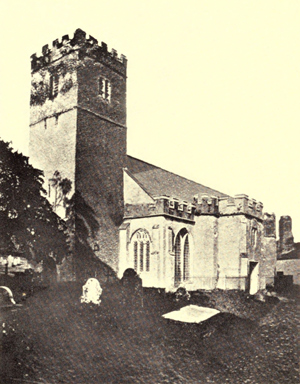
DARTINGTON OLD CHURCH, NOW DESTROYED (The railing by the south porch enclosed the tomb of the Froudes)
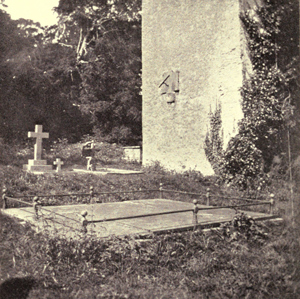
THE PRESENT ASPECT OF HURRELL FROUDE’S BURIAL-PLACE (IN THE FOREGROUND), DARTINGTON OLD CHURCHYARD
In 1836, the ‘vanishing of such a spirit without sign’ was not to be endured. It was the most natural thing in the world that all he had written should be gathered together, that such a lover of books (as Leigh Hunt says somewhere, in one of his happy literary retrospects), should himself become a book. Hurrell became a singular book, as it happened, made up, paradoxically, of matter never prepared by himself for publication; and he and it were put forth as a party manifesto. It may not be uninteresting to review the origin and character of 203 The Remains of the late Reverend Richard Hurrell Froude, M.A., Fellow of Oriel College, Oxford, printed by the Rivingtons in 1838 and 1839, and consisting of four volumes octavo. The Editors, whose names do not appear upon the title-page, were the Rev. John Keble and the Rev. John Henry Newman. The latter is generally supposed to have done most of the work; there are published letters of Keble’s to Sir John Coleridge, and of Newman’s to Mr. Frederic Rogers, which go to show that the idea of bringing out the Remains, and the initiatory labour, including the first Preface, were Newman’s. But according to Coleridge’s Memoir, Mr. Keble, as collaborator, wrote by far the greater part of both Prefaces. For the very beautiful second one he was certainly responsible.[266]
Of Part I. of these Remains, Vol. i. is devoted to a Private Journal; Memoranda personal and philosophical; Letters to Friends; one Latin and five English poems; seven pages of remembered miscellaneous sayings; and a diary as Appendix. The companion volume is devoted to Sermons complete and fragmentary; three Essays on subjects connected with arts and sciences, and three on subjects purely ecclesiastical. Part II., Vol. i., has five papers and some fragments, none of which are on secular themes; and the final volume is given up to the History of the Contest between Thomas à Becket, Archbishop of Canterbury, and Henry II., drawn from original documents and State Papers, left unfinished by Hurrell Froude, and carried on and edited by the Rev. James Bowling Mozley.
The collecting of ‘dearest Froude’s papers’ had begun before April, 1836; they were looked over at Hursley in July; by September, Newman, otherwise busy as he was, writes that he is getting on with the transcriptions, and that James Mozley has been hard at work during the whole Vacation on S. Thomas of Canterbury. Archdeacon Froude sends up his auxiliary supplies in October, from Dartington Parsonage.
‘… I sent off a parcel to you, three days ago, by Henry Champernowne: it contains the text of dear Hurrell’s manuscripts. 204 All your letters to him that I can find are also enclosed. With the latter I must confess I have not parted without regret. They are memorials of your affectionate friendship with one whose image is ever before me, and to which I could never turn without a delightful interest that I cannot describe. His correspondence for many years with myself[267] turns principally on little passing incidents, or relates to matters of private concern; but it is of great value to me as a sort of journal from early boyhood nearly to the time of our separation.’
Lyra Apostolica was issued in November, and several of the critics had taken pains to single out ‘β’s’ poems for special commendation, even if at the expense of Keble and Newman: certainly Samuel Wilberforce did so, in his asked-for review, the tone of which was so disconcerting and unexpected to the asker;[268] and The Christian Observer had saluted Hurrell as ‘the most spiritual and least bigoted of the whole set.’ All this was encouraging to the projectors of the Remains, who knew better than outsiders of how keen and high an intellect, how holy an inspiration, their cause had been deprived. Newman’s notes, as the editing progressed, are very sanguine.
To the Rev. John Keble, June 30, 1837.
‘… I have transcribed [R. H. F.’s] Private Thoughts, and am deeply impressed with their attractive character. They are full of instruction and interest, as I think all will feel. I have transcribed them for your imprimatur. If you say Yes, send them to me; I propose to go to press almost immediately. These Thoughts present a remarkable instance of the temptation to rationalism, self-speculation, etc., subdued. We see his mind only breaking out into more original and beautiful discoveries, from that very repression which, at first sight, seemed likely to be the utter prohibition to exercise his special powers. He used playfully to say that his “highest ambition was to be a humdrum,” and by relinquishing the prospect of originality he has but become the more original.’
205 On July 5, Newman gives to Rogers categorical reasons for his plan of publication.
‘1. To show his … unaffectedness, playfulness, brilliancy, which nothing else would show. His Letters approach to conversation, to show his delicate mode of implying, not expressing, sacred thoughts; his utter hatred of pretence and humbug. I have much to say on the danger which I think at present besets the Apostolical Movement of getting peculiar in externals, i.e., formal, manneristic. Now Froude disdained all show of religion. In losing him we have lost an important correction…. His Letters are a second-best preventative.
‘2. To make the work interesting, nothing takes so much as these private things.
‘3. To show the history of the formation of his opinions. Vaughan[269] was observing the other day that we never have the history of men in the most interesting period of their life, from eighteen to twenty-eight or thirty, while they are forming: now this gives Froude’s.
‘4. To show how deliberately and dispassionately he formed his opinions. They were not taken up as mere fancies: this invests them with much consideration. Here his change from Tory to Apostolical is curious.
‘5. To show the interesting growth of his mind, how indolence was overcome, etc.; to show his love of mathematics, his remarkable struggle against the lassitude of disease, his working to the last.
‘6. For the intrinsic merit of his remarks.
‘If you think the notion entertainable, I wish you could put the MS. into the hands of some person who is a good judge, yet more impartial than ourselves, in order to ascertain his impression of it…. If you and the other agree in countenancing the notion, then send down the MS. to Keble, with an enumeration of [my] reasons for publishing.’
To the Rev. John Keble, July 16, 1837.
‘… Williams has suggested the publication of extracts from Hurrell’s letters. I feared at first they would be too personal 206 as regards others; but then I began to think that if they could be given, they would be next best to talking with him, and would show him in a light otherwise unattainable. Then there are so many clever things in those he sent me: the first hints of principles which I and others have pursued, and of which he ought to have the credit. Moreover, we have often said the Movement, if anything comes of it, must be enthusiastic. Now here is a man fitted above all others to kindle enthusiasm. I have written to William Froude about it, who caught at the idea, which he said had already struck him. Considering the state of the University, everything which can tell against Hampdenism[270] will be a gain.’
Newman continued sanguine.
To J. W. Bowden, Esq., Hursley, Oct. 6, 1837.
‘… I am here for a week to consult with Keble about Froude’s papers, which are now in the press, and require a good deal of attention. You will, I think, be deeply interested in them. His father has put some into my hands of a most private nature. They are quite new even to Keble, who knew more about him than anyone…. All persons of unhackneyed feelings and youthful minds must be taken with them; others will think them romantic, scrupulous, over-refined, etc.’
The ‘papers of a most private nature’ dated chiefly from Hurrell’s twenty-third to his twenty-seventh year. ‘They have taught me,’ Mr. Keble writes to that friend, his own earliest biographer, whom they were to disturb and shock when once in print, ‘they have taught me things concerning him which I never suspected myself, as to the degree of self-denial which he was practising when I was most intimate with him. This 207 encourages me to think that there may be many such whom one dreams not of.’
How Froude came to leave these secret manuscripts behind him is not perfectly clear. Mr. Keble had advised burning them, long before. During the months and even years when there was natural opportunity for disposing of all his affairs, Froude had abstained from destroying his papers. The only explanation is that he was too completely indifferent, in all such matters, to make a move of any sort. He belonged to a journal-keeping age and a journal-keeping family: to write, and to dismiss the writing from memory, were to him easy matters. Neither his kind of memory, nor his degree of self-attentiveness, would have helped him to produce an Apologia. His diaries, properly speaking, have absolutely no egotism: he is merely dramatically concentrated on R. H. F. as a moral ‘dummy’ convenient for observation and correction, and it was quite in keeping with his habit that he should have taken no thought whatever of a testamentary nature, towards the end. He could, of course, have had no suspicion of the ultimate use to which his confessions were soon to be put. Besides, he would harbour no fear of depreciation, but would rather have desired that, even in the grave.
On the fly-leaf of the finished book they placed a sweet motto from the Adeste, sanctæ conjuges, the midnight hymn appointed for the Office of the Commemoration of Holy Women. It came from the Parisian Breviary, in which Froude had delighted. Newman was editing the Hymns included in it at this very time.
‘Se sub serenis vultibus Austera virtus occulit, Timens videri, ne suum, Dum prodit, amittat decus.’
Isaac Williams’ sensitive translation is a fit mate for the Latin:
‘Neath [a] look serene concealed, Stern Virtue hid her shield, Fearing to lose that Love, within, Which half is lost by being seen.’
Such a motto, it might be urged, was both too personal 208 and too deprecatory. The perfect posy for the venture would have been, instead, a word of Felippo di Boni:
‘Son soldato Ancor io: Stringo una spada Che forte in pugno Ed immortal mi sta. Dio mi l ha data; Equando morto io cada, Fatta spirito mio, Combatterà!’
The Editors felt, no doubt, that anything like this, for all of its fitness, would have imported a note of unnecessary defiance. To print the Remains at all was certainly war-cry enough.
The first Part, comprising two volumes, appeared at mid-winter, 1838. It was much talked of, as was inevitable, among the interested friends and foes of the High Church party, and it bred the most contrary impressions. Beyond the familiar circle, Froude’s comrades and their followers, what success the book won was a frank succès de scandale. Its one tangible result was to urge on Low Church zealots to build the Martyrs’ Memorial at Oxford. It was dedicated in 1841; and subconsciously, it was from plinth to finial what Mr. Keble called it, ‘a public dissent from Froude.’[271] Love for Ridley, Latimer, and the great Cranmer who, as F. Rogers once predicated, ‘burned well,’ were less potent in raising that graceful landmark than heated disapprobation of Froude, Newman, and Keble himself. Sic vos non vobis. Hurrell liked ironical situations. Here was one to his hand.
The sale of the Remains was never great; in fact, it was so 209 restricted that the publishers, about seven months after the launching of the first Part, made considerable demur before bringing the second Part out at all. No extra edition was called for; the work has stood, ever since, among the out-of-print rarities of London catalogues. Of the mass of writing which it comprised, sacred or secular, there has been but a single paper reprinted: the remarkable paper on State Interference in Matters Spiritual, issued by Selwood in 1869, with a strongly corroborative Introduction from the pen of that good militant shepherd, the Rev. William J. E. Bennett, Vicar of Frome.
On March 29, 1838, Newman wrote from Oxford to Keble, on the subject then uppermost in their minds.
‘You must not be vexed to have a somewhat excited letter from Edward Churton[272] on the subject of dear Hurrell’s Remains. I doubt not, too, you really will not be so. All persons whose hearts have been with Cranmer and Jewel are naturally pained; and one must honour them for it. It is the general opinion here that the Journal ought to have been published, and is full of instruction. Yesterday morning I had the following pleasant announcement from William Froude: “My father is much pleased with Hurrell’s book. He had been rather alarmed by some comments made upon it in a letter from Sir John Coleridge; but the book itself has quite reassured him. The Preface says exactly what one wished to have said.”’
If Archdeacon Froude felt satisfied, that would atone for much. Mr. Rose’s opinion was next in importance to the Archdeacon’s, to the Oriel men responsible for this particular exercise of it. Fortunately, he was sufficiently favourable, writing to Pusey from King’s College on March 14, 1838, to ask for ‘an account,’ or ‘a sketch’ of ‘poor Froude’s most interesting Remains. I do not know to whom to give them for review. For very few can understand or appreciate his very peculiar excellences. A book so miscellaneous, touching on so very many points is a very hard matter for a regular reviewer.’[273] Apart from these graded expressions of private 210 sympathy, there was censure and even ridicule to bear; and self-earned troubles are proverbially not the sweetest. Violent denunciations arose on all sides, and especially within the bosom of an ungrateful Church. The Lady Margaret Professor of Divinity fulminated from the very University pulpit; the Bishop of Ferns and Leighlin, the most persevering ‘charger’ of all, thundered against ‘that very rash and intemperate young man.’ Even the House of Commons was, on one occasion at least, disturbed by godly zeal exerted against the book. To James Mozley, during July, Newman wrote: ‘You see Lord Morpeth[274] has been upon me in the House, as editor of the Remains. Gladstone has defended me; Sir R[obert] Inglis the University.’[275] And Rogers sends his vivacious message to Newman: ‘What do you think of Gladstone’s exculpation of you? And what of the face Froude would have made at being quoted in the House of Commons as “an accomplished gentleman” by Lord Morpeth?’[276]
The Remains, quickly as it fell out of print, was a storm-centre. Mr. Gladstone, concerned with defending the good faith of the editor-in-chief, yet handled the oppugned work with repeated regrets.[277] He has left it upon record, referring to an earlier year, and echoing the adjectives of Bishop O’Brien just quoted: ‘My first impressions and emotions in connection with [the Oxford Movement] were those of indignation at what I thought the rash intemperate censures pronounced by Mr. Hurrell Froude upon the Reformers.’[278] Newman’s Correspondence[279] gives quite a roll-call of the Bishops, editors, magazines, and private persons ‘opening on us.’ He adds: ‘I can fancy the old Duke sending down to ask the Heads of Houses whether we cannot be silenced.’
Some who took the Remains to heart were more than half sorry that it was published. The real reasons for that measure had been in the Prefaces a little obscured, because 211 largely taken for granted as obvious. So much is clear: the need had been felt of issuing a book to serve as a dead friend’s only monument. But the moment one came to handle his compositions, all warlike, all new, one foresaw the ethical risk of putting them forward, without first educating a public to read them. Mr. Wilson, representing his own earliest feeling, and that of Mr. Keble his Vicar, sympathised, in the very beginning, with Newman over ‘the great difficulty and perplexity you must be in at present, as to what course to take…. We cannot afford by any shock even to throw back into their former upright posture of indifference or suspicion some who are now leaning our way.’ To publish poor Hurrell at all turned out a large diplomatic matter. Confident that he needed only to be known to be loved and trusted, Newman resolved to make him intimately and unmistakably known, and his opinions, in consequence, heeded as they deserved. The Remains is almost the first among modern English books to expose what is sacredly private: we are all used now, whether with diminishing or undiminishing protest, to exhibitions of the spiritual anatomy of humankind. The Editors’ challenge to an Erastian world seemed based on the belief that their cause had bred its perfect flower in Froude, and that only to show him as he was, with his mighty single-hearted zest, his aspirations towards holiness, and his playful gentleness, would be to show also the attaching loveliness of their cause. They proceeded upon one or two syllogisms which had no flaw, but also no application. For, plainly, Froude was impossible to be understanded of the people, and the more he himself was expounded the worse it was for the system which he personified. An eminent critic led the way in dwelling, not on the question so unmistakably thrust forward, of Præmunire, but on Hurrell’s confessed and repented glance to see ‘whether goose came on the table at dinner!’ That goose is well known to a number of contemporary persons who have never owned a copy of the Remains, nor heard what ascetic theology has to say of such a thing as concupiscence of the eyes. Hurrell, in a secret hour, had named the goose only to his guardian angel, between whom and himself the sense of humour could hardly come into play. Keble’s 212 humour, and Newman’s likewise, were almost incomparably keen: one knows not how these passages survived the proofreading. It was inevitable, however, that public attention should fasten upon them with disrelish and horror. They were unusual, they were not ‘self-respecting’; they belonged to types outgrown and superseded; in short, they were fatally ‘un-English,’ to that most respectable year 1838. It was bidden to admire a humility and disinterestedness in which it could not believe. A completely non-sentimental religion was a trying spectacle, even to the most religious among Early Victorian readers. A young man ever accusing himself, a young man waiving his own profit, and doing these monstrous things by force of will and habit, all his life, was simply an offence to common morals. Natural virtues are well enough: truth, industry, ambition, family affection, are at least legal: they are not a slap in the face to what is called a Christian community. But a temper fed from hidden springs, and full of austerity and detachment, must ever look to the mass of men like an alien thing, the outcome of hypocrisy or sheer foolishness. Nothing but an outward and visible career passed in nursing the sick in hospitals can, to this day, redeem it.
‘The public,’ says a sociologist,[280] with charming scorn, ‘are acquainted with the nature of their own passions, and the point of their own calamities; can laugh at the weakness they feel, and weep at the miseries they have experienced: but all the sagacity they possess, be it how great soever, will not enable them to judge of likeness to that which they have never seen, nor to acknowledge principles on which they have never reflected. Of a comedy or a drama, an epigram or a ballad, they are judges from whom there is no appeal; but not of the representation of facts which they have never examined, of beauty which they have never loved.’ The good public and anything which savours of the merely supernatural, the good public and the Kingdom of Heaven, in short, are incongruous. But it is only fair to them to quote, again, the word of a far more practical observer, which had, from the first, a bearing on those whom the writer calls ‘the firebrands of the Movement’: ‘I do not say the English are a people of good 213 sense, but I say they abhor extremes, and always fly off from those who carry things too far.’[281] They do indeed. But every conclusion becomes an extreme, and a thing carried too far, where they are concerned.
Froude had always trimmed his sails not so much to the wind, as according to a theory of navigation. It follows that ‘the picture of a mind,’ his mind, such as his friends wished to exhibit it, was not a ‘necessity to the times’: in fact, it was an intrusion upon them. It was in deadly hostility not only to their low ideals, but to their ordinary characteristics and best accepted spirit. Froude, or his unconscious influence, was only too well organised to ‘toss and gore several persons,’ and the self-satisfied Establishment which had honourably reared them. An illustration of existing contraries may not be far to seek. Two good men of mark, born and dying in the roomy Church of England, once expressed, each in his turn, his feeling about his epitaph. Mr. Robert Southey was pleased to say (with what his age considered perfect decorum, with what our age must admit to be perfect truth): ‘I have this conviction: that die when I may, my memory is one of those which will “smell sweet, and blossom in the dust.”’ He also repeated the sentiment in verse. But the testamentary ideas of Richard William Church ran in another mould:
‘Rex tremendæ majestatis, Qui salvandos salvas gratis, Salva me, Fons Pietatis!’
It is safe to predicate that thinking persons who sympathise with the one, revolt from the other. Now the cleavage between the dispositions which brought about these irreconcilable expressions, is the cleavage in the national ideals. What is so sure of blossoming in the dust, although professedly it lay all stress upon the Vicarious Atonement, is Protestantism. The belief in the necessity of the co-operative human will in the scheme of Redemption, although it attain only to an awestruck hope of the Almighty Mercy, is, well—not precisely Protestantism! Between the two moods there is no mutual approach, still less, amalgamation: for between them is set 214 up the Sign to be contradicted. It is to be feared that Hurrell Froude, had he known of an admired poet’s intention for ever to ‘smell sweet,’ could hardly have been restrained from quoting his kinsman Hamlet’s ‘Pah!’ Piety which of malice prepense smells sweet, will like Hurrell Froude no better now than it liked him in the Tractarian twilight. It will be seen that Mr. Southey was not enthusiastic over the Remains.
To put the Remains on the open market was too bold a venture of faith, though they would have served their dialectic purpose well, and found their own readily, even had they been privately issued, even if edited with greater reserve. It was quite natural that Froude should have passed posthumously for a mere agitator given up to triviality and impudence. If it were true that for him living, ‘one constantly trembled, in mixed society,’ what can have possessed his Editors to think that his anarchist voice (the voice, really, of a great constructive critic) would be suffered in a four-volume monologue? All he was, all he thought, separated him by whole elements and universes from the ordinary citizen. Accost between them turned farcical in the act: ‘as if a dog should try to make friends with a fish!’ His disqualifications for the final mission given him were intellectual as well as moral. To name but two among them, he was in love with the ‘Dark’ Ages, the fountainhead of hard logic and thorough craftsmanship, and still more in love with the original document, at a period when historical research was not only unfashionable, but inferentially abhorred; and his animus must needs have seemed ‘Popish’ or worse, when it but led him to handle as self-evident fallacies the darling predilections of centuries of British basilolatry.