LOUISE IMOGEN GUINEY (continued 2)
Reading edition
‘Lloyd’s[38] immense catalogue of books, that he recommends as necessary, has frightened me beyond measure: but I am 35 getting to be of your opinion, that to be fully occupied is almost necessary, in order to get through life with tolerable ease and comfort….’
Says the Editor of the Newman Correspondence, in entering upon the annals of the year 1826: ‘The Oriel election and Fellowship was this year a momentous one to Mr. Newman, as bringing him into intimacy with the friend whose influence he ever felt powerful beyond all others to which he had been subject.’ Newman writes of the election to his mother on March 31, 1826, in terms of convinced enthusiasm which are not unlike Crabb Robinson’s after encountering for the first time the youthful William Hazlitt. ‘By-the-bye, I have not told you the name of the other successful candidate:[39] Froude of Oriel. We were in grave deliberation till near two this morning, and then went to bed. Froude is one of the acutest and clearest and deepest men in the memory of man. I hope our election will be in honorem Dei et sponsæ suæ ecclesiæ salutem, as Edward II. has it in our Statutes.’ The Oriel electors had their own standards, and gloried in them. Fellowships depended hardly at all on the technical and the prescribed; indications of the scope and accuracy of acquired knowledge passed for next to nothing; but what did count, in Oriel’s golden days, was a man’s whole momentum and equilibrium, his relationship to the intellectual life, his mastery over his own faculties: ‘not what he had read, but what he was like.’ Originality, distinction, was the cachet, and Oriel College was the first in Oxford to throw open her unhampered Fellowships to the entire University. Like Whately, Thomas Mozley, and Newman himself, Froude who stood only moderately high in the books of the University examiners, had been preferred before candidates who were double-firsts. He took, as was but natural, an even more rapturous pleasure in the event than Newman had done. He wrote to Keble, when he was steadying himself under the impact of a lasting good fortune:
36 ‘My dreamy sensations have at length subsided, and I cannot think how I could have made myself such a fool as to be so upset! But it was altogether such a surprise to me, and I knew it would delight my father so much, that I could not stand it all. I do not mean that when the news was announced to me I did not contemplate the possibility of it; for you must know that I am the most superstitious of the species, and that on the first day of the examination I had a sort of indescribable sensation from which I augured the event. But such a confused prophesying as this is so very different from a sober expectation that it served rather to increase than to diminish my surprise at its being realised.’
And again, turning from what he thought an almost unnatural success, he seeks refuge in his own special pun. ‘Crede mihi,’ he confides to Keble on the eve of Candlemas, ‘idem sum ille φροῦδος qui utroque pede claudicans e scholis evasi: me in nulla re scholastica ex illo tempore usque ad hunc diem sentio profecisse.’ In ‘Empty-head’ limping with both feet out of the Schools, we are to recognise an allusion to Hurrell’s unforgotten double-second class. He was too humble to see that for a Romany rye of his sort, a double-second class was really a quite extravagant toll to pay to University conventions.
Oriel soon became a hotbed of revolution, as the consequence of her anti-academical processes of selection. Within two years, troubles began, and Froude, with Newman, R. I. Wilberforce, and Dornford, the other public Tutors, took up and for a long time maintained, against the settled paganism of the College, their own ‘fierce’ views of their duty towards undergraduates. Of this duty Froude and Newman had a particularly clear conviction. Keble had struck, and struck strongly, the pastoral note as early as 1818, and developed it in a letter to Sir J. T. Coleridge.[40] On the other hand, the Provost and the administrators held that intercourse between Tutor and pupil should be a routine of lectures only, and not that and a cure of souls beside. The antagonism lasted for nearly four years, during which Froude’s deep friendship with Newman grew up, and was perfected. The end came with 37 Hawkins’ express refusal to sanction the further supply of pupils to the would-be spiritual directors who so quietly defied him. They had ‘led the last struggle for the ancient quasi-parental and religious character of the College Tutor.’[41] As the pupils they had went up for degrees and left the University, they fell quite idle, in that respect, by 1831, and with all their smouldering zeal and moral fire within them, the way was open for another onset of the Laudians which was destined to affect the consciences not alone of young Oriel, but of the nation and the age.
Froude’s allotted rooms were directly over Newman’s, in the Chapel angle of the Great Quad of Oriel College. The new Fellow did not, as such, come into residence until after the Easter vacation; during the following month, April, we find him still luxuriating in Devonshire and plunging deep into abstract metaphysics. ‘I have been taken with a fit of writing,’ he confesses to Keble. ‘I am happier than I ever was at Oxford, far: but that is not saying much.’ Apparently, he had posted manuscripts for criticism, and received it as gratefully and as combatively as usual. ‘I am infinitely indebted to you,’ he writes, ‘for your expeditious attention to my concern, and will try my best to set to rights the places you row [about]. However, I still maintain that my end is both relevant and true and my puzzle-headed antithesis a good one; but I bow my head in implicit confidence, as far as practice goes. Distinctions and refinements are growing on me, and I am all in a maze; and it is delightful to have the shadow of a great rock in a weary land to which I may turn for temporary shelter. If I had a year more, I could not make it at all to my satisfaction; so I must make the best of it.’
His note-books for this year and the next are full of the contemned ‘distinctions and refinements.’ In trying to beat out his conceptions of moral growth (a thing he refused to recognise in himself), he jots down some striking and arresting thoughts. Two or three which lie metaphysically not far apart, must suffice for transcription. They show the 38 coherence, the synthetic power with which Froude’s philosophy knit all worlds into one.
—‘For whatever cause the great Author of Nature contrived that resemblance (as it appears to us) which subsists between the part of His dominions of which He has given us a consciousness, and that other part with which we are acquainted only through our understanding, it seems calculated to assist our conceptions of the one to observe what passes in the other…. The business of our life seems to be to acquire the habit of acting as we should do if we were conscious of all that we know…. It is delightful to see things turn out well whose case seems in some sort to represent to us our indistinct conceptions of our own. Animals fainting under the effect of exercise, and then again recovering their strength which that very exercise has contributed to increase; the slow and, uncertain degrees in which this increase is effected, and yet the certainty in which it is effected: the growth of trees sometimes tossed by winds and checked by frosts, yet, by the evil effects of these winds, directed in what quarter to strike their roots so as to secure themselves for the future, and by these frosts hardened and fitted for a new progress the next summer:—in things of this sort I am so constituted as to see brethren in affliction evidently making progress towards release.’
—‘Some people imagine that there is something blasphemous in the supposition that a finite creature can be conscious in two places at once. This is so far from being true that even our own experience contradicts it. Perhaps there is some absurdity in the very idea which attributes a place to consciousness, or the things capable of it. With regard to ourselves, there is nothing to show us where we are conscious (though most people suppose the conscious thing is somewhere within the body), or that we may not be with equal propriety said to be conscious, or, in other words, to be, wherever anything is of which we are conscious. It seems to me that the question where we are, is one not of fact, but of degree; and that the only facts which make us suppose we are where our body is, give us likewise the same reason for supposing that in the same sense we sometimes are far away from the body.’
—‘Yesterday, before breakfast, while the vacancy produced 39 by fasting was still on me, and I was reading the Psalms, and craving for a comprehension of the things which I could only look on as words, and was worked up to such a pitch that I felt trying to see my soul, and make out how it was fitted to receive an impression from them,—Merton bell[42] began to go; and it struck me (I cannot tell why) that if such a trifle as that could give me such a vivid idea, my soul must be a most intricate thing; and that when senses were given to the blind part of it, what things would those appear, the apprehension of which I was struggling after! This is as near what passed in my mind as I can find expressions to shape my memory by. This blindness of heart is what, by habit and patience, it is our work practically to remove. We are to shape our souls for its removal, by making it in harmony with the things invisible.’
These passages mark a great point of divergence between the writer and the ‘religious genius’ with whom his memory is identified to all generations. It is something of an anomaly, even, to find the young Froude, and not the young Newman (rather the less practical of the practical pair), developing so strong a habit of purely speculative thought; but it was that which gave him his silent leadership. He combined with his turn for abstractions (yet with scorn shared with Newman for ‘formulas which antedate the facts’) an unexpected power of philosophical application of scientific ideas. All these half-mystical gymnastics of the reflective faculty are going to tell in 1833 and after, when the hour of action strikes, and when, by his already gathered impetus, Hurrell Froude is going to dart ahead in a still level flight, like a gull’s. He will seem external, as if talking more than he thinks, talking somewhat to the bewilderment of those others who can hardly think for his talking. He will be gay; he will be glib; he will pass care-free amid the sweat of horses and men, simply because of these long hard mental vigils, pen in hand, up Oriel Staircase No. 3, while he is hearing Merton bell, and trying to see his soul.
To Keble, who was still at home during the spring of 1826, Hurrell confides impressions of the Newman who had 40 already conceived so lofty an opinion of him, and had probably not taken pains to conceal it: the Newman who dearly loved, to the last, to be ‘disvenerated.’ Many important Fellows of Oriel, such as Arnold, Hampden, Jelf, Jenkyns, Pusey, were absent from Oxford: hence they lack mention in our critic’s roster.
To the Rev. John Keble, May 25, 1826.
‘I should like to detail to you our [College] proceedings, but no striking features occur to my mind at present; so I will favour you with my general impressions. [Whately?][43] is the only one with whom I have got to be at all intimate; he is not the least of a Don, and I like him very much indeed. [Davison?] is a person for whom I have a very great veneration: but he is such an immense person that I hardly dare bring myself in contact with him.[44] [Newman] is, to my mind, by far the greatest genius of the party, and I cannot help thinking that, sometime or other, I may get to be well acquainted with him: but he is very shy,[45] and dining with a person now and then does not break the ice so quickly as might be wished. I venerate [Davison?] but dislike him: I like [Newman] but disvenerate him. Old [Wilberforce?][46] is very funny, good-natured, and, I think, very much improved. And now for my ill-fated inconsistent self; I have been trying to be 41 diligent, and have been horribly idle; trying to be contented, and yet constantly fidgety; trying to be matter-of-fact, and have nearly cracked myself with conceited metaphysics. This last is principally attributable to Lucretius, whom I have been reading with considerable attention, and intense admiration; I shall very soon have finished him, as I have got on some way in the Sixth Book. In the end of the Book, about the mortality of the soul, there are some magnificent extraordinary reflections on our longings for something indescribable, and beyond our reach; on our having affections which have no adequate object, and which we long to forget and smother, because we cannot gratify them: [reflections] which make a striking preface to Bishop Butler’s sermons on the Love of God.’
June 15, 1826, was the five hundredth anniversary of the foundation of Oriel College. Perhaps the observance of it served to stimulate Hurrell’s filial piety and his spontaneous regard for the past. Few Fellows of Colleges, then or since, ‘supinely enjoying the gifts of the Founder,’ as Gibbon says, would have offered, after such an occasion, this private prayer, found among Hurrell’s papers:
—‘Almighty God, Father of all Mercies, I beg to offer Thee my deep and unfeigned thanks for all the blessings which Thou hast bestowed upon me; but in addition to those of Thy favours which I enjoy in common with all mankind, I more particularly bless Thy Holy Name for those of which I partake as member of this College; for the means Thou hast given me of daily sustenance, and of a continual admission to Thy house and service, through the pious charity of holy men of old. I bless Thee, O Lord, in that Thou didst put into their heart the desire of erecting to themselves a memorial, and of leaving to posterity a great example in the foundation and endowment of a seminary of religious learning; and I pray Thee that, as it has fallen to my lot to succeed to this their institution, I may fulfil my part in it as I believe they would approve if they could be present with me; that I may not waste in foolish or gross indulgences the means afforded me of obtaining higher ends; or allow myself to consider as my own that time which I receive their wages for dedicating to Thy service, by the 42 advancement of useful learning, and adorning the doctrine of God our Saviour. But more especially do I beg of Thee to accept my thankfulness for those merciful dispensations of Thy Providence which affect my lot in particular. That it has pleased Thee to bring me into the world under the shadow of my holy mother, in the recollection of whose bright society Thou hast given me, as it were, a consciousness of that blessedness which Thou hast taught us to look for in the presence of Saints and Angels. Also, that my lot has been so cast that I should fall into the way of one[47] whose good instructions have, I hope, in some degree, convinced me of the error of my ways, and may, by Thy grace, serve to reclaim me from them; with whose high friendship I have most unworthily been honoured, and in whose presence I taste the cup of happiness.’
The correspondence with Keble continued implicitly confidential at all times. But Hurrell writes freely at the close of his first Long Vacation as Fellow, and after his return to Oriel, of his scruples and self-dissatisfactions and aspirations: ‘thoughts that do wander through eternity.’
To the Rev. John Keble, Oct. 14, 1826.
‘It will seem rather pompous to announce my determination not to rise till I have got a letter written to you; but unless I start with some such resolution, I shall not be able to get one written at all. I have made three attempts to write … but all of them ran off into something wild, which upon reflection I thought would be better kept to myself. The fact is, that I have been in a very strange way all the summer, and having had no one to talk to about the things which have bothered me, I have been every now and then getting into fits of enthusiasm or despondency. But the result has been in some respects a good one, and I have got to take a very great pleasure in what you recommended to me when we were together at F[airford], the evening before I left you our first summer, i.e. good books; and I feel I[48] understand places in the Psalms in a way I never used to. I go back to Oxford with a determination to set to at Hebrew and the early Fathers, 43 and to keep myself in as strict order as I can: a thing which I have been making ineffectual attempts at for some time, but which never once entered my head for a long time of my life….
‘I wish you would say anything to me that you think would do me good, however severe it may be. You must have observed many things very contemptible in me, but I know worse of myself, and shall be prepared for anything. I cannot help being afraid that I am still deceiving myself about my motives and feelings, and shall be glad of anything on which to steady myself. Since I have been here I have been getting more comfortable than I had been for a good bit, from the society of I[saac][49] and P[revost][50] whom I get to like more and more every day…. We were to have wandered over North Wales together, but have been obliged to relinquish that scheme for this time, and perhaps it is a good thing, as far as I am concerned, to have a less exciting life for the present. I have had one bit of romance, viz., a walk early in the morning up the Vale of Rydal to Devil’s Bridge. The W[illiamses] wanted us to ride, but I thought I should remember it better by walking…. I shall always like scrambling expeditions as long as I can recollect ours up the Wye. Those few days seem like a bright spot in my existence; or perhaps it would be a more apt similitude to compare it to what you quoted as we were going in the boat to Tintern: “The shadow of a great rock in a weary land.”
‘I daresay you will think this letter rather strange, but it cannot do me any good to bottle everything up; besides, I think there is no pleasure in letters which do nothing but detail matters of fact. I should have liked much better to have seen you; but as I suppose there is no chance of that for some time, I must make the best of it. When I said that I had taken to liking good books, I did not mean that I had read many. I have read over and over again Bishop Taylor’s Holy Living 44 and Dying, but till I came here I had not gone farther; since, I have read five sermons of Bishop Wilson, one on the History of Christianity, and the others on Profiting by Sermons; also most of Law’s Serious Call, about which I remember what you said to me three years ago.’[51]
To the Rev. John Keble, Nov. 5, 1826.
‘It may seem an odd sort of thing to say, but I got from your letter something more like happiness than I have known since my mother died. Since that time it seems as if I had been ἄθεος ἐν τῷ κόσμῳ; but I hope I may yet get right at last. It is a great comfort to find so many expressions in the Psalms like “O tarry thou the Lord’s leisure,” as they serve to keep up the hope that, weary and unsatisfactory as are my attempts to be religious, they may in time “comfort my heart.” And now I can talk to you about myself, I feel a sort of security against bewildering my mind with vague thoughts, which I did not know where to check, because I could not get anyone to sympathise with them at all.
‘I have borrowed Mr. Bonnell’s Life,[52] and have got about two-thirds through it. I did not at first like the plan you recommended to me about reveries, as I had been directing all my actions with a view to fitting myself for realising my reveries. But it is a wretched unsatisfactory pursuit, for besides that it does not seem to have any real religion in it, I have often felt as if I had lost myself, and that I was acting blindly, without a drift. It is much better to give up all notion of guiding myself, and “seek first the kingdom of God and His righteousness, and all these things shall be added.” I beg your pardon for putting before you the roundabout fantastic methods to which I have been resorting to arrive at 45 a plain simple truth that ought to have come at once; but perhaps they may serve to show the state of my mind better than any direct description I could give. It is very frightful to see people like Mr. Bonnell so alarmed about themselves, and expressing so strongly the wretchedness of their moral condition. It seems as if, to a fellow like me, it must always be presumptuous not to despair. The evening before last I was much struck with a thought in the beginning of Hooker’s Preface to the Ecclesiastical Polity, about not permitting thoughts to pass away as in a dream. It seems as if people might make so much more out of their lives by keeping records of them….
‘I will write you down some horridly-expressed verses which call themselves to the tune of “Allan Water” and “Rousseau’s Dream”; the first sketched in autumn, 1825, but undergoing changes for a long time, poor as is the result; the second written at W[illiams’s]. I have not shown them to anyone, and they may give you a sort of guess at the things my mind has been running upon.’
‘On the Banks of Allan Water’ was his favourite air.
[‘The Fashion of this World Passeth Away.’]
‘Ere the buds their stores deliver, Have ye watched the springtime gay? Have ye seen the sere leaves shiver In an autumn day? Have ye loved some flower appearing, Tulip, or pale lily tall, Day by day its head uprearing, But to mourn its fall? Have ye on the bosom rested Of some friend that seemed a god? Have ye seen her relics vested In their long abode? With the years that ye have numbered, With the flowers that gaily blow, With the friends whose sleep is slumbered, Ye shall perish too.’
[Heaven-in-Earth.]
46
‘Oh, can it be that this bright world Was made for such dull joys[53] as ours? Dwells there not aught in secret furled ‘Mid Nature’s holy bowers?[54] Is it for naught that things gone by Still hover o’er our wondering mind, And dreamy feelings, dimly high, A dwelling-place within us find? No: there are things of higher mould, Whose charmèd ways we heedless tread; And men even here a converse hold With those whom they shall meet when dead. Lord of the World, Almighty King, Thy shadow resteth over all: Or where the Saints Thy terrors sing, Or where the waves obey Thy call.’
To this productive year belong also some haunting unfinished lines which might bear for a title The Summons. Of course none of these three poems of Hurrell’s appeared, later, in Lyra Apostolica; nor elsewhere than in the Remains.
‘To-night my dreary course is run, And at the setting of the sun, Far beneath the western wave I seek my quiet grave, Amid the silent halls of Fate, Where lie in long and shadowy state The embryos of the things that be Waiting the hour of destiny. I hear thy magic voice; I hear it, and rejoice…. To-morrow: ere the hunter’s horn Has waked the echoes of the morn….’
Froude at this time was associating a good deal with Blanco White, the Anglicised Spaniard and ex-priest who came to Oriel, aged fifty-one, when Tyler left it, and deeply interested Oriel men with his knowledge of the scholastic philosophy. 47 For some three years he was in great repute among them: his mental gifts were invalidated to them, later, by his aimlessness and instability. To his practical acquaintance with the Roman Breviary, often demonstrated in his own rooms, after dinner, to Froude, Newman, Pusey, and Wilberforce, Hurrell owed much, especially in conjunction with the able lectures on liturgical subjects being delivered by Dr. Lloyd.
Hurrell’s most intimate letter of all those addressed to Keble, beating and surging with the pathos which is inseparable from a young man’s interior life, ends sadly and bravely on Jan. 8, 1827:
‘I am glad of your advice about penance, for my spirit was so broken down that I had no vigour to go on even with the trifling self-denials I had imposed on myself; besides, I feel that though it has in it the colour of humility, it is in reality the food of pride. Self-imposed, it seems to me quite different from when imposed by the Church; and even fasting itself, to weak minds, is not free from evil, when, however secretly it is done, one cannot avoid the consciousness of being singular…. I have not much more to say, and when anything comes over me, will put it down on a large sheet, and send it off when it is full. I am so very unequal to my feelings, that sometimes I suspect all to be hypocrisy; but the tide has by this time so often returned after its ebbing, that finding myself again on the dry land does not make me so much doubt the reality of all His waves and storms which have gone over me.’
To his dear Robert Isaac Wilberforce, an approaching guest, Hurrell indites on the same day a more mundane theme:
‘I must prepare you to find me a great humbug about cock-shooting; for, though I will not recede from my assertions concerning the pre-eminent qualifications of our woods in that line, yet, as our sporting establishment does not go beyond the bare appointments for what Bob calls hedge-popping, the vicinity of the cocks will serve no other purpose than to make you feel more acutely the disadvantages of a connection with such unknowing people.’
His Tutorship was not an unmixed enjoyment to him, after taking his M.A. Of it he writes thus seriously, humbly, and characteristically:
48 To the Rev. John Keble, Oct. 23, 1827.
‘Perhaps it may amuse you to hear something of my proceedings in my new line of life. I have six Lectures in all: three each day…. I have now got through two days and seen the general aspect of affairs, and as yet no liberties have been taken with me, to my knowledge: however, this is the thing against which I endeavour to arm myself, and from which I expect a fruitful harvest of moral discipline. I look upon it as one of the best opportunities which can be given me to put my elements into order and harmony. It is a quick and efficacious refreshment to me to think of the south-westerly waves roaring round the Prawle after our stern, or the little crisp breakers that we cut through, when you cruised with us off Dartmouth Harbour. Somehow or other, without having exposed myself that I know of, in any flagrant way, there remains upon my mind a more vivid impression of my incompetence than I expected to await my entrance into the office. I feel called on to act a part for which neither my habits nor my studies have fitted me. I am, and always have been, childishly alive to the pain of being despised, and I cannot but feel that I have not the sort of knowledge to give me any command over the men’s attention, or even power of benefiting the attentive; and, if it was not that I know how good it is for myself, I believe I should give it up at once!… Two more tedious days are over; I am not a bit more in love with my occupation, so that this letter, instead of suggesting to you some ludicrous ideas and reminiscences, will terminate in a concatenation of dolefulness, and ask for a consolatory answer.
‘Lloyd gave us his introductory Lecture to-day, i.e., settled the books we were to do, and the times of coming, and was very good-natured, as usual, in his reception of all of us. I am afraid my time and spirits will be so much drawn upon in another quarter, that I shall not have much left of either for him. Otherwise an historical account of the Liturgy, tracing all the prayers, through the Roman Missals and Breviaries, up to their original source, for one Lecture, and the Epistle to the Romans and First of Corinthians for the other, would be a very 49 eligible subject to spend a good deal of time on…. I go to the Tyrolese singers, who perform some national music in the Town-Hall at eight o’clock. I hope they will help to lull me into a momentary forgetfulness; and that I may dream myself among lakes and mountains, far, far away from the vulgar crowd.’
Hurrell’s forecast that his time and spirits would be drawn upon to the detriment of his studies, was due to the anxiety he began to feel about his brother Robert. The latter had followed Hurrell to Oriel in 1822, and graduated B.A. on the 8th of June, 1826. Ardent and active in everything, he had taken a chill during that Long Vacation, after a particularly long pull at sea, and the chill was to terminate only in consumption.
To the Rev. John Keble, New Year’s Day, 1828.
‘… I wish I could write verses! and then I should make an attempt to perpetuate in my mind the notions that came into it the other day at seeing the dead body of a poor woman who for the last two years has been in a state of intense bodily suffering, from which she was released a few days since. I do not recollect having seen her before her illness; but while she was alive I had never seen her free from the expression of dull pain; and her face was distorted by a sore wound, which never healed, on the side of her mouth. But the morning after her death there was such a quiet careworn beauty on her countenance, that it seemed to me as if good spirits had been ornamenting her body at last, to show that a friend of theirs had inhabited it. I am willing to hope that the recollection of it may be a help to me in fits of scepticism, when everything seems so tame and commonplace.’
These serious thoughts haunted Hurrell at home where his brother’s health was failing day by day. ‘Bob’ had the chief share of the physical beauty and vitality of the family. One who knew him well has preserved an anecdote of his lovable mischief.
‘The richness and melody of Copleston’s[55] voice surpassed 50 any instrument…. It was no small part of the daily amusement of the undergraduates to repeat what Copleston had said, and just as he said it, and to vary it from their own boyish imaginations…. The second of the four Froudes, who died young, made this a special study. Coming out of Tyler’s room after a Lecture, he tapped gently at the door, and said in the exact Copleston tone: “Mr. Tyler, will you please step out a moment?” Tyler rushed out, exclaiming: “My dear Mr. Provost!” but only saw the tail of the class descending the staircase. “You silly boys, you’ve been playing me a trick!” was all that he could say.’[56]
The wheel of fortune brought the Provostship of Oriel not to ‘an angel,’ John Keble, but to Edward Hawkins, on the promotion of Copleston to the See of Llandaff, early in this year. A letter of Froude’s to him has been preserved. There is an entry in the former’s Diary, under date of Nov. 22, 1826, thus printed: ‘Promised —— I would not vote against him if ever he stood for the ——. Foolish: but I must abide by it.’ Hawkins and James Endell Tyler were the two among the Fellows who had for years set their hearts upon the Provostship. Tyler lost his chance when he left Oriel during the autumn for the living of S. Giles-in-the-Fields, London, where Endell Street, W.C., yet preserves his name. Either to him, or to Hawkins, Hurrell had hastily pledged his word. But when he wrote the following letter he was quite aware of Mr. Keble’s definite withdrawal from the candidacy which was not yet announced. As a matter of fact, Mr. Keble had never consented to come forward, and his disciple’s course became, thereby, easy as well as plain.
To the Rev. Edward Hawkins,[57] Jan. 23, 1828.
‘My dear Hawkins,—Though I don’t set so high a value on the emanations of my pen as to volunteer a superfluous communication, yet, from what Churton said to me in his note, I fancy I ought to supply an ἔλλειμμα in my last 51 letter by making a more formal declaration of my unconditional and uncompromising determination to rank myself among your retainers. I am really very sorry that my stupid delay in answering your letter should have caused you any bother (to use a studiously elegant expression, than which I cannot hit on a better): and this is the more provoking, as I actually had written you an answer the first day; but as I said something at the end of it about my brother, which afterwards I thought too gloomy, and which, I believe, was suggested by seeing him look particularly unwell from some accident, I thought it rather too hard to call on you for sympathy in my capricious fancies. I suppose I may take the liberty to enclose this in a cover to the Bishop, otherwise I should hesitate to draw on your purse as well as your time for such a scribble as this. However, I have left you enough clear paper at the end to work out a question in algebra, or make the skeleton of a sermon! And as this is probably worth more than any words I have to put into it, I shall conclude by begging you to consider me ever affectionately,
‘R. H. Froude.’
For poor ‘Bob’ Froude, full of frolic and power, the Lusisti satis had been spoken. He died on April 28, 1828, between the dates of the two following letters, which Hurrell wrote with a heavy heart.
To the Rev. Robert Isaac Wilberforce, April 2, 1828.
‘… I have not much spirits to write to you, but will not allow my promise to go for nothing. When I first came home I found my brother very much emaciated and enfeebled, but not quite so far gone as I had been prepared for. But since I have been here his disorder has been making very rapid progress indeed…. From what I had heard at Oxford, I almost doubted I might not find all over before my arrival: and the relief which I felt when, on getting off the coach at Totnes, I heard from my father that, not a quarter of an hour before, he[58] had driven in to meet me, was so great as almost to unsettle my resolution. So that now the near prospect of a 52 conclusion is rather hard to face. Even so late as yesterday evening I began a letter to you, in which I expressed a hope that when Monday came my brother and I might not part for ever, but that he would be alive on my return for the Long Vacation. But the medical person who has attended him told me, just now, that unless he was relieved from his present oppression, forty-eight hours would end him. In this state I really do not think that the [Oriel] election has claims on me so great as those which retain me here; and, unless his illness take some unexpected turn, I shall write to [the Provost] in a day or two, to apologise for absenting myself. I cannot, indeed, flatter myself that any turn will long retard the encroachment of the disorder; but, unless appearances decidedly indicated that, by staying out the Vacation, I should see all, I think it would be foolish to shrink from my business; for, when the time of parting came, it would be worse a fortnight hence than now…. I have known enough of myself to foresee the return of all my fretfulness and absurdity, when I leave this enchanted atmosphere. I hope you will excuse my not writing a longer letter; for most things now seem insipid to me, except such as I have no right to inflict upon you. So good-bye, my dear [Robert], for the present, and do not expect to see me till the beginning of Term. I should very much wish to take my part in the election, and do not even now wholly abandon the idea. For I know that active occupation is the best resource, and I shall not shrink from it merely to indulge my feelings.’
To the Rev. John Keble, May, 1828.
‘… The feelings under which I wrote to you last, were, as you say, like the effect of a stunning blow, and I was quite surprised, myself, how quickly they evaporated. I cannot indeed call them either groundless or irrational, and I am, in some respects, not contented at being so soon released from them. Yet many things have occurred to me, which, even to my reason, have made things seem better than they did at first. The more I think of B[ob], the more I am struck with his singleness of heart, and the low estimation in which he held himself. I have found, too, some things which he had written, 53 which I regret much that he had not shown me, which give me almost assurance that he was farther advanced in serious feeling, and had taken greater pains to fight against himself than anyone supposed. Among others, there is one which seems to me quite beautiful, On the Legitimate Use of Pleasure; which he has headed with: “My opinion, June, 1827. I wonder what it will be next year.” It is well arranged as a composition, quite elegant in the language, and shows that he must have thought over the Ethics in a common-sense way, and compared it with Bishop Butler. I had often heard him say what a fool he used to be in thinking that the Ethics was only something to be got up, and something quite irrelevant to actual conduct…. But I feel now as if I had been conversing with a person, who, if he had not much undervalued himself, would never have deferred to me….’
To the Rev. John Henry Newman, Aug. 12, 1828.
‘I have just torn up a letter which I began for you the other day, and fear that you will have cause to wonder how I could reserve this for a better destiny. For the fact is, that I seem to myself to become duller as I grow older, and to have acquired a fustiness independent of place and occupation, an inherent fustiness which idleness cannot blow away nor variety obliterate…. I fear from what I hear of C[hurton][59] that the chance of his recovery is at present very slender. His brother wrote to me the other day to ask what place in Devonshire we reckoned the best suited[60] to complaints of that description, as his enfeebled state put his going abroad out of the question. But I know from experience how little Devonshire air can do … I myself am still, as I indeed have been for a long time, perfectly well. But I find the freshness which at first resulted from a relaxation from College discipline now gradually 54 wearing out; and as the images of impudent undergraduates fade away from the field of my fancy, and the consciousness of what I am released from becomes less vivid, a new host of evil genii take possession of the deserted spot. Till within this last week or so, I felt quite differently from what I ever used to, and reckoned myself to have become quite a cheerful fellow; but now I begin to see with my old eyes, and to feed upon the dreams of faëryland.
‘“And as I mark the line of light that plays O’er the smooth wave towards the burning west, I long to tread that golden path of rays, And think ’twould lead to some bright Isle of Rest.”
… I have a brother now at home who is coming to Oriel next term, and will make a very good hand at mathematics unless he is very idle.’
The brother at home referred to was William Froude, afterwards LL.D. (Glasgow) and F.R.S., then newly come from Westminster School. He was entered at Oriel on Oct. 23, 1828, with Hurrell for Tutor.
To the Rev. John Keble, Aug. 26, 1828.
‘… I have long been meditating a letter to you, and have put it off from day to day, in hopes that when the fine weather should come at last, it might rekindle in me some spark of poetical feeling. But I was thinking over with myself last night how I could scrape up a verse or two in honour of this long-wished-for revolution, and was, after some fruitless pains, obliged to abandon the undertaking. It is a melancholy fact, yet full often does it force itself upon me, and in too unquestionable a shape, that I get stupider as I get older; and that I either never was what I used to think myself, or that Nature has recalled her misused favours! In vain is it that night after night I have tried to peep through the clouds at Lyra and Cassiopeia, as they chase one another round the pole, and that I have got up at three to see Mercury rise, when he was at his longest distance from the sun; and that I have sailed to Guernsey on a fine day and come back on a finer, when the waves washed in on the deck as each passed in succession; and that (when for a short time off the island in a 55 calm) I found the latitude within a minute by taking the sun’s meridian altitude, and that I have seen him rise out of the water, cut in two by the horizon as sharp as a knife. “This brave o’erhanging firmament, this majestical roof fretted with golden fire,—what seemeth it to me but a pestilent congregation of vapours?” I can partly account for it from the fact that we are so uncommonly comfortable and cosy here, and quite agree with you, that “home by mazy streams” is not the most bracing school in which the recipient of habits can be disciplined.
‘Then, henceforth, hail! ye impudent undergraduates: γεύεσθε, μὴ φείδεσθε.’
‘I heard from N[ewman] the other day, with the testimonials,’ he adds, a little later. ‘… He is a fellow that I like the more, the more I think of him; only I would give a few odd pence if he were not a heretic!’ This in reference to Newman’s early Evangelicalism, not yet sloughed away. As between Froude and Newman, so between Newman and Pusey, affection appears to have preceded perfect intellectual confidence. There is a parallel thought, in more sedate dress, in Newman’s private journal of May 17, 1823: ‘That Pusey is Thine, O Lord, how can I doubt? … yet I fear he is prejudiced against Thy children…. Lead us both on in the way of Thy commandments!’[61] Hurrell quickly came to a correct reading of Newman, and he presently made sure that his beloved Keble should share it too. He said once, when conversation ran on the traits of undoubted excellence in criminal characters: ‘Were I asked what good deed I had ever done, I should say that I had brought Keble and Newman to understand each other.’ That mutual love, indeed, despite a long parting, never wavered. There is an odd little footnote to be gathered from Mr. Anthony Froude’s ‘Oxford Counter-Reformation.’[62] He is speaking of events subsequent to 1845.
‘My eldest brother had left to us younger ones, as a characteristic instruction, that if we ever saw Newman and 56 Keble disagree, we might think for ourselves. The event which my brother had thought as impossible as that a double star should fly asunder in space, had actually occurred. We had been floated out into mid-ocean upon the Anglo-Catholic raft, buoyed up by airy bubbles of ecclesiastical sentiment. The bubbles had burst, the raft was splintered, and we—I mean my other brother and myself—were left, like Ulysses, struggling in the waves.’
Says Mr. Thomas Mozley,[63] referring to this time, and to tastes shared in common among Oriel men: ‘I think we all of us found it easier to admire and even to criticise, than to design. Keble, Froude, and Ogilvie undertook a memorial of William Churton, to be placed in S. Mary’s. It was to be simple, modest, and unobtrusive, like the subject. Whether the result carried out this idea, I leave others to say,’ If we are to judge from a letter of Hurrell’s addressed to Keble, the first design emanated from Newman, though drawn by himself. ‘I don’t make much progress in my design for C[hurton’s] monument,’ he writes on May 23, 1829. ‘O[gilvie] decides on its being Gothic; and if this is the case, it will never do to let it take its chance in the hands of a statuary.[64] Yet the responsibility of doing it one’s self makes me so fastidious that I cannot settle on anything,’ He had thought of falling back upon ‘the sort of niches which are used to hold statues of saints, or [stoups for] holy water: somehow it does not seem quite congruous to make one of these merely to frame an inscription.’ However, he draws a narrow pointed arch over a tall pedestal supporting a plain cross, on the suggestion of Newman, adding that he likes it especially, though it may be a bit eccentric.[65] ‘It is to stand in the wall over one of the doorways, between the blank window on the south side, and the window in which the gallery terminates. This is meant to be represented standing under an arch cut out in the wall.’ There were not many Englishmen attempting Early English decoration in 1829. The memorial to William Ralph Churton, 57 Fellow of Oriel, aged twenty-seven, phthisi eheu præreptus, is to be found in S. Mary’s Church, though not in the position allotted it in this letter; and the big ugly white sarcophagus with fussy details in high relief on a grey ground is certainly no design of Hurrell Froude’s.
Froude’s intimate correspondence with Newman began in 1828, their friendship having been forming since 1826. To all to whom the latter spoke or wrote with affection, as Miss Mozley reminds us, he was ever open and confiding. ‘But there is distinction in his confidences. Thus to his mother he writes what it would not occur to him to say to anyone else: experiences, sensations, and odd encounters; dreams, fancies, and passing speculations: while to Hurrell Froude, on another field altogether, there is the same absolute trust, and unlocking of the heart.’[66]
Sometimes, in the early letters, the correspondent at Dartington feels impelled to continue his autobiography, in default of anything better to deal with. ‘When I come to consider my resources,’ he says in his smiling mock-grandiose way, ‘I feel that they will not prove commensurate with my malignity, and that I shall not be able even to bore you with success.’
To the Rev. John Henry Newman, Aug. 12, 1829.
‘Since I left Oxford, little has happened to me, and still less have I done. I have indeed written two sermons, and they lasted near twenty minutes, so that I may hope to get on. But the time that they took me is quite absurd, and that which they gave me an excuse for wasting, under the plea of thought, grotesque indeed. Also, the paper that I wasted on things that turned out to have no reference to the subject would form a distinct object of contemplation; and after all, when I came to preach them, they seemed so rambling and incomplete that I could not fancy, while I was reading them, how anyone could possibly follow me. Besides this, I have done nothing except getting my equatorial put up and adjusted in our garden, and trying provoking experiments on the insensibility of my hearing organs. I find the summit of 58 perception to which I can attain is to observe that a note harmonises better with its octave, twelfth, and fifth, than with their next-door neighbours. I also can acknowledge a discord in a deuce[67] and a seventh; but as for knowing one from the other, unless they come very close on each other, it passes my comprehension how man can do it…. I am quite ashamed of the length of time this has been on the stocks, and of the shabby performance which it turns out. Alas, it is a sad reflection that I am condemned to retrograde in all respects: to find no resting-place for my self-complacency either in my intellectual, moral, or corporeal prowess, and notwithstanding to be as conceited as ever!’
This was a note of needless dissatisfaction only too sincere, repeated in Keble’s ear. ‘As for me, I despair of ever becoming a scholar or mathematician either, beyond just enough to amuse myself when I am a solitary country Curate….’
1829 is a silent year with Hurrell, on the whole. He had lost his beloved brother, and he was preparing for his own Ordination. In the late summer he paid his first visit to his cousins at Keswick.
To the Rev. John Keble, Sept. 17, 1829.
‘The evening I received your criticisms I wrote you three sides of a letter, and did not send it, only because I thought time would produce things better worth writing: and now I am so changed in position and circumstances I think I may as well begin again. So all I will retain of my former letter is a criticism on The Christian Year, suggested by a very tempestuous night, in which all our party were crossing the Channel in a pilot-boat. You must not say “the wild wind rustles in the piping shrouds”:[68] shrouds never “pipe” when trees or rustling can be presented to the fancy, but only on occasions when it is more sublime than comfortable to be a 59 listener. This, in my letter, I endeavoured to enforce by a description of the scene I witnessed, and the night I spent on deck: but I doubt not you will willingly take all this for granted…. I left Devonshire more than a fortnight since for Cumberland. [Dornford?][69] made me stay some time in Dublin, which was my first stage, and is, in point of time, much the nearest way: and also sent me into the north of Ireland after Captain Mudge, who is surveying the coast. In my hunt for him, I saw the Giants’ Causeway, every stone of which is beset by some fellow who claims a fee for describing it. It is certainly well worth seeing; but you can conceive nothing so perfectly unlike any of the pretended representations of it. I made two bad drawings there, which will serve to keep it in my own mind, but will do little to illuminate mankind at large. I am forgetting all this while to tell you that, while at Dublin, I found I was within twenty-five miles of
‘“The Lake whose gloomy shore Skylark never warbles o’er”:
and immediately hired a horse, to start the next morning at five to see it. I was most unlucky in my day, as it had been fine for the preceding week, and only set in for rain when I got among the Wicklow mountains. I had a very wild romantic uncomfortable ride through a wholly uninhabited country, till I got within the baleful influence of lionisers,[70] and was pestered out of my wits by humbugging guides who dinned into my ears miserable expansions of Tom Moore’s note about St. Kevin, till I was quite out of patience. The day was so misty that it was only once or twice that I could make out the scene distinctly, and so constantly raining, that all my paper was soaked in trying to draw what I could make out. By dint of perseverance, I crawled into poor St. Kevin’s[71] cell, which is hardly large enough to coil one’s self up in, 60 and when I was there hardly a square foot of it was dry: so the day answered the purpose, at any rate, of showing me that there is a dark side to a hermit’s existence. He had chosen himself a most picturesque rocky point, which projects a little into the Lake, with one or two hollies and mountain ashes growing up in its crevices; and cut out a cell for himself in its perpendicular face. It would take too much space to describe the grand gloom of the Lake, the seven ruined Churches on its borders (one of which is still a burial-ground for the Roman Catholics), and that extraordinary Tower, a relic of paganism, which stands in one of the churchyards.
‘I am now on the bank of the Lake by which my mother was brought up, and of which I used to hear over and over again. It has been much altered by Macadamisers, and the house she lived in has been sold. Houses seem to have sprung up about Keswick Lake as if it was a Torquay or Sidmouth; and new dandy names have been given to all the creeks and islands, and nothing but gaiety seems to be going on or thought of. But I suppose old Skiddaw looks pretty much the same as he used to do, and will see things go to pot with their predecessors…. I hope in a day or two to find out the Parish Register, and see her birth and marriage: which is something like poring over the name of a place one likes in a map….’
The home of Margaret Spedding’s childhood, Armathwaite Hall, is within six miles of Cockermouth, the birthplace of Wordsworth. It stands at the foot of Bassenthwaite Lake, and looks out towards some of the loveliest and best-known mountains of the district, including Skiddaw, Helvellyn, and the Borrowdale Hills. It had been sold to Sir Frederick Vane, Bart., of Hutton Hall, Penrith, in 1796. Hurrell was a guest at Mirehouse, where his cousin John Spedding was always from time to time entertaining some of the noted literary men of the period.
To Newman, on Sept. 27, 1829, he writes more of St. Kevin’s dismal and delightful habitation, and ends with the praises of his mother’s county. ‘I got to Cumberland about ten days since, and I can safely assert that it exceeds anything 61 that imagination can conjure up. I don’t mean that the extensive views of lake and mountain are so especially splendid, for, when the scene is on so large a scale, the trees and rocks become deplorably insignificant, woods seem little better than furze brakes; but, in rambling along the brooks and waterfalls, one comes to such excessively romantic corners, that they have quite put me out of love with Devonshire. The only thing which I desiderate is a Church steeple here and there in the valleys; for the worst of it is, that very few of the Parish Churches here are in exterior little better than a decent barn. What a horrid-looking scribble this is! and I know it is full of false spellings of all sorts, which will in many places make it unintelligible.’
To the Rev. John Keble, Feb. 5, 1830.
‘My Lectures this Term are less fatiguing than they have ever been yet, and there are fewer men that one cannot take an interest in. I have a set of very nice men in Pindar, which I am glad to be forced to get up: it certainly is one of the most splendid organs of Tory feeling that I have come in contact with! Don’t you think he had the republican artificial style in his head when he talked about
κόρακες ὣς ἄκραντα γαρύετον Διὸς πρὸς ὄρνιχα θεῖον?’
All was grist which came to this preoccupied critic’s mill. He had an unaffected fondness for the classics. His theory about the poet whom he loved and understood best, and whom he is always quoting, is that he was a shy pastoral lyrist driven by officious friends into the epic field. Says Newman in a passing note of interest: ‘It was [Froude’s] notion that Horace and others used to (what is now called) patronise Virgil, as a man who really had a great deal in him; but who, the pity was, would not conform himself to the habits of society, and so lost opportunities of influence. So they set him upon the Æneid, to make something of him.’[72]
On Easter Monday, 1830, the Rev. R. H. Froude preached in the pulpit of S. Mary-the-Virgin, before the University, his sermon on Knowledge. His quiet sober sermons, of which 62 no fewer than twenty appear complete in the Remains, are to a reader searching, pitiless, unforgetable. The undergraduate, however, must have ‘disvenerated’ them.
This to Newman, on Aug. 1, 1830, in a letter filled with political comment admiring the spirit of King Charles X. and Polignac in their disasters, and growling over Whig successes in England, is too amusing to be omitted. ‘… I set out in the rain to Exeter. I was not very well; and had made up my mind, as a matter of conscience, to have a tooth out when I got there; because, though it had not yet ached, I thought it probable it might before I had another opportunity. I got to Exeter, went to the dentist, had the forceps applied: the top of the tooth broke; they were applied again: a splinter came out of the side; and so on, till it was down fair with the jaw, and part of the nerve had come away in the fragments. Nothing remained to be done except to punch, etc.; and here I thought: “Satis jam pridem sanguine fuso”: I had satisfied my debt to my future self; and the present self might be excused from further suffering, till the toothache actually came.’
Froude’s lecturing at Oxford was now quite done; Newman’s and Robert Wilberforce’s likewise; they resigned their Tutorships as gracefully as they might, being joyful over the turn things had taken. The long opposition maintained against their desire to arrange the terminal table in accordance with their own best judgment, ended in total defeat for ‘the erect fighting figures’ of the three friends. The Provost himself, Hampden, Denison, and the junior Copleston rushed into the breach with Lectures many and purposeful; but Oriel felt the change, whether for good or ill, to be a real crisis. According to one distinguished commentator, her regeneration dates from that day; according to another, she never recovered the loss, and could but suffer her scholarly pre-eminence to pass, gradually but surely, to Balliol, which has ever since held it. Two at least of the dispossessed Tutors had conceived already a wider field of action for their energies. They had leisure now to think and to write; and leisure bred consequences. ‘Humanly speaking,’ Newman assures us, in his fragment of autobiography, 63 written throughout in the third person, ‘the Movement never would have been, had they not been deprived of the Tutorship, or had Keble, not Hawkins, been Provost.’
Newman made a proposal that Robert Wilberforce or Froude should join him in the care of S. Mary’s parish, or rather, in building up at Littlemore what the Vicar ultimately intended even then should become a separate parish: but neither saw his way to accept the work. From letters of this time we gather knowledge of their ever-increasing attention to the Fathers; to the ethical aspects of many great political questions; and to the country walks and rides, apart or together, which did so much to strengthen that pure passion for Nature, ‘subdued and cherished long,’ which in Newman, as in Froude, lent sweetness and balance to character. Froude’s heartfelt love of Devon is conspicuous, whether he be in it or away from it. During the Long Vacation of 1831, he succeeded in carrying Newman off from his books and the stuffy summer air of low-lying Oxford, to the delights of Dartington. As a glowing corroboration of what Hurrell himself was always writing, it is worth while to quote his friend’s description of the district, sent to his interested mother at Iffley.
‘Dartington, July 7, 1831.
‘I despatched a hasty letter yesterday from Torquay which must have disappointed you from its emptiness; but I wished you to know my progress. As we lost sight of the Needles, twilight came on, and we saw nothing of the coast. The night was beautiful, and on my expressing an aversion to the cabin, Froude and I agreed to sleep on deck…. When I awoke, a little before four, we were passing the Devonshire coast, about fifteen miles off it. By six we were entering Torbay…. Limestone and sandstone rocks of Torbay are very brilliant in their colours and sharp in their forms; strange to say, I believe I never saw real rocks before, in my life! This consciousness keeps me very silent, for I feel I am admiring what everyone knows, and it is foolish to observe upon. You see a house said to have belonged to Sir Walter Ralegh;[73] 64 what possessed him to prefer the court at Greenwich to a spot like this?… I know I am writing in a very dull way, but can only say that the extreme deliciousness of the air, and the fragrance of everything makes me languid, indisposed to speak or write, and pensive. My journey did not fatigue me, to speak of, and I have no headache, deafness, or whizzing in my ears; but, really, I think I should dissolve into essence of roses, or be attenuated into an echo, if I lived here!… What strikes me most is the strange richness of everything. The rocks blush into every variety of colour, the trees and fields are emeralds, and the cottages are rubies. A beetle I picked up at Torquay was as green-and-gold as the stone it lay upon, and a squirrel which ran up a tree here just now was not the pale reddish-brown to which I am accustomed, but a bright brown-red. Nay, my very hands and fingers look rosy, like Homer’s Aurora, and I have been gazing on them with astonishment. All this wonder I know is simple; and therefore, of course, do not you repeat it. The exuberance of the grass and the foliage is oppressive, as if one had not room to breathe, though this is a fancy. The depth of the valleys and the steepness of the slopes increase the illusion, and the Duke of Wellington would be in a fidget to get some commanding point to see the country from. The scents are extremely fine, so very delicate yet so powerful; and the colours of the flowers as if they were all shot with white. The sweet peas especially have the complexion of a beautiful face: they trail up the wall, mixed with myrtles, as creepers. As to the sunset, the Dartmoor heights look purple, and the sky close upon them a clear orange. When I turn back and think of Southampton Water and the Isle of Wight, they seem, by contrast, to be drawn in Indian ink, or pencil. Now I cannot make out that this is fancy, for why should I fancy? I am not especially in a poetic mood. I have heard of the brilliancy of Cintra and still more of the East, and I suppose that this region would pale beside them; yet I am content to marvel at what I see, and think of Virgil’s description of the purple meads of Elysium. Let me enjoy what I feel, even though I may unconsciously exaggerate.’
65 Newman’s senses were extraordinarily delicate: he writes as if at thirty he was half unaware of some of his most special faculties.
A week later, a postscript follows, addressed to Harriett Newman, telling of ‘a sermon to write for to-morrow, which I do believe to be as bad a one as I have ever written, for I was not in the humour; but I do not tell people so. It may do good, in spite of me!’ and this confidence: ‘The other day the following lines came into my head. They are not worth much; but I transcribe them:
‘There strayed awhile, amid the woods of Dart, One who could love them, but who durst not love: A vow had bound him ne’er to give his heart To streamlet bright, or soft secluded grove. ’Twas a hard humbling task, onward to move His easy-captured eye from each fair spot, With unattached and lonely step to rove O’er happy meads which soon its print forgot. Yet kept he safe his pledge, prizing his pilgrim lot.’[74]
There was a lifelong strife in Newman’s mind between created and Uncreated Beauty, or rather, a lifelong choice. He seems to have felt that he could not be as much of a poet as his own heart prompted, and be also as much of a hard-working saint as Divine Grace called him to be. For him, as in the beginning, a loved landscape was ‘pagan’: a temptation towards false gods. How little his attitude was understood, during his life, is well illustrated by the published complaint of Mr. Aubrey de Vere that his friend Dr. Newman of the Catholic University would never make time to go driving with him through the exquisite scenery about Dublin, though invited again and again. In all this, as in much else, he was entirely Augustinian. Ejiciebas eas et intrabas pro eis. It does not seem clear that Hurrell Froude, who outran Newman in many austerities, shared fully in the exercise of this signal one. His loneliness of spirit, far more developed than his friend’s, was also far less conscious, and his boyish relish of the beauties of moor and sea based itself, rather, on a 66 philosophy which was Keble’s, and Henry Vaughan’s long before him:
‘Thou who hast given me eyes to see And love this sight so fair, Give me a heart to find out Thee, And read Thee everywhere!’[75]
Certainly, Newman was never so tormented by his affection for music, or for anything else in the same class, as he was by the glamour of out-of-doors at Taormina, and the homelier charms of ‘Devon in her most gentle dimplement.’ Spiritual matters apart, one does not perceive what else could have inwrought him more effectually with the very fibres of Hurrell’s being, than his felt infatuation for the Dartington he visited but twice in his busy life. They shared the same passion, again, for Rome. The spirit of place can always create a final test between any two cultivated minds. To differ in kind or even in degree of response to it, is indeed to differ.
The principle which lay at the bottom of Newman’s renunciation was one, however, which was equally familiar to his friend. It may not always have involved, for him, the need of so determined a depreciation of the loveliness of rural England, as too keen a reminder of
‘Isaac’s pure blessings, and a verdant home,’
things forsworn by both young men in that ‘highly religious and romantic idea of celibacy’ which they had adopted for good and all, between them, without Keble’s help. As Newman says of S. Basil and S. Gregory, retiring together from the world: ‘somehow, the idea of marrying-and-taking-Orders, or taking-Orders-and-marrying; building or improving their parsonages, and showing forth the charities, the humanities, and the gentilities of a family man, did not suggest itself to their minds.’ Nothing is plainer than that the arch-celibate was Froude, and not Newman: perhaps it would be quite exact to say that the idea, in Froude, as in Pascal, was wholly endemic, and in Newman only so in part. We are told in the Apologia how the idea was strengthened and supernaturalised by contact with Froude. Hurrell sometimes deplored with unmixed simplicity the social disqualifications 67 of a total abstainer. ‘I wrote S[am] a letter the other day,’ he tells Robert Wilberforce, when the future Bishop had plighted his troth. ‘I suspect it was of the dullest! for I have no knack at writing to people in his interesting situation.’ In all this lack of sympathy with ordinary conduct and motive, there was no touch whatever of conscious oddity, but only of childishness. Newman, by far the tenderer heart of the two, never shared it.
Newman has left us an account of the origin of the sermon he mentions, which was preached in the old Church on July 16, 1831: that on the Pool of Bethesda, ‘Scripture a Record of Human Sorrow,’ in the first volume of Parochial Sermons. ‘Twice in my life,’ he writes about 1862, ‘have I, when worn with work, gone to a friend’s house to recruit…. When I was down at Dartington for the first time, in July, 1831, I saw a number of young girls collected together, blooming, and in high spirits; “and all went merry as a marriage-bell.” And I sadly thought what changes were in store, what hard trial and discipline was inevitable. I cannot trace their history; but Phillis and Mary Froude married, and died quickly. Hurrell died. One, if not two, of the young Champernownes died.[76] My sermon was dictated by the sight and the foreboding. At that very visit [from Oxford] Hurrell caught, and had his influenza upon him, which led him by slow steps to the grave. He caught it sleeping, as I did, on deck, going down the Channel from Southampton to Torbay. Influenza was about, the forerunner of the cholera. It went through the Parsonage at Dartington. Every morning the sharp merry party, who somewhat quizzed me, had hopes it would seize upon me. But I escaped; and sang my warning from the pulpit…. I am a bird of ill omen.’[77]
Correspondence of course broke out anew, the moment the two were parted. Hurrell’s Greek reading progressed on his own summary lines. ‘Timæus gets worse and worse. I can see no point in which it is interesting, except as a fact to prove what stuff people have sucked down…. I have cut 68 Timæus,’ he announces a bit later, ‘and have nearly finished Gorgias, which is as elegant and clever and easy as possible.’ His weather comments (such being unavoidable in England) are concise and instructive. By way of letting Newman know that there had been a fortnight of fine weather since the latter’s own rainy experiences at Dartington, he throws out an abrupt postscript of July 29: ‘What a lie old Swith.[78] has told!’
The Rev. Thomas Mozley seems to have received conditional offers or promises from Hurrell of sharing with him a country cure. The former proposed first the vacant Moreton Pinkney, thirty miles north of Oxford, then the parish of S. Ebbe’s, within its ancient limits. But both projects failed of realisation. Hurrell’s strength had to be hoarded, and Archdeacon Froude was averse to any measure which would create new duties, and cause a stricter separation between them. Keble, on behalf of his friend, would have favoured Northamptonshire rather than the city. He saw Newman on August 10 of this Long Vacation of 1831. ‘He wishes you to have a country parish,’ Newman writes; ‘he did not give his reasons.’ Newman himself coveted Hurrell’s parochial co-operation. These plans for an active employment of superfluous energies, formed, one after another, by appreciators of them, were destined to be vain. Meanwhile, relish for historical study was indicating to him how he could be of use, in a day full of most unscholarly conceptions of the past, long before the documentary firmament had been unrolled by Government for the man in the street. Dandum est Deo eum aliquid facere posse. He knew the path he meant to take, and communicates his dream to Newman, prefacing it with a bit of encouraging domestic news: ‘W[illy] continues very steady, getting up at half-past five, and working without wasting time till two or three.’ His next surviving brother William was then twenty years old, and reading for Honours.
To the Rev. J. H. Newman, Aug. 16, 1831.
‘Since you wish to have a definite categorical answer to M[ozley’s] question, I will say, No; and having said this, will 69 proceed to my reasons and qualifications. First, whatever you may think, I have a serious wish, and (if I could presume to say so) intention of working at the ecclesiastical history of the Middle Ages. Now, my father assures me that such a parish as [S. Ebbe’s] would be a complete occupation of itself, so that I am unwilling at once, and without giving myself the trial, to give up the chance of doing what I cannot but think as clerical, as improving, and much better suited to my capacity, such as it is, than the care of a parish. A small parish, and a less bothering one, might be a recreation, almost; but such an absorbing one as this I should be sorry to take, till I found that I could not work at anything else. Secondly, my qualification of the ‘No’ is this: if you either feel very certain I shall do nothing else, or have a strong opinion as to the improvement I should get from the occupation you propose, believe me willing to be convinced that my present view is incorrect.
‘I have read a good deal of Plato, have stuck in Parmenides as in Timæus, but think all which keeps clear of metaphysics is as beautiful and improving as anything I ever read. As to Socrates, I can scarcely believe that he was not inspired, and feel quite confident that Plato is responsible for every tint of [puzzleheadedness] which shows itself in his arguments. One is apt, of course, to be carried away with a thing at the moment; but my present impression is, that Gorgias, Apologia Socratis, Crito, and Phædo, rank next to the Bible in point of the greatness of mind they show, and in grace of style and dramatic beauty surpass anything I have ever read. I think I am improved in composition, and attribute it to imitation of Plato. I am going to serve D[enbury?] for the next month, and shall have to write a number of sermons.
‘How atrociously the poor King of Holland[79] has been used; but nothing yet is so painful as the defection of the heads of the Church. I hear that the Bishop of Ferns[80] is dying: spes ultima.’
During the early autumn, Froude returns to the curacy 70 question, and reiterates the conviction which his own idiosyncrasy was strengthening in him every day, and which surely was as warranted as it was sincere.
‘I have read the Lives of Wycliffe and Peacocke[81] in Strype; but must read much more about them and their times, before I shall understand them. At present I admire Peacocke and dislike Wycliffe. A great deterioration seems to have taken place in the spirit of the Church after Edward III.’s death. I hope I shall have perseverance to work up the history of the period. If I do this, I shall not think myself bound to take a curacy.’
It is a thousand pities that we can never have on our shelves the Froude of historical verity, to counterbalance the Froude of historical romance. Hurrell, so far as he got, was certainly all for ‘the ideas underlying history, and their organic connection,’ and was but poorly adapted for ‘the insertion of his own ideas into history … the professing to find in history what he had in reality put there.’[82] Is it not clear that such a fault may spring not from perverseness, but from the too pictorial eye? This the elder brother lacked, as likewise the other disadvantage of a magical prose style. That perturbing possession, the luckiest asset of the essayist, seems to delight in playing tricks on historians, for in the past, at least, the dullest have been the safest.
As one who understood the dangers of style, Hurrell chides Newman for the hair-splitting preliminary method to which he was treating The Arians. ‘If you go on fiddling with your Introduction, you will most certainly get into a scrape at last!’ And then: ‘I have for the last five days been reading Marsh’s Michaelis, which I took up by accident, and have been much interested by it. I see that old Wilberforce[83] owes to it much of the profundity which I have before now been floored and overawed by. It has put many things into my head that I never thought of before.’
71 The first unmistakable symptoms of Hurrell’s chronic illness had developed by the January of 1832. ‘I don’t think he takes care of himself,’ Keble says anxiously, in a letter to Newman, shortly after his election to the Professorship of Poetry. And Hurrell himself had confessed to Newman, as it were, ‘how ill all’s here about my heart: but ’tis no matter.’ Hence the reply from Oxford, on the 13th.
‘Your letter was most welcome, sad as it was; I call it certainly, from beginning to end, a sad letter, and yet somehow sad letters, in their place, and in God’s order, are as acceptable as merry ones. What I write for now is to know why you will not trust your brother to come up by himself? Let him go into your rooms; and do stop in Devonshire a good while, in which time you not only may get well, but may convince all about you that you are well—an object not to be neglected…. Your advice about my work is not only sage, but good, yet not quite applicable, though I shall bear it in mind. Recollect, my good Sir, that every thought I think is thought, and every word I write is writing, and that thought tells and that words take room, and that though I make the Introduction the whole book, yet a book it is; and though this will not steer clear of the egg blunder, to have an Introduction leading to nothing, yet it is not losing time. Already I have made forty-one pages out of eighteen.’ The correspondence between the two, then as ever, gives diverting glimpses of the mordant and ineffably frank critic away from Oxford, and the divine and man-of-letters in residence who continually sought, ‘in the beaten way of friendship,’ the advice he did not invariably need. Thus he sends a rough draft to Dartington of ‘a sermon against Sir James Mackintosh, Knight,’[84] expecting strictures, ‘should you discern anything heretical,’ and calling special attention to the argument: ‘therefore be sharp.’ The young censor was pleased to approve ‘on the whole,’ though with minor reservations. ‘As to your Annotationes in Neandri[85] Homiliam,’ Newman writes cheerfully, ‘to be sure I have treated them with what is now called true respect; for 72 I have spoken highly of them, and done everything but use them! I did not have them till Saturday morning; so having your authority for what I wanted (i.e., the soundness of the main position and the τόποι), I became indolent.’
Meanwhile, towards the end of January, Hurrell sends an asked-for bulletin of his physical progress, and follows it up with several others, in all of which he makes it unconsciously plain that he has more pressing interests than his own sinking barometry. His mind was going forward by leaps and bounds towards convictions then unguessed-at, now quite general, about ‘the Tudor Settlement.’
To the Rev. J. H. Newman, Jan. 29, 1832.
‘I promised I would give an account of myself, if I did not appear in person by the beginning of Term. I am getting rid, though by slow degrees, of all vestiges of cough, and, what is more to the purpose, my father is quite easy about me, which he was far from being when I first came home…. I have been very idle lately, but have taken up Strype now and then, and have not increased my admiration of the Reformers. One must not speak lightly of a martyr, so I do not allow my opinions to pass the verge of scepticism. But I really do feel sceptical whether Latimer was not something in the Bulteel[86] line; whether the Catholicism of their formulæ was not a concession to the feelings of the nation, with whom Puritanism had not yet become popular, and who could scarcely bear the alterations which were made; and whether the progress of things in Edward the Sixth’s minority may not be considered as the jobbing of a faction. I will do myself the justice to say that those doubts give me pain, and that I hope more reading will in some degree dispel them. As far as I have gone, too, 73 I think better than I was prepared to do of Bonner and Gardiner. Certainly the ἦθος of the Reformation is to me a terra incognita, and I do not think that it has been explored by anyone that I have heard talk about it.’
With what astonishing prescience this novice surveys his terra incognita!
Again, writing to Newman on Feb. 17, the obsession for historical truth, as the handmaid to religious reform, breaks through some melancholy detail. He has been asked for a full bulletin; he confesses that the doctor states, and that he himself cannot deny, that there has been an attack on the lungs, attended, however, with but little pain or fever. He finds it ‘disheartening,’ for he had been taking long rides, and was in great spirits. Then he runs on to a topic which occurs to him not for the first nor for the last time. Might it not be a good thing to turn journalist, to have a Quarterly, and to speak in it the thing which is? ‘Imagine me in a yellow jacket,’ he says elsewhere to Newman; imagine him seated, and goose-quilled, and editorial. It was never to be. Was it not quite as well? Would not Mr. Froude (if the pun will pass muster) have proved gunpowder in a Magazine? He talks as he always talks of his own inspirations, derisively. But plainly, his heart is in it. He would start, this time, ‘on a very unpretending scale,’ and design his foxy Quarterly ‘to be at first only historical and matter-of-fact, so that writing for it would be the reverse of a waste of time even if it failed entirely, which I really hardly think possible, considering the ridiculous unfounded notions most people have got, and the vast quantity of unexplored ground. A thing of that sort might sneak into circulation as a book of antiquarian research, and yet, if well-managed, might undermine many prejudices. I am willing to think that I could contribute two articles per annum to such a work, without losing a moment of time, indeed getting through more than I should else. Memoirs of Hampden would be a subject [Keble] would take to with zest, as he hates that worthy with as much zeal and more knowledge than your humble servant. However, this is a scheme formed at a distance, which, as Johnson remarks, makes rivers look narrow and 74 precipices smooth. Can you tell me where to go for the history of Lutheranism? I must know something of it, before I get a clue to Cranmer and the rest.’
Lastly, to the same correspondent, on Feb. 26.
‘… I trouble you with a few lines of grateful acknowledgment for the concern you are so kind as to take in my welfare, though I cannot at the same time refrain from observing that your advice does more credit to your heart than your head…. I was at Dr. [Yonge’s[87]], where I stayed three days, and was thoroughly examined. He assures me that whatever may have been the matter with me, I am now thoroughly well, and that I may return to Oxford at once without imprudence. At the same time, he says I must be extremely cautious, as the thing which formed in my windpipe proves me to be very liable to attack, and he looks on it as an extraordinary piece of luck that I got rid of it as I did. I am to wear more clothing than I have hitherto done, and to renounce wine for ever; the prohibition extends to beer: quò confugiam?’
Before Hurrell left home, his father had notified Newman of their conditional intention to visit the Continent. ‘If the doctor advises it,’ the Archdeacon writes on Feb. 22, ‘I have offered to be Hurrell’s companion to the Mediterranean, or any other part of the world that may be supposed most favourable in such a case as his. I own [that] my faith in the advantages to be gained by going abroad is not very great, unless they can be procured under the most favourable circumstances. At any rate, I think your suggestion for his giving up the office of Treasurer[88] shall be followed.’ He had held this office of Junior Treasurer since 1828, to the great general satisfaction, sharing with Newman the mental quickness, the ‘constitutional accuracy’ and the conscientiousness which go towards the casting-up of a perfect accountant. Hurrell, however, came up in the spring, whence he blithely reports his improved health.
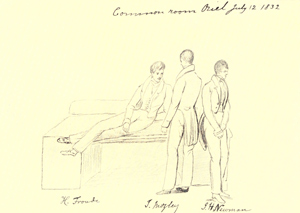
Common room Oriel July 12 1832 H. Froude J. Mozley J. H. Newman From a pencil drawing by Miss Maria Giberne
75 To the Rev. John Keble, May 5, 1832.
‘… Thinking that you may wish to know something of my concerns, and wishing to know something of yours, … I send you the following. As to myself, about which valuable thing I am most concerned, you must know that I have at last found a κρησφύγετον in barley-sugar; only to think that my stars should let me off so easily! Sucking has had a most wonderful effect on me, and has removed nearly all that F[airford][89] had left of tendency to irritation; I might say all, if I could suck continually, but just now these east winds take advantage of casual intervals, and remind me that I am not perfectly at liberty. However, I have left off my handkerchief, and never feel the want of it; also, I am up at half-past six every morning; and taking an enlarged view of myself, I think my condition to be approved of.’
Up to July 31, Froude remained in Oxford, being and doing with all his usual zest, writing his papers on architecture, proving a very well-head of vitality to his friends, and ‘living his life.’ Could it have been indeed as early as this that he cut across the preliminaries described by Lord Blachford,[90] and paralysed an intended appeal to Bishops and Deans by announcing that he, for one, meant to ‘get on the box’ in person? This is thought to be the moment of Miss Giberne’s inspiration. It would seem as if the date should be a year later. In July of 1832 the Tutorial question was over; and there was no other agendum in debate between Froude and Newman. However that may be, there in the handsome lady’s sketch-book is Hurrell, smoothly, almost infantinely, mischievous, with one obedient Mozley to listen and abet; there is Newman, at an angle of the ottoman, distinctly not surveying with fond adoring gaze and yearning heart his friend (as he says he does, in a poem, part of which, at least, was written that very week), but back to back with him, sulking furiously, and putting on a silent stare which sufficiently expresses human disapproval: that little sudden void stare, 76 entirely characteristic, as of one who is forced to survey, for the time being, an endless vista of Siberian snows.
It was a boding time; the cholera was raging all about; Newman himself was tired and dejected from overwork, and none too hopeful concerning Hurrell’s health or the impending prospect of separation. Long after, annotating his own correspondence at Edgbaston, he tells us something special about the lines just referred to, in what may be called, from a merely literary point of view, one of the most successful, though one of the least known, of his shorter lyrics. Hurrell’s share in it is no more, so to speak, than a tiny marginal portrait of him, tender, in passing, as the work of some old Flemish illuminator. Newman ascribes the origin of the last lines to this July. ‘With reference to the memory of that parting, when I shook hands with him, and looked into his face with great affection, I afterwards wrote the stanza:
‘And when thine eye surveys With fond adoring gaze And yearning heart, thy friend, Love to its grave doth tend.’[91]
But it is remarkable that the completed poem is dated Valetta, January 30, 1833: as if to mark the vanishing of the only shadow which ever crossed the united path of Newman and Froude; and that shadow was due, as we shall see, to a fancy of Newman’s, conceived in illness. Abstract and gnomic as his verses are, two human faces, nameless but recognisable, look through them with ‘sad eyes spiritual and clear.’ One is Mary Newman’s, in her sisterly youth;[92] the other is Hurrell Froude’s. Dearly as Newman loved his many friends, then and after (and as Dean Church reminds us, mutual affection as profound as that of the early Christians, was the very hall-mark of the Tractarians), there is but one friend discernible in the long vista of his poetry, most of which was written in his living presence. Hurrell may never have suspected as much. The temper of both, shrinking from the 77 least emotional emphasis, would have precluded any open give-and-take. The privilege of being English has its own system of taxation. The Cardinal, in his old age (possibly when Little Lord Fauntleroy was overrunning the stage), had to assure some inquirer, by post, that he hardly had been in the habit of addressing Hurrell as ‘Dearest,’ in the prose exigences of every day.
The truant Fellow, restored to his father’s Parsonage, was able to send a definite announcement of his future movements, within a fortnight of his leaving Oxford.
To the Rev. J. H. Newman, Sept. 9, 1832.
‘I am afraid poor [Willy] will make no hand of his Second Class. He has no interest, and can pick up none, for what he is about; and all his interleaves and margins are scribbled over with lug sails. You will be glad to hear that I have made up my mind to spend the winter in the Mediterranean, and my father is going with me, the end of November, and we shall see Sicily and the south of Italy. We are both very anxious that you should come with us. I think it would set you up…. I have read M. Thierry’s stuff.[93] His ignorance is surprising. He supposes Oxford to have been a Bishopric in Henry the Second’s time, and he sticks in Saxons ad libitum, quoting authorities with which I am familiar, and where nothing of the sort occurs. My translations have been at a standstill…. Also, I am getting to be a sawney,[94] and not to relish the dreary prospects which you and I have proposed to ourselves. But this is only a feeling: depend on it, I will not shrink, if I buy my constancy at the expense of a permanent separation from home. I think this journey will set me up, and then I shall try my new style of preaching. We must indulge ourselves and other people with a little excitement on such matters, or else the indifferentists will run away with everything!’
William Froude, at Michaelmas, took his First Class in 78 Mathematics, and a Third in Classics, quite as Hurrell expected. As to the microbe of travel thus featly introduced into the post, it did its work upon the recipient, though not without much hesitation and debate. One of Newman’s arguments against a plan with which, it is plain, he fell violently in love at once, was the state of his own health, involving, possibly, some additional responsibility for Archdeacon Froude. ‘You need fear nothing,’ Hurrell gallantly assures him, ‘on the score of two invalids: I am certainly better now than I have been for more than a year. I bathed yesterday with great advantage, took a very long walk, drank five glasses of wine, and am better for it all. My contemplated expedition is wholly preventative, so don’t be uneasy on that score…. As to my sawney feelings, I own that home does make me a sawney, and that the First Eclogue runs in my head absurdly. But there is more in the prospect of becoming an ecclesiastical agitator than in At nos hinc alii, etc.’
On Monday, December 3, Newman set out on the Southampton coach, reaching Exeter next day, and Falmouth, whence the Maltese packet of 800 tons, called the Hermes, was to sail, early on the Wednesday morning following. He wrote there his poem,
‘Are these the tracks of some unearthly friend?’
the first of eighty-five dating from the Mediterranean voyage, the eighty-fifth being the ‘Lead, Kindly Light’ which has endeared to English-speaking pilgrims the Straits of Bonifacio. When the Froudes arrived at Falmouth, Newman had a nocturnal adventure to relate to them. He had been very roundly sworn at by a person, apparently a gentleman, who sat near him on the box. ‘I had opened by telling him he was talking great nonsense to a silly goose of a maid-servant stuck atop of the coach; so I had no reason to complain!’ The hasty fellow-traveller afterwards apologised. In the moonlight he had attributed a highly laic motive to Newman’s interference, so the latter explains to his mother. On the 8th of December the Hermes sailed. The three friends were to be together for five months, and their route is minutely 79 and enchantingly mapped out in the first volume of the Newman Correspondence. The journey held unique experiences, filled with interest, for the two younger men, and they, on their part, seemed to have interested deeply many whom they met. Hurrell kept a log as they moved, for his brothers and sisters, for Mr. Keble, for Mr. Williams, and a few others; and out of it a fairly connected narrative can be extracted, of a colour and form quite other than Newman’s, the better correspondent, but graphic enough. Before starting on his voyage, Hurrell had seen in print, in the first and second volumes of The British Magazine, both his pioneer papers on Gothic Architecture, and the earlier chapters of his history of S. Thomas à Becket; these were followed, in volume iv., by The Project of Henry II. for Uniting Church and State, A.D. 1154.