← Table of contents
How to Study Fiorillo

No. 36.

Reading edition
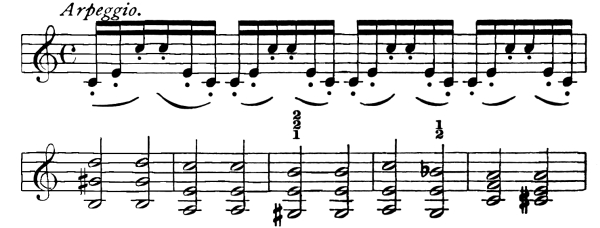
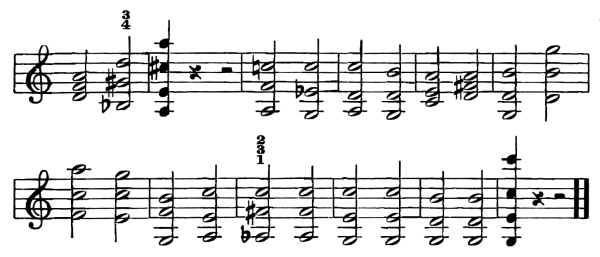
Illustration from How to Study Fiorillo A detailed, descriptive analysis of how to practice these studies, based upon the best teachings of representative, modern violin playing

[Listen]

Illustration from How to Study Fiorillo A detailed, descriptive analysis of how to practice these studies, based upon the best teachings of representative, modern violin playing

[Listen]

Different Arpeggios for Playing the Preceding Chords.

Illustration from How to Study Fiorillo A detailed, descriptive analysis of how to practice these studies, based upon the best teachings of representative, modern violin playing

[Listen]

Illustration from How to Study Fiorillo A detailed, descriptive analysis of how to practice these studies, based upon the best teachings of representative, modern violin playing

[Listen]

Illustration from How to Study Fiorillo A detailed, descriptive analysis of how to practice these studies, based upon the best teachings of representative, modern violin playing

[Listen]

Illustration from How to Study Fiorillo A detailed, descriptive analysis of how to practice these studies, based upon the best teachings of representative, modern violin playing

[Listen]

Illustration from How to Study Fiorillo A detailed, descriptive analysis of how to practice these studies, based upon the best teachings of representative, modern violin playing

[Listen]

Illustration from How to Study Fiorillo A detailed, descriptive analysis of how to practice these studies, based upon the best teachings of representative, modern violin playing

[Listen]

Illustration from How to Study Fiorillo A detailed, descriptive analysis of how to practice these studies, based upon the best teachings of representative, modern violin playing

[Listen]

Illustration from How to Study Fiorillo A detailed, descriptive analysis of how to practice these studies, based upon the best teachings of representative, modern violin playing

[Listen]

Illustration from How to Study Fiorillo A detailed, descriptive analysis of how to practice these studies, based upon the best teachings of representative, modern violin playing

[Listen]

Illustration from How to Study Fiorillo A detailed, descriptive analysis of how to practice these studies, based upon the best teachings of representative, modern violin playing

[Listen]

Illustration from How to Study Fiorillo A detailed, descriptive analysis of how to practice these studies, based upon the best teachings of representative, modern violin playing

[Listen]

Illustration from How to Study Fiorillo A detailed, descriptive analysis of how to practice these studies, based upon the best teachings of representative, modern violin playing

[Listen]

Illustration from How to Study Fiorillo A detailed, descriptive analysis of how to practice these studies, based upon the best teachings of representative, modern violin playing

[Listen]

Illustration from How to Study Fiorillo A detailed, descriptive analysis of how to practice these studies, based upon the best teachings of representative, modern violin playing

[Listen]

Illustration from How to Study Fiorillo A detailed, descriptive analysis of how to practice these studies, based upon the best teachings of representative, modern violin playing

[Listen]

Before beginning this étude, review the chord studies of Sitt[25] and Kreutzer, using with the first Sitt study the following bowings:

1. Whole bow.

2. Lower half.

3. Two notes to a bow, middle, point and heel.

4. Four notes to a bow.

I prefer this study to the Sevcik 4,000 Bowings, Section V. I would, however, use the Sevcik studies for securing a flexible wrist stroke.

Also use Schradieck’s Technical Violin School, Books II and III.[26] I make some changes in the chords of this étude, as follows:
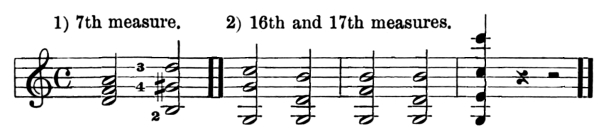
Illustration from How to Study Fiorillo A detailed, descriptive analysis of how to practice these studies, based upon the best teachings of representative, modern violin playing

[Listen 1)]

[Listen 2)]

Use also the following bowing:

Single detached chords down bow, lower half.
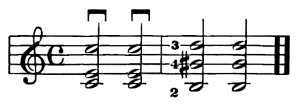
Illustration from How to Study Fiorillo A detailed, descriptive analysis of how to practice these studies, based upon the best teachings of representative, modern violin playing

[Listen]

The wrist must be very flexible. The whole arm is used. Play the three notes simultaneously. Play also thus, whole bow:

Illustration from How to Study Fiorillo A detailed, descriptive analysis of how to practice these studies, based upon the best teachings of representative, modern violin playing

[Listen]

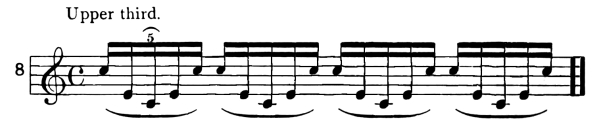
We now come to the pure legato at the point, middle, and heel of the bow.

Two notes tied, four and eight. Vary this by playing the first two notes legato, the second two staccato at the point of the bow; the first two legato, lower half, the second two flying staccato.

We will now turn to two styles of legato bowing: eight notes to a bow; two tied notes followed by six tied. Use the whole bow, also upper and lower half. The next bowing is two tied followed by the short staccato at the point of the bow. Then use two tied, two cut, at the middle or point of the bow. Apply the principles of Sevcik, 4,000 Bowings, Sections III, IV, and V.

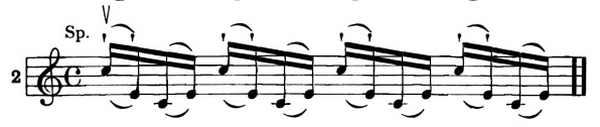
I would introduce a style of bowing very much used in solo and orchestral work: a running legato at the point in triplets. Same at the middle of the bow. Same at the heel. Three tied legato, followed by three flying staccato, lower half of bow. Three down-stroke middle, spiccato, three up-stroke.

These are all the practical bowings I use, but notes played in one bow, at the point, are useful.

FOOTNOTES:

Notes in this chapter

Explore with AITake your curiosity a little further.

Reading settings