No. 16.
Reading edition
Again, the term Allegro is a somewhat elastic one. The stroke is at or near the point of the bow, the first note covering enough space so as to allow a longer bow for the three slurred notes. This group should be sharply accented. Play forte throughout. Play the longer staccato groups in the second and third line near the point of the bow, using as little space as possible, until we come to the last two notes. Owing to the modulations in this étude, I frequently ask students to memorize it. We usually analyze it. There is a growing tendency among violin teachers to analyze all technical works and pieces with students. Foreign teachers rarely do so. It is a question whether the lesson should include harmonic analysis. That should be taught elsewhere. The violin teacher’s duty is to teach the pupil how to play works. Harmony and theory should be taught in classes. It is wise, however, to call attention to keys. All the major and minor keys should be studied. Remember the sharp accentuation on the first note, down bow, of slurred groups of three notes.
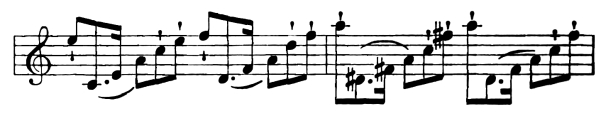
[Listen]
The trill should be played with a down bow. Raise the bow slightly between octaves; also play at the middle of the bow. Accent trills. The fingering in the last three measures is as follows:
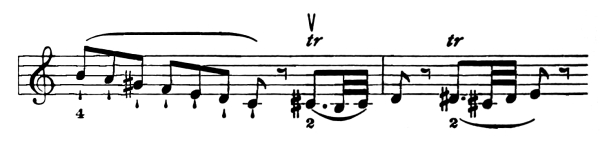
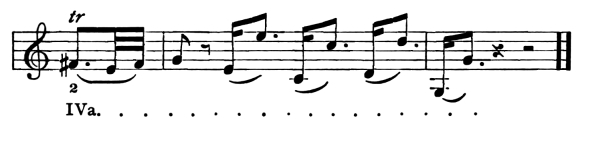
[Listen]