No. 23.
Reading edition
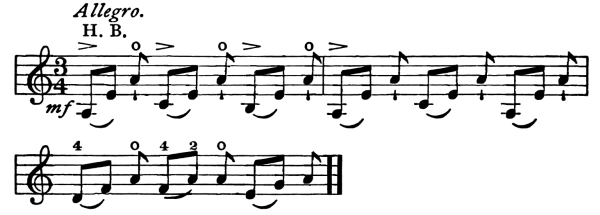
[Listen]
The bowing suggested in the twenty-third étude is one of the most frequent and natural ones in concertos. It is adapted to an allegro movement, and while it may be satisfactorily played near the point of the bow, the forte would indicate a longer bow, possibly the upper third. A free, undulating movement of the wrist, with only a slight arm movement, in two-string transfers is desired. Again, the student must be cautioned against raising the fingers too quickly. All fingers must take their positions quickly and maintain them. In three-string transfers more arm movement is necessary. Do not play over the entire surface of the hair. Keep largely to the outer edge. Note that the middle note is higher than the third note of this group, hence it is wise to use this bowing:
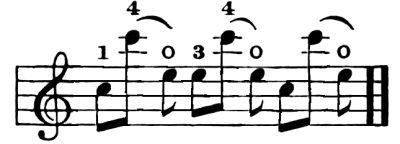
[Listen]
We return to the former bowing in the next line.
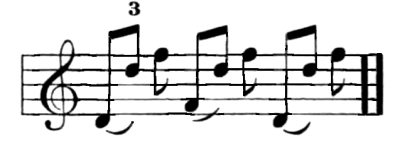
[Listen]
The up-bow is not staccato, but a free stroke that will not be a decided contrast to the preceding slurred notes. In connection with this étude observe intonation carefully. Also add to the flexibility of the wrist by the use of the Études of Hans Sitt, Op. 92, Book III.[17]