FLOWER DESCRIPTIONS
Reading edition
“A fresh footpath, a fresh flower, a fresh delight”
Richard Jefferies
22
I WHITE
Blood-root. Sanguinaria Canadensis. Poppy Family.
Rootstock.—Thick, charged with a crimson juice. Scape.—Naked, one-flowered. Leaves.—Rounded, deeply lobed. Flower.—White, terminal. Calyx.—Of two sepals falling early. Corolla.—Of eight to twelve snow-white petals. Stamens.—About twenty-four. Pistil.—One, short.
In early April the firm tip of the curled-up leaf of the blood-root pushes through the earth and brown leaves, bearing within its carefully shielded burden—the young erect flower-bud. When the perils of the way are passed and a safe height is reached this pale, deeply lobed leaf resigns its precious charge and gradually unfolds itself; meanwhile the bud slowly swells into a blossom.
Surely no flower of all the year can vie with this in spotless beauty. Its very transitoriness enhances its charm. The snowy petals fall from about their golden centre before one has had time to grow satiated with their perfection. Unless the rocky hill-sides and wood-borders are jealously watched it may escape us altogether. One or two warm sunny days will hasten it to maturity, and a few more hours of wind and storm shatter its loveliness.
Care should be taken in picking the flower—if it must be picked—as the red liquid which oozes blood-like from the wounded stem makes a lasting stain. This crimson juice was prized by the Indians for decorating their faces and tomahawks.
Shad-bush. June-berry. Service-berry. Amelanchier oblongifolia. Rose Family.
A tall shrub or small tree found in low ground. Leaves.—Oblong, acutely pointed, finely toothed, mostly rounded at base. Flowers.—White, growing in racemes. Calyx.—Five-cleft. Corolla.—Of five rather long petals. Stamens.—Numerous, short. Pistils.—With five styles. Fruit.—Round, red, berry-like, sweet and edible, ripening in June.
23
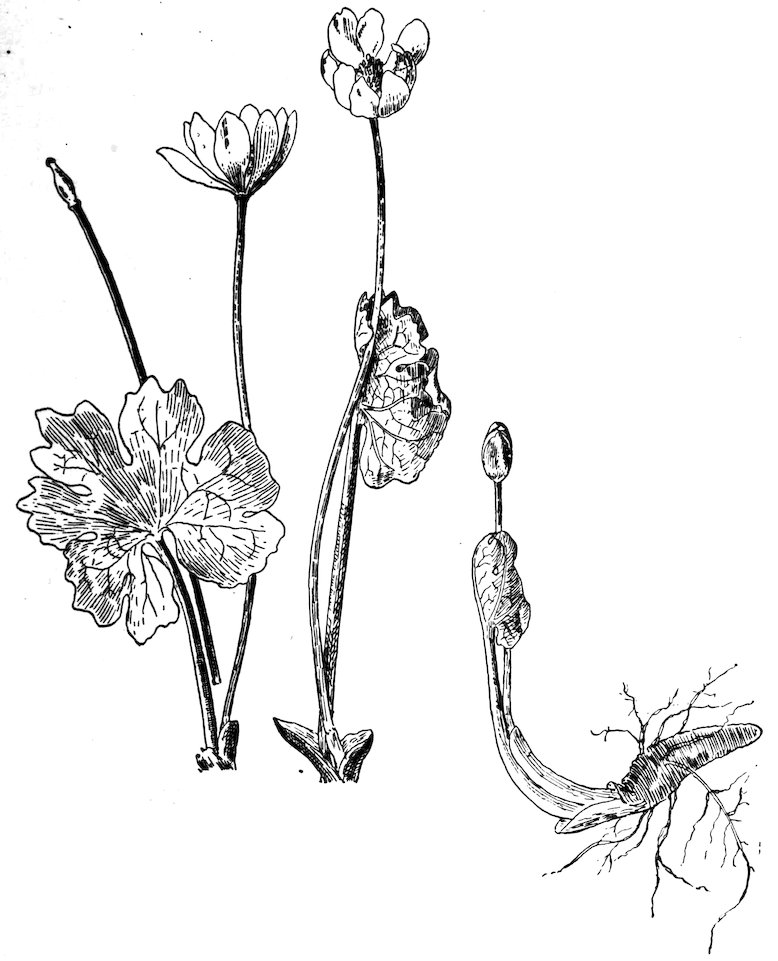
PLATE I BLOOD-ROOT.—S. Canadensis.
24Down in the boggy meadow in early March we can almost fancy that from beneath the solemn purple cowls of the skunk-cabbage brotherhood comes the joyful chorus—
For lo, the winter is past!—
but we chilly mortals still find the wind so frosty and the woods so unpromising that we return shivering to the fireside and refuse to take up the glad strain till the feathery clusters of the shad-bush droop from the pasture thicket. Then only are we ready to admit that
The flowers appear upon the earth,
The time of the singing of birds is come.
Even then, search the woods as we may, we shall hardly find thus early in April another shrub in blossom, unless it be the spice-bush, whose tiny honey-yellow flowers escape all but the careful observer. The shad-bush has been thus named because of its flowering at the season when shad “run;” June-berry, because the shrub’s crimson fruit surprises us by gleaming from the copses at the very beginning of summer; service-berry, because of the use made by the Indians of this fruit, which they gathered in great quantities, and, after much crushing and pounding, utilized in a sort of cake.
Wood Anemone. Wind-flower. Anemone nemorosa. Crowfoot Family.
Stem.—Slender. Leaves.—Divided into delicate leaflets. Flower.—Solitary, white, pink, or purplish. Calyx.—Of from four to seven petal-like sepals. Corolla.—None. Stamens and Pistils.—Numerous.
—Within the woods,
Whose young and half transparent leaves scarce cast
A shade, gay circles of anemones
Danced on their stalks;
writes Bryant, bringing vividly before us the feathery foliage of the spring woods, and the tremulous beauty of the slender-stemmed anemones. Whittier, too, tells how these
—wind flowers sway
Against the throbbing heart of May.
25
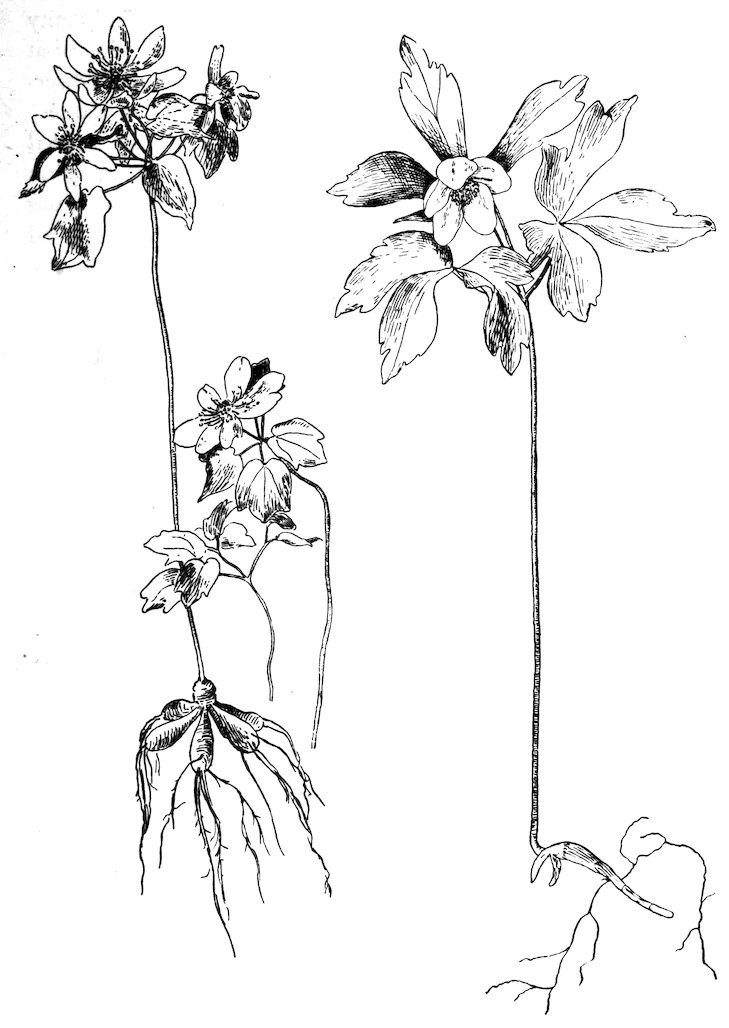
PLATE II RUE ANEMONE.—A. thalictroides. WOOD ANEMONE.—A. nemorosa.
26And in the writings of the ancients as well we could find many allusions to the same flower were we justified in believing that the blossom christened the “wind-shaken,” by some poet flower-lover of early Greece, was identical with our modern anemone.
Pliny tells us that the anemone of the classics was so entitled because it opened at the wind’s bidding. The Greek tradition claims that it sprang from the passionate tears shed by Venus over the body of the slain Adonis. At one time it was believed that the wind which had passed over a field of anemones was poisoned and that disease followed in its wake. Perhaps because of this superstition the flower was adopted as the emblem of sickness by the Persians. Surely our delicate blossom is far removed from any suggestion of disease or unwholesomeness, seeming instead to hold the very essence of spring and purity in its quivering cup.
Rue Anemone. Anemonella thalictroides. Crowfoot Family.
Stem.—Six to twelve inches high. Leaves.—Divided into rounded leaflets. Flowers.—White or pinkish, clustered. Calyx.—Of five to ten petal-like sepals. Corolla.—None. Stamens.—Numerous. Pistils.—Four to fifteen.
The rue anemone seems to linger especially about the spreading roots of old trees. It blossoms with the wood anemone, from which it differs in bearing its flowers in clusters.
Star-flower. Trientalis Americana. Primrose Family.
Stem.—Smooth, erect. Leaves.—Thin, pointed, whorled at the summit of the stem. Flowers.—White, delicate, star-shaped. Calyx.—Generally seven-parted. Corolla.—Generally seven-parted, flat, spreading. Stamens.—Four or five. Pistil.—One.
Finding this delicate flower in the May woods, one is at once reminded of the anemone. The whole effect of plant, leaf, and snow-white blossom is starry and pointed. The frosted tapering petals distinguish it from the rounded blossoms of the wild strawberry, near which it often grows.
27
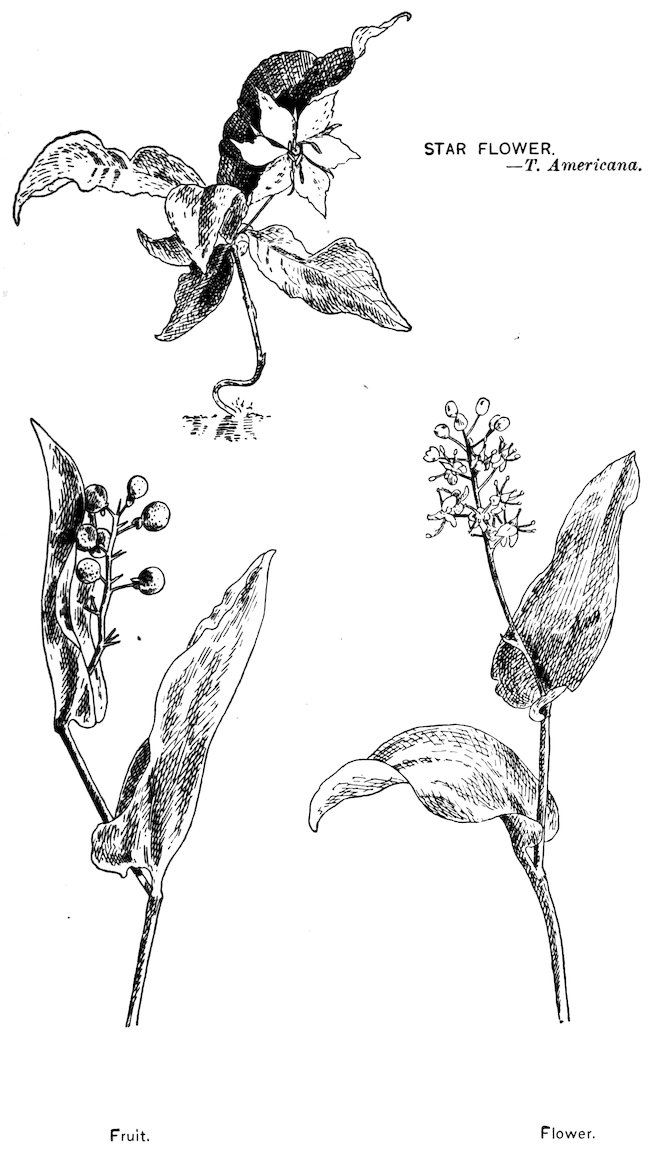
PLATE III STAR-FLOWER.—T. Americana. Maianthemum Canadense.
28
——— ——— Maianthemum Canadense. Lily Family.
Stem.—Three to six inches high, with two or three leaves. Leaves.—Lance-shaped to oval, heart-shaped at base. Flowers.—White or straw-color, growing in a raceme. Perianth.—Four-parted. Stamens.—Four. Pistil.—One, with a two-lobed stigma. Fruit.—A red berry.
It seems unfair that this familiar and pretty little plant should be without any homely English name. Its botanical title signifies “Canada Mayflower,” but while it undoubtedly grows in Canada and flowers in May, the name is not a happy one, for it abounds as far south as North Carolina, and is not the first blossom to be entitled “Mayflower.”
In late summer the red berries are often found in close proximity to the fruit of the shin-leaf and pipsissewa.
Gold Thread. Coptis trifolia. Crowfoot Family.
Scape.—Slender, three to five inches high. Leaves.—Evergreen, shining, divided into three leaflets. Flowers.—Small, white, solitary. Calyx.—Of five to seven petal-like sepals which fall early. Corolla.—Of five to seven club-shaped petals. Stamens.—Fifteen to twenty-five. Pistils.—Three to seven. Root.—Of long, bright yellow fibres.
This little plant abundantly carpets the northern bogs and extends southward over the mountains, its tiny flowers appearing in May. Its bright yellow thread-like roots give it its common name.
Pyxie. Flowering-moss. Pyxidanthera barbulata. Order Diapensiaceæ.
Stems.—Prostrate and creeping, branching. Leaves.—Narrowly lance-shaped, awl-pointed. Flowers.—White or pink, small, numerous. Calyx.—Of five sepals. Corolla.—Five-lobed. Stamens.—Five. Pistil.—One, with a three-lobed stigma.
In early spring we may look for the white flowers of this moss-like plant in the sandy pine-woods of New Jersey and southward. At Lakewood they appear even before those of the trailing arbutus which grows in the same localities. The generic name is from two Greek words which signify a small box and anther, and refers to the anthers, which open as if by a lid.
29
Crinkle-root. Toothwort. Pepper-root. Dentaria diphylla. Mustard Family (p. 17).
Rootstock.—Five to ten inches long, wrinkled, crisp, of a pleasant, pungent taste. Stem.—Leafless below, bearing two leaves above. Leaves.—Divided into three-toothed leaflets. Flowers.—White, in a terminal cluster. Pod.—Flat and lance-shaped.
The crinkle-root has been valued—not so much on account of its pretty flowers which may be found in the rich May woods—but for its crisp edible root which has lent savor to many a simple luncheon in the cool shadows of the forest.
Spring-cress. Cardamine rhomboidea. Mustard Family (p. 17).
Rootstock.—Slender, bearing small tubers. Stem.—From a tuberous base, upright, slender. Root-leaves.—Round and often heart-shaped. Stem-leaves.—The lower rounded, the upper almost lance-shaped. Flowers.—White, large. Pod.—Flat, lance-shaped, pointed with a slender style tipped with a conspicuous stigma; smaller than that of the crinkle-root.
The spring-cress grows abundantly in the wet meadows and about the borders of springs. Its large white flowers appear as early as April, lasting until June.
Whitlow-grass. Draba verna. Mustard Family (p. 17).
Scapes.—One to three inches high. Leaves.—All from the root, oblong or lance-shaped. Flowers.—White, with two-cleft petals. Pod.—Flat, varying from oval to oblong, lance-shaped.
This little plant may be found flowering along the roadsides and in sandy places during April and May. It has come to us from Europe.
Shepherd’s Purse. Capsella Bursa-pastoris. Mustard Family (p. 17).
Stem.—Low, branching. Root-leaves.—Clustered, incised or toothed. Stem-leaves.—Arrow-shaped, set close to the stem. Flowers.—White, small, in general structure resembling other members of the Mustard family. Pod.—Triangular, heart-shaped.
This is one of the commonest of our wayside weeds, working its way everywhere with such persistency and appropriating other people’s property so shamelessly, that it has won for itself the nickname of pickpocket. Its popular title arose from the shape of its little seed-pods.
30
May-apple. Mandrake. Podophyllum peltatum. Barberry Family.
Flowering stem.—Two-leaved, one-flowered. Flowerless stems.—Terminated by one large, rounded, much-lobed leaf. Leaves (of flowering stems).—One-sided, five to nine-lobed, the lobes oblong, the leaf-stalks fastened to their lower side near the inner edge. Flower.—White, large, nodding from the fork made by the two leaves. Calyx.—Of six early falling sepals. Corolla.—Of six to nine rounded petals. Stamens.—Twice as many as the petals. Pistil.—One, with a large, thick stigma set close to the ovary. Fruit.—A large, fleshy, egg-shaped berry, sweet and edible.
“The umbrellas are out!” cry the children, when the great green leaves of the May-apple first unfold themselves in spring. These curious-looking leaves at once betray the hiding-place of the pretty but unpleasantly odoriferous flower which nods beneath them. They lie thickly along the woods and meadows in many parts of the country, arresting one’s attention by the railways. The fruit, which ripens in July, has been given the name of “wild lemon,” in some places on account of its shape. It was valued by the Indians for medicinal purposes, and its mawkish flavor still seems to find favor with the children, notwithstanding its frequently unpleasant after-effects. The leaves and roots are poisonous if taken internally, and are said to have been used as a pot-herb, with fatal results. They yield an extract which has been utilized in medicine.
Twin-leaf. Rheumatism-root. Jeffersonia diphylla. Barberry Family.
A low plant. Leaves.—From the root, long-stalked, parted into two rounded leaflets. Scape.—One-flowered. Flower.—White, one inch broad. Sepals.—Four, falling early. Petals.—Eight; flat, oblong. Stamens.—Eight. Pistil.—One, with a two-lobed stigma.
The twin-leaf is often found growing with the blood-root in the woods of April or May. It abounds somewhat west and southward.
Harbinger-of-Spring. Erigenia bulbosa. Parsley Family (p. 15).
Stem.—Three to nine inches high, from a deep round tuber. Leaves.—One or two, divided into linear-oblong leaf-segments. Flowers.—White, small, few, in a leafy-bracted compound umbel.
31
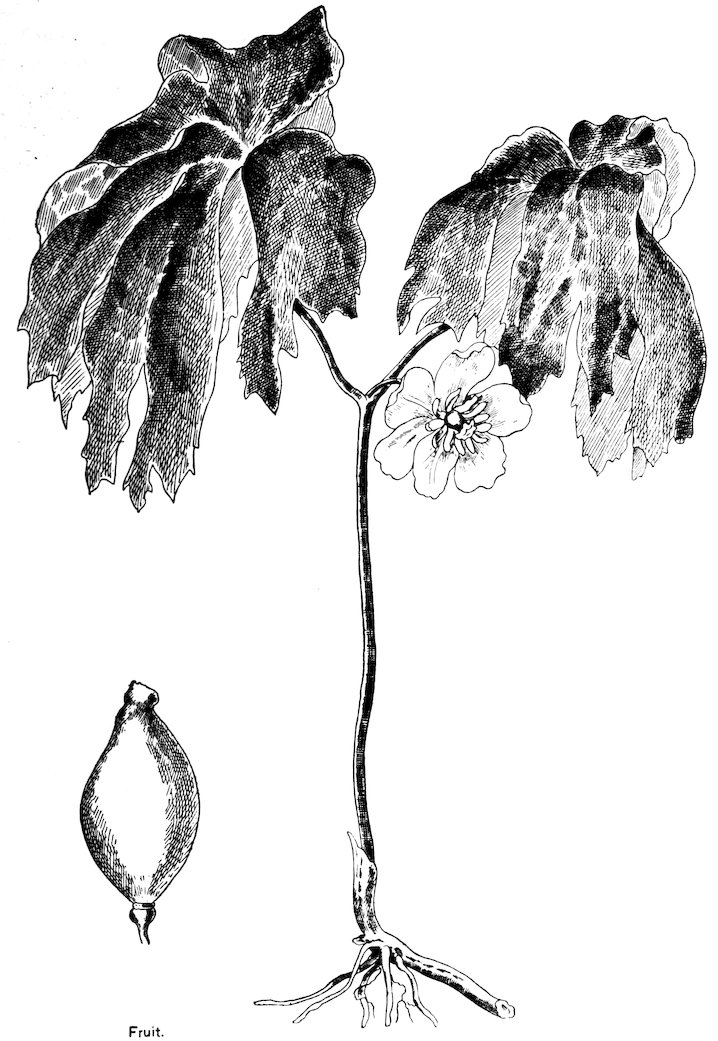
PLATE IV MAY-APPLE.—P. peltatum.
32The pretty little harbinger-of-spring should be easily identified by those who are fortunate enough to find it, for it is one of the smallest members of the Parsley family. It is only common in certain localities, being found in abundance in the neighborhood of Washington, where its flowers appear as early as March.
Early Everlasting. Plantain-leaved Everlasting. Antennaria plantaginifolia. Composite Family (p. 13).
Stems.—Downy or woolly, three to eighteen inches high. Leaves.—Silky, woolly when young; those from the root, oval, three-nerved; those on the flowering stems, small, lance-shaped. Flower-heads.—Crowded, clustered, small, yellowish-white, composed entirely of tubular flowers.
In early spring the hill-sides are whitened with this, the earliest of the everlastings.
Spring Beauty. Claytonia Virginica. Purslane Family.
Stem.—From a small tuber, often somewhat reclining. Leaves.—Two; opposite, long and narrow. Flowers.—White, with pink veins, or pink with deeper-colored veins, growing in a loose cluster. Calyx.—Of two sepals. Corolla.—Of five petals. Stamens.—Five. Pistil.—One, with style three-cleft at apex.
So bashful when I spied her,
So pretty, so ashamed!
So hidden in her leaflets
Lest anybody find:
So breathless when I passed her,
So helpless when I turned
And bore her struggling, blushing,
Her simple haunts beyond!
For whom I robbed the dingle,
For whom betrayed the dell,
Many will doubtless ask me,
But I shall never tell!
Yet we are all free to guess—and what flower—at least in the early year, before it has gained that touch of confidence which it acquires later—is so bashful, so pretty, so flushed with rosy shame, so eager to defend its modesty by closing its blushing petals when carried off by the despoiler—as the spring beauty? To be sure, she is not “hidden in her leaflets,” although often seeking concealment beneath the leaves of other plants—but why not assume that Miss Dickinson has availed herself of something of the license so freely granted to poets—especially, it seems to me—to poets of nature? Perhaps of this class few are more accurate than she, and although we wonder at the sudden blindness which leads her to claim that
—Nature rarer uses yellow
Than another hue—
when it seems as though it needed but little knowledge of flowers to recognize that yellow, probably, occurs more frequently among them than any other color, and also at the representation of this same nature as
—Spending scarlet like a woman—
when in reality she is so chary of this splendid hue; still we cannot but appreciate that this poet was in close and peculiar sympathy with flowers, and was wont to paint them with more than customary fidelity.
33
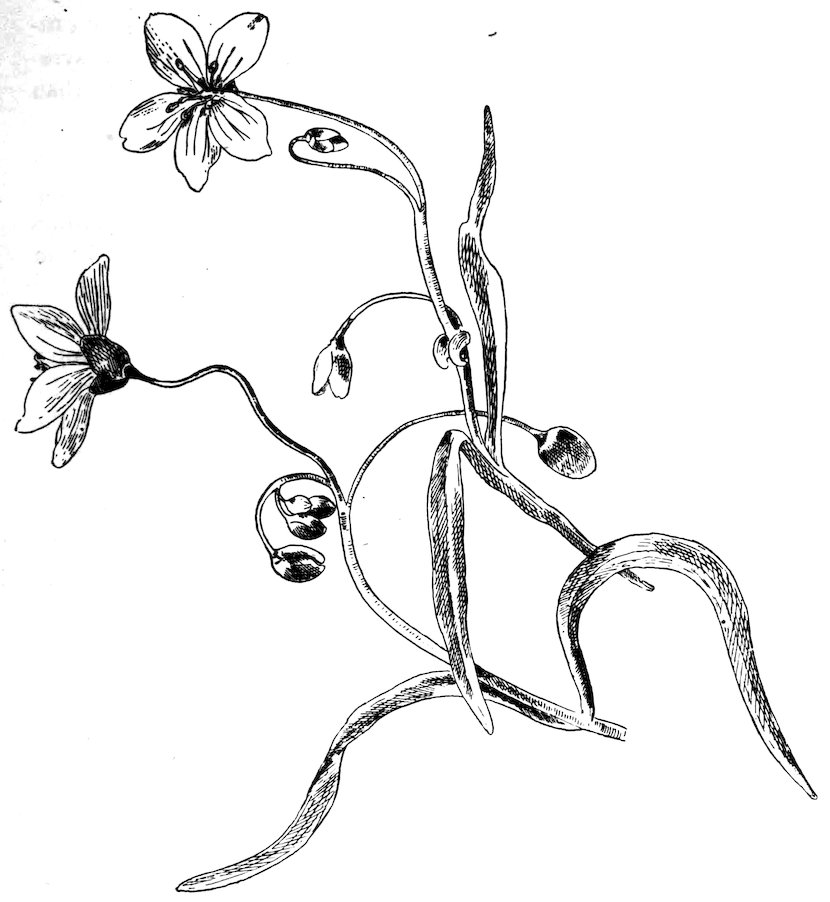
PLATE V SPRING BEAUTY.—C. Virginica.
34We look for the spring beauty in April and May, and often find it in the same moist places—on a brook’s edge or skirting the wet woods—as the yellow adder’s tongue. It is sometimes mistaken for an anemone, but its rose-veined corolla and linear leaves easily identify it. Parts of the carriage-drive in the Central Park are bordered with great patches of the dainty blossoms. One is always glad to discover these children of the country within our city limits, where they can be known and loved by those other children who are so unfortunate as to be denied the knowledge of them in their usual haunts. If the day chances to be cloudy these flowers close and are only induced to open again by an abundance of sunlight. This habit of closing in the shade is common to many flowers, and should be remembered by those who bring home their treasures from the woods and fields, only to discard the majority as hopelessly wilted. If any such exhausted blossoms are placed in the sunlight, with their stems in fresh water, they will probably regain their vigor. Should this treatment fail, an application of very hot—almost boiling—water should be tried. This heroic measure often meets with success.
Dutchman’s Breeches. White-hearts. Dicentra Cucullaria. Fumitory Family.
Scape.—Slender. Leaves.—Thrice-compound. Flowers.—White and yellow, growing in a raceme. Calyx.—Of two small, scale-like sepals. Corolla.—Closed and flattened; of four somewhat cohering white petals tipped with yellow; the two outer—large, with spreading tips and deep spurs; the two inner—small, with spoon-shaped tips uniting over the anthers and stigma. Stamens.—Six. Pistil.—One.
35
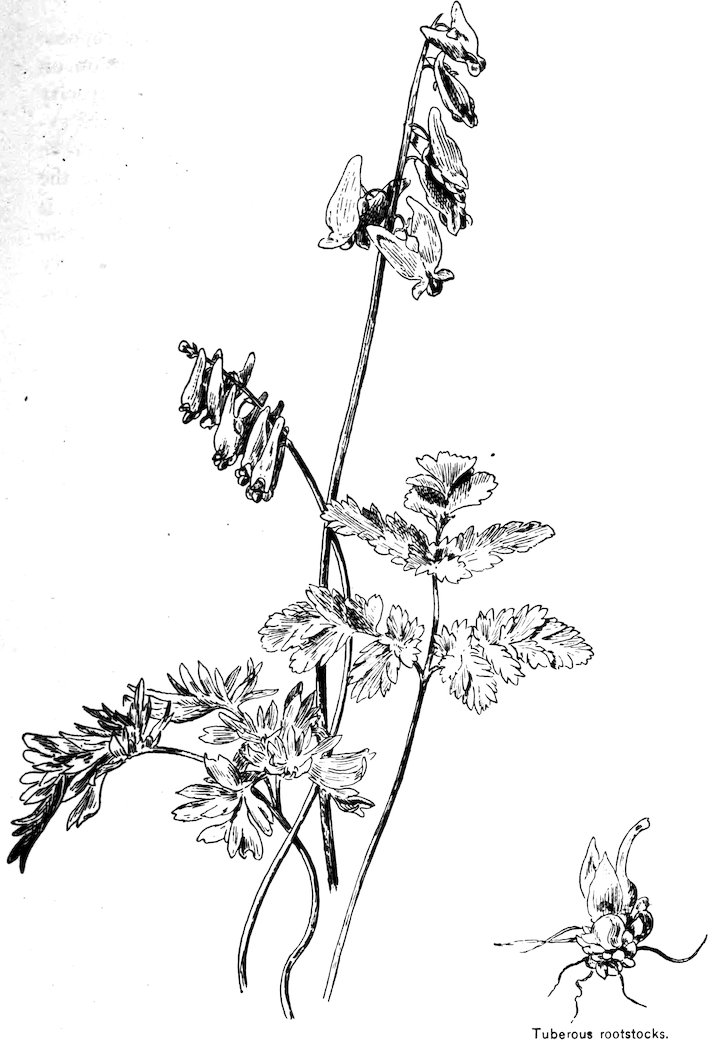
PLATE VI DUTCHMAN’S BREECHES.—D. Cucullaria.
36There is something singularly fragile and spring-like in the appearance of this plant as its heart-shaped blossoms nod from the rocky ledges where they thrive best. One would suppose that the firmly closed petals guarded against any intrusion on the part of insect-visitors and indicated the flower’s capacity for self-fertilization; but it is found that when insects are excluded by means of gauze no seeds are set, which goes to prove that the pollen from another flower is a necessary factor in the continuance of this species. The generic name, Dicentra, is from the Greek and signifies two-spurred. The flower, when seen, explains its two English titles. It is accessible to every New Yorker, for in early April it whitens many of the shaded ledges in the upper part of the Central Park.
Squirrel Corn. Dicentra Canadensis. Fumitory Family.
The squirrel corn closely resembles the dutchman’s breeches. Its greenish or pinkish flowers are heart-shaped, with short, rounded spurs. They have the fragrance of hyacinths, and are found blossoming in early spring in the rich woods of the North.
Foam-flower. False Mitre-wort. Tiarella cordifolia. Saxifrage Family.
Stem.—Five to twelve inches high, leafless, or rarely with one or two leaves. Leaves.—From the rootstock or runners, heart-shaped, sharply lobed. Flowers.—White, in a full raceme. Calyx.—Bell-shaped, five-parted. Corolla.—Of five petals on claws. Stamens.—Ten, long and slender. Pistil.—One, with two styles.
Over the hills and in the rocky woods of April and May the graceful white racemes of the foam-flower arrest our attention. This is a near relative of the Mitella or true mitre-wort. Its generic name is a diminutive from the Greek for turban, and is said to refer to the shape of the pistil.
Early Saxifrage. Saxifraga Virginiensis. Saxifrage Family.
Scape.—Four to nine inches high. Leaves.—Clustered at the root, somewhat wedge-shaped, narrowed into a broad leaf-stalk. Flowers.—White, small, clustered. Calyx.—Five-cleft. Corolla.—Of five petals. Stamens.—Ten. Pistil.—One, with two styles.
37
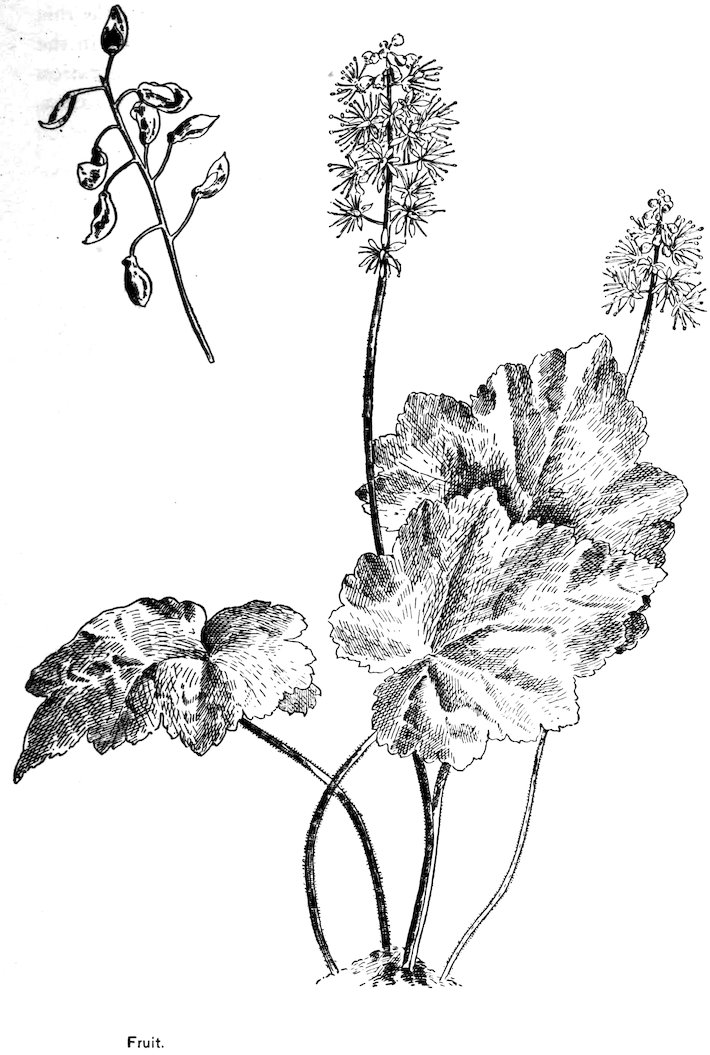
PLATE VII FOAM-FLOWER.—T. cordifolia.
38In April we notice that the seams in the rocky cliffs and hill-sides begin to whiten with the blossoms of the early saxifrage. Steinbrech—stonebreak—the Germans appropriately entitle this little plant, which bursts into bloom from the minute clefts in the rocks and which has been supposed to cause their disintegration by its growth. The generic and common names are from saxum—a rock, and frango—to break.
Mitre-wort. Bishop’s Cap. Mitella diphylla. Saxifrage Family.
Stem.—Six to twelve inches high, hairy, bearing two opposite leaves. Leaves.—Heart-shaped, lobed and toothed, those of the stem opposite and nearly sessile. Flowers.—White, small, in a slender raceme. Calyx.—Short, five-cleft. Corolla.—Of five slender petals which are deeply incised. Stamens.—Ten, short. Pistil.—One, with two styles.
The mitre-wort resembles the foam-flower in foliage, but bears its delicate crystal-like flowers in a more slender raceme. It also is found in the rich woods, blossoming somewhat later.
Indian Poke. False Hellebore. Veratrum viride. Lily Family.
Root.—Poisonous, coarse and fibrous. Stem.—Stout, two to seven feet high, very leafy to the top. Leaves.—Broadly oval, pointed, clasping. Flowers.—Dull greenish, inconspicuous, clustered. Perianth.—Of six spreading sepals. Stamens.—Six. Pistil.—One, with three styles.
When we go to the swampy woods in March or April we notice an array of green, solid-looking spears which have just appeared above the ground. If we handle one of these we are impressed with its firmness and rigidity. When the increasing warmth and sunshine have tempted the veiny, many-plaited leaves of the false hellebore to unfold themselves it is difficult to realize that they composed that sturdy tool which so effectively tunnelled its way upward to the earth’s surface. The tall stems and large bright leaves of this plant are very noticeable in the early year, forming conspicuous masses of foliage while the trees and shrubs are still almost leafless. The dingy flowers which appear later rarely attract attention.
39
Carrion-flower. Cat-brier. Smilax herbacea. Lily Family.
Stem.—Climbing, three to fifteen feet high. Leaves.—Ovate, or rounded heart-shaped, or abruptly cut off at base, shining. Flowers.—Greenish or yellowish, small, clustered, unisexual. Perianth.—Six-parted. Stamens.—six. Pistil.—One, with three spreading stigmas. (Stamens and pistils occurring on different plants.) Fruit.—A bluish-black berry.
One whiff of the foul breath of the carrion flower suffices for its identification. Thoreau likens its odor to that of “a dead rat in the wall.” It seems unfortunate that this strikingly handsome plant which clambers so ornamentally over the luxuriant thickets which border our lanes and streams, should be so handicapped each June. Happily with the disappearance of the blossoms, it takes its place as one of the most attractive of our climbers.
The common green-brier, S. rotundifolia, is a near relation which is easily distinguished by its prickly stem.
The dark berries and deeply tinted leaves of this genus add greatly to the glorious autumnal display along our roadsides and in the woods and meadows.
Larger White Trillium. Trillium grandiflorum. Lily Family.
Stem.—Stout, from a tuber-like rootstock. Leaves.—Ovate, three in a whorl, a short distance below the flower. Flower.—Single, terminal, large, white, turning pink or marked with green. Calyx.—Of three green, spreading sepals. Corolla.—Of three long pointed petals. Stamens.—Six. Pistil.—One, with three spreading stigmas. Fruit.—A large ovate, somewhat angled, red berry.
This very beautiful and decorative flower must be sought far from the highway in the cool rich woods of April and May. Mr. Ellwanger speaks of the “chaste pure triangles of the white wood lily,” and says that it often attains a height of nearly two feet.
T. cernuum has no English title. Its smaller white or pinkish blossom is borne on a stalk which is so much curved as to sometimes quite conceal the flower beneath the leaves. It may be sought in the moist places in the woods.
40The painted trillium, T. erythrocarpum, is also less large and showy than the great white trillium, but it is quite as pleasing. Its white petals are painted at their base with red stripes. This species is very plentiful in the Adirondack and Catskill Mountains.
Ground-nut. Dwarf Ginseng. Aralia trifolia. Ginseng Family.
Stem.—Four to eight inches high. Leaves.—Three in a whorl, divided into from three to five leaflets. Flowers.—White, in an umbel. Fruit.—Yellowish, berry-like. Root.—A globular tuber.
The tiny white flowers of the dwarf ginseng are so closely clustered as to make “one feathery ball of bloom,” to quote Mr. Hamilton Gibson. This little plant resembles its larger relative, the true ginseng. It blossoms in our rich open woods early in spring, and hides its small round tuber so deep in the earth that it requires no little care to uproot it without breaking the slender stem. This tuber is edible and pungent-tasting, giving the plant its name of ground-nut.
Ginseng. Aralia quinquefolia. Ginseng Family.
Root.—Large and spindle-shaped, often forked. Stem.—About one foot high. Leaves.—Three in a whorl, divided into leaflets. Flowers.—Greenish-white, in a simple umbel. Fruit.—Bright red, berry-like.
This plant is well known by name, but is yearly becoming more scarce. The aromatic root is so greatly valued in China for its supposed power of combating fatigue and old age that it can only be gathered by order of the emperor. The forked specimens are believed to be the most powerful, and their fancied likeness to the human form has obtained for the plant the Chinese title of Jin-chen (from which ginseng is a corruption), and the Indian one of Garan-toguen, both of which, strangely enough, are said to signify, like a man. The Canadian Jesuits first began to ship the roots of the American species to China, where they sold at about five dollars a pound. At present they are said to command about one-fifth of that price in the home market.
41
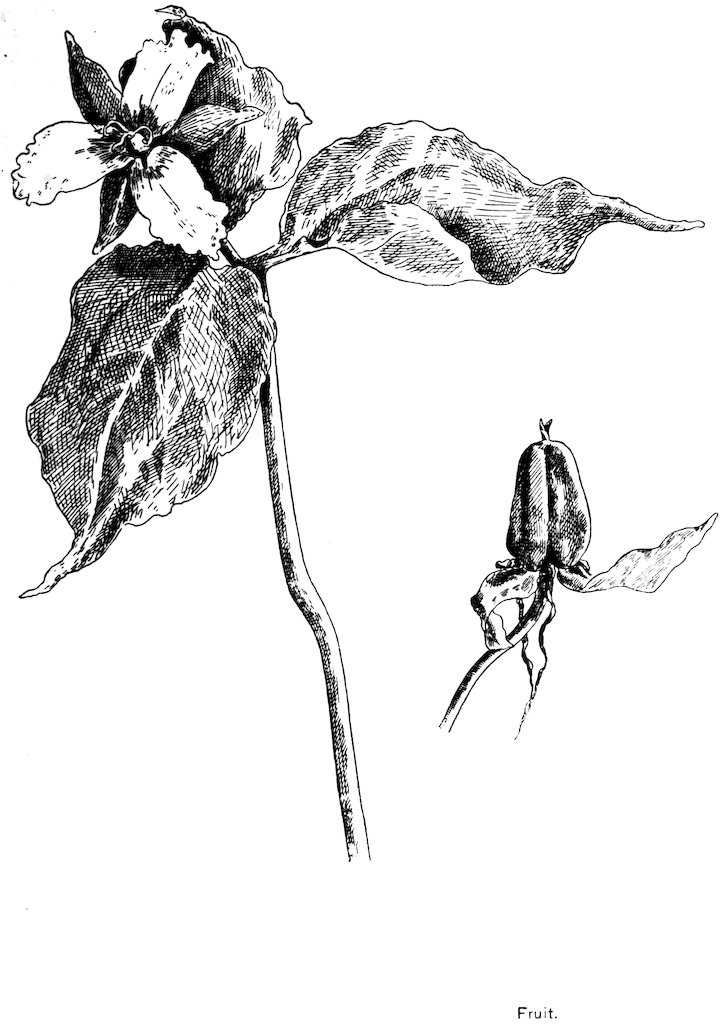
PLATE VIII PAINTED TRILLIUM.—T. erythrocarpum.
42
Wild Sarsaparilla. Aralia nudicaulis. Ginseng Family.
Stem.—Bearing a single large, long-stalked, much-divided leaf, and a shorter naked scape which bears the rounded flower-clusters. Flowers.—Greenish-white, in umbels. Calyx.—With short or obsolete teeth. Corolla.—Of five petals. Stamens.—Five. Fruit.—Black or dark purple, berry-like.
In the June woods the much-divided leaf and rounded flower-clusters of the wild sarsaparilla are frequently noticed, as well as the dark berries of the later year. The long aromatic roots of this plant are sold as a substitute for the genuine sarsaparilla. The rice-paper plant of China is a member of this genus.
Spikenard. Aralia racemosa. Ginseng Family.
Root.—Large and aromatic. Stem.—Often tall and widely branched, leafy. Leaves.—Divided into many leaflets. Flowers.—Greenish-white, in clusters which are racemed. Fruit.—Dark purple, berry-like.
Canada Violet. Viola Canadensis. Violet Family.
Stem.—Leafy, upright, one to two feet high. Leaves.—Heart-shaped, pointed, toothed. Flowers.—White, veined with purple, violet beneath, otherwise greatly resembling the common blue violet.
We associate the violet with the early year, but I have found the delicate fragrant flowers of this species blossoming high up on the Catskill Mountains late into September; and have known them to continue to appear in a New York city-garden into November. They are among the loveliest of the family, having a certain sprightly self-assertion which is peculiarly charming, perhaps because so unexpected.
The tiny sweet white violet, V. blanda, with brown or purple veins, which is found in nearly all low, wet, woody places in spring, is perhaps the only uniformly fragrant member of the family, and its scent, though sweet, is faint and elusive.
43
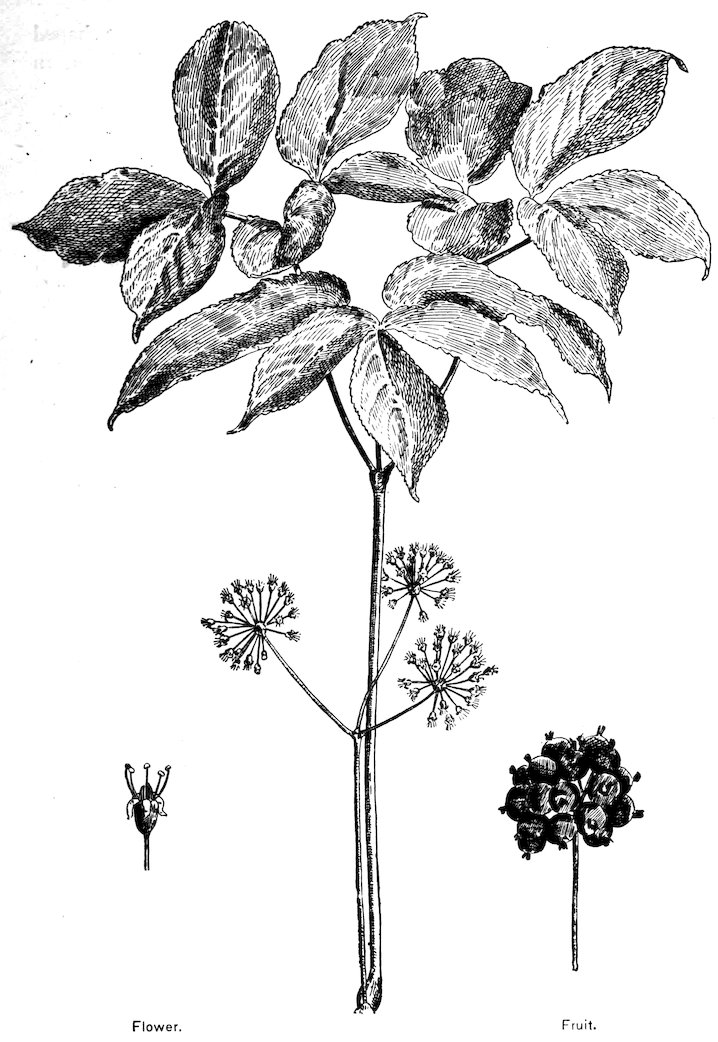
PLATE IX WILD SARSAPARILLA.—A. nudicaulis.
44The lance-leaved violet, V. lanceolata, is another white species which is easily distinguished by its smooth lance-shaped leaves, quite unlike those of the common violet. It is found in damp soil, especially eastward.
Solomon’s Seal. Polygonatum biflorum. Lily Family.
Stem.—Slender, curving, one to three feet long. Leaves.—Alternate, oval, set close to the stem. Flowers.—Greenish-white or straw-colored, bell-shaped, nodding from the axils of the leaves. Perianth.—Six-lobed at the summit. Stamens.—Six. Pistil.—One. Fruit.—A dark blue berry.
The graceful leafy stems of the Solomon’s seal are among the most decorative features of our spring woods. The small blossoms which appear in May grow either singly or in clusters on a flower-stalk which is so fastened into the axil of each leaf that they droop beneath, forming a curve of singular grace which is sustained in later summer by the dark blue berries.
The larger species, P. giganteum, grows to a height of from two to seven feet, blossoming in the meadows and along the streams in June.
The common name was suggested by the rootstocks, which are marked with large round scars left by the death and separation of the base of the stout stalks of the previous years. These scars somewhat resemble the impression of a seal upon wax.
The generic name is from two Greek words signifying many, and knee, alluding to the numerous joints of the rootstock.
Choke-berry. Pyrus arbutifolia. Rose Family.
A shrub from one to three feet high. Leaves.—Oblong or somewhat lance-shaped, finely toothed, downy beneath. Flowers.—White or reddish, small, clustered. Calyx.—Five-cleft. Corolla.—Of five petals. Stamens.—Numerous. Pistil.—One, with two to five styles. Fruit.—Small, pear-shaped or globular, berry-like, dark red or blackish.
This low shrub is common in swamps and moist thickets all along the Atlantic coast, as well as farther inland. Its flowers appear in May or June; its fruit in late summer or autumn.
45
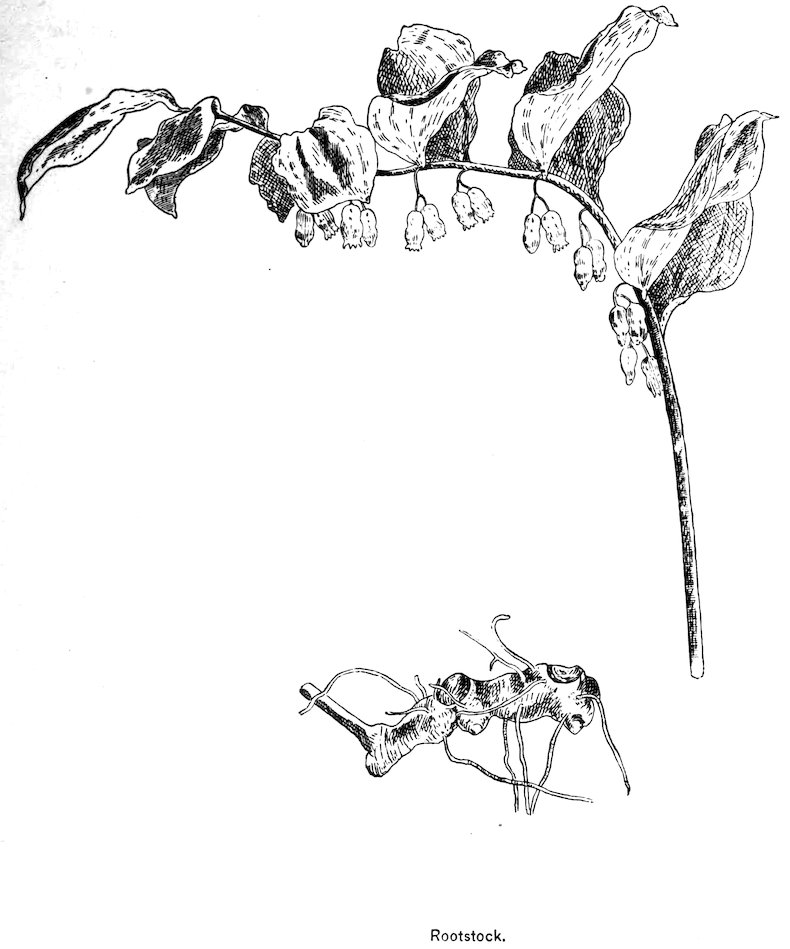
PLATE X SOLOMON’S SEAL.—P. biflorum.
46
Creeping Snowberry. Chiogenes serpyllifolia. Heath Family.
Stem.—Slender, trailing and creeping. Leaves.—Evergreen, small, ovate, pointed. Flowers.—Small, white, solitary from the axils of the leaves. Calyx.—Four-parted, with four large bracelets beneath. Corolla.—Deeply four-parted. Stamens.—Eight. Pistil.—One. Fruit.—A pure white berry.
This pretty little creeper is found blossoming in May in the peat-bogs and mossy woods of the North. It is only conspicuous when hung with its snow-white berries in late summer. It has the aromatic flavor of the wintergreen.
Bearberry. Arctostaphylos Uva-ursi. Heath Family.
A trailing shrub. Leaves.—Thick and evergreen, smooth, somewhat wedge-shaped. Flowers.—Whitish, clustered. Calyx.—Small. Corolla.—Urn-shaped, five-toothed. Stamens.—Ten. Pistil.—One. Fruit.—Red, berry-like.
This plant blossoms in May, and is found on rocky hill-sides. Its name refers to the relish with which bears are supposed to devour its fruit.
False Solomon’s Seal. Smilacina racemosa. Lily Family.
Stem.—Usually curving, one to three feet long. Leaves.—Oblong, veiny. Flowers.—Greenish-white, small, in a terminal raceme. Perianth.—Six-parted. Stamens.—Six. Pistil.—One. Fruit.—A pale red berry speckled with purple.
A singular lack of imagination is betrayed in the common name of this plant. Despite a general resemblance to the true Solomon’s seal, and the close proximity in which the two are constantly found, S. racemosa, has enough originality to deserve an individual title. The position of the much smaller flowers is markedly different. Instead of drooping beneath the stem they terminate it, having frequently a pleasant fragrance, while the berries of late summer are pale red, flecked with purple. It puzzles one to understand why these two plants should so constantly be found growing side by side—so close at times that they almost appear to spring from one point. The generic name is from smilax, on account of a supposed resemblance between the leaves of this plant and those which belong to that genus.
47
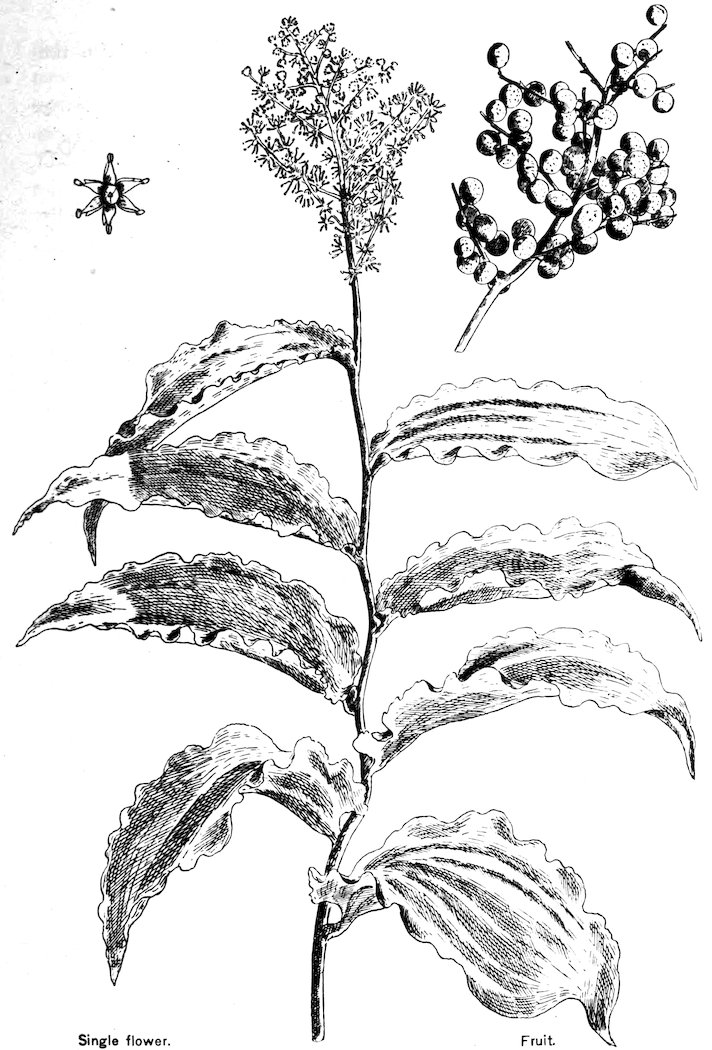
PLATE XI FALSE SOLOMON’S SEAL.—S. racemosa.
48
Maple-leaved Viburnum. Dockmackie. Arrow-wood. Viburnum acerifolium. Honeysuckle Family.
A shrub from three to six feet high. Leaves.—Somewhat three-lobed, resembling those of the maple, downy underneath. Flowers.—White, small, in flat-topped clusters. Calyx.—Five-toothed. Corolla.—Spreading, five-lobed. Stamens.—Five. Pistil.—One. Fruit.—Berry-like, crimson, turning purple.
Perhaps our flowering shrubs contribute even more to the beauty of the early summer woods and fields than the smaller plants. Along many of the lanes which intersect the woodlands the viburnums are conspicuous in June. When the blossoms of the dockmackie have passed away we need not be surprised if we are informed that this shrub is a young maple. There is certainly a resemblance between its leaves and those of the maple, as the specific name indicates. To be sure, the first red, then purple berries, can scarcely be accounted for, but such a trifling incongruity would fail to daunt the would-be wiseacre of field and forest. With Napoleonic audacity he will give you the name of almost any shrub or flower about which you may inquire. Seizing upon some feature he has observed in another plant, he will immediately christen the one in question with the same title—somewhat modified, perhaps—and in all probability his authority will remain unquestioned. There is a marvellous amount of inaccuracy afloat in regard to the names of even the commonest plants, owing to this wide-spread habit of guessing at the truth and stating a conjecture as a fact.
Hobble-bush. American Wayfaring-tree. Viburnum lantanoides. Honeysuckle Family.
Leaves.—Rounded, pointed, closely toothed, heart-shaped at the base, the veins beneath as well as the stalks and small branches being covered with a rusty scurf. Fruit.—Coral-red, berry-like.
The marginal flowers of the flat-topped clusters of the hobble-bush, like those of the hydrangea, are much larger than the 49inner ones, and are without either stamens or pistils; their only part in the economy of the shrub being to form an attractive setting for the cluster, and thus to allure the insect-visitors that are usually so necessary to the future well-being of the species. The shrub is a common one in our northern woods and mountains. Its straggling growth, and its reclining branches, which often take root in the ground, have suggested the popular names of hobble-bush, and wayfaring-tree.
Round-leaved Dogwood. Cornus circinata. Dogwood Family.
A shrub six to ten feet high. Leaves.—Rounded, abruptly pointed. Flowers.—Small, white, in flat, spreading clusters. Calyx.—Minutely four-toothed. Corolla.—Of four white, oblong, spreading petals. Stamens.—Four. Pistil.—One. Fruit.—Light blue, berry-like.
The different members of the Dogwood family are important factors in the lovely pageant which delights our eyes along the country lanes every spring. Oddly enough, only the smallest and largest representative of the tribe (the little bunch-berry, and the flowering-dogwood, which is sometimes a tree of goodly dimensions), have in common the showy involucre which is usually taken for the blossom itself; but which instead only surrounds the close cluster of inconspicuous greenish flowers.
The other members of the genus are all comprised in the shrubby dogwoods; many of these are very similar in appearance, bearing their white flowers in flat, spreading clusters, and differing chiefly in their leaves and fruit.
The branches of the round-leaved dogwood are greenish and warty-dotted. Its fruit is light blue, and berry-like.
The panicled dogwood, C. paniculata, may be distinguished by its white fruit and smooth, gray branches.
The red-osier dogwood, C. stolonifera, is common in wet places. Its young shoots and branches are a bright purplish-red. Its flower-clusters are small; its fruit, white or lead-color.
The bark of this genus has been considered a powerful tonic, and an extract entitled “cornine,” is said to possess the properties of quinine less strongly marked. The Chinese peel its 50twigs, and use them for whitening their teeth. It is said that the Creoles also owe the dazzling beauty of their teeth to this same practice.
Bellwort. Oakesia sessilifolia. Lily Family.
Stem.—Acutely angled, rather low. Leaves.—Set close to or clasping the stem, pale, lance-oblong. Flower.—Yellowish-white or straw-color. Perianth.—Narrowly bell-shaped, divided into six distinct sepals. Stamens.—Six. Pistil.—One, with a deeply three-cleft style.
In spring this little plant is very abundant in the woods. It bears one or two small lily-like blossoms which droop modestly beneath the curving stems.
With the same common name and near of kin is Uvularia perfoliata, with leaves which seem pierced by the stem, but otherwise of a strikingly similar aspect.
Hawthorn. White-thorn. Cratægus coccinea. Rose Family.
A shrub or small tree, with spreading branches, and stout thorns or spines. Leaves.—On slender leaf-stalks, thin, rounded, toothed, sometimes lobed. Flowers.—White or sometimes reddish, rather large, clustered, with a somewhat disagreeable odor. Calyx.—Urn-shaped, five-cleft. Corolla.—Of five broad, rounded petals. Stamens.—Five to ten, or many. Pistil.—One, with one to five styles. Fruit.—Coral-red, berry-like.
The flowers of the white-thorn appear in spring, at the same time with those of the dogwoods. Its scarlet fruit gleams from the thicket in September.
White Baneberry. Actæa alba. Crowfoot Family.
Stem.—About two feet high. Leaves.—Twice or thrice-compound, leaflets incised and sharply toothed. Flowers.—Small, white, in a thick, oblong, terminal raceme. Calyx.—Of four to five tiny sepals which fall as the flower expands. Corolla.—Of four to ten small flat petals with slender claws. Stamens.—Numerous, with slender white filaments. Pistil.—One, with a depressed, two-lobed stigma. Fruit.—An oval white berry, with a dark spot, on a thick red stalk.
51
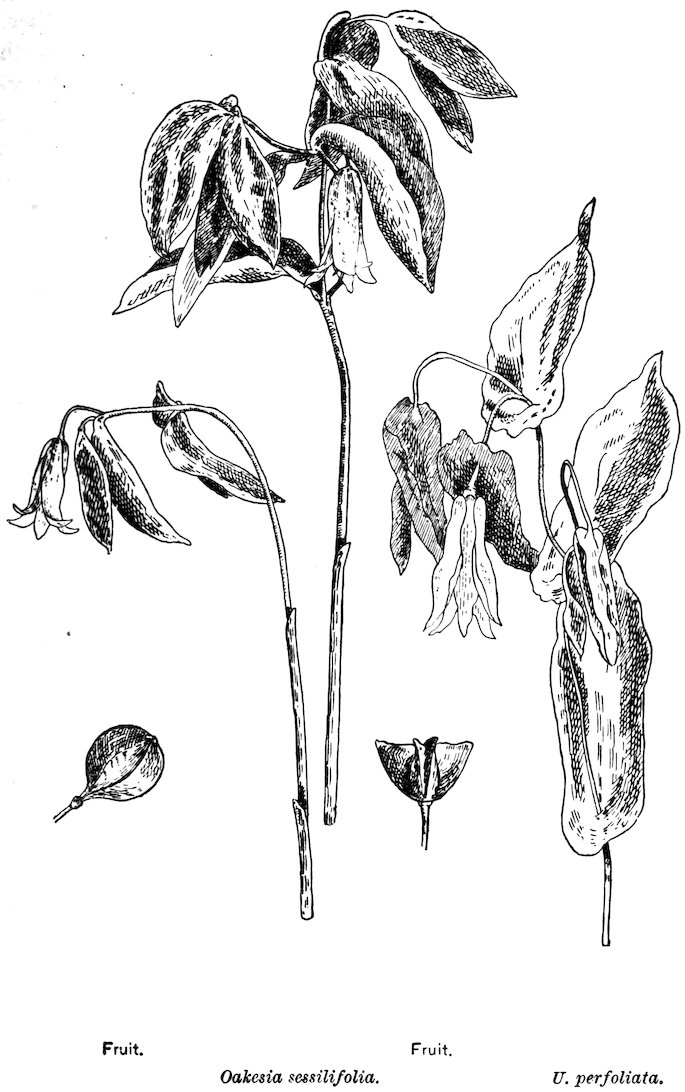
PLATE XII BELLWORT.
52The feathery clusters of the white baneberry may be gathered when we go to the woods for the columbine, the wild ginger, the Jack-in-the-pulpit, and Solomon’s seal. These flowers are very nearly contemporaneous and seek the same cool shaded nooks, all often being found within a few feet of one another.
The red baneberry, A. rubra, is a somewhat more Northern plant and usually blossoms a week or two earlier. Its cherry-red (occasionally white) berries on their slender stalks are easily distinguished from the white ones of A. alba, which look strikingly like the china eyes that small children occasionally manage to gouge from their dolls’ heads.
Mountain Holly. Nemopanthes fascicularis. Holly Family.
A much branched shrub, with ash-gray bark. Leaves.—Alternate, oblong, smooth, on slender leaf-stalks. Flowers.—White, some perfect, others unisexual; solitary or clustered in the axils of the leaves on long, slender flower-stalks. Calyx.—Minute or obsolete. Corolla.—Of four or five spreading petals. Stamens.—Four or five. Pistil.—One. Fruit.—Coral-red, berry-like.
The flowers of this shrub appear in the damp woods of May. Its light red berries on their slender stalks are noticed in late summer when its near relation, the black alder or winterberry is also conspicuous. Its generic name signifies flower with a thread-like stalk.
Winterberry. Black Alder. Ilex verticillata. Holly Family.
A shrub, common in low grounds. Leaves.—Oval or lance-shaped, pointed at apex and base, toothed. Flowers.—White; some perfect, others unisexual; clustered on very short flower-stalks in the axils of the leaves; appearing in May or June. Calyx.—Minute. Corolla.—Of four to six petals. Stamens.—Four to six. Pistil.—One. Fruit.—Coral-red, berry-like.
The year may draw nearly to its close without our attention being arrested by this shrub. But in September it is well nigh impossible to stroll through the country lanes without pausing to admire the bright red berries clustered so thickly among the leaves of the black alder. The American holly, I. opaca, is closely related to this shrub, whose generic name is the ancient Latin title for the holly-oak.
53
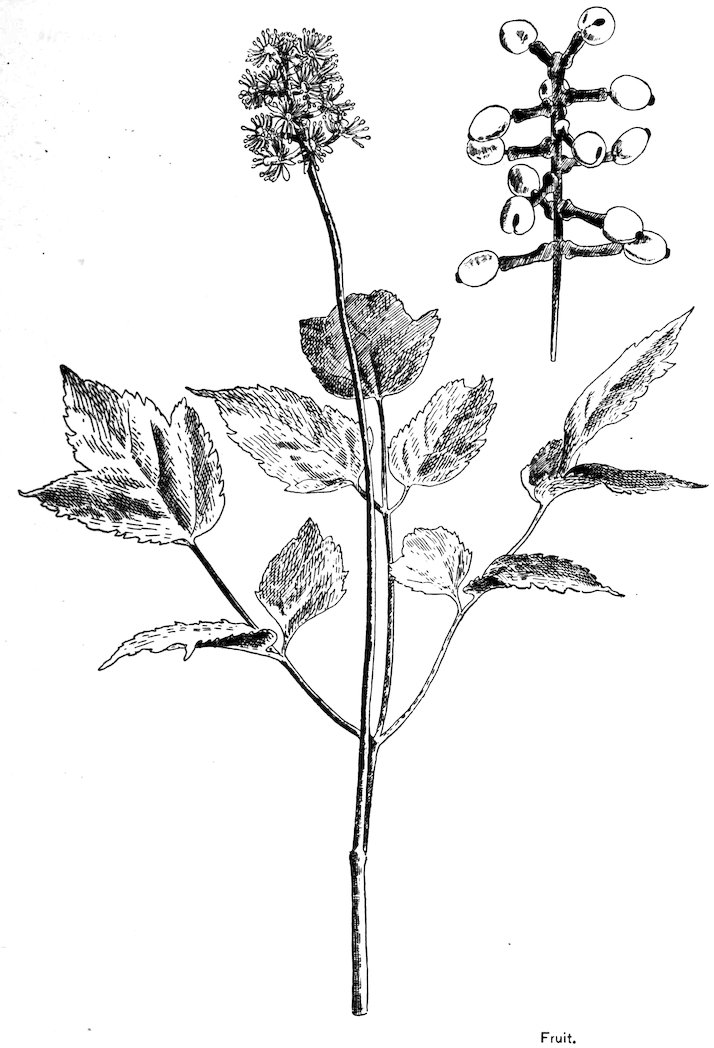
PLATE XIII WHITE BANEBERRY.—A. alba.
54
Red-berried Elder. Sambucus racemosa. Honeysuckle Family.
Stems.—Woody, two to twelve feet high. Leaves.—Divided into leaflets. Flowers.—White, resembling those of the Common Elder (p. 78), but borne in pyramidal instead of in flat-topped clusters. Fruit.—Bright red, berry-like.
The white clusters of the red-berried elder are found in the rocky woods of May; its scarlet fruit, like that of the shad-bush, appearing in June.
Bunch-berry. Dwarf Cornel. Cornus Canadensis. Dogwood Family.
Stem.—Five to seven inches high. Leaves.—Ovate, pointed, the upper crowded into an apparent whorl of four to six. Flowers.—Greenish, small, in a cluster which is surrounded by a large and showy four-leaved, petal-like, white or pinkish involucre. Calyx.—Minutely four-toothed. Corolla.—Of four spreading petals. Stamens.—Four. Pistil.—One. Fruit.—Bright red, berry-like.
When one’s eye first falls upon the pretty flowers of the bunch-berry in the June woods, the impression is received that each low stem bears upon its summit a single large white blossom. A more searching look discovers that what appeared like rounded petals are really the showy white leaves of the involucre which surround the small, closely clustered, greenish flowers.
The bright red berries which appear in late summer make brilliant patches in the woods and swamps. Both in flower and fruit this is one of the prettiest of our smaller plants. It is closely allied to the well-known flowering-dogwood, which is so ornamental a tree in early spring.
In the Scotch Highlands it is called the “plant of gluttony,” on account of its supposed power of increasing the appetite. It is said to form part of the winter food of the Esquimaux.
55
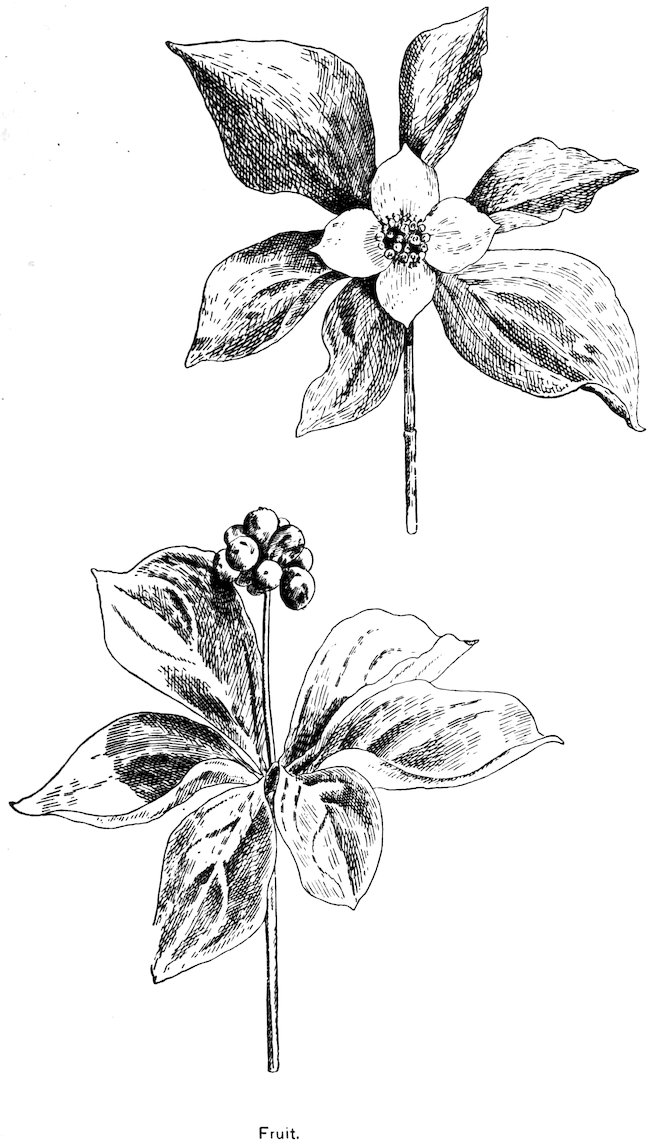
PLATE XIV Fruit. BUNCH-BERRY.—C. Canadensis.
56
Sweet Bay. Laurel Magnolia. Magnolia glauca. Magnolia Family.
A shrub from four to twenty feet high. Leaves.—Oval to broadly lance-shaped, from three to six inches long. Flowers.—White, two inches long, growing singly at the ends of the branches. Calyx.—Of three sepals. Corolla.—Globular, with from six to nine broad petals. Stamens.—Numerous, with short filaments and long anthers. Pistils.—Many, packed so as to make a sort of cone in fruit. Fruit.—Cone-like, red, fleshy when ripe; the pistils opening at maturity and releasing the scarlet seeds which hang by delicate threads.
The beautiful fragrant blossoms of the sweet bay may be found from June till August, in swamps along the coast from Cape Ann southward.
Lizard’s Tail. Saururus cernuus. Pepper Family.
Stem.—Jointed, often tall. Leaves.—Alternate, heart-shaped. Flowers.—White, without calyx or corolla, crowded into a slender, wand-like terminal spike which nods at the end. Stamens.—Usually six or seven. Pistils.—Three or four, united at their base.
The nodding, fragrant spikes of the lizard’s tail abound in certain swamps from June till August. While the plant is not a common one, it is occasionally found in great profusion, and is sure to arrest attention by its odd appearance.
Moonseed. Menispermum Canadense. Moonseed Family.
Stem.—Woody, climbing. Leaves.—Three to seven-angled or lobed, their stalks fastened near the edge of the lower surface. Flowers.—White or yellowish, in small loose clusters, unisexual. Calyx.—Of four to eight sepals. Corolla.—Of six to eight short petals. Stamens and Pistils.—Occurring on different plants. Fruit.—Berry-like, black, with a bloom.
Clambering over the thickets which line the streams, we notice in September the lobed or angled leaves and black berries of the moonseed, the small white or yellowish flowers of which were, perhaps, overlooked in June.
57
Mountain Laurel. Spoonwood. Calico-bush. Kalmia latifolia. Heath Family.
An evergreen shrub. Leaves.—Oblong, pointed, shining, of a leathery texture. Flowers.—White or pink, in terminal clusters. Calyx.—Five-parted. Corolla.—Marked with red, wheel-shaped, five-lobed, with ten depressions. Stamens.—Ten, each anther lodged in one of the depressions of the corolla. Pistil.—One.
The shining green leaves which surround the white or rose-colored flowers of the mountain laurel are familiar to all who have skirted the west shore of the Hudson River, wandered across the hills that lie in its vicinity, or clambered across the mountains of Pennsylvania, where the shrub sometimes grows to a height of thirty feet. Not that these localities limit its range: for it abounds more or less from Canada to Florida, and far inland, especially along the mountains, whose sides are often clothed with an apparent mantle of pink snow during the month of June, and whose waste places are, in very truth, made to blossom like the rose at this season.
The shrub is highly prized and carefully cultivated in England. Barewood Gardens, the beautiful home of the editor of the London Times, is celebrated for its fine specimens of mountain laurel and American rhododendron. The English papers advertise the approach of the flowering season, the estate is thrown open to the public, and the people for miles around flock to see the radiant strangers from across the water. The shrub is not known there as the laurel, but by its generic title, Kalmia. The head gardener of the place received with some incredulity my statement that in parts of America the waste hill-sides were brilliant with its beauty every June.
The ingenious contrivance of these flowers to secure cross-fertilization is most interesting. The long filaments of the stamens are arched by each anther being caught in a little pouch of the corolla; the disturbance caused by the sudden alighting of an insect on the blossom, or the quick brush of a bee’s wing, dislodges the anthers from their niches, and the stamens spring upward with such violence that the pollen is jerked from its hiding-place in the pore of the anther-cell on to the body of the insect-visitor, 58who straightway carries it off to another flower upon whose protruding stigma it is sure to be inadvertently deposited. In order to see the working of this for one’s self, it is only necessary to pick a fresh blossom and either brush the corolla quickly with one’s finger, or touch the stamens suddenly with a pin, when the anthers will be dislodged and the pollen will be seen to fly.
This is not the laurel of the ancients—the symbol of victory and fame—notwithstanding some resemblance in the form of the leaves. The classic shrub is supposed to be identical with the Laurus nobilis which was carried to our country by the early colonists, but which did not thrive in its new environment.
The leaves of our species are supposed to possess poisonous qualities, and are said to have been used by the Indians for suicidal purposes. There is also a popular belief that the flesh of a partridge which has fed upon its fruit becomes poisonous. The clammy exudation about the flower-stalks and blossoms may serve the purpose of excluding from the flower such small insects as would otherwise crawl up to it, dislodge the stamens, scatter the pollen, and yet be unable to carry it to its proper destination on the pistil of another flower.
The Kalmia was named by Linnæus after Peter Kalm, one of his pupils who travelled in this country, who was, perhaps, the first to make known the shrub to his great master.
The popular name spoonwood grew from its use by the Indians for making eating-utensils. The wood is of fine grain and takes a good polish.
The title calico-bush probably arose from the marking of the corolla, which, to an imaginative mind, might suggest the cheap cotton-prints sold in the shops.
White Swamp Honeysuckle. Clammy Azalea. Rhododendron viscosum. Heath Family.
A shrub from three to ten feet high. Leaves.—Oblong. Flowers.—White, clustered, appearing after the leaves. Calyx-lobes.—Minute. Corolla.—White, five-lobed, the clammy tube much longer than the lobes. Stamens.—Usually five, protruding. Pistil.—One, protruding.
59
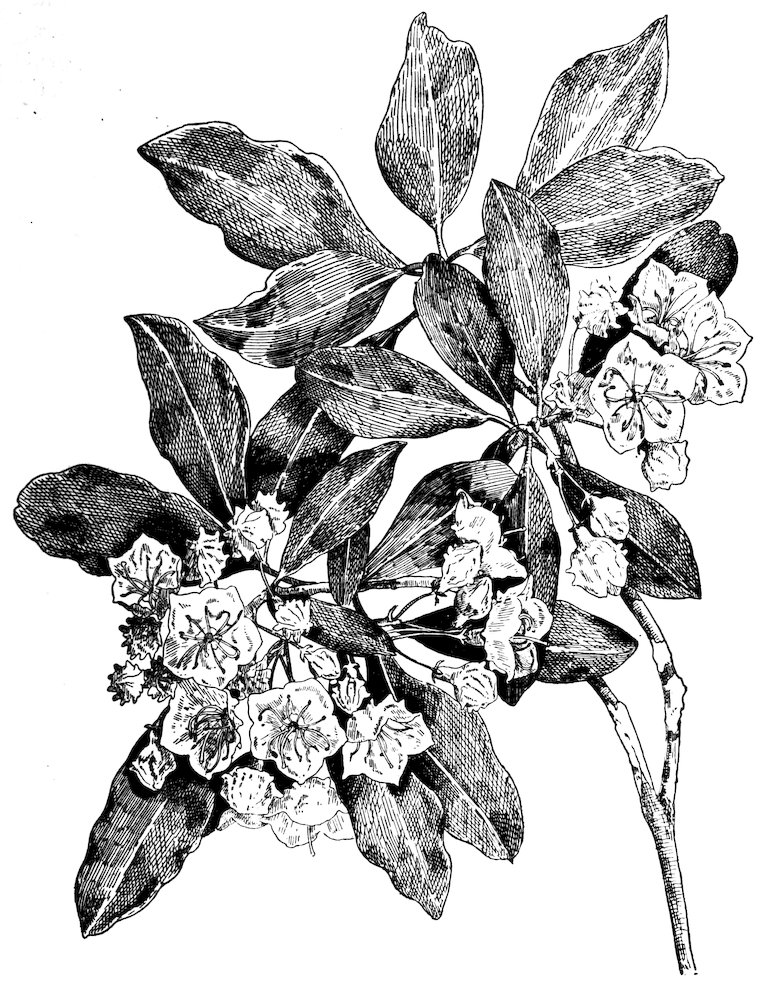
PLATE XV MOUNTAIN LAUREL.—K. latifolia.
60The fragrant white flowers of this beautiful shrub appear in early summer along the swamps which skirt the coast, and occasionally farther inland. The close family resemblance to the pink azalea (Pl. LXV.) will be at once detected. On the branches of both species will be found those abnormal, fleshy growths, called variously “swamp apples” and “May apples,” which are so relished by the children. Formerly these growths were attributed to the sting of an insect, as in the “oak apple;” now they are generally believed to be modified buds.
American Rhododendron. Great Laurel. Rhododendron maximum. Heath Family.
A shrub from six to thirty-five feet high. Leaves.—Thick and leathery, oblong, entire. Flowers.—White or pink, clustered. Calyx.—Minute, five-toothed. Corolla.—Somewhat bell-shaped, five-parted, greenish in the throat, with red, yellow, or green spots. Stamens.—Usually ten. Pistil.—One.
This beautiful native shrub is one of the glories of our country when in the perfection of its loveliness. The woods which nearly cover many of the mountains of our Eastern States hide from all but the bold explorer a radiant display during the early part of July. Then the lovely waxy flower-clusters of the American rhododendron are in their fulness of beauty. As in the laurel, the clammy flower-stalks seem fitted to protect the blossom from the depredations of small and useless insects, while the markings on the corolla attract the attention of the desirable bee.
In those parts of the country where it flourishes most luxuriantly, veritable rhododendron jungles termed “hells” by the mountaineers are formed. The branches reach out and interlace in such a fashion as to be almost impassable.
The nectar secreted by the blossoms is popularly supposed to be poisonous. We read in Xenophon that during the retreat of the Ten Thousand, the soldiers found a quantity of honey of which they freely partook, with results that proved almost fatal. This honey is said to have been made from a rhododendron which is still common in Asia Minor and which is believed to possess intoxicating and poisonous properties.
61
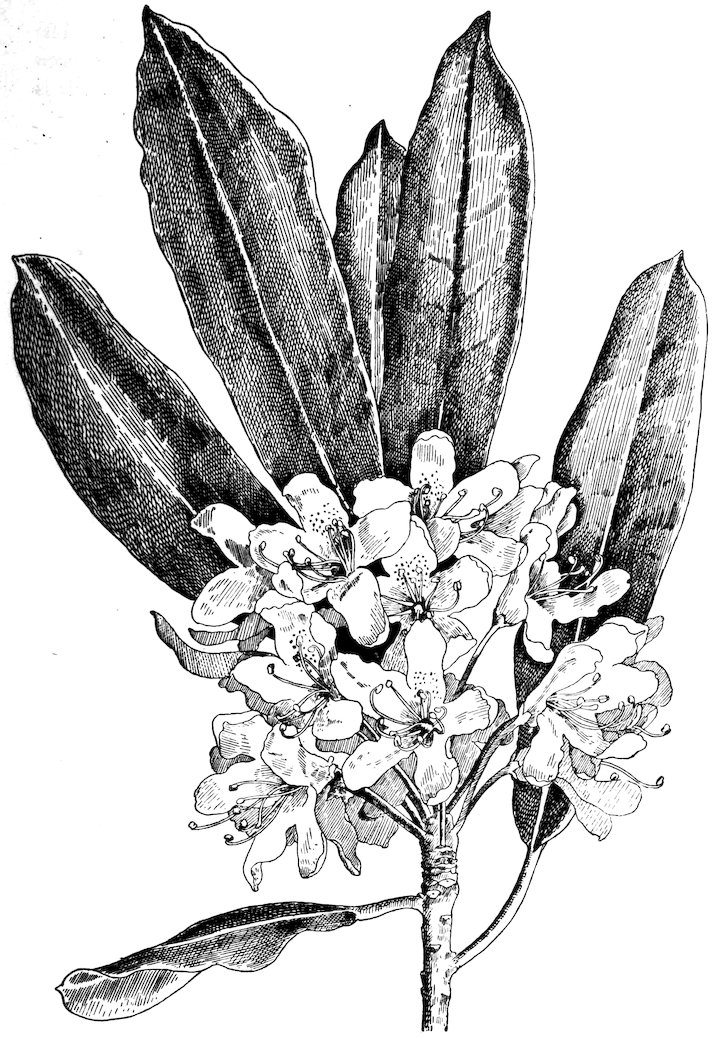
PLATE XVI AMERICAN RHODODENDRON.—R. maximum.
62Comparatively little attention had been paid to this superb flower until the Centennial Celebration at Philadelphia, when some fine exhibits attracted the admiration of thousands. The shrub has been carefully cultivated in England, having been brought to great perfection on some of the English estates. It is yearly winning more notice in this country.
The generic name is from the Greek for rose-tree.
Wood Sorrel. Oxalis Acetosella. Geranium Family.
Scape.—One-flowered, two to five inches high. Leaves.—Divided into three clover-like leaflets. Flower.—White veined with red, solitary. Calyx.—Of five sepals. Corolla.—Of five petals. Stamens.—Ten. Pistil.—One with five styles.
Surely nowhere can be found a daintier carpeting than that made by the clover-like foliage of the wood sorrel when studded with its rose-veined blossoms in the northern woods of June. At the very name comes a vision of mossy nooks where the sunlight only comes on sufferance, piercing its difficult path through the tent-like foliage of the forest, resting only long enough to become a golden memory.
The early Italian painters availed themselves of its chaste beauty. Mr. Ruskin says: “Fra Angelico’s use of the Oxalis Acetosella is as faithful in representation as touching in feeling. The triple leaf of the plant and white flower stained purple probably gave it strange typical interest among the Christian painters.”
Throughout Europe it bears the odd name of “Hallelujah” on account of its flowering between Easter and Whitsuntide, the season when the Psalms sung in the churches resound with that word. There has been an unfounded theory that this title sprang from St. Patrick’s endeavor to prove to his rude audience the possibility of a Trinity in Unity from the three-divided leaves. By many this ternate leaf has been considered the shamrock of the ancient Irish.
The English title, “cuckoo-bread,” refers to the appearance of the blossoms at the season when the cry of the cuckoo is first heard.
63
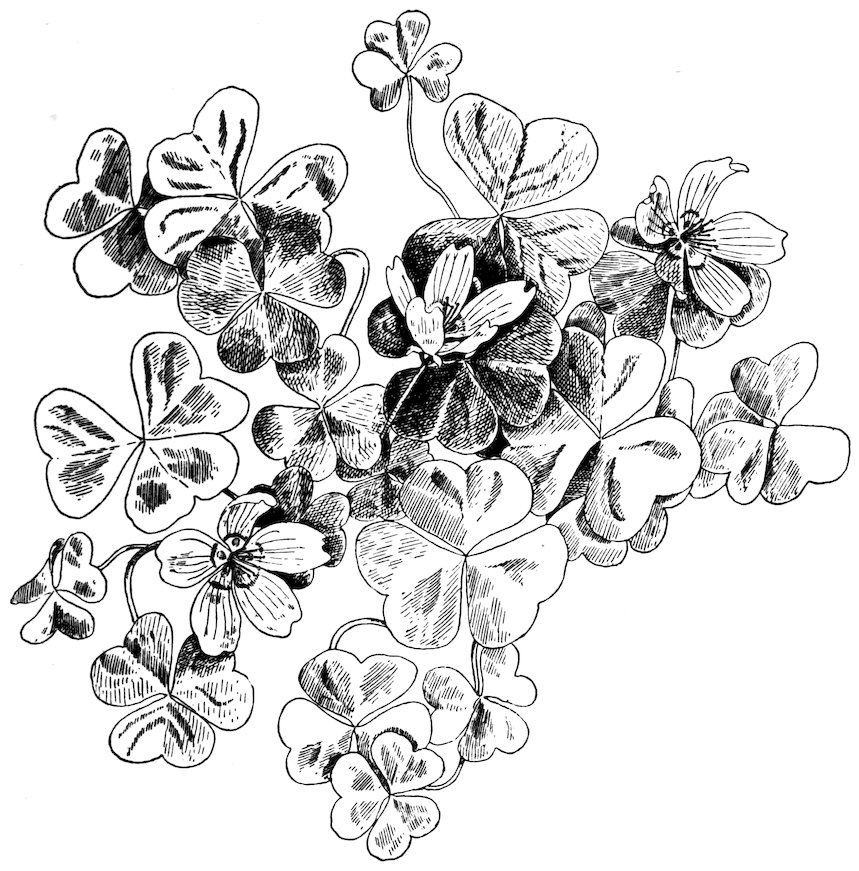
PLATE XVII WOOD SORREL.—O. Acetosella.
64Our name sorrel is from the Greek for sour and has reference to the acrid juice of the plant. The delicate leaflets “sleep” at night; that is, they droop and close one against another.
Poison Sumach. Rhus venenata. Cashew Family.
A shrub from six to eighteen feet high. Leaves.—Divided into seven to thirteen oblong entire leaflets. Flowers.—Greenish or yellowish-white, in loose axillary clusters; some perfect, others unisexual. Fruit.—Whitish or dun-colored, small, globular.
The poison sumach infests swampy places and flowers in June. In early summer it can be distinguished from the harmless members of the family by the slender flower-clusters which grow from the axils of the leaves, those of the innocent sumachs being borne in pyramidal, terminal clusters. In the later year the fruits of the respective shrubs are, of course, similarly situated, but, to accentuate the distinction, they differ in color; that of the poison sumach being whitish or dun-colored, while that of the other is crimson.
Staghorn Sumach. Rhus typhina. Cashew Family.
A shrub or tree from ten to thirty feet high. Leaves.—Divided into eleven to thirty-one somewhat lance-shaped, toothed leaflets. Flowers.—Greenish or yellowish-white, in upright terminal clusters, some perfect, others unisexual, appearing in June. Fruit.—Crimson, small, globular, hairy.
This is the common sumach which illuminates our hill-sides every autumn with masses of flame-like color. Many of us would like to decorate our homes with its brilliant sprays, but are deterred from handling them by the fear of being poisoned, not knowing that one glance at the crimson fruit-plumes should reassure us, as the poisonous sumachs are white-fruited. These tossing pyramidal fruit-clusters at first appear to explain the common title of staghorn sumach. It is not till the foliage has disappeared, and the forked branches are displayed in all their nakedness, that we feel that these must be the feature in which the common name originated.
65
Poison Ivy. Rhus Toxicodendron. Cashew Family.
A shrub which usually climbs by means of rootlets over rocks, walls, and trees; sometimes low and erect. Leaves.—Divided into three somewhat four-sided pointed leaflets. Flowers.—Greenish or yellowish-white, small, some perfect, others unisexual; in loose clusters in the axils of the leaves in June. Fruit.—Small, globular, somewhat berry-like, dun-colored, clustered.
This much-dreaded plant is often confused with the beautiful Virginia creeper, occasionally to the ruthless destruction of the latter. Generally the two can be distinguished by the three-divided leaves of the poison ivy, the leaves of the Virginia creeper usually being five-divided. In the late year the whitish fruit of the ivy easily identifies it, the berries of the creeper being blackish. The poison ivy is reputed to be especially harmful during the night, or at any time in early summer when the sun is not shining upon it.
Virginia Creeper. American Ivy. Ampelopsis quinquefolia. Vine Family.
A woody vine climbing by means of disk-bearing tendrils, and also by rootlets. Leaves.—Usually divided into five leaflets. Flowers.—Greenish, small, clustered, appearing in July. Fruit.—A small, blackish berry in October.
Surely in autumn, if not always, this is the most beautiful of our native climbers. At that season its blood-like sprays are outlined against the dark evergreens about which they delight to twine, showing that marvellous discrimination in background which so constantly excites our admiration in nature. The Virginia creeper is extensively cultivated in Europe. Even in Venice, that sea-city where one so little anticipates any reminders of home woods and meadows, many a dim canal mirrors in October some crumbling wall or graceful trellis aglow with its vivid beauty.
66
Shin-leaf. Pyrola elliptica. Heath Family.
Scape.—Upright, scaly, terminating in a many-flowered raceme. Leaves.—From the root, thin and dull, somewhat oval. Flowers.—White, nodding. Calyx.—Five-parted. Corolla.—Of five rounded, concave petals. Stamens.—Ten. Pistil.—One, with a long curved style.
In the distance these pretty flowers suggest the lilies-of-the-valley. They are found in the woods of June and July, often in close company with the pipsissewa. The ugly common name of shin-leaf arose from an early custom of applying the leaves of this genus to bruises or sores; the English peasantry being in the habit of calling any kind of plaster a “shin-plaster” without regard to the part of the body to which it might be applied. The old herbalist, Salmon, says that the name Pyrola was given to the genus by the Romans on account of the fancied resemblance of its leaves and flowers to those of a pear-tree. The English also call the plant “wintergreen,” which name we usually reserve for Gaultheria procumbens.
P. rotundifolia is a species with thick, shining, rounded leaves.
Common Black Huckleberry. Gaylussacia resinosa. Heath Family.
One to three feet high. Stems.—Shrubby, branching. Leaves.—Oval or oblong, sprinkled more or less with waxy, resinous atoms. Flowers.—White, reddish, or purplish, bell-shaped, growing in short, one-sided clusters. Calyx.—With five short teeth. Corolla.—Bell-shaped, with a five-cleft border. Stamens.—Ten. Pistil.—One. Fruit.—A black, bloomless, edible berry.
The flowers of the common huckleberry appear in May or June; the berries in late summer. The shrub abounds in rocky woods and swamps.
Common Blueberry. Vaccinium corymbosun. Heath Family.
Five to ten feet high.
The blueberry has a bloom which is lacking in the huckleberry. It is found in swamps or low thickets in late summer.
67
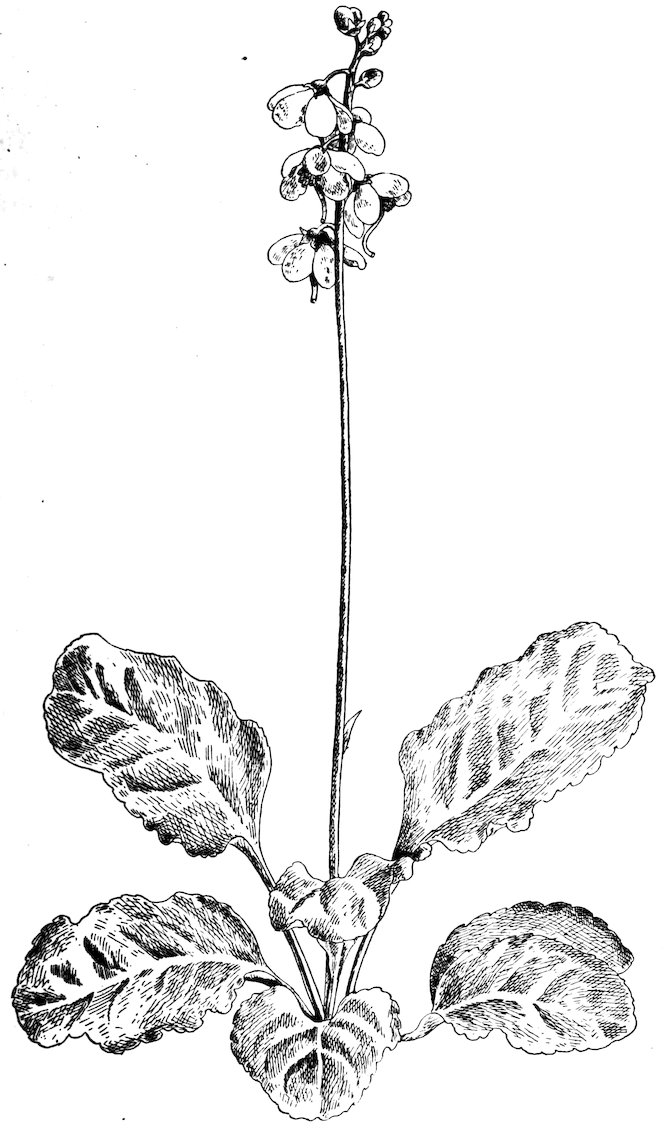
PLATE XVIII SHIN-LEAF.—P. elliptica.
68
Squaw Huckleberry. Vaccinium stamineum. Heath Family.
Two or three feet high. Stems.—Diffusely branched.
This large greenish or yellowish berry is hardly edible. The flowers appear in June, and are easily recognized by their protruding stamens. The leaves are pale green above and whitish underneath.
Pipsissewa. Prince’s Pine. Chimaphila umbellata. Heath Family.
Stem.—Four to ten inches high, leafy. Leaves.—Somewhat whorled or scattered, evergreen, lance-shaped, with sharply toothed edges. Flowers.—White or purplish, fragrant, in a loose terminal cluster. Calyx.—Five-lobed. Corolla.—With five rounded, widely spreading petals. Stamens.—Ten, with violet anthers. Pistil.—One, with a short top-shaped style and disk-like stigma.
When strolling through the woods in summer one is apt to chance upon great patches of these deliciously fragrant and pretty flowers. The little plant, with its shining evergreen foliage, flourishes abundantly among decaying leaves in sandy soil, and puts forth its dainty blossoms late in June. It is one of the latest of the fragile wood-flowers which are so charming in the earlier year, and which have already begun to surrender in favor of their hardier, more self-assertive brethren of the fields and roadsides. The common name, pipsissewa, is evidently of Indian origin, and perhaps refers to the strengthening properties which the red men ascribed to it.
Spotted Pipsissewa. Chimaphila maculata. Heath Family.
The spotted pipsissewa blossoms a little later than its twin-sister. Its slightly toothed leaves are conspicuously marked with white.
White DaisY. White-weed. Ox-eyed Daisy. Chrysanthemum Leucanthemum. Composite Family (p. 13).
69
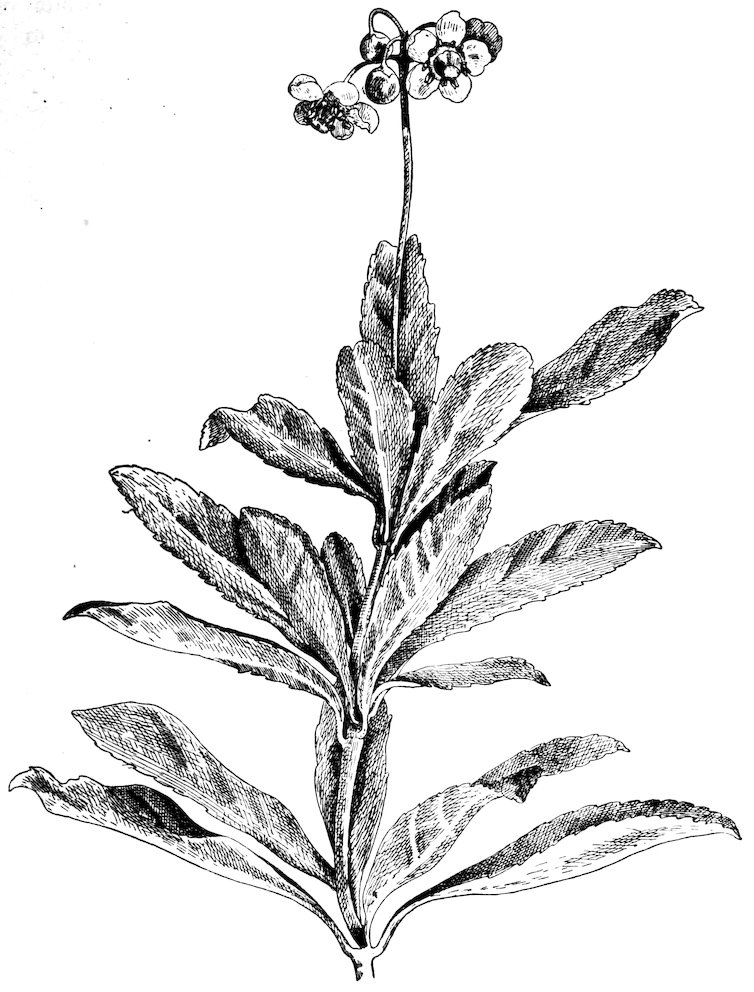
PLATE XIX PIPSISSEWA.—C. umbellata.
70The common white daisy stars the June meadows with those gold-centred blossoms which delight the eyes of the beauty-lover while they make sore the heart of the farmer, for the “whiteweed,” as he calls it, is hurtful to pasture-land and difficult to eradicate.
The true daisy is the Bellis perennis of England,—the
Wee, modest crimson-tippit flower
of Burns. This was first called “day’s eye,” because it closed at night and opened at dawn,—
That well by reason men it call may,
The Daisie, or else the eye of the day,
sang Chaucer nearly four hundred years ago. In England our flower is called “ox-eye” and “moon daisy;” in Scotland, “dog-daisy.”
The plant is not native to this country, but was brought from the Old World by the early colonists.
Daisy Fleabane. Sweet Scabious. Erigeron annuus. Composite Family (p. 13).
Stem.—Stout, from three to five feet high, branched, hairy. Leaves.—Coarsely and sharply toothed, the lowest ovate, the upper narrower. Flower-heads.—Small, clustered, composed of both ray and disk-flowers, the former white, purplish, or pinkish, the latter yellow.
During the summer months the fields and waysides are whitened with these very common flowers which look somewhat like small white daisies or asters.
Another common species is E. strigosus, a smaller plant, with smaller flower-heads also, but with the white ray-flowers longer. The generic name is from two Greek words signifying spring and an old man, in allusion to the hoariness of certain species which flower in the spring. The fleabanes were so named from the belief that when burned they were objectionable to insects. They were formerly hung in country cottages for the purpose of excluding such unpleasant intruders.
71
Mayweed. Chamomile. Anthemis Cotula. Composite Family (p. 13).
Stem.—Branching. Leaves.—Finely dissected. Flower-heads.—Composed of white ray and yellow disk-flowers, resembling the common white daisy.
In midsummer the pretty daisy-like blossoms of this strong-scented plant are massed along the roadsides. So nearly a counterpart of the common daisy do they appear that they are constantly mistaken for that flower. The smaller heads, with the yellow disk-flowers crowded upon a receptacle which is much more conical than that of the daisy, and the finely dissected, feathery leaves, serve to identify the Mayweed. The country-folk brew “chamomile tea” from these leaves, and through their agency raise painfully effective blisters in an emergency.
New Jersey Tea. Red-root. Ceanothus Americanus. Buckthorn Family.
Root.—Dark red. Stem.—Shrubby, one to three feet high. Flowers.—White, small, clustered. Calyx.—White, petal-like, five-lobed, incurved. Corolla.—With five long-clawed hooded petals. Stamens.—Five. Pistil.—One, with three stigmas.
This shrubby plant is very common in dry woods. In July its white feathery flower-clusters brighten many a shady nook in an otherwise flowerless neighborhood. During the Revolution its leaves were used as a substitute for tea.
Bastard Toadflax. Comandra umbellata. Sandalwood Family.
Stem.—Eight to ten inches high, branching, leafy. Leaves.—Alternate, oblong, pale. Flowers.—Greenish-white, small, clustered. Calyx.—Bell or urn-shaped. Corolla.—None. Stamens.—Five. Pistil.—One.
The bastard toadflax is commonly found in dry ground, flowering in May or June. Its root forms parasitic attachments to the roots of trees.
72
Wintergreen. Checkerberry. Mountain Tea. Gaultheria procumbens. Heath Family.
Stem.—Three to six inches high, slender, leafy at the summit. Leaves.—Oval, shining, evergreen. Flowers.—White, growing from the axils of the leaves. Calyx.—Five-lobed. Corolla.—Urn-shaped, with five small teeth. Stamens.—Ten. Pistil.—One. Fruit.—A globular red berry.
He who seeks the cool shade of the evergreens on a hot July day is likely to discover the nodding wax-like flowers of this little plant. They are delicate and pretty, with a background of shining leaves. These leaves when young have a pleasant aromatic flavor similar to that of the sweet birch; they are sometimes used as a substitute for tea. The bright red berries are also edible and savory, and are much appreciated by the hungry birds and deer during the winter. If not thus consumed they remain upon the plant until the following spring when they either drop or rot upon the stem, thus allowing the seeds to escape.
White Sweet Clover. White Melilot. Melilotus alba. Pulse Family (p. 16).
Stem.—Two to four feet high. Leaves.—Divided into three-toothed leaflets. Flowers.—Papilionaceous, white, growing in spike-like racemes.
Like its yellow sister, M. officinalis, this plant is found blossoming along the roadsides throughout the summer. The flowers are said to serve as flavoring in Gruyère cheese, snuff, and smoking-tobacco, and to act like camphor when packed with furs to preserve them from moths, besides imparting a pleasant fragrance.
Waterleaf. Hydrophyllum Virginicum. Waterleaf Family.
One to two feet high. Leaves.—Divided into five to seven oblong, pointed, toothed divisions. Flowers.—White or purplish, in one-sided raceme-like clusters which are usually coiled from the apex when young. Calyx.—Five-parted. Corolla.—Five-cleft, bell-shaped. Stamens.—Five, protruding. Pistil.—One.
This plant is found flowering in summer in the rich woods.
73
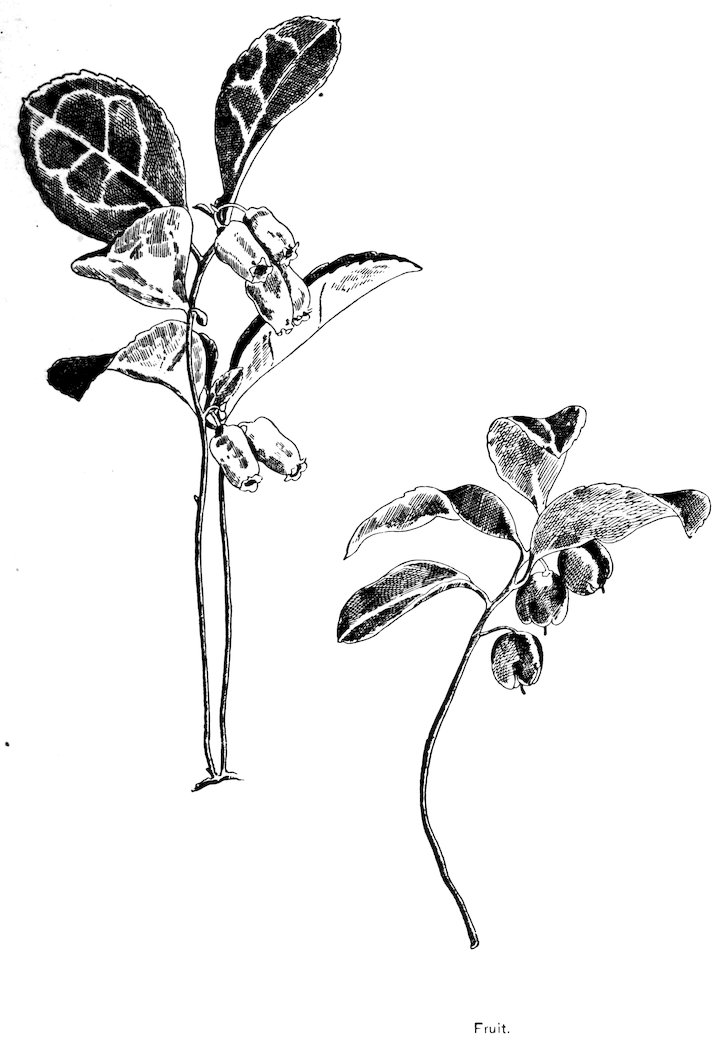
PLATE XX WINTERGREEN.—G. procumbens.
74
Indian Pipe. Corpse-plant. Monotropa uniflora. Heath Family.
A low fleshy herb from three to eight inches high, without green foliage, of a wax-like appearance, with colorless bracts in the place of leaves. Flower.—White or pinkish, single, terminal, nodding. Calyx.—Of two to four bract-like scales. Corolla.—Of four or five wedge-shaped petals. Stamens.—Eight or ten, with yellow anthers. Pistil.—One, with a disk-like, four or five-rayed stigma.
The effect of a cluster of these nodding, wax-like flowers in the deep woods of summer is singularly fairy-like. They spring from a ball of matted rootlets, and are parasitic, drawing their nourishment from decaying vegetable matter. In fruit the plant erects itself and loses its striking resemblance to a pipe. Its clammy touch, and its disposition to decompose and turn black when handled, has earned it the name of corpse-plant. It was used by the Indians as an eye-lotion, and is still believed by some to possess healing properties.
Field Chickweed. Cerastium arvense. Pink Family.
Four to eight inches high. Stems.—Slender. Leaves.—Linear or narrowly lance-shaped. Flowers.—White, large, in terminal clusters. Calyx.—Usually of five sepals. Corolla.—Usually of five two-lobed petals which are more than twice the length of the calyx. Stamens.—Twice as many, or fewer than the petals. Pistil.—One, with as many styles as there are sepals.
This is one of the most noticeable of the chickweeds. Its starry flowers are found in dry or rocky places, blossoming from May till July.
The common chickweed, which besets damp places everywhere, is Stellaria media; this is much used as food for songbirds.
The long-leaved stitchwort, S. longifolia, is a species which is common in grassy places, especially northward. It has linear leaves, unlike those of S. media, which are ovate or oblong.
75
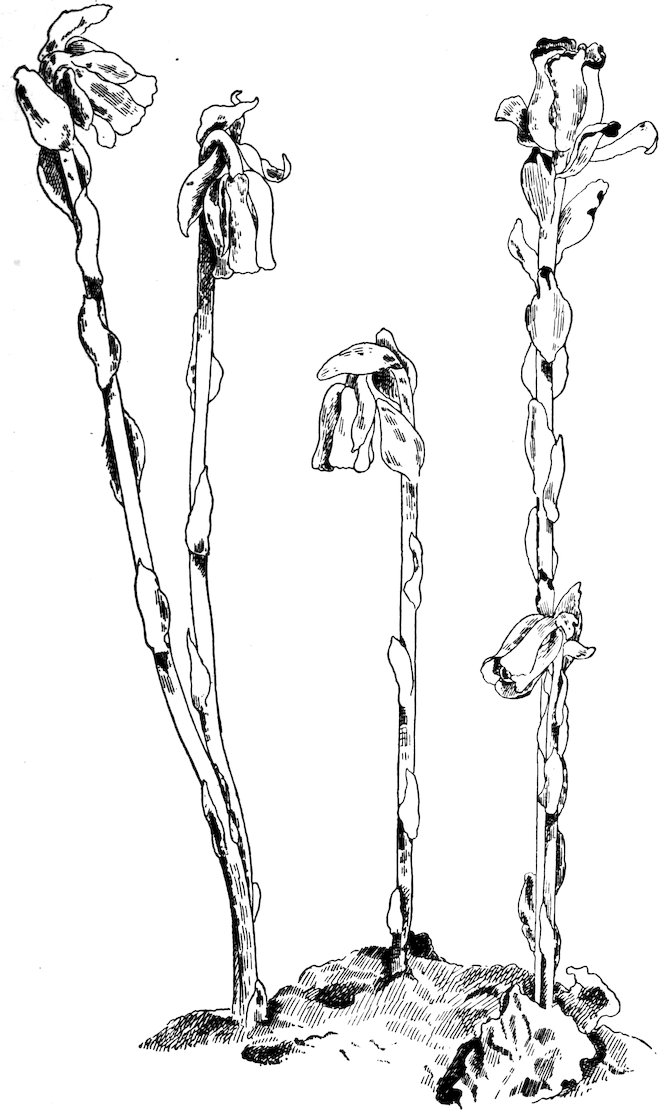
PLATE XXI INDIAN PIPE.—M. uniflora.
76
Enchanter’s Nightshade. Circæa Lutetiana. Evening Primrose Family.
Stem.—One or two feet high. Leaves.—Opposite, thin, ovate, slightly toothed. Flowers.—Dull white, small, growing in a raceme. Calyx.—Two-lobed. Corolla.—Of two petals. Stamens.—Two. Pistil.—One.
This insignificant and ordinarily uninteresting plant arrests attention by the frequency with which it is found flowering in the summer woods and along shady roadsides.
C. Alpina is a smaller, less common species, which is found along the mountains and in deep woods. Both species are burdened with the singularly inappropriate name of enchanter’s nightshade. There is nothing in their appearance to suggest an enchanter or any of the nightshades. It seems, however, that the name of a plant called after the enchantress Circe, and described by Dioscorides nearly two thousand years ago, was accidentally transferred to this unpretentious genus.
Thimble-weed. Anemone Virginiana. Crowfoot Family.
Stem.—Two or three feet high. Leaves.—Twice or thrice cleft, the divisions again toothed or cleft. Flowers.—Greenish or sometimes white, borne on long, upright flower-stalks. Calyx.—Of five sepals. Corolla.—None. Stamens and Pistils.—Indefinite in number.
These greenish flowers, which may be found in the woods and meadows throughout the summer, are only striking by reason of their long, erect flower-stalks. The oblong, thimble-like fruit-head, which is rather noticeable in the later year, gives to the plant its common name.
Cleavers. Goose-grass. Bedstraw. Galium Aparine. Madder Family.
Stem.—Weak and reclining, bristly. Leaves.—Lance-shaped, about eight in a whorl. Flowers.—White, small, growing from the axils of the leaves. Calyx-teeth.—Obsolete. Corolla.—Usually four-parted, wheel-shaped. Stamens.—Usually four. Pistil.—One with two styles. Fruit.—Globular, bristly, with hooked prickles.
This plant may be found in wooded or shady places throughout the continent. Its flowers, which appear in summer, are 77rather inconspicuous, one’s attention being chiefly attracted by its many whorls of slender leaves.
Bitter-sweet. Wax-work. Celastrus scandens. Staff-tree Family.
Stem.—Woody, twining. Leaves.—Alternate, oblong, finely toothed, pointed. Flowers.—Small, greenish, or cream-color, in raceme-like clusters, appearing in June. Pod.—Orange-colored, globular, and berry-like, curling back in three divisions when ripe so as to display the scarlet covering of the seeds within.
The small flowers of the bitter-sweet, which appear in June, rarely attract attention. But in October no lover of color can fail to admire the deep orange pods which at last curl back so as advantageously to display the brilliant scarlet covering of the seeds. Perhaps we have no fruit which illuminates more vividly the roadside thicket of late autumn; or touches with greater warmth those tumbled, overgrown walls which are so picturesque a feature in parts of the country, and do in a small way for our quiet landscapes what vine-covered ruins accomplish for the scenery of the Old World.
Culver’s Root. Veronica Virginica. Figwort Family.
Stem.—Straight and tall, from two to six feet high. Leaves.—Whorled, lance-shaped, finely toothed. Flowers.—White, small, growing in slender clustered spikes. Calyx.—Irregularly four or five-toothed. Corolla.—Four or five-lobed. Stamens.—Two, protruding. Pistil.—One.
The tall straight stems of the culver’s root lift their slender spikes in midsummer to a height that seems strangely at variance with the habit of this genus. The small flowers, however, at once betray their kinship with the speedwells. Although it is, perhaps, a little late to look for the white wands of the black cohosh the two plants might easily be confused in the distance, as they have much the same aspect and seek alike the cool recesses of the woods. This same species grows in Japan and was introduced into English gardens nearly two hundred years ago. It is one of the many Indian remedies which were adopted by our forefathers.
78
Black Cohosh. Bugbane. Black Snakeroot. Cimicifuga racemosa. Crowfoot Family.
Stem.—Three to eight feet high. Leaves.—Divided, the leaflets toothed or incised. Flowers.—White, growing in elongated wand-like racemes. Calyx.—Of four or five white petal-like sepals, falling early. Corolla.—Of from one to eight white petals or transformed stamens. Stamens.—Numerous, with slender white filaments. Pistils.—One to three.
The tall white wands of the black cohosh shoot up in the shadowy woods of midsummer like so many ghosts. A curious-looking plant it is, bearing aloft the feathery flowers which have such an unpleasant odor that even the insects are supposed to avoid them. Fortunately they are sufficiently conspicuous to be admired at a distance, many a newly cleared hill-side and wood-border being lightened by their slender, torch-like racemes which flash upon us as we travel through the country. The plant was one of the many which the Indians believed to be efficacious for snake-bites. The generic name is from cimex—a bug, and fugare—to drive away.
Common Elder. Sambucus Canadensis. Honeysuckle Family.
Stems.—Scarcely woody, five to ten feet high. Leaves.—Divided into toothed leaflets. Flowers.—White, small, in flat-topped clusters. Calyx.—Lobes minute or none. Corolla.—With five spreading lobes. Stamens.—Five. Pistil.—One, with three stigmas. Fruit.—Dark purple, berry-like.
The common elder borders the lanes and streams with its spreading flower-clusters in early summer, and in the later year is noticeable for the dark berries from which “elderberry wine” is brewed by the country people. The fine white wood is easily cut and is used for skewers and pegs. A decoction of the leaves serves the gardener a good purpose in protecting delicate plants from caterpillars. Evelyn wrote of it: “If the medicinal properties of the leaves, berries, bark, etc., were thoroughly known, I cannot tell what our countrymen could ail for which he might not fetch from every hedge, whether from sickness or wound.”
The white pith can easily be removed from the stems, hence the old English name of bore-wood.
79
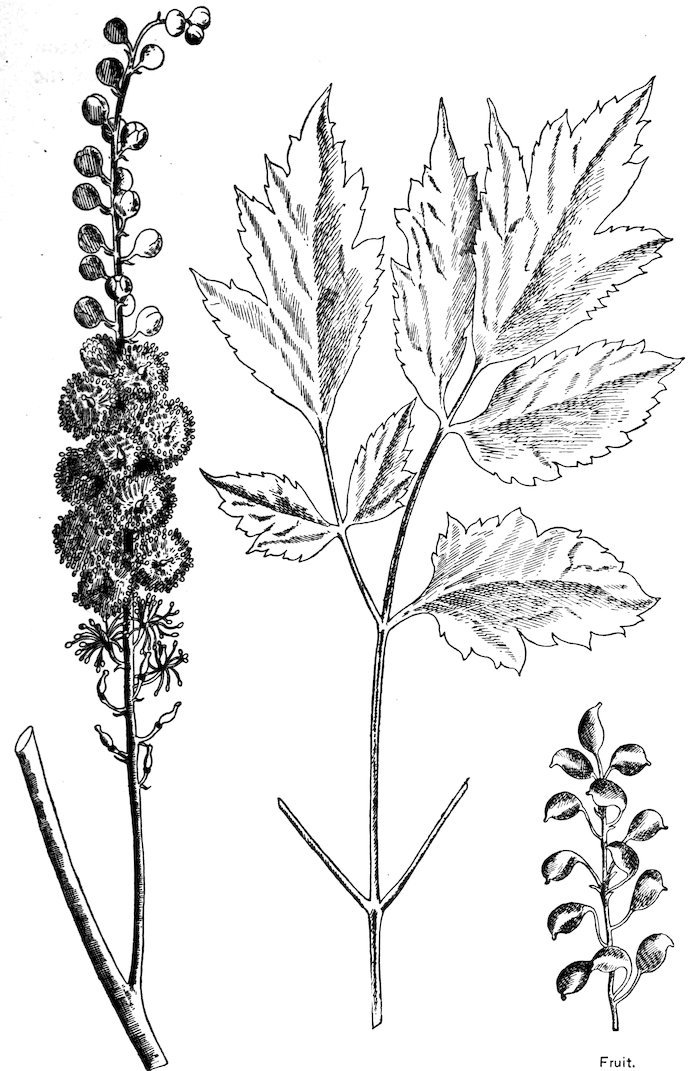
PLATE XXII BLACK COHOSH.—C. racemosa.
80The name elder is probably derived from the Anglo-Saxon aeld—a fire—and is thought to refer to the former use of the hollow branches in blowing up a fire.
Spurge. Euphorbia corollata. Spurge Family.
Stem.—Two or three feet high. Leaves.—Ovate, lance-shaped or linear. Flowers.—Clustered within the usually five-lobed, cup-shaped involucre which was formerly considered the flower itself; the male flowers numerous and lining its base, consisting each of a single stamen; the female flower solitary in the middle of the involucre, consisting of a three-lobed ovary with three styles, each style being two-cleft. Pod.—On a slender stalk, smooth.
In this plant the showy white appendages of the cup-shaped clustered involucres are usually taken for the petals of the flower; only the botanist suspecting that the minute organs within these involucres really form a cluster of separate flowers of different sexes. While the most northerly range in the Eastern States of this spurge is usually considered to be New York, the botany states that it has been recently naturalized in Massachusetts. It blossoms from July till October.
Partridge Vine. Mitchella repens. Madder Family.
Stems.—Smooth and trailing. Leaves.—Rounded, evergreen, veined with white. Flowers.—White, fragrant, in pairs. Calyx.—Four-toothed. Corolla.—Funnel-form, with four spreading lobes, bearded within. Stamens.—Four. Pistil.—One, its ovary united with that of its sister flower, its four stigmas linear.
At all times of the year this little plant faithfully fulfils its mission of adorning that small portion of the earth to which it finds itself rooted. But only the early summer finds the partridge vine exhaling its delicious fragrance from the delicate sister-blossoms which are its glory. Among the waxy flowers will be found as many of the bright red berries of the previous year as have been left unmolested by the hungry winter birds. This plant is found not only in the moist woods of North America, but also in the forests of Mexico and Japan. It is a near relative of the dainty bluets or Quaker ladies, and has the same peculiarity of dimorphous flowers (p. 232).
81
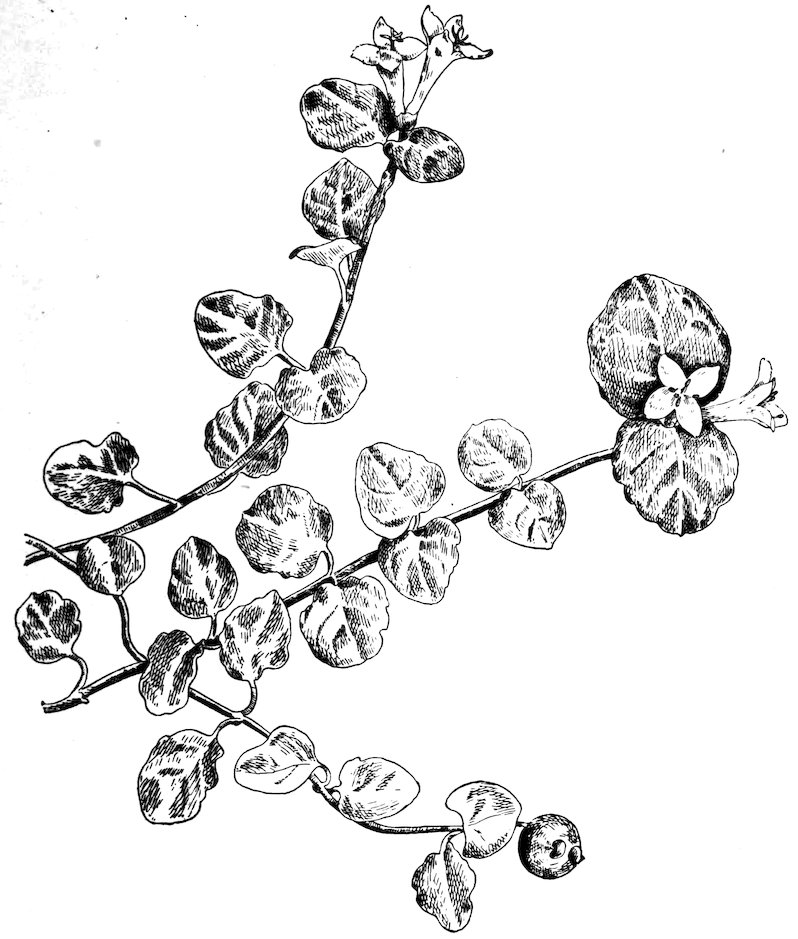
PLATE XXIII PARTRIDGE VINE.—M. repens.
82
Green Orchis. Habenaria virescens.
Ragged Fringed Orchis. Habenaria lacera. Orchis Family (p. 17).
Leaves.—Oblong or lance-shaped. Flowers.—Greenish or yellowish-white, growing in a spike.
These two orchids are found in wet boggy places during the earlier summer, the green antedating the ragged fringed orchis by a week or more. The lip of the ragged fringed is three-parted, the divisions being deeply fringed, giving what is called in Sweet’s “British Flower-Garden” an “elegantly jagged appearance.” The lip of the green orchis is furnished with a tooth on each side and a strong protuberance in the middle. So far as superficial beauty and conspicuousness are concerned these flowers do scant justice to the brilliant family to which they belong, and equally excite the scornful exclamation, “You call that an orchid!” when brought home for analysis or preservation.
Button-bush. Cephalanthus occidentalis. Madder Family.
A shrub three to eight feet high. Leaves.—Opposite or whorled in threes, somewhat oblong and pointed. Flowers.—Small, white, closely crowded in round button-like heads. Calyx.—Four-toothed. Corolla.—Four-toothed. Stamens.—Four. Pistil.—One, with a thread-like protruding style and blunt stigma.
This pretty shrub borders the streams and swamps throughout the country. Its button-like flower-clusters appear in midsummer. It belongs to the family of which the delicate bluet and fragrant partridge vine are also members. Its flowers have a jasmine-like fragrance.
83
Mild Water-pepper. Polygonum hydropiperoides. Buckwheat Family.
Stem.—One to three feet high, smooth, branching. Leaves.—Alternate, narrowly lance-shaped or oblong. Flowers.—White or flesh-color, small, growing in erect, slender spikes. Calyx.—Five-parted. Corolla.—None. Stamens.—Eight. Pistil.—One, usually with three styles.
These rather inconspicuous but very common flowers are found in moist places and shallow water.
The common knotweed, P. aviculare, which grows in such abundance in country dooryards and waste places, has slender, often prostrate, stems, and small greenish flowers, which are clustered in the axils of the leaves or spiked at the termination of the stems. This is perhaps the “hindering knotgrass” to which Shakespeare refers in the “Midsummer Night’s Dream,” so terming it, not on account of its knotted trailing stems, but because of the belief that it would hinder the growth of a child. In Beaumont and Fletcher’s “Coxcomb” the same superstition is indicated:
We want a boy
Kept under for a year with milk and knotgrass.
It is said that many birds are nourished by the seeds of this plant.
Climbing False Buckwheat. Polygonum scandens. Buckwheat Family.
Stem.—Smooth, twining, and climbing over bushes, eight to twelve feet high. Leaves.—Heart or arrow-shaped, pointed, alternate. Flowers.—Greenish or pinkish, in racemes. Calyx.—Five-parted, with colored margins. Corolla.—None. Stamens.—Usually eight. Pistil.—One, with three stigmas. Seed-vessel.—Green, three-angled, winged, conspicuous in autumn.
In early summer this plant, which clambers so perseveringly over the moist thickets which line our country lanes, is comparatively inconspicuous. The racemes of small greenish flowers are not calculated to attract one’s attention, and it is late summer or autumn before the thick clusters of greenish fruit composed of the 84winged seed-vessels arrest one’s notice. At this time the vine is very beautiful and striking, and one wonders that it could have escaped detection in the earlier year.
——— ——— Dalibarda repens. Rose Family.
Scape.—Low. Leaves.—Heart-shaped, wavy-toothed. Flowers.—White, one or two borne on each scape. Calyx.—Deeply five or six-parted, three of the divisions larger and toothed. Corolla.—Of five petals. Stamens.—Many. Pistils.—Five to ten.
The foliage of this pretty little plant suggests the violet; while its white blossom betrays its kinship with the wild strawberry. It may be found from June till August in woody places, being one of those flowers which we seek deliberately, whose charm is never decreased by its being thrust upon us inopportunely. Who can tell how much the attractiveness of the wild carrot, the dandelion, or butter-and-eggs would be enhanced were they so discreet as to withdraw from the common haunts of men into the shady exclusiveness which causes us to prize many far less beautiful flowers?
Starry Campion. Silene stellata. Pink Family.
Stem.—Swollen at the joints, about three feet high. Leaves.—Whorled in fours, oval, taper-pointed. Flowers.—White, in a large pyramidal cluster. Calyx.—Inflated, five-toothed. Corolla.—Of five deeply fringed petals. Stamens.—Ten. Pistil.—One, with three styles.
In late July many of our wooded banks are decorated with the tall stems, whorled leaves, and prettily fringed flowers of the starry campion.
Closely allied to it is the bladder campion of the fields, S. Cucubalus, a much smaller plant, with opposite leaves, loosely clustered white flowers, a greatly inflated calyx, and two-cleft petals. This is an emigrant from Europe, which was first naturalized near Boston, and has now become wild in different parts of the country, quite overrunning some of the farm-lands which border the Hudson River.
85
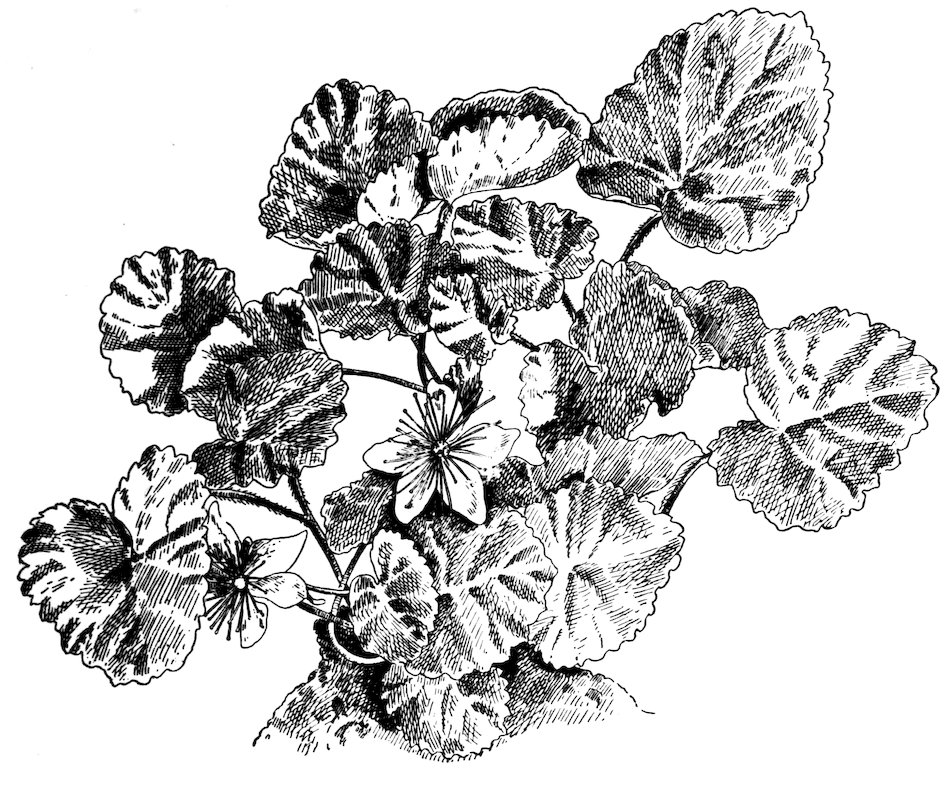
PLATE XXIV Dalibarda repens.
86
Colic-root. Star-grass. Aletris farinosa. Bloodwort Family.
Leaves.—Thin, lance-shaped, in a spreading cluster from the root. Scape.—Slender, two to three feet high. Flowers.—White, small, growing in a wand-like, spiked raceme. Perianth.—Six-cleft at the summit, oblong-tubular. Stamens.—Six. Pistil.—One, with style three-cleft at apex.
In summer we find these flowers in the grassy woods. The generic title is the Greek word for “a female slave who grinds corn,” and refers to the mealy appearance of the blossoms.
Tall Meadow Rue. Thalictrum polygamum. Crowfoot Family.
Four to eight feet high. Leaves.—Divided into many firm, rounded leaflets. Flowers.—White, in large clusters; some perfect, others unisexual. Calyx.—Of four or five small petal-like sepals which usually fall off very early. Corolla.—None. Stamens.—Numerous. Pistils.—Four to fifteen.
Where a stream trails its sluggish length through the fields of midsummer, its way is oftentimes marked by the tall meadow rue, the feathery, graceful flower-clusters of which erect themselves serenely above the myriad blossoms which are making radiant the wet meadows at this season. For here, too, we may search for the purple flag and fringed orchis, the yellow meadow lily, the pink swamp milkweed, each charming in its way, but none with the cool chaste beauty of the meadow rue. The staminate flowers of this plant are especially delicate and feathery.
White Avens. Geum album. Rose Family.
Stem.—Slender, about two feet high. Root-leaves.—Divided into from three to five leaflets, or entire. Stem-leaves.—Three-lobed or divided, or only toothed. Flowers.—White. Calyx.—Deeply five-cleft, usually with five small bractlets alternating with its lobes. Corolla.—Of five petals. Stamens.—Numerous. Pistils.—Numerous, with hooked styles which become elongated in fruit.
The white avens is one of the less noticeable plants which border the summer woods, blossoming from May till August. Later the hooked seeds which grow in round burr-like heads secure wide dispersion by attaching themselves to animals or clothing. Other species of avens have more conspicuous golden-yellow flowers.
87
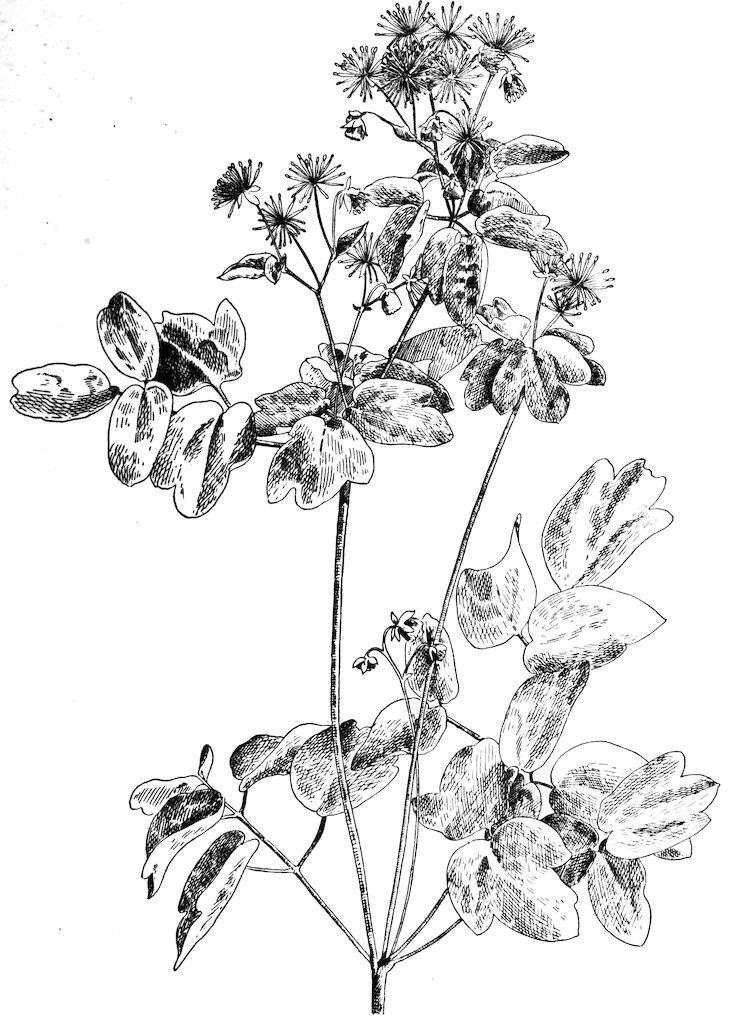
PLATE XXV TALL MEADOW RUE.—T. polygamum.
88
Meadow-sweet. Spiræa salicifolia. Rose Family.
Stem.—Nearly smooth, two or three feet high. Leaves.—Alternate, somewhat lance-shaped, toothed. Flowers.—Small, white or flesh-color, in pyramidal clusters. Calyx.—Five-cleft. Corolla.—Of five rounded petals. Stamens.—Numerous. Pistils.—Five to eight.
The feathery spires of the meadow-sweet soar upward from the river banks and low meadows in late July. Unlike its pink sister, the steeple-bush, its leaves and stems are fairly smooth. The lack of fragrance in the flowers is disappointing, because of the hopes raised by the plant’s common name. This is said by Dr. Prior to be a corruption of the Anglo-Saxon mead-wort, which signifies honey-wine herb, alluding to a fact which is mentioned in Hill’s “Herbal,” that “the flowers mixed with mead give it the flavor of the Greek wines.”
Although the significance of many of the plant-names seems clear enough at first sight, such an example as this serves to show how really obscure it often is.
White Water-lily. Nymphæa odorata. Water-lily Family.
Leaves.—Rounded, somewhat heart-shaped, floating on the surface of the water. Flowers.—Large, white, or sometimes pink, fragrant. Calyx.—Of four sepals which are green without. Corolla.—Of many petals. Stamens.—Indefinite in number. Pistil.—With a many-celled ovary whose summit is tipped with a globular projection around which are the radiating stigmas.
This exquisite flower calls for little description. Many of us are so fortunate as to hold in our memories golden mornings devoted to its quest. We can hardly take the shortest railway journey in summer without passing some shadowy pool whose greatest adornment is this spotless and queenly blossom. The breath of the lily-pond is brought even into the heart of our cities where dark-eyed little Italians peddle clusters of the long-stemmed fragrant flowers about the streets.
89
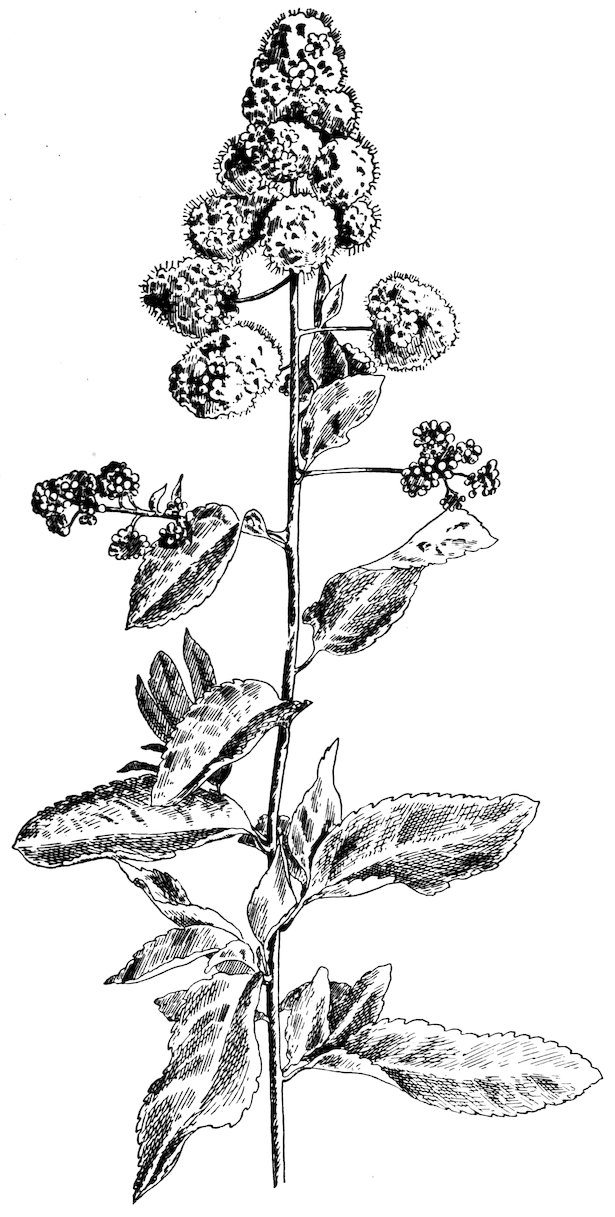
PLATE XXVI MEADOW-SWEET.—S. salicifolia.
90In the water-lily may be seen an example of so-called plant-metamorphosis. The petals appear to pass gradually into stamens, it being difficult to decide where the petals end and the stamens begin. But whether stamens are transformed petals, or petals transformed stamens seems to be a mooted question. In Gray we read, “Petals numerous, in many rows, the innermost gradually passing into stamens,” while Mr. Grant Allen writes: “Petals are in all probability enlarged and flattened stamens, which have been set apart for the work of attracting insects,” and goes on to say, “Flowers can and do exist without petals, ... but no flower can possibly exist without stamens, which are one of the two essential reproductive organs in the plant.” From this he argues that it is more rational to consider a petal a transformed stamen than vice versa. To go further into the subject here would be impossible, but a careful study of the water-lily is likely to excite one’s curiosity in the matter.
White Vervain. Verbena urticæfolia. Verbena Family.
Three to five feet high. Leaves.—Oval, coarsely toothed. Flowers.—Small, white, in slender spikes, otherwise resembling Purple Vervain.
It almost excites one’s incredulity to be told that this uninteresting looking plant, which grows rankly along the highways, is an importation from the tropics, yet for this statement the botany is responsible.
Round-leaved Sundew. Drosera rotundifolia. Sundew Family.
Scape.—A few inches high. Leaves.—Rounded, abruptly narrowed into spreading, hairy leaf-stalks; beset with reddish, gland-bearing bristles. Flowers.—White, growing in a one-sided raceme, which so nods at its apex that the fresh-blown blossom is always uppermost. Calyx.—Of five sepals. 91Corolla.—Of five petals. Pistil.—One, with three or five styles, which are sometimes so deeply two-parted as to be taken for twice as many.
What’s this I hear
About the new carnivora?
Can little plants
Eat bugs and ants
And gnats and flies?
A sort of retrograding:
Surely the fare
Of flowers is air,
Or sunshine sweet;
They shouldn’t eat,
Or do aught so degrading!
But by degrees we are learning to reconcile ourselves to the fact that the more we study the plants the less we are able to attribute to them altogether unfamiliar and ethereal habits. We find that the laws which control their being are strangely suggestive of those which regulate ours, and after the disappearance of the shock which attends the shattered illusion, their charm is only increased by the new sense of kinship.
The round-leaved sundew is found blossoming in many of our marshes in midsummer. When the sun shines upon its leaves they look as though covered with sparkling dewdrops, hence its common name. These drops are a glutinous exudation, by means of which insects visiting the plant are first captured; the reddish bristles then close tightly about them, and it is supposed that their juices are absorbed by the plant. At all events the rash visitor rarely escapes. In many localities it is easy to secure any number of these little plants and to try for one’s self the rather grewsome experiment of feeding them with small insects. Should the tender-hearted recoil from such reckless slaughter, they might confine their offerings on the altar of science to mosquitoes, small spiders, and other deservedly unpopular creatures.
D. Americana is a very similar species, with longer, narrower leaves.
The thread-leaved sundew, D. filiformis has fine, thread-like leaves and pink flowers, and is found in wet sand along the coast.
92
Pokeweed. Garget. Pigeon-berry. Phytolacca decandra. Pokeweed Family.
Stems.—In length from six to ten feet high; purple-pink or bright red, stout. Leaves.—Large, alternate, veiny. Flowers.—White or pinkish, the green ovaries conspicuous, growing in racemes. Calyx.—Of five rounded or petal-like sepals, pinkish without. Corolla.—None. Stamens.—Ten. Pistil.—One, with ten styles. Fruit.—A dark purplish berry.
There is a vigor about this native plant which is very pleasing. In July it is possible that we barely notice the white flowers and large leaves; but when in September the tall purple stems rear themselves above their neighbors in the roadside thicket, the leaves look as though stained with wine, and the long clusters of rich dark berries hang heavily from the branches, we cannot but admire its independent beauty. The berries serve as food for the birds. A tincture of them at one time acquired some reputation as a remedy for rheumatism. In Pennsylvania they have been used with whiskey to make a so-called “portwine.” From their dark juice arose the name of “red-ink plant,” which is common in some places. The large roots are poisonous, but the acrid young shoots are rendered harmless by boiling, and are eaten like asparagus, being quite as good, I have been told by country people.
Despite the difference in the spelling of the names, it has been suggested that the plant was called after President Polk. This is most improbable, as it was common throughout the country long before his birth, and its twigs are said to have been plucked and worn by his followers during his campaign for the Presidency.
White Fringed Orchis. Habenaria blephariglottis. Orchis Family (p. 17).
About one foot high. Leaves.—Oblong or lance-shaped, the upper passing into pointed bracts. Flowers.—Pure white, with a slender spur and fringed lip; growing in an oblong spike.
93
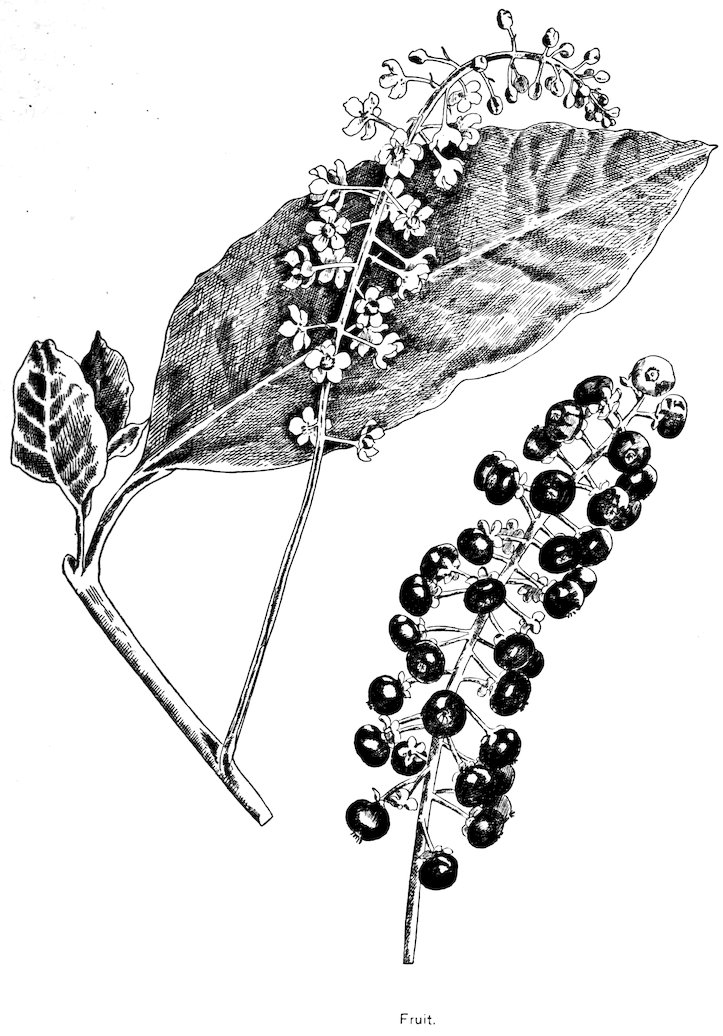
PLATE XXVII POKEWEED.—P. decandra.
94This seems to me the most exquisite of our native orchids. The fringed lips give the snowy, delicate flowers a feathery appearance as they gleam from the shadowy woods of midsummer, or from the peat-bogs where they thrive best; or perhaps they spire upward from among the dark green rushes which border some lonely mountain lake. Like the yellow fringed orchis (Pl. LII), which they greatly resemble in general structure, they may be sought in vain for many seasons and then will be discovered one midsummer day lavishing their spotless loveliness upon some unsuspected marsh which has chanced to escape our vigilance.
Rattlesnake-plantain. Goodyera pubescens. Orchis Family (p. 17).
Scape.—Six to twelve inches high. Leaves.—From the root in a sort of flat rosette; conspicuously veined with white; thickish, evergreen. Flowers.—Small, greenish-white, crowded in a close spike.
The flowers of the rattlesnake-plantain appear in late summer and are less conspicuous than the prettily tufted, white-veined leaves which may be found in the rich woods throughout the year. The plant has been reputed an infallible cure for hydrophobia and snake-bites. It is said that the Indians had such faith in its remedial virtues that they would allow a snake to drive its fangs into them for a small sum, if they had these leaves on hand to apply to the wound.
Common Yarrow. Milfoil. Achillea Millefolium. Composite Family (p. 13).
Stem.—Simple at first, often branching near the summit. Leaves.—Divided into finely toothed segments. Flower-heads.—White, occasionally pink, clustered, small, made up of both ray and disk-flowers.
95
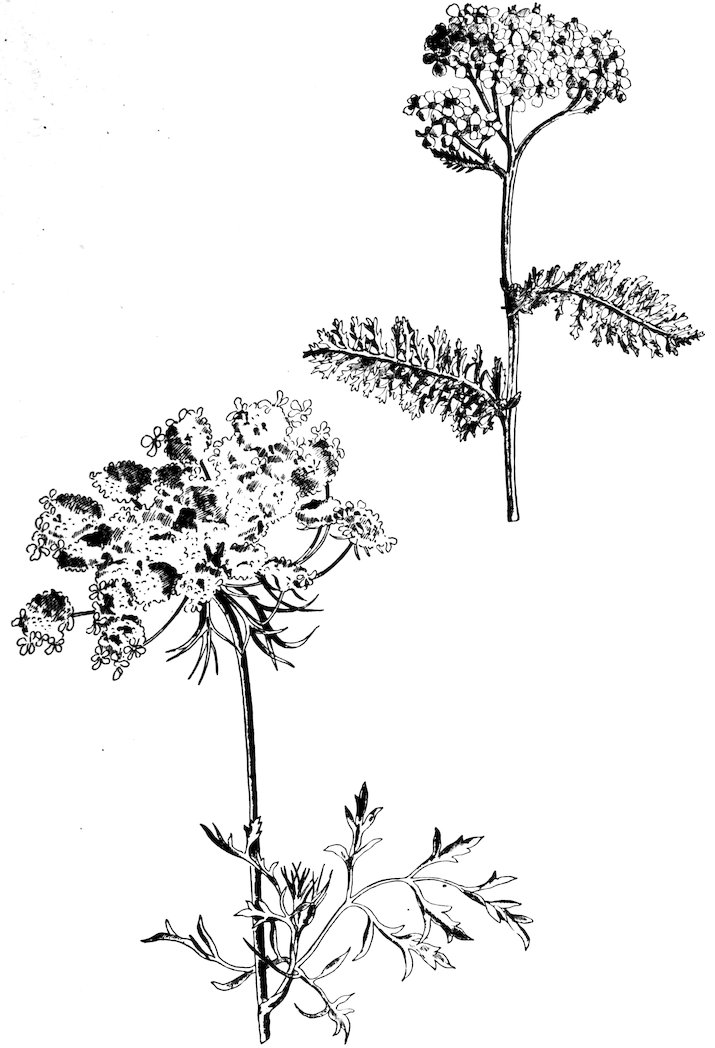
PLATE XXVIII WILD CARROT.—D. carota. YARROW.—A. millefolium.
96This is one of our most frequent roadside weeds, blossoming throughout the summer and late into the autumn. Tradition claims that it was used by Achilles to cure the wounds of his soldiers, and the genus is named after that mighty hero. It still forms one of the ingredients of an ointment valued by the Scotch Highlanders. The early English botanists called the plant “nosebleed,” “because the leaves being put into the nose caused it to bleed;” and Gerarde writes that “Most men say that the leaves chewed, and especially greene, are a remedie for the toothache.” These same pungent leaves also won it the name of “old man’s pepper,” while in Sweden its title signifies field hop, and refers to its employment in the manufacture of beer. Linnæus considered the beer thus brewed to be more intoxicating than that in which hops were utilized. The old women of the Orkney Islands hold “milfoil tea” in high repute, believing it to be gifted with the power of dispelling melancholy. In Switzerland a good vinegar is said to be made from the Alpine species. The plant is cultivated in the gardens of Madeira, where so many beautiful, and in our eyes rare, flowers grow in wild profusion.
Wild Carrot. Bird’s Nest. Queen Anne’s Lace. Daucus carota. Parsley Family (p. 15).
Stems.—Tall and slender. Leaves.—Finely dissected. Flowers.—White, in a compound umbel, forming a circular flat-topped cluster.
When the delicate flowers of the wild carrot are still unsoiled by the dust from the highway, and fresh from the early summer rains, they are very beautiful, adding much to the appearance of the roadsides and fields along which they grow so abundantly as to strike despair into the heart of the farmer, for this is, perhaps, the “peskiest” of all the weeds with which he has to contend. As time goes on the blossoms begin to have a careworn look and lose something of the cobwebby aspect which won them the title of Queen Anne’s lace. In late summer the flower-stalks erect themselves, forming a concave cluster which has the appearance of a bird’s nest. I have read that a species of bee makes use of this ready-made home, but have never seen any indications of such an occupancy.
This is believed to be the stock from which the garden carrot was raised. The vegetable was well known to the ancients, and we learn from Pliny that the finest specimens were brought to Rome from Candia. When it was first introduced into Great Britain is not known, although the supposition is that it was brought over by the Dutch during the reign of Elizabeth. In the writings of Parkinson we read that the ladies wore carrot-leaves 97in their hair in place of feathers. One can picture the dejected appearance of a ball-room belle at the close of an entertainment.
Water-Hemlock. Spotted Cowbane. Cicuta maculata. Parsley Family (p. 15).
Stem.—Smooth, stout, from two to six feet high, streaked with purple. Leaves.—Twice or thrice-compound, leaflets coarsely toothed. Flowers.—White, in compound umbels, the little umbels composed of numerous flowers.
This plant is often confused with the wild carrot, the sweet Cicely, and other white-flowered members of the Parsley family; but it can usually be identified by its purple-streaked stem. The umbels of the water-hemlock are also more loosely clustered than those of the carrot, and their stalks are much more unequal. It is commonly found in marshy ground, blossoming in midsummer. Its popular names refer to its poisonous properties, its root being said to contain the most dangerous vegetable-poison native to our country and to have been frequently confounded with that of the edible sweet Cicely with fatal results.
Mock Bishop-weed. Discopleura capillacea. Parsley Family (p. 15).
One or two feet high, occasionally much taller. Stems.—Branching. Leaves.—Dissected into fine, thread-like divisions. Flowers.—White, very small, growing in compound umbels with thread-like bracts.
This plant blossoms all summer in wet meadows, both inland and along the coast; but it is especially common in the salt marshes near New York City. It probably owes its English name to the fancied resemblance between the bracted flower-clusters and a bishop’s cap. Its effect is feathery and delicate.
Sweet Cicely. Osmorrhiza longistylis. Parsley Family (p. 15).
One to three feet high. Root.—Thick, aromatic, edible. Leaves.—Twice or thrice-compound. Flowers.—White, growing in a few-rayed compound umbel.
The roots of the sweet Cicely are prized by country children for their pleasant flavor. Great care should be taken not to confound 98this plant with the water-hemlock, which is very poisonous, and which it greatly resembles, although flowering earlier in the year. The generic name is from two Greek words which signify scent and root.
Water-parsnip. Sium cicutæfolium. Parsley Family (p. 15).
Two to six feet high. Stem.—Stout. Leaves.—Divided into from three to eight pairs of sharply toothed leaflets. Flowers.—White, in compound umbels.
This plant is found growing in water or wet places throughout North America.
Arrow-head. Sagittaria variabilis. Water-plantain Family.
Scape.—A few inches to several feet high. Leaves.—Arrow-shaped. Flowers.—White, unisexual, in whorls of three on the leafless scape. Calyx.—Of three sepals. Corolla.—Of three white, rounded petals. Stamens and Pistils.—Indefinite in number, occurring in different flowers, the lower whorls of flowers usually being pistillate, the upper staminate.
Among our water-flowers none are more delicately lovely than those of the arrow-head. Fortunately the ugly and inconspicuous female flowers grow on the lower whorls, while the male ones, with their snowy petals and golden centres, are arranged about the upper part of the scape, where the eye first falls. It is a pleasure to chance upon a slow stream whose margins are bordered with these fragile blossoms and bright, arrow-shaped leaves.
Water-plantain. Alisma Plantago. Water-plantain Family.
Scape.—One to three feet high, bearing the flowers in whorled, panicled branches. Leaves.—From the root, oblong, lance-shaped or linear, mostly rounded or heart-shaped at base. Flowers.—White or pale pink, small, in large, loose clusters which branch from the scape. Calyx.—Of three sepals. Corolla.—Of three petals. Stamens.—Usually six. Pistils.—Many, on a flattened receptacle.
The water-plantain is nearly related to the arrow-head, and is often found blossoming with it in marshy places or shallow water.
99
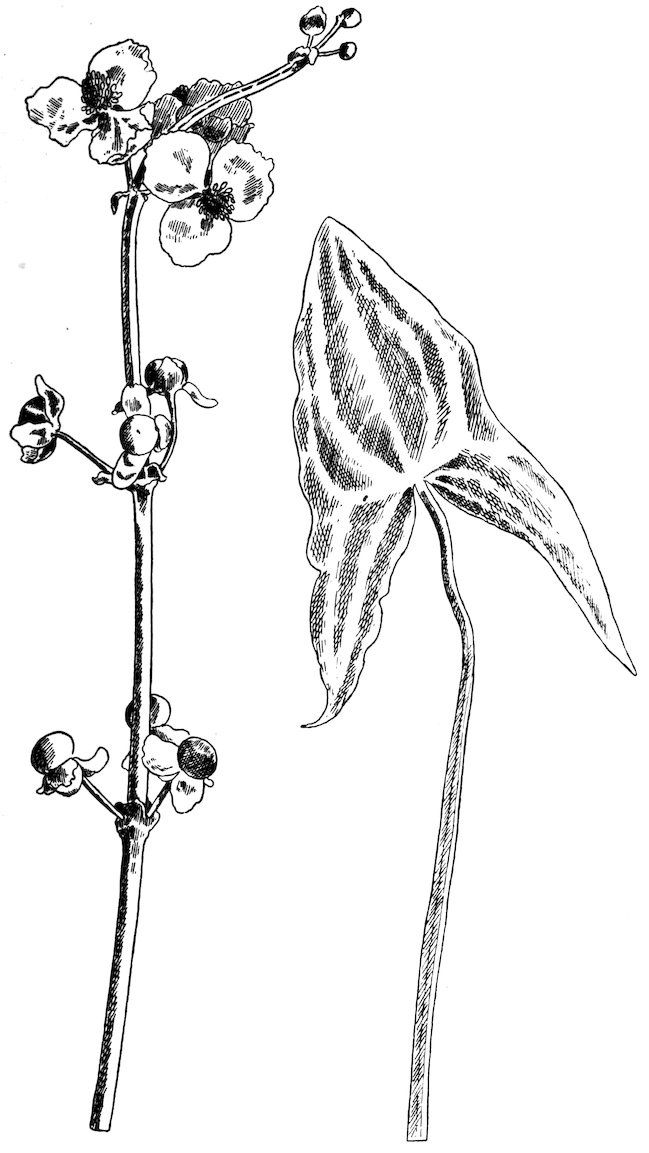
PLATE XXIX ARROW-HEAD.—S. variabilis.
100
Ground Cherry. Physalis Virginiana. Nightshade Family.
A strong-scented, low, much branched and spreading herb. Leaves.—Somewhat oblong or heart-shaped, wavy-toothed. Flowers.—Greenish or yellowish-white, solitary on nodding flower-stalks. Calyx.—Five-cleft; enlarging and much inflated in fruit, loosely enclosing the berry. Corolla.—Between wheel-shaped and funnel-form. Stamens.—Five, erect, with yellow anthers. Pistil.—One. Fruit.—A green or yellow edible berry which is loosely enveloped in the much-inflated calyx.
We find the ground cherry in light sandy soil, and are more apt to notice the loosely enveloped berry of the late year than the rather inconspicuous flowers which appear in summer.
Turtle-head. Chelone glabra. Figwort Family.
One to seven feet high. Stem.—Smooth, upright, branching. Leaves.—Opposite, lance-shaped, toothed. Flowers.—White or pinkish, growing in a spike or close cluster. Calyx.—Of five sepals. Corolla.—Two-lipped, the upper lip broad and arched, notched at the apex, lower lip three-lobed at the apex, woolly bearded in the throat. Stamens.—Four perfect ones, with woolly filaments and very woolly, heart-shaped anthers, and one small sterile one. Pistil.—One.
It seems to have been my fate to find the flowers which the botany relegates to “dry, sandy soil” flourishing luxuriantly in marshes; and to encounter the flowers which by rights belong to “wet woods” flaunting themselves in sunny meadows. This cannot be attributed to the natural depravity of inanimate objects, for what is more full of life than the flowers?—and no one would believe in their depravity except perhaps the amateur botanist who is endeavoring to master the different species of golden-rods and asters. Therefore it is pleasant to record that I do not remember ever having met a turtle-head, which is assigned by the botany to “wet places,” which had not gotten as close to a stream or a marsh or a moist ditch as it well could without actually wetting its feet. The flowers of this plant are more odd and striking than pretty. Their appearance is such that their common name seems fairly appropriate. I have heard unbotanical people call them “white closed gentians.”
101
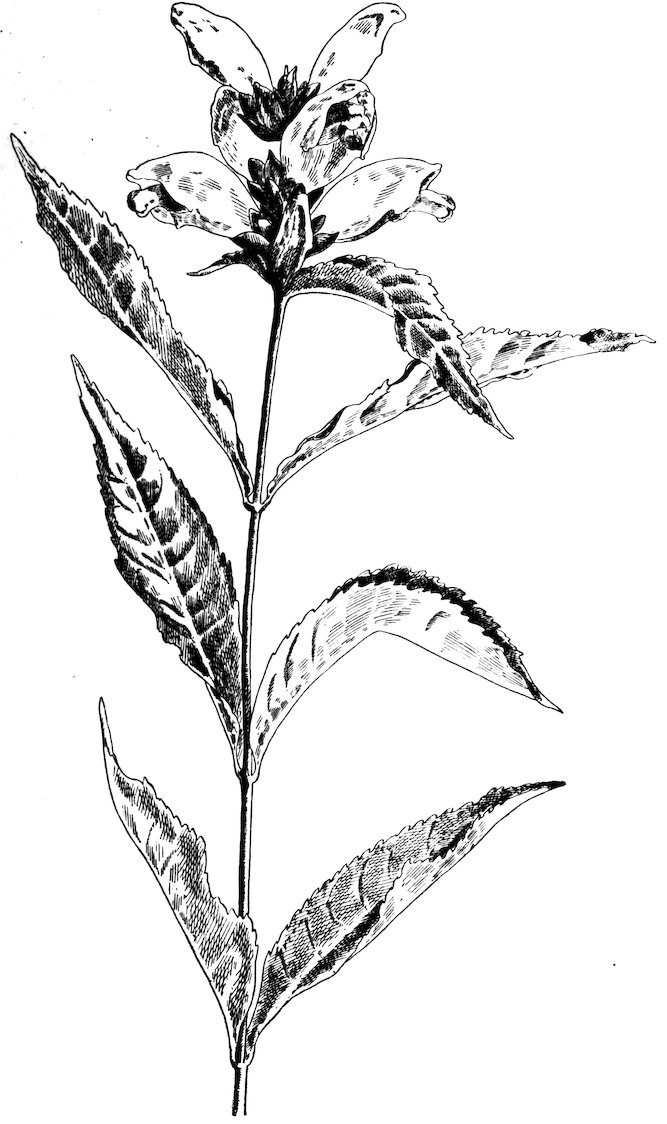
PLATE XXX TURTLE-HEAD.—C. glabra.
102
Common Dodder. Love Vine. Cuscuta Gronovii. Convolvulus Family.
Stems.—Yellow or reddish, thread-like, twining, leafless. Flowers.—White, in close clusters. Calyx.—Five-cleft. Corolla.—With five spreading lobes. Stamens.—Five. Pistil.—One, with two styles.
Late in the summer we are perhaps tempted deep into some thicket by the jasmine-scented heads of the button-bush or the fragrant spikes of the clethra, and note for the first time the tangled golden threads and close white flower-clusters of the dodder. If we try to trace to their source these twisted stems, which the Creoles know as “angels’ hair,” we discover that they are fastened to the bark of the shrub or plant about which they are twining by means of small suckers; but nowhere can we find any connection with the earth, all their nourishment being extracted from the plant to which they are adhering. Originally this curious herb sprang from the ground which succored it until it succeeded in attaching itself to some plant; having accomplished this it severed all connection with mother-earth by the withering away or snapping off of the stem below.
The flax-dodder, C. Epilinum, is a very injurious plant in European flax-fields. It has been sparingly introduced into this country with flax-seed.
Traveller’s Joy. Virgin’s Bower. Clematis Virginiana. Crowfoot Family.
Stem.—Climbing, somewhat woody. Leaves.—Opposite, three-divided. Flowers.—Whitish, in clusters, unisexual. Calyx.—Of four petal-like sepals. Corolla.—None. Stamens and Pistils.—Indefinite in number, occurring on different plants.
In July and August this beautiful plant, covered with its white blossoms and clambering over the shrubs which border the country lanes, makes indeed a fitting bower for any maid or traveller who may chance to be seeking shelter. Later in the year the seeds with their silvery plumes give a feathery effect which is very striking.
103
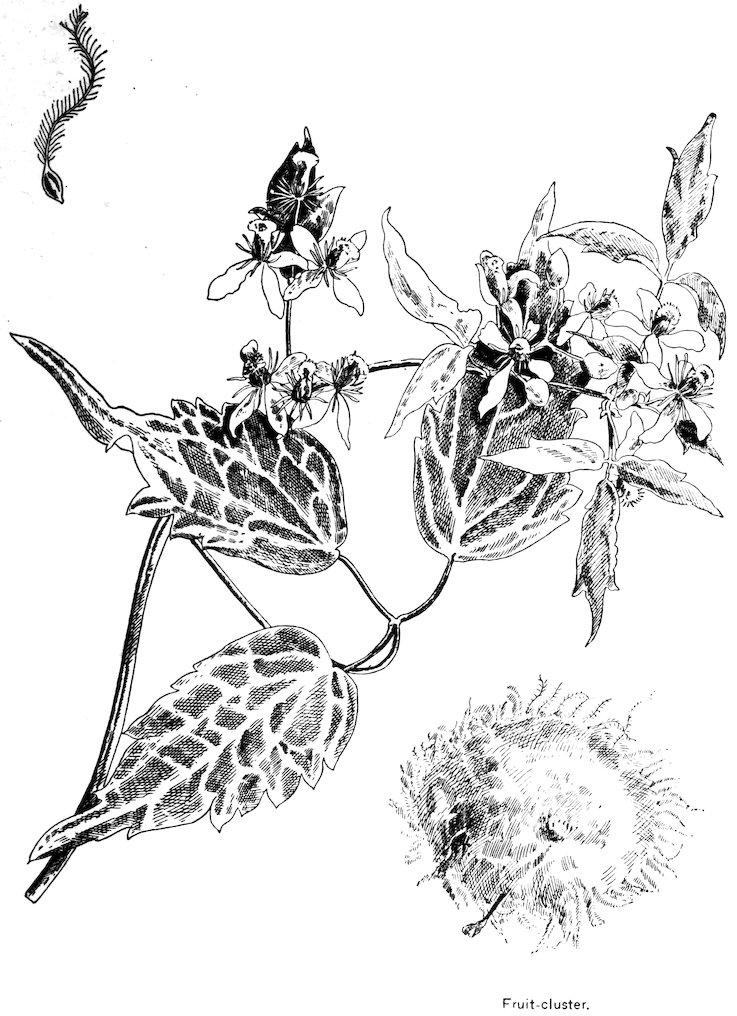
PLATE XXXI TRAVELLER’S JOY.—Clematis Virginiana.
104This graceful climber works its way by means of its bending or clasping leaf-stalks. Darwin has made interesting experiments regarding the movements of the young shoots of the Clematis. He discovered that, “one revolved describing a broad oval, in five hours, thirty minutes; and another in six hours, twelve minutes; they follow the course of the sun.”
Sweet Pepperbush. White Alder. Clethra alnifolia. Heath Family.
A shrub from three to ten feet high. Leaves.—Alternate, ovate, sharply toothed. Flowers.—White, growing in clustered finger-like racemes. Calyx.—Of five sepals. Corolla.—Of five oblong petals. Stamens.—Ten, protruding. Pistil.—One, three-cleft at apex.
Nearly all our flowering shrubs are past their glory by midsummer, when the fragrant blossoms of the sweet pepperbush begin to exhale their perfume from the cool thickets which line the lanes along the New England coast. There is a certain luxuriance in the vegetation of this part of the country in August which is generally lacking farther inland, where the fairer flowers have passed away, and the country begins to show the effects of the long days of heat and drought. The moisture of the air, and the peculiar character of the soil near the sea, are responsible for the freshness and beauty of many of the late flowers which we find in such a locality.
Clethra is the ancient Greek name for the alder, which this plant somewhat resembles in foliage.
Thorn-apple. Jamestown Weed. Datura Stramonium. Nightshade Family.
Stem.—Smooth and branching. Leaves.—Ovate, wavy-toothed or angled. Flowers.—White, large and showy, on short flower-stalks from the forks of the branching stem. Calyx.—Five-toothed. Corolla.—Funnel-form, the border five-toothed. Stamens.—Five. Pistil.—One. Fruit.—Green, globular, prickly.
The showy white flowers of the thorn-apple are found in waste places during the summer and autumn, a heap of rubbish forming their usual unattractive background. The plant is a rank, ill-scented one, which was introduced into our country from Asia. 105It was so associated with civilization as to be called the “white man’s plant” by the Indians.
Its purple-flowered relative, D. Tatula, is an emigrant from the tropics. This genus possesses narcotic-poisonous properties.
Wild Balsam-apple. Echinocystis lobata. Gourd Family.
Stem.—Climbing, nearly smooth, with three-forked tendrils. Leaves.—Deeply and sharply five-lobed. Flowers.—Numerous, small, greenish-white, unisexual; the staminate ones growing in long racemes, the pistillate ones in small clusters or solitary. Fruit.—Fleshy, oval, green, about two inches long, clothed with weak prickles.
This is an ornamental climber which is found bearing its flowers and fruit at the same time. It grows in rich soil along rivers in parts of New England, Pennsylvania, and westward; and is often cultivated in gardens, making an effective arbor-vine. The generic name is from two Greek words which signify hedgehog and bladder, in reference to the prickly fruit.
White Asters. Aster. Composite Family (p. 13).
Flower-heads.—Composed of white ray-flowers with a centre of yellow disk-flowers.
While we have far fewer species of white than of blue or purple asters, some of these few are so abundant in individuals as to hold their own fairly well against their bright-hued rivals.
The slender zigzag stems, thin, coarsely toothed, heart-shaped leaves, and white, loosely clustered flower-heads of A. corymbosus, are noticeable along the shaded roadsides and in the open woods of August.
Bordering the dry fields at this same season are the spreading wand-like branches, thickly covered with the tiny flower-heads as with snowflakes, of A. ericoides.
A. umbellatus is the tall white aster of the swamps and moist thickets. It sometimes reaches a height of seven feet, and can be identified by its long tapering leaves and large, flat flower-clusters.
106A beautiful and abundant seaside species is A. multiflorus. Its small flower-heads are closely crowded on the low, bushy, spreading branches; its leaves are narrow, rigid, crowded, and somewhat hoary. The whole effect of the plant is heath-like; it also somewhat suggests an evergreen.