FLOWER DESCRIPTIONS (continued 3)
Reading edition
Tick-Trefoil. Desmodium nudiflorum. Pulse Family (p. 16).
Scape.—About two feet long. Leaves.—Divided into three broad leaflets, crowded at the summit of the flowerless stems. Flowers.—Papilionaceous, purplish-pink, small, growing in an elongated raceme on a mostly leafless scape.
This is a smaller, less noticeable plant than D. Canadense. It flourishes abundantly in dry woods, where it often takes possession in late summer to the exclusion of nearly all other flowers.
The flowers of D. acuminatum grow in an elongated raceme from a stem about whose summit the leaves, divided into very large leaflets, are crowded; otherwise it resembles D. nudiflorum.
D. Dillenii grows to a height of from two to five feet, with erect leafy stems and medium-sized flowers. It is found commonly in open woods.
Many of us who do not know these plants by name have uttered various imprecations against their roughened pods. Thoreau writes: “Though you were running for your life, they would have time to catch and cling to your clothes.... These almost invisible nets, as it were, are spread for us, and whole coveys of desmodium and bidens seeds steal transportation out of us. I have found myself often covered, as it were, with an imbricated coat of the brown desmodium seeds or a bristling chevaux-de-frise of beggar-ticks, and had to spend a quarter of an hour or more picking them off in some convenient spot; and so they get just what they wanted—deposited in another place.”
Bouncing Bet. Soapwort. Saponaria officinalis. Pink Family.
Stem.—Rather stout, swollen at the joints. Leaves.—Oval, opposite. Flowers.—Pink or white, clustered. Calyx.—Of five united sepals. Corolla.—Of five pinkish, long-clawed petals (frequently the flowers are double). Stamens.—Ten. Pistil.—One, with two styles.
A cheery pretty plant is this with large, rose-tinged flowers which are especially effective when double.
197
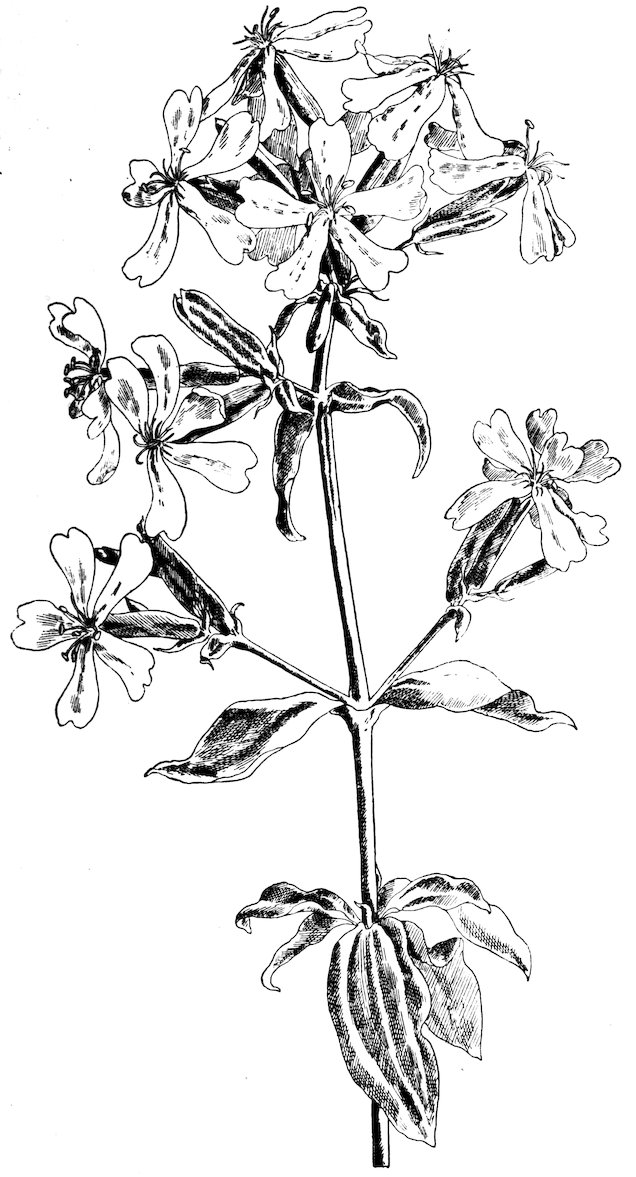
PLATE LXX BOUNCING BET.—S. officinalis.
198Bouncing Bet is of a sociable turn and is seldom found far from civilization, delighting in the proximity of farm-houses and their belongings, in the shape of children, chickens, and cattle. She comes to us from England, and her “feminine comeliness and bounce” suggest to Mr. Burroughs a Yorkshire housemaid. The generic name is from sapo—soap, and refers to the lather which the juice forms with water, and which is said to have been used as a substitute for soap.
Steeple-bush. Hardhack. Spiræa tomentosa. Rose Family.
Stems.—Very woolly. Leaves.—Alternate, oval, toothed. Flowers.—Small, pink, in pyramidal clusters. Calyx.—Five-cleft. Corolla.—Of five rounded petals. Stamens.—Numerous. Pistils.—Five to eight.
The pink spires of this shrub justify its rather unpoetic name of steeple-bush. It is closely allied to the meadow-sweet (Pl. XXVI.), blossoming with it in low grounds during the summer. It differs from that plant in the color of its flowers and in the woolliness of its stems and the lower surface of its leaves.
Deptford Pink. Dianthus Armeria. Pink Family.
One or two feet high. Leaves.—Opposite, long and narrow, hairy. Flowers.—Pink, with white dots, clustered. Calyx.—Five-toothed, cylindrical, with awl-shaped bracts beneath. Corolla.—Of five small petals. Stamens.—Ten. Pistil.—One, with two styles.
In July and August we find these little flowers in our eastern fields. The generic name, which signifies Jove’s own flower, hardly applies to these inconspicuous blossoms. Perhaps it was originally bestowed upon D. caryophyllus, a large and fragrant English member of the genus, which was the origin of our garden carnation.
Purple Loosestrife. Lythrum Salicaria. Loosestrife Family.
Stem.—Tall and slender. Leaves.—Lance-shaped, with a heart-shaped base, sometimes whorled in threes. Flowers.—Deep purple-pink, crowded and whorled in an interrupted spike. Calyx.—Five to seven-toothed, with little processes between the teeth. Corolla.—Of five or six somewhat wrinkled petals. Stamens.—Usually twelve, in two sets, six longer and six shorter. Pistil.—One, varying in size in the different blossoms, being of three different lengths.
199
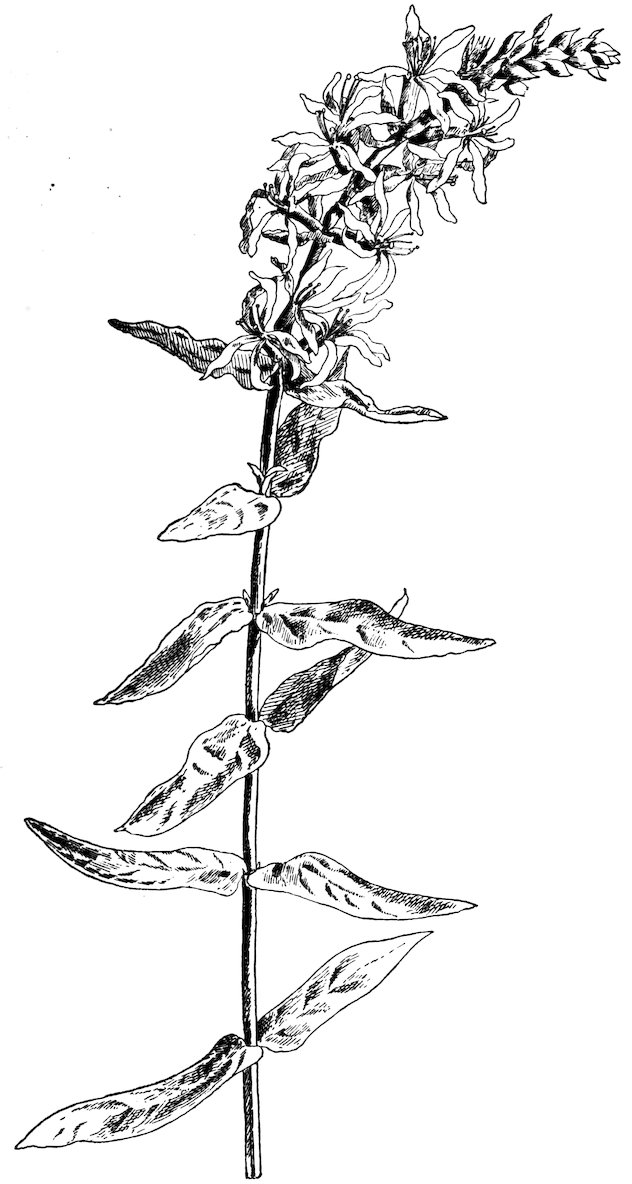
PLATE LXXI PURPLE LOOSESTRIFE.—L. Salicaria.
200One who has seen an inland marsh in August aglow with this beautiful plant, is almost ready to forgive the Old Country some of the many pests she has shipped to our shores in view of this radiant acquisition. The botany locates it anywhere between Nova Scotia and Delaware. It may be seen in the perfection of its beauty along the marshy shores of the Hudson and in the swamps of the Wallkill Valley.
When we learn that these flowers are called “long purples,” by the English country people, the scene of Ophelia’s tragic death rises before us:
There is a willow grows aslant a brook,
That shows his hoar leaves in the glassy stream,
There with fantastic garlands did she come,
Of crow-flowers, nettles, daisies, and long purples
That liberal shepherds give a grosser name,
But our cold maids do dead men’s fingers call them.
Dr. Prior, however, says that it is supposed that Shakespeare intended to designate the purple-flowering orchis, O. mascula, which is said to closely resemble the showy orchis (Pl. LXII.) of our spring woods.
The flowers of the purple loosestrife are especially interesting to botanists on account of their trimorphism, which word signifies occurring in three forms, and refers to the stamens and pistils, which vary in size in the different blossoms, being of three different lengths, the pollen from any given set of stamens being especially fitted to fertilize a pistil of corresponding length.
Meadow-beauty. Deer-grass. Rhexia Virginica. Melastoma Family.
Stem.—Square, with wing-like angles. Leaves.—Opposite, narrowly oval. Flowers.—Purplish-pink, clustered. Calyx-tube.—Urn-shaped, four-cleft at the apex. Corolla.—Of four large rounded petals. Stamens.—Eight, with long curved anthers. Pistil.—One.
It is always a pleasant surprise to happen upon a bright patch of these delicate deep-hued flowers along the marshes or in the sandy fields of midsummer. Their fragile beauty is of that order which causes it to seem natural that they should belong to a genus which is the sole northern representative of a tropical family. In parts of New England they grow in profusion, while in Arkansas the plant is said to be a great favorite with the deer, hence one of its common names. The flower has been likened to a scarlet evening primrose, and there is certainly a suggestion of the evening primrose in the four rounded, slightly heart-shaped petals. The protruding stamens, with their long yellow anthers, are conspicuous.
201
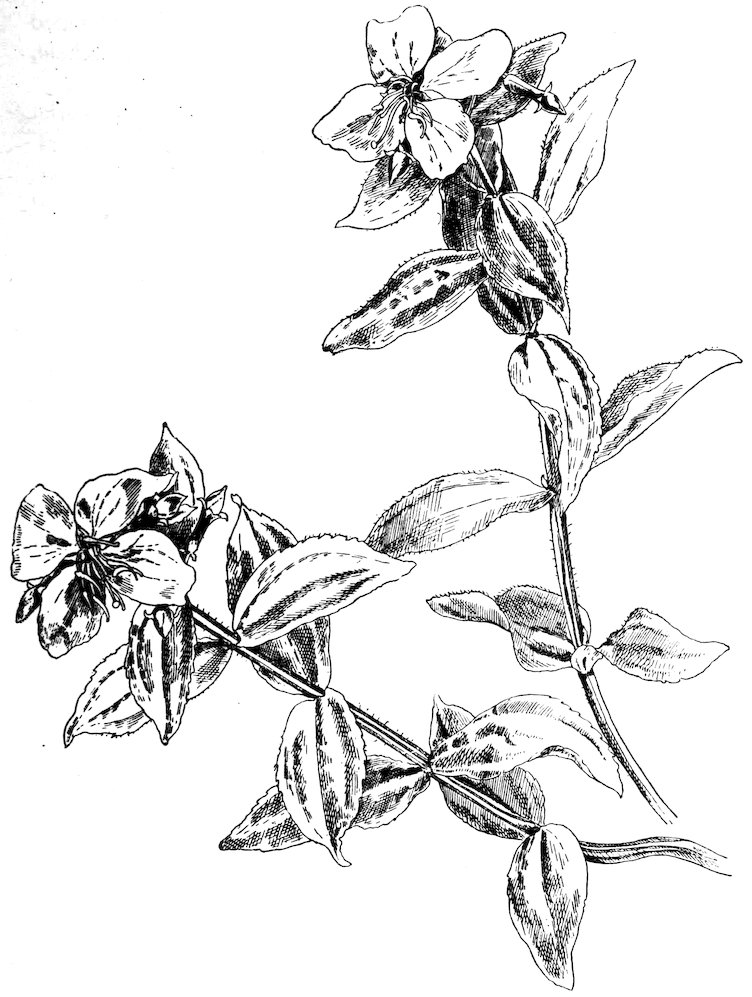
PLATE LXXII MEADOW-BEAUTY.—R. Virginica.
202Of the plant in the late year, Thoreau writes: “The scarlet leaves and stem of the rhexia, sometime out of flower, make almost as bright a patch in the meadows now as the flowers did. Its seed-vessels are perfect little cream-pitchers of graceful form.”
Clammy Cuphea. Wax-weed. Cuphea viscosissima. Loosestrife Family.
Stem.—Sticky, hairy, branching. Leaves.—Usually opposite, rounded, lance-shaped. Flowers.—Deep purplish-pink, solitary or in racemes. Calyx.—Tubular, slightly spurred at the base on the upper side, six-toothed at the apex, usually with a slight projection between each tooth. Corolla.—Small, of six unequal petals. Stamens.—Eleven or twelve, of unequal sizes, in two sets. Pistil.—One, with a two-lobed stigma.
In the dry fields and along the roadsides of late summer this plant is found in blossom. Its rather wrinkled purplish-pink petals and unequal stamens suggest the flowers of the spiked loosestrife, L. Salicaria, to which it is closely related.
Sea Pink. Sabbatia stellaris. Gentian Family.
Stem.—Slender, loosely branched. Leaves.—Opposite, oblong to lance-shaped, the upper narrowly linear. Flowers.—Large, deep pure pink to almost white. Calyx.—Usually five-parted, the lobes long and slender. Corolla.—Usually five-parted, conspicuously marked with red and yellow in the centre. Stamens.—Usually five. Pistil.—One, with two-cleft style.
The advancing year has few fairer sights to show us than a salt meadow flushed with these radiant blossoms. They are so abundant, so deep-hued, so delicate! One feels tempted to lie down among the pale grasses and rosy stars in the sunshine of the August morning and drink his fill of their beauty. How often nature tries to the utmost our capacity of appreciation and leaves us still insatiate! At such times it is almost a relief to turn from the mere contemplation of beauty to the study of its structure; it rests our overstrained faculties.
203
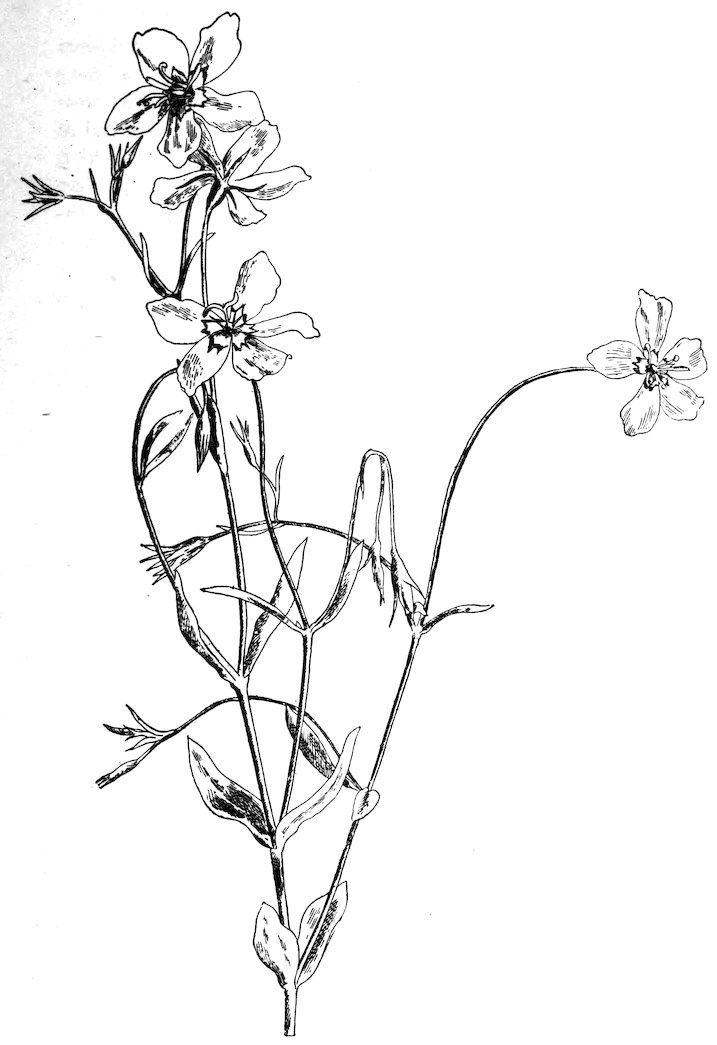
PLATE LXXIII SEA PINK.—S. stellaris.
204The vivid coloring and conspicuous marking of these flowers indicate that they aim to attract certain members of the insect world. As in the fireweed the pistil of the freshly opened blossom is curved sideways, with its lobes so closed and twisted as to be inaccessible on their stigmatic surfaces to the pollen which the already mature stamens are discharging. When the effete anthers give evidence that they are hors de combat by their withered appearance, the style erects itself and spreads its stigmas.
S. angularis is a species which may be found in rich soil inland. Its somewhat heart-shaped, clasping, five-nerved leaves and angled stem serve to identify it.
S. chloroides is a larger and peculiarly beautiful species which borders brackish ponds along the coast. Its corolla is about two inches broad and eight to twelve-parted.
Marsh St. John’s-wort. Elodes campanulata. St. John’s-wort Family.
Stem.—One or two feet high, often pinkish, later bright red. Leaves.—Opposite, set close to the stem or clasping by a broad base. Flowers.—Pinkish or flesh-color, small, closely clustered at the summit of the stem and in the axils of the leaves. Calyx.—Of five sepals, often pinkish. Corolla.—Of five petals. Stamens.—Nine, in three sets, the sets separated by orange-colored glands. Pistil.—One, with three styles.
If one has been so unlucky, from the usual point of view, or so fortunate, looking at the matter with the eyes of the flower-lover, as to find himself in a rich marsh early in August, his eye is likely to fall upon the small, pretty pinkish flowers and pale clasping leaves of the marsh St. John’s-wort. A closer inspection will discover that the foliage is dotted with the pellucid glands, and that the stamens are clustered in groups after the family fashion. Should the same marsh be visited a few weeks later dashes of vivid color will guide one to the spot where the little pink flowers were found. In their place glow the conspicuous ovaries and bright leaves which make the plant very noticeable in late August.
Elodes is a corruption from a Greek word which signifies growing in marshes.
205
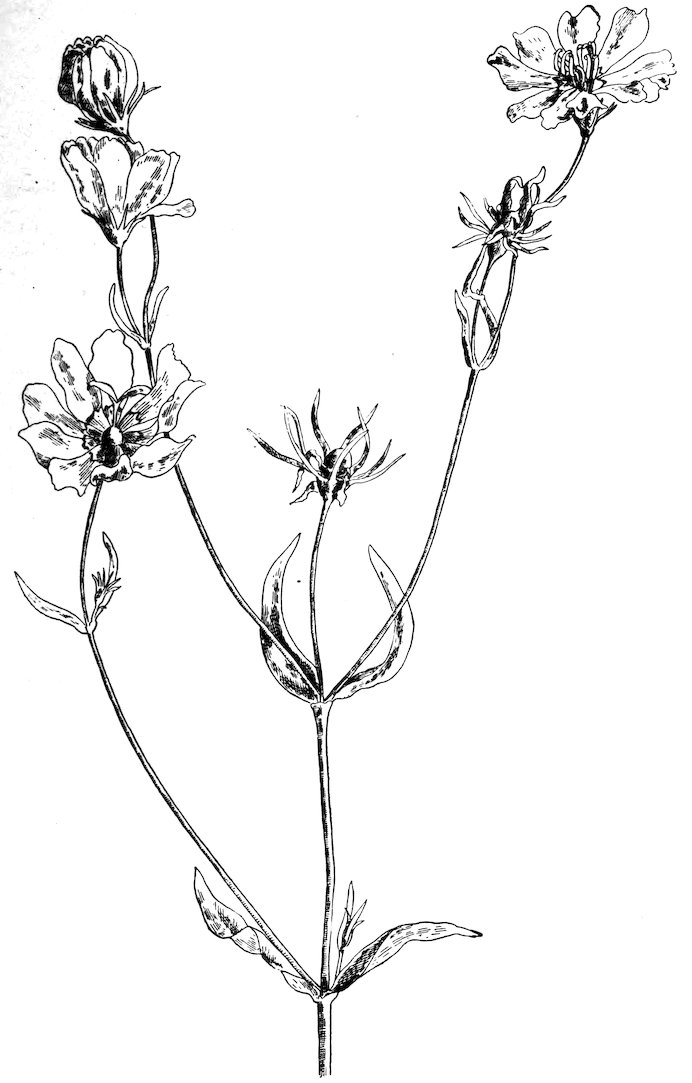
PLATE LXXIV Sabbatia chloroides.
206
Rose Mallow. Swamp Mallow. Hibiscus Moscheutos. Mallow Family.
Stem.—Stout and tall, four to eight feet high. Leaves.—The lower three-lobed, the upper oblong, whitish and downy beneath. Flowers.—Large and showy, pink. Calyx.—Five-cleft, with a row of narrow bractlets beneath. Corolla.—Of five large petals. Stamens.—Many, on a tube which encloses the lower part of the style. Pistils.—Five, united into one, with five stigmas which are like pin-heads.
When the beautiful rose mallow slowly unfolds her pink banner-like petals and admits the eager bee to her stores of golden pollen, then we feel that the summer is far advanced. As truly as the wood anemone and the blood-root seem filled with the essence of spring and the promise of the opening year, so does this stately flower glow with the maturity and fulfilment of late summer. Here is none of the timorousness of the early blossoms which peep shyly out, as if ready to beat a hasty retreat should a late frost overtake them, but rather a calm assurance that the time is ripe, and that the salt marshes and brackish ponds are only awaiting their rosy lining.
The marsh mallow, whose roots yield the mucilaginous substance utilized in the well-known confection, is Althæa officinalis, an emigrant from Europe. It is a much less common plant than the Hibiscus, its pale pink flowers being found in some of the salt marshes of New England and New York.
The common mallow, Malva rotundifolia, which overruns the country dooryards and village waysides, is a little plant with rounded, heart-shaped leaves and small purplish flowers. It is used by the country people for various medicinal purposes and is cultivated and commonly boiled with meat in Egypt. Job pictures himself as being despised by those who had been themselves so destitute as to “cut up mallows by the bushes ... for their meat.”[7]
207
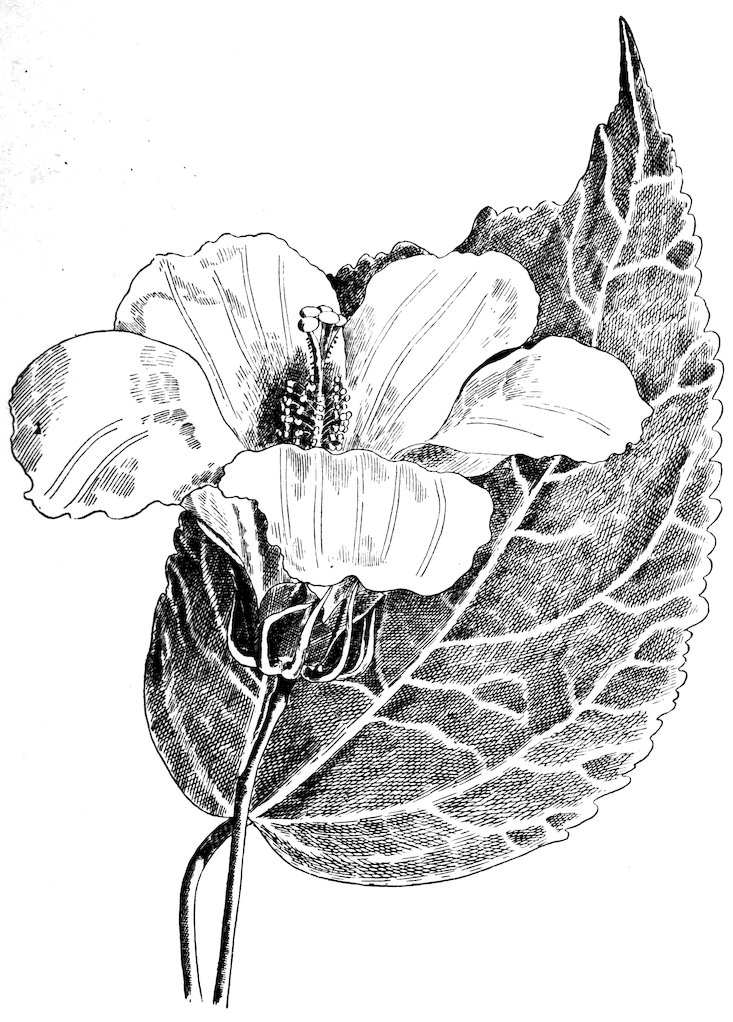
PLATE LXXV ROSE MALLOW.—H. Moscheutos.
208
Salt Marsh Fleabane. Pluchea camphorata. Composite Family (p. 13).
Stem.—Two to five feet high. Leaves.—Pale, thickish, oblong or lance-shaped, toothed. Flower-heads.—Pink, small, in flat-topped clusters, composed entirely of tubular flowers.
In the salt marshes where we find the starry sea pinks and the feathery sea lavender, we notice a pallid-looking plant whose pink flower-buds are long in opening. It is late summer or autumn before the salt marsh fleabane is fairly in blossom. There is a strong fragrance to the plant which hardly suggests camphor, despite its specific title.
Hairy Willow-herb. Epilobium hirsutum. Evening Primrose Family.
Three to five feet high. Stem.—Densely hairy, stout, branching. Leaves.—Mostly opposite, lance-oblong, finely toothed. Flower.—Purplish, pink, small, in the axils of the upper leaves, or in a leafy, short raceme. Calyx.—Four or five-parted. Corolla.—Of four petals. Stamens.—Eight. Pistil.—One, with a four-parted stigma.
The hairy willow-herb is found in waste places, blossoming in midsummer. It is an emigrant from Europe.
Fireweed. Great Willow-herb. Epilobium angustifolium. Evening Primrose Family.
Stem.—Four to seven feet high. Leaves.—Scattered, lance-shaped, willow-like. Flowers.—Purplish-pink, large, in a long raceme. Calyx.—Four-cleft. Corolla.—Of four petals. Stamens.—Eight. Pistil.—One, with a four-lobed stigma.
In midsummer this striking plant begins to mass its deep-hued blossoms along the roadsides and low meadows. It is supposed to flourish with especial abundance in land that has newly been burned over; hence, its common name of fireweed. Its willow-like foliage has given it its other English title. The likeness between the blossoms of this plant and those of the evening primrose betray their kinship. When the stamens of the fireweed first mature and discharge their pollen the still immature style is curved backward and downward with its stigmas closed. Later it straightens and lengthens to its full dimensions, so spreading its four stigmas as to be in position to receive the pollen of another flower from the visiting bee.
209
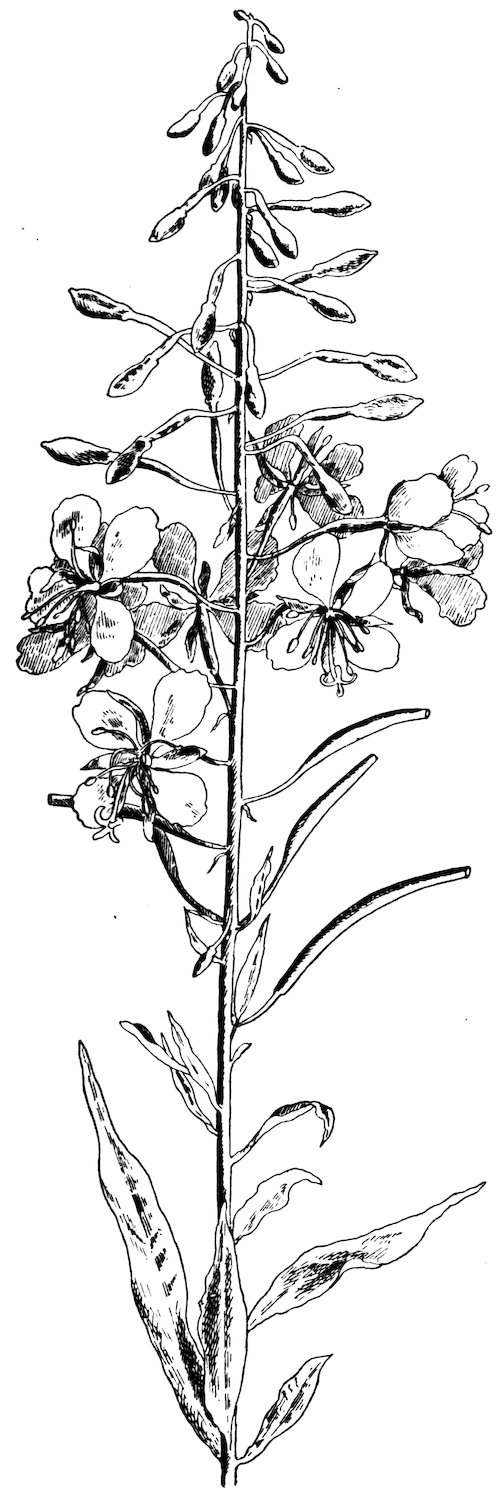
PLATE LXXVI FIREWEED.—E. angustifolium.
210
——— ——— Epilobium coloratum. Evening Primrose Family.
One to three feet high. Leaves.—Rather large, lance-shaped, sharply toothed. Flowers.—Pale pink, small, more or less nodding, resembling in structure those of the hairy willow-herb. Pistil.—One, with a club-shaped stigma.
This species is found in abundance in wet places in summer.
Purple Gerardia. Gerardia purpurea. Figwort Family.
Stem.—One to four feet high, widely branching. Leaves.—Linear, sharply pointed. Flowers.—Bright purplish-pink, rather large. Calyx.—Five-toothed. Corolla.—One inch long, somewhat tubular, swelling above, with five more or less unequal, spreading lobes, often downy and spotted within. Stamens.—Four, in pairs, hairy. Pistil.—One.
In late summer and early autumn these pretty noticeable flowers brighten the low-lying ground along the coast and in the neighborhood of the Great Lakes. The sandy fields of New England and Long Island are oftentimes a vivid mass of color owing to their delicate blossoms. The plant varies somewhat in the size of its flowers and in the manner of its growth.
The little seaside gerardia, G. maritima, is from four inches to a foot high. Its smaller blossoms are also found in salt marshes.
The slender gerardia, G. tenuifolia, is common in mountainous regions. The leaves of this species are exceedingly narrow. Like the false foxglove (Pl. LIX.) and other members of this genus, these plants are supposed to be parasitic in their habits.
Joe-Pye-weed. Trumpet-weed. Eupatorium purpureum. Composite Family (p. 13).
Stem.—Stout and tall, two to twelve feet high, often dotted. Leaves.—In whorls of three to six, oblong or oval, pointed, rough, veiny, toothed. Flower-heads.—Purplish-pink, small, composed entirely of tubular blossoms, with long protruding styles, growing in large clusters at or near the summit of the stem.
211
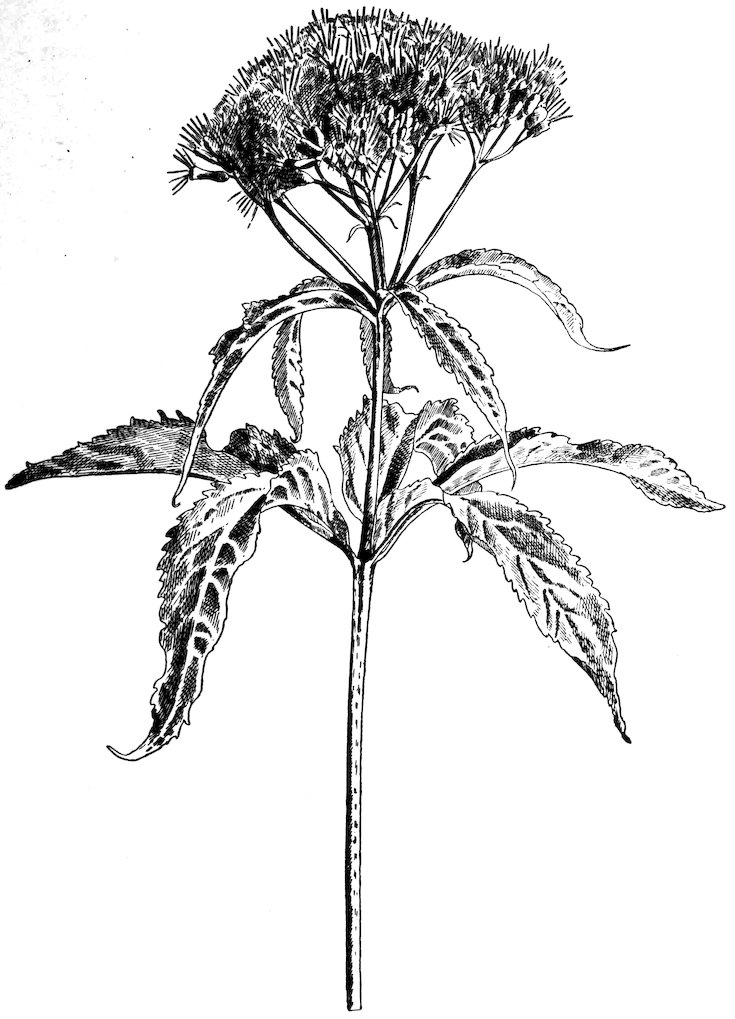
PLATE LXXVII JOE-PYE-WEED.—E. purpureum.
212The summer is nearly over when the tall, conspicuous Joe-Pye-weed begins to tinge with “crushed raspberry” the lowlands through which we pass. In parts of the country it is nearly as common as the golden-rods and asters which appear at about the same season. With the deep purple of the iron-weed it gives variety to the intense hues which herald the coming of autumn.
“Joe Pye” is said to have been the name of an Indian who cured typhus fever in New England by means of this plant. The tiny trumpet-shaped blossoms which make up the flower-heads may have suggested the other common name.
Pink Knotweed. Polygonum Pennsylvanicum. Buckwheat Family.
One to four feet high. Stem.—Branching. Leaves.—Alternate, lance-shaped. Flowers.—Bright pink, growing in thick, short, erect spikes. Calyx.—Mostly five-parted, the divisions petal-like, pink. Corolla.—None. Stamens.—Usually eight. Pistil.—One, with a two-cleft style.
In late summer this plant can hardly escape notice. Its erect pink spikes direct attention to some neglected corner in the garden or brighten the fields and roadsides. The rosy divisions of the calyx persist till after the fruit has formed, pressing closely against the dark seed-vessel within.
Sand Knotweed. Polygonella articulata. (Formerly Polygonum articulatum.) Buckwheat Family.
Erect, branching, four to twelve inches high. Leaves.—Linear, inconspicuous. Flowers.—Rose-color, nodding, in very slender racemes. Calyx.—Five-parted. Corolla.—None. Stamens.—Eight. Pistil.—One, with three styles.
Under date of September 26th, Thoreau writes: “The Polygonum articulatum, giving a rosy tinge to Jenny’s desert, is very interesting now, with its slender dense racemes of rose-tinted flowers, apparently without leaves, rising cleanly out of the sand. It looks warm and brave, a foot or more high, and mingled with deciduous blue curls. It is much divided, with many spreading, slender-racemed branches, with inconspicuous linear leaves, reminding me, both by its form and its colors, of a peach-orchard in blossom, especially when the sunlight falls on it; minute rose-tinted 213flowers that brave the frosts, and advance the summer into fall, warming with their color sandy hill-sides and deserts, like the glow of evening reflected on the sand, apparently all flower and no leaf. Rising apparently with clean bare stems from the sand, it spreads out into this graceful head of slender, rosy racemes, wisp-like. This little desert of less than an acre blushes with it.”
Note.—The Moss Pink, Phlox subulata, with purple-pink flowers, and Phlox glaberrima, with pink or whitish flowers, will be found in the Blue and Purple section (p. 235). The Mountain Laurel (p. 57) and the American Rhododendron (p. 60) are frequently found bearing pink flowers. At times it has been difficult to determine whether certain flowers should be described in the Pink or in the Purple section. The reader should bear this in mind, consulting both in dubious cases.
214
IV RED
Wild Columbine. Aquilegia Canadensis. Crowfoot Family.
Twelve to eighteen inches high. Stem.—Branching. Leaves.—Much-divided, the leaflets lobed. Flowers.—Large, bright red, yellow within, nodding. Calyx.—Of five red petal-like sepals. Corolla.—Of five petals in the form of large hollow spurs, which are red without and yellow within. Stamens.—Numerous. Pistils.—Five, with slender styles.
—A woodland walk,
A quest of river-grapes, a mocking thrush,
A wild-rose or rock-loving columbine,
Salve my worst wounds,
declares Emerson; and while perhaps few among us are able to make so light-hearted and sweeping a claim for ourselves, yet many will admit the soothing power of which the woods and fields know the secret, and will own that the ordinary annoyances of life may be held more or less in abeyance by one who lives in close sympathy with nature.
About the columbine there is a daring loveliness which stamps it on the memories of even those who are not ordinarily minute observers. It contrives to secure a foothold in the most precipitous and uncertain of nooks, its jewel-like flowers gleaming from their lofty perches with a graceful insouciance which awakens our sportsmanlike instincts and fires us with the ambition to equal it in daring and make its loveliness our own. Perhaps it is as well if our greediness be foiled and we get a tumble for our pains, for no flower loses more with its surroundings than the columbine. Indeed, these destructive tendencies which are strong within most of us generally defeat themselves by decreasing our pleasure in a blossom the moment we have ruthlessly and without purpose snatched it from its environment. If we honestly wish to study its structure, or to bring into our homes for preservation a bit of the woods’ loveliness, its interest and beauty are sure to repay us. But how many pluck every striking flower they see only to toss it carelessly aside when they reach their destination, if they have not already dropped it by the way. Surely if in such small matters sense and self-control were inculcated in children, more would grow up to the poet’s standard of worthiness:
215
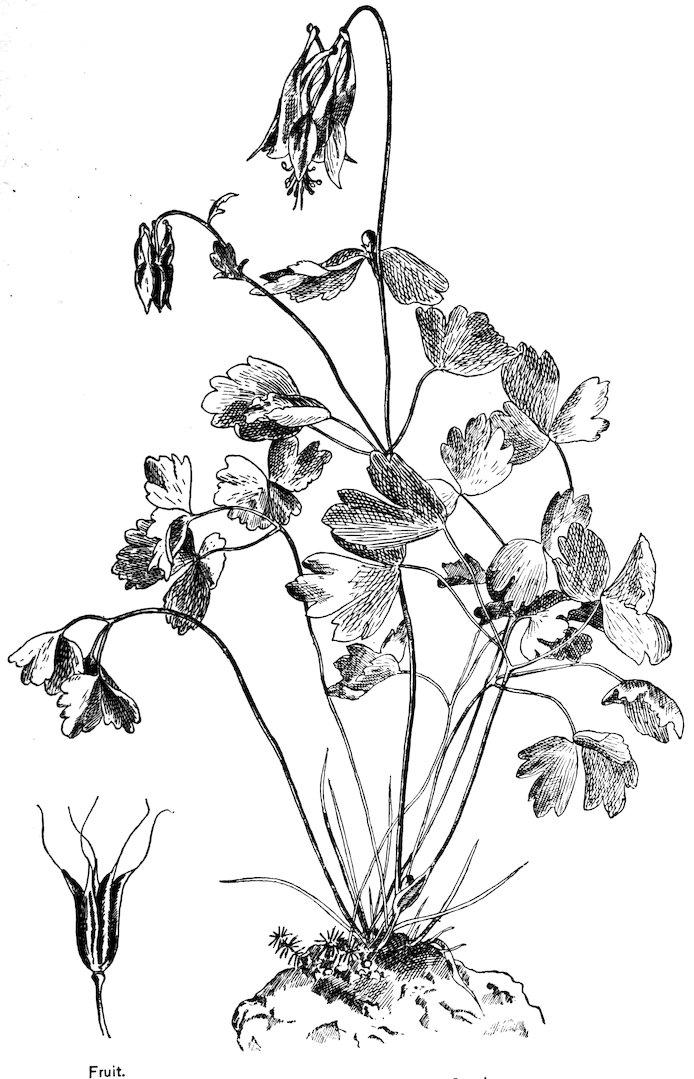
PLATE LXXVIII WILD COLUMBINE.—A. Canadensis.
216Hast thou named all the birds without a gun?
Loved the wood-rose and left it on its stalk?
At rich men’s tables eaten bread and pulse?
Unarmed, faced danger with a heart of trust?
And loved so well a high behavior,
In man or maid, that thou from speech refrained,
Nobility more nobly to repay?
O, be my friend, and teach me to be thine![8]
The name of columbine is derived from colomba—a dove, but its significance is disputed. Some believe that it was associated with the bird-like claws of the blossom; while Dr. Prior maintains that it refers to the “resemblance of its nectaries to the heads of pigeons in a ring around a dish, a favorite device of ancient artists.”
The meaning of the generic title is also doubtful. Gray derives it from aquilegus—water-drawing, but gives no further explanation, while other writers claim that it is from aquila, an eagle, seeing a likeness to the talons of an eagle in the curved nectaries.
Wake Robin. Birthroot. Trillium erectum. Lily Family.
Stem.—Stout, from a tuber-like rootstock. Leaves.—Broadly ovate, three in a whorl a short distance below the flower. Flower.—Single, terminal, usually purplish-red, occasionally whitish, pinkish, or greenish, on an erect or somewhat inclined flower-stalk. Calyx.—Of three green spreading sepals. Corolla.—Of three large lance-shaped petals. Stamens.—Six. Pistil.—One, with three large spreading stigmas. Fruit.—A large, ovate, six-angled reddish berry.
217
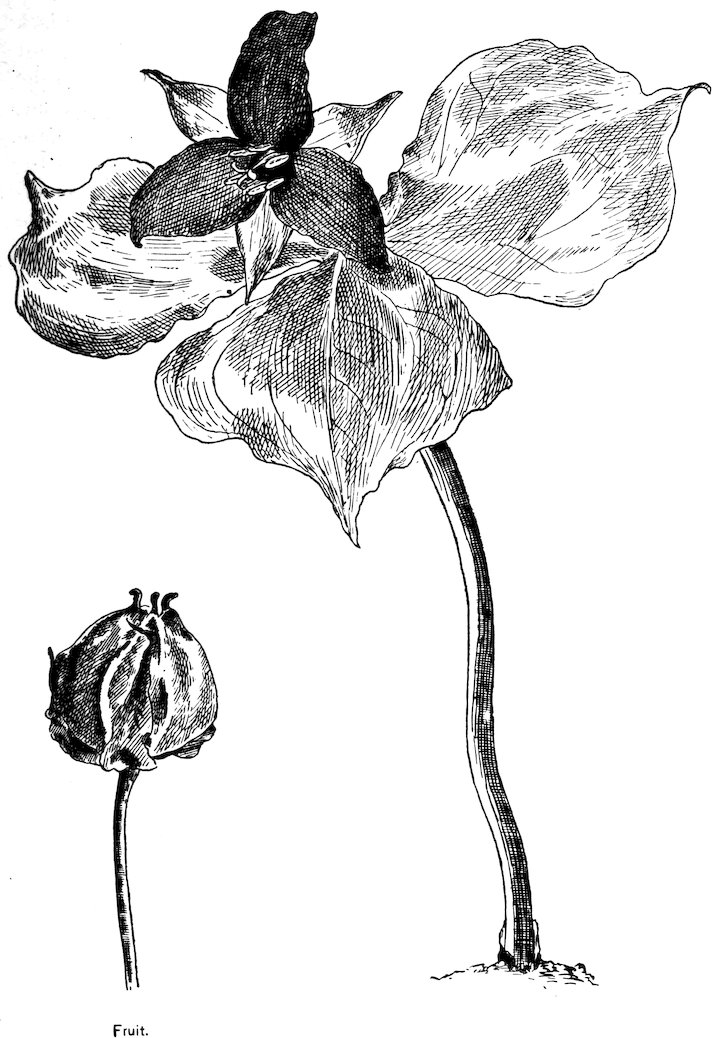
PLATE LXXIX WAKE ROBIN.—T. erectum.
218This wake robin is one of the few self-assertive flowers of the early year. Its contemporaries act as if somewhat uncertain as to whether the spring had really come to stay, but no such lack of confidence possesses our brilliant young friend, who almost flaunts her lurid petals in your face, as if to force upon you the welcome news that the time of birds and flowers is at hand. Pretty and suggestive as is the common name, it is hardly appropriate, as the robins have been on the alert for many days before our flower unfurls its crimson signal. Its odor is most unpleasant. Its reddish fruit is noticeable in the woods of late summer.
The sessile trillium, T. sessile, has no separate flower-stalk, its red or greenish blossom being set close to the stem-leaves. Its petals are narrower, and its leaves are often blotched or spotted. Its berry is globular, six-angled, and red or purplish.
The wake robins are native to North America, only one species being found just beyond the boundaries in the Russian territory.
Wood Betony. Lousewort. Pedicularis Canadensis. Figwort Family.
Stems.—Clustered, five to twelve inches high. Leaves.—The lower ones deeply incised, the upper less so. Flowers.—Yellow and red, growing in a short dense spike. Calyx.—Of one piece split in front. Corolla.—Two-lipped, the narrow upper lip arched, the lower three-lobed. Stamens.—Four. Pistil.—One.
The bright flowers of the wood betony are found in our May woods, often in the company of the columbine and yellow violet. Near Philadelphia they are said to be among the very earliest of the flowers, coming soon after the trailing arbutus. In the later year the plant attracts attention by its uncouth spikes of brown seed-pods.
Few wayside weeds have been accredited with greater virtue than the ancient betony, which a celebrated Roman physician claimed could cure forty-seven different disorders. The Roman proverb, “Sell your coat and buy betony,” seems to imply that the plant did not flourish so abundantly along the Appian Way as it does by our American roadsides. Unfortunately we are reluctantly forced to believe once more that our native flower is 219not identical with the classic one, but that it has received its common name through some superficial resemblance to the original betony or Betonica.
Painted Cup. Castilleia coccinea. Figwort Family.
Stem.—Hairy, six inches to a foot high. Root-leaves.—Clustered, oblong. Stem-leaves.—Incised, those among the flowers three to five-cleft, bright scarlet toward the summit, showy. Flowers.—Pale yellow, spiked. Calyx.—Tubular, flattened. Corolla.—Two-lipped, its upper lip long and narrow, its lower short and three-lobed. Stamens.—Four, unequal. Pistil.—One.
——Scarlet tufts
Are glowing in the green like flakes of fire;
The wanderers of the prairie know them well,
And call that brilliant flower the painted cup.[9]
But we need not go to the prairie in order to see this plant, for it is equally abundant in certain low sandy New England meadows as well as in the near vicinity of New York City. Under date of June 3d, Thoreau graphically describes its appearance near Concord, Mass.: “The painted cup is in its prime. It reddens the meadow, painted-cup meadow. It is a splendid show of brilliant scarlet, the color of the cardinal-flower, and surpassing it in mass and profusion.... I do not like the name. It does not remind me of a cup, rather of a flame when it first appears. It might be called flame flower, or scarlet tip. Here is a large meadow full of it, and yet very few in the town have ever seen it. It is startling to see a leaf thus brilliantly painted, as if its tip were dipped into some scarlet tincture, surpassing most flowers in intensity of color.”
Wood Lily. Wild Red Lily. Lilium Philadelphicum. Lily Family.
Stem.—Two to three feet high. Leaves.—Whorled or scattered, narrowly lance-shaped. Flower.—Erect, orange-red or scarlet, spotted with purple. Perianth.—Of six erect narrowly clawed sepals, with nectar-bearing furrows at their base. Stamens.—Six. Pistil.—One, with three-lobed stigma.
Here and there in the shadowy woods is a vivid dash of color made by some wild red lily which has caught a stray sunbeam 220in its glowing cup. The purple spots on its sepals guide the greedy bee to the nectar at their base; we too can take the hint and reap a sweet reward if we will, after which we are more in sympathy with those eager, humming bees.
This erect, deep-hued flower is so different from its nodding sister of the meadows, that we wonder that the two should be so often confused. When seen away from its surroundings it has less charm perhaps than either the yellow or the Turk’s cap lily; but when it rears itself in the cool depths of its woodland home we feel the uniqueness of its beauty.
Turk’s Cap Lily. Lilium superbum. Lily Family.
Stem.—Three to seven feet high. Leaves.—Lance-shaped, the lower whorled. Flowers.—Orange or scarlet, with purple spots within, three inches long, from three to forty growing in pyramidal clusters. Perianth.—Of six strongly recurved sepals. Stamens.—Six, with long anthers. Pistil.—One, with a three-lobed stigma.
Consider the lilies of the field, how they grow;
They toil not, neither do they spin;
And yet I say unto you, that even Solomon in all his glory
Was not arrayed like one of these.
How they come back to us, the beautiful hackneyed lines, and flash into our memories with new significance of meaning when we chance suddenly upon a meadow bordered with these the most gorgeous of our wild flowers.
We might doubt whether our native lilies at all resembled those alluded to in the scriptural passage, if we did not know that a nearly allied species grew abundantly in Palestine; for we have reason to believe that lily was a title freely applied by many Oriental poets to any beautiful flower.
Perhaps this plant never attains far inland the same luxuriance of growth which is common to it in some of the New England lowlands near the coast. Its radiant, nodding blossoms are seen in great profusion as we travel by rail from New York to Boston.
221
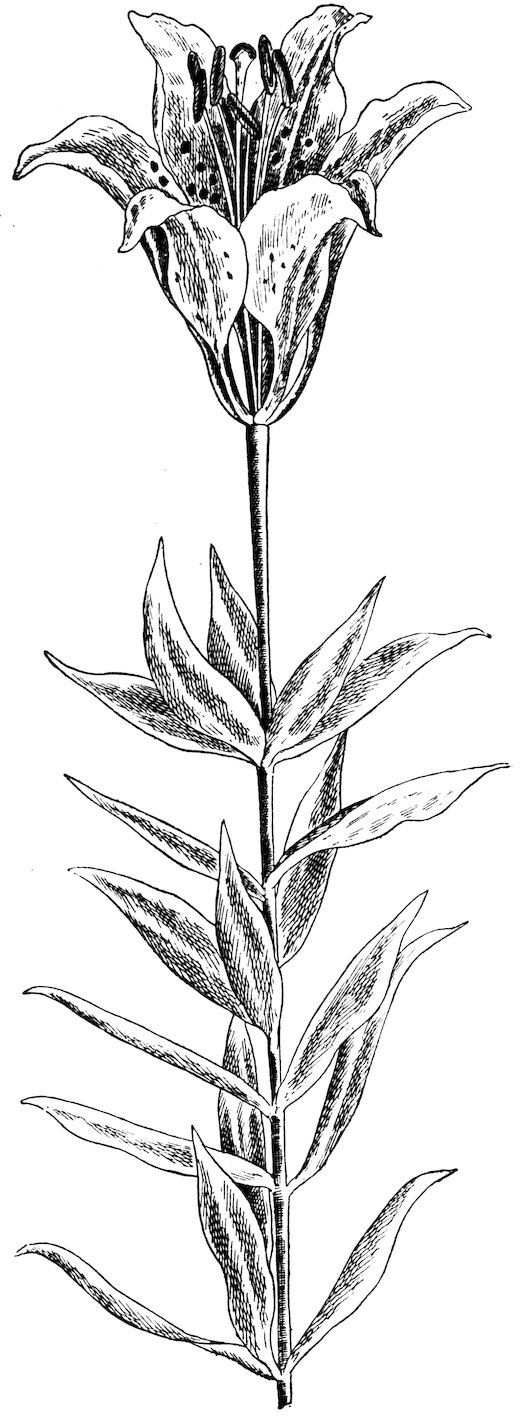
PLATE LXXX WOOD LILY.—L. Philadelphicum.
222
Hound’s Tongue. Cynoglossum officinale. Borage Family.
Stem.—Clothed with soft hairs. Leaves.—Alternate, hairy, the upper ones lance-shaped, clasping somewhat by a rounded or heart-shaped base. Flowers.—Purplish-red, growing in a curved raceme-like cluster which straightens as the blossoms expand. Calyx.—Five-parted. Corolla.—Funnel-form, five-lobed. Stamens.—Five. Pistil.—One. Fruit.—A large nutlet roughened with barbed or hooked prickles.
This coarse plant, whose disagreeable odor strongly suggests mice, is not only a troublesome weed in pasture-land but a special annoyance to wool-growers, as its prickly fruit adheres with pertinacity to the fleece of sheep. Its common name is a translation of its generic title and refers to the shape and texture of the leaves. The dull red flowers appear in summer.
Butterfly-weed. Pleurisy-root. Asclepias tuberosa. Milkweed Family.
Stem.—Rough and hairy, one or two feet high, erect, very leafy, branching at the summit, without milky juice. Leaves.—Linear to narrowly lance-shaped. Flowers.—Bright orange-red, in flat-topped, terminal clusters, otherwise closely resembling those of the common milkweed (p. 192.) Fruit.—Two hoary erect pods, one of them often stunted.
Few if any of our native plants add more to the beauty of the midsummer landscape than the milkweeds, and of this family no member is more satisfying to the color-craving eye than the gorgeous butterfly-weed, whose vivid flower-clusters flame from the dry sandy meadows with such luxuriance of growth as to seem almost tropical. Even in the tropics one hardly sees anything more brilliant than the great masses of color made by these flowers along some of our New England railways in July, while farther south they are said to grow even more profusely. Its gay coloring has given the plant its name of butterfly-weed, while that of pleurisy-root arose from the belief that the thick, deep root was a remedy for pleurisy. The Indians used it as food and prepared a crude sugar from the flowers; the young seed-pods they boiled and ate with buffalo-meat. The plant is worthy of cultivation and is easily transplanted, as the fleshy roots when broken in pieces form new plants. Oddly enough, at the Centennial much attention was attracted by a bed of these beautiful plants which were brought from Holland. Truly, flowers like prophets are not without honor save in their own country.
223
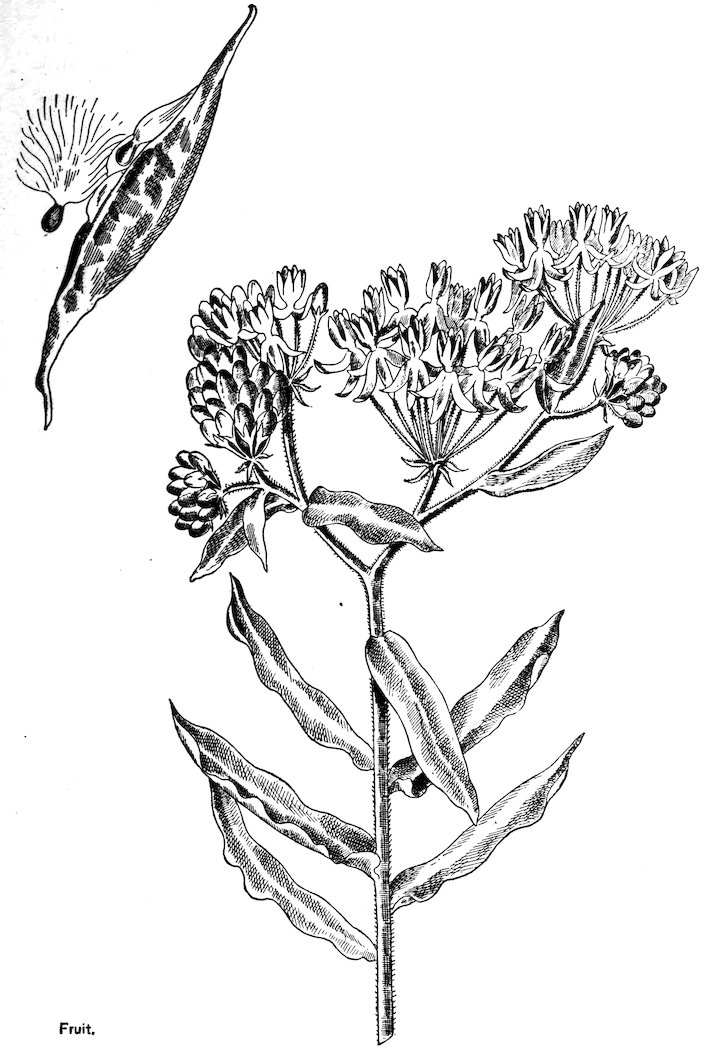
PLATE LXXXI BUTTERFLY-WEED.—A. tuberosa.
224
European Hawkweed. Devil’s Paintbrush. Hieracium aurantiacum. Composite Family (p. 13).
Stem.—Hairy, erect. Leaves.—Hairy, oblong, close to the ground. Flower-heads.—Orange-red, composed entirely of strap-shaped flowers, clustered.
In parts of New York and of New England the midsummer meadows are ablaze with the brilliant orange-red flowers of this striking European weed. It is among the more recent emigrants to this country and bids fair to become an annoyance to the farmer, hence its not altogether inappropriate title of devil’s paintbrush. In England it was called “Grimm the Collier,” on account of its black hairs and after a comedy of the same title which was popular during the reign of Queen Elizabeth. Both its common and generic names refer to an ancient superstition to the effect that birds of prey used the juice of this genus to strengthen their eyesight.
Oswego Tea. Bee Balm. Monarda didyma. Mint Family (p. 16).
Stem.—Square, erect, about two feet high. Leaves.—Opposite, ovate, pointed, aromatic; those near the flowers tinged with red. Flowers.—Bright red, clustered in a close round head. Calyx.—Reddish, five-toothed. Corolla.—Elongated, tubular, two-lipped. Stamens.—Two, elongated, protruding. Pistil.—One, with a two-lobed style, protruding.
We have so few red flowers that when one flashes suddenly upon us it gives us a pleasant thrill of wonder and surprise. Then red flowers know so well how to enhance their beauty by seeking an appropriate setting. They select the rich green backgrounds only found in moist, shady places, and are peculiarly charming when associated with a lonely marsh or a mountain brook. The bee balm especially haunts these cool nooks, and its rounded flower-clusters touch with warmth the shadows of the damp woods of midsummer. The Indians named the flower O-gee-chee—flaming flower, and are said to have made a tea-like decoction from the blossoms.
225
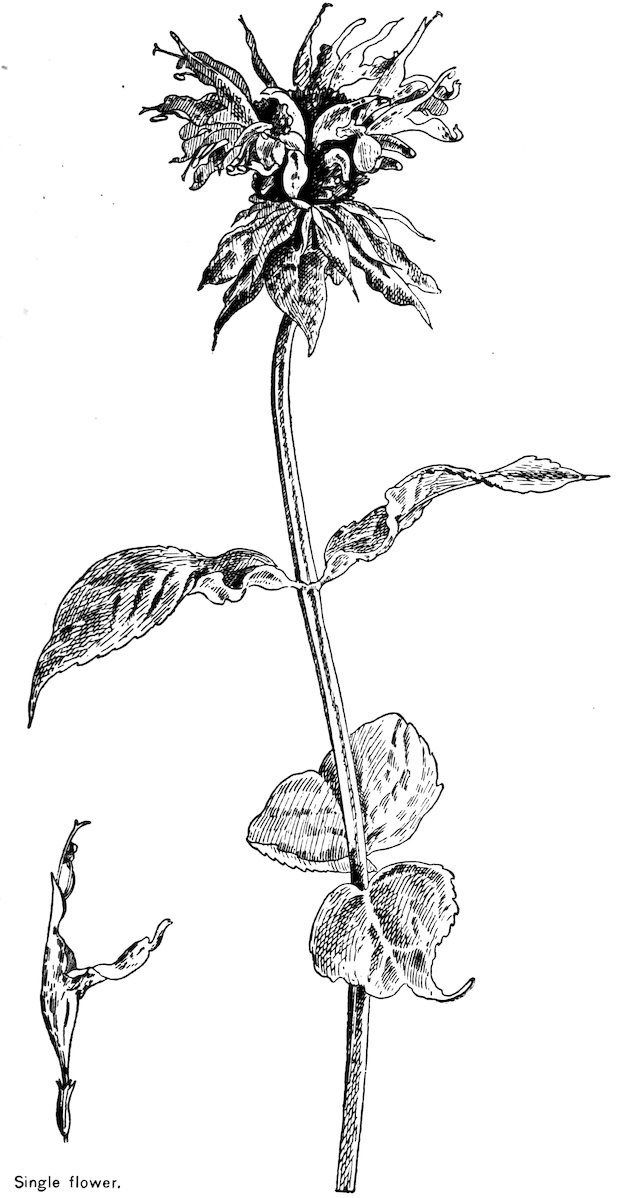
PLATE LXXXII OSWEGO TEA.—M. didyma.
226
Pimpernel. Poor-Man’s-Weather-Glass. Anagallis arvensis. Primrose Family.
Stems.—Low, spreading. Leaves.—Opposite, ovate, set close to the stem. Flowers.—Red, occasionally blue or white, growing singly from the axils of the leaves. Calyx.—Five-parted. Corolla.—Five-parted, wheel-shaped. Stamens.—Five, with bearded filaments. Pistil.—One.
This flower is found in sandy fields, being noted for its sensitiveness to the weather. It folds its petals at the approach of rain, and fails to open at all on a wet or cloudy day. Even in fine weather it closes in the early afternoon and “sleeps” till the next morning. Its ripened seeds are of value as food for many songbirds. It was thought at one time to be serviceable in liver complaints, which reputed virtue may have given rise to the old couplet:
No ear hath heard, no tongue can tell
The virtues of the pimpernel.
Cardinal-flower. Lobelia cardinalis. Lobelia Family.
Stem.—From two to four feet high. Leaves.—Alternate, narrowly oblong, slightly toothed. Flowers.—Bright red, growing in a raceme. Calyx.—Five-cleft. Corolla.—Somewhat two-lipped, the upper lip of two rather erect lobes, the lower spreading and three-cleft. Stamens.—Five, united into a tube. Pistil.—One, with a fringed stigma.
We have no flower which can vie with this in vivid coloring. In late summer its brilliant red gleams from the marshes or is reflected from the shadowy water’s edge with unequalled intensity——
As if some wounded eagle’s breast
Slow throbbing o’er the plain,
Had left its airy path impressed
In drops of scarlet rain.[10]
The early French Canadians were so struck with its beauty that they sent the plant to France as a specimen of what the wilds of the New World could yield. Perhaps at that time it received its English name which likens it to the gorgeously attired dignitaries of the Roman Church.
227
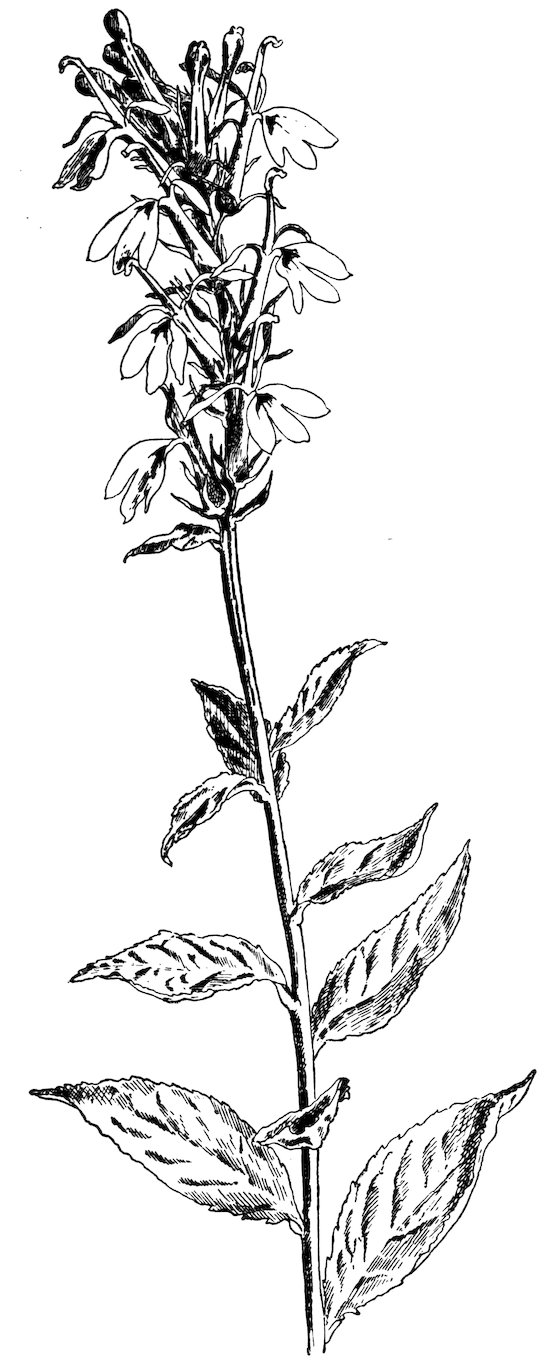
PLATE LXXXIII CARDINAL-FLOWER.—L. cardinalis.
228
Trumpet Honeysuckle. Lonicera sempervirens. Honeysuckle Family.
A twining shrub. Leaves.—Entire, opposite, oblong, the upper pairs united around the stem. Flowers.—Deep red without, yellowish within; in close clusters from the axils of the upper leaves. Calyx.—With very short teeth. Corolla.—Trumpet-shaped, five-lobed. Stamens.—Five. Pistil.—One. Fruit.—A red or orange berry.
Many of us are so familiar with these flowers in our gardens that we have, perhaps, considered them “escapes” when we found them brightening the pasture thicket where really they are most at home, appearing at any time from May till October.
The fragrant woodbine, L. grata, is also frequently cultivated. Its natural home is the rocky woodlands, where its sweet-scented whitish or yellowish flowers appear in May. Its stamens and style protrude conspicuously beyond the corolla-tube, which is an inch in length.
The greenish or yellowish flowers of the fly honeysuckle, L. ciliata, grow in pairs. They are found in the rocky woods of May, on an erect, bushy shrub, the leaves of which are all distinct, never meeting about the stem.
229
V BLUE AND PURPLE
Liverwort. Liver-leaf. Hepatica triloba. Crowfoot Family.
Scape.—Fuzzy, one-flowered. Leaves.—Rounded, three-lobed, from the root. Flowers.—Blue, white, or pinkish. Calyx.—Of six to twelve petal-like sepals; easily taken for a corolla, because directly underneath are three little leaves which resemble a calyx. Corolla.—None. Stamens.—Usually numerous. Pistils.—Several.
The liver-leaf puts forth her sister blooms
Of faintest blue—
soon after the late snows have melted. Indeed these fragile-looking, enamel-like flowers are sometimes found actually beneath the snow, and form one of the many instances which we encounter among flowers, as among their human contemporaries, where the frail and delicate-looking withstand storm and stress far better than their more robust-appearing brethren. We welcome these tiny newcomers with especial joy, not alone for their delicate beauty, but because they are usually the first of all the flowers upon the scene of action, if we rule out the never-tardy skunk-cabbage. The rusty leaves of last summer are obliged to suffice for the plant’s foliage until some little time after the blossoms have appeared, when the young fresh leaves begin to uncurl themselves. Some one has suggested that the fuzzy little buds look as though they were still wearing their furs as a protection against the wintry weather which so often stretches late into our spring. The flowers vary in color from a lovely blue to pink or white. They are found chiefly in the woods, but occasionally on the sunny hill-sides as well.
The generic name, Hepatica, is from the Greek for liver, and was probably given to the plant on account of the shape of its leaf. Dr. Prior says that “in consequence of this fancied likeness 230it was used as a remedy for liver complaints, the common people having long labored under the belief that nature indicated in some such fashion the uses to which her creations might be applied.”
Common Blue Violet. Viola cucullata. Violet Family.
Scape.—Slender, one-flowered. Leaves.—Heart-shaped, all from the root. Flowers.—Varying from a pale blue to deep purple, borne singly on a scape. Calyx.—Of five sepals extended into ears at the base. Corolla.—Of five somewhat unequal petals, the lower one spurred at the base. Stamens.—Short and broad, somewhat united around the pistil. Pistil.—One with a club-shaped style and bent stigma.
Perhaps this is the best-beloved as well as the best known of the early wild flowers. Whose heart has not been gladdened at one time or another by a glimpse of some fresh green nook in early May where
—purple violets lurk,
With all the lovely children of the shade?
It seems as if no other flower were so suggestive of the dawning year, so associated with the days when life was full of promise. Although I believe that more than a hundred species of violets have been recorded, only about thirty are found in our country; of these perhaps twenty are native to the Northeastern States. Unfortunately we have no strongly sweet-scented species, none
—sweeter than the lids of Juno’s eyes
Or Cytherea’s breath,—
as Shakespeare found the English blossom. Prophets and warriors as well as poets have favored the violet; Mahomet preferred it to all other flowers, and it was chosen by the Bonapartes as their emblem.
Perhaps its frequent mention by ancient writers is explained by the discovery that the name was one applied somewhat indiscriminately to sweet-scented blossoms.
231
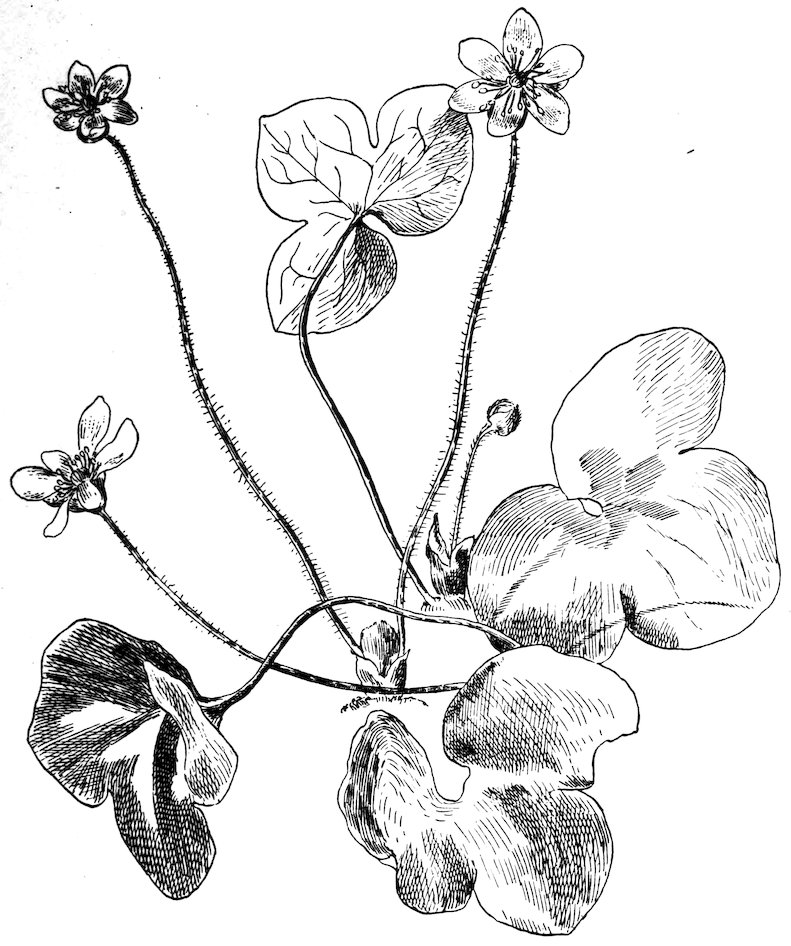
PLATE LXXXIV LIVERWORT.—H. triloba.
232The bird-foot violet, V. pedata, unlike other members of the family, has leaves which are divided into linear lobes. Its flower is peculiarly lovely, being large and velvety. The variety, V. bicolor, is especially striking and pansy-like, its two upper petals being of a deeper hue than the others. It is found in the neighborhood of Washington in abundance, and on the shaly soil of New Jersey.
An interesting feature of many of these plants is their cleistogamous flowers. These are small and inconspicuous blossoms, which never open (thus guarding their pollen against all depredations), but which are self-fertilized, ripening their seeds in the dark. They are usually found near or beneath the ground, and are often taken for immature buds.
Dog Violet. Viola canina, var. Muhlenbergii. Violet Family.
Three to eight inches high. Stems.—Leafy. Leaves.—Heart-shaped, wavy-toothed. Flowers.—Pale violet.
This is the commonest blue species of the leafy-stemmed violets. It is found in wet, shady places from May till July.
Bluets. Quaker Ladies. Houstonia cærulea. Madder Family.
Stem.—Erect, three to five inches high. Leaves.—Very small, opposite. Flowers.—Small, delicate blue, lilac, or nearly white, with a yellowish eye. Calyx.—Four-lobed. Corolla.—Salver-shaped, four-lobed, corolla-tube long and slender. Stamens.—Four. Pistil.—One, with two stigmas.
No one who has been in the Berkshire Hills during the month of May can forget the loveliness of the bluets. The roadsides, meadows, and even the lawns, are thickly carpeted with the dainty enamel-like blossoms which are always pretty, but which seem to flourish with especial vigor and in great profusion in this lovely region. Less plentiful, perhaps, but still common is the little plant in grassy places far south and west, blossoming in early spring.
233
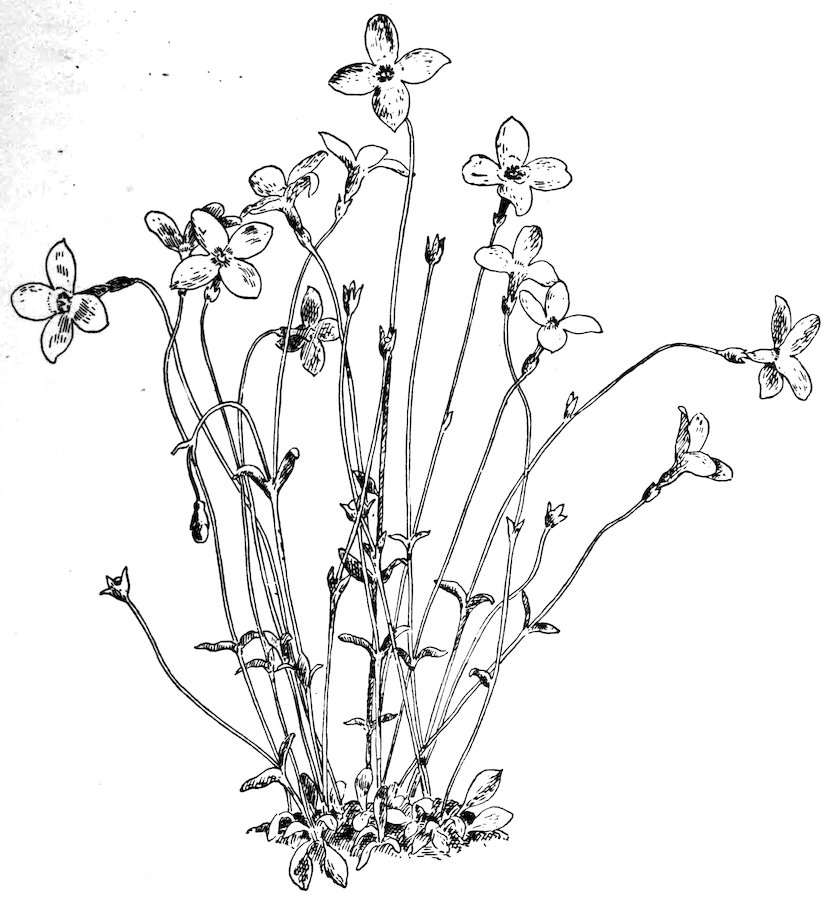
PLATE LXXXV BLUETS.—H. cærulea.
234The flowers are among those which botanists term “dimorphous.” This word signifies occurring in two forms, and refers to the stamens and pistils, which vary in size, some flowers having a tall pistil and short stamens, others tall stamens and a short pistil. Darwin has proved, not only that one of these flowers can seldom fully fertilize itself, but that usually the blossoms with tall pistils must be fertilized with pollen from the tall stamens, and that the short pistils are only acted upon by the short stamens. With a good magnifier and a needle these two forms can easily be studied. This is one of the many interesting safeguards against close-fertilization.
Bluebells. Virginian Cowslip. Lungwort. Mertensia Virginica. Borage Family.
One to two feet high. Stem.—Smooth, pale, erect. Leaves.—Oblong, veiny. Flowers.—Blue, pinkish in bud, in raceme-like clusters which are rolled up from the end and straighten as the flowers expand. Calyx.—Five-cleft. Corolla.—Trumpet-shaped, one inch long, spreading. Stamens.—Five. Pistil.—One.
These very lovely blossoms are found in moist places during April and May in parts of New York as well as south and westward. The English naturalist, Mr. Alfred Wallace, seeing them, for the first time, in the vicinity of Cincinnati, writes in the Fortnightly Review: “In a damp river-bottom, the exquisite blue Mertensia Virginica was found. It is called here the ‘Virginian cowslip,’ its drooping porcelain-blue bells being somewhat of the size and form of those of the true cowslip.”
Blue-eyed Mary. Innocence. Collinsia verna. Figwort Family.
Six to twenty inches high. Stems.—Branching, slender. Leaves.—Opposite, the lower oval, the upper ovate—lance-shaped, clasping by the heart-shaped base. Flowers.—Blue and white, long-stalked, appearing whorled in the axils of the upper leaves. Calyx.—Deeply five-cleft. Corolla.—Deeply two-lipped, the upper lip two-cleft, the lower three-cleft. Stamens.—Four. Pistil.—One.
Unfortunately these dainty flowers are not found farther east than Western New York. From there they spread south and westward, abounding so plentifully in the vicinity of Cincinnati that the moist meadows are blue with their blossoms in spring or early summer.
235
Forget-me-not. Myosotis laxa. Borage Family.
Stems.—Slender. Leaves.—Alternate, lance-oblong. Flowers.—Blue, small, growing in a raceme. Calyx.—Five-lobed. Corolla.—Salver-shaped, five-toothed. Stamens.—Five. Pistil.—One.
Along the banks of the stream, and in low wet places, we may look for these exquisite little flowers. This plant is smaller and less luxuriant than the European species, blossoming in early summer.
Wild Phlox. Phlox divaricata. Polemonium Family.
Nine to eighteen inches high. Stems.—Spreading or ascending. Leaves.—Opposite, oblong or lance-oblong, Flowers.—Pale lilac-purple, in a loose, spreading cluster. Calyx.—With five slender teeth. Corolla.—With a five-parted border, salver-shaped, with a long tube. Stamens.—Five, unequally inserted in the tube of the corolla. Pistil.—One, with a three-lobed style.
We may search for these graceful, delicately tinted flowers in the rocky woods of April and May.
Nearly allied to them is the wild sweet William, P. maculata, the pink-purple blossoms of which are found along the streams and in the rich woods of somewhat southern localities.
The beautiful moss pink, P. subulata, is also a member of this genus. This little evergreen heath-like plant clothes the dry hill-sides with a glowing mantle of purple-pink every spring, Southern New York being probably its most northerly range in our Eastern States. Great masses of these flowers may be seen covering the rocks in the Central Park in May.
The pink or whitish clusters of P. glaberrima are found in the open woods and prairies somewhat westward in July.
Robin’s Plantain. Blue Spring-daisy. Erigeron bellidifolius. Composite Family (p. 13).
Stem.—Simple, hairy, producing offsets from the base. Root-leaves.—Somewhat rounded or wedge-shaped. Stem-leaves.—Somewhat oblong, lance-shaped, partly clasping. Flower-heads.—Rather large, on slender flower-stalks, composed of both strap-shaped and tubular flowers, the former (ray-flowers) bluish-purple, the latter (disk-flowers) yellow.
This is one of the earliest members of the Composite family to make its appearance, that great tribe being usually associated 236with the late summer months. The flower might easily be taken for a purple aster which had mistaken the season, or for a blue daisy, as one of its common names suggests. E. Philadelphicus is a later very similar species with smaller flower-heads.
One-flowered Cancer-root. Aphyllon uniflorum. Broom-Rape Family.
Scape.—Slender, fleshy, three to five inches high, one-flowered. Leaves.—None. Flower.—Pale purple, solitary, one inch long, with a delicate fragrance. Calyx.—Five-cleft. Corolla.—Somewhat two-lipped, with two yellow bearded folds in the throat. Stamens.—Four. Pistil.—One.
In April or May the odd pretty flower of the parasitic one-flowered cancer-root is found in the damp woodlands.
Violet Wood Sorrel. Oxalis violacea. Geranium Family.
Scape.—Five to nine inches high, several-flowered. Leaves.—Divided into three clover-like leaflets. Flowers.—Violet-colored, clustered on the scape. Calyx.—Of five sepals. Corolla.—Of five petals. Stamens.—Ten. Pistil.—One, with five styles.
This little plant is found in somewhat open or rocky woods, its lovely delicate flower-clusters appearing in May or June. This species is more common southward, while the pink-veined wood sorrel (Pl. XVII.) abounds in the cool woods of the North.
Pitcher-Plant. Side-saddle Flower. Huntsman’s Cup. Sarracenia purpurea. Pitcher-plant Family.
Scape.—Naked, one-flowered, about one foot high. Leaves.—Pitcher-shaped, broadly winged, hooded. Flower.—Red-purple, large, nodding. Calyx.—Of five colored sepals, with three bractlets at the base. Corolla.—Of five fiddle-shaped petals which are arched over the greenish-yellow style. Stamens.—Numerous. Pistil.—One, with a short style which expands at the summit into a petal-like umbrella-shaped body, with five small hooked stigmas.
237
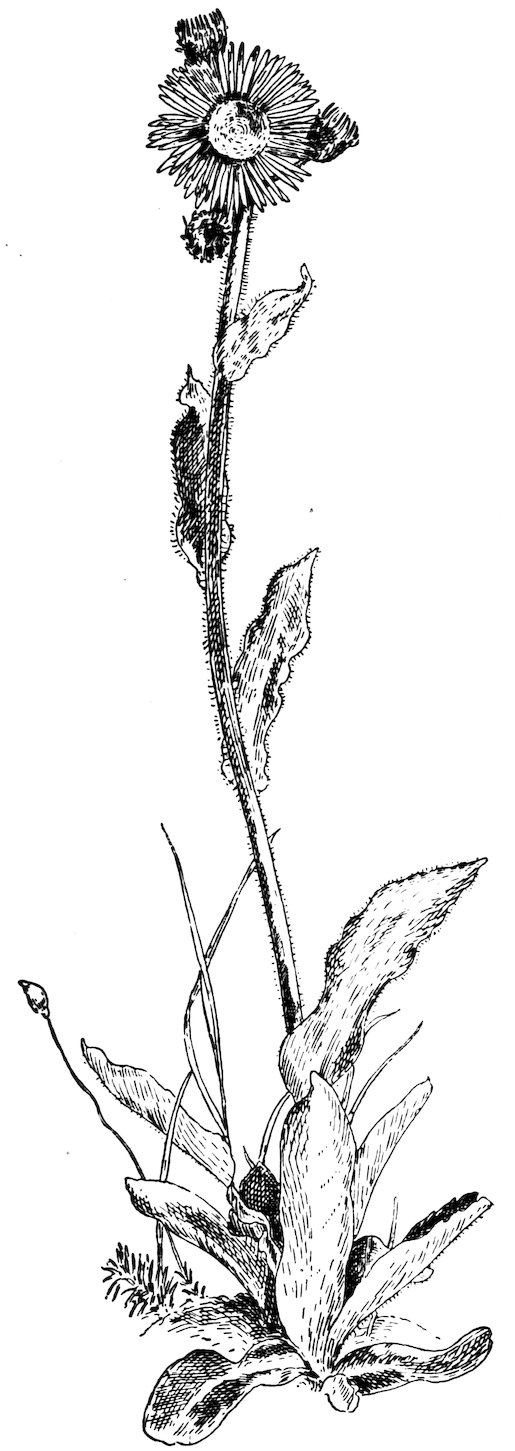
PLATE LXXXVI ROBIN’S PLANTAIN.—E. bellidifolius.
238The large nodding flower of the pitcher-plant may be found during June in the peat-bogs of New England as well as farther south and west. It is less familiar to most people than the curious pitcher-like leaves, which are usually partially filled with water and drowned insects; part of their inner surface being covered with a sugary exudation, below which, for a space, they are highly polished, while on the lower portion grow the stiff bristles which point downward. Insects attracted by the sugary secretion find themselves prisoners, as they can seldom fight their way through the opposing bristles, neither can they usually escape by such a perpendicular flight as would be necessary from the form of the cavity. The decomposed bodies of these unfortunates are supposed to contribute to the nourishment of the plant, as it is hardly probable that this elaborate contrivance answers no special purpose.
Wild Geranium. Wild Cranesbill. Geranium maculatum. Geranium Family.
Stem.—Erect, hairy. Leaves.—About five-parted, the divisions lobed and cut. Flowers.—Pale pink-purple, rather large. Calyx.—Of five sepals. Corolla.—Of five petals. Stamens.—Ten. Pistil.—With five styles, which split apart at maturity so elastically as to discharge the seeds to some distance.
In spring and early summer the open woods and shaded roadsides are abundantly brightened with these graceful flowers. They are of peculiar interest because of their close kinship with the species, G. pratense, which first attracted the attention of the German scholar, Sprengel, to the close relations existing between flowers and insects. The beak-like appearance of its fruit give the plant both its popular and scientific names, for geranium is from the Greek for crane. The specific title, maculatum, refers to the somewhat blotched appearance of the older leaves.
Gill-over-the-Ground. Ground Ivy. Nepeta Glechoma. Mint Family (p. 16).
Stems.—Creeping and trailing. Leaves.—Small and kidney-shaped. Flowers.—Bluish-purple, loosely clustered in the axils of the leaves. Calyx.—Five-toothed. Corolla.—Two-lipped, the upper lip erect and two-cleft, the lower spreading and three-cleft. Stamens.—Four. Pistil.—One, two-lobed at the apex.
239
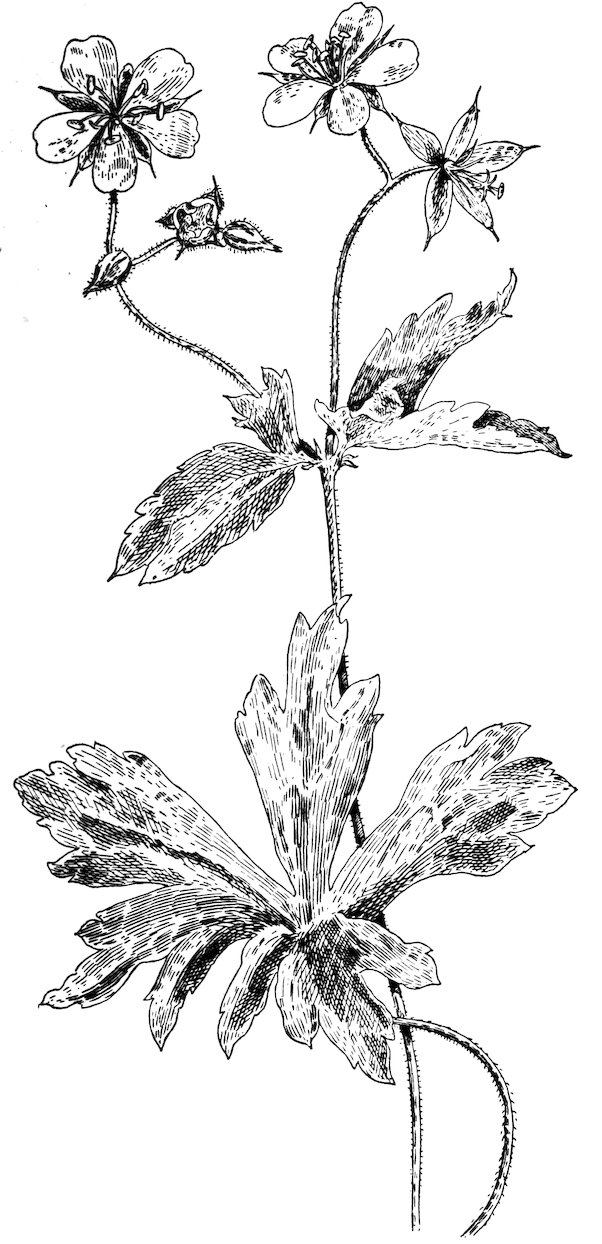
PLATE LXXXVII WILD GERANIUM.—G. maculatum.
240As the pleasant aroma of its leaves suggest, this little plant is closely allied to the catnip. Its common title of Gill-over-the-ground, appeals to one who is sufficiently without interest in pasture-land (for it is obnoxious to cattle) to appreciate the pleasant fashion in which this little immigrant from Europe has made itself at home here, brightening the earth with such a generous profusion of blossoms every May. But it is somewhat of a disappointment to learn that this name is derived from the French guiller, and refers to its former use in the fermentation of beer. Oddly enough the name of alehoof, which the plant has borne in England and which naturally has been supposed to refer to this same custom, is said by a competent authority (Professor Earle, of Oxford) to have no connection with it, but to signify another sort of hofe, hofe being the early English name for the violet, which resembles these flowers in color.
The plant was highly prized formerly as a domestic medicine. Gerarde claims that “boiled in mutton-broth it helpeth weake and akeing backs.”
Larkspur. Delphinium. Crowfoot Family.
Six inches to five feet high. Leaves.—Divided or cut. Flowers.—Blue or purplish, growing in terminal racemes. Calyx.—Of five irregular petal-like sepals, the upper one prolonged into a spur. Corolla.—Of four irregular petals, the upper pair continued backward in long spurs which are enclosed in the spur of the calyx, the lower pair with short claws. Stamens.—Indefinite in number. Pistils.—One to five, forming pods in fruit.
In April and May the bright blue clusters of the dwarf larkspur, D. tricorne, are noticeable in parts of the country. Unfortunately they are not found east of Western Pennsylvania.
The tall wand-like purplish racemes of the tall larkspur, D. exaltatum, are found in July in the rich soil of Pennsylvania, and much farther south and west as well.
Wild Lupine. Lupinus perennis. Pulse Family (p. 16).
Stem.—Erect, one to two feet high. Leaves.—Divided into seven to eleven leaflets. Flowers.—Blue, papilionaceous, showy, in a long raceme. Pod.—Broad, hairy.
In June and July the long bright clusters of the wild lupine are very noticeable in many of our sandy fields. Its pea-like 241blossoms serve to easily identify it. Under date of June 8th, Thoreau writes: “The lupine is now in its glory.... It paints a whole hill-side with its blue, making such a field (if not meadow) as Proserpine might have wandered in. Its leaf was made to be covered with dewdrops. I am quite excited by this prospect of blue flowers in clumps, with narrow intervals, such a profusion of the heavenly, the Elysian color, as if these were the Elysian fields.... That is the value of the lupine. The earth is blued with it.”
Harebell. Campanula rotundifolia. Campanula Family.
Stem.—Slender, branching, from five to twelve inches high. Root-leaves.—Heart-shaped or ovate, early withering. Stem-leaves.—Numerous, long and narrow. Flowers.—Bright blue, nodding from hair-like stalks. Calyx.—Five-cleft, the lobes awl-shaped. Corolla.—Bell-shaped, five-lobed. Stamens.—Five. Pistil.—One, with three stigmas.
This slender, pretty plant, hung with its tremulous flowers, springs from the rocky cliffs which buttress the river as well as from those which crown the mountain. I have seen the west shore of the Hudson bright with its delicate bloom in June, and the summits of the Catskills tinged with its azure in September. The drooping posture of these flowers protect their pollen from rain or dew. They have come to us from Europe, and are identical, I believe, with the celebrated Scotch bluebells.
Blue-eyed Grass. Sisyrinchium angustifolium. Iris Family.
Four to twelve inches high. Leaves.—Narrow and grass-like. Flowers.—Blue or purple, with a yellow centre. Perianth.—Six-parted, the divisions bristle-pointed. Stamens.—Three, united. Pistil.—One, with three thread-like stigmas.
For the sun is no sooner risen with a burning heat,
But it withereth the grass,
And the flower thereof falleth,
And the grace of the fashion of it perisheth.
So reads the passage in the Epistle of James, which seems so graphically to describe the brief life of this little flower, that we 242might almost believe the Apostle had had it in mind, were it to be found in the East.
The blue-eyed grass belongs to the same family as the showy fleur-de-lis and blossoms during the summer, being especially plentiful in moist meadows. It is sometimes called “eye-bright,” which name belongs by rights to Euphrasia officinalis.
Venus’s Looking-glass. Specularia perfoliata. Campanula Family.
Stem.—Somewhat hairy, three to twenty inches high. Leaves.—Toothed, rounded, clasping by the heart-shaped base. Flowers.—Blue. Calyx.—Three, four, or five-lobed. Corolla.—Wheel-shaped, five-lobed. Stamens.—Five. Pistil.—One, with three stigmas.
We borrow from Mr. Burroughs’s “Bunch of Herbs” a description of this little plant, which blossoms from May till August. “A pretty and curious little weed, sometimes found growing in the edge of the garden, is the clasping specularia, a relative of the harebell and of the European Venus’s looking-glass. Its leaves are shell-shaped, and clasp the stalk so as to form little shallow cups. In the bottom of each cup three buds appear that never expand into flowers, but when the top of the stalk is reached, one and sometimes two buds open a large, delicate purple-blue corolla. All the first-born of this plant are still-born as it were; only the latest, which spring from its summit, attain to perfect bloom.”
Skull-cap. Scutellaria. Mint Family (p. 16).
Stem.—Square, usually one or two feet high. Leaves.—Opposite, oblong, lance-shaped or linear. Flowers.—Blue. Calyx.—Two-lipped, the upper lip with a small, helmet-like appendage which at once identifies this genus. Corolla.—Two-lipped, the upper lip arched, the lateral lobes mostly connected with the upper lip, the lower lip spreading and notched at the apex. Stamens.—Four, in pairs. Pistil.—One, with a two-lobed style.
The prettiest and most striking of this genus is the larger skull-cap, S. integrifolia, whose bright blue flowers are about one inch long, growing in terminal racemes. In June and July they may be found among the long grass of the roadsides and meadows. They are easily identified by the curious little appendage on the upper part of the calyx, which gives to this genus its common name.
243
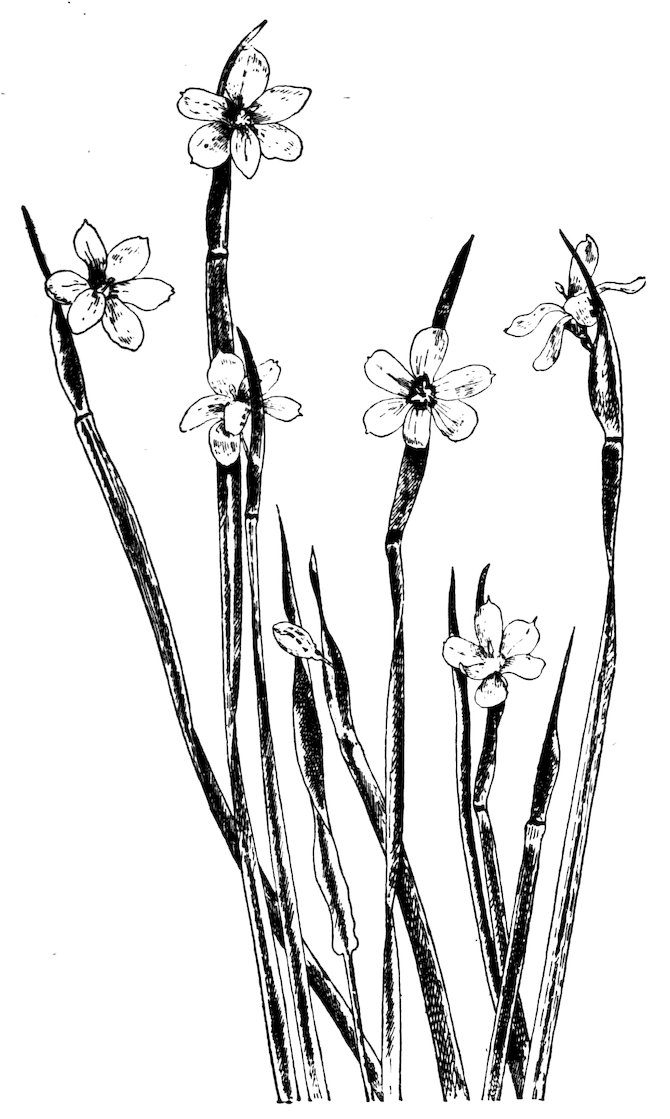
PLATE LXXXVIII BLUE-EYED GRASS.—S. angustifolium.
244Perhaps the best-known member of the group is the mad-dog skull-cap, S. lateriflora, which delights in wet places, bearing small, inconspicuous flowers in one-sided racemes. This plant is quite smooth, while that of S. integrifolia is rather downy. It was formerly believed to be a sure cure for hydrophobia.
S. galericulata is usually found somewhat northward. Its flowers are much larger than those of S. lateriflora, but smaller than those of S. integrifolia. They grow singly from the axils of the upper leaves.
Fleur-de-lis. Larger Blue Flag. Iris versicolor. Iris Family.
Stem.—Stout, angled on one side, leafy, one to three feet high. Leaves.—Flat and sword-shaped, with their inner surfaces coherent for about half of their length. Flowers.—Large and showy, violet-blue, variegated with green, yellow, or white; purple-veined. Perianth.—Six-cleft, the three outer divisions recurved, the three inner smaller and erect. Stamens.—Three, covered by the three overarching, petal-like divisions of the style. Pistil.—One, with its style cleft into three petal-like divisions, each of which bears its stigma on its inner surface.
Born in the purple, born to joy and pleasance,
Thou dost not toil nor spin,
But makest glad and radiant with thy presence
The meadow and the lin.[11]
In both form and color this is one of the most regal of our wild flowers, and it is easy to understand why the fleur-de-lis was chosen as the emblem of a royal house, although the especial flower which Louis VII. of France selected as his badge was probably white.
It will surprise most of us to learn that the common name which we have borrowed from the French does not signify “flower-of-the-lily,” as it would if literally translated, but “flower of Louis,” lis being a corruption of the name of the king who first adopted it as his badge.
245
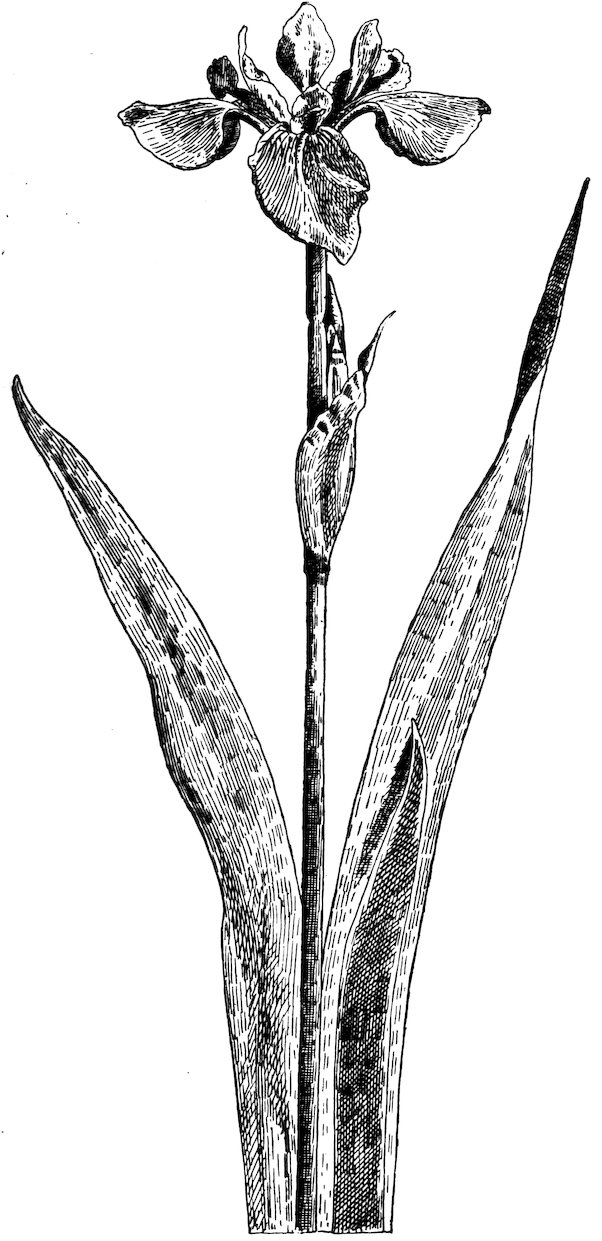
PLATE LXXXIX FLEUR-DE-LIS.—I. versicolor.
246For the botanist the blue-flag possesses special interest. It is a conspicuous example of a flower which has guarded itself against self-fertilization, and which is beautifully calculated to secure the opposite result. The position of the stamens is such that their pollen could not easily reach the stigmas of the same flower, for these are borne on the inner surface of the petal-like, overarching styles. There is no prospect here of any seed being set unless the pollen of another flower is secured. Now what are the chances in favor of this? They are many: In the first place the blossom is unusually large and showy, from its size and shape alone almost certain to arrest the attention of the passing bee; next, the color is not only conspicuous, but it is also one which has been found to be especially attractive to bees; blue and purple flowers being particularly sought by these insects. When the bee reaches the flower he alights on the only convenient landing-place, one of the recurved sepals; following the deep purple veins which experience has taught him lead to the hidden nectar, he thrusts his head below the anther, brushing off its pollen, which he carries to another flower.
The rootstocks of the Florentine species of iris yield the familiar “orris-root.”
The family name is from the Greek for rainbow, on account of the rich and varied hues of its different members.
The plant abounds in wet meadows, the blossoms appearing in June.
American Brooklime. Veronica Americana. Figwort Family.
Stem.—Smooth, reclining at base, then erect, eight to fifteen inches high. Leaves.—Mostly opposite, oblong, toothed. Flowers.—Blue, clustered in the axils of the leaves. Calyx.—Four-parted. Corolla.—Wheel-shaped, four-parted. Stamens.—Two. Pistil.—One.
Perhaps the prettiest of the blue Veronicas is the American brooklime. Its clustered flowers make bright patches in moist ground which might, at a little distance, be mistaken for beds of forget-me-nots. It blossoms from June till August, and is almost as common in wet ditches and meadows as its sister, the common speedwell, is in dry and open places. Some of the members of this genus were once believed to possess great medicinal virtues, and won for themselves in Europe the laudatory names of Honor and Praise.
247
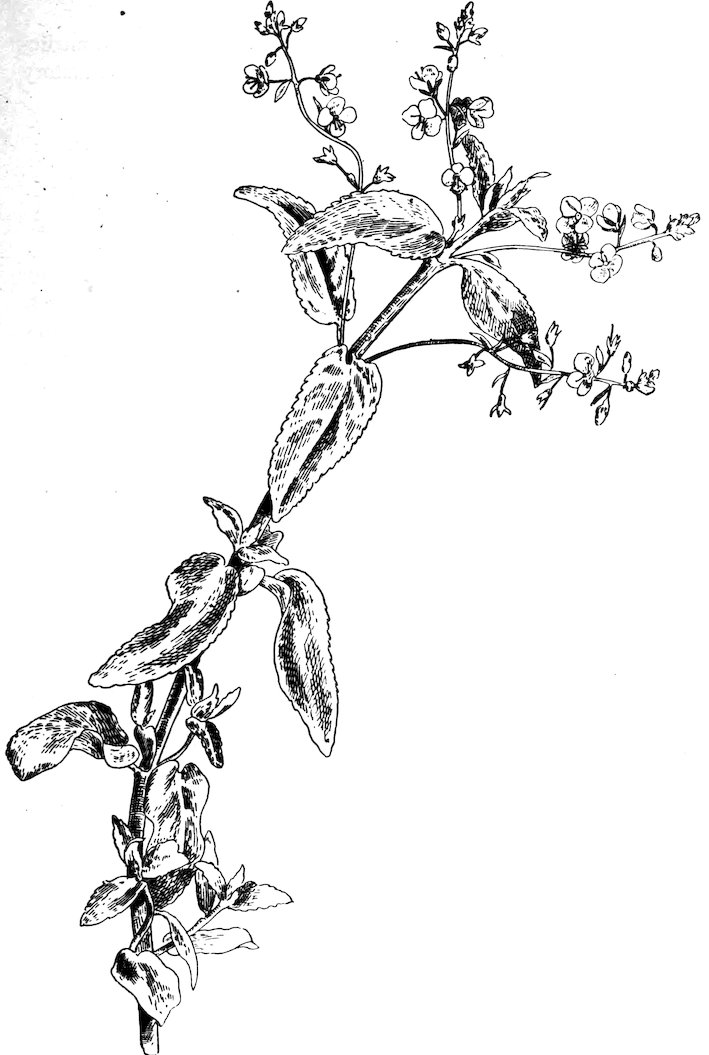
PLATE XC AMERICAN BROOKLIME.—V. Americana.
248
Common Speedwell. Veronica officinalis. Figwort Family.
The little speedwell’s darling blue
is noticeable during June and July, when clusters of these tiny flowers brighten many a waste spot along the sunny roadsides. This is a hairy little plant, with a stem which lies upon the ground and takes root, thus spreading itself quickly over the country.
Arethusa. Arethusa bulbosa. Orchis Family (p. 17).
Scape.—Sheathed, from a globular bulb, usually one-flowered. Leaf.—“Solitary, linear, nerved, hidden in the sheaths of the scape, protruding after flowering.” (Gray.) Flower.—Rose-purple, large, with a bearded lip.
In some localities this beautiful flower is very plentiful. Every June will find certain New England marshes tinged with its rose-purple blossoms, while in other near and promising bogs it may be sought vainly for years. At least it may be hoped for in wet places as far south as North Carolina, its most favorite haunt being perhaps a cranberry-swamp. Concerning it, Mr. Burroughs writes: “Arethusa was one of the nymphs who attended Diana, and was by that goddess turned into a fountain, that she might escape the god of the river Alpheus, who became desperately in love with her on seeing her at her bath. Our Arethusa is one of the prettiest of the orchids, and has been pursued through many a marsh and quaking-bog by her lovers. She is a bright pink-purple flower an inch or more long, with the odor of sweet violets. The sepals and petals rise up and arch over the column, which we may call the heart of the flower, as if shielding it. In Plymouth County, Mass., where the Arethusa seems common, I have heard it called Indian pink.”
249
Purple Fringed Orchises. Orchis Family (p. 17).
Habenaria fimbriata.
Leaves.—Oval or oblong; the upper, few, passing into lance-shaped bracts. Flowers.—Purple, rather large; with a fan-shaped, three-parted lip, its divisions fringed; with a long curving spur; growing in a spike.
Habenaria psycodes.
Leaves.—Oblong or lance-shaped, the upper passing into linear bracts. Flowers.—Purple, fragrant, resembling those of H. fimbriata, but much smaller, with a less fringed lip; growing in a spike.
We should search the wet meadows in early June if we wish to be surely in time for the larger of the purple fringed orchises, for H. fimbriata somewhat antedates H. psycodes, which is the commoner species of the two and appears in July. Under date of June 9th, Thoreau writes: “Find the great fringed orchis out apparently two or three days, two are almost fully out, two or three only budded; a large spike of peculiarly delicate, pale purple flowers growing in the luxuriant and shady swamp, amid hellebores, ferns, golden senecio, etc.... The village belle never sees this more delicate belle of the swamp.... A beauty reared in the shade of a convent, who has never strayed beyond the convent-bell. Only the skunk or owl, or other inhabitant of the swamp, beholds it.”
American Pennyroyal. Hedeoma pulegioides. Mint Family (p. 16).
Stem.—Square, low, erect, branching Leaves.—Opposite, aromatic, small. Flowers.—Purplish, small, whorled in the axils of the leaves. Calyx.—Two-lipped, upper lip three-toothed, the lower two-cleft. Corolla.—Two-lipped, upper erect, notched at apex, the lower spreading and three-cleft. Fertile stamens.—Two. Pistil.—One, with a two-lobed style.
This well-known, strong-scented little plant is found throughout the greater part of the country, blossoming in midsummer. 250Its taste and odor nearly resemble that of the true pennyroyal, Mentha pulegium, of Europe.
Monkey-flower. Mimulus ringens. Figwort Family.
Stem.—Square, one to two feet high. Leaves.—Opposite, oblong or lance-shaped. Flowers.—Pale violet-purple, rarely white, growing singly from the axils of the leaves. Calyx.—Five-angled, five-toothed, the upper tooth largest. Corolla.—Tubular, two-lipped, the upper lip erect or spreading, two-lobed, the lower spreading and three-lobed, the throat closed. Stamens.—Four. Pistil.—One, with a two-lobed stigma.
From late July onward the monkey-flowers tinge the wet fields and border the streams and ponds; not growing in the water like the pickerel-weed, but seeking a hummock in the swamp, or a safe foothold on the brook’s edge, where they can absorb the moisture requisite to their vigorous growth.
The name is a diminutive of mimus—a buffoon, and refers to the somewhat grinning blossom. The plant is a common one throughout the eastern part of the country.
Common Motherwort. Leonurus cardiaca. Mint Family (p. 16).
Stem.—Tall and upright. Leaves.—Opposite, the lower rounded and lobed, the floral wedge-shaped at base and three-cleft. Flowers.—Pale purple, in close whorls in the axils of the leaves. Calyx.—“With five nearly equal teeth, which are awl-shaped, and when old rather spiny, pointed, and spreading.” (Gray.) Corolla.—Two-lipped, the upper lip somewhat arched and bearded, the lower three-lobed and spreading. Stamens.—Four, in pairs. Pistil.—One, with a two-lobed style.
The tall erect stems, opposite leaves, and regular whorls of closely clustered pale purple flowers help us to easily identify the motherwort, if identification be needed, for it seems as though such old-fashioned, time-honored plants as catnip, tansy, and motherwort, which cling so persistently to the skirts of the old homestead in whose domestic economy they once played so important a part, should be familiar to us all.
251
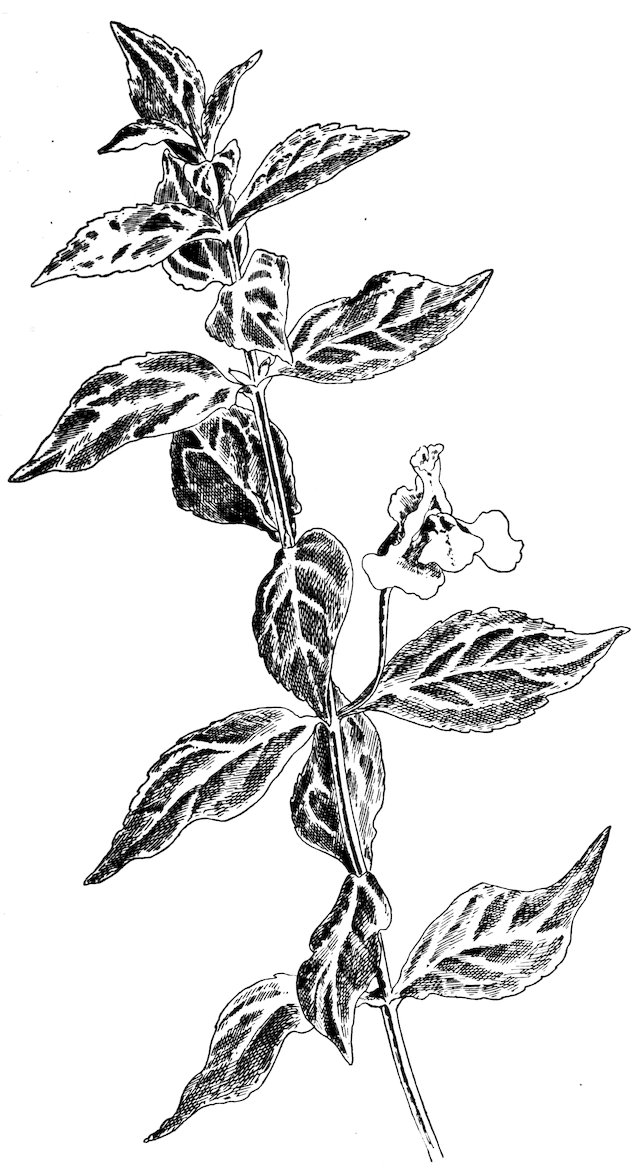
PLATE XCI MONKEY-FLOWER.—M. ringens.
252
Corn Cockle. Lychnis Githago. Pink Family.
About two feet high. Leaves.—Opposite, long and narrow, pale green, with silky hairs. Flowers.—Rose-purple, large, long-stalked. Calyx-lobes.—Five, long and slender, exceeding the petals. Corolla.—Of five broad petals. Stamens.—Ten. Pistil.—One, with five styles.
In many countries some of the most beautiful and noticeable flowers are commonly found in grain-fields. England’s scarlet poppies flood her farm-lands with glorious color in early summer; while the bluets lighten the corn-fields of France. Our grain-fields seem to have no native flower peculiar to them; but often we find a trespasser of foreign descent hiding among the wheat or straying to the roadsides in early summer, whose deep-tinted blossoms secure an instant welcome from the flower-lover if not from the farmer. “What hurte it doeth among corne! the spoyle unto bread, as well in colour, taste, and unwholesomeness, is better known than desired,” wrote Gerarde. The large dark seeds fill the ground wheat with black specks, and might be injurious if existing in any great quantity. Its former generic name was Agrostemma, signifying crown of the fields. Its present one of Lychnis, signifies a light or lamp.
Blue Vervain. Simpler’s Joy. Verbena hastata. Vervain Family.
Four to six feet high. Leaves.—Opposite, somewhat lance-shaped, the lower often lobed and sometimes halberd-shaped at base. Flowers.—Purple, small, in slender erect spikes. Calyx.—Five-toothed. Corolla.—Tubular, somewhat unequally five-cleft. Stamens.—Two, in pairs. Pistil.—One.
Along the roadsides in midsummer we notice these slender purple spikes, the appearance of which would be vastly improved if the tiny blossoms would only consent to open simultaneously.
253
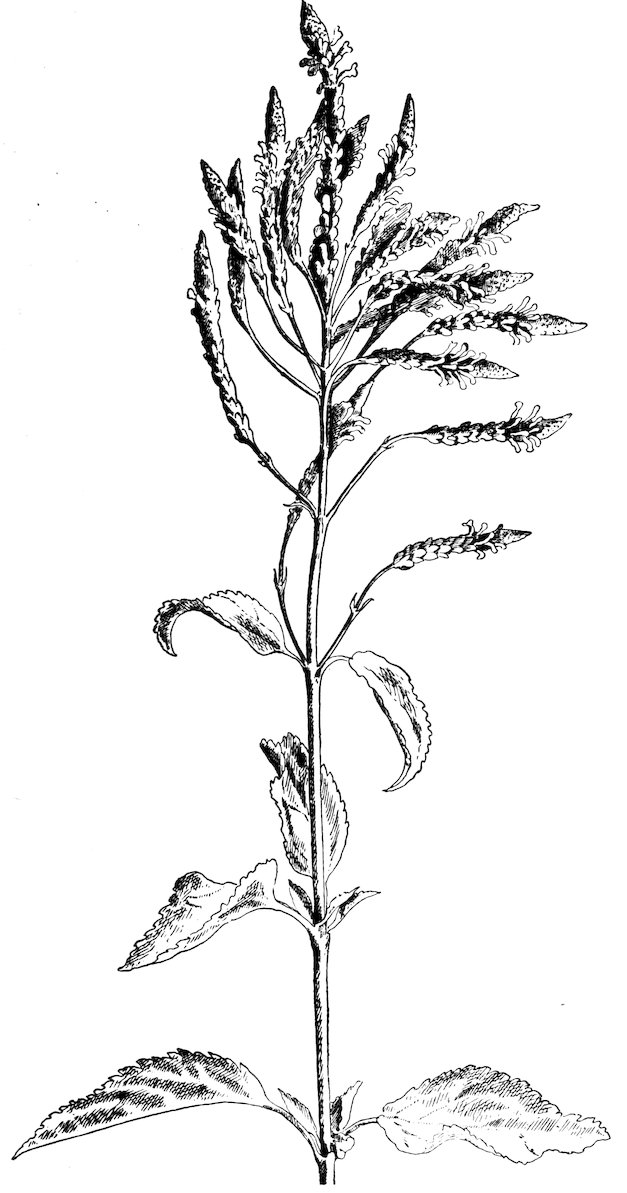
PLATE XCII BLUE VERVAIN.—V. hastata.
254In earlier times the vervain was beset with classic associations. It was claimed as the plant which Virgil and other poets mention as being used for altar-decorations and for the garlands of sacrificial beasts. It was believed to be the herba sacra of the ancients, until it was understood that the generic title Verbena was a word which was applied to branches of any description which were used in religious rites. It certainly seems, however, to have been applied to some especial plant in the time of Pliny, for he writes that no plant was more honored among the Romans than the sacred Verbena. In more modern times as well the vervain has been regarded as an “herb of grace,” and has been gathered with various ceremonies and with the invocation of a blessing, which began as follows:
Hallowed be thou, Vervain,
As thou growest on the ground,
For in the Mount of Calvary
There thou was first found.
It was then supposed to be endued with especial virtue, and was worn on the person to avert disaster.
The time-honored title of Simpler’s joy arose from the remuneration which this popular plant brought to the “Simplers”—as the gatherers of medicinal herbs were entitled.
Beard-tongue. Pentstemon pubescens. Figwort Family.
Stem.—One or two feet high, clammy above. Leaves.—Opposite, oblong to lance-shaped. Flowers.—Dull purple or partly whitish, showy, in a slender open cluster. Calyx.—Five-parted. Corolla.—Tubular, slightly dilated, the throat nearly closed by a bearded palate; two-lipped, the upper lip two-lobed, the lower three-cleft. Stamens.—Four, one densely bearded sterile filament besides. Pistil.—One.
These handsome, showy flowers are found in summer in dry or rocky places. They are especially plentiful somewhat southward.
The white beard-tongue of more western localities is P. digitalis. This is a very effective plant, which sometimes reaches a height of five feet, having large inflated white flowers.
Self-heal. Heal-all. Brunella vulgaris. Mint Family (p. 16).
Stems.—Low. Leaves.—Opposite, oblong. Flowers.—Bluish-purple, in a spike or head. Calyx.—Two-lipped, upper lip with three short teeth, the lower two-cleft. Corolla.—Two-lipped, the upper lip arched, entire, the lower spreading, three-cleft. Stamens.—Four. Pistil.—One, two-lobed at the apex.
255
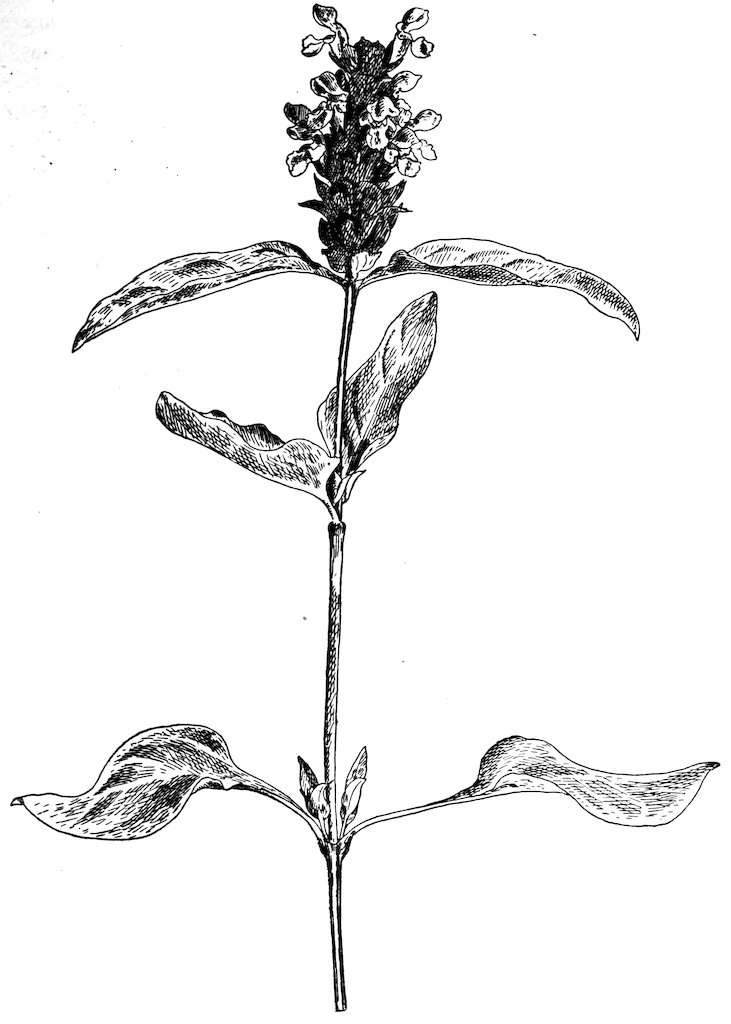
PLATE XCIII SELF-HEAL.—B. vulgaris.
256Throughout the length and breadth of the country, from June until September, the short, close spikes of the self-heal can be found along the roadsides. The botanical name, Brunella, is a corruption from Prunella, which is taken from the German for quinsy, for which this plant was considered a certain cure. It was also used in England as an application to the wounds received by rustic laborers, as its common names, carpenter’s herb, hook-heal, and sicklewort, imply. That the French had a similar practice is proved by an old proverb of theirs to the effect that “No one wants a surgeon who keeps Prunelle.”
Wild Bergamot. Monarda fistulosa. Mint Family (p. 16).
Two to five feet high. Leaves.—Opposite, fragrant, toothed. Flowers.—Purple or purplish, dotted, growing in a solitary, terminal head. Calyx.—Tubular, elongated, five-toothed. Corolla.—Elongated, two-lipped. Stamens.—Two, elongated. Pistil.—One, with style two-lobed at apex.
Although the wild bergamot is occasionally found in our eastern woods, it is far more abundant westward, where it is found in rocky places in summer. This is a near relative of the bee balm (Pl. LXXXII.), which it closely resembles in its manner of growth.
Day-flower. Commelina Virginica. Spiderwort Family.
Stem.—Slender, branching. Leaves.—Lance-shaped to linear, the floral ones heart-shaped and clasping, folding so as to enclose the flowers. Flowers.—Blue. Calyx.—Of three unequal somewhat colored sepals, the two lateral ones partly united. Corolla.—Of three petals, two large, rounded, pale blue, one small, whitish, and inconspicuous. Stamens.—Six, unequal in size, three small and sterile, with yellow cross-shaped anthers, three fertile, one of which is bent inward. Pistil.—One.
The odd day-flower is so named because its delicate blossoms only expand for a single morning. At the first glance there seem to be but two petals which are large, rounded, and of a delicate shade of blue. A closer examination, however, discovers still another, so inconspicuous in form and color as to escape the notice of the casual observer. This inequality recalls the quaint tradition as to the origin of the plant’s generic name. There were three brothers Commelin, natives of Holland. Two of them were botanists of repute, while the tastes of the third had a less marked botanical tendency. The genus was dedicated to 257the trio: the two large bright petals commemorating the brother botanists, while the small and unpretentious one perpetuates the memory of him who was so unwise as to take little or no interest in so noble a science. These flowers appear throughout the summer in cool woods and on moist banks.
Blue Linaria. Blue Toadflax. Linaria Canadensis. Figwort Family.
Stems.—Slender, six to thirty inches high. Leaves.—Linear. Flowers.—Pale blue or purple, small, in a long terminal raceme. Calyx.—Five-parted. Corolla.—Two-lipped, with a slender spur, closed in the throat. Stamens.—Four. Pistil.—One.
The slender spikes of the blue linaria flank the sandy roadsides nearly all summer, and even in November we find a few delicate blossoms still left upon the elongated stems. These flowers have a certain spirituality which is lacking in their handsome, self-assertive relation, butter-and-eggs.
Spiderwort. Tradescantia Virginica. Spiderwort Family.
Stems.—Mucilaginous, leafy, mostly upright. Leaves.—Linear, keeled. Flowers.—Blue, clustered, with floral leaves as in the day-flower. Calyx.—Of three sepals. Corolla.—Of three petals. Stamens.—Six, with bearded filaments. Pistil.—One.
The flowers of the spiderwort, like those of the day-flower, to which they are nearly allied, are very perishable, lasting only a few hours. They are found throughout the summer, somewhat south and westward. The genus is named in honor of Tradescant, gardener to Charles I. of England.
Pickerel-weed. Pontedaria cordata. Pickerel-weed Family.
Stem.—Stout, usually one-leaved. Leaves.—Arrow or heart-shaped. Flowers.—Blue, fading quickly, with an unpleasant odor, growing in a dense spike. Perianth.—Two-lipped, the upper lip three-lobed and marked with a double greenish-yellow spot, the lower of three spreading divisions. Stamens.—Six, three long and protruding, the three others, which are often imperfect, very short and inserted lower down. Pistil.—One.
The pickerel-weed grows in such shallow water as the pickerel seek, or else in moist, wet places along the shores of streams 258and rivers. We can look for the blue, closely spiked flowers from late July until some time in September. They are often found near the delicate arrow-head.
Blueweed. Viper’s Bugloss. Echium vulgare. Borage Family.
Stem.—Rough, bristly, erect, about two feet high. Leaves.—Alternate, lance-shaped, set close to the stem. Flowers.—Bright blue, spiked on one side of the branches, which are at first rolled up from the end, straightening as the blossoms expand. Calyx.—Five-parted. Corolla.—Of five somewhat unequal, spreading lobes. Stamens.—Five, protruding, red. Pistil.—One.
When the blueweed first came to us from across the sea it secured a foothold in Virginia. Since then it has gradually worked its way northward, lining the Hudson’s shores, overrunning many of the dry fields in its vicinity, and making itself at home in parts of New England. We should be obliged to rank it among the “pestiferous” weeds were it not that, as a rule, it only seeks to monopolize land which is not good for very much else. The pinkish buds and bright blue blossoms with their red protruding stamens make a valuable addition, from the æsthetic point of view, to the bunch of midsummer field-flowers in which hitherto the various shades of red and yellow have predominated.
Nightshade. Solanum Dulcamara. Nightshade Family.
Stem.—Usually somewhat climbing or twining. Leaves.—Heart-shaped, the upper halberd-shaped or with ear-like lobes or leaflets at the base. Flowers.—Purple, in small clusters. Calyx.—Five-parted. Corolla.—Five-parted, wheel-shaped. Stamens.—Five, yellow, protruding. Pistil.—One. Fruit.—A red berry.
259
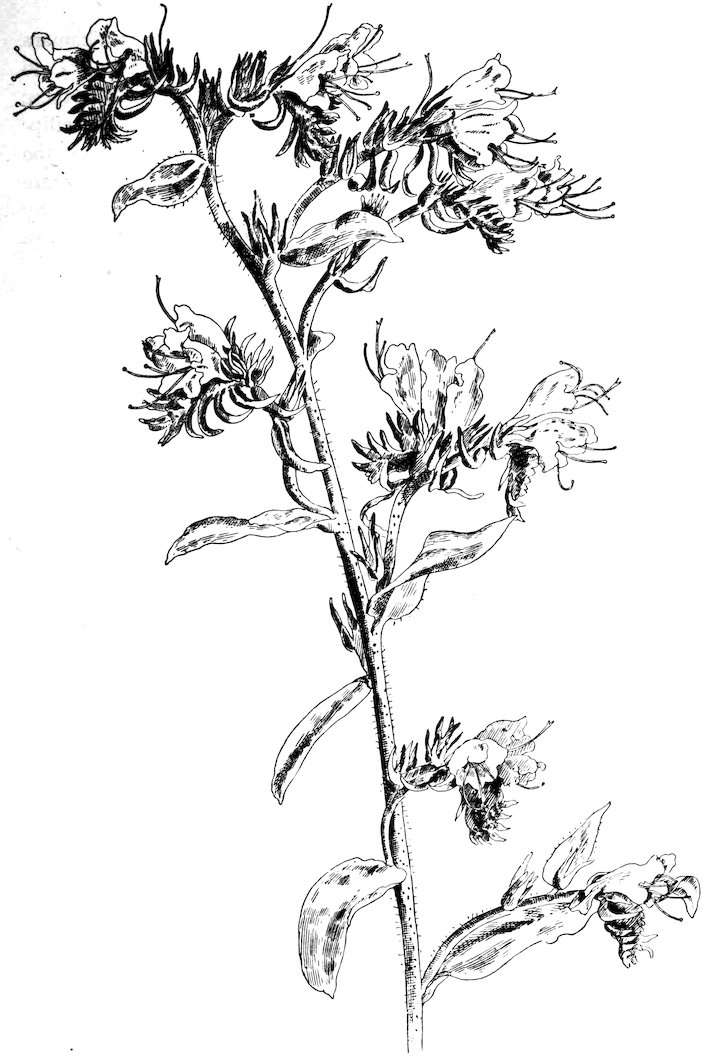
PLATE XCIV BLUEWEED.—E. vulgare.
260The purple flowers, which at once betray their kinship with the potato plant, and, in late summer, the bright red berries of the nightshade, cluster about the fences and clamber over the moist banks which line the highway. This plant, which was imported from Europe, usually indicates the presence of civilization. It is not poisonous to the touch, as is often supposed, and it is doubtful if the berries have the baneful power attributed to them. Thoreau writes regarding them: “The Solanum Dulcamara berries are another kind which grow in drooping clusters. I do not know any clusters more graceful and beautiful than these drooping cymes of scented or translucent, cherry-colored elliptical berries.... They hang more gracefully over the river’s brim than any pendant in a lady’s ear. Yet they are considered poisonous; not to look at surely.... But why should they not be poisonous? Would it not be bad taste to eat these berries which are ready to feed another sense?”
Great Lobelia. Lobelia syphilitica. Lobelia Family.
Stem.—Leafy, somewhat hairy, one to three feet high. Leaves.—Alternate, ovate to lance-shaped, thin, irregularly toothed. Flowers.—Rather large, light blue, spiked. Calyx.—Five-cleft, with a short tube. Corolla.—Somewhat two-lipped, the upper lip of two rather erect lobes, the lower spreading and three-cleft. Pistil.—One, with a fringed stigma.
The great lobelia is a striking plant which grows in low ground, flowering in midsummer. In some places it is called “High-Belia,” a pun which is supposed to reflect upon the less tall and conspicuous species, such as the Indian tobacco, L. inflata, which are found flowering at the same season.
If one of its blossoms is examined, the pistil is seen to be enclosed by the united stamens in such a fashion as to secure self-fertilization, one would suppose. But it is hardly probable that a flower as noticeable as this, and wearing a color as popular as blue, should have adorned itself so lavishly to no purpose. Consequently we are led to inquire more closely into its domestic arrangements. Our curiosity is rewarded by the discovery that the lobes of the stigma are so tightly pressed together that they can at first receive no pollen upon their sensitive surfaces. We also find that the anthers open only by a pore at their tips, and when irritated by the jar of a visiting bee, discharge their pollen upon its body through these outlets. This being accomplished the fringed stigma pushes forward, brushing aside whatever pollen may have fallen within the tube. When it finally projects beyond the anthers, it opens, and is ready to receive its pollen from the next insect-visitor.
261
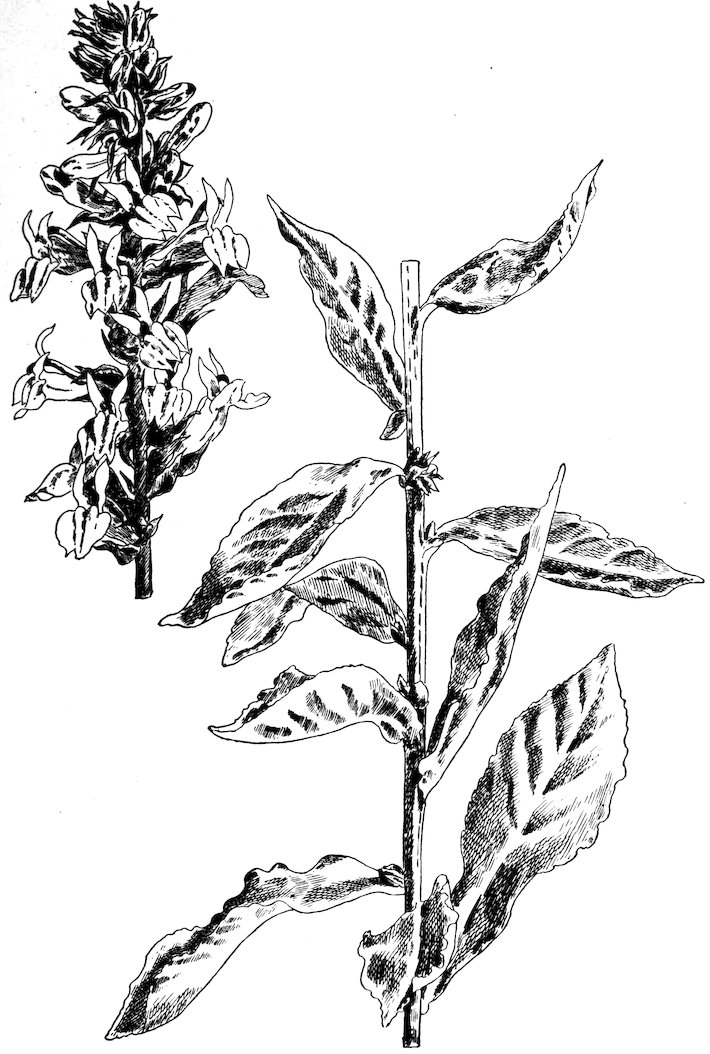
PLATE XCV GREAT LOBELIA.—L. syphilitica.
262The genus is named after an early Flemish herbalist, de l’Obel.
Indian Tobacco. Lobelia inflata. Lobelia Family.
One to two feet high. Stem.—Branching from the root. Leaves.—Alternate, ovate, or oblong, somewhat toothed. Flowers.—Blue or purple, small, growing in a loose raceme, resembling in structure those of the great lobelia. Pod.—Much inflated.
During the summer we note in the dry, open fields the blue racemes of the Indian tobacco, and in the later year the inflated pods which give it its specific name. The plant is said to be poisonous if taken internally, and yields a “quack-medicine” of some notoriety. The Indians smoked its dried leaves, which impart to the tongue a peculiar tobacco-like sensation.
There are other species of lobelia which may be distinguished by their narrower leaves and uninflated pods, and by their choice of moist localities.
Hog Pea-nut. Amphicarpæa monoica. Pulse Family (p. 16).
Stem.—Climbing and twining over plants and shrubs. Leaves.—Divided into three somewhat four-sided leaflets. Flowers.—Papilionaceous, pale lilac, or purplish, in nodding racemes. Pod.—One inch long.
Along the shadowy lanes which wind through the woods the climbing members of the Pulse family are very abundant. During the late summer and autumn the lonely wayside is skirted by
Vines, with clust’ring bunches growing;
Plants, with goodly burden bowing.
And in and out among this luxuriant growth twist the slender stems of the ill-named hog pea-nut, its delicate lilac blossoms nodding from the coarse stalks of the golden-rods and iron-weeds or blending with the purple asters.
This plant bears flowers of two kinds: the upper ones are perfect, but apparently useless, as they seldom ripen fruit; while the lower or subterranean ones are without petals or attractiveness of appearance, but yield eventually at least one large ripe seed.
263
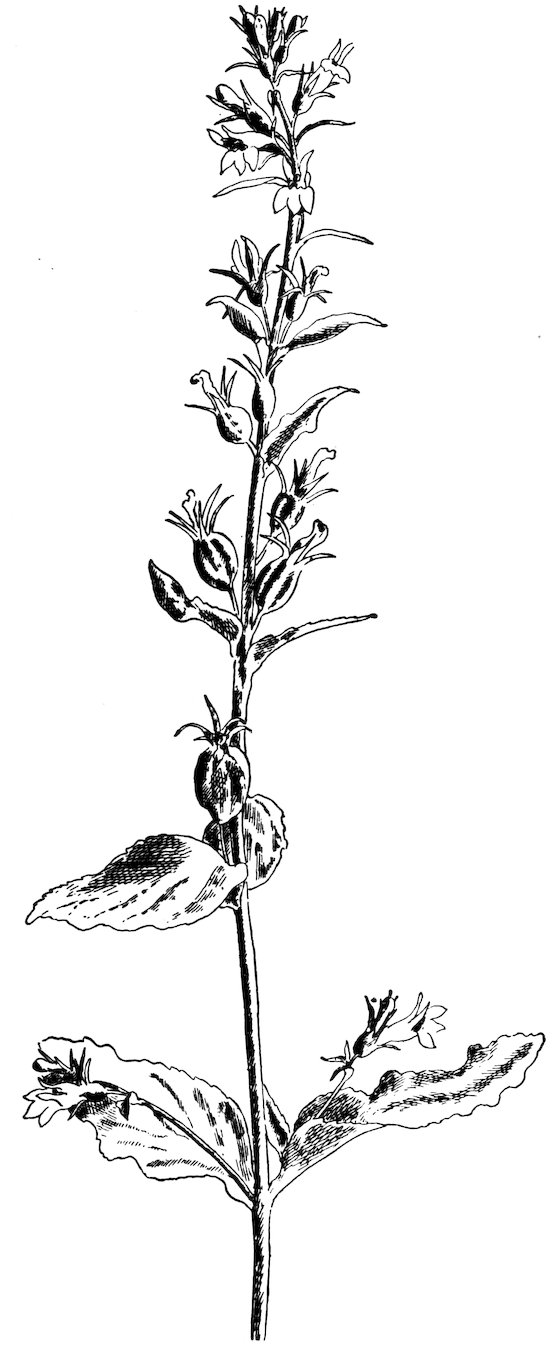
PLATE XCVI INDIAN TOBACCO.—L. inflata.
264
Beach Pea. Lathyrus maritimus. Pulse Family (p. 16).
About one foot high, or more. Stem.—Stout. Leaves.—Divided into from three to five pairs of thick oblong leaflets. Flowers.—Papilionaceous, large, purple, clustered.
The deep-hued flowers of this stout plant are commonly found along the sand-hills of the seashore, and also on the shores of the Great Lakes, blooming in early summer. Both flowers and leaves are at once recognized as belonging to the Pulse family.
——— ——— Strophostyles angulosa. Pulse Family (p. 16).
Stems.—Branched, one to six feet long, prostrate or climbing. Leaves.—Divided into three leaflets, which are more or less prominently lobed toward the base, the terminal two-lobed; or some or all without lobes. Flowers.—Purplish or greenish, on long flower-stalks. Pod.—Linear, straight, or nearly so.
This somewhat inconspicuous plant is found back of the sand-hills along the coast, often in the neighborhood of the beach pea, and climbing over river-banks, thickets, and fences as well. It can usually be identified by its oddly lobed leaflets.
Blue Vetch. Vicia cracca. Pulse Family (p. 16).
Leaves.—Divided into twenty to twenty-four leaflets, with slender tips. Flowers.—Papilionaceous, blue turning purple, growing in close, many-flowered, one-sided spikes.
This is an emigrant from Europe which is found in some of our eastern fields and thickets as far south as New Jersey. It usually climbs more or less by means of the tendril at the tip of its divided leaves, and sometimes forms bright patches of vivid blue over the meadows.
Another member of this genus is V. sativa, the common vetch or tare, with purplish or pinkish flowers, growing singly or in pairs from the axils of the leaves, which leaves are divided into fewer and narrower leaflets than those of the blue vetch. This species also takes possession of cultivated fields as well as of waste places along the roadside.
265
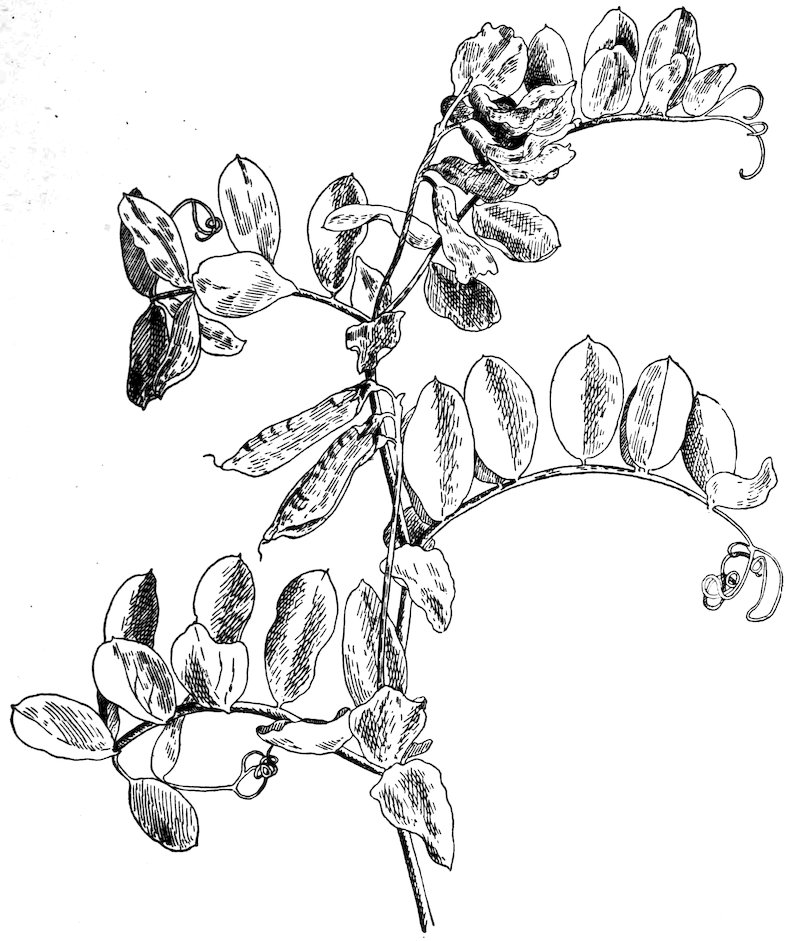
PLATE XCVII BEACH PEA.—L. maritimus.
266
Chicory. Succory. Cichorium Intybus. Composite Family (p. 13).
Stems.—Branching. Leaves.—The lower oblong or lance-shaped, partly clasping, sometimes sharply incised, the floral ones minute. Flower-heads.—Blue, set close to the stem, composed entirely of strap-shaped flowers; opening at different times.
Oh, not in Ladies’ gardens,
My peasant posy!
Smile thy dear blue eyes,
Nor only—nearer to the skies—
In upland pastures, dim and sweet,—
But by the dusty road
Where tired feet
Toil to and fro;
Where flaunting Sin
May see thy heavenly hue,
Or weary Sorrow look from thee
Toward a more tender blue![12]
This roadside weed blossoms in late summer. It is extensively cultivated in France, where the leaves are blanched and used in a salad which is called “Barbe des Capucins.” The roots are roasted and mixed with coffee both there and in England.
Horace mentions its leaves as part of his frugal fare, and Pliny remarks upon the importance of the plant to the Egyptians, who formerly used it in great quantities, and of whose diet it is still a staple article.
Blue and Purple Asters. Aster. Composite Family (p. 13).
Flower-heads.—Composed of blue or purple ray-flowers, with a centre of yellow disk-flowers.
267
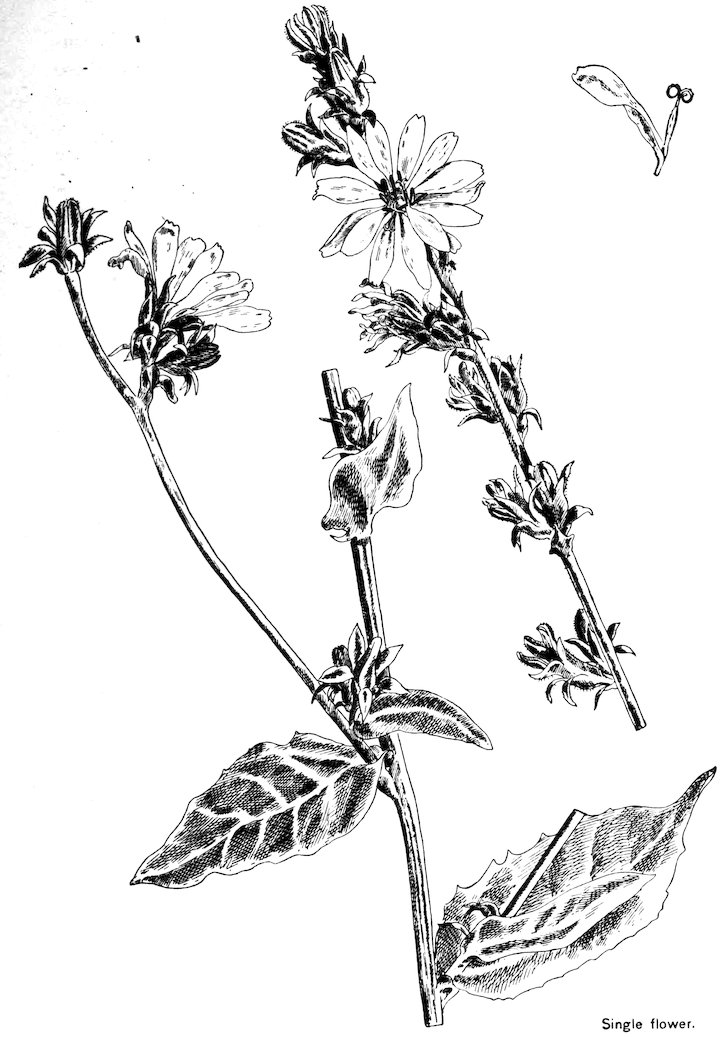
PLATE XCVIII CHICORY.—C. Intybus.
268As about one hundred and twenty different species of aster are native to the United States, and as fifty-four of these are found in Northeastern America, all but a dozen being purple or blue (i.e., with purple or blue ray-flowers), and as even botanists find that it requires patient application to distinguish these many species, only a brief description of the more conspicuous and common ones is here attempted.
Along the dry roadsides in early August we may look for the bright blue-purple flowers of A. patens. This is a low-growing species, with rough, narrowly oblong, clasping leaves, and widely spreading branches, whose slender branchlets are usually terminated by a solitary flower-head.
Probably no member of the group is more striking than the New England aster, A. Novæ Angliæ, whose stout hairy stem (sometimes eight feet high), numerous lance-shaped leaves, and large violet-purple or sometimes pinkish flower-heads, are conspicuous in the swamps of late summer.
A. puniceus is another tall swamp-species, with long showy pale lavender ray-flowers.
One of the most commonly encountered asters is A. cordifolius, which is far from being the only heart-leaved species, despite its title. Its many small, pale blue or almost white flower-heads mass themselves abundantly along the wood-borders and shaded roadsides.
Perhaps the loveliest of all the tribe is the seaside purple aster, A. spectabilis, a low plant with narrowly oblong leaves and large bright heads, the violet-purple ray-flowers of which are nearly an inch long. This grows in sandy soil near the coast and may be found putting forth its royal, daisy-like blossoms into November.
Great Britain can claim but one native aster, A. Trifolium, or sea-starwort as it is called. Many American species are cultivated in English gardens under the general title of Michaelmas daisies. The starwort of Italy is A. amellus. The Swiss species is A. Alpinum.
This beautiful genus, like that of the golden-rod, is one of the peculiar glories of our country. Every autumn these two kinds of flowers clothe our roadsides and meadows with so regal a mantle of purple and gold that we cannot but wonder if the flowers of any other region combine in such a radiant display.
269
Iron-weed. Vernonia Noveboracensis. Composite Family (p. 13).
Stem.—Leafy, usually tall. Leaves.—Alternate, somewhat lance-oblong. Flower-heads.—An intense red-purple, loosely clustered, composed entirely of tubular flowers.
Along the roadsides and low meadows near the coast the iron-weed adds its deep purple hues to the color-pageant of late August. By the uninitiated the plant is often mistaken for an aster, but a moment’s inspection will discover that the minute flowers which compose each flower-head are all tubular in shape, and that the ray or strap-shaped blossoms which an aster must have are wanting. These flower-heads are surrounded by an involucre composed of small scales which are tipped with a tiny point and are usually of a purplish color also.
Blue Curls. Bastard Pennyroyal. Trichostema dichotomum. Mint Family (p. 16).
Stem.—Rather low, branching, clammy. Leaves.—Opposite, narrowly oblong or lance-shaped, glutinous, with a balsamic odor. Flowers.—Purple, occasionally pinkish, not usually clustered. Calyx.—Five-cleft, two-lipped. Corolla.—Five-lobed, the three lower lobes more or less united. Stamens.—Four, very long and curved, protruding. Pistil.—One, with a two-lobed style.
In the sandy fields of late summer this little plant attracts notice by its many purple flowers. Its corolla soon falls and exposes to view the four little nutlets of the ovary lying within the enlarged calyx like tiny eggs in their nest. Its aromatic odor is very perceptible, and the little glands with which it is covered may be seen with the aid of a magnifier. The generic name, Trichostema, signifies hairy stamens and alludes to the curved hair-like filaments.
Sea Lavender. Marsh Rosemary. Statice Caroliniana. Leadwort Family.
Stems.—Leafless, branching. Leaves.—From the root, somewhat oblong, thick. Flowers.—Lavender-color or pale purple, tiny, scattered or loosely spiked along one side of the branches. Calyx.—Dry, funnel-form. Corolla.—Small, with five petals. Stamens.—Five. Pistil.—One, with five, rarely three, styles.
In August many of the salt marshes are blue with the tiny flowers of the sea lavender. The spray-like appearance of the 270little plant would seem to account for its name of rosemary, which is derived from the Latin for sea-spray, but Dr. Prior states that this name was given it on account of “its usually growing on the sea-coast, and its odor.”
Blossoming with the lavender we often find the great rose mallows and the dainty sea pinks. The marsh St. John’s-wort as well is frequently a neighbor, and, a little later in the season, the salt marsh fleabane.
Blazing Star. Liatris scariosa. Composite Family (p. 13).
Stem.—Simple, stout, hoary, two to five feet high. Leaves.—Alternate, narrowly lance-shaped. Flower-heads.—Racemed along the upper part of the stem, composed entirely of tubular flowers of a beautiful shade of rose-purple.
These showy and beautiful flowers lend still another tint to the many-hued salt marshes and glowing inland meadows of the falling year. Gray assigns them to dry localities from New England to Minnesota and southward, while my own experience of them is limited to the New England coast, where their stout leafy stems and bright-hued blossoms are noticeable among the golden-rods and asters of September. The hasty observer sometimes confuses the plant with the iron-weed, but the two flowers are very different in color and in their manner of growth.
Common Dittany. Cunila Mariana. Mint Family (p. 16).
About one foot high. Stem.—Much branched, reddish. Leaves.—Opposite, aromatic, dotted, smooth, ovate, rounded or heart-shaped at base, set close to the stem. Flowers.—Small, purple, lilac or white, clustered. Calyx.—Five-toothed. Corolla.—Small, two-lipped, the upper lip erect, usually notched, the lower three-cleft. Stamens.—Two, erect, protruding. Pistil.—One, with a two-lobed style.
In late August or early September the delicate flowers of the dittany brighten the dry, sterile banks which flank so many of our roadsides. At a season when few plants are flowering save the omnipresent members of the great Composite family these dainty though unpretentious blossoms are especially attractive. The plant has a pleasant fragrance.
271
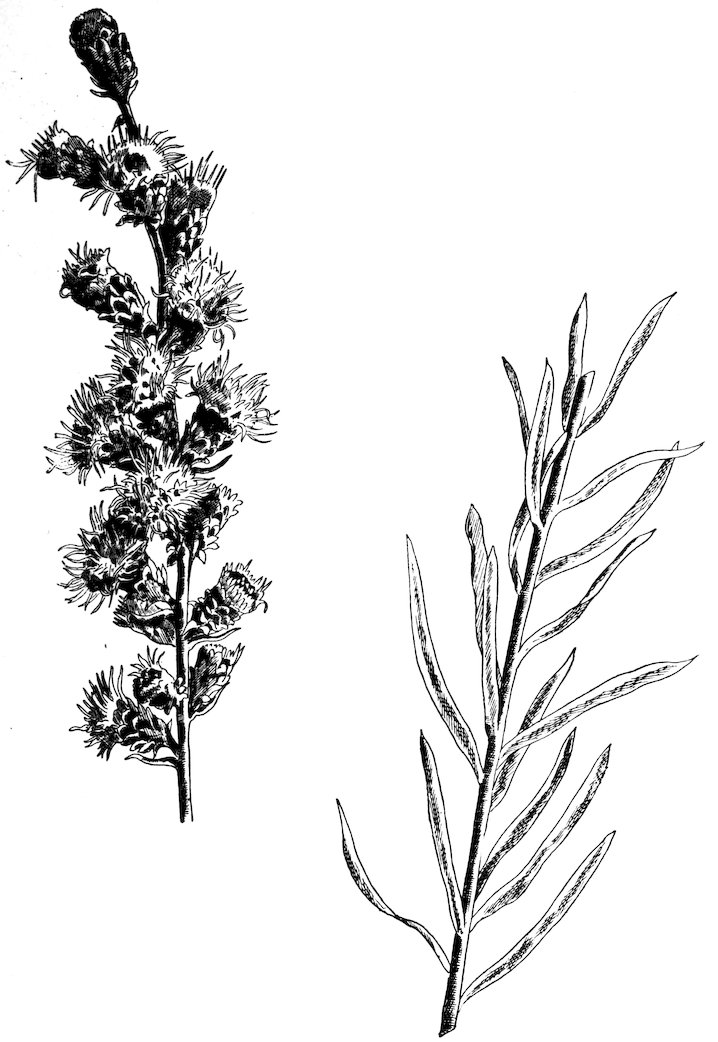
PLATE XCIX BLAZING STAR.—L. scariosa.
272
Closed Gentian. Gentiana Andrewsii. Gentian Family.
Stem.—One to two feet high, upright, smooth. Leaves.—Opposite, narrowly oval or lance-shaped. Flowers.—Blue to purple, clustered at the summit of the stem and often in the axils of the leaves. Calyx.—Four or five-cleft. Corolla.—Closed at the mouth, large, oblong. Stamens.—Four or five. Pistil.—One, with two stigmas.
Few flowers adapt themselves better to the season than the closed gentian. We look for it in September when the early waning days and frost-suggestive nights prove so discouraging to the greater part of the floral world. Then in somewhat moist, shaded places along the roadside we find this vigorous, autumnal-looking plant, with stout stems, leaves that bronze as the days advance, and deep-tinted flowers firmly closed as though to protect the delicate reproductive organs within from the sharp touches of the late year.
To me the closed gentian usually shows a deep blue or even purple countenance, although like the fringed gentian and so many other flowers its color is lighter in the shade than in the sunlight. But Thoreau claims for it a “transcendent blue,” “a splendid blue, light in the shade, turning to purple with age.” “Bluer than the bluest sky, they lurk in the moist and shady recesses of the banks,” he writes. Mr. Burroughs also finds it “intensely blue.”
Five-flowered Gentian. Gentiana quinqueflora. Gentian Family.
Stem.—Slender, branching, one or two feet high. Leaves.—Opposite, ovate, lance-shaped, partly clasping. Flowers.—Pale blue, smaller than those of the closed gentian, in clusters of about five at the summit of stems and branches. Calyx.—Four or five-cleft, small. Corolla.—Funnel-form, four or five-lobed, its lobes bristle-pointed. Stamens.—Four or five. Pistil.—One, with two stigmas.
Although the five-flowered gentian is far less frequently encountered than the closed gentian, it is very common in certain localities. Gray assigns it to “moist hills” and “along the mountains to Florida.” I have found it growing in great abundance on the Shawangunk Mountains in Orange County, N. Y., where it flowers in September.
273
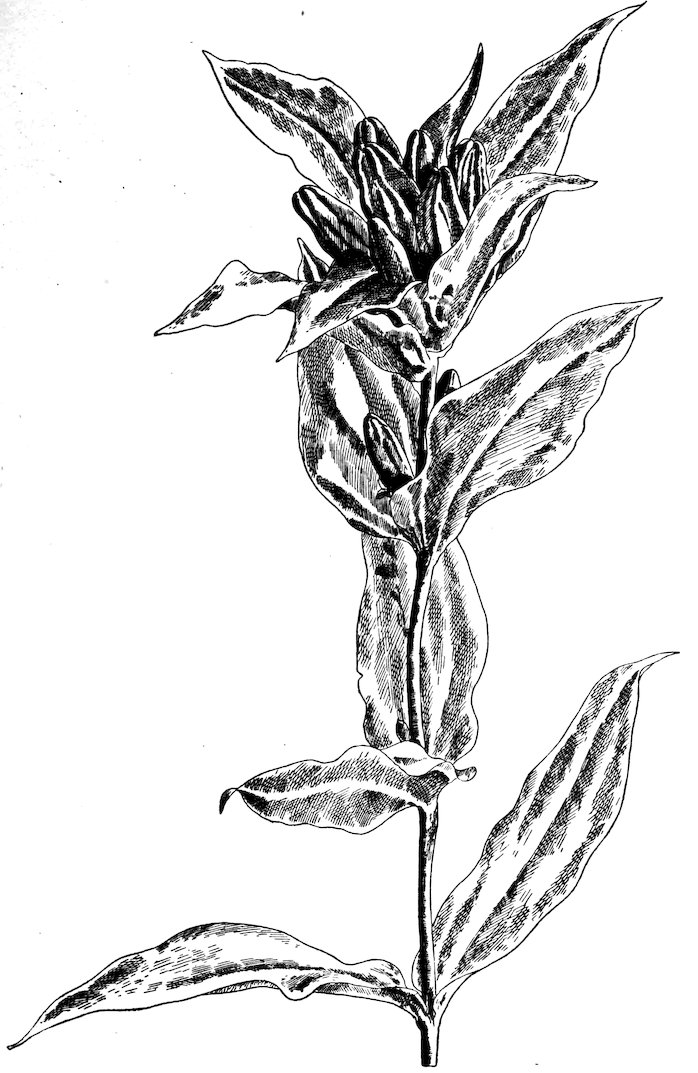
PLATE C CLOSED GENTIAN.—G. Andrewsii.
274
Fringed Gentian. Gentiana crinita. Gentian Family.
Stem.—One to two feet high. Leaves.—Opposite, lance-shaped or narrowly oval. Flowers.—Blue, large. Calyx.—Four-cleft, the lobes unequal. Corolla.—Funnel-form, with four fringed, spreading lobes. Stamens.—Four. Pistil.—One, with two stigmas.
In late September when we have almost ceased to hope for new flowers we are in luck if we chance upon this
—blossom bright with autumn dew
whose
—sweet and quiet eye
Looks through its fringes to the sky,
Blue—blue—as if that sky let fall,
A flower from its cerulean wall;[13]
for the fringed gentian is fickle in its habits, and the fact that we have located it one season does not mean that we will find it in the same place the following year; being a biennial, with seeds that are easily washed away, it is apt to change its haunts from time to time. So our search for this plant is always attended with the charm of uncertainty. Once having ferreted out its new abiding-place, however, we can satiate ourselves with its loveliness, which it usually lavishes unstintingly upon the moist meadows which it has elected to honor.
Thoreau describes its color as “such a dark blue! surpassing that of the male bluebird’s back!” My experience has been that the flowers which grow in the shade are of a clear pure azure, “Heaven’s own blue,” as Bryant claims; while those which are found in open, sunny meadows may be justly said to vie with the back of the male bluebird. If the season has been a mild one we shall perhaps find a few blossoms lingering into November, but the plant is probably blighted by a severe frost, although Miss Emily Dickinson’s little poem voices another opinion:
· · · · ·
But just before the snows
There came a purple creature
That ravished all the hill:
And Summer hid her forehead,
And mockery was still.
The frosts were her condition:
The Tyrian would not come
Until the North evoked it,
“Creator! shall I bloom?”
275
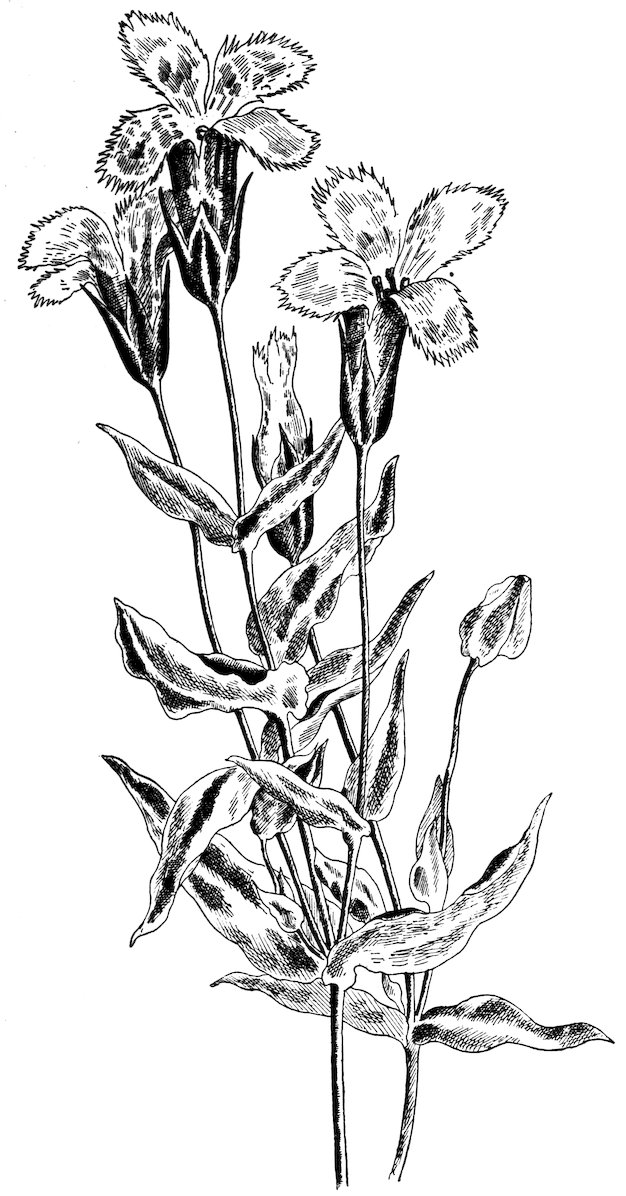
PLATE CI FRINGED GENTIAN.—G. crinita.
276
VI MISCELLANEOUS
Skunk Cabbage. Swamp Cabbage. Symplocarpus fœtidus. Arum Family.
Leaves.—Large, becoming one or two feet long; heart-shaped, appearing later than the purple-mottled spathe and hidden flowers. Flowers.—Small and inconspicuous; packed on the fleshy spike which is hidden within the spathe.
If we are bold enough to venture into certain swampy places in the leafless woods and brown cheerless meadows of March, we notice that the sharply pointed spathes of the skunk cabbage have already pierced the surface of the earth. Until I chanced upon a passage in Thoreau’s Journal under date of October 31st, I had supposed that these “hermits of the bog” were only encouraged to make their appearance by the advent of those first balmy, spring-suggestive days which occasionally occur as early as February. But it seems that many of these young buds had pushed their way upward before the winter set in, for Thoreau counsels those who are afflicted with the melancholy of autumn to go to the swamps, “and see the brave spears of skunk-cabbage buds already advanced toward a new year.” “Mortal and human creatures must take a little respite in this fall of the year,” he writes. “Their spirits do flag a little. There is a little questioning of destiny, and thinking to go like cowards to where the weary shall be at rest. But not so with the skunk-cabbage. Its withered leaves fall and are transfixed by a rising bud. Winter and death are ignored. The circle of life is complete. Are these false prophets? Is it a lie or a vain boast underneath the skunk-cabbage bud pushing it upward and lifting the dead leaves with it?”
277
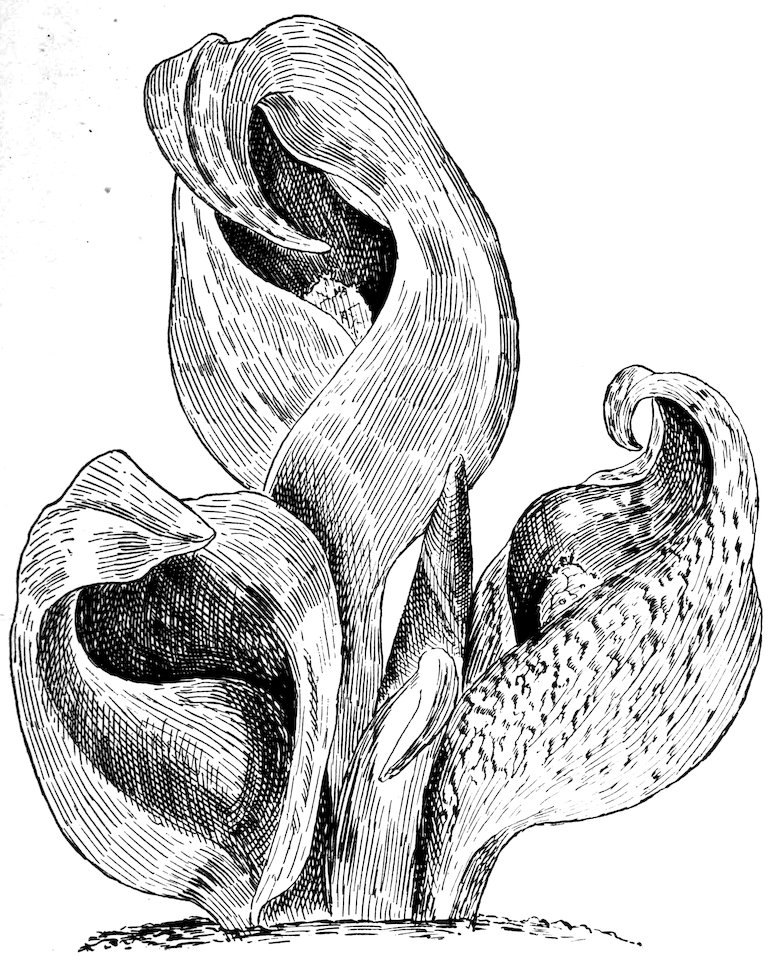
PLATE CII SKUNK CABBAGE.—S. fœtidus.
278The purplish shell-like leaf, which curls about the tiny flowers which are thus hidden from view, is a rather grewsome-looking object, suggestive of a great snail when it lifts itself fairly above its muddy bed. When one sees it grouped with brother-cabbages it is easy to understand why a nearly allied species, which abounds along the Italian Riviera, should be entitled “Cappucini” by the neighboring peasants, for the bowed, hooded appearance of these plants might easily suggest the cowled Capuchins.
It seems unfortunate that our earliest spring flower (for such it undoubtedly is) should possess so unpleasant an odor as to win for itself the unpoetic title of skunk cabbage. There is also some incongruity in the heading of the great floral procession of the year by the minute hidden blossoms of this plant. That they are enabled to survive the raw March winds which are rampant when they first appear is probably due to the protection afforded them by the leathery leaf or spathe. When the true leaves unfold they mark the wet woods and meadows with bright patches of rich foliage, which with that of the hellebore, flash constantly into sight as we travel through the country in April.
It is interesting to remember that the skunk cabbage is nearly akin to the spotless calla lily, the purple-mottled spathe of the one answering to the snowy petal-like leaf of the other. Meehan tells us that the name bear-weed was given to the plant by the early Swedish settlers in the neighborhood of Philadelphia. It seems that the bears greatly relished this early green, which Meehan remarks “must have been a hot morsel, as the juice is acrid, and is said to possess some narcotic power, while that of the root, when chewed, causes the eyesight to grow dim.”
Wild Ginger. Asarum Canadense. Birthwort Family.
Leaves.—One or two on each plant, kidney or heart-shaped, fuzzy, long-stalked. Flower.—Dull purplish-brown, solitary, close to the ground on a short flower-stalk from the fork of the leaves. Calyx.—Three-cleft, bell-shaped. Corolla.—None. Stamens.—Twelve. Pistil.—One, with a thick style and six thick, radiating stigmas.
279
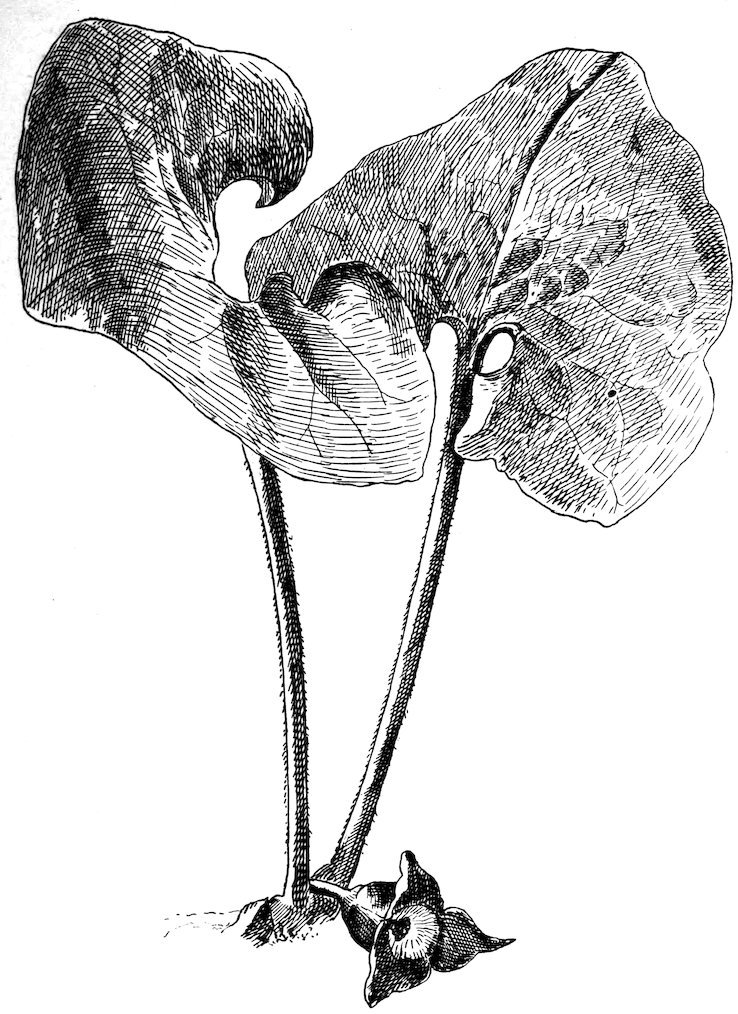
PLATE CIII WILD GINGER.—A. Canadense.
280Certain flowers might be grouped under the head of “vegetable cranks.” Here would be classed the evening primrose, which only opens at night, the closed gentian, which never opens at all, and the wild ginger, whose odd, unlovely flower seeks protection beneath its long-stemmed fuzzy leaves, and hides its head upon the ground as if unwilling to challenge comparison with its more brilliant brethren. Unless already familiar with this plant there is nothing to tell one when it has reached its flowering season; and many a wanderer through the rocky woods in early May quite overlooks its shy, shamefaced blossom.
The ginger-like flavor of the rootstock is responsible for its common name. It grows wild in many parts of Europe and is cultivated in England, where at one time it was considered a remedy for headache and deafness.
Jack-in-the-Pulpit. Indian Turnip. Arisæma triphyllum. Arum Family.
Scape.—Terminated by a hood-like leaf or spathe. Leaves.—Generally two, each divided into three leaflets. Flowers.—Small and inconspicuous, packed about the lower part of the fleshy spike or spadix which is shielded by the spathe. Fruit.—A bright scarlet berry which is packed upon the spadix with many others.
These quaint little preachers, ensconced in their delicate pulpits, are well known to all who love the woods in early spring. Sometimes these “pulpits” are of a light green veined with a deeper tint; again they are stained with purple. This difference in color has been thought to indicate the sex of the flowers within—the males are said to be shielded by the green, the females by the purple, hoods. In the nearly allied cuckoo-pints of England, matters appear to be reversed: these plants are called “Lords and Ladies” by the children, the purple-tinged ones being the “Lords,” the light green ones the “Ladies.” The generic name, Arisæma, signifies bloody arum, and refers to the dark purple stains of the spathe. An old legend claims that these were received at the Crucifixion:
Beneath the cross it grew;
And in the vase-like hollow of the leaf,
Catching from that dread shower of agony
A few mysterious drops, transmitted thus
Unto the groves and hills their healing stains,
A heritage, for storm or vernal shower
Never to blow away.
281
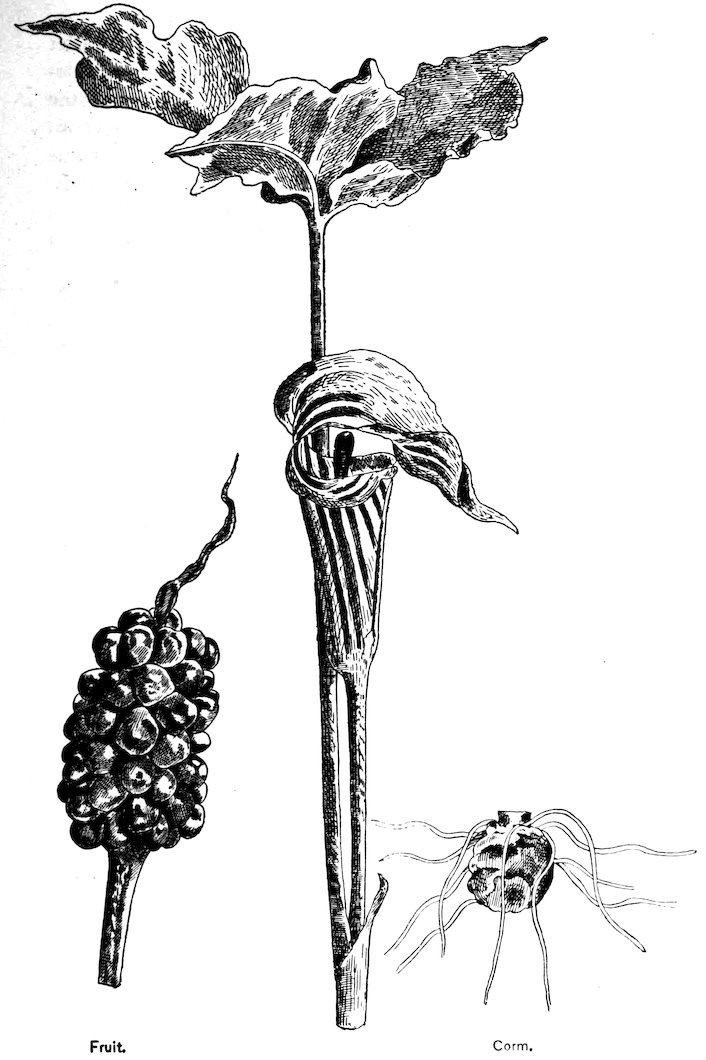
PLATE CIV JACK-IN-THE-PULPIT.—A. triphyllum.
282The Indians were in the habit of boiling the bright scarlet berries which are so conspicuous in our autumn woods and devouring them with great relish; they also discovered that the bulb-like base or corm, as it is called, lost its acridity on cooking, and made nutritious food, winning for the plant its name of Indian turnip. One of its more local titles is memory-root, which it owes to a favorite school-boy trick of tempting others to bite into the blistering corm with results likely to create a memorable impression.
The English cuckoo-pint yielded a starch which was greatly valued in the time of Elizabethan ruffs, although it proved too blistering to the hands of the washerwomen to remain long in use. Owing to the profusion with which the plant grows in Ireland efforts have been made to utilize it as food in periods of scarcity. By grating the corm into water, and then pouring off the liquid and drying the sediment, it is said that a tasteless, but nutritious, powder can be procured.
Alum-root. Heuchera Americana. Saxifrage Family.
Stems.—Two to three feet high, glandular, more or less hairy. Leaves.—Heart-shaped, with short, rounded lobes, wavy-toothed, mostly from the root. Flowers.—Greenish or purplish, in long narrow clusters. Calyx.—Bell-shaped, broad, five-cleft. Corolla.—Of five small petals. Stamens.—Five. Pistil.—One, with two slender styles.