HOW? OR, SPARE HOURS MADE PROFITABLE. (continued 4)
Reading edition
Procure or make from thin wood a box about a foot square, and five or five and a half inches deep. Cut a hole through the central point of the bottom, to allow of the passage of the crank.
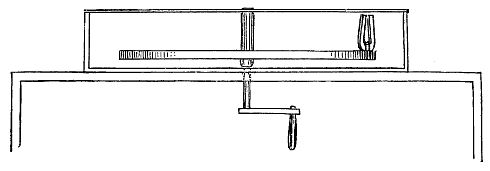
Now from a board cut a round disk which shall revolve easily inside the box, and pass through its center an axle which shall be long enough to form a support for the ring-master on the top or stage, and extend down through the top of the soap-box, where it ends in a crank by which the whole machinery is worked. On the top of this disk, and a short distance from the edge, fasten a common horseshoe magnet, which should be about four inches long, and can be bought at almost any toy store for ten cents. This must be fastened in an upright position by means of staples, as seen in the illustration.
After the magnet is arranged so that it will revolve 271easily, fit the top of the box with a stiff pasteboard cover, which shall just clear the magnet; and mark upon this a circle which is to represent the ring of the circus.
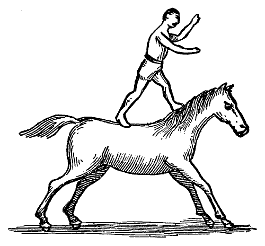
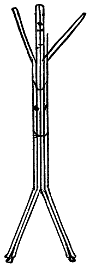
Out of stiff pasteboard cut the ring-master, and with a small nail or strong pin fix him in place. Now from four thicknesses of pasteboard cut out a horse and rider, something like that represented in Fig. 3, and insert between the layers which form each forefoot, a nail, the head of which extends slightly below the pasteboard. File these nail-heads so that they shall be smooth and rounded. 272Glue the two layers together to form the legs of the animal, and spread them slightly apart, as seen in Fig. 4 (which gives an end view of the object), having already glued all four layers to form the body of horse and rider.
Various horses of different colors, forms, positions, and with or without riders, may be made in a similar manner; and elephants or other animals may be substituted for the horses, and made to move around the track, as if subject to the master’s whip. After the glue is dry, the outside edges should be rounded and the roughnesses removed by the use of a rasp and sand-paper.
The ring-master should be so fastened, facing the horse, as to turn with each revolution of the axle.
The back of the box is fitted with a pasteboard or cloth screen, painted to represent stage scenery, and supported on either side by uprights, from the top of which float banners. For further decorations the twigs of evergreen trees are added, those of the larch or spruce, or perhaps best of all the small branches of the juniper or cedar tree, are best for the purpose. When these tiny stage trees become brown and faded, they can be easily exchanged for fresh ones, or may be painted with green paint, if a new supply is not readily obtainable.
The front of the box may be papered with fancy wall-paper, 273or otherwise decorated to suit the fancy of the maker; and the one who supplies the motive power, or, in other words, turns the crank, should be kept out of sight of the audience if possible. As the horses are not connected with any visible motive power, the cause of their revolution will be enveloped in a mystery which will add vastly to the entertainment of the little folks.
―――――◀▶―――――
TO PRODUCE RAISED FIGURES ON AN EGG.
Melt some tallow, and with it paint on the shell of an egg, making letters, numbers, profiles, or any outline which your fancy may suggest, or the fineness of the brush may permit. Then immerse the egg in strong vinegar. After the lapse of a few hours, whatever is covered with the lines of tallow will project slightly, the vinegar, which is mainly acetic acid, having dissolved away the unprotected surface. By painting with a fine brush an intricate scroll or vine pattern, carrying it all around the egg, the result is very pretty, giving somewhat the effect of carved ivory.
274―――――◀▶―――――
AN ARITHMETICAL CURIOSITY.
Write the nine digits in their order, and multiply them by 9; the result will be composed of units, excepting the next to the last, thus:
123456789
9
----------------
1111111101
Multiply by 18, instead of 9, and the product will consist of 2’s. By 27, and it will be 3’s. In this manner all the digits may be obtained by multiplying by the multiples of 9; as 36, 45, 54, etc.
―――――◀▶―――――
ONE WAY TO FIND THE NUMBER OF DAYS IN THE MONTH.
Count the knuckles of the hands, with the spaces between them; all the months with thirty-one days will fall on the knuckles, and those with less than thirty-one in the spaces. Thus, beginning with the forefinger of the left hand, July will come on the knuckle of the little finger; then beginning with August on the forefinger of the right hand, December will be reached at the knuckle of the third finger.
275―――――◀▶―――――
SOME ELECTRICAL EXPERIMENTS.
Considerable amusement may be derived from the electrical phenomena manifested by a sheet of stout brown paper, when friction is applied to it. Having warmed such a sheet, and rubbed it with the dry palm of the hand, or some woolen fabric, giving six or eight smooth, steady strokes, with considerable pressure, and all in one direction, away from the body, then place a bunch of keys in the center of the paper, and lift it by the ends; a spark of electricity may now be taken from the keys.
If ordinary unglazed paper be immersed in a mixture of equal parts of sulphuric and nitric acids, then well washed with plenty of water and dried, it becomes extremely electric. If placed on a wooden table, or, better still, on a waxed cloth, and rubbed with the hand, it attracts feathers, pith-balls, fragments of paper, or other small light objects.
When suddenly stripped from the waxed cloth in a darkened room, the entire surface will have a luminous phosphorescent appearance. A spark can be taken from it by holding the finger about half an inch from the surface. If placed against the wall it will adhere to it and keep its place for several minutes.
This paper retains its electrical properties a long time. When weakened, it is sufficient to slightly heat it to restore all its energy.
276―――――◀▶―――――
THE ELECTROPHORUS.
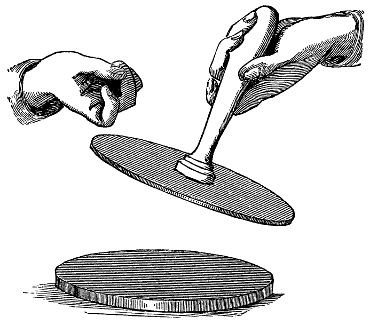
This instrument, whose name, derived from the Greek, means bearer of electricity, consists of two parts; first, a cake or disk of resin, or of shellac and wax, these substances being melted and poured into a tin mold; second, a disk of brass, or sometimes of thin, well-dried wood, covered on each side with thin sheet-brass or even thick tin-foil. This should be fitted with a glass handle, to insulate it; a stout, round bottle of moderate size will answer. The cake of resin is rubbed vigorously; a surface of fur is the best to use for this, such as a cat-skin or fox-tail. The disk is then taken by the handle and rested on the cake, and its upper surface touched a moment with the finger; then, on withdrawing the disk from the 277resin, a bright electric spark can be obtained from it. By resting it once more on the resin, again touching and withdrawing it, another spark may be elicited, and so on for eight or ten successive trials.
The scientific explanation of this phenomenon is, that negative electricity is excited in the cake by friction. When the disk is applied, the electricity does not pass into it from the cake, but is induced in the disk by the law of electrical polarity; the lower surface being covered with positive electricity, while the negative is repelled to the upper side, from which it is drawn by the finger. Then, when the disk is lifted, the spark of positive electricity may be drawn.
If the construction of the instrument just described appears too formidable a task to my young readers, perhaps they may yet be inclined to experiment with
A SIMPLE ELECTROPHORUS.
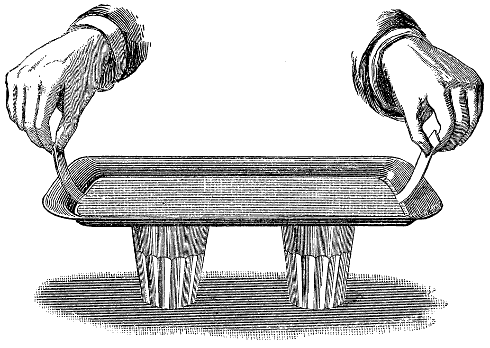
Take a lacquered iron “tea-tray;” cut a sheet of stout brown paper so as to fit the flat part of the tray, and fix two strips of paper at each end by means of sealing-wax. These strips serve as handles by which to lift the paper, and the sealing-wax, being a non-conductor, prevents the electricity from passing off. The tray is also insulated by placing it upon two tumblers.
The sheet of paper is now heated quite hot, placed on a 278wooden table, and rubbed with a hard and very dry clothes-brush. Then it is lifted and placed on the tray.
The paper is negatively electrified; it induces a similar state in the lower side of the tray, which should be touched a moment with the finger; then lift the paper from the tray. An electric spark can now be taken from the latter.
The strips by which the paper is lifted can be brought together, and held by the thumb and finger of one hand, leaving the other free to take the spark. The paper may now be replaced. By touching the lower surface of the tray, and lifting the paper as before, another spark may be obtained, and so on for several times, if the air be dry.
279
THE EBONITE ELECTROPHORUS.
This piece of apparatus, also called Pfeiffer’s electrophorus, is composed of a thin sheet of ebonite, measuring about six by eight inches. A small sheet of brass, about five by three inches, is fixed on one side. With this, electricity may be evoked with unusual readiness.
It is placed flat on a wooden table, and rubbed successively on both sides with the open hand; if lifted in the left hand, and the right hand is presented to the brass, a spark will be received.
―――――◀▶―――――
A LEYDEN JAR.
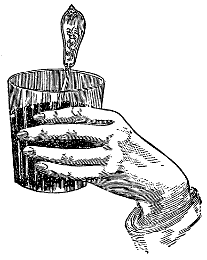
This may be made as follows: Fill a plain glass tumbler two-thirds full of shot; insert the bowl of a spoon in the shot, leaving the handle projecting. Hold the tumbler 280in the hand, and bring the handle of the spoon near to the electrophorus—previously prepared for action—so as to receive its spark. On repeating this a few times, the electric fluid will be accumulated in the “jar,” and the many small sparks may be obtained as one large one, by approaching the finger to the spoon, still holding the tumbler in the other hand.
This idea may be varied by using a large wide-mouthed bottle or small jar, instead of the tumbler, and covering the outside nearly up to the top with tin-foil. If that rare treasure, a bullet-mold, is to be had, a ball may be formed on the end of a stout wire, and used instead of the spoon, the end with the ball being the projecting one, thus making an article corresponding more nearly to the regular professional pattern.
―――――◀▶―――――
THE PITH DANCER.
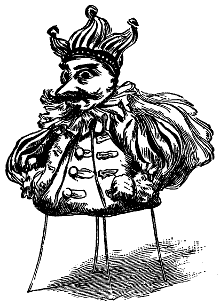
This fastidious little skipper never dances except to piano music. It is fashioned from pith, cork, or other light material. Generally it has a human head and body; but when we consider its dancing extremities, we must regard it as a quadruped, or even a tripod, as the case may be; for it stands on three or four stout hog’s bristles. These may be borrowed from the floor-brush, 281and should be even at the lower ends, that the dancer may stand erect. It should be painted in a gay and conspicuous manner, to compensate for its diminutive size, and a mantle of colored tissue-paper may add to its consequence. When the image is complete, stand it on the sounding-board of the piano, which should be operated with vigor. The dancer will respond to the lively notes with edifying briskness and vivacity.
―――――◀▶―――――
THE OBEDIENT BOTTLE.
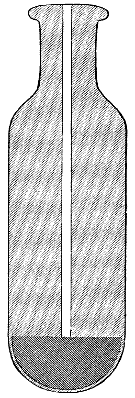
Fashion a shape like a small bottle, out of pith, paper pulp, or some other light substance. Cut a bullet in two, and fasten the base of the bottle to the flat portion of one 282of the halves. A straight piece of large wire, the length of the bottle, should be provided, and a hole made down through the center of the bottle, into which it will slide readily, and remain with the end out of sight. This hole may be made with greater ease before attaching the bullet. This object can be made to yield apparent obedience to the commands of its maker. If he orders it to remain upright, he will place it on the table without inserting the wire, when nothing but constant pressure will induce it to lie prostrate. Then, taking it into his hands, and skillfully introducing the wire while the attention of 283the observers is directed elsewhere, he next orders it to lie flat; and, as the weight of the wire overbalances it, it will tumble over as often as it is set up.
The bullet should be covered with thin paper as smoothly as possible, and the whole affair painted, to better conceal the modus operandi.
―――――◀▶―――――
THE IMMOVABLE CARD.
If a card, such as an ordinary visiting card, is turned down about a quarter of an inch at each end, at right angles to the rest of the card, and then placed on a table so as to rest on the turned edges, you may safely challenge most persons to blow it so as to make it turn over on the other side. It would naturally seem easier to overturn a card so prepared, than one whose shape remained unchanged; but whoever tries it will find that the facts are otherwise.
The card can be overthrown, however, by blowing on the table, toward the card, as the stream of air is then reflected against its under side.
―――――◀▶―――――
A TRIPLE BRIDGE.
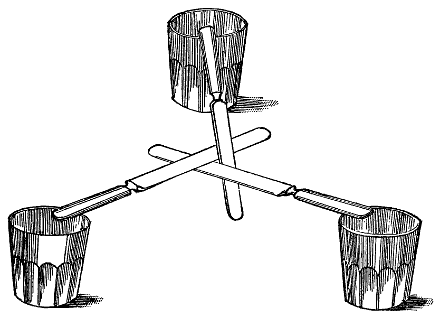
This may be constructed by means of three table-knives, in the manner illustrated in the figure. Three goblets or 284tumblers will serve as the piers; these are to be arranged in a triangle, a little farther from each other than the length of the knives. Lay two of the knives on the table, with the blades crossing each other. Then pass the blade of the third knife over the uppermost blade of the other two, and under the undermost; then take them up and place them with the ends of the handles on the rims of the glasses. The bridge now sustains itself, and if a moderate weight be placed upon it, it will be all the firmer.
―――――◀▶―――――
AN ILLUSTRATION OF “INERTIA.”
Inertia is defined as the tendency of a body to persevere in its state either of rest or motion. It is generally 285used in the sense of persisting in a state of rest. Among the many illustrations of this property of matter, is one which figured in the text-books of thirty or forty years ago, and which the boys of that time adapted to their amusement by constructing the apparatus here illustrated.
It consists of three parts: the board which forms the base, a post about six inches high, and a strip of stout whalebone, or dry, elastic wood.
The board should be as much as seven-eighths of an inch in thickness, and the elastic strip or spring should be firmly inserted in an inclined slit cut through the board. The places of the spring and post should be so adjusted to each other, that when the latter is secured solidly by a good-sized screw passing up through the board, the former will press with its upper end against the top of the post (as shown by the dotted line) with some degree of force.
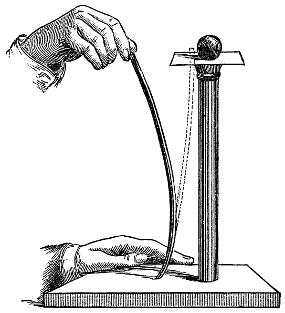
The top of the post should be hollowed slightly, to retain the ball; and the appearance of the whole will be improved by a coat of shellac or paint.
Now place a card on the top of the post; and if it is sufficiently level, a marble or bullet may be induced to remain on it, directly over the column; if not, a large bean, a spool, or a coin, will prove more tractable. Draw back the spring with the thumb and finger, as in the illustration; 286let it go suddenly, and it will snap the card away, leaving the superimposed object resting quietly on the top of the column.
The same principle is sometimes illustrated by balancing a card on the finger, placing a coin on the card, and snapping away the card with the other hand, the coin remaining on the finger.
Another way is to pile up a small tower with “checkers” or “draughts.” By a quick blow with a ruler, one checker may be knocked from between the others, without overturning the tower.
287―――――◀▶―――――
OTHER CHRISTMAS HOLIDAY AMUSEMENTS.
Perhaps one evening of this ever delightful season might not be more entertainingly spent than in witnessing an exhibition of some feats in Magic, if any lad of the company could become sufficiently expert in the art to render them with a fair amount of skill.
There are many of these mysterious tricks performed by the professional “Thaumaturgist” or “Prestidigitateur,” but as most of them require a complicated or expensive apparatus, I shall only call your attention to such as are comparatively simple, and require but few “aids” or materials for their fulfillment.
HOW TO PALM A COIN.
As it is necessary for any boy or girl who intends to become an expert sleight-of-hand performer to be a successful palmer, this is naturally the first lesson to be learned. Indeed, very few of the tricks performed by an expert prestidigitateur would be effective without its use.
To explain this art is difficult, although it is an easy matter to show how the thing is done. By the aid of an illustration may be seen, however, the final position of the coin, or how it is held while it is palmed.
If possible, balance a half-dollar on the tip of the second finger of the right hand; but if not at first easily 288accomplished let the coin rest on the tips of the second and third fingers, steadying it, in this position, by touching it lightly with the thumb. Close the hand quickly and the coin will rest in the palm. Then, by throwing the thumb forward, the ball of the thumb will hold the silver piece on one side, and that part of the palm which lies between the second and third fingers holds it securely on the other.
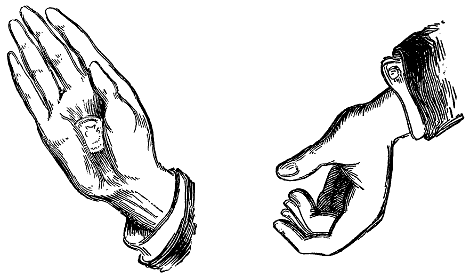
Practice this well, and be sure you can depend upon yourself to accomplish it perfectly with the left as well as the right hand, before you try any of the following tricks in the presence of a critical audience.
HOW TO PASS A COIN.
Borrow of your audience two half-dollars and lay them on your table.
289Next shake your sleeves and let your friends see that you have no coins hidden about you. When they are convinced that such is the case, pick up one half-dollar with the thumb and second finger of your right hand. Palm this in your right hand while you pretend to pass it to your left, of course making a motion with the left hand as if it received and still held the coin.
The right hand will then seem to be empty, although still holding the half-dollar. Next pick up the other coin with the right hand, and place the hand behind you, being careful to keep the left well in front, and always in sight of your audience. Make some few remarks concerning the difficulty of the trick, and at last pronounce the magic word “Pass”; at the same time clink the two coins together, as if one had hit the other in the meeting. Then bring the right hand forward, and, opening it and the left at the same time, show that the coin has actually left the latter and entered the former, as you promised it should do.
HOW TO ROB PETER AND ENRICH PAUL.
Twenty pieces of money are necessary for this trick; and two-cent pieces, or quarters, are perhaps the most convenient sizes to use. Of these, borrow fifteen from your audience, the other five have at hand, but concerning which your friends are to know nothing.
290Having borrowed them from the company, count out five, and give them to one of your audience, while to another you give ten, and after having seen that the latter counts his carefully, take those given to the first, mutter some cabalistic nonsense, and order them to pass into the hands of the one who has the ten pieces. Finally, request him to count them again, when, strange to relate, he will find that he has fifteen, instead of the ten pieces which he was supposed to have.
The trick is performed in this manner: Upon receiving the money, throw it upon a plate or box cover—the plate is the best—and passing it to the first person, request him to take five of the pieces away. Now give the remaining money, with the plate, to the second, and ask him to drop each coin as he counts it, on the plate, that all may know he has counted correctly.
Then comes the only difficult part of the trick. Ask the one who has counted the coins to hold both his hands, while you pour the money into them, and taking the plate in your left hand, pour the contents into your right, where you have already five more palmed (the five the audience have not seen). Now pour the fifteen into the hands of number two, and impress upon him the importance of keeping his hands well closed over the money. This will prevent his noticing that an addition has been made. Take the five from person number one, and pretend 291to place them in your other hand, but instead palm them. Do your talking and command the money to pass. If you have taken proper care in palming your coins, the audience, as well as the one holding the money, will be greatly amazed by the trick.
DANGER OF REPETITION.
In almost any performance of this kind, the audience, especially if of one’s intimate friends, are anxious for the performer to try again whatever strikes them as strange or mysterious, being of course on their guard to watch certain movements, at points in the performance which they had scarcely noticed before.
So it is very unsafe to try any trick over again immediately after it has been once performed, or in fact during the same evening; although perhaps it might be safely done if a number of different ones intervened. If beseeched to try it “just once more,” make as graceful an excuse as you can, and suggest in its place something equally interesting.
THE INEXHAUSTIBLE HAT.
For this trick, seven half-dollars are required, and are concealed in the right hand by “palming,” as the five two-cent pieces were hid in the former trick.
292First, borrow of one of your audience a tall silk hat, promising to return it “as good as new” at the end of the performance. Let the audience examine it to see that the owner is not in league with yourself, and then, walking to the back of the room, place it upon a table. While walking toward the table, with the back toward the audience, palm your coins, which should be held in some convenient pocket, readily accessible when the moment comes for using them.
Next, turn to your audience, having your coins well concealed in your right hand, and request some one to lend you six half-dollars; but immediately, under the pretense of disliking to trouble them, step forward, and, excusing yourself for the liberty, take a coin from the folds of a lady’s dress, by simply letting one of those concealed in your hand slip to the end of your fingers. If you have had sufficient practice in “coining” you will find no difficulty in doing this, and your audience will be inclined to believe you actually found the money secreted in the fabric, although they may believe you had some hand in placing it in its hiding-place.
If you have been thus far successful, go to the hat, and, calling attention to the fact, drop the half-dollar into it; then, as if you imagined some one was doubtful whether the coin was really in the hat, make some remark to the effect that if they do not believe you dropped it you will 293do so again, at the same moment thrusting your hand down to the crown to take it in sight again.
At the moment the hand is in this position, carefully place the six half-dollars on the bottom, and let one remain in the palm. Pick up one of these six, and holding it high, let it drop, being careful, however, that it does not hit the other five.
The coin in your hand you proceed to take from any unusual place which may occur to you—the window curtain, portière, a gentleman’s beard, or a lady’s coiffure, are those most naturally suggested. As soon as you take a half-dollar from its hiding-place, you pretend to place it in your left hand, and from there command it to pass to the hat, but in reality you palm it in your right where it is ready for the next position from which you desire to take it. Proceed in this way until you have gathered in six half-dollars.
As these have been lying quietly in the hat during all this time, you have no anxiety about sending them there, and must simply avoid going near it while apparently filling it with the money. When the last silver piece has been sent to its destination, request the audience to select some one of its members to count the money in the hat, and see that none has been lost in its flight hence. It will, of course, be found all right, and great will be the curiosity to know how you placed it there; but do not 294allow yourself to be influenced into trying it a second time, for with the close watching you will undergo your secret will be discovered.
ANOTHER HAT TRICK.
The hat may well be called “inexhaustible,” for all manner of things may be made to come from its prolific crown, and in such profusion, that a receptacle of double its size would hardly contain them.
If two boys have learned the art of palming well, they may assist each other, and, if at all ingenious, invent a variety of tricks for an evening’s amusement.
The following is but a suggestion, which may be varied by different materials:
Let them borrow from the audience two tall silk hats, and place them upon chairs standing some distance from each other. Each having provided himself with a small rubber ball—the one resembling the other as nearly as possible—they are ready to proceed. The hats were of course empty when passed to the stage, but as the first boy takes his place, back of the chair which contains a hat, he should glance down into it, and with surprise, draw out a ball which he has had concealed in his right hand, show it to the audience and then pretend to put it in his left hand, but instead palm it in the right; at the same time extending his left toward his partner. The second 295boy stretches out his right arm as if to receive the ball, and at the moment his hand touches the fingers of No. 1, he lets that which he has been palming in his right hand slip down to his fingers, as if he had just received it from his friend. Now, pretending to change it to his left, he palms it, as No. 1 has done, and finally drops his left hand, which is supposed to hold the ball, into the hat in front of him, at the same time giving the side or crown a rap with one of his fingers, to imitate the falling of the ball. This same thing may be repeated indefinitely, until you have balls enough to stock the village. When you see the audience is beginning to tire, let No. 1 say, “My hat is empty; shall I help you count the balls in yours?” No. 2 nods assent, and looks down, as if expecting the hat to be full. He must then pretend great surprise, and taking up the hat must turn it upside down, gently shake it—remembering it is borrowed—and with the audience wonder what has become of all the balls.
Eggs, small lemons or oranges, little china dolls, and a number of small toys may be substituted for the rubber balls above given.
THE PERAMBULATING EGG.
This trick is one of the easiest, while at the same time one of the most pleasing, of the magician’s arts. In it an egg, apparently without any impulse beyond that which 296resides within itself, travels over a hat, and after reconnoitering it in its every nook and corner, passes gracefully over to another, and commences its journey of discovery around the second in much the same manner it has traversed the first.
Two hats are borrowed from the audience, and a dish of eggs is placed upon the table by their side, when the performer requests the lady stationed at the piano to give some music, and the exhibition commences. The egg which is used is merely a shell, the inside having been sucked or blown out through tiny holes made at either end. A slender silken thread is tied to the upper button of the performer’s waistcoat, while attached to the other end is a small piece of wax or other sticky substance. Just before the performance commences, show the dish of eggs, and then pass away from them and back of your audience, to show that they (the eggs) are in no way attached to your person.
As the music strikes up, walk to the table, take the shell from the dish, making it appear that you had no choice, but took the first one you chanced to touch, and place it inside the hat, at the same moment pressing the bit of wax to its side.
As the egg is in the hat it is necessary for it to pass out upon the outside surface. To do this the hat is slowly moved downward until the egg is even with the brim; 297then by careful management and a little practice, the effect is produced of the egg walking up the hat instead of the hat being lowered to the egg. You may now take the egg in your hand and, holding the hat with the crown upward in a horizontal position, place it beneath the egg, and turn it slowly away from yourself. The effect will be that the egg is traveling up hill. By placing the other hat close to the one upon which you are performing, and slowly drawing it under the egg, the latter will appear to pass over to the crown of the second hat, and very much the same movements may be repeated on this as on the first.
THE MAGIC DISPATCHER.
Borrow a quarter or half-dollar from your audience, and ask the owner to place some mark upon it by which it may be identified. Wrap this in the corner of a handkerchief, and give it to some one to hold. Next take a ball of yarn, and having placed it in a tumbler, ask some other person in your audience to hold his hand over the top of the tumbler in such a way that the ball will be kept in place, and the yarn will run smoothly through the fingers. Hold one end of the yarn some distance from the tumbler, or near where the coin is held, and inform your audience that, as your dispatcher is in good working order, you will proceed to send the coin your 298friend has in his hand into the very center of the ball of yarn. Take the opposite corner of the handkerchief from the one holding the money in your right hand, and having counted one, two, three, command the coin to pass, at the same instant snatching the handkerchief from your friend’s hand. Next commence to unwind the ball, being careful to keep some distance from the tumbler while so doing.
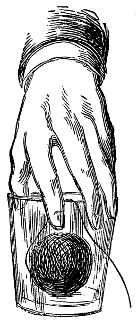
As the yarn is nearing its end, the silver piece will drop upon the bottom of the tumbler, and nothing is left for you to do but to request the owner of it to step forward and see if it is the one he lent you.
In this, as in many of the tricks you have already learned, very little preparation is required. First, a coin 299of the same denomination as the one borrowed is sewed in a corner of the handkerchief. The ball is wound upon a stick of a particular shape, which is drawn out when the coin is to be substituted in its place. This stick should be about two and a half inches long, one and a quarter inches wide, and an eighth of an inch thick, rounded off at one end, and scraped until it is perfectly smooth.
When winding your ball, be careful to have the rounded end of the stick in the center of the ball, and the other end projecting slightly on one side.
After you have procured your coin, palmed it, and given the handkerchief containing the other into the hands of some person to hold, go for your ball, which should be at some distance from your audience, that you may have time to draw out the stick and insert the coin in its place, while you are walking back to the table upon which is your tumbler.
The trick is now done, but the audience must be kept ignorant of the fact, while your conversation and subsequent acting should shroud it in all the mystery possible.
THE TURKISH RING TRICK.
A few years ago I had the good fortune to see a famous magician perform. Many and wonderful were the things 300he did, and at times it seemed as if other than human skill must be aiding him in his craft.
Among others, he gave the following trick, which was as enthusiastically applauded as many of the others. It had for me no element of strangeness, as I was already initiated into its secret. Since it has ever been a favorite in the little amateur performances we have from time to time been in the habit of giving, I hope it may gain a wider popularity in the larger circle of friends to whom I am about to disclose it.
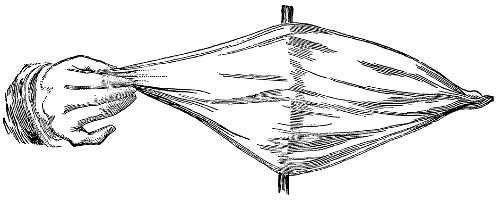
To the public it appears as follows: A plain gold ring is borrowed, placed in a handkerchief, and given to a person to hold. A small stick is held by two others, in such a position that its center is hidden by the handkerchief; each person holds an end. The magician commands the ring to pass, at the same moment snatching the handkerchief, a corner of which he has taken, away from the one holding it—when behold! the ring, which a 301moment ago was in the spectator’s hand, is now whirling around the stick, which it evidently has just reached.
It is performed as follows: When the ring is taken from its owner, it is palmed, and not placed in the handkerchief, as one is led to suppose, the handkerchief being supplied, as you probably have already guessed, with a ring which is sewed in its end. In passing the stick to the holders, you have simply to pass it through the right hand, in the center of which your ring is palmed, and, of course, through the ring itself. Then, holding it until it is hidden by the handkerchief, is not difficult to do. When you first take up the stick, be sure and use your left hand, so that you will have it ready to pass through your ring without any awkward or suspicious movements. Finally, pulling the handkerchief suddenly and quickly across the stick, causes the ring to whirl upon it very much as if it had just dropped in its place. It is always well, when performing with the handkerchief, to have a second and similar one in your pocket, to show in case suspicion should be aroused concerning it.
HOW TO MELT AND RE-COIN A HALF-DOLLAR.
Supply your table with a candle in a light candlestick, and a glass of water. When ready to perform, request some one of your audience to lend you a half-dollar, suggesting at the same time, that a new bright coin would 302best suit your purpose. Have it marked that the owner may be sure of its identity.
If nothing but dull coins are to be found, have a small bottle of ammonia at hand, and holding the piece in your hand, pour a few drops of the liquid upon it; let it stand a few moments and then wipe with a bit of cloth. Treat both sides in the same way, and brighten up the edges in like manner. All this while you may be talking of this treatment, as if it were intended to render the metal more fusible, but be careful not to mention what the fluid is, or for what it is really intended. This treatment is, of course, not necessary in the case of new coins, in which case it can be omitted.
When the silver is bright, and presents the appearance of a new coin, take it between the thumb and forefinger of your right hand, look at it carefully, and then pretend to drop it into your left hand, but instead palm it in your right.
Now continue to move your left hand as if working the coin around in it, keeping up a continual flow of small talk during the whole performance. The difficulty of melting silver, the amount of heat required, and the comparative hardness of different metals, forming good subjects, with which you will become familiar before your public exhibition.
To render the idea of palming an apparent impossibility, 303take up the candle in your right hand. This will render the holding of the coin less troublesome, and appear to your audience as a conclusive evidence that the half-dollar is in your left hand.
After you have pretended to place the coin in your left hand, do not for an instant forget to appear as if it really was there, and keep that hand always in sight of your audience.
Having taken the lighted candle in your right, hold the left hand above the flame, and move the fingers as if allowing the silver to pass down, drop by drop, into the candle itself. If, just before this, previous to taking the candle, you could catch up the glass for a drink and drop a spoonful of water into the hollow of your left hand, the dropping of it into the candle-flame would add to the impression of melting silver. You can wet your hand slightly in many natural ways, as no one would imagine the water had anything to do with the trick. Continue to pretend to drop the silver, until it would naturally be gone; then, without removing your hand, open it and announce that the half-dollar is melted, and can be found in the candlestick; assuring the donor that he need not be alarmed, as you can bring it out as it was before it went in, if he will but have patience.
Put the candlestick down upon the table, and pretend to pick out bits of silver from the various parts of it with 304the right hand, placing them as they are gathered in the palm of the left hand. At a convenient moment, when the right is exactly above the left hand, drop the half-dollar into it, and the trick is done. But it would not do to let the audience know this, so you must continue to work the left hand as if molding the coin in shape, blowing with the mouth into the palm as if cooling the heated mass; toss it from hand to hand as if to cool it more rapidly, and finally return it to the spectator from whom it was borrowed.
BURNING THE CENTER FROM A HANDKERCHIEF.
The young performer will find but little difficulty in performing this simple sleight-of-hand trick successfully. A lighted candle, a small stick, or magic wand, and a piece of thin cambric or muslin about six inches square, are the materials required.
Place the lighted candle on your table, and the wand on another table or shelf some distance from the former with the bit of cambric behind it.
Now borrow of some lady present a handkerchief, a gentleman’s being inconveniently large. Take the handkerchief by the center, pull it carefully between the fingers and thumb of left hand, and advance toward the candle.
Just as you are about to burn it, stop and say, as if in 305answer to some remark overheard, “Oh, no, I have not changed the handkerchief. See!” and at the same time allow another inspection of it.
Suggest now to its owner, if, in case her handkerchief is burned, she would like it restored again to its proper condition; and, upon her answering in the affirmative, announce the necessity of the magic wand for that purpose. Walk to the spot where the wand is lying, and take it up, managing to pick up at the same time between the left thumb and forefinger the bit of cambric; the center of this piece should be pointed outward so that it may be readily pulled out at the desired moment, the remainder being neatly rolled up and palmed under the thumb. This piece should have been rolled up with the central point slightly projecting when first placed on the shelf, and the performer should manage to turn his back toward the audience for a few moments when taking up the wand.
Place the wand in one of your coat pockets as you advance toward your candle, and again take the handkerchief, putting it this time into the left hand, and pull up the small piece of material, completely hiding the center of the real handkerchief between the second and third fingers and the palm of the hand.
The portion of the cambric extending beyond the thumb and forefinger may now be safely burned, and 306the audience may be sure the handkerchief is burned, as you can make some display of rolling it up in a ball, taking care, however, to separate the burned piece from the real article. Now take the wand from the pocket, and at the same time manage to drop the small semi-burned piece of muslin unperceived into the pocket; touch the handkerchief with the wand, and, after some magic word or words, return the handkerchief to the owner to be examined, remarking that you hope not even an odor of smoke is noticeable about it.
Whenever displaying feats in magic, it is better for the performer to go forward among the audience if he has anything to show or have examined, than to allow the latter to come to his portion of the room. His table has often some things upon it which if seen near by would do much toward dispelling the mystery connected with his works.
A wide space should be left between his table and the front row of spectators, as he often has occasion to step between the two in some of his feats.
The lights also should be judiciously arranged, so as not to shine too directly upon his hands or person, or even upon his table. Always have everything you can possibly need in some easily accessible place, and in just the position most convenient to be taken.
Decide beforehand what tricks you will perform, and 307in just what order they are to be given. Of course, all the materials are not to be spread on the table at the commencement of the entertainment, as they would be in the way, and confuse you in your first acts; but they should all be at hand, and while articles are being examined which have passed through the various vicissitudes in a former trick, you can utilize the time when the attention is thus carried away from yourself to gather together and properly place the materials for your next feat.
Never be induced to perform a trick a second time, unless nearly a whole evening’s performance intervenes. Even then it is pretty sure to be detected.
THE MAGIC ROPE.
Take a piece of clothes-line, six or seven yards long, and pass it among your audience for inspection. While it is going its rounds, have your hands securely tied with a handkerchief, which should be passed around the wrists and knotted on one side.
When the rope is returned to you, drop one end between your arms, or inside the handkerchief, and request some one to take both ends of the rope and pull, to make sure your hands are firmly tied. It would now seem impossible to get the rope off, unless the hands were untied 308or the ends released. After two or three rapid motions, however, the rope drops to the floor, while your hands remain tied as at first.
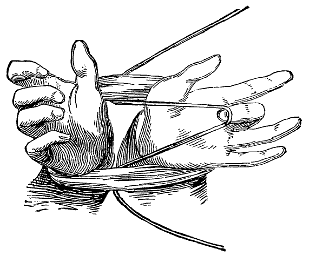
First, do not have your hands tied so tightly that you cannot move them; this can be arranged by holding them slightly apart while they are being tied. After the rope has been pulled by the holder, it is somewhat relaxed; and then, by rubbing it between the wrists a loop may be formed, into which the second finger may be slipped. The whole hand is now readily thrust through, and only a jerk is necessary to send the rope upon the floor. In performing this trick, work as quickly as possible, that your movements may not be easily followed.
A CAMPING-OUT COOKING-STOVE.
Although the winter season is now well upon us, and its reigning king, Jack Frost, jealous if we but mention 309the “camp-fire,” has covered its very site with ice and snow, we need not fear incurring his displeasure by the following exhibition.
Procure an old silk hat if possible, and pass it among your audience for inspection. Have upon the stage, or at your end of the room, a table, with a drawer open at the back. In this drawer have a small cake in the tin in which it was baked. Let it be made in a patty-pan if convenient. Beside this cake have a small tin cup, which will fit rather tightly into the mouth of a china jar you have also provided. On the top of the table have an unlighted candle, the jar, which should be porcelain if possible, a basket containing a few eggs, a pitcher of water, some flour, and a box marked sugar. The hat, after having been examined, is returned to you; and the cake, along with the cup which is to receive the eggs and flour, are put into it. This is effected as follows: Take the cake and cup in your left hand, keeping it down behind the table, and your hat in the right hand; bring the cake and cup up to the edge, and immediately cover it with the hat, which you begin brushing with your right. Keep up a running discourse all the time, so that the movement will seem natural, and not be suspected. In a moment or two partly withdraw the left hand, and grasping the brim of the hat, turn it upside down upon the table. If the tin is not in a good position to catch the eggs and flour which 310you are to drop into it, palm a penny and pretend to find it in the hat, chiding your audience for carelessly overlooking it, remarking that although a useful thing to have, it is not exactly a proper ingredient for cake. Of course, while pretending to pick up the coin, you can arrange the tin cup on top of your cake in the middle of the hat. Be sure that it stands firm.
Now proceed to break one or more eggs, and drop the contents into the hat, taking especial care that they drop into the cup. Next throw in a spoonful of sugar, and then pour a few drops of water and one or two spoonfuls of flour into the jar, and stir well with a spoon. Pour the contents of the jar into the cup, and then, under pretense of draining the last drop into the hat, force the jar down over the cup, and work it around until the cup is well pushed up into the mouth of the jar. It is needless to add that you must pretend all the while that you are scraping or shaking out the mixture. The jar can now be taken out and carelessly placed behind the sugar-pail or any other object, to prevent the edge of the tin cup from being seen.
The trick is now completed, the only necessary thing to do is to keep up the acting until the cake is supposed to be finished.
First, stir it well by moving the spoon around quite actively in the hat; then light the candle, and, informing 311your audience that the cake is ready for baking, take the hat in one hand and hold it over the candle for a minute or two, occasionally glancing in to see if it is doing well.
In a short time announce that it is baked; and after blowing out the candle, take the cake from the hat, turn it out upon a plate, and placing a knife by its side, pass it to some one to cut, and politely request your friends to try it, and judge upon the efficacy of your camp-stove. If the hat was borrowed, return it with thanks to its owner, and congratulate him upon having such a useful article always on hand.
NECESSITY OF A SOBER COUNTENANCE.
In most, in fact all, of these exhibitions, it is absolutely necessary that one should keep a sober countenance while performing. No matter how hard your audience laugh, do not allow the shadow of a smile to flit across your face. If you do it will take away much of the effectiveness and half the mystery, from whatever you are doing.
I once had a young friend, a quick bright boy, who was very successful in palming, and in many of the other elements in sleight-of-hand tricks, but he had a ridiculous and unconquerable habit of laughing whenever his audience laughed, and, in fact, of sometimes anticipating the laugh, and commencing before his friends saw anything worth laughing about.
312He was of course not successful, and was never watched with as much interest as his brother, who, although not as clever, was as sober as a judge from the beginning to the end of the performance. No amount of hilarity in the audience affected him in the least. If he found it was impossible to make himself heard, he stood still and waited; but always with the same quiet, calm countenance he would have worn had he been walking up the aisle of a church. Learn to command your countenance, as one of the most important requisites of a successful magician.
THE GREAT CHINESE ROPE FEAT.
Many years ago this trick was exhibited in a show-window on Broadway, but as probably most of the people who then saw it have long since forgotten how it was performed, I give the following account:
Two ropes, each about three yards in length, are given to the audience to examine, which of course are pronounced perfect; then they are passed through the sleeves of a coat, in such a way as to suspend it; the ends are then given to two boys to hold. The performer then places his hand inside the coat, and having requested those who are holding the ends of the rope to pull, the coat falls to the floor, having in some mysterious manner worked off the ropes.
313

Of course, the whole secret of this trick depends upon the arrangement of the ropes, which are of themselves perfect. After they have been examined, and are returned to the performer, he pretends to measure them, and while so doing manages to bend each rope double; that is, he brings the two ends of each together; while still holding them he contrives to slip a small elastic band over the center of one, and bringing the middle of the other alongside of it, he slips the band over both, thus tying them together, as shown in the illustration.
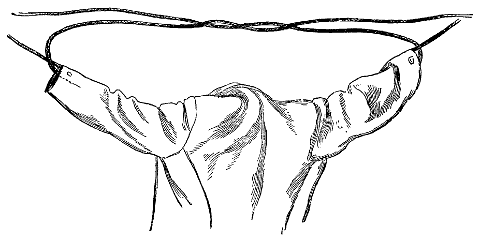
Now holding this juncture carelessly in his left hand, over which arm a coil or two of the rope is thrown, he passes the ends marked A through one sleeve of the coat, and the end marked B through the other, and these are the ends he gives to the two persons to hold.
314If he now slips off the rubber band, the coat will fall; but each person will have both ends of the same rope in his hand, and the mystery would be easily solved. To remedy this, however, the performer, under pretense of making the trick still more difficult, takes an end from each of the holders, and proceeds to tie a single loop, as seen in the illustration, thus reversing the ends, which he then returns to them.
Of course, when the band is taken off, each person has but one end of either rope in his hand.
TO PULL A STRING THROUGH A BUTTON-HOLE.
Tie together the ends of a piece of string about two feet long; pass it thus tied through a button-hole of your coat. Hitch the two ends on your thumbs, and catch up with each little finger the upper string on the thumb of the opposite hand; then, stretching the hands apart, the string will appear in a very complicated tangle. If the hold of the right thumb and left little finger, or vice versâ, be then loosed, and the hands quickly separated, the string will come away from, and appear as if it had passed through, the outside edge of the button-hole.
TO UNITE A PARTED STRING.
Take a piece of string about four feet long; hold the ends, pointed upward, between the first and second finger and thumb of the left hand, and the first finger and 315thumb of the right hand, letting the remainder of the string hang down in a loop. Now bring the right hand close to the left, crossing at right angles that end of the cord held in the left hand, and continue to pull until half the length of the string has passed the left hand, at the same time slipping the third finger of the left hand between the two parts of the string.
The first finger and thumb of the right hand should then seize the string at a point just below the little finger of the left hand, the third finger of that hand at the same time drawing back the string toward the palm of the hand.
The part of the string now held horizontally between the two hands is only the continuation of the end held in the left hand, though it will appear to be the middle of the string.
This piece of the string some one of the audience should be invited to cut, and thus apparently divide the string in halves, although in fact he only cuts off two or three inches.
Place all the ends of the string between the teeth, withdraw the short piece with the tongue, and show the remainder, apparently as the string was at the commencement.
Of course, the string must not be measured, or the trick will be detected.
316―――――◀▶―――――
A MINERAL GARDEN.
Fill a clear glass jar—a fruit jar will answer the purpose—with sand, to the depth of two or three inches; insert a few pieces of sulphate of iron, sulphate of copper, and sulphate of aluminum, so that they will be barely covered with the sand.
Now fill the jar to within about three inches of the top with a solution of silicate of soda, commonly known as “water-glass,” which can be procured at most large city drug stores. This should be diluted with three times its bulk of water before it is poured in; and care should be taken not to stir up the sand and disarrange the chemicals.
After standing about a week, the silicates of the various bases will appear in a luxuriant and variously colored growth, resembling vegetation.
Now the silicate solution may be displaced with clear water, which should be poured in very carefully, so as not to break or disturb the vegetation. This permanent miniature forest will be found to present a very attractive appearance, and as no pruning or weeding are required, the young gardener will probably feel that his trouble is well repaid. Its development from day to day will be watched with interest by all the members of the household, although it will be of especial value to the invalid, 317to whom any new and interesting object to watch is a blessing indeed.
Another pleasing and ingenious device I insert for the benefit of this class of my readers, wishing, in the meantime, that it might be in my power to make their in-door life so bright and full of interest, that they would forget the more active sports of their sturdy brothers and sisters, or at least cease to regret their enforced confinement. This little affair I shall call
THE CRYSTAL VASE.
This sparkling ornament will almost make itself, so little trouble is required.
You have only to half fill a tall glass tumbler with water, and put in half a teacupful of table salt, then let it stand.
As the water dries out, put in a little more, adding salt also in due proportion; and keep this up for five or six months.
By degrees an incrustation of crystals will fill the tumbler, and spread gradually down the outside; extending and thickening till the whole vessel is covered with an irregular glittering mass, which might well be the work of the ice-sprites in the kingdom of Jack Frost.
As the crystals approach the bottom of the tumbler, the 318latter should be set in a saucer; when the tiny stalactites have enveloped this also, the vase is complete.
Should it be desired to enhance still further the decorative effect of this by the use of color, a blue tint can be communicated by adding a little indigo blueing to the salt and water. Should other colors be desired, almost all of those employed in coloring alum crystals (see page 25) may be used with equal success in this case. By adding different colors at different times, a variegated effect may be produced.
The gradual growth of the crystals, and enlargement of the mass, is a very interesting spectacle.
―――――◀▶―――――
THREE CHRISTMAS OR BIRTHDAY GIFTS.
When speaking of Christmas presents in an earlier portion of this book, I unintentionally omitted three quite interesting and easily made puzzles, which are always pleasing sources of amusement to the young folks, and sure to while away many half-hours on stormy days. Such presents are always valuable additions to the nursery closet, and in an indirect way are as gratifying to mamma and nurse as to the little recipient himself. The first of these is called the
OCTAGON PUZZLE.
This puzzle consists of twelve irregular pieces of stiff 319pasteboard or wood, which are to be arranged in the form of an octagon.
Although these pieces can be cut from pasteboard, they are more lasting, stronger, and better every way if made of wood. White holly, such as is employed for brackets, is a nice material to use.
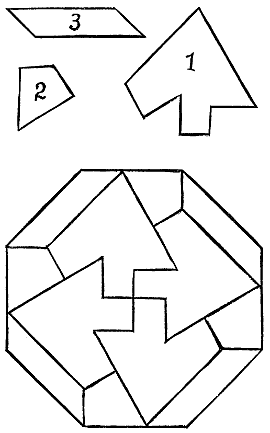
With a jig-saw cut four pieces in shape like that represented in Fig. 1, four like Fig. 2, and four more like Fig. 3; rub the edges down with sand-paper, and, if you like, paint each set a different color. When the paint is dry, varnish them.
320Pack them in a small pasteboard box, which you can neatly cover with paper—any fancy color will do—and you will find your little brother or sister will be as well pleased with them as with many toys which have come direct from the store.
Another puzzle of the same character as this is
THE CROSS PUZZLE.
In this, as in the Octagon, the pieces composing the cross may be made of pasteboard, but are better and stronger if made of the white holly or other thin “bracket wood.”
321
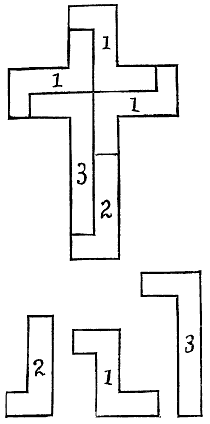
Cut three pieces—with the jig-saw, of course—in shape like Fig. 1, one piece like Fig. 2, and one like Fig. 3.
These pieces may be of any size, but relatively each one must correspond with the sizes and shapes indicated in the diagram.
Paint as fancy may dictate, after smoothing the edges off with sand-paper. Pack in a box treated like that used for the “Octagon Puzzle.”
The last of these interesting puzzles is known as the
SQUARE PUZZLE.
Of the pasteboard or white holly cut out eight squares of whatever size desired; divide four of them into halves by cutting them from corner to corner, so there are in all twelve pieces.
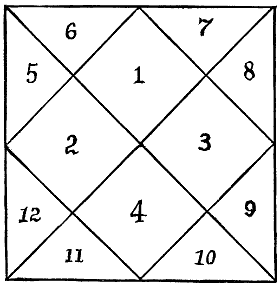
The puzzle is to form a square of these twelve pieces. The illustration shows how this is done.
322When these puzzles are given to the little folks, no “key” should accompany them, but the children should try to put them together without help. If, however, you find they begin to lose interest, show them the first step, and encourage them to try to finish it by themselves.
There are great differences in children in this respect; some persevering and unwilling to be helped at all, while others become discouraged at the smallest obstacles and refuse to try. The latter should be encouraged by a little help, care being taken, however, that they do a considerable portion of the work themselves.
No doubt this “indolence,” as it is sometimes erroneously called, is generally due to a weak physical condition, rather than to inferior mental powers. A child of this temperament, instead of being ridiculed by his more vigorous companions, should be encouraged and stimulated to action; and such games or puzzles as those contained in this book are just the things to accomplish this end.
―――――◀▶―――――
A SIMPLE FOUNTAIN.
Take a bottle holding eight or ten ounces, and insert a tube in the cork. A fine glass tube or even a pipe-stem will answer.
323The tube should reach nearly but not quite to the bottom of the bottle, and should fit air-tight in the cork.
Fill the bottle about three-fourths full of water, and blow with considerable force down the tube. Upon removing the mouth, the water will spurt out, forming a miniature fountain; which will continue to play as long as any water remains in the bottle.
―――――◀▶―――――
THE FAN FROM NAGASAKI.
A few months ago, a friend who had been for several years a resident of Japan, came home to America for a visit, and brought with her a bright little son and daughter, neither of whom had ever set foot on our American shores before. The children were delighted with their American cousins; and evidently could not find words strong enough to sound the praises of the new games and sports which they were constantly learning.
Their lives had been spent with Chinese or Japanese nurses; and although kind-hearted and devoted as my friend assured me these people were, the little exiles must have had a sorry time of it in their foreign play-room, when compared with our own boys and girls. The respect and almost reverence with which they regarded Jack, the most daring scapegrace in our family, would 324have been very amusing had it not been pathetic. What Jack did was always marvelous in their eyes, and into many an unsuspected trap they were beguiled by his mischievous pranks. They were what most of you boys and girls would call very green, when they first reached us, but under Jack’s tuition, I fear that next winter—in fact, at the very time you are reading this—perhaps they will be trying the same tricks upon their innocent Japanese nurse that Jack tried upon them.
It will not be strange if that long-suffering personage does not in his secret heart have less respect for this illustrious nation than he has been wont to have before.
But if so ignorant in most things, these children were very ingenious and uncommonly happy in making things of paper.
One rainy morning, about a week after they came to us, I had occasion to go into the nursery for something, and was quite surprised to find the children busily engaged in folding paper. Edith had brought down some rice-paper from her trunk, and with the help of her brother, was fashioning all sorts of odd things from it; while the younger members of my own family were looking on with intense interest.
I left the room, after watching them for a few minutes, but an hour later, upon entering it again, found them still employed in the same amusement.
325It seems that their nurse had been in the habit of teaching them many Japanese arts to keep them still while under his charge. Their nurse was a man, strange to say, as very few female servants are employed in either China or Japan, and now they in their turn were teaching these to us. I confess the graceful, pretty things they were making had quite a fascination for me, and I even left off what I had been doing, and became a pupil with the youngsters. I took up the article which they were just beginning to learn, and, following my little teacher’s directions, I made what I have styled “The Fan from Nagasaki,” because my little instructress was born and lived in that city, and learned her art from a native Jap, and not because the fan itself, if it can strictly be called a fan, came from that region.
The children called it by a delightfully odd Japanese name, which you would find it hard to pronounce even if I should invent a way of spelling it.
Edith used Japanese or rice paper for those she made; but we found a stout quality of brown wrapping-paper, not too stiff, answers nearly as well.
If brown paper is used, a rectangular piece about two feet long, by one and a half feet wide, is a good-shaped piece to use.
Mark off each of the edges which measure eighteen inches into six equal parts, each division being of course 326three inches long (see Fig. 1). Now double the paper on the line at x, and you have a shape like Fig. 2. Fold the uppermost half under at the line a a, and again outward at the line b b; then fold the under half in precisely the same manner, and your paper is like Fig. 3.
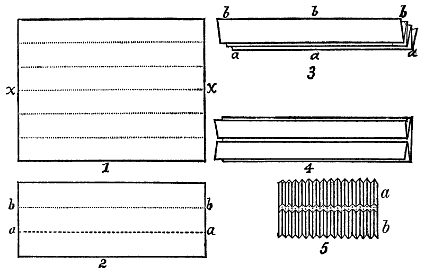
Upon examining the edge a a a, two openings between the folds will be seen; whereas at the edge b b b, three openings will be found. The hand has next to be placed in the middle of these three openings, and the paper spread out toward the right and toward the left; that middle fold lying flat or unfolded for the time being. Another figure is now made like Fig. 4. Now commencing at one end of this long strip, crinkle it the whole length as you would a lamplighter top, making the folds even, about a quarter or half an inch wide. Be careful not to make these folds wider than this, as the 327fan does not work as well when they are wide. Yon have now a figure like that seen in Fig. 5; and if your folds have been carefully and firmly creased, your paper is prepared to make all sorts of strange shapes. I think Edith told me her nurse could make sixty-five different forms from a similarly folded bit, and most of these she was able to reproduce; but as it is some time since the children left us to visit other friends, and I have not given the subject a second thought till now, I find I have forgotten how many of the more intricate ones were formed. Perhaps with the directions for these my readers will catch the knack, as we Yankees call it, and can improvise some forms unlike any of these, for themselves. Whatever you succeed in making, you may be quite certain that the Nagasakian nurse, away off on the other side of the earth, is ahead of you, and has made the same form before; for his sixty-five must include about everything one could possibly fashion from its folds.
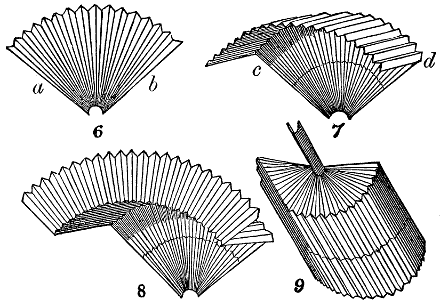
In Fig. 6, the lower edge of Fig. 5 is held between the thumb and forefinger of the left hand, while the top is spread out like a fan. For Fig. 7, take Fig. 6, insert the fingers at a, and pass them round to b, raising the paper outward. Fig. 8 is a continuation of 6 and 7, as the upper layer of the overhanging edge in Fig. 7 is raised by passing the finger under it at c, and bringing it out at d.
Fig. 9 is a reverse of Fig. 8. Catch the paper by the 328part now uppermost, pinch that part well together, and loosen the part which was confined in Fig. 8.
It must be remembered that every time the fan is changed, the paper must be pinched into its original form, Fig. 5. It will now be necessary to make that change. After creasing the folds firmly in place (Fig. 5), lift up the upper part a, bring the lower plaits b well together, and hold them for the handle. With the disengaged hand, arrange the upper part in the form of a sunshade. Another form may be got by raising the upper layer of the sunshade cover, a species of cup or goblet. By drawing out b until it is at right angles with the upright, the goblet form is nearer correct.
Now reverse the paper, and spread out the lower part 329so that it may represent the body of a wine-glass; that which in Fig. 10 was the top of the sunshade, is now the foot of the glass, as seen in Fig. 11.
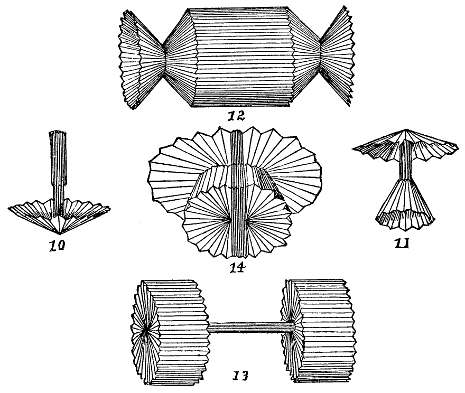
The Chinese lantern (Fig. 12) is as easily made. Open out all the paper, and twist it around; catch it now by the central part, and by compressing the central folds well together, these wheels are produced (Fig. 13).
The hat, or cup and saucer (Fig. 14), is readily made by opening the paper out again, and catching it at the two ends.
We now come to a new form of subjects, so the original form (Fig. 5), must once more be reverted to. If the paper is caught at both ends, it can easily be folded so as 330to form Fig. 15, and a table-mat may be made by drawing it out like Fig. 16.
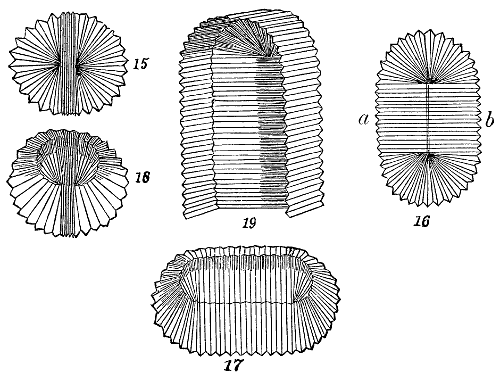
A “nappie” dish, oval in form, and resembling Fig. 17, may be made from Fig. 16, by simply raising up the sides a and b. By pressing the paper inward, Fig. 18 is obtained. Fig. 19 is made by drawing the paper out again, and letting it loose at the end. Thus you see, by pulling out some parts and drawing in others, a quantity of things could be made other than these I have shown. It would be quite interesting if every boy and girl who reads this, would try on some rainy day to see how near to the sixty-five he or she could come. If two or three friends in the same neighborhood should unite their 331forces, and count all which are unlike, without reference to the maker, they might not fall so far short of the illustrious Japanese—I wish I could remember his name—after all.
―――――◀▶―――――
THE MINIATURE YACHT AND HOW TO RIG HER.
Boat making and sailing are most fascinating pursuits, and we do not know but the old saying, “When a man has taken to boat-sailing, he is a sailor to the end of his days,” is to a certain degree applicable to the boy who intelligently fits out his tiny craft, and sends her on little voyages across the neighboring pond.
If the sailing is to be done on water of any depth, there is one caution we should like to give at the very outset: Learn to swim before you sail her. No mere pleasure is worth risking one’s life for, and accidents will happen even to the most careful boys.
After this, you may play on or near the water with as much safety as on the land.
Aside from the pleasure, one learns an extremely useful lesson in making a miniature model yacht, and in sailing her. A certain familiarity with the rigging, and the looks of the thing, will thus be obtained, and if your fingers have patiently set up shrouds and stays, and rove the mimic halyards, they will be less at sea with the ropes and stays of a real vessel.
332Many boys living near the sea, and accustomed every day to see vessels lying at anchor, or sailing in and out of the harbor, have very hazy ideas concerning the rigging of any kind of craft. Well I remember in my early days of being obliged to run down to the wharf to see where to attach my topmast. Whether it belonged forward or aft of my mast I had not the slightest remembrance, and yet scarcely a day went by without my seeing a vessel in some form or other.
Boys are not the only persons, however, who look at things and do not see them. The power of minute and careful observation is a rare quality, and the majority of people go through life without forming the habit, or indeed dreaming they have not made the best use of their sight.
For the benefit of the boys who belong to this class, and those less fortunate ones living inland where yachts are unknown, I write this chapter.
In several of our large cities, ponds are set apart for the especial purpose of sailing toy vessels. They are the exclusive property of the boys, and any fine afternoon in season, and frequently out of season, if the ice does not interfere, crowds of boys may be seen sitting on the edges of these “lakes,” intently watching the graceful fleet as it skims lightly over the water. The sixty-acre lake in Prospect Park, Brooklyn, and Conservatory Lake, Central 334Park, New York, are both set apart for the owners of these miniature yachts; and it is wonderful how many older people, as well as the boys themselves, take interest in this amusement.
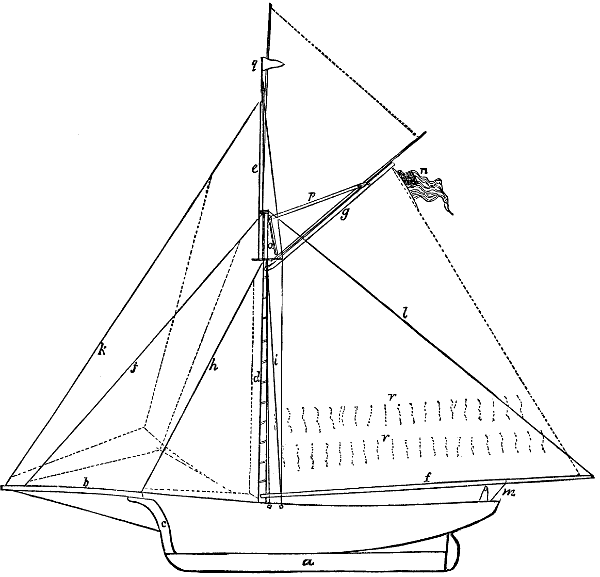
a Keel.
b Bowsprit.
c Stern.
d Mast.
e Topmast.
f Boom.
g Gaff.
h Forestay.
i Shrouds.
j Jib-stay.
k Topmast-stay.
l Topping lift.
m Main-sheet.
n Ensign.
o Throat halyards.
p Peak halyards.
q Burgee.
r Reef points.
The building and sailing of tiny yachts is carried to a much greater extent in England than in this country. There the Prince of Wales is deeply interested in the sport, and has instituted a “Royal Yacht Club,” presided over by himself, which has regular yacht regattas. These regattas take place on Serpentine Lake, in Hyde Park, every summer, and are considered quite important events. The yachts belonging to this club are very elegant affairs, one of them being valued at $5,000, yet none of them are over five feet in length.
We do not expect our boy readers to emulate their British cousins, but with the following simple directions we feel confident they can, with a fair amount of skill in the use of tools, and careful labor, make a very respectable miniature yacht, which shall be correct as far as she goes in both form and rigging.
In the fashioning of a miniature boat, the hull is the first thing which claims our attention; and in making this, two elements are to be considered, rapidity and stability.
The rapidity or ease with which a vessel moves through water, is gained by a narrow hull—that is, narrow in proportion to its length—which, to be sure, renders the vessel 335somewhat unstable; but this instability may be overcome by loading the keel with lead. There is danger, however, of carrying this to too great an extent, by lowering the vessel so much that the friction against her sides more than counteracts the fine proportions of her build. Hence a skillful designer reconciles these two points.
There are two types of model recognized in yacht building: First, the English cutter model, which is narrow, and quite deep in proportion to width, with its keel heavily weighted to secure the necessary stability. This model is best adapted to rough cruising in strong winds and heavy seas, such as prevail on the English coasts.
Second, the American: This, our model, is much wider, or, in nautical phrase, has much more beam in proportion to length and depth. Indeed, it is often so shallow as to merit the term “skimming-dish,” ofttimes applied to this class of vessels.
These boats are usually fitted with center-boards, which can be lowered or raised according to the need of the moment, instead of the deep keel of the English model, American vessels having the advantage of smoother water in which to make their cruises. The sheltered surface of Long Island Sound and the bays which adjoin it at either end, afford excellent sailing grounds for those owned in New York and the vicinity.
336For the toy boats our boys may desire to make, a medium between these two types will probably be found preferable in practice.
The center-board may be ruled out at once, as both itself and the well in which it plays would require more time and patience in their construction than most boys would care to give.
It is much better to have your boat too wide than too narrow, as a capsize is far more disconcerting to the average young yachtsman, than a slight inferiority of speed.
For a sloop yacht, the greatest width should be about one-third the length; and the point of greatest width, or beam, should be somewhat nearer the stern than bow.
Probably the best way to make a toy yacht is to procure a piece of wood, which is about three times as long as it is wide and deep, and whittle out your hull as your judgment or fancy may dictate; keeping in mind a few essential points, however, to insure ultimate success.
First, draw a line from the middle point of one end to the middle point of the other end of the top of the block; this will serve as a guide to the bow and the center of the stern. Care should be taken not to make your vessel too blunt at the bow; as a sailor would say, “the lines at the bow should be fine when they meet the water.”
The elegant appearance of the boat is increased by giving an overhang to the stern, instead of running it up 337vertically; and if the young builder is confident in the use of his tools, a sheer, as it is called, of the lines at the top, or the gunwale, will add greatly to the grace of its appearance. For the benefit of those who do not understand the meaning of the word sheer, it may be explained that it is the gradual and graceful downward curve from bow to stern, noticeable in the bulwarks of vessels when seen from one side.
It is perhaps superfluous to add that great care should be taken to have each side of the craft alike, for if a preponderance of weight is on one side, the vessel will tip; while if the curve is unequal, she will not sail evenly.
The hollowing out of the inside is most conveniently accomplished with a sharp gouge and mallet, while the hull is secured firmly in a vise. When this is finished, a hole should be made in the bottom to receive the lower end of the mast, and care should be taken not to bore through the hull, as it would be difficult to stop the ingress of water through it.
We have now come to the keel, which must be firmly attached to the hull. The best way to do this is to drive three slender brass screws through the bottom of the boat, with ends projecting from one-fourth to one-half an inch along the line of the proposed keel. Make a temporary box around these, inclosing a space equal to the length and breadth of the keel, with strips of thin wood, such as 338cigar-box wood; strips of heavy pasteboard may answer the purpose sufficiently well. In either case this mold should be firmly attached to the hull, in such a manner that after casting the keel it may be readily removed. Perhaps the best way to accomplish this is to paste it in place by means of narrow bands of stout paper. The inside of the mold must be rubbed with oil or lard to prevent the lead from adhering to its sides. This lead must be melted over a very hot fire, so that it will not cool too rapidly upon entering the mold, in which case it would not hold together as well. When cold, the mold may be detached, and the keel will be held firmly in place by the three screws.
The deck should be made of thin board, cut so as to accurately fit the top of your hull. If a sheer has been given to the bulwarks, it is of course much more difficult to fit the deck accurately, as it should follow the curve. It will very likely be found necessary to steam the board used, to make it sufficiently flexible. It will be possible to use stout pasteboard for the purpose, if both sides and edges are given a couple of coats of paint, which treatment should also be applied to the inside of the hole for the mast.
This hole should be placed very slightly farther astern than the hole already mentioned, made in the bottom of the vessel. The effect of this will be to give the mast a 339slight rake. This is always the case with the masts of a schooner yacht, but builders of sloop yachts occasionally omit the rake and “step” the mast in a vertical position.
The bowsprit may be fastened by two staples made of small wire, and driven down over it. One is driven down into the stem, or extreme forward point of the hull, and corresponds to what is called the “gammon iron” in a full-sized craft; the other secures the “inboard” end of the bowsprit, or that which is nearer the stern. This end is called the heel, and should nearly reach the mast. The outer end should project beyond the hull to a distance of nearly one-third the latter’s length.
The rudder can be whittled from a thin piece of wood, in the shape shown in the figure; the upper part or head is round, and passes up through a hole in the overhang. The top of this rudder-head is squared off to fit the hole in the end of the tiller or helm. The rudder is “shipped” very much as a barn-door or window-blind is set in place. Suitable hinges for the rudder of a toy boat can be made of pins from which the heads have been filed. Two pins may be bent double for staples, and inserted into the “stern-post” of the vessel; while two others bent at right angles may be driven into the rudder, the projecting ends hanging down through the staples. The rudder should turn with sufficient friction to hold its place, at 340whatever angle it may be set. The hollow of the boat should not extend back into the overhang, as water might enter it through the rudder-hole.
The mast is composed of two parts or pieces; the lower part is what is always understood when the “mast” is spoken of. The smaller piece, fastened to the upper end of the mast, is called the topmast.
The “mast,” which extends above the deck to a distance equal to about three-fourths the length of the hull, passes through the hole in the deck already mentioned, and rests firmly in the hole made for it in the bottom of the hull.
The lower end of the topmast is lapped on in front of the upper end of the mast, as seen in the figure, and may be secured in place by two loops of fine brass wire.
The spars of next importance are those which stretch the mainsail. The larger is called the “boom,” and extends along the lower edge or “foot” of the mainsail; while the other, which is called the “gaff,” is secured to its upper edge or “head.” The boom is equal in length to the mast; the usual meaning of the word is here intended, i. e., the lower part. The gaff is a little over one-half the length of the boom.
The mast and topmast taper slightly toward their upper ends, while the gaff is nearly the same size throughout its entire length. The boom generally 341swells a little, being somewhat larger in the middle than at either end.
The boom and gaff are adjusted to the mast by a “jaw” on either side, forming a crotch, which keeps them from slipping off. Builders of miniature yachts will, however, probably find it more convenient to whittle the ends of the spars in the form of a crotch than to attach jaws as separate pieces.
Other smaller spars which enter into the equipment of racing craft, will be mentioned in speaking of the sails.
The standing rigging is now to be considered; this consists of stays and shrouds. “Shrouds” are ropes which lead from near the head of the mast to either side of the vessel, where they are fastened into the chain-plates. These are strong iron bands firmly bolted to the timbers. The shrouds of the model yacht, however, can be attached to copper tacks driven into the sides. They—the shrouds—are tied around the mast just below the point where the lower end of the topmast ends.
In “real” yachts these shrouds end in loops which encircle the mast, and rest upon, or are held in place by blocks called “hounds” attached to either side. But young ship-builders will probably find it will answer all purposes to make a slight notch on either side of the mast, at the point indicated.
A sloop yacht has usually two shrouds on either side, 342while in a large ship there are four or five, making, as is known, a good-sized ladder.
The “fore-stay” runs from the same point on the mast to the top of stem.
In case the reader may be ignorant of the meaning of nautical terms, it may be well to say here that by “stem” is meant the piece of timber in the hull placed farthest forward, also called “forefoot” and “cutwater.” The “fore-stay” may be passed through the staple already mentioned, which fastens the bowsprit to the hull. The jib-stay passes from mast-head to outer end of bowsprit.
The topmast-stay runs from the top of the topmast to the forward end of the bowsprit; here it is sometimes passed through a hole in the end, and brought down to the forefoot, near the water line.
The bob-stay runs from the end of the bowsprit to the stem, and acts as a brace to offset the strain of the “headsails,” or the sails in front of the mast. In a large yacht it is necessary that this stay be very strong; and in such cases it is often a substantial strip of iron or steel.
A yacht has, also, what are called “backstays,” which run on either side from head of “topmast” to points on the sides somewhat abaft, or back of the places where the shrouds are attached.
There are also “cross-trees,” with “topmast shrouds” 343leading from them to the top of the topmast; but these, as well as the backstays, may as well be dispensed with by our juvenile naval architect, as a complication of unnecessary cords is to be avoided on a miniature craft.
We must now take up the sails, the most important of which is the mainsail. The shape of this may be sufficiently well understood from the figure. The edge next the mast is called the “luff,” while the outer or longer side opposite to this is called the “leech.” The upper and lower edges are called respectively the “head” and “foot.” The lower after corner of this sail is called the “clew,” the lower fore corner the “tack,” while the upper after corner is called the “peak.”
The “mast-hoops” are attached to the “luff” and run up and down the mast as the sail is raised or lowered. In vessels of miniature size, these may be supplied by small brass curtain rings. The “foresail” also runs on small rings or loops which slide on the forestay. The jib, in like manner, is attached to the “jib-stay”; the “jib-topsail” or “flying-jib” to topmast-stay.
It may be well to dispense with the forestay, and to enlarge the jib so as to occupy the additional space thus given, as the work will be less, and the appearance quite as good.
It now remains to consider the “gaff-topsail,” which occupies the space between the topmast and the gaff. 344This sail is set in quite a number of ways; in a sloop yacht it is usual to stretch it on two light spars, which are contiguous to mast and gaff.
Beside these, racing yachts in light winds carry a “balloon jib,” which is simply an extremely large jib-topsail; and a “spinnaker,” which is used in going before the wind. It is shaped like a large jib, and is spread by means of a small spar extending along its foot, called the “spinnaker boom,” so that it may take the wind on the side opposite the mainsail.
These sails are spread by means of running rigging. First, the halyards, by means of which the sails are hoisted. The mainsail usually has two halyards, one line being attached to the gaff near where it touches the mast, which is called the “throat halyards.” The other is smaller, encountering less strain, and is termed “peak halyards,” as it raises that part of the sail after the luff has been hoisted.
The gaff-topsail of a regular yacht also has two halyards, one of which raises the edge next the mast, and the other draws its foot out to end of gaff.
The “jibs” are each raised by one “halyard” attached to head or upper corner.
In a small boat like that we are considering, one halyard for each sail will be amply sufficient. In fact it is a frequent practice to keep the sails permanently spread; 345which has this in its favor, that they are much smoother, much less wrinkled, than when furled between cruises.
The “topping lift” is a line which leads from the head of the “mast” to the outer end of the “boom,” which it keeps from falling on deck when sail is lowered.
The sheets are not sails, as the reader not conversant with nautical expressions would suppose, but ropes, or lines, which keep the sails in their proper position in respect to the wind. The main-sheet, which controls the mainsail, is attached to the boom at a point just above the stern, to which the other end is led. Here it is fastened to a cleat.
The sheets of the headsails are fastened to their “clews” or lower aft corners, and led to cleats near foot of mast. In large craft the sheets are passed through a number of pulleys in order to secure sufficient purchase.
In addition to the rigging already mentioned, many other ropes might be enumerated, such as the “downhauls,” “outhauls,” “spinnaker brace and guy,” “bowsprit shrouds,” etc., but as has already been said, the less confusion of cords in a miniature craft, the better.
―――――◀▶―――――
A SCHOONER YACHT.
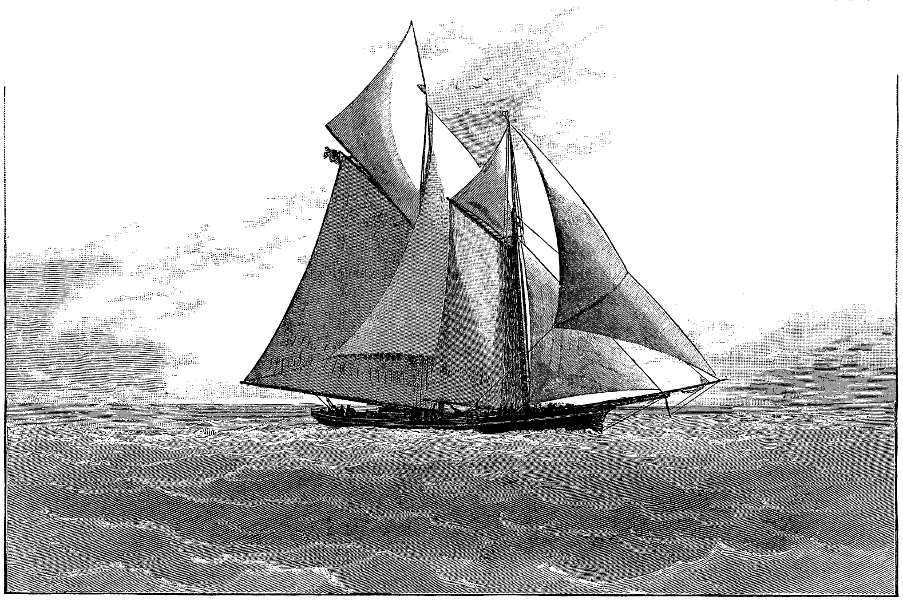
In this the length should be greater in proportion to its other dimensions than in the sloop yacht. The mainmast 346should be stepped a little abaft the middle point of the hull. The foremast is stepped about midway between the mainmast and the stem, and should be very nearly as high as the mainmast. The foretop-mast, however, should be decidedly shorter than the maintop-mast.
The bowsprit of the schooner yacht should be somewhat thicker and shorter in proportion than that of the sloop yacht, and is lengthened to the desired extent by means of a small spar resting on its top, which is called the jib-boom.
The forestay comes down to the bowsprit head, instead of to the stem. The jib-stay runs from the mast-head to the jib-boom, through which it passes a short distance from the end of the latter. The topmast stay extends from the upper part of the topmast to the end of the jib-boom. The two latter stays pass from the jib-boom to the “martingale,” a short spar, which has a hook at its upper end. This hook passes through an iron ring on the under side of the head of the bowsprit.
The martingale extends downward toward the water, while the stays pass through it, or through iron loops affixed to either side, and are fastened to the stem or the upper part of the bows.
As in the sloop, one or more stout bobstays connect the bowsprit head with the stem.
The two masts are braced together by means of certain 349stays, of which the most important is the spring-stay, which connects the mast-heads. Two other stays extend from the maintop-mast to the foremast head. (See figure.)
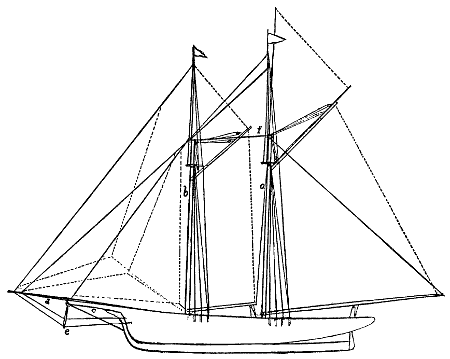
a Mainmast.
b Foremast.
c Bowsprit.
d Jib-boom.
e Martingale.
f Spring-stay.
The mainsail and its gaff-topsail are similar to those of the sloop, but the foresail is much smaller, as it must pass between the masts in tacking, and varies little in breadth from head to foot.
A schooner yacht has a maintop-mast staysail, which is used in racing, and comes down nearly to the deck. Its sheet is rove through a block at the after end of the boom, 350whence it is brought back to the stern and “belayed” to a cleat.
“Belaying” is the nautical term for winding a rope on a cleat or belaying pin; which is done as a boy winds his kite string, on each end alternately, in figure-eight style.
The fore gaff-topsail is not provided with spars or booms at its edges, but has rings along its luff, like those of the lower sails, which run on the foretop-mast.
The sails of a large vessel have ropes called bolt-ropes, sewed entirely around their edges, which may, of course, be dispensed with in the sails of the miniature yacht, as they will be sufficiently strong without such aid.