HOW? OR, SPARE HOURS MADE PROFITABLE. (continued 3)
Reading edition
Care must be taken at first not to crack or break holes in the brass, but after a little practice, and a thicker quality of brass is used, you will learn to avoid this danger.
PLAQUE IN HAMMERED BRASS.
When quite confident in the use of your tools, you can proceed to make a card-receiver decorated with an antique head, as in the figure; or by enlarging the design, and making the background circular, a plaque will be the result, which will be useful for holding fruit, or, set in a 178velvet frame, will make an ornament for your walls. A sheet of brass nearly one-eighth of an inch in thickness, and at least seventeen inches square will be required.
As in work of this character a deeper relief is desirable, you will find it more agreeable to work over a bed of composition, which is more yielding than wood, and can be made with but little trouble; this composition can be obtained in small cakes at any store where jewelers’ tools are for sale; but you can easily make it yourself by thoroughly mixing fine sand, well-sifted wood ashes, or even brick-dust, with equal parts of pitch or resin; a tiny bit of tallow improves it considerably. This pitch bed, as it is called, can be spread on a flat table or board, and the sheet of brass, after the design has been carefully traced thereon, fastened down upon it by means of four screws at the corners. To draw the design for the plaque, with a strong pair of carpenter’s dividers describe a circle whose diameter shall be sixteen and one-half inches, and within this draw a second circle, with a diameter of fifteen inches. The space between these two circles is to be left untouched, as it will be turned over to inclose the wire which forms the edge, if for a platter; or will extend under the edge of the velvet, if intended to be framed. Be sure and put your screws outside the large circle, as holes in the body of the plaque would ruin its effect. In this work heavier blows with the hammer will be needed; and a large, well-shaped 179nail used for the background. Work around the pattern until it stands out in line relief.
The brass will become discolored and black during the process of hammering; but, when done, it can be readily cleaned, at first with oxalic acid and rotten-stone, then a final polishing with chamois-skin.
When well polished, take it to a tinsmith and he will make it up for you as a platter, or trim and bend the edges for a plaque.
CARD-RECEIVER.
In making the card-receiver, take the design off on tracing-paper, and then carefully trace it with a sharpened stick or end of a bone crochet-hook, over the impression-leaf on the sheet of brass. In this also the relief should be high, thus rendering it necessary that it should be hammered on the composition-bed. Polish and finish this in the same manner as the plaque.
FOXING.
Foxing, or sticking the metal to be embossed upon a block covered with pitch, is a favorite method with many workers. The block can be of iron or wood, and should measure eight or nine inches across; this rests upon a deep ring of straw, which is readily made by an ingenious boy, as it simply consists of the twisting several wisps of rye straw in the form of a large cable, and then bending 180them into a small ring of even thickness. Catch them in place with a large darning-needle filled with wrapping-twine. Nice rings, made of leather, and designed expressly for this purpose, can be obtained in the trade, but the home-made ones answer as well for any work a novice would be competent or even desirous of undertaking. The top of the block is covered with pitch, which should be warmed, and then given the slightest possible coating of oil, whenever a new object is to be placed upon it. Care must be taken that too much oil is not used, as in that case it will be impossible to make the surface of the brass adhere to the bed. In work of a nice nature, where the lines are many and fine, and the background complicated, this is by far the most satisfactory bed to use, and when the metal is “annealed” it will be found invaluable.
ANNEALING.
When working in very heavy metal, it is often necessary to soften it somewhat, especially if a deep relief is desired. This is accomplished by placing the plate upon a bed of glowing coals, and allowing it to remain there till it becomes soft, but not in the least melted, and then removing it with pincers. Hammering upon the cold metal is inclined to make it brittle, and at times slightly unmanageable, and this unpleasant quality can be overcome 181by annealing; but so much care and patience are required to accomplish this process successfully, that it is not very popular with young workers. In many larger designs, a very high relief is obtained by turning the brass after the plaque has been hammered upon the right side as much as seems necessary, and with the round end of the hammer sending strong, even blows into the figure, at whatever points the highest work is desired. By annealing the metal, and working the pattern from the inside after the background is finished, a very fine bunch of well-rounded grapes is easily formed, and makes a very nice subject for a fruit-dish or dining-room plaque. A dragon, and the emblem of St. Mark, both make unusually fine designs for a mediæval plaque.
As you become more expert in this art you will constantly desire new punches. Designs will suggest themselves to you, and it will be impossible to obtain them ready-made, so it is well for a boy to learn to make his own tools. A kind of square steel wire about one-eighth of an inch thick is made for this purpose, and can be bought in any quantity; this can be cut with a file, and the ends formed into the desired shapes.
A SALVER IN REPOUSSÉ.
A very beautiful salver, which will not only be ornamental but exceedingly useful, can be easily made by one 182accustomed to work upon sheet-brass. A piece twenty by fifteen inches in size, and about one-eighth of an inch thick, will be required for one of medium size. Strike off with the dividers a quarter circle in each corner, to give it a slightly oval effect, and draw a line around the salver parallel to the intended edge, and one and three-fourths inches from it. The entire central surface can be hammered in the honey-comb pattern, which is so popular just now, and is done with a perfectly straight-edged punch, its length determining the side of the hexagon, or if preferred the pentagon, as both forms are equally attractive; or it may contain some graceful design done in low relief. The more original the design the more unique the salver, provided it is artistic and in harmony with the object and use for which it is intended.
It would be well for all young workers in brass to examine carefully any work of that nature which comes within their field of view, especially any antique or foreign brasses, with a view toward perfecting their own designs, or gaining ideas for others.
When the work on this salver is completed, take it to the tinman, and tell him how you wish it made up, and he will do it for you for a very small sum.
A SILVER BANGLE FOR A LADY’S BRACELET.
For the past few years there has been an increasing 183passion among young girls for the little round bangles, which tinkle so musically with every movement of the slender white wrist, that we are forcibly reminded of the old nursery rhyme:
“With rings on her fingers,
And bells on her toes,
She shall have music
Wherever she goes.”
And as it has long been a matter of rivalry, as to who should display the greatest number of these resonant favors, it is quite certain that one of the pretty trifles will make a very acceptable present to any of your sisters or girl friends you may desire to please. They are usually made from ten cent pieces, but occasionally a bit of silver no larger than an old-fashioned three-cent piece is used. The coin is beaten or rolled flat, and the giver’s initials or monogram, with perhaps a date, is engraved on one side. Now a much more unique and artistic thing could be made by annealing the coin, and beating its surface flat on some firm, hard bed. After the silver is reduced to the proper size and thinness, with a pen or pencil draw some odd designs, and hammer it in shape with a small, blunt-pointed nail. Ancient coins, such as are frequently on exhibition in store windows, afford excellent subjects for this class of ornaments. When the design is well indented, 184the work can be cleaned by boiling it in sulphuric acid and water, and polishing it with chamois-skin.
A BANGLE BRACELET.
A bangle bracelet can be easily made of hammered work, from a narrow strip of sheet-silver, which can be obtained from any silversmith at a small cost. The design is to be traced on the silver in the same manner as upon the sheet-brass, and great care must be taken in the working out of each little detail. When the work is finished, it should be sent to a jeweler to be made up and polished. This is of course an expensive, as well as a very nice piece of work, and should not be tried until considerable skill in the manipulation of sheet-metal has been acquired, and success seems in a large degree certain.
Many ladies are fine workers in repoussé, and it cannot fail to be a source of satisfaction to every one interested in the art to know, that each year its merits are becoming more fully known and appreciated by that great class of people, whose purchases govern the prices of all artistic things. Now, boys, I have simply touched upon this very interesting subject of repoussé, and given you a few directions, culled from my own experience. If, however, I have succeeded in stimulating in you a desire to pursue 185this subject further, you will find many excellent helps, in the form of books or pamphlets, in any of our large stores devoted to artists’ materials and supplies.
―――――◀▶―――――
A FRAME FOR A PLAQUE.
A fine frame for any kind of plaque, whether repoussé, porcelain, leather work, or papier-maché, can be easily made from a square piece of wood, about six inches wider than the subject to be framed; this can be beveled at the edges, or left as when sawed. In the center, with a strong pair of carpenter’s dividers describe a circle, whose diameter shall be half an inch shorter than that of the plaque. Bevel the front edge of this opening, then covering the whole front surface of this wood with thin glue, lay it, face downward upon the piece of plush or velvet, intended to cover it; the material lying flat and smooth, with its raised surface downward, upon an uncovered table. Cut the center of the cloth away, allowing enough on the edge to draw over the opening of the frame; slash this to within a short distance of the wood, that it may lay evenly when finished; now glue this firmly down upon the back, and bring over the outside edges and fix them in the same way. When this is dry, fasten in your plaque with brads driven into the back of the frame, and 186extending over the edge of the opening at its back. Finally, when certain all is securely fastened, wet a piece of brown paper, cut to exactly cover the entire back of plaque and frame both, cover it with paste and press it in place. It is necessary to wet the paper first, to prevent its wrinkling or forming great bubbles when dry. When the paper is dampened, a bit of paste around the edge is all that is necessary to hold it in place.
After this backing is completed, a couple of screw-eyes and a wire cord are to be added, and your plaque is ready for your walls.
―――――◀▶―――――
THE AQUARIUM.
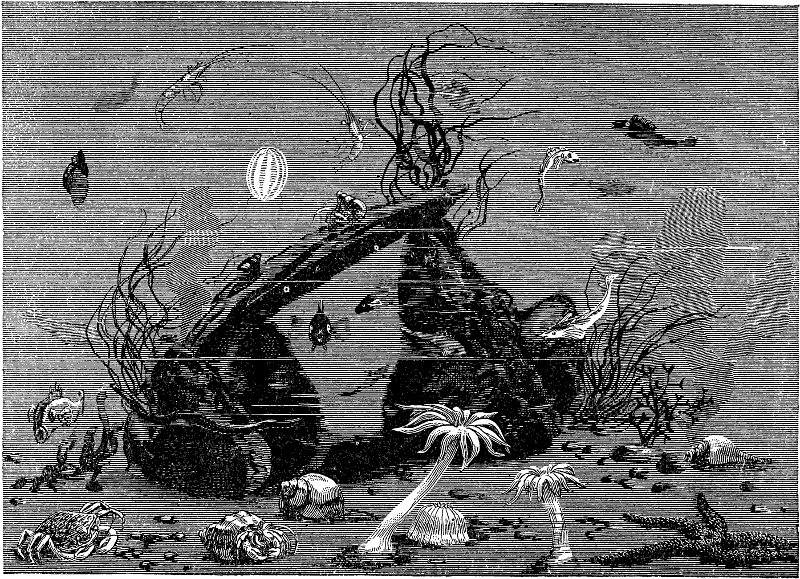
The name aquarium was formerly sometimes given to a tank or cistern placed in a hot-house, and intended for the cultivation of aquatic plants; but in later years its signification has widened, so that it now embraces animals as well as plants in its category. Its use seems to have been known nearly a hundred years ago, and a number of gentlemen, in the latter part of the eighteenth century, made several successful experiments by means of this “scientific plaything,” as some writer has happily called it. The aquarium can be used for either salt or fresh water animals, the former necessitating a residence conveniently near the sea, for the purpose of occasionally 189replenishing it with a fresh supply of the water. It may be an ordinary globe, or it can be made of slabs of heavy glass, fastened inside an iron frame-work, with a peculiar kind of cement, made specially for the purpose. They can be obtained in different sizes at several places in New York and other cities, and as the materials in themselves are expensive, and the work of making one usually results in a series of disappointments, and finally, in total failure, the expediency of buying one ready-made cannot be too strongly urged upon the young naturalist. Although the large aquarium accommodates more inmates, the globe is much more easily cleaned, and answers equally well for a few fishes, as the one in my window will testify. As fresh-water animals and plants are more accessible to the larger proportion of boys in the country, and the globe much cheaper, while it occupies less space than the large square articles alluded to above, it may possibly not come amiss for me to give, for the benefit of those of my readers who are interested in the subject, a description of my own fresh-water aquarium, and what little experience I have derived from it.
It is a globe of ordinary shape, and has the capacity of a common water-pail. For several years it was stocked with gold-fish, but it was, moreover, a source of ceaseless anxiety and trouble. The fish would die or turn black without any apparent cause, and, still worse, would frequently 190have what we termed “fits” in the night, and jump out of the globe on the floor, where they would be found, cold and lifeless, in the morning.
The experiment of keeping these decidedly troublesome pets was finally given up, and the empty globe placed high and dry upon a closet shelf.
One day nearly a year ago, a young member of our household brought home three small fishes (the common dace), and begged so hard that the globe might be brought out, and converted into the family fish-pond once more, that we finally consented, and the little fishes were soon at home in our library window. Not more than a week after this, a genuine mud-turtle was added to the collection, and, strange as it may seem, these little creatures have lived at peace with each other ever since.
We covered the bottom with a few pebbles from the brook, and afterward added some sand and a handful of shells from the sea-shore.
We experimented with several species of water-plants, but were convinced that a tiny fine-leaved plant, of which I have forgotten the name, but which grows very plentifully in our northern fresh-water brooklets, and the vallisneria Spiralis, or common tape or eel-grass, gave the greatest satisfaction on the whole. With these little plants growing on its bottom, we are not obliged to change the water for several days at a time.
191In bright sunny weather the plants give forth plenty of oxygen for the fishes to breathe. This can be readily seen by noting the little air-bubbles adhering to the leaves and stems, or rising slowly to the surface of the water; but in cloudy weather this gas-making process diminishes, so that after awhile the air becomes vitiated, and the fishes, finding it hard to breathe, are forced to swim near the top, with their heads at the surface of the water. At such times it is well to introduce fresh air into the water, by filling a cup with the water, and, holding it an inch or two above the surface, pour it slowly back into the globe; by repeating this process several times the water is made comparatively pure once more. Another and easier way of accomplishing this is by using a small syringe instead of the cup; but care must be taken in either case to avoid hitting the fish with the descending stream.
Their food consists of angle-worms and flies in summer, and bits of fresh meat cut very fine with the scissors, during the colder portions of the year.
THE SALT-WATER AQUARIUM.
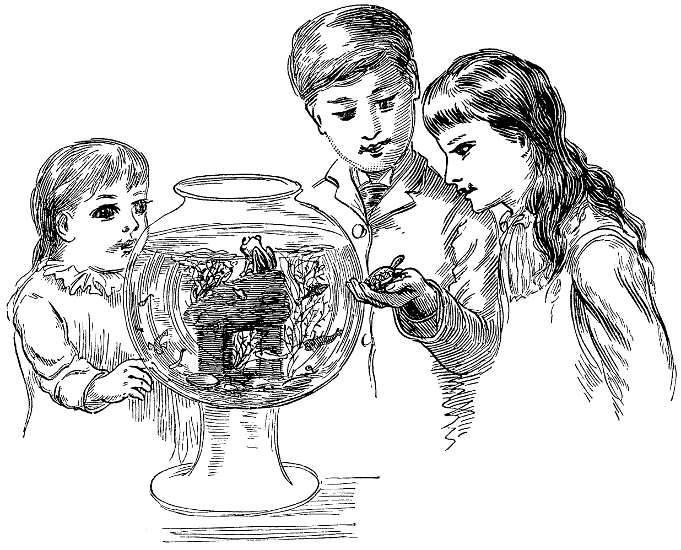
The globe answers equally as well for salt as for fresh water fish, provided its inmates are not crowded and are supplied with a sufficient quantity of good sea-water. In 192obtaining this supply, it is desirable to have it dipped from deep water some distance from the shore, or from the channel if possible.
In preparing your globe, put a handful of gravel and sand on the bottom, then with three or four irregular stones build a cave or little arch, for the fishes to play beneath.
Although some authorities say that the aquarium should be kept in the shade, the one with which the writer was familiar through childhood always stood in a south window, which was only partially shaded by some great trees in the garden beyond.
Occasionally, on very sunny days in spring or early summer, before the leaves were fully grown, a newspaper would be placed between the glass and the window-pane, or over a corner of the top, to give the desired protection; but the tiny cavern usually supplied sufficient shade, and it was ever a source of unabating amusement to watch the little fellows swim in and out through the arches, darting now here and again there, hiding in the shadow of some moss-grown stone, to spring out a moment later upon an unsuspecting companion swimming leisurely by; their little games of hide-and-seek and of tag were very entertaining to witness, and we children would frequently find ourselves quite excited over the success or failure of our special favorite in the game.
195As the aquarium of which I speak was a large one, it frequently had several inmates at the same time; among these the little nippers, or, as the dwellers along the coast of New York State call them, killie-fish—so named by the Dutch settlers from their frequenting the little kills, or inlets, along the shore—always held a conspicuous place. Indeed, these little fishes seem to be blessed with a long string of names entirely disproportionate to the size of their tiny little bodies. In some places they are known as minnows, while on the shores of the Narragansett they retain their old Indian name of Mummychog. They are a bright, lively little fish, darting through the water with such rapidity, that you hold your breath in fear lest they dash themselves against the glass at the end, but they never do; just as contact with it seems a matter of certainty, they suddenly turn a sharp angle, face about, and perhaps come to the front and peer at you through the glass, with their funny little faces pressed up close to its surface. They are of a greenish-gray color upon the back, which gradually shades to a bright silvery tone at the sides, and their eyes, which are large and staring, have a very mild, good-natured expression.
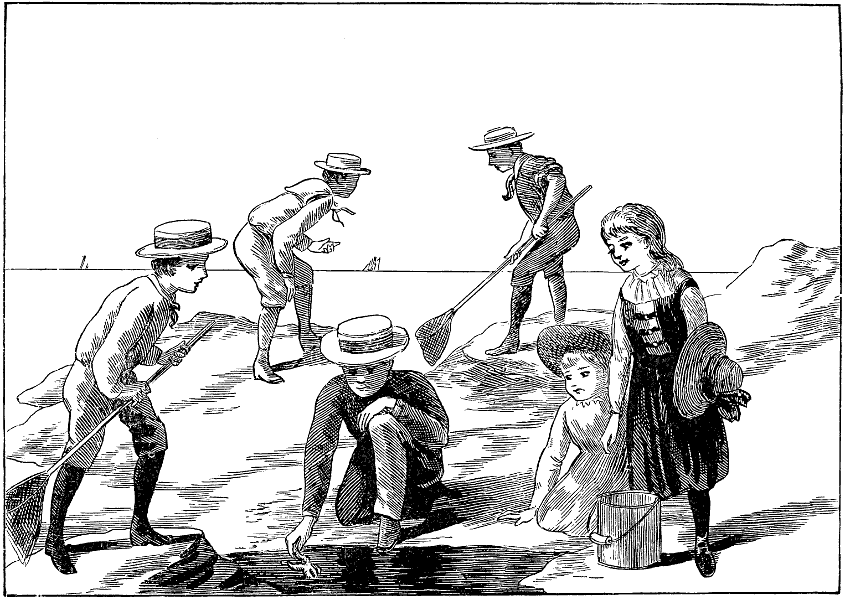
Very different from these are the sticklebacks (Gasterosteus), also fine subjects for the aquarium, for a more pugnacious or plucky little fellows it would be hard to find than these graceful little tyrants, which in early 196spring are found in our creeks and salt-water ditches in great abundance. As this is the only season of the year in which they can be captured, it is best to be on the watch for them during the last of March or the first of April. A dip-net, made of a piece of mosquito netting caught over a small hoop, and attached to a long, slender handle, is best for catching all kinds of fish for the aquarium, and the shores of bays or salt-water streams supply a greater abundance than the open sea, or the shore washed by the heavy ocean waves. If your globe is the vessel you are to use, the sticklebacks will afford you quite as much amusement as any fish you could find, for aside from their quick, lively manner, they are a very handsome fish. The male is of a rich ruddy color, his little silvery sides giving forth gleams of red or blue, which vary considerably, according to his temper. If he feels quiet and peaceful, they are pale and soft in tone, but if indignant, they become very brilliant, and the little chap with his savage, fiery eye, becomes an object of great respect and terror to all the other denizens of the water within reach of his teeth or sharp little spines. The female is less brilliantly colored than the male, is blunter in build, and has a comparatively mild disposition, leaving all little differences with other fish for her liege lord and master to settle, for which duty he is perfectly well fitted and takes great delight in performing; indeed, 197so quarrelsome were these little fellows, that they would soon kill all fish of other species in the tank, and when no other subject was at hand, would fall to and fight one another, biting as ugly dogs might do, and spearing with their tiny spines, till one had acquired complete supremacy over all the rest. It is very interesting to watch the process of their nest-building, and to see them, like so many lilliputian carpenters, lay the sticks and hairs in place, working as if their whole life depended upon their unceasing exertions. We used to put in bits of broom-corn split in threads, and bristles from the floor-brush, for materials; and the work of building would generally occupy three or four days. The nest was built in one corner of the box (we were obliged to keep the sticklebacks in a separate glass case, as they killed all the other fish if together) and well up on the sides, with a tiny round hole at the top for the fish to go in and out. After a short time—I do not remember now just how long—hundreds of little fish came out from the nest, and were very lively for two or three days, but in a week they were all dead, and the parents had the waters to themselves once more. We never succeeded in raising the young fish, I remember, but I do not now recall whether any reason was ever ascribed to our failure, or if it was even known.
But to go back to our large aquarium. Fortunately for us, not many fish are as quarrelsome as the sticklebacks, 198and most of those I shall now describe live together in perfect harmony. The young of larger fish do very nicely for a time in the aquarium, and a young eel is a rather amusing although somewhat sluggish fellow to keep.
The most amusing denizens are creatures of the crab family. The little hermit-crabs, found in quantities on any shelving beach of the bay or sea inlet, create much sport for the young naturalist. These little crabs, you must know, are soft little fellows, for whom nature in a frugal moment prepared no house or covering to protect them from the thumps they might receive from both water and stones; but the little fellows, with a shrewdness one would hardly suspect in creatures so small, rise equal to the occasion, and help themselves to the empty snail-shells left by their more fortunate neighbors. When small they occupy the little black snail-shells, moving from a smaller to a larger as they increase in size. After outgrowing these plainer homes they take possession of the pretty grayish-white shells also found in abundance on our shores. It is frequently quite amusing to watch two fight over a particularly desirable one, which either has chosen for its own, and ofttimes the battle will be long and heavy before either will give up that which he considers by rights his own. If you have one or more of these little wanderers in your globe, remember to put in 199two or three empty snail-shells for them to flee to when they have outgrown their present abode. Their manner of eating affords a very entertaining spectacle. Clams, either soft or hard, cut into tiny bits, form the principal food for all the dwellers in the aquarium, and a long stick with a needle driven in one end, to form a tiny spear, is used in passing it to them. When a particular crab is to be fed, a bit of clam is taken up on the needle, and lowered down in the water to a position directly in front of him. At first, before he has become acquainted with this mode of dining, he draws in his claws, and nothing but the shell is to be seen upon the bottom; but in a few moments the little fellow lets himself out again, little by little, with a quick, jerky movement, till at last his two little eyes stand in an upright position, and he is ready to seize the tempting morsel. This he does with his longest claw, and holding the clam firm in his grasp, he proceeds to pick it in pieces with the other long claw, and pass it along to the smaller set, which in turn give it to the next in order, until it finally disappears in the mouth itself, and is swallowed by the little creature.
It is important to have two or three snails in your globe to act as scavengers, and keep the water free from the refuse which would otherwise remain on the bottom. These little creatures are often seen moving slowly along on the surface of the glass, feeding upon the green moss 200or confervæ which accumulates so quickly on all the objects under water. The pipe-fish, a peculiarly shaped specimen, comparatively rare on our Atlantic coast, is worthy a place in your collection; and the shrimp, the acrobat of the aquarium, whose funny little backward movements, when the poor little fellow is frightened, create so much laughter among the little folks, must not be forgotten. Young scallops are very pretty, and when left undisturbed open their shells a trifle, disclosing a beautiful fringe of tiny blue tentacles which wave to and fro with every motion of the water.
The medusæ, also called jelly-fish, with their umbrella-like cover, and long, slender tentacles streaming downward, are pretty for a time, but do not live long after they are taken from the sea. The Cydippe and the Beroe are very lovely specimens of this class, the former particularly is noticeable for its beautiful iridescent colors. The beautiful orange colored medusa is an unsafe inmate, as he very soon kills all the fishes within his reach.
If it is possible, obtain one or more of the beautiful sea-anemones, and add it to your globe; the large, bright-colored members of this class are only to be found in the tropics, but very pretty, delicate specimens are sometimes found in our northern waters, where a rock or bit of stonework is constantly washed over by a swift current. If possible, it is better to take the stone on which they rest, as it 203is almost impossible to remove them from its surface without killing them. This was, however, done several times with success, and the anemones lived in our aquarium as long as they could be expected to exist in perfectly quiet water. When these creatures are at rest or frightened they draw down into little shapeless masses; but when looking for food they stretch up again, and expand on the top of the long stalk, as we may call it, a beautiful flower-like head, resembling an aster in form, and of a deep brownish-yellow color. When food is passed down to this animated blossom, it will fold its little tentacles one by one around it, and pass it down into its mouth, open to receive it, but which is entirely hidden by the beautiful petals of this delicate flower.
All of you have probably noticed the serpulæ, or worm-like excrescences often seen upon oyster and other hard shells. If one of these shells be taken from the water and immediately placed on the bottom of your aquarium, after a few days, when the little animals feel quite at home, they send out of one end of their slender tubes bunches of the loveliest, delicate brown fern-like feelers, which sway about in the water like the beautiful roadside ferns in a gentle summer breeze.
But in the salt as in the fresh water aquarium, vegetation is necessary for a healthful condition of the inmates. Here we see on a miniature scale that wonderful balance 204of organic forces which exists on the larger globe around us. The vegetation exhales the purifying oxygen, which renders the water fit for sustaining animal life; the fishes and other animals in their turn give forth the carbonic-acid gas, which is equally needed for the healthful development of the plants; while, last of all, the snails—those little scavengers nature has so wisely provided—remove such minute portions of decaying matter as might otherwise pass unnoticed, and so contaminate the entire water in the globe.
―――――◀▶―――――
THE WOODEN WINDMILL.
So common were these little toys among the companions of my childhood, that it seemed almost superfluous to insert what I supposed every boy must be familiar with; but upon questioning my young friends, I find that very few of them away from the sea-coast towns of New England, and the sailor-like influence or atmosphere which permeates them, know anything of the pretty little windmills, or weather-vanes, which we copied from those of our sailor friends.
It was no uncommon thing in those days for some boy less ingenious than his companions to use a little strategy, and so get his work done for him by proxy; and the 205manner in which he would proceed was generally something like this: Early some bright spring morning, with jackknife and shingle in hand, he would saunter down to the wharf, upon which he knew at an early hour the old sea captains of the village would assemble, and wait his chance. Here the old captains, and the sailors, who by reason of their advanced age took the same honorary title, were wont to gather on the sunny side of the weather-beaten old store-house, and watch from under their heavy gray eyebrows the bay stretched out before them, while they enjoyed their pipes, and lived over again the wonderful adventures and disasters of their successive voyages; and here he would watch for his prey, little suspected by those kindly old souls, who had, years long gone by, ruled with iron will over the crews and destinies of great ships, known to him only by their names. Occasionally two or three would arrive at the wharf together, and he knew his chances were gone for that day at least; but usually some one, whose breakfast may not have claimed as much attention as usual, would be seen making his way down the quiet village street, easily recognized by his rolling gait, his inseparable pipe, and manner of scanning the clouds and horizon. Now our friend would begin to whittle in earnest, soon attracting the attention of the ancient mariner by his awkward movements. Of course, he would receive no end of ridicule 206for his stupidity; but as that did not sink very deep in his boyish soul, he was prepared to pay a greater price, if necessary, for the work he expected to receive. It not unfreqently happened that the old fellow would take the shingle to show him how to begin, and would get so much interested in the work that he would offer to do it during the day, and would actually whittle away on the little boat, while he or one of his companions related for the fiftieth time how the Nautilus passed through so many hair-breadth escapes, and finally reached port at last, with no soul missing and cargo untouched.
It was during these long voyages, when time hung heavily on their hands, that they acquired their skill in fashioning these mechanical toys, which almost always had for their motive power the wind or the waves.
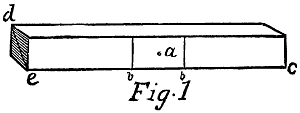
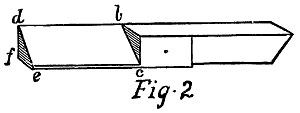
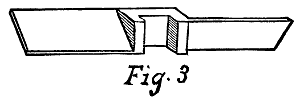
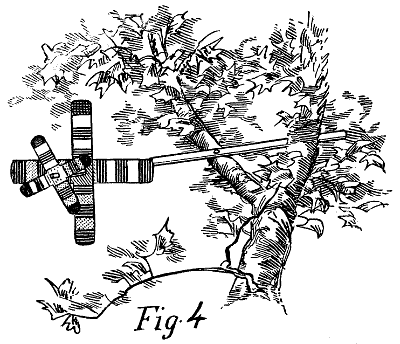
The simplest form of windmill from this source I remember seeing is very easily constructed. It is made from an oblong piece of wood like Fig. 1. Through the center of this bore a hole, a, for the pivot upon which it will finally turn, and mark the two lines at b. Now, commencing at the point b, cut off the corner, b c, and make 207the surface flat as in Fig. 2; then cut off the opposite side of the other end, indicated in Fig. 1 by the dotted lines d e, in a like manner. Your figure will now resemble Fig. 2, and both ends will form a prism like b c d e f; but b c d e should be a thin flat blade, so the corner or edge, commencing at f, should be cut down in the same manner that e d was treated in Fig. 1. Make the other blade to correspond and chamfer out the middle, or square piece, as seen in Fig. 3. This middle piece is not a square, although I have spoken of it as such, but is oblong, to allow room for another two-bladed piece made precisely like this to interlock with it. When these two pieces are fitted together, fasten them with one or more nails, and then insert the small round stick upon which the windmill is to turn. Fig. 4 shows an arrangement by which 208two windmills are operated on the same stick. These should turn in opposite directions to make them effective, and this is easily accomplished by simply cutting the vanes of the one so that the wind shall strike it at an angle opposite to that with which it strikes the other. Should you care to decorate them in colors, it had best be done by painting bands or stripes across each vane, all to correspond with each other in width and shade. For instance, take the windmill in Fig. 4; let the outside bands be of chrome yellow and one inch wide; the next red and two inches wide; while the third yellow, and the fourth blue, should each be an inch in width. The axis 209should have a greater diameter where the larger revolves upon it, but should be cut smaller where it meets the back of the little windmill. Nails in front and back of the larger, and front of the smaller, are necessary to keep them in place.
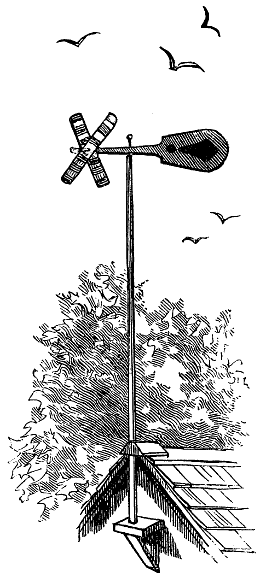
Perhaps the most satisfactory way of arranging such a 210windmill is to place it on the end of a weather-vane, as shown in Fig. 5. It is then always presented to the wind. The vane and the windmill may be painted the same color, or the latter may be decorated in stripes, as before described, and the vane given a color which will harmonize with it. Care must be exercised to fasten each part strongly in place, as the strain is very great during a strong wind or in a storm.
THE SCREW-PROPELLER; OR, WEATHER-VANE AND WINDMILL COMBINED.
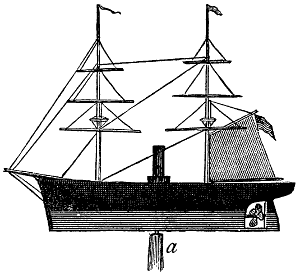
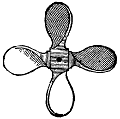
Take a piece of board, seven-eighths of an inch thick, and large enough to make a vessel of the size you desire. Cut out a hull like that in the illustration. Make a small windmill like that just described, but with rounded 211ends to the vanes, like that represented in Fig. 2. Pass a strong wire through the hole in the center, and drive it into the stern of Fig. 1; fasten the other end into the rudder, which should be stationary. Be careful when planning your vessel to allow sufficient room for the windmill to revolve below the over hang. Bore a hole at a for the pivot to rest in, upon which the weather-vane is to turn, and insert the two masts in their proper places. Cut a small mizzen-sail from thin board and nail it to the mast.
The flags are of red and blue flannel, the stays of copper or galvanized wire, and the bowsprit a small stick, cut from a tough bit of wood. This propeller may be painted to suit the fancy, but usually is black, with a narrow yellow or white stripe near the top. The lower third is frequently painted green, however, which adds considerably to its nautical appearance. The windmill should be a bright red, and the entire vessel should have plenty of time to dry before being placed in its final position.
THE SIDE-WHEELER.
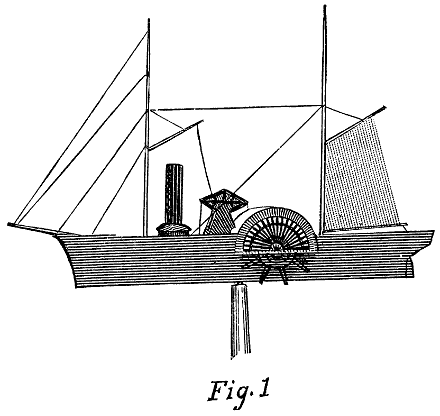
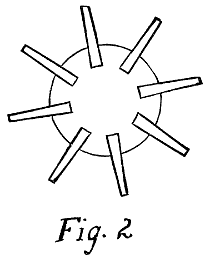
Another, and very pretty windmill, which can be easily constructed by a boy, is in the form of a steam-boat, the paddles of which are always presented to the wind by 212the position of the boat itself. Cut out of a seven-eighths of an inch board a hull like that seen in the illustration, and make the hole for the pivot at the middle point between bow and stern; bore another hole just aft of this for the axle of the paddle-wheels. Out of thin wood cut two circular disks for these wheels, and dovetail the paddles into their edges as seen in Fig. 2. Next cut out two half circles of your thin wood for paddle-boxes, and bore a hole in each for the axle of the wheels. These are to shield the upper half of the wheels from the wind. Now take a piece of tin, in shape like Fig. 3, and wide 213enough to accommodate the wheels on either side, and nail it to the edges of the paddle-boxes, as seen in the figure; the ends, a, are to be nailed upon the deck of the steamer, and answer the purpose of keeping these boxes in position. Paint this boat black and green, the latter occupying the lower third of the hull, while a narrow line of yellow or white around the top relieves the somberness 214of the upper part. The paddle-boxes should be black, with narrow lines of light red radiating from a small semicircular figure of the same color near the bottom. This boat should also be fitted with a small mizzen-sail, made of tin or thin board, and painted white. The top of the paddle-boxes is buff or light yellow, and the wheels or windmills are a bright red.
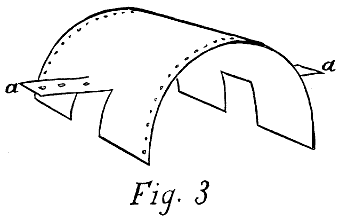
In this steam-boat, a “dummy” walking-beam, cut out of a single piece of thin wood, can be added if desired, and should be painted in solid black, or, if liked, it can be striped like that in the “Toy Steam-boat,” elsewhere described in this book. The smoke-stack in this, as well as the screw-propeller, should be nailed in place before the first painting.
If you should care to take the trouble, the walking-beam can be made to move by simply cutting away the hull between the paddle-boxes, to allow the crank to turn in, and bending the axle of the wheels in the form of the crank described in the “Toy Steam-boat.” A long slit must also be cut in the tin cover of the paddle-boxes, to allow of the play of the connecting-rod. Small flags of bright-colored strong cloth can be placed in the proper places if desired, and really add considerable to the bright, pretty effect when first made; but as they are soon ruined by the combined influences of sun, rain, and wind, they are hardly desirable, unless the boat is in 215some position where it can be easily reached, and the little flags changed for new ones, as they become faded or torn.
THE REGATTA WINDMILL.
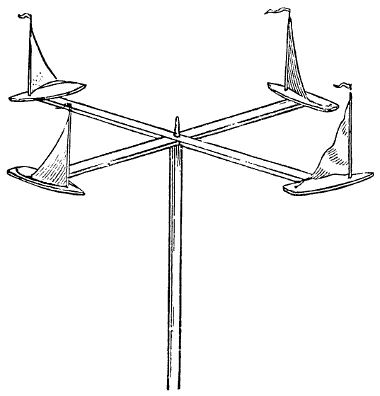
Take two sticks of wood, about three feet long, and one inch in diameter; fasten them together at their central points, so that their arms shall be at right angles with each other (see Fig. 1); and bore a large hole through the point of intersection. From shingles cut out four boats, each eight inches long, and fit them with masts; next cut from strong new cloth four small triangular pieces for sails, and sew them to the masts; fasten the lower corner by a strong bit of cord to the stern, as seen in Fig. 2; then cut a small flag from red 216flannel and nail it to the top of the mast. You can paint these boats if you like, and also the cross-pieces upon which they are finally nailed. Care must be taken that they all head the same way. Observe their positions in Fig. 1.
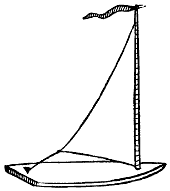
Fig. 1 shows the affair finished and mounted on its pole. Place them in as high a position as possible, so that they may catch the breeze from all directions.
―――――◀▶―――――
A BOY’S SOLAR MICROSCOPE.
The microscope is, as every boy knows, an optical instrument, which enables us to see and examine objects which are too small to be seen by the naked eye. The arrangement of the solar microscope is similar to that of the magic lantern, the sun taking the place of the limelight usually employed. In this form of the magic lantern, 217two difficulties are to be overcome; one, the necessarily fixed position of the instrument; and the other, the very inconvenient habit the sun has of constantly changing his position; so that it would be impossible to adjust the lens without the aid of a mirror, to throw sufficient light in upon the object to be examined. Both of these obstacles are surmounted in the simple arrangement of the solar microscope here described.
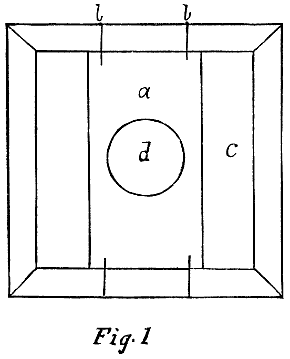
First make a strong frame of wood, seven-eighths of an inch in thickness, that will exactly fit in the lower half of the window when the sash is thrown up; and in the middle of this fit an upright board a foot wide, which has a hole cut in its center ten inches in diameter. Fasten it 218strongly in place by four nails driven through the frame, and well into the ends of the boards, or, if more convenient, by long screws inserted in the same places. Fig. 1 shows the position of the board a, also that of the nails b. The open spaces, c, are to be closed by several thicknesses of brown paper pasted or tacked across on the inside of the frame. The upper part of the window must also be closed, so that no ray of light shall enter the room, except through the hole d.
Before proceeding further, it may be well to remark, that, as perhaps the largest part of the work is the cutting of no less than seven circular holes of various sizes, through as many pieces of board, a scroll-saw will be 219found an almost indispensable aid to the construction of this apparatus. Also, that the window in which this microscope is used must necessarily have a southern exposure.
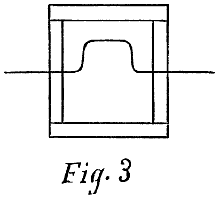
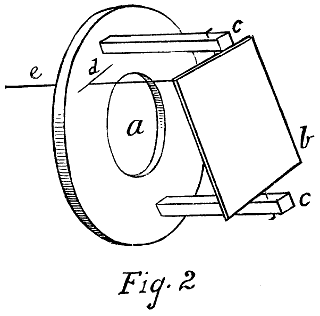
In Fig. 2 we have a disk of half-inch wood, twelve inches in diameter, with an opening in the center four inches across, to hold the condensing lens, a; b is a mirror five inches wide and ten inches long, turning on an axis which passes through the supports, c c, the latter being attached to the disk. These supports should be long enough to admit of the mirror turning entirely around without touching the disk, and are fastened in place by screws passing through the disk and into their ends. When the mirror is in place, cut the slit d parallel with the edge of the mirror, for the wire e to pass through. The manner of attaching the wire to the back of the mirror is seen in Fig. 3. The back is first covered with paper to prevent 220its scratching; then the wire is bent and laid in place, and lastly, a piece of very strong paper is pasted over the wire and entire back, and caught down over the edge of the front, forming a narrow frame to the glass; the ends of this wire should pass through rather small holes 221in c c, so that it will not turn easily out of position. A handle (see f, Fig. 4) should be placed on the other side of the disk, and just across the lens from the slit d.
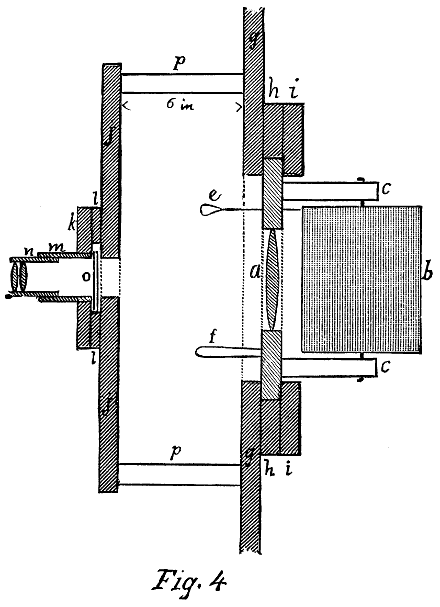
Next take two pieces of wood, fifteen inches square and half an inch thick; in the center of one cut a hole twelve inches in diameter, while in that of the other cut another round hole only ten inches across. In Fig. 4, which represents a section of this microscope, g is the central board of the screen, marked a in Fig. 1; h is the piece you have just made, with the central opening twelve inches in diameter; and i is the second piece, which measures fifteen inches square, but has a hole of only ten inches diameter in its center; d, which has a dotted surface, to distinguish it from the frame-work, is the large disk (Fig. 2), which, you remember, is just twelve inches in diameter, and, consequently, will exactly fit the opening in h; if these edges are rough, sand-paper both with a coarse quality first, finishing them off with a finer kind. When d is in position, and moves easily but not loosely in h, place i over it and fasten it in place with screws, passing through i into h; but h, of course, must first be strongly nailed or screwed upon g.
You will now see that by turning the handle, f, the position of the mirror, which is fastened to this disk, can be easily changed so that it shall face in any direction, while by drawing the wire, e, it can be turned so as to reflect 222the sun’s rays through the lens, a, from whatever quarter of the heavens it may be shining. This double adjustment of the mirror and lens enables you to throw the rays of the sun through the opening in upon the object, o, at any hour of the day. As the mirror is adjusted in Fig. 4, the sun must be very low, as its rays, to strike the mirror, would necessarily be nearly horizontal.
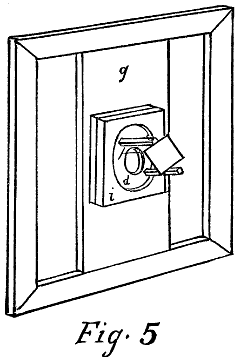
The lens, a, should be held in place by two pieces of whalebone, bent around on either side of it, at the edge of the opening in d; this lens is four inches in diameter, and has a focal length of nine or ten inches; its adjustment had better be left till everything else in the microscope 223has been finished. Fig. 5 shows the appearance of this when completed.
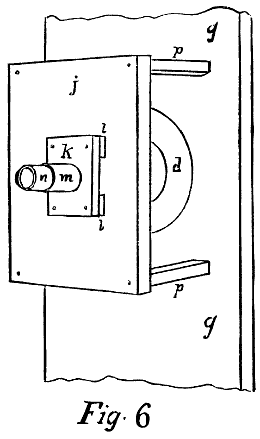
As the outer part of the work is fitted, we will now turn our attention to the other, or inner, side of the screen. In Fig. 4, the board j is eighteen inches long by ten inches wide, and half-an-inch thick. In the middle is a small circular hole, one and one-half inches in diameter. This is fastened to the middle board, g, by the four horizontal posts, p, each six inches long.
Now take a square piece of half-inch board, five 224inches across, cut a circular hole two inches in diameter in the middle, and fit into this hole a pasteboard tube four inches long, which is painted black on the inside. The edge of the circular hole in j should also be black. In Fig. 6, which represents this board, you will notice two cleats, l l, fastened to the back of k; these are also made of half-inch wood, and are five inches long by one wide. In Fig. 4, the position of k and l is seen in connection with the longer piece, j; the center of the openings in j and k should form one and the same horizontal line. The opening between l and l is for the glass slides upon which the objects to be examined are placed.
After these parts are fastened in their proper places, make a pasteboard tube, with a black inner surface, as represented at n, about four inches in length, and inclose in one end two lenses, each one and one-half inches in diameter, and each having a focal length of four inches. Fit this tube in the one marked m. Now, having everything in place, fit in the lens, a, so that it will send the rays of light directly through the hole in j upon the object in l, and fasten it securely in place with your bent whalebones.
The screen upon which the image is thrown can be the opposite whitewashed surface of the room, if by a proper adjustment of the tubes the image can be made distinct, or it can be a sheet stretched over a frame-work of light 225wood; the latter is preferable, as it can be more easily brought in focus. Of course, in this form, as in any other “magic lantern,” the nearer the screen to the lantern, the longer the tubes m n; but the image, which is smaller, gains in brilliancy of illumination, while with these conditions reversed, the results are the opposite; a larger image, but less bright in appearance. The same light being spread over a larger surface is necessarily less strong.
SOME OBJECTS FOR THIS MICROSCOPE.
The objects which can be examined by aid of this instrument are many in number, and can be readily prepared by simply inserting them between two pieces of glass, sufficiently small to slide in the opening l l, and pasting bits of brown paper over the edges to hold them in place.
In this manner the legs of flies and mosquitoes, the heads of the latter with their venomous sting; hairs of the dog and cat, also from the human head; tiny sections of human skin; down from the butterfly’s wing, obtained by dusting off a few of the tiny particles upon a glass plate; the pollen from different flowers; spores of the puff-ball and tiny grains of dust, all make very interesting subjects for study, when magnified and thrown upon the screen in the darkened room.
226One of the most interesting experiments with this form of the magic lantern is made by throwing the image of a drop of some solution, like sulphate of copper, upon the screen, and watching the process of its crystallization; sulphate of copper and of iron; hyposulphite of soda, which latter may be colored by adding a very little permanganate of potash to the solution.
The eels in a drop of vinegar, drops of stagnant water, and the larvæ of the mosquito are also interesting objects, when viewed by the aid of this powerful magnifier.
―――――◀▶―――――
SEA-MOSSES.
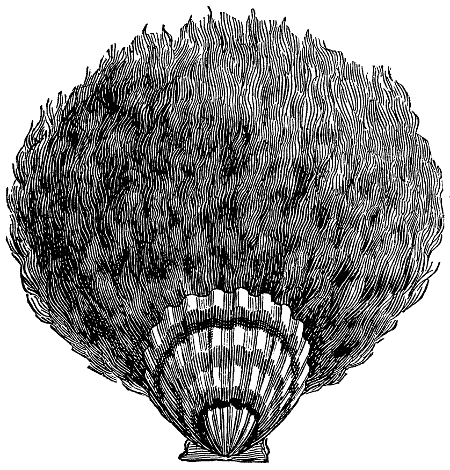
No boy who has lived on our coast, or, indeed, who has spent much time near the sea, could have failed to notice and admire the beautiful feathery mosses which sway about so gracefully under the surface of the water. The most delicate mosses are not found upon the open sea-beach, but in the more sheltered bays and inlets near the coast, and one who has never given them especial attention cannot fail to be impressed by the great variety of form and color to be found within a small space of water. Ranging in color from the palest pink or straw to the deepest purple or brown, and from the lightest sea-green to the darkest shade of olive, they are capable of being 227arranged in most beautiful bits of coloring, while the delicate, fine specimens, united with the coarser varieties, add to the effectiveness of the whole. To gather and arrange these mosses is not as difficult a task as most people imagine. Any boy can, with a little care, make a fine collection, which would be valued very highly by some inland friend who cannot reach the sea-shore every year, or perhaps not more than once or twice in a lifetime. If any of you, my boy readers, have any such friend, do not fail to collect a quantity of the mosses common to the waters near you, and arrange them on cards for their preservation. In gathering your mosses have an old tin can filled with water in the bottom of the boat, and after detaching from the stones, throw them immediately into the can. When you get home they can be left in the can of salt water over night, if you have not the time to attend to them at once; or they may be put into a basin of fresh water, and left for awhile to wash away the salt and sand that remains on them. When they seem perfectly clean, take two or three carefully up on a bit of paper and throw them into a basin of clean water.
Now the delicate part of the process is reached. Have a number of square pieces of unglazed paper at hand—ribbon paper is very good for the purpose—and thrust them carefully into the water under the bit of moss you desire to take out. With a long, slender darning-needle 228carefully arrange the tiny filaments, so that they shall form a graceful composition, and raise the card carefully from the water. It is not necessary to exercise as much care with the coarser “silver mosses,” as their more wiry branchlets naturally assume graceful positions, and the water flowing from the surface of the card does not so easily disarrange their positions. When all the mosses have been taken up on cards, fasten each to a table or shelf to dry. This is done by driving a pin through one 229corner of the card into the edge of the shelf or table, and allowing it to remain undisturbed until both the moss and paper are perfectly dry. They may now be mounted upon cards prepared for the purpose, and their names, with the locality where they were found, neatly written beneath; or they may be preserved in a case or frame.
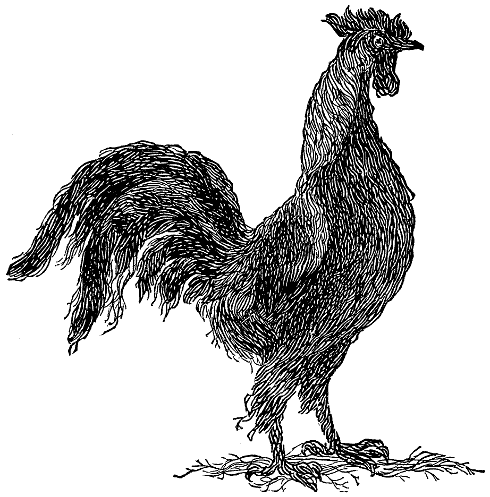
The illustrations show two different arrangements of sea-mosses for the frame. In the first, that seen in Fig. 1, they are glued upon a background of fine white cardboard, 230one layer superimposed above another, until they extend forward from the card for an inch or more. Their stems are finally covered by a small, well-striped scallop-shell which has been washed clean and varnished. It is perhaps needless to add that the effect is very pretty. The “silver mosses” are best adapted for this arrangement.
The design given in Fig. 2 is quite grotesque in its appearance, and appeals rather more to the average boy’s taste than the former arrangement. Red and brown mosses are used entirely, unless the effect seems too somber, in which case a little “silver moss” may be introduced on the back to lighten it a trifle.
Tiny baskets, made of pretty scallop-shells nicely fitted together and varnished, are often filled with the coarser varieties of moss, and are very pretty; but if they are unprotected from the dust they are soon destroyed, and unless covered with a glass case or inverted thin plain glass tumbler, they hardly pay for the trouble of making.
―――――◀▶―――――
ANTIQUES AND HORRIBLES.
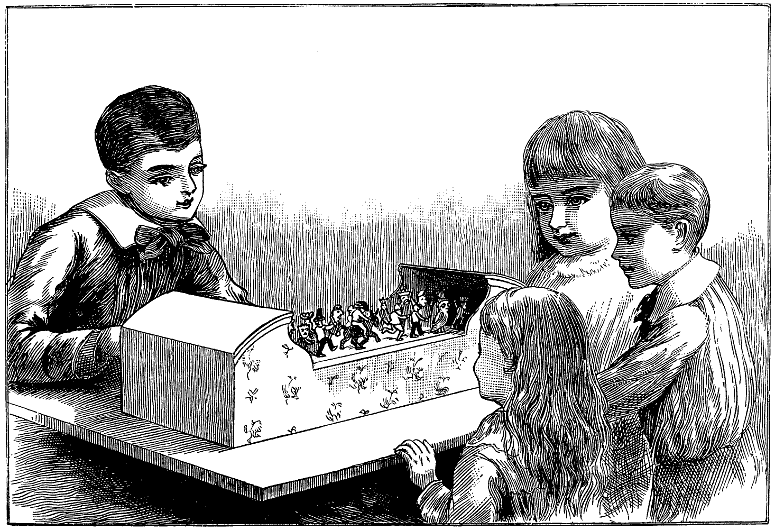
This is another of the mechanical toys which was common during my childhood. The whole affair is so simple that a small boy could make it, in a less finished form at 233least, and the most sullen little fellow in all the land could not fail to be amused by the grotesque procession of clowns and hobgoblins, kings and countrymen, birds and fishes and animals, whose names no naturalist could tell, and whose like was never seen on this earth before. This procession travels on and on, as long as the crank is turned. The above illustration gives some idea of a few of the many members of the band, but any boy at all ingenious, will see that he has a variety—the more grotesque and outlandish the better the effect. Fig. 2 shows a section of the machinery; the box-like covering is removed, and the frame-work exposed to view. First procure a board, a, about twenty by eight inches; next two rollers upon which the band is to turn, for you must have seen that these little images are made of thin cardboard, attached to an endless band of strong cloth. These rollers should be rather larger than broomsticks, and held in place by four uprights, c. Only two of these can be seen in the cut. A table, d e, extends between the rollers and is supported by four legs, f, which should be of sufficient length to make the top, d e, come just below the upper section of the band, g g are boards, the same width as the bottom, a, and of sufficient height to make a good foundation for the top, and to allow free passage of the procession. None of the figures should be much over three inches in height, and none should be attached to 234the cloth in more than one place; that is, by only one foot, as they would be unavoidably torn in passing over the rollers if more firmly fixed. The top and front are of pasteboard, and the whole exposed surface is covered with pretty wall-paper. On the right roller at the back end, fix a small crank, or handle, and the machine is started by turning this. When about to give a grand exhibition, be careful to turn in the right direction, and not set the whole procession running backward, as you might easily do if unobserving or forgetful. The images are much more amusing if painted in bright colors. Use plenty of blue, red, yellow, black, and white paint, with a touch here and there of rich green and purple; and you may perhaps almost make your audience believe that Fourth of July is here again, and they are viewing the “Antiques and Horribles” through the large end of a spy-glass.
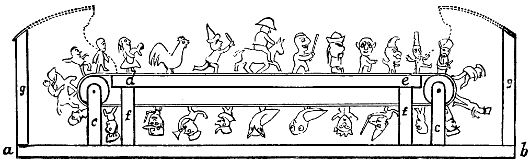
235―――――◀▶―――――
THE MUSICAL CHICKENS.
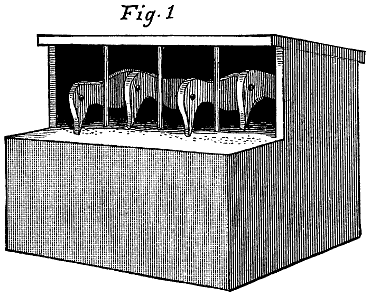
One of the most pleasing toys for children, which may be counted among those made by boys themselves, is this little coop of chickens. Make a box like Fig. 1, leaving off the top and back boards until the works are placed within it. The little bars which separate the chickens are thin strips of wood. In Fig. 2, a represents one of the chickens, which is also made of thin wood and painted yellow; a hole is made at b, to allow the passage of a strong stiff wire, upon which the chickens turn, and by which they are also kept in place. At the end, c, of each, a strong piece of linen thread is tied through a small hole bored for the purpose, and each line is caught to a separate nail, driven in the bottom of the box, just 236below the chicken, in such a manner that when it is drawn tightly in place it will just touch the roller d. Fig. 1 shows just where each chicken is placed, and how far their heads protrude through the bars. The ends of the wire, b, which holds them in place, can be fastened on one side by simply pushing one end into a hole bored partly through the wood to receive it; the other should be slipped into a groove made for it, and fastened in place by a wedge nailed just above it when in position. Fig. 3 shows the roller in full, and the little blocks or cams which are placed along its surface. These little cams are made of wood, not more than three-eighths of an 237inch thick, and are placed at such distances from each other along the roller that the middle point of each shall come opposite one of the threads.
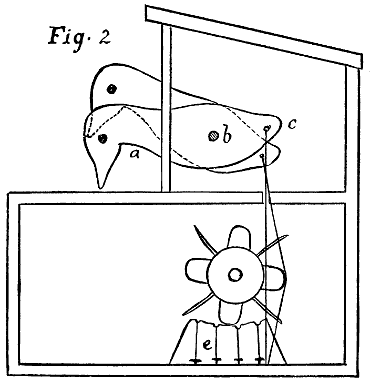
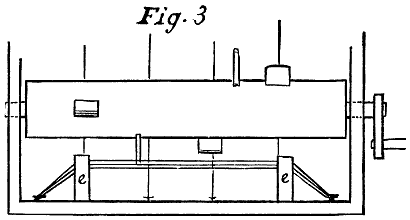
Between these blocks, but so situated that they will not come in contact with any one of the threads, are little quills, driven into tiny gashes made in the roller. These quills are an inch long, and should all be of the same length. One end of the roller is fitted with a crank, while the other is fastened in place by a wooden pin or long nail. Below this, at either end of the box, is a curved bridge, e, into which grooves are cut and slender brass wires drawn very tightly, as seen in a violin. The curve made by the wires, however, is unlike that in the above-named instrument, being concave instead of convex. Now it will be seen that by placing the roller in such a position that the quills will strike the wires with some force as the wheel revolves, a constant tinkling sound like that of a toy piano 238is the result; and at the same time, as the little blocks come in contact with the strings, they push the thread backward, and in so doing lower the point c, and consequently raise the head of the chicken. The top of the extension in front of the bars is made of thin board and painted green, while a slight sprinkling of yellow over its surface represents the meal the chickens are supposed to be eating. The remainder of the box may be painted to suit the fancy of the maker.
―――――◀▶―――――
CAPTAIN S.’S PEG PUZZLE.
One bright summer morning, which seems but a short while ago, unless I stop and count the years that have passed since then, we children were invited to take a sail across the bay with one of the kind-hearted old captains who owned a trim little cat-boat, which her owner was wont to boast would beat any other craft of her length in the harbor. But there was not much chance of beating anything on the morning of which I write, for, although a light northerly breeze was stirring when we intended to start, the girls of our party took so much time in which to get ready, that by the time we were fairly under way we were scarcely able to fill our sail. However, we managed to make some little headway, and in the course of 239two hours reached the beautiful rocky point covered with its grove of fine old trees, which, but for the delay in starting, would have been reached much earlier in the day. This point was quite a favorite spot for excursionists, and was hailed with delight by most of our party. We boys, however, cared more for the little Sea Dog, and the companionship of old Captain S., than for the walks on shore. So, claiming our full share of the good things packed in the baskets stowed away in the cabin, we decided to remain on board and share our picnic with the captain on the bay.
After all were on shore, and the hampers had been taken to the grove, we hoisted the sail and made for deeper water; but there was no wind, and we had to content ourselves with looking at the glassy surface around us, and feeling that we were in a boat away from shore, even if not in rapid motion. We ate our lunch as we listened to a delightful story told by the captain, of how his ship was once chased by a pirate, and only escaped through the timely interposition of a snow-storm. We next tried our hands at the oars and rowed some distance further from the land. Finally, as we were about to return for the others of our party on shore, a small piece of wood Fred found on the cabin floor changed the current of our thoughts, and we saw for the first time the little device I am about to describe. This bit of wood 240which he had picked up was a thin strip of a cigar-box cover. In one end was a circular hole about an inch in diameter, in the middle was a square hole of the same diameter, and at the extreme end was still another opening, in the form of an isosceles triangle, the perpendicular being of the same length as the side of the square.
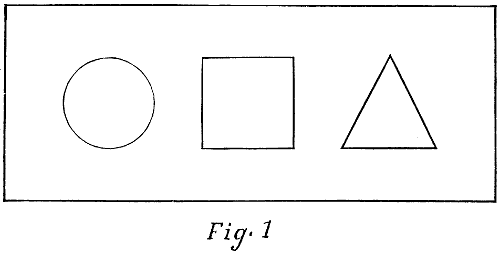
When Captain S. saw the piece of wood he challenged us each to make one peg which should exactly fit all three holes. “But it can’t be done, Captain,” we both exclaimed at once; “the holes that have corners couldn’t be fitted with a round peg, and the peg large enough for the square would be too large for the triangle,” continued Fred, as he examined the openings more carefully. “But it can be done,” answered Captain S., with a peculiar kind of chuckle he always gave when very much 241pleased. “It can be done, for I have done it hundreds of times.”
He had done it hundreds of times; had made one peg which should fit a round, a square, and a triangular hole, and fit them nicely! How was it to be done? We thought it over, and tried to study it out; we even took out our jackknives and whittled away at an old broken thole-pin which lay in the bottom of the boat. But we couldn’t make it work; there were always the corners to be filled, and little spaces would be left if we tried to compromise, and make the pin less round as it increased in length; then the triangle! that wouldn’t accommodate itself to any shape we could devise. We whittled away for over an hour, now and again receiving a little encouragement from the captain, who greatly enjoyed our successive failures. During the meantime a brisk south-west wind had sprung up, and we were bounding over the water at a delightful speed; but we paid little attention to the sail; in fact, we hardly knew we were moving at all, so intent had we become to solve the mystery. After the others of the party came on board, we soon fired them with our enthusiasm, and every bit of available wood and every jackknife was brought into use. But not one of the party was bright enough to hit upon the right shape. I shall never forget the fun made of us by the girls—not one of whom, by the way, could sharpen a lead-pencil 242decently—when the captain finally showed us how the thing was done. Asking one of the older boys to take the helm, he picked up a bit of wood we had thrown aside as too small, whipped out his jackknife, and in less time than it takes me to write it, had the peg made and fitted to the holes. How he made it fit so well in so short a time has never ceased to be a source of wonder to me; but probably the practice of years, while off on lonely whaling cruises, had something to do with his dexterity.
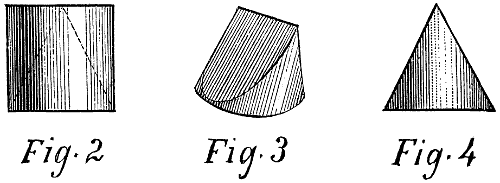
He first whittled out a cylinder, which exactly fitted the circular hole; then he cut it off, so that its length should be the same as the diameter of the square (see Fig. 2). Now, by putting this sideways into the square opening, it fitted it perfectly. Lastly, leaving the base of the cylinder undisturbed, he cut away from either side until he had a shape like Fig. 3, which, when looked at from another point, presents the appearance of Fig. 4, and would, of course, perfectly fit the last and triangular opening.
243―――――◀▶―――――
SLATE GAMES FOR CHILDREN.
A slate is one of the most useful presents which can be given to a child. Long before the little hands can fashion letters, or the infant mind comprehend them, the baby fingers can make marks and scratches upon the smooth surface and derive considerable amusement from the exercise.
As the little one grows older, these meaningless scrawls gradually change to more intelligible forms, and then it is that the “Tit-Tat-To,” so very old, and yet so delightfully new, to every little girl or boy in their turn, comes into play.
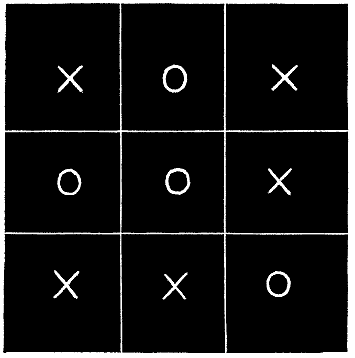
TIT-TAT-TO.
This game is played on a figure similar to the above, 244made on an ordinary slate. The players alternately mark in the figure, the one a cross, and the other a nought; he who first obtains a row, either horizontally, perpendicularly, or diagonally, wins the game, and calls out the following rhyme:
“Tit-Tat-To, my last go;
Three jolly butchers all in a row.”
The object of each of the players is equally to obtain such a row and to prevent his opponent from obtaining one.
AIR, EARTH, OR THE SEA?
This game—which is sometimes called Birds, Beasts, and Fishes—is instructive as well as interesting to children who have some slight knowledge of natural history. It is played as follows: Two boys take their slates, and each writes down the first and last letters of the name of some bird, beast, or fish, first stating whether it belongs to the air, earth, or water, or from which category the name is selected, and puts a cross for each of the intermediate letters. For example: James writes upon his slate T × × × r, and remarks, as he passes it to his companion, “the earth.” Charles selects a bird and marks upon his slate as follows: E × × × e, saying, at the same time, “the air.” They exchange slates, and each tries to 245guess the name of the beast or bird indicated, and fills up the blanks accordingly. It is evident that those indicated above are respectively tiger and eagle.
TURKS AND RUSSIANS.
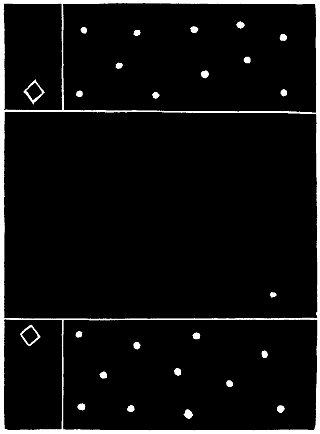
The slate should be divided into three divisions, the top and bottom divisions each having a small compartment marked off therein, as shown in the annexed diagram.
246One of the two end divisions should be allotted to the Turks, and the other to the Russians, and marks put therein, to represent the soldiers of the respective nations.
Each player having provided himself with a well-sharpened pencil, the game is played as follows: The players decide the order of play, and the first selected being supposed to be a Turk, places the point of his pencil at the spot marked in the smaller compartment of the Turkish division of the slate and draws it quickly across the slate in the direction of the opposing army.
The pencil will, of course, leave a line marking its track, and all the men of the opposite side through which the track passes count as dead. Each player plays alternately, and he wins who first kills all the men on the opposite side.
The track of the pencil must be rapidly made and must be either straight or curved; any track in which there is an angle does not count. Sometimes the players turn their heads or close their eyes when making the track.
THIRTY-ONE.
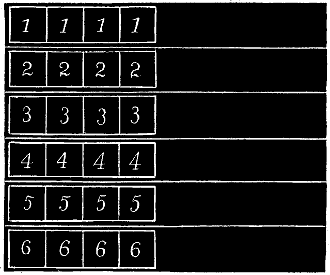
Although this game is usually played upon a board similar to the one in the cut, and with small wooden blocks made for the purpose, a slate properly marked off 247would answer very well for the board, and bits of pasteboard, marked with the necessary figures, do equally well for the blocks.
The game consists of playing these bricks or squares of pasteboard, so that the column added up makes just thirty-one.
As only two persons play together, suppose William and Mary are contestants. Mary commences the game by playing a six; that is, she slides one of the blocks numbered six over to the right-hand side of the board. Then William plays block No. 4. This makes ten. Mary then plays two, and William follows with a five, making seventeen total. Now, some calculation is necessary if either will win. Mary, after some study, ventures 248a five, and William plays a six. It is now only necessary for Mary to slide No. 3 over to the right side, to make the total thirty-one and beat.
That move of Mary’s—which was made after considerable deliberation—was not a safe one, as William could have moved over a one and made the total only twenty-three. This would require eight more to complete the required thirty-one, and as six is the largest number on the blocks, William would have had the last play and gained the contest.
Rules for Thirty-one.
The object of each player is to gain thirty-one, or nearer thirty-one than his opponent, without going over that number.
Put the blocks or bits of pasteboard on the left side of the board; and each in turn moves any piece they like to the other side.
Each player moves alternately one piece at a time.
Add together the numbers on all the blocks moved, until one or the other gains thirty-one, without going over that number.
The player gaining this number by his individual block wins.
The final honor is given to him who wins three out of five single games.
249―――――◀▶―――――
SOLITAIRE.
During the long winter evenings, we cannot have too many games to amuse the younger members of the household, and a variety is always acceptable.
Where the family is large and the means small, and especially in the country where boys are forced to rely upon their own devices in the way of amusement, few of the ready-made games find their way into the household.
Now boys, and girls, too, let me whisper to you so softly that your city cousins may not hear—you are no losers because of that fact. A great part of the enjoyment of a thing consists in the making of it. And many of the games which are best enjoyed by children all over the land you can, with a little ingenuity and some trouble, perhaps, make for yourself.
Among the many things which a boy can make, there are very few more interesting or fascinating than the simple game of Solitaire, or, as it is more frequently called, The Peg Puzzle.
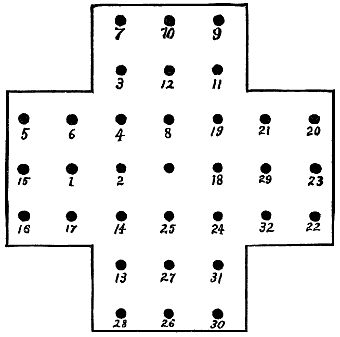
Take a piece of smooth board, from nine inches to a foot square, cut out the corners as indicated in the illustration, and bore holes in the positions indicated by the dots.
Out of soft pine or other suitable wood whittle thirty-two 250pegs, which are to fit into these holes; the middle or thirty-third hole is to be left empty.
The game consists in removing all the pegs excepting one from the board, and that one is to be left in the middle hole.
This is effected, as in “checkers,” by a series of captures; that is, when taken off the board, the peg removed must first have been jumped over by another peg.
In beginning the game, peg No. 1 jumps over peg No. 2, and is placed in the central hole. No. 2 is then removed from the board. As the hole occupied by No. 2 is now empty, peg No. 3 jumps over No. 4, and is placed in the 251empty hole No. 2. No. 4 is removed, and the moves continue in like manner as those described.
The following is a key to the solution of the puzzle, but should not be consulted until you find it impossible to accomplish the feat without its aid.
KEY.
1 to centre
3 to 2
5 to 4
2 to 3
7 to 4
8 to 6
9 to 7
11 to 3
7 to 4
6 to 8
13 to 2
x to 1
15 to 2
16 to 14
2 to 13
18 to 11
20 to 19
8 to 21
22 to 20
20 to 19
11 to 18
24 to 14
26 to 25
25 to 17
28 to 14
17 to 25
29 to x
x to 27
30 to 24
32 to 25
27 to centre.
―――――◀▶―――――
BATTLEDORE AND SHUTTLECOCK.
If any of my young boy friends wishes to make a useful, and at the same time acceptable, present to a sister 252or girl friend, he cannot do better than make a set of this pretty and amusing game.
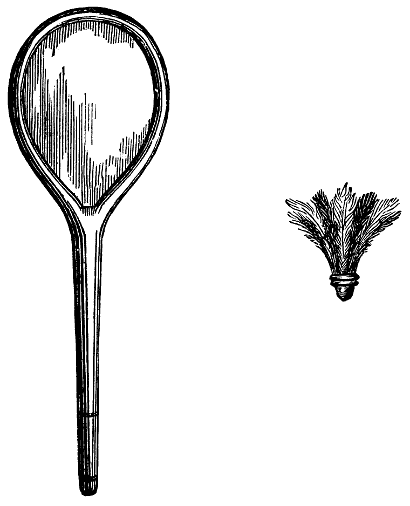
The battledore is readily made with a hickory stick and a piece of hoop, and the shuttlecock with a cork and a few short feathers. The forms of the two are shown in the illustrations.
The game is played by two players, each having a battledore, and each bats the shuttlecock from one to the 255other, the one failing to return it when it is batted to him within possible reach losing a point in the game. A game consists of twenty points, and the best two out of three games gains the match.
―――――◀▶―――――
RING TOSS.
This light pastime for the summer lawn, or for the parlor on a winter’s evening, is one of the most graceful and pretty games ever invented. Although particularly intended for the fairer sex, boys are generally the most skillful, if not the most graceful, competitors in the game.
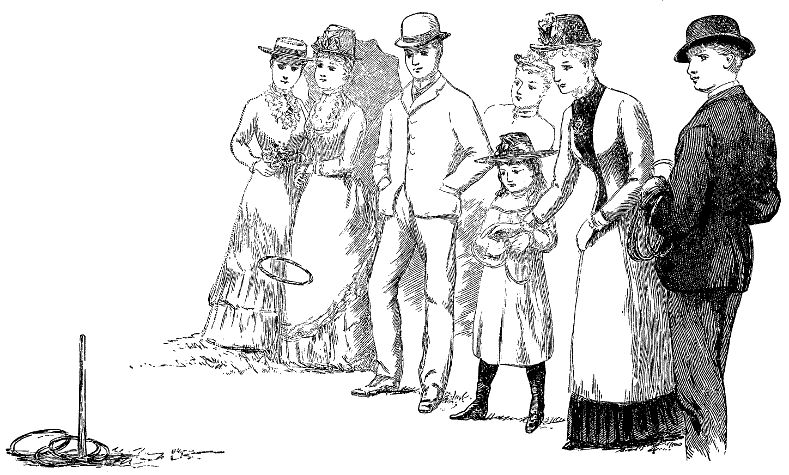
This game is played with a target-post, more or less ornamental, as the skill and taste of the maker may decree, and a number of light rings or small hoops, ranging from five to ten inches in diameter.
The rings are nicely made of old hoop-skirt wires, bent in the desired shape, and strongly fastened with cords, the whole covered with bright silk or ribbon; the greater variety of colors used the brighter the effect of the game. The ribbons need not necessarily be perfectly fresh, as in winding the rings any soiled spots can readily be hidden.
It is also better to have the rings divided into three sets or sizes, and all those of each set as nearly as possible of the same size. For instance, if eighteen rings are to be 256used, let six be about five inches in diameter, six more be seven or eight inches, and the remaining six to be ten inches across.
The game is simply to toss the rings so as to fall on the target-post. The smaller the rings the higher the count.
For the large rings one point is scored, for the next in size two points, and for the smallest or five-inch rings, three points—fifty points being a full game.
The distance on a lawn which the player stands from the target-post is twenty-five feet. In the parlor it is fifteen feet.
―――――◀▶―――――
CHECKERS.
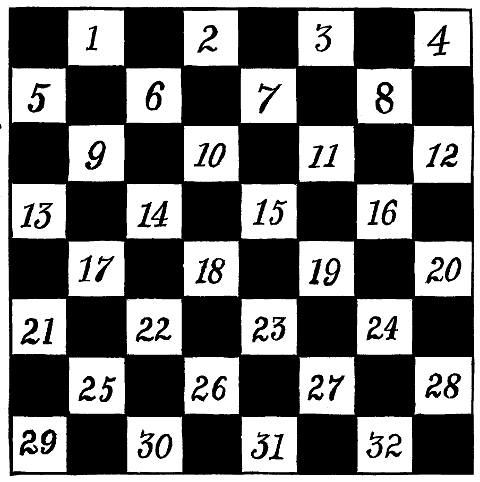
As I write the above title, I wonder if there is a boy or a girl in this great American land who does not own a checker-board, or does not know how to play this delightful game. The game was brought to us from England, we cannot say how many years ago, probably by the first settlers in these then lonely wilds.
This game of checkers is a scientific one and is governed entirely by calculation. So, in order to become a good player, one has to give considerable time and thought to the subject, which is perhaps as good mental discipline as many of our less interesting school studies.
257The game is played upon a board or table, divided off into thirty-two white and thirty-two black squares, with twelve white and twelve black men or checkers.
The board can be made out of thin wood, or upon a strong piece of pasteboard, the white squares left the original color of the material used, and the black colored with ink or paint, whichever is most conveniently at hand.
258For the checkers, small pieces of wood may be used, or black and white buttons be substituted in their place.
The table or board should be so placed that each player shall have a black square at his right hand, if playing on the white squares, or a white square, if playing on the black.
The men move obliquely forward until they arrive at the last, or the adversary’s head row, when they are made kings and can then move backward as well as forward.
To distinguish a king from a common man he is crowned, by placing another checker of the same color on top of him, as soon as he reaches the king’s row.
The adversary’s men are taken by leaping over them, and must be taken whenever offered or exposed. No move can be recalled after the man has been quitted; that is, after the finger has been removed from him.
The players have the first move in each game alternately.
Checkers may best be learned by playing, for awhile at least, upon a board on which the white squares are numbered, some authorities advising the placing of permanent numbers in a corner of each white square, so as to be seen when the men are placed.
The numbers are arranged as follows: 1 being on your right hand and 4 on your left; number 5 the right hand of the second row, and 8 the left, and so on. See illustration.
259The black men are placed upon 1 to 12; the white on 21 to 32.
In order to understand the game more readily, it may be of some assistance to beginners to show how a simple game might be played.
Suppose B., who has the black men, makes the first move from 11 to 15. W. follows him with 22 to 18. B. now moves from 15 to 22, jumping over 18, and capturing it by the move. 22 is now exposed, so W. is obliged to take it, and to do so moves from 25 to 18. B. now commences a new line of moving, and passes 8 to 11. W. moves 29 to 25 thus breaking his king’s row. B. 4 to 8; W. 25 to 22; B. 12 to 16; W. 24 to 20; B. 10 to 15. Now W. moves 27 to 24, and loses the game by so doing. B. follows with 16 to 19, thus exposing 19. As it is a law in the game that the opposite side must take up the exposed men, W. is obliged to jump 19, and moves from 23 to 16 in so doing. B. moves from 15 to 19; W. 24 to 15 to jump 19; B. 9 to 14; W. 18 to 9, and captures 14. B. now sees 15 and 22 exposed, and moves from 11 to 25, thus capturing both men by the act. W. 32 to 27; B. 5 to 14, jumping 9. W. 27 to 23; B. 6 to 10. W. 16 to 12; B. 8 to 11. W. 28 to 24; B. 25 to 29, and is made a king. W. now moves 30 to 25, but as 29 is a king and can move backward as well as forward, B. moves from 29 to 22 and jumps 25, but exposes the king, which is quickly captured by W., 260who moves from 26 to 17. Now both sides proceed in a quiet manner for a time, B. moving from 11 to 15, W. 20 to 16, B. 15 to 18, W. 24 to 20. B. captures 28 by moving from 18 to 27, and W. takes 27 by jumping from 31 to 24. B. 14 to 18; W. 16 to 11, which is taken by B. who moves 7 to 16. W., in turn, takes 16 with 20, which he jumps over to 11. B. 18 to 23; W. 11 to 8. B. 23 to 27, and W. now gains another king by moving 8 to 4. B. moves 27 to 31 and also gets a king. The king, you remember, can move backward, so W. moves from 4 to 8; B. 31 to 27. W. 24 to 20; B. 27 to 23. W. 8 to 11; B. 23 to 18. W. 11 to 8, and B. 18 to 15, which shows the game is lost to W.
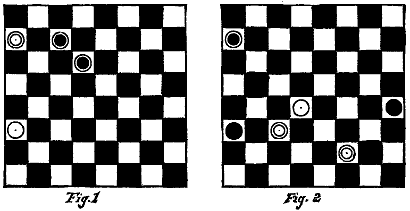
The two following problems are given for practice, and are intended to materially assist the learner in gaining some knowledge of the intricacies of the game.
261
SOLUTION TO NO. 1.
Black to move and win.
Black. White.
1st move 6 to 1 5 to 9
2d move 10 to 15 9 to 5
3d move 15 to 18 5 to 9
4th move 1 to 5 9 to 6
5th move 18 to 15 21 to 17
6th move 5 to 1 6 to 9
7th move 15 to 18 9 to 5
8th move 18 to 22 17 to 14
9th move 1 to 6 5 to 1
10th move 6 to 2 14 to 10
11th move 22 to 18 1 to 5
12th move 18 to 14 White loses.
SOLUTION TO NO. 2.
White to move and win.
White. Black.
1st move 18 to 14 5 to 1
2d move 14 to 9 1 to 5
3d move 22 to 17 5 to 14
4th move 17 to 10 21 to 25
5th move 10 to 15 25 to 30
6th move 15 to 19 30 to 25
7th move 27 to 32 25 to 22
8th move 19 to 24 20 to 27
9th move 32 to 23 White wins.
―――――◀▶―――――
THE SPIRIT JEW’S-HARP.
During the Christmas holidays, when families are home for the season, and entertainments are the principal things desired in the long bright evenings, perhaps a few more tricks may not come amiss.
Among these the spirit jew’s-harp will be sure to amuse and at the same time mystify both the older and younger members of the company, who will probably form the audience on these Christmas or New-year’s evenings; and will form a pleasant entertainment between the acts of a 262charade or the lapses in the music. Briefly described, the trick is as follows:
A jew’s-harp is placed in the mouth, and played upon for awhile with the finger in the ordinary way. Gradually, however, the performer moves his hand away, but continues the motion of playing some distance from the mouth, while the instrument continues to play quite as clearly and distinctly as before. The hand may wave above the head, or in any position, to show the audience that no thread or string is connected with the tongue of the instrument, but must keep up the motion of playing as long as the sound continues to come.
Procure a jew’s-harp with a very flexible tongue, and cover the end with a smooth ball of sealing-wax. Now place the instrument in your mouth with its tongue pointed inward, and if your tongue is placed against the ball of sealing-wax and suddenly pushed out, and as suddenly released, a sound will be produced much as if it was pushed out in the ordinary way with the finger.
After a time you will find it possible to produce different notes upon it, and with some practice will find it as possible to play tunes as by the common method.
It will now be seen that during the whole performance the music is elicited by the tongue, and not by the finger as at first appears; the placing the forefinger of the right hand to the mouth, and moving it as if playing in the 263ordinary way, is simply a little ruse to mislead the audience.
The performer should so stand that the light does not shine too strongly upon his face, and thus expose the absence of the tongue of the jew’s-harp, and a complete mastery of the instrument in the inverted position should be acquired before one attempts the trick in public.
―――――◀▶―――――
A NEW WAY TO KINDLE THE FIRE.
There are many ways given for producing fire, but the following is the most unique, and at the same time convenient, of all these various methods, as it consists in simply blowing the flame from the mouth, and so igniting the camp-fire or whatever else one wishes to burn.
To all appearances you fill your mouth with raw cotton, and then, taking a fan in your right hand proceed to make the fire. First a stream of blue smoke will be seen curling from your lips, and after a moment or two a bright spark will appear in the mass of cotton in the mouth. This spark is quickly followed by others until at last a clear bright flame bursts forth.
Many of the audience may not believe that it is a genuine flame, but a paper may be lighted from it and 264passed around the room, which will soon convince the most skeptical that it certainly is bonâ fide fire.
To perform this trick, procure from a chemist a piece of amadon or German tinder. This is an inexpensive material, brown in color, and soft and silky to the touch. Tear off a small piece—perhaps as large as a dime—and roll it in a small bit of cotton wool, having already lighted one end of the tinder. Place this with other cotton in your hand, and you are ready to produce all the fire your audience may demand.
First place the cotton which conceals the lighted tinder in your mouth—it will not burn you—and then some of the loose cotton you have in your hand; and remember to draw the breath in through the nostrils, but breathe it out through the mouth. This will fan the tinder and in a moment light the cotton in front of it, so that the smoke will begin to pass out with the breath; then the sparks will appear, and finally the flame, as described above. While placing fresh cotton in the mouth, you may take advantage of the fact that your hand is before your mouth to let some of the burnt cotton fall out. By exercising a little tact your audience may be mystified for a long time, and, in fact, will probably be unable to guess the secret at all, unless you yourself divulge it to them.
265―――――◀▶―――――
A HOME-MADE COMPASS.
Break a knitting-needle in two pieces, and magnetize one of the pieces by passing it two or three times over one of the poles of a strong magnet. Insert this piece through a small cork. Fix an ordinary needle in the end of the cork with the end projecting.
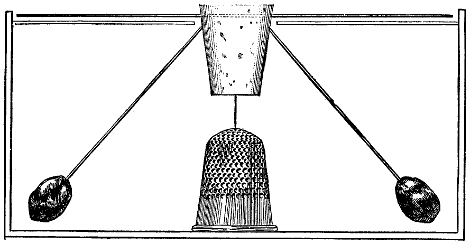
Break the other piece of the knitting-needle into two equal parts; and having wound one end of each with thread pass the other end into the cork, as seen in the illustration.
Next procure a small brass thimble, deeply indented, and balance the cork upon it by dropping melted sealing-wax upon the thread-covered ends, first on one side and then on the other, until the equilibrium is established.
A small round box is next needed, and having fitted 266the top with a disk, like that seen in Fig. 2, cut the central hole large enough for the easy movement of the cork.
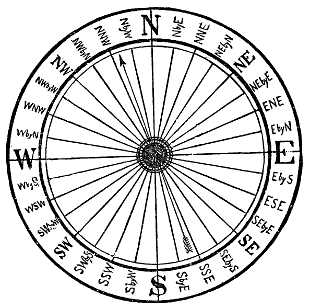
Now place the thimble on the bottom of the box, holding it in place with a few drops of glue. (Le Page’s liquid glue is best for this, as for all occasions in which glue may be required in constructing the objects described in this book.) Balance the cork upon it, with the needle-point resting in one of the indentations on top of the thimble, the magnetic needle having been temporarily taken out. Now adjust the cardboard disk in place.
Lastly, insert the magnetized needle, and your compass is completed.
This compass can be made very useful upon the various 267excursions into the woods which boys are always fond of taking, and, as a simple mechanical toy, much amusement may be derived from it.
By presenting the south pole of the magnet to the north pole of the compass, and jerking it quickly away, the momentum of the needle will carry it around several times before the impulse is exhausted.
The same experiment may be tried with the magnetized blade of a jackknife.
The magnetic needle does not point to the north pole of the earth, but to a point called the magnetic pole. This variation, or declination, is, from the Atlantic region of this continent, a few degrees westward of the direct north.
The arrow indicates about the average variation; and if the compass be so placed that the needle will rest directly over it, the line N. S. will more nearly indicate the true north and south.
The card should be held in place not by glue, but by a few very short pins (filed off and re-sharpened). Then if the needle is shaken from its perch, the card can be removed to permit its re-adjustment.
268―――――◀▶―――――
HOW TO MAKE A CIRCLE.
Many of the operations described in this book require the making of circles of various sizes.
Those readers who own a pair of dividers, especially if they are furnished with a pencil-holder, will find this an easy matter. Those who are not as fortunate may be glad to learn the following ready way of describing circles accurately to any size desired.
One of the common substitutes for dividers is a loop of string or thread passed around the pencil-point, and a pin inserted in the center of the proposed circle. This is a tiresome and vexatious method, as it is difficult to tie the loop at just the right length when a circle of a specified size is to be made, the stretching of the thread adding to the perplexity. The loop is also very ready to slip up and down on the pencil or pin, making it altogether a matter of unusual good fortune to obtain a satisfactory result.
The better way is to take a strip of stout paper or thin card, about half an inch wide and a little more than half the length of the circle’s diameter. A strip cut from a postal card will serve the purpose admirably.
Near one end of this make a hole large enough for the insertion of the pencil-point. Toward the other end make a pinhole, the distance of which from the first 269hole must be half the diameter of the circle required. Stick a pin through this hole into the center of your proposed circle; place the pencil-point in the other, and you can achieve your result with accuracy and ease.
―――――◀▶―――――
THE MAGNETIC CIRCUS.
This mechanical toy is comparatively simple in its construction, and will serve as the foundation for one of the 270many Saturday shows, which are so dearly prized by most of the bright, active boys in our land.
A good-sized soap-box serves as a table on which the toy is to rest. The back is removed, and a hole cut in the top admits the passage of the crank. It is perhaps unnecessary to add that the exposed surface of this box should be papered, or covered with a cloth curtain, in such a manner as to give it a decorative effect.
The attraction of a magnet or iron is the principle on which the “circus” is made to work.