"How Britannia Came to Rule the Waves" (continued 7)
Reading edition
“Having got leave to go on shore from the delegates of our ship, I landed and passed through the dockyard, followed by the whole of the delegates of the fleet, Parker and Davis walking together in procession. When outside the gates, they saw the Lancashire fencibles coming to strengthen the garrison, to whom they offered every insult they could devise. On this the officer in command halted his men, and coming up to the admiral and commissioner, who were standing opposite the gates, asked, so I understood him, whether he might be permitted to surround the delegates, complaining of the insults offered to himself and his men. On this I involuntarily exclaimed, ‘Now’s the time;’ when the admiral asked me what I meant, and how I dared to speak? I said, ‘These are all the delegates,’ pointing out to them Parker and Davis and others. The fellows overheard me, and I have no doubt I became a marked man. I may congratulate myself on the event which carried us away from the fleet, otherwise I might have suffered what others did, and been yard-armed, tarred, and feathered; but I feel justified in saying that, had my suggestion been acted upon, there would have been an end of the mutiny at the Nore. Returning on board I found that every arrangement had been made, and the Clyde being the inshore ship, was to move first, which she did, and ran under the batteries; when, either from incompetency or fear, our pilot refused to take charge of the ship, and the tide being on the turn to ebb, Sir Harry Neale thought it advisable to wait for a more favourable opportunity. In the meantime we were visited by the delegates of some of the leading ships, who abused our crew for permitting the Clyde to escape without our firing upon her. So incensed did the men become at this, that one of the quartermasters, John Ainslie, came aft, and asked the first lieutenant whether they might not throw the blackguards overboard, which, I doubt not, a nod of assent would have effected.
“The mutineers now gave orders to our crew to place the frigate between the Inflexible and Director, to send our gunpowder on board the Sandwich, Admiral Parker as he was called, and to unbend our sails, with which orders our people agreed to comply. Sir Harry was immediately acquainted with the circumstances, and he at once arranged that the ship, instead of doing so, should run into Sheerness. When all was prepared, with springs to our cables to cast inshore, and we were ready to cut, in heaving the spring broke, and we cast outward. Sir Harry, whose presence of mind never forsook him, on this directed the quartermaster to take the command and he would dictate to him. All was sheeted home in a moment, and we stood in between the two line-of-battle ships, which had their guns double-shotted, their crews being all ready with lanyards in hand to fire upon us. The ship by that time had got good way, when Sir Harry gave the order to let fly all the sheets, which took the mutineers by surprise, and supposing that the ship was coming to an anchor, they did not fire. Sir Harry then ordered the helm to be put hard a-port, which caused the ship to shoot ahead of the Inflexible. He now came on deck and took the command, crying out to the ship’s company, ‘Well done, my lads!’ when a loud murmur of applause was heard fore and aft; but we had no time to cheer. ‘Now, clear away the bulkheads, and mount the guns,’ he cried. By this time the whole fleet of 82 sail had opened their fire upon us. The shot fell like hail, but, whether intentionally or not, few struck our hull. It was reported that the Director fired blank cartridges or she might have done us more injury; but I believe that her crew, struck with awe at the idea of firing on their countrymen, and also with admiration of their bravery, fired wide. In little more than two hours the bulkheads were cleared away from the cabin door to the break of the quarter-deck, the whole space having been fitted up with cabins for the suite of her royal highness, the guns on both sides being also down in the hold. The guns were mounted and we were ready for action. The men now came aft and begged that, should the mutineers come after them, they might go down with the ship rather than return to the fleet at the Nore. Our master, although a good pilot, did not feel himself justified in taking charge of the ship within the boundaries of a branch pilot. We were therefore on the look-out for a pilot-vessel, when a lugger was discovered on the lee bow, and we were on the point of bearing down on her, when we saw the North Sea Fleet coming with the red flag flying, having left their station in a state of mutiny, the admiral and all the officers being under arrest. A frigate bore down to us, when Sir Harry gave the speaking-trumpet to the quartermaster Stanley, and when she hailed as to what we were doing there, he replied that we were looking out to stop the ships with provisions for the fleet. She then proceeded, and joined the fleet again, and we made sail after the lugger. The necessary signals were made, but not being answered, we gave chase, and, after a run of four hours, captured the Castor and Pollux, a French vessel of 16 guns. We were proceeding to Portsmouth with our prize, when she, being to windward, spoke a brig, who informed us that the mutiny had again broken out at Spithead. Sir Harry on this thought it prudent to anchor under Dungeness until he could communicate with the Admiralty. During the night, as we lay there, a ship was seen bearing down towards us, which, however, answered the private signals; but that could not be depended upon, as it was probable that the mutineers would have possessed themselves of them. We accordingly beat to quarters. The men again repeated their request to sink rather than surrender to the mutineers. The stranger appeared high out of the water, and we could not be certain whether she might not be a line-of-battle ship. The wind being very light, she closed slowly. The suspense was awful. The springs were hove on to keep our broadside to bear. Sir Harry hailed, and her answer was, ‘The Hussar frigate, Lord Garlies, from the West Indies.’ Having come from a long voyage, her appearance was accounted for. Seeing the lights at all our port-holes, those on board the frigate could not understand the necessity of such extreme precautions, being, of course, ignorant of the mutiny. When her men wore acquainted with our situation, they were so struck with the bravery and determination of the Saint Fiorenzo’s ship’s company that they immediately said, should any ship be sent to bring us back, they would share our fate. None, however, came, and in a few days we heard that the mutiny was at an end, and we sailed, I think, for Plymouth, and another ship was ordered to take over the Princess of Hesse-Homburg.”
By the daring and determination of another captain, Sir Henry Trollope, he prevented his ship’s company from joining the mutineers. He had been removed from the Glutton to the Russell, 74, one of the North Sea Fleet, which lay in Yarmouth Roads. On hearing that his crew were about to join the mutineers, he came to the resolution of compelling them, by a proceeding of the most desperate character, to obey his orders. Providing himself with provisions and water, a compass and a chart, and a brace of pistols, he secretly entered the powder-magazine. Besides the door at the entrance, there was a grate, through which he could look into the outer apartment. Seating himself with his pistols in his hand, he sent for the delegates, and ordered them at once to get the ship under way, to carry her out to sea. “You know me, my lads,” he said, calmly; “we have been ordered to proceed to the Texel, and these orders must be obeyed. Sooner than have her name disgraced, I will blow her and all on board up into the air. Return on deck and attend to your duty.”
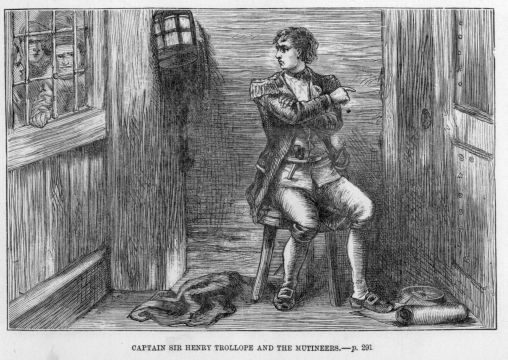
The mutineers looked aghast, but they knew their captain, and of what he was capable, too well to disobey him. They could not have molested him, even had they dared. The crew, obeying their officers, while the captain sat far below in the magazine, their guiding spirit, got the ship under way, and stood out to sea—the rest of the ships, either not aware of what she was about, or not venturing to interfere with her. In a short time she joined Admiral Duncan, who, with his flag flying on board the Venerable, was blockading the Texel. He had been left with only his own ship and the Adamant, keeping in check a Dutch fleet of 15 sail of the line, under Admiral de Winter. In order to prevent the Dutch from coming out, Admiral Duncan made use of a ruse, frequently repeating signals, as if communicating with the main body of his fleet in the offing. At length he was joined by other line-of-battle ships, but his fleet, severely battered by bad weather, and being short of provisions, had to put back into Yarmouth Roads, while Captain Trollope remained with a small squadron to watch the enemy. He continued there till the 9th of October, when information was brought that the Dutch fleet was at sea. He immediately sailed, and having looked into the Texel, on the 11th the Russell and other ships were seen with the signal flying at their mast-heads that the enemy was in sight to leeward. The Dutch fleet stood away, however, towards the coast of Suffolk, when, finding that the English admiral was within seven leagues of him, he sailed back towards Camperdown, followed by the English look-out frigates. De Winter now formed a close line of battle, and resolutely awaited Admiral Duncan. The British fleet on this bore down on the enemy, with the signal flying for close action. The Monarch, leading the larboard division of the British fleet, first cut the Dutch line, pouring in well-directed broadsides on the ships on either side of her. The action soon became general; one after the other the Dutch ships were compelled to strike. One of them, the Hercules, catching fire, the crew threw overboard their powder, and were therefore obliged to surrender their ship. The Dutch admiral’s ship, the Vryheid, held out gallantly to the last, but was at length compelled to yield, when the rest of the ships which had not yet struck their colours, did their best to make off. By this time the English were in possession of two seventy-fours, five sixty-fours, two fifties, and two frigates. The escaping enemy could not be pursued, for the land was close aboard, and the fleet in nine fathoms water. All the victors could do, therefore, was to secure their prizes, and to endeavour to get clear of the shore before nightfall. The Dutchmen had fought gallantly, aiming at the hulls of the British ships, which were fearfully shattered, and in all of them numerous shots were found sticking; though the masts and rigging were but comparatively little injured. The English lost 228 killed and 812 wounded, including many officers, and the Dutch 540 killed and 620 wounded. Of the whole Dutch fleet seven only escaped, and five of these were afterwards captured. With regard to the number of their guns, the two fleets were almost equal—the English ships carrying altogether 1150 guns, and the Dutch 1034; besides which, the latter had some corvettes and brigs which took part in the action, and greatly annoyed their opponents, though their guns were not counted. The victory of Camperdown was gained by the very men who had taken part in the mutiny. On the news reaching England, all those still under sentence were pardoned.
During this year occurred the unfortunate attack on Santa Cruz, in the island of Teneriffe, when, in attempting to land on the mole, Nelson lost an arm, and the gallant Captain Bowen, with several lieutenants, was killed, many of the boats being sunk and their crews perishing.
In the year 1798 the French made three attempts to land armies in Ireland, but on each occasion their fleets were driven back, and many of their ships were captured. A previous attempt had been made in 1796, when they were scattered and discomfited by the weather. The second succeeded in landing a body of troops; the greater number were killed, and the survivors were made prisoners. In the third, the Hoche, under the command of Commodore Bompart, was captured, as were several frigates of his squadron; while the fourth, finding the warm reception the troops would meet with should they attempt to land, put back into port.
At this time there were no less than 30,000 French prisoners in England, and by an agreement with their own government, which was to support them, it was arranged they should reside at Portsmouth, Plymouth, Norman Cross, Liverpool, Edinburgh, Chatham, and Stapleton. Arrangements were made towards the end of the war for the exchange of prisoners, but it was found that there were only 2800 English in France. The French Directory now issued a decree declaring that all persons natives of, or originally belonging to, neutral countries, or countries in alliance with France, serving on board any English ship, should be tried as pirates. The English Government, in retaliation, threatened to treat all subjects of the French Republic in the same manner, should the savage order be carried out. This threat had the desired effect.
Bonaparte had been for some time planning a campaign in Egypt. Sailing with a large fleet from Toulon, he first captured Malta, and then proceeded to Alexandria, wonderfully escaping Earl Saint Vincent and Vice-Admiral Sir Horatio Nelson. Napoleon having landed, his fleet, under Admiral Brueys, brought up in Aboukir Bay. Here Nelson found the French on the 8th of August, drawn up at anchor in order of battle, and at 3 p.m. he threw out the signal to prepare for the fight, followed an hour afterwards with orders to anchor by the stern with springs to their cables. Another signal was shortly afterwards made to signify that the admiral meant to attack the enemy’s van and centre. At 6 p.m. Nelson signalised to the fleet to fill and stand on, which they did in admirable order, the Goliath leading; when, soon afterwards hoisting their colours, with the Union Jack in several parts of the rigging, the British ships took up the stations allotted to them. At 6:20 p.m. the Conquirant, followed by the Guerrier, opened her fire upon the Goliath and Zealous, which was quickly answered by those ships; but the sun had already sunk into the ocean before any other British ship had fired a shot. Loud cheers now burst from every ship of the English fleet, when the men, flying to their guns, opened their broadsides with a spirit which soon knocked away the masts and spars of their opponents, and spread death and destruction on board their ships. The action had continued for two hours, several French ships having struck, when a fire was perceived on board the Orient, which in an hour afterwards blew up with a tremendous explosion, the burning wreck falling far and wide around, and setting fire to several ships, friends and foes, in the neighbourhood. So awful was the effect, that for ten minutes not a gun was fired on either side. Thus the battle raged all night long, till soon after dawn the French frigate Artemise, after striking her colours, also caught fire, and with a terrific explosion blew up.
In the morning the enemy’s ships still in a condition to make sail got under way and endeavoured to escape. Of the thirteen French ships of the line, by this time, one had blown up, eight had surrendered, and two had escaped. Of the remaining two, one, the Timoléon, was on shore, with her colours flying; the other, the Tonnant, lay about two miles from her, a mere wreck, but also with her colours up. On the approach, however, of the Theseus and Leander, she hauled them down; while the crew of the Timoléon set her on fire, and she soon afterwards blew up. Thus, in the memorable “Battle of the Nile,” the French lost eleven line-of-battle ships, besides frigates. In this action the British lost 218 killed and 678 wounded. Among the latter was Horatio Nelson, who was struck above his already darkened eye by a splinter; while all the ships were considerably cut up. On board the Orient fell the Commodore Casa Bianca, as well as his gallant young son, who had refused to quit his post; and the French commander-in-chief, Brueys, who, after receiving two severe wounds, was nearly cut in two by a shot. While still breathing, he desired not to be carried below, but to be left to die upon deck, exclaiming in a firm voice, “Un amiral Français doit mourir sur son banc de quart.”
“A French admiral ought to die on his quarter-deck.”
While the ship was in flames, the boats of the British ships put off to save the hapless crew, seventy of whom were thus rescued. The heroic conduct of the captain of the Tonnant, Du Petit Thonars, deserves to be recorded. He first lost both his arms, and then one of his legs; even then, still able to speak, he gave his dying commands to his crew not to surrender the ship. Of the English fleet, the Culloden unhappily got on shore while going into action, and only by great exertions did she get off, after the battle was over. That the French fought with the utmost gallantry is acknowledged by all, while we must rank the victory of the Nile among the most brilliant achievements of the British Navy.
After the battle every effort was made to repair the damages the ships had received, and to fit the prizes for the voyage to England. Nelson sent the prisoners taken on board them on shore in a cartel, on their parole not to serve again during the war; but Napoleon, with his usual disregard for treaties, formed them into a battalion, which he called the “nautic.” Three of the prizes, being in too shattered a condition to be refitted, were burnt; another, the Peuple-Souverain, being considered unfit to proceed farther than Gibraltar, was there turned into a guard-ship. The five remaining vessels arrived safely at Plymouth; three of them being new and magnificent ships, the Tonnant, Franklin, and Spartiate, were added to the British Navy, the name of the former being changed to Canopus. Rewards were liberally bestowed upon the victors; Sir Horatio Nelson was created a peer of Great Britain by the title of Baron Nelson of the Nile and of Burnham Thorpe, while a pension was settled on him of 2000 pounds a-year by the English Parliament, and 1000 pounds a-year by the Irish; the East India Company presenting him with 10,000 pounds.
After the defeat of his fleet at Aboukir, Napoleon determined to invade Syria. His plans, however, were thwarted by Sir Sidney Smith, who having captured the fleet which was bringing the battering-cannon and ammunition from Damietta for the siege of Saint Jean d’Acre, made use of it to fortify that town, into which, with a small body of seamen and a few officers, he threw himself, and put it into a state of defence, while he organised the Turkish troops who formed its garrison. Napoleon, obtaining fresh guns, in a short time laid siege to Acre. Though he made several desperate attempts to storm it, they were on each occasion repulsed by the valour of the Turks, aided by the fire from the English and sultan’s ships. During one of the many engagements the Theseus frigate caught fire, and the poop and after-part of the ship was almost blown to pieces, several of her officers and men being killed. The fire was put out by the courage of the surviving officers and crew.
Napoleon, enraged at his defeat, made every effort to destroy Sir Sidney Smith. Two attempts to assassinate him, however, happily failed. At length an Arab dervish appeared with a letter to the pacha, proposing a cessation of arms for the purpose of burying the dead bodies, which in vast numbers were piled up under the ramparts. While this proposal was under consideration, with unexampled treachery, Napoleon attempted to storm the town; but the garrison were on the alert, and the assailants were driven back with great slaughter. The Arab tribes having been induced to cut off the supply of provisions for the French army, on the 20th of May Napoleon raised the siege, and leaving his guns behind him, precipitately retreated towards Egypt. Such is a brief outline of one of the most daring exploits ever performed by a naval man.
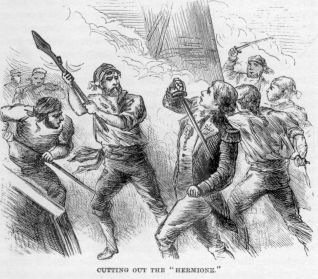
Of a very different character, though one in which consummate bravery was displayed, was the cutting-out of the Hermione frigate. She had been in the year 1799 under the command of Captain Hugh Pigot, one of those tyrant commanders who are truly said to make their ships “hells afloat.” While cruising off Porto Rico, as the crew were reefing top-sails, the captain shouted that he would flog the last man off the mizen-topsail yard. Two, in their attempt to spring over their comrades’ backs, missing their hold, fell on the quarter-deck and were killed. The captain, it is said, on seeing it, merely observed, “Throw the lubbers overboard.” The crew, who were probably a bad lot to begin with, for such a captain could not have obtained a good ship’s company, from a long succession of tyrannical acts, had become infinitely worse. The next day they rose on their officers, murdered the greater number, including the captain, and carried the ship into La Guayra, a port of the Spanish Main. Hearing that the Hermione, which had been fitted out by the Spaniards and strongly armed, was lying in the harbour of Puerto Cabello, Captain Hamilton, commanding the Surprise, a 28-gun frigate, determined to cut her out. Coming off the port on the 21st of October, he discovered her moored head and stern between two strong batteries on either side of the harbour, with her sails bent and ready for sea. After waiting off the port till the 24th without mentioning his intentions, he addressed his crew, reminding them of many enterprises they had undertaken, and pointing out to them that unless they should at once attempt the capture of the frigate, some more fortunate vessel would carry off the prize. Three hearty cheers showed him that he might depend on his crew. “I shall lead you myself,” he added. “Here are the orders for the six boats to be employed, with the names of the officers and men to be engaged on the service.”
Every arrangement had been judiciously made. The crew were to be dressed in blue; the password was Britannia, the answer Ireland. The boarders were to take the first spell at the oars; then, as they neared the Hermione, they were to be relieved by the regular crews. The expedition was to proceed in two divisions, the one to board on the starboard, the other on the larboard bow, gangway, and quarter. Sharp axes were provided for those who were to cut the bower cable, while others were told off to cut the stern cable, and certain men were to go aloft to loose the sails. In the event of their reaching the ship undiscovered, the boarders only were to board, while the boats’ crews were to take the ship in tow directly the cables were cut; but should they be discovered, the crews of each boat were to board and all aid in the enterprise. The rendezvous was to be on the Hermione’s quarter-deck. At half-past seven the boats were hoisted out, the crews mustered, and away they pulled from the Surprise. As it happened, within a mile of the Hermione the expedition was discovered by two gunboats, and the alarm being given, firing commenced. Captain Hamilton on this pushed for the frigate, believing that all his boats would do the same, but some, misunderstanding his orders, engaged the gunboats. On approaching, lights were seen at every port, with the ship’s company at quarters. Captain Hamilton pushed for the bows, and climbing up, his foot slipped and his pistol went off; but he soon succeeded in gaining a footing on the forecastle, and those who had been ordered to loose the sails immediately got the foresail ready for bending and hauling out to the yard-arms, thus forming a screen to themselves, for not a Spaniard was there to interfere with them. On looking down from the forecastle, they saw the crew of the Hermione at quarters on the main-deck, firing away into the darkness, utterly unconscious that the enemy were on board. Captain Hamilton, with the gunner and fourteen men, now made his way to the quarter-deck—part of them, however, under the gunner, being driven back by the Spaniards, who gained possession of the forecastle. Another party of English also neglecting to rendezvous on the quarter-deck, the captain was left for some minutes to defend himself against the attack of four Spaniards, one of whom stunned him, when he fell. Happily, some of his men came to the rescue, and a party of marines climbing over the larboard gangway, now gave a favourable turn to affairs. The rest of the boats coming up, the marines formed, fired a volley, and ran down with fixed bayonets on the main-deck. About sixty Spaniards retreated to the cabin, and surrendered. For some time, however, fighting continued on the main-deck and under the forecastle. The cables were cut, the sails were loosed, while the gunner and two men, though severely wounded, standing at the helm, the boats took the frigate in tow, and she stood out of Puerto Cabello. The batteries immediately opened, and a Portuguese reported that he heard the Spanish prisoners threatening to blow up the frigate. A few muskets fired down the hatchway restored order, and in less than an hour after Captain Hamilton was on board, all opposition had ceased, and the Hermione was his prize. By 2 p.m. the ship was out of gunshot of the batteries, the towing-boats were called alongside, and her crews came on board. In this wonderful enterprise the British had only 12 wounded, while the Spaniards, out of a crew of 365, lost 119 killed and 97 wounded, most of them dangerously. The cutting-out of the Hermione may well be considered one of the most desperate services ever performed, and no man was ever more deserving of the knighthood he received than Captain Hamilton, who had planned every detail, and personally led the bold attack. He himself was among the most severely wounded; besides a blow on his head, he received a sabre wound on the left thigh, another by a pike in his right thigh, and a contusion on the shin-bone by grape-shot; one of his fingers was badly cut, and he was also much bruised.
For some time previously to this, detectives, if they may be so-called, were stationed at each of the ports to discover the members of the crew who had been on board the Hermione at the time of the mutiny. No mercy was shown to those who had taken part in it. A large number were hung; it used to be said, indeed, that more suffered than actually then belonged to her, though they might have done so at some former period.
Sir Edward Hamilton long lived to enjoy his honours.
The days when fabulous amounts of prize-money were to be picked up had not yet passed by, although the rich Spanish galleons which went to sea in the times of Drake were seldom to be found. In October of this year, 1799, fortune smiled on the officers and ships’ companies of two British frigates. The Naiad, of 38 guns, Captain Pierrepoint, while cruising in latitude 44 degrees 1 minute north, and longitude 12 degrees 35 minutes west, came in sight of two frigates, to which, notwithstanding the disparity of force, he gave chase. They proved to be the Spanish 34-gun frigates Santa Brigida and Thetis, from Vera Cruz, bound to Spain. He followed them all night, when, early in the morning of the 16th, another ship was seen in the south-west, which hoisting her number showed herself to be the 38-gun frigate Ethalion, Captain James Young; and soon afterwards two other 32-gun frigates, the Alcmène, Captain Digby, and the Triton, Captain J. Gore appeared. The Spaniards, hoping to escape, steered different courses, but each were pursued by two British frigates, which, before long coming up with them, compelled them to haul down their colours. Fortunately, a breeze coming off the land, the captors with their prizes were enabled to stand off the coast, just in time to save themselves from being attacked by four large ships, which came out of Vigo. While the English frigates were preparing to receive the enemy, the four ships put back into port. The prizes were found to have on board a cargo of specie, besides other merchandise, to an amount which gave each captain upwards of 40,000 pounds, each lieutenant 5000 pounds, each warrant officer upwards of 2000 pounds, each midshipman nearly 800 pounds, each seaman and marine 182 pounds. Even the seamen and marines might have been well contented with the gold pieces they had to chink in their pockets; though in too many instances they were probably all dissipated before they had been many days on shore. Yet complaints were general of the uneven way in which prize-money was distributed. It was a common saying among sailors, that when the pay-clerk went on board ships to pay prize-money, he clambered with his money-bags into the main-top and showered down the money at random; all which remained upon the splinter-netting (a coarse rope netting spread as a kind of awning) was for the men, and all that went through for the officers. The captain of a ship not under the admiral’s flag received three-eighths of the net proceeds. In this instance the three-eighths were divided among the four captains who assisted in the capture of the two Spanish frigates. On the treasure being landed, it was escorted in sixty-three artillery waggons, by horse and foot soldiers, and armed seamen and marines, attended by bands of music, and a vast multitude, to the dungeons of the citadel of Plymouth, whence it was afterwards removed, much in the same style, and deposited in the Bank of England.
Still more fortunate, a few years later, was Lord Cochrane, when, in command of the Pallas, he captured three rich prizes in succession, of which the value could not have been far short of 300,000 pounds. As, however, he only took one fourth, his share amounted to about 75,000 pounds. As it was, however, he nearly lost not only a large portion of his booty, but his liberty, as, while returning home after he had taken the last prize, three of the enemy’s line-of-battle ships were seen. The wind freshening to half a gale, the Pallas was standing on, carrying all the sail she could, when it was found that the enemy were gaining on her. In this desperate emergency Lord Cochrane ordered every stitch of sail to be suddenly taken in, and the three ships of the enemy, one being on the weather, another on the lee beam, and the third nearly on the weather quarter, unable to get their canvas off and haul to the wind, shot miles away to leeward. The Pallas on this wore round and made sail on the opposite tack. The enemy, however, were soon again in chase, but night coming on, a lantern in a cask was put overboard, and the Pallas, altering her course, got clear of her pursuers, and reached Plymouth in safety. As he sailed up the harbour Lord Cochrane had a gold candlestick, five feet in height, fixed to the mast-head, and, as may be supposed, he never after this had any difficulty in manning his ship, when gold candlesticks were to be picked up, in addition to “pewter” and “cobs,” the nickname given by seamen to silver and dollars. They have always been found ready to volunteer on board dashing frigates sent to stations where such prizes were supposed to abound.
The last important action was that known as the Battle of the Baltic. Napoleon had induced the Northern powers of Denmark, Sweden, and Russia to form a league, denominated an armed neutrality, for the French being unable to keep the sea, he hoped under their flags to obtain provisions and ammunition for his armies. To counteract this formidable confederacy, the English sent a fleet of 18 sail of the line, with a few frigates, and a number of bomb-vessels and gunboats, in the first place to attack the Danish fleet, and then to take in hand the other two confederates. After many delays, and attempts to induce the Danes to come to terms, on the 2nd of April, 1801, a portion of the fleet, which had been intrusted by Sir Hyde Parker to Lord Nelson, appeared before Copenhagen, and commenced an attack on the floating batteries and forts prepared by the Danes for the defence of their city. There is not space to give the details of the battle. The Danes fought heroically, their floating batteries being remanned over and over again from the shore. After three hours’ cannonading, from which both parties suffered severely, Sir Hyde Parker, understanding that two of the British line-of-battle ships were in distress, threw out a signal for discontinuing the action. On its being reported to Nelson, he shrugged his shoulders, repeating the words, “Leave off action? Now, damn me if I do. You know, Foley, I have only one eye—I have a right to be blind sometimes;” then putting the glass to his blind eye, in that mood of mind which sports with bitterness, he exclaimed, “I really do not see the signal—keep mine for closer battle flying! That’s the way I answer such signals. Nail mine to the mast.”
At 1:30 p.m. the Danish fire slackened, and at 2 p.m. ceased along nearly the whole of the line. Among the British officers who fell was the gallant Captain Riou, who was cut in two while carrying his frigate, the Amazon, into action. After the flags of all the chief batteries had been struck, some of the lighter vessels that had got adrift fired on the boats which approached to take possession of them. Nelson prepared a letter to send to the Crown Prince of Denmark, threatening to destroy the prizes unless this proceeding was put a stop to. He concluded his letter, “The brave Danes are the brothers and should never be the enemies of England.” A wafer was then given him, but he ordered a candle to be brought from the cock-pit, and sealed the letter with wax, affixing a larger seal than is ordinarily used, remarking as he did so, “This is no time to appear hurried and informal.”
The remainder of the batteries having at length ceased firing, a flag of truce arrived from the shore, when the action, which had continued for five hours, was brought to a close, the total loss of killed being 255, and of wounded 688. The Danish loss amounted to between 1600 and 1800. The result of the victory was the secession of Denmark from the league, and the Emperor of Russia dying soon afterwards, the armed neutrality was dissolved.
Napoleon now began to hope more ardently than ever that he should ere long land his victorious legions on British ground. To carry them over, he had collected a large flotilla, chiefly at Boulogne. By Lord Nelson’s orders, a desperate attempt was made by the boats of the squadron to destroy them. Some were gun brigs of between 200 and 250 tons; others were flats, vessels capable of carrying a crew of 30 men and 150 soldiers, with either a mortar or a long 24-pounder, as well as swivels and small-arms. Though some few were captured, all attempts at their destruction failed. The British cruisers, however, kept too good a watch to allow them to put to sea.
Numerous cutting-out expeditions took place during the war, in which both officers and men displayed the greatest possible amount of courage and determination. One of the most daring and successful on record was the capture of the French 20-gun ship-corvette Chevrette, while lying under some batteries in Camaret Bay, by the boats of the Doris, Beaulieu, and Uremic, forming part of the Channel Fleet under Admiral Cornwallis, stationed off Brest Harbour. At the first attempt the boats were discovered, and the Chevrette ran a mile and a-half farther up the bay, and took on board a party of soldiers. Notwithstanding this, the next night, the 21st, the boats of the three frigates, joined by the barge and pinnace of the Robust, 74, amounting in all to 15, and containing about 280 officers and men, under the command of Lieutenant Losack, the second in command being Lieutenant Keith Maxwell of the Beaulieu, left their ships at 9:30 p.m. As they were pulling into the bay, Lieutenant Losack, with six boats, went in chase of a boat supposed to be sent as a look-out from the Chevrette, and as he did not return, Lieutenant Maxwell proceeded on without him. About 1 a.m. the flotilla coming in sight of the Chevrette, she opened a heavy fire on them of grape and musketry, and at the same time they were assailed by a fire of musketry from the shore. Undaunted by this, the British boarded the ship, some on the starboard bow and quarter, and others on the larboard bow, bravely opposed by the Frenchmen, who were armed with muskets and pistols, sabres, tomahawks, and pikes. Some, indeed, attempted to enter the boats, but were driven back by the British, who, having lost their pistols and muskets, made their way cutlass in hand. Some who had been directed to loose the sails, fought their way on to the corvette’s yards. Here they found the foot-ropes strapped up, but, notwithstanding every obstacle, the sails were let fall in less than three minutes after the boarders had gained the deck. The cable having, in the meantime, been cut outside, a light breeze blowing from the land, and the quartermaster of the Beaulieu, Henry Wallis, fighting his way to the helm, and though bleeding from his wounds, taking charge of the wheel, the ship drifted out of the bay. On seeing the canvas loose, some of the Frenchmen leaped overboard, and others sprang down the hatchways, thus allowing the British to gain possession of the quarter-deck and forecastle, now nearly covered with the bodies of the slain. For some time, however, the Frenchmen who had fled below kept up a sharp fire of musketry, but the English, firing down in return, compelled them to yield. On her way out the prize was exposed to a heavy fire of round and grape from the batteries, but, the wind increasing, she got out of grape-shot. Not till then did Lieutenant Losack and his companions get on board. Two officers were killed, one of whom was Lieutenant Sinclair of the marines, while defending Mr Crofton, a midshipman, who had been severely wounded while boarding. The other, Robert Warren, a midshipman. Another, Lieutenant Waller Burke, was mortally wounded. Altogether, 11 were killed and 57 wounded, and I marine drowned in the Beaulieu’s barge, which was sunk by a shot from the corvette. The gallantry of the boatswain of the Beaulieu, Mr John Brown, was also conspicuous. After attempting to force his way in to the Chevrette’s fore-quarter-gallery, he climbed up over the taffrail, when standing up for some time exposed to the enemy’s fire, waving his cutlass, he shouted out, “Make a lane there;” then, gallantly dashing among the Frenchmen, he fought his way to the forecastle. Here he continued driving back the French, who attempted to regain the post, all the time carrying out the orders he received from the quarter-deck, while he assisted in casting the ship and making sail as coolly as if he had been carrying on duty under ordinary circumstances.
During the war, which ended at the peace of Amiens, on the 27th of March, 1802, England had captured 80 sail of the line, and numberless other ships, besides various islands in the West Indies and other parts of the world, from the French, Spaniards, and Dutch. Though most of the latter were given up, the navy of England had gained a renown which can never be obliterated.
Chapter Sixteen.
George the Third—from A.D. 1803 to end of war A.D. 1814.
The “piping times of peace” were not destined to last long. Napoleon, indeed, had never ceased making preparations for war from the time the treaty of Amiens was signed. On the 16th of May the British Government, discovering his aims, issued letters of marque and ordered general reprisals; and at the same time Holland, being in reality a province of France, all ships belonging to the Batavian Republic in English ports were detained. Admiral Cornwallis, in command of the Channel Fleet, of 10 sail of the line and frigates, which was lying in Cawsand Bay, had his flag flying on board the Dreadnought, 98. With these he proceeded the next day to cruise off Ushant, and watch the motions of the French ships in Brest Harbour; other small squadrons being sent, as soon as they were ready, off the other French ports, containing either ships of the line or gunboats, of which Napoleon was collecting vast numbers for the invasion of England. In a short time that war, which was to last ten years, commenced in earnest. The French gunboats were, however, kept pretty close prisoners by the English cruisers, and whenever any of them ventured out from under the protection of their batteries, they were attacked, captured, driven on shore, or compelled to seek shelter in the nearest port under their lee; while many of them were gallantly cut out and carried off in triumph, even when moored in positions where they could receive assistance from the forts on shore.
Out of the numberless gallant deeds performed by the crews of boats and small vessels engaged in this service, one must be instanced for its singularity, and the bravery displayed by the commanding officer and his followers. A hired cutter, the Sheerness, carrying 8 4-pounders and 30 men and boys, under the command of Lieutenant Henry Rowed, while watching Brest Harbour, observed two chasse-marées close inshore. Having sent a boat with seven men and the mate to cut off one of them, the commander proceeded in the cutter in chase of the other, which was about five miles off, under the protection of a battery. A calm coming on, he, with the boatswain, John Marks, and three other men, jumped into a small boat and pulled away for the chase. The latter, after some time, ran on shore under the battery, where thirty soldiers were observed drawn up on the beach. Notwithstanding the heavy fire they at once opened, Lieutenant Rowed dashed alongside. The Frenchmen having deserted their vessel, he began making efforts to get her off; in this, as the tide was rising, he at length succeeded, and going ahead in the boat, towed her away from the shore. He had pulled about a third of a mile, when suddenly a French boat, with an officer and nine men armed with muskets, were seen alongside, having pulled up in the wake of the vessel. Before the French could have time to attack them, John Marks sprang on board the chasse-marée, and seizing a boat-stretcher, stood prepared to prevent any of the enemy from getting up the side. The astonishment of the Frenchmen gave time to the lieutenant and his three men to climb on board and to prepare their firearms and cutlasses. The French, who attempted to get up the side, were driven back, when they sheered off, but discharged their muskets at the English as they pulled away, while the battery also opened fire. Wonderful as it may seem, though forty-nine musket-balls were found sticking in the prize, not a man was hurt; and both chasse-marées were carried off.
For some time the principal fighting was between the English cruisers in the channel and the invasion flotilla, as Napoleon’s gunboats were called; and as their stings might annoy, though they could not inflict serious injury, attempts were made to destroy them by fire-vessels or catamarans—which was the name given to a species of nautical infernal machine—though without much success. The catamaran consisted of a coffer of about 21 feet long and 3 and a half broad, somewhat in shape like a log of mahogany, wedge-shaped at each end. It was covered with thick planking, and lined with lead, thoroughly caulked and tarred, while over all was a coat of canvas, payed over with hot pitch. To give an idea of its size, the vessel weighed about two tons. Inside was a piece of clock-work, the mainspring of which, on withdrawing a peg placed on the outside, would, after going six or ten minutes, draw the trigger of a lock, and explode the vessel. Every other part was filled with about 40 barrels of gunpowder and other inflammable matter. As much ballast was placed in it as would keep the upper surface of the deck even with the water’s edge. It had no mast, and had to be towed towards the scene of its operations. The tow-rope was at one end, and to the other was fixed a rope with a grappling-iron at its extremity, kept afloat by pieces of cork. This grappling-iron, it was intended, should hook itself to the cable of the vessel it was to destroy, and thus swing the catamaran alongside. It was, indeed, on a larger scale, though with less destructive power, something like Harvey’s torpedo of the present day.
Lord Keith, who was with a squadron off Boulogne, first made use of four of the machines, in the hopes of destroying some of a flotilla of 150 vessels moored in a double line outside the pier. Three exploded one after another, doing very little harm; but a heavily armed launch, which had chased one of the boats towing a catamaran, ran foul of it, when the launch and every one on board was blown into the air.
Numerous other engagements took place, and frequently the portions of the flotilla moving from the different ports towards Boulogne were severely handled by the British cruisers. Occasionally, small English vessels, venturing too close inshore for the purpose of attacking them, were captured by the French.
At length Napoleon managed to collect a vast number of prames and gun-vessels, with other craft, the whole flotilla amounting to 2293, of which the larger were armed. These were intended to carry 163,645 men, of whom 16,783 were sailors, besides 9059 horses. This flotilla was organised in six grand divisions. One, denominated the left wing, was stationed at Étaples, to convey the troops under Marshal Ney from the camp of Mottrieux. Two other divisions were in the port of Boulogne, to convey the troops from the two camps on either side of it, under Soult. A fourth was at the port of Vimereux to carry the corps of Marshal Lannes. The Gallo-Batavian flotilla, assembled off Ambleteuse, formed the fifth grand division, destined to transport the troops under Marshal Davoust; while the sixth, at Calais, was to carry the Italian infantry, and various divisions of mounted and dismounted dragoons.
On the 3rd of August, 1805, Napoleon came to Boulogne to inspect the flotilla, and so completely organised was it by this time, that although the extremities of the camps were more than two miles from the point of embarkation, an hour and a-half only was occupied in getting men and horses on board. All he wanted was the arrival of his fleet under Villeneuve, to protect his mighty flotilla during its passage across the channel, and then, as his generals at all events believed, the conquest of England was certain.
Meantime Nelson, who at the breaking out of the war had been appointed to the command of the fleet in the Mediterranean, was watching Villeneuve, resolved to prevent him from appearing on the spot where his fleet was so anxiously looked for by Napoleon. On the 18th of May, 1803, he had hoisted his flag on board his old ship, the Victory, and on the 20th had sailed from Spithead, first bound to Brest, and from thence to the Mediterranean. Here he remained for nearly two years, without once setting foot on shore, watching and waiting for the Toulon fleet, endeavouring to induce them to come out and give him battle. At length, on the 18th of January, 1805, the French fleet did come out, but a heavy gale blowing. Nelson was then at anchor off the coast of Sardinia. Supposing that they had gone to Egypt, he sailed in chase, but found that they had put back into Toulon. Hence again Villeneuve sailed, and escaping through the straits, was joined by the Spanish fleet at Cadiz, which had 4500 troops on board. The combined fleet of the enemy now numbered 20 sail of the line and 10 frigates, while Nelson had but 10 sail of the line and 3 frigates. With these, however, he chased Villeneuve to the West Indies, where, after threatening several of the islands, he fled back to Europe, with Nelson after him. When about twenty leagues west of Finisterre, on the 22nd of July, the French admiral was attacked by Sir Robert Calder, with 15 line-of-battle ships, but escaped into Cadiz, with the loss of two of the Spanish ships. Nelson, meantime, had sought the enemy on the north-west coast of Ireland, and then came back into the channel, where his ships reinforced the fleet under Admiral Cornwallis off Ushant, and he himself, worn out with fatigue and anxiety, went on shore for a short rest.
It was now that Napoleon urged Villeneuve to come into the channel, ending with the words, “England desires us, we are all ready, all is embarked, appear, and within four-and-twenty hours all is finished.” No sooner did Nelson hear that the French and Spanish fleet had entered Cadiz than, again offering his services, he arrived at Portsmouth on the 14th of September, and the next morning, putting off in his barge to the Victory, he bade his last farewell to England. On the 29th of September, his birthday, he was off Cadiz, and joining Collingwood, took command of the British fleet, then amounting to 27 sail of the line. Villeneuve had been waiting till the Spaniards were ready, and till a favourable wind would allow him to sail. On the 9th of October Nelson sent Collingwood his plan of attack, his intention being to advance towards the enemy in two lines, led by eight of his fastest three-deckers, and thus to break through the enemy’s line. Collingwood, having the command of one line, was to break through the enemy about the twelfth ship from the rear, Nelson intending to lead through the centre, while the advanced squadron was to cut off three or four ships ahead of the centre. He would make few signals: no captain could do wrong who placed his ship close alongside that of an enemy. Not till the 19th did the admiral learn that Villeneuve had put to sea, when he at once concluded that he intended to enter the Mediterranean. Two days afterwards, the ever-memorable 21st of October, 1805, at daylight, when the English fleet was about seven leagues from Cape Trafalgar, Nelson discovered the enemy six or seven miles to the eastward, which had so manoeuvred as to bring the shoals of Trafalgar and San Pedro under the lee of the British fleet, while they kept the port of Cadiz open for themselves.
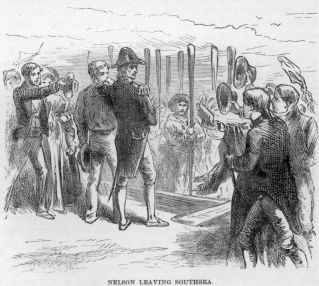
Nelson now hoisted the signal to bear down on them in two lines. Nelson led one in the Victory, Collingwood the other in the Royal Sovereign. On going into action he asked Captain Blackwood, who had come on board to receive orders, what he should consider a victory. “The capture of 14 sail of the line,” was the answer. “I shall not be satisfied with less than 20,” said Nelson.
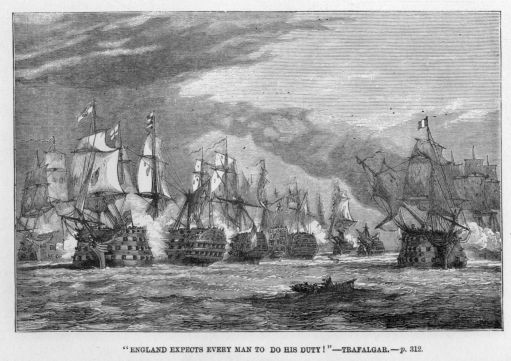
Shortly afterwards up went the signal, “England expects every man to do his duty.”
Notwithstanding the attempts made to induce Lord Nelson to allow the Teméraire to lead his line into action, the Victory carrying all sail, kept her station. Ahead of her was Villeneuve’s flag-ship, the Bucentaur, with the Santissima Trinidad as his second before her; while ahead of the Royal Sovereign, the leader of the lee column, was the Santa Anna, the flag-ship of the Spanish vice-admiral. The sea was smooth, the wind very light; the sun shone brightly on the fresh-painted sides of the long line of French and Spanish ships, when the Fougueux, astern of the Santa Anna, opened her fire on the Royal Sovereign, which, at about ten minutes past noon, delivered her larboard broadside, with guns double-shotted, at the Santa Anna, and with such precision as to disable 14 of her guns, and to kill or wound 400 of her crew; while with her starboard broadside she raked the Fougueux. Just then Collingwood exclaimed to his captain, “Rotherham, what would Nelson give to be here;” and at the same moment Nelson was observing, “See how that noble fellow Collingwood carries his ship into action.”
The wind now falling to almost a calm, the Victory and the ships in her wake advanced so slowly that seven or eight of the rearmost ships of the French van having opened fire upon the Victory before she had fired a single gun, 50 of her men were killed or wounded, and her main-topmast with her studdensail-boom shot away, and every sail, especially on the foremast, had become like a sieve. At about four minutes after twelve she opened with both her broadsides. Captain Hardy now informed Nelson that it was impossible to break the enemy’s line without running on board one of their ships. “Take your choice—go on board which you please,” was the answer.
The Victory, as she approached the Bucentaur, fired a 68-pounder carronade containing a round-shot and a keg with 500 musket-balls, from the larboard side of her forecastle, right into the cabin-windows of that ship; and as she forged slowly ahead, the whole of her 50 broadside guns, all doubly and some trebly shotted, so as completely to rake her, killing or wounding as many men as the Bucentaur had lost, and dismounting 20 of her guns. Receiving the fire of an 80-gun ship, the Neptune, the Victory’s helm being put hard a-port, she ran on board the Redoutable, into which she poured a heavy fire, while with her aftermost starboard guns she engaged the Santissima Trinidad. Besides the heavy fire of great guns and musketry she was enduring from other ships, she received the shot of the Redoutable’s main-deck guns, and also constant discharges of musketry from the three tops of that ship. It was from the mizen-top of the Redoutable, at about 1:25 p.m., that, as Nelson and Captain Hardy were walking the deck together, the admiral was shot by a musket-ball, which entered his left shoulder, and descending lodged in his spine. Hardy, who had just turned, saw him in the act of falling, with his left hand just touching the deck. He was removed by the sergeant of marines and two seamen to the cock-pit.
In the meantime the action raged furiously. Soon after the first four ships of the lee division had cut through between the centre and rear of the enemy’s line. The remainder, as they came up, forced their way into the dense mass and engaged such ships as they could best attack. The weather division was doing the same, rather ahead of the centre, and at about 1:30 p.m. the battle was at its height. At about 3 p.m. the firing began to slacken, and two hours afterwards had wholly ceased, by which time 9 French sail of the line, including one burnt, and 9 Spanish were captured. Nine French and 6 Spaniards escaped, of which 4 French ships made sail to the southward, and 11, 5 of which were French and 6 Spanish, reached Cadiz, most of them much knocked about; while all the frigates and smaller craft also escaped.
Within twenty minutes after the fatal shot had been fired from her, the Redoutable struck her colours, and about three hours after Nelson had received his wound, he breathed his last.
In the whole action the British lost 449 killed and 1241 wounded, while several of the ships lost two of their masts, and five were totally dismasted. Lord Nelson intended to anchor the fleet and prizes, but this Lord Collingwood did not think fit to do, and a gale coming on from the south-west, some of the prizes went down, others were driven ashore, one escaped into Cadiz, some were destroyed, and only four by the greatest exertions were saved. To the credit of the Spaniards it must be recorded that the English prize-crews which landed from the wrecks were treated with the greatest kindness.
Although there were few trophies, the result of the victory was completely to disconcert Napoleon’s plans, and to prevent him from invading England. Four ships which escaped after the action were captured by Sir Richard Strachan on the 4th of November, and not while the war continued did the French and Spanish navies ever recover the tremendous blow they had received off Cape Trafalgar. Thus, of the once formidable French and Spanish fleet of 35 sail of the line, 2 were taken by Sir Robert Calder, 4 of those captured at Trafalgar were carried into Gibraltar, as were the 4 taken by Sir Richard Strachan, 15 were sunk or were burnt or wrecked; 3 only fit for sea escaped into Cadiz; while 7, so severely battered as to be mere wrecks, got into the same port, making up the whole number mentioned. In vain for some time did Napoleon attempt to send another fleet to sea. His ships were either blockaded by the British squadrons, or, when they did manage to escape, were attacked and beaten by our fleets. At the same time small squadrons or single cruisers running out of port committed much havoc on English commerce; not, however, with impunity. Numerous actions between light squadrons and single ships took place. The enemy, indeed, were never safe, even in port; and expeditions to cut out vessels in the harbours or under the protection of forts were much in vogue.
The navy of England was, at the commencement of 1806, larger than it had ever before been, consisting of 551 cruisers in commission, of which 104 were line-of-battle ships; in addition to which 26 were building or being built, and 10 in ordinary, a large proportion of the rest being frigates carrying from 56 to 28 guns.
A new method had been introduced to strengthen ships by diagonal braces or by doubling or sheathing them with plank, and sometimes when they were in bad condition both bracing and doubling them. By this means 22 sail of the line, several frigates, and other smaller vessels had been made fit for active service.
In this year, also, was launched the first British ship of war constructed of teak. Two first-rate ships also were ordered, the Nelson and the Caledonia, of a tonnage and force double that of many of the old ships of the line. To man this large fleet Parliament made a vote of 120,000 seamen and marines.
The four ships captured by Sir Richard Strachan were carried into Plymouth, and were added to the British Navy, the Formidable having the name of Brave given to her, the Duguay-Trouin that of the Implacable, while the Scipion and Mont Blanc were allowed to retain their former names. The Implacable and Scipion were, however, the only ships considered as fit for service.
Notwithstanding the heavy loss France had sustained, Bonaparte managed to send to sea a fleet of 11 sail of the line, and a number of frigates, in two squadrons. One of these sailed for the West Indies early in 1806, while the other steered for the Cape of Good Hope. Admiral Duckworth, who, with 7 sail of the line, had been blockading Cadiz, came up with the former of these squadrons, consisting of 5 ships, 2 frigates, and a corvette, and after a severe action took or destroyed the whole of the five line-of-battle ships.
Among the gallant actions performed at this time was one which shows that seamen fight as well on shore as afloat. The British 38-gun frigate Loire, Captain Maitland, cruising off the coast of Spain, having chased a privateer into the Bay of Camarinas, situated to the eastward of Cape Finisterre, sent in three of her boats, under the command of Lieutenant James Lucas Yeo, to bring her out. Instead of one, they found two privateers, moored under a battery of 10 guns. Both were captured, in spite of the fire of the battery; but in order to secure the larger of the two, Lieutenant Yeo was compelled to abandon the smallest vessel. To recompense himself for her loss, he captured three merchant-vessels laden with wine on his way out. From his prisoners Captain Maitland learned that a French privateer of 26 guns was fitting out at Muros, and being acquainted with the navigation of the bay, he resolved on her capture or destruction. Accordingly, on the 4th of June, he stood into the bay, with springs on his cables, ready to attack the fort, and towing his boats, with fifty officers and men under the command of Lieutenant Yeo. On passing close to the shore, the Loire was exposed to a fire from two long 18-pounders, which considerably annoyed her. On this Captain Maitland ordered Lieutenant Yeo to land and spike the guns. The gallant lieutenant departing on this service, the Loire stood on, when, as she opened the bay, she discovered at anchor within it a large corvette pierced for 26 guns, and a brig of 10 guns; but as the armament of both vessels was on shore, they were unable to offer any resistance. The Loire, however, was now exposed to a hot fire from a fort of 12 long 18-pounders, from which, as she was less than a quarter-of-a-mile off, nearly every shot struck her hull. Finding that by standing on he should be exposed to a still hotter fire, Captain Maitland ran as close in as he could venture, and anchoring the frigate with a spring on her cable, opened her broadside. So strong, however, was the fort, that the frigate’s shot committed little or no damage, while numbers of her crew were falling, some severely wounded. Lieutenant Yeo had in the meantime landed, and storming the 2-gun battery, put its defenders to flight. Having spiked the guns, Lieutenant Yeo discovered the large fort close to the town of Muros, which was severely annoying the frigate. Without hesitation, he resolved to attack it, and his men were eager to follow him. The garrison were so occupied in firing at the frigate, that not only was the approach of the British unperceived, but the outer gate had actually been left open. On the seamen rushing forward, headed by Lieutenant Yeo, the sentinel who only just then perceived them, fired his musket and retreated, followed closely by the storming party, which on reaching the inner gate was met by the governor, and those he had time to rally round him, sword in hand. With a blow of his cutlass, which was broken in the effort, the lieutenant laid him dead at his feet. A desperate struggle ensued in the narrow passage between the officers of the garrison and the British seamen, who, bearing down all opposition, drove the enemy before them to the farther end of the fort, many of whom in their terror sprang through the embrasures down upon the rocks below, a height of twenty-five feet. The garrison of the fort consisted of upwards of 100 men, composed of the crew of the corvette, 22 Spanish soldiers, and several Spanish volunteers. Of these, the governor, the second captain of the corvette, and a Spanish gentleman, with nine other men, were killed, and thirty wounded, before the survivors, finding all opposition useless, laid down their arms; when the British colours, greatly to the satisfaction of the frigate’s crew, were seen flying on the flagstaff. Directly the fort was in the possession of the British, the seamen and marines did their best to assist the wounded prisoners, and were amply repaid by the gratitude which the unfortunate men’s friends expressed when they came to carry them into the town. The guns being spiked and thrown over the parapet, and part of the fort being blown up, the British embarked, carrying off 40 barrels of powder, 2 small brass cannon, and 50 stand of arms. The corvette and brig, as also the Spanish merchant-vessel, were taken possession of, when Captain Maitland sent a flag of truce to the town, promising that should the stores of the two privateers be delivered up, he would not injure the town; he also refrained from capturing a number of small merchant-vessels which lay in the bay, considering that it was cruel to deprive the poor owners of the means of obtaining a livelihood. His terms were gladly accepted, and the bishop and one of the principal inhabitants of Muros came off to express their gratitude for the kind way in which their victors had treated them, and offering such refreshment as the place could afford to the British captain and his officers. The corvette was named the Confiance, and on his return home Lieutenant Yeo was appointed to her. Shortly afterwards he was raised to post-rank, the Confiance being rated as a post-ship, with an armament of 22 carronades, 18-pounders, and a complement of 140 men and boys, in order that he might still remain her captain.
Among the most remarkable of the gallant actions of this period between single ships was that fought in August, 1805, between the British 18-pounder 36-gun frigate Phoenix, Captain Thomas Baker, and the French frigate Didon, of 40 guns, Captain Milius. The Didon measured 1091 tons, and had a crew of 330 men, the weight of her metal amounting to 563 pounds; while the Phoenix measured but 884 tons, her crew numbering only 245 men, and the weight of her metal was 444 pounds. The Didon, which had three days before sailed from Corunna with despatches for the Rochefort squadron, and after escaping an action from another English frigate, had been visited by the skipper of an American merchant-vessel, who informed Captain Milius that a ship whose topgallant-sails were just then rising out of the water to windward was an English 20-gun ship, on board of which he had been the previous evening, and from what he had heard he was sure that she would venture to engage the Didon. Captain Milius, though ordered to avoid an action, believing that victory was certain, backed his mizen-topsail and kept his main-topsail shivering to allow the British ship to come up with him. The stranger was the Phoenix, and which was not only a smaller frigate, but Captain Baker had disguised her to resemble at a distance a sloop of war. The mistake into which Captain Milius had been led by his treacherous visitor was therefore not discovered until the Phoenix was close to the Didon, which ship, hoisting her colours, fired a gun to windward, and at 8:45 a.m. opened her broadside. Captain Baker, in order to prevent the Didon from escaping, had resolved to engage to leeward, but, from the manoeuvres of the French ship, unable to do this, he stood down right at her to windward with all sail set. By this bold measure he succeeded in bringing his broadside to bear on the Didon at pistol-shot distance, when a hot fire of round-shot, grape and musketry was exchanged between the combatants. The Phoenix from the press of sails she carried, ranged ahead of the Didon, which lay almost stationary, and before she could haul up, was raked by the latter; but as the crew were ordered to lie down, they escaped without damage. By the rapidity with which the crew of the Phoenix repaired her damaged rigging, they avoided an attempt made by the Didon to rake her with her starboard broadside. In a short time the Didon’s larboard bow ran against the starboard-quarter of the Phoenix, both ships lying nearly in a parallel direction, the former having only one gun which could be brought to bear on her antagonist. At that moment the Frenchmen in vast numbers attempted to board the Phoenix, but were vigorously repulsed; while the marines of both ships exchanged a warm and destructive fire. At this juncture a young midshipman, Edward Phillips, observed a man upon the Didon’s bowsprit end taking deliberate aim at Captain Baker, close to whom he was standing. Being armed with a musket, he, thrusting the captain on one side, fired. At the same moment the Frenchmen fell into the water, while the bullet intended for the captain’s head tore off alone the rim of his hat. Several men who were sick below, leaving their hammocks, employed themselves in bringing up powder, while the acting purser, Mr John Colman, who might with propriety have remained to assist the surgeons in the cock-pit, appeared on deck with a brace of pistols in his belt and a broadsword in his hand, encouraging the crew by every means in his power. Still, the great superiority of the French made it doubtful which ship would gain the victory; when Captain Baker by great exertions brought the aftermost main-deck gun to a port which he had cut by enlarging one of the stern windows. Several of his men were killed by the French marines while the operation was going forward, but at length he succeeded in running it through the port, and, at his first discharge, sweeping the Didon from her larboard bow to her starboard-quarter, laid low twenty-four of her crew. The British marines were, in the meantime, keeping up so spirited a fire on the forecastle of the Didon that they prevented the Frenchmen from discharging the carronade placed on it. This work continued for half-an-hour, when the Didon fore-reached on the Phoenix, which, as she did so, brought her second aftermost gun to bear on her, and at its first discharge cut away the gammoning of her bowsprit and did other damage. Though the guns of the Phoenix were lighter than those of the Didon, they were fired nearly half as quick again. The Didon had by this time, as she passed out of gunshot, lost her main-topmast, while her foremast was in a tottering condition, and her hull severely shattered. The rigging of the Phoenix had also been so much cut about that she was almost unmanageable. Both frigates, which had gone into action with nearly all their sails set, now exhibited a melancholy appearance, their canvas riddled or in tatters, and rope-ends drooping from their masts and yards. Their crews were now employed in repairing their damaged rigging, and so well trained and diligent was that of the Phoenix that in a short time they had knotted and spliced her rigging and rove fresh braces. While so employed, about noon, they were encouraged by seeing the Didon’s foremast fall over the side. Soon afterwards a light air of wind springing up, the Phoenix, trimming her sails, stood down towards the Didon, and having got within gunshot, was about to open her fire, when the French frigate, being utterly helpless, hauled down her colours.
The Phoenix had lost her second lieutenant, 1 master’s mate, and 10 seamen killed, and 3 officers, 13 seamen, and 12 marines wounded; while the Didon had had 27 officers and men killed, and 44 badly wounded out of her crew of 330 men, who were looked upon as one of the most efficient in the French navy, while Captain Milius, who was known for his gallantry and seamanship, had fought his frigate with the greatest bravery.
The crew of the Phoenix had still a difficult duty to perform. Their prisoners greatly outnumbered them, and not only had they to refit the two ships, but to keep a strict watch on their captives. The Didon’s main-mast was so severely wounded that it had immediately to be cut away, when the Phoenix, taking her in tow, steered for a British port. On the evening of the 14th she fell in with the Dragon, 74, which ship accompanying her, the next day they came in sight of M. Villeneuve’s fleet. On this the Phoenix, with her prize in tow, made sail to the southward, pursued by several French ships; but after a time they tacked and left her and her prize to proceed unmolested. Having passed Lisbon, she was steering for Gibraltar, when, during a thick fog, the ringing of bells and firing of guns were heard. Meeting with the Euryalus frigate, Captain Baker learned that the sounds proceeded from the Franco-Spanish fleet. He accordingly again altered his course to the westward. He had a still greater danger to contend with. The French pilot belonging to the Phoenix overheard some of the prisoners talking of a plan for getting possession of the Phoenix. The intended mutiny was speedily crushed. Shortly afterwards the pilot brought aft Captain Milius’ late coxswain, accusing him of being the ringleader. The French captain was very indignant, and demanded of the man whether he had any complaint to offer. On his acknowledging that he had none, Captain Milius besought Captain Baker to put the fellow in irons, declaring him to be a disgrace to the name of Frenchman. After this the prisoners remained quiet, and the Phoenix with her prize, having the advantage of a good wind, at length safely reached Plymouth Sound on the 3rd of September. The Didon, which was a beautiful and fast-sailing frigate, was purchased for the navy, but, without ever having been sent to sea, was unaccountably broken up in 1811.
Humane and brave as British officers have almost always proved themselves, tyrannical captains, who in most instances have been also deficient in courage and seamanlike qualities, have occasionally been found in the service. Among men of this class the Honourable Captain Lake, commanding the sloop of war Recruit, must be ranked. While at Plymouth he had pressed a young seaman, Robert Jeffrey by name, belonging to Polperro in Cornwall, out of a privateer. Shortly afterwards the Recruit sailed for the West Indies. While in those seas, the ship having run short of water, Jeffrey was accused of stealing, on the 10th December, a bottle of rum, and some spruce beer out of a cask. He was accordingly put in the black-list. Two or three days afterwards the Recruit came in sight of the desert island of Sombrero, eighty miles to the south-west of Saint Christopher. Captain Lake on seeing it suddenly took it into his head to maroon Jeffrey on the island. Accordingly, that very evening, he was conveyed on shore in a boat, commanded by the second lieutenant, who had with him a midshipman and four seamen. Even the buccaneers, when they thus treated a culprit, had the humanity to leave him arms, and food, and clothing; but Captain Lake ordered the unfortunate youth to be left on this uninhabited spot with no other clothing than that he wore, without a particle of food. The lieutenant, observing that his bare feet were cut by the sharp stones, obtained a pair of shoes from one of the men, and gave him a knife and a couple of handkerchiefs, contributed by himself and the midshipman. The lieutenant advising him to keep a bright look-out for passing vessels, then, according to his orders, leaving the poor fellow, pulled back to his ship. Soon after the arrival of the Recruit at the Leeward Islands, Sir Alexander Cochrane, the commander-in-chief, hearing what had occurred, sent her back to bring off the man, in case he should have survived. The officers on landing searched the island over, but could discover no traces of the marooned seaman. Jeffrey, however, was not dead. For eight days he had subsisted on such limpets as he could find among the rocks, and the rain water which he discovered in their crevices. He was growing weaker and weaker, for though he had seen several vessels pass, he was unable from weakness to hail them; till, on the morning of the ninth day, an American schooner, the Adams, of Marblehead, Massachusetts, hove in sight, and his signal being seen, the master came on shore and saved him from the death which probably would have soon overtaken him. He was landed at Marblehead, where he remained till 1810, when the English Government hearing of the occurrence, sent for him, and gave him his discharge, taking the big R off his name thus enabling him to receive all arrears of pay. On the whole circumstance being inquired into, Captain Lake, who acknowledged that he had landed Jeffrey upon Sombrero under the belief that it was inhabited, was deservedly sentenced to be dismissed from the British Navy. In 1807, it having become known that Napoleon intended to take possession of the Danish fleet, to recompense himself for the loss of his own, a British fleet of 17 sail of the line and 21 frigates, and smaller vessels, was despatched to the Baltic, under the command of Admiral Gambier. An army of 20,000 men was also sent at the same time, commanded by Lord Cathcart, and they were directed to demand the surrender of the Danish fleet, the English Government undertaking merely to hold it as a deposit, to be restored at a general peace. The fleet reached its destination early in August. After various skirmishes with the Danish gunboats and batteries, it completely surrounded the island of Zealand, when the troops were landed, and the Danish general, Peiman, refusing the terms offered, on the 2nd of September the English fleet and batteries opened fire on Copenhagen, which was ultimately set on fire. The bombardment continued for three days, with a short interval, in the hopes that the Danes would yield; but it was not till a number of the garrison and inhabitants had been killed, and a large portion of the city burnt down, that General Peiman sent out a flag of truce. Lord Cathcart’s reply was, that no capitulation could be listened to unless accompanied by the surrender of the Danish fleet. This was at length agreed to, and the British were put in possession of the citadel and the ships of war, with their stores. In six weeks the whole of the fleet fit for sea was carried off, the remaining few ships being destroyed; while a large amount of naval stores was embarked, as was the army, without a casualty. On going down the sound, the Neptunus, one of the prizes, an 80-gun ship, got on shore, and was destroyed, as were also most of the Danish gunboats, in consequence of bad weather coming on. The fleet, however, without further accident, at the close of October, arrived safely at Yarmouth and the Downs. Whatever opinion may be formed of the legality or expediency of the enterprise, no one can deny that it was carried out with ability and promptitude; and as the Danes would undoubtedly have assisted Napoleon in his designs against England, she was certainly justified in thus summarily preventing Denmark from injuring her.
It was at this time that the Danish island of Heligoland was captured by the Majestic, 74, and the Quebec frigate, but being of no possible use, was recently handed over to Germany.
The next expedition on a large scale in which a British fleet was engaged brought neither advantage to the country nor honour to its leaders. The Turks having been tampered with by the French, Sir John Duckworth, in command of a squadron, had been sent to Constantinople to take possession of or destroy the Turkish fleet should the sultan not give a sufficient guarantee of his friendly intentions. According to his instructions, Sir John proceeded with his squadron up the Dardanelles, his ships being exposed to the fire of the forts on either hand. Altogether, the loss of the squadron amounted to 6 killed and 51 wounded. The Turks, however, were not to escape without punishment. Not far from the Castle of Abydos lay the Turkish squadron, which had the audacity to fire on the British ships as they passed. While four of the latter came to an anchorage to prevent their escape, Sir Sidney Smith, with three frigates, ran in and anchored within musket-shot of them, when, opening his fire, he compelled one of the Turkish sixty-fours and two frigates, and other smaller vessels, to run on shore, the only ones which did not do so being captured, a fort under which they had sought protection being also destroyed. Unhappily, one of the British ships, the Ajax, commanded by Captain Blackwood, caught fire during the night, and so rapidly did the flames extend, that no efforts availed to put them out, and upwards of 250 souls, among whom were two merchants and two women passengers, perished. It was supposed that the fire was caused by the spontaneous combustion of some coals stowed in the after-cock-pit.
Sir John, on arriving before Constantinople, lost a considerable time in diplomatic negotiations, while the Turks were doing their utmost to fortify their city and the island of Prota, which commanded the anchorage. Instead of attacking the city, Sir John sailed again down the Dardanelles, receiving on his way a hot fire from the Castle of Abydos and other forts on either hand. The Turks fired granite shot, one of which, weighing 800 pounds and measuring 6 feet in circumference, passed through the side of the Active, two feet above the water, and lodged on the orlop-deck, close to the magazine-scuttle, without injuring a man. So large was the aperture made by it, that Captain Mowbray, her commander, saw two of his crew thrusting their heads out of it at the same moment. Another shot of the same weight struck the main-mast of the Windsor Castle, and cut it more than three-quarters through. Other ships were struck by shot of equal dimensions. Four men on board the Standard were killed by one of these shot, which, at the same time striking a salt or ammunition box on deck, caused an explosion by which a lieutenant, 3 petty officers, and 37 men and 6 marines were wounded, and 4 seamen in their alarm leapt overboard—the total loss by this single shot amounting to 8 killed and drowned, and 47 wounded. The story is told of a seaman who thrust his head out of one of the shot-holes, and pertinaciously kept it there. When asked why he did so, he replied that he considered it the safest place, as he was sure no other shot would come in at that hole.
By great exertions the French had in the year 1809 fitted out 9 line-of-battle ships, in addition to the squadrons already at sea, which, under the command of M. Allemand, had arrived in Basque Roads.
Here they were for some time blockaded by the British Channel Squadron under Lord Gambier, whose flag was flying on board the Caledonia, of 120 guns, Captain Sir H. Burrard Neale. Lord Gambier had himself suggested the possibility of destroying the French fleet by means of fire-ships, though he considered, as his letter expresses it, “a horrible mode of warfare, and the attempt very hazardous, if not desperate.” The Admiralty had, however, anticipated him, and had already ordered the construction of several fire-ships, which, on the arrival from the Mediterranean of Lord Cochrane, commanding the 38-gun frigate Impérieuse, were placed under his command. On his reaching the fleet he was coldly received by the other captains, who were jealous of the appointment of a junior officer to conduct so important a service. Lord Cochrane remarks that two only, Rear-Admiral Stafford and Sir Harry Neale, received him in a friendly manner. Lord Cochrane was not a man to be disconcerted by such conduct, and felt thoroughly convinced that the plan he proposed would succeed. The French, aware of the danger of their position, had done their utmost to fortify it. The defences on Ile d’Aix were strengthened, and works were commenced on the Boyart Shoal on the opposite side of the entrance to the roads, while a boom half-a-mile in length, composed of spars and cables, had been laid down and secured by heavy anchors. This boom, forming an obtuse angle, occupied a deep channel between Ile d’Aix and the Boyart Shoal, and it was supposed would prove effectual against the passage of fire-ships. The French fleet was drawn up in two lines inside the boom, with three frigates in line ahead of them. The ships thus placed, aided by the batteries on shore, would have been sufficient to sink the British fleet had it attempted to force a passage. Besides the fire-ships, Lord Cochrane had constructed two explosion vessels. The largest contained 1500 barrels of powder, formed into a solid mass by wedges and wet sand rammed hard between the casks. On the top of this mass of gunpowder were 400 live shells with short fusees, together with as many hundreds of hand grenades and rockets.
The night of the 11th of April was fixed on for the enterprise. The fire-ships were ready, but one mortar-vessel, the Etna, alone had arrived. The Impérieuse, from whence operations were to be directed, anchored close to the inner end of the Boyart Shoal. The Aigle, Unicorn, and Pallas frigates, brought up in a line to the northward of her, in order to receive the crews of the fire-ships and support the boats of the fleet, while the Etna anchored off the north-east point of Ile d’Aix, covered by the Emerald frigate and four gun brigs. Two others, with screened lights hoisted, were to act as pointers for the guidance of the fire-ships. They were to pass between the two light vessels, and then shape a course for the boom. A strong wind from the north-west enabled the fire-ships to run about two points free for the boom. At 8:30 p.m. Lord Cochrane, accompanied by Lieutenant Bissell, embarked on board the largest of the explosion vessels, on the perilous undertaking, the other fire-ships followed. He was accompanied by a boat’s crew of four volunteers only, in addition to the lieutenant. Having nearly reached the boom, he ordered the lieutenant and his men to get into the boat while he ignited the port-fires. It was supposed that the fusees would burn fifteen minutes, by the end of which time the boat might be well out of the range of the grenades; but scarcely five minutes had elapsed ere a terrific explosion occurred, throwing up a huge wave which nearly swamped the boat, while grenades and rockets were darting round them on all sides, shells and missiles of every description rising in the air. The escape of Lord Cochrane and his companions was almost miraculous, for not one of them was hit. The fire-ship, too, had performed her destined work, if not as completely as had been desired, sufficiently so to enable the Mediator fire-ship, Commander Woolridge, to force her way. In his eagerness to direct her against the enemy, he remained till the explosion actually occurred, when he, with two lieutenants, a seaman, and the gunner, who was killed, were blown out of the ship. So well directed were the six other fire-ships that two fell on board the Ocean, of 120 guns, and the Regulus, a 74, the former being compelled to cut her cables, and she soon afterwards, narrowly escaping the Pallas Shoal, ran on shore, where she again had a narrow escape from another fire-ship. So panic-stricken were the French crews that every effort to escape was made. The scene was indeed truly terror-inspiring, the darkness rendering the effect of the burning ships, the flight of shells and rockets, and the flashes of the guns awful in the extreme.
The danger in which the French ships were placed will best be understood from an account written by one of the officers of the Ocean, the French admiral’s flag-ship. After the Ocean, narrowly escaping being blown up, had grounded, a burning fire-ship grappled her athwart her stern. Every effort was made to prevent the fire from catching the ship; the engine playing, completely wetted the poop, while spars were used to heave off the fire-ship, and axes to cut the lashings of her grapnels fastened to the end of her yards; but the chevaux-de-frise on her sides held her firm. The flames from the fire-ship covering the whole of the poop, it seemed impossible that the Ocean could escape. At this juncture two other line-of-battle ships, the Tonnerre and Patriote, fell on board her. The first broke her own bowsprit and destroyed the Ocean’s main-channels. As the fire-ship athwart the stern was now about to drive forward along the starboard side, the Tonnerre was got free. Unless this had happened the fire-ship would have fallen into the angle formed by the two ships, and would inevitably have burnt them. The fire-vessel having now drifted under the bowsprit of the Ocean, was there held for some time. In order to afford the Tonnerre and Patriote an opportunity to get out of her reach, an attempt had been made to drown the magazine, but the flow of water was too slow for the purpose. In the efforts to clear the fire-ships upwards of fifty men fell into the sea and were drowned, the boats saving others.
Shortly afterwards another fire-vessel approached on the starboard-quarter, but the Ocean’s guns cut away her main-mast, and wearing, she passed close alongside. For the remainder of the night vessels were seen burning on all sides. Daylight revealed the French fleet in a deplorable condition; the Ocean on the mud at a distance of half-a-mile to the south-east of the anchorage in Aix Road; to the south-east of her, about fifteen hundred yards off, on a rocky bed, lay the Varsovie and Aquilon, and close to them on somewhat better ground the Regulus and Jemappes. The Tonnerre, already bilged, and her main-mast cut away, and most of her guns hove overboard, lay at the entrance of the Charente, and at some distance off the Calcutta, close to the wreck of the Jean Bart. The Patriote and Tourville also lay not far from the channel of the Charente. Four frigates were also on shore in the same direction. All the grounded ships were more or less on the heel—those on the Pallas Shoal in a very desperate condition. Thus, although the fire-vessels had not caused the immediate destruction of any of the French fleet, they had been the means of reducing nearly the whole of them to a comparatively defenceless state. Lord Cochrane, in the Impérieuse, being the nearest English ship, was the first to perceive their condition, and immediately telegraphed, “The fleet can destroy the enemy—seven on shore;” at 6:40, “Eleven on shore;” and at 9:30, “Enemy preparing to heave off.” At first it was hoped that Lord Gambier would immediately stand in and complete the destruction of the helpless enemy; and there can be little doubt, had such men as Sir Sidney Smith or Lord Cochrane himself been in command, such would have been accomplished; but Lord Gambier, afraid of risking the loss of the whole fleet by venturing among the shoals, called his captains on board, held a council of war, and allowed the favourable time to pass by. The tide rising enabled several of the ships to get afloat, and run up the Charente out of the way of danger. The Impérieuse, without waiting for orders, after signalling for assistance, stood towards three of the French ships, the Calcutta, Varsovie, and Aquilon. After some time she was joined by some gun brigs and bomb-vessels, and later by the Indefatigable, and other frigates. She had, in the meantime, compelled the Calcutta to cease firing, and the Frenchmen to abandon her. Lord Cochrane then sent a midshipman and boat’s crew to take possession, when, without orders, the midshipman set her on fire, and in the evening she blew up with a tremendous explosion. The Tonnerre was also set on fire by her own officers and crew, and blew up. The fire from the English ships compelled the Varsovie and Aquilon to submit at 5:30 p.m. Five other French ships lying on shore at the mouth of the Charente might also have been destroyed had there been any reserve of fire-vessels, but these were wanting, and though efforts were made to prepare three more, by the time they were ready the wind had shifted and they could not be used. The French lost the Varsovie, of 84 guns, the Aquilon and Tonnerre, of 74 guns, and the Calcutta, of 50 guns. The Impérieuse during the action had three seamen killed, and Mr Gilbert, an assistant-surgeon, Mr Marsden, purser, seven seamen, and two marines wounded, while the Revenge had three men killed and Lieutenant Garland and fourteen men wounded, she also receiving considerable damage in her hull from the batteries on Ile d’Aix. The French loss was much more considerable; the Varsovie especially, having 100 killed and wounded, while the captain of the Aquilon was killed in a boat of the Impérieuse, when seated by the side of Lord Cochrane, by a shot from the burning Tonnerre. The burning Varsovie and Aquilon, being supposed by the French to be fire-ships, created a further panic among them. The captain and crew of the Tourville, believing that the fire-vessel was bearing down upon them, deserted their ship, and hastened in their boats on shore. A gallant French quartermaster, however, of the name of Bourgeois, managed to get on board again before the boat shoved off, resolved to stand by his ship to the last. To secure his safety should the fire-ships grapple the Tourville, he at once began constructing a raft. He had just completed it when an English boat approached, the crew of which were ignorant that the ship was abandoned. Bourgeois hailed her twice, but receiving no reply, fired a musket which he found at the gangway. This was returned, but the intrepid fellow, hastening to the captain’s cabin, where he found twenty loaded muskets, discharged them in quick succession, when, greatly to his satisfaction, the boat pulled away. After he had been on board an hour, he discovered three of his shipmates insensible from drink on the lower-deck. A short time after this three of the Tourville’s boats, with a young midshipman, who now took the command, returned on board the Ocean, and he and the brave quartermaster prepared to defend their ship to the last. Fortunately for them, the English, not aware of what had happened, did not attack her, or she would undoubtedly have been added to the list of the French ships destroyed on the occasion Lord Cochrane still remained with the gun brigs, and the Pallas, Captain Seymour, her commander, having gallantly decided on rendering him assistance. At 8 a.m. on the 13th of April he despatched the brigs and mortar-vessel to attack the ships still aground. The Etna unfortunately split her mortar, and the other vessels could do the enemy but little harm. A strong wind and tide prevented the Impérieuse and Pallas from taking a part in the attack. At noon five other small vessels were sent in by Lord Gambier, who wrote to Lord Cochrane giving him leave to attack the Ocean, but observing that there was little prospect of success, and desiring to see him as soon as possible. Lord Cochrane replied, “We can destroy the ships which are on shore, which I hope your lordship will approve of.” The Impérieuse, therefore, remained until the next day, when Lord Gambier, finding that Lord Cochrane would not quit his post as long as he had a shadow of discretionary authority, superseded him in the command of the fire-ships by Captain Wolfe, observing, “I wish you to join me as soon as possible, that you may convey Sir Harry Neale to England, who will be charged with my despatches.” The Impérieuse, therefore, proceeded to Basque Roads, where Lord Cochrane had a disagreeable interview with the admiral, who insinuated that he desired to take all the merit of the service to himself. On his arrival in England Lord Cochrane, who had now a seat in Parliament, gave notice that he should oppose the vote of thanks about to be proposed to Lord Gambier. On hearing this Lord Gambier, on his arrival, demanded a court-martial. The evidence of Captain Pulteney Malcolm was much in favour of Lord Cochrane, but the other witnesses supported Lord Gambier, and sentence was pronounced, honourably acquitting him of all blame. From that day Lord Cochrane’s prospect of success in the navy was destroyed. Though attempts were made by Lord Mulgrave to bribe him over, he refused to abandon what he considered his duty to his constituents and the country. The vote of thanks to Lord Gambier was carried by a majority of 161 to 39.