"How Britannia Came to Rule the Waves" (continued 10)
Reading edition
The punishment inflicted on the Riff pirates was soon forgotten, and they continued their depredations on British commerce. In 1851 they captured the brigantine Violet and the schooner Amelia, killing the masters and several men among their crews, while the survivors were carried into slavery. On information of the outrage being received at Gibraltar the Janus, Captain Powell, started immediately to punish the pirates. Both vessels were found total wrecks on shore. The Janus could therefore only retaliate by firing on the piratical boats, which she did, totally destroying the whole of those seen. She afterwards came in sight of another large pirate fleet. The boats were sent on shore to destroy them, but the Riff people collecting in overwhelming numbers, attacked them so furiously that they were compelled to return to the ship, Captain Powell himself and seven men being wounded. The Violet’s crew were, however, liberated.
War with China—1856.
The seizure of the Arrow, sailing under British colours, by the Chinese, and their haughty refusal to make any reparation, compelled the British minister at Canton to apply to Sir Michael Seymour, commander-in-chief on the China station, to try the efficacy of his guns in inducing the commissioner, Yeh, to yield to his demands. The admiral’s flag was flying on board the Calcutta, 84; he had under him the Winchester, of 50 guns, the Sybil and Pique, of 40, and the Hornet and Encounter, screw-steamers, the first of 17 and the other of 15 guns, and three paddle-wheel steamers and three sloops of war. He was in a short time reinforced by the Sanspareil, of 70 guns, the Nankin, of 50, the Amethyst, of 26, several screw-steamers, and a considerable number of gunboats, well suited for navigating the Chinese rivers. The English admiral first sailed up to Canton, and took possession of all its outer defences, one of which, the Macao fort, situated in the middle of the river, he garrisoned with a force of marines. The Barrier Forts, armed with 150 guns, were stormed and captured, the guns spiked, and the buildings destroyed. These proceedings, however, had no effect on Yeh, and he still held out. Accordingly, bringing up other vessels, the admiral ordered an attack on Canton itself. The ships soon made a breach in the walls, when a body of seamen and marines under Captains Elliott and Stuart and Commanders Holland and Bate stormed the place, and in a short time the gallant Bate having scaled the walls at the head of one detachment, waved the British ensign on the top of the breach; the gate of the city was blown open, and in less than an hour Canton was in possession of the British. The blue-jackets and marines abstained from all acts of plunder, and treated the inhabitants so well that they came fearlessly alongside the vessels, bringing fresh provisions of all kinds. The admiral, not considering it advisable to retain the city, withdrew his men, leaving only a force sufficient for the protection of the factory. This place the Chinese attempted to burn, and made every effort to destroy the fleet with fire-rafts and enormous explosive machines, some of which, it is said, contained 3000 pounds of gunpowder. They were invariably, however, towed clear of the ships. Yeh then one night sent a fleet of 23 war-junks in the hopes of surprising the fleet. Getting news of the intended attack, the admiral despatched the Barracouta with a fleet of boats under Captain Wilson of the Winchester, the admiral himself afterwards joining, and in half-an-hour the whole of the fleet was destroyed, with the exception of the admiral’s vessel, carrying 60 guns, which was brought off.
Still Yeh refused to yield, and Sir Michael therefore attacked the Bogue Forts, which now mounted upwards of 200 guns, and the whole were captured with trifling loss the mandarins having run away and deserted their men, who began in their terror to throw themselves into the sea, till they were persuaded by Captain Hall that they would not be injured.
Meantime, the Chinese were beginning to repair the Barrier Forts, which, as they commanded the river, the admiral resolved to destroy. Two of them, the French Folly and Dutch Folly, were successively attacked. Captains Wilson and Cochrane landing at the head of 850 seamen and marines, stormed the latter, and blew up it and the 30 guns with which it was armed. The Dutch Folly was garrisoned by 140 seamen, under the command of Commodore Elliott, while, to protect the squadron, two strong booms were thrown across the river, one above and the other below it. This terminated the year 1856.
Early in the following year the Chinese having collected a fleet of 90 large junks and 30 row-boats, advanced from three different quarters, hoping to overwhelm the British squadron; but the ships, opening their fire, soon put them to flight, when they were followed by the boats and several more destroyed. For several months no active operations took place. Unhappily, the Honourable Captain Keppel’s ship, the Raleigh, on her way to Hong-Kong, struck on a rock and was totally wrecked. Sir Michael, however, gave him command of the Alligator, and placed under him the Bittern sloop and the hired steamers, Hong-Kong and Sir Charles Forbes, attached to the Raleigh as tenders. As soon as active operations were commenced, a squadron of gunboats towing about 20 ship’s boats, most of them armed with a heavy gun, was despatched up the Escape Creek in search of a large fleet of Chinese war-junks. As soon as the Chinese saw them, they took to flight up a shallow creek, where the gunboats pursuing them, grounded; but the officers jumping into the boats, continued the pursuit, when Commander Forsyth captured ten, and Mr Brown, mate of the Hornet, with a single boat’s crew, attacked and carried three large ones in succession. Altogether, ten were taken and seventeen destroyed.
Several smaller expeditions were made with the like success. Still, the main fleet of the Chinese remaining in safety in Fatshan, the admiral resolved to lead against it an expedition he had organised of 11 gunboats and between 50 and 60 boats of the fleet, carrying 2000 men. Each division of boats was commanded by the captains of the ships to which they belonged. The fleet they were to attack consisted of 80 of the largest junks, manned by 6000 of the best Chinese sailors and warriors. It was drawn up under heavy batteries on either bank; across the stream 50 junks were found moored side by side, the large guns in their bows pointed down it. The admiral waited till dead low water, the most favourable time for making his attack, and he hoped that the junks would be unable to move till he got up to them, while should any of his own gunboats take the ground, they would soon again be afloat with the rising tide. The Chinese had further strengthened their position by sinking junks laden with stone, against one of which the Coromandel, carrying the admiral’s flag, grounded. He, on this, landing with a party of blue-jackets and marines, stormed one of the batteries, the garrison of which soon took to flight. Meantime, the Haughty, the leading gunboat, attacked the largest of the junks; her crew jumping overboard, the example was followed by those of the rest of the fleet, when the whole squadron was immediately set on fire. Commodore Keppel attacked and carried a second battery, and then sent his division of boats against another squadron of junks. These having been destroyed, he pushed on three miles till he saw before him the main body of the largest junks moored compactly across the stream with their heavy bow-guns pointing at him. These opened so tremendous a fire that in a few moments every boat was hit. The commodore’s coxswain was killed, and scarcely a man in the boat escaped. While Lieutenant Prince Victor of Hohenlohe was engaged in attending to a wounded man, a shot whizzed between him and the commodore, and had he not been bending down, he would have been killed. So full of water was the boat that Keppel had to jump on the after-thwart to keep his legs out of it, when another round-shot passed through both sides of the boat scarcely an inch below him. At length, as the boat was on the point of sinking, he and his companions, taking the wounded men, got into one of the Calcutta’s boats. The rest of the flotilla had suffered in the same way, and numerous officers and men had been killed or wounded. The commodore, seeing that there was little hope of success at that moment, ordered the boats to retire, and the deck of the Hong-Kong was soon covered with the wounded men brought on board. The fire of the Chinese still reaching her, several more men were killed on board. The admiral, however, hearing the firing, had sent up reinforcements, and Commodore Keppel, calling to the rest of the boats to follow, again dashed forward in the Raleigh’s cutter, in a style which so daunted the Chinese that, cutting their cables, they pulled away up the stream. The British seamen cheered and, opening fire from their big guns, were soon up to the sternmost junks. These were quickly captured, their crews in many instances leaping overboard. The rest were pursued for seven miles, till the British boats found themselves almost in the middle of the large city of Fatshan. Here the commodore landing put a considerable body of troops to flight, and would have captured and held the town had not the admiral considered the enterprise useless. He contented himself, therefore, with towing away five large junks, the only portion of the Chinese fleet which had escaped destruction. This success was purchased at the cost of 84 men killed and wounded. Chuenpee, further down the river, was next captured without difficulty, for though considerably strengthened, so disheartened were the Chinese that they did not attempt to defend it.
Considerable reinforcements were now sent out from England, including the Shannon, Captain W. Peel, the Pearl, Sanspareil, and numerous gunboats; but news of the Sepoy mutiny having reached the admiral, he immediately despatched them to Calcutta with a force of Royal Artillery and other troops. During the eventful struggle which ensued, the crews of the Shannon and Pearl, formed into naval brigades, did good service. In November, 1857, the Indian mutiny being nearly quelled, operations in China were recommenced. Yeh proved as obstinate as ever, and to bring him to reason Canton was again attacked. Besides 800 regular troops, the British force consisted of the marines and 1550 blue-jackets, well trained to act on shore. They were formed into three divisions under Captains Stuart, Key, and McClure, the command of the whole being confided to Commodore Elliott. The French, who had now joined the English, had also a naval brigade of less size. The smaller vessels and gunboats having arrived before Canton, began and kept up a ceaseless fire on the walls as well as on the heights both inside and outside the city, replied to by the cannon, jingalls, and rockets of the Chinese. On the morning of the 29th the naval brigade stormed and captured a large temple close to the walls, and at daylight the artillery, which had been landed, opened fire and soon effected a breach. The signal was now given for the scaling parties to advance, and rushing forward with ladders in hand they were quickly up to the walls. The French had the honour of getting over first, not having waited for the signal. The British seamen in different directions were not long after them, Commander Fellowes, of the Cruiser, being the first to mount. The Chinese fought bravely, and many of the British seamen fell. Among them was Captain Bate, of the Actaeon, who was killed while about to mount a scaling ladder. Captain Key with his brigade seizing a battery turned its guns upon the foe; and division after division having got over, swept the Chinese before them, till by nine o’clock the city was won. So large was the city that it took some days before it could be thoroughly occupied. Among those captured were Yeh himself and several other mandarins of rank. As a punishment for his conduct he was sent as a prisoner to Calcutta. The whole loss of the allies was under 130 men killed and wounded, the larger portion belonging to the naval brigade. After this the fleet proceeded to the Peiho, at the mouth of which stands the town of Taku, to which the emperor had despatched a new commissioner named Tau, to negotiate with Lord Elgin. As, however, Tau behaved exactly as Yeh had done, the English and French admirals sent a squadron to capture the forts which guard the entrance to the river. They had been of late greatly strengthened, and from the ditches and wide extent of mud spread before them, were truly formidable. The force consisted of the Cormorant, Commander Saumarez, the Nimrod, Slaney, several French vessels, and a number of the smaller British gunboats, Opossum, Bustard, Staunch. The two admirals going up on board the Slaney. The Cormorant leading, broke through a boom of great strength, passed across the river, and various vessels quickly taking up their position, opened their fire on the forts, which, though defended for some time, at length yielded, their garrisons taking to flight. A squadron of gunboats, with the English and French admirals on board, then made their way up to Tientsin, a large city midway between Pekin and the sea. The emperor, now fearing that his capital itself would be attacked, came to terms. The fleet, however, remained ready to compel him to keep to them, should he attempt to evade fulfilling his engagements. In the meantime a small squadron, consisting of the Retribution, Captain Barker, the Furious, Captain S. Osborn, the Cruiser, Commander Bythesea, the gunboat Lee, Lieutenant Jones, and surveying-vessel Dove, Commander Ward, made a voyage up the Yang’tse Kiang, 600 miles above Nankin, to a city of importance called Hang-keo. From the shallowness of the water the larger vessels frequently grounded, and on passing Nankin, then in possession of a formidable army of rebels, which attacked them, they had to fight their onward way. At length the Retribution could proceed no farther, but Osborn leading the rest reached Hang-keo in safety. On their way back the larger vessels again grounded, but being released by a flood, the whole succeeded in returning to Shanghai.
Sir Michael Seymour returning home, was succeeded by Admiral J. Hope, with his flag on board the Chesapeake. Besides six larger vessels, he had under his command a squadron of nine gunboats. Each boat was armed with two long guns and two howitzers, and before they went into action the admiral sent on board each from the Chesapeake an additional 32-pounder and an organised crew to work it. Those who knew the Chinese best were very sure, as the result proved, that the emperor did not intend to keep the terms of the treaty. Admiral Hope arrived off the Peiho on the 8th of June, and as soon as he attempted to ascend it for the purpose of proceeding to Pekin to announce the arrival of the British ambassador, he discovered that the forts had been greatly strengthened, and that obstructions of all sorts had been placed across the river. Strong booms had been carried from side to side, and iron stakes driven into the bottom at intervals, reaching within two feet of high-water mark. The Chinese having neglected to remove the obstructions, after the admirals had waited several days, Mr Bruce and the French ambassador having arrived, the admiral sent in to say that unless his demands were immediately complied with he should force his way. A force of blue-jackets and marines 700 strong were told off to storm the forts, and the admiral, shifting his flag to the Plover, led his squadron of gunboats, accompanied by those of the French, towards the forts. During the night Captain Wills with three boats had broken the first boom with barrels of gunpowder, and pushing on, was examining the inner one, when the moon rising revealed his position to the Chinese, who opened so warm a fire on him that he was compelled to retire. The plan proposed was to attack the works on the river side with the gunboats, and the batteries being silenced, to storm with the landing-party. The gunboats, as far as they were able, took up the position allotted to them, but from the shallowness of the water, the Starling and Banterer got aground. No sooner did they open fire than the Chinese began blazing away from a line of heavy guns, which, in a short time, played havoc among them. The Plover was almost knocked to pieces, and her commander killed, 30 of her crew being killed or wounded, and the admiral himself severely hurt. He, however, shifted his flag on board the Opossum, whose commander was shortly afterwards wounded, and her screw becoming fouled, she drifted down the stream. On this Admiral Hope went on board the Cormorant, and on her deck, lying in his cot, issued his directions till overcome by loss of blood. Captain Shadwell then took the command. The engagement continued with great fury on both sides, but the Lee and Haughty were both nearly destroyed. The tide having sunk several feet, the English guns produced less effect on the fort than at first. At the end of four hours, however, nearly all the Chinese guns on the left bank were silenced, though those on the right still continued their fire. It was determined, therefore, to storm the forts on that side, and late in the evening the force destined for that purpose was landed, led by Captains Shadwell and Vansittart and Colonel Lemon, of the marines, and supported by Commanders Commerell and Heath. The gallant Captain Tricault led a body of French, and the boats of an American man-of-war assisted in landing the men. Scarcely, however, had they jumped on shore, unable to obtain the slightest shelter, than the Chinese opened a tremendous fire on them with jingalls, rifles, and muskets, and every gun that could be brought to bear. In a few minutes numbers were hit, Captain Vansittart was mortally wounded, Captain Shadwell’s foot was smashed, and Colonel Lemon fell, severely hurt. The command now devolved on Commerell, who gallantly led forward his men; but two ditches and a wide extent of mud intervened between them and the fort, and so thickly did the shot rain down on them that, before they got twenty yards, 300 were killed or wounded, and they were compelled to retreat—many unfortunate fellows being suffocated in the mud. Of the numerous vessels which had run on shore, all were got off with the exception of the Cormorant, Plover, and Lee, which were knocked to pieces to prevent them falling into the hands of the Chinese. In this disastrous affair above 80 men had been killed and 350 wounded, many of whom died from their hurts.
The Chinese were not allowed, however, for any length of time to boast of their victory. The Peiho was again entered, the town of Pehtang was occupied and the Taku Forts again attacked from the sea and land. Though the army lost a good many men in the operations, not one on board the gunboats was killed. The booms across the river were broken through, the iron stakes drawn, and Admiral Hope pushing on in the Coromandel with a squadron of gunboats, arrived before Tientsin, which yielded to the first summons.
After this the duties of the steamers consisted chiefly in conveying the heavy siege trains of baggage and provisions for the supply of the army in the neighbourhood of Pekin, when after his army had been thoroughly defeated, and at the moment that his city was about to be stormed, the emperor yielded to all the demands of the allies. The emperor had acted with great treachery in the negotiations for peace, imprisoning and torturing the English envoys and escort, so as a lesson to him and his people, his celebrated Summer Palace was burnt to the ground, thus showing them that had they thought fit Pekin itself might have been treated in the same manner.
Russian War—1854-55.
Russia had shown her evident intention of laying violent hands on Turkey, by destroying with a treachery unworthy a civilised nation a Turkish squadron at Sinope, and England and France being bound by treaty to protect the Ottoman Empire, without delay each despatched a fleet into the Black Sea. That of England was under the command of Admiral Dundas, who had his flag on board the Britannia, of 120 guns, his second in command being Rear-Admiral Sir Edmund Lyons, whose flag flew on board the Agamemnon, of 91 guns, a name known to fame. The other ships were the Trafalgar, of 120 guns, the Queen, of 116, the Albion, 91, Rodney and London, 90, Vengeance, 84, Bellerophon, 80, Sanspareil, 70, Arethusa and Leander, 50, Tribune and Curacoa, 31, Retribution, steam-frigate, 28, Diamond, 26, Terrible and Sidon, steam-frigates, 22, Highflyer, steam-sloop, 21, Furious and Tiger, 16, the former a steam-frigate, the Niger, 13, and nine steam-sloops. The French fleet consisted of 15 sail of the line, and 21 frigates and smaller vessels.
From the first Admiral Lyons contemplated an attack on Sebastopol, and in order to ascertain the strength of its fortifications, Captain Drummond, of the Retribution, before war was actually declared, was sent there with a despatch for the Russian governor. He ran in during a fog, and had brought up before even his presence was discovered. Having sent his despatch on shore, he waited for an answer, making good use of his time, and when it arrived, having exchanged salutes with the governor, he stood out again with the valuable information he had obtained. Peace not having been actually broken, the Furious, Captain Loring, was sent to Odessa to bring off the British consul, or any British subjects who might wish to leave it. As the frigate was receiving them on board, the garrison, notwithstanding the flag of truce she carried, fired on her. This treacherous conduct deserved a prompt punishment. A fleet accordingly on the 17th of April sailed for that port, off which they anchored on the 20th. The line-of-battle ships could not get close enough to the walls, and a squadron of English and French steam-frigates under Captain Jones, of the Sampson, stood in and delivered their broadsides. Having done so, one after another in succession steamed rapidly round out of gunshot, to return again and fire as before. The Russian guns returned the compliment with red-hot shot, which set the Vauban on fire. Captain Mends, of the “gallant Arethusa,” remembering the fame of her name, though he had only his sails to depend on, ran in as close as the depth of water would allow, and opened a heavy fire from his 9-inch shell guns, and repeated his manoeuvres till recalled by a signal from the flag-ship. Ultimately some gunboats with rockets were directed to try their powers; at last flames burst forth from several parts of the works, and at one o’clock the magazine in the principal fort exploding cast destruction around. The batteries having been now silenced, the squadron stood closer in and destroyed moat of the vessels which had taken shelter behind the mole. Soon after the fleet retired from before Odessa, the Tiger, which had been stationed off the coast, ran on shore. While attempts were being made to get her off the Russians brought down a field battery, from which they opened so brisk a fire that Captain Gifford, being mortally wounded, and several of his men hit, he was compelled, in order to save their lives, to haul down his flag.
Another visit to ascertain the strength of Sebastopol was paid by Captain Tatham, of the Fury. Disguising her like an Austrian packet, which he knew was expected in the harbour, he boldly stood in on the 10th of May, running past two brigs of war, and having sufficiently looked about him steamed as calmly out again, hoisting the British colours as soon as he had got out of shot. While still in sight of the batteries he captured a Russian schooner, and was carrying her off, when some frigates getting under way, chased him and compelled him to abandon his prize. The fleets now proceeded off Sebastopol, sending away some of their ships in order to induce the Russians to come out and fight them. All their efforts proved vain, and Sir Edmund Lyons scoured the Black Sea till not a Russian vessel of any size remained on its bosom.
Some months thus passed, when the army having been collected at Varna, Sir Edmund Lyons, to whom the task was intrusted by the commander-in-chief, embarked them on board the transports destined for their reception. Admirably were the arrangements made, both for their embarkation and landing on the shores of the Crimea. Indeed, difficult as were both operations, they were carried out without the loss of a man, and with that only of one or two horses drowned. While the army marched towards the Alma, the fleet proceeded along the shore. Some of the steamers standing in, put to flight the few Russian troops their guns could reach. For some time it was hoped that the Russian ships would come out of Sebastopol and give battle to the allied fleets; but all hopes of their doing so were lost when the Russians, having arranged some of their finest line-of-battle ships across the harbour, scuttled them, and their masts were seen slowly descending beneath the surface. No hopes remaining of a naval engagement, each ship supplied a contingent of men, who were formed into a naval brigade, under Captain Stephen Lushington, a body of the French seamen being employed in the same manner. None of the brave fellows employed in the siege performed a greater variety of duties, or behaved with more gallantry, than did the British blue-jackets on shore. They fought in the batteries, armed with some of their own heavy ship’s guns dragged up by themselves from the shore, carried the scaling-ladders in many an assault, assisted to land the stores, and were for some time the principal labourers in forming a road between Balaclava and Sebastopol. Led by the gallant Captain Peel, they took an active part in the assault on the Redan, on which occasion they lost 14 killed and 47 wounded. They were ever-active in succouring those who had been left on the field of battle, whether blue-jackets or red-coats, and many who might have perished owed their lives to their courage and activity. During the engagement known as the Little Inkerman, on the 26th of October Mr Hewett, mate of the Beagle, while in command of a Lancaster gun, was greatly instrumental in the defeat of the Russians. Having received a message by a sergeant from an officer, who thought the battery would be taken in reverse, to spike his gun and retreat, he replying that he only received orders from his own captain, got his gun round to bear on the Russians, and blowing away the parapet, poured his fire down on them in a way which compelled them to abandon their object.
As soon as the troops on shore were ready to open with their batteries, the combined fleets prepared to perform their parts in attacking the sea faces of Sebastopol. By this time Admiral Dundas had given up the command of the fleet to Sir Edmund Lyons, who, as before, directed all the operations. The Agamemnon and Sanspareil were the only line-of-battle ships fitted with screws, but there were steamers sufficient to tow all into action, or to assist them out again if necessary. The final arrangements were made on the 16th between the English and French admirals, when it was settled that the French and Turks should attack the forts on the south side of the harbour, and the English those on the north. Early on the morning of the 17th the order to weigh was given—the fleets having been collected in Kazatch Bay, some distance to the north of the city. The French and Turks, who formed one line, naturally led; the Britannia followed, close to the Charlemagne, the rearmost of the French line. An inshore squadron had been formed, consisting of the Agamemnon, Sanspareil, and London, which was afterwards joined by the Albion and other ships. The Britannia, the most southern of the British ships, took up her position opposite Fort Constantine; next to her in succession were the Trafalgar, Vengeance, Rodney, and Queen. The Agamemnon, piloted by Mr Ball in the little steam-tender Circassia, glided on till she was about 750 yards from Fort Constantine, close to a shoal, which prevented her nearer approach. The London, Sanspareil, and Albion followed her, but were unable to get quite as near the fort as she was. The admiral had warned Mr Ball that his little vessel would probably be sunk, and promised to keep a boat ready to save him and his crew should she go down; but undaunted by the danger, he stood on amid a perfect shower of shot and shell, sounding as he went, till the line was cut from the leadsman’s hand by a shot from the batteries; but another leadsman immediately took his place, and the Circassia, without a man killed, though frequently hulled, steamed out of harm’s way. Immediately the Agamemnon’s anchor was dropped, she opened her fire, as did the other ships in succession. Fortunately, from being so close in, the Russian shot mostly passed over her, as the guns had been trained for a longer range; but the ships to the north of her suffered considerably. Happily, one of the first shells she fired reached the powder-magazine in the fort, which, blowing up with a tremendous explosion, drove the Russians from their guns, and though they again returned, it was to find that a large number of them had been dismounted, while the upper part of their works were crumbling to pieces from the effects of the fire from the British ships. From their lower batteries, however, and from various forts on the heights, so hot was the Russian fire, that the Albion and London, terribly shattered, were compelled to haul off. The Sanspareil also brought up so close to the Agamemnon as to be unable to use her foremost guns, and had to get under way to take up a better berth, and for a time the Agamemnon stood the brunt of the battle in her part of the line. The Sanspareil, however, again quickly came to her support, and the Albion, having repaired some of her damages, returned; but as the London was unable to do so, the admiral signalled to the Rodney, the Queen, Bellerophon, and Arethusa, to come to his assistance. A short time afterwards the Queen, set on fire by a shell, was compelled to retreat, and the Rodney got on shore at the end of the bank; but a large portion of her crew having joined the naval brigade, she had but few men on board, and therefore fought only her main-deck guns, and though in so exposed a position, escaped with comparatively little loss. For five hours the whole fleet kept up perhaps the most tremendous cannonade that has ever been fired from British or any other ships, when night coming on, the Agamemnon made the signal for the fleet to retire, she herself being the last to leave her station. Though during that time the upper portions of some of the Russian batteries had been knocked away, and a large number of people killed and wounded in them, the furious cannonade which had been so long kept up produced no result to compensate the British for a loss sustained of 44 killed and 266 wounded, besides the damages received by many of the ships, two of which, the Albion and Arethusa, had to go to Malta to be repaired. Though the French ships suffered more than ours, they lost under 200 men killed and wounded. The steamers had gallantly performed their part in towing the ships in and out of action, notwithstanding the showers of shot and shell directed at them. Altogether, the admirals came to the conclusion that it was useless attempting to batter down the stone walls of the fortifications, or to again expose their ships to such a fire as they had that day endured.
A portion of the allied fleets still remained before Sebastopol, and harassed the garrison by sending into the harbour two fast, strongly-armed steamers night after night, which, always keeping in motion, fired their shot into the city, and rapidly steamed out again before the enemy could get their guns to bear on them. On one of these occasions the admiral’s son, while directing the course of his vessel, was so severely wounded that he died shortly afterwards.
During the winter months of 1855 no operations were undertaken by the fleet, but as soon as the finer weather allowed the ships to navigate the Black Sea, an expedition sailed for Kertch, a town of importance at the extreme eastern point of the Crimea, containing immense magazines of corn, with which from thence the beleaguered garrison was supplied. Just as the expedition was sailing, however, Canrobert, who had supreme authority over the French naval forces, forbade Admiral Brueys from proceeding, and Sir Edmund magnanimously gave up the enterprise for a time at the earnest request of his colleague. A fortnight afterwards, however, General Pelissier succeeding Canrobert, authorised the French admiral to proceed in support of the English. An overpowering fleet accordingly sailed towards the entrance of the Sea of Azov. As soon as the ships appeared off Kertch, the Russians blew up their fortifications without firing a shot, and evacuated the place. The only officer who had an opportunity of distinguishing himself was Lieutenant McKillop, commanding the Snake, of 4 guns. Perceiving a Russian steamer in the offing, he obtained leave to chase her, which he did till she got under the forts of Yenikale, when both fort and steamer opened their guns on him. Undaunted, he returned the salute, throwing his shells upon both his opponents, and in three-quarters of an hour set the steamer on fire. He was still blazing away at the fort, when three other steamers were seen approaching, and they also, as he refused to run, began to attack him, the guns of each one of them being of heavier calibre than his. He continued engaging them till assistance sent by the admiral arrived, when the whole of the Russian vessels were captured.
While the larger ships proceeded in various directions along the coast, a squadron consisting of the smaller vessels and gunboats were sent into the Sea of Azov, under Captain Lyons, of the Miranda, to attack the numerous stores of corn and other provisions accumulated at different spots along the shores. On the return of the Miranda to Sebastopol, Captain Lyons was succeeded by Commander Sherard Osborn in the Vesuvius. Although the duties imposed on the squadron were not apparently of a very heroic character, they were attended with a considerable amount of risk, and were carried out in a most spirited and gallant manner. In several places the magazines and stores were protected by large bodies of the enemy, who fought courageously in their defence, but were invariably defeated by the determination and activity of the British seamen. Taganrog and other places were protected by heavy batteries, which, however, did not prevent the little squadron from attacking them and coming off victorious. For many months the steam-vessels were thus employed moving about from one place to another. Wherever they were least expected, the officers landed with parties of men, and did not hesitate to proceed either up the rivers or some way inland wherever they gained intelligence that storehouses existed, and in no instance failed to set them on fire. Many hazardous and gallant acts were performed. In this way the squadron were of the most essential service to the allies, and by almost depriving the garrison of Sebastopol of their means of support, were mainly instrumental in the reduction of the great fortress. In a short time scarcely a Russian trading-vessel on those waters had escaped destruction or capture. The vessels of the squadron were everywhere, and often, when espied by troops of Cossack cavalry from the shore, there would be a race between them and the vessels who should first arrive at the store-houses, which the latter had destined to destruction, while the steamers’ long guns played on the Cossacks, and generally sent them galloping away inland out of range of fire, so that when they reached the store-houses they found them burnt to the ground. One of the last places attacked was Gheisk, in the neighbourhood of which, extending for fully four miles along the shore, were collected in huge stacks quantities of corn and hay; while close to the town, under the protection of its batteries, were large piles of timber, cured fish, numerous boats, and naval stores of all descriptions. The place was protected by a strong force of infantry and cavalry. Notwithstanding, Captain Osborn proceeded to attack it with the gunboats Grinder, Boxer, Cracker, and Clinker; but the shallowness of the water would allow them to get only just within range of the batteries. The squadron was, however, supplied with a number of large boats which could carry heavy guns, and these he brought close in to the shore in order to cover the landing-parties, distributing them in four divisions, under Commander Kennedy and Lieutenants Ross, Day, and Strode, with directions to land at intervals of a mile from each other, and then driving the Russians before them to set fire to the stores. To protect the stores, the Russians had thrown up light breast-works along the whole of their front, but they were not such as to arrest British blue-jackets for a moment. Fortunately, the wind blew directly on shore, and thus as soon as the boats opened fire the smoke was driven in the faces of the enemy. The seamen quickly landing, notwithstanding the warm fire with which they were received, drove the Russians before them, and the stacks being at once ignited, the dense volumes of smoke which arose from them completely concealed the movements of the British, whose only object being to destroy the corn and hay, did not follow the enemy. Success attended every one of the operations; in a little more than six hours every stack was blazing, as were the piles of timber, the boats, naval stores, and dried fish, under the protection of the batteries at Gheisk—the whole work being accomplished with the loss only of five men wounded.
To prevent the escape of any of the Russian ships on the fall of Sebastopol, the allied squadron brought up across the harbour, when the enemy having already sunk the remainder of their line-of-battle ships, set fire to all their steamers, thus with their own hands destroying the whole of their fleet. The English and French fleet then sailed for Kinburn, standing on the shore of a shallow bay full of shoals. On their way they appeared off Odessa, in order to mislead the Russians, and then proceeded direct for their destination. The troops, consisting of 5000 British, and a large number of French, were landed on the 15th, and some of the gunboats stood in, and began firing to distract the garrison. The roughness of the sea, however, prevented the ships from commencing the grand attack till the 17th. The smaller steamers and gunboats then advanced, circling round and delivering their fire in rapid succession, silencing the Russian guns, killing the men, and forcing them to take refuge under ground. About noon the line-of-battle ships, English and French, entered into action in magnificent order close to the batteries, while a squadron of steamers, led by Sir Houston Stuart and the French rear-admiral, approached the forts on the northern side, and began pouring in their broadsides. Not for a moment was there a cessation of the thundering roar of the guns, while the whole fleet and doomed fortress became shrouded in dense wreaths of smoke, the gunboats on the other side keeping up their fire with fearful effect. The fire from the French floating batteries, which had lately been sent out at the suggestion of Napoleon, was most effective, while their power of resistance was fully as great as had been expected, the heavy shot by which they were frequently struck falling harmless from their iron sides, while the shells shivered against them like glass. The bombardment from the larger ships had continued scarcely a quarter-of-an-hour when a white flag was seen flying from the ramparts as a token of submission, and as if by magic the firing ceased. In a short time afterwards the old Russian general appeared to deliver up his sword, and he and a large staff of officers, who were permitted to retain their swords, became prisoners.
The Russians themselves blew up Oczakov, which was to have been attacked, while Sir Houston Stuart led a squadron up the Boug, and destroyed a battery on its shore. Had not the Russians soon afterwards come to terms, not a place of importance on their southern coasts would have been left in their possession.
Operations in the Baltic.
While one British fleet was attacking the Russians on the southern shores of their empire, another of still greater power was sent up the Baltic to prove to them that no part of their coasts was safe. Great results were naturally expected from it, and, indeed, England had never before sent so really powerful a fleet to sea—not on account of the number of the ships, but from their means of inflicting injury, most of them possessing steam power, while their guns were more effective than any which had before been used. The fleet consisted of the Duke of Wellington, of 131 guns, Neptune, Saint George, and Royal George, 120, Saint Jean d’Arc, 101, Princess Royal, James Watt, Nile, and Majestic, of 91, Caesar and Prince Regent, of 90, Monarch, 84, Cressy, 80, Boscawen and Cumberland, 70, Edinburgh, Hogue, Blenheim, and Ajax, of 60, Impérieuse and Euryalus, of 51, and Arrogant, of 46, besides frigates, sloops, and numerous paddle-steamers, the whole under the command of Admiral Sir Charles Napier. Gallant and energetic as he had always proved himself, he was now sixty-eight years of age, and those who knew him best feared too truly that his energies had begun to fail him, and that he would have acted more wisely by remaining on shore. The French also sent a considerable fleet to take part in the operations. The first portion of the fleet entered the Great Belt on the 25th of March, and proceeding to the Gulf of Finland, established a rigorous blockade. Napier then, moving towards Helsingfors, prevented a junction of the two portions of the Russian fleet, while in the meantime Admiral Plumridge, scouring the Gulf of Bothnia, captured a large number of merchantmen.
One of the first exploits in the Baltic was performed by Captain Yelverton, of the Arrogant, and Captain W.H. Hall, of the Hecla, who, running up a narrow creek, made their way to the town of Ekness, eight miles from the sea, where, after a sharp engagement with some batteries, they carried off a large merchant-vessel under the noses of the enemy. The fleets then appeared off Cronstadt, the approaches to which had been carefully surveyed by the indefatigable Captain Sulivan, of the Lightning, but the strength of the fortifications induced the admirals to believe that it would be useless to attack it, and they in vain endeavoured to tempt the Russian fleet to come out and give them battle. Bomarsund was the first place of importance assailed. It was attacked on the land side by the English artillery and French troops, as well as by the English and French marines, with a brigade of seamen who were landed after a fort which was in their way had been blown to pieces, while thirteen ships of the allied fleet assailed it from the sea. The ships directed their fire against a large circular fort mounting nearly 100 guns, with a garrison of 2000 men, when the shot soon shattered the huge masses of stone, which literally crumbled away before them, and in a short time the garrison, seeing that resistance was useless, yielded, and Bomarsund was taken possession of. It was, however, said that the works, though apparently strong, had been constructed by contract, and were therefore less able to withstand the shot hurled against them than the other fortresses which Russia possessed on her sea-board. Still, if such was the case, it does not detract from the praise due to those who had made the attack. The whole fortress was forthwith blown up, with the exception of one portion, which was allowed to stand for a few days to enable the Edinburgh to try some of her heavy guns against it, and it was finally levelled with the rest of the works.
The winter season coming on, compelled the fleet to return to England. Whatever may be said of the gallant old admiral’s conduct during the war, it was acknowledged that the crews of his ships, though inexperienced when they set sail, returned in a high state of efficiency.
While these proceedings were taking place in the Baltic, in order as much as possible to annoy the Russians in all portions of their vast territory, a small British squadron, consisting of the Eurydice, Captain Ommaney, the Miranda, Captain Lyons, and the Brisk, Commander Seymour, were sent into the White Sea, where, though they found it impossible to attack Archangel, they destroyed several government establishments. The Miranda also, steaming up the river Kola for thirty miles, attacked the capital of Russian Lapland, of the same name, and, with her yardarms almost over the walls, set the city on fire and destroyed most of the public buildings and magazines. In spite of the hot fire with which his ship was assailed from the batteries, Captain Lyons returned from his gallant enterprise without losing a man, and, after capturing a fleet of merchant-vessels, rejoined Captain Ommaney.
The most unfortunate event of the whole war occurred on the Pacific coast, when a small English and French squadron, in attempting to take a number of Russian vessels anchored off Petro Pauloffsky, they were driven off, while by bad management the whole of the Russian vessels escaped.
The following year Admiral Dundas, being appointed to the command in the Baltic, sailed in the Duke of Wellington, of 130 guns, with Rear-Admiral Sir Michael Seymour as his second in command in the Exmouth, of 90 guns, and numerous other line-of-battle ships, block-ships, and smaller vessels, nearly all fitted with the screw, and upwards of twenty gunboats. At the end of May the fleet arrived off Cronstadt, when the two admirals, going on board the Merlin, which, under the command of Captain Sulivan, had been actively surveying that and other places in the Baltic, stood in to examine the works and the Russian fleet protected by them. They were not long in coming to the conclusion that the place, if not impregnable, would be most difficult to assail, while it was ascertained that a vast number of torpedoes had been placed in all directions in the shallow waters over which the ships must pass. Many had been put down in the preceding year, but, though looked for, none had been discovered; this year, however, several were fished up, and one was brought on board the Exmouth, when, while Admiral Seymour and his officers were examining it, it exploded in their midst. Though the admiral was wounded, as were several other officers and men, not one was killed. The Merlin, also, while passing over a shallow, exploded two, one of which drove in her side, breaking or disabling everything in that portion of the ship, though, happily, without committing any further damage. The greater number discovered had not been properly set, and thus had become injured from various causes. The boats, by carefully creeping wherever they were likely to be placed, ultimately discovered nearly the whole which it was supposed had been laid down. Very different would have been the result had they been constructed as torpedoes are at the present day, when in all probability many of our ships would have been destroyed.
The Russian fleet kept securely within their fortifications while the English and French remained off Cronstadt. All intention of attacking it being abandoned, the allies proceeded in different directions. The smaller vessels cruised off the coast, destroying all the government magazines and stores they could reach, and capturing innumerable merchant-vessels; while the admirals were preparing for an attack on the fortress of Sveaborg, which had been considerably strengthened since the preceding year. It stands on three islands, round the whole circumference of which the works form an almost unbroken line, and within them are vast arsenals full of all descriptions of warlike stores; while in front of the fortress lies a cluster of rocky islets. The passages between these islets had been carefully surveyed by Captain Sulivan, and on each of those nearest the fortress, mortar batteries were now placed, while the mortar-boats formed in a line outside them. The gunboats and mortar-vessels in different divisions were directed to stand in among the islets, where there was sufficient room for their movements, while the whole were covered by the frigates, which took up their stations outside. Some of the principal buildings in the fortress had been selected as targets, and so well had Captain Sulivan placed the mortar-vessels, that the shells thrown from them fell exactly on the spots at which they were aimed, as was ascertained by the cloud of smoke which rose from each. Hitherto it had been considered necessary not to fire more than seven shots in an hour from a mortar, but Captain Wemyss, who had charge of the mortar-vessels, considering that should such a plan be adopted, the enemy would have time to extinguish the flames they produced, determined to allow a much less interval to elapse, and sent no less than thirty shells an hour from each mortar. The gunboats were in the meantime performing their part, moving rapidly in circles, each boat firing as she brought her guns to bear on the fortifications. Besides their ordinary armament, each vessel had received on board from the line-of-battle ships a 10-inch gun, and two of them, the Snapper and Stork, had been armed with long Lancaster guns. These were detached to attack a large three-decker at anchor between the islets, and so furious a fire did they open that flames several times burst out from her, while in a short time nearly seventy of her crew had been killed. The Russians, with their numerous guns, fired away rapidly in return. Though the gunboats were within range, their small size and quick movements made them difficult marks to hit, and only one or two were struck. The batteries thrown up on the small islets were throwing shells at the same time, while the Arrogant, Cornwallis, Hastings, and Amphion attacked the Drumsio and Sandham batteries, and kept them amply employed. About noon, some shells fell into several powder-magazines, which blew up with successive explosions, casting huge fragments of masonry and numberless shells into the air, proving the destruction which had been produced. The bombardment continued during the whole day, and not till sunset did Admiral Dundas withdraw the gunboats, or till some time afterwards the mortar-vessels, when the boats of the fleet, armed with rockets, were sent off to attack Vargon and the other principal islands, under Captain Caldwell, of the Duke of Wellington. Thus fearfully the unhappy garrison were annoyed during the whole night, and at daybreak the gunboats and mortar-vessels again began to play on the batteries. The mortars, however, were so considerably worn by the firing of the previous day, that one or two burst, and none were so effective as before. East Svarto, which had before escaped, was now attacked by a division of English and French mortar-boats, placed by Captain Sulivan considerably nearer the fortifications than they had hitherto ventured. Their fire was replied to by some heavy guns, which the enemy had brought up, but no damage was received from them. In a short time, dense columns of smoke and forked flames ascending in all directions showed that the buildings, magazines, and arsenal were being destroyed, and when night came on, one unbroken sheet of flame ascended from the fortress. To prevent the enemy from attempting to extinguish it, the rocket-boats were again sent in, and effectually performed their object. The conflagration continued, raging all night, and on the morning of the 11th there was no sign of its abatement. The admiral was therefore satisfied that the work he had undertaken was accomplished, and as the Russians had ceased to fire, he discontinued the action. The whole of the operation had been accomplished without the loss of a single man killed, and scarcely 16 in the British fleet wounded; but the slaughter among the unfortunate Russians was prodigious. Of one whole regiment but few had survived, and at Vargon and Svarto a large number of the garrison had been killed. Had shells not been used, and an attempt simply been made to destroy the fortress with the ships’ heavy guns, the allies would probably have been driven away with severe loss, without making any impression on its massive walls. It was the first time in the history of war that shells had been thrown from a distance at which the besiegers could not be reached by the enemy’s shot, or that shot had been discharged from vessels moving at so rapid a rate as to render it scarcely possible for the besiegers to strike them. These circumstances, with the use of torpedoes, showed that a new era in marine warfare had commenced, and that from henceforth the style of fighting which had existed down to the period of Algiers and Navarino was about entirely to be changed.
No other operation of importance was undertaken, and the winter approaching, the admiral sent home the sailing-vessels and gunboats, though he did not finally quit Kiel till the first week in December, when soon afterwards the whole fleet arrived safely in England. Happily, the various reverses he had experienced induced the Emperor of Russia to see the hopelessness of continuing the war, and to sue for peace.
From the time of the Crimean war and onwards, the British Navy has happily never had occasion to engage in warfare with the ships of any of the other great Powers. Individual ships and “naval contingents,” however, have taken part in operations of more or less importance, and the first action in which a British vessel was opposed to an ironclad, took place in 1877, when the cruiser Shah engaged for some hours the Peruvian turret-ship Huascar.
In the course of one of the numerous revolutions that so often convulse the South American Republics, the latter vessel had become little better than a pirate, by levying contributions on various seaport towns, but having been venturesome enough to deal with British vessels in the same way, the Shah and the Amethyst were sent to demand satisfaction. The Huascar, however, paid no attention, and at last the British ships opened fire on her.
The Shah was a fast cruiser armed with heavy guns, but was wholly unarmoured, while the Amethyst was only a small sloop, also unarmoured. The Huascar was a small, low, turret-ship of the Devastation type, with only one ten-inch gun mounted in her turret, but she was thickly armoured, and obtained a great advantage by taking up such a position that the Shah had frequently to cease fire for fear of sending her shot into the adjacent town of Ylo.
The combat continued for three hours without result, as the Shah had to keep at long-range; her shot repeatedly struck her opponent, but without result, owing to her armour. One shell however pierced the armour, and bursting inside, killed one man and wounded several more. None of the Huascar’s shot struck the Shah although they fell close on every side. Night put an end to the combat, and enabled the Huascar to escape. In the course of the action the Shah fired the first Whitehead torpedo ever used in actual warfare; the distance however, was too great and it failed to reach the mark. Next day the Huascar surrendered to her own government.
The next occasion on which British warships were engaged was at Alexandria in July 1882. There had been trouble in Egypt for some time, and a month previously many Europeans had perished at the hands of the Alexandrian mob. A “National” party, headed by Arabi Pasha, was preparing revolt, and it was found that the fortifications of Alexandria were being strengthened, which would give serious trouble if marines had to be landed again to give protection to the Europeans. As the French declined to co-operate in any way, the British Government were left to deal with the matter alone, and, as the Egyptians declined to surrender the forts, pending the restoration of order, notice was given that the forts would be bombarded unless the demands were complied with. No answer being forthcoming, seven of the most powerful ironclads proceeded to bombard the forts, and after firing the whole day, drove the Egyptians from their guns and silenced the forts, blowing up a couple of magazines, and dismounting many of the guns. A large number of the Egyptians were killed, while on our side, only six men were slain, the armour giving efficient protection. The armour of the flag-ship however, was once perforated by a 10-inch shell, which dropped smoking on the deck, but a brave gunner, named Israel Harding, rushed upstairs, flung water on it to extinguish the fuse, and then dropped it into a bucket of water. For this brave deed, he was awarded the Victoria Cross.
Later on, our sailors gave great assistance during the expedition sent to relieve General Gordon in Khartoum, manning the gunboats which advanced up the Nile to that city, only to find that he had been murdered whenever it became known that they were at hand.
Chapter Twenty.
The Evolution of the Modern Warship.
We may now pass on from the history of the doings of the British Navy to the history of the ships themselves, and the appliances with which our sailors fought. We have seen that in the time of King Alfred, when the Navy, properly so-called, came into existence, ships had but one deck, or were nearly altogether open, and had but one or two masts with large square sails, being propelled in calms and contrary winds by long oars. For purposes of offence they were fitted with beaks or rams to pierce the sides of the enemy, and were provided with catapults or other engines for hurling missiles, and with tubes for projecting Greek fire to create smoke and set their opponent on fire. The main tactics of the time, however, consisted in grappling with the enemy and transforming the combat into a hand-to-hand mêlée.
When cannon were first mounted on board ship, about the year 1335, they were fired over the bulwarks, and the gunners were thus fully exposed to the enemy’s fire. About the year 1500, however, the Dutch introduced the modern practice of pointing the guns through ports in the ship’s side, so that the gunners would be sheltered from all shot that could not pierce the sides. This improvement was soon universally adopted, and by the beginning of the sixteenth century, ships resembling on the whole the sailing ship of modern times had been evolved, having one or two tiers of guns. But as the fight was still at comparatively close quarters—owing to the guns being small, and of no great range,—warships were fitted with cumbrous “forecastles” and “aftercastles” (see illustration on page 69), and with heavy tops on the masts, to contain musketeers, in order to command the enemy’s deck. These features greatly detracted from their seaworthiness, and made them unwieldy, cumbrous craft.
As the centuries went on, experience gradually remedied the mistakes of the earlier builders. Artillery also was improved, and tactics no longer depended to the same extent on boarding and hand-to-hand fighting. High “forecastles” and “aftercastles,” and heavy tops, thus became of little use and were discarded, as were also the oars used on smaller craft, as the art of sailing became better understood and vessels more seaworthy. For similar reasons the navigating and fighting sections of the crew, hitherto distinct, were merged into one, only a small number of “marines,” as they are now called, being retained to perform military duties for which fully trained seamen were not required.
English naval architects seem to have had little inventive genius till a late period. The early ships were all imitations from the Genoese or other maritime people of the Mediterranean, while latterly the best vessels were either taken from the French or else copied from them. For instance the model for all the 80-gun ships built at the beginning of the nineteenth century was the Canopus, which was taken from the French, under the name of Franklin, at the Battle of the Nile in 1798. The Belleisle, a “74,” captured in 1795, bore a conspicuous part in the battle of Trafalgar. Many frigates also, whose names are known to fame, were acquired in the same way and performed useful service against their former possessors.
In the early part of the eighteenth century British men-of-war were of insufficient size for the guns they were made to carry, with the result they worked and sailed heavily, while in heavy weather their lower batteries could seldom be used. The smaller the vessel the thinner is her planking, and the more liable are her crew and structure to suffer from the shot of the enemy. Other nations realised this long before we did, especially the Americans, who built forty-four gun frigates almost as large as our “seventy-fours,” while their planking was even thicker. This, of course, told heavily against us in the war with the United States, but we were taught a lesson which perhaps helped us later on. In truth Britain’s battles were won not because her ships were superior in size or armament to those of other nations but on account of the pluck, courage, determination, and good seamanship of British officers and crews, and because the latter had been well trained to use their guns.
At last British naval architects woke up from their long lethargy and began to think for themselves. Till the end of the eighteenth century the ships were flat-sterned with heavy “quarter-galleries” projecting from the side at the stern, while their bows below water were bluff with long projecting beak-heads which, to avoid weight, were but flimsy structures, affording no protection whatever to the crew. In 1805 Sir Robert Seppings remedied this defect by constructing a solid circular bow right up to the main-deck, thus protecting the crew from raking shot. A dozen years later the same designer abolished the quarter-galleries, and introduced the neater and stronger circular stern. From this time forward, improvements were considerable and rapid until about 1860, when the ironclad settled the fate of the “wooden walls” that had protected England for well-nigh a thousand years.
But, while the sailing ship was being brought to its highest perfection, it was on the eve of being supplanted altogether. In 1769, Watt took out his first patent for the steam engine, and in October 1788 Mr Miller, of Dalswinton in Scotland, first applied the new motive power to propel a vessel. An engine was placed on a frame, fixed between two pleasure boats, and made to turn two paddle-wheels, one in front of the other—the invention of William Symington—which drove the improvised steamer across Dalswinton Loch, at the rate of five miles an hour. The first practical steamer, however, was not built till 1801, when Lord Dundas, taking advantage of Mr Miller’s labours, after spending 7000 pounds on experiments in two years, built the Charlotte Dundas. It was intended to work her on the Forth and Clyde Canal, but the proprietors having objected that she would damage the banks, she was laid up, as was a second boat.
In 1804, John Stephens of Hoboken, near New York, built a small vessel 22 feet in length, which ran at the rate of seven or eight miles an hour, and Fulton soon afterwards introduced steamers on the Hudson. In the year 1812 the Comet was launched by Henry Bell, a ship carpenter of Helensburgh, and began to ply on the Clyde, being the first British steamer that ran regularly with passengers. The Comet was of 40 feet keel, 25 tons burthen, and 3 horse-power. The second steamer launched on the Clyde was the Elizabeth, in 1813, and the year following, Mr Fife of Fairlie launched the Industry, which was in use for upwards of fifty years. After this, steam navigation rapidly increased, steamers being introduced on the Thames in 1815.
The first war steamer ever built, was constructed by Fulton during the war between the United States and Great Britain in 1814, It was a large vessel after the plan of the first experimental steamer, two vessels with the paddles between them, evidently to protect them from the enemy’s shot. This vessel was intended to carry 30 guns, and was fitted with machinery to discharge hot water through the port-holes, by which the ammunition of the enemy would be rendered useless, and her crew scalded to death, if they attempted to come to close quarters. She was also said to be armed with numerous cutlasses and pikes moved to and fro by machinery, so that the boarding would be impossible, while it was supposed that her paddles would enable her to keep ahead or astern of her enemy, so that the broadside guns could not be trained on her. It is doubtful, however, if this marvellous production was ever actually completed, and as her machinery could only have been imperfectly protected, she might have been disabled and left at her enemy’s mercy.
Some years later the Americans had the honour of performing the first Atlantic voyage under steam, with the Savannah, which arrived at Liverpool on July 15th 1819, after a voyage of 26 days from New York. Six years later the Enterprise, an English vessel, made the longer voyage to India.
Some years passed before it occurred to the Admiralty that steamers could be of any use to the Navy, and it was not till 1823 that they purchased the Monkey tug, which, not withstanding its undignified name and humble employment, had the honour of being the first steam-vessel belonging to the Royal Navy. She was a vessel of about 212 tons, and 80 horse-power, and did good service in her day. Both Admiralty and naval officers held steamers,—“smoke-jacks,” or “tea-kettles,” they were generally called—in great contempt, supposing that their only possible use would be as despatch-boats, or as tugs. It was reasoned that paddles would be so readily disabled in action, that it would be useless to fit them to fighting ships. However, after a year or so, several steam-sloops and frigates were built which took some part in the Syrian and Chinese wars, as also in operations in the Parana. In none of these wars, however, were they subjected to any severe test of their liability to damage under fire.
All possible difficulties on this latter score, were solved in 1834, when Mr Francis Pettit Smith invented the screw propeller, which works wholly under water. He succeeded in propelling a small model by this means on his father’s horsepond at Hendon, in Middlesex, and in 1836 he took out a patent for his invention. The idea was old; in 1775, Bushnell, an American, had utilised it to propel a submarine boat, but up till then, practical difficulties in working had not been solved.
Smith was neither a naval man nor an engineer, and for some time, neither Admiralty, engineers, nor naval men believed that the invention would work with sufficient power to drive a ship against the wind. Fortunately others thought differently, and in 1836, a vessel of 10 tons, with an engine of 6 horse-power, was built and successfully tried, first on the Paddington Canal, and then on the Thames. Finally, it put out to sea, and demonstrated by its behaviour in severe weather, that the screw was equally successful in rough water.
This turned the scales in favour of the screw. A larger boat was built, which showed her powers to the Lords of the Admiralty, by towing their barge to Blackwall and back, at the average rate of 10 miles an hour. Still they were not convinced, and it was not for a couple of years or so that they took the matter up, after a successful voyage made by the Archimedes, the first sea-going screw steamer. They then built a small craft called the Bee, fitted with both paddles and screw, to try which was the better means of propulsion. The screw had the best of it, and after the further experiment of building two vessels of the same size and power, the one with paddles the other with a screw, and finding the screw still superior, it was finally adopted as an auxiliary to the sails. Little thought the naval experts of that period, that another fifty years or so would see both sails and wooden ships quite obsolete—as far as the Navy was concerned at any rate.
These experiments showed clearly that the screw was absolutely essential to every warship, as in a calm, the finest sailing ship would be at the mercy of any small steamer, armed with long-range guns. Thus while new vessels were laid down specially designed to carry screws, wherever it was found possible to do so, all the efficient battleships and frigates were fitted with auxiliary engines. Of course these converted sailing ships, not having been designed for the purpose, could only carry engines of small power, still, it was a case of half a loaf being better than no bread, and was the best that could be done under the circumstances.
The first propellers were in the form of an ordinary screw thread, but it was soon found that separate fans were equally satisfactory, and more convenient to make. Much discomfort was caused by the excessive vibration caused by the early screws, but various improvements in their design reduced this. The fans of the screws are now attached by means of; bolts to a hollow sphere on the end of the shaft, and should a fan be damaged, it can be readily replaced. At first all screws were so constructed, that they could be lifted up through a well when sails alone were being used, so that it would not impede the ship. The funnels, too, being made to shut up like a telescope, a steamer could thus be easily turned into a sailing ship.
At the very time that the screw propeller was initiating a revolution in the method of steam propulsion, another revolution was taking place in shipbuilding material. Iron barges had been used as far back as 1787, and an iron steamer had been built at Tipton about the year 1821, but for another twenty years iron ships were not viewed with favour, and only began to force their way to the front about the beginning of the reign of Queen Victoria. Even then they were deemed utterly unsuitable for war vessels, as being very difficult to repair and keep afloat when perforated by the enemy’s shot, as they must inevitably be in action. But in the course of time, the iron vessel naturally raised the possibility of protecting warships by armour, and the matter, was forced to the front when gunmakers followed the lead of the shipbuilders and engineers, and set themselves to see what could be done in the way of improving ordnance, that had remained practically unchanged for hundreds of years, saving for more accurate workmanship.
Up till this time, only solid round-shot had been used on shipboard. An attempt had been made to get Napoleon the First to sanction the use of shells for naval use; fortunately, for some reason or other, he declined to do so, and thus our great struggle for naval supremacy was carried on with the solid round-shot that had been in vogue from the earliest introduction of cannon. The smooth-bore cannon from which they were fired, could not be relied on to project them with accuracy to distances greater than about 1500 yards; beyond this range, their flight became so erratic, that it was simply a waste of ammunition to fire them. Whitworth and Armstrong set themselves to solve the problem of how to make cannon shoot better.
The experiments of Whitworth and Armstrong resulted in the production of rifled guns, based on a principle that had already been tried with success in small-arms. The rifling enabled long conical shot to be fired with far greater accuracy than the old round-shot, and as these conical shot were two or three times as heavy as the round-shot that could be fired from a gun of the same bore, the guns of a given bore had only to be rifled to be suddenly raised to a much heavier grade, supposing them to be strong enough to stand the heavier charge of powder required. Not only that, but their range would be much greater, and their shot would pass through both sides of the stoutest ship in existence. For, when fired at wooden targets identical in material and thickness with the side of a ship, the projectiles went through them as if they had been paper, or, if shells were used, tore them to pieces. Even strong iron plates failed to withstand their impact. The thinner plates they tore open; as the thickness was increased, they first buried their heads in the metal, but stuck fast; then indented it only; and finally glanced off, but not until the plate had been made 4 or 5 inches thick.
Further progress was also made by the invention of breech loaders, which gave an increased rate of fire to these already formidable weapons, and to make matters still worse, much larger guns than had ever been made before could now be constructed without difficulty, and naval men justly began to feel uncomfortable about the safety of our “wooden walls.”
In 1859, the French led the way by constructing the Gloire, which was covered with thick iron plates, and our Admiralty had to face the task of constructing ironclad ships, and of armouring existing ships, pending the construction of others. One thing was very plain; the existing high-sided ships could not carry the weight of even the thinnest armour that would be of any service.
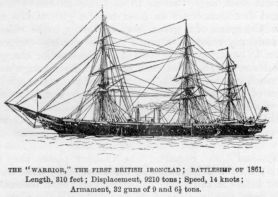
In 1861, the Warrior was produced in answer to the French Gloire. She was a frigate-built vessel doing 14 knots, and carried thirty-two heavy guns, 200 feet only of her length of 310 feet were armoured with iron plates 4 and a half inches thick—which was proof against any guns then existing—as it was thought that her seaworthiness would be impaired if the great weight of the armour were extended to the two ends. But to protect the vessel from raking shot—that is, shots fired at her when bow on, or stern on, to the enemy—armoured partitions, or “bulkheads”, as they are called, were provided.
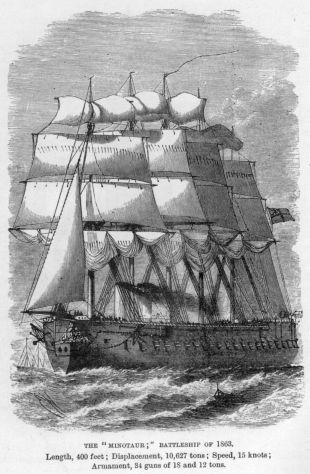
In 1861, ships of the type of the Minotaur were built, armoured from stem to stern. These were considered monster ships at the time, as they had a displacement of, 10,627 tons and were 400 feet in length. Their speed was 14 or 15 knots, attained by engines of 6,700 horse-power. The bow was constructed on the ram principle, projecting some distance under the water, and her sides were covered with iron plates 5 inches thick, tapering off in thickness, however, as they approached the bow. Further, she was divided into many compartments below water, with watertight doors, so that if pierced, either in action or by grounding, she might still be kept afloat. She was fitted with five masts, made partly of iron, while her armament consisted of thirty-four 12-ton and 18-ton guns. Her cost was, 478,000 pounds but she and her sister ships the Agincourt and Northumberland did not come up to their expectations, being found unwieldy on account of their great length, while in a few years it was found that their armour was not thick enough to withstand the more powerful guns that were being manufactured.
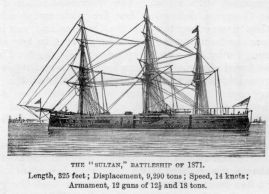
The next type of design was that of the Hercules, the prototype of the “citadel” design. This ship was protected from end to end by much thicker armour than had hitherto been used, but instead of carrying the armour right up to the upper deck, to save weight it was in the form of a narrow belt protecting a few feet above and below the water line only, except amidships, where it was carried up to the upper deck, forming a “citadel,” inside which her ten 18-ton and 12-ton guns were well protected. In this way her guns, waterline, and engines—or “vitals,” as these are known for short—were fully protected at the expense of less vital parts of the ship. Though smaller and less expensive than the Minotaur she was a far more efficient ship. Her broadside was 1818 pounds. The Sultan, another ship of much the same type, had a broadside of 1964 pounds. During the early sixties another type of vessel came to the front. Captain Coles had invented the “turret,” which consisted of a turn-table or revolving platform, round which was a shield of thick armour, turning with it: the top was also closed in. In the shield was a very small port for the gun—which was aimed by revolving the turret till it pointed at the required object. The crew was thus completely protected from the enemy’s fire.
In the American Civil War the Federals or Northerners, had provided two of their wooden frigates with these turrets and sent them to attack the Merrimac, a cut-down wooden frigate which had been armoured and provided with a ram. The Merrimac steamed up to the Congress, delivering her fire with awful effect, and then proceeding towards the Cumberland, ran into her near the bow, ripping an enormous rent in her side, and hung on by her own sharp prow while she fired into the fractured chasm. She then backed out and repeated her tremendous onslaught, suffering little from the fire of her enemy, till the latter went down. She next attacked the Congress with shells, which killed the greater number of the Federal crew, and in half-an-hour the few survivors hauled down their colours.
Later on the Merrimac was attacked by the armoured Monitor. The two ships hammered away at one another for many hours without result; only five men were killed after a five hours action, for the armour beat the gun.
The result of these actions made it clear that turret-ships to be of any use must be armoured, and as a first experiment it was decided to cut-down the Royal Sovereign, a ship of the size of the Duke of Wellington. Her masts and her three upper decks were taken off, her lower-deck alone remaining, so that she was cut-down almost to the water’s edge. Massive plates of iron were fastened to her sides and deck, thus converting her into an ironclad, while four turrets were sunk into the deck in a line fore and aft, three of them containing one huge gun each, firing 300-pound shot, while the fourth and foremost turret contained two guns. The muzzles of the guns were only a little way above the deck, and the bulwarks were hinged so that when the guns were to be fired they could be dropped over the side so as not to be in the way.
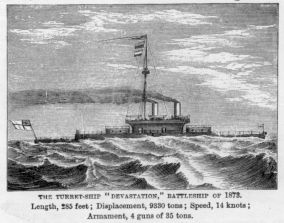
Amidships was a circular armoured box, rather higher than the turrets, called the “conning-tower.” Here the captain took his stand in time of action, communicating with the engines, turrets, and other parts of the ship, by speaking tubes. In more recent ships the vessel is also steered from the conning-tower in time of action. Such was our first converted ironclad turret-ship. She was, however, found to be of little value, drawing too much water to serve for harbour defence, and not being handy enough at sea in manoeuvring.
Turret-ships, as first constructed, were very heavily, armoured, and in consequence rather unseaworthy. Being intended for coast defence only, they always had a harbour available in bad weather, and sails were not required as they were never far from a coal supply.
In 1869, however, Sir Edward Reed designed the first sea-going turret-ships, properly so-called, taking the bold step, as it seemed then, of providing no sails. These were the Devastation and Thunderer, which, despite many faults, proved to be serviceable ships for over thirty years. These were ships of, 9,330 tons, and 14 knots speed, and the annexed picture gives their general appearance. Their hulls were protected by 12-inch armour, and the turrets by 14-inch armour, while an important improvement was introduced by providing what is called a “protective deck,” that is, a horizontal deck, of armour several inches thick, which prevents shot from penetrating to the engines, etcetera, below. Their armament consisted of four 35-ton guns firing 600-pound shot, and as all these guns could fire on either side, their broadside was, 2,400 pounds. Their crews were composed of only 300 men, and though they cost about 150,000 pounds less than the Minotaur they were far more efficient and powerful warships. They lay very low in the water, their bows rising only 9 feet above it, while the stern was even lower, being only 4 and a half feet above the waterline. Amidships, however, the deck was raised some 6 or 8 feet higher.
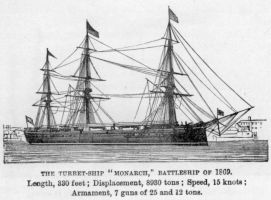
Between the two turrets was a large superstructure, the walls of which curved outwards all over the top. A passage passed through it from side to side, in which were the doors leading to the hatchways and to the hurricane deck above, on which were the conning tower, wheels, etcetera. The boats were also carried on this deck, high above the water, so that there was no obstruction to the firing of the guns in the turrets below.
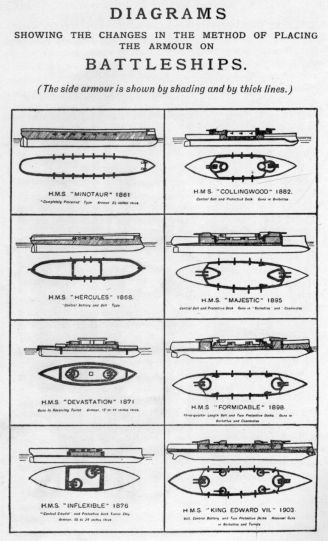
It might have been supposed, that a ship so low in the water could not venture out to sea in rough weather, but, though her forecastle was frequently completely submerged in a heavy sea, she has behaved very well.
Other turret ships, however, had been built a year or two earlier with masts and sails, and bows of ordinary height. At first these ships were over-masted and canvassed, but after one of them, the Captain, capsized during a gale in the Bay of Biscay, this defect was remedied. This class was represented by the Monarch, completed in 1869, a vessel of 8930 tons, and 15 knots speed. She carried seven guns, those in the turrets weighing 25 tons.
The turret-ship reached its highest development in the year 1876, when the Inflexible was designed. By this time, guns had so greatly increased in power, that the thickness of armour required to withstand their shot was very great, and, as this involved an enormous addition to the dead weight that had to be carried, some means had to be devised whereby an efficient protection could be carried. The “central citadel” form of design was that finally adopted, in which the armour was concentrated on a citadel in the centre of the vessel, amply protecting the engines, turrets, and other “vitals” of the ship, the rest of the hull being left wholly unprotected, save for a “protective deck,” about the level of the waterline. This deck being horizontal, would always be struck by shot at a very oblique angle, hence its thickness afforded a much greater amount of protection—about double—than if placed vertically on the sides.
The Inflexible was a ship of 11,800 tons, and was driven at a speed of nearly 13 knots, by engines of 6,500 horse-power. The turrets were arranged one on each side of the ship, and thus enabled to fire both ahead and astern or on the broadside. These turrets were protected by armour 18 inches thick, and each carried two 80-ton guns, firing a 1700-pound shot to a distance of eight miles. These monster muzzle-loading guns were loaded from outside the turret, by means of hydraulic machinery. The armour on the sides was 2 feet thick, and the vessel was divided into 135 compartments, so that she would not be readily sunk. The Inflexible was the last of the turret-ships properly so-called. She was not the success that had been hoped; her engine power, which gave only 12 and a half knots, had been sacrificed to obtain heavier armament and protection, and as she was slower than much older ships, she was laid aside before vessels launched earlier than she was. About this time, the combination of several important factors worked a revolution in warship design. The Russo-Turkish war of 1878-79, taught that a torpedo was a more important element in naval warfare than had been imagined. Launches going at the rate of 18 or 20 miles an hour, covered a mile in about three minutes, and if they attacked at night, were so small, quick-moving, and indistinguishable, that they could attack the most powerful battleship with little risk of being hit by the snap shots of the few slow-firing heavy guns, with which modern ships were armed.
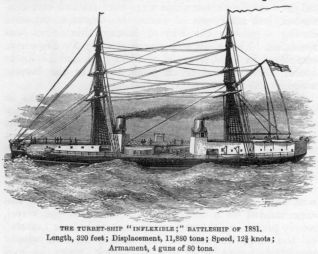
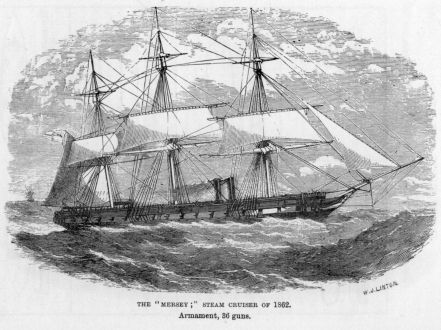
The machine gun was first introduced to meet this danger; it could send a continuous shower of rifle bullets at the approaching boat, and riddle and sink her before she got near enough to do mischief; but when torpedo boats began to be armoured with iron plates, proof not only against rifle bullets, but even against the heavier Hotchkiss and Nordenfeldt half-pounder guns, except at very close ranges, it was seen that an armament of small guns was desirable to repel torpedo boats, or to be used against unarmoured cruisers, whose superior speed would soon take them out of danger from the slow-firing heavy guns. Another factor was the introduction of longer guns, and what are termed “slow burning” powders. These last do not explode with such sudden violence as the ordinary powder, so that there is less sudden strain on the gun, while a steadier pressure on the shot is kept up. The long gun enables the pressure of the gases formed by the burning powder to act longer on the shot, with the result that a higher velocity is given to it, not only increasing its range, but also its penetrative power.
The result of these improvements was to some extent a repetition of what had taken place when rifled guns were first introduced. Guns could be made lighter, and yet be much more powerful than the old patterns of the same bore, and it was seen that a ship could with advantage be provided with a “secondary” armament, as it is called of these smaller yet powerful guns. Armour, too, was being improved, so that it could be made thinner and yet equally effective; higher speeds were also called for, and it was evident that warships must be designed on different lines to meet or take advantage of the new conditions.
The first ship designed on the new lines was the Collingwood, a vessel of 9,500 tons, 16 and a half knots speed, and 7,000 horse-power. She was the first ship of what was called the “Admiral class,”—several sister ships named after famous admirals. The four heavy guns of the Devastation type of turret-ship were retained, mounted fore and aft, but instead of placing them in turrets, the turret armour was fixed to the deck, forming what is known as a “barbette,” or breastwork, over the upper edge of which the gun fired. Inside the barbette the gun revolved on its turn-table; its breech, together with the gunners, was protected by a hood of armour which revolved with the gun. This arrangement is probably less liable to be knocked out of action by the enemy’s shot than the turret.
Amidships was the “secondary” armament of six 6-inch breech-loading guns. All the guns were mounted well above the water, enabling them to be used even in a heavy sea, which could not be done in the case of ships lying low in the water like the Devastation.
A further impetus was given to the development of the secondary armament by the introduction of “smokeless” powder—which, however, gives a very slight smoke,—and the “quick-firing gun.” By simplifying the breech mechanism, using metal cartridge cases for the ammunition instead of silk bags—which necessitated the sponging out of the piece after each shot to remove the smouldering fragments—arranging the “sights” of the gun so that it could be aimed while loading was going on, and other ingenious arrangements, it was found that 6-inch 100-pounder guns could be fired many times per minute without any mechanical appliances. About the same time also, means were found of firing with safety what are called “high explosives,” that is, explosives of far greater destructive power than the same weight of gunpowder. Similar improvements were naturally extended to the larger guns, and thus there has been a reversion to the type of ships mounting a fair number of guns, the lighter ones, firing shells of 100 pounds, being intended to wreck the unarmoured portions of the enemy, and demoralise his crew; the heavier ones, 200-pounders, 380-pounders, and 850-pounders, being adapted to pierce the armour and destroy the guns or the machinery. Some idea of the terrible power of modern quick-fire guns may be obtained when it is mentioned that a modern ship, armed with one 6-inch 100-pounder gun could fire—and hit every time too, at three-quarters-of-a-mile range—a greater weight of metal per minute than could be kept up by the 52 guns on the broadside of Nelson’s Victory, or even by the broadside of the more modern Britannia.
Such are the types of the principal battleships constructed up to nearly the end of the nineteenth century, and we may now glance at the cruisers.
The frigate of the olden days, used for scouting and cruising, was the favourite ship in the great wars, as they bore off the greatest proportion of prize-money, and afforded their commanders greater opportunities of gaining promotion and distinction. As already mentioned, the French built faster and finer craft of this description than we did, and Nelson was always complaining that we had not a sufficient number of swift frigates to keep down whose of the enemy.
The frigates had from 28 to 50 guns, and did not vary much in general design, although the Americans taught us to build them of larger size and of thicker planking. When steam was introduced, engines were fitted to these cruisers, and they were given a few knots superior speed to the line-of-battle-ships. To enable them to keep the sea for long periods without their bottoms becoming fouled by marine growths—which decrease the speed—their iron hulls were sheathed wood, which in its turn was covered by copper. Ships of this type were not armoured. The Shah, which fought the Huascar in 1877, was a ship of this description; she carried 26 heavy guns, and had a speed of 16 knots.
Other vessels were specially designed as rams. The sinking of the powerful battleships Vanguard, in the Irish sea, and Victoria, in the Mediterranean, after accidental collision with the ram of another ship in the squadron, shows the terrible effect of this weapon when it can strike home. But torpedoes render it highly improbable that the opportunity of using it will ever arise. Modern naval battles will probably be fought and decided, at the minimum range of 2 miles, or thereby.
Chapter Twenty One.
Modern Engines of War.
For many centuries after the invention of gunpowder, little change took place in the weapons used in naval warfare, the chief developments being in the way of better workmanship and material, and the production of guns of larger size.
About the end of the eighteenth century, however, the period from which so many of our modern improvements begin to date, inventors began to plan new and improved methods of disposing of the enemy. About the year 1770, the American Bushnell conceived the idea of what his fellow-countryman Fulton afterwards called the “torpedo.” This weapon consisted of a case of powder which was to be attached to the bottom of the enemy’s ship by the aid of a submarine boat, leaving it to explode later on by means of a clock inside.
The submarine boat was actually made in 1775; it was egg-shaped in form, and held one man. It was propelled through the water by means of a screw propeller, worked by manual power; a similar screw, arranged vertically, enabled the boat to rise or sink at will. With this boat, during the War of Independence, he, or some other operator, succeeded in getting under a British man-of-war lying at anchor near New York. Without her crew having the slightest suspicion of his presence, he attempted to screw his torpedo to her bottom, but his auger encountered what appeared to be a bar of iron. When shifting to another position he lost the ship altogether, and being unable to find her again was forced to cast off the torpedo and make away, as the clock-work inside had been arranged to explode soon afterwards. And about an hour later the crew of the warship were first roused to their danger by the explosion of the torpedo at no great distance from them, and they were the more alarmed as they were wholly unable to account for it.
In the beginning of the nineteenth century another American, named Fulton, having borrowed Bushnell’s ideas, came over to Europe and endeavoured to get the French government to take up his plans for submarine warfare. After long delay he was at length given the sum of 10,000 francs, with which he successfully constructed a submarine boat. In this boat he remained under water for more than four hours, and having been required to blow up a small vessel had no difficulty in getting under her and in blowing her to pieces with his torpedo. The torpedo in a highly developed form is now one of the most important weapons in naval tactics.
In spite of the success of Fulton’s experiments, his plans were not adopted, either by Napoleon or by the British Admiralty, to whom Fulton afterwards offered them. The great European wars having been brought to an end by the downfall of Napoleon, the torpedo for a while sunk into oblivion, although during the Crimean war the Russians used submarine mines to protect their harbours. But during the American Civil War the torpedo was again brought to the front, and the Southerners, or “Confederates,” used vast numbers of them, to the great damage of the Northerners, or “Federals.”