"How Britannia Came to Rule the Waves" (continued 4)
Reading edition
Again, he speaks of many rogueries practised. Among others, on the 4th of June he went “by water to Woolwich, and there saw an experiment made of Sir R. Ford’s Holland’s yarne (about which we have lately had so much stir, and I have much concerned myself for our ropemaker, Mr Hughes, who represented it so bad), and we found it to be very bad, and broke sooner than upon a fair trial, five threads of that against four of Riga yarne; and also that some of it had old stuffe that had been tarred, covered over with new hempe, which is such a cheat as hath not been heard of.”
The war with the Dutch had not yet commenced, but there was every probability of it soon breaking out, though the English fleet was at that time in a sadly unprepared state. On the 28th of June, 1662, he says: “Great talk there is of a fear of a war with the Dutch, and we have orders to pitch upon 20 ships to be forthwith set out; but I hope it is but a scarecrow to the world to let them see that we can be ready for them; though God knows, the king is not able to set out five ships at this present without great difficulty, we neither having money, credit, nor stores.”
With regard to the stores, he says, on the 21st of July: “To Woolwich to the rope-yard, and there looked over several sorts of hemp, and did fall upon my great survey of seeing the working and experiments of the strength and the charge in the dressing of every sort; and I do think have brought it to so great a certainty, as I have done the king some service in it, and do purpose to get it ready against the duke’s coming to towne to present to him. I see it is impossible for the king to have things done as cheap as other men.”
On the 4th of September he remarks, notwithstanding all their shortcomings, that the fleet was in a far better condition than in the days of Queen Elizabeth. “Sir William Compton I heard talk with great pleasure of the difference between the fleet now and in Queen Elizabeth’s days; where, in 1588, she had but 36 sail great and small in the world, and ten rounds of powder was their allowance at that time against the Spaniards.”
He speaks of yachts as pleasure vessels, a name derived from the Dutch, one of which class of vessels so-called had been presented by them to the late king. “By water to Woolwich; in my way saw the yacht lately built by our virtuosos (my Lord Brunkard and others, with the help of Commissioner Pett also), set out from Greenwich with the little Dutch bezan to try for mastery; and before they got to Woolwich the Dutch beat them half-a-mile (and I hear this afternoon that, in coming home, it got above three miles), which all our people are glad of.”
On the 18th of February, 1663, he says that he finds “the true charge of the navy” to be “after the rate of 374,743 pounds a-year.”
On the 14th of April Sir George Carteret tells him that Parliament “will call all things in question; and, above all, the expenses of the navy;” “and into the truth of the report of people being forced to sell their bills at 15 per cent, losse in the navy.”
On the 23rd of May Sir George says that Parliament intend to report 200,000 pounds per annum as the ordinary charge of the navy.
The importance of having wet-docks in which ships could be fitted out was well understood. He speaks of finding certain creeks at Portsmouth, and mentions Commissioner Pett’s design to form a wet-dock in Saint Mary’s creek, “which can be done at no great charge, and yet no little one; he thinks, towards 10,000 pounds;” and that the place is likely to be a very fit one when the king has money to do it with.
He mentions a letter of Sir William Petty, “wherein he says that his vessel, which he hath built upon two keels (a model whereof, built for the king, he shewed me), hath this month won a wager of 50 pounds, in sailing between Dublin and Holyhead, with the pacquett-boat, the best ship or vessel the king hath there; and he offers to lay with any vessel in the world. It is about 30 ton in burden, and carries 30 men, with good accommodation (as much more as any ship of her burden), and so any vessel of this figure shall carry more men, with better accommodation by half, than any other ship. This carries also ten guns of about five tons weight. In their coming back from Holyhead they started together, and this vessel came to Dublin by five at night, and the pacquett-boat not before eight the next morning; and when they come they did believe that this vessel had been drowned, or at least behind, not thinking she could have lived in that sea.” He concludes, “I only affirm that the perfection of sailing lies in my principle, find it out who can.”
By his account we find that machines to perform the same service as torpedoes were thought of in those days. He tells “Dr Allen,” with whom he had “some good discourse about physick and chymistry, what Dribble, the German Doctor, do offer of an instrument to sink ships he tells me that which is more strange, that something made of gold, which they call in chymistry aurum fulminans, a grain, I think he said, of it, put into a silver spoon and fired, will give a blow like a musquett, and strike a hole through the silver spoon downward, without the least force upward.”
He gives an amusing account of a trial about the insurance of a ship, before Lord Chief-Justice Hide. “It was pleasant to see what mad sort of testimonys the seamen did give, and could not be got to speak in order; and then their terms such as the judge could not understand; and to hear how sillily the counsel and judge would speak as to the terms necessary in the matter, would make one laugh; and, above all, a Frenchman, that was forced to speak in French, and took an English oath he did not understand, and had an interpreter sworn to tell us what he said, which was the best testimony of all.”
On the 3rd of December, 1663, he gives us the satisfactory intelligence “that the navy (excepting what is due to the yards upon the quarter now going on) is quite out of debt; which is extraordinary good news, and upon the ’Change, to hear how our credit goes as good as any merchant’s upon the ’Change is a joyfull thing to consider, which God continue!”
The next day he remarks, “The King of France, they say, is hiring of 60 sail of ships of the Dutch, but it is not said for what design.”
On the 22nd of January he went down to Deptford, “and there viewed Sir William Petty’s vessel; which hath an odd appearance, but not such as people do make of it.”
On the 4th of March he “saw several people trying a new-fashion gun, brought by my Lord Peterborough this morning, to shoot off often, one after another, without trouble or danger.” This must have been something of the fashion of a revolver of the present day.
One of the first entries regarding the Dutch war is on the 21st of November, 1644. “This day, for certain, news is come that Teddiman hath brought in eighteen or twenty Dutchmen, merchants, their Bourdeaux fleet, and two men-of-war to Portsmouth. And I had letters this afternoon, that three are brought into the Downes and Dover; so that the warr is begun: God give a good end to it!”
On the 31st of December he says: “My Lord Sandwich at sea with the fleet at Portsmouth, sending some about to cruise for taking of ships, which we have done to a great number.”
On the 11th of January, 1665: “This evening, by a letter from Plymouth, I hear that two of our ships, the Leopard and another, in the Straights, are lost by running aground; and that three more had like to have been so, but got off, whereof Captain Allen one; and that a Dutch fleet are gone thither; and if they should meet with our lame ships, God knows what would become of them. This I reckon most sad news; God make us sensible of it!”
The following remarks show the threatening attitude of the Dutch: on the 12th of January, 1665, “Spoke with a Frenchman, who was taken, but released, by a Dutch man-of-war, of 36 guns (with seven more of the king’s or greater ships), off the North Foreland, by Margett. Which is a strange attempt, that they should come to our teeth; but, the wind being easterly, the wind that should bring our force from Portsmouth, will carry them away home.”
On the 15th he was called in, with Sir William Penn, to see the king, “And there Sir W. Penn spoke pretty well to dissuade the king from letting the Turkish ships go out; saying (in short), the king having resolved to have 130 ships out by the spring, he must have above 20 of them merchantmen. Towards which, he, in the whole river, could find but 12 or 14, and of them the five ships taken up by these merchants were a part, and so could not be spared. That we should need 30,000 sailors to man these 130 ships, and of them, in service, we have not above 16,000; so that we shall need 14,000 more. That these ships will, with their convoys, carry about 2000 men, and those the best men that could be got; it being the men used to the southward that are the best men of warr, though those bred in the north, among the colliers, are good for labour. That it will not be safe for the merchants, nor honourable for the king, to expose these rich ships with his convoy of six ships to go, it not being enough to secure them against the Dutch, who, without doubt, will have a great fleet in the Straights.”
At a visit of the Duke of York, he hears, by a letter from Captain Allen, “First, of our own loss of two ships, the Phoenix and Nonsuch, in the Bay of Gibraltar; then of his and his seven ships with him, in the Bay of Cales, or thereabouts, fighting with the 34 Dutch Smyrna fleet; sinking the King Solomon, a ship worth 150,000 pounds, or more, some say 200,000 pounds, and another; and taking of three merchant-ships. Two of our ships were disabled by the Dutch unfortunately falling, against their will, against them—the Advice, Captain W. Poole, and Antelope, Captain Clerke. The Dutch men-of-war did little service. Captain Allen, before he would fire one gun, come within pistol-shot of the enemy. The Spaniards, at Cales, did stand laughing at the Dutch, to see them run away and flee to the shore, 34 or thereabouts, against eight Englishmen at most.”
“Captain Allen led the way, and himself writes that all the masters of the fleet, old and young, were mistaken, and did carry their ships aground.”
“Captain Seale, of the Milford, hath done his part very well, in boarding the King Solomon, which held out half-an-hour after she was boarded; and his men kept her an hour after they did master her, and then she sank, and drowned about 17 of her men.”
He speaks, a few days afterwards, of meeting the owners of the double-bottomed boat the Experiment, which again reminds us of the plan, at present adopted, to guard ships against the effects of torpedoes.
On the 17th of April he heard an account of the capture of three privateers, one of which was commanded by Admiral Everson’s son. Captain Golding, of the Diamond, was killed in the action. “Two of them, one of 32, and the other of 20 odd guns, did stand stoutly up against her, which hath 46, and the Yarmouth that hath 52, and as many more men as they. So that they did more than we could expect, not yielding till many of their men were killed. And Everson, when he was brought before the Duke of York, and was observed to be shot through the hat, answered, that he wished it had gone through his head, rather than been taken. One thing more is written; that two of our ships, the other day, appearing upon the coast of Holland, they presently fired their beacons round the country to give them notice. And news is brought the king, that the Dutch Smyrna fleet is seen upon the back of Scotland; and, thereupon, the king hath wrote to the duke, that he do appoint a fleet to go to the northward to try to meet them coming home round; which God send!”
On the 28th he went down the river to visit the victualling ships, “where I find all out of order.”
On the 8th of June he writes: “Victory over the Dutch, June 3, 1665. This day they engaged, the Dutch neglecting greatly the opportunity of the wind they had of us, by which they lost the benefit of their fire-ships. The Earl of Falmouth, Muskerry, and Mr Richard Boyle killed on board the duke’s ship, the Royall Charles, with one shot, their blood and brains flying in the duke’s face, and the head of Mr Boyle striking down the duke, as some say. The Earle of Marlborough, Portland, Rear-Admirall Sansum killed, and Capt. Kerby and Ableson. Sir John Lawson wounded, hath had some bones taken out, and is likely to be well again. Upon receiving the hurt, he sent to the duke for another to command the Royal Oake. The duke sent Jordan out of the Saint George, who did brave things in her. Capt. Jer. Smith, of the Mary, was second to the duke, and stepped between him and Captain Seaton, of the Urania (76 guns and 400 men), who had sworn to board the duke, killed him 200 men, and took the ship himself, losing 99 men, and never an officer saved but himself and lieutenant. His master, indeed, is saved, with his leg cut off; Admiral Opdam blown up, Trump killed, and said by Holmes; all the rest of their admiralls, as they say, but Everson (whom they dare not trust for his affection to the Prince of Orange), are killed, we having taken and sunk, as is believed, about 24 of their best ships, killed and taken 8 or 10,000 men, and lost, we think, not above 700. A greater victory never known in the world. They are all fled. Some 43 got into the Texell, and others elsewhere, and we in pursuit of the rest.”
On the 16th he goes down to Whitehall, and hears more about the battle. “Among other things, how my Lord Sandwich, both in his councils and personal service, hath done most honourably and serviceably. Jonas Poole, in the Vanguard, did basely, so as to be, or will be, turned out of his ship. Captain Holmes expecting upon Sansum’s death to be made rear-admirall to the prince (but Harman is put in), hath delivered up to the duke his commission, which the duke took and tore. Several of our captains have done ill. The great ships are the ships to do the business, they quite deadening the enemy. They run away upon sight of the prince. Captain Smith, of the Mary, the duke talks mightily of, and some great thing will be done for him. Strange to hear how the Dutch do relate, as the duke says, that they are the conquerors, and bonfires are made in Dunkirke in their behalf, although a clearer victory can never be expected. Mr Coventry thinks they cannot have lost less than 6000 men, and we not dead above 200, and wounded about 400; in all about 600. Captain Grove, the duke told us this day, hath done the basest thing at Lowestoffe, in hearing of the guns, and could not (as others) be got out, but staid there, for which he will be tried, and is reckoned a prating coxcombe, and of no courage.”
The fleet did not escape the plague, which was at that time raging in London. On the 12th of August it appeared at Deptford, on board the Providence fire-ship, which was just fitting out to go to sea.
At Sheerness, a yard was in course of being laid out to lay provisions for cleaning and repairing of ships, the most proper place for the purpose.
On the 19th the fleet came home, “to our great grief, with not above five weeks dry and six weeks wet provisions, however, must go out again, and the duke hath ordered the Soveraigne, and all other ships ready, to go out to the fleet and strengthen them. This news troubles us all, but cannot be helped.”
On the 9th of September, 1665, he meets Sir William Doyly and Evelyn at supper: “And I with them full of discourse of the neglect of our masters, the great officers of state, about all business, and especially that of money, having now some thousands prisoners kept to no purpose, at a great charge, and no money provided almost for the doing of it.”
“Captain Cocke reports as a certain truth that all the Dutch fleet, men-of-war and merchant East India ships, are got every one in from Bergen, the 3rd of this month, Sunday last, which will make us all ridiculous.”
On the 14th, however, he says: “A letter from my Lord Sandwich at Solebay, of the fleet’s meeting with about eighteen more of the Dutch fleet, and his taking of most of them; and the messenger says, that they had taken three after the letter was wrote and sealed, which being twenty-one, and the fourteen took the other day, is forty-five sail, some of which are good and others rich ships.”
On the 18th he goes to Gravesend in the bezan yacht, and “by break of day we come to within sight of the fleet, which was a very fine thing to behold, being above 100 ships, great and small, with the flag-ships of each squadron distinguished by their several flags on their main, fore, or mizen-masts. Among others, the Soveraigne, Charles, and Prince, in the last of which my Lord Sandwich was. And so we come on board, and we find my Lord Sandwich newly up in his night-gown very well.”
He attends a council of war on board, “When comes Sir W. Penn, Sir Christopher Mingo, Sir Edward Spragg, Sir Jos. Jordan, Sir Thomas Teddiman, and Sir Roger Omittance.” Sir Christopher Mings was one of the bravest admirals of the day. He was the son of a shoemaker, and had worked his way up in the sea-service. He was killed the following year, June, 1666, in action with the Dutch. Pepys describes him as “a very witty, well-spoken fellow, and mighty free to tell his parentage, being a shoemaker’s son.”
On the 25th of January, 1666, he writes: “It is now certain that the King of France hath publickly declared war against us, and God knows how little fit we are for it.”
As an example of the way affairs were managed, he tells us that, viewing the yard at Chatham, he observed, “among other things, a team of four horses coming close by us, drawing a piece of timber that I am confident one man could easily have carried upon his back. I made the horses be taken away, and a man or two to take the timber away with their hands.”
Still more abominable was the way in which the wages of the unfortunate seamen were kept back. On the 7th of October, 1665, he writes: “Did business, though not much, at the office, because of the horrible crowd and lamentable moan of the poor seamen that lie starving in the streets for lack of money, which do trouble and perplex me to the heart; and more at noon, when we were to go through them, for then above a whole hundred of them followed us, some cursing, some swearing, and some praying to us.” He continues: “Want of money in the navy puts everything out of order; men grown mutinous, and nobody here to mind the business of the navy but myself.”
On the 19th of May, 1666: “Mr Deane and I did discourse about his ship Rupert, built by him, which succeeds so well as he hath got great honour by it, and I some by recommending him—the king, duke, and everybody saying it is the best ship that ever was built. And, then, he fell to explain to me his manner of casting the draught of water which a ship will draw beforehand, which is a secret the king and all admire in him; and he is the first that hath come to any certainty beforehand of foretelling the draught of water of a ship before she be launched.”
On the 4th he describes the fight between the English and Dutch, the news brought by a Mr Daniel, “who was all muffled up, and his face as black as the chimney, and covered with dirt, pitch, and tar, and powder, and muffled with dirty clouts, and his right eye stopped with okum.” The English “found the Dutch fleet at anchor, between Dunkirke and Ostend, and made them let slip their anchors; they about ninety and we less than sixty. We fought them and put them to the run, till they met with about sixteen sail of fresh ships, and so bore up again. The fight continued till night, and then again the next morning from five till seven at night. And so, too, yesterday morning they began again, and continued till about four o’clock, they chasing us for the most part of Saturday, and yesterday we flying from them.” Prince Rupert’s fleet, however, was seen coming, “upon which De Ruyter called a council, and thereupon their fleet divided into two squadrons—forty in one, and about thirty in the other; the bigger to follow the duke, the less to meet the prince. But the prince come up with the generall’s fleet, and the Dutch come together again, and bore towards their own coast, and we with them. The duke was forced to come to anchor on Friday, having lost his sails and rigging.”
Some days afterwards he continues the description of the fight: “The commanders, officers, and even the common seamen do condemn every part of the late conduct of the Duke of Albemarle; running among them in his retreat, and running the ships on ground; so as nothing can be worse spoken of. That Holmes, Spragg, and Smith do all the business, and the old and wiser commanders nothing.”
“We lost more after the prince came than before. The Prince was so maimed, as to be forced to be towed home.” Among several commanders killed in the action was Sir Christopher Mings.
He describes the affection the seamen entertained for those commanders they esteemed: “About a dozen able, lusty, proper men come to the coach-side with tears in their eyes, and one of them that spoke for the rest begun and said to Sir W. Coventry, ‘We are here a dozen of us, that have long known and loved and served our dead commander, Sir Christopher Mings, and have now done the last office of laying him in the ground. We would be glad we had any other to offer after him, and in revenge of him. All we have is our lives; if you will please to get His Royal Highness to give us a fire-ship among us all, here are a dozen of us, out of all which choose you one of us to be commander, and the rest of us, whoever he is, will serve him; and, if possible, do that which shall show our memory of our dead commander, and our revenge.’ Sir W. Coventry was herewith much moved, as well as I, who could hardly abstain from weeping.”
“Sir Christopher Mings was a very stout man, and a man of great parts, and most excellent tongue among ordinary men; and would have been a most useful man at such a time as this.”
He gives a deplorable account of the state of the navy, the neglect of business by Charles and his brother, and the want of money. On the 8th of October, 1665, he writes: “I think of twenty-two ships, we shall make shift to get out seven. (God help us! men being sick, or provisions lacking.) There is nothing but discontent among the officers, and all the old experienced men are slighted.”
Speaking of the action with the Dutch, he says: “They do mightily insult of their victory, and they have great reason. Sir William Barkeley was killed before his ship taken; and there he lies dead in a sugar-chest, for everybody to see, with his flag standing up by him. And Sir George Ascue is carried up and down the Hague for people to see.”
The abominable system of the press-gang was then in full force, and was carried on with the same cruelty which existed till a much later period: “To the Tower several times, about the business of the pressed men, and late at it till twelve at night shipping of them. But, Lord! how some poor women did cry; and in my life I never did see such natural expression of passion as I did here in some women bewailing themselves, and running to every parcel of men that were brought one after another to look for their husbands, and wept over every vessel that went off, thinking they might be there, and looking after the ship as far as ever they could by moone-light, that it grieved me to the heart to hear them. Besides, to see poor, patient, labouring men and housekeepers leaving poor wives and families, taken up on a sudden by strangers, was very hard, and that without press-money, but forced against all law to be gone. It is a great tyranny.”
The next morning he went “to Bridewell to see the pressed men, where there are about 300; but so unruly that I durst not go among them; and they have reason to be so, having been kept these three days prisoners, with little or no victuals, and pressed out and contrary to all course of law, without press-money, and men that are not liable to it.”
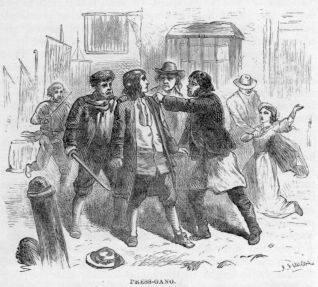
“I found one of the vessels loaden with the Bridewell birds in a great mutiny; I think it is much if they do not run the vessel on ground.”
He continues: “With regard to the building of ten great ships, none to be under third-rates; but it is impossible to do it, unless we have some money.”
Sir W. Penn gives his advice as to the mode of fighting at sea: “We must fight in a line, whereas we fight promiscuously, to our utter and demonstrable ruin; the Dutch fighting otherwise; and we, whenever we beat them. 2. We must not desert ships of our own in distress, as we did, for that makes a captain desperate, and he will fling away his ship when there are no hopes left him of succour. 3rd. That ships when they are a little shattered must not take the liberty to come in of themselves, but refit themselves the best they can, and stay out—many of our ships coming in with very small disableness. He told me that our very commanders, nay, our very flag-officers, do stand in need of exercising among themselves, and discoursing the business of commanding a fleet; he telling me that even one of our flagmen in the fleet did not know which tack lost the wind or kept it in the last engagement. Then in the business of forecastles, which he did oppose, all the world sees now the use of them for shelter of men.”
He observes that “we see many women now-a-days in the streets, but no men; men being so afraid of the press.” He speaks of purchasing “four or five tons of corke, to send this day to the fleet, being a new device to make barricados with, instead of junke.” The importance of protecting men against shot was even then, it will be seen, thought of.
On the 10th he goes “to the office; the yard being very full of women coming to get money for their husbands and friends that are prisoners in Holland; and they lay clamouring and swearing and cursing us, that my wife and I were afraid to send a venison-pasty that we have for supper to-night, to the cook’s to be baked.”
On the 23rd July Sir W. Coventry talks to him of the “Loyal London (which, by the way, he commends to be the best ship in the world, large and small) hath above eight hundred men. The first guns made for her all bursted, but others were made, which answered better.”
Speaking of the late battle, he remarks that “the Resolution had all brass guns, being the same that Sir John Lawson had in her in the Straights. It is to be observed that the two fleets were even in number to one ship.”
Sir W. Coventry “spoke slightingly of the Duke of Albemarle, saying, when De Ruyter come to give him a broadside—‘Now,’ says he (chewing of tobacco the while), ‘will this fellow come and give me two broadsides, and then he shall run;’ but it seems he held him to it two hours, till the duke himself was forced to retreat to refit, and was towed off, and De Ruyter staid for him till he come back again to fight. One in the ship saying to the duke, ‘Sir, methinks De Ruyter hath given us more than two broadsides.’ ‘Well,’ says the duke, ‘but you shall find him run by-and-by,’ and so he did, but after the duke himself had been first made to fall of.”
From the accounts he gives of the condition of the navy, it is surprising that our ships were not everywhere beaten. On the 20th of October he writes: “Commissioner Middleton says that the fleet was in such a condition as to discipline, as if the devil had commanded it; so much wickedness of all sorts. Enquiring how it came to pass that so many ships had miscarried this year, he tells me that the pilots do say that they dare not do nor go but as the captains will have them; and if they offer to do otherwise, the captains swear they will run them through. That he heard Captain Digby (my Lord of Bristoll’s son, a young fellow that never was but one year, if that, in the fleet) say that he did hope he should not see a tarpawlin have the command of a ship within this twelve months”—tarpaulin being the common name applied to a sailor in those days.
On the 19th: “Nothing but distraction and confusion in the affairs of the navy.”
On the 28th he adds: “Captain Guy to dine with me. He cries out of the discipline of the fleet, and confesses really that the true English valour we talk of is almost spent and worn out; few of the commanders doing what they should do, and he much fears we shall therefore be beaten the next year. He assures me we were beaten home the last June fight, and that the whole fleet was ashamed to hear of our bonfires. The Revenge having her forecastle blown up with powder to the killing of some men in the river, and the Dyamond being overset in the careening at Sheerness, are further marks of the method all the king’s work is now done in. The Foresight also and another come to disasters in the same place this week in the cleaning.”
On the 2nd of November he describes the Ruby, French prize, “the only ship of war we have taken from any of our enemies this year. It seems a very good ship, but with galleries quite round the sterne to walk in as a balcone, which will be taken down.”
News of the Dutch having been seen off the mouth of the Thames alarms every one; and on the 24th of March, 1667, he writes: “By-and-by to the Duke of Yorke, where we all met, and there was the king also; and all our discourse was about fortifying of the Medway and Harwich; and here they advised with Sir Godfrey Lloyd and Sir Bernard de Gunn, the two great engineers, and had the plates drawn before them; and indeed all their care they now take is to fortify themselves, and are not ashamed of it.”
On the 9th of June he writes: “I find an order come for the getting some fire-ships presently to annoy the Dutch, who are in the king’s channel, and expected up higher.”
The next day: “News brought us that the Dutch are come up as high as the Nore; and more pressing orders for fire-ships. We all went down to Deptford, and pitched upon ships and set men at work, but, Lord! to see how backwardly things move at this pinch, notwithstanding that by the enemy being now come up as high as almost the Hope.”
Anxiety and terror prevailed in the city, and people were removing their goods—the thoughtful Mr Pepys making a girdle to carry 300 pounds in gold about his body. The alarm is further increased when a neighbour comes up from Chatham, and tells him that that afternoon he “saw the Royal James, the Oake, and London burnt by the enemy with their fire-ships; that two or three men-of-war come up with them, and made no more of Upnor Castle’s shooting than of a fly; that the Dutch are fitting out the Royal Charles.”
Ships were to be sunk in the river, about Woolwich, to prevent the Dutch coming up higher.
“The masters of the ships that are lately taken up, do keep from their ships all their stores, or as much as they can, so that we cannot despatch them, having not time to appraise them, nor secure their payment. Only some little money we have, which we are fain to pay the men we have with every night, or they will not work. And, indeed, the hearts as well as the affections of the seamen are turned away; and in the open streets in Wapping, and up and down, the wives have cried publickly, ‘This comes of not paying our husbands; and now your work is undone, or done by hands that understand it not.’”
Some of the men, “instead of being at work at Deptford, where they were intended, do come to the office this morning to demand the payment of their tickets; for otherwise they would, they said, do no more work; and are, as I understand from everybody that has to do with them, the most debauched, swearing rogues that ever were in the navy, just like their prophane commander.”
“Nothing but carelessness lost the Royal Charles, for they might have saved her the very tide that the Dutch came up. The Dutch did take her with a boat of nine men, who found not a man on board her; and presently a man went up and struck her flag, and jacke, and a trumpeter sounded upon her, ‘Joan’s placket is torn;’ they did carry her down at a time, both for tides and wind, when the best pilot in Chatham would not have undertaken it, they heeling her on one side to make her draw little water, and so carried her away safe.”
“It is a sad sight to see so many good ships there sunk in the river, while we would be thought to be masters of the sea.”
He also examines the chain which had been carried across the river, “and caused the link to be measured, and it was six inches and one-fourth in circumference.”
He commends the Dutch “for the care they do take to encourage their men to provide great stores of boats to save them; while we have not credit to find one boat for a ship.” The English mode “of preparing of fire-ships,” he observes, “do not do the work, for the fire not being strong and quick enough to flame up, so as to take the rigging and sails, lies smothering a great while, half-an-hour before it flames, in which time they can get the fire-ships off safely. But what a shame it is to consider how two of our ship’s companies did desert their ships. And one more company did set their ship on fire and leave her; which afterwards a Feversham fisherman came up to, and put out the fire, and carried safe into Feversham, where she now is. It was only want of courage, and a general dismay and abjectness of spirit upon all our men; God Almighty’s curse upon all that we have in hand, for never such an opportunity was of destroying so many good ships of theirs as we now had.”
To replace the Royal Charles carried away, a new ship was launched on the 4th of March, 1668, called the Charles; “God send her better luck than the former.”
At a Privy Council which he attended, “to discourse about the fitness of entering of men presently for the manning of the fleet, before one ship is in condition to receive them,” the king observed, “‘If ever you intend to man the fleet without being cheated by the captains and pursers, you may go to bed and resolve never to have it manned.’”
At another council he speaks of “a proposition made to the Duke of York by Captain Von Hemskirke, for 20,000 pounds to discover an art how to make a ship go two feet for one what any ship do now, which the king inclines to try, it costing him nothing to try; and it is referred to us to contract with the man.” He afterwards says that the secret was only to make her sail a third faster than any other ship.
On the 25th of March, 1669, a court-martial was held about the loss of the Defyance. The sentence was, “That the gunner of the Defyance should stand upon the Charles three hours with his fault writ upon his breast, and with a halter about his neck, and so be made incapable of any service.” The ship was burnt by the gunner allowing a girl to carry a fire into his cabin.
Whatever our shortcomings in regard to naval affairs, it is pleasant to believe that they cannot possibly be so great as in the days of Mr Samuel Pepys.
Chapter Eleven.
William and Mary—from A.D. 1689 to A.D. 1702.
One of the last acts of James was to send a fleet under the command of Lord Dartmouth to intercept that of William of Orange, which it was known was on the point of sailing. On board the Dutch fleet was Admiral Herbert, acting as commander-in-chief, though all the officers were Dutch. It was hoped that he would win over the English fleet. As it proved, both the officers and men of the navy were as ill-affected to James as were those of the army. Thus, as an old writer observes, “that naval force which James had cultivated with so much care, and on which he depended so much, proved of no use—so difficult a thing is it to bring Englishmen to enslave England.”
The Dutch fleet consisted of about 50 men-of-war, 25 fire-ships, and near 400 transports and victuallers and other vessels, carrying about 4000 horse and 10,000 foot. Admiral Herbert led the van of the fleet, Vice-Admiral Evertzen brought up the rear, and the prince himself was in the centre, carrying a flag with English colours, and their highnesses’ arms surrounded with this motto, “The Protestant Religion and the Liberties of England,” and underneath the motto of the House of Nassau, “Je Maintiendrai,” “I will maintain.”
After being driven back by a storm, the fleet came to an anchor in Torbay on the 4th of November. The prince wished to land that day, it being the one on which he was born and married, and he fancied that it would look auspicious to the army, and animate the soldiers, but the general wish was that he should not land till the following, being Gunpowder Treason day, that their landing on that day might have a good effect on the minds of the English. No sooner had the Dutch fleet got into harbour than a heavy storm sprang up from the westward, which compelled the English fleet to run into Portsmouth, from which they could not again issue till William had won the day. When Lord Dartmouth was able to leave the port he conducted the fleet to the Downs, and there holding council of war, it was resolved—first, to dismiss from their commands all such officers as were known to be papists, and then to send up an address to his highness setting forth their steady affection to the Protestant religion, and their sincere concern for the safety, freedom, and honour of their country.
Not long after this the ships were dispersed, some to the dockyards to be dismantled and laid up, others to be cleaned and repaired, and such as were in the best condition for sea were appointed for necessary services. The first service in which Admiral Herbert was employed was to endeavour to intercept the French fleet which had sailed for Ireland to support the landing of King James. On the 1st of May, 1689, the English admiral discovered the enemy’s ships at anchor in Bantry Bay; when the French stood out to sea in a well-formed line of battle to meet him. After a warm engagement of some hours the two fleets separated, when the French, claiming the victory, retired into Bantry Bay, and the English towards Scilly. After waiting for reinforcements in the chops of the channel, none arriving, Admiral Herbert returned to Portsmouth. Notwithstanding his ill-success, the king, in gratitude for the services he had before rendered him, created him Earl of Torrington, while Captains John Ashby, and Cloudesly Shovel were knighted. In 1690 Sir Cloudesly Shovel commanded a squadron of six men-of-war, which escorted the fleet of transports conveying King William’s forces to Carrickfergus, in Ireland. The Earl of Torrington, when in command of the combined English and Dutch squadrons in the channel, on the 30th of June, fell in with the French fleet commanded by the Count de Tourville between Cherbourg and the Isle of Wight. The combined fleets amounted to 56 ships only, while the French possessed 78 men-of-war and 22 fire-ships. The Dutch and Blue Squadrons being surrounded by the French, after making a gallant defence, were rescued by the Earl of Torrington. After this, finding that no impression could be made on the French fleet, it was decided in a council of war that it would be wiser to destroy the disabled ships than, by protecting them, hazard an engagement. The Anne, of 70 guns, which was dismasted, was forced on shore and destroyed. The enemy also attempted to destroy a Dutch 64 which was driven on shore, but her commander defended her with so much bravery, that he compelled the French to desist, and she, being got off, arrived safe in Holland. The earl then retreated into the Thames, leaving a few frigates to observe and watch the motions of the enemy, who remained masters of the channel. In consequence of his conduct, the earl was brought to a court-martial, but having ably defended himself, he was unanimously acquitted. The king, notwithstanding, to appease the clamours of the nation and the Dutch, took away his commission.
He was succeeded in the command of the fleet by Admiral Russell, who, greatly owing to the energetic proceedings of Queen Mary, while the king was absent in Ireland, had, by May, 1691, a squadron of considerable force, equipped and ready for sea, at his disposal. So elevated were the French at their unusual success, that they had the following inscription engraved on the stern of a new first-rate ship of war named the Saint Louis:—
“I, on the ocean, am the mightiest thing, As on the land, is my all-potent king.”
English men-of-war were ere long, however, to teach them to sing a different note. A fleet of ninety-nine sail, including the Dutch ships, was got ready by May, 1692. The English fleet was divided into two squadrons, the Red and the Blue. Among the ships we find the names of many which have become famous in naval history. There were six ships of 100 guns each. In the Red Squadron there was the Britannia, carrying the flag of Admiral Russell; the Royal Sovereign, that of Vice-Admiral Sir Ralph Delaval; the London, that of the rear-admiral, Sir Cloudesly Shovel; the Sandwich, of 90 guns; the Swiftsure, Hampton Court, Eagle, and Captain; of 70; the Ruby, Oxford, and Centurion, of 50. In the Blue Squadron there were the Victory, of 100 guns, with the flag of Admiral Sir John Ashby; the Windsor Castle, with that of Vice-Admiral Sir George Rooke; the Neptune, of 96 guns; the Albemarle and Vanguard, of 90 guns; the Royal Oak, of 74; the Northumberland, Berwick, Warspight, Monmouth, and Edgar, of 70; the Lion and Dreadnought, of 60—names long known in the British Navy. Altogether, the English fleet carried 4504 guns, and 27,725 men. The Dutch fleet carried rather more than half the number of guns, and less than half the number of men. No more powerful fleet had ever yet ploughed the ocean—it was, probably, immeasurably more so than that which encountered the Spanish Armada; while the commanders were as expert and daring as their predecessors, the seamen were infinitely better trained.
The combined fleet sailed from Spithead on the 18th of May, and stood across to the coast of France. The Chester and Charles galleys, being sent ahead, just at dawn on the 19th, Cape Barfleur bearing south-west by south, distant about seven leagues, made the signal of the French fleet being in sight, by firing some guns. Admiral Russell thereon ordered his fleet to form a line of battle, and directed the rear to attack, so that, should the French stand to the northward, they might the sooner come up and engage. As the sun rose above the ocean on that May morning, soon after four o’clock, the enemy were seen standing southward, forming their line on the same tack as that of the allied squadrons. The French admiral, De Tourville, who had till now supposed that he was about to meet only a portion of the English fleet, nevertheless considering that their hasty retreat would cause a confusion which might prove more hazardous than the battle itself, continued his orders for the engagement, and bore down on the allies. Admiral Russell on seeing this, annulled the signal for the rear to attack, and bore away to join the leeward-most ships, and formed a line ahead in close order of sailing. The French advanced till within musket-shot of the English line, when, hauling up to windward, the Soleil Royal, at 11:30 a.m., opened fire upon the Britannia. De Tourville’s object was to cut through the English line, but in consequence of the light breeze having dwindled to a calm, in bearing up as he did the French admiral lost his advantage. The Soleil Royal and the Britannia thus lay for an hour and a quarter about three-quarter’s musket-shot of each other, the English plying their guns so warmly, that the Frenchman was in that time dreadfully cut up in his rigging, sails, and yards; it being evident, also, that he had lost a great many men, for no effort was being made to repair damages. So actively did the English gunners work their pieces, that it was reckoned that during the whole fight they fired at least three broadsides while the French fired two. Captains Churchill and Aylmer who had come up to assist the admiral, had six of the enemy’s largest ships to deal with; while Sir Cloudesly Shovel, who had got to windward, briskly plied the Count de Tourville’s squadron. As the day advanced, however, a dense fog came on, so that in a short time not a ship of the enemy could be seen, and the English, for fear of injuring their friends, ceased firing. The ships which had not yet got into action on account of the calm, had their boats ahead, and used their utmost endeavours to tow them into the fight. The English fire-ships had, however, been put to good use, having burnt four of the enemy’s ships. The killed and wounded were already numerous; the Eagle alone having 70 men killed and 150 wounded. Among the former were Rear-Admiral Carter, and Captain Hastings of the Sandwich.
Night coming on, the darkness, increased by the thick fog, put an end to the fight for that day. On the morning of the 10th a portion of the French fleet was discovered, when, the wind springing up, a general chase was ordered. This continued till 4 p.m., when, the wind shifting to the southward, and the ebb ceasing, both fleets anchored and furled sails.
On the 21st the fleet anchored near the Race of Alderney, Cape La Hogue, bearing about south. Twenty-three of the French ships had anchored still nearer the Race, and fifteen others about three leagues to the westward. The flood-tide setting in strong, a number of the French ships were observed to be driving; on this Admiral Russell threw out a signal to Vice-Admiral Delaval to stand inshore and destroy them. On following out his directions, he found the Soleil Royal and two others aground, close to the beach. Finding, however, that his ships drew too much water, he sent in three fire-ships, embarking in one of them himself. He succeeded in burning two of the three-deckers, but another fire-ship was sunk by the enemy’s shot. The Saint Albans and Ruby standing in, now attacked a third French ship, when Vice-Admiral Delaval, observing that her crew had deserted their guns, boarded. On finding dead and wounded men alone on her decks, he ordered the latter to be removed, and then set the ship on fire.
One of the fire-ships, commanded by Captain Fowlis, who was conducting her against the Soleil Royal, was set on fire by her shot, though he and his crew escaped. Captain Heath, however, succeeded in burning her with another fire-ship, in the most gallant manner. The Conquirant was burnt by Captain Greenaway, and the Admirable by the boats. The greater number of the enemy’s ships had run in for shelter close to the shore. Accordingly, on the 23rd of May, Admiral Russell despatched Vice-Admiral Rooke with a squadron of men-of-war, frigates, and fire-ships, and the boats of the fleet, to destroy those ships. It was found, however, that the small frigates alone could advance near enough to effect anything. The boats, however, gallantly led by Rooke, pulled in at night and destroyed seven of them, and the next morning, again pulling in, burnt eight, with several transports and ammunition vessels. Several of the ships were first boarded, and the French, with their own guns, driven from their platforms and batteries on shore; and this was done in sight of the French and Irish camps, which lay ready to invade England. Altogether, sixteen sail of the line and numerous transports were destroyed. The victory was complete, and the annihilation of the French fleet entirely dissipating the hopes of James, its effect contributed greatly to place William the Third on his throne. Vice-Admiral Rooke, who became one of England’s greatest admirals, was knighted for his gallantry on this occasion.
While some of the ships returned to Spithead, a considerable portion were stationed in different parts of the channel to watch the French fleet, and to prevent them making their way either to the eastward or westward.
Among the gallant men who have contributed to the naval glory of England, the name of John Benbow must ever be had in remembrance. His father, Colonel Benbow, was one of those true-hearted cavaliers who fought bravely for their king to the last, and having seen one of his brothers shot by the Parliamentary forces, he made his escape, till an amnesty being granted, he was able to return and live in private in England. His fortune having been expended, he was glad to accept a small office belonging to the Ordnance, in the Tower. On the breaking out of the first Dutch war, the king came to examine the magazines. Charles, whose memory was as quick as his eye, recognised the veteran, who had for twenty years been distinguished by a fine head of grey hair. “My old friend, Colonel Benbow,” said he, “what do you here?”
“I have,” returned the colonel, “a place of 80 pounds a-year, in which I serve your majesty as cheerfully as if it brought me in 4000 pounds a-year.”
“Alas!” said the king, “is that all that could be found for an old friend of Worcester? Colonel Legge, bring this gentleman to me to-morrow, and I will provide for him and his family as it becomes me.”
Short as the time was, the colonel did not live to claim the royal promise; for, overcome by the king’s unexpected gratitude, sitting down on a bench, he there breathed his last before his majesty was well out of the tower. Whatever might have been the king’s intentions, he thought no more of the old cavalier’s family, and the colonel’s son, John, went to sea in a merchant-vessel, and shortly became owner and commander of a ship, called the Benbow frigate. No man was better known or more respected by the merchants upon the Exchange. The following anecdote shows his character, and is in accordance with the spirit of the times in which he lived. In the year 1688 he was, while in command of the Benbow frigate, attacked on his passage to Cadiz by a Sallee rover of far superior force, against which he defended himself with the utmost bravery. At last the Moors boarded him, but were quickly beaten out of his ship again with the loss of thirteen men, whose heads Captain Benbow ordered to be taken off, and thrown into a tub of pork pickle. On reaching Cadiz he went on shore, ordering a negro servant to follow him with the Moors’ heads in a sack. Scarcely had he landed when the officers of the revenue inquired of the servant what he had in his sack. The captain answered, “Salt provisions for his own use.”
“That may be,” answered the officers, “but we must insist upon seeing them.” Captain Benbow said that he was no stranger there, that he was not accustomed to run goods, and pretended to take it very ill that he was thus suspected. The officers told him that the magistrates were sitting not far off, and if they were satisfied, the servant might carry the provisions where he pleased. The captain consented to the proposal, and away they marched to the custom-house. The magistrates, when he came before them, treated Captain Benbow with great civility, telling him that they were sorry to make a point of such a trifle, but that since he refused to show the contents of his sack to their officers, they were compelled to demand a sight of them.
“I told you,” said the captain, sternly, “they were salt provisions for my own use. Cassar, throw them down upon the table; and, gentlemen, if you like them, they are at your service.”
The Spaniards were much struck at the sight of the Moors’ heads, and no less so at the account the captain gave them of his engagement, and defeat of so large a force of barbarians. They sent an account of the whole matter to the court at Madrid, and the King of Spain was so much pleased with it, that he requested to see the English captain, who made a journey to court, where he was received with much respect, and not only dismissed with a handsome present, but the king was to write a letter on his behalf to King James, who, upon his return, gave him a ship, which was his introduction to the Royal Navy.
He had always been looked upon as a bold, brave, and active commander, and one who, though he maintained strict discipline, took care of, and was therefore cheerfully obeyed by, his seamen. He maintained the same character in the Royal Navy, and was ever beloved and honoured by his ships’ companies. As the channel was much infested by French privateers, a large number of which were fitted out at Saint Malo, it had been considered advisable to destroy that town and the vessels within its harbour. Captain Benbow, with a squadron of twelve ships of the line, four bomb-galliots, ten or twelve frigates, and several sloops, having crossed the channel, entered the harbour and came to an anchor within half-a-mile of the town. The ships then opened fire, and continued battering away at the place till four in the morning, when they were compelled to come out to prevent grounding. Two successive days they continued doing the same, firing seventy bombs one day, but with frequent intermissions, inducing the inhabitants to believe that they were about to retire. The captain had, however, prepared a fire-ship, with which it was intended to have reduced the town to ashes. This vessel was a new galliot, of about 300 tons. In the bottom of the hold were placed above a hundred barrels of powder, covered with pitch, tar, resin, brimstone, and faggots. Over this was a row of thick planks or beams, with holes pierced through them in order to communicate the fire from above, and upon them were placed 340 carcases filled with grenadoes, cannon-balls, iron chains, firearms loaded with ball, large pieces of metal wrapped up in tarpaulins, and other combustible matters. This craft was sent in before the wind, and was near the very foot of the wall where it was to be fastened, when a sudden gust of wind drove it upon a rock, where it stuck, near the place where it was intended to have blown up. The engineer, however, had time to set fire to it before he retired. It blew up soon afterwards, but the carcases, which were to have done the greatest execution, being wet, did not take fire; yet the shock was so terrible, that it threw down part of the town wall, shook every house in the town, and overthrew the roofs of above 300 which were nearest. The capstan, weighing above a ton, was thrown over the wall on the top of a house, which it beat down. A similar machine had been used for blowing up the bridge at the siege of Antwerp in 1585.
In 1694 another expedition, under the command of Sir Cloudesly Shovel, was sent to the coast of Flanders, for the purpose of destroying the town of Dunkirk. Previous attacks had been made on the coast of France of a similar character. Mr Meesters, the inventor of some infernal machines, accompanied the expedition. He requested that a captain might be appointed to the command of the smaller craft, and Captain Benbow was accordingly directed to take command of the bomb-galliots and fire-ships. Owing to numerous delays, the French having got notice of the intended attack, had time to make preparations for defeating it, which resulted in the loss of several ships. Dieppe, however, had been bombarded, when 1100 bombs and carcases were thrown into it with such success, that the town was set on fire in several places, and the townsmen and some regiments sent to their assistance had to beat a rapid retreat.
An infernal machine, such as has before been described, was blown up at the pierhead. It made a frightful noise, but did little execution, occasioned, as was supposed, by the pierhead lying too low. The fuzee having gone out, Captain Dunbar, who commanded the vessel, again went on board and set fire to it in the most gallant manner.
Havre-de-Grâce was likewise bombarded, when the town was set in flames. Bad weather coming on, the bomb-vessels were ordered off, the mortars being either melted or the vessels so shattered, that no present use could be made of them. One of them, the Granado, was entirely blown to pieces by a bomb, which fell into her. It was it hoped, however, that Sir Cloudesly’s expedition would be more successful. Notwithstanding a heavy fire from a French frigate in the roads, from numerous forts, and from five other frigates near the basin, Captain Benbow carried his vessels and boats close up to the town, and came off again in the night without any damage. The next day, the weather being fair, the boats and vessels were again sent in, when the French frigate, after firing her broadside, ran in to the pier. In the afternoon, two infernal machines were blown up at a little distance from the pierhead, but without doing any damage, except to the crew of the boat which towed them in, who were all blown up on board. The French, also, having driven piles outside the pierheads, and sunk four ships, it was found impossible to approach nearer the town, and the undertaking was therefore abandoned. This is one of the many instances which prove that fire-ships, if resolutely met by the enemy against whom they are intended to act, are not capable of effecting much damage.
A remarkable instance of promotion for gallant conduct occurred early in the reign of William and Mary. On the 25th of March, 1689, the 36-gun frigate Nonsuch, Captain Roome Coyle, fell in with two French ships, one mounting 30, the other 22 guns, off Guernsey. He without hesitation engaged them, when he and the master being killed, and there being no lieutenant on board, the boatswain, Robert Simcock, took the command. So spiritedly did the brave boatswain continue the action, that both French ships were captured. For his gallant conduct Mr Simcock, on reaching Portsmouth with his prize, was forthwith promoted to the rank of captain, and appointed to command the Nonsuch.
Next year a ship called the Friends’ Adventure, belonging to Exeter, was captured by a French privateer, who took out of her the master and five of his men, leaving on board only the mate, Robert Lyde, of Topsham, twenty-three years of age, and John Wright, a boy of sixteen, with seven Frenchmen, who had orders to navigate the ship to Saint Malo. When off Cape la Hogue, a strong wind springing up, drove them off the French coast. Lyde now began to entertain hopes of recovering the ship, and on the 6th of March he and his companion took the opportunity, while two of the Frenchmen were at the pump, one at the helm, one on the forecastle, and three asleep in the cabin, to attack them. Lyde with an iron crowbar killed one of the men at the pump, and knocked down the other at one blow. Wright at the same moment knocked down the man on the forecastle, and they then secured the man at the helm. One of the Frenchmen hearing a scuffle, and running up from between decks to the assistance of his companions, was wounded by the mate, but the two others coming to his relief seized and had nearly secured the gallant fellow, when the boy, bravely hurrying to his aid, after a sharp struggle, killed one and gave the other quarter. Having thus made themselves masters of the ship, they put the two disabled men into bed, ordering a third to look after them, and secured them between decks. One they kept bound in the steerage, and made use of the remaining man to navigate the vessel, which, on the 9th of March, they brought safely into Topsham, with their five prisoners on board.
About the same time the sloop Tryal was captured by a French man-of-war, who put five Frenchmen on board, leaving only the master, Richard Griffiths, afterwards Captain Griffiths, commonly known by the name of “Honour and Glory,” and a boy, John Codamon, in the sloop. Griffiths and his boy having formed their design, suddenly set upon the five Frenchmen, and, having wounded three and forced all five down into the hold, carried their vessel with their prisoners safe into Falmouth.
I give these instances to show the stuff out of which the commanders and crews of men-of-war were formed in those days. They show, also, that the authorities who governed the navy appreciated bravery, and were ready to obtain the services of such gallant fellows for the advantage of the country.
We find fire-ships at this period universally sent to sea with fleets. Sir Francis Waller, on board the Sussex, was ordered to proceed to Cadiz, and from thence to convoy the merchant-vessels he might find there to Turkey or any ports in Spain or Italy. His fleet consisted of fifteen third-rates, seven fourth-rates, one fifth-rate, six fire-ships, two bomb-vessels, a hospital-ship, and a store-ship in company with several Dutch ships of war. Having touched at Gibraltar, he again put to sea, and met with gales of wind; and ultimately, in thick weather, he with part of his fleet running to the straits mistook the entrance. The Sussex, with 550 men on board, foundered, two Moors only escaping. The admiral’s body was afterwards discovered on shore much mangled. Besides this loss, 409 were drowned belonging to various ships which were either driven on shore or foundered. Among them was the Cambridge, a ship of 70 guns, and the Lumley Castle.
On most occasions the fire-ships, being generally old vessels fit for no other purpose, were the chief sufferers. A Dutch ship of 70 guns ran on shore, but was got off again, as were several other ships; indeed, few escaped without much damage. This was the most violent storm that had ever been known in those seas since the memory of man.
William was now taking measures for retrieving the honour of the British Flag, and appointed Admiral Russell commander-in-chief of the navy, and several other eminent officers to form a new commission of admiralty. He also, finding that the pay of sea-officers was less than that of other countries, directed that the sea pay of flag-officers, commanders, lieutenants, masters, and surgeons should be doubled; as also that all flag-officers and captains of first, second, third, fourth, and fifth-rate ships, and also the masters of first, second, and third-rates, who had served a year in the same post in the ships of those rates, or been in a general engagement, should have half-pay while on shore, to be paid quarterly out of the general estimate of the navy. From this it is evident that they before this time, as also those of other ranks, received no half-pay while on shore. It was also ordered that only such commissioned officers as had been put in by the Admiralty, and warrant officers as had been put in by the Navy Board, should receive the benefit of half-pay; that half-pay officers be expected to assist the Navy Board; that no convoy money be demanded or received under the penalty of forfeiting and losing employment for ever; that the commanders transmit to the Admiralty when and why they came into port.
The French had not abandoned their design of restoring James the Second to the throne. He had abdicated, and in 1696, while most of the British ships were laid up, and the rest were employed in the protection of the trade up the Mediterranean, it was discovered that 500 transports were in Dunkirk ready to take on board an army of 20,000 men, under the escort of fifteen sail of men-of-war, for the invasion of England. While these preparations were making, and every ship was of consequence, the Royal Sovereign, laid up at Chatham to be rebuilt, took fire, and was totally consumed. She was the first great ship that ever was built in England. The great object then was only to exhibit as much splendour and magnificence as possible. In the reign of Charles the Second, however, being taken down a deck lower, she became one of the best men-of-war in the world, and so formidable to her enemies, that none of the most daring among them would willingly lie by her side. She had been in almost all the great engagements that had been fought between England and Holland, and in the last fight between the English and French, when she compelled the Soleil Royal to fly for shelter among the rocks. At length, leaky and defective with age, she was laid up at Chatham, in order, as has been said, to be rebuilt.
In the year 1691 the first mention is made of a regular regiment of marines being raised to serve on board ship. In this year one dry and two wet docks were ordered to be constructed at Portsmouth, and orders were given to survey the harbour of Falmouth, and report whether it was capable of being made a proper port for the refitting and docking ships of the Royal Navy.
It was not till the year 1693 that men-of-war on the home service were allowed to carry to sea spare topmasts and sails.
In 1694 the king, by the advice of the excellent Queen Mary, granted the royal palace of Greenwich to be converted into a hospital for decayed seamen in the Royal Navy. Sir Christopher Wren was appointed as architect, and an annual sum of money was granted to complete and extend the buildings. The foundation of the first new building was laid on the 3rd of June, 1696.
In the same year the landmark on the beach at Stoke, near Gosport, called the Kicker, was erected, and the buoy of the horse placed at Spithead, for the better security of ships going into Portsmouth Harbour. Some docks were made at Plymouth, and storehouses, as also residences for the accommodation of the officers of the dockyard, were built.
In 1695 brass box-compasses were invented and allowed to the ships in the Royal Navy. Many ships having been wrecked upon the Eddystone Rock off Plymouth, an application was made to the Trinity House to erect a lighthouse on it, which was begun to be built in 1696, and was finished in three years. Many masters and owners of ships agreed to pay one penny per ton outwards and inwards, to assist in defraying the expense.
In 1696 an Act of Parliament was passed to establish a register for 30,000 seamen, to be in readiness at all times for supplying the Royal Navy. They were to have a bounty of forty shillings yearly. None but such registered seamen were to be preferred to the rank of commissioned or warrant officers in the Royal Navy. They were likewise entitled to a double share in all prizes, and when maimed or superannuated, were admitted into Greenwich Hospital. The widows and children of such registered seamen who might be killed in the service were admissible into that hospital. It was also enacted that sixpence per month should be deducted from the wages of all seamen both in the merchant-service as well as in the Royal Navy, for the support of Greenwich Hospital.
A composition was invented to be laid on the bottoms of ships to preserve them against worms. The experiment was ordered to be tried on his majesty’s ship the Sheerness.
In 1696 the Parliament voted 2,372,197 pounds for the maintenance of 40,000 seamen and two regiments of marines, the ordinary of the navy, and the charge of the registry of seamen. This was the largest sum by far hitherto voted for the maintenance of the navy.
In 1697 Commissioner Greenhill proposed a plan for rowing of ships in a calm, which was tried on board His Majesty’s ship the Experiment.
In 1700 the rate of pay of sea-officers was again reduced. It was far less than that of the French; the French admiral having 1500 pounds per annum for his table-money, whereas the English admiral had only 365 pounds, no allowance whatever being made to other admirals, unless commanders-in-chief.
For several years the West Indies and Spanish Main had been infested by the buccaneers, who plundered without distinction the ships of all nations, but particularly those of the Spaniards. Several were taken, among the most notorious of whom was Captain Kidd, who, being brought to England and tried at the Old Bailey, was fully convicted, and executed with several of his companions. The immense property which Kidd had amassed was given for the support of Greenwich Hospital. The Earl of Bellamont, Governor of New England, and others, were accused in Parliament of favouring Kidd, and giving him a commission, but the charges were refuted.
On the 25th of July, 1701, a new Royal Sovereign, of 110 guns, was launched at Woolwich. She was the largest ship in the navy, the length of her keel was 146 feet 6 inches, and from the top of the taffrail to the fore-part of the figure-head, 210 feet 7 inches; her extreme breadth being 54 feet 3 and a half inches.
Several actions exhibiting extraordinary courage, performed during the war with France, are worthy of notice. On the 30th of May, 1695, William Thompson, master of a fishing-boat belonging to Poole, in Dorsetshire, with a crew of one man and a boy, observed a French sloop privateer standing towards him. He had but two swivel guns and a few muskets; the privateer had two guns, several small-arms, and sixteen men. Thompson, finding that his small crew were ready to support him, made up his mind to do battle with the Frenchman. As she approached, he began blazing away, and in a short time wounded the captain, and mate, and six men of the privateer, upon which she sheered off. Thompson on this made chase, and so skilfully did he manage his little craft, and with so much determination keep up his fire, that after engaging the privateer for two hours, she struck. On his arrival at Poole with his prize, he was warmly received, and the Lords of the Admiralty, hearing of his gallantry, presented him with a gold chain and a medal of the value of 50 pounds.
Another fishing-vessel, belonging to Whitesand, commanded by a Mr Williams, falling in with some merchant-vessels which had been captured by French privateers, attacked them with so much courage and skill, that he retook the whole. He received the same reward as had Mr Thompson.
Not long afterwards a coasting sloop, the Sea Adventure, commanded by Peter Jolliffe, fell in, off Portland, with a French privateer, which was in the act of taking possession of a small fishing-vessel belonging to Weymouth. The privateer endeavoured to escape, when Jolliffe made sail in chase, and coming up, briskly opened his fire, when he compelled her to release her prize. Not content with this success, he continued the fight, and at length drove her on shore in Lulworth Bay. The seafaring population of the village hurrying out, captured the privateer, and made prisoners of her crew.
Just before the close of the war, Captain William Jumper, commanding the Weymouth, engaged and sank the Fougueux, a French 48-gun ship, and shortly afterwards he fell in with another French 50-gun ship, but in the heat of the engagement, some powder on board the Weymouth blew up the poop, and disabled her for further immediate action. Having repaired damages, Captain Jumper again closed with the enemy, but unhappily his bowsprit and three lower-masts fell overboard, when the French ship made sail and escaped. On the 19th of the following August he fell in with a sail to leeward, between the island of Cloune and Saint Martins. He immediately ran down, hoisting the French ensign, and yawing a little to show it. Another French frigate at anchor under the castle, weighed and stood off. The first man-of-war, suspecting the character of the stranger, made sail, but the Weymouth, outsailing her, got close under her lee, keeping his French ensign flying to prevent the enemy from firing at his masts till he was near enough. He then hoisted the English ensign and poured in a broadside, and commenced bracing his main-topsail back; when, before he had fired off a second round, the enemy, which proved to be L’Amore, of Rochefort, a king’s ship, struck her colours. The other ship, seeing the fate of her consort, escaped. The prize was a vessel similar to an English galley. She carried 20 guns on the upper-deck, and 9 on the lower-deck, but 4 on the quarter-deck, and between decks she had small ports for oars.
Chapter Twelve.
Queen Anne—from A.D. 1702 to A.D. 1714.
Anne, daughter of James the Second, married the Prince George of Denmark, and ascended the throne March the 8th, 1702. Although the army was held in more consideration during her reign than the navy, the British seamen managed by their gallant deeds to make the service respected at home and abroad. It was not much to his advantage that the queen appointed her consort, Prince George, to be Lord High Admiral. The acts done in his name were not so narrowly scrutinised as they would otherwise have been, and the commissioners of the Admiralty took good care to shelter themselves under his wing.
Three of the most celebrated admirals in this reign were Sir George Rooke, Sir Cloudesly Shovel, and Admiral Benbow. Sir George, upon the breaking out of war with France, was appointed to the chief command of the fleet. An expedition, which he at once sent against Cadiz, was unsuccessful. Not long afterwards, intelligence was carried to Sir George that a French squadron and a fleet of Spanish galleons was at Vigo. Sir George immediately sailed with the English and Dutch fleets, and appeared before that port. The weather being hazy, the people in the town did not discover them. The passage into the harbour is not more than three-quarters of a mile across. Batteries had been thrown up on either side, and garrisoned with a large body of troops, while a strong boom, composed of ships-yards and topmasts fastened together with three-inch rope, had been carried across it. The top chain at each end was moored to a 70-gun ship, while within the boom were moored five ships, of between 60 and 70 guns each, with their broadsides fronting the entrance to the passage, so that they could fire at any ship which came near the boom, forts, or platform. As it was impossible for the whole fleet to enter, a detachment of fifteen English and ten Dutch men-of-war, with all the fire-ships, followed by the frigates and bomb-vessels, were ordered to enter and attempt the destruction of the enemy’s fleet, while the troops were to land and attack the forts in the rear. Vice-Admiral Hopson in the Torbay led the van; but when he got within shot of the batteries it fell calm, so that the ships were compelled to come to an anchor. A strong wind, however, soon afterwards springing up, Admiral Hopson cutting his cables clapped on all sail, and, amidst a hot fire from the enemy, bore up directly for the boom, which he at once broke through, receiving broadsides from the two ships at either end. The rest of the squadron and the Dutch following, sailed abreast towards the boom, but being becalmed they all stuck, and were compelled to hack and cut their way through. Again a breeze sprang up, of which the Dutchman made such good use that, having hit the passage, he went in and captured the Bourbon. Meantime Admiral Hopson was in extreme danger, for the French fire-ship having fallen on board him, whereby his rigging was set on fire, he expected every moment to be burnt; but it happened that the fire-ship was a merchantman, and laden with snuff, and being fitted up in haste, the snuff in some measure extinguished the fire. The gallant Hopson, however, received considerable damage, for, besides having his fore-topmast shot away, he had 115 men killed and drowned, and 9 wounded, while his sails and his rigging were burnt and scorched. He was, therefore, compelled to leave his ship, and hoist his flag on board the Monmouth.
At the same time, Captain Bokenham, in the Association, laid his broadside against the town, while Captain Wyvill, in the Barfleur, a ship of the like force, was sent to batter the fort on the other side. The firing of the great and small shot of both sides was continued for some time, till the French admiral, seeing the platform and fort in the hands of the English and his fire-ship useless, while the confederate fleet were entering, set fire to his own ship, ordering the rest of the captains under his command to follow his example, which was done in so much confusion, that several men-of-war and galleons were taken by the English and Dutch. The allies and French lost about an equal number of men, but by this victory a vast amount of booty, both of plate and other things, was captured. The Spanish fleet was the richest that ever came from the West Indies to Europe. The silver and gold was computed at 20,000,000 of pieces of eight, of which 14,000,000 only had been taken out of the galleons and secured by the enemy at Lagos, about twenty-five leagues from Vigo, and the rest was either taken or sunk in the galleons. Besides this, there were goods to the value of 20,000 pieces of eight, and a large quantity of plate and goods belonging to private persons. A few years ago only, a company was formed in England for the purpose of dredging for the treasure sunk in the galleons, but the scheme was abandoned on the discovery that much less amount of treasure than here described was really lost, the confederates having captured nearly all of that which had not been landed at Lagos.
By this blow the naval power of France was so deeply wounded, that she never recovered it during the war.
Admiral Benbow had in the meantime been despatched to the West Indies, in command of a small squadron, to prevent the Spanish islands from falling into the power of France. Hearing that Monsieur de Casse, the French admiral, had sailed for Carthagena, he pursued him. On the 19th of August, in the afternoon, he discovered ten sail steering westward along the shore under their topsails. Upon this, he threw out a signal for a line of battle. The frigates being a long time coming up, and the night advancing, Benbow steered alongside the French, having disposed his line of battle in the following manner:—The Defiance, Pendennis, Windsor, Breda, Greenwich, Ruby, and Falmouth. Though he endeavoured to near them, he intended not to make any attack until the Defiance had got abreast of the headmost. He, however, was compelled before long to open his fire; but after two or three broadsides had been exchanged, the Defiance and Windsor luffed up out of gunshot, leaving the two sternmost ships of the enemy engaged with the admiral, while his own ships in the rear did not come up as he had expected. He afterwards altered his line of battle. The next morning at daybreak, he was near the French ships, but none of his squadron, excepting the Ruby, were with him, the rest lying some miles astern. There was but little wind, and though the admiral was within gunshot of the enemy, they did not fire. In the afternoon, a sea-breeze springing up, the enemy got into line and made what sail they could, while the rest of the English ships not coming up, the admiral and Ruby plied them with chase-guns, and kept them company all the next night. On the 21st the admiral again exchanged fire with the enemy’s fleet, as did the Ruby, and he would have followed had not the Ruby been in such a condition that he could not leave her. The Ruby was so disabled during this and the following day, that the admiral ordered her to return to Port Royal.
The rest of the squadron now came up, and the enemy being but two miles off, the gallant Benbow was at last in hopes of doing something, and continued, therefore, to steer after them, but again, all his ships, with the exception of the Falmouth, were astern, and at twelve the enemy began to separate. Early on the morning of the 24th he again came within hail of the sternmost of the French ships. At three, while hotly engaged with them, the admiral’s right leg was shattered to pieces by a chain-shot, and he was carried below, but soon after, he ordered his cradle on the quarter-deck, and the fight was continued till daylight, when one of the enemy’s ships, of 20 guns, was discovered to be very much disabled. A strong breeze now brought the enemy down upon him, when three of his own ships getting to leeward of the disabled ship, fired their broadsides and stood to the southward. Then came the Defiance, which, after exchanging fire with the disabled ship, put her helm a-weather and ran away before the wind, without any regard to the signal of battle. The French seeing the two ships stand to the southward, and finding that they did not attack, immediately bore down upon the admiral, and running between their disabled ship and him, poured in all their shot, by which they brought down his main-topsail yard, and shattered his rigging very much.
Some time after this, his line of battle signal flying all the while, Captain Kirby came on board and told him that he had better desist, that the French were very strong, and that from what was past, he would guess he would make nothing of it. On this he sent for the rest of the captains. They obeyed him, but were most of them of Captain Kirby’s opinion. This satisfied the admiral that they were not inclined to fight; when, had they supported him, the whole French fleet might have been captured. On this he returned with his squadron to Jamaica. As soon as he arrived he ordered a court-martial on the captains who had deserted him. One, Captain Hudson, died a few days before his trial came on. Captains Kirby and Wade were condemned to death, and being sent home, were shot immediately on their arrival at Plymouth, in 1703.
The gallant Benbow, in spite of the fearful wound he had received, lingered till the 4th of November, when he yielded up his brave spirit, feeling more the disgrace which his captains had brought upon the English flag than his own sufferings. All the time of his illness he continued to issue his orders, and showed more anxiety for the interests of the nation than for his private affairs. He received a proof of what would have been the result of the action had he been properly supported, in a letter from the brave French Admiral Du Casse. “Sir,—I had little hopes on Monday last but to have supped in your cabin, but it pleased God to order it otherwise. I am thankful for it. As for those cowardly captains who deserted you, hang them up, for by God they deserve it.—Yours, Du Casse.”
The opinion of the nautical poets of the time is well shown in one of those sea-songs which have done so much to keep up the spirits of British tars.
“The Death of Benbow.” Come all ye sailors bold, Lend an ear, lend an ear, Come all ye sailors bold, lend an ear; ’Tis of our Admiral’s fame, Brave Benbow called by name, How he fought on the main, You shall hear, you shall hear. Brave Benbow he set sail, For to fight, for to fight; Brave Benbow he set sail With a free and pleasant gale, But his captains they turned tail. In a fright, in a fright. Says Kirby unto Wade, I will run, I will run; Says Kirby unto Wade, I will run; I value not disgrace, Nor the losing of my place, My en’mies I’ll not face With a gun, with a gun. ’Twas the Ruby and Noah’s Ark Fought the French, fought the French; ’Twas the Ruby and Noah’s Ark fought the French; And there was ten in all; Poor souls they fought them all, They valued them not at all, Nor their noise, nor their noise. It was our Admiral’s lot, With a chain-shot, with a chain-shot; It was our Admiral’s lot, with a chain-shot Our Admiral lost his legs; Fight on, my boys, he begs, ’Tis my lot, ’tis my lot. While the surgeon dressed his wounds, Thus he said, thus he said; While the surgeon dressed his wounds, thus he said, Let my cradle now, in haste, On the quarter-deck be placed, That my enemies I may face, Till I’m dead, till I’m dead. And there bold Benbow lay, Crying out, crying out; And there bold Benbow lay, crying out, Let us tack about once more, We’ll drive them to their own shore; I don’t value half-a-score, Nor their noise, nor their noise.
In 1703 Rear-Admiral Dilkes did good service by pursuing a fleet of forty-three French merchantmen, convoyed by three men-of-war, into a bay between Avranches and Mount Saint Michael. He first sent in his boats, under cover of the ships, when fifteen sail were taken, six burnt, and three sunk; and, on the following morning, the enemy having got into too shoal water for the large ships to approach, he in person led the boats, when two men-of-war were burnt, a third was taken, and seventeen more of the merchant-vessels were burnt, so that only four escaped. For this signal service the queen ordered gold medals to be struck, and presented to the admiral and all his officers.
Parliament this year voted 40,000 men, including 5000 marines, for the sea-service.
On the night between the 26th and 27th of November, one of the most fearful storms ever known in England began to blow. It commenced between eleven and twelve o’clock, from the west-south-west, with a noise which resembled thunder, accompanied by bright flashes of lightning, and continued with almost unrelenting fury till seven the next morning. During these few hours thirteen men-of-war were cast away, and 1509 seamen were drowned. Among the officers who lost their lives were Rear-Admiral Beaumont, when his ship, the Mary, was driven on the Goodwin Sands. Of the whole ship’s company, Captain Hobson, the purser, and one man, Thomas Atkins, alone were saved. The escape of Atkins was remarkable. When the ship went to pieces, he was tossed by a wave into the Stirling Castle, which sank soon after, and he was then thrown by another wave, which washed him from the wreck into one of her boats. Sir Cloudsley Shovel, who was lying in the Downs, saved his ship by cutting away her main-mast, though she narrowly escaped running on the Galloper. The wives and families of the seamen who perished on this occasion received the same bounty as would have been granted had they been actually killed in fight in her majesty’s service. The House of Commons also resolved to present an address to her majesty, stating, that as they could not see any diminution of her majesty’s navy without making provision to repair the same, they besought her immediately to give directions for repairing this loss, and for building such capital ships as her majesty should think fit.
In 1704 Sir George Rooke, who commanded a large squadron in the Mediterranean, on board of which was a body of troops under the Prince of Hesse, resolved to attempt the capture of Gibraltar. On the 17th of July, while the fleet lay in Tetuan Roads, he called a council of war, when, finding that his officers were ready to support him, he gave orders that the fleet should at once proceed to the attack. Entering the Bay of Gibraltar, the ships took up a position to prevent all communication between the rock and the continent, and the Prince of Hesse landed on the isthmus with 1800 marines. His highness having taken post there, summoned the governor, who answered that he would defend the place to the last. At daybreak on the following morning, the 22nd, Sir George ordered the ships under the command of Rear-Admiral Byng and Rear-Admiral Vanderduesen to commence the cannonade, but owing to want of wind they were unable to reach their stations till nearly nightfall. In the meantime, to amuse the enemy, Captain Whitaker was sent in with some boats, who burnt a French privateer of 12 guns at the old mole. On the 23rd, soon after daybreak, the ships having taken up their stations, the admiral gave the signal for commencing the cannonade, when, in five or six hours, 15,000 shot were thrown into the fortress, compelling the enemy to retreat from their guns. Sir George now considering that could the fortifications be captured, the town would yield, sent in Captain Whitaker with all the boats, to endeavour to possess himself of it. Captain Hicks and Captain Jumper, who lay next the mole, were the first to reach the shore with their pinnaces, and before the other boats could come up, the enemy sprang a mine, which blew up the fortifications on the mole, killed 2 lieutenants and about 40 men, and wounded about 60 others. The gallant captains, then advancing, gained possession of the great platform, Captain Whitaker capturing a redoubt half-way between the mole and the town, many of the enemy’s guns being also taken. The next day the governor offered to capitulate; when, hostages being exchanged, the Prince of Hesse marched into the town, of which he took possession, the Spaniards composing the garrison being allowed to march out with all the honours of war—though the French were excluded from this part of the capitulation, and were detained as prisoners of war.
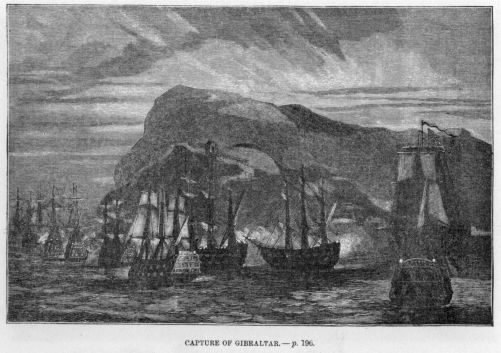
The town was found to be extremely strong, with 100 guns mounted, all facing the sea, and with two narrow passes to the land. It was also well supplied with ammunition, but the garrison consisted of less than 150 men. However, it was the opinion that fifty men might have defended the fortifications against thousands, and the attack made by the seamen was brave almost beyond example. Sixty only were killed, including those blown up, and 216 wounded. As this design was contrived by the admiral, so it was executed entirely by the seamen, and to them was the honour due.
Leaving a garrison under the Prince of Hesse, the fleet sailed to Tetuan, in order to take in wood and water. At the end of the year the Spaniards attempted its recapture, but Sir John Leake arriving to its relief, surprised and took three French frigates, a fire-ship, corvette, and storeship laden with warlike stores, the very night before the Spaniards had intended to storm it. The following month 2000 troops arrived to garrison the place, making it no longer necessary for the ships to remain in the bay.