WHAT TO GROW. (continued 2)
Reading edition
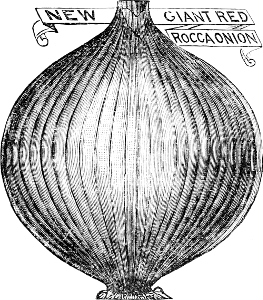
NEW GIANT RED ROCCA ONION
GIANT RED ROCCA ONION.
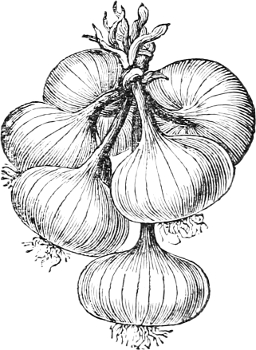
WHITE QUEEN ONION.
Giant Yellow Rocca.—This variety is similar to the Giant Red Rocca described above, except in color, which is a clear golden yellow. It is this variety which is the real “Spanish Onion,” so generally sold at the fruit stands in the cities.
Burpee’s Mammoth Silver King.—This I believe to be the handsomest variety of onion grown, as I think the white-skinned varieties the most attractive. The bulbs are slightly flattened, but are very thick through, averaging five to six inches in diameter, and have been grown to the enormous weight of over four pounds to the single bulb, while two-pound bulbs are frequently produced under fair culture. The skin is a beautiful silvery white; the flesh is even whiter, while the flavor is very mild and pleasant, the Italians eating them as we do apples.
PARSLEY.
This should be grown by every gardener on account of its usefulness, both for seasoning and garnishing. As it seeds in the second season, fresh plantings should be made every spring. The seed, being very slow to germinate, should be soaked in tepid water for twenty-four hours before planting. The best way is to sow in the hotbed or cold frame and transplant to the garden, but it can be sown in drills where wanted and thinned out to the proper distance apart. I always try to have a bed of it near the kitchen door, as it saves much running; if such a bed cannot be conveniently placed, some should be cut and brought in with the other vegetables, as it will keep fresh some days if kept in cold water. In the fall some of the best roots should be taken up and planted in the cold frame, or put in pots and boxes in the sunny windows of the house, for a winter supply. The leaves and tops from trimming the celery are also very fine for flavoring.
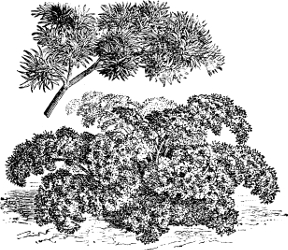
EXTRA CURLED DWARF PARSLEY.
The Extra Curled Dwarf is so much finer and handsomer than the other kinds that it should be the only one grown.
PARSNIPS.
This is a winter vegetable, needing hard freezing to refine and bring out its best quality; the roots should be left to stand where grown until they can be dug in the spring or through the winter as wanted, though some may be dug and stored in heaps for use when the ground is frozen too solidly to admit of digging them. If there is more than are wanted for table use, there should be no delay in getting them dug and marketed as early in the spring as possible, for when they begin to sprout and grow, they very soon become woody and unfit to eat. A row should be sown in the garden at the same time as the onions, beets, etc., are planted. It is best to sow the seed quite thickly; by thickly I mean one seed every inch or so; when the young plants are about three inches high they should be thinned out to six inches apart in the row, care being taken to leave only one plant in a place, as, if two are left, they will spoil the symmetrical shape of the roots by growing against each other. In planting the seed I always try to run it in between two rows of beets, onions, lettuce, or other early crop, thus working it with the wheel hoe while small, and when the other crops have been taken off there is room to work it with the cultivator, which is run as close to the rows and as deeply as possible, so that the roots may attain the largest size. In digging the roots when the ground is frozen hard and is impenetrable to the spade, I use a long iron post digger with a steel blade.
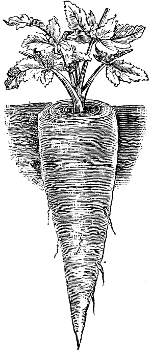
IMPROVED GUERNSEY PARSNIP.
VARIETIES OF PARSNIPS.
For the last three seasons I have grown the Improved Guernsey, and have found it so much superior in size and quality to the Long Smooth, as to be above comparison. The roots are smooth, fine shaped, and free from small roots, while the quality is very superior.
PEAS.
The first planting should be made in the spring, as soon as the ground can be prepared. It is my practice to sow three varieties at the first planting, and two varieties at each subsequent one, kinds being sown which will mature in succession, one being ready to pick about the time the preceding one is past. The same result may be obtained by making plantings of the same sort a week apart. I think my way the easier, and besides, relish the variety. A drill of fifty feet would probably be sufficient for an ordinary family to have in bearing, but as my own family is large and very fond of this vegetable, and insist upon having them upon the table every day in the season when it is possible to grow them, I find a full row across the garden none too many to have in bearing at one time.
For several years past I have given up raising the tall growing peas requiring brush or sticks for their support, as it is not easy to procure sufficient brush for a garden of this size, unless you have a convenient woods upon which to draw, and even then it takes a great deal of labor to get the brush and stick the peas; while it takes more than twice as long to clear the ground for the succeeding crop, and the rows must be planted at a greater distance apart, to admit of cultivation.
The quality of the dwarf kinds is fully as good as of the tall growing ones, and in many kinds the crop borne is fully as prolific; the only strong point that I know of in favor of the brushed peas, is that the pickers do not growl half so much at picking them as they do over the lower growing ones, and that some of the varieties can be had later in the summer, as their height serves to shade the ground between the rows and thus keeps it cool. As for the growls of the picker, the short vines admit of no loafing place, and no true gardener or lover of his craft ever seems to be aware that he has such a thing as a spine (except on his cucumbers) till he tries to straighten up at the end of the day’s work.
For sowing the seed, plow a drill as deeply as possible with the hand plow; sow the seed thickly, say a quart to 200 feet of drill, and cover by plowing the dirt back again; when the hand-plow is not among the assortment of tools, scrape a drill three inches deep and as broad as the blade of the hoe, scatter the seed the whole breadth of the drill, using about one-third more seed than above directed, and then press them into the bottom of the drill with the sole of the boot, covering the fine dirt in afterward with a steel rake; this takes longer to do, but is a much better way to plant them when the time can be spared; the row being broader it gives the plants more room, and the seed being planted more deeply will better withstand the hot weather. For the very earliest planting the seed should only be covered about an inch deep, and more soil can be drawn around them when well started. The successive plantings of peas should be kept up until the middle of June; those planted later than this will mildew, and not fill out the pods, unless in a cool and shady situation. The plantings should be resumed about the first week in August, and three successive plantings, about ten days apart, should be made. The vines and pods of these peas will most likely mildew, but the peas that you will get in the cool days of the fall will be the finest in quality, of the whole season. In selecting the sorts to plant, the wrinkled varieties will be found of better quality than the smooth kinds, the latter requiring to be picked while quite young, as they become hard, while the wrinkled ones remain longer in good condition.
VARIETIES OF PEAS.
Burpee’s Extra Early.—This is a remarkably early selection of the well-known Philadelphia Early. It is the first variety to ripen, ripens nearly all its pods at one time, and is very sweet and tender when cooked; the vines grow about two feet in height, but can easily be supported by driving stakes every few feet and confining the vines with twine running from one stake to another.[7]

BURPEE’S EXTRA EARLY PEA.
American Wonder.—This little fellow is really a wonder, as it grows only eight to ten inches in height and is literally covered with pods. It is remarkably early, ripening in from thirty-five to forty days, and in succulent sweetness cannot be surpassed.
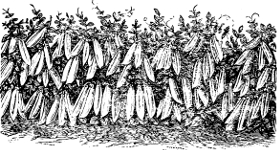
AMERICAN WONDER PEAS.
Extra Early Premium Gem.—This variety is about ten days later than the American Wonder, and grows from twelve to fourteen inches in height. The peas are remarkably fine in quality, and I have planted it for several years as my main variety.
Pride of the Market.—A new pea that I have grown the past two seasons, and find of very superior merit. The price of the seed has been too high to admit of extensive planting, but with these three dwarf kinds, the only ones planted for the table this last season, I can say that I have never been better supplied, or with finer peas. This variety grows about a foot and a half in height and bears a very heavy crop of pods, which latter and the peas that they contain are of unusual size and substance.[8]
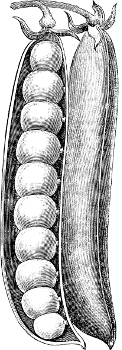
LAXTON’S EVOLUTION PEA.
Laxton’s Evolution.—This variety is a novelty in the way of peas; in the other varieties the object having been of late years to have the pods all mature as nearly as possible at the same time; this object has been sought for the benefit of the market gardeners, while in this new variety we have a kind which will, from its everbearing habits, be a great boon to the family gardener. The vines grow about three feet high, and bear continuously, for a space of nearly three months, an abundance of handsome, large pods, each of which contains eight to ten wrinkled peas, the pods being borne in clusters of two, which facilitates the picking. Like all wrinkled varieties, the quality of this remarkable pea is most excellent.
Champion of England.—This is a large growing late sort, and is very productive, with peas of delicious flavor. The vines grow to four or five feet in height, and this past summer I ate them in perfection fully a month after the other varieties had disappeared from the table.[9]
Copyright,
1887, By W. ATLEE BURPEE.
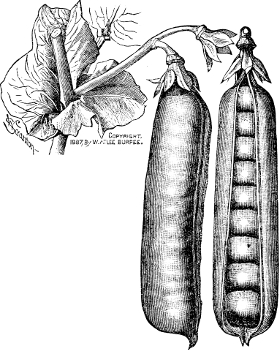
BURPEE’S QUANTITY.
PEPPERS.
The seed should be sown about the middle of March, in the hotbed, if wanted for summer use, and as soon as the nights are warm they should be planted out. They can be sown in the open ground if the fruit is not wanted for use before fall. As they are used in preparing various kinds of pickles, etc., it would probably be the better plan to plant some at both times. When about six inches high, they should be transplanted to the rows where they are to fruit, and should be set about two feet apart in the row. Where room is scarce, I usually set two pepper plants between each hill of cantaloupes, as they grow well above the vines and are not at all in the way, while having the ground shaded from the hot sun by the vines of the melons, the surface being kept cool and moist by their broad leaves, is of great advantage to the peppers. In choosing varieties, those kinds having the mildest flavor and handsomest appearance should be selected.
VARIETIES OF PEPPERS.
Burpee’s Ruby King.—This variety produces the handsomest, and at the same time the largest and mildest peppers that I have ever grown; one specimen this season being six inches long and over ten inches in round circumference. When ripe the fruit is a beautiful, bright, ruby-red color, and the flavor is mild and pleasant, being much milder than in any other variety of red pepper.
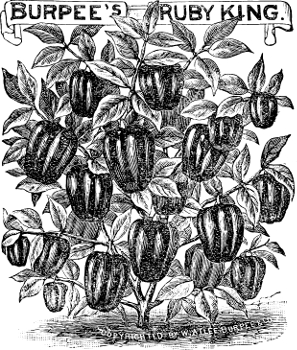
BURPEE’S RUBY KING.
Burpee’s Golden Upright.—In this variety the fruit grows in a different manner from any other large pepper that I have ever seen; it grows upright on the fruit stems, instead of pendulous. The fruits are large and handsome, being about four to five inches in length, and are of rich golden yellow tinged with red. In taste it is as mild as the Ruby King—the two making a very fine contrast when used together.
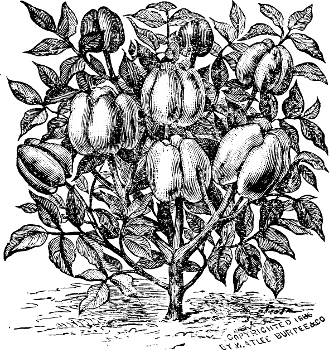
BURPEE’S GOLDEN UPRIGHT PEPPER.
Bull Nose and Golden Dawn are the finest of the older kinds, but do not compare with the two above given, either for size or mildness of flavor.
Red Cluster.—This is one of the finest varieties that I have ever grown; it is low and bushy in growth, and is covered with a profusion of thin, round peppers, about three inches in length and one-quarter inch in diameter at the base, tapering to a long, sharp point. When ripe, the fruit is a brilliant coral red, and a plant covered with fruit looks like some brilliant-foliaged plant that has escaped from the flower garden. It is very hot and pungent in flavor, and an idea of the productiveness can be had from the fact that over twelve hundred were counted on a single plant this last summer.[10]
PUMPKINS.
These take up so much room that they properly belong in the corn field, or in a patch of their own, in one of the cultivated fields. If there is no place for them outside the kitchen garden, and they can be kept far enough away from the squashes and cantaloupes, they can be planted about every twenty feet, in every fourth row of potatoes or sweet corn. They should not be planted until the corn or potatoes have grown three or four inches high, or they will be in the way of cultivating these crops. If one row of the corn were left out, and a row of pumpkins planted, it would probably be the most satisfactory way to grow them, as the tall growing corn, of which there should be at least five rows between them and any other vines, would prevent the pollen from mixing, and as the hills need only be four or five feet apart, a great many could be raised in a row. The pumpkins must all be gathered in and stored before any heavy frosts, as it will spoil and start them to rotting.
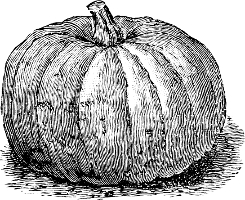
SMALL SUGAR PUMPKIN.
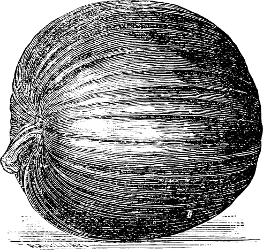
NEW GOLDEN MARROW PUMPKIN.
VARIETIES OF PUMPKINS.
Small Sugar.—This is very handsome and prolific, of small size, the pumpkins averaging about ten inches in diameter; the skin is a deep orange yellow. It is very fine grained in flesh, sweet in taste, and an excellent keeper.
Golden Marrow.—Of round shape, slightly ribbed and flattened at the ends; the skin is a rich golden orange color; the flesh is of extra quality, and very soft and tender when cooked. It is a splendid keeper, vigorous grower, and keeps well throughout the winter.[11]
RADISHES.
These should be sown as soon as the ground can be worked in the spring, and successive sowings should be made every two or three weeks, as recommended with peas, lettuce, etc. Do not sow too many at one time, but sow frequently, that they may be had fresh and crisp; they soon become either hollow, or hard and woody, if allowed to stand long after they are of sufficient size for use. Where there is glass enough to spare, it is an excellent plan to sow two or three rows in the hotbed at each planting of seeds, which will furnish them for use several weeks before they can be had from the garden.
There is a general impression that radishes do not do well except in very light soil, while my experience is that it is mainly a matter of manure and cultivation, and that good radishes can be raised early in the season on the heaviest of soils, though later in the season they will not succeed unless the soil be favorable. Where “Night Soil” can be obtained and composted with ashes, it will make the finest kind of manure for the radish bed; but it should be applied with judgment, as it will burn up any crop if applied too heavily. This manure can hardly be so readily applied in a special location in the garden worked by horse power, and I strongly disapprove of making “beds” in such a garden; it should be kept as level as possible, that all the cultivation may be done with the wheel and horse hoes; while “beds” mean lots of slow hand work, and hard beaten ground in the paths and edges, that are perpetual sources of weeds; while in the level garden the location of rows and crops can be continually shifted, every portion of the ground being used, and none escaping cultivation.
For the earliest plantings, the small, very early kinds should be used, and these will grow the finest radishes of the season, fresh, crisp, and slightly pungent. For summer use, the large summer kinds, of very mild flavor, should be selected. These latter should be planted from the first of June until the first of August, after which I begin to sow the small early kinds again, having found that I can grow them as fine and palatable as in the spring. In sowing these in the kitchen garden I sow a part of a row at a time, in the portion worked with the wheel hoe, where the rows are about one foot apart; the seed is sown thinly in the drills, and if it comes up too thickly, should be thinned out to one inch apart for the small kinds and two inches for the larger ones. The seed should be sown from one-half inch to one inch in depth, according as it is early or late in the season or in heavy or light soils. The radishes should be pulled early in the morning and kept in fresh water in a cool cellar until used, so as to have them fresh, brittle and crisp. The large winter varieties are not much raised, except by the Germans, being rather too pungent for the American taste.[12] The seed is generally mixed with the turnip seed and broad-casted or drilled in together, but if I were planting them, I would think it much better to sow them in drills and cultivate separately.
VARIETIES OF RADISHES.
Burpee’s Earliest (Scarlet Button).—I have grown this new radish for two seasons and consider it the earliest and finest radish that I have ever grown. It is the earliest, about one inch in diameter, handsome, crisp and brittle. The color is the deepest scarlet. It has very small leaves, and a great many can be grown in a small space, rendering it very valuable for forcing. Last winter I sowed seed between the rose bushes in my forcing houses and kept my table supplied, and had large quantities to sell.
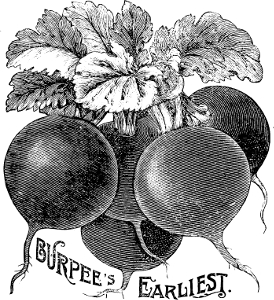
BURPEE’S EARLIEST (SCARLET BUTTON) RADISHES.
Natural size, when ready for use.
Early Long Scarlet Short Top.—This is a fine selection of the long, slender scarlet radishes so generally seen in the spring, and is preferred by some to the round or turnip radishes. It is very early, tender, crisp and fine flavored; the roots averaging half an inch in diameter at the top and tapering from that throughout their length of four or five inches.
Earliest Carmine, Olive-Shaped.—A very early radish, of a rich carmine color, and while not so early as Burpee’s Earliest, attains fully twice the size; the roots are of an even, regular olive shape and very fine quality. It is an excellent radish for forcing, on account of its size and appearance and the small growth of top which it makes, enabling many to be grown in a small space.[13]
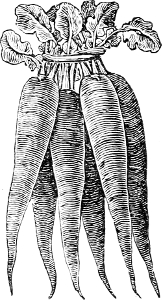
LONG SCARLET RADISH.
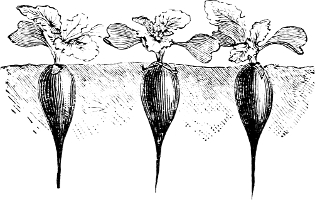
EARLIEST CARMINE, OLIVE RADISH.
SUMMER VARIETIES OF RADISHES.
Golden Globe.—This variety is of very quick growth and fine quality, being ready for use in from four to six weeks after sowing the seed. In shape it is almost entirely round, the color quite bright, and the quality very sweet and crisp.
Giant White Stuttgart produces very large roots, frequently reaching the size of an ordinary turnip; it is very quick growing and resists the heat of summer well, being firm and brittle until it runs to seed. The skin and flesh are pure white, a good guarantee of its mild flavor.
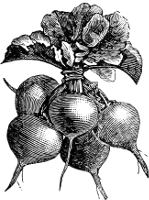
GOLDEN GLOBE RADISH.
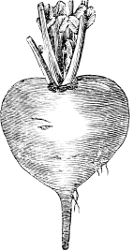
GIANT WHITE STUTTGART RADISH.
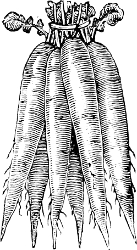
LONG WHITE VIENNA, OR LADY FINGER RADISH.
Long White Vienna.—This is a very fine long, white radish, both skin and flesh being pure white; it is crisp and brittle and rapid in growth, and to my mind of a much more attractive shape than the large globe radishes, which, unless pulled young, are too large for any but the confirmed lover of radishes.
Large White Globe.—A very large, round, summer turnip radish, with pure white skin and flesh, which is very crisp and brittle. It grows quickly and withstands heat well. It is similar to the Golden Globe, except in color.[14]
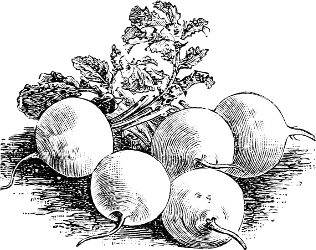
LARGE WHITE GLOBE RADISH.
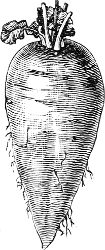
CALIFORNIA MAMMOTH.
WINTER VARIETIES.
California Mammoth White.—This is the largest of all radishes, the roots growing eight to ten inches long and two to three inches in diameter, while the flesh is solid, snow white and of excellent flavor.
Chinese Rose.—This is a bright, rose-colored variety, of very attractive appearance; it is of excellent quality, a good keeper, and one of the best varieties for winter use.
POTATOES.
A small planting, say two or three rows, of these should be made as early as possible in the spring, the amount planted depending on how soon they will be followed by the main crop. These may be planted in the furrow when the ground is plowed, but I prefer to plant the earliest ones in furrows struck out about three inches deep, after the ground has been thoroughly prepared, as they will come up more quickly. The rows should be dressed with phosphate, to give them a quick growing start, and the pieces of tuber placed about one foot apart; the ground may be run over with a sharp spike harrow when the potatoes are just coming through, or left a little longer and then worked with the cultivator. The soil must be kept well worked, and as close to the roots as it is possible to run. The bugs must be watched for and destroyed as soon as they appear, either by dusting with Paris green mixed with plaster, or with other insect poisons, or by picking them off and destroying them by hand, which is the easier way when the patch is small and potato plants are young. If these early bugs are destroyed before they can lay their eggs, the work of protecting the summer crop will be greatly lessened. Where the main crop of potatoes is to be raised in the garden, they should be planted about the first day of May, or the middle of April, that they may be harvested by the middle or last of August, and the ground used for a crop of turnips, peas, or other second-crop vegetables. As soon as the vines begin to die, and the skin of the potatoes is well set, so that it will not rub off with the fingers, the tubers should be dug or plowed up and stored, not only that the ground may be used again, but because, if they are left in the ground, they will either start to grow again or begin to rot. When dug, I pile them in small heaps of twenty bushels or so on the barn floor, dusting each pile as it is made with dry, air-slacked lime, about a quart to a heap; this helps to dry and preserve them, and prevents any tendency to rot. The barn doors are left open through the day, for a few days, and the potatoes dry gradually, until time for storing them, when it comes cold, though where there is a cool vegetable cellar it will save time to store them at once, and, of course, at this time of the year the ventilators of the cellar should be wide open. Where the cellar is too warm and the potatoes start to sprout, it is said that it may be prevented by turning them frequently, but I have never had an opportunity to try it. The first planting should be made of some very early ripening varieties, while the main crop should be of a kind selected for good size, heavy cropping, and the best cooking qualities.
SWEET POTATOES.
Like some other vegetables, these are generally supposed to require special soil and situation to do well, but with plenty of manure and good cultivation they can be raised of fine size and quality in any garden. As described in the chapter on hotbeds, the old potatoes are planted in a warm bed, about the first of April, and when the ground is prepared, these are taken up and the sprouts broken off close to the potato. The potatoes should be buried two or three inches deep in the bed, which will give each shoot a bunch of fine roots when it is broken off. When the nights are warm, and the trees well out in leaf, plow a double furrow where the row of sweet potatoes is to be; that is, run the plow each way in the same furrow; then fill in two or three inches of fine manure, and plow the furrows back again, forming a ridge over the manure. In the centre of this ridge plant the sets about one foot apart; they must be kept well cultivated, and the running vines must not be allowed to strike root into the soil, or they will form lots of small potatoes, and none large enough for use; some gardeners keep the vines coiled round the central plant, but the easier way is to throw the vines from two rows together, then cultivate the side left bare, and throw them back again, cultivating the other side; after the first time they need not be moved but once for each cultivation, as the blank side can be cultivated and the vines thrown over on it, leaving the other side free, which can be cultivated first the next time it is done, and the vines thrown back. Throwing the vines over can be done very quickly by running a rake handle or long light pole under them, and throwing its whole length of them over at once: they can be dug as soon as large enough for use, by scraping the dirt away from the side of the hill, the potatoes pulled off, and the vines left to form more. The whole crop should be dug as soon as the vines are blackened by the first frost, and spread out in a cool dry place, where there will be no danger of their freezing. On account of the vines taking so much room, the rows should be at least five feet apart.
SAGE.
A dozen roots or more of this herb should be planted in some part of the garden where it will not be disturbed by the plow, or if this cannot be done readily, the roots can be taken up when the plowing is done, divided and reset, which would probably raise a larger and finer crop of leaves than allowing them to stand in the same place year after year. The crop should be cut off a few inches above the ground, as soon as it has made its growth and before it begins to bloom. The shoots will again start to grow, and two or three crops can be cut in a season; the cut tops can be tied in bunches and hung to the rafters, or spread thinly on the floor of a cool loft or garret.
SPINACH.
This is a quick-growing green, and very hardy, making it valuable for early spring and late fall growing. It cannot be raised during summer, on account of its running immediately to seed without making many leaves. It can be sown as soon as the ground can be worked in the spring, and will be ready for use in a few weeks; about three sowings may be made, two weeks apart, or more, if the season is longer, though it will hardly be good if planted after the middle of May. The whole plant is cut off even with the ground, at any time before it starts to run to seed, the leaves and stems being used as boiled greens. Large sowings should be made in October, of the hardy variety, as it can be cut throughout the winter; a later sowing may be made the first of November, and lightly covered with litter when the ground has been frozen hard; this covering should be raked off early in the spring, and it will complete its growth before the first spring planting is ready for use.
VARIETIES OF SPINACH.
New Thick-leaved Round.—This variety produces large, thick, dark green leaves, somewhat crumpled. It possesses the valuable quality of standing for some time after attaining its growth, before running to seed.
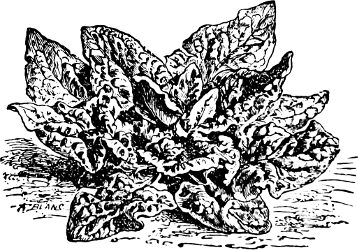
NEW LONG-STANDING SPINACH.
The Norfolk Savoy Leaved.—The leaves of this kind are wrinkled like a Savoy cabbage. It makes a large bunch of succulent leaves, producing more weight of leaves than any other variety, and is more hardy than any of the other kinds.
New Long Standing.—This is one of the best varieties for spring sowing, as it stands longer than any other before running to seed. The leaves are thick, fleshy and crumpled like the Norfolk Savoy Leaved.
SQUASHES.
Hills should be made for the culture of these, in the same manner and at the same time as described for cucumbers, cantaloupes, etc. These hills should be at some distance from the vines above mentioned, as there is danger of the pollen mixing and spoiling the melons, etc. There are some localities where the winter squashes do not do well or are difficult of cultivation; but the small summer squashes are of easy culture in any locality, though of finer quality on a warm sunny slope than elsewhere. The only trouble in growing them is to protect them from the ravages of the Striped Squash Bug while young, for which purpose I use slug shot, dusted on the leaves early in the morning, while the dew is still on them.
The vines should be allowed plenty of room to run, at least four feet on every side. The vines soon cover the ground and prevent using the cultivator; but the large leaves so shade the soil that few weeds grow, and where they rear their heads above the vines they can be cut out with hand hoes or pulled out after a rain, by hand.
As we can hardly use the product of more than a dozen hills, I divide the long row across the garden into three parts, planting the squashes at one end, watermelons in the centre, while the other end is occupied by cucumbers, which prevents any mixing of pollen, and gives a sufficient quantity of each fruit without disturbing the symmetry of the garden. In gathering the squashes for table use, care must be taken that they are not too old, or they will be tough and stringy when cooked; the easiest way to judge them is to try them with the nail or small stick; if it does not cut the skin freely and easily they are too old; no push should be required to make the cut. This is also a good test when in doubt about the proper condition of sweet corn, and should be applied to grains near the base of the ear. No old squashes should be allowed to remain on the vines of the summer varieties, for if they are allowed to ripen, the vine, having fulfilled its natural purpose, will dry up and die, while if the fruits are picked off, it will continue to grow and produce fruit.
The winter squashes are raised in the same manner, but are more difficult to start, as the young plants are subject to a borer which eats them off under ground. Plenty of seed should be sown in each hill, and as soon as you see a plant wilting or cut off, dig around its roots with your fingers or a stick until you find and kill the borer, otherwise, he will continue his labors on the other plants in the hill. The plants should also have careful watching and dusting, to preserve them from the usual insects that prey on young vines. When the plants are about one foot in length they should be thinned out to two or three in a hill, though the danger from borers is hardly passed yet, but to allow them to stand too thickly after attaining this size would stunt them and lessen the crop. The squashes should be gathered before there is any hard frost and stored in a cool, well-aired cellar. Some of the winter varieties are equally good for summer use before they become too old and hard; if these are planted, the one planting will furnish fruit for both seasons.
SUMMER VARIETIES OF SQUASHES.
Early White Bush, or Patty-Pan.—This is the best known and most generally planted of the early squashes; when young the quality is very fine, the flesh is fine grained and of delicate flavor. It is a bush variety and the vine does not “run.”
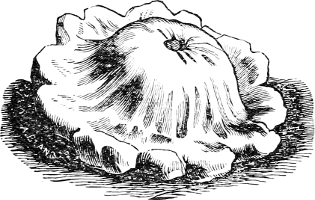
EARLY WHITE BUSH SQUASH.
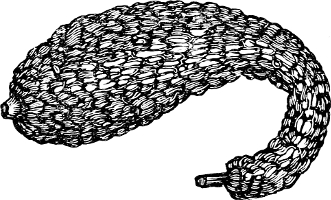
GOLDEN SUMMER CROOKNECK SQUASH.
Golden Summer Crookneck.—A small crook-necked summer squash, the skin of which is a bright yellow color and is covered with warty excrescences. It is early, productive and of excellent flavor.
White Pineapple, or White Turban.—This variety produces a very handsome fruit, though of peculiar shape, as will be seen from the accompanying illustration. The blossom end of the squash is smooth and round, while from the stem end start ribs or ears, which attain their largest breadth and end near the middle of the squash; these ears usually grow in pairs. This variety is of excellent quality, and can be used at any stage of its growth, and the full-grown fruits can be preserved for early winter use. The skin and flesh are both of a pure creamy white tint; the flesh being very thick, while the seed cavity is quite small. The flesh is fine grained and of the best quality, possessing a rich cocoanut flavor.
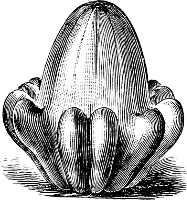
WHITE PINEAPPLE SQUASH.
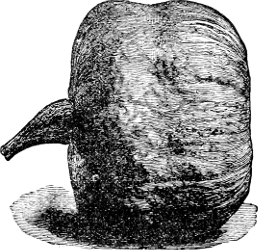
ESSEX HYBRID SQUASH.
WINTER VARIETIES OF SQUASHES.
Essex Hybrid.—A very productive squash of the finest quality and an excellent keeper, specimens having been kept until June, as sound and good as when gathered. It is one of the richest flavored, finest grained and sweetest of all squashes, while at the same time it is one of the largest and most productive, growing close together on the vines and averaging from eight to twelve pounds in weight. It is of early, quick growth, and can be raised very successfully as a second crop, following early potatoes, peas, etc.
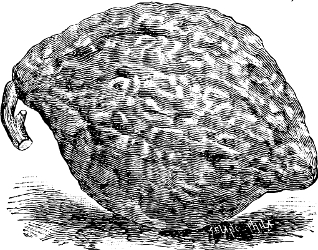
HUBBARD SQUASH.
Hubbard.—This is a standard and well-known winter squash, and is of most excellent quality for winter use, but is not so well adapted to all soils and localities as the preceding varieties, nor of such easy culture.
TOMATOES.
These rank with the standard vegetables, such as corn, potatoes, etc., and yet it is not many years since they were grown in flower gardens only, the brilliant color of their fruit being then considered quite a pleasing novelty. Now, by the introduction of the canning industry, there is not a day in the year when they are absent from our table. Their culture is of the simplest, being largely a matter of soil and manure and good early plants, to be set out as soon as the weather will permit in the spring. The seed is sown in hotbeds, from the middle of March to the middle of April; if possible, they should be transplanted, when about two inches high, to another sash, where they may stand three or four inches apart. When there is not room for this, the seed should be sown thinly in drills four inches apart, and when well started, should be thinned out to two inches apart in the row. The hotbeds should be given plenty of air on warm days that the plants may be stocky and thrifty when planting-time comes. They should not be set out until the temperature is over 60° at night, or until the oak trees are well out in leaf. They should have plenty of room, at least three feet in the row and four feet between the rows, and for an ordinary family at least four rows should be planted. Two rows should be of the earliest and two with plants sown a month later, for in some varieties there is a tendency to die off after raising one crop, though constant picking as fast as they ripen, and not allowing surplus ones to remain on the vines, will greatly prolong the bearing period; so much so, that in most years I make but one planting. The earliest hotbed plants will begin to ripen fruit the last week in July or the first in August, while, if you make a hill, as for corn, about May 10th, and put in a dozen or so seed where you want the plant to stand, pulling all out but the strongest one when they get a good start, you can have this second lot in bearing about the last of August, without the use of glass or the labor of transplanting.
The young plants must be thoroughly cultivated and hoed; when hoeing, the dirt should be loosened right up to the plant, and when it has been worked loose and made fine should be drawn up to the stem, two or three inches in height. It frequently happens, when the season is late, that the plants have grown a foot, or even two feet, in height or length. This is no disadvantage, but rather a help, if treated in the following manner: A gutter two or three inches in depth and nearly the length of the plant, is scraped under the planting line with the hoe, and the plants laid lengthwise in this and covered over, all but about five or six inches of the top, which is bent straight upward and afterward treated as though it were a plant of that size; the long stem underground immediately forms roots and assists in feeding the growth of the plant.
The ground should be well manured, but if the soil is light it can be overdone, as the plant will run too much to vine and be late in producing fruit. I have found that, though there is a general impression that tomatoes do best on a light, sandy soil, the best tomatoes I have ever raised have been on my poorest and heaviest ground. On a plot of ground where the plow turned up the yellow clay at a depth of five or six inches, I have had the ground covered; covered so that you could hardly put your foot down anywhere in the patch without treading on a tomato, and not a cracked or rotten one among them. At another time I planted all the plants there were at that time of the now famous Turner Hybrid, in a patch of clay soil where young nursery trees had been grown for five years, and you can ask any nursery-man how much that leaves in the soil. Yet this patch produced tomatoes which astonished all beholders and led to its being placed at once upon the market; and right here I would say that the flavor and appearance of this variety have been so fine with me that I have obtained double price for my tomatoes since I have been growing it. In the last ten years I have had the handling of the first stock of three new tomatoes, each one of which has seemed near perfection when originated, yet each has been much superior to its predecessor. I mention this only to show how the craft of “assisting nature,” or gardening, is always progressing and gaining new interest in the mind of the gardener. There is a constant charm about it, that, once it takes possession of you, never lets go.
If the full-sized, green and partly ripe tomatoes are picked off when there is danger of frost, and placed under the sash of the cold frame, or on the floor of the cellar, they will ripen gradually, and though not of very fine quality, may be had fresh almost until Christmas; they must, of course, be entirely green when picked, to consume so much time in ripening.
If some plants of the golden or yellow varieties are planted, they will add greatly to the attractiveness of the dish when mingled with the red ones, served sliced in the ordinary manner. If you save your own seed, the earliest ripened specimens should be saved for that purpose, and should be of perfect shape and evenly ripened, with no core, crack or rot about them. The easiest way to clean this seed is, take a small box, knock the top and bottom off, and nail some wire fly screening over the bottom; take the fresh tomatoes, not rotten ones, as are frequently used, and squeeze the seeds into this sieve, throwing the pulp and flesh away; the seed can be washed free and clean by running clean water upon them, keep them constantly stirred and pick out the bits of pulp as they become free and float upon the top of the water, while the water and finer particles will pass off through the screening. When clean allow all the water to drain off and spread the seeds thinly on a smooth board or cloth in the sun; they should be stirred frequently, to prevent their adhering to each other when dry. If seeds are washed out in this manner and carefully dried, you can depend on every one growing, while from those saved in the ordinary manner, from tomatoes that have been allowed to heat and rot, sometimes not one seed in a hundred will germinate.
VARIETIES OF TOMATOES.
Extra Early Advance.—This variety is said to be the earliest in cultivation; at any rate, it is certainly a very early variety, and at the same time its fruits are of large size, of handsome, bright, red color and good quality; the solid flesh is free from the hard, green core present in the old varieties.
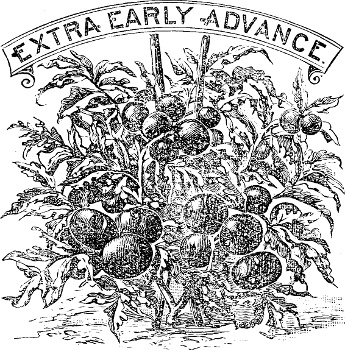
EXTRA EARLY ADVANCE TOMATO.
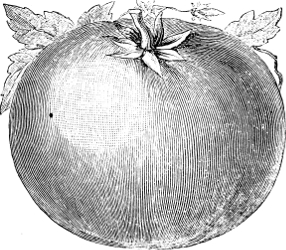
BURPEE’S CARDINAL TOMATO.
Burpee’s Cardinal.—I had the pleasure of growing this variety before it was introduced, having been presented with a small packet of seed by the originator, who requested me to make a trial of its merits, and though it was an unfavorable season, and, as I wished to keep it separate, I could not plant it in my best tomato ground, its fine qualities exceeded all that he claimed for it. It is of beautiful appearance, every fruit being a brilliant cardinal red, uniform in shape, and without blemish or cracks. The flesh is of the same bright color, is firm and free from any rot or core, and is of superior flavor. The vine is very heavy bearing, and one of the best for all purposes that I know.
Burpee’s Climax.—This variety resembles somewhat the preceding kind, excepting that the fruits are a light crimson in color and do not average so large as does the Cardinal. The fruit matures early, ripens evenly, without core or cracks. The flesh is fine-flavored, solid, and produces but few seeds; it is a good kind for all purposes.
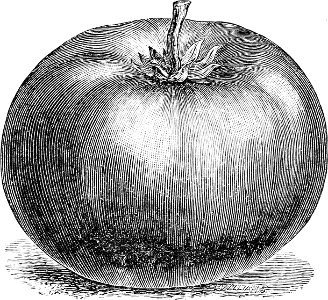
ESSEX EARLY HYBRID TOMATO.
Essex Early Hybrid.—Very early, solid, rich flavored and handsome. It is of large size and grows perfectly smooth; the color is a bright pink, ripening evenly all over. It is very early, a great bearer, and, being solid, is a most excellent variety for shipping purposes.
Golden Queen.—This is the best yellow tomato that I have ever grown. The fruit is of good size, handsome color, smooth, round shape, and superior quality. They should be in every garden, for the sake of the pleasing contrast they make when served with the red varieties.
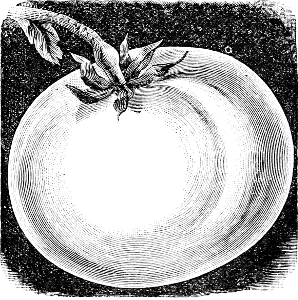
GOLDEN QUEEN TOMATO.
Turner Hybrid.—This variety I consider the tomato above all others, not only for its large size, handsome appearance and heavy cropping, but most of all for its superior quality, which far surpasses that of any other tomato that I have over eaten; and if there is one crop more than another that I pride myself upon, it is my tomatoes. Mr. Burpee, of W. Atlee Burpee & Co., gave me, in 1884, the small paper of seed sent them by a customer, and I planted it, as stated in the general chapter on tomatoes, and was so much pleased with it that since that time I have planted it altogether for my own use, with the single exception of a few plants of the Golden Queen. It is a rank, strong grower, with peculiar foliage, the vines strongly resembling potato tops. The fruit is very large and remarkably early for the size of the tomatoes; the average weight of the fruit is from twelve to eighteen ounces, so it will readily be seen that the size is very large, while, as above stated, I do not think it is possible to recommend the quality too highly.[15]
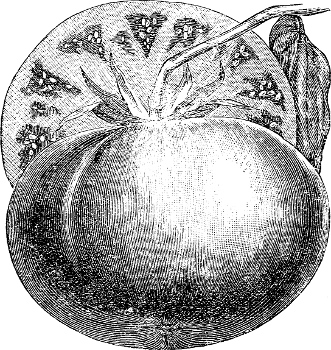
TURNER HYBRID TOMATO.
TURNIPS.
With our hot, dry summers, turnips can only be raised satisfactorily as a fall crop. They can be grown as a second crop, after early sweet corn, potatoes or peas, and should be sown as soon as possible after the first of August. The ground should be plowed or run over two or three times with the cultivator, and then harrowed till it is as fine as it is possible to make it. If the seed is sown broadcast, some winter radish seed should be mixed and sown with it. The ground should be rolled after sowing, not only to compact the soil round the seeds, which is essential to good germination, but also to prevent washing by the September rains, if the ground is at all sloping. But where the finest turnips and a sure crop are desired, it is much better to sow our garden turnips in drills, one foot apart if you have a wheel hoe, or as narrow as you can cultivate, if you have not. This will tend to having the roots of even size, and the finest appearance, as they can be frequently worked. When about three inches high, or when beginning to form bulbs, they should be thinned out to four or five inches apart in the rows, with the narrow hoe, leaving each bulb to stand by itself. It will be found that by this method, with careful culture, a larger as well as a much finer crop can be raised on the same ground than if they were sown broadcast, and that not half as much seed need be used, as it is carefully planted just where it is to grow.
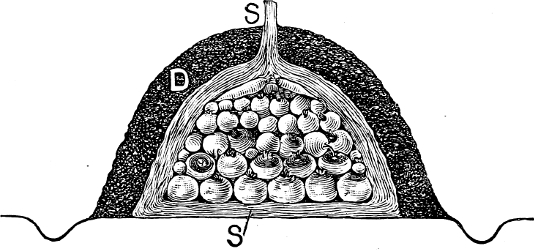
Illustration showing manner of storing turnips, beets, carrots, etc., in the garden for winter use. S, straw covering and ventilating chimney; D, covering of soil over the straw.
About the third week in November, or before there is danger of the ground becoming hard, the turnips should be pulled and the tops cut off; take enough in the cellar for immediate use, and store the rest in heaps. Select a well-drained piece of ground, as directed for burying cabbages; it will be most convenient to have them near together; spread about two inches of straw on the ground, and heap the turnips upon it in the shape of a cone, not more than ten or fifteen bushels in a heap; cover this with straw, an inch or two thick, and bind it together at the top, and let it stick up a foot or so above the top of the cone; then cover the heap with four to six inches of soil, all but the straw top to the cone, which acts as a chimney or ventilator; the roots can thus be kept in good order throughout the winter. The surplus beets and carrots can be put in with the turnips, and the whole can be gotten at, any day when the temperature is above freezing, by making a hole in one side of the heap, taking out what you want, and carefully closing the opening again. The straw bottom and sides are not absolutely necessary, but are a great improvement and convenience, and will preserve the roots in a much cleaner and finer condition; the straw not only helping to keep out the frost, but at the same time providing ventilation for the heap.
VARIETIES OF TURNIPS.
Early Red, or Purple Top Strap-Leaved.—The best known and most generally planted variety. It is a quick grower, and the flesh is very fine grained and flavored. The red top of the bulb, which extends down to where it rests in the soil, adds very much to the appearance of this popular variety.
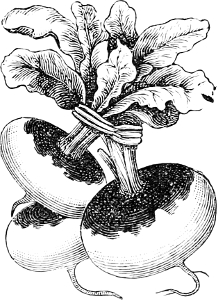
PURPLE TOP STRAP-LEAVED.
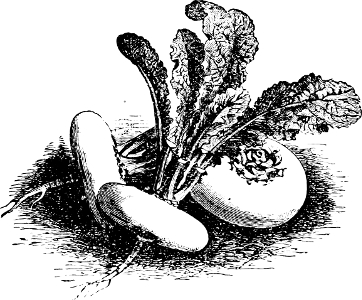
EARLY WHITE FLAT DUTCH TURNIP.
Early White Flat Dutch.—This is a quick growing and very early variety. The skin and flesh are a clear white, and the flesh is solid; very sweet and juicy, and of mild flavor.
Extra Early Purple Top Milan.—This kind is said to be the earliest of all turnips, maturing two weeks earlier than the Early Red. The bulb is very flat, of medium size, quite smooth, with a bright purple top; leaves grow very short, making a small, neat top. The pure white flesh is solid, fine grained, and of superior quality, even in the largest specimens. It is an excellent keeper, retaining its good quality throughout the winter.
White Egg.—As its name implies, this is a pure white turnip, of egg-shaped growth. It grows very quickly; has a thin white skin, and very solid, fine-grained white flesh. It is very sweet and juicy, of mild flavor and grows to a good size. It is a good variety for either early or late planting.
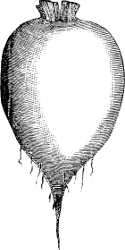
WHITE EGG TURNIP.
WATERMELONS.
These are also supposed to require special location and soil, but can easily be raised in any garden where the climate is warm enough for cantaloupes, tomatoes, etc. What they most need is plenty of encouragement, in the shape of thorough cultivation and liberal feeding with well-rotted manure. The hills are prepared in the same manner as for cantaloupes, excepting that where the manure or compost can be obtained, a good-sized hole should be dug, and well-rotted manure or compost put in as liberally as the supply will admit of, even half a barrel to the hill. If this kind of hills can be made, you can plant with seed of some of the large growing varieties, and be sure of success, unless your season is very short. If the season is too short, or if you have not the manure for large hills, I would recommend some of the smaller fruiting varieties, as they are fully as fine in quality, ripen early, and set more melons than the larger kinds. From ten to a dozen seeds should be sown in each hill about the last of May, or when the temperature does not go below 60° at night. When they have got a good start, thin out to two or three plants in a hill.

HUNGARIAN HONEY MELON
If your melons are of the tough-rind variety, as for instance the “Ironclad,” you can pick them off at the approach of frost, and by storing them in a cool, frost-proof cellar, have them in good condition till Christmas. Though my own opinion is that they lose their attractiveness when the hot weather is gone, still, it is always one of the main aims, in gardening, to have things out of season as well as at their regular period of ripening.
VARIETIES OF WATERMELONS.
Hungarian Honey.—This melon is one of the best for the small garden. Though not large, averaging eight to ten inches in diameter, it is perfectly round, so that there is a great deal of eating in one of them, while the quality is not equaled in any other variety. The melons ripen early, and the vines are vigorous in growth and very productive. As its name, “Honey Melon,” implies, it is sweet and luscious, and of a rich honey flavor, melting completely and leaving no stringy fibre in the mouth. The dark green skin, and intense brilliant red of the flesh, make a very striking appearance when cut.
Burpee’s Mammoth Ironclad.—A large melon, of superior quality, and where there is room to grow them, will be found a profitable crop for market. Under ordinary culture, it frequently attains a weight of sixty to seventy pounds. They take their name of Ironclad from the exceeding toughness of the thin rind. Cutting into one is almost like cutting into sheet iron, though the flesh inside is fresh, crisp and melting. So strong is this rind, that I have stood on one of the smaller melons with a companion, our united weight of over 340 pounds not cracking the ripe flesh within in the slightest degree; and I have seen a wagon load of melons driven over one in the field without damaging it in the slightest. While it does not produce many melons to the vine, it more than makes up in size and weight what it lacks in quantity, being a heavy cropper when this is taken into account. The flesh is very beautiful, of a dainty red color and rich, sugary flavor. The flesh is never mealy, but always firm and solid. In shape this melon is oblong, its length often being two and a half times greater than its diameter.
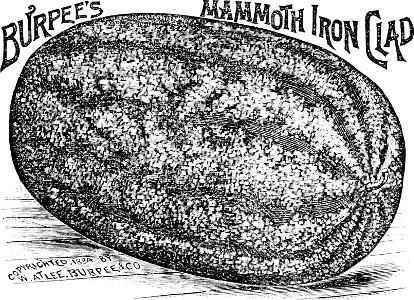
Burpee’s mammoth Iron Clad
Icing, or Ice Rind.—This is a dark, green-skinned melon, of nearly round shape. It is a favorite variety, on account of the solidity of its flesh, thin rind, and rich, luscious, sugary flavor.
Cuban Queen.—The melons of this variety are very handsome and attractive in appearance; the skin being striped, dark, and light green, in a pleasing manner. The vines are strong and vigorous in growth, and bear enormous crops when well manured. The melons are large, very heavy, and of the finest quality. The rind is very thin, being scarcely more than half an inch in thickness on a large melon; the flesh is bright red, very solid, rich, and sugary. This is one of the very best varieties for general culture in all sections. The shape of this variety is oblong, being about twice its diameter in length.
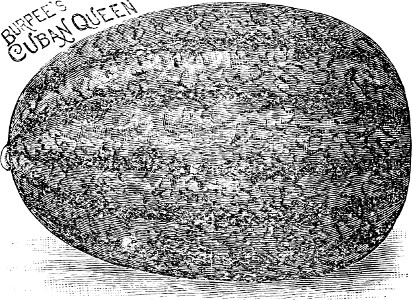
BURPEE’S CUBAN QUEEN
111-lb CUBAN QUEEN WATERMELON.
Kolb’s Gem.—The skin of this melon is striped, as in the Cuban Queen, but is not so handsome, as there is not the same amount of contrast between the two shades; the shape is much shorter, being nearly round. The flesh is bright red, and of good flavor; and owing to its tough rind is a very good shipping and keeping variety.[16]
RHUBARB, CURRANTS AND GOOSEBERRIES.
These three I would plant in the same row, in the small fruit plot or permanent part of the garden, mainly because a third of a row of each will afford an ample supply for a good-sized family, and all require nearly the same treatment. The plants of each are all set together, each in its own third of the row, not interspersed. The plants should be set as early in the spring as possible, or can be planted in the fall and well mulched with manure. The crowns of the rhubarb should be set an inch or two under the surface, and no stalks pulled until the second or third season; in the fall, when the ground is frozen hard, the old leaves should be pulled off and the row well mulched with long manure; in the spring this should be worked down to the roots, when the ground is fit to work, and the soil kept loose and free from weeds while the rhubarb is making its growth. The stalks can be pulled as soon as they are large enough for use, and can be pulled until they become so small as to be unfit for use; then dig in some fine manure or compost, and let it grow at will until fall, when the stalks will again be fit for use, though this second crop is generally allowed to go to waste, mainly, I think, through ignorance of the fact that it is just as palatable as in the spring, and that it can easily be canned for winter use. Like asparagus, it must be liberally and continually fed, to have it in fine condition and of good size.
The currants and gooseberries are subject to the ravages of the currant worm, which cleans up every leaf and berry on the bushes just as they are about to ripen. To prevent this, the bushes should be dusted with white hellebore when the first worm makes his appearance; as this is a very strong poison many are afraid to use it; and, indeed, great care must be taken in using the fruit; still, the worms usually appear about the time the bushes are in bloom, and if promptly welcomed will have disappeared, and the poison be washed off the bushes before the fruit has formed. Any one who does not like to use the hellebore can dust the bushes with road dust or dry wood ashes every morning while the dew is still on the leaves; care should be taken that the under side of the leaves should receive a good portion of whatever is used. There is still another way of getting rid of these pests, and that is by hand-picking them; but any one who has tried it will agree with me that it is a somewhat tedious process when done every morning for a couple of weeks.
When the fall comes these bushes should be well mulched, and in the spring, before the growth starts, the old wood should be cut out of them, care being taken not to trim them too severely; never take out more than a third of the wood, or you will trim away your crop of fruit for the season. When the spring opens, dig in the mulch and keep the ground well worked and free from weeds, as in the asparagus and rhubarb.
BLACKBERRIES, BLACK CAP RASPBERRIES AND RED RASPBERRIES.
The culture is the same for all these, and they should be planted in liberal quantities, so that there may be plenty to preserve, as well as a full supply for the table. In my own kitchen garden I have two rows of Wilson’s Early Blackberry, one row Gregg Black Cap, and one row each of Philadelphia and Cuthbert Raspberries, and still the family cry for more, so I shall add about two rows of Wilson, Jr. Blackberries, and one of Lucretia Dewberry, in the spring. The dewberry will ripen before the blackberries, and thus prolong the season, as is already done with the two varieties of red raspberries.
The plants should be planted as early in the spring as the ground can be gotten into suitable condition, and if purchasing from a nursery, select those plants which are grown from root-cuttings, for they will not “sucker” so much, and where the garden is constantly well fed and cultivated this will save much in working, and the plants being carefully trimmed will last for years without replacing. The rows should be ten or twelve feet apart, so as to admit of free passage in cultivating and picking. As they do not grow so wildly until after the fruit has been picked, a couple of rows of peas or a row of early corn can be grown between each row. I have tried planting at closer distances, with the invariable result that by fall the berry patch was an impassable jungle. For manuring the berries coarse manure should be applied in the fall, or short, well-rotted manure in the spring; in either case plowing it under as applied; if plowed in the fall the furrows should all be thrown toward the rows, thus partly banking them over for the winter.
In the first warm days in the spring these bushes should have their trimming; all the old wood that has borne fruit will be dead and should be cut out at the ground. Three or four good healthy young shoots should be selected to each plant, cut off at three and a half or four feet in height, and the side shoots cut back to three or four inches; cut off all the rest of the suckers. This is important, for if too many are left there will be but a small crop of inferior fruit. When the whole patch has been trimmed and cleared up it should be staked; or each plant may be staked as trimmed, but the trimming will have to be left until a week or so later, as the stakes cannot be driven in the frozen ground. For this purpose I use old fence rails, sawing them in the middle and then splitting each piece into two or three stakes, or the large limbs, say one to two inches thick, left from trimming brush, can be used; the fence-rail stakes, however, last longer than the fresh cut poles, and are much more easily driven.
It will be a great help in picking-time if the row is gone over with a large pair of hedge shears, and the longest of the young shoots shortened in, so as to allow easy access to the row. Where it is more convenient, the bearing wood may be cut out as soon as the crop is gathered, thus throwing all the strength of the plant into the young shoots.
Where there is not plenty of manure, bone dust or phosphate can be sown on after the plowing in the spring and worked down with the harrow or cultivator. It, of course, takes a good deal of rope to tie all these and a good patch of grape vines up every spring, so I go to a printing office and buy the old Sisal rope which comes on the bundles of paper; this is strong, and can be bought very cheaply, as it is all in short lengths, in fact, most offices would be glad to oblige a good subscriber by giving it to him. The bushes should be planted eight feet apart in the row.
GRAPES.
I grow grapes between the rows of berry bushes, half way from each row, which are twelve feet apart. The vines are eight feet apart in the row; at every vine is planted an old fence rail, the ends squared off, and the bottom coated with coal tar before planting; these stand six feet above the surface, and from top to top runs a light pole or single strand of wire. The vines are tied up to the posts and out along the rail; this gives a clear space underneath for keeping the ground worked, and it bears the crop in the most convenient position for gathering. The vines should be trimmed early in February, that the wounds may contract and harden before the sap flows. The vines should be tied up with fresh rope; do not depend on any old ties, as, though they may look strong, the birds will pick them to pieces to make nests of. Trim the vines to long canes, two to four to each post, and divide them at the top, carrying half out the top pole or wire in each direction; cut the side shoots back to two eyes each, as these are the spurs that will furnish the fruit branches. If fruit is desired in finest condition a two-pound paper bag should be tied round the neck, to the stem of each bunch, placing the bunch inside, when the berries are about half grown; this preserves the grapes from mildew and, what is more destructive, the ravages of bees and birds.
STRAWBERRIES.
There should be one or two rows of strawberries across the garden; the rows four feet apart. It will be found a great deal easier to keep them free from weeds and to gather the fruit when grown in this way. The varieties, one early and one late, or both rows of a continuous bearing kind, should be of the perfect flowering character, as there are plenty of varieties of this character which are as good and prolific as any pistillate sort grown, and they are not so much trouble to grow, or as uncertain a crop. The plants should be set early in the spring, in well-manured ground, twelve inches apart in the row, and should be hoed and cultivated as frequently as possible. As the runners start lay them lengthways of the row and let them root in, keeping the soil loose and fine, so that they can easily take hold.
The blossoms should be kept picked off the season of planting, or they will take the strength of the young plant so that it will make but a feeble growth and no runners. In growing the plants in this way the runners should not be allowed to form a row more than one and a half feet wide, as this will be fully two feet in the second season, and as much as a picker can manage. The grass particularly should be kept out of the rows of young plants, or it will take a start in the spring and entirely crowd out the strawberries.
These rows should be set out every spring, taking the plants from the outside of the rows planted the preceding year, as it is almost impossible to keep them free from weeds after the first season, besides which they do not bear more than half so many, nor nearly such large berries, the second season. Unless the ground is very rich where the young plants are set, it is a good plan to sow a heavy coat of phosphate, bone, or, best of all, wood ashes, just before they are worked with the cultivator for the first time in the spring. The young plants should not be planted in land that has just been in sod, as it is full of white grubs, which will eat the plants off underground, and care should also be taken that the manure for the strawberry plot is not infested with them. These rows should be lightly covered with long manure, old hay or other litter, in the fall, after the ground has become frozen hard, so that they may be protected from rapid freezing and thawing; and if the covering is not too heavy, it can be left on in the spring and the plants will shoot up through it, leaving it as a mulch and serving to keep the berries clean, by saving them from contact with the ground, as does the straw mulching, from which the berry is generally supposed to take its name.
In selecting varieties choose those which are recommended as suitable for your soil, heavy or light, or such as have proved good in your immediate neighborhood, as some of the finest kinds are worthless in a different soil from that to which they are adapted. If especially fine, large berries are desired, the plants should be set in rows three feet apart, the plants twelve inches, as before, and all the runners kept cut off as fast as they appear. In this case heavy mulching is imperative, or the stools will be thrown out of the ground in the spring freezing and thawing. When the spring opens, the mulching should be cleared away from the crown of the plant, but should be allowed to remain on the ground surrounding the plant, as the weeds can easily be kept from such a patch, and fresh fertilizer applied. The patch may be continued in bearing for two or three seasons, but it will be found a great deal easier if a fresh patch is planted in new ground each year.
COMPOST.
This should be prepared in the early spring for use in the hills, and if it can be stacked in the fall and allowed to rot through the winter, it will be all the better. It can be composed of barnyard scrapings, well-rotted manure, chicken manure, night soil, or other strong fertilizer, mixed with at least an equal bulk of soil or ashes. This should be wet enough to rot thoroughly, but should not be allowed to lie exposed to the weather where its strength will leach away. When thoroughly mixed, I place it in old barrels under a shed and pour water on top of each barrel occasionally, to keep it rotting.
MANURE.
A good supply of manure should be either made or bought, as the garden should have a good dressing at least two years out of three; the third year I usually use a phosphate, but would use the manure if I could spare it, using also a good dressing of air-slaked lime every two or three years. The manner of applying the lime and phosphate is the same, but they must not be used the same season, as the lime will destroy the effect of the phosphate. They are sown on in the spring, after the ground has been plowed, and before harrowing, the harrow thoroughly mixing them with the soil. The supply of manure may be largely increased by pulling up the early peas, corn, cabbage stalks, etc., as fast as the crops are gathered, and adding them to the manure heap; this should be so located that all slops and waste from the house can be thrown upon it, so as to assist in keeping it constantly rotting; where corn stalks, tall weeds, etc., are put on the manure heap they should be cut into short lengths, with a corn cutter or other implement, to facilitate rotting and handling when the manure is drawn out.
SAVING SEEDS.
The gardener will consult his judgment and his pocketbook in buying seeds, as there are many varieties of which, if he has a good strain, he can save as good seed as he can buy; but the greatest care should be used in doing so, as the quality and quantity will both rapidly deteriorate if inferior specimens are selected from which to save seed. Thus it will not do to take off all the best ears of corn, or the tightest heads of lettuce, using the nubbins and runts for seed, or the next year the nubbins will predominate and the lettuce will go to seed without taking the trouble to form a head at all.
The best plan is to set apart a section of the row of each variety for seed, and not gather any for use from that part; here all the nubbins and inferior specimens could be pulled off, throwing the full strength of the plant into the finest fruits; and the same way with the vines; one or more hills, as desired, could be kept for the purpose of bearing seed only.
All seeds should be thoroughly cleaned and dried, and each package should be carefully marked with name and date before storing. The seed chest should be in some cool place where there is no danger of frost or very warm heat, and, most of all, no danger from dampness. It is important to have the date of saving the seed marked, so that when all is not used it may be kept, as frequently a crop fails from a bad season or other causes, and a new lot of equal merit cannot be obtained, the date serving to tell how good the seed is; seed of some vegetables retaining vitality for only two years, and others as long as ten years.
HOW AND WHAT TO GROW IN A KITCHEN GARDEN OF ONE ACRE.
THE SECOND PRIZE ESSAY.
BY MISS L. M. MOLL.
To insure success in horticulture, the first requisite is a deep, rich, well-drained soil. For a garden, nothing can be more important than good drainage. Soil properly drained is warmer, dries faster, and can be worked earlier in the spring; it is easier to work in a wet season, and more open and moist in a dry season. Taking for granted, then, that the ground has perfect drainage, it should be plowed deeply in the fall, so as to allow the frost to penetrate and sweeten the soil. In addition to this, the frost will be out sooner in the spring, and the superfluous moisture drained off more quickly, thus leaving the land in a workable condition at least a week earlier.[17]
Putting manure on the ground in the fall, or during winter, is a practice I would not recommend, because some of its most valuable portions are sure to be washed into the drains by the melting snow and spring rains, leaving the plants rather a meagre supply of nourishment to draw from when they come to need it most. The proper way to do is to give the ground a liberal spreading of thoroughly decomposed barnyard manure in spring, as soon as the land is in a workable condition.[18]
This should immediately be plowed in, and be followed with a sharp, weighted harrow, to thoroughly pulverize and mix the soil. This is important, as the surface of the soil is not so liable to harden or bake afterwards, if the ground is well worked in the spring. The soil is also permeated to a greater depth by the sun and air, causing healthier and quicker growth, consequently better and earlier vegetables. The form of our one-acre patch should, by all means, be a rectangle, made longer than wide, with the rows running lengthwise, and all perfectly straight, and everything else so arranged that as much of the cultivation can be done by horse power as possible. But let me say right here, that no one should undertake the cultivation of a kitchen garden without being willing to do a reasonable portion of the work by hand. This part of the work can, however, be greatly lessened by using the various labor-saving garden implements, to be purchased at reasonable rates, of most seed firms.
If “variety is the spice of life,” it can certainly nowhere be more desirable than in the kitchen garden, which is to supply our table with its yearly demand for choice vegetables; I say choice, since every one having the care of a garden should strive to grow everything of the very best, and that, too, in great abundance and variety.
The most convenient mode of arranging the different kinds of vegetables is to; 1st, Place the perennial plants in one bed, running the entire length of the ground; 2d, Plant the vegetables side by side which are to remain out all winter, so as not to interfere with next spring’s plowing; 3d, Arrange side by side those varieties which require the whole season to mature; and, 4th, Put beside each other the quickly maturing kinds, which may be succeeded by other varieties, in order that the ground to be occupied by a second crop may be all in one piece.
The preliminaries being arranged, we are now ready to go into details, and to this end we shall first take under consideration the permanent bed, so called from the fact that it is to contain such perennials as asparagus, rhubarb, horse radish, artichoke, and chives; also parsley, and a collection of herbs, without which no garden is complete.
The herbs are placed here because they require a soil especially prepared for them, by the addition of either fine sand or sifted coal ashes, to make it mellow and dry.
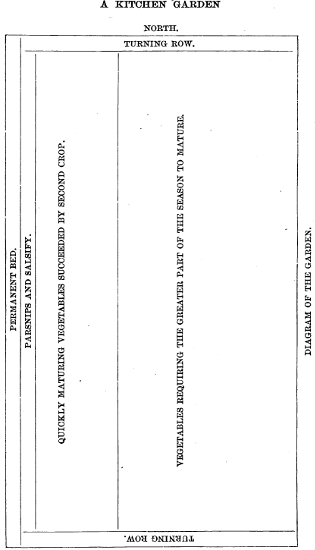
DIAGRAM OF THE GARDEN.
ASPARAGUS.
Asparagus, one of the best and earliest of spring vegetables, would be in universal use, but for the prevalent though erroneous idea that it is difficult to grow. Being a gross feeder, the soil can scarcely be too rich. Although the process of deep trenching is now being discarded, yet, to attain the best result it is necessary that a large quantity of rotted manure be worked into the bed, to a depth of at least 18 inches. Instead of losing two years’ time by raising plants from seed, send and get strong two-year old plants early in spring. Set these in the prepared bed, 18 inches apart each way, and about six inches deep. Give frequent and thorough cultivation, and as soon as the tops are ripe in fall, cut off and burn them, to prevent the nuisance of seedling asparagus about the garden. Next spring, and for at least fifteen years after, the bed should give a full crop, and should have a heavy dressing of manure put on each fall, which should be spaded in before the shoots appear in spring, together with a sprinkling of three pints of salt per square rod.
To facilitate gathering, make the bed of such a width as that the centre can be reached from both sides. Cut all shoots as soon as they appear, till the time for the final cutting, which will vary from the middle of May to the middle of June, according to latitude and your fondness for this most delicious plant.
RHUBARB.
Rhubarb, known familiarly as Pie Plant, succeeds best in deep, somewhat retentive soil. Coming, as it does, before berries or fruit, its acid leaf stalks form an admirable substitute. It may be raised from seed, but to get the quickest returns procure strong roots in spring, and plant them three feet apart each way, the ground having first been fertilized and dug to a considerable depth. Never permit a plant to exhaust itself by seed-bearing; stir the soil often, cover with coarse litter in fall, fork it over in the following spring, and you may rely upon a good supply of pie plant for many years to come.
HORSE RADISH.
The best is grown by planting 8-inch lengths of root grown the previous year. These young roots planted in spring, small end down, with the top two inches below the surface, in rich, well-cultivated soil, will form radish of large size and superior quality, in one season’s growth. After having several weeks’ growth rub off the young side roots from the newly-planted roots, to increase the size and insure a smooth, well-shaped root. See to it that no roots are scattered about the garden, as every piece of root, however small it may be, will, in a short time, become a strong plant, difficult to eradicate, and thus prove how annoying a good thing is in the wrong place.
GLOBE ARTICHOKE.
The Globe Artichoke is cultivated for its flower heads, which are cooked like asparagus, in an undeveloped state. On account of its hardiness, easy culture and perennial nature, this plant should be more generally grown. Plants raised from seed sown the previous year, set in any good garden soil two feet apart, with slight covering in winter, will remain in bearing a long time.
JERUSALEM ARTICHOKE.
The Jerusalem Artichoke needs only to be planted in order to thrive. Its tubers can be made into quite palatable pickles, and I have seen instances where, in the absence of cucumber pickles, the artichoke tuber was prepared the same way and used as a substitute.
CHIVES.
Chives are perfectly hardy perennial little members of the onion tribe, and are grown exclusively for their tops, which are used wherever the flavor of onion is required. Planted in small clumps in any common garden soil, they will grow readily, and in time increase so as to render a division necessary. The tops appear very early in spring, and can be shorn throughout the season, hence this valuable little plant should have a place in every garden.
PARSLEY.
As parsley seed is so obstinate about germinating in spring, it does better if sown in autumn, as soon as ripe. Where that is not possible, the seed may be sown in spring, but “don’t look for the plants till you see them coming,” since parsley seed just comes up when it feels like coming up, and not before. The plants should be given a moist, rich soil and a partly-shaded situation. The curled sorts are ornamental, but the plain-leaved is best for general use in cookery. When once established, a supply can easily be kept up from self-sown seed.[19]
AROMATIC HERBS.
Aromatic or Sweet Herbs are worthy of more attention than they generally receive. If cooks used them more freely, doctors would have less occasion for prescribing them. The soil of the herb bed should be mellow and warm, but not over-rich. Deep, fertile soil produces an increase in size and foliage at the expense of fragrance, strength and flavor. The seeds should be sown as early in spring as the ground can be prepared.
Sweet Basil, Summer Savory, Sweet Marjoram, Sage and Thyme are grown for their foliage, which is used for seasoning, while Sweet Fennel, Dill, Coriander, Anise and Caraway are chiefly prized on account of their aromatic seeds. Aside from being useful for culinary purposes, most of the above-named plants possess valuable properties.
This completes the permanent bed.
Before proceeding any further I wish to have it understood that hereafter, in the course of this paper, all seeds advised to be sown broadcast are to be sown in long, narrow beds, with narrow walks between the beds, for convenience in gathering the crop and to protect the plants from being trodden upon.
Where sowing in drills is advised, it is likewise to be understood that all drills are to be not less than eighteen inches apart, and the cultivation between them to be done with a hand cultivator or wheel hoe, followed by hand hoeing between the plants if necessary.
Where planting in rows is recommended, it is intended that all rows, unless otherwise mentioned, should be not less than two and a half feet apart, to admit of the cultivation with a one-horse plow or cultivator, followed also by hand hoeing around the plants or hills.
Concerning the distance plants should be apart in the rows or otherwise, it may be safely said that each plant should stand so that when fully matured its outside leaves will just touch those of its nearest neighbor. This rule does not apply to onions and root crops, which may stand closer.
Concerning the best varieties of the different kinds of vegetables the reader is referred to the catalogues of reliable seedsmen. I shall recommend such varieties as I know to be good from personal experience.
PARSNIPS AND SALSIFY.
Alongside of the permanent bed, plant parsnips and salsify. Parsnip seed germinates slowly and quickly deteriorates by age, therefore early sowing and seed of unquestionable freshness are of primary importance. The subsoil should by all means be thoroughly loosened by the subsoil plow, unless it is naturally of a loose, friable texture. When it is borne in mind that parsnip roots grow wholly under ground, and when well grown measure over eighteen inches in length, the necessity for this will be seen at once. Sow in drills and thin to five inches apart. Parsnips may safely be left in the ground all winter, as frost greatly improves them in saccharine quality.
Salsify or oyster plant, as the name implies, possesses the flavor of the oyster to a marked degree, and is highly esteemed by many on this account. It should have the same treatment in every respect as directed for the parsnip, and like it, too, is improved by frost. In the ground adjoining the parsnips and salsify, plant such vegetables as lettuce, spinach, radish, peas, bush beans, onions, kohl rabi, early cabbage, cauliflower, early potatoes and sweet corn. These mature nearly in the order named, and in time enough to be succeeded by other vegetables which will be mentioned hereafter.
LETTUCE, SPINACH AND RADISH.
Seed of lettuce, spinach and radish should be sown broadcast and as early as possible, with later sowings at intervals of about two weeks for a successive supply. Soil for lettuce and spinach should be of more than ordinary richness, and should contain sufficient moisture to insure rapid continuous growth. The best lettuce heads are raised by sowing seed in a hotbed and transplanting to the open ground when plants are two inches high. Cabbage varieties should be selected for this purpose. In this way I have grown heads of the New York Lettuce to weigh two pounds each, under ordinary treatment. Hanson, Burpee’s Golden Heart and Perpetual Lettuce are all good sorts. The Cos varieties do best if tied up a few days before using, to blanch all the inner leaves.
The Radish will thrive in any good garden soil, but a light sandy loam is better than heavily manured ground. In order to be crisp and tender, the growth should be rapid and unchecked. I can recommend French Breakfast, Golden Globe, White Stuttgart and Chartiers. The latter is of unusual merit.
PEAS.
As we all want green peas as early as possible, the seed should be planted early—the earlier the better. Peas will bear a great deal of cold without the slightest injury, either in the ground or after they are up. Sow in drills at the rate of one pint of seed to thirty-five feet of drill. To keep up a succession make a sowing of an early, medium, and a late variety at the same time. In about two weeks make another sowing as before. Soil for early varieties should be warm and very rich. Late varieties should be planted deeper than early sorts, but the soil should not be so rich, as late varieties are more productive on moist, cool ground, not over rich. Philadelphia Extra Early, American Wonder and Telephone can be relied upon. After trying various methods for training pea vines I am satisfied that brush is the most effective support. Place a few short twigs or sticks on each side of dwarf peas, to prevent them from leaning over and decaying on the ground, as is often the case in a wet season.
DWARF OR BUSH BEANS.
Dwarf or bush beans should not be planted before danger from frost is over. Being very tender, nothing is gained by planting earlier. They may be planted in hills one foot apart, with four plants to the hill, but the better way, I think, is to plant in drills, with plants three inches apart in the drill.
Seed should be covered lightly with mellow soil. Beans often fail to come up, from being covered too deeply, especially if there is much rain after planting. Two plantings of both early and late varieties, at intervals of two weeks, will give a supply until pole beans come in season. Beans should never be hoed while the foliage is wet, as that produces rust. Black Wax, Early Valentine and Golden Wax are standard sorts.
ONIONS.
Onions may be raised successfully either from seed or from sets. If to be grown from seed no time should be lost in getting it sown in the spring. Sow in drills and thin the plants when about the size of quills, disturbing the remaining plants as little as possible. For southern latitudes and for an early supply it is better to grow onions from sets planted three inches apart, in drills. Sets are small onions grown the previous year, from seed sown quite thickly. Sets may be planted very early, as they will not be injured even if the ground should freeze after they are planted. Wethersfield and Danvers are good varieties. For extra large specimens, select Italian varieties.
KOHL RABI, EARLY CABBAGE AND CAULIFLOWER.
Seed of kohl rabi, early cabbage and cauliflower should be sown in a hotbed, and the plants transplanted to the open ground when four inches high.
Kohl rabi is grown for its turnip-shaped bulb, which is formed above ground, by the expansion of the stem. The bulb should be used while young and tender, as age detracts from its good quality. Set the plants eight inches apart in the row. For later use sow seed in drills and thin to the proper distance apart. When well grown and properly prepared for the table, the kohl rabi is one of the most desirable of vegetables, and should be in every garden. Early White Vienna is the best variety.
Plant early cabbage in rows, with plants eighteen inches apart in the row. After trying several different sorts I have decided upon Early Jersey Wakefield, Early Flat Dutch, and Fottler’s Brunswick, as the best varieties for this latitude, and, as the cabbage worm has made late cabbage an uncertain crop for several years past here, in southern Illinois, we have planted largely of the Early Flat Dutch cabbage and had it picked and put up before the cabbage worm made its appearance. This I know, from experience, to be better than the use of all the insect powders combined.[20]
To grow cauliflower to perfection, the ground needs extra heavy manuring, and the plants must be supplied with an abundance of water as soon as heads begin to form. Plants should stand the same distance apart as early cabbage. The outside leaves should be pinned together over the centre, to shield the head from the direct rays of the sun, which often cause it to turn green, thus rendering it inferior in quality or entirely unfit for use. Early Snowball and Erfurt are both good and reliable. Nowhere does success depend more on the quality of the seed than in the cauliflower.
SWEET CORN.
Sweet corn should be planted as soon as the ground is reasonably warm, in hills, three feet apart, three plants to a hill. The season for sweet corn can be greatly prolonged by planting early and late sorts, at intervals of a few weeks. There are many good early kinds, but I think the best late variety is Stowell’s Evergreen, which produces ears of the largest size, that remain in a condition fit for the table longer than those of any other variety of sweet corn.
POTATOES.
If you wish to enjoy new potatoes early in the season, your seed potatoes must be planted as early in the spring as the ground can be prepared. Plant them one foot apart in the row and cover with the corn plow. I would advise the planting of medium-sized potatoes in preference to large ones cut to pieces. If large ones must be used cut them a few days beforehand, so that the newly cut surface may dry before planting, otherwise, there is danger of the pieces rotting in the ground, especially if there is much rain immediately after planting. The Early Ohio gave us excellent returns for several years in succession.
We will next take under consideration that portion of the garden devoted to the vegetables requiring the greater part of the season to mature. The most important of these are:—
EGG PLANTS, TOMATOES, POLE BEANS, BEETS, CARROTS, LATE CABBAGE, CUCUMBERS, SQUASHES AND SWEET POTATOES.
Sow Egg Plant and Tomato seed in a hotbed and remove the young plants to a cold frame when three inches high, from whence do not remove them till the weather is settled and warm.
Egg Plant will repay the extra care it requires, and should be in every garden. Handle the plants very carefully in transplanting, and never remove them to the open ground before the nights are warm. At the North plants may be grown in flower pots plunged in a cold frame till the weather is sufficiently warm. Plants should stand 2½ feet apart in the row, and the soil should be very rich and warm. New York Purple is the leading variety, but those who succeed with the Black Pekin cannot fail to be pleased with its large, glossy fruits.
When all danger from frost is over, carefully transplant the Tomato plants from the cold frame to the open ground, to stand two feet apart in the row. As they grow tie them up on a trellis and remove all superfluous branches, so as to give the growing fruit the benefit of full sunshine, without which it will be of inferior quality and scarcely worth the having.[21] Nothing can be worse than allowing tomato plants to grow along the ground at will without any support. Better it would be not to grow any at all than to degrade them in that manner. Make a small trellis, four feet high, by nailing a few pieces of lath across small stakes driven into the ground. I regard Livingston’s Perfection as an excellent variety, and have grown extra large specimens of the Mikado, which, by the way, seems to have been cast in the same mold as the Turner Hybrid.[22] Be this as it may, I can heartily recommend either variety to all wishing to grow fine, solid, enormous-sized tomatoes.
Pole Beans, as the name implies, require poles or some other support for the vines to twine upon. The poles must be set firmly, to prevent being blown over by the wind. Where poles are not procurable, the vines may be trained upon strings stretched up and down along two wires, which are stretched and firmly fastened to posts or stakes, one wire above and the other below. Pole Bean trellis, seven feet high, can be purchased, and will answer the purpose for which they are intended. The best pole bean of its kind is the Large White Lima. Being very tender, it should not be planted before the ground is warm. The beans will come up sooner if the eye in the seed is placed downward. The seed should be lightly covered with mellow soil, as this bean, considering its size, has less penetrating power in coming up than any other kind. In rainy seasons I have covered the seed with coffee grounds, which never became compact or hard from the beating rains, and nearly every bean came up nicely, while those covered with earth were almost a total failure.[23] The Large White Lima is generally considered difficult to grow, but I cannot say so, as I have grown it without much difficulty, and had beans to perfection by the pailful throughout the summer. Mine were planted in very rich soil and the rows were about four feet apart, three plants to a hill, and the hills two feet apart. If supported by a trellis, beans should be placed one foot apart in the row. The above applies to all pole beans, whether Limas or string beans. Of the latter class of beans I have found White Creaseback a variety of great merit. Southern Prolific and Dutch Case Knife are also good. At the North, where the seasons are too short for the Large Lima, the Small Lima or Sieva, as it is also called, should be planted.