Chapter III · (continued 2)
Reading edition
Visitation from house to house was kept up for many weeks previous to the election, and in the house and by the wayside, much temperance seed was sown. The result, so well known, strengthened the hearts of the laborers.
The Elyria Republican, one of the best weekly papers in northern Ohio, and a sterling advocate for the temperance cause, was started in October, 1874, and grew out of the Woman’s Crusade. The order from the Lake Shore Railroad Company prohibiting their employés entering a saloon, was the result of the temperance agitation of northern Ohio.
During the ensuing winter of 1874-75, the spirit of work being upon us, but laws unobserved, and public sentiment unfavorable to direct temperance effort, a Relief Committee for the poor of our place was added to our League. The town was districted and thoroughly visited. The sum of $358.11 was raised, besides numerous articles of comfort contributed and distributed among our poor, with the exception of $63.47 sent to the relief of Kansas sufferers.
A large and commodious room was secured in place of the old one, and occupied April 1st, 1875, and Temperance Hall still continues to be an important institution in our midst. A Tuesday afternoon prayer and business meeting is always held there, and so much of importance requires attention on these occasions, that three hours are often spent by the faithful ones, who never fail to attend.
The Temperance Lyceum, composed of sixty-seven young people, often attracting many more to their lively debates and entertainments, on Tuesday evening of each week, is the most hopeful feature of the winter of 1875-76. A jail visitation has also been added to our work during the past winter, from which reports have been of deep interest.
And now, as we cast our eyes over the years, we miss the beloved faces of many who started with us in this work. The patriarch whose constant presence and prayers at our meetings were a ceaseless benediction; the voice, sweetest of all in its pleading tones for the right, now caught up into the angel choir; the aged mothers in Israel who led in feeble strains our earthly petitions, now strong in the life above, and, with the door scarce closed between us, the man of God, who strengthened us by every good word and work—“All folded their pale hands so meekly,” “Spake with us on earth no more.”
And our work—what shall we say of that? To the superficial view the result is humiliatingly meagre. Broken promises lie scattered along the past, thick as dead leaves in autumn; friends grown cold and faithless, enemies defiant and triumphant.
But to the vision opened by faith a fairer view is revealed. In that unseen realm, where every true prayer here, sparkles with its own divine radiance, and every struggle for God and humanity is wrought into beauteous form and color; there may we see, undimmed by the mists of earth, the glorious fabric we have helped to weave.
Let us then be up and doing, and by all the experience of the past two years—richest of our lives—and by the memory of our cherished dead, renew our vows and clasp hands again for the work, as long as a brother man lies in the sepulchre of drunken degradation, and we have power from God to work.
ATHENS, OHIO.
I am indebted to Miss Helen Walker for the following facts: The temperance wave touched our place on the evening of February 4th, when in a little company of Christians, a letter from McArthur was read, speaking of the work there, and urging the women of Athens to attempt a similar one here.
A prayer-meeting was appointed for eight o’clock the following morning, to which came a number of earnest women, and a few men ready to encourage them. Women came who knew what it was to see loved ones cast away strength, and talents, and all fear of God, and lie down in a drunkard’s grave; and women came, who in secret, with tears, had been crying: “How long, O Lord?”
Since the commencement of this work, an aged mother in Israel has often remarked: “No one knows how the evil of intemperance has burdened my heart during the past winter. Though not suffering from it in my own family, yet to see so many young men yielding to its influence made one tremble for the future of our country. Oh! how many nights I have besought God to stay this evil. There were times when I could pray for nothing else.”
No doubt other Christians in our land had this subject pressed home to their hearts in the same way, and the foundations of this wide-spread temperance revival lies in such prayers.
Well, the women who met on that morning of February 5th, 1874, organized their meeting, chose President, Vice-President, and Secretary, drew up pledges, and talked of the work before them. But beyond all that they cried to the Lord their God, and set themselves to walk carefully before Him, and seek His guidance. Other prayer-meetings followed until the day fixed upon for going forth to the saloons. Ah! then there was sinking of heart, and shrinking and trembling.
On the morning of the 10th of February they signified, by rising to their feet, their willingness to go forth. How weak they felt, yet how courageous, and what a strange courage is that which accompanied trembling limbs and tear-bedimmed eyes. Then was illustrated Paul’s paradox, “When I am weak, then am I strong.” But with some the shrinking so prevailed over faith, that they went not up to the battle in the beginning. With slow steps and prayerful hearts they left the church, after joining in the solemn hymn:
“A charge to keep I have, A God to glorify.”
They walked under a heavy burden that morning, but trusting in the Lord, they went forth feeling in their souls, that “He had sounded forth the trumpet which should never call retreat.”
Three saloons were visited, but no signatures obtained, but an unseen Leader strengthened their hearts. One of the number said, “When I first opened my lips to pray, my heart grew light, and never before did I experience such a sacred nearness to God.”
In the afternoon the band increased in numbers, and they visited five places, still no signatures. The following day, February 11th, five saloons in the edge of town were visited, and one signature obtained on the dealers’ pledge; at the end of the week three druggists and two dealers had signed the pledges presented to them; a third dealer had given his promise not to sell, and a fourth had closed his saloon. These two names were afterwards placed upon the pledge.
During the next week prayer-meetings were held in four different saloons, which also had been visited the previous week. Two saloons closed this week, one saloonist putting his name on the pledge. On Friday, February 27th, one dealer signed the dealers’ pledge, and the personal pledge for one year. The following Monday, March 2d, still another dealer signed. No name was obtained from this time until three weeks had elapsed, but on the afternoon of March 25th the last druggist signed the pledge, and our work seemed drawing to a close. But much yet remained to be done to give permanence to what had been already accomplished, and to crown the work with complete success.
But still they keep praying for those who had agreed not to sell or drink intoxicating liquors. They were often remembered in prayer by name, that God would keep them faithful to their pledges.
One day when the workers were gathered in a place which seemed strange and unfamiliar, one of our number spoke In these words: “Ever since I engaged in this work I have seemed to see before me my Saviour hanging on the cross. I see Him with His bowed head, suffering, dying for me, and I want you all, with me, to think of this when our work seems heavy to us, and the way grows weary. He has done so much for us, let us do somewhat for Him.” After that sweet appeal their hearts burned within them, and did they not draw nearer to the dear cross? At other times, when the flesh was weary, and faith drooped, how a few words from the Bible would cheer them! “I will lift up mine eyes to the hills, from whence cometh my help. My help cometh from the Lord, who made heaven and earth. The Lord shall preserve thy going out, and thy coming in, from this time forth even forever more.”
Time would fail to recall the many incidents and memories connected with this work. We have been more than repaid for all our weariness and anxiety, by our sweet Christian communion with each other, and with Jesus, and by seeing this cause, which is of the Lord, prospering, and we pray that he will still carry it on to a sure completion.
Laura Ballard adds the following:
The Crusade work in our town was characterized by great earnestness and spirituality; and those of us who were engaged in it will never cease to thank the Lord for the part we were permitted to take in it. The sin of intemperance is very far from being done away with in our town; but when some sneeringly tell us, “the woman’s work did no good, things are worse than before,” we can only say, we don’t understand just how, and why it is; but we know that, that work was of the Lord, and we were called to it, and the Lord never makes mistakes.
A temperance prayer-meeting has been kept up ever since that time, and is now well attended. We meet during the warm weather at eight A. M., on Friday morning. It is cheering to see twelve or fourteen mothers and housekeepers lay aside their morning work for an hour of earnest pleading with the Lord for a blessing on those who never pray for themselves.
COLUMBUS, OHIO.
The gospel wave of temperance had cleared many of the villages of Ohio of rum, before the larger towns engaged in the movement. The work in the cities was undertaken with many misgivings. The saloons were so numerous, and the foreign population so large, and because of appetite, or interest so identified with the liquor business, that many worthy Christian people advised against saloon visitation. A mob and bloodshed might be the result.
But in Columbus, Ohio, the women met daily to counsel with each other, and to pray. And on the 3d of March, while at prayer, in the First Presbyterian Church, the baptism of the Holy Spirit came down upon them, and fifty women, consecrated to God and His work, rose from their knees and marched forth from the church to the saloons. Not, however, till they set the great bell, hanging in the steeple, to ringing.
The tolling of the bell attracted the attention of the people, and the news that the women had begun a Crusade against rum, spread like a flash, and in a few moments vast crowds of people were following them.
After visiting the principal hotels and saloons, they returned to the church, and a rousing prayer-meeting followed. Many who had not been accustomed to hear the gospel, were there to listen to the songs and prayers.
The next day the number of Crusaders had increased to three hundred, and there was great enthusiasm among the better class of people. As the women slowly filed out of the Presbyterian Church, many of the church-bells were rung. Thousands of people lined the streets, and many a “God bless you” followed them. But the German beer-dealers were very angry, and were determined to break the matter up, or turn it to ridicule, if possible.
One saloon-keeper had provided a brass band, and when the ladies appeared before his saloon, the band struck up, “Shoo, fly, don’t bother me,” and many of the drunken roughs joined, with inharmonious voices. But the ladies, not the least disconcerted, sang one of their sweet gospel songs; and many a tear was brushed away from manly cheeks, as amid the jargon they lifted their gentle voices to God in supplication for these wretched lost ones, who gloried in their shame. The band, however, changed to “Home, sweet home,” and they were followed by laughter and jeers, as they moved away.
The saloon-keepers rallied their forces. Their wretched victims, crawled out of their dens, to join in the hooting and howling with which they greeted the purest and best women of the city, and mock prayer-meetings were held, after which beer was freely dispensed, without pay. It was evident that Satan’s kingdom was stirred, and a strong stand would be made against the Crusaders.
Passing through Columbus, about this time, I caught a little of the spirit of the movement, and heard many interesting facts.
A Boston gentleman, who boarded the train at Columbus, but who looked back wistfully as we moved out of the city, told me that he went there prejudiced against the whole movement. He could not reconcile it with his ideas of social propriety, or womanly delicacy. But curiosity led him to their meetings, and he had followed them, day after day, through the streets, till all his prejudices were gone. It had given him a new view of Christianity, as an aggressive power against sin. He never had been so impressed with gospel truth in all his life, as in these meetings held in the streets and saloons. The solemnity of the judgment day rested down upon the masses of the people: others acted as if possessed with devils.
It was an awfully solemn sight, to see arrayed on the one side, the best and truest Christian women of the city, with earnest, solemn faces bending in prayer, and appealing in gentle, eloquent words to God, in behalf of those who reviled them, and who were ruining their homes and their city; while, on the other side, men of avarice leered at them from behind their counters, and the bleared and bloated victims of rum, with the leprosy of sin written all over their faces, mocked at the truths which alone could save them from a drunkard’s grave and a drunkard’s hell.
“With all my prejudices against women speaking and praying,” said he, “it didn’t take me long to determine which side I would take. I have stayed a week here, since getting through with business, to enjoy the Crusade, and marvel at the wonderful works of God. Thank God for the Crusade!” he added, reverently.
A German, who had listened with unconcealed interest, now broke in upon the conversation.
“You b’lieves in dem Crusaders? I dinks dem vimins has besser be at home mit der chil’ren. I has von goot frien’ in Columbus, and dese vimins spile hees pisness entirely already. Mine frien’ is von nice man, has much riches already, and von fine house and carriage, and everyding so nice. But dese vimins come so much singin’ and brayin’, and so much foolishness, that he loses much money already, and dey most set him crazy mit der brayin’.”
“What business is your friend in?” I inquired.
“He keeps von nice lager peer saloon.”
“How is it that he loses money? The women don’t take it.”
“He give away so much peer already to get the peoples to come dere and drink, so that the vimins will be ’fraid, and go way purty soon.”
“The women don’t want him to give away his beer.”
“Well, dey rob him; dey trive the people from der schop.”
“How many horses and drays were sold, and how many women and children did he rob, that he might buy a carriage?”
He took the hint immediately, and spoke up with some spirit—
“Dat is dere pisness. He dakes gare of hees own wife and chil’ren.”
“And these women are taking care of their business and their families, by breaking up his trade.”
“Dis is von strange countre—I never vonce see vimins do zat in Schermany. Zis is no free countre any more. Good-day, madame, I goes into de schmoking-car.”
It was very evident that the mass of ladies and gentlemen near us were in sympathy with the Crusaders, from the undisguised pleasure they took in the hasty withdrawal of the knight of the beer mug. I saw his face no more.
On the 20th of March two or three hundred of the women of Columbus, marched in a procession to the State Capitol, and held a meeting in the rotunda.
The members of both houses left their seats, and stood reverently, with uncovered heads, during this meeting. The women were preparing for a struggle that they foresaw would come, and they went to their work boldly. A bill was introduced in the legislature to protect the sale of ale and beer.
The women met it with counter-petitions, and mass-meetings. Delegations came from all the neighboring towns, and the capitol building was crowded during every session with the friends and enemies of temperance. It was a hand-to-hand fight with the rum power, and the women gained the victory.
On the 18th of April they had the satisfaction, after the midnight hour, of seeing the legislature adjourn without doing anything in the interest of rum.
Columbus contains a large foreign element, and the work was, therefore, the more difficult and dangerous: the men hooted, blasphemed, and even spit upon the kneeling women. While the women were at prayer, before a saloon, one day, a German shouldered a keg of beer, and marched through the prayer-circle, and the men and boys set up an unearthly shouting and screaming. But good results followed: several saloons closed out business, and liquors of all kinds were banished from the Union Depot; many men reformed, and many citizens signed the pledge, among them James G. Bull, mayor of the city. At a State dinner, soon after, where every luxury was provided, wine was banished; such was the advance made in public sentiment. A State dinner without wine would not have been thought possible before the Crusade. And so the women work on, looking for the time when complete victory shall crown their efforts.
VAN WERT, OHIO.
The work began about the 10th of March, 1874.
The following officers were chosen: President, Mother Webster; Vice-Presidents, Mrs. Elcock, Mrs. Hines, Mrs. Kennedy, Mrs. Sevinford, Mrs. Richey; Secretary, Mrs. M. J. McFadden; Executive Committee, Mrs. M. M. Minger, Mrs. M. Harnly.
The Spirit of the Lord seemed to move upon the hearts of the women. A meeting was called to be held at the M. E. Church. I doubt whether any one had any definite plan in view.
Mrs. Dr. Hines (one of the faithful workers), in relating her experience of those days, says: “I heard of the meeting, felt quite undecided about going; but I felt a restlessness, and could not be satisfied to stay at home. I took my seat in the back part of the church, thinking I would not say a word. Very soon some one called out, ‘There is Mrs. Hines: let us hear what she thinks of this movement;’ and then, without a moment’s hesitation, I said, ‘I thought the work would be a success, that God was about to answer the prayers of those crushed women and children, who had felt the power of the demon drink so long, through those that should have been their protectors; and from that day to this the work of the Crusade has been dear to my heart.’ Another says:
“As for myself, I remember well when I first heard the work talked off. I thought if it ever came here, I would do all that I could, quietly, so that it would not be noticed; but firmly determined in my own mind that I never would go into a saloon to pray, nor go out upon the streets, under any circumstances, or appear in public, but would be a silent worker. But nothing could make me believe that the Crusade was not the direct power of God upon the hearts of His children. The work was inaugurated at that first meeting I spoke of, and almost before I had time to think, I was addressing an audience of hundreds. God gave me power, and for a year, with others, I went to different places in the country helping to defeat license. Ohio gained this victory through the Crusade.
“Although of a very delicate constitution, I, with my sisters, went through mud and slush, standing or kneeling in the snow, going to meetings night after night, visiting saloons in the daytime, and through it all, and all the opposition, God preserved us by His mighty power, and to His name be all the glory. After a while the number thinned, until but the faithful few remained. Our prayer-meetings have been kept up until the commencement of the reformed men’s movement this spring.
“Our aged President, Mother Webster, was always a power in the Crusade, faithful to the last.
“During the first week of the work in Van Wert, one saloon-keeper, a German, who had always been accustomed to drink beer, refused the ladies admittance, while his wife made sport, and laughed mockingly at the ladies. But one morning, when the band stopped at his door, he admitted them, and told the ladies he had sold his last drop. Then there was such a joyful hand-shaking, and a prayer-meeting of thanksgiving.
“Another German, who was poor and had a family of interesting children, was very much opposed to the ladies’ visits. For some time they were refused admittance, and prayers were offered in German and English. About a week afterward, he disposed of his liquors, put out his white flag, and started to meet the ladies, telling them he had sold his last drop of liquor. It was a sacrifice, for he was dependent upon his daily labor for the support of his family.” We are indebted to Mrs. M. Harnly and Mrs. Elcock for the above facts.
The contest, with various successes, continued until the 6th of March, when a decided victory was gained at the municipal election. The ladies worked and prayed, and many of the temperance men were energetic and persistent. The issue was squarely made, “whiskey or no whiskey.” The temperance candidates won a decided victory. When the result of the election became known, the bells rang out a joyous peal, and the new mayor-elect, Mr. T. S. Gilliland, rolled out a barrel of apples that were in his office as a temperance treat. A prohibitory ordinance was passed, and the saloons were closed.
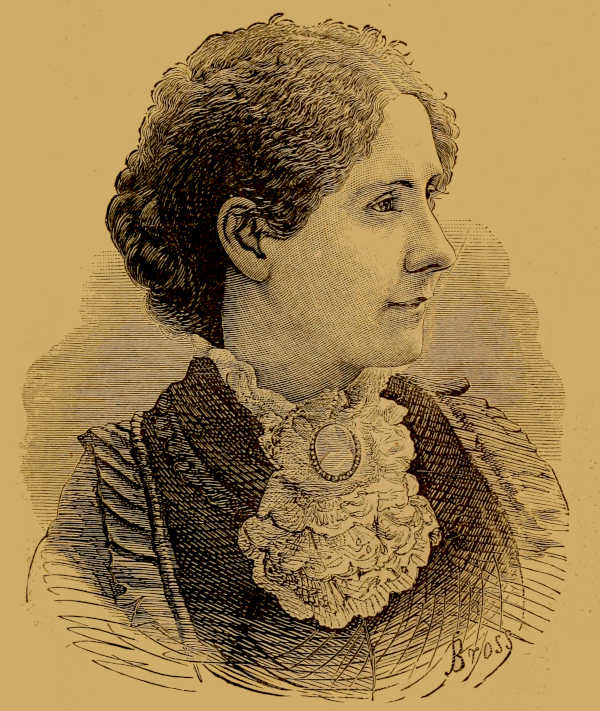
MRS. SARAH KNOWLES BOLTON,
First Assistant Corresponding Secretary Woman’s National Christian Temperance Union.
CINCINNATI, OHIO.
There was much prayerful interest in Cincinnati. Many of the best women of the church, bending low at the dear Christ’s feet, were asking: “What wilt thou have me to do?”
The difficulties in the way seemed more formidable for saloon work there than at any point in the State, or perhaps in the country. But these consecrated women were ready to follow the Master wherever He led.
Cincinnati was a great manufacturing centre. The annual trade in spirituous and malt liquors amounted to over $33,000,000, and there was immense capital invested in massive buildings and machinery.
One-third of the population of the city were Germans, accustomed to beer-drinking, which tended to make the traffic respectable.
Any interference with the trade was regarded as an attack upon their personal liberties. Many of them were ignorant bigots or infidels, who were ready, on any pretext, to cry out against the Bible and Puritanism, and many of them belonged to the criminal classes, as the police records will show.
To meet this class in the saloons and beer-gardens, when the city council was made up largely of men interested in the traffic, and the mayor of the city was ready to do the bidding of the liquor oligarchy, was a fearful risk. But Christ led the way and gave the courage.
The first saloon visited was a fashionable resort, called the “Custom House,” next door to the Merchants’ Exchange. The house was well patronized by first-class drinkers.
The time chosen was the lunch hour, when many of this class were lingering over their cups.
The women, unheralded, were in the saloon before any of them had time to escape. In a moment an immense crowd was surging about the door, and escape was impossible. A prayer-meeting was held, which lasted about half an hour.
The proprietor, affecting indifference, invited them to “come again,” an invitation which they accepted; but when they visited that saloon again it was like “a banquet hall deserted:” the merchants and fashionable drinkers were careful not to be caught there again.
The trade began to be interfered with, which aroused bitter opposition, and the saloons were closed against them.
The Esplanade, a large, paved square in the heart of the business part of the city, and the market-places, became praying-stations, and many a season of prayer was held on the curbstones opposite saloons.
A CRUSADE DOG
A lady in one of the bands had a large Newfoundland dog, that always accompanied her.
He seemed to know their business. He would walk before them with stately mien, till he came to a saloon, and then stop and turn around, as much as to say: “Here is work for you.” He would walk back and forth before the saloon while they sang; but as soon as they knelt to pray he would go and set himself down on his haunches beside the woman who lead in prayer, no matter if she were a stranger, and reverently maintain his position till the prayer was ended. Then he would start briskly off to look for another saloon.
It is said that he showed a decided preference for only one prayer at each saloon. Perhaps he knew that there were nearly three thousand in that great city, and feared that they would not make the rounds, unless he hurried them.
A German saloon-keeper tried to set his dog on one of the bands, (not this one,) but the poor brute had more sense, and politeness, and humanity, than his master, and wouldn’t even bark, but hung his head in shame.
One day the crowd about the Esplanade was very large and threatening. Every foot of space was occupied, and all the streets approaching it were filled. But the ladies had advertised a meeting there, and they went forth, in the name of Christ, to face the howling mob.
They marched right on, two and two, as though no crowd menaced them. Many temperance men, and order-loving citizens, were there mingling with the crowd, determined to prevent, if possible, a riot. Mrs. Leavitt led the band. The crowd parted as they approached. A scissors-grinder had been hired by the rum party, for twenty-five dollars, to push his cart through the crowd, ringing his bells. He undertook the job, but his cart was broken into a thousand pieces, and he was arrested and marched off to jail, and subsequently fined fifty dollars. So his enterprise did not pay. Mrs. Leavitt gave the following graphic account of the beginning of the Crusade, at one of the mass-meetings held in connection with the annual meeting of the National Union at Newark, which was reported by Miss M. E. Winslow for The Morning, from which we copy:
“People at the East have little idea of what the Crusade really was. One of our local papers described its opening in these terms: ‘Hell on earth! The devil woke up! The women on their knees!’ I always knew that liquor was an awful thing, but I felt no responsibility about it, and when I first heard of the Crusading in Hillsboro’ and Washington Court-House, I felt in my heart, though I did not say so, that it was a prostitution of prayer. But there came to that city of 3,000 saloons, (open twenty-four hours of every day, and seven days of every week, with an average of 15,000 men pouring out death by the glass all the time,) a call for the women to meet and consider the subject in a certain church. I went to my room and asked the Lord what I should do. It was a short prayer, for in ten minutes I was at the corner with my hat on, on my way.
“The church was fuller than I had ever known it, women, old and young, rich and poor, praying and sobbing; and such prayers I had never heard. In an hour or two about eighty of us started—I hardly know how we did it—for one of the most fashionable saloons. The wealth represented by those eighty women being over $3,000,000. We walked two by two; some men blessed us as we passed, and some cursed. We went into the ‘sample-room,’ and asked permission for a moment of prayer, which was granted. You can imagine the praying we did, as we agonized that Jesus Christ would come and convert that rum-seller. Eight thousand people had gathered outside in a few moments. I had never opened my mouth to pray in public before, but God opened it now. We were there thirty or forty minutes, and then went out, where men pointed a finger of scorn at us, and every one thought we would be crushed. But we never felt so near heaven as we did then. We walked homeward, singing, ‘There is a Fountain filled with blood.’ Every day after that we met at nine o’clock, and went out in bands every hour, visiting different saloons, hundreds following us.
“One day I led a band of eighty, or a hundred to the Esplanade. The authorities had said this must be put down, and the mayor had privately given orders to the police to ‘be scarce where the women were.’ We did not know that; and after visiting fourteen saloons, we marched towards the Esplanade, where we found a dense mass of several thousand men awaiting us. I heard a man say, ‘Jack, a woman’s foot shan’t touch the Esplanade to-day!’ And I said, ‘Lord, give us the Esplanade.’ One great brutal-looking fellow stood in my way, debauched and degraded, yet with a look which told there was a heart somewhere. I took it for granted this was Jack. Bless God for woman’s intuition. I walked right up to him and said, ‘Jack!’ He started as if he wondered how I knew his name. ‘Jack, we are a band of broken-hearted mothers and wives, weeping and praying because you are all going to hell as fast as you can go. We want to pray here, right by this fountain, and I want you to make way for us and keep the men still till we get through our service.’
“First he looked like thunder; then he looked foolish; then I smiled sweetly at him (always smile at a man if you want him to do what he don’t want to), and he said, with a fearful oath, ‘I’ll do it. Make way for the Crusaders!’ and as he forced his great, brawny shoulders through the crowd, many voices shouted,
‘GOD BLESS THE CRUSADERS!’
I never asked the Lord for a policeman again. I’d rather have Jack. At last we stood close to that central fountain, which is the glory of Cincinnati, and sang, ‘Jesus the water of life will give,’ and I think there must have been joy among the angels of God at the chorus that rung through the square. Then we sang ‘Rock of Ages,’ and then I talked to the crowd. I forgot all about the liquor-saloons, and thought only of Jesus Christ upon the cross, I then called upon all who wanted to be saved and have us pray for them to kneel down, and 2,000 men, mostly reeking with the fumes of rum and tobacco, knelt there on the pavement seeking Christ, with tears and sobs.
“The next day our church was so full that we were obliged to have some place to hold an overflow meeting, and we telegraphed to Rev. Mr. Beecher (nephew of Henry Ward Beecher), that we must have his church in ten minutes. ‘Ten minutes, do you say? You shall have it in five,’ was the answer, and in ten minutes it was packed to overflowing; and afterward we held two daily meetings.”
One of the regular meeting-places of the praying bands of Cincinnati was a large, open market-house. Thousands gathered there daily. The place and all the avenues leading to it were usually well filled. But one day, as the band of women approached, they found an unusually vile and belligerent crowd. Butchers fresh from their stalls, with their sleeves rolled up, and their bloody aprons on, and their butcher knives in their hands; villanous-looking men with ugly pistols protruding from their pockets; and women debased by strong drink, uttering curses, were all huddled together, while just across the street a cannon had been placed so as to sweep the market-house if fired.
Altogether, the circumstances were anything but encouraging. But the women marched right on to their usual meeting-place in the centre of the open space and began to sing:
“There is a fountain filled with blood, Drawn from Immanuel’s veins, And sinners plunged beneath that flood Lose all their guilty stains.”
The crowd was somewhat hushed into respectful silence by the singing. Mrs. Leavitt, who led the band that day, made the opening prayer. As they knelt on the paving stones she found herself facing the cannon, with a possibility of its being fired.
The crowd, that seemed to expect such an event, surged to either side so as to be well out of the way. But her consecration to God covered all that, and she remembers saying to herself: “If God wants to take me, as He did Elijah, to heaven in a chariot of fire, I would just as soon go that way as any other.” And she thought no more about the cannon or the vile men with knives and pistols, but prayed straight up to God for the perishing multitudes about her. And there came down upon the people such mighty awakening power, that the most desperate and unbelieving bowed their heads, and tears streamed down many a sin-scarred face.
And when the meeting was over, and they invited the people to come with them to the house of God, many followed them to the church, and hundreds remained to pray.
The placing of the cannon was a trick to frighten the women, but it did not succeed; and as they took no notice of it, the experiment was never repeated. The falling off in the liquor traffic in Cincinnati was very great; the trade in the leading houses in that business losing tens of thousands of dollars.
During the first six months of the Crusade, in the United States Revenue District in which Cincinnati is situated, the falling off In the revenue on liquor alone was about $3,000,000. And such was the interest, that one day the Merchants’ Exchange suspended, at least for a time, their business, to follow a few women who modestly and quietly sang and prayed on the Esplanade, or before the large saloons near by.
At first, the manufacturers and dealers laughed at the attempt of the women to call public attention to the traffic. But when they saw that this was effectually done, and that they were losing by thousands, they were wild with rage.
I overheard a conversation between two Cincinnati liquor-dealers at the time.
They were seated just behind me in a railroad car, so I could but choose to hear; and the curses they heaped upon Christian women were loud and deep; almost every word was emphasized with an oath.
“We must do something to stop this horrid thing, or we are ruined,” said one.
“The press has played the mischief with us,” exclaimed the other, “by publishing their movements. We must buy up the press. If they don’t stop writing about it, we must withdraw all our advertisements. Let this be a united thing with us, and they will soon have to look after their own bread and butter. These women have cut down my sales more than $20,000 this spring.”
“The mayor and city council ought to do something before the city is ruined. They are a pack of fools to let a few praying women ruin our business in this way.”
And then they talked and planned earnestly. The press was to be dealt with, the mayor brought to issue a proclamation against the women, forbidding their singing and praying on the streets, etc.
The mayor and city council were quite willing to serve the rum cause, as results show.
The ladies soon after were informed that they could no longer hold meetings in the streets, but must confine themselves to the public squares and market-places, unless a saloon-keeper chose to open his doors to them.
They obeyed orders, and went on with their work in the places designated. But one day, while one of the bands was quietly walking up the street, they were met and surrounded by a mob of the vilest men and women in the city. They were, no doubt, sent out by the dealers to intimidate the women, and received their reward in strong drink on their return.
The mayor also, accompanied by his private secretary, came to them and earnestly appealed to the ladies to quit their work and go home.
“I’ll not be responsible for your safety unless you do. For God’s sake, ladies, desist.”
The ladies in turn appealed to him to disperse the mob. They were quiet, unoffending citizens, walking the streets, which was their right; and as for their lives, they relied on God, not on him. All the while this parley was going on, the vile drunken mob was hooting and howling.
No attempt was made to disperse them. But the mayor was exceedingly annoyed with the violence and obscenity of a German woman near him, and turning upon her he commanded silence. “Shame! shame! such indecency.” But the words were scarcely out of his mouth till she began cursing him, and the mob uttering a horrid yell rushed toward him. He raised his hand, waving them back; but they came on like a herd of wild cattle, pushing each other forward, whirling him like a top from the sidewalk into the gutter. His secretary ran like a frightened deer, and the mayor, as soon as he could gather up himself and find his hat, followed suit. They remembered Lot’s wife, and never looked behind them. Some of the women of the band had been knocked down; but they soon fell into line, and now that the mob was behind them, marched down into the heart of the city, singing,
“Nearer, my God, to Thee, Nearer to Thee, Even though it be a cross, That raiseth me.”
The insults offered to the ladies aroused a feeling of indignation, and an address was prepared, and a committee of gentlemen appointed to present it to the mayor. The reading of the paper brought on a discussion, in which the mayor said it would take all the police force within twenty-four square miles of the city to protect the ladies.
Dr. Payne—“Do we understand you to say that you are powerless in the hands of a mob?”
Mayor Johnson—“It would appear so from the practical experience of yesterday afternoon.”
Dr. Payne—“Then, sir, it is high time that the pulpit began to thunder, and that all good men should arise, and see that men are elected who will enforce the law.”
The committee then entered upon a defence of the rights of women to go upon the streets as they had been doing, notwithstanding the riotous crowds which surrounded them, and the disorders consequent thereon, which point the mayor met by saying, that he believed with Lincoln, that the blow should be aimed at the cause.
Dr. Payne—“Yes, but the cause is the liquor traffic, not these women.”
Dr. Taylor—“We only claim their rights, and if women cannot be protected by law, the result will be that neither can we, and the blow that strikes them, strikes us. If they be prosecuted for praying, so may I. The same mob spirit that attacked women yesterday, may attack citizens. If we cannot obtain protection, by addressing you, where shall we go?”
In the course of the conversation, the mayor said, that the whole Board of Police Commissioners were opposed to the women.
Immediately following this interview the mayor issued a proclamation, addressed: To the ladies composing the Temperance League; forbidding them to hold meetings on the streets, basing this action on an old sidewalk ordinance that had been a dead letter for years.
I quote again from Mrs. Leavitt’s speech.
“By this time there was such a falling off in the liquor trade that the mayor and common council, twenty-three of whose members were in the liquor trade, said the Crusade must be stopped; so they raked up an old sidewalk ordinance which said that no group of more than three should occupy the sidewalk at any one place and time. But we knew nothing of it, and we went to a saloon where we were denied admittance, so we knelt outside. The pavement was eighteen feet wide, of which we occupied about thirty inches. I was leader that day, and gave out, ‘Rock of Ages, cleft for me,’ when a policeman laid his hand on my shoulder, and said, ‘Mrs. Leavitt, you are under arrest!’ ‘All right,’ said I. ‘Let me hide myself in Thee.’ And then we prayed for that policeman, and for the others, and for the crowd. We tried the patience of that policeman a little, for our service lasted sixty minutes. Some shouted, some cried, but all were happy; and then we rose and walked in an orderly manner, two by two, about two miles, to the station-house. As soon as we got there we kneeled down and prayed again, and then they asked our names, nativity, and ages. They took mine first, and while they were taking the others, I thought may be the Lord had something for me to do there; so I went round to the cells and talked with the inmates. In one I found a boy of eighteen, who said, ‘I wouldn’t have my mother know I am here for all the world. I came in under an assumed name. Did you?’ So I visited every cell, and pointed every prisoner to Christ. I tried to guess a conundrum (I never guessed one in my life), and I will give it to you. ‘How is it that every one I spoke to was put in for drunkenness, and we forty-three women were brought there for trying to put it down?’ We expected to be sent to the work-house for thirty days; so presently the husband of one of our number came in, and asked in the most touching tones, ‘What shall I do with the baby?’ ‘Go home and feed him,’ said his wife, ‘I wouldn’t be got off for twenty babies.’ Then the mayor came in. You have heard of the man who drew the elephant in a lottery, and then didn’t know what to do with it. The mayor looked just like that man. At last, when we had stayed two hours, the common council excused us till Monday on parole. So we marched back to the church, and gave our report, and it seemed as though the roof would come off with the ring of the doxology that followed.
“On Monday morning we went to the police court, and while they were trying the prisoners for drunkenness, we who were arrested for trying to stop them from drinking went round, preached Christ, and got twenty signatures to our pledge. When our turn came they did not know what to do with us. We had put on all our best things, and though I say it, were FORTY-THREE OF THE PRETTIEST-LOOKING WOMEN YOU EVER SAW, and all just as happy as could be. Six of us were ministers’ wives, three wives of rich bankers, and all the rest of wealthy citizens. At last they told us we had been naughty, but they would forgive us this time if we wouldn’t do so any more. We went back to the church, and a few of us went out crusading.
“But we didn’t want to break the law, and just at this time the Crusade began to change its form from active crusading into steady, organized work; so we only went out in parties of three or four, and we have been doing this ever since.”
The city officers and the police force were in the interests of the liquor traffic, and the arrest of the ladies was a part of a well-concerted plan to break down the temperance work.
We must not omit to give the names of the forty-three women arrested and thrust into the common jail:
Mrs. Rev. S. K. Leavitt, Mrs. Rev. W. I. Fee, Mrs. Rev. C. H. Taylor, Mrs. D. H. Baldwin, Mrs. Charles Folger, Sarah Shipley, Mary Whitaker, Mrs. May A. French, Mrs. Olive Roseboom, Mrs. Lottie Oldrieve, Mrs. Lizzie R. Harvey, Mrs. A. F. Whiteman, Miss Ellen King, Mrs. S. E. Massey, Miss Kate M. Warden, Miss Helen Russell, Miss Susan Sutton, Miss Annie Nunn, Mrs. J. R. Squire, Mrs. Mary J. Montford, Mrs. Ellen Hewson, Mrs. Whitredge, Mrs. Rev. C. H. Payne, Mrs. Rev. A. McHugh, Mrs. Dr. Carter, Mrs. S. J. H. Elstner, Mary White, Mrs. Kate Traugh, Mrs. Maria Stevens, Mrs. A. V. Crum, Mrs. H. Robinson, Miss Lottie Nunn, Mrs. Lucy M. McKenzie, Mrs. May Francis, Miss May Talbot, Miss Jennie Forbes, Miss Mary Scott, Mrs. E. B. Dalton, Miss Eliza Hughes, Mrs. Frederick Hanbold, Mrs. Mary Warner, Mrs. E. H. Mance, Mrs. Wealthy Fisk.
Dr. Fowler, of Chicago, who happened to be in the city at the time, and went with them to the jail, at a mass-meeting said: “Although I do not belong to this city, I say as an old heathen said, ‘Whatever concerns mankind, concerns me.’ Not only the immortal forty-three, but every woman in the land went down into the streets yesterday, and was scoffed and jeered at by those who stood in the saloon doors. You are not alone. All the good people of the land say, ‘You are fighting our battle,’ and from 10,000 pulpits are going up prayers for those who have made one bright page on the records of the police courts. The day may come when you can sell that page for money, enough to buy all the saloons in the city.” (Applause.)
Stirring, eloquent speeches were also made by Dr. C. H. Payne, Mr. Rowland, Rev. S. K. Leavitt; and Mrs. Leavitt followed with a solemn, earnest appeal, that brought nearly all the men and women in the house to their feet.
There was a meeting of citizens of the first ward, and a protest was prepared and sent to the mayor and city council—a protest, strongly condemning their action and calling upon them to maintain law and order.
Nearly all the pulpits of Cincinnati thundered against the liquor traffic, a strong public sentiment was created, and the women have gone steadily on with their work from that day to this. A large number of meetings are sustained in various parts of the city, and at Walnut Hills; tens of thousands have signed the pledge, and it is no longer respectable to sell or drink intoxicating liquors in Cincinnati.
A large hall has been secured for head-quarters, where meetings are held daily, and their influence is felt throughout the entire city.
WHITE SHOES AND WHITE DRESSES.
One morning, during the Crusade, a drunkard’s wife called on Mrs. Leavitt. She carried a babe in her arms only six weeks old, and was pale and weak from sickness and fasting, and this was her pitiful story:
“My husband is drinking himself to death; he is lost to all humane feeling; our rent is unpaid, and we are liable to be put out into the street, and there is no food in the house for me and the children. He has a good trade, but his earnings all go into the saloon on the corner near us; he is becoming more and more brutal and abusive. We seem to be on the verge of ruin. How can I, feeble as I am, with a babe in my arms, earn bread for myself and children?”
“Why not have your husband converted?” questioned Mrs. Leavitt, as the drunkard’s wife finished her sad story.
“Oh, there is no hope of such a thing. He cares for nothing but rum.”
“I’ll come and see him this afternoon.”
“He’ll insult you.”
“No matter; my Saviour was insulted, and the servant is not above his Lord.”
That very afternoon Mrs. Leavitt called at the little tenement house. The husband was at work at his trade in a little back room, and one of the children was sent to tell him that a lady wished to see him. The child, however, soon returned with the message: “My pa says he won’t see any one.”
“You go back and tell your pa,” said Mrs. Leavitt, in her energetic way, “that a lady wishes to see him on very important business, and she must see him, if she has to stay till after supper.”
She knew there was nothing in the house to eat. A moment afterward a poor, bloated, besotted wreck of a man stood before her.
“What do you want?” he demanded, as he came shuffling into the room.
“Please be seated and look at this paper,” she answered, pointing to a vacant chair at the other end of the table at which she was sitting, and handing a printed pledge to him.
He read it slowly, and then, throwing it down upon the table, broke out violently:
“Do you think I’m a fool? I’ll drink when I please, and let it alone when I please. I’m not going to sign away my personal liberty.”
“Do you think you can stop drinking?”
“Yes: I could if I wanted to.”
“I think you’re a slave to the rum-shop down on the corner.”
“No!”
“Then you love the saloon-keeper’s daughter better than you do your own little girl.”
“No, I don’t, either.”
“When I came by the saloon-keeper’s house I saw his little girl coming down the steps, and she had on white shoes, and a white dress, and a blue sash. Your money helped to buy them. I come here, and your little girl, more beautiful than she, has on a faded, ragged dress, and her feet are bare.”
“That’s so, madam.”
“And you love the saloon-keeper’s wife better than you love your own wife.”
“Never; no, never!”
“When I came by the saloon-keeper’s house, I saw his wife come out with the little girl, and she was dressed in silks and laces, and a carriage awaited her. Your money helped to buy the silks and laces, and the horses and the carriage. I come here, and I find your wife in a faded calico gown, doing her own work: if she goes anywhere, she must walk.”
“You speak the truth, madam.”
“You love the saloon-keeper better than you love yourself. You say you can keep from drinking if you choose; but you helped the saloon-keeper to build himself a fine brick house, and you live in this poor, tumble-down old house yourself.”
“I never saw it in that light before.” Then, holding out his hand that shook like an aspen leaf, he continued: “You speak the truth, madam—I am a slave. Do you see that hand? I have a piece of work to finish, and I must have a mug of beer to steady my nerves, or I cannot do it; but to-morrow, if you’ll call, I’ll sign the pledge.”
“That’s a temptation of the devil; I did not ask you to sign the pledge. You are a slave, and cannot keep it. But I do want to tell you this: There is One who can break your chains and set you free.”
“I want to be free.”
“Well, Christ can set you free, if you’ll submit to Him, and let Him break the chains of sin and appetite that binds you.”
“It’s been many a long year since I prayed.”
“No matter; the sooner you begin the better for you.”
He threw himself at once on his knees, and while Mrs. Leavitt prayed she heard him sobbing out the cry of his soul to God.
The wife followed Mrs. Leavitt in an earnest prayer. The words were simple and broken with sobs, but somehow they went straight up from her crushed heart to God, and the poor man began to cry in earnest for mercy.
“O God! break these chains that are burning into my soul! Pity me, and pity my wife and children, and break the chains that are dragging me down to hell. O God! be merciful to me, a sinner.” And thus out of the depths he cried to God, and He heard him and had compassion upon him, and broke every chain and lifted every burden; and he arose a free, redeemed man.
When he arose from his knees he said: “Now I will sign the pledge, and keep it.” And he did. A family altar was built, the comforts of life were soon secured—for he had a good trade—and two weeks after this scene, his two little girls came into the Sunday-school, with white shoes, and white dresses, and blue sashes on, as a token that his money no longer went into the saloon-keeper’s till.
But the lesson that should impress us most is, that this disciple, helped of God, devoted less than two hours to this service of redeeming a family for time and for eternity. Go, thou, and do likewise! The Master is waiting for you in many a desolate home. Go, speak in His name, and He will be with you, and help you.
WHAT A PICTURE DID.
The heading of The Reform, an illustrated tract paper, is composed of three pictures. The first represents a drunkard staggering home to his family. In his hand he holds a bottle; his wife, with her babe in her arms and her little boy clinging to her dress, is shrinking from him. Terror and fear are depicted upon the countenances of the three.
The second picture represents the same man, standing at a table, a woman holding out a pen to him with one hand, and with the other a paper upon which are seen the words, “Temperance Pledge.”
In the third picture we see the same man, well clothed, walking erect, with a cane in his hand, and leading a little boy up a flight of steps to a nice house, in the door of which stands the wife, with beaming smile upon her face, and hardly able to hold the baby, who is overjoyed at seeing the father.
A bundle of these papers was sent to one of the ladies in Cincinnati, who distributed them in the market, at the hospital and jail.
Two months afterwards she was stopped on the street by a German woman, who told her the following story:
“You shoost stop von minute vile I tells you vot is in mine heart. You come von day to mine stall in de market, you give mine old man a paper, and you gives me a paper.
“Ven I goes to mine home, mine children dey cries for dere dinner. I says, ‘You shoost keep still, and I vill give you von paper a vomans give me in de market.’ So dey spreads a paper on de floor, und dey kicks up dere heels, und dey looks hard at de pictures. Vile I gets mine dinner, dey visper. Mine leetle boy he says: ‘Dat is pap mid the bottle! dat leetle boy vot hides hind his mudder’s dress is me, ven I’m skeered at pappy, und de baby is Helwig, cause dat is shoost de vay he hides hind mudder’s ear when pappy’s drunk.’ Den dey say, ‘Mudder, vat dat voman do mit de table?’ I says, ‘De temperance voman vants de man to sign de pledge, and says he drinks no more beer or whiskey, den his wife and children be no more feared of him.’
“Dey looks hard at de picter, den dey vispers and dey say, ‘Mudder, will pappy look nice like de udder picter, would he sign de pledge?’
“And I says, ‘Yes, childrens, your fadder would look shoost like dat if he goes no more to saloons.’
“Mine old man den he comes in to his dinner. He loves his children ven he is sober. My children dey see he no drunk, so dey runs to him mid de papers, and dey say, ‘Pappy, that is you mid de bottle, and dot voman is mudder, and de baby wot hides hind his mudder’s ear is Helwig. Pappy, vont you go to de temperance voman’s mit de table, and sign de pledge, and den you will look shoost like dat nice man mit de cane, and Helwig he will look shoost like dis baby vot tries to jump out of his mudder’s arms and is so glad to see his pappy?’ Mine old man he gets so mad, and he says, ‘I eat no dinner, I hates de temperance, I hates de temperance,’ and my children dey cry, dey be so scared. My old man he slams de door, and he goes off. He comes home to supper and he say de first ting, ‘I hates de temperance, I hates de temperance,’ and he no speak to de children, and dey be so skeered.
“After supper mine old man he makes de children go to ped, and he smokes, and he scolds, and he gets so mad he no goes to de saloon, like he always does all his life mid me.
“Ven it vas bed-time mine old man he lay down his pipe and he says: ‘Old woman, I’s no been good to you; I gets drunk no more; I goes no more to saloons; mine heart is sick mit what mine children say. I loves mine wife, I loves mine children ven I gets no drunk.’ Den I put mine apron to mine eyes, and I cries, and mine old man he cries. Den we stand by de childer’s bed, and mine old man he kiss me, and he kiss de children, and he says, ‘Mine heart is so sick all de day mit vat de children says to me.’
“I tells you I loves dat leetle paper, mine heart is so glad dat you gives it to me. I folds it up shust so nice and I puts it mit a handkerchief round, and I puts it in mine under-drawer in mine bureau mit mine children’s tings what died.”
CLYDE, OHIO.
The women worked and prayed faithfully for five weeks. During the first two weeks, two saloons closed, one dealer disposing of his liquors, the other giving them up to the ladies to be emptied into the street. They were poured into the gutter amid great rejoicings, and the singing of the doxology.
While one of the women was pleading with Carroll, a saloon-keeper, she referred to the fact that her boys were becoming drunkards. “Oh!” said he, “I do not think I ever sold your boys any.” “But,” said the noble woman, with tearful emphasis, “you sell to somebody’s boys.”
One Saturday evening, as the ladies approached one of the most prominent saloons, the proprietor came out and informed them that they could not hold services in front of his house; that he would spill his last drop of blood before they should do it. He had his back yard and saloon full of help. The ladies immediately commenced their exercises, and he called his rabble out to hoot; a pail of cold water was splashed into the face of the one who was praying. She never broke a sentence, but said: “O Lord, we are now baptized for the work.” The effect was good, it was a most complete victory. All became quiet, and the saloon-keeper accompanied them to the church, and oh, such earnest prayers as were offered in the church for that man. Mass-meetings were held every Wednesday evening, and the pressure of public sentiment became so great, that the saloon-keepers closed for an indefinite time.
CEDARVILLE, OHIO.
In 1873, the ever-memorable time, in the history of the women Crusaders of Ohio, we in Cedarville were aroused to work by the call from our Father in heaven.
It seemed as though a few of the sisters here, were called out for the work, even before the sisters in Hillsboro’. We had our first meeting announced, and a speaker engaged, and had of ourselves determined to organize for work. But by a providence of God we were kept back to let the sisters at Hillsboro’ and Washington Court-House commence first.
January 2d, our first meeting was held, and we were fully equipped for visiting the saloons. We did not need to wait, and hold our prayer-meetings in the church; the Lord had prepared us before, in our homes, so we went at once to the saloons to hold prayer-meetings; we felt the Lord had made such a distinct call for us to go, that we had no fears: we knew that He would lead us. Our mouths were filled with song and prayer; our sympathies were awakened to such a degree, it seemed nothing on earth could have stopped us from going on in the path the Lord had laid out for us. Thanks be to the Lord for the faith He gave us.
We felt that we must do something; that if we did not, our homes would be made desolate, our hearts would be broken, our sons would all perish. The words, “What wilt thou have me do?” were spoken so plainly that we felt we must do something to help the wretched souls out of their bondage. My husband being a zealous temperance man, was easily aroused to action; he sent for a lecturer, Dr. Watt: he came, and spoke earnestly for the cause; the next day we made our first visit to the saloons, through the snow and bitter cold, but we were not cold; we went early and late until all our saloons were closed.
We had three saloons and two drug stores—one of the drug stores was as bad as any of the saloons, and we thought worse, for there our best young men went to drink, when they would not have been seen at a saloon. One of the druggists signed the pledge, but one would not, notwithstanding we prayed and plead earnestly with him. He had a suit pending in the Supreme Court at that time, and he was very much embittered against us. A lady of our town had sued him for selling liquor to her husband, and had gained it in the county court; but he had appealed it to a higher court, so we did not expect him to give up very soon, but we made him a special object of prayer; he was not an ignorant foreigner, but a native of this place, and had been taught better things, and knew the power of prayer, and knew too, that we were praying earnestly for him, that his wicked business might be stopped. We think he wanted to be clear of the whiskey, but he didn’t want to lose a dollar, so he sold it all in a lump; and for a short time we were clear of the traffic.
But as the whiskey men found their cause was in great danger, they put forward a man and sustained him. We made a powerful effort to stop him, got out a petition and tried to get all we could to sign it, but some we had depended on as being firm friends of temperance, failed us, said there was no use trying: if the people couldn’t get whiskey here they would go to “Xenia” to get it.
Notwithstanding all our efforts, the saloon was opened, and in a short time another one. Then we were in great trouble, but concluded we had better hold prayer-meetings again at the saloons. Some thought the time was past for that, but a few of us felt we must pray for their removal, and it was not long until one of these men took fits: he was taken sick about four o’clock in the afternoon, and died at two o’clock that night. In our meeting that day we had prayed especially for him. As we watched these saloons every evening from dusk of evening until about ten o’clock, (that being the time when most of the drinking was done,) and prayed they might be removed, it did seem as though the Lord answered our prayer in a marvellous manner. Nor was this all: just about that time the other saloonist had some sort of a strange spell which was pronounced fits; he took them just when the women were praying for him, he got frightened, closed his saloon, and went into the grocery business. He thought that would save him, but he still has fits. In answer to our prayers both saloons were closed.
We still have our prayer-meetings; they have been kept up regularly ever since the Crusade. We still have one saloon, but there is not one-third the quantity of whiskey sold now. Many have reformed; it has become unpopular to be seen going to a saloon, and none will go, except those who care nothing for their reputation.
We see great results from our temperance work here, but still we expect to work on, while there is a saloon in operation.
We have a temperance fund; some have subscribed as much as $500: I think over twenty have subscribed that much. There is about $38,000 in the bank; ten per cent. of that money can be drawn to defray any expense the association may have in law suits, etc.; the men have a business committee to look up cases for prosecution, and to watch the saloons to see whether they sell according to law. Thus it will be noticed we have public sentiment in our favor.
I am indebted to Mrs. R. O. Stewart for the facts in this account.
MARIETTA, OHIO.
I am indebted to Mrs. J. M. Eells for the following account of the work in Marietta: It has been my privilege to be engaged in the cause of temperance for many years, but never have I seen the power of God so manifested as in the Crusade, and the recent reform movement. Previous to the work here in Marietta, many groaned under the heavy burden of the sin of intemperance. Feeling that something must be done, and that prayer would avail, yet we did not lay hold on the means of grace as we should have done until stimulated by the persevering efforts of our sisters in Washington and Hillsboro’.
Thanks be to our Heavenly Father for the great good that has been accomplished by our feeble efforts. When our work commenced, if I am rightly informed, the number of saloons amounted to about sixty in this place and vicinity—kept mostly by Germans. Our sympathy embraced all classes of drinking men; but our efforts were more closely drawn to the saloonist for a time.
With prayers, tears, songs, and entreaties we went from the house of God to the doors of the saloons, and we trust to the hearts of the saloonists, though few surrendered, until affliction laid them low: six have gone to their final account.
There is one remarkable incident connected with our work. A young man, of upright character in society, was engaged in dealing out to others that which he would not drink himself, though from childhood he had been employed in a saloon. During all this time he was never known to touch a drop of intoxicating drinks. The ladies labored with him, endeavoring to show the inconsistency of such a course, pressing the question: “Are you doing by others as you would that others should do to you?”
The answer would invariably be: “This is my way of getting a living. People will drink. I might as well sell it as any one else. I know what I am about. I read my Bible—attend church with a hope of heaven.”
We left, saying we feared he was deceiving himself. He kept on and on until, in the stillness of night, his house was wrapt in flames. We thought he had lost his all, but a few days later we were invited to call at his new establishment, fitted up in fascinating style, to allure the weak. At this crisis he was attacked with a disease which, in a few days, numbered him with the dead. In his ravings he was heard to cry, “I cannot, I will not die.”
Our encouragement in laboring with drinking men has been great, especially when we hear them in our gospel meetings testifying to the goodness of God in reclaiming them from a life of sin, and taking away their appetite for strong drink.
Through the efforts of the ladies, and the recent Reform movement, many, very many families have been made happy and provided for well, by the reclaiming of a father, husband, son, and brother. Yes! we have seen the tattered, reeling, profane man clothed and in his right mind; also the weeping mother and half-starved children with their tears wiped away, and fed and clothed; and the rough, defiant saloonist bathed in tears.
Something like two thousand signed the pledge during these movements.
Words of cheer often come to us in these late days, from one and another who were blest during the Crusade. One man said he wished the ladies had thought of the poor drunkard long before; it would have saved him ten years of wretchedness. He never met with anything that went to his heart as their appeals did.
We are encouraged more, by seeing in our walks, places where a bar had been kept changed to a neatly furnished sitting-room. We like to enter and converse with the occupants. They always invite us to call again, saying, “Doesn’t this room look better than when the bar was in it?”
Our work is still going on, under the influence of the Good Templars, gospel meetings, and the Woman’s Christian Temperance Union. The work has gone on here very much as in other places.
We still hold it to be God’s work, and pray that He will bless all efforts put forth by His people for the overthrow of the monster vice, Intemperance.
XENIA, OHIO.
This city, beautiful for situation, is the pride of southern Ohio, and contains a population of about ten thousand inhabitants. At the commencement of the Crusade there were one hundred and twenty places where liquor was sold—one saloon to eighty-three inhabitants.
Dr. Dio Lewis assisted in organizing the movement in this city. Temperance soon became the all-absorbing topic of conversation among all classes. The women organized under the leadership of Mrs. Colonel Lowe. The women of wealth and culture came at once to the front, to take their share of the burden of the work. Denominational lines were broken down, and women accustomed to psalm-singing joined heartily in gospel songs.
One of the worst saloons in the place was the “Shades of Death,” kept by a young man named Phillips, who kept a liquor shop and gambling den of the worst character, although he had been well brought up.
A special correspondent of the Cincinnati Gazette gives us the following graphic account of the work at this saloon:
“Xenia, Ohio, February 13th.
“At the close of my letter yesterday the women held the ‘Shades of Death’ in close investment. It was agreed by the ladies to adjourn for dinner, and so I announced; but there was no adjournment. The determined women could not find it in their hearts to leave, and they did not until near five o’clock. Such as found it necessary to go home to their families did so, but were early back to the place of prayer.
“This saloon is a brick house on the corner of Whiteman and Second streets, having one door on each. Under the back room there is a deep cellar, where much of the gambling is carried on, quite out of sight. At first the women held their station on the two sidewalks, but at length discovered a third door in the rear, through which some of those caught in the saloon had already made good their escape. This outlet was quickly occupied by the women, and so the place was surrounded. The keeper, Phillips, was not prepared for this, and came to the door and remonstrated vigorously; but the response came in spiritual song:
“‘A charge to keep I have.’
“In vain Stephen assured the women that their praying would do no good. They only sang the more fervently,
“‘To patient faith the prize is sure.’
“A fiddle was played inside, and some dancing attempted, but this did not last long. Through a broken window the services outside were distinctly heard inside. The proprietor sent for a glazier, and had the missing glass replaced. The faces of bloated white and colored men appeared at the windows side by side.
“The representatives of six wholesale liquor-houses were here yesterday, offering the saloonists all the liquors they can make use of, while the campaign lasts, free of charge.
“One of these gentlemen was in the ‘Shades of Death’ when it was invested. About two o’clock he came to the front door to tell the women that they were helpless, and could do nothing; that they did not know where their own sons and husbands might be at that moment. His own wife had no idea he went to such places. An estimable woman of God began to pray for him, and, as he retreated through the door, they followed him in. Phillips came out about three o’clock, accompanied by his brother, to draw the crowd away. A part followed him across the street, but the siege was not lifted.”
“Xenia, Ohio, February 19th, 1874.
“Just as I sealed my letter, I heard a great shout in the street, and soon after all the church-bells in the city commenced ringing. At the same time there arose a prolonged cheering from the Grangers’ Convention, just across the street from the hotel, and it was evident that something unusual had happened. Going on the street for the news, I saw crowds of people thronging towards Whiteman street, and heard on every hand in joyful accent, ‘The “Shades of Death” has unconditionally surrendered.’ The good news, as the temperance people considered it, proved true, and I found Whiteman street thronged with people. At a little before three o’clock, as it appeared from the general account, Mr. Steve Phillips, proprietor of the ‘Shades of Death,’ invited the ladies to enter, and announced that he gave up everything to them, and would never sell anything intoxicating in Xenia again. Then the ladies, joined by the spectators, sang,
“‘Praise God, from whom all blessings flow,’
while the liquors were rolled into the street. A half-barrel of blackberry brandy, the same of highwines, a few kegs of beer, and some bottles of ale and whiskey, were soon emptied into the street, amid the shouts of an enthusiastic multitude. The leading lady then announced that if Mr. Phillips went into any other business in Xenia, they should feel it a duty to support him. A despatch was sent to the Grangers, eliciting three cheers, and all the bells were set ringing in honor of the first great victory. When I arrived, the liquor had mostly collected in one depression in the street, and such a stench went up—‘a rank offence, that smelt to heaven’—as made me think it a very fortunate thing for somebody’s insides that the liquor had been poured out. Of the women around, some were crying, some laughing, a few alternately singing and returning thanks. One elderly lady in the edge of the crowd was almost in hysterics, but still shouting in a hoarse whisper such as one often hears at camp-meeting: ‘Bless the Lord! O-o-o, bless the Lord!’ She had the appearance of a lady in good circumstances, and a citizen informed me that she is ordinarily one of the quietest, most placid of women. One of her sons died of intemperance, and another is much addicted to liquor. On every side nothing was witnessed but smiles, laughter, tears, prayers, hand-shaking, and congratulations.”
Phillips opened a meat-market at his old stand, and was most liberally patronized.
The good work went on. At the close of the second week, twenty-five out of the forty-seven saloons were closed, some permanently, others during the war. The street prayer-meetings were kept up without intermission for over a month, when the ladies decided to try the picket work, which proved quite effectual.
But at the municipal election, the whiskey party was triumphant; not because there was a lack of temperance sentiment, but for lack of unity, and earnest effort on the part of moral and temperance men.
The liquor element became defiant and insulting. While Mrs. Monroe’s band was at Hollencamp’s brewery, a man came out with a mug of beer in his hands, and stopping a woman in the midst of her prayer, offered her a drink; holding out the foaming beer, he told her it was Jesus.
One day, while the ladies were holding services, Bloom, Altschul, and other liquor-dealers, with their degraded customers, surrounded them, and the interruptions became so boisterous and threatening, that Mayor Keever and Marshal Riley interfered for the protection of the ladies.
Notwithstanding all these discouragements, the ladies continued their work, and will continue till a complete victory is won.
WAYNESVILLE, OHIO.
“Waynesville is a quiet village in Warren county, of strong Quaker proclivities. It is situated on a gentle slope which descends to the little Miami river. Across the stream is the little village of Corwin, named after the illustrious governor and statesman of Ohio. Together these two towns boast that they have a population of twelve or fifteen hundred. The groups of white houses form a very quiet, pretty picture.”
The women of this quiet little village commenced public work January 17th, and maintained one of the most protracted and determined campaigns of the Crusade. There were three saloons in the two towns: two in Waynesville, and one in Corwin.
The first real work of the Crusade was the circulation of a petition, which was largely signed, and sent to the town council, asking them to prohibit the sale of ale and beer. The desired ordinance was passed. In the meantime the ladies held prayer-meetings, and prepared for street work, if that should be necessary. A report having obtained that the women intended to commence crusading on Saturday, Timothy Liddy printed and circulated the following notice, which I give verbatim et literatim.
“Notice.—As it has come to my hearing that there is a rumor in circulation that some of the ladies in and about Waynesville, O., are about to visit my grocery on Saturday, the 17th inst., for the purpose of holding a prayer-meeting, I advise all the ladies concerned in the movement to keep clear of my grocery, and keep within the bounds of the law, as my grocery is not a place of worship.
“TIMOTHY LIDDY.
“Waynesville, O., Jan. 16th, 1874.”
The women accepted it as a challenge, and marched at once to Mr. Liddy’s saloon for a prayer-meeting. Mr. Liddy was very obstinate, and his wife maintained a threatening attitude.
“I’ll scald yez! I’ll scald yez!” she cried. But the women had enlisted for the war, and were not deterred by her threats. The other saloon in Waynesville was kept by William F. Raper; the saloons were on diagonally opposite corners, which was a great convenience to the ladies, as with their large band they could keep up a continual prayer-meeting in both saloons. Mr. Liddy declared that “These wimmen are worse than haythens.” Both saloon-keepers closed their doors against the women, and on the 7th of February, with the ground covered four inches deep with snow and the snow still falling, they sang and prayed again and again in front of Raper’s saloon, and some of them afterwards declared that it was a most delightful meeting.
As the weather continued inclement, a few of the ladies took shelter in covered carriages drawn up in front of the saloons for their use, while on picket duty; a vacant room on the third corner was fitted up for the use of the band, so the siege went on with a degree of comfort. Books were kept in which the name of every man entering either saloon was registered; the result was a large falling off in the patronage.
The house occupied by Liddy was finally bought over his head, and he was forced to close, and Raper soon afterwards surrendered. He wrote Miss Esther Pugh the following letter:
“Miss Pugh:—I have thought the matter over, and have come to the conclusion to let the ladies empty the ale.
“William F. Raper.”
There was great rejoicing, and immense enthusiasm, and in response to the letter, the ladies marched through a pouring rain to the saloon. Mr. Raper very graciously assisted the women in rolling out his liquors on the pavement. But the enthusiasm of the women was so great, that they didn’t wait for assistance, but seized the kegs of ale in the cellar, and by almost superhuman effort carried them up the steep cellar-stairs into the street; and their contents were soon poured upon the ground.
The whole force was now concentrated upon Tom Franey’s saloon, at Corwin. Tom was noted for his politeness. The ladies who came to pray in his saloon were treated with great consideration, and when the prayer-meeting was over, and he had shaken hands all around, an omnibus was at the door to carry the ladies back to Waynesville. The ladies were not turned from their purpose by his blandishments, but continued their work till it began seriously to interfere with his business. His saloon was the only one now in the centre of a large district, dotted over with villages. But the country people ceased to come with their jugs and bottles, and the polite Franey became ungracious, and went so far as to threaten to sue the Society for damaging his business. After securing legal advice, he changed his mind, and closed his doors against the Crusaders; but they sang and prayed beside his door until he, too, surrendered unconditionally.
The officers of the League which did such valiant work were: President, Esther Pugh; Vice-Presidents, Mrs. Devitt, Mrs. Rebecca Randall, Mrs. Levi Cook, Mrs. Kate Allen; Secretary, Miss Annie Fisher. Among the workers were, Miss Phebe Bailey, Mrs. John Fetter, Miss Addie Keys, Miss Eliza Bunting, Mrs. Israel Wright, Rachel Hopkins, Mrs. Dr. Way, Eliza Nedry, Jane Jones, and others. It was the habit of these ladies, when visiting a saloon, to fall at once upon their knees, and remain kneeling most of the time during their stay. The company was made up of all denominations, members of the Society of Friends pre-dominating, Orthodox and Hicksites commingling, and all sang together gospel songs. Their meetings were characterized by deep religious feeling, and were intensely solemn. The siege, that resulted in closing all the saloons in these two villages, was protracted forty-nine days.
NEW CONCORD, OHIO.
We are indebted to Mrs. E. J. Oxley for the facts in this report.
The Christian Women’s Temperance Union of New Concord, Ohio, was organized March 18th, 1874, at a meeting held in the Presbyterian Church. Prior to this time, a few of the Christian women of the village had met several times in the capacity of a temperance prayer-meeting.
A temperance mass-meeting was held in the Reformed Presbyterian Church, on the evening of the 27th. Two of the ministers were staunch temperance men who had nobly battled against intemperance for many years. These men, hand in hand, and shoulder to shoulder, did much to assist the women, who pledged themselves to labor for life against intemperance, and adopted as their watchword, “eternal vigilance and perseverance.”
These meetings were well attended, partly because the people were becoming excited on the temperance question, and partly because it was the “Woman’s movement.”
The novelty of women holding public meetings, perhaps, drew out some who would not otherwise have attended a temperance meeting.
In the latter part of May, committees were appointed to canvass the town with copies of the pledge, in order to obtain all the signatures that could be secured, and leave all without an excuse. The canvassers met with unexpected success. In a short time our pledge-book contained 277 signatures to the citizens’ pledge, and 60 to the “Band of Promise” pledge.
A “Band of Promise” was organized May 5th, 1874. Its pledge prohibited the use of intoxicating liquors of any kind as a beverage, the use of tobacco in any form, and also stipulated that the subscribers would refrain from the use of profane language.
Some of the parents who were quite willing to have their children become members of the Band of Promise, objected to their signing the pledge, because they said they could not keep it, but it was not long before the children were allowed to sign it. This Band proved a great benefit, not only to the children themselves, who were receiving a course of thorough temperance training, but also to their parents, many of whom could not have been induced to attend any of the other temperance meetings, but were eager to attend the children’s mass-meetings, to hear their own dear little boys and girls sing or speak their particular pieces: proving that this is the great field for temperance workers: the field where the seed now sown will, at some not far distant day, yield “an hundred-fold.”
The entertainments by the Band of Promise were by far the most Interesting temperance meetings held in the place; their music was sweeter and more attractive than any other, and their performances were more highly appreciated than the most eloquent speakers who could be brought forward, simply because the people were generally interested in children. They are the hope of both church and state.
Although there was no saloon in our village, there was one just a little out of town, in one of the best places for that business that could well be found—outside of the corporation, out of view from town, and accessible by four different ways. This was kept by Wm. Wylie, who claimed to be selling according to law, and could not be gotten rid of until the summer of 1875, when at last he grew tired of the frequent visits of the “preachers and temperance women,” and closed out.
Prayer-meetings and temperance visitors had made his trade dull, so he concluded to give up the business and try to earn an honest living by the “sweat of his brow.”
The last visit, and perhaps the one productive of most good, was made about the last of July, 1875, when a procession of fourteen or fifteen women, accompanied by five men, three of them ministers—Revs. M’Arthur, M’Clurkin, and Murch—marched out one afternoon. On arriving there they found the house closed, as if there was no one at home; but they soon had evidence that the family were there, and proceeded to hold a prayer-meeting in front of the saloon. After a while Mr. Wylie came out, and they had an opportunity of talking with both him and his partner. He threatened prosecution, and did come to town to try to get law. Soon after this he quit selling liquor, and has since signed the pledge.
The only street or outdoor work this League ever had to do was on the 23d of May, 1874. This was Saturday, the day of an “animal and circus show.” It was also a communion season with the people of the Reformed Presbyterian congregation.
Early in the morning some of the League received information that a man from a neighboring village had brought a wagon-load of liquors, and was prepared to sell near the show grounds. He had selected a very good place for his business, a short distance out of the corporation, by the roadside, and was doubtlessly anticipating a fine day’s work; but before he had time to make many sales the temperance women were on the grounds, too, to watch, and to see, at least, that he did not sell to any of their friends, or any others, if they could prevent.
This little band of eight or ten women, led by Mrs. Murch, first vice-president, and accompanied by perhaps half a dozen of the good old temperance men, as a kind of escort, at first tried to persuade Mr. Davis to go away, but they could neither induce him to sign the pledge, sell out to them, nor accept any proposition which they could make. He seemed invincible, determined to sell, “according to law,” as he said. Soon a large crowd of men, women, and children had gathered to see what this little handful of temperance women would or could do with a man who seemed to defy both them and “their law.”
Other women continued to come, until by afternoon the few who had gone out in the morning were pretty strongly reinforced, and as the day wore on Mr. Davis learned that temperance women and those restrained by their presence, were not very good customers.
But not until late in the afternoon did he show any signs of retreat. The law protecting persons holding religious services being found, was read to him by Mrs. Murch; he being within the limits prescribed by that ordinance, as the Reformed Presbyterian people were holding religious services in their church. Soon after the law was read to him, he began very reluctantly to pack up his kegs, boxes, and other saloon arrangements, and turned his face homeward, followed by a large and promiscuous crowd, some of whom followed him entirely out of town.
The shades of evening fell upon a quiet and peaceful village, and many hearts rejoiced that there had not been one intoxicated man in town that day.
This day’s labors strengthened the temperance women, and brought them into favor with some who had before thought they were transcending woman’s proper sphere. During the summer of 1874 frequent public mass-meetings were held, at which the question of “License or No license” was freely discussed, there being one article in the new Constitution which was to be submitted to the vote of the people of Ohio on the 18th of August. Union temperance prayer-meetings were held almost every week in some one of the four churches, through this summer, fall and winter.
These meetings were called union meetings, because the different pastors had been invited to conduct them, and a general invitation was extended. These soon became very interesting, large numbers attending. On the 18th of August, an all-day prayer-meeting was held, the object of which was to plead that God would guide the voters throughout the State, to cast their ballots in favor of “No license.” Their prayers were heard—the decision was, No License.
A most interesting entertainment by the Band of Promise was given October 26th, in College Hall, about sixty girls and boys taking part. In this meeting there were some from almost every family in town. This entertainment consisted of music, temperance songs, declamations and select essays. They were highly appreciated, some of which would have done credit to much older boys and girls. The children were not only benefited, but highly delighted, so much so that in a few weeks there were many anxious “little folks,” inquiring of the committee of arrangements, who had drilled the class, when there would be another children’s mass-meeting.
This was the first of these “Temperance Exhibitions,” but not the last. They were held as often as once in three months, and sometimes oftener.
In January and February, 1875, petitions to Congress and the Legislature, asking for temperance legislation, and also petitions to the Centennial Commission, asking that no brewery or distillery be allowed on the Centennial grounds, and that the gates be closed on the Sabbath, were circulated with unexpected success.
Again, in January, 1877, petitions to Congress and the Legislature, asking for prohibitory laws, were again circulated with still better success, this time securing, in the village and country neighborhoods around, 868 signatures to one petition, and 800 to the other. The winter before, only about 300 names were obtained.
The W. C. T. U. still hold weekly prayer-meetings, but with much depleted numbers. Instead of forty and more members, as at first, there are but ten or twelve of the Crusade members, and a few others. Many do not think it is necessary to keep up a temperance organization when there is no public work to do.
RAVENNA, OHIO.
An organization was formed in Ravenna, March 12th, 1874. It was called the Woman’s Temperance League, Mrs. M. A. Woodbridge, President, Mrs. R. B. Witter, Secretary. The features of the work were similar to those throughout the State. Daily prayer-meetings were held, from which bands of women went forth in the name of the Lord to visit saloons, a portion of the League remaining in supplication at the church until their return, much good resulting therefrom. These meetings were held continuously for many weeks, with frequent mass-meetings in the evening.
After the close of the Crusade, the meetings were held regularly, with more or less frequency, as circumstances required, until early last year, when the League was suspended, and the commencement of the present year a Woman’s Christian Temperance Union was formed, auxiliary to the State Union. Most excellent temperance work has been done in the town and county, for which we give God the glory.
MARION, OHIO.
“For weeks before we took any forward step in the temperance work in our own place, our hearts had been fired by reading of what had been done in other places. Hillsboro’ and Washington Court-House seemed the scenes of miracles. Other towns and villages fell into line. But we halted. Could we do anything?”
At last an informal meeting was held on February 23d. It was resolved to circulate two petitions, one to our State Legislature, asking that “no change be made in the famous Adair Liquor Law,” and one to the Constitutional Convention, praying that our legislative bodies have the right reserved to them of enacting prohibitory laws with regard to the sale and manufacture of all alcoholic liquors. Twelve hundred and twenty-five signatures were obtained to the first of these petitions, and twelve hundred and fifty-five to the second.
A large and enthusiastic mass-meeting was held on Sabbath, P. M., and on Monday, March 2d, a business meeting. Most of the places of business were closed, and the largest audience-room in the place was packed almost to suffocation. One hundred and eighty-five women pledged themselves to co-operate in the “Women’s Temperance Movement,” until the sale of intoxicating liquors, as a beverage, was abolished. One hundred and sixty men pledged themselves to sustain the women in their work. It was decided to hold a daily prayer-meeting “during the war.”