Chapter II
Reading edition
HILLSBORO’, OHIO.
I am indebted to Mrs. Dean K. Fenner for this able report; I have added but little to it.
On the evening of the 23d December, 1873, there might have been seen in the streets of Hillsboro’, Ohio, persons singly or in groups wending their way to Music Hall, where a lecture on temperance was to be delivered by Dr. Dio Lewis, of Boston, Massachusetts.
Some account of the town and people of Hillsboro’ is necessary in this connection. It is a small place, containing something more than 3,000 people, and situated in a beautiful part of southern Ohio. Owing to the educational advantages of the place—there being two colleges for young ladies there and a large public school—the inhabitants are rather better educated than is usually the case in small towns, and its society is indeed noted in that part of the country for its quietude, culture, and refinement.
But Hillsboro’ was by no means exempt from the prevailing scourge of intemperance. The early settlers of Hillsboro’ were mostly from Virginia, and brought with them the old-fashioned ideas of hospitality. No sideboard was considered properly furnished unless the usual supply of decanters and glasses was there. The habit of drinking was almost the rule. For many years previous to the crusade the professional men, and especially of the bar, were nearly all habitual drinkers, and many of them very dissipated. Of course the influence of their example was felt everywhere about them, and extended to the next generation. When a few earnest temperance men, among whom was Governor Allen Trimble, initiated a total abstinence movement in or about the year 1830, the pulpit took up arms against them, and a condemnatory sermon was preached in one of the churches.
Thus it was that although from time to time men, good and true, banded themselves together in efforts to break up this dreadful state of things and reform society, all endeavors seemed to fail of any permanent effect. Outside appearances were indeed better. The farmers could get their harvests in without a keg of whiskey, and the family grocers no longer sold it with their tea and sugar. But in many homes the light of hope was gone out. Mothers were heart-broken and wives worse than widowed. Sighs and tears were continually poured out from sorrowing souls, who saw no hand stretched out for their deliverance.
The plan laid down by Dr. Lewis challenged attention by its novelty at least. He believed and argued that the work of temperance reform might be successfully carried on by women if they would set about it in the right manner—going to the saloon-keeper in a spirit of Christian love, and persuading him for the sake of humanity and his own eternal welfare to quit the hateful, soul-destroying business. The doctor spoke with enthusiasm; and, seeing him so full of faith, the hearts of the women seized the hope—a forlorn one, ’tis true, but still a hope—and when Dr. Lewis asked if they were willing to undertake the task, scores of women rose to their feet, and there was no lack of good men who pledged themselves to encourage and sustain the women in their work.
A meeting for the further development of the plan was agreed upon, to be held in the Presbyterian Church at ten o’clock next morning, Wednesday, December 24th, and at the time appointed there was gathered a solemn assembly. A strange work was to be done, and by unaccustomed hands.
On bended knee, and with uplifted hearts, they invoked the blessing and guidance of Him “who knoweth the end from the beginning,” and then proceeded to the business of the hour.
Rev. W. J. McSurely, pastor of the Presbyterian Church, was called to the chair. A committee was appointed to prepare an appeal which was to be presented to the liquor-sellers; also a druggist’s pledge and a dealer’s pledge.
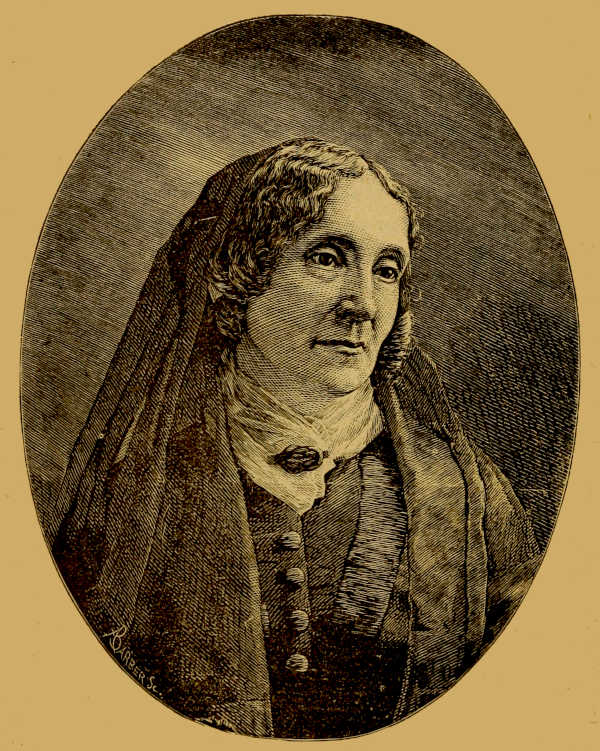
MRS. ELIZA J. THOMPSON,
Leader of the First Crusade Band.
Officers were then elected: Mrs. Eliza J. Thompson, President; Mrs. Sally McDowell, Vice-President; Mrs. Mary B. Fenner, Secretary.
Mrs. Thompson is the daughter of ex-Governor Trimble, of Ohio. She is a lady of culture, about sixty years of age, of modest and pleasant appearance and very agreeable manners. She speaks with great simplicity, in a conversational style, and with a quaintness that is peculiarly attractive. Whenever she addresses an audience she is sure of an attentive hearing.
Her recital of
“THE FIRST CRUSADE”
is somewhat on this wise: “On the 22d of last December Dr. Dio Lewis lectured before our lyceum. It was a literary lecture, and the subject was ‘Our Girls.’ I wasn’t there. My boy came home and said, ‘Ma, they’ve got you into business;’ and went on to tell that Dio Lewis had incidentally related the successful effort of his mother, by prayer and persuasion, to close the saloon in a town where he lived when a boy, and that he had exhorted the women of Hillsboro’ to do the same, and fifty had risen up to signify their willingness, and that they looked to me to help them to carry out their promise. As I’m talking to you here familiarly, I’ll go on to say that my husband, who had retired, and was in an adjoining room, raised up on his elbow and called out, ‘Oh! that’s all tomfoolery!’ I remember I answered something like this: ‘Well, husband, the men have been in the tomfoolery business a long time; perhaps the Lord is going to call us into partnership with them.’ I said no more. The next morning my brother-in-law, Colonel ——, came in and told me about the meeting, and said, ‘Now, you must be sure to go to the women’s meeting at the church this morning; they look to see you there.’ Our folks talked it all over, and my husband said, ‘Well, we all know where your mother’ll take this case for counsel,’ and then he pointed to the Bible and left the room.
“I went into the corner of my room, and knelt down and opened my Bible to see what God would say to me. Just at that moment there was a tap on the door and my daughter entered. She was in tears; she held her Bible in her hand, open to the 146th Psalm. She said, ‘Ma, I just opened to this, and I think it is for you,’ and then she went away, and I sat down and read
THIS WONDERFUL MESSAGE FROM GOD.
“‘Put not your trust in princes, nor in the son of man, in whom there is no help. Happy is he that hath the God of Jacob for his help, whose hope is in the Lord his God; which keepeth truth forever; which executeth judgment for the oppressed; the Lord looseth the prisoners; the Lord openeth the eyes of the blind; the Lord raiseth them that are bowed down; the Lord loveth the righteous; the Lord relieveth the fatherless and the widow—but the way of the wicked he turneth upside down. The Lord shall reign forever, even thy God, O Zion, unto all generations. Praise ye the Lord!’
“I knew that was for me, and I got up, put on my shoes, and started. I went to the church, in this town where I was born. I sat down quietly in the back part of the audience-room, by the stove. A hundred ladies were assembled. I heard my name—heard the whisper pass through the company, ‘Here she is!’ ‘She’s come!’ and before I could get to the pulpit, they had put me ‘in office’—I was their leader.
“Many of our citizens were there, and our ministers also. They stayed a few minutes, and then rose and went out, saying, ‘This is your work—we leave it with the women and the Lord.’ When they had gone, I just opened the big pulpit Bible and read that 146th Psalm, and told them the circumstance of my selecting it. The women sobbed so I could hardly go on. When I had finished, I felt inspired to call on a dear Presbyterian lady to pray. She did so without the least hesitation, though it was the first audible prayer in her life. I can’t tell you anything about that prayer, only that the words were like fire.
“When she had prayed, I said—and it all came to me just at the moment—
‘NOW, LADIES, LET US FILE OUT, TWO BY TWO,
the smallest first, and let us sing as we go,
“Give to the winds thy fears.”’
“We went first to John ——’s saloon. Now, John was a German, and his sister had lived in my family thirteen years, and she was very mild and gentle, and I hoped it might prove a family trait, but I found out it wasn’t. He fumed about dreadfully and said, ‘It’s awful; it’s a sin and a shame to pray in a saloon!’ But we prayed right on just the same.”
That the choice was dictated by God we must believe, for in all the trials and discouragements which have beset us, and they have been many, her trust in God has never failed. She had tested his faithfulness through many years of heavy and sore trouble, and had proved that his promises are “Yea and amen, to them that believe.” And no other woman could have kept up such a spirit of courage and hopefulness in the little band of devoted women, who have met week after week, all these years, to pray for God’s blessing on the work.
After the election of officers, came the plan for work. It was decided to go to the drug stores first, so that the saloonists might not plead their example as an excuse for themselves.
Mrs. J. M. Boyd was chosen to present the appeal on that visit. All the druggists signed the pledge except Mr. Dunn, of whom more hereafter.
Next day the ladies held another meeting, but decided not to make any visitations, it being Christmas-day, and the hotel-keepers more than usually busy and not likely to listen very attentively to our proposition.
On the 26th, the hotels and saloons were visited; Mrs. Thompson presenting the appeal. And it was on this morning, and at the saloon of Robert Ward, that there came a break in the established routine. “Bob” was a social, jolly sort of fellow, and his saloon was a favorite resort, and there were many women in the company that morning whose hearts were aching in consequence of his wrong-doing. Mrs. Thompson presented the appeal, another lady read a selection in the Bible, and then Mrs. Thompson began to talk to him; and she did it with her heart all stirred up by the memory of the wrongs the man had done to many whose weakness he had taken advantage of, dragging them down to disgrace and ruin. Ward was evidently touched. He confessed that it was a “bad business,” said if he could only “afford to quit it he would,” and then tears began to flow from his eyes. Many of the ladies were weeping, and at length, as if by inspiration, Mrs. Thompson kneeled on the floor of the saloon, all kneeling with her, even the saloonist, and prayed, pleading with indescribable pathos and earnestness for the conversion and salvation of this and all saloon-keepers. When the amen was sobbed rather than spoken, Mrs. Washington Doggett’s sweet voice began, “There is a fountain,” etc., in which all joined; the effect was most solemn, and when the hymn was finished the ladies went quietly away, and that was the first saloon prayer-meeting.
This is a fair specimen of the saloon visiting as carried on in Hillsboro’ for more than three months. Then the doors were locked and the prayer-meetings were held on the pavements; extreme care was taken not to obstruct the passage-way.
Mr. W. H. H. Dunn, the druggist, who refused to sign the druggist’s pledge, and who was known to be selling whiskey for drinking, and to minors, too, in disobedience of the law, became very much incensed at the continuous effort on the part of the women to persuade him to sign the pledge, and I may say here that not the women alone plead with him; a petition signed by a large number of the leading men of the place was presented to him by two of the oldest and most respected citizens, without the least effect. Let it be said as some excuse for him that he had bad advisers, and that large sums of money were sent him by the Whiskey Ring, that he might be able to fight the Crusaders in the courts.
The first thing done was the issuing of a “pronunciamento,” forbidding the women to sing and pray on his store steps, or on the sidewalk in front of his store. This was printed on slips of paper, and copies scattered over the town, and about the front of the drug store in question. This was early in the morning of the 31st January, 1874, and when the hour came for the usual prayer-meeting, there was a great questioning as to what was to be done; finally, some of the gentlemen said the ladies should go on the street as usual, and that by the time they had gone the round of the saloons, a place would be ready in front of Mr. Dunn’s.
Accordingly, in an hour or two, there was erected in front of the drug store a covered structure, made of boards and canvas, enclosed on three sides, and open on the side next the store. The ladies soon took possession and held a prayer-meeting.
Mr. Dunn could not stand that, so he applied to Judge Safford, then presiding at court in Hillsboro’, for an injunction against this “tabernacle.” The injunction was granted, and a notice served on Mr. Sayler, a very active temperance man, after he had gone to bed. It was Saturday night, and in order that he might obey the law and still keep the Sabbath, he dressed himself, procured some help, and had everything removed by twelve o’clock. An appeal was made at once by the temperance people for dissolution of the injunction; the case was heard by Judge Steele, at the February term of court, and the injunction dissolved on the finding of a legal flaw in the application of the plaintiff. But Mr. Dunn was not to be quieted. He now brought a suit for “trespass” against the Crusaders, and asked $10,000 damages.
This suit was heard before Judge Gray, at the May term of court, 1875. Able counsel was employed on both sides. The question was felt to be a vital one, and the court-room was crowded to overflowing for seventeen days. The examination of witnesses occupied thirteen or fourteen days, though not nearly all of the two hundred were called to the stand.
One incident of this trial must be told. It happened during Judge Safford’s speech, one of Mr. Dunn’s counsel. There was in the court-room a dear old lady, Mrs. Margaret Foreaker, a genuine mother in Israel, who, full of faith, prayed much during the trial, and while Judge Safford was speaking, prayed especially that he might be “confounded.” He had been going along swimmingly, and entirely to the satisfaction of his friends, when suddenly he seemed to lose the thread of his argument, dropped his eye-glasses two or three times, could not find his references, made quotations not bearing on the points he was trying to establish, and his embarrassment was so obvious that Mrs. F. said afterward she did not know but she had “prayed too hard.” The judge did not recover himself, and one of Dunn’s friends went over to the hotel and reported the case as “lost,” that Judge Safford had ruined it.
The jury were compelled by the ruling of the court to bring a verdict against the defendants, and laid the costs on them, with $5 damages. Counsel for the defence made a bill of exceptions to the rulings of Judge Gray, and the case was carried to the Supreme Court of the State. It is still pending, but will probably be dismissed, as Mr. W. H. H. Dunn is now a bankrupt. Mr. Sayler owns the store, and Mr. Dunn’s assignee will not defend the suit in Supreme Court.
The “street work” was not resumed after the Dunn suits began. It was thought best not to defy the law even in appearance until the decision of the courts should be known. But there was plenty to do. The new constitution was about to be presented to the people of Ohio, and “License” or “No License” was the great question. The women girded themselves for the strife. Into the school districts and smaller towns they went in little parties, held meetings, organized leagues, circulated petitions, and kept on praying. The license clause was defeated.
A few miles north of Hillsboro’ is the little village of L——. It is quite a pleasant little place; the people are intelligent; there are two churches, good schools, and a few stores, etc. But there was one drawback to the peace of the community, and that was the drinking-saloon attached to the hotel. The proprietor was one of the oldest citizens, and when the Crusade began it was hoped that he would at once come over on the temperance side. But as he did not, there was a meeting called in the little white church to consider what should be done. The meeting was large, and after a prayer, a visiting committee of ladies went down to Mr. ——’s saloon. He met them at the door, and very kindly invited them into the parlor with his amiable wife and daughter. There they talked the matter over, but he refused to sign the pledge. The next day they called again, and he was very angry and locked the door; but on the third day, seeing that the whole community was roused, he grew calm, and said, “Ladies, I will not sign your pledge; but I will promise you in the presence of God that I will never sell another drop of liquor in this town after the 20th of this month, and if I violate my word you may have every cent I am worth. I will walk out and you may walk in.” He kept his word for a while, but the temptation to put a few more dimes in his pocket was too strong, and he secretly bought another barrel of whiskey. Just at this time several of the leading temperance women were sick and could not visit him, but “God met him.” The quiet village was alarmed by the cry of “fire!” It was the hotel. It caught from a segar thrown into a sawdust spittoon in the saloon. While it was burning, a lady said, “O, dear! our town is built so compactly, it will all burn.” “Never thee fear,” said a good Quaker sister, “not a building will burn but that one. Don’t thee see? not a leaf is moving; the flames go straight up, and the sparks fall back on the house.” She was right. The hotel, store, saloon, and all belonging to it were entirely burned, while not another house caught fire. Unappalled by this judgment, Mr. —— built a room on the same lot in which to sell whiskey, but became paralyzed, and in a short time died a miserable death. There is no whiskey now sold in L——.
I want to relate one or two little incidents that show the hardening effect of liquor-selling on the dealer.
There was a saloon-keeper brought from Greenfield to H—— to be tried under the Adair law. The poor mother who brought the suit had besought him not to sell to her son—“her only son.” He replied roughly that he would sell to him “as long as he had a dime.” Another mother, an old lady, made the same request, “lest,” she said, “he may some day fill a drunkard’s grave.” “Madam,” he replied, “your son has as good a right to fill a drunkard’s grave as any other mother’s son.” And in one of the Hillsboro’ saloons a lady saw her nephew. “O, Mr. B——,” said she, “don’t sell whiskey to that boy: if he has one drink he will want another, and he may die a drunkard.” “Madam, I will sell to him if it sends his soul to hell,” was the awful reply. The last man is a peculiarly hard, stony sort of man; his lips look as if chiselled out of flint, a man to be afraid of. One morning, when the visiting band reached his door, they found him in a very bad humor. He locked his door and seated himself on the horse-block in front in a perfect rage, clenched his fist, swore furiously, and ordered us to go home. Some gentlemen, on the opposite side of the street, afterwards said that they were watching the scene, ready to rush over and defend the ladies from an attack, and they were sure it would come; but one of the ladies, a sweet-souled woman, gentle and placid, kneeled just at his feet, and poured out such a tender, earnest prayer for him, that he quieted down entirely, and when she rose and offered him her hand in token of kind feeling, he could not refuse to take it.
But it was not always stormy; sometimes it was summer-sunshine, as witness: One bright Saturday afternoon, while we were singing the sweet songs of Zion and offering prayer, an old gentleman, a stranger to us all, stood at a little distance from our band, and while listening to us was led by the Spirit to give his heart to God. He went to his home bearing the glad tidings to his friends. He told it in church the following Sabbath, and a revival began then which resulted in many conversions.
As I go over these facts of a time so full of interest, I recall the figure of a venerable, dignified old gentleman, full of vigor and enthusiasm, though the frosts of seventy-five winters had whitened his head; this was General Jos. J. McDowell, the husband of our vice-president. His interest kept pace with the work, he was at nearly all the meetings, and had ever a word of counsel or encouragement for the women. But there was one thing lacking. He was not a professing Christian, and his many friends grew sad when they saw that he was drawing so near the close of life without the only hope that can lighten the pathway to the tomb. The time came, however, for the Spirit to do its work. The ladies had been holding a series of religious meetings in their consecrated league room, morning after morning, for two months (January and February, 1876). The presence of the One Mighty to save and strong to deliver was gloriously manifesting himself, and on one of these mornings General McDowell came in and took his seat. Mrs. Thompson, who was leading the meeting on that occasion, after a very touching hymn had been sung, Scripture read, and prayer offered, proposed spending a short time in testimony. One and another had spoken, when Mrs. T—— said, in a kind, familiar way, “General McDowell, we are most happy to have you with us this morning, and as you have so often encouraged our hearts in our temperance work, we should love to hear you speak.”
He arose slowly, and in a very solemn manner said, “I do not feel worthy to speak on sacred subjects before you good women.” After some hesitation he resumed, “I have been a great sinner; for many years, especially during the war, I had almost come to the conclusion that there was no such thing as religion, but seeing the spirit of divine love displayed by the crusading ladies of our town, as they have knelt on snow even, in front of the barred doors of these worse than murderers, to pray for their souls; and as in the churches I have watched the tears stream down their cheeks as they have prayed the divine blessing upon them and their families, I have felt my heart soften. Now I feel that I can say I love the Saviour.” The scene that followed can be better imagined than described, as that devoted wife, who had prayed for her noble husband for more than fifty years, received him a new creature in Christ Jesus. All were baptized afresh by the Holy Spirit, and we grasped with firmer hold the hand of our Almighty Friend who had bidden us walk upon the untried waves, December 23d, 1873.
Since the departure of this dear friend of the Crusade to the “Home of the Soul,” for which home he was rapidly matured, wonderful developments of divine mercy have been displayed in our highly-favored town, Hillsboro’. Last spring a gracious revival resulted from the “union services” of the Quaker Evangelists, Nathan and Esther Frame. Scores of young men were converted during these meetings who had been the objects of our earnest and special prayers. Many a mother’s heart was made glad, and the churches all received their dead raised to life again.
Thus God prepared our community for the glorious dawn of the Murphy movement, and wonderfully qualified by reformation based upon conversion, our Congressman elect, Hon. Henry Dickey, for its inauguration. The first Murphy meeting was held on the evening of May 15th, 1877, and the first men to sign the pledge were some of our prominent citizens in every profession; but pre-eminently the lawyers, men of talent and influence, but whose habit of intemperance had long been a source of grief and anxiety to their friends. Three hundred signed the pledge upon the first evening; within two weeks over two thousand names were upon the roll; some of the most energetic workers in the movement were men who were foremost in opposing the Crusade, unsparing and bitter in their invectives against all concerned. That which fills us with astonishment and devout thanksgiving is the desire evinced by these men, that old scores be wiped out, and Christian women come to the front and help in the cause by their presence and sympathy.
BAPTIZED IN WHISKEY.
Among the many interesting incidents of work reported at the Woman’s Temperance Camp-Meeting at Ocean Grove was the following, related by Mrs. E. J. Thompson, of Hillsboro’:
“During the Crusade, a saloon-keeper consented to close his business. There was a great deal of enthusiasm and interest, and we women decided to compensate the man for his whiskey and make a bonfire of it in the street. A great crowd gathered about the saloon, and the barrels of whiskey were rolled out to the public square where we were to have our bonfire. Myself and two other little women, who had been chosen to knock in the heads, and had come to the place with axes concealed under our shawls, went to our work with a will.
“I didn’t know I was so strong, but I lifted that axe like a woodman and brought it down with such force that the first blow stove in the head of a barrel and splashed the whiskey in every direction. I was literally baptized with the noxious stuff. The intention was to set it on fire, and we had brought matches for that purpose, but it would not burn! It was a villanous compound of some sort, but we had set out to have a fire, and were determined by some means or other to make it burn, so we sent for some coal oil and poured it on and we soon had a blaze. The man who could sell such liquors would not be likely to keep the pledge. He is selling liquors again.”
VICTORY AT WASHINGTON C. H.
Most of the facts in the following history of the work at Washington C. H. have been gleaned from the official report of the secretary, Mrs. M. V. Ustick.
It will be seen that the Crusade began in this town only two days later than at Hillsboro’. And Washington C. H. was the first place where the Crusade was made prominent and successful.
On Friday morning, Dec. 26th, 1873, after an hour of prayer in the M. E. Church, forty-four women filed slowly and solemnly down the aisle, and started forth upon their strange mission with fear and trembling, while the male portion of the audience remained at the church to pray for the success of this new undertaking; the tolling of the church-bell keeping time to the solemn march of the women, as they wended their way to the first drug store on the list. (The number of places within the city limits where intoxicating drinks were sold was fourteen—eleven saloons and three drug stores.) Here, as in every place, they entered singing, every woman taking up the sacred strain as she crossed the threshold. This was followed by the reading of the appeal and prayer; then earnest pleading to desist from their soul-destroying traffic and sign the dealer’s pledge.
Thus, all the day long, they went from place to place, without stopping even for dinner or lunch, till five o’clock, meeting with no marked success; but invariably courtesy was extended to them; not even their reiterated promise, “We will call again,” seeming to offend.
No woman who has ever entered one of these dens of iniquity on such an errand needs to be told of the heart-sickness that almost overcame them as they, for the first time, saw behind those painted windows or green blinds, or entered the little stifling “back room,” or found their way down winding steps into the damp, dark cellars, and realized that into such places those they loved best were being landed, through the allurements of the brilliantly lighted drug store, the fascinating billiard-table, or the enticing beer-gardens, with their syren attractions. A crowded house at night, to hear the report of the day’s work, betrayed the rapidly increasing interest in this mission.
On the 27th the contest really began, and, at the first place, the doors were found locked. With hearts full of compassion, the women knelt in the snow upon the pavement, to plead for the divine influence upon the heart of the liquor-dealer, and there held their first street prayer-meeting.
At night the weary but zealous workers reported at a mass-meeting of the various rebuffs, and the success in having two druggists sign the pledge not to sell, except upon the written prescription of a physician.
The Sabbath was devoted to union mass-meeting, with direct reference to the work in hand; and on Monday the number of ladies had increased to near one hundred. That day, December 29th, is one long to be remembered in Washington, as the day upon which occurred the first surrender ever made by a liquor-dealer, of his stock of liquors of every kind and variety, to the women, in answer to their prayers and entreaties, and by them poured into the street. Nearly a thousand men, women, and children witnessed the mingling of beer, ale, wine, and whiskey, as they filled the gutters and were drank up by the earth, while the bells were ringing, men and boys shouting, and women singing and praying to God who had given the victory. But on the fourth day, “stock sale-day,” the campaign had reached its height, the town being filled with visitors from all parts of the county and adjoining villages. Another public surrender, and another pouring into the street of a larger stock of liquors than on the previous day, and more intense excitement and enthusiasm.
Mass-meetings were held nightly, with new victories reported constantly, until on Friday, January 2d, one week from the beginning of the work, at the public meeting held in the evening, the secretary’s report announced the unconditional surrender of every liquor-dealer, some having shipped their liquors back to wholesale dealers, others having poured them into the gutters, and the druggists as all having signed the pledge. Thus a campaign of prayer and song, had, in eight days, closed eleven saloons, and pledged three drug stores to sell only on prescription. At first men had wondered, scoffed, and laughed, then criticised, respected and yielded.
Morning prayer and evening mass-meetings continued daily, and the personal pledge was circulated till over one thousand signatures were obtained. Physicians were called upon to sign a pledge not to prescribe ardent spirits when any other substitute could be found, and in no case without a personal examination of the patient.
Early in the third week the discouraging intelligence came that a new man had taken out license to sell liquor in one of the deserted saloons, and that he was backed by a whiskey house in Cincinnati, to the amount of $5,000, to break down this movement. On Wednesday, the 14th, the whiskey was unloaded at his room. About forty women were on the ground and followed the liquor in, and remained holding an uninterrupted prayer-meeting all day and until eleven o’clock at night. The next day, bitterly cold, was spent in the same place and manner, without fire or chairs, two hours of that time the women being locked in, while the proprietor was off attending a trial. On the following day, the coldest of all the winter of 1874, the women were locked out, and stood on the street holding religious services all day long.
Next morning a tabernacle was built in the street, just in front of the house, and was occupied for the double purpose of watching and prayer through the day; but before night the sheriff closed the saloon, and the proprietor surrendered; thus ended the third week.
A short time after, on a dying bed, this four days’ liquor-dealer sent for some of these women, telling them their songs and prayers had never ceased to ring in his ears, and urging them to pray again in his behalf; so he passed away.
Early in the work Mrs. George Carpenter, Mrs. A. C. Hirst, Mrs. A. E. Pine and Mrs. Ogle, who were appointed to draw up an appeal, presented the following
APPEAL.
Knowing, as you do, the fearful effects of intoxicating drinks, we, the women of Washington, after earnest prayer and deliberation, have decided to appeal to you to desist from this ruinous traffic, that our husbands, brothers, and especially our sons, be no longer exposed to this terrible temptation, and that we may no longer see them led into those paths which go down to sin, and bring both body and soul to destruction. We appeal to the better instincts of your own hearts, in the name of desolated homes, blasted hopes, ruined lives, widowed hearts, for the honor of our community, for our happiness; for our good name, as a town; in the name of the God who will judge you, as well as ourselves; for the sake of your own souls, which are to be saved or lost, we beg, we implore you, to cleanse yourselves from this heinous sin, and place yourselves in the ranks of those who are striving to elevate and ennoble themselves and their fellow-men; and to this we ask you to pledge yourselves.
This appeal was adopted, and was afterwards extensively used in other parts of the State, and in other States.
A property-holders’ pledge was also circulated—pledging men not to rent, or lease property, to be used as saloons, nor to allow any dealings of the liquor traffic to be carried on upon any premises belonging to them. This pledge was generally signed by holders of real estate.
During this week came a plea for help from Hillsborough. In answer to that call, on Monday, January 12th, a committee, consisting of Profs. Morehouse and Dean, and Mrs. M. G. Carpenter, Mrs. Judge McLean, Mrs. Judge Priddy, and Miss Annie Ustick, went to Hillsborough, spent the evening in attendance upon a mass-meeting there, and next forenoon in prayer and conference with the workers, returning in time to attend the mass-meeting at home, bringing with them encouraging words.
By this time the new method of fighting whiskey began to attract the attention of the press and people in surrounding places; and meetings were announced to be held in every village and school district in the county. Committees of ladies and gentlemen were sent out to assist in these meetings. Committees were also sent, by request, into all adjoining counties, the meetings being constantly kept up at home, and all the while gaining in interest.
About this time came word from Columbus, that the Adair Liquor Law was in great danger of being repealed; consequently the following communication was sent to every known Temperance organization throughout the State, by the Washington League:
“To the Secretary of Women’s Temperance League, at ——:
“Dear Sister—By order of the entire body of our Temperance League, we send you an urgent request that you immediately appoint a committee of not less than six, of the most earnest and effective workers, who shall be ready at an hour’s notice, to respond to the call embodied in the following resolution:
“‘Resolved, That the secretary of this meeting be requested to correspond with the ladies in all places where the Temperance movement is now, or may be progressing, asking the same to appoint a delegation to appear at Columbus, when called, if any action of the legislature, threatening the safety of the Adair Liquor Law, may be contemplated.’
“Please notify us of your decision in the matter, forwarding us one name to whom we may telegraph if necessary.”—[Signed by the secretary.]
Responses poured in from all Leagues addressed—the word “Ready.” But the law remained undisturbed that winter.
The names of the following women, chosen by God and men to inaugurate this great work and carry it forward to success, appeared in the columns of the Fayette County Herald at the time:
Mrs. George Carpenter; Miss Annie Ustick; Mrs. A. C. Hirst; Mrs. A. E. Pine; Mrs. B. Ogle; Mrs. P. E. Morehouse; Miss M. A. Love; Mrs. Wm. Stevens; Mrs. O. Grubbs; Mrs. J. Van Deman; Mrs. E. Milliken; Mrs. A. Blakemore; Mrs. Wm. Smith; Mrs. P. T. Light; Mrs. H. L. Hadley; Mrs. F. Nitterhouse; Mrs. D. McLean; Mrs. Allen Hegler; Mrs. T. N. Ustick; Miss A. E. Robinson; Miss Julia Wood; Miss Anna Cherry; Mrs. S. Lydy; Miss Brightie Ogle; Miss Flora Ogle; Mrs. Barnett; Mrs. Farmer; Mrs. Geo. Dahl; Mrs. M. Gardner; Miss Kate Foster; Mrs. Col. Maynard; Mrs. Dr. Dennis; Mrs. Dr. Coffman; Miss Belle Stuckey; Mrs. H. P. Cherry; Mrs. J. B. Priddy; Mrs. M. Blackmore; Mrs. A. E. Silcott; Miss L. Milliken; Miss Emma Wilcox; Mrs. H. P. Ustick; Miss Ida Dean; Mrs. J. Hopkins; Mrs. C. L. Getz; Mrs. T. Gardner; Mrs. Wm. Gordon; Miss A. Kephart.
But there still remained the beer hall of Charlie Beck, about half a mile out. Carriages were furnished the ladies, free of charge, from the temperance livery-stable of Collins & Bitzer, and in these the band made daily visits to Beck’s.
At this time the Cincinnati Commercial sent a reporter to view the land, from whose graphic pen we quote the following:
“I reached Washington at noon of January 20th, and seeking Mr. Beck’s beer garden, found him in a state of terrible nervousness, as the ladies had spent the forenoon in front of this place. He evidently regarded me as a spy, but was much mollified when assured that I was only a journalist, and made voluminous complaint in ‘high Dutch’ and ‘low English.’
“‘I got no vitnesses. Dem vimens dey set up a shob on me. But you don’t bin a ’bitual drunkard, eh? No, you don’t look like him. Vell, coom in, coom in. Vat you vant, beer or vine? I dells you, dem vimens is shust awful. By shinks, dey build a house right in the shreet, and stay mit a man all day a singin’ and oder foolishness. But dey don’t get in here once agin already.’
“In obedience to this invitation, I had entered by the side door—the front was locked and barred—to find four customers indulging in liquor, beer and pigs’ feet.
“Mr. Beck kept open house nearly all that night; the sounds of revelry were plainly heard in town, and in the morning several drunken men came into town, one of whom tumbled down into a livery-stable, and went to sleep on a manure pile, from which he was carried to the lock-up. Matters were evidently coming to a crisis, and I went out early; but the ladies reached there in force just before me. I met Mr. Beck hurrying into town to consult his lawyer, or, as he phrased it, ‘to see mein gounsel ven I no got a right to my own broberty.’
“The main body of the ladies soon arrived, and took up a position with right centre on the doorstep, the wings extending each way beyond the corners of the house, and a rearward column along the walk to the gate. In ludicrous contrast the routed revellers, who had been scared out of the saloon, stood in a little knot fifty feet away, still gnawing at the pigs’ feet they had held on to in their hurried flight, while I took a convenient seat on the fence. The ladies then sang—
‘Oh, do not be discouraged, for Jesus is your friend; He will give you grace to conquer, and keep you to the end.’
“As the twenty or more clear, sweet voices mingled in the enlivening chorus—
‘I’m glad I’m in this army,’ etc.—
the effect was inspiring. I felt all the enthusiasm of the occasion, while pigs’ feet party, if they did not feel guilty, certainly looked so.
“The singing was followed by a prayer from Mrs. Mills Gardner. She prayed for the blessing of God on the temperance cause generally, and in this place particularly; then for Mr. Beck, his family and friends, his house, and all that loved him, and closed with an eloquent plea for guidance in the difficult and delicate task they had undertaken. In one respect the prayer was unsurpassed; it was eminently fitting to the place and the occasion. As the concluding sentences were being uttered, Mr. Beck and his ‘gounsel’ arrived. The ladies paid no attention to either, but broke forth in loud strains,
‘Must Jesus bear the cross alone? No, there’s a cross for me,’
when the lawyer borrowed some of my paper, whispering at the same time, ‘I must take down their names. Guess I shall have to prosecute some of them before we stop this thing.’
“I should need the pen of an Irving and pencil of a Darley to give any adequate idea of the scene. On one side, a score of elegant ladies, singing with all the earnestness of impassioned natures; a few yards away a knot of disturbed revellers, uncertain whether to stand or fly; half way between, the nervous Beck, bobbing around like a case of fiddle-strings with a hundred pounds of lager beer fat hung on them; and on the fence by the ladies, a cold-blooded lawyer and excited reporter scribbling away as if their lives depended on it. It was painful from its very intensity.
“The song ended, the presiding lady called upon Mrs. Wendels, and again arose the voice of prayer—so clear, so sweet, so full of pleading tenderness, that it seemed she would, by strength of womanly love, compel the very heavens to open and send down in answer a spark of divine grace that would turn the saloon-keeper from his purpose. The sky, which had been overcast all the morning, began to clear, the occasional drops of rain ceased to fall, and a gentle south wind made the air soft and balmy. It almost seemed that nature joined in the prayer.
“Again the ladies sang—
‘Are there no foes for me to face,’
with the camp-meeting chorus,
‘Oh, how I love Jesus, Because he first loved me.’
“As the song concluded, the lawyer suddenly stepped forward, and said:
“‘Now, ladies, I have a word to say before this performance goes any further. Mr. Beck has employed me as his attorney. He cannot speak good English, and I speak for him here. He is engaged in a legitimate business, and you are trespassers on his property and rights. If this thing is carried any further, you will be called to account in the court, and I can assure you the court will sustain the man. He has talked with you all he desires to. He does not want to put you out forcibly; that would be unmanly, and he does not wish to act rudely. But he tells you to go. As his attorney, I now warn you to desist from any further annoyance.’
“Again the ladies sang—
‘My soul, be on thy guard, Ten thousand foes arise.’
And Miss Annie Ustick followed with a fervent prayer for the lawyer and his client; but they had fled the scene, leaving the house locked up. After consultation, the ladies decided to leave Mr. Beck’s premises and take a position on the adjoining lot. They sent for the ‘tabernacle,’ a rude frame building they had used in front of Slater’s saloon. This they erected on the adjoining lot, put up immense lights to illuminate the entrance to the beer garden, and kept up a guard from early morning till midnight.
“For two weeks religious services were held in the tabernacle day and night, and the women were constantly on duty; at the end of which time an injunction was granted Mr. Beck and the tabernacle was taken down.
“Temperance was still the pulpit theme on the Sabbath, and on Monday morning, February 9th, all the business houses were closed from 8 to 9 to attend the business men’s prayer-meeting. Large delegations were present from adjoining villages at that early hour. At the meeting there came a messenger from this man stating that he would give up his business, which announcement was received with cheers. It was then decided that all who were not enjoined from so doing should march out to Mr. Beck’s beer garden, where the proprietor met them at the gate, and after a brief consultation with a committee appointed for that purpose, he publicly announced: ‘You comes so many, I quits. I will never sell any more beer or whiskey.’ Again the crowd gave vent to their feelings in cheers. Messengers were despatched to the women who remained praying in the church, to join them. All the bells commenced ringing, and the procession, numbering two hundred strong, started out to Sullivan’s beer house, now the only remaining saloon in the township. Marching up Court street, the numbers increased, and amid the most profound silence the men and women pursued their journey. About half way there the man in question was met and interviewed. He asked two days to consider, which were granted. The procession then returned, the bells all the time ringing out their chimes upon the crisp morning air. Meetings, morning and evening, continued with unabated interest, and at each came to us the cry from other points, ‘Come and help us.’
“On Wednesday morning, February 11th, at mass-meeting in the Presbyterian Church, Mr. Sullivan came in and publicly pledged himself to ‘quit forever the liquor business.’ A general rejoicing and thanksgiving followed this surrender of the ‘last man.’
“Thus, through most of the winter of 1874 no alcoholic drinks were publicly sold as a beverage in the county.
“The summer was given up to the defeat of the license clause in the new constitution which was to come before the people on the 18th of August.
“Mass temperance picnics were a prominent feature of the season, and the untiring zeal of the workers was crowned with success on election day.
“During the two intervening years weekly temperance league-meetings have been kept up by the faithful few, while frequent union mass-meetings have been held, thus keeping the subject always before the people.
“To-day the disgraceful and humiliating fact exists that there are more places where liquors are sold than before the Crusade. Does any one ask the result of all this labor, and if the movement was a failure? We answer to the first question of results: The idea that women are to take an active part in the great conflict between religion and the rum power, was evolved by this very Crusade. None saw quicker than the women themselves the weak and strong points of the movement, and these praying bands have become thoroughly organized Women’s Christian Temperance Unions; and reform clubs, reading-rooms, coffee-houses, and friendly inns are the outgrowth of these ‘unions.’ Other countries have felt the impulse, and the best women of Europe and Canada are being organized into ‘leagues’ and ‘unions.’
“Was this movement, then, a failure? No! No! The long list of reformed lives; the restored happiness and prosperity of once desolated homes; the still longer list of our noble young men, who were arrested in their first downward steps in the path of intemperance and ruin, and whose upright and useful lives will be standing monuments of good for years to come. Who dares to compute such results? The improved public sentiment, banishing the wine cup from the social circle, from the sideboards and cellars of respectable homes—the awakening and uniting of all Christian hearts in one grand work for God and humanity. All these are the outgrowth of a reformation which has since belted the world—the most far-seeing being utterly unable to grasp its results.
“An incident recently under the observation of the writer is in point. During the winter of 1876 a grand banquet was given the Ohio General Assembly, judiciary, and military officers by some of the prominent citizens of our capital city. No labor or expense was spared in ministering to the comfort or pleasure of the guests, yet no wine was to be found in all that banquet hall. One of the hosts of the evening remarked that ‘before the “Women’s Crusade” the giving of such an entertainment without wine would have been impossible.’
“A failure? No! Eternity alone will unfold the glorious success of that work. To have banished liquor from the land, as at first the movement seemed to promise, would have been a miracle, and God does not now work in such manner; and the work we feel he meant to do in this Crusade was to rouse up his people to a sense of their duty; to awaken his church, which seemed to be strangely indifferent and asleep to this terrible evil. Thus He crowned the movement with success; and while His followers believe and trust Him, the good work will go on to completion, for
“‘Right is right, as God is God, And right the day will win; To doubt would be disloyalty, To falter would be sin.’”
WILMINGTON, OHIO.
We are indebted to Rhoda Worthington and Mary Hadley for the following history of the work in Wilmington:
In pursuance to the call of the pastors of the different churches of Wilmington, a large and earnest assemblage of citizens gathered at the M. E. Church, on Saturday evening, January 3d, to devise some plan of procedure, by which all lovers of the race might be brought to work in harmony for the suppression of the sale of intoxicating drinks within the limits of the corporation of Wilmington.
The meeting was called to order by the Rev. William Runyan, pastor of the M. E. Church. After the singing of the hymn, “All hail the power of Jesus’ name,” the audience were led in prayer by the Rev. S. H. Bingman, pastor of the Christian Church. The meeting was then addressed in a stirring and thrilling appeal in behalf of the movement, by the Rev. A. C. Hirst, of Washington C. H., Ohio. Mr. Hirst, in the course of his remarks, set forth the main features of the plan pursued by the people of Washington, but thought that, if the people of Wilmington would take hold of the matter with the one object in view, viz., to suppress the liquor traffic in our midst, some plan suited to the local requirements of the case would develop itself. At the close of Mr. Hirst’s address, remarks on the duties of the hour were made by W. E. Prichard and others. A temporary organization was then effected. Mr. William H. Cole, superintendent of public schools, was called to the chair, and J. H. Grove was nominated as secretary.
A committee of five, consisting of Messrs. Hildebrant, Zeigler, Albright, Gaskill, and Outcalt, was appointed to secure the names of such men as were willing to pledge themselves to support the ladies in efforts to suppress the sale of intoxicating drinks within the limits of Wilmington.
On the suggestion of Mrs. Mary N. Hadley, a minister in the Society of Friends, it was moved, that all women interested in the cause of temperance be requested to meet in the Friends’ Church, Sunday, January 4th, at four o’clock P. M., and that all men willing to aid the ladies in this movement be requested to meet in the Baptist Church, at the same hour, for prayer and consultation.
At the women’s meeting at four o’clock, Sabbath evening, there was a good attendance. Rhoda C. Worthington was called to act as president of the meeting. She came forward and said, “As the children of Israel did not see the Red Sea open before they came to it, nor the prophets see the waters of Jordan roll back until the soles of their feet touched the brim of the water, so it seems we must go forward in this work, trusting that a way will be made for us.” Rachel MacGregor and Lizzie C. Runyan were then called on to act as secretaries. Huldah C. Estes was elected leader, and Sarah S. Walker secretary of the field of labor, who was to make the report of our proceedings to the public mass-meetings at night.
At 10 A. M., sixty-three ladies, some of them the tearful wives of dissipated husbands, solemnly marched forth amid the peals of all the church-bells of the town, to visit the places where liquors were sold in Wilmington, and pray for and with the dealers, and implore them to desist from this work of destruction. Most of the men of the congregation remained, and engaged in prayer and supplication to God, that the great mission of the mothers, wives, and sisters of Wilmington might be successful.
One young man told his mother that he placed himself on a corner to see the fun as the women passed along, “but,” said he, “they all came weeping, and I wept, too.”
In the congregation, as we passed out, aged men bowed their heads, tears were seen to drop to the floor; none seemed to notice, or scarcely know, that others were weeping. The first place we entered was Brown Bro.’s drug store. A hymn was sung, three prayers were offered, and the pledge presented and signed, the druggist shedding tears while he signed. “Glory, hallelujah, our God is marching on,” was sung, and we passed out.
We made many visits before we obtained all the signatures of the dealers, continuing eight days in the work, our numbers increasing to more than one hundred women.
We then had four drug stores and nine saloons. During all the preliminary meetings, a number of persons who manifested a deep interest in all proceedings—men and women, too—were persons whose faces had not often been seen inside of church walls. But they tarried, not seeming to tire at the most lengthy exercises. There was a greater unanimity on the part of the different societies than had ever before been observable in any movement looking to the good of the general community. The feeling as the women filed out of the church, two by two, was of the intensest kind. It was no common errand on which they started, and their appearance on the streets awed to silence those whose hearts beat no responsive thrill.
From drug store to drug store, and from dram shop to dram shop, these brave women went during four hours and a half, daily, pleading, singing, and praying, in behalf of those who were engaged in the unholy traffic of rum-selling.
The meetings were continued in the church until the return of the women at half-past three in the afternoon, when, after a short time spent in consultation and devotional exercises, the meeting closed. At night the church was packed in every part. Extra seats had been procured, and the aisles and vestibule were filled to such an extent that egress was an impossibility. After a season spent in devotional exercises, the report of the work done by the women during the day was read by Sarah S. Walker, and was listened to with breathless attention.
The remainder of the evening was occupied in the transaction of business, speaking, singing, and prayer, and securing signatures to the total abstinence pledge. Some of these meetings were the most remarkable ever held in Wilmington, and their influence cannot be computed or gainsaid.
On other days the same procession of earnest, devoted women filed out of the church amid the ringing of bells, and the supplication and prayers of their fathers, husbands, and brothers, through snow and sleet; and when the procession returned to the church there was awaiting them a large meeting of men, to give them a prayerful reception.
The rain, sleet, and snow in an unusual degree kept on falling, but the meeting at the Friends’ meeting-house showed the indomitable purpose of the good people who were engaged in this work. At one of the many meetings the following appeal, having been prepared by the women engaged in the work of visitation, was read and adopted:
“Sisters—Feeling greatly encouraged at the results of yesterday’s work, and thanking God our Father, who giveth us the victory through Christ, our crucified but risen and glorified Redeemer, and feeling that, from the character of the men engaged in the liquor traffic, the amount of capital and financial interest employed in the same, and the silent yet powerful influence of many members of our community in backing up these men in their unholy calling, that we may have a long siege—therefore, let us call upon all our Christian brothers and sisters in the country surrounding Wilmington, to at once earnestly identify themselves with this great Christian temperance movement, by organizing, and placing themselves in communication with us, and thus be ready to help us in carrying forward the work.”
The Crusaders, as they went out on their mission of love, were urged forward by the prayers and tears of the active Christian community, and aided by the moral sentiment of very many who made no pretensions of religion. The unity of effort, fixedness of purpose, and hearty support given to the work procured entire success.
As the women were engaged all day in their work, arrangements were made for them to have lunch every day during this protracted effort.
Superintendent William Cole and Sheriff Hackny took the lead in this matter. It was announced each night, at the mass-meeting, where lunch would be given, and who would pay for it. A correspondent says: The saloon-keepers weakened in their efforts to stem the tide of public opinion. Several were ready to sell out and quit the business, but the women were not willing to buy. J. R. Hawley, a colored saloon-keeper, announced in the meeting that he was resolved to quit.
The ringing of all the bells in the town announced to the people that the lines were broken, and victory was only a question of time. The women were vigilant, and regardless of the weather, went bravely on with the work.
Half-way promises were made, but they desired a complete surrender. Thomas Young, a colored man, who had a saloon in Clarktown (a part of Wilmington, over the railroad), signed the pledge, amid the ringing of bells, and singing of songs of praise, that the outposts were surrendering.
It was resolved at this meeting, “That the business men be requested to close their houses between the hours of nine o’clock A. M., and three o’clock P. M., of the following day.” This was generally done, and the meeting held in the Friends’ meeting-house was largely attended during the day. The procession was larger than ever, and their influence correspondingly increased. Whenever they found a saloon closed against them, praying and singing was carried on in the street. From Main to South, and up and down South street, the procession moved as the ladies thought best for the accomplishment of the good work in which they were engaged. Mr. J. J. Stagg, of the Gates House, generously entertained the women in the procession; that day one hundred and thirty took dinner there. That day the last place we visited before dinner was the court-house, court being in session. We spent some time in religious service there, but some of the members of the bar made it convenient to be absent.
One day before that, just after we had taken lunch, we came out and stopped on the court-house steps, and Lizzie C. Runyan led in prayer. We afterward heard that a liquor case was just then being tried, that the court became demoralized for a time until we went away, and the lawyer who lost his suit accused his opponent of making an arrangement with us to go there; but we knew nothing of what was going on, and acted only under the impression of the moment, many of us not knowing we were going there until the one leading stopped.
At night the meeting was densely packed. At this meeting a plan of work was arranged for Saturday, somewhat different from the previous days; we divided into as many companies as there were saloons, having a few who could sing and some who would pray in each company.
Saturday’s meeting was held in the Baptist Church, and the procession, large and formidable in appearance, started out, and a regular detail went to each of the saloons to watch and pray. It was arranged that every fifteen minutes the church-bell would be rung, and each company would then pass on to the next saloon; that day our enemy became exasperated. Before they were rid of one company another would be seen coming. We soon became too earnest to hear the bell, but went on from place to place. When any one of the unfortunate fellows was discovered on the street, a delegation of earnest, devoted women would surround him, and escape seemed hopeless. Never before had our town witnessed such a scene. Men dry for drinks, who had come in expecting no trouble, wandered disconsolately about the streets, and went home at night-fall in a different condition from what had been their habit on previous Saturdays, and the bowls of egg-nog already mixed up for their use were still standing unmolested. They would see a company of us at one place and think these were the Crusaders, and they would go on hurriedly to another shop, perhaps enter the door before they perceived women were there, too; then some would very unconcernedly ask for a half-dozen apples or something else, and pass out. Through the vigilance of the women but little liquor was sold during the day, and at night all of the saloons were temporarily closed, and the chances were much against any open purchase of liquor. The week had been one of intense excitement and active work, and such an up-building of public sentiment as had never been manifested here before.
Union service was held at the Friends’ Church on Sabbath morning and evening. At the morning hour Rev. James Kendall preached one of his characteristic sermons, which was listened to attentively by as large an audience as could be packed into the house. The evening service was very good, made up of singing, praying, and general speaking.
Monday meetings were held at the M. E. Church. The attendance was prompt and the procession moved early, and took possession of the saloons. Men who had been brave all the week before, gave in and surrendered. Thomas Norton, Fred. Hineman, George Lauber, Henry Getz, Washington Champ, and Patrick Egan, gave up the business, and while they did not all sign the pledge, they all promised to quit. Norton and Hineman emptied their saloons.
As an episode of the day’s work, the capture of the Xenia ale-wagon and the frightened driver will long be remembered. He entered town and was replenishing saloons, while the attention of all were taken up by the pouring out of a half-barrel of gin, given up for that purpose.
G. Thomas Young had signed the pledge, and his liquors were poured into the gutter from the court-house pavement; some poor fellows drank from the gutter, taking it up with their hands; one ran up and caught some in his hat and drank it, although his hat was not a new one. The crowd dispersed: some went home, but most of the temperance women and men went to the M. E. Church.
When it was announced that the ale-wagon was in town and M. N. Hadley was beside it, it was soon overtaken by a vast crowd. A colored boy caught hold of the horses; the wagon was soon surrounded by the women; earnest prayer was offered, and just as we had a pledge written, to present to him, to sign, not to enter our place again on such an errand by day or by night, the city marshal told the boy to quit his hold of the bridle, and the driver lay whip to the horses and fled. We telegraphed to Salina, and they were ready to receive him by the time he arrived there.
The meeting that night was a joyful one, and the work was reported in a much more forward condition than any one could have expected. Thursday found all ready for work, and there being a suspicion that the saloon of Conners had been open during the night, a delegation met early and was ready to take possession, as soon as it was opened for business. The meeting was held in the Baptist Church, and the procession came out promptly. During the day Edward Conners and Alice Bourke signed the pledge, thus closing all the drinking-saloons or places in the town. The men engaged in the work not feeling entirely satisfied with the fulfilment of some of the pledges, kept a watch.
All the saloon-keepers signed the pledge except Norton and Getz, and they both closed under the promise not to sell again. Norton finally sold out at auction, and poured out his beer and turned himself into the street.
Many individuals who worked without ceasing during this effort we would gladly mention by name, but not having room for all, we do not desire to discriminate. The work encouraged all good citizens, and a brotherly feeling has been wonderfully developed among the different churches.
It was estimated from freight books, that during the six months beginning with July 1st, and ending December 31st, 1873, that the sum of twenty-five thousand dollars was spent in this place for liquors.
The above will give our readers some idea of the immense injury which our town has suffered from the sale of intoxicating liquors; over one hundred and forty dollars a day.
After the closing up of the saloons, the people on the streets were universally sober, and in marked contrast to former times. We are informed by one whose duty it is to extinguish the street-lamps, that there is a wonderful change in the order on the streets since the closing of the saloons. Previously, disorder and drunkenness was the rule night after night, but now he will go around the town without any sign of disturbance.
The Lebanon Star says, “In Wilmington, Clinton county, there were, a week ago, we are told, twelve saloons. On last Monday night there was but one remaining. The women did it. No suits were brought; but as we understand it, they just talked and sung and prayed, and the hearts of the liquor-sellers (many of them have hearts) gave way, and they quit the business. As the walls of Jericho fell at the sound of rams’ horns, so will the liquor traffic vanish in the presence of a healthy public sentiment properly manifested.”
RESOLUTION OF THANKS.
The following resolution was unanimously adopted by the women, at the last meeting held by them at the close of their arduous labors in putting down the liquor traffic in our town. It is a resolution which fully explains itself, and we give it without further comment:
Resolved, That we return our sincere thanks to our Heavenly Father for putting kindness into the hearts of the pastors, and so many of the brethren of all denominations amongst us, together with our friend, M. Rombach, and those who claim alliance with no church organization, to so cordially co-operate with, and encourage us in the performance of the duties of the last few days by their prayers and sympathy; also, kind attention in the bountiful provision for the sustenance of our bodies, and care for our comfort and convenience by improving street-crossings, etc. And again we will thank him for the silent breathing of “God speed the work,” which we felt was with many of our citizens and neighbors who had no opportunity to manifest their interest and co-operation therein, and in humility we desire to thank and praise his holy name for causing the saloon-keepers with whom we have labored, to treat us with such profound respect and gentility. And last, but not least, we most devoutly thank him that he has enabled us to work thus lovingly together, until the language of our hearts is, “Truly is it the Lord’s doing, and marvellous in our eyes.”
On behalf of the women of Wilmington and vicinity.
R. C. Worthington, President.
There were many women who attended our league-meetings regularly, who never went on the street as Crusaders. When we would start out they would go home, or remain at the prayer-meeting.
These were led by ministers: W. E. Prichard, S. H. Bingham, Wm. Runyan, and Friends.
A relief committee was appointed, consisting of both men and women, which did much to relieve the poor of our town. The children of the public schools were invited to come out.
We taught them the following pledge:
A pledge we make, no Wine to take, Or Brandy red, to turn the head; Or Whiskey hot, to make the sot; Or fiery Rum, that ruins home; Nor will we sin, by drinking Gin; Hard Cider, too, will never do; Or brewers’ Beer, the heart to cheer. To quench our thirst, we’ll always bring Cold Water, from the well, or spring. Also, from Tobacco’s use we plead excuse; The filth and scent thus we prevent, That does accrue from Snuff and Chew; And Smoke, we abhor, from Pipe or Cigar. To this Pledge we live, for the joy it will give To Fathers and Mothers, our neighbors, and others.
Wilmington, Clinton county, Ohio.
Some of the saloons were open, but claimed to be selling cider only. One had protested that he did not sell whiskey, and tried hard to convince us of the fact. His door opened into an alley. The children stopped before his front window, and began repeating the pledge; he raised the window, put his head out, and said, in an impatient voice, and with an Irish brogue, “What are ye all a doing here?” The children all turned their sober little faces toward him, repeating on. What he heard was just the line,
“Or Whiskey hot, to make the sot;”
when down went the window. It was very amusing, but none laughed at the time.
One place we visited was a livery-stable, where many had been seen drinking and drunk. The keeper was greatly incensed to think we had stopped on his pavement—talked rather roughly; said, “If we came there just once more, he would sell out, and set up in the liquor business, and would show us he could sell if he wanted too.” This was all the rough language we had spoken to us, except by one druggist, who was so thrown off his dignity to think we dared go to him; he asked us to sign a pledge that we would not steal anymore, then he would sign ours; many of them answered him they would, but he did not present any: but we found afterward that John Deck, the livery-man, perhaps would have been elected our marshal had it not been for the way he talked to us. How glad we were then that we suffered, that the right man might be elected; some men said they expected to have voted for him, but would not because he talked so roughly to us.
Mary N. Hadley, a minister in the Society of Friends, may be said to have been one of our most indefatigable private, as well as public, laborers at home and abroad; while we have many whose faith and untiring zeal and energy are worthy of a record, although their share of the work was done in so quiet a way, that eternity alone will recognize it all, and give it its due reward of honor and praise.
Lizzie C. Runyan, wife of the minister of the M. E. Church, was, after she fully entered the work, most gifted in prayer and public speaking.
Some time after we had quit all visiting of the dealers, either by committees or otherwise, on the day of the spring election we met in the M. E. Church, and continued most of the day in the capacity of a prayer-meeting. The mayor, marshal and councilmen we desired were elected, and served their time out faithfully.
In the beginning we felt ourselves, as it were, thrust into the work by our Allwise Father, for we were allowed no time to consult as to qualifications, or convenience, or scarcely of how to proceed until we found ourselves in the work. Truly can we say: “This is the Lord’s doing, and it is marvellous in our eyes.” One of the most striking features of it to us, and one which plainly shows the hand of Deity, is, that it is not those who have suffered most directly, or are most likely to suffer thus, from the evils of strong drink, who are first to enter the field. As God sent his own Son to give his life a ransom for his fallen children, even now he calleth those who profess to be his followers to exercise in their measure (though too small to bear comparison) the same spirit of unselfish love. “Greater love hath no man than this, that a man lay down his life for his friends.” While we look upon the incomplete condition of our work in this place, we are not discouraged; we can say, hitherto the Lord hath helped us, and in his own time he will again visibly move onward.
Wilmington was the third town to enter the Crusade, and the first to cry Victory! and we felt the reaction as deep and sore as any.
NEW VIENNA, OHIO.
The Crusade fire which came down like an electric cloud upon Hillsboro’ and Washington Court-House, Ohio, spread rapidly from town to town.
New Vienna, a small railroad village, was one among the first to become conspicuous, because of the wickedness of one of its liquor-dealers, and the persistent faith of the women engaged in the work.
The last saloon to surrender was the “Dead Fall,” kept by John Calvin Van Pelt. The building was a miserable one-story frame structure near the railroad depot, and Van Pelt had the reputation of being “the wickedest man in Ohio.” In appearance he looked like a prize-fighter, and in behavior he acted like one possessed of devils.
The very first visit of the ladies enraged Van Pelt beyond anything they had ever seen. In his fury, he threatened that if they came to his saloon again, he would “hang, draw, and quarter them every one.” And he looked bloodthirsty enough to undertake any murderous deed.
But, fortunately, these women were imbued with a heroism that comes from above, and had a faith that would not shrink in the presence of bodily peril. And the next day about fifty of them marched down to the “Dead Fall,” as though no threat had ever been made against them.
Van Pelt had made special preparations for them. In one of his show-windows an axe besmeared with blood was placed; in the other an unusually fine display of whiskey-bottles; over the door jugs and bottles were hung, and a black flag conspicuously surmounted all; while within doors, Van Pelt could be seen walking the floor and flourishing a club at invisible foes. Now this was all very consistent—whiskey, a rowdy to serve it; the black flag and the axe, the symbols of the trade.
The sight of the flag and the axe, nor even the hostile demonstrations of Van Pelt, deterred the women; they moved right on without halting, or a quiver of fear, under the black flag of piracy and death, into the very presence of the man with the axe and club.
Van Pelt stood back in amazement, and the women began to sing and pray. A great crowd had gathered in the street about the saloon, but, notwithstanding their presence, while the ladies were at prayer, and one of them was earnestly praying for him that he might be baptized with the Holy Ghost, with a horrid oath he said, “I’ll baptize you!” and commenced dashing buckets of dirty water over them.
The crowd of men were enraged and threatened him, but the ladies plead that he might not be punished. But some of the fathers and husbands of the women who had been drenched with beer and dirty water had him arrested, and for a week he had time for reflection in the quiet of the jail. He came forth, however, more bitter and furious than ever.
He had the audacity to go to the Friends’ Church, where the ladies were holding a meeting, and try to engage them in a public controversy.
“Why did the Lord put the stimulant in the corn and grape if it was not for the use of man?” he shouted, furiously. His question betrayed his ignorance, and they might have answered him that the Lord did not put it there, but that it came only with decay and rottenness, but instead, they sang:
“My soul be on thy guard, Ten thousand foes arise, And host of sins are pressing hard To draw thee from the skies;”
and prayed for him especially.
On the 26th of January, when the ladies visited the saloon, he met them at the door, and told them they might come in and hold a prayer-meeting on condition that he would be allowed to make every other prayer. The women were amazed, but consented, and the prayer-meeting began. A lady was the first to pray, and she was followed by a long, blasphemous harangue by Van Pelt.
“He asked the Lord to have mercy on the women, whom he classed with the brutes, and to teach them wisdom and understanding. Woman, he said, first caused man to sin, and there was great need of prayer in their behalf. He said the Lord opened the first distillery, and made the first wine, and that he was following the example of the Lord, and other like words of blasphemy.” The women, although filled with amazement, prayed on, until Van Pelt had made three long blasphemous prayers. They looked to see him struck dumb by the divine power, but God is merciful and long-suffering, and one week from that day he surrendered.
He had given some intimation that he would surrender at two o’clock. Boys ran through the streets ringing hand-bells, and crying at the top of their voices, “Everybody meet at Van Pelt’s saloon at two o’clock, and hear his decision.”
There was a general gathering of the people, who closed up their stores and shops and rushed to the saloon. When the ladies arrived, Van Pelt presented himself, and with a good deal of feeling said, “I do not yield to law or force, but to the women, who have labored in love.”
Then ordering the men to stand back, he rolled out his stock of liquors, and taking the axe besmeared with blood, with which he had tried to terrify the women, he knocked in the head of every cask, and sent the contents gurgling down the gutter.
Then drawing himself up to his full height, he said, most solemnly, “Ladies, I now promise you to never sell or drink another drop of whiskey as long as I live, and also promise to work with you in the cause with as much zeal as I have worked against you.”
He also remarked that he hoped the women of the United States would never cease until every drop of whiskey was emptied upon the ground, as his was.
Just then the train from Cincinnati arrived. The crowd set up a deafening cheer. A photographist caught the scene, and preserved it to posterity. The women gathered around Van Pelt, shaking his hands, and congratulating him, and the glad news spread through the town, creating great excitement.
The doxology was sung, and all the bells of the town were rung in honor of the occasion. That evening Van Pelt spoke at a mass-meeting and confessed his wickedness, and denounced the business. He referred to his saloon as a low doggery, saying, “Yes, I’ll call it a low doggery, for no man can keep a high one.” He had often taken the last ten cents from a man for whiskey when he knew that the money had been earned by his wife or child. Every man who sells whiskey does this. Little faces thus robbed had often appealed to his heart with greater force than any words of man. He was now determined to quit this business forever, and throw his strength on the other side of the question.
Thus New Vienna was cleared of grog-shops.
KENTON, OHIO.
The Crusade work began early in January. The town was canvassed, and a large number of personal pledges obtained, and by the 2d February ten saloons had surrendered, and two were closed by law.
General Robinson, during the work, made a most eloquent and impressive address, showing up the whiskey-ring in a way that made them instantly quail.
GALLIPOLIS, OHIO.
This town was settled by the French, in 1790, and from that day on whiskey flowed freely.
Early in January, the women commenced Crusade work, and by March 2d, three saloon-keepers had yielded. Mr. Crowley allowed them to take down his sign and empty his whiskey into the gutter. Three hundred habitual drunkards signed the pledge. All sects and parties united in the great reform; and at the annual election a majority in favor of a prohibitory ordinance was secured, and five out of six of the seats in the council, and all the school board, and most of the minor offices were filled by temperance men.
The result was, that sixteen saloons closed, and the police-officers reported crime lessened nine-tenths.
GREENFIELD, OHIO.
The secretary gives the following statement of work:
Our league began the work January 12th, 1874, and continued until the latter part of March.
For nearly three months we visited saloons almost every day. At the end of that time there was but one saloonist who had not made some concessions to us; and, except by the drug stores, and this one saloon, there was no liquor sold in our town.
Few of these, however, had signed the pledge, but from outside pressure abandoned it for the time being.
RESULTS.
How we in our weak human nature love to see the results of our work for Jesus!
To-day, three years and a half after, we find four of the fifteen places where liquor was sold have kept their pledges; a number of moderate drinkers reformed have stood fast. But the greatest and grandest result is that of the change of public sentiment. Four years ago a temperance lecturer, of no mean ability, could scarcely find a respectable sized audience to listen to him; but at any time since the Woman’s Crusade the simple announcement of a temperance mass-meeting would insure a crowded hall. Our League in all these years has still prayed that in some way God would carry on the work. One earnest petition was that God would raise up some one in our midst who would be a “sharp arrow,” and last May, God answered our prayer, and Senator Dickey came over from the ranks of King Alcohol, and from under the power of sin, into the temperance army and into the fold of Christ. This man inaugurated the Murphy movement in Greenfield, which we feel to be the outgrowth of the Woman’s Crusade. Many who have always scoffed at the Crusade now refer to it with the deepest respect, and acknowledge it to have been a fore-runner of this great thing which we know is also of the Lord. I want to add that our ladies were always kindly treated by the saloonists; we have no thrilling experiences to tell or hair-breadth escapes to relate; also that the gentlemen “held the rope” always.
When we met at the church to start to work, they met with us, and while we went to the saloons they prayed, or rather had all-day prayer-meetings, often expressing their sympathy by ringing the bell.
Then, too, we had messenger boys, who would carry little notes from the league to the church, reporting various stages of the work to our brothers at the church. At the close of the day we returned to the church to sing, perhaps, “One more day’s work for Jesus,” before we went to our homes.
Clinton, the worst man engaged in the business, whose place was named “The Den of Iniquity,” said, after his surrender, “I thought I had sand enough in my craw to stand anything; but the prayers of these women did stir me up; they were enough to sink a wooden man.” Thirteen saloons in all were closed.
FRANKLIN, OHIO.
There were six saloons in this village, when the Crusade commenced, January 21st. Webber, a German saloon-keeper, sent for a brass band to drown the voices of the praying women, but prayer and tears silenced the band, and they fled from the field, and Webber himself signed the dealer’s pledge and gave up the business.
Five thousand dollars were raised to keep saloons out of the town, and a library and social hall established, and eighteen hundred dollars raised to purchase books, and to pay the rent of the hall. The rent of the hall was prepaid for twenty years.
MORROW, OHIO.
The ladies of Morrow commenced the street work, January 26th, to encounter seventeen drinking-places, fourteen of which were regular saloons.
They labored unceasingly till all but two insignificant doggeries were closed; these held out persistently.
A correspondent of a Cincinnati paper gives the following account of the town, which had been blasted by rum:
“Population, eleven hundred; drinking-places, fifteen; increase of population in ten years, two hundred persons; increase of municipal taxation, one hundred and thirty per cent.; decline in business reported at twenty-five per cent.; manufactures nothing, and no increase in the value of property; eighteen vacant dwelling-houses, and numbers of the best citizens removed. Such are the facts given me by the ‘old and reliable.’ Verily it was time for the law or the gospel to do something. The place has a beautiful and romantic site. They have three railroads, and expect connection soon with a trunk line to the East. On one side is the river, and on the other the beautiful hill, with hundreds of sites for palatial residences. In the neighborhood is good fishing and hunting, and all around is scenery unsurpassed in the State of Ohio. Apparently this is just the place for a favorite summer resort.
“Twenty-five years ago Morrow had aspirations. There were, and are, unsurpassed facilities for manufacturing—still unimproved. Three large hotels at that time were filled most of the summer with families and visitors from Cincinnati. The society was good; church, school, and lyceum were thoroughly organized; and besides the manufacturing interests which were being established, the place expected to become a city of elegant retired country-seats. Somehow the saloons got the start, the manufacturers took the alarm, the expected good families did not come, and many that were here moved away. If the place has improved in twenty years, that fact is not apparent to the naked eye. Still there are many good families in Morrow. They have borne the demoralization and tyranny of the whiskey power until it has become a question of life and death with them; and they have entered on this struggle in the spirit in which patriots fight for their homes, feeling that unless they conquer, they must emigrate. It is not a question of philanthropy alone, and other people’s good, here, as in some places: they must conquer or die.”
Wilmington, a neighboring town, had been cleared of the traffic, and Mrs. Runyan, the wife of a Methodist minister, and Mrs. Hadley, a Quakeress, went over from that place to Morrow to aid their sisters in the Crusade. There was great enthusiasm; over fifty ladies rallied around them, and the work commenced in earnest.
There were many hard cases among the saloon-keepers. Looskins threatened to shoot the first woman that crossed his threshold.
A notice was posted up conspicuously in Opes’ and Goepper’s saloon, “No singing and praying women allowed here.” Martin Fath brought out his sewing machine and ran it violently during their stay. Some of the saloons locked their doors.
Henry Scheide, who was a young man of some culture, and kept the most respectable saloon in the place, proved to be one of the hardest cases.
A Cincinnati reporter gives us the following sample of Scheide’s rambling talk:
“We’ll worry ’em some, though I’m the only one that lets the ladies in. It don’t bother me much; they only sing and pray, and slay about half an hour. I’ll open every time they come, shutting doors on nobody. There’s no rowdies come into this place. Those ladies don’t understand it: they have a foolish prejudice about this business. Now I can run this establishment just as nice as a dry goods store, and I do.... O, if they’d stay all day, I’d soon stop that. This is my business, and I won’t let anybody interfere with it. There’s a State law against selling by the drink, but nobody pays any attention to it. We run that risk. No man but a low sneak, who has a spite against you, will drink in your house, and then go and make complaint against you. The council won’t make any order here. They’re men of too much sense. I tell you a town must have a decent saloon, or it won’t prosper. All the farmers nearly in the country, when they go to sell their grain or buy goods, are going where they can get a dram. They will have their beer or ale. Stop the sale here, and two-thirds of our travel leaves us. Maybe, though, if no town had saloons, it might make it even; but the others will have them.
“Women get along in all these towns because they have no opposition. Mayor and officers and lawyers are all with them, because it was a new thing. But here we’ve got some rights. Our lawyers are with us. It’s politics that’s really at the bottom of this thing. It’s been tried here.”
I glean the following facts from the writings of T. A. H. Brown, in “Fifty Years’ History of the Temperance Cause.”
On the 17th of February, Henry Scheide went before Judge Gilmore, of Eaton, with the following petition:
“The said Henry Scheide, plaintiff, prays that each and every one of the said defendants, individually, jointly, and collectively, be restrained, prohibited, and enjoined from molesting, disturbing, or hindering the said Henry Scheide in the prosecuting and conducting his said business, upon any pretence or pretext whatever, and invading, or meeting in or about his premises, to obstruct his said business; and also prays judgment against all of said defendants for the sum of one thousand dollars, and prays for all other proper relief in the premises.”
The said defendants were—
Mrs. E. R. Grim,
Frank Forshnell,
Geo. W. Davis,
John Hanford,
Oscar T. Hanford,
B. F. Wilson,
H. J. Coffeen,
Josiah Fairchild,
Porter Corson,
Jas. H. Jeffery,
W. P. Hanford,
J. T. Welch,
and one hundred and four other ladies and gentlemen, among whom were Dio Lewis and Van Pelt.
The trial came off at Lebanon, the 28th of February. It was a great day in Lebanon. The whole town of Morrow came over. A public dinner was given by the Lebanon ladies to their persecuted sisters. Forty of the defendants marched to the court-house in solemn procession. Every inch of space in the building was packed full.
After noticing the first two points at length, the judge decides on the third point of the case as follows: Judge Smith presiding. “But there is another ground, which, in my judgment, effectually disposes of this motion. That is third, viz.: That the allegations of the petition are not true. He alleges that he kept a house where he conducted business according to law. From the nature of the case, the character of this business in this respect is directly in issue, and from the proof it is perfectly clear to my mind that instead of this it was a place where intoxicating liquors were habitually sold, in violation of the laws of the State, and where gambling was constantly being carried on.
“Such a place as this our statute expressly declares to be a public nuisance, and which being shown in a proper case would have to be ordered by the court to be shut up. Now, the doctrine is perfectly well settled that a nuisance, either public or private, may be abated even by force, so no breach of the peace is committed. Surely, then, the means used here, with the view of abating this nuisance, were not unlawful or in derogation of the rights of the plaintiff; for, as the keeper of such an establishment, the maintainer of a public nuisance, and a gambling-house, he can have no standing in a court of equity, when he asks to be protected in his unlawful and criminal business. The injunction will be dissolved at plaintiff’s costs.”
Thus the women triumphed in the only injunction case of the Crusade that was decided on its merits. There was great rejoicing at Morrow. A correspondent, writing from there under the inspiration of the good news, gives the following graphic description of the scene:
“As I write, the band is playing and marching through our streets, followed by an immense throng of men, women, and children, shouting and rejoicing. Every church-bell, school-bell, etc., in town is ringing, and two or three locomotives are creating a terrible noise, whistling and ringing their bells. In fact, the entire town is wild with excitement. Hundreds of country people, hearing the noise of the bells and general tumult, are flocking to town from all quarters, many thinking the village was in flames. An immense meeting is now in progress at the Presbyterian Church, in addition to the immense throng upon our streets. Speeches are being made, and cheer upon cheer is rending the air. Morrow never had such an awakening, everybody being happy except the lawyers who defended Scheide, and four or five saloon patrons.”